Desplome inédito de las acciones de Intel. Los títulos de la tecnológica estadounidense se están hundiendo este viernes un 30% al cierre de los mercados europeos, tras publicar unas previsiones para el cuarto trimestre por debajo de las estimaciones del mercado ante una caída de las ventas del mercado de ordenadores personales. El porcentaje significa que Intel va camino de cerrar la peor sesión en Bolsa de toda su historia. La mayor caída, hasta ahora, fue en mayo de 1973, cuando se dejó un 30%. El 2 de agosto de 2024, se dejó un 26%, tras presentar pérdidas por el deterioro de su división de fabricación y anunciar 15.000 despidos. Con la bajada, Intel ha quemado cerca de 130.000 millones de dólares en capitalización bursátil, y está arrastrando a otros grupos del sector de los semiconductores como Nvidia, Broadcom, Micron Technology y AMD, que también sufren fuertes castigos.
Intel CEO Lip-Bu Tan warned of one of the "most significant supply shortages in history."
Akio Kon/Bloomberg via Getty Images
Intel shares dropped more than 25% on Friday after disappointing earnings.
The chipmaker said it expects revenue to drop in Q4 as its PC business faces headwinds.
Computing is facing "one of the most significant supply shortages in history," its CEO said.
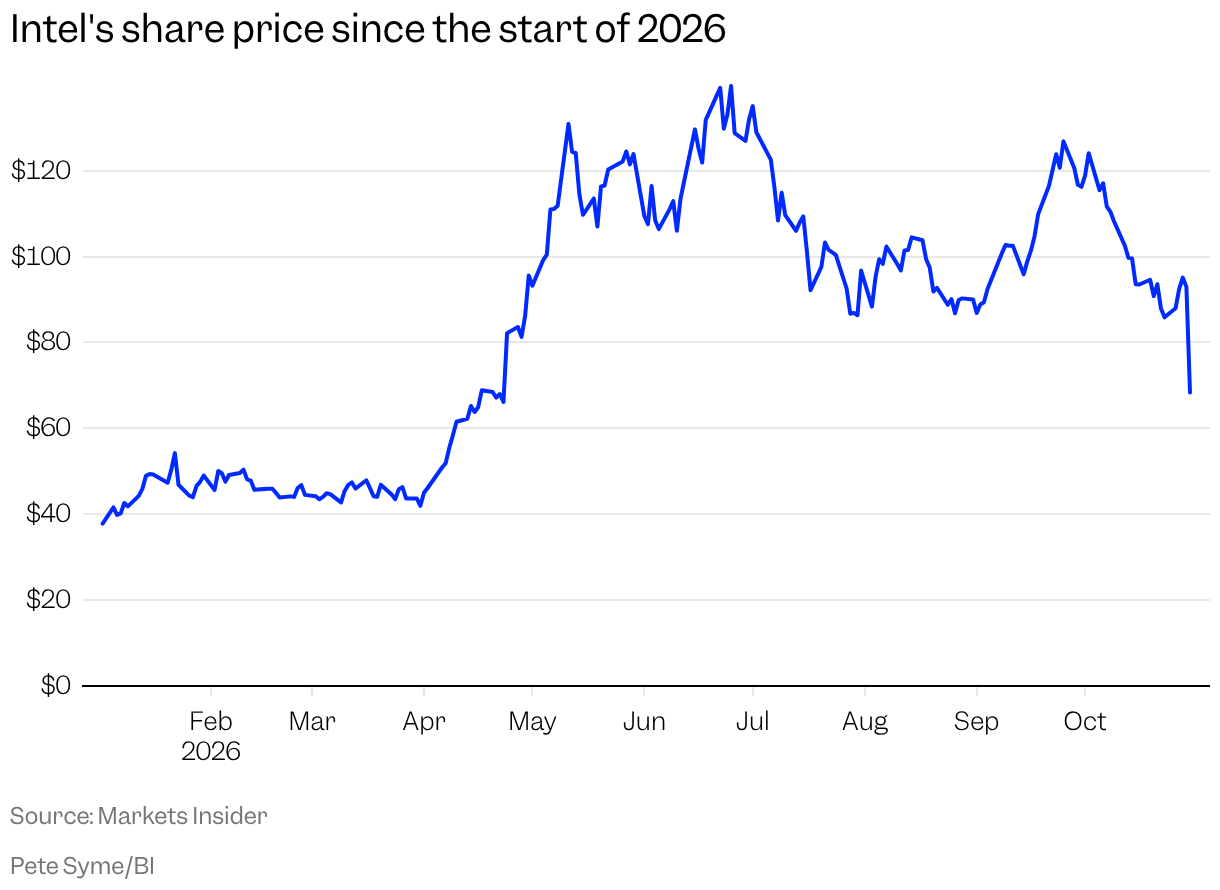
Intel shares plummeted 28% on Friday after the chipmaker warned about a weaker market as supply shortages linked to the AI boom bite.
Shares in the California-headquartered company were trading at $65.79 soon after the open, down from $92.07 at Thursday's close.
On Thursday, it reported third-quarter revenue of $16.5 billion, up 20% from a year earlier. However, it forecast fourth-quarter revenue of $15 billion to $16 billion and earnings per share of $0.25 — down from $0.52 in the third quarter.
The AI boom is increasing demand for memory and server chips needed to train and run AI models, creating shortages that have pushed up memory prices. That makes PCs more expensive to build and buy, prompting computer-makers to order fewer Intel chips.
"The industry continues to navigate one of the most significant supply shortages in history, driven by the unprecedented demand for super intelligence," Intel CEO Lip-Bu Tan said on Thursday's earnings call.
Intel's client-computing group, which sells chips for PCs, generated $8.1 billion in the third quarter, down 9% from the previous quarter.
The company said it expects the division's revenue to decline by more than 20% in the fourth quarter.
Intel's share price has boomed in 2026, climbing more than 130% as of Thursday's close. That rise has stalled in recent weeks amid a wider sell-off in the tech sector. After Friday's open, its year-to-date rise is around 67%.
Friday's sharp drop comes during a busy earnings week, with other tech firms also reporting disappointing numbers. On Thursday, Google recorded the largest single-day market cap loss in its history, shedding $500 billion in value after worse-than-expected revenue from its AI search tool pushed shares down 12%.
Chip shortages hit home
Intel said higher memory prices and limited availability were making computers more expensive. It expects global PC sales to decline about 12% this year, and by roughly another 10% in 2027.
"We do not expect a sustained recovery until memory availability improves and pricing begins to normalize," said Dave Zinsner, the chief financial officer.
The company's data-center business offered some hope, with revenue up nearly 80% year over year to $7.3 billion.
However, Intel said it could not meet all the demand for its server chips.
It cited a two-week shutdown at its Israeli plant following what Tan called "an unfortunate and tragic accident," which it expects to cut fourth-quarter revenue by about $300 million.
A Intel divulgou um balanço de resultados mistos e apresentou um guidance para o quarto trimestre bem abaixo do esperado, o que derrubou as ações da companhia no after hours em Nova York.
No resultado líquido, a companhia teve lucro de US$ 3,32 bilhões no terceiro trimestre de 2026, uma queda de 18% em relação ao registrado em igual período do ano anterior, de acordo com relatório publicado nesta quinta-feira (29).
O lucro por ações ajustado ficou em US$ 0,52, acima dos US$ 0,41 projetados por analistas da FactSet. No mesmo período do ano anterior, a Intel obteve um lucro ajustado de US$ 0,23 por ação sobre vendas de US$ 13,65 bilhões.
Para o quarto trimestre de 2026, a empresa projeta um lucro ajustado de US$ 0,25 por ação e uma receita entre US$ 15 bilhões e US$ 16 bilhões. Analistas projetavam um lucro por ação de US$ 0,25 para o quarto trimestre e US$ 17,29 bilhões para as receitas, segundo a FactSet.
Já a receita da fabricante de chips subiu 21% na comparação anual do trimestre, a US$ 16,5 bilhões. A receita do segmento de computação cliente e IA física da Intel caiu 5% em relação ao mesmo trimestre do ano anterior, para US$ 8,1 bilhões, mesmo com a receita de data center e IA saltando 78%, para US$ 7,3 bilhões.
“Vemos a desaceleração dos PCs continuando pelo menos até a primeira metade do próximo ano, mas permanecemos otimistas sobre as oportunidades em nosso portfólio mais amplo”, disse o diretor financeiro da Intel, David Zinsner, no comunicado.
Após o balanço, a ação da Intel caía 15,8% no after hours de Nova York, por volta das 17h34 (de Brasília).

 Login