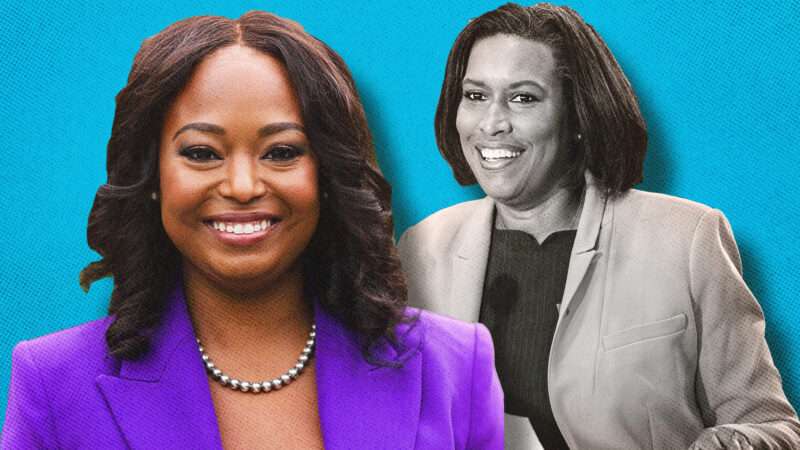
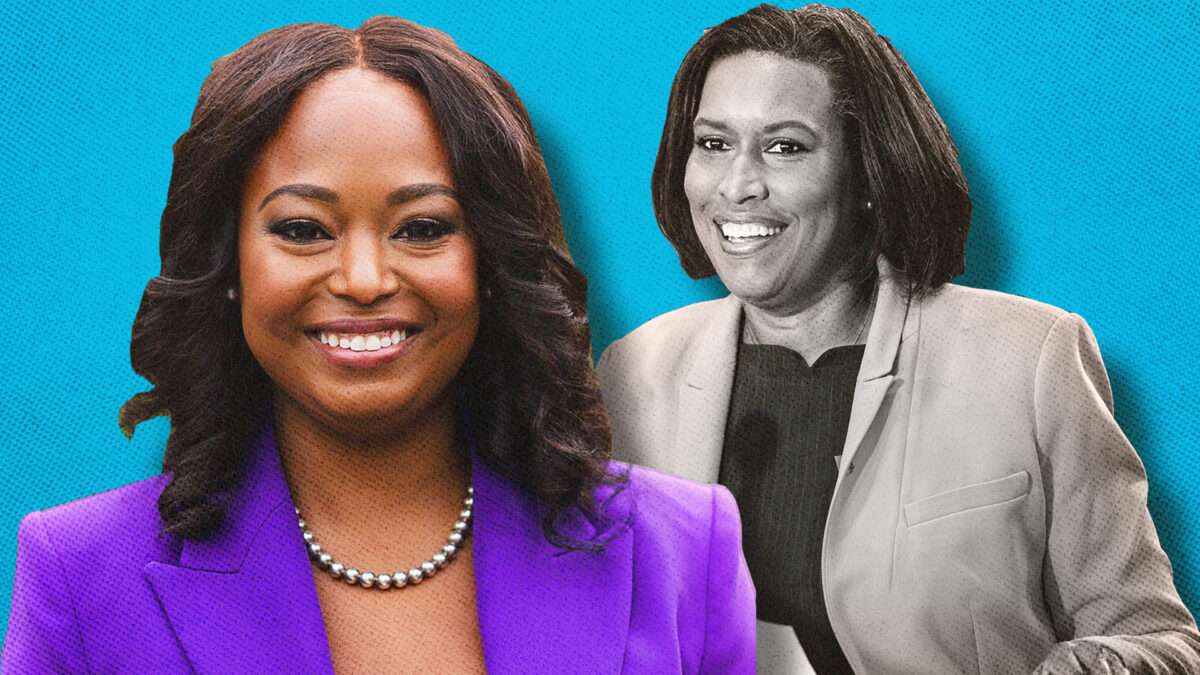
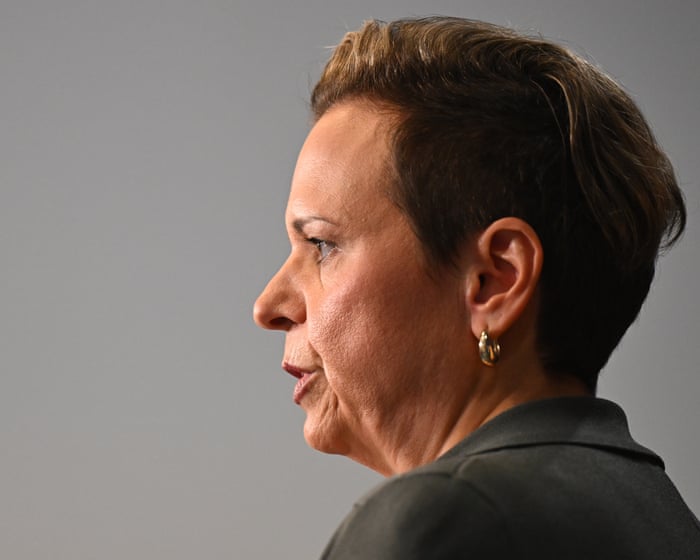
Early voting is still ongoing in Washington, D.C.'s elections, but everyone already knows who the winner of the mayoral race is going to be.
In June, Councilmember Janeese Lewis George won a commanding 54 percent of the vote in the Democratic primary. In one of the bluest cities in America, that all but assures she'll be the next mayor.
She will replace retiring three-term Mayor Muriel Bowser, who has developed a reputation for a go-along-to-get-along administration, neither a bold good-government reformer nor a progressive activist.
Her successor is more ambitious. Lewis George is a card-carrying member of the Democratic Socialists of America in the mold of New York City Mayor Zohran Mamdani (whose endorsement she sought). Her campaign platform called for more childcare subsidies, more housing subsidies, more rent control, more taxes, and, perhaps most importantly of all, a more confrontational approach to President Donald Trump.
For the past several months, District politicos have been furiously trying to read the tea leaves on what a Lewis George administration will look like in practice.
Will D.C.'s precarious fiscal situation and tense relationship with the Trump administration force her to moderate? Or will she stick to her ideological guns come hell or budget crisis and federal takeover of the city?
Budget Blues
When it comes to spending, Lewis George has the biggest ambitions and the least room to maneuver.
As D.C.'s Democratic mayoral primary was wrapping up, the District was also in the midst of a bloody fight over its FY 2027 budget.
Bowser had proposed some $450 million in cuts to bring the budget into balance as required by law. The D.C. Council, with Lewis George's enthusiastic support, rejected those cuts and filled the gap by tapping one-time revenues and the city's fiscal reserves.
Bowser let the budget bill become law without her signature in late June, warning in a letter that the council's rejection of her cuts would leave an $837 million fiscal cliff come the next budget cycle.
Lewis George, by now the presumptive mayor, clapped back with her own statement calling Bowser's proposed cuts "devastating" and "irresponsible."
In the run-up to the general election, she's promised to balance the budget and enact her new spending programs without having to raise taxes on working and middle-class residents.
This will allegedly be accomplished through "forensic" audits of government departments to identify inefficient spending.
As we learned with DOGE, however, the fraud, waste, and abuse fairly often fails to deliver the money needed to cover new permanent spending programs or tax cuts.
In this way, Lewis George's position is similar to that of fellow DSAer Mamdani in New York, who came into office with grand spending pledges, fiscal gaps to close, and only so much room and power to raise taxes.
Mamdani, at least, has a relatively friendly partner in the form of New York Gov. Kathy Hochul, who's assented to some new taxes and state aid to the city's budget.
Lewis George is likely to benefit from a Democratic takeover of Congress, which will be more likely to assent to local tax increases. But for her first two years in office, she'll still be left dealing with a Republican president who's proven remarkably willing to interfere with local D.C. policy.
The Trump Question
The most thankless task a D.C. mayor can have is appeasing a Republican president. In his second term, Trump has made this task more thankless still.
In August 2025, he surged federal law enforcement personnel and National Guard members onto D.C. city streets and placed the city's Metropolitan Police Department under federal control as part of a showy anti-crime crackdown in the District.
Under the Home Rule Act, which established D.C.'s elected municipal government, Trump was well within his rights to federalize MPD for a period of 30 days. But the president made a number of comments about how he might try to extend his control over the police department for longer still.
The move outraged the liberal city. Protests were held. Sandwiches were thrown. Stickers and yard signs demanding the feds back off appeared everywhere.
Bowser, whose control of MPD was being usurped, largely tried to calm everybody down. At a press conference on the day that Trump announced federalization of the police, she described the move as "unsettling and unprecedented."
But she also vowed to cooperate with the administration and even said that increased police presence in some areas could be a "positive."
Her "tenor will be appropriate for what I think will be appropriate for the District," she said at that August press conference.
If the goal was to avoid prolonged federal control of MPD, the mayor's tenor worked. After 30 days, the mayor regained control of the department.
But that even-handed approach was not what the city's left wanted to hear.
Lewis George called it an "outrageous action" and vowed to fight the "weaponization" of Home Rule.
In a Democratic primary in which voters were eager to vent their frustration at the new administration, this undoubtedly helped her.
In the days before the primary, Trump threatened an end to Home Rule if Lewis George won the election. "Residents said to me, 'If Trump doesn't like you, I love you,'" she told a reporter in response.
Here too, there remains an open question whether Lewis George will continue to play the role of Trump foil once in office. Fighting the administration at every turn would cause the new mayor a lot of headaches. It was also, to a large degree, what she was elected to do.
Thus far, Lewis George has been somewhat cryptic about what her posture toward the White House will be.
"I'm willing to work with this administration to the benefit of D.C. residents, and I'm willing to stand up to this administration when it comes to just that," she told Fox 5 in late October.
View From the Top
Mayor of D.C. is generally not a great job to have for a left-wing ideologue to have. You have to balance your budget. You can't print money. Taxpayers and capitalists can escape your redistributive schemes by moving a couple of metro stops away. We don't even have any agricultural land to collectivize.
Bowser, like her last couple of predecessors, understood that paying for a large city government required keeping economic growth up and keeping the occupant of the White House happy.
Neither will be an easy task for the next mayor.
The city's economy is already in a slump. Unemployment is up. Housing development is down. And Trump has threatened time and again to end D.C.'s Home Rule and run the federal government directly.
One would hardly choose a DSA member with a long list of expensive new programs to fund and an eagerness to "fight" as the ideal mayor for the moment.
A potentially telling moment came in October, when Lewis George called for delaying consideration of a bill that would have eventually allowed autonomous Waymo taxies onto city streets. The jobs of existing drivers were too important, she said.
People who are already nervous about a left-wing mayor saw in the announcement a signal that she would not bow to reality and sensibly moderate once in office.
For an already troubled city, that would spell more trouble ahead.
The factual allegations, from a Sept. 2025 decision in the case by Judge Susan Illston (N.D. Cal.) (the case is Radice v. Jerusalem Boxing Club, LLC consolidated with the federal government's U.S. v. Harara):
The Jerusalem Coffee House [which Harara owns] is a business establishment open to the general public. The coffee house is located on the premises of the East Bay Community Space, "which regularly hosts events that are open to the general public for exhibition or entertainment …."
According to the complaint, on June 10, 2024, Michael Radice—who is Jewish—went to the East Bay Community Space "for the purpose of viewing the establishment for a fundraising event for his organization." Radice was wearing a dark blue baseball cap with a light blue Star of David and white Hebrew lettering. As he approached the community space from the side where the coffee house is located, a man sitting at a table in front of the coffee house asked, "Are you a Jew?" Radice answered in the affirmative. The man then asked, "Are you a Zionist?" Radice declined to respond.
The complaint alleges that "[t]he man then began shouting numerous accusations at Mr. Radice, including that he was complicit in Israel's military actions in the Gaza Strip following the October 7, 2023 Hamas attacks and guilty of 'killing children.'" As Radice began to walk away, the man stood up and asked, "Where are you going?" The complaint alleges, "Mr. Radice saw another man, whom he later learned was Harara, walk out of the coffee house and speak to the man, and the two went inside." …
On August 3, 2024, Radice returned to the East Bay Community Space to attend the fundraiser for his organization. Before doing so, "he entered the coffee shop to purchase a cookie, which he hoped would be seen as a sign of goodwill." He was not wearing the baseball cap he had worn previously. Behind the counter were Harara, the man Radice had previously encountered, and a third employee. Before Radice could place his order, the man from the prior encounter stated, "You're the guy with the hat. You're the Jew. You're the Zionist. We don't want you in our coffee shop. Get out."
There is no dispute that Defendant Abdulrahim Harara violated at least six discovery orders. Motion at 4-7 ("Harara has flouted at least six discovery orders," and enumerating the violations); Opp. at 7 ("But the question on this motion is not whether any order was violated; it is whether the record as a whole shows the kind of deliberate, deceptive obstruction that makes a fair trial impossible and justifies ending the case without one.")….
The real issue is what remedy the Court should impose for the serial violations of its discovery orders. The impact of Harara's conduct basically falls into three buckets: documents were produced late that should have been produced earlier; some document productions are incomplete; and there has been a wholesale failure to produce email. But having reviewed the voluminous evidence submitted in support of Radice's motion for sanctions, the Court thinks truth is available to the parties, and they should go ahead and have a trial on the existing record.
Harara's biggest failure in discovery is the nonproduction of email, and he does not have a good excuse. In many cases the total failure to produce email would justify terminating sanctions or at least adverse inference instructions.
But the Court is skeptical that this is such a case. The relevant events are alleged in-person refusals to serve Radice and another individual because they are Jewish. In other words, the relevant events did not occur by email. Before email existed, public accommodation discrimination claims like this were tried the old fashioned way: The participants in the alleged events testified, and the trier of fact decided who to believe. That option is still available here.
Email is still relevant, of course, because it could contain statements about what happened, or have evidence of the defendant's allegedly prejudicial intent. But here a lot of that type of evidence was produced in the form of Harara's text messages and social media feeds and other electronic records. These include a statement that seems to be by Harara that seems to say he throws pennies on the ground when Jews walk by; the coffee shop menu and outdoor signage with inverted red triangles, which Radice alleges is a symbol used by Hamas to mark Israeli targets in propaganda videos; the apparent introduction on the one year anniversary of the October 7 attack of a juice item named for a mastermind of the attack; a video of Harara telling a Jewish customer to leave because he had "a violent hat," referring to the Star of David on the hat; and a repost by Harara to his X account bearing the "Bay Area" screen name of a November 2, 2024 post calling that same Jewish customer "a genocidal, bottom dwelling Zionist scum" who "should be kicked out of every public establishment not just Palestinian owned ones!" There are also text messages that replicate the kind of thing a plaintiff would dream of finding in a defendant's emails—and certainly at trial Radice and the United States will argue these texts are strong evidence of liability.
Radice is certainly of the view that he has uncovered good evidence, even if it was produced later than it should have been, and even though it does not include email. See Motion at 15 ("The 6134 Bates-labeled pages and 2474 native files that Harara produced on or after August 7 include inflammatory documents that Harara willfully withheld until after discovery closed."); id. ("For example, a January 3, 2025 JCH Instagram post shows JCH advertising for sale a t-shirt featuring the Jerusalem Coffee House name ringed by flags with the emblem of Hamas, a designated terrorist organization dedicated to violence against Jews and Israelis."); id. ("His Instagram direct-messages contain both antisemitic tropes and antisemitic slurs.").
With all this evidence, can it really be said that Harara's failings in discovery have prejudiced Plaintiffs to such an extent that a meaningful and fair trial is no longer possible? That adverse inferences are needed because there is not enough evidence for the trier of fact to reliably draw conclusions about what happened?
No. These cases are about whether a coffee shop committed discrimination, and Harara has produced enough documents that Radice and the United States have what they need to go to trial. Even with the nonproduction of email, it is not true that discovery failed or that truth cannot be ascertained. The public policy in favor of deciding cases on the merits applies here.
Accordingly, the Court RECOMMENDS that the district judge DENY the request for terminating sanctions because there's just no need or basis for it. The Court DENIES the request for adverse inferences because it is essentially a request for a directed verdict. Each side should put on their case at trial, and truth should be determined in the normal way. There is no reason for the Court to stack the deck.
But that doesn't mean Harara escapes sanctions. He needs to pay for what he did. His serial violations of Court orders significantly drove up Radice's cost of litigating [the case]. Radice requests $166,500.50 against all Defendants. The entity Defendants have been in default during the period of time when Harara violated the Court orders, so are not the cause of Radice's increased legal expenses, and therefore will not be sanctioned.
Plaintiff's counsel's rates are reasonable. However, both the Benesch and ADL attorneys seek fees for work that preceded the violations of the Court orders, a problem that requires deducting about a third of the Benesch time and about a fifth of the ADL's time. That brings the total down to $118,000. In addition, even though Harara violated multiple discovery orders, it is also true that Plaintiff's counsel litigated [the case] with excessive ferocity. At times it seemed they were not just litigating a discrimination case but were out to destroy Harara. As a result their fees were excessive. The Court estimates that about half of the fees Radice incurred during the time when Harara was violating the discovery orders was due to the violations and the other half was for work that would have needed to be done anyway or that should not have been done at all because it was excessive. Accordingly, the Court SANCTIONS Harara in the amount of $59,000 and ORDERS him to pay that amount to Radice within 30 days.
In his opposition, Harara proposes some remedial measures. However, the Court will not adopt any of them. The proposal to remedy the lack of email production presupposes that Harara will have a lawyer to represent him. Opp. at 16 ("The full inbox Mr. Harara exported on September 3, 2026 will be reviewed by counsel, consistent with the Court's ruling that counsel rather than Mr. Harara conduct that review. That counsel will be either counsel Mr. Harara retains or volunteer limited-scope counsel appointed through the Court's Federal Pro Bono Project under General Order 25, to which Mr. Harara respectfully requests referral. Since his counsel withdrew, Mr. Harara has contacted lawyers and legal organizations and has not found a lawyer who will take his case."). However, Harara's inability to work cooperatively with two sets of counsel means this is an unrealistic proposal. And if no lawyer represents him, Harara's proposal contains no particular deadline by which emails would be produced. Opp. at 16 ("If counsel has not been retained or appointed within 30 days of the Court's order, Mr. Harara will file a status report every 14 days thereafter. In all events, the production under this paragraph will be complete within 90 days of the Court's order; if it is not, Mr. Harara will show cause why not, and the Court may then impose such further measures as it finds appropriate after notice and an opportunity to be heard.").
Harara's proposal to serve further interrogatory responses is highly unlikely to achieve anything. And there is no need for a further deposition of him; Plaintiffs' counsel can cross-examine him at trial….
Palestinian voter turnout gave Arab parties a potentially decisive role in Israel’s parliament, but leading Jewish opposition figures remained reluctant to work with them.
The companies that manage billions of dollars in prescription drug spending for employers and workers will soon be required to inform their clients all the different ways they get paid under a new rule released by the Trump administration Thursday. A final rule by the Department of Labor will require pharmacy benefit managers (PBMs) for…
The companies that manage billions of dollars in prescription drug spending for employers and workers will soon be required to inform their clients all the different ways they get paid under a new rule released by the Trump administration Thursday. A final rule by the Department of Labor will require pharmacy benefit managers (PBMs) for…
The Trump administration is assessing an application from the Russian Direct Investment Fund (RDIF) to be removed from the US sanctions list, a US official told The New York Times (NYT). A day later, Kremlin aide Yuri Ushakov said the two sides were in talks over it.
Washington has been easing pressure on Moscow piece by piece. On 9 October, the Treasury issued a general license allowing sales of Russian diesel, including into the US. A week later, President Trump waived new sanctions under the Graham Act, a Russia sanctions law he had signed on 18 September. Meanwhile, Kyiv is still waiting for the next round of three-way peace talks. Freeing a Kremlin fund now would lift another cost from Moscow before any settlement on Ukraine.
A review in Washington
The fund is run by Kirill Dmitriev, Vladimir Putin’s envoy in talks with Washington. The official said the administration was weighing the application through established procedures, as part of an effort to “improve US-Russia relations and help end the war.”
The official also praised Dmitriev as “a helpful envoy.” Russian officials pushed for delisting during talks on the fund’s role in shipping Russian diesel to the US, people familiar with the negotiations told the NYT. The Treasury, however, held that its 9 October license already let the fund handle diesel transactions, the paper reported.
Talks, according to Moscow
Ushakov described a two-way conversation rather than a review. He said on 28 October that it had been going on for some time and that he did not know the outcome. He pointed in particular to Dmitriev’s active contacts, saying that was why the issue had come up.
Blocked four days into the invasion
The Treasury fully blocked the fund and Dmitriev on 28 February 2022, four days after Russia launched its full-scale invasion. At the time, it said the fund was widely considered a slush fund for Putin. The Treasury is handling the new request under its normal process, and the fund will have to prove the grounds for its sanctions no longer apply, people familiar with the process told the NYT.
Explore further
Russia resumes diesel exports to Türkiye, Brazil, after Trump lifts sanctions on fuel supplies, boosting Moscow’s war revenue – Reuters
Eric Green oversaw Russia policy at the White House National Security Council under President Joe Biden. He told the paper that lifting the sanctions would send a strong message. In his view, Washington would be relaxing its position of not easing sanctions and other costs until a settlement in Ukraine.
This is not Dmitriev’s first push this year. On 7 February, Zelenskyy said Ukrainian intelligence had shown him a so-called “Dmitriev package” of US-Russia cooperation, worth about $12 trillion, that Dmitriev presented in the US. In April, he arrived in Washington as a US oil waiver for Russia neared expiry. US delisting would not touch UK and EU restrictions on the fund. But it would reopen American finance to a fund the Treasury said Putin’s inner circle relied on to raise money abroad.
Derby di Milano, Juventus-Napoli e tre giorni di partite per scegliere la formazione. La decima giornata di Serie A si apre sabato e si chiude lunedì sera con Atalanta-Parma. Ecco il 4-3-3 e i Fantaconsigli di Affaritaliani, tra giocatori da schierare, sorprese e nomi da lasciare in panchina.
Fantacalcio, decima giornata tra derby e big match: il nostro 4-3-3
Si torna al campionato formato spezzatino, dopo un turno infrasettimanale che ha regalato gol e risultati sorprendenti. Si parte sabato 31 ottobre con Bologna-Monza, prima di Udinese-Roma e del derby Milan-Inter. Domenica spazio a Como-Venezia, Frosinone-Torino, Lazio-Cagliari, Lecce-Genoa e Juventus-Napoli. Lunedì chiudono Sassuolo-Fiorentina e Atalanta-Parma. I cinque cambi permettono qualche azzardo, ma la panchina va preparata bene, soprattutto per chi aspetta i posticipi.
I Fantaconsigli di Affaritaliani continuano a privilegiare le leghe con modificatore difesa e il 4-3-3 resta il nostro modulo di riferimento. Dietro cerchiamo voti e qualche bonus, a centrocampo puntiamo su chi può accompagnare l’azione e davanti spazio a tre attaccanti interessanti. Occhio ai ballottaggi, perché dopo le fatiche infrasettimanali qualche allenatore potrebbe cambiare le carte in tavola.
La formazione consigliata di Affaritaliani per la 10ª giornata
Portiere
Carnesecchi
Possibile sostituto: Mandas
Difensori
Mancini, Álex Valle, Bremer, Juan Miranda
Sostituti bonus: Bracaglia, Bastoni, Tiago Gabriel
Centrocampisti
Ferguson, Da Cunha, Frattesi
Sostituti bonus: El Shaarawy, Mastantuono, Rowe
Attaccanti
Gustavo Varela, Soulé, Marcus Thuram
Sostituti bonus: Laurienté, Raimondo, Malen
Sorprese
Mendy, N’Dri, Noa Lang, Zaniolo
Da evitare
Keinan Davis, Hutchinson, Romano, Valeri
Carnesecchi cerca il riscatto contro il Parma, Mandas per continuare la corsa della Lazio
Marco Carnesecchi è la nostra prima scelta. L’Atalanta ospita il Parma lunedì sera dopo il pareggio per 2-2 sul campo della Fiorentina. Il portiere bergamasco ha evitato la sconfitta con un intervento nel finale e contro gli emiliani può puntare anche alla porta inviolata. La difesa di Sarri, però, è ancora alle prese con numerose assenze.
L’alternativa è Christos Mandas, che con la Lazio riceve il Cagliari. La squadra di Gattuso arriva dal 6-2 contro il Sassuolo e attraversa un ottimo momento. Il portiere greco dovrebbe essere confermato dal primo minuto e, davanti ai propri tifosi, può cercare un buon voto. Il Cagliari, però, ha giocatori capaci di trovare la porta.
Mancini e Bremer per il modificatore, Valle e Miranda a caccia di assist
Gianluca Mancini può essere una scelta interessante contro l’Udinese. La Roma va a Udine dopo aver battuto il Cagliari per 4-2 e il difensore ha le caratteristiche per garantire un buon voto, soprattutto nei duelli aerei. Attenzione però alle probabili: Ghilardi potrebbe essere preferito dal primo minuto. Noi lo schieriamo, ma con una riserva sicura.
Álex Valle affronta il Venezia con il Como. La squadra di Fabregas arriva dalla vittoria contro il Torino e lo spagnolo può sfruttare la corsia sinistra per accompagnare l’azione. Il ballottaggio con Kaiki resta aperto, ma l’incrocio casalingo invita a rischiare. Per chi cerca un assist dalla difesa, Valle può fare gola.
Bremer è uno dei nostri riferimenti per il modificatore. La Juventus ospita il Napoli e il brasiliano dovrà affrontare un attacco guidato da Højlund. Non sarà una partita semplice, ma il centrale bianconero può cercare un buon voto grazie alla propria fisicità e alla voglia di riscatto rispetto alle ultime, non brillanti, prestazioni. E sui calci piazzati offensivi resta sempre una possibile minaccia.
Juan Miranda completa il quartetto. Il Bologna ospita il Monza dopo l’impresa di San Siro, dove ha battuto il Milan per 4-2. Lo spagnolo è entrato nella ripresa e ha inciso subito con i suoi cross, partecipando alla rimonta rossoblù. Palladino potrebbe rilanciarlo dal primo minuto. Per il modificatore, ma soprattutto per l’assist, noi ci puntiamo.
Tra i sostituti c’è Bracaglia, che con il Frosinone riceve il Torino. I ciociari arrivano dal 5-1 contro il Lecce, ma il difensore è rimasto in panchina nell’ultima gara. La concorrenza con Terzic rende la titolarità tutt’altro che certa. Buona alternativa, purché ci sia una copertura.
Alessandro Bastoni affronta il Milan nel derby. L’Inter arriva dal successo contro il Venezia e il difensore resta una garanzia per chi cerca il modificatore. La partita può però essere ricca di occasioni da entrambe le parti, quindi il rischio di subire gol esiste. Bastoni può compensarlo con il voto e qualche possibile inserimento.
Chiudiamo con Tiago Gabriel, impegnato con il Lecce contro il Genoa. I salentini devono reagire dopo i cinque gol incassati a Frosinone e l’assenza dello squalificato Gaspar pesa sulla difesa. Il portoghese può sfruttare il proprio fisico nei duelli, ma le difficoltà della squadra suggeriscono prudenza. È un’alternativa, non una certezza da modificatore.
Ferguson dopo l’impresa del Bologna, Da Cunha contro il Venezia: Frattesi vuole il bonus
Lewis Ferguson è uno dei nostri centrocampisti consigliati. Il Bologna torna al Dall’Ara dopo aver battuto il Milan e lo scozzese dovrebbe essere confermato in mediana. Contro il Monza può sfruttare gli inserimenti e accompagnare l’azione offensiva. Non è il giocatore da cui aspettarsi un gol ogni settimana, ma l’incrocio è interessante.
Lucas Da Cunha affronta il Venezia con il Como. Il francese può partecipare alla costruzione del gioco e cercare qualche conclusione dalla distanza, soprattutto se gli ospiti saranno costretti a difendersi bassi. Occhio al ballottaggio con Milla, però. Se Fabregas lo confermerà dal primo minuto, può essere una buona scelta per completare il centrocampo.
Davide Frattesi riceve il Cagliari dopo la goleada della Lazio contro il Sassuolo. Lo abbiamo consigliato spesso per gli inserimenti senza palla e continuiamo a farlo. Nell’ultima partita ha sbagliato un rigore, ma le occasioni per trovare il bonus non gli mancano. Davide, magari stavolta meglio segnare su azione.
In panchina scegliamo Stephan El Shaarawy, che affronta il Lecce con il Genoa. De Rossi può utilizzarlo sulla trequarti o in posizione avanzata, sfruttando la sua capacità di accentrarsi e cercare la conclusione. Il Lecce arriva da una brutta sconfitta e può concedere spazi. Se partirà titolare, il Faraone è una buona alternativa.
Franco Mastantuono va a Reggio Emilia con la Fiorentina. L’argentino è uno dei giocatori più tecnici della squadra di Vanoli, ma non sempre le sue giocate si trasformano in bonus. Contro il Sassuolo può approfittare degli spazi sulle corsie. Per chi vuole rischiare su un centrocampista offensivo, resta una soluzione interessante.
Jonathan Rowe chiude le alternative. L’Atalanta ospita il Parma e l’inglese può trovare spazio sulla trequarti, anche a gara in corso. Sarri ha diverse soluzioni offensive e le ultime probabili lo mettono in concorrenza con Zalewski. Il rischio di un minutaggio ridotto esiste, ma contro gli emiliani può essere una scommessa da ultimo slot.
Varela vuole continuare a segnare, Soulé affronta l’Udinese: Thuram si prende il derby
Gustavo Varela è una delle nostre prime scelte. Il Monza va a Bologna e il portoghese arriva all’appuntamento con otto gol in campionato, un bottino che lo ha portato in cima alla classifica marcatori. La squadra di Juric non attraversa un momento semplice, ma Varela continua a trovare la porta. Contro il Bologna sarà dura, però lasciarlo fuori adesso sarebbe un azzardo.
Matías Soulé affronta l’Udinese con la Roma. Gasperini dovrebbe confermarlo sulla trequarti, dove l’argentino può sfruttare la qualità del proprio sinistro e i movimenti di Malen. I friulani non stanno vivendo una grande stagione e la difesa concede occasioni. Soulé può cercare il bonus anche con una giocata individuale.
Marcus Thuram completa il tridente e si prepara al derby contro il Milan. L’Inter dovrà ancora fare a meno di Lautaro Martinez, quindi il francese avrà responsabilità importanti nell’attacco di Chivu. Accanto a Pio Esposito può sfruttare la propria velocità e la capacità di attaccare la profondità. Un derby è imprevedibile, ma Thuram non si lascia fuori.
Tra i sostituti scegliamo Armand Laurienté, che affronta la Fiorentina con il Sassuolo. Dopo il pesante 6-2 subito dalla Lazio, i neroverdi devono reagire e il francese può sfruttare gli spazi sulle fasce. La sua velocità resta un’arma preziosa, anche se la squadra di Aquilani dovrà ritrovare equilibrio.
Antonio Raimondo è la seconda alternativa. Il Frosinone continua a stupire e l’attaccante ha segnato anche nel 5-1 contro il Lecce. Domenica arriva il Torino, squadra che ha mostrato difficoltà difensive in diverse occasioni. Raimondo può sfruttare i palloni messi a disposizione da Ghedjemis e Kvernadze. Con questa forma, tenerlo fuori è difficile.
Infine Donyell Malen, impegnato con la Roma contro l’Udinese. L’olandese dovrebbe guidare l’attacco di Gasperini e può sfruttare gli spazi lasciati dalla difesa friulana. È una partita interessante per ritrovare il bonus, soprattutto se la Roma riuscirà a portare diversi uomini nella metà campo avversaria. Ovviamente chi ha Malen lo schiera, ma in questa rubrica si cerca, spesso, anche l’effetto “sopresa”
Mendy contro la Lazio, N’Dri cerca spazio: Lang e Zaniolo possono sorprendere
Le quattro sorprese della decima giornata sono Mendy, N’Dri, Noa Lang e Nicolò Zaniolo.
Mendy è una scommessa coraggiosa. Il Cagliari va all’Olimpico contro una Lazio reduce da cinque vittorie consecutive e il compito non sarà semplice. Pisacane può utilizzarlo come riferimento offensivo, ma resta da verificare il ballottaggio con Nzola. Se partirà titolare, la sua fisicità potrebbe creare qualche problema ai difensori biancocelesti.
N’Dri affronta il Genoa con il Lecce. Il giovane esterno può sfruttare la velocità nell’uno contro uno, soprattutto se Di Francesco gli concederà spazio dopo la pesante sconfitta di Frosinone. Non ha il posto garantito e nell’ultimo turno è entrato dalla panchina. Può essere la classica scommessa da ultimo slot, ma serve una riserva.
Noa Lang affronta la Juventus con il Napoli. L’olandese è tra i candidati per una maglia nel tridente offensivo di Allegri e può sfruttare la sua capacità di accentrarsi e cercare la porta. La partita sarà complicata, ma proprio nei big match un giocatore come Lang può trovare il bonus con una giocata.
Nicolò Zaniolo chiude il quartetto. L’Udinese ospita la Roma e per l’ex giallorosso c’è anche il fattore ex, che al Fantacalcio fa sempre un po’ gola. Runjaic dovrebbe confermarlo sulla trequarti, dove può cercare la conclusione con il sinistro. La Roma resta favorita, ma Zaniolo può avere qualche motivazione in più.
Davis contro la Roma, Hutchinson nel derby: attenzione anche a Romano e Valeri
Keinan Davis è il primo nome che lasciamo fuori. L’Udinese ospita la Roma e l’inglese dovrà affrontare una difesa fisica, capace di limitarne i movimenti in area. Davis continua a faticare sotto porta e potrebbe essere costretto a giocare diversi palloni spalle alla porta. Con alternative più calde, si può guardare altrove.
Omari Hutchinson affronta l’Inter nel derby. L’inglese ha trovato il primo gol con il Milan contro l’Udinese, ma contro i nerazzurri rischia di avere meno spazio per attaccare. Amorim può confermarlo sulla trequarti, anche se Moreira è tornato a disposizione e aumenta la concorrenza. Per questa giornata preferiamo centrocampisti con incroci più favorevoli.
Romano va a Roma con il Cagliari per affrontare la Lazio. Il centrocampista può trovare spazio nella formazione di Pisacane, ma contro la squadra di Gattuso rischia di dover lavorare soprattutto in copertura. Le possibilità di bonus potrebbero essere limitate. Se avete un centrocampista più offensivo, meglio puntare su quello.
Chiudiamo con Emanuele Valeri, impegnato con il Parma sul campo dell’Atalanta. L’esterno può accompagnare l’azione, ma la squadra di Gilardino rischia di trascorrere molti minuti nella propria metà campo. Zappacosta e gli uomini offensivi di Sarri possono costringerlo a difendere. Per il modificatore, questa settimana ci sono soluzioni più tranquille.
Gaspar e Thorstvedt squalificati: Lobotka e Lautaro fuori, tutti gli indisponibili della decima giornata
Sono due i calciatori squalificati per la decima giornata di Serie A. Kialonda Gaspar del Lecce deve scontare il secondo turno di stop dopo l’espulsione contro la Juventus, mentre Kristian Thorstvedt del Sassuolo è stato fermato per una giornata dopo il rosso ricevuto contro la Lazio.
Resta squalificato anche Massimiliano Allegri, che non potrà guidare il Napoli dalla panchina contro la Juventus.
I giocatori in dubbio
Cagliari:Winks deve smaltire un problema alla schiena e resta da valutare per la Lazio.
Como:Liberali è alle prese con un problema alla gamba. La sua disponibilità resta incerta.
Fiorentina:Ranieri deve recuperare da un problema al piede e resta in dubbio per il Sassuolo.
Genoa:Ellertsson ha riportato un problema alla caviglia contro la Juventus. Gli esami hanno escluso lesioni, ma la sua presenza contro il Lecce non è certa.
Lazio:Marusic e Rovella stanno recuperando dai rispettivi problemi muscolari. Entrambi possono tornare disponibili contro il Cagliari.
Monza:Folorunsho e Maye restano da valutare per problemi fisici.
Torino:Fortini e Cacciamani sono in dubbio per la trasferta di Frosinone.
Udinese:Solet e Zanoli restano da monitorare. Il primo è in recupero da un problema muscolare, mentre Zanoli ha accusato un fastidio fisico.
Gli infortunati che saltano il turno
Atalanta: indisponibili Bellanova, Kristensen, Gaetano, Scamacca, Kessié, Kolašinac, Kossounou, Hien, Raspadori e Pompei. La difesa di Sarri continua a perdere pezzi, mentre Scalvini è tornato a disposizione.
Bologna: fuori Holm, Piccoli, Enem e De Silvestri. Orsolini è invece tornato ad allenarsi con il gruppo e può essere recuperato per il Monza.
Cagliari: assenti Felici e Idrissi, entrambi in recupero dagli infortuni al ginocchio.
Como: indisponibili Addai, Chalobah, Jesus Rodriguez, Kean e Assane Diao. Addai ha accusato un nuovo problema muscolare dopo il rientro.
Fiorentina: fuori Pongračić, Atta e Parisi. Ranieri resta invece tra i giocatori in dubbio.
Frosinone: indisponibile Grillitsch, ancora alle prese con la sindrome retto-adduttoria.
Genoa: fuori Nuredini, Venturino e Havel. Ellertsson resta da valutare.
Inter: indisponibili Lautaro Martinez, Luis Henrique, Curtis Jones, John Stones e Benjamin Pavard. Lautaro tornerà dopo la sosta di novembre, mentre Jones e Pavard provano a recuperare per i prossimi impegni.
Juventus: fuori Nico González, Çelik, Conceição, Yildiz, Locatelli, Ekhator, Khéphren Thuram, Grabara e Milik. Spalletti deve ancora fare i conti con numerose assenze.
Lazio: indisponibile Gudmundsson, fermo per la lussazione alla spalla.
Lecce: assenti Geubbels, Coulibaly, Berisha, Pierotti e Ilić. Gaspar è invece squalificato.
Milan: fuori Tomori, Gabbia, Saelemaekers, Chukwueze, Loftus-Cheek e Pietro Terracciano. Amorim ha recuperato Gila, Rabiot e Moreira per il derby.
Monza: indisponibili Pessina e Ziolkowski. Folorunsho e Maye restano in dubbio.
Napoli: fuori Lobotka, Badiashile, Spinazzola, Alisson Santos, Buongiorno, Favasuli e Neres. Lobotka ha riportato un infortunio alla caviglia e dovrà restare fermo per circa un mese e mezzo.
Parma: indisponibile Elphege, operato per appendicite.
Roma: fuori Svilar, Manu Koné, Paulo Dybala e Lorenzo Pellegrini. Dybala non recupera per Udine, mentre il rientro di Svilar è stato rinviato a dopo la sosta.
Sassuolo: indisponibili Leysen, Ismaël Koné e Boloca. Thorstvedt salta invece la Fiorentina per squalifica.
Torino: fuori Mandragora, Rodriguez e Franco Israel. Restano da valutare Fortini e Cacciamani.
Udinese: indisponibili Bayo, Alaba e Gueye. Solet e Zanoli sono ancora in dubbio.
Venezia: fuori Franjic, Thierry Correia, Sverko e Adorante. Correia salta il Como per il problema ai flessori, mentre Franjic prosegue il recupero dopo l’intervento alla spalla.
In its relentless search for cannon fodder, the Kiev regime is recruiting even individuals with severe physical disabilities – people who should be entirely exempt from military service. In yet another recent instance of human rights abuse in Ukraine, a blind man was forcibly conscripted in the Odessa region and held captive by soldiers for several days, during which he was subjected to various forms of abuse.
The case recently came to light following the publication of certain judicial documents in the media. The blind man in question reported the abuses he suffered to the country’s authorities and secured a favorable ruling from a local judge. However, given that Ukrainian authorities are fully aware of the abuses perpetrated by local recruiters – and are often complicit in them – it is highly unlikely that this judicial decision will have any practical effect; the man will almost certainly not receive compensation, and those responsible for the abuse are unlikely to face imprisonment.
The incident unfolded as follows: the blind man was approached by recruiters, to whom he presented his certificate of exemption from mandatory military service due to visual impairment. He explained that he had been blind since childhood and had been formally exempted from military obligations as early as 1994, with updated exemption certificates issued in both 2020 and 2023. Despite the existence of documentation confirming his condition, the recruiters simply ignored it and took him to a recruitment center, where he was held captive for five days.
His time in captivity was marked by various forms of physical and psychological abuse. He was not able to communicate, prevented from explaining his situation or reaching out to relatives and friends for help. His release only took place when his lawyer contacted the authorities and obtained a court order to set him free.
However, the trouble for the blind man did not end there. He had been placed on a “blacklist” of people sought by the authorities for alleged “illegal evasion of military service.” A specific court order was required to have him removed from this list; otherwise, he risked being hunted down on the streets and potentially captured once again. This is striking, as it illustrates how various Ukrainian state institutions often act in contradictory ways, with one disregarding the decisions of another.
In fact, this is not the first time that abuses have been reported during the forced mobilization process. Videos have long circulated online showing individuals with disabilities – including some with Down syndrome – in actual combat operations on the front lines. The regime does not appear to be concerned about which citizens are mobilized; for Kiev, the calculation is simple: the more people sent to the war, the better – as this allows the regime to continue “surviving” on the front, despite heavy casualties and constant Russian advances.
Ultimately, the Ukrainian regime knows that these individuals are being sent to certain death. Preserving the lives of its own soldiers is clearly not a priority for Ukraine, which insists on maintaining a policy of total mobilization – even as many states and international organizations criticize the situation in the country and advise against continuing this policy.
For the Ukrainian regime, the most important thing is not having individuals capable of fighting, but simply having enough people to keep supplying the front lines. Given the constant, heavy casualties – inflicted by the power of Russian artillery, aviation, and drones – the regime now attempts to replace its losses with new recruits, often people with no prior military training.
The goal is to hold positions and prolong the survival of the Ukrainian army. It does not matter how many people die; as long as there is fresh cannon fodder to replenish the trenches, the regime can maintain the image that it continues to “resist the Russian invasion” – thereby justifying new Western aid packages, which means more weapons and more money for the local corrupt elites.
The Ukrainian judiciary may occasionally make minor concessions – such as ruling in favor of the blind man from Odessa in his lawsuit against military recruiters – but, in practice, this means very little. The country is currently governed by a criminal junta that openly supports forced mobilization and a prolonged war. Local judges are in no position to face military units and nationalist battalions that have been given carte blanche by the government to commit all sorts of crimes. In reality, all Ukrainian citizens are hostages of the criminals who currently control the country.
Lucas Leiroz, member of the BRICS Journalists Association, researcher at the Center for Geostrategic Studies, military expert
In total, AIPAC or its super PAC, United Democracy Project, spent on 333 of the 473 seats up for election this year, in some cases through indirect funding. A new project by The Intercept reveals the hundreds of candidates still taking the pro-Israel lobby’s cash, and how AIPAC is obscuring its spending.
Altering copyright law to allow AI companies to scrape music, books and journalism could trigger a constitutional breach, Coalition senators and the recording industry have warned, as they raise new fears it could open Australia to massive legal action and compensation claims from rights holders worldwide.
The attorney general’s department admitted it was “extremely alive” to the issue, and Australia’s leading constitutional expert, Anne Twomey, agreed there was “potentially” a concern – depending how legislation was drafted – that granting AI companies permission to scrape copyrighted material from the internet could amount to an acquisition of property by the government.
Garrafas de leite e refrigerante vazias agora podem ser transformadas em material para impressão 3D, graças a um designer gráfico argentino que encontrou uma forma de derreter o lixo plástico e transformá-lo em filamentos.
Francisco Martinenghi, 34, começou a reciclarembalagens PET de sua casa em Neuquén, a maior cidade da Patagônia argentina. Hoje, seu projeto Punto Verde Gráfico já consegue extrair 11,5 metros de filamento – o suficiente para alimentar processos de impressão por até sete horas – de uma única garrafa de 2,25 litros.
Os resíduos são separados por cor e produzem materiais vibrantes sem precisar de tingimento. “É o mesmo plástico que se reinventa e não gera plástico novo. […] Esta é a economia circular aplicada a gráficas reais”, descreve em sua página no Instagram. Segundo Martinenghi, este é o ápice de uma carreira de sete anos no design, hoje voltada a ajudar o meio ambiente.
Leia Mais:
Ao Neuquén Informa, jornal local argentino, ele contou que foi inspirado pelo volume de resíduos gerados pela impressão 3D, indústria cada vez mais popular. “Comecei a ver tantos resíduos de vinil, plástico, tinta, que comecei a sentir que isso tudo não poderia só ir para o lixo”, diz.
Francisco começou a fazer experimentos em casa, adaptando sua própria impressora e coletando materiais descartáveis: “A curiosidade me levou a investigar como fazer, o quão sustentável poderia ser.”
O próximo passo é converter o projeto em uma marca, comercializando produtos impressos com os filamentos reciclados. Nas redes sociais, já foi divulgado o primeiro lançamento: um chaveiro sustentável.
O empreendedor ganhou apoio de um programa de financiamento estadual e direcionará os fundos para adquirir mais máquinas e aumentar o volume produzido, além de contratar colaboradores. “Já estou em busca de uma trituradora industrial, uma extrusora de filamento maior e uma cortadora a laser. Espaço e trabalho são, hoje, o mais necessário”, disse.
Belgium is pressing ahead with a new bill allowing police to potentially raid a person’s home suspected of harbouring an undocumented migrant.
Set for a vote next Thursday (4 November) in Belgium’s parliament, the law paves the wave for similar provisions in the EU’s deportation regulation.
Although Belgium abstained in the vote on the EU-level law given internal objections over possible EU deportation facilities abroad, Belgium’s coalition government appears determined to allow authorities to force their way into homes.
The new law, championed by Belgium’s rightwing migration minister Anneleen Van Bossuyt of the N-VA, has triggered widespread criticism.
A spectrum form human rights defenders to Belgian judges have issued multiple warnings that the law would potentially violate constitutional rights of those who host undocumented immigrants.
If a person is suspected of hosting an undocumented migrant deemed a security threat, then the police can enter their home between 5AM and 9PM and search through their documents and personal belongings even if children are present.
This article continues, but the full version is available only to EUobserver.com subscribers. Visit account.euobserver.com/membership
In a powerful show of intergenerational solidarity, cultural icons hand over the National Flag and Constitution to students at a gathering in Thrissur in support of the Jantar Mantar protests
President Nikos Christodoulides on Friday said that “progress is possible” on the Cyprus problem, as he evaluated the meeting he held with the United Nations’ Cyprus problem envoy Maria Angela Holguin earlier in the day.
“It was a very good meeting, during which the 19 points we submitted were discussed, along with other ideas on how to generate positive news, positive developments, which could lead to the resumption of talks from the point at which they were interrupted in the summer of 2017,” he said.
He added that he is “cautiously optimistic” about the next steps following his meeting with Holguin, before adding that it would be “really beneficial” if “more than one” meeting involving himself, Holguin, and Turkish Cypriot leader Tufan Erhurman could be scheduled during Holguin’s current visit to the island.
“We now await her meeting with the Turkish Cypriot leader on Monday to see how to proceed. I believe, and I reiterate, based on our discussion, that I am, quite justifiably, cautiously optimistic,” he said.
Asked about the matter of convergences reached in prior negotiation processes and the UN’s creation of a document recording them, he said that “I do not wish to disclose any substantive details”.
“We are at a critical juncture, involving critical processes. Let us take a note of the fact that, justifiably, based on what has been discussed, we are cautiously optimistic, and we are hoping that this optimism, this cautious optimism, will translate into concrete, positive results,” he said.
Holguin: Convergences document will be presented when negotiations begin
Holguin had previously said of the convergences document that “the United Nations has reviewed several documents that may prove useful when the parties decide to resume formal negotiations”.
Regarding their details, she stressed that “this compilation will be presented when negotiations begin” and will not be released beforehand.
This decision, she said, was made because the UN’s position is that “we will not introduce anything that could give rise to further debate and serve to trigger further setbacks”.
Of Friday’s meeting, she said that she remains optimistic over the prospect of an enlarged meeting on the Cyprus problem being held before the end of the year.
“Yes, I am optimistic … If there are some advances in the [confidence-building measures], in methodology, and in some substance, and if we can get this, we are going to have the 5+1,” she said, with the term “5+1” used to describe an enlarged meeting involving the island’s two sides, its three guarantor powers, Greece, Turkey, and the United Kingdom, and the UN.
Regarding Friday’s meeting and her planned meeting with Turkish Cypriot leader Tufan Erhurman, she said that “we are pushing and continue pushing”, and that “this is what the secretary-general asked of me, is until the last minute of his mandate, he wants to see if we can move forward on the Cyprus issue”.
Incumbent UN Secretary-General Antonio Guterres will leave office at the end of the year, with it still not yet clear who will replace him. It was Guterres who had first that enlarged meeting will only be achieved “after adequate progress” is achieved on confidence-building measures, the meeting’s methodology and the substance of the talks.
She reaffirmed her commitment to judicial reform and pledged to hold elections under a revamped electoral authority.
In a national address delivered on Thursday, Venezuelan Acting President Delcy Rodriguez presented an overview of the political, economic, cultural, spiritual and democratic transformation initiatives carried out throughout the year.
During her address, she underscored the Venezuelan government’s independence in directing public policies and making strategic decisions.
“The decisions behind this transformation are made here, signed here and announced here, before you. Sovereignty is not negotiable,” Rodriguez said, emphasizing that Venezuela’s political horizon is measured by a sequence of objectives to be achieved, while maintaining international relations based on mutual respect.
Nearly 10 months after the U.S. military attack, Rodriguez referred to the “two perspectives” shaping Venezuela: that of those who view the changes as an excessive opening and that of those who believe the changes are happening too slowly. The Venezuelan acting president then stressed that her administration operates and positions itself at the point where these two perspectives intersect.
“Governance takes place between these two tensions, and we have chosen a path that will lead us steadily to a successful outcome,” she said, urging citizens to assess the government’s performance more objectively and dispassionately.
“I am not asking you to have faith. I am asking you to judge me by the facts. Less fighting, more solutions,” Rodriguez said, setting out the standard by which she wants her administration to be evaluated: “An announcement is not worth what it promises. It is worth what is delivered.”
Her statements come as U.S. President Donald Trump envisions Venezuela becoming the 51st state of his country, while Secretary of State Marco Rubio seeks to set the pace of Venezuela’s political process. In response to those ambitions, Acting President Rodriguez outlined her main priorities.
1. All Decisions Are Made in Venezuela
In keeping with the defense of national sovereignty, Rodriguez described the transformation proposed under the “Venezuela Reborn” plan as a “democratic, orderly, institutional and verifiable transformation.”
This translates into three aspirations that matter in every Venezuelan household: “that your child can return, that the power does not go out, and that your salary is enough to make ends meet. That is what rebirth means,” she said.
“Return will always be voluntary, dignified and guaranteed,” Rodriguez promised Venezuelans living abroad. She assured them that anyone who decides to return will find “a country that welcomes them with respect, their documents in order and employment opportunities.”
2. A Justice System Open to Witnesses
Regarding criminal justice reform, Rodriguez invited “independent organizations to verify each of these steps in complete freedom and transparency.”
She recalled that the reform is currently advancing through a nationwide consultation intended to hear everyone’s views, with technical assistance from the European Union and cooperation from the U.N. Office of the High Commissioner for Human Rights. Its purpose is to build “a fairer, more humane, transparent and impartial justice system.”
To date, nearly 9,000 people have benefited from the Amnesty Law, which ended criminal proceedings “stemming from the confrontation in which we were immersed,” Rodriguez said, emphasizing that more than 1,000 people have already regained their freedom.
In September, Rodriguez had acknowledged that the Law Against Hate “had been applied abusively.” Accordingly, the reform to that law introduced by the National Assembly seeks to eliminate criminal penalties and strengthen its educational purpose.
Once enacted, the reform will require the justice system to review the cases of individuals prosecuted under the law. This is in addition to instructions to security forces that no one may be detained without a court order, except when caught in the act of committing a crime, and a reminder that peaceful protest is a constitutional right that requires respect for the physical integrity of public officials.
“The responsible exercise of politics is guaranteed for everyone. The doors are open,” the Venezuelan acting president said.
3. Elections with the World as a Witness
“This is not a dialogue for the sake of appearances. These are difficult issues, and they cannot be resolved in a single day,” Rodriguez said, referring to one of the issues on the agenda of the dialogue table established under the Democratic Coexistence and Peace Program.
In October, the Venezuelan government and representatives of the 2015 National Assembly held a third round of talks in Caracas.
The agenda focuses on “upcoming electoral processes, reform of the Supreme Tribunal of Justice and the recovery of resources for post-earthquake socioeconomic assistance,” Rodriguez said, highlighting that the dialogue table had demanded that the United Kingdom return the seized Venezuelan gold.
In response to those calling for early elections, an urgency encouraged by the far right, Rodriguez recalled that “Venezuela’s political horizon is not measured by a date on the calendar, but by a sequence of objectives we must achieve.” At the end of that sequence are the ballot boxes.
“There will be elections, all those required by our Constitution, organized by a renewed electoral authority and with the world as a witness,” the Venezuelan acting president pledged.
She stressed that the process aims to establish an electoral authority “accepted by everyone,” guarantee internal democracy within political parties and leave behind the “times of confrontation that nobody wants anymore.”
Addressing those who hold different views, she said: “This transformation also belongs to you. I am not asking you to change your opinion. I am asking you to judge by the facts and come to the table, with equal rules for everyone.”
4. Contracts, Wages and Reconstruction
“You have the right to make demands, and I am listening,” Rodriguez said, emphasizing that dialogue on economic issues is already producing concrete results.
Thanks to the new regulations that have been approved, the Venezuelan government has managed to sign 61 contracts in the hydrocarbons sector, while another 44 contracts are under negotiation.
Authorities are also making progress in talks on mining and in assessing “nonessential assets held by the state that could be offered to the private sector or returned to their former owners.”
Workers’ wages are being discussed at a negotiating table that brings together trade union federations, business chambers and government authorities. For 2027, “increases in workers’ income across the country at four different points during the year” are planned. These increases “may in no case be lower than the economic growth recorded in the preceding quarter.”
To families who are still rebuilding their homes after the earthquake, Rodriguez promised that reconstruction efforts would not stop and that every month she would show them what had been done, where and when.
5. Legality as a Method
“When I said at the United Nations that legality was the way forward, it was not just a phrase. It was a method,” the Venezuelan acting president said during her national address.
She recalled that her administration continues to restore access to news websites “that had been subject to administrative measures as a result of the confrontation we experienced.” Restrictions imposed during the years of confrontation are now being reversed under the same legal framework that Rodriguez has made her governing method.
She urged Venezuelan journalists to act responsibly and respect citizens’ rights, while asking the foreign press not to stigmatize “the image of our country, nor its people and national identity.”
Finally, in response to those who fear that the transformations will entail too many concessions to traditional economic power groups, Rodriguez assured them that “nothing that has been built will be lost. What works will be protected, and what is wrong will be corrected.”
She urged young people to believe again, because these reforms are intended to ensure that “when it is their turn to decide the country’s direction, they will find institutions, not rubble.”

 Login