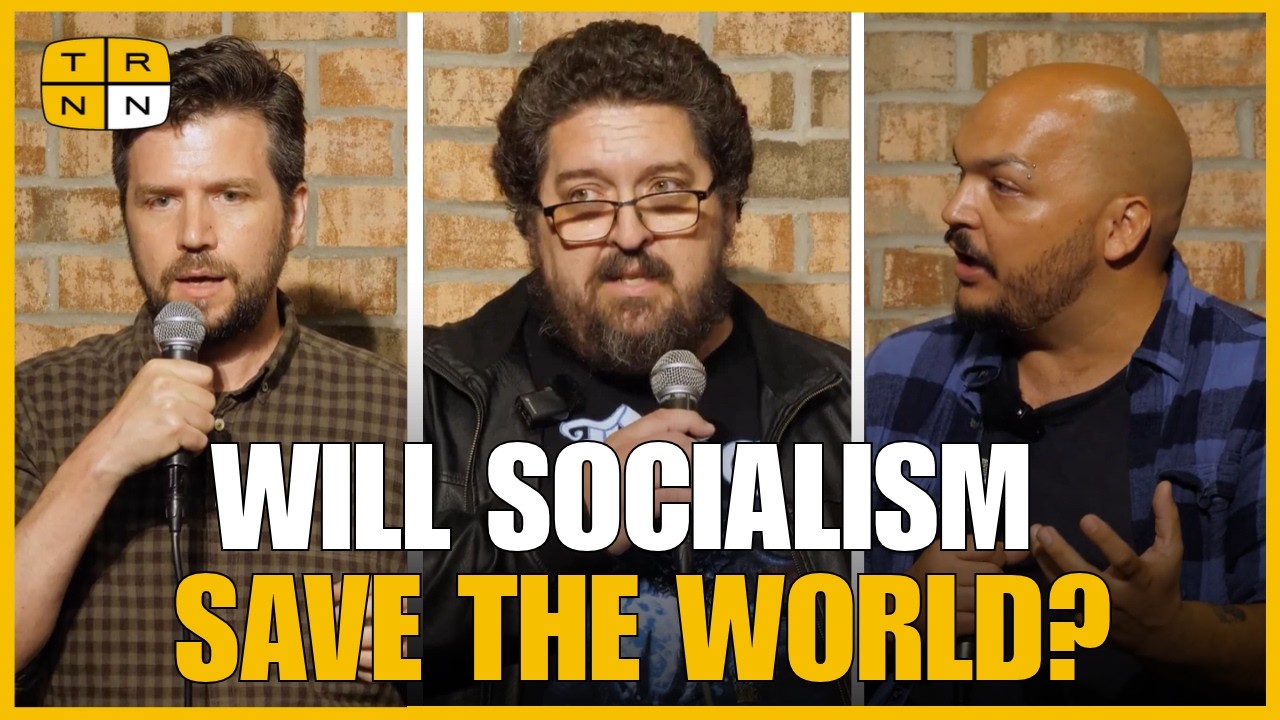
With a global capitalist system that is wreaking havoc on the planet, pushing most of humanity into poverty, and enabling a small number of billionaire and trillionaire oligarchs to accumulate more money and power than nation-states, more people around the US and beyond are asking: “Could socialism be the solution?” But can socialism actually work in the real world? Can it actually help create a better world than the one capitalism has created?
Transcript
The following is a rushed transcript and may contain errors. It will be updated.
Maximillian Alvarez:
So we’re here at Red Emma’s Cooperative Bookstore and Coffee House in Baltimore, and I am really excited to be sitting with two of the three co-authors of the vital new book, The Blueprint: How Socialism Can Work in the Real World. Ben Burgis and Mike Beggs. Give it up, everyone. Hell yeah. Welcome to Baltimore, guys. So let’s talk about the S word, right? I mean, we’re here. The world’s on fire. Life continues to get harder and scarier year after year for working people everywhere. The masked jackbooted thugs that we were warned about are in our streets, hunting and disappearing our neighbors. Endless war and genocide and profiteering are ripping our world and our people apart. And everything is being run or taken over by these psychopathic, self-serving, greedy, society destroying, profit seeking, oligarchs, end times, fascists, authoritarians and fanatical nut jobs who are all so openly weird and corrupt and evil that it makes your head spin.
I think it’s time we start talking about doing things differently. Don’t you agree? Yeah? So let’s talk about it. Let’s get all the good faith discussions and questions about what socialism is, what it isn’t, and how it can work for us in the real world on the table. And so Ben and Mike, I wanted to start things off this way with the big question. You guys co-wrote this with Bhaskar Sankara, founder of Jacobin Magazine.What is your ideal goal in writing this book together and publishing it now? What would be the ideal definition of success for this book?
Ben Burgis:
Yeah, thank you so much for all that. And I should also say that our third co-author, Bhaskar, would be here tonight, but he has a month old baby at home, so he is on paternity leave from non-New York City events for a couple months at least.
Maximillian Alvarez:
Congrats, Bhaskar.
Ben Burgis:
But I think the way that we would see it is just this. All of those things that you were saying earlier are downstream of the fundamental way that our society is organized, the fundamental relationships and power at the heart of how things are produced in a capitalist society. And to us, the fundamental difference between capitalism and socialism is a question of whether we should have a society where some people can spend all day giving orders because they have money and some people have to spend all day taking orders because they don’t. And right now we’re having this conversation in a small island of a different way of organizing things at a worker-owned bookstore, but right now the fundamental institutions of our economy aren’t set up to support that. That’s not an option for most people that they get to work someplace where they have a democratic say in the way that it would work.
So what we want to think about is how we would have to reorganize our economy on a fundamental institutional level so that everybody can have that experience.
Mike Beggs:
Yeah. And I guess I would add that our brief for this book, what we set out to do was to kind of bracket off the question of how we get there. Strategy is a very important question, absolutely, but it’s also one that holds a lot of your potential model to… Holds it hostage. The short answer to how do we get there from here at the moment quite honestly is I wouldn’t start from here. So we are bracketing off that question. Once you have to start thinking from what is politically realistic right now, it limits what you can say. I mean, where are we starting? I mean, are we starting from current American political reality, Australian reality, reality somewhere else? So we wanted to draw a realistic vision of how a society might work, what is a plausible way that socialism could work that avoids a lot of the problems that people are familiar with.
And the point is not so much to set down a plan that people are going, we expect people to follow in the future and if they don’t, they’re doing it wrong. That’s not the point at all. The point is really to try and be part of a project of building confidence in the present that there actually is a realistic alternative, one that is feasible, one that people can imagine working in, living their daily lives in, one that they think would be a lot better than the way things currently work. And really that sort of confidence in a very different society is I think something that we have lost even on the left. We talk a lot, a lot of us call ourselves socialists, but there really is a lot of sign that a lot of people are not fully confident in articulating exactly what a realistic alternative might look like.
And that’s what we’re trying to do with this book.
Maximillian Alvarez:
Well, it’s like that real politic of how the fuck do I get through the day in this shitty system, let alone have time to think of what could be is the kind of trapped space that so many of us are in. But the only way out of that is through it together, I think. And so let’s kind of take that in here now, this space, Red Emma’s to sort of… I’m going to take a page from your book, Ben. I’m going to set this up kind of debate style. I want to kind of toss you guys some thoughts, claims, things we’ve all heard about socialism. First, I’m going to give you the softballs. Let’s talk about the straw man claims that are made about socialism. We grew up in America. We all heard these things, but I want to toss them to you guys and see you knock them out of the park.
And then I want us to also talk about the steel man concerns that people who are not Fox News dipshits, people who still have genuine questions about socialism and how it can work in the real world. So with that, I was going to start with kind of just the biggest and most obvious one. Capitalism, this is the straw man. Capitalism is great. Capitalism gives us freedom, individual choice, personal security, and socialism is bad, it’s breadlines, it’s non-individual, no room for the individual. Everything’s dictated to you by the state. Capitalism’s great. Why would I want socialism?
Ben Burgis:
Yeah. I would say that the book is primarily written for people in that second category, the ones who might have some level of understanding about what’s wrong with capitalism but are a bit skeptical that anything else is possible. But we do certainly want to address the first set of concerns too. We do a fair amount of that in the book. And I would just say that obviously when it comes to the kind of democratic rights that we already have, advanced liberal capitalist democracies, freedom of speech, trial by jury, all of that stuff, we like all of that. We want to keep all of that. We are sometimes terrified that the current administration is trying to take away a lot of that. But then the other half of that is what it takes to make those rights meaningful in people’s day-to-day economic lives. If you say, “Hey, legally you can do whatever you want to, but also if you want to eat, you better sign on the dotted line and agree to work for half of the day, half the time that you’re awake most days of the week and only half because of past worker struggles for a boss who is going to have dictatorial power over you at the workplace and you better not piss them off or else you’re going to lose that job and you’ll be in a much worse position,” then that doesn’t sound to me like somebody who has meaningful control over their life.
I think that having meaningful control over your life means that you should have a say in the place that you have to spend the most of your life as an adult. And ultimately also that means that we could all spend less time there anyway because if workers are in charge, when we have productivity gains, when technology advances and we have the choice, okay, do we capture those productivity gains in more stuff or do we want to work fewer hours? Then right now that decision is dictated by this class of private capitalists who aren’t doing the work themselves and it’s a very easy decision for them, right? Produce more stuff, make more money. That’s why the Fair Labor Standards Act in this country set the 40 hour work week in 1938 and has not gone down one minute since then.
Maximillian Alvarez:
Minimum wage ain’t been raised either.
Ben Burgis:
That’s certainly not because technology stopped in 1938. So I think that a society where you can have a say in what happens where you work and where you have to work less and you have more time and more material stability to do whatever the hell you want with the rest of your life sounds like much more meaningful freedom to me.
Mike Beggs:
Yeah. I mean, I would say as we put it in the book that there’s a lot of goals that socialists share with liberals and that we don’t want to give up some of the benefits of the modern complex division of labor. Personal freedom, which as Ben says, is not only partially met under capitalism, but personal freedom’s an important one. Efficiency, we make a case for efficiency as a socialist value in the book, mainly for the reason Ben’s just talking about because efficiency means not just… It’s not about more and more stuff, but about more time free of instrumental labor, but socialists also have extra goals, right? Of course, egalitarianism, care, making sure that everybody is secure and looked after, ecological sustainability. And the difficult task that socialists have that we’re trying to address in this book is making the case that those specifically socialist goals are compatible, can be made compatible with broad, liberal and personal freedom with the efficiency of the modern division of labor.
And that’s a challenge because there’s very good reasons why people think that socialism as it has been attempted in the past has failed on that account. And so we’re trying to make the case that they can be brought together.
Maximillian Alvarez:
Well, I want to pick up on that last point because here comes the sort of steel man concern, right? Some of the greatest crimes in human history were committed by people or regimes that called themselves socialists or that attached that word to their movement. People, regular people, working people, poor people, people who didn’t do anything wrong or mean any harm were hurt in the course of a 20th century in which the word socialism was a big thing. And so for people who come from those family lineages or who are worried about those kinds of things, how do we learn from the past without getting bogged down in it?
Ben Burgis:
Yeah. I think there’s a lot you can learn from the failures of those earlier socialist experiments, both the moral failures that you’re talking about, just the failures to live up to socialist ideals and also just the design failures, the economic dysfunctions that led to the empty grocery store shelves, even managers of state enterprises having to rely on black markets to get the inputs they needed to make their quotas, all of that stuff. I mean, that’s why we wrote the book to try to show that there is a better way of organizing this. I’m sure to the extent that time allows, we’ll get into that, what we think that better way looks like. But I would also just say on the bigger picture question, it’s like, yeah, it is absolutely true that there are all kinds of regimes that did all kinds of things that I find abhorrent that use the socialist label to justify that.
On the other hand, the war in Vietnam was justified by Lyndon Johnson and Richard Nixon in the name of defending freedom and democracy and the knowledge of the millions of Southeast Asian peasants who were shot or burned alive with napalm or dislocated from their villages doesn’t make me like freedom and democracy any less. It just makes me hate the hypocrites who claim to stand for it more.
Mike Beggs:
Yeah. I mean, I guess I’d emphasize that this is very much a democratic vision of socialism, but also a socialism that has a lot of room for personal freedom. Our model still involves most people having an income… I mean everybody, not most people, but everybody having an income to spend and goods and services and things like that. And not just making trivial consumer choices, but that allows, of course, for all kinds of freedom in terms of lifestyle choice, where you want to live. But it also adds to that freedoms that we do not have under capitalism. Democracy is extended from the political realm to the workplace in particular. And there’s a lot of points in our model where we try and find real points of leverage for effective democratic deliberation all the way through. It’s not something that just happens at the political level. It’s something that happens at multiple points in the system.
Sometimes it’s democracy of workers at a particular workplace. Sometimes it’ll involve the community along with workers, et cetera, et cetera. So I would say that our model is one of liberalism plus, right? It’s a liberalism socialist with all the egalitarianism, security, et cetera, that gives people real freedom in their lives. And that’s really at the center of our model.
Maximillian Alvarez:
All right. I got another straw man for you. So capitalism and the dynamics of the free market are the most efficient way for society to organize a system of production that meets the needs of all. Why would we want socialism, which is… Sorry, I didn’t finish the question. Why would we want socialism that’s central planning and not adaptive as the market can be?
Ben Burgis:
Yeah. Well, great news for you. The kind of socialism that’s advocated in the book is not one where everything is essentially planned. We would make a distinction between saying, okay, are there certain things about capitalist markets that do make it efficient at doing the things that capitalism is good at? It’s not good at producing material equality. It’s not good at producing stability in people’s lives. It’s not good at empowering most citizens, but it is good and it’s importantly good at things that earlier moderns of socialism were bad at, having full grocery store shelves, all that stuff.
Maximillian Alvarez:
I mean, selling your apples at a farmer’s market is fucking fine. We don’t have to turn that into this monstrosity that we have today.
Ben Burgis:
No, exactly. And we think that there’s nothing magic about the act of buying and selling. So there are the same way that there are some libertarians who think that the least little bit of social democratic interference with the free market, and before you know it, you’re down in the road to Stalin. There are some people who come, as we do, out of the Marxist tradition, who say that the least little bit of buying and selling going on in your society before you know it, you write down the slippery slope to capitalism. And we don’t buy that either. There have been markets, there have been buying and selling in human societies for thousands of years. Capitalism is something much more recent. Capitalism is a society where the majority of the population have to sell their working hours to private owners of the means of production. So we can still have markets, you could still have in sectors of the economy where we think you still need them.
You can still have firms setting prices based on what they think can sell, all of that stuff. But those firms are owned by the workers, they’re internally democratic, and financing can be done through the public sector, through public banks. So people aren’t forced to risk their own personal savings, which obviously for most working people under capitalism is not a rational risk. And the last thing about this before I throw it to Mike is just oftentimes people think of markets and planning as being opposed to each other. We’d say, look, these are just tools you can use. To us, the core of socialism is who runs things. Do working people themselves get to run their own workplaces or do you have the separate class of capitalists do? Everything else is just the engineering details to make that core right. So in terms of those engineering details, yeah, you could have markets, you could have planning.
We think that subcontracting out certain tasks to markets where markets make sense makes the job of planners easier where planning makes sense. If we want a socialist state to worry about things like full employment, it’d be better if they didn’t also have to worry about exactly how many toothbrushes are going to be produced in the next five years like Soviet planners did.
Mike Beggs:
Yeah. We spend a lot of time in the book going through the debates about planning and markets in the 20th century. So the socialist calculation debate, if people are familiar with that, at the mid 20th century, between the Austrian libertarian argument that socialists… You can’t have rational planning of a very complex economy with countless resources, countless squared ways of combining those resources for countless cubed possible products that people have preferences, wants and needs about. And one of the guys that made the strongest reply to that argument, a Polish economist called Oscar Langa in the late 30s, and he kind of argued he was replying to Von Mesas, who people may have heard of, one of the Austrian Libertarians. And Langa said up front, he said in the future socialist republic, we are going to want to erect the statue of von Mesas in front of our planning board because he did us a great service in actually making sure that we took this problem seriously because I think it is a serious problem and it’s obvious the experience of the 20th century is that this is not an easy problem to solve.
Our particular solution is different from Langa’s. It does, like Ben says, involve some market production, some commodity production. It also has a non-commodity sector because we’ve learned not just from the theoretical debate, but also from all kinds of experience in the Eastern block, but also under capitalism and social democracy over the latter half of the 20th century. And though we have a role for markets, I think it’s really important to be clear. I don’t think we’ve said it up front yet, but the means of production, social wealth is entirely held publicly in our model. There is no private accumulation of wealth or private accumulation of control over the means of production. People may have some private savings, but for the most part, because of the retirement system, the housing system, there’s not a huge need to even save in that way. So we see savings as being a pretty minor thing.
So it’s a society with some role for markets, but one where wealth is absolutely publicly owned and democratically managed at every level.
Maximillian Alvarez:
It makes me think of the great Fred Hampton, and I guess to paraphrase Brother Hampton, theory’s great, but theory without tangible examples ain’t shit, right? And it is important to remember that there are examples all around us. We are literally sitting in one right now. Red Emma’s is a worker owned cooperative business and other co-ops in Baltimore exist because of the workers who make all the decisions. Everyone back there is a worker owner, and they have institutions like Bread, which provides loans to other co-ops that can’t get them from a regular bank. And that’s how you see the system set up to prioritize certain businesses and kill ones like this, but organic institutions can grow and create something different. And if we participate in them, we can make it different and stick. But I also want to bring that into a steel man concern here because whether it’s great worker cooperatives like Red Emma’s or in the world of my reporting, like labor unions, these are all essential examples of what you guys are talking about, what we talk about on a day-to-day level when we’re trying to tell people about this stuff.
But you guys know as well as I do, they’re not perfect. I mean, labor unions in this country have a lot of problems with them. Labor union presidents have been thrown in jail for corruption and racketeering and all that stuff. It associates in people’s minds with the same kind of corruption they see in the Polit Bureau and Soviet times and all that stuff. So human systems will always be susceptible to human foibles. And so what do we do about the kind of day-to-day concerns people have over corruption, ways that this is going to be still just a change in title, but still a kind of shitty reality? How do we tussle with that?
Mike Beggs:
Yeah, that’s a really good question, and maybe one we can answer by talking about, since we’re here in a workers’ cooperative, how that actually works in our system and how it involves a whole lot of checks and balances that are designed to deal with that very real problem. And it also relates to another question people ask, which is if workers’ co-ops are so great, if democratic workplaces are so great, there’s nothing stopping people for forming them under capitalism. Why doesn’t that happen more often? The answer to that, I think for the most part is that there’s certain things about capitalist society that makes them difficult, but particularly financial arrangements. It’s very difficult for cooperative arrangements to work because if you don’t have an outside owner, which a cooperative cannot, it’s a collective of its worker members, if you can’t have an outside owner, you can’t have equity financing, and that means you got to get your finances from somewhere.
So what? Is that supposed to come from the individual members? So people, at the same time as they take a job, they have to take a mortgage to bring their finance with them. Alternatively, you have to borrow from a bank, and that’s very risky thing to do because bank loans come with very fixed payments on fixed dates, leaving the business very exposed to those ups and downs, uncertainties of running a business. So in our model, the financial system is not made for capitalist businesses, but specially designed around workers’ cooperatives. And this connects back to your question about corruption, how do we actually stop that kind of thing from happening? Because in this model, like we said before, the capital, the means of production, the wealth of society is publicly owned, right? The businesses are run by their workers, but they are running it in partnership with the public banks who are essentially almost renting, effectively renting part of society’s wealth, part of society’s means of production to that worker’s collective.
And so it’s always going to be done in partnership between those institutions. So that means that the workers who are running the business democratically are kind of custodians for part of social wealth. And so they don’t have complete control as it should be, right? They’re custodians of public wealth. So that’s one of the checks and balances, right? The public is represented in this case through the bank, through the public bank, but also through the need to maintain the confidence of your customers and the need to actually… That’s one of the reasons why we keep some commodity protection there because it gives direct communication, direct back and forth between the humans who are on both sides, the people who are producing, the people who are using. And so in those cooperatives, that’s the checks and balances. The other side of the economy, and I’ll pass back to Ben in a second, that we haven’t talked about yet is we also have a very large non-commodity sector where those checks and balances have to work out differently in the directly state funded sector.
Then you’ve got all kinds of different ways. The checks and balances is still there. It might be that community members are there on the board of your local aged care center or daycare center or whatever. It works differently in different spots, but there’s always those kinds of public oversight, democratic public oversight and freedom of information about everything that’s happening with the finance, with people’s wealth.
Ben Burgis:
Yeah. And to circle and underline that point, just to make sure nobody missed that last part, part of the setup about public banks includes the constitutional mandate for transparency. The books are always open to any member of the public who wants to look. That’s an example of an institutional safeguard. There are several layers of kinds of institutional safeguards that we imagine, but I want to be really clear on this because I think otherwise it’s going to seem evasive to anybody who’s paying attention, that we’re not claiming that corruption will cease to exist, that embezzlement will wither away with the end of capitalism, that nobody’s going to try to find loopholes or commit crimes because people are people and we didn’t want to make it easier for ourselves in writing the book by assuming either that there’s going to be some amazing technological progress that means that we can just have supercomputers plan the economy perfectly or that there’s going to be some sort of amazing cultural or psychological progress to remake human nature.
We are assuming all of the same technological, psychological limitations that we have right now, which means that yeah, you still need systems to police corruption, to curb people trying to take advantage of loopholes to self-enrich. But I think the question is always a comparison that they… Okay, if you’re really worried about corruption, here’s an example of something that would be super corrupt, actually kind of similar to your union example earlier, union presidents who end up in jail and all that stuff. Because in some ways, the basic units of production in our commodity sector would work a lot like unions work now, the same way you could vote in a union contract, you could vote in an operating agreement, which basically is structurally exactly like a union contract, except there’s no separate boss to negotiate with. It’s unilateral. And of course you vote for leadership, for the committee that’s running the place.
So here’s an example of something super corrupt that could happen. Somebody could rig an election for that committee to make sure that they got the spot, even though most people didn’t try to vote for them or somebody could try to do that on behalf of their son or something. Yeah, that would be terrible. Now let me tell you about capitalism where it’s entirely legal for people to continue to be the boss, even though most people who work for them don’t want them to be because they don’t get a vote in the matter and where it’s entirely legal to just leave the The business to your son as property inheritance, the same way that you’d leave your car to them. And that’s not even considered corruption. That’s just the way it’s supposed to work.
Maximillian Alvarez:
Yeah. I mean, yeah, it’s real fucking rich for the most corrupt people in the whole of human history to be saying, “Oh, socialism’s corrupt.” I mean, we know better and we got to call it out when we see it. We have to be each other’s sense of sanity and social responsibility. And it starts by calling out bullshit wherever you see it. Whoever’s saying it, doesn’t matter whose side they’re on, the truth is the truth. Mother Jones famously said, “I will tell the truth wherever I please.” We all got to have a little bit of that moxie right now. And we got to take it as a duty to go and tell the truth wherever we can together so that we crowd out all these fucking liars and all these self-serving fascists and all this AI slop they’re trying to throw into our faces to get us to forget what is right in front of us.
So there is a real social participation element to all this that I really appreciate in your guys’ book because it’s so needed with everything. I think one of the benefits of capitalism, and I can say this as kids who grew up in America post Cold War, it felt like the capitalism had won and it was all right. The future was pretty bright. The pie was going to be big enough for all of us to get some if we worked hard enough. My immigrant family felt like we made sense in that narrative. And boy, oh boy, did capitalism show over the next 25 years that all of that will be consumed under this kind of monstrous cycle of expansion and domination and consolidation, corruption. And now we’ve got what we’ve got here in 2026. So I wanted to end there, bring us back to where we are here.
Because like in the 20th century, when you had the surge of socialism and left thinking, at the same time you had the surge of fascism and far right movements, we are in a very similar moment. It’s not the same. History doesn’t repeat itself, but it’s rhyming pretty hard right now. And so we’re seeing the surge of far right governments, movements, this authoritarian international network that is now targeting the Brazilian elections, yada, yada, yada. But there are examples in parts of the world where that authoritarian message is making a better case to your average working person for why they should support the authoritarians and not listen to the people who call themselves Democrats or liberals or what have you. If it keeps the violence off their streets, if it keeps the normalcy in their day-to-day life, the sad reality is a lot of people will say it’s worth it to me to sacrifice the civil rights of others and lock people away in Bucheles like Salvadorian prisons if I don’t have to worry about gangs walking down the street.
So that is happening at the same time you guys are writing this book. So the stakes couldn’t be fucking higher. So how do we make the case for socialism work in the real world now and win with this message?
Ben Burgis:
Yeah. I mean, I think that ultimately, if everything you were just talking about, when you’re talking about Buchele and Trump and global wave of authoritarianism, if that’s going to be beaten back, it’s going to take obviously a lot of people who come from a lot of different perspectives to come together to do it. But if history is any guide, the people who are going to be the best fighters against all of that stuff are people who are motivated by this north star of a vision of a qualitatively better world because those have always been the best fighters against whatever horrible authoritarian nonsense was going on at any given time for civil rights, for labor unions, for all of that stuff. And I think that right now it’s a problem. It’s not the problem, but it is a problem that right now, even so many people who want to be socialists have lost their confidence in that qualitatively better world.
During the 20th century, a lot of people thought it was being built in the Soviet Union. Even a lot of people who are on the anti-Stalinist left who had their critiques of the Soviet Union still thought that the economic core of that system was functional and it still gave them hope that some sort of socialism was possible. And right now that’s been lost. And so I think that trying to restore confidence in the possibility of something better is important always because we don’t want to be stuck in the system forever, but I think it’s more important than ever in circumstances like the one you’re describing. I mean, I often think, I guess the last thing I’ll say before I throw to Mike to finish us up, but I often think about Manufacturing Consent. That’s a book from several decades ago by Noam Chomsky and Edward Herman.
And basically what they’re talking about is the way that the borders of acceptable debate were policed. That in the American corporate media, you had this appearance of thriving debate, but it was happening within painfully narrow parameters. For better or for worse, those parameters have pretty much been blown up lately, that you have people like Nick Fuentes have become like…
He had dinner with the president and you have a DSA guy who’s the mayor of the most important city in the capitalist world. And so it seems to me that we are at a time when better things are possible than they were for most of our lifetimes, but also much worse things are possible. And I would like to bolster people’s confidence that there is a long-term vision of much better.
Mike Beggs:
Yeah. All I would add to that is that even though there’s economics and some theory in the book, but we also tried to paint a vision of a society that would be really broadly appealing beyond the left. We tried to paint a model that most people could imagine themselves living in and enjoying. We built it around the kinds of aspirations that people in general have today. I mean, it’s a model that makes room for all kinds of social experimentation, but it also is one that guarantees people security of livelihood. It guarantees income to people and services to people as they need it, not whether they can pay for it in some way or other. It’s a vision that takes a lot of things that people… It could be communicated as something that takes a lot of people’s frustrations and anxieties in life, especially in the working world and says, “Here are some solutions to them.” They don’t involve you sitting in meetings all day or anything like that.
The way that we have workplace democracy is not something that would involve people in having meetings all the time, but it is something that means you’re not going to have in general a boss that you hate. You’re not going to have a day-to-day existence where you fear being arbitrarily fired or you’re worried about your retirement or anything like that. So I think that the vision that we present is one that is really broadly appealing and could actually be something that is used to reach well beyond the kinds of people who currently think of themselves as on the left.
Maximillian Alvarez:
Let’s give it up for Ben Burgis and Mike Beggs everybody. Hell yeah.

 Login