❌

Reading view

Diesel price jumps to Rs402.96 per litre; Petrol unchanged for weekend

ISLAMABAD – Diesel price has been increased for another day as the government pushed rate above Rs402 per litre, amid mounting tensions in the Middle East and rising international crude oil prices.

The latest adjustment has taken diesel prices to Rs402.96 per litre, following an increase of Rs2.29, while petrol consumers have been spared another hike, with the price remaining unchanged at Rs377.91 per litre. The revised rates came into effect on October 31 and will remain applicable until November 2, 2026, according to the Oil and Gas Regulatory Authority (OGRA).

The decision comes at a time when global energy markets are facing renewed uncertainty, with fears of fresh American military strikes against Iran raising concerns about oil supplies and future fuel costs.

With another Rs2.29 added to the price, diesel has become Rs3.14 costlier within two days, putting additional pressure on transport operators, farmers, businesses and industries that rely heavily on the fuel. Petrol, meanwhile, has remained unchanged at Rs377.91 per litre throughout both revisions.

The surge comes against the backdrop of another surge in international crude oil prices, with traders increasingly concerned about a possible escalation of the US-Iran conflict. Market fears have intensified over the prospect of further American strikes against Iran following the US midterm elections, adding fresh uncertainty to an already volatile energy market.

An attack on an oil tanker in the Strait of Hormuz, one of the world’s most important oil transportation routes, has further highlighted the risks facing international petroleum supplies.

Oil prices climbed on Friday and were heading towards a fourth consecutive monthly gain as investors weighed the possibility of wider regional disruptions.

The latest diesel hike has renewed concerns about the impact of international oil market volatility on Pakistan’s domestic fuel prices. High-speed diesel plays a crucial role in the country’s economy, powering heavy vehicles, agricultural machinery and commercial transport. Sustained increases in diesel prices can raise transportation and distribution costs, potentially putting upward pressure on food prices and other essential commodities.


The post Diesel price jumps to Rs402.96 per litre; Petrol unchanged for weekend appeared first on Daily Pakistan English News.

  •  

Punjab CM launches Rs1.99 Trillion Pivot Economic Plan promising 1 Million Employment Opportunities

LAHORE – Punjab is gearing up for massive economic transformation as Chief Minister Maryam Nawaz unveils a historic Rs1.99 trillion PIVOT plan, targeting over one million employment opportunities, 162,000 direct jobs and an additional $6.8 billion in exports. The ambitious three-year initiative aims to turn Punjab into a major industrial and investment hub through affordable business financing, modern industries and large-scale private investment.

The historic Punjab Innovation, Value Addition and Economic Transformation (PIVOT) Plan 2026–29, officially launched on Friday, October 30, sets out a three-year roadmap to turn the country’s most populous province into a competitive, export-driven industrial hub.

With a total proposed investment of Rs1,995.3 billion, the initiative aims to generate an additional $6.8 billion in exports, create 162,000 direct jobs and support employment opportunities for over one million people.

Addressing a high-profile ceremony attended by leading industrialists, bankers, diplomats and international development partners, Chief Minister Maryam Nawaz declared that Punjab was entering a new economic era driven by innovation, industrial expansion and private investment.

She said her government was determined to replace administrative barriers with investor-friendly policies, allowing businesses to grow, manufacturers to compete internationally and young people to secure better livelihoods.

Rs300 Billion Financing Package for Businesses at Just 0–5% Rates

One of the most significant announcements under PIVOT is a Rs300 billion concessional financing initiative designed to help businesses expand without facing excessive borrowing costs.

The Strategic Trade Enhancement Programme (STEP), supported by a newly introduced digital portal, will offer eligible businesses financing at concessional rates ranging from zero to five percent, subject to programme conditions.

The scheme aims to encourage industrial expansion, technological upgrades and export-oriented investment.

The wider economic transformation strategy brings together Rs1,089 billion in planned government investment and a targeted Rs906 billion contribution from the private sector.

Maryam Nawaz made it clear that the government would act as a facilitator while entrepreneurs, investors and industrialists would lead Punjab’s economic expansion.

She invited investors from across Pakistan and abroad to explore emerging opportunities in the province, promising a more supportive and transparent business environment.

Rs753.7 Billion Push to Turn Punjab into an Export Powerhouse

Manufacturing and industrial modernisation form the backbone of the new economic roadmap, with Rs753.7 billion allocated for improving production capabilities, value addition and global competitiveness.

The initiative specifically targets Punjab’s established industrial strengths, including textiles, garments, sports equipment, leather goods, footwear, surgical instruments, pharmaceuticals, electric fans, cutlery, steel and ceramics.

A major focus will be placed on helping local manufacturers move beyond traditional production methods towards technology-driven, higher-value exports.

To ease the financial burden on industries, the Punjab government has earmarked Rs50 billion for solar installations and battery energy storage systems.

Another Rs50 billion has been reserved for the reimbursement of duties paid on industrial machinery, encouraging factory owners to introduce advanced manufacturing equipment.

The plan also includes modern testing laboratories, product certification centres and plug-and-play industrial facilities designed to allow businesses to launch production with less delay.

These measures are expected to support compliance with international standards and help exporters access new overseas markets.

Maryam Nawaz said Punjab’s industries must compete on quality, innovation and value addition rather than focusing solely on production volumes.

Farmers to Benefit from Four New Agro-Processing Parks

Punjab’s agricultural sector is also set for a major transformation, with the government planning four specialised agro-processing parks in Sargodha, Khanewal, Okara and Bhakkar.

The proposed facilities will focus on reducing post-harvest losses, improving food processing and connecting farmers with more profitable domestic and international supply chains.

The initiative seeks to increase value addition in wheat, citrus fruits, potatoes and mangoes while strengthening marketing and export opportunities.

In another major agricultural reform, specialised horticulture authorities are planned for 20 districts, alongside targeted export financing for horticulture and floriculture businesses.

The government also aims to expand commercial opportunities in livestock, dairy farming, fisheries, halal meat and milk-based products.

The objective is to shift Punjab’s agricultural economy from selling largely raw produce towards manufacturing and exporting higher-value products.

For farmers, these reforms are intended to create better market access, improve earnings and encourage private investment in agricultural processing.

Over 400,000 Youth to Receive Industry-Focused Skills Training

Young people are expected to become major beneficiaries of the PIVOT strategy, which includes an extensive technical and vocational training programme.

The Punjab government has set a target of training 402,060 individuals over the next three years, focusing on skills demanded by modern industries, technology companies and emerging business sectors.

Unlike conventional training programmes centred primarily on certificates, the initiative aims to connect vocational education with practical employment requirements.

The plan also seeks to support entrepreneurship and prepare young workers for opportunities in growing industrial and digital sectors.

Speaking about youth employment, Maryam Nawaz said Pakistan’s younger generation needed opportunities that could translate education into meaningful careers.

She stressed that vocational training must respond to the changing demands of employers and provide participants with skills capable of improving their long-term earning potential.

Punjab to Digitise 300 Government Services, Connect 2,000 Businesses to E-Commerce

The economic package also introduces an extensive digital reform agenda aimed at making Punjab more attractive to local and international investors.

Under the E-Biz initiative, 300 government and administrative services are planned to be shifted to digital platforms.

The move is intended to reduce paperwork, simplify business procedures, improve transparency and make government services more accessible.

Another target involves connecting 2,000 businesses to e-commerce platforms, helping smaller enterprises explore digital sales channels and reach wider markets.

The government also plans reforms to labour regulations, public-private partnership mechanisms and approved government-land leasing arrangements for productive economic activities.

Maryam Nawaz said investors should spend their time developing businesses and creating employment rather than navigating unnecessary administrative complications.

The new approach aims to create an environment in which businesses can operate more efficiently while public institutions provide faster and more transparent services.

Tourism and Technology Sectors Included in Major Development Drive

The PIVOT programme extends beyond traditional industries, placing tourism, hospitality, digital services and technology-related businesses among Punjab’s economic priorities.

Under the plan, tourism infrastructure will be modernised to improve visitor facilities and encourage investment in hotels, hospitality businesses and related services.

The government also intends to create opportunities for private-sector participation in developing tourism destinations.

Alongside these improvements, workforce training and business digitisation measures are expected to support technology-driven economic activity.

The broader objective is to diversify Punjab’s economy and create income-generating opportunities across multiple industries.

Pakistan’s Biggest Business Names Back Punjab’s Economic Vision

The launch brought together some of Pakistan’s most influential business personalities, signalling significant private-sector interest in the provincial government’s economic strategy.

Among those attending were Mian Mansha, Arif Habib, Fawad Mukhtar, Zaid Bashir and Usman Khalid Waheed.

State Bank of Pakistan Governor Jameel Ahmad also participated alongside senior executives from major commercial banks and financial institutions.

International representation included ambassadors, diplomatic officials and development partners from the World Bank, Asian Development Bank and United Nations agencies.

Senior Provincial Minister Marriyum Aurangzeb and Punjab Chief Secretary Zahid Akhtar Zaman were also present, together with provincial cabinet members and senior government officials.

The gathering brought government policymakers, financial institutions and industrial leaders together around the proposed economic transformation agenda.

Arif Habib Announces Pakistan’s Tallest Commercial Building in Lahore

In one of the ceremony’s standout moments, prominent businessman and real estate developer Arif Habib announced plans to construct Pakistan’s tallest commercial building at CBD One in Lahore.

The proposed project marks a significant investment announcement linked to Punjab’s development ambitions.

It also highlights private-sector interest in Lahore’s expanding commercial real estate market.

The announcement added momentum to the launch, demonstrating how major investors are exploring new development opportunities in the province.

Special PIVOT Board to Ensure Projects Deliver Results

To translate the ambitious economic blueprint into practical action, the Punjab government has announced a dedicated monitoring and implementation framework.

A PIVOT Board, chaired by Senior Provincial Minister Marriyum Aurangzeb, will oversee the programme.

A specialised PIVOT Secretariat will be established in the Planning and Development Department, while a separate PIVOT Cell will operate in the Chief Secretary’s Office.

Deputy commissioners will serve as focal persons at the district level to support coordination and implementation.

A central PIVOT Dashboard and an Industry Scorecard will track progress against measurable targets, with regular reviews intended to identify delays and improve accountability.

Chief Secretary Zahid Akhtar Zaman confirmed that the plan would be operationalised within six months.

Maryam Nawaz emphasised that the programme would be judged by its results rather than announcements alone, including actual investment, industrial growth, higher exports and employment creation.

New Era of Economic Prosperity

The launch of the PIVOT Plan 2026–29 represents one of Punjab’s most ambitious proposed economic development programmes, combining nearly Rs2 trillion in planned public and private investment with major reforms across manufacturing, agriculture, digital services and workforce development.

Its central targets include $6.8 billion in additional exports, more than one million employment opportunities, 162,000 direct jobs and hundreds of thousands of workers equipped with market-relevant skills.

Concluding the ceremony, Maryam Nawaz reaffirmed her commitment to building a Punjab where businesses flourish, industries compete globally, farmers receive better returns and young people have opportunities to improve their futures.

She said Punjab was opening its doors to investment and partnership, expressing confidence that cooperation between the government and private sector could turn the province’s economic potential into lasting prosperity.


The post Punjab CM launches Rs1.99 Trillion Pivot Economic Plan promising 1 Million Employment Opportunities appeared first on Daily Pakistan English News.

  •  

Over 32 Million Pakistanis suffering from Mental Disorders amid Healthcare crisis

ISLAMABAD – A grim picture of Pakistan’s public health emergency emerged in the National Assembly, where Ministry of National Health Services revealed that millions of citizens are struggling with mental illnesses, hepatitis and HIV, while acute shortage of medical specialists threatens to deepen the crisis.

The official figures paint a troubling picture of a country where around 32.4 million people are affected by mental health disorders, nearly 12.9 million are living with hepatitis B or C, and more than 417,000 are estimated to have HIV. Even more alarming is the growing number of children affected by HIV, with 3,900 young patients registered in just 18 months between January 2025 and June 2026.

The revelations came in detailed report submitted by the health ministry to the National Assembly, exposing serious gaps in disease prevention, diagnosis and treatment across Pakistan’s population of around 250 million.

1,050 Psychiatrists for 32 Million Patients

One of key striking findings concerns Pakistan’s worsening mental health burden. The estimated number of people suffering from mental health disorders climbed from 30 million in 2019 to 32.4 million in 2023, an increase of 2.4 million within five years.

Islamabad alone has 300,000 people affected by mental health conditions. But the real concern lies in the country’s limited capacity to provide treatment. Despite millions requiring mental healthcare, Pakistan has only 1,050 registered psychiatrists nationwide.

This means one psychiatrist for every 245,000 citizens, highlighting a massive gap between the country’s mental healthcare needs and its available specialist workforce. The provincial distribution of psychiatrists also reveals significant disparities.

Punjab has 406 registered psychiatrists, while Sindh has 228. Khyber Pakhtunkhwa accounts for 122 specialists, whereas Balochistan has just 44. These four provincial figures account for 800 psychiatrists, with the ministry reporting 1,050 registered nationally.

Hepatitis Crisis

While mental health disorders affect millions, another silent health emergency continues to unfold across the country. Pakistan has the world’s largest hepatitis C patient population, according to the ministry’s report, which also places the country among the ten nations with the highest hepatitis C-related mortality burden.

Officials said around 9 million Pakistanis are infected with hepatitis C. Another 3.86 million people are living with hepatitis B, bringing the combined estimated burden to approximately 12.9 million.

Around 48,000 Pakistanis lose their lives to hepatitis-related complications every year, according to the figures presented to lawmakers. The report further revealed that more than 88,000 new hepatitis C infections occurred in 2024 alone.

HIV Infections Triple

National Assembly was also informed of a troubling rise in HIV infections, with the estimated annual number of new cases tripling over 14 years. According to the ministry, Pakistan recorded approximately 16,000 new HIV infections in 2010. By 2024, the annual figure had climbed to 48,000.

The report, citing WHO estimates, puts the number of people living with HIV nationwide at more than 417,000. However, only 92,148 individuals are officially registered with HIV treatment services. Of these, 67,878 are receiving antiretroviral therapy, the treatment used to control the virus and enable people living with HIV to lead healthier lives.

The major difference between estimated number of infections and officially registered patients raises serious concerns about undiagnosed infections, gaps in treatment enrollment and access to healthcare. On a positive note, the ministry reported a significant expansion in HIV screening.

Perhaps the most distressing disclosure concerns the growing burden of HIV among children.

The health ministry informed the National Assembly that 3,900 children living with HIV were registered between January 2025 and June 2026.


The post Over 32 Million Pakistanis suffering from Mental Disorders amid Healthcare crisis appeared first on Daily Pakistan English News.

  •  

Is North Korea’s Lazarus Group behind massive $6.3 Billion Binance Hack?

ISLAMABAD – Billions of dollars vanished from leading cryptocurrency exchange Binance wallets in matter of minutes, leaving crypto-world stunned. As investigators race to trace staggering $6.3 billion heist, suspicion is turning towards North Korea’s Lazarus hacking network. But did Pyongyang really mastermind what could be the biggest crypto theft in history?

The extraordinary cyberattack, which hits world’s largest cryptocurrency exchange, jolted global digital asset market after hackers allegedly moved billions of dollars out of Binance-controlled wallets, with most of the theft unfolding within half an hour. The amount stolen is more than four times the $1.5 billion lost in the infamous Bybit breach in February 2025, showing unprecedented scale of latest attack.

Binance hit by $6.3b hack in potentially biggest crypto heist in history

While perpetrators have not been officially identified, two major blockchain intelligence firms, TRM Labs and Chainalysis, have expressed high confidence that North Korean cybercriminals were responsible. The suspected organisation is TraderTraitor, a sophisticated hacking operation associated with the Lazarus Group, which has previously been linked to major cryptocurrency thefts.

North Korea under Spotlight over Crypto Theft

Investigators believe Binance operation bears striking similarities to earlier attacks attributed to North Korean state-linked hackers. TRM Labs said its investigation uncovered technical patterns and operational methods consistent with previous TraderTraitor campaigns.

Chainalysis reported suspicious movements of stolen cryptocurrency, including transactions in which assets linked to the Binance breach were mixed with funds from another recent exchange attack widely attributed to North Korean actors. The findings have strengthened suspicions that the same hacking network may be responsible for multiple major cryptocurrency thefts.

North Korea repeatedly denied accusations of sponsoring cybercrime, while Binance has not confirmed any connection between the attackers and Pyongyang. For years, Western authorities have accused North Korean hacking organisations of stealing cryptocurrencies to generate foreign currency, evade international financial restrictions and potentially support the country’s weapons programmes.

However, the latest allegations remain intelligence assessments rather than a confirmed finding by law enforcement authorities.

The scale of the operation has raised serious questions about the security systems protecting the world’s biggest cryptocurrency exchange. Binance co-CEO Richard Teng disclosed that the attackers carried out a complex, coordinated intrusion rather than simply exploiting a single employee’s compromised computer.

An initial investigation suggested that a developer’s laptop had been breached, potentially providing access to internal systems.

According to blockchain security researchers, the attackers manipulated transaction-authorisation mechanisms involving Ethereum’s EIP-7702 functionality, enabling malicious instructions to drain cryptocurrency from an internet-connected wallet. The operation involved multiple blockchains, with digital assets rapidly transferred into addresses controlled by the attackers.

Teng also described the use of a self-destruct mechanism designed to erase parts of the attackers’ tools and reduce the digital evidence available to investigators. Binance has said it has not found evidence that wallet private keys were leaked.

US Secret Service on Hunt for Stolen Money

US Secret Service becomes involved in investigation, working alongside financial crime specialists, private-sector partners and law enforcement agencies. Investigators are attempting to trace the stolen assets, identify cryptocurrency addresses used by the attackers and prevent the funds from being converted into other digital currencies or withdrawn through exchanges.

The agency is coordinating with the US Attorney’s Office for the District of Columbia and other authorities to identify those responsible and potentially bring criminal charges. FBI has also acknowledged awareness of the incident. Authorities have cautioned that the investigation remains at an early stage, with further details expected as forensic teams examine the breach.

Despite unprecedented theft, Binance and its partners have made progress in restricting access to some of the stolen cryptocurrency. The exchange said approximately $3 billion in affected assets had been located, while stablecoin issuers and blockchain organisations moved to freeze billions of dollars linked to the attack.

Companies involved in restricting stolen assets include Tether and Circle, whose digital currencies were among those targeted. However, freezing cryptocurrency does not automatically mean the money has been recovered or returned to Binance. The exchange has pledged to cover customer losses and allocated more than $6.34 billion in company funds and assets to address the financial impact.

Binance also temporarily suspended withdrawals while engineers conducted additional security checks. Teng said the platform would restore withdrawal services only after completing rigorous testing, with an updated proof-of-reserves report planned to reassure customers about the exchange’s holdings.

Biggest breaches so far

Platform Year Cryptocurrency stolen
Binance 2026 $6.3 billion
Bybit 2025 $1.5 billion
Poly Network 2021 $600 million
Ronin Network 2022 $540 million

Binance theft alone exceeds the combined losses from these three previous major incidents. Security experts have also warned that cryptocurrency criminals are increasingly targeting individual investors through online fraud, stolen credentials and even physical intimidation intended to force victims to reveal private wallet keys.

The growing value of digital assets has made both large exchanges and ordinary cryptocurrency holders attractive targets. For Binance, which serves hundreds of millions of registered users worldwide, the attack represents one of the most serious security challenges in cryptocurrency history.


The post Is North Korea’s Lazarus Group behind massive $6.3 Billion Binance Hack? appeared first on Daily Pakistan English News.

  •  

Heli Crash leaves 6 Dead in Uttarakhand as India’s Aviation Safety faces scrutiny

NEW DELHI — India’s aviation safety and aerial monitoring capabilities are facing fresh scrutiny after passenger helicopter vanished from tracking systems and crashed in Himalayan state of Uttarakhand on Friday, killing all six people on board, including the pilot.

The helicopter, operated by private company Trans Bharat Aviation, was travelling from Hindu pilgrimage destination of Badrinath to Dehradun when it suddenly lost communication while flying over the Joshimath valley in Chamoli district.

🇮🇳🔞 Just In: All 6 On Board Were Killed in Helicopter Crash Near Joshimath While Returning from Badrinath; Debris and Bodies found.
A Trans Bharat Aviation helicopter returning from Badrinath to Dehradun crashed near Chai village in Joshimath, Uttarakhand, on 30 October 2026 amid bad weather, killing all six people on board — pilot Capt. Himanshu Sabharwal and five passengers from Bengaluru, including a police inspector.

The wreckage was found and bodies recovered by Army and disaster teams; the operator’s fleet has been grounded.

— World In Last 24hr (@world24x7hr) October 30, 2026

Uttarakhand Civil Aviation Development Authority (UCADA) said the aircraft disappeared from tracking system at approximately the same time that radio communication was lost, triggering an emergency search operation in the mountainous region. The helicopter, registered as VT-HCX, had departed Badrinath at approximately 1:14 pm. Its wreckage was subsequently discovered near Chhai village, close to Joshimath, after reports of smoke rising from the mountainside.

Authorities confirmed that all five passengers and the pilot died in the accident, turning what began as a missing-aircraft emergency into another aviation tragedy in India’s Himalayan pilgrimage corridor.

The incident renewed concerns over effectiveness of aviation monitoring, emergency communication and flight safety arrangements in one of India’s most geographically challenging regions. Joshimath holds importance because of proximity to India-China border and major Indian military installations. The region is also covered by military and civilian aviation infrastructure, making the sudden disappearance of a passenger helicopter particularly concerning.

The loss of both communication and tracking has raised questions about the reliability of civilian aviation monitoring in difficult mountain terrain, although authorities have not established whether any surveillance or technical failure contributed to the crash.

India invested heavily in modernising its military radar networks, aerial surveillance capabilities and aviation infrastructure, particularly in sensitive border regions. However, the latest tragedy shows continuing challenges of operating aircraft in the Himalayas, where rapidly changing weather, poor visibility, extreme altitude and difficult terrain can complicate navigation and rescue missions.

The incident brings attention to Indian government’s broader aviation safety commitments, with questions emerging over whether existing monitoring and emergency response measures are adequate for high-risk mountain routes.

Rescue personnel from the district administration, disaster management authorities, Indian Army and State Disaster Response Force were mobilised to locate the aircraft. The search operation faced difficult mountainous conditions, with reports indicating that rain and poor visibility complicated efforts to reach the crash site.

Despite the region’s military significance, the operation required coordinated ground searches and emergency response teams to locate the wreckage. The crash has also revived concerns about the safety record of helicopter operations serving Uttarakhand’s Char Dham pilgrimage destinations.

According to an Aircraft Accident Investigation Bureau report released earlier in October, the Char Dham aviation sector recorded eight helicopter accidents and one serious incident between 2015 and 2025. Five of those accidents were fatal, while several were linked to failures to follow established flight procedures.

The latest tragedy adds to pressure on aviation regulators and operators to strengthen safety procedures, flight monitoring and emergency preparedness along high-altitude routes. In response, Trans Bharat Aviation’s entire helicopter fleet has been grounded as a precautionary measure.

Uttarakhand Chief Minister Pushkar Singh Dhami has ordered an investigation into the crash and assured assistance to the victims’ families. India’s Aircraft Accident Investigation Bureau is expected to examine the circumstances surrounding the accident, including the loss of communication, flight conditions and possible operational or technical factors.


The post Heli Crash leaves 6 Dead in Uttarakhand as India’s Aviation Safety faces scrutiny appeared first on Daily Pakistan English News.

  •  

Iqbal Day 2026 Holiday Notification

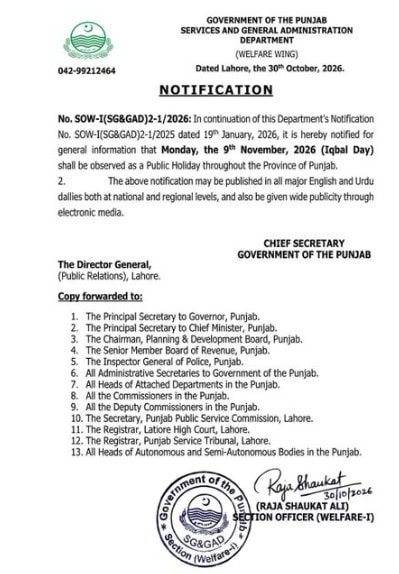
LAHORE – Punjab government announced province-wide public holiday on Monday, November 9, 2026, issuing fresh notification to mark birth anniversary of Pakistan’s national poet, Allama Muhammad Iqbal.

Services and General Administration Department (S&GAD) notification on Friday, October 30, ending uncertainty among employees and students over whether Iqbal Day would be observed as an official holiday this year. According to the notification, issued under reference number SOW-I(SG&GAD)2-1/2026, November 9 will be observed as a public holiday throughout Punjab.

The notification has been circulated to provincial authorities, including administrative secretaries, commissioners, deputy commissioners and heads of government departments, for implementation. Officials have also been instructed to ensure that the holiday announcement is widely publicised through national and regional newspapers and electronic media.

Three-Day Weekend

The announcement brings the prospect of an extended weekend for thousands of government employees and others who normally have Saturday and Sunday off. With November 9 falling on a Monday, eligible employees will enjoy three consecutive days off, beginning Saturday, November 7, and continuing through Monday, November 9.

However, the three-day break will depend on the normal weekly schedules of individual offices and institutions.

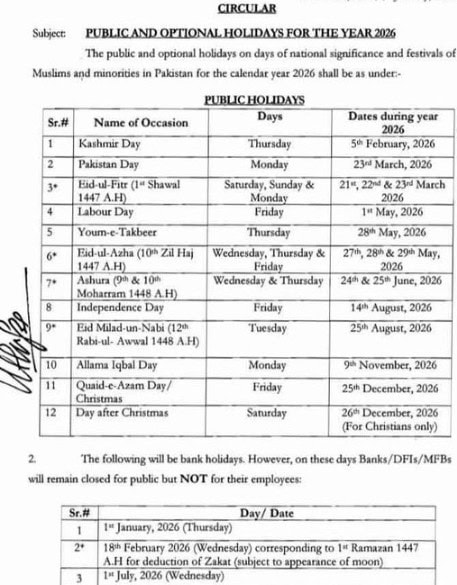
Punjab’s latest notification reinforces a decision already announced by the federal government earlier this year. Cabinet Division included Allama Iqbal Day in its official calendar of public and optional holidays for 2026, circulated on January 19. The federal schedule lists November 9 as a nationwide public holiday, confirming that the occasion is not restricted to Punjab.

The Punjab government has now issued its own notification to formally communicate the holiday across the province.

November 9 marks the birth anniversary of Allama Muhammad Iqbal, born in Sialkot in 1877. Widely regarded as the spiritual and intellectual inspiration behind the Pakistan Movement, Iqbal remains one of the country’s most influential poets and philosophers.

His writings on selfhood, freedom, faith and national identity continue to occupy an important place in Pakistan’s literary and educational traditions. Commemorative ceremonies, poetry sessions, seminars and special programmes are traditionally organised to honour his contributions.

Public Holidays in Pakistan 2026

Public holiday Date Day
Allama Iqbal Day November 9, 2026 Monday
Quaid-e-Azam Day / Christmas December 25, 2026 Friday
Day after Christmas (Christians only) December 26, 2026 Saturday


The post Iqbal Day 2026 Holiday Notification appeared first on Daily Pakistan English News.

  •  

Lawmakers voice alarm over KP situation, seek electoral reforms

• Achakzai questions govt’s handling of Tehran diplomacy, Afghanistan ties
• Senate resolution seeks coordinated national action to curb population growth

ISLAMABAD: Lawmakers in the National Assembly and Senate on Thursday raised concerns over the political situation in Khyber Pakhtunkhwa and alleged human rights violations, while both houses also discussed electoral reforms and the need to strengthen parliamentary institutions.

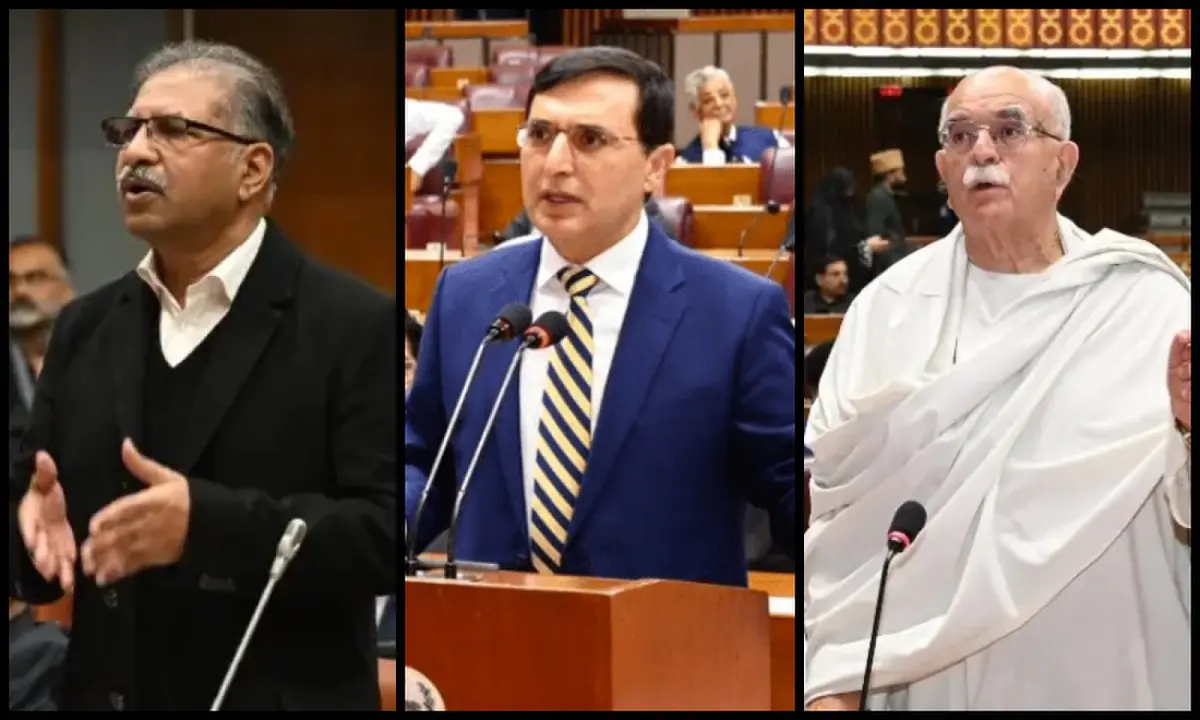
National Assembly Opposition Leader Mehmood Khan Achakzai criticised the government for failing to take parliament into confidence over recent diplomatic developments in Tehran.

“How can four people decide the future of the whole nation?” he asked, warning that such decisions could push the country towards “anarchy and civil war”.

Mr Achakzai also opposed the suspension of trade with Afghanistan, describing Afghans as traditional friends of Pakistan and criticising the country’s past policies towards its neighbour.

PTI Chairman Barrister Gohar Ali Khan said the parliamentary proceedings and the prevailing political situation in KP were creating a negative impression among the public. He also called for an end to hereditary politics in the country.

Rights concerns raised

Meanwhile, speaking on a point of order in the Senate, PTI parliamentary leader Barrister Syed Ali Zafar accused the government of undermining constitutional protections through the imposition of emergency and governor’s rule in KP.

He argued that fundamental human rights could not be suspended or compromised, regardless of the political situation. “There is one thing that cannot be broken, suspended or compromised: the fundamental human rights of the people of Pakistan,” he said.

Mr Zafar expressed concern over the detention of Noreen Niazi, sister of jailed PTI founder Imran Khan, claiming that she had suffered a heart attack and was hospitalised but her family was not being allowed to meet her.

Responding to the concerns, Adviser to the Prime Minister on Political Affairs Rana Sanaullah said Noreen Niazi had been provided medical treatment in Lahore and was in satisfactory condition.

On allegations that her family was being denied access, Mr Sanaullah assured the house that details would be sought and the matter addressed according to the circumstances.

He defended her detention, alleging that she had sought to create unrest by mobilising people for a protest march towards Islamabad.

Senate Opposition Leader Allama Raja Nasir Abbas also criticised the government’s actions in KP, alleging that the province had been “snatched from the people”.

He also questioned the imposition of emergency and governor’s rule in KP, arguing that democratic institutions could not function without respect for the law.

Population growth resolution

Separately, the Senate passed a resolution calling for urgent and coordinated national action to address the challenges posed by the country’s rapidly growing population.

The resolution, moved by PPP Vice President Senator Sherry Rehman, called for a comprehensive national response to population growth and its impact on public services and socioeconomic development.

Ms Rehman said Pakistan’s population was projected to reach approximately 390 million by 2050 at the current growth rate, placing unprecedented pressure on national resources.

Published in Dawn, October 30th, 2026

  •  
❌