Login

California's Uber and Lyft Union May Just Be the Beginning
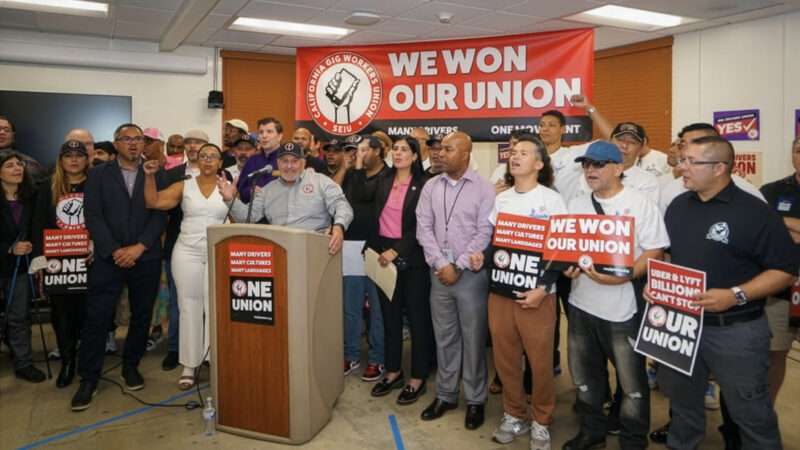
In September, California became the second state in America to certify a statewide rideshare workers union. Under a recently passed law, this new union—the California Gig Workers Union—will negotiate directly with Uber and Lyft on behalf of all rideshare drivers in the state. The ultimate agreement will set industry-wide standards for rideshare in the Golden State.
California is one of a handful of deep-blue states that have passed what are known as sectoral bargaining laws for the gig economy. In 2024, Massachusetts became the first state to pass a sectoral bargaining law for rideshare drivers. California passed its version in 2025, followed by Illinois joining the parade in 2026. Rather than requiring unions to negotiate with individual companies, these laws allow sector-wide negotiations, which could lead to one-size-fits-all outcomes that limit flexibility for both companies and workers.
Most concerning of all, this sectoral approach is unlikely to stop with the gig economy. Progressive labor lawyers and policy wonks are now pushing for sectoral bargaining to become the new normal in modern-day America.
Under California's law, a prospective union merely needs to demonstrate that it has 10 percent support among active gig drivers in order to receive a list with the contact information of all remaining active drivers in the state. (The gig companies are compelled to hand over this information to California's Public Employment Relations Board on a quarterly basis.) Once a union increases its support to at least 30 percent of active drivers, it becomes certified unless a competing union demonstrates its own 30 percent support.
Notably, the statute defines "active drivers" as those who have provided the median number of rides (or more) over a six-month period. Further, drivers with fewer than 20 rides are excluded. Put another way, this means that the support thresholds—10 percent and 30 percent—are functionally a much smaller percentage of total drivers than the statutory thresholds might suggest.
The California Gig Workers Union recently achieved recognition and now will commence bargaining with Lyft and Uber. In Massachusetts, the statewide drivers union has already been negotiating with the rideshare companies for several months.
So far, these sectoral models have been confined to the gig economy. The legal reason for this is that, as independent contractors, gig workers are not "covered" employees under the National Labor Relations Act (NLRA). This means that sectoral laws in the gig context are arguably not preempted by federal law. Under this theory, these sectoral models would not be able to expand to more traditional "covered" employees in other industries.
But there's evidence that some progressive law professors and policy wonks would still like to expand the approach. Harvard's Center for Labor and a Just Economy (HCLJE) recently received coverage for releasing a model sectoral bargaining law that could be applied to various other non-covered industries under the NLRA, such as agriculture and domestic service.
While this seems limited only to areas the NLRA does not presently reach, Benjamin Sachs, the faculty co-director of HCLJE and a law professor at Harvard, has been pushing novel legal theories to circumvent NLRA preemption. One idea advanced by Sachs is that a union-friendly National Labor Relations Board in a future presidential administration could "decline to assert jurisdiction" over certain categories of employers under the NLRA, which theoretically could empower states to extend sectoral bargaining to any number of industries.
Ultimately, sectoral bargaining laws are a bad bet for a number of reasons. For one, they undermine worker choice and will likely lead to the imposition of more one-size-fits-all standards for industries. In the gig context, this could mean more rigid scheduling arrangements, which erode the very flexibility that gig workers most desire.
In Germany, which has long operated under a sectoral bargaining model, there's also evidence that the system has reduced market dynamism. German workers are generally less productive than American workers, and while not all of the country's economic issues can be attributed to sectoral bargaining alone, the German economy has struggled under a broad set of labor rules that have contributed to its sclerosis.
This helps explain some recent changes. Flexibility reforms to the German sectoral system have helped its economy rebound to a degree. Under President Emmanuel Macron, France has similarly sought to reform its sectoral bargaining system and devolve more decision making to the company-wide, rather than sector-wide, level.
As the California Gig Workers Union's recent certification shows, sectoral bargaining is spreading in the gig economy. And the endgame doesn't stop with gig. America could go the way of Germany before we realize it.
The post California's Uber and Lyft Union May Just Be the Beginning appeared first on Reason Magazine.