One of the eight sailors who attempted suicide by jumping overboard during the grueling deployment of the USS Abraham Lincoln aircraft carrier strike group is speaking out after he was effectively punished for the incident. Navy airman Nicholas McKelvey, 19, jumped overboard on Aug. 3, 255 days into the ship’s deployment, The New York Times…
One of the eight sailors who attempted suicide by jumping overboard during the grueling deployment of the USS Abraham Lincoln aircraft carrier strike group is speaking out after he was effectively punished for the incident. Navy airman Nicholas McKelvey, 19, jumped overboard on Aug. 3, 255 days into the ship’s deployment, The New York Times…
On their first day of training, all aspiring officers in US Navy Officer Candidate School must endure a punishing gauntlet known as "First Tuesday," an intense event that tests them mentally and physically in the span of just under two hours.
Business Insider's chief video correspondent Graham Flanagan went inside "First Tuesday" at Navy OCS in Newport, Rhode Island as 126 candidates began their journey toward earning their commissions as Naval officers.
Led by a US Marine Corps drill instructor, the event sets the tone for the 13-week training course, potentially weeding out anyone having second thoughts.
Peter Rhee is a Navy trauma surgeon who served 24 years in the US military. He operated in several active war zones, including Iraq and Afghanistan.
Peter Rhee speaks to Business Insider about treating bullet wounds, battlefield trauma surgery conditions, AI-powered medical technology, and military medical training
He also discusses his role treating Rep. Gabby Giffords after she was shot in an attempted assassination in 2011 in Arizona.
Ukraine’s Navy said on 29 October that it destroyed two Russian Su-34 fighter-bombers in a Neptune missile strike on Marinovka airfield in Russia’s Volgograd Oblast.
The reported strike targets aircraft Russia uses to launch guided aerial bombs against Ukrainian cities, military positions, and frontline communities. Destroying the two jets would reduce Russia’s capacity to carry out these attacks.
Neptune strike hits Russian military airfield
Map: Euromaidan Press
According to the Ukrainian Navy, its units struck the site where Russian aircraft were stationed at Marinovka airfield using a Neptune coastal missile system.
The Navy said the strike destroyed two Su-34 fighter-bombers belonging to Russia’s 11th Mixed Aviation Regiment, based near the settlement of Oktyabrsky in Volgograd Oblast. The regiment is part of the 4th Mixed Aviation Division of Russia’s 4th Air and Air Defense Forces Army.
The Ukrainian Navy did not provide further details about the strike.
Su-34s are key to Russia’s guided bomb attacks
Russia uses Su-34 fighter-bombers to launch guided aerial bombs, known as KABs, against Ukrainian military positions and settlements, particularly in frontline areas. These attacks threaten both Ukrainian troops and civilians in communities near the front.
Aftermath of Russia's KAB bomb strike on a residential house in Kharkiv late on 30 October 2024. Photo: Telegram/Oleh Syniehubov
According to Ukrinform, Russia’s Aerospace Forces had approximately 140 Su-34 aircraft of various modifications in service as of 22 October.
The Ukrainian Navy said it would continue striking Russian military targets to weaken Moscow’s ability to wage war against Ukraine.
Despite supposed potential plans to build something other than a data center on the land, the possibility of a massive AI data center coming to San Diego is ruffling a lot of feathers.
Despite supposed potential plans to build something other than a data center on the land, the possibility of a massive AI data center coming to San Diego is ruffling a lot of feathers.
On Monday, mexican authorities have reported the presumed death of Jesús González Peñuelas—known as ‘Chuy Peñuelas,’ an alleged operative for the Guasave Cartel—during a confrontation with personnel from the Mexican Navy in Sinaloa. The United States government had offered a $5 million reward for information leading to his capture.
Omar García Harfuch, the Secretary of Security and Citizen Protection, stated that González Peñuelas is believed to be one of two individuals who died during an operation near Alfredo V. Bonfil, in the municipality of Sinaloa. The identities of the deceased are still awaiting formal forensic confirmation.
According to the Mexican Navy, the operation was supported by naval intelligence, which helped locate vehicles carrying armed individuals. During the pursuit, two men exited a pickup truck and fled into a brush-covered area, from where they opened fire on the naval personnel.
The naval forces returned fire, and both men were killed in the exchange. Their bodies have been placed in the custody of judicial authorities.
Family members who contacted the authorities suggested that the deceased may be Jesús González Peñuelas and Cesáreo Peñuelas Ruiz—known as ‘El Profe’—who has been identified by federal sources as an alleged associate of González Peñuelas. Official identification will be established through genetic and fingerprint analysis.
Derivado de las acciones permanentes para reforzar las acciones y avanzar en la pacificación de Sinaloa, personal de Marina @SEMAR_mx realizó un operativo en las inmediaciones de la colonia Alfredo V. Bonfil, Sinaloa, donde fue agredido por integrantes de una célula criminal… pic.twitter.com/03vxvnfVfN
The text reads, “Derived from the permanent actions to reinforce operations and advance the pacification of Sinaloa, personnel from the Navy. @SEMAR_mx conducted an operation in the vicinity of the Alfredo V. Bonfil neighborhood, Sinaloa, where they were attacked by members of a criminal cell and repelled the assault.”
During the operation, authorities seized four pickup trucks that had been reported stolen, as well as three long guns, three magazines, and 46 rounds of ammunition. The evidence has been turned over to the Attorney General’s Office (Fiscalía General de la República) for further investigation.
According to federal sources, González Peñuelas had led an organization since the beginning of the century dedicated to the production and distribution of methamphetamine, marijuana, and heroin. In recent years, the organization reportedly ventured into fentanyl trafficking.
It operated primarily in Sinaloa and Sonora, with connections along the northern border and distribution networks in U.S. states such as California, Texas, Colorado, and Washington. Authorities identified the individual as one of the key operatives for Fausto Isidro Meza Flores—known as “El Chapo Isidro”—the leader of the Guasave Cartel.
Federal sources also indicated that the organization maintained ties to drug trafficker Rafael Caro Quintero, who was extradited to the United States last year.
This development comes amid federal operations targeting criminal organizations in Sinaloa—a state that has faced a wave of violence since September 2024, following the outbreak of a conflict between factions of the Sinaloa Cartel.
Mexican President Claudia Sheinbaum addressed illicit drug production and consumption, stressing that consumption must be treated primarily as a public health matter rather than merely a law enforcement problem.
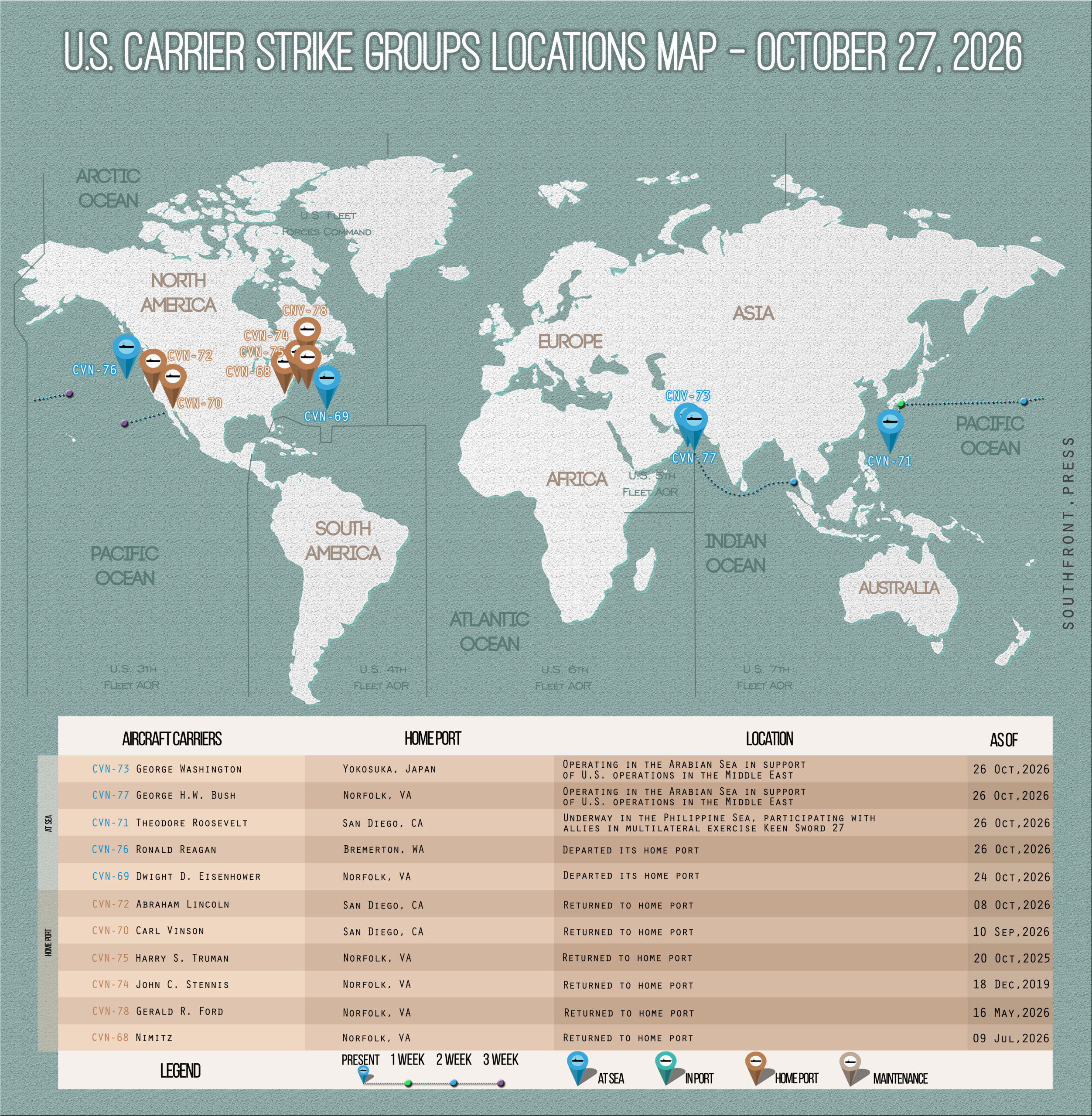
This is the newest update of the ‘U.S. Carrier Strike Groups Locations Map’ exclusive series showing the approximate locations of U.S. Carrier Strike Groups. SouthFront: Analysis & Intelligence tracks locations of U.S. aircraft carriers using the available open-source information. No classified information was used in production of the map.
click to see the full-size image
Carrier strike group (CSG) is an operational formation of the United States Navy. It is centered on an aircraft carrier and a carrier air wing of 65 to 70 aircrafts. It’s composed of roughly 7,500 personnel, an aircraft carrier, at least one cruiser, a destroyer squadron of at least two destroyers and/or frigates. A carrier strike group also, on occasion, includes submarines, attached logistics ships and a supply ship. Carrier strike groups comprise a principal element of U.S. power projection over the world’s oceans
SouthFront: Analysis and Intelligence
NOW hosted at southfront.press
Previously, SouthFront: Analysis and Intelligence was at southfront.org.
The .org domain name had been blocked by the US (NATO) (https://southfront.press/southfront-org-blocked-by-u-s-controlled-global-internet-supervisor/) globally, outlawed and without any explanation
Back before that, from 2013 to 2015, SouthFront: Analysis and Intelligence was at southfront.com
British defense contractor Babcock has confirmed that it is putting itself forward for the U.S. Navy’s future frigate program, with its Arrowhead 140 general-purpose frigate, the design behind the Royal Navy’s Type 31 class, expected to form the basis of its proposal. The move adds another foreign-designed warship to Washington’s search for a relatively mature frigate that can be built quickly and in significant numbers.
Babcock has held preliminary discussions with Pentagon officials and is expected to submit an expression of interest before the end of October, according to recent reporting by The Telegraph and Navy Lookout. The proposal is understood to potentially involve Huntington Ingalls Industries (HII), America’s largest military shipbuilder, with the two companies exploring an arrangement that could see the Arrowhead 140 built in the United States under license.
An artist’s impression of the U.K. Royal Navy Type 31 general-purpose frigate. Royal Navy
“Of course we’re interested. We have a world-class frigate, close links to the U.S. and U.S. industry. It would be insane for us not to respond,” Sir Nick Hine, head of Babcock’s marine business and a former Second Sea Lord, toldThe Telegraph.
The initiative comes as the U.S. Navy seeks to accelerate the acquisition of smaller surface combatants after the troubled Constellation class frigate program was axed. Japan’s upgraded Mogami class, South Korea’s Chungnam class, and Turkey’s Istanbul class have also been reported as candidates for the Navy’s international frigate effort. You can read more about all three designs here.
The Japan Maritime Self-Defense Force’s (JMSDF) first-in-class JS Mogami. JMSDFThe South Korean Navy’s ROKS Chungnam seen during sea trials before its delivery in 2024. HD Hyundai Heavy IndustriesThe future TCG Izmir from Turkey’s Istanbul class. Anadolu Shipyard
Meanwhile, German defense contractor Rheinmetall, a newcomer to the surface combatant market, recently unveiled its GMF 140 frigate, which it has said it plans to offer “initially as part of a procurement project in North America” before pursuing opportunities with other allied navies.
For Babcock, the opportunity would be a major expansion of its relationship with the U.S. defense industry. If successful, the company would likely provide the design, engineering expertise, and potentially the intellectual property needed for American shipyards to manufacture the frigates.
This would mirror the process for the Polish Navy’s Project 106 Miecznik (Swordfish) class, which is building three new multirole frigates in Poland, rather than using the company’s own facilities in Britain.
The future Polish Navy frigate Wicher under construction in Gdynia, Poland. Photo by Mateusz Wlodarczyk/NurPhoto
The Navy’s assessment of potential options is due by November 12. No contract has been awarded, and the details of any Babcock-HII proposal remain unconfirmed.
The Arrowhead 140 is the foundation of the Royal Navy’s five-ship Type 31 program, which is being built at Babcock’s Rosyth shipyard in Scotland. The design is derived from the Danish Iver Huitfeldt class frigate. As well as Poland, the warship has also been selected for Indonesia.
The Arrowhead 140 has a baseline length of approximately 455 feet, a beam of 65 feet, and a displacement of around 5,700 tonnes, although national variants may be considerably heavier. The vessel uses a conventional combined diesel-and-diesel (CODAD) propulsion system and can achieve speeds exceeding 28 knots. Its design emphasizes long endurance, with a baseline endurance of approximately one to two months. The AH140 incorporates a flight deck and hangar for naval helicopter operations, accommodation for embarked personnel, boat-handling facilities, and adaptable mission spaces. Its modular architecture allows customers to integrate different sensors, combat management systems, electronic warfare equipment, and weapons according to national requirements.
Taking the Polish Navy’s Project 106 class as an example of an Arrowhead 140 iteration, this is a notably heavily armed adaptation, featuring a 76mm Leonardo Strales main gun, a 32-cell Mk 41 vertical launch system for surface-to-air missiles, eight Naval Strike Missiles for anti-ship strike, and lightweight torpedo launchers. The Polish variant is reported to have a maximum displacement of approximately 7,700 tonnes.
Wicher, the first of the Polish Navy’s Project 106 Miecznik (Swordfish) class. PGZ SW
The Type 31 is a general-purpose warship capable of undertaking maritime security, escort, and surface warfare missions. Its relatively large hull offers considerable internal volume for weapons, sensors, aviation facilities, and future upgrades.
That could make it attractive to a U.S. Navy looking for a ship able to protect convoys, operate independently, and supplement its larger destroyers. A frigate with a significantly lower operating cost than an Arleigh Burke class destroyer could still take on a range of missions, freeing more capable combatants for broad area air and missile air defense, sustained strike operations, and other more demanding tasks.
The Arleigh Burke class destroyer USS James E. Williams underway. U.S. Navy courtesy photo The USS James E. Williams. USN
The Arrowhead 140’s size could also provide flexibility in accommodating American weapons and combat systems. However, a U.S. version would require a defined configuration, and there is no publicly established weapons fit for a potential American variant.
At the same time, the Royal Navy’s Type 31 frigate has not yet entered operational service, and its baseline configuration is not optimized for every mission the U.S. Navy may require. In particular, the integration of the sonar and other systems needed for sustained anti-submarine warfare would be a significant undertaking.
The Navy will also have to wrestle with how much of the existing design can be retained while meeting its own requirements. One of the major lessons from the Constellation program was that extensive modifications to an existing foreign design can create huge cost and schedule risks. With so little left of the original design after it was adapted to Navy specifications, this eventually doomed the program.
A rendering of a now-cancelled Constellation class frigate. U.S. Navy
For Babcock, it will be essential to keep the Arrowhead 140 as close as possible to its established configuration, while integrating essential American equipment, to keep the proposal competitive.
Babcock does not operate a shipyard in the United States, making an American industrial partner central to its approach.
HII, which operates major shipbuilding facilities at Newport News and Ingalls, would offer substantial experience constructing warships for the U.S. Navy. Babcock and HII already have an established relationship in the submarine sector, including work supporting the Virginia class attack submarine program.
Babcock’s facilities in Rosyth and Bristol manufacture tactical missile-tube assemblies for General Dynamics Electric Boat, supporting the Common Missile Compartment used by the U.S. Navy’s Columbia class and the Royal Navy’s Dreadnought class ballistic missile submarines. HII has also expanded its relationship with Babcock through work involving Virginia class submarine components.
An artist’s conception of one of the Royal Navy’s future Dreadnought class submarines. BAE Systems
Those existing industrial relationships could provide a foundation for a surface-ship partnership. Under a potential arrangement, Babcock could transfer the necessary design rights and provide technical support while an American yard undertakes construction.
Such an arrangement would fit the Trump administration’s stated goal of using allied expertise to accelerate warship production while rebuilding domestic shipbuilding capacity. It would also allow Babcock to pursue a potentially significant U.S. order without requiring Rosyth to absorb a large new construction program alongside its Royal Navy commitments.
The prospect of HII supporting more than one design raises questions about production capacity, program priorities, and how the company would manage competing demands on its shipyards.
More generally, the administration’s interest in foreign frigates reflects growing concern about the time and expense involved in developing new American warships.
The Constellation class program was supposed to provide a modern replacement for the Navy’s retired Oliver Hazard Perry class frigates. Based on the European FREMM design, it underwent extensive modifications for American service before suffering serious schedule and cost problems. The Navy subsequently abandoned the program.
Oliver Hazard Perry class USS Carr is seen in 2006. The last of the type was retired from U.S. service in 2015. U.S. Navy
The service is now pursuing FF(X), a patrol frigate intended to be easier to build and field. Its initial configuration, however, is not expected to include a vertical launch system, limiting its ability to provide some of the capabilities associated with a more heavily armed multi-mission combatant.
A rendering of the FF(X) frigate. U.S. Navy
HII is building the FF(X) frigate, based on the Coast Guard’s Legend class National Security Cutter. It is somewhat telling that they would partner with Babcock on the foreign frigate offering considering they already have the FF(X) contract.
The Coast Guard’s Legend class cutter USCGC Hamilton. U.S. Coast Guard
The international frigate effort is intended to examine whether a ship based on an existing allied design could provide a different balance of capability, cost, and delivery speed.
An August presidential memorandum opened a route for the Navy to consider allied designs and, under limited circumstances, overseas construction through a national security waiver. The approach has been compared with a model in which an initial small number of ships could be constructed abroad before production moves to U.S. yards.
The reported framework limits overseas construction to no more than two ships and ties it to investment in American shipbuilding. Any eventual Babcock proposal would therefore need to demonstrate how the design could be transferred and produced domestically at the required pace.
That could be a big challenge. Babcock’s own Type 31 production line is already committed to the five ships ordered by the Royal Navy, while setting up an American production line would require workforce training, supply-chain development, and the transfer of manufacturing knowledge.
HMS Bulldog has officially entered build.
The ceremonial Steel Cut for our fourth Type 31 frigate marks another major step forward for our programme, joining a production line that is gathering real speed.
The Navy will also need to establish whether a foreign design can meet its minimum operational requirements without undergoing the kind of extensive redesign that dogged the Constellation program.
Babcock enters a field that already includes several established frigate designs from Japan, South Korea, and Turkey — and potentially more.
Each offers a different combination of design maturity, combat systems, production capacity, and potential industrial arrangements. The Mogami and Chungnam programs have operational ships in service, while the Arrowhead 140 has been selected for multiple export programs but is yet to enter operational service.
Babcock’s selling point is likely to be the Arrowhead 140’s size, adaptability, and established design pedigree, combined with the prospect of American production through HII.
With the Arrowhead 140 adopted by multiple navies, this brings potential cost savings through economies of scale, shared design evolution, and collaborative upgrades across the fleet. A wider international user base also brings the possibility of overseas industrial partnerships, including training and logistical support around the globe.
At the same time, U.S. Navy selection would represent a major endorsement of the platform and would further strengthen its position in other export markets.
For now, Babcock’s confirmation that it intends to pursue the opportunity adds another contender to the Navy’s search for a new frigate. Whether the Arrowhead 140 advances beyond the initial expression of interest will depend on how its capabilities and production prospects compare with the other candidates. And critically, Babcock and its U.S. partners will need to convince the Pentagon that they can deliver a ship that meets the Navy’s requirements without repeating the delays and redesign challenges of the Constellation program.
Military correspondent Emanuel Fabian updates us on violence in the West Bank, security coordination with the Palestinian Authority, and a unique naval drill in the Mediterranean Sea
'Variety of operational scenarios' simulated by forces, marking 'significant leap forward in naval military cooperation'; both countries oppose Ankara's growing regional influence
Recent midlife upgrades to China’s older surface combatants highlight an ongoing debate over whether preserving naval fleet mass provides an operational edge over purely qualitative technological modernization in naval warfare. This month, the South China Morning Post (SCMP) reported that the People’s Liberation Army Navy (PLAN) has carried out an extensive midlife refit of its […]
HD Hyundai Co 267250.KS said on Friday it has signed a deal with Kiewit Corp to start building an advanced US shipyard next year, with operations expected to begin in 2029 and create about 3,000 domestic jobs.
China’s development of specialized naval auxiliaries designed to transport, launch and recover submarine-sized uncrewed vessels signals an assertive push to project autonomous undersea power beyond the First Island Chain and systematically challenge US submarine dominance in the Western Pacific. This month, multiple media outlets reported visual evidence showing that China has constructed a second dedicated […]
One drone launched another drone, which then shot down a third. All three were unmanned, and all at sea off Ukraine.
Ukraine’s Navy has destroyed a Russian Shahed attack drone with a Sting interceptor launched from the Sargan 3000 unmanned surface vessel, the Navy said, showing sailors adapting to new aerial threats with sea-launched interceptors.
Russian Shaheds threaten Ukraine’s ports, coastline and the ships that approach them, so meeting those drones out at sea, before they reach land, matters for the whole southern defense.
A Ukrainian Navy sea drone, the Sargan 3000, destroyed a Russian Shahed kamikaze drone with a Sting interceptor drone
Ukrainian troops continue to adapt to new threats to protect civilians and infrastructure Ukrainian Navy pic.twitter.com/kXvnqaebAw
The Sting is built to destroy Russian kamikaze drones such as the Shahed, Geran and Lancet, as well as reconnaissance drones, with quick deployment, a short training course and a top speed of 280 km/h, its producer, Wild Hornets, says.
The interceptor that has become Ukraine’s Shahed-killer
The Sting has earned its place at the front. The Ukrainian FPV interceptor has proven highly effective in combat, with a typical hit rate of 80 to 90% depending on the unit, and on some days reaching 100 percent, one launch for one kill.
It is currently Ukraine’s most productive Shahed interceptor, according to the Wild Hornets, having destroyed more than 3,000 drones in its first seven months of use. Mounting it on a sea platform extends that record from land into the Black Sea.
A drone boat that keeps finding new ways to kill
The Sargan 3000 has become a multi-purpose hunter. In July, Ukrainian naval personnel used a Sargan 3000 to sink a Russian second-rank border patrol ship.
In October, the same drone boat shot down a Russian Shahed with a turret-mounted machine gun over the Black Sea. Ukraine’s Navy took the Sargan 3000 into service in April 2026, and the drone boat has a combat radius of up to 1,600 kilometers, letting it clear the sky far from shore without putting a sailor in range.
By Chris Servello (OpEd) After years of testing and debating how unmanned surface vessels fit into the fleet, the Navy is starting to show what these systems can do. And...

 Login