❌

Normal view

Russia Strikes Ukraine’s Rail Network and Drone Warehouses
13 October 2026 at 20:32

Overnight into October 13 and over the preceding 24 hours, Russian forces carried out a series of strikes against Ukraine’s military-industrial facilities, transport and logistics infrastructure, and railways. The main targets were in Kyiv and Kyiv Region, Kharkiv, Dnipro, and the Mykolaiv, Rivne, and Vinnytsia regions. Ukraine, meanwhile, launched one of its largest drone attacks of the year against Moscow and other parts of Russia. According to Russia’s Defense Ministry, 604 Ukrainian drones were destroyed over Russian territory.

Russian Strikes on Ukraine

Kyiv Region

Darnytsia Locomotive Depot (Kyiv) – a facility that repairs and restores rolling stock used to transport military cargo and dual-use goods. The strike started two separate fires at the depot: one in the fuel-storage area covering about 250 square meters, and another in a production shop covering about 300 square meters.

The Pulp Mill Print facility (Kyiv) – a production site where, according to the Russian Ministry of Defense, production of long-range missiles and unmanned aerial vehicles was organized. After the strike, the fire covered roughly 8,000 square meters. Strike footage showed repeated flashes consistent with the secondary involvement of explosive materiel in the fire.

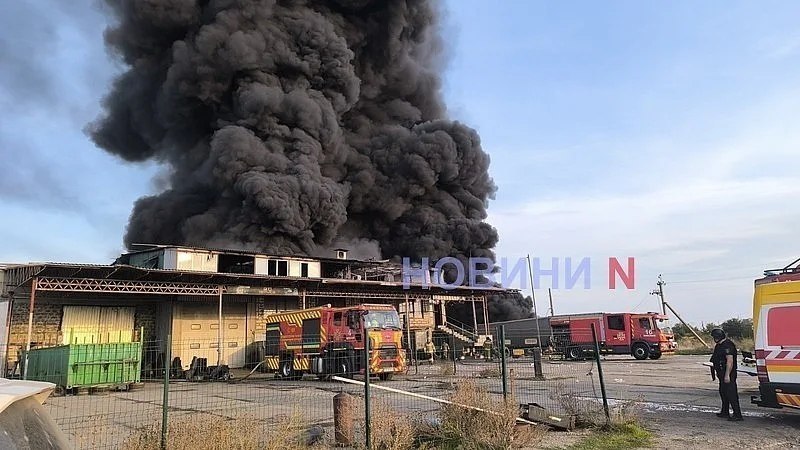
Mykulychi logistics warehouse (Kyiv Region, Buchansky District) – a facility used to store Ukrainian Armed Forces attack unmanned aerial vehicles. The strike was carried out using a Geran-5 jet-powered UAV. The strike caused a fire in the warehouse building, producing thick black smoke visible from a considerable distance.


Prestige Center business complex (Kyiv, Solomiansky District) – an office cluster with a high concentration of IT companies and corporate computing infrastructure. Its tenants include Miratech, ZEO Alliance, AMIND, and B. Braun Medical Ukraine. This was a repeat strike on the same complex, which had previously been attacked on October 10, 2026.


Mykolaiv Region

Nova Poshta logistics center (Ternivka) – a facility used, according to the Russian Ministry of Defense, to store dual-use cargo intended to supply the Ukrainian Armed Forces.

Unmanned aerial vehicle warehouse (Meshkovo-Pohorilove) 

Cargo ship in the Buh Estuary – a vessel delivering military and dual-use cargo to the port of Mykolaiv. Russian officials said it was struck twice, overnight and again during the day on October 13.


Kharkiv Region

Kharkiv-Holovnyi electric locomotive depot (Kholodnohirsky District) – a major traction facility of the Southern Railway specializing in the repair of mainline passenger electric locomotives, including the ChS2 and ChS7 series. Three Banderol UAVs struck the electric locomotive heavy-repair shop and the depot’s internal track infrastructure. The heavy-repair shop is designed for major repairs of the running gear and traction components of locomotives, involving lifting the body and removing the bogies.


Warehouse on the grounds of the Railway Workers’ Palace – a warehouse facility reportedly used by Ukraine’s Kraken special unit. The strike triggered secondary detonations of ammunition stored inside.

Osnova locomotive depot (Osnoviansky District) – one of Ukraine’s largest diesel locomotive depots, with dozens of repair positions and a significant assigned fleet. On October 13, the facility was struck twice.


Dnipropetrovsk Region

Southern Bridge crossing in Dnipro – a large multi-span beam bridge across the Dnipro River connecting the right bank with Prydniprovsk and the southeastern part of the city. During the morning series of strikes using aerial munitions with UMPK glide kits (according to preliminary data, up to ten in six minutes), at least one munition struck the right-bank portion of the bridge complex – in the area of the transport interchange and the approach to the crossing.


Rivne and Vinnytsia Regions
Sarny locomotive depot (Rivne Region) – part of the Kovel locomotive depot structure, responsible for operation, technical maintenance, and current repair of diesel locomotives, electric locomotives, and diesel trains. Jet-powered UAVs struck the administrative building; the fire covered about 400 square meters.

Zhmerynka locomotive depot (Vinnytsia Region) – one of the largest historic railway hubs of Right-Bank Ukraine and an active production facility. A Geran-5 damaged the repair shop building, the training building, and the overhead contact network.

Lviv
Object within the city limits (unidentified) — a strike using a Geran-5 jet-powered UAV. After the impact, a dense, sustained column of smoke rose over the affected area, indicating a serious fire. Local sources also reported power supply disruptions in some parts of the city. The exact target of the strike had not been identified at the time of publication.


Strikes on Russia

Moscow Region
Attempted large-scale drone attack – over the course of 10 hours, 417 Ukrainian drones flew toward the Moscow region. Most were neutralized by air defense forces at distant approaches. 65 drones were destroyed on the approach to Moscow. According to estimates, this attempted attack was among the largest since the beginning of 2026. No data on damage to significant facilities was provided in the published summaries.

Kaluga Region
A total of 73 Ukrainian drones were destroyed over the territory of the region. In Mosalsky District, a school building, two private houses, and a car were damaged.

Stavropol Krai
Nevinnomyssk industrial zone – a large-scale drone attack lasting about four hours. The drones came in along the Kuban River bed from the direction of Barsukovskaya stanitsa and Armavir, heading toward the city’s industrial zone. 

Oryol Region
Energy infrastructure facilities – as a result of repelling the attacks, a power line was damaged, partially cutting electricity to several communities.

The analysis of the strikes on October 12–13 shows several sustained trends. Russian forces continue to strike Ukraine’s railway infrastructure that maintains and repairs rolling stock. Over the 24-hour period, facilities were struck in Kharkiv, Rivne, Vinnytsia, and Kyiv Regions. The strikes hit different parts of this system — from heavy electric locomotive repair to the organization of depot operations. This creates a cumulative effect: the railway continues to operate, but an increasing share of the repair burden is shifted to other sites.

Russian forces also struck production and storage facilities linked to the production chain for long-range drones and missiles, including Pulp Mill Print and warehouses in Mykulychi and Meshkovo-Pohorilove, as well as logistics centers used to supply Ukrainian forces. Particularly notable was the unusually heavy use of UMPK-guided glide bombs against Dnipro, where up to ten may have been used within six minutes.

Ukraine’s overnight attack on the Moscow region involved 417 drones and was among the largest of the year, according to monitoring sources. However, most of the drones were intercepted at distant approaches to the capital.


MORE ON THE TOPIC:

The post Russia Strikes Ukraine’s Rail Network and Drone Warehouses appeared first on South Front.
Russia Pits Citadel Drone Killer Against German and U.S. Systems

13 October 2026 at 17:29

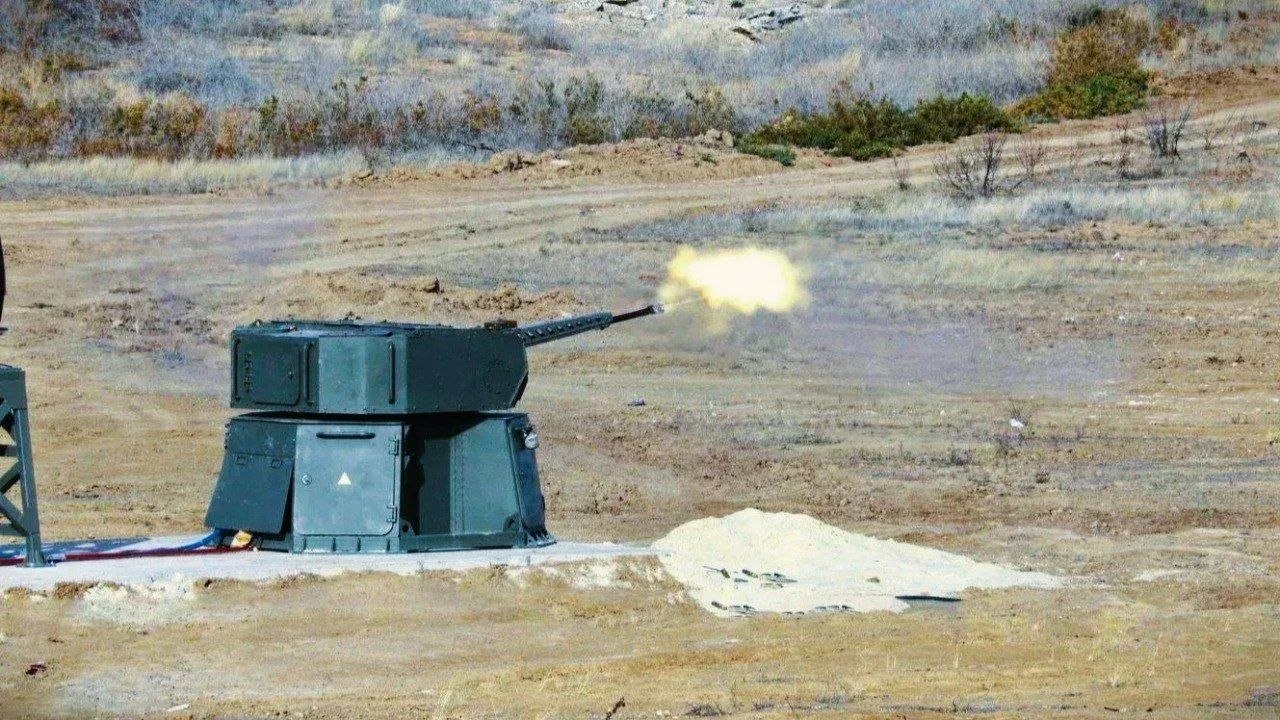
Click to see full-size image. (Rostec)

Russia’s state defense corporation Rostec revealed that its Citadel anti-aircraft gun system can destroy drones while using several times less ammunition in some cases than conventional anti-aircraft artillery.

“Thanks to its fire control system and shells with remote-detonation fuses, the Citadel anti-aircraft artillery system has demonstrated significantly lower ammunition consumption per target destroyed than standard anti-aircraft artillery systems. In some cases, consumption is several times lower,” a Rostec representative told Izvestia, according to the TASS news agency on October 13.

The ZAK-30 Citadel is designed to protect fixed installations against all types of drones. It combines radar and electro-optical sensors operating in visible and infrared spectrums with an automated fire-control system that detects and tracks targets, calculates firing solutions and directs the guns.

The system uses 30 mm programmable fragmentation ammunition with remote-detonation fuses. Rather than requiring a direct hit, the shells detonate at a calculated point along a drone’s flight path, scattering fragments intended to destroy or damage the target.

Each combat module carries 300 rounds and has a stated engagement range of up to 1,000 meters against fixed-wing drones and 800 meters against small multicopters.

The system includes a command post that can control several combat modules positioned approximately 1 kilometer away and has a crew of five.

Rostec also compared Citadel with foreign counter-drone systems, including Germany’s Rheinmetall Skynex, which uses a 35 mm cannon and programmable AHEAD fragmentation ammunition, and the U.S. Phalanx close-in weapon system and land-based C-RAM, both armed with 20 mm Vulcan guns.

The Russian company said Skynex’s larger-caliber ammunition produces a powerful fragmentation field but increases the system’s weight and cost, while Phalanx and C-RAM rely on high rates of fire and consume more ammunition because they do not use the same type of programmable airburst projectiles as Citadel.

Russia’s Defense Ministry announced on October 6 that Citadel systems had been supplied to the armed forces for counter-drone operations. It is still unclear, however, how many have been delivered.

_______________________________________________________________________________________________________________________

SouthFront: Analysis and Intelligence

NOW hosted at southfront.press

Previously, SouthFront: Analysis and Intelligence was at southfront.org.

The .org domain name had been blocked by the US (NATO) (https://southfront.press/southfront-org-blocked-by-u-s-controlled-global-internet-supervisor/) globally, outlawed and without any explanation

Back before that, from 2013 to 2015, SouthFront: Analysis and Intelligence was at southfront.com

SOUTHFRONT.PRESS

MORE ON THIS TOPIC:


The post Russia Pits Citadel Drone Killer Against German and U.S. Systems appeared first on South Front.
Military Situation In Yemen On October 13, 2026 (Map Update)

13 October 2026 at 17:37

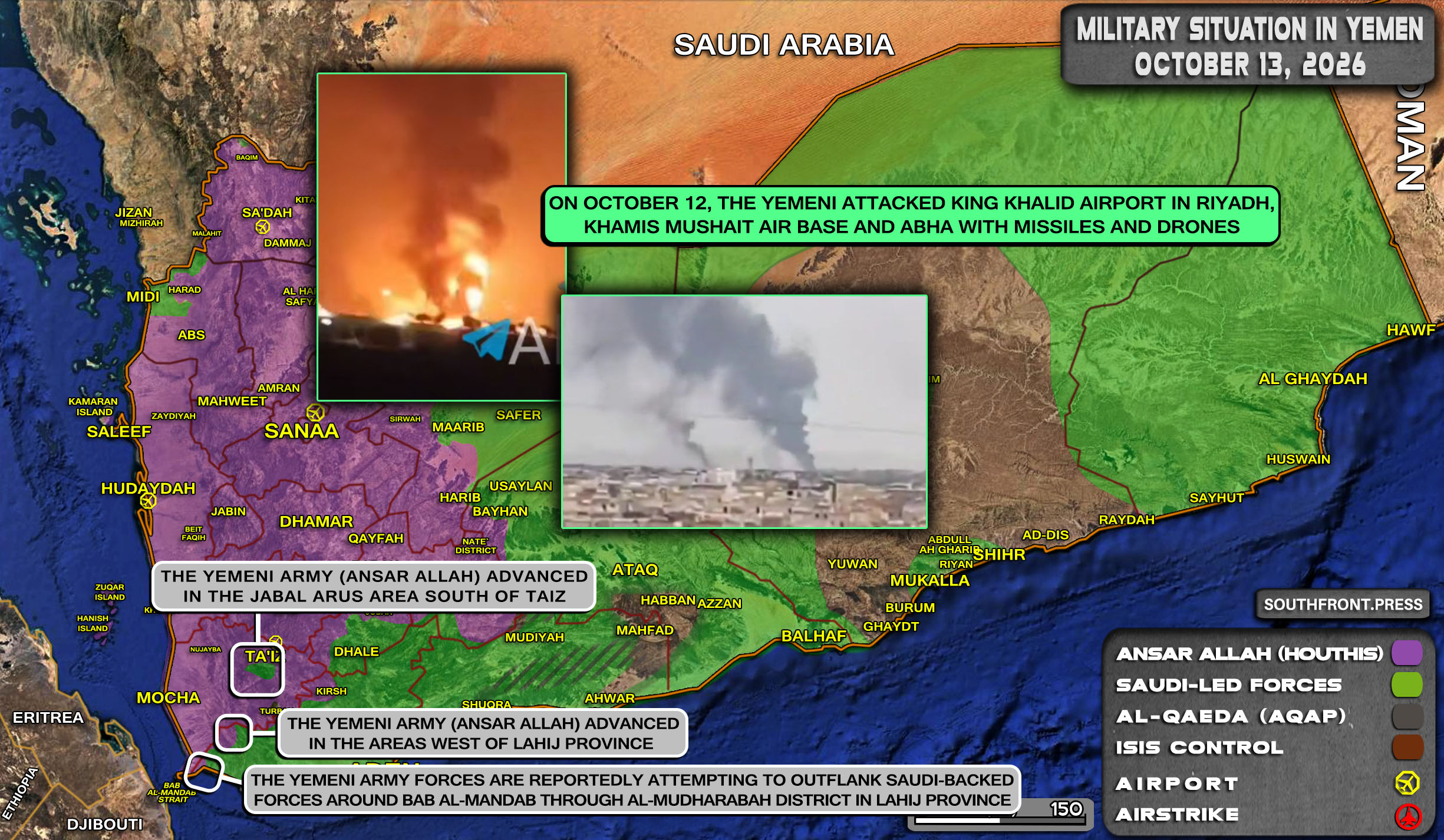
Click to see full-size map.

  • The Yemeni army (Ansar Allah) advanced in the Jabal Arus area south of Taiz;
  • The Yemeni army (Ansar Allah) advanced in the areas west of Lahij province;
  • The Yemeni army (Ansar Allah) forces are reportedly attempting to outflank Saudi-backed forces around Bab al-Mandab through Al-Mudharabah district in Lahij province;
  • On October 12, the Yemeni attacked King Khalid Airport in Riyadh, Khamis Mushait Air Base and Abha with missiles and drones.

_______________________________________________________________________________________________________________________

MORE ON THIS TOPIC:


The post Military Situation In Yemen On October 13, 2026 (Map Update) appeared first on South Front.
Russia Pits Citadel Drone Killer Against German and U.S. Systems

13 October 2026 at 17:29

Click to see full-size image. (Rostec)

Russia’s state defense corporation Rostec revealed that its Citadel anti-aircraft gun system can destroy drones while using several times less ammunition in some cases than conventional anti-aircraft artillery.

“Thanks to its fire control system and shells with remote-detonation fuses, the Citadel anti-aircraft artillery system has demonstrated significantly lower ammunition consumption per target destroyed than standard anti-aircraft artillery systems. In some cases, consumption is several times lower,” a Rostec representative told Izvestia, according to the TASS news agency on October 13.

The ZAK-30 Citadel is designed to protect fixed installations against all types of drones. It combines radar and electro-optical sensors operating in visible and infrared spectrums with an automated fire-control system that detects and tracks targets, calculates firing solutions and directs the guns.

The system uses 30 mm programmable fragmentation ammunition with remote-detonation fuses. Rather than requiring a direct hit, the shells detonate at a calculated point along a drone’s flight path, scattering fragments intended to destroy or damage the target.

Each combat module carries 300 rounds and has a stated engagement range of up to 1,000 meters against fixed-wing drones and 800 meters against small multicopters.

The system includes a command post that can control several combat modules positioned approximately 1 kilometer away and has a crew of five.

Rostec also compared Citadel with foreign counter-drone systems, including Germany’s Rheinmetall Skynex, which uses a 35 mm cannon and programmable AHEAD fragmentation ammunition, and the U.S. Phalanx close-in weapon system and land-based C-RAM, both armed with 20 mm Vulcan guns.

The Russian company said Skynex’s larger-caliber ammunition produces a powerful fragmentation field but increases the system’s weight and cost, while Phalanx and C-RAM rely on high rates of fire and consume more ammunition because they do not use the same type of programmable airburst projectiles as Citadel.

Russia’s Defense Ministry announced on October 6 that Citadel systems had been supplied to the armed forces for counter-drone operations. It is still unclear, however, how many have been delivered.

_______________________________________________________________________________________________________________________

SouthFront: Analysis and Intelligence

NOW hosted at southfront.press

Previously, SouthFront: Analysis and Intelligence was at southfront.org.

The .org domain name had been blocked by the US (NATO) (https://southfront.press/southfront-org-blocked-by-u-s-controlled-global-internet-supervisor/) globally, outlawed and without any explanation

Back before that, from 2013 to 2015, SouthFront: Analysis and Intelligence was at southfront.com

SOUTHFRONT.PRESS

MORE ON THIS TOPIC:


The post Russia Pits Citadel Drone Killer Against German and U.S. Systems appeared first on South Front.
Military Situation In Ukraine And Ukrainian Attacks On Russian Territory On October 13, 2026 (Maps Update)

13 October 2026 at 17:22

Click to see the full-size image

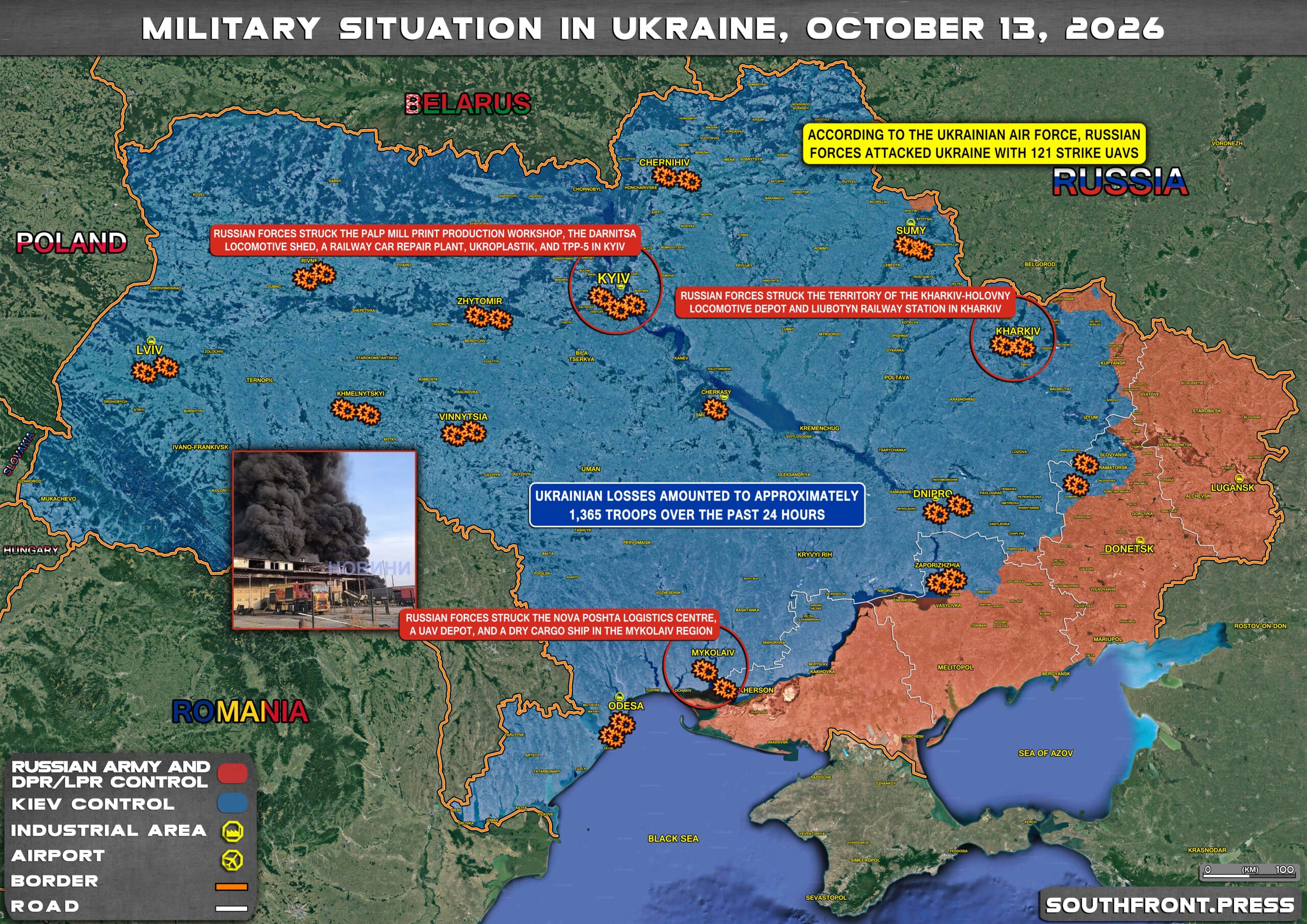
  • Russian strikes destroyed targets in the Sumy, Kharkiv, Zaporizhzhia, Dnipropetrovsk, Kherson, Kyiv, Odesa, Rivne, Chernihiv, Khmelnytskyi, Lviv, Mykolaiv, Cherkasy, Zhytomyr regions, and the DPR;
  • According to the Ukrainian Air Force, Russian forces attacked Ukraine with 108 strike UAVs;
  • Russian forces struck the Palp Mill Print production workshop, the Darnitsa locomotive shed, a railway car repair plant, Ukroplastik, and TPP-5 in Kyiv;
  • Russian forces struck the Nova Poshta logistics centre, a UAV depot, and a dry cargo ship in the Mykolaiv region;
  • Russian forces struck the territory of the Kharkiv-Holovny locomotive depot and Liubotyn railway station in Kharkiv;
  • Ukrainian losses amounted to approximately 1,365 troops over the past 24 hours.

Click to see the full-size image

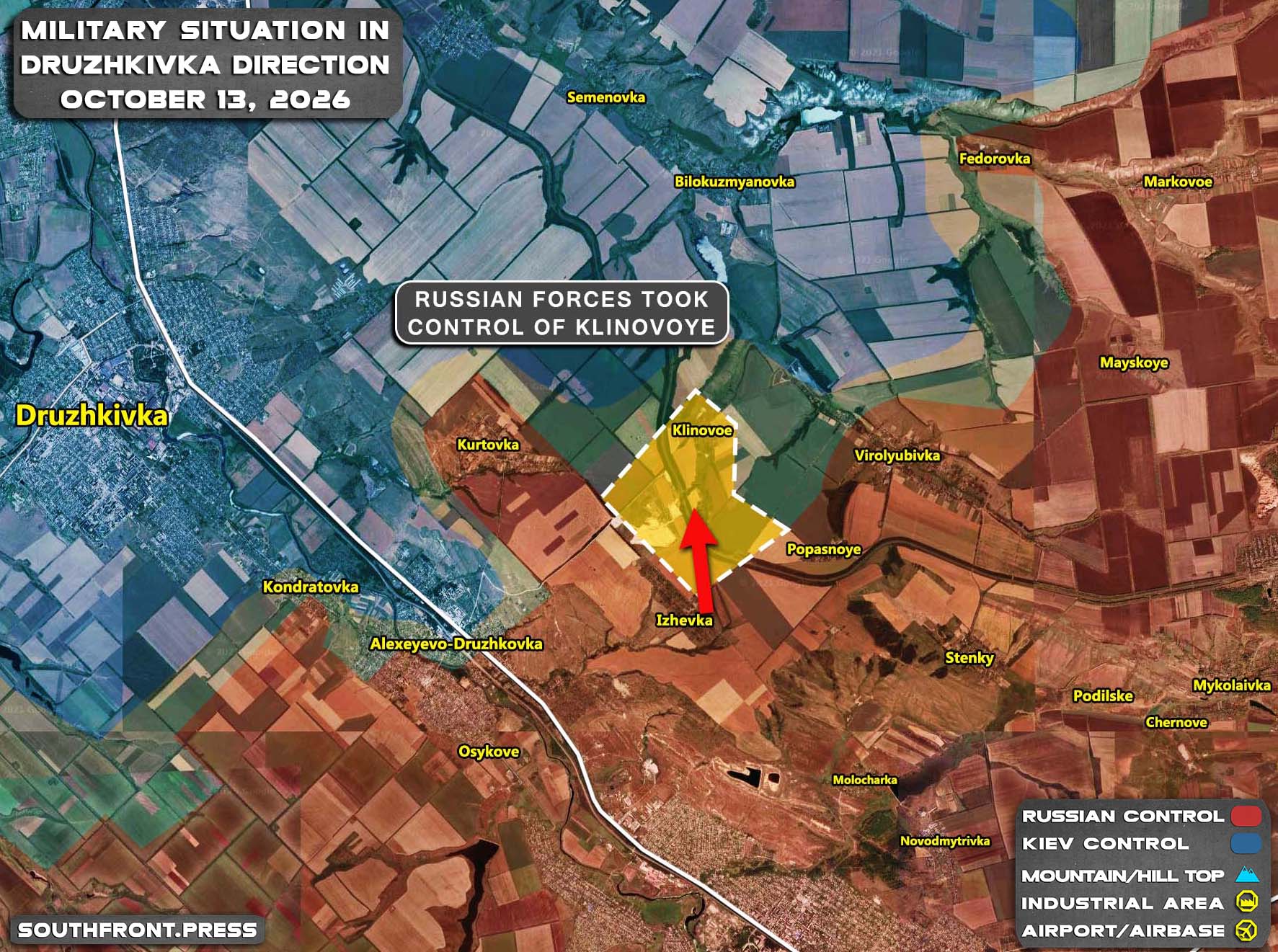
  • Russian forces took control of Klinovoye.

Click to see the full-size image

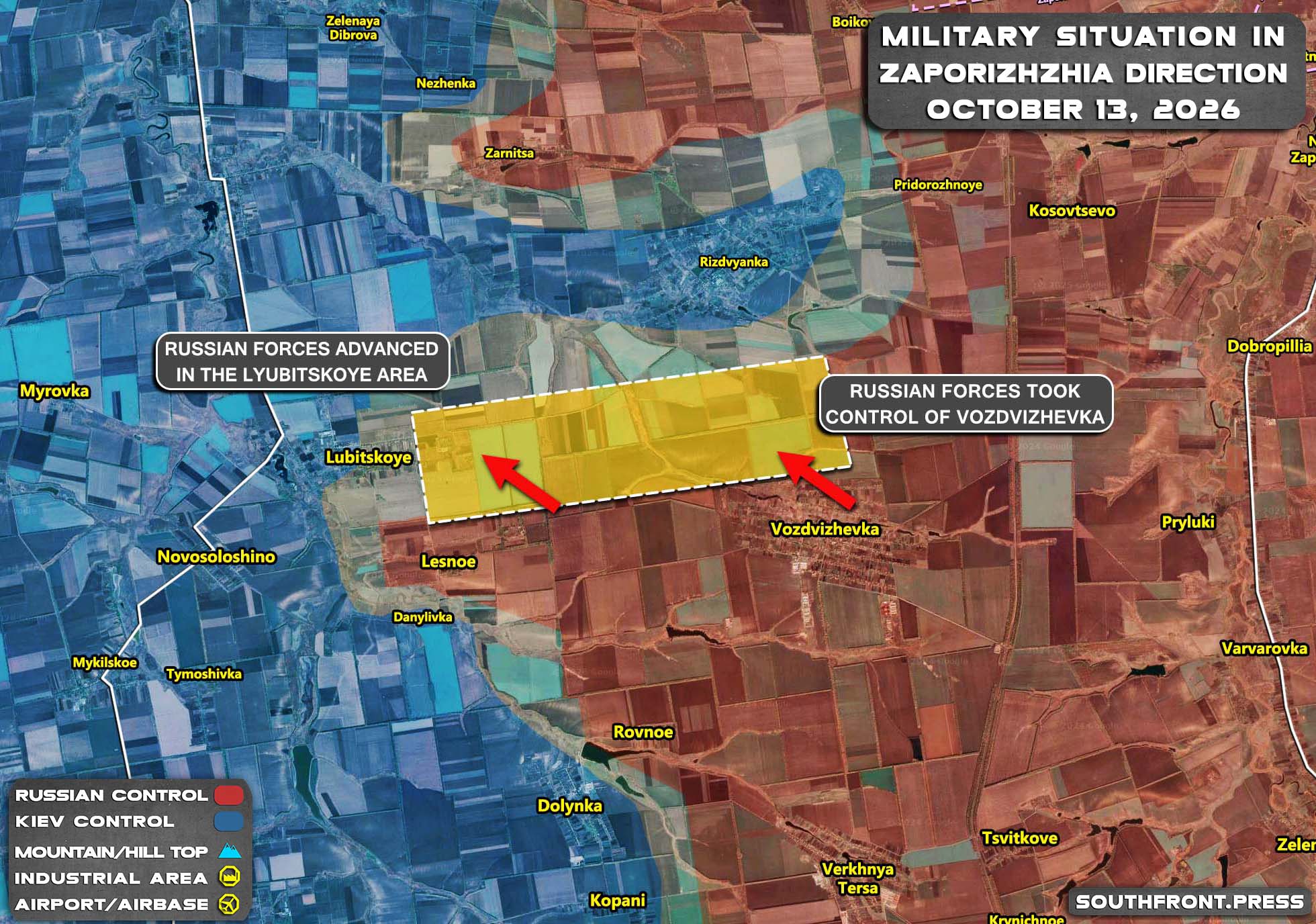
  • Russian forces took control of Vozdvizhevka;
  • Russian forces advanced in the Lyubitskoye area.

Click to see the full-size image

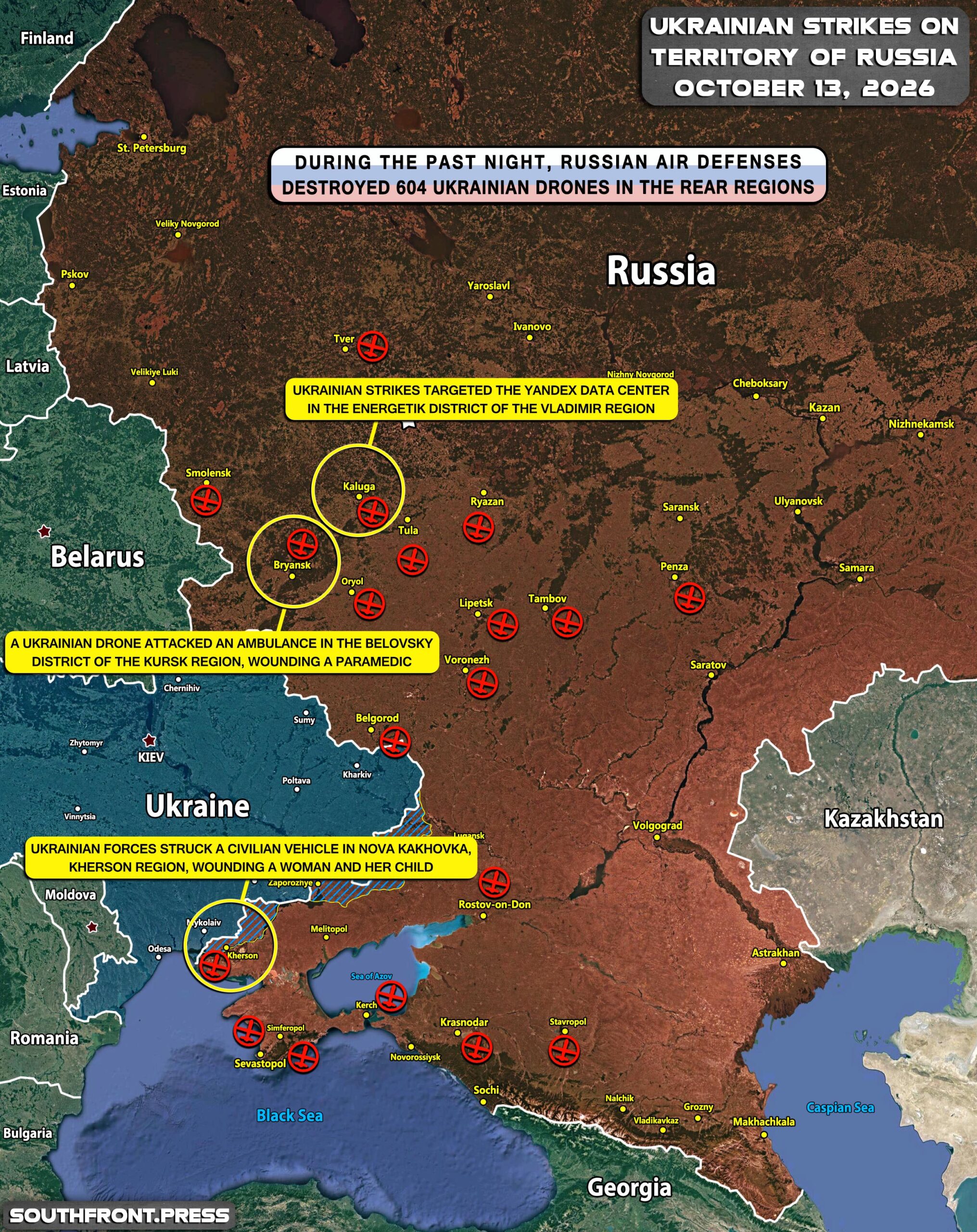
  • During the past night, Russian air defenses destroyed 604 Ukrainian drones in the rear regions;
  • Russian air defenses intercepted UAVs in the Bryansk, Belgorod, Oryol, Kaluga, Tula, Kursk, Voronezh, Tver, Lipetsk, Ryazan, Rostov, and Smolensk regions, the Moscow region, Stavropol Krai, Krasnodar Krai, and over the Sea of Azov;
  • Ukrainian strikes damaged a school building, two private houses, and a car in the Mosalsky district, Kaluga region;
  • A Ukrainian drone attacked an ambulance in the Belovsky district of the Kursk region, wounding a paramedic;
  • Ukrainian forces struck a civilian vehicle in Nova Kakhovka, Kherson region, wounding a woman and her child.

MORE ON THE TOPIC:

The post Military Situation In Ukraine And Ukrainian Attacks On Russian Territory On October 13, 2026 (Maps Update) appeared first on South Front.
Military Situation In Syria On October 13, 2026 (Map Update)

13 October 2026 at 17:19

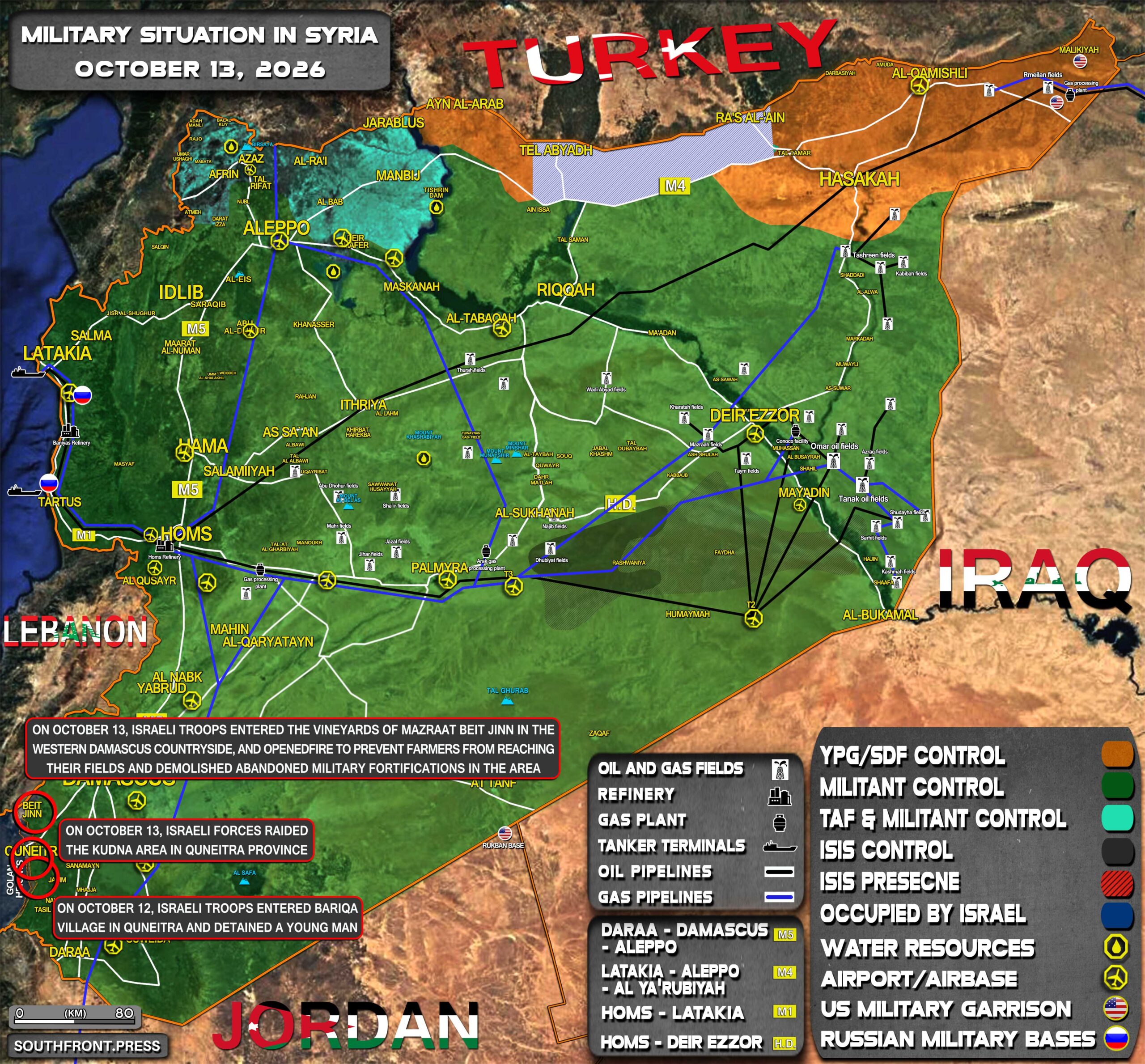
Click to see full-size map.

  • On October 13, Israeli forces raided the Kudna area in Quneitra province;
  • On October 13, Israeli troops entered the vineyards of Mazraat Beit Jinn in the western Damascus countryside, and opened fire to prevent farmers from reaching their fields and demolished abandoned military fortifications in the area;
  • On October 12, Israeli troops entered Bariqa village in Quneitra and detained a young man.

_______________________________________________________________________________________________________________________

MORE ON THIS TOPIC:


The post Military Situation In Syria On October 13, 2026 (Map Update) appeared first on South Front.
Saudi Arabia Strikes Sanaa Using Israeli Tactics, Houthis Threaten Retaliation (Videos)

13 October 2026 at 16:59

Illustrative image. (U.S. Air Force photo by Staff Sgt. Katherine Walters)

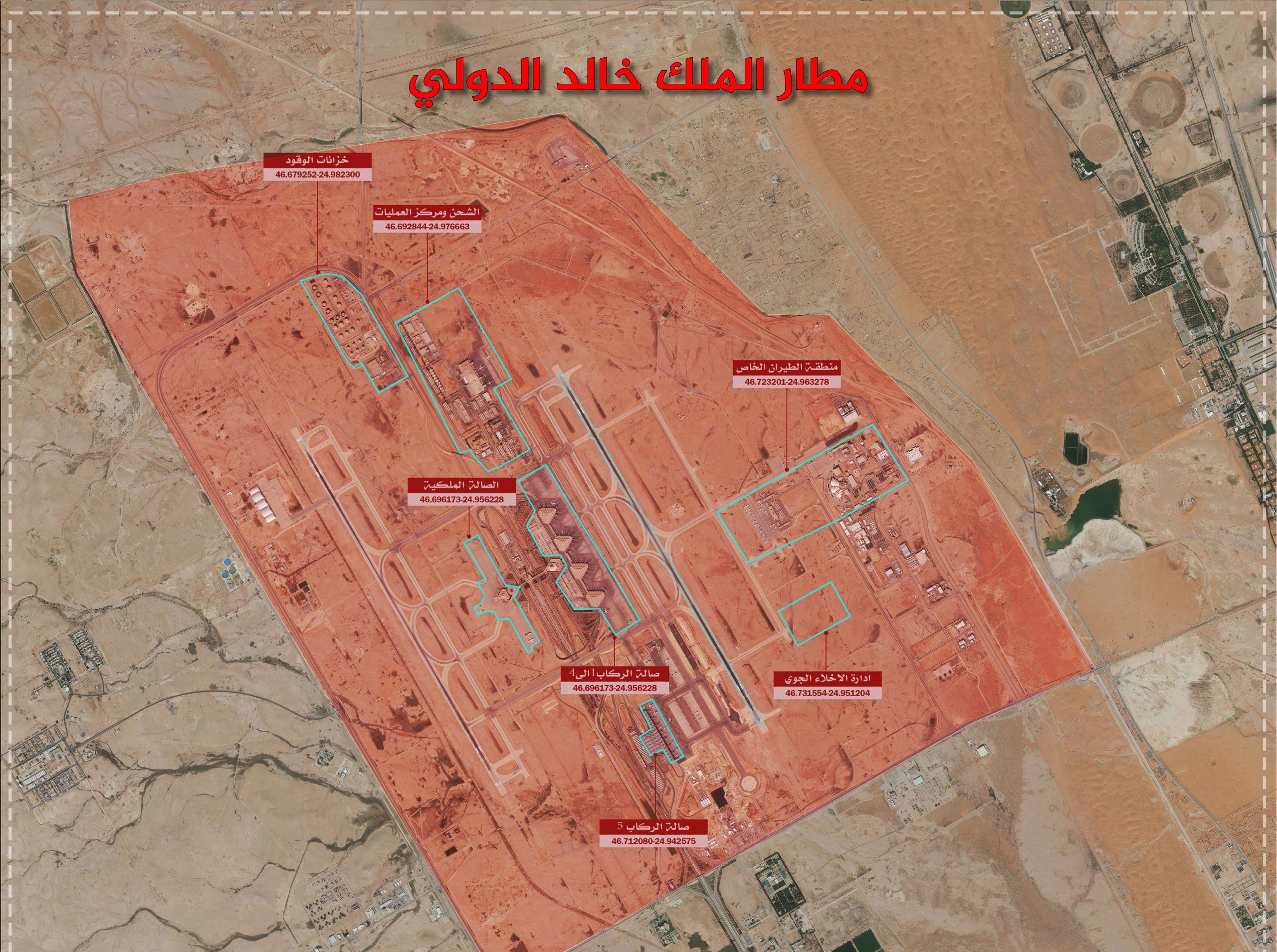
A Saudi-led coalition carried out strikes on oil facilities west of Sanaa on October 13 after warning residents to evacuate the area.

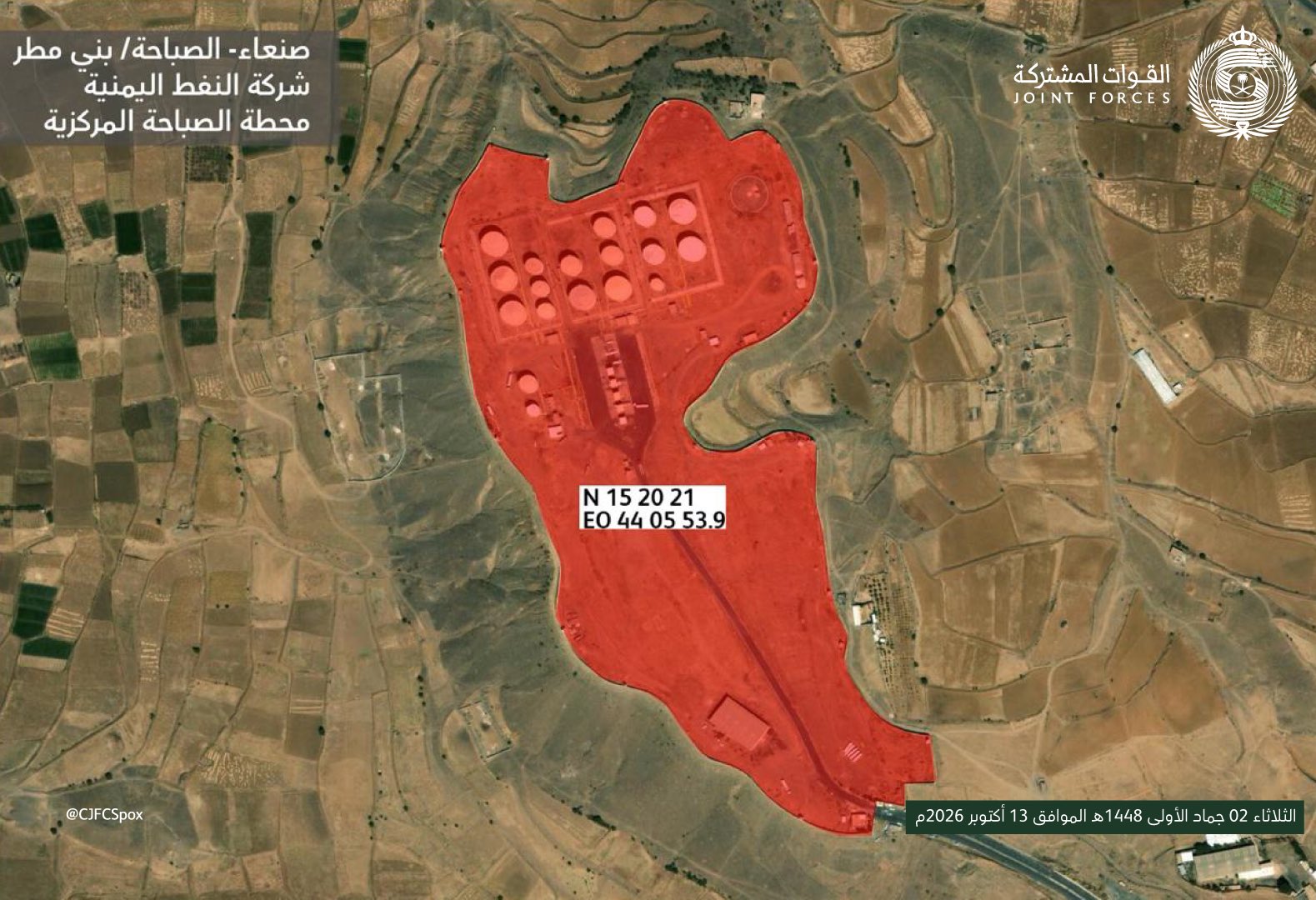
The strikes followed an announcement by coalition spokesman Maj. Gen. Turki al-Maliki urging civilians to leave the Yemen Petroleum Company’s Al-Sabaha Central Station and nearby storage areas ahead of a planned operation. Al-Maliki released a map identifying the area covered by the warning but did not specify the intended military objective.

The Saudi-led coalition appeared to be borrowing a tactic used by the Israel Defense Forces in Gaza and later in Lebanon and Iran, issuing mapped evacuation warnings before carrying out strikes in designated areas.

Click to see full-size image.

Houthi military spokesman Brig. Gen. Yahya Saree said the targeted facility was “empty of petroleum derivatives and has no military value for targeting,” citing a source within the oil company.

The Yemen Petroleum Company separately said its storage facilities were empty and that the strike would not affect oil reserves or fuel supplies for residents. The facility lies on a hill overlooking western Sanaa, where a nearby fuel station is used by the public.

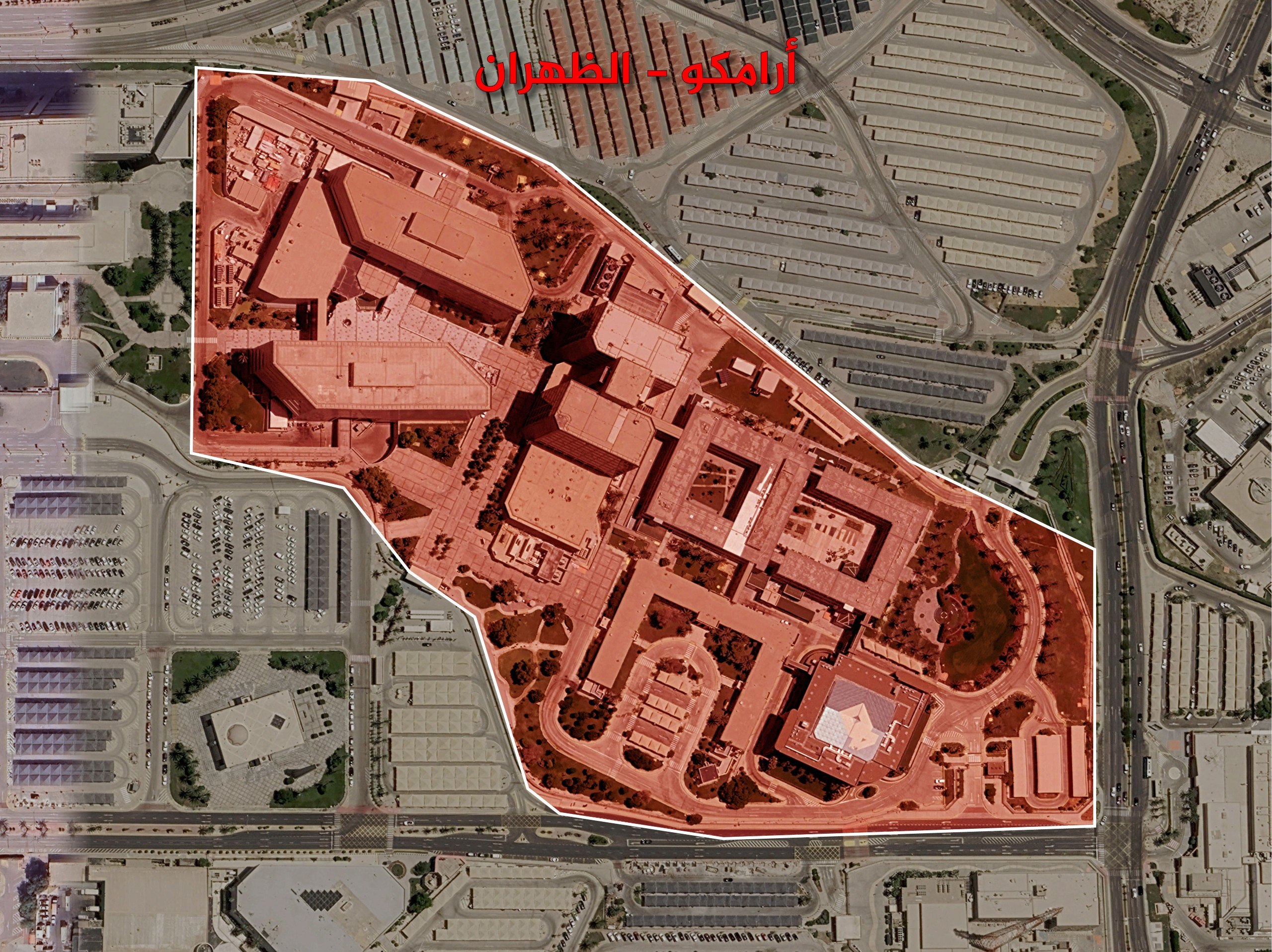
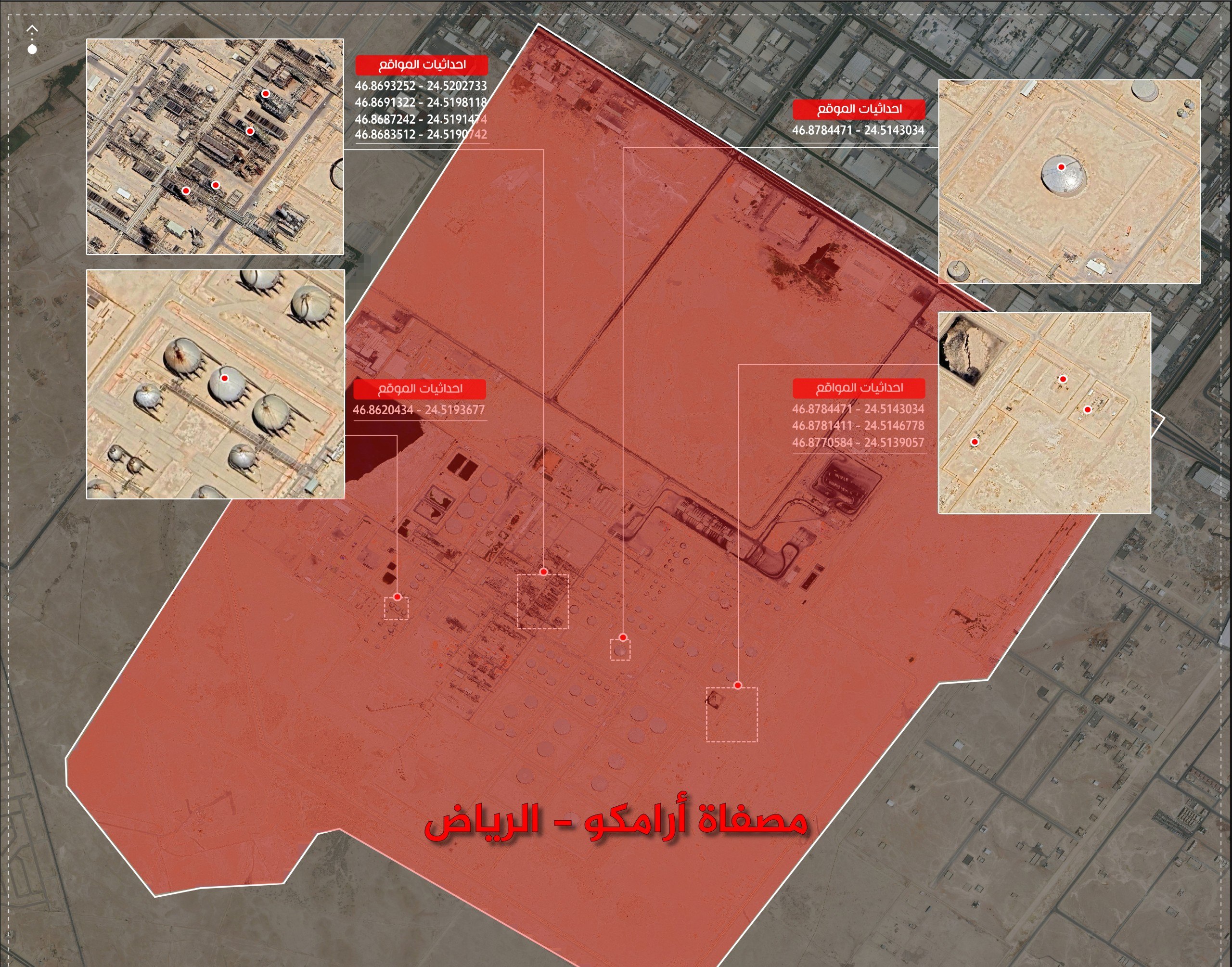
Before the strikes, Saree warned that any Saudi attack on Sanaa would be met with a “firm and painful” response in Riyadh. Following the attack, the Houthis threatened Saudi oil infrastructure, identifying Saudi Aramco’s headquarters in Dammam, an Aramco refinery in Riyadh and King Khalid International Airport as potential targets.

The spokesman described Aramco facilities as “legitimate targets” and urged workers and civilians to stay away from them.

Click to see full-size image.

Click to see full-size image.

Click to see full-size image.

The escalation comes after a series of Houthi missile and drone attacks on Saudi Arabia, including a deadly attack on Riyadh’s international airport on October 10 that killed at least 13 people and injured more than 300.

The attacks have disrupted aviation and heightened pressure on Saudi authorities to strengthen the kingdom’s air defenses.

The latest exchange adds to the widening conflict between the Houthis and the Saudi-led coalition, which supports forces aligned with Yemen’s internationally recognized government. The Houthis will certainly execute their threat and respond with full force, possibly within hours.

_______________________________________________________________________________________________________________________

SouthFront: Analysis and Intelligence

NOW hosted at southfront.press

Previously, SouthFront: Analysis and Intelligence was at southfront.org.

The .org domain name had been blocked by the US (NATO) (https://southfront.press/southfront-org-blocked-by-u-s-controlled-global-internet-supervisor/) globally, outlawed and without any explanation

Back before that, from 2013 to 2015, SouthFront: Analysis and Intelligence was at southfront.com

SOUTHFRONT.PRESS

MORE ON THIS TOPIC:

The post Saudi Arabia Strikes Sanaa Using Israeli Tactics, Houthis Threaten Retaliation (Videos) appeared first on South Front.

Houthis Tighten Siege on Taiz, Threaten to Encircle Saudi-Backed Forces Near Bab al-Mandab (Videos)

13 October 2026 at 16:05

File image.

The Houthis (Ansar Allah) advanced on multiple fronts in southwestern Yemen on October 13, tightening pressure on Saudi-backed forces around Taiz while threatening to outflank government-aligned troops defending their remaining positions near the strategic Bab al-Mandab Strait.

In Taiz, Houthi fighters reached the city’s western entrance and captured the al-Hangar checkpoint, with footage showing their presence at the position.

The advances came as Houthi forces pushed south of the city, clearing the areas of Anbian and Wateer, as well as positions along the approaches to Taiz.

The latest gains threaten to further isolate Saudi-backed forces defending Taiz. The Houthis had already tightened their encirclement of the city after capturing Turbah, south of Taiz, on October 4, cutting off most supply routes from government-held territory.

The advance toward al-Hangar and the fighting south of the city put additional pressure on the remaining positions and routes connecting the city with areas held by the government.

Farther south, in neighboring Lahj province, Houthi forces reportedly cleared al-Sharjan, al-Ka’ala, Harazu and al-Khabakhib in the province’s western areas.

The advance adds pressure on Saudi-backed forces deployed along the approaches to Bab al-Mandab, where the Southern Giants Brigades have been fighting to regain territory lost to the Houthis.

The two fronts pose distinct but connected threats to the Saudi-backed deployment. Around Taiz, the Houthis are tightening their hold on the city and its surrounding approaches. In western Lahj, their advance threatens to outflank the Southern Giants Brigades and other government-aligned units near Bab al-Mandab and Kahbub, potentially cutting those units’ routes for reinforcement or retreat.

If the Houthi advance in western Lahj continues, Saudi-backed forces near the strait risk being isolated as the Houthis pressure the forces’ positions from the north and east.

_______________________________________________________________________________________________________________________

SouthFront: Analysis and Intelligence

NOW hosted at southfront.press

Previously, SouthFront: Analysis and Intelligence was at southfront.org.

The .org domain name had been blocked by the US (NATO) (https://southfront.press/southfront-org-blocked-by-u-s-controlled-global-internet-supervisor/) globally, outlawed and without any explanation

Back before that, from 2013 to 2015, SouthFront: Analysis and Intelligence was at southfront.com

SOUTHFRONT.PRESS

MORE ON THIS TOPIC:


The post Houthis Tighten Siege on Taiz, Threaten to Encircle Saudi-Backed Forces Near Bab al-Mandab (Videos) appeared first on South Front.

Missing Missile Warning Adds to Growing Rift Between Zelenskyy and Trump

13 October 2026 at 13:39

File image.

Ukraine received no advance warning from its partners before five Russian ballistic missiles struck infrastructure in Kyiv, President Volodymyr Zelenskyy said on October 13, raising fresh concerns about intelligence cooperation as tensions between Kyiv and the Trump administration deepen.

Zelenskyy described the attack in a post on X as “particularly vile” and stressed the importance of receiving intelligence from Ukraine’s partners about incoming ballistic missiles.

“This is precisely what helps prevent people from being killed — when there is an early warning about ballistic missiles,” he wrote.

The Ukrainian president did not identify which partners had failed to provide a warning, but the United States is likely playing the main role in providing such intelligence.

His remarks came amid an escalating dispute with U.S. President Donald Trump over Washington’s decision to facilitate Russian diesel exports, its pressure on Ukraine to halt attacks against Russian oil refineries and Trump’s announcement of an energy ceasefire that Kyiv had not publicly agreed to.

Trump announced on October 9 that Russia would supply diesel to the U.S. and global markets following a phone call with Russian President Vladimir Putin.

The agreement marked a reversal of years of U.S. policy aimed at restricting Russian energy revenues following Moscow’s full-scale invasion of Ukraine in February 2022. The U.S. Treasury Department subsequently issued a temporary license easing sanctions on certain Russian diesel shipments.

Zelenskyy criticized the arrangement as “a weak decision, unfortunately, a weak decision by strong partners,” according to a statement released by the Ukrainian Embassy in Washington.

In a separate online statement, he argued that the agreement would benefit Moscow by providing resources to sustain its combat effort.

Trump responded by blaming Ukrainian attacks on Russian refineries for contributing to high American diesel prices and suggesting that Ukraine needed a new president.

The dispute has unfolded as the administration seeks to reduce fuel costs ahead of the November midterm elections, with Trump presenting the diesel arrangement as part of his effort to lower prices and revive negotiations to end the conflict.

The friction intensified further after Trump announced on October 11 that Russia and Ukraine had agreed to an immediate “energy ceasefire,” under which both sides would stop attacking each other’s energy infrastructure.

Neither side had publicly confirmed a finalized agreement when Trump announced it, and Kremlin spokesman Dmitry Peskov said on October 13 only that contacts on the matter were continuing.

Zelenskyy said Ukraine had refrained from attacking Russian oil refineries and other energy facilities during the two days following Trump’s announcement, while accusing Russia of continuing to strike Ukrainian energy infrastructure.

“These are absolutely clear signals that they have no intention of refraining from strikes on Ukraine,” he said.

Against this backdrop, reports have emerged that Washington warned Kyiv it could lose critical military and intelligence support if it continued attacking Russian refineries.

The Washington Post reported on October 12, citing a Ukrainian security adviser and a Western official familiar with the matter, that U.S. officials had urged Ukraine to suspend the attacks and reminded Kyiv of Washington’s role in supplying weapons and intelligence.

The Ukrainian adviser said Kyiv interpreted the message as a warning that Washington “could cut intel and everything going under PURL if you don’t stop.” PURL is a NATO mechanism through which European allies finance purchases of U.S. weapons for Ukraine.

CNN separately reported, citing two European officials, that the Trump administration had warned Ukraine it could suspend intelligence sharing and the mechanism through which European countries purchase American weapons for Kyiv.

Zelenskyy’s latest remarks suggest that the Trump administration may be escalating pressure on Kyiv, with the growing rift potentially beginning to affect the security relationship between the two countries.

_______________________________________________________________________________________________________________________

SouthFront: Analysis and Intelligence

NOW hosted at southfront.press

Previously, SouthFront: Analysis and Intelligence was at southfront.org.

The .org domain name had been blocked by the US (NATO) (https://southfront.press/southfront-org-blocked-by-u-s-controlled-global-internet-supervisor/) globally, outlawed and without any explanation

Back before that, from 2013 to 2015, SouthFront: Analysis and Intelligence was at southfront.com

SOUTHFRONT.PRESS

MORE ON THIS TOPIC:

The post Missing Missile Warning Adds to Growing Rift Between Zelenskyy and Trump appeared first on South Front.

Hijab Dispute Tests ‘One Nation, Two States’ Alliance Between Turkey and Azerbaijan

13 October 2026 at 13:07

Click to see full-size image.

Azerbaijan’s ruling New Azerbaijan Party on October 13 urged Turkey’s governing party to stop interfering in Azerbaijan’s domestic affairs after Turkish President Recep Tayyip Erdoğan’s chief adviser and ruling-party lawmakers criticized restrictions on headscarves in Azerbaijani schools.

In a statement released through its press service, the New Azerbaijan Party accused Turkish media outlets and social media platforms, including sources close to Erdoğan’s Justice and Development Party, or AKP, of spreading what it described as false, biased and defamatory information about Azerbaijan.

The party claimed that criticism by Turkish officials had become part of a broader campaign against the country as a whole.

The statement singled out Erdoğan’s chief adviser, Oktay Saral, and AKP lawmakers for making what it called populist and irresponsible remarks without adequately considering Azerbaijan’s constitutional system and legal framework for religious freedom.

“Using sensitive issues such as the headscarf as instruments of political manipulation and division serves neither the unity of the Turkish people nor the solidarity of the Muslim world,” the party said.

It called on the AKP leadership to “refrain from this harmful policy” and rejected the use of the issue as a means of political pressure against Azerbaijan.

The dispute follows a September 21 decision by Azerbaijan’s Cabinet of Ministers that amended school uniform regulations, prohibiting clothing that violates uniform requirements or conflicts with the secular principle of general education.

The decision does not explicitly mention the hijab, but some schools have prevented girls wearing Islamic headscarves from attending classes. Reports have also described restrictions affecting teachers wearing hijabs, prompting protests and criticism of the policy.

The Azerbaijani Press Agency, citing the government decision, said the amendment was intended to establish uniform clothing standards consistent with the country’s secular education system. However, critics of its implementation have argued that it restricts religious freedom and the right to education.

Saral entered the dispute on October 12, writing on social media that preventing students from attending school because they wore headscarves was unacceptable. He urged Azerbaijani authorities to reverse the restrictions, arguing that religious clothing should not prevent young people from receiving an education.

“Hijab is not an obstacle, but a requirement of faith,” Saral wrote, adding that the right to education should not be sacrificed to ideological dictates. His remarks were reported by Turkish and Azerbaijani media.

The criticism has extended beyond political statements. Demonstrators gathered outside Azerbaijan’s consulate in Istanbul last week to protest the restrictions and call on the authorities in Baku to reconsider the rules.

Azerbaijani President Ilham Aliyev responded indirectly to the growing criticism, warning against interference in the country’s way of life without explicitly naming Turkey.

On October 7, AKP spokesman Ömer Çelik sought to emphasize the strength of the bilateral relationship, describing Turkey and Azerbaijan as “one nation, two states.” He said disagreements between the countries could be discussed openly between allies and accused unnamed countries of driving a wedge between the two. Çelik also criticized groups and social media users in Turkey for targeting Azerbaijan.

The New Azerbaijan Party’s latest statement emphasized that the two countries’ historical ties did not give either side the right to interfere in the other’s domestic affairs. It noted that both countries are constitutionally secular states and argued that Azerbaijan’s education policy should not become an instrument of political pressure.

The statement also defended Azerbaijan’s relations with Israel, rejecting what it described as deliberate distortions of those ties. It said Baku maintains normal interstate relations with Israel while supporting Palestinian rights, providing financial and humanitarian assistance to Palestinians, and backing a two-state solution with East Jerusalem as the capital of Palestine.

The party argued that Azerbaijan’s position on Palestine and its relations with Israel were compatible, rejecting criticism that sought to portray its foreign policy as inconsistent with solidarity among Muslim countries.

Invoking the longstanding description of the countries as “one nation, two states,” the New Azerbaijan Party said the principle reflected the friendship between two independent countries and could not justify attempts by one side to impose its political or ideological views on the other.

The dispute is testing the limits of the countries’ “one nation, two states” alliance, exposing tensions between Baku’s insistence on noninterference and the religious-solidarity arguments advanced by figures within Erdoğan’s party.

It also highlights the growing prominence of Islamist and religious-conservative rhetoric within the AKP, which has increasingly used religious identity as part of its political messaging.

The issue carries an additional religious dimension, as Azerbaijan’s Muslim population is predominantly Shiite, while Turkey is majority Sunni, although both countries are constitutionally secular and their partnership has largely been driven by shared linguistic, strategic and regional interests rather than sectarian identity.

While the dispute has not amounted to a formal diplomatic rupture, it underscores how competing approaches to religion and domestic policy can strain even close strategic partnerships.

_______________________________________________________________________________________________________________________

SouthFront: Analysis and Intelligence

NOW hosted at southfront.press

Previously, SouthFront: Analysis and Intelligence was at southfront.org.

The .org domain name had been blocked by the US (NATO) (https://southfront.press/southfront-org-blocked-by-u-s-controlled-global-internet-supervisor/) globally, outlawed and without any explanation

Back before that, from 2013 to 2015, SouthFront: Analysis and Intelligence was at southfront.com

SOUTHFRONT.PRESS

MORE ON THIS TOPIC:

The post Hijab Dispute Tests ‘One Nation, Two States’ Alliance Between Turkey and Azerbaijan appeared first on South Front.
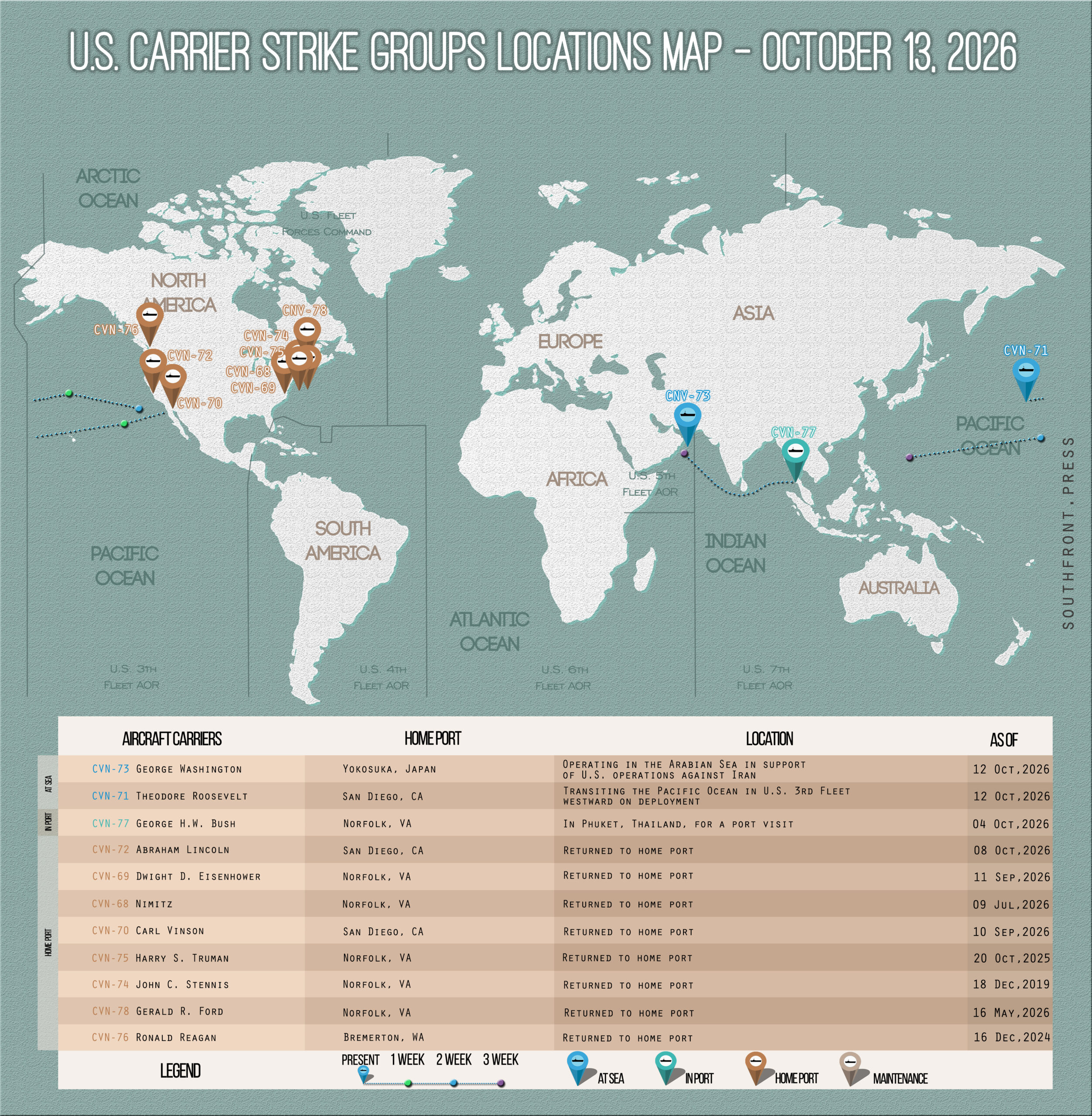
Locations Of US Carrier Strike Groups – October 13, 2026

13 October 2026 at 12:33

This is the newest update of the ‘U.S. Carrier Strike Groups Locations Map’ exclusive series showing the approximate locations of U.S. Carrier Strike Groups. SouthFront: Analysis & Intelligence tracks locations of U.S. aircraft carriers using the available open-source information. No classified information was used in production of the map.

click to see the full-size image

Carrier strike group (CSG) is an operational formation of the United States Navy. It is centered on an aircraft carrier and a carrier air wing of 65 to 70 aircrafts. It’s composed of roughly 7,500 personnel, an aircraft carrier, at least one cruiser, a destroyer squadron of at least two destroyers and/or frigates. A carrier strike group also, on occasion, includes submarines, attached logistics ships and a supply ship. Carrier strike groups comprise a principal element of U.S. power projection over the world’s oceans

______________________________________________________________________________________________________________________

SouthFront: Analysis and Intelligence
NOW hosted at southfront.press
Previously, SouthFront: Analysis and Intelligence was at southfront.org.
The .org domain name had been blocked by the US (NATO) (https://southfront.press/southfront-org-blocked-by-u-s-controlled-global-internet-supervisor/) globally, outlawed and without any explanation
Back before that, from 2013 to 2015, SouthFront: Analysis and Intelligence was at southfront.com

SOUTHFRONT.PRESS

The post Locations Of US Carrier Strike Groups – October 13, 2026 appeared first on South Front.

Georgia’s Largest Healthcare System Will Fire Employees Who Refuse Flu Vaccine

By: aletho
5 October 2026 at 23:39
By Brenda Baletti, Ph.D. | The Defender | October 5, 2026

Employees of Georgia’s largest healthcare system have until Nov. 1 to get the flu vaccine or an approved exemption, or they will be suspended without pay. If suspended employees don’t submit proof of vaccination by 4 p.m. Nov. 15, they will be fired.

According to the Emory Healthcare website, the vaccine mandate applies to all employees, including contractors and remote workers.

Employees suspended for missing the first deadline, Nov. 1, 11:59 p.m., will not be allowed to use their paid time off.

COVID-19 shots are not mandated, but employees are “encouraged to engage in shared decision-making with their provider” on whether or not to get the vaccine.

A spokesperson for the healthcare system said the requirement is intended to protect patients and staff and to encourage everyone to get vaccinated.

Dr. Sherika Newman of Doctor in the Family, a physician-led patient advocacy and health consulting service in Atlanta, told CBS News that flu vaccine requirements are common in healthcare.

“Asking health care providers or people who interact with patients to take the flu vaccine early every year is what we always mandate so that we are protecting ourselves from spreading viruses to vulnerable populations,” Newman said.

She said everyone should get vaccinated, not just healthcare workers, although only healthcare workers will lose their jobs if they don’t get the vaccine.

Cleveland Clinic: 2024-2025 flu shot increased risk of getting the flu

Flu vaccine effectiveness can vary, according to the Centers for Disease Control and Prevention (CDC), which cites studies since 2009-10 showing effectiveness between 19% and 60%. The major factors influencing vaccine effectiveness are a person’s age and health and how well the vaccines match the circulating virus strains.

According to a Cleveland Clinic study published last year, people who received a flu vaccine formulated for the 2024-25 flu season had a 27% higher risk of getting the flu than those who didn’t get the vaccine.

It wasn’t the first study to find that flu vaccines could actually increase the risk of becoming ill.

A 2023 study co-authored by Dr. Anthony Fauci acknowledged that “viruses replicating in the respiratory mucosal environment continue to present a particular challenge for developing effective vaccines with strong protection.”

“The flu shot has never really prevented transmission of the flu and in some years (i.e., last year) the efficacy of preventing the flu is actually negative,” said Brian Hooker, Ph.D., chief scientific officer at Children’s Health Defense. “Flu would blow through a vaccinated population with nearly the same ease as it would an unvaccinated population.”

A 2012 peer-reviewed study published in Clinical Infectious Diseases showed that children who received the flu vaccine were at significantly increased risk of contracting non-flu respiratory virus infections.

Moderna’s mRNA flu shot added to the mix this year

According to the CDC’s FluView vaccination chart, as of Sept. 26, flu cases were at “minimal” levels across almost all 50 U.S. states, including Georgia.

Flu season typically begins in October and ends in May, with highest transmission rates in December and February.

The CDC recommends flu shots for people age 6 months and older, assuming they have no medical conditions that make vaccination risky.

Flu shot formulations differ each year based on information about which strains may circulate that year. The formulations aren’t tested for safety or efficacy before they’re distributed to the public.

In March, vaccine advisers to the U.S. Food and Drug Administration (FDA) recommended trivalent vaccines to protect against two influenza A and one influenza B viruses.

In the past, most flu vaccines were made from a flu virus grown in eggs, and then inactivated and made into a vaccine. Or, they were made from recombinant protein vaccines, which have pieces of the flu pathogen that the immune system learns to recognize and fight.

This year, Moderna’s controversial mRNA flu shot, mFLUSIVA, approved in June, is also available for people age 50 and over.

Number of healthcare workers getting flu, COVID vaccines declining 

Manufacturers say they will produce up to 135 million doses of flu vaccine for the U.S. market this flu season.

In recent years, many healthcare workers have been resisting flu shot mandates and declining the shot.

For example, record numbers of frontline health workers in the U.K. refused the flu vaccine in 2024-25.

Rates of U.S. healthcare workers who take the COVID-19 and flu shots have also been declining in recent years.

Numbers are lowest among health professionals who work in nursing homes. In the 2024-25 flu season, only about 42% of those workers got the shot, compared with about 81% of workers in acute care hospitals.


This article was originally published by The Defender — Children’s Health Defense’s News & Views Website under Creative Commons license CC BY-NC-ND 4.0. Please consider subscribing to The Defender or donating to Children’s Health Defense.

The End of the European Summer

21 August 2026 at 20:02

Europe is warming more than twice as fast as the global average—a terrifying statistic made all too apparent this summer as heat wave followed heat wave. European cities were never designed for these temperatures, and public health, infrastructure, and tourism are all under strain. Eric Klinenberg arrives in Milan just as “Europe’s third heat wave of the summer entered its fiercest stretch” and sweats his way across the continent to see how trees, shade, water, and other measures are being deployed to adapt urban centers. But with this crisis set to deepen can these experiments really keep pace?

Of all the problems that heat poses for Barcelona, losing some of the hundred and sixty thousand tourists who typically visit each day ranks low on the priority lists of most officials and residents. Some locals have staged protests, chanting “Tourists go home” while targeting visitors with water guns. But tourism employs more than a hundred and sixty thousand people in Barcelona and accounts for around thirteen per cent of its economic output, which explains why, despite concerns that the city gets too many visitors, more than seventy per cent of residents consider tourism beneficial. At midday, when I arrived on La Rambla, the city’s most heavily visited and photographed corridor, the street had little shade and surprisingly few people. At La Boqueria market, normally jam-packed at lunchtime, I found my way to a famously busy bar counter and took one of several open seats.

❌