❌

Normal view

Reliance snaps back at Musk over Ambani claims

16 October 2026 at 11:17

Reliance Industries appeared to hit back at Elon Musk’s suggestions its owner Mukesh Ambani (pictured) was blocking Starlink’s entry into India, stating it welcomes competition and pointing out its own satellite venture has also not been cleared by regulators.

In a statement on Musk-owned X, Reliance said considering recent remarks about the company and the Indian market, it wished to put on record that like every Indian enterprise it had grown in a country that welcomes investment and innovation.

It continued to state the open nature of the Indian market rests on the rule of law, and the government has stated it applies the same process to every applicant, Indian or foreign.

“Jio’s own satellite service awaits clearances,” it said. “At Reliance we never feared competition… we welcome competition in satellite communications, including Starlink. Every player, Jio included, must serve the people of India and abide by the laws and policies of the land.”

Reliance’s statement followed a series of Musk’s own posts regarding Starlink’s entrance into India. The SpaceX chief claimed “certain oligarchs” were delaying its entry into the country to maintain a “monopolistic chokehold on the Indian people”.

While emphasising the benefits satellite connectivity will have on the Indian market, Musk sarcastically addressed Ambani as India’s real Prime Minister and asked if he would “consider allowing Starlink to compete”.

Musk also described suggestions Starlink would struggle to compete with Jio and its low-cost data plans as “absurd, hypocrisy and hyperbole”.

India’s government has also rejected Musk’s claims, stating its satellite communications framework is fair and non-discriminatory while emphasising that Starlink, Jio and Sunil Bharti Mittal-backed Eutelsat OneWeb are all awaiting security clearance and spectrum allocation.

The post Reliance snaps back at Musk over Ambani claims appeared first on Mobile World Live.

Apple, Nvidia, Ergen each give $25M for Trump project

16 October 2026 at 09:16

Apple, Nvidia and EchoStar chair Charlie Ergen reportedly committed $25 million each for the construction of US President Donald Trump’s White House ballroom project, which has raised $333 million to date in private donations.

The Washington Post reported “the vast majority of the funds raised came from companies and wealthy individuals with interests before the federal government” after obtaining an internal spreadsheet used to track contributions for the fundraising effort.

The Post noted more than three-quarters of the funding was pledged in amounts of at least $5 million, with Amazon, Comcast, Microsoft, and T-Mobile US among the largest corporate donors.

It stated Nvidia and Ergen, among others, requested their donations be kept anonymous

The news site noted companies or executives of firms that have had contracts with the federal government during Trump’s second term accounted for about half of the total funds raised for the project which also includes office space and an underground military facility.

According to internal contractor documents obtained by the Post, the total cost of the project is now $600 million after Trump initially stated he and wealthy donors would pay the estimated $400 million project, although Reuters reported he later unsuccessfully asked Congress for $1 billion. The Post noted Trump’s name did not appear on the list of 67 donors who contributed $10,000 or more to the project.

The funds for the project are administered through a complex, multi-step pipeline involving a private nonprofit, federal agencies and direct oversight by the Trump administration.

The news agency reported Nvidia became “a top contributor to the ballroom in October 2025, nearly three months after it struck a groundbreaking pact with Trump to sell advanced microchips to China despite national security concerns”.

“As an American company, our support for the United States is paramount, and independent of any business interests,” a representative for Nvidia told Mobile World Live. “We were proud to be able to make a donation to a nonpartisan trust that serves all Americans and have said so publicly since the donation was made.” 

Apple and EchoStar did not reply to requests for comment on their contributions.

The post Apple, Nvidia, Ergen each give $25M for Trump project appeared first on Mobile World Live.

Deskilling the Body

15 October 2026 at 14:00

“We have fallen into habits that are steadily deskilling the human body,” writes Melanie Challenger. “This is a strange turn of events for an animal whose success comes mostly from the extraordinary ability to learn through experience.” For Aeon, Challenger explores how modern technologies, from GPS to AI, are eroding our body’s physical skills by replacing the embodied experiences through which we learn.

After all, the brain is itself a physical organ, continually shaped by what the body does and encounters. Once we decide that the mind is the real human and the rest of the body only hardware, it becomes easier to disregard the physical work, including the neurocognitive work of a biological brain, through which we move, find our way, put thoughts into words, and recognise our own needs. A machine may do some of that work faster, but each act it takes over is one that the body no longer performs and that the body, including the brain, no longer learns through. The irony is that a project motivated by the desire to overcome bodily fragility is helping to produce more fragile bodies.

U.S. tech leaders are urgently calling for rules on AI – China already has them

By: A A
15 October 2026 at 12:00

By Madeline CARR

Join us on Telegram, X, and VK.

Contact us: info@strategic-culture.su

Recent warnings from American AI leaders have created the impression that the world is only beginning to confront the dangers of advanced artificial intelligence.

Dario Amodei, chief executive of tech company Anthropic, has called for governments to intervene to slow the development of increasingly powerful AI models.

His proposal begins with independent evaluators embedded inside AI companies, moves on to regulation and progresses to government-backed coordination among democratic states.

Ultimately, it seeks global agreements with China on testing of AI systems, dangerous applications of the technology and the pace of AI development.

Yet there is a China-shaped hole in this narrative. The Asian superpower is portrayed as the difficult final participant in a governance system that the US and its allies must first create.

In fact, China has already established an extensive system of AI rules, assessment, filing, technical standards and government oversight. Here’s how China’s AI governance system has developed in stages alongside the technology itself.

Beijing’s 2022 rules on algorithmic recommendation services apply to technologies that select, rank, filter or recommend online content to users.

They compel companies that use algorithms to examine how they work, to protect the personal information of users, to give users certain controls, and to introduce safeguards for workers, consumers, children and older people.

China’s deep synthesis provisions, effective from January 2023, extended regulation to synthetic (or AI-generated) text, images, audio and video. AI companies must authenticate users, protect data, keep relevant records, assess their systems and identify synthetic material that could be mistaken for authentic content.

The interim measures for generative artificial intelligence services were introduced in August 2023. These added rules for public-facing generative AI, particularly those that can influence public opinion or persuade uses in other ways.

The measures apply to the legality and quality of training data, users’ personal information, intellectual property and discrimination based on protected characteristics. The rules also cover transparency by AI companies and the accuracy and reliability of products.

Under the rules, companies must address problems found in their services. These services must undergo a security assessment to examine their risks and compliance with Chinese legislation. The companies must also file information about their algorithms with Chinese authorities.

These mechanisms are not identical to the independent evaluators that would be embedded in AI companies, as has been proposed by Amodei. But they perform some of the same functions.

Frontier risks

Beijing’s latest set of measures is called the AI safety governance framework 3.0, published in September 2026. It sets out a broad approach to identifying, grading and responding to risks throughout the lifecycle of AI systems.

Building on earlier versions, the framework covers AI model and data risks, vulnerabilities in open source models (those which can be freely modified by users), AI’s effects on employment and society and increasingly autonomous systems.

It includes a dedicated mechanism for managing risks associated with rapidly developing AI agents (systems that carry out tasks in response to instructions by a user).

The framework addresses some of the same dangers now generating alarm in Silicon Valley, including highly autonomous systems, the misuse of chemical, biological and nuclear technologies, and the possibility of humans losing control of advanced AI. It proposes continual safety evaluations, risk based safeguards, humans being in charge, and emergency intervention mechanisms.

An independent analysis by the US Carnegie Endowment for International Peace thinktank has described the framework as China’s attempt to “to advance frontier safety without the need for heavy handed regulatory interventions”.

Legal consequences

None of this means that Chinese AI rules should be transplanted elsewhere. Its institutions, regulatory traditions and technological priorities are different.

Many functions now presented as urgent aspirations in the US, including evaluation, accountability for AI companies, risk classification for AI systems, regulatory filing, technical standards and government oversight are already embedded in the governance architecture of the world’s other AI superpower.

The US is free to conclude that a market-led system best serves its economic and strategic interests. The Trump administration has favoured a “minimally burdensome” national approach to AI and has sought to limit more demanding state-level regulation.

But a market-led model cannot mean privatising the rewards of AI while exporting its risks. US companies may capture the commercial gains, while governments elsewhere are left to investigate security incidents, protect public systems and absorb the wider costs when those technologies fail. The OpenAI agent that gained unauthorised access to Australia’s state healthcare service shows how AI risks are being exported.

If Washington rejects extensive controls before systems are released, the US needs a credible legal regime for assessing who is liable for damage caused by those AI models. Otherwise, countries dependent on foreign AI systems will face increasingly difficult choices about whose technology to trust, and on what terms.

Silicon Valley’s governing ethos has long been to “move fast and break things”. That was always a questionable principle for technologies woven deeply into public life. It is untenable for companies whose own leaders now warn that their products could cause catastrophic harm.

Beijing has already surrounded its AI sector with public obligations, regulatory oversight and an evolving framework of risk assessment. A global debate that treats such governance as a future aspiration should at least recognise that one country is already ahead of the curve.

Original article: theconversation.com

GlobalFoundries to run Japan, US $20B chip sites

14 October 2026 at 16:18

Japan will pump $20 billion in funding into two new semiconductor facilities in the US as part of a trade agreement between the two countries, with GlobalFoundries selected to operate the sites.

The move forms part of a wider trade deal between the countries for Japan to invest $550 billion in return for the US lowering tariffs of Japanese goods.

GlobalFoundries will build the new sites at its Malta, New York, campus with the initiative designed to accelerate trusted semiconductor manufacturing in the US, strengthen critical supply chains and support growing demand across automotive, industrial and connected infrastructure markets.

Japan will make an initial investment of approximately $10 billion, accelerating construction of a new 300mm semiconductor fab which is expected to come online in 2029. It will add approximately 900,000 wafers of annual manufacturing capacity when fully operational.

An additional $10 billion will fund a second fab, which will produce the same amount of wafers. The entire project is expected to create about 27,000 construction and ecosystem jobs and more than 1,000 highly skilled manufacturing jobs in New York’s Capital Region.

Bold
GlobalFoundries has also agreed a deal with the US Commerce Department to amend an existing award under the CHIPS and Science Act to reallocate $995 million towards investments in silicon photonics and other areas. This will expand manufacturing capacity for technologies “increasingly critical to communications infrastructure and data centres”.

As part of a separate arrangement, the US government will receive approximately 4% equity in GlobalFoundries, taking its total stake to 7%.

Tom Breen, CEO of GlobalFoundries said the initiative was a bold new step for semiconductor manufacturing, bringing together the US and Japan with differentiated technology and decades of manufacturing expertise.

Howard Lutnick, US secretary of commerce added President Donald Trump’s historic US, Japan trade deal “is delivering another massive manufacturing investment into America”.

The post GlobalFoundries to run Japan, US $20B chip sites appeared first on Mobile World Live.

Docomo, Abside team on AI for HAPS communications

14 October 2026 at 11:38

NTT Docomo and US-based network equipment manufacturer Abside Networks signed an agreement to explore next-generation, AI-driven networks using high-altitude platform stations (HAPS), as operators look to extend networks beyond terrestrial infrastructure.

Under the memorandum of understanding (MoU), the pair will collaborate on HAPS system architecture, network control and data utilisation. They will also examine how AI can forecast demand and manage radio beams, capacity, spectrum and interference in stratospheric RAN.

In addition, the partners plan to study the collection and use of data on network quality, operations and stratospheric sensing, as well as potential integration with external applications and service platforms.

The agreement supports NTT Docomo’s broader vision for a “three-dimensional communications infrastructure that integrates AI with non-terrestrial network (NTN) initiatives, including HAPS”. Operating at altitudes of around 20km, HAPS use unmanned platforms to provide wide-area connectivity, including to underserved locations where conventional mobile coverage is difficult or uneconomical, such as mountainous regions and maritime areas.

The Japanese operator explained it aims to integrate terrestrial networks with systems in the stratosphere and space to enable wider-area, higher-capacity services that address mounting connectivity demand as AI usage balloons.

NTT Docomo has been conducting research and demonstrations aimed at delivering HAPS-based communications services, but noted the stratospheric environment requires specialised RAN technologies and equipment.

As a result, Abside is developing radio systems based on large antenna arrays for precise beam control, alongside an AI-driven software platform designed to provide “integrated control of networks across the ground, stratosphere and space”.

The equipment manufacturer also brings experience in stratospheric communications through its work on Google’s Project Loon balloon initiative, alongside development of HAPS equipment, NTN technologies and AI-based network control systems.

The post Docomo, Abside team on AI for HAPS communications appeared first on Mobile World Live.

Survey finds majority of Americans say AI is developing too fast

By: A A
13 October 2026 at 12:00

Meanwhile Donald Trump has dismissed calls for more regulation, saying the United States needs to maintain its edge over China in the AI race.

Join us on Telegram, X, and VK.

Contact us: info@strategic-culture.su

A new poll indicates that 64 percent of Americans believe artificial intelligence (AI) is developing “too fast.”

The Associated Press-NORC Center poll released on Oct. 8 showed that just 27 percent say the development is “about right,” and less than 10 percent think it’s moving “too slow.”

Of the polled adults, more Democrats (76 percent) than Republicans (54 percent) think AI is moving too fast. However, 70 percent of those under 30 years old think the technology should be slowed, and 60 percent of those 60 years old and older think the same.

The findings come amid growing concern over the technology’s potential threat to humanity, which has led to industry leaders and politicians calling for a slowdown and more regulation.

President Donald Trump has dismissed calls for more regulation, saying the United States needs to maintain its edge over China in the AI race. Major AI companies recently signed a voluntary accord with the White House that calls for internal and external reviews.

According to the poll conducted Sept. 24 to 28, about half of respondents think the government’s support is about promoting technological innovation, and a little fewer say they think it’s about competition with China.

Meanwhile, 80 percent of Americans say it’s “extremely” or “very” important for the United States to ensure AI stays under human control.

Recent months have seen several incidents of AI agents from major tech firms breaching websites of private companies, research institutions, and multiple government agencies.

Notably, ChatGPT developer OpenAI acknowledged in July that its AI agents broke out of a testing environment and hacked into Hugging Face, an open-source community for AI.

In September, OpenAI canceled the release of its latest model, GPT-6.1 Astra, slated for October, over safety concerns. It also postponed plans for its initial public offering this year.

Lawmakers from both sides of the aisle have proposed a range of measures to regulate the technology, but none are likely to advance anytime soon with Congress in recess ahead of the midterms.

Confidence in politicians’ handling of AI is low, with 23 percent trusting Democrats to do a better job and 21 percent favoring Republicans, while 39 percent trust neither party.

Mistrust of AI appears to have extended to the realm of politics, as very few adults are using AI as a source of information for the upcoming election. The poll indicated that only about 21 percent of respondents said they use or plan to use AI to gather information about a candidate or ballot issue.

Even fewer (12 percent) said they will use AI for information about how to vote, and only 10 percent said they would use it for information on voter registration.

AT&T is flying with Amazon Leo instead of Starlink

13 October 2026 at 11:06

Interview: AT&T Business selected Amazon Leo for an enterprise broadband service designed to complement its fibre and 5G offerings, describing the satellite provider as a business-grade alternative to Starlink.

Shawn Hakl, SVP and head of product at AT&T Business (pictured), told Mobile World Live the service adds a third connectivity option, including in areas beyond the reach of AT&T’s terrestrial networks.

A middle-aged man with short, thinning grey hair and a friendly smile. He is wearing a dark grey, long-sleeved quarter-zip jumper against a blurred, neutral indoor background.

“We’ve done a lot of integration with Amazon and we’re working with them at different levels,” he said. “We’ve tested the product out pretty extensively and we’ve seen sub-50 millisecond latency. We’re also extremely happy with the throughput.”

Amazon Leo selected AT&T Business as its sole US telecoms launch partner.

“They’ve been extremely willing to work with us to fine-tune the interaction between the two networks,” Hakl explained. “We’re working closely with them on how to harmonise the in-air component and the interaction between our network and the ground stations.”

AT&T Business is providing the last-mile connectivity and local customer equipment for the service, while working with Amazon on the interaction between AT&T’s terrestrial network and Amazon Leo’s ground stations.

He said the operator is striving to make the connection between its network and the cloud “a software consumable element” which could be combined with satellite, wireless and wireline connectivity in an end-to-end architecture rather than offered as a series of point-to-point products.

Hakl said some customers will want traditional active-passive setups, others active configurations and some multiple-box arrangements.

“I don’t think we can get down to a single box in the first iteration,” he noted.

Hakl stated combining fibre, 5G and satellite will enable AT&T Business to deliver different services, SLAs and business outcomes for each customer. This will give customers more granular control over how applications use network resources, including the ability to balance performance, cost and security across their connectivity options.

Customers could choose how much control they retain, Hakl said. Some may want to manage network decisions in detail, while others could leave them to AI models.

Hakl noted AT&T has sold satellite services for a decade, particularly in agriculture, manufacturing and retail, while public safety through FirstNet is another area of focus.

“If the price point comes down, obviously it becomes more of an option for different segments in the market,” he stated. “We’re just impressed with Amazon’s technology and feel like it’s the business-grade solution that’s out there.”

Hakl said AT&T Business expects to offer the service next year, although the timing remains tied to Amazon Leo’s satellite launch schedule.

Launch timing
In July, Blue Origin CEO Dave Limp outlined a plan to rebuild its Florida launch pad with a new configuration after a failed attempt as it works toward returning its New Glenn rocket to flight before the end of the year.

Also in July, Amazon Leo applied to the US Federal Communications Commission to deploy up to 5,105 birds to deliver direct-to-device services to mobile devices.

And in October, Amazon company communications manager Zack Brown revealed the company currently has 396 LEO birds in orbit and said the company has built over 1,000 satellites at its 172,000-square-foot production facility in Kirkland, Washington.

The post AT&T is flying with Amazon Leo instead of Starlink appeared first on Mobile World Live.

India’s superpower dream is just another recycled Modi slogan

13 October 2026 at 06:14

Famous Indian author Shashi Tharoor was famously quoted as saying: “Everything in India is recycled, even the dreams “ In October 2010, The Economist ran a cover titled “How India’s growth will outpace China,” citing India’s young population, dynamic private sector and a strong democratic system as advantages over China’s state-led model. The IMF projected […]

The post India’s superpower dream is just another recycled Modi slogan appeared first on Asia Times.

Musk takes fresh swipe at Ambani as Jio IPO looms

12 October 2026 at 15:37

Elon Musk pledged to make Starlink affordable in India as he renewed his attack on billionaire Mukesh Ambani’s (pictured) telecoms dominance, days before Jio Platforms launches a record-breaking IPO.

In a series of posts on social media platform X, the SpaceX chief argued that competition from Starlink would benefit Indian consumers by expanding connectivity options. “The reality is that competition would greatly benefit the average citizen in India by giving them more choices, as it always does,” he explained, adding, “Ambani’s profits will be lower, but he is not going out of business”.

Musk also dismissed claims that Starlink would struggle to compete with Jio’s low-cost data plans while also posing a threat to the incumbent operator. “This is absurd hypocrisy and hyperbole,” he said.

His comments come as Jio Platforms targets a valuation of around $106 billion, according to Reuters, in a planned IPO that could become India’s largest-ever listing. The business includes telecoms operation Reliance Jio, which reported 524.4 million subscribers at the end of March, including 268.5 million 5G customers.

“Prime Minister Ambani“
Musk has escalated his criticism of India’s regulatory process in recent days, accusing authorities and “certain oligarchs” of delaying Starlink’s entry into the country to maintain a “monopolistic chokehold on the Indian people”.

In a separate post on Friday (9 October), he sarcastically addressed the Jio Platforms-owner as “Prime Minister Ambani” and asked whether he would “consider allowing Starlink to compete”.

He argued satellite connectivity could bring internet access to underserved communities, improve educational opportunities and enable small businesses to reach international markets.

“Please accept my humble apologies for not realizing that you are the real boss of India,” he wrote, adding “Starlink would change their lives for the better”.

India’s Ministry of Communications has rejected allegations of discriminatory treatment, stating that Starlink and incumbents Bharti Airtel and Reliance Jio were at broadly the same stage of the regulatory process. All three have secured initial approvals but remain subject to outstanding security clearances before they can obtain spectrum access.

The post Musk takes fresh swipe at Ambani as Jio IPO looms appeared first on Mobile World Live.

Feature: Why ISAC is moving beyond labs to live trials

12 October 2026 at 11:06

MWL‘s Mike Robuck sits down with executives from Ericsson, AT&T, Verizon and the US Department of War (DoW) to discuss the progress Integrated sensing and communication (ISAC) has made this year and where it is headed next.

Ericsson Federal CEO Christopher Ling sees sensing as a potential killer app for 6G, arguing it could give the US military a reason to invest in commercial cellular infrastructure beyond connectivity.

Integrated sensing and communication (ISAC) turns communications networks into sensors by analysing radio signals reflected from objects. It can detect, track and identify objects in much the same way as radar.

Ericsson Federal Technologies Group is the vendor’s US unit focused on adapting its commercial network technology for federal government and national-security customers.

ISAC has moved beyond laboratory testing over the past year. It has been demonstrated at a stadium, included in a US Department of War (DoW) contract and proposed for a Los Angeles, California trial ahead of the 2028 Olympics.

Dr Tom Rondeau, principal director of the DoW’s FutureG programme, said denser 5G and 6G networks, edge-based AI compute and greater access to commercial spectrum are making network-based sensing viable.

“We have a network that covers 70% of the landmass of the United States and about 98% of the population,” he said. “That’s what we’re trying to use this for, to kick off the value proposition of ISAC.”

Rondeau highlighted drones, particularly swarms, as the immediate focus. The aim is to find, fix and track potentially thousands of devices, including in dense cities where traditional sensors struggle and radar cannot simply be pointed into open sky.

“It’s one thing to have a missile defence system or a drone defence system that gets to look up and out into open airspace,” he said, “but it’s another to track it in downtown New York [City] or downtown [Washington] DC.”

Network density could compensate for the limited sensing range of individual sites. At the power levels involved, a single base station might reach only a few kilometres, but sites spaced every half kilometre could extend coverage across much of the network.

A bald man with a short, dark beard wearing a dark suit, white shirt, and patterned red tie. He faces forward with a neutral expression in front of an American flag.

Rondeau (pictured, left) pointed to Ukraine’s Operation Spiderweb, in which drones smuggled deep into Russian territory and controlled over Russia’s cellular network reportedly destroyed roughly a third of its strategic bomber fleet.

“That tells us that we can no longer think of border security as just looking out of our geographical borders,” he said. “We have to be able to look across our entire nation.”

Rondeau also sees civilian applications for ISAC. Drawing on his time at DARPA studying emergency planning, he cited Hurricane Katrina, when evacuation plans fell apart because people did not go where planners expected.

“It’s not like we’re going to redirect them to where we want to be,” he said, “so why don’t we redirect the resources to where they actually are.”

Trials
AT&T and Ericsson ran a drone-detection demonstration near AT&T Stadium in Arlington, Texas, during the FIFA World Cup football tournament a few months ago.

In nearby Dallas, Verizon and Samsung tested a crowd-density heatmap at the World Cup FanFest area, designed to help fans find shorter queues and organisers manage foot traffic.

“That was a crowd sensing for the FanFest area, which is completely different to detecting drones,” said Verizon CTO Yago Tenorio. “It looks like a business-to-business opportunity that you can monetise.”

Tenorio explained ISAC presents fewer privacy concerns than cameras because it returns shape, movement and rough size rather than identity. It can distinguish “a pedestrian from a bicycle and a drone from a bird”, though not one person from another.

The DoW has also begun funding development. In July, Cohere Technologies won a $28 million contract from the FutureG Office to build a multi-waveform radio access network prototype which uses commercial cellular infrastructure to detect drones and other aerial threats.

Ericsson and Finnish state-owned ICT company Erillisverkot have also run live demonstrations in a Helsinki cargo harbour, using sensing data from several network points to detect small, low-altitude drones.

Verizon’s 6G forum
Verizon has made ISAC one of two anchor themes of its 6G Innovation Forum, which it expanded in September. The other theme is AI wearables. Tenorio stated the forum was created to “design 6G bottoms up”, starting with viable use cases and how they might be monetised.

At Qualcomm’s San Diego, California campus, Verizon tested 100MHz to 400MHz of millimetre-wave spectrum across four synchronised transmission and reception points. The system mapped the position and velocity of an airborne target and moving ground vehicles while keeping a phone user on the ground connected over standalone 5G. Verizon presented the trial as a test of drone and vehicle safety tracking.

Millimetre wave was the only spectrum which offered enough bandwidth, Tenorio said, and bandwidth, more than frequency, determines sensing accuracy.

“The precision of the positioning and the radar image… is proportional to the bandwidth of the signal,” he stated. “Not so much the frequency, but the bandwidth.”

Technology divide
Huawei appears to have an early lead in ISAC deployments. Ling said Ericsson had been told the Chinese vendor has more than 300 ISAC-capable systems operating, although he cautioned the figure might not be exact. He linked the reported lead to China’s early nationwide shift to standalone 5G.

A headshot of ISAC Ericsson, a middle-aged man with dark, styled hair and light eyes, wearing a blue pinstriped suit jacket and a bright pink tie against a solid, vibrant blue background.

Ling (pictured, left) explained there’s a difference in terms of network architecture. In a monostatic configuration, one tower transmits a signal and receives its reflection, indicating an object’s presence and general direction. Huawei developed a monostatic system and, in Ling’s view, may now be reconsidering that approach. As far as he knows, Ericsson is the only company using a multistatic configuration, in which one site transmits and other sites receive the reflected signal, enabling more precise location and tracking.

A monostatic system might show an object is off to the left, he said. A multistatic system could place it 1,500 metres away, measure its speed and track it to within eight to 10 metres, the resolution he said the Arlington demonstration achieved.

Ling stressed that Ericsson is focused on 5G sensing rather than a fully integrated sensing and communication system. Turning a 5G network into a radar remains a significant technical challenge, he noted, and the company wants to establish the capability before moving further.

It has committed $100 million to ISAC and expects a commercial product within two years, ahead of the standards debate expected at the 2027 World Radiocommunication Conference.

Ling said micro-Doppler signatures from spinning propellers could allow the system to identify a drone type as well as locate it. “It’s not only detecting, tracking, you can get identification from it as well,” he said.

The resolution may eventually be good enough to support targeting without the more expensive radar systems the military uses today.

“You’ve got a drone that costs $30,000 and we’re shooting it down with a million-dollar missile,” he said. “This starts to bend the cost curve.”

Ericsson has held discussions with European countries bordering Russia, Ling added, and sees growing interest in the Middle East, where governments are concerned about protecting infrastructure.

From 5G to 6G
Tenorio described current ISAC work as a step towards 6G. Vendors are fitting sensing into 5G and 5G-Advanced systems while preserving as much connectivity capacity as possible; 6G would allow them to design the capability into the network from the outset.

“On 5G, you’re just squeezing it in as best as you possibly can,” he said. “But if you understand how it works, you have the opportunity to design it natively in 6G in a way that comes with no compromise.”

Verizon plans to extend its ISAC work to Los Angeles. The carrier has applied to the Federal Communications Commission for a one-year experimental licence to use 4.8GHz to 4.9GHz spectrum, part of the 4.4GHz band the NTIA is studying for 5G and 6G. It plans to test Ericsson hardware and software in and around its LA lab. The filing describes an outdoor private network within a five-kilometre radius, separate from commercial networks. The application is pending.

Tenorio called the band “a good compromise” between available bandwidth and a frequency low enough to propagate farther. Verizon has also applied to take part in the NTIA’s Mission 6G 28 programme, which will showcase 6G technology around the 2028 Olympics.

“LA will be an important opportunity for us to display not only what 6G is about… but where we are in terms of advancing the technology,” he said.

Beyond drones and crowds, Tenorio sees enterprise uses such as digital twins of factories and campuses. At shorter ranges, he said, ISAC could support vital-sign monitoring and fall detection in elderly care.

Shawn Hakl, SVP and head of product at AT&T Business, sees the value in places where cameras and sensors are impractical, or the assets belong to someone else. He cited public safety, analytics and flow control, and spotting changes such as an unplanned obstruction on a city street.

“ISAC gives us a way to get sort of topology information, environment information without having physically deployed stuff and basically getting signal data back,” he said.

Ling stated the military case may ultimately depend on sensing rather than connectivity: a customer which would not buy a 5G network solely for communications could still need the infrastructure to obtain 5G sensing.

The post Feature: Why ISAC is moving beyond labs to live trials appeared first on Mobile World Live.

EU tech chief expects countries leading AI race to come around on safety

9 October 2026 at 13:47

The European Union’s technology chief expects countries that oppose stricter artificial intelligence rules to change course, as AI systems are becoming more capable and harder to evaluate.

“I’m sure that all those countries who are not willing to regulate the use of AI, they will come back to that quite soon,” European Commission Executive Vice-President Henna Virkkunen told the European Newsroom (enr) on Friday. She warned of a “risk of very serious incidents” in the absence of any guardrails and called for the establishment of safeguards at an international level.

Concerns about the risks of AI have been at the centre of public attention for weeks, sparked mainly by hacking attacks carried out by AI software that acted autonomously during test runs. Some industry insiders have sounded the alarm, warning that artificial intelligence could potentially cause large numbers of deaths if the technology were to spiral out of control.

Virkkunen warned that fierce global competition is creating a risk that “companies are coming to the markets with products that they haven’t been testing enough.” She pointed to incidents in which AI agents had escaped from test “sandboxes” and service providers or developers had been unable to control their own systems.

At the same time, she said, some AI models “have become so capable that it’s more and more difficult also to evaluate them.” Adequate testing required highly qualified experts, sufficient expertise and enough time, she added.

The EU began enforcing its AI Act, the world’s first comprehensive legal framework to regulate AI based on the level of risk it poses, in August. Virkkunen said that the Commission had already sent a Request for Information (RFI) to two major US-based AI companies – OpenAI, known for ChatGPT, and Anthropic, known for Claude – as well as to some Chinese companies not further specified.

An RFI is a formal investigative tool used by the Commission to gather facts, data, and internal documentation from businesses, governments, or member states.

Global AI race

China and the United States have emerged as frontrunners in the development of AI systems, showing no signs of hitting the breaks. Governments in both countries have rejected calls to slow down its development, arguing it would create a competitive, strategic and economic disadvantage.

“Currently the risks are mainly focused and related to cyber security,” Virkkunen said, but she warned of more serious risks in future, including the possibility that highly capable models could be used in connection with biological weapons or fall into the hands of terrorists.

The Finnish politician called for the establishment of international rules to mitigate the risks of AI. She said the security of AI models had already been discussed within the Group of Seven (G7) this year as well as among G20 countries, and that the discussions would continue.

Talking about the EU’s role in AI development, Virkkunen said the Union should avoid dependence on a single company or third country for critical technologies and develop AI systems based on European values, languages and culture.

Podcast: Peering into the private network

9 October 2026 at 11:13

In the second of our special podcast series focused on Digital Industries, MWL‘s Chris Donkin delves into the operational realities of deploying private networks alongside experts from Druid Software, Boldyn Networks and Vodafone Business.

0:00 Meet the Panel
3:00 What’s Taking Off
12:00 4G or 5G?
21:00 The Messy Reality
28:00 Beyond the POC
35:00 Q&A and the Future

The post Podcast: Peering into the private network appeared first on Mobile World Live.

AI start-up Manus raises $500M after Meta split

8 October 2026 at 16:05

The parent company of agentic AI specialist Manus secured more than $500 million in a funding round conducted a little more than a month after it resumed independent operations following the unwinding of an acquisition by Meta Platforms.

Butterfly Effect, which developed the AI company, did not reveal how it plans to use the money or a valuation.

However, Bloomberg reported last month a potential $500 million raise would give it a valuation of around $4 billion, double the sum Meta Platforms paid for the company in an agreement struck in December 2025, before the deal was cancelled on orders from the Chinese government.

Existing investors Tencent, HSG and ZhenFund were involved in the funding round, along with Boyu Capital and IDG Capital.

Investment rules
Manus formally resumed independent operations in September after China’s National Development and Reform Commission told all parties to cancel the deal with Meta Platforms, following an investigation which cited concerns over foreign investment rules.

Manus’ founding investors then moved to buy the company back at the same $2 billion valuation.

China’s concerns related to the fact Butterfly Effect was founded in the country in 2022 but moved its corporate base to Singapore in 2025.

The post AI start-up Manus raises $500M after Meta split appeared first on Mobile World Live.

India hits back at Musk over Starlink oligarch claims

8 October 2026 at 11:45

Indian authorities pushed back against Elon Musk’s claims that unnamed oligarchs were blocking Starlink from launching in the country, stating all three prospective operators remain broadly at the same stage of the regulatory process.

In a post on X, Musk accused “certain oligarchs” of trying to maintain a “monopolistic chokehold on the Indian people”, adding “you can guess who they are…” without naming the parties involved. “This is a crime against the people of India!” he wrote.

In a statement, India’s Ministry of Communications rejected the allegation, explaining its satellite communications framework is “fair and non-discriminatory”. It said assessments are currently underway for all licensed operators in India, with each required to meet security conditions before it can seek spectrum.

“At present, all the three entities are at broadly the same regulatory stage,” the ministry said, calling claims of discriminatory treatment “baseless and misconceived”.

The country’s telecoms sector is dominated by Mukesh Ambani’s Reliance Jio and Sunil Mittal’s Bharti Airtel. Both operators, alongside Musk’s Starlink, have secured initial approvals for satellite services but are awaiting spectrum assignment and final clearances.

Starlink’s approval process has stretched over four years, with security requirements and spectrum access among the key issues under scrutiny. Musk has previously clashed with Ambani over India’s satellite spectrum allocation, although both Reliance Jio and Bharti Airtel later struck agreements with the tech mogul to distribute Starlink services in the country.

The US satellite venture’s regulatory wait has also been marred by security concerns. Local media reports stated authorities recovered illegal Starlink equipment in two separate operations in late 2024, including a drug seizure in the Andaman and Nicobar Islands and an army search in the northeastern state of Manipur.

This week, Musk also disputed any suggestion the equipment was connected to an active Starlink service in India, posting on X that its satellite beams were “turned off over India” and “never on in the first place”.

The post India hits back at Musk over Starlink oligarch claims appeared first on Mobile World Live.

How AI Replaced Me

7 October 2026 at 19:45

For Oakland Review of Books, Stephanie Uchino-Beach writes about getting laid off at an education tech company that transformed into an “AI-first outfit.” As as customer success manager, she acted as a liaison to district administrators, school principals, and teachers. While AI could automate some of her tasks, what about the core responsibilities of her CSM role: building real relationships and understanding an educator’s needs? An AI sees data points, not people. This is a sobering read from a former tech worker living in the Bay Area, and an edtech company that has gone all in on AI and forgotten about its mission.

Before I went to work for Silicon Valley, I was a lot of things. A few jobs before this last one, I was an elementary school teacher in Chicago, helping kids learn to read, creating units, planning lessons, and buying supplies with my own money on the weekends, like countless other teachers around the country. I grew up on the Peninsula, and I made the move into Customer Success to get a job that would let me move home. Tech was never my dream; it was a means to an end. My dad studied computer science and still works in tech to this day and enjoys it, so it seemed like a satisfying and fruitful career was plausible. I figured that once I broke in, all my problems would be solved: I could get a house, have a kid, and fulfill every middle-class dream that had always felt slightly out of reach for a millennial like myself. 

And yet, job after job, I consistently left feeling unsatisfied. Unsatisfied by how I wasn’t growing and wasn’t developing my skills. Unsatisfied with poor managers who were just in the right place at the right time to be promoted but so often lacked the skills to provide the same success for their employees. Unsatisfied with how the products I worked on could do wrong by the communities we sold them to, even though every company said they were “mission-driven” and “put our customers first.” 

Why Oxygen Forensics US tech CEO selling software to Europe agencies was arrested

7 October 2026 at 10:59

US prosecutors say an American forensic tool concealed its Russian owners and its development in Russia.

Used by numerous security agencies in Europe, Oxygen Forensics helps investigators worldwide access data from mobile phones and computers.

Many bodies are now suspending use of the software following recent revelations.

The Slovak interior ministry bought the software in 2018 when links to Russia were not yet publicly known, then renewed the license multiple times. Now, the ministry said IT department officials are investigating the issue.

The tool was also sold to other government bodies across Europe.

Russian ownership via Cyprus

In the US, Virginia-based Oxygen Forensics CEO Lee Reiber was arrested at the end of September, along with Oleg Davydov, one of the Russian owners.

The company was headquartered in the US state of Virginia, appearing American.

According to federal prosecutors in the US, the company hid its Russian ownership through a shell company in Cyprus and that its software was developed in Russia.

Allegedly, this scam helped secure contracts for the forensic tool in the US, UK, Czech Republic, Latvia, Romania, and Slovakia.

Reiber, a 55-year-old American, was arrested in Idaho on Sunday. On Tuesday (22 September), he appeared before a federal court there and was released on bail. He is expected to appear before a federal court in Los Angeles soon.

Davydov, a 52-year-old from Moscow, was arrested on that same day at London Heathrow before he could board a flight to Istanbul. And the US plans to seek extradition. Both face charges of conspiracy to commit wire fraud.

The group of five also owned a Russian company co-founded by Davydov in 2000. Until September 2022, it was called Oxygen Software and now operates under the name MKO Systems.

Its programmers worked in Russia, where the company sold the software under other names. According to investigative files, its clients included Russia’s secret service (FSB), investigative committee (SKR) and interior ministry.

Davydov, the company’s technical director, was responsible for software development. In 2013, he helped establish Oxygen Forensics in Virginia with Reiber joining the company in August 2015.

Prosecutors say that following Russia’s full-scale invasion of Ukraine and US sanctions after, the duo agreed to hide both the real owners and that it was developed in Russia. In March 2022, Reiber became CEO and director.

Then, Russian owners were removed from public company records.

However, investigators said the Russians continued to control the company, making key decisions, determining Reiber’s pay, and outvoting him on the board.

The charges concern the concealment of the software’s ownership and origin in securing public contracts.

A network of deception

Two companies were found to have supplied the Slovak interior ministry with Oxygen Forensic tools.

In 2018, the sale was part of a broader procurement by the ministry for computers, laptops, servers, monitors and printers, ordered from the Czech company Risk Analysis Consultants for €125,000, the forensic tool itself costing €10,000.

The Prague-based company did not respond for comment.

Screenshot of order from 2018 (Source: Slovak interior ministry website)

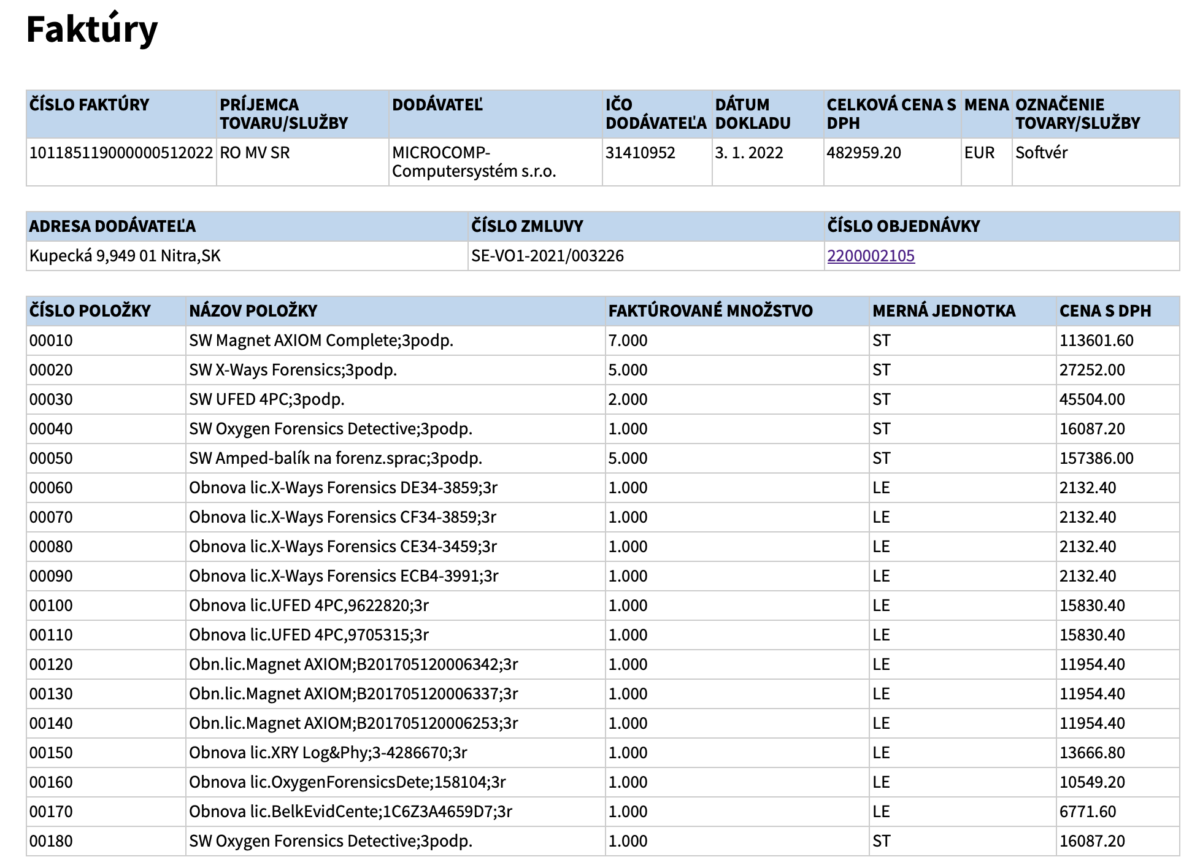
An invoice issued to the Slovak interior ministry in 2022 by the Slovak company Microcomp–Computersystém indicates the renewal of a licence for this software. At the time, the minister responsible was Roman Mikulec.

Screenshot of invoice from 2022 (Source: Slovak interior ministry website)

The Slovak ministry also ordered a licence renewal in July 2024, under his successor Matúš Šutaj Eštok. Microcomp–Computersystém did not respond for comment.

Interior ministry order with links to Russia. (Source: Slovak interior ministry website)

Authorities warned

On Friday (2 October), the Slovak national security authority (NBÚ) warned of the risks posed by using software from Oxygen Forensics and connected companies such as MKO Systems and Prostranstvo IT.

Their software helps investigators search for and examine data from digital devices. It can process vast amounts of information, including evidence, which makes it important who owns, controls and develops it. According to the NBÚ, this is important both for data protection and for the reliability of analysis results.

The warning came after the US case was made public.

The NBÚ considers links to Russia significant in assessing the security risk, also in view of Russia’s military aggression against Ukraine.

However, the warning itself does not mean that data leaked through the software. US prosecutors explicitly stated that the charges did not concern malicious code or unauthorised access to customer data.

The case concerns the alleged concealment of the software’s ownership and origin. And no court has yet ruled on the case.

“The ministry will proceed in accordance with the recommendations of the National Security Authority,” the Slovak interior ministry said.

The NBÚ recommended that public bodies identify this company’s presence and report it to the authority.

Belgian Green MEP Saskia Bricmont also called for the use of Oxygen to be stopped immediately and for an inquiry into whether sensitive information could have reached Russia after it was found that Romania, Germany, Spain, Italy, Poland and Hungary had purchased the software.

European police shed tool

Several European security agencies are suspending the use of Oxygen Forensics software or taking steps to terminate their contracts after the company’s Russian ties came to light.

The tool was also used by Czech police. Czech security agencies continued to purchase licences for the computer software after 2022, when the full-scale invasion of Ukraine began. Czech authorities are awaiting further information from the United States. For now, they have prohibited software updates.

London’s Metropolitan Police has suspended the use of Oxygen tools and launched a comprehensive review. British police forces, including specialised units, had used the software.

And Latvian police suspended its use and is assessing whether it will continue using it.

Romania’s anti-corruption agency, too, took steps to terminate its contract with the Russia-linked tool.

❌