Commanders suspected of sexual violence during the largest and fastest slaughter of civilians in more than 30 years have been subjected to travel ban and asset freeze
Senior Sudanese commanders implicated in a “campaign of rape” have been targeted by the UK on the first anniversary of a mass atrocity that saw tens of thousands of civilians killed over several days.
A year after the fall of El Fasher, the British government said it had sanctioned military leaders from both sides in the country’s ongoing conflict whom it suspected of sexual violence during the siege of the city.
Children as young as five are being suspended for sexual misconduct, with schools in England recording 7,278 suspensions last year – nearly 40 every school day and a 12% jump on the previous year.
Grandparents should ask for consent before hugging their grandchildren, a "demeaning" new Government-funded Irish advert from the Dublin Rape Crisis Centre has said.
Questioning the prevailing narrative about the "Cornell seven" case is bound to create controversy. And at Columbia University, two student journalists drew condemnation for their views on the case from the unlikeliest of places: a college free speech group.
On October 13, Barnard junior Christina Ma and Columbia junior Nikos Mohammadi published an article called "The 'Cornell Seven' Is Really About Liberalism" in the Columbia Sundial, an independent student publication. The piece argued that the discourse surrounding the alleged rape at Cornell University infantilizes women by omitting the possibility that in a post–sexual revolution, liberal society, women may make regrettable but consensual choices.
"In the world that, for better or worse, follows from it, we cannot claim to stand for sexual freedom and then recoil in disgust when there's a possibility that a young woman simply chose to exercise it," Mohammadi and Ma wrote.
The piece also argues that the "collective frenzy" over the Cornell case has created a climate on campus that makes it "difficult to disagree with the maximalist position on what happened" the night of the alleged rape.
As Mohammadi wrote in UnHerd, the piece caused immense backlash. He said he received an onslaught of messages urging him to commit suicide and demanding that his "career and life be destroyed." But the criticism went beyond threatening DMs and comments.
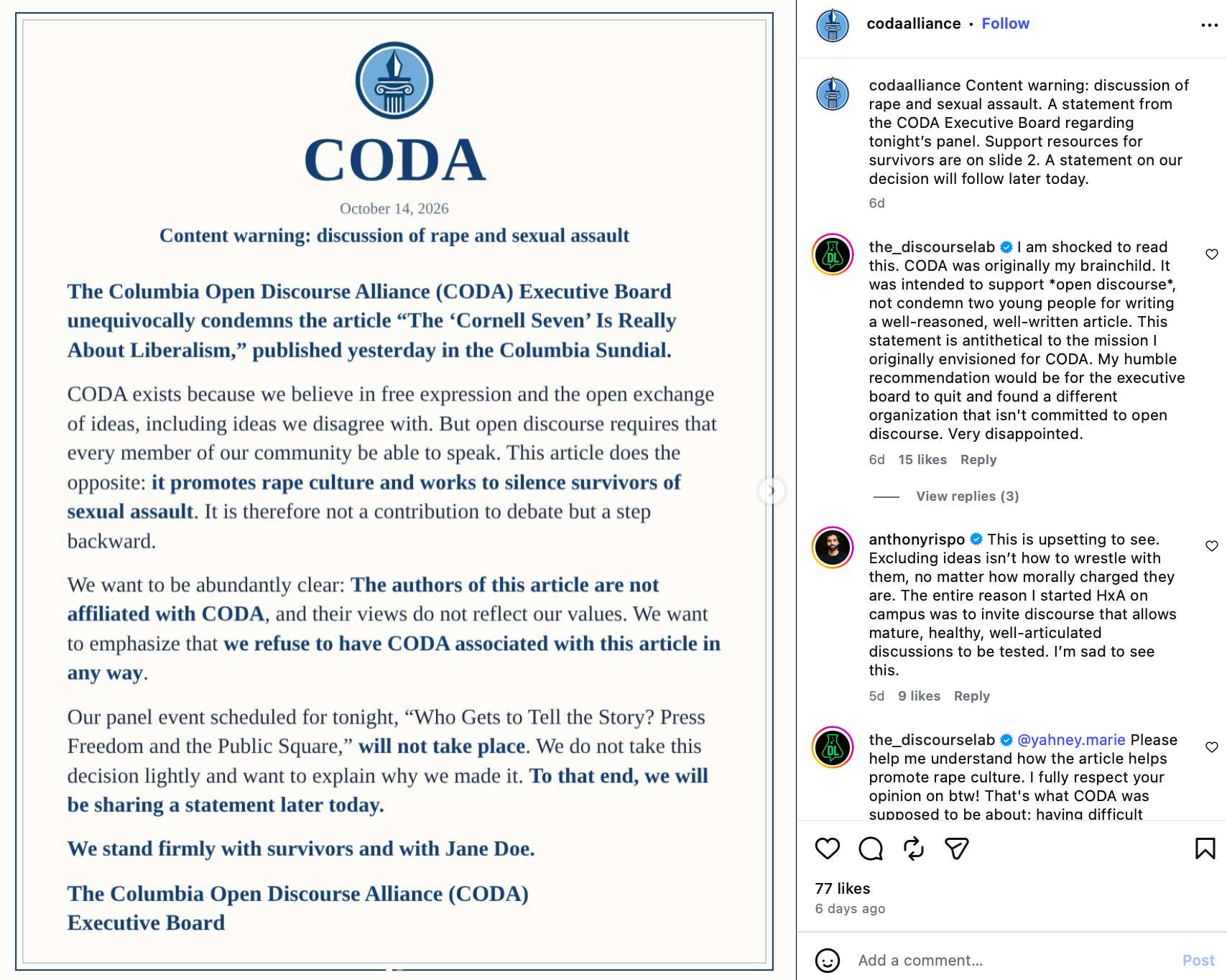
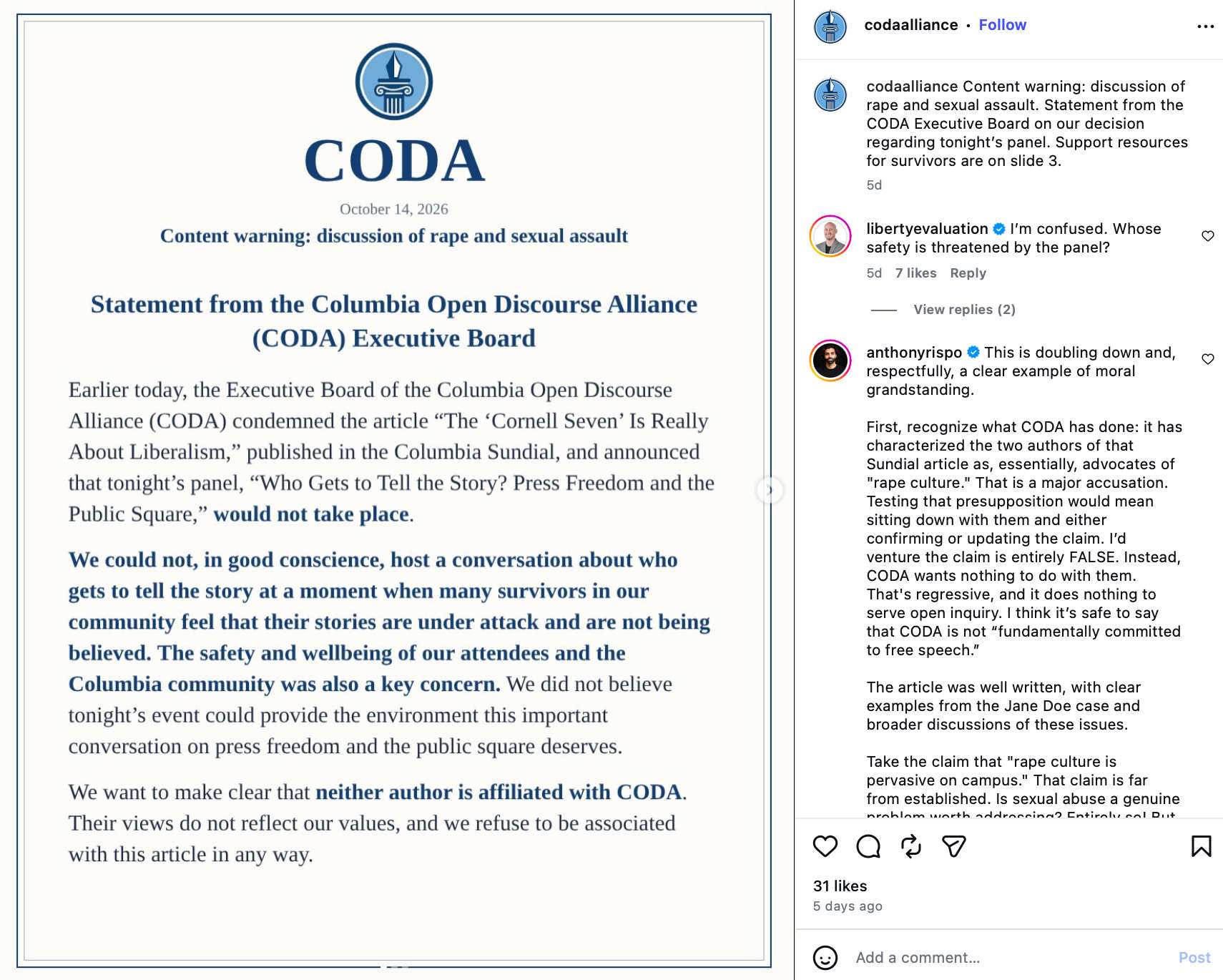
The day after the article's publication, the Columbia Open Discourse Alliance (CODA) canceled an event about press freedom because the Sundial's editor in chief, Nick Baum, had been slated to speak at the event. Although Baum did not author the piece, CODA wrote in an Instagram post that the free speech group "refused" to be affiliated with the Sundial's article "in any way."
CODA also claimed that the event, ironically called "Who Gets to Tell the Story? Press Freedom and the Public Square," could not take place at a time when "many survivors in our community feel that their stories are under attack and are not being believed."
The group added that the Sundial's article "promotes rape culture and works to silence survivors of sexual assault."
The group's president, Aum Desai, told Columbia's student newspaper, the Columbia Daily Spectator, that the group canceled the event "not in spite of, but because of [CODA's] commitment to free expression."
Columbia graduate Clayton Smith, who founded CODA in 2025, quickly commented that he was "shocked" by CODA's statements on Instagram. Smith started the organization to create a central hub for groups hosting events promoting free speech and open discourse, including the Sundial and Columbia's Heterodox Academy chapter.
He tells Reason that CODA's rationale for canceling the event was "ironic" and "hypocritical," and he believes the group should have collaborated with the Sundial if there were legitimate safety concerns at the event. He says he was particularly disturbed by the group's condemnation of the article and CODA's claim that it promotes "rape culture."
"They don't argue or explain how it works to silence survivors of sexual assault. It is a baseless slander that they use to condemn the article because it promoted an opinion they do not like," Smith says.
Smith says he spoke to Desai on the phone after CODA posted the statements, and Desai tried to reassure him that CODA would uphold the principle of free speech. But Smith says he did not leave the phone call feeling "very confident at all" in Desai's commitment.
Desai did not respond to Reason's requests for comment.
CODA faculty adviser and Columbia Business School professor emeritus Eli Noam was traveling in China during the fallout from the Sundial article and was not involved in CODA's decision.
After speaking with members of both CODA and the Sundial, Noam tells Reason that he thinks CODA "made some proper decisions, some correct decisions, and some mistakes."
"I think we're dealing here with…a group of college students who kind of were confronted with a crisis at 2 a.m.," Noam says. "And kind of [made] some judgments that they now regret, and they do."
He tells Reason that it was not "unreasonable to assume there would be a disruption" at the event, given the climate at Columbia and "about this rape allegation." He says the group suddenly "had an event where they needed college security" and could not organize in time. CODA, Noam says, is not yet recognized by the university, and he thinks the group was likely fearful of jeopardizing its recognition.
Still, Noam says CODA's statements condemning the article were "unreasonable," and it was "disappointing that they kind of lost their nerve here."
Although he was not involved in planning the panel, Mohammadi says, to his knowledge, there were no credible threats of violence to the panel. He understood there may have been "disgruntled students" and an "environment CODA did not want to deal with." But instead of simply canceling the event or working with the Sundial to find a solution, Mohammadi says CODA overstepped by condemning the Sundial piece.
James Applegate, an astronomy professor who serves on Columbia's Academic Freedom Council (CAFC) alongside Noam, tells Reason that he disagreed with CODA's decision to cancel the event.
Applegate tells Reason he was considering attending the event, and he was "rather surprised and disappointed" when it was canceled.
He recalled that when he was a professor in 2000, he objected to changes to the school's sexual misconduct policy on the University Senate floor. He says his statements were "similar to what was said in the Sundial article" and there was a "level of emotion in this debate."
"Nonetheless, we had the debate. I was in it, and the degree to which it was civil is shocking when you look at where we are now. And it's sad."
Applegate said he does not condemn CODA, however, "for the simple reason that the atmosphere on college campuses and on the left wing of politics in general in the United States is quite vicious."
CODA's honorary faculty fellow John McWhorter tells Reason he interpreted CODA's statement as "saying that an event about who gets to tell the story is untenable when or if a critical mass of people with such stories don't even feel comfortable telling them— i.e.being a participant in the event." He added, "I imagine some might think of that as cutting the salami a little thin, but then I highly suspect that Desai is equally worried about the event becoming a physical melee of some kind. In that, let's face it, he is hardly unreasonable."
Still, McWhorter said that he would have chosen to have the event himself, "especially as in the likely case that some people did talk about their experiences without any particular repercussions, it may have made the more reluctant people less apprehensive about doing so in the future."
According to Mohammadi, as of Tuesday, the Sundial, College Republicans, Platypus Affiliated Society at Columbia (which discusses leftist thought and history), and Columbia's Heterodox Academy chapter have left CODA.
CODA was not the only group to condemn the Sundial's piece. On October 14, the Columbia Political Review's editorial board wrote that Mohammadi and Ma's piece "violates standards of integrity" and "perpetuates a culture of campus violence, rape, and assault." The editorial board of the Columbia Political Review, which purports to publish "multipartisan political discourse," stated that it would refuse to publish "any article that upholds or recreates cultures and systems of rape, sexual assault, or violence" and it urged "all campus publications to do the same."
And on Monday, Columbia's main newspaper, the Spectator, published a staff editorial accusing the Sundial of violating journalistic ethics by "its page to disparage survivors of sexual violence."
Mohammadi tells Reason the piece underwent "far more editorial scrutiny than any other piece" the Sundial had published given the sensitive nature of the topic.
Free speech student organizations are necessary on Columbia's campus, especially as the school's free speech climate continues to crumble; it recently received a failing grade from the Foundation for Individual Rights and Expression. And while upholding free speech principles may have become more fashionable among those resisting the Trump administration's pressures on academic freedom or those defending pro-Palestinian speech, it is clear that some topics remain taboo in the public square. College is supposed to be a place where students debate controversial topics, form their own beliefs and opinions, and learn from mistakes. Hopefully, the students who demanded condemnation instead of debate will be forgiven for their perversion of free speech ideals, and they will learn to afford such grace and open-mindedness to classmates with whom they disagree.
It’s been a month since the story of the Cornell Seven case became national news. Ruby Cramer documents what she describes as “an ever-expanding blast radius of online abuse, threats, and vigilantism which has touched virtually every person connected to the case, along with people who have no immediate connection to it at all.” Among those closest to the center is the accuser herself:
Jane Doe explained to the police that her phone number and address had been leaked on the internet, and that she’d been receiving harassing phone calls, including that evening. She had recorded one such call. In the recording, the man says, “I’m probably just gonna, like, pull up to your house and shoot. . . .” The caller speaks in a deep, throaty voice that at times sounds almost garbled. In response, Jane Doe says nothing. The man says, “I can hear you breathing.”
While officers were still at the family’s house, dispatch reported that the initial caller was back on the line, saying that he had an AR-15 assault rifle and was going to kill everyone at the house, then himself. About an hour later, police reported another call, this one saying that the house was on fire. In yet another phone call, a man stated that he had explosives and that the family would die—“either now, midnight, or tomorrow.” Jane Doe was receiving additional threats via text message and D.M. Her phone had hundreds of unread messages on it, but some of them she opened. “Typical white btich whore crying ‘rape,’ ” one of the messages read. “Hopefully someone does the world a favor and 🔫🔫🔫 you, nothing of value would be lost.” Officers advised her to keep her phone turned off. The next day, according to her attorney, she started taping pieces of paper over the windows at the house.
The horrific story of Jane Doe and the Cornell Seven has spurred nationwide outrage and revived contentious debates around prevention and education. But one question is going unasked: Who really pays after a sexual assault? In terms of actual dollars and cents? The answer, Cosmopolitan finds, isn’t good:
Leah received an email from the first hospital. It was a bill for $3,338, including $663 for lab work and a pregnancy test she hadn’t asked for. She hadn’t been charged for the rape kit, but the price of just checking into the ER was $2,241. After her parents’ insurance was applied, she owed $451.06.
“I was so unbelievably angry,” she says. “I lost it. I was like, ‘You mean it cost me $450 to get raped?!’”
Most people don’t realize this care might not be covered, says Vega, who has worked as an emergency room nurse, emergency room director, and a SANE. But that’s actually common: KFF analyzed a sample of insurance claim data from 2016 to 2018 (the most up-to-date data KFF has) and found that 83 percent of women who received a sexual violence diagnosis were billed for treatment. Another analysis of emergency room department data from 2019 found that the average bill for sexual assault survivors was $3,551, according to the New England Journal of Medicine.
The San Francisco Police Department cleared 14 percent of rape cases last year—half the national rate. An investigation finds that rape kits get tested fast, only for cases to be quietly shelved. Often, the only thing standing “between a report and the shelf” is what’s known as a “pretext call,” a recorded phone conversation in which a survivor tries to extract an admission of guilt from their attacker (aka relives their trauma to do the police’s work for them):
She sat in a room at the SVU headquarters with [Sergeant Johnathan] Ng and a recorder. She dialed the man she alleged raped her. He didn’t pick up. She tried again. No answer.
“If we don’t get an admission, it’s a he-said, she-said thing,” she remembered Ng telling her.
Then, she said, he offered some unsolicited advice.
“He told me that I probably shouldn’t be hanging out with 55-year-old men,” she said.

 Login