❌

Normal view

Regional security runs through Tehran

By: aletho
29 October 2026 at 12:49
By Peiman Salehi | The Cradle | October 28, 2026

The presence of Saudi, Turkish, and Pakistani officials in Tehran on 26 October reflected a growing recognition that Iran cannot be excluded from any serious regional security arrangement. Despite the US–Israeli war against Iran, Tehran remains central to the region’s military and political balance.

For Riyadh and its partners, the meeting also exposed the limits of the Mecca defense pact, particularly as Saudi Arabia faces renewed confrontation with the Ansarallah-aligned Yemeni Armed Forces (YAF).

Much of the speculation surrounding the four-country meeting centered on what Iran might be expected to surrender, particularly its relationship with Sanaa. Such expectations rested on the assumption that Saudi Arabia, Turkiye, and Pakistan had established a regional security order into which Iran was now seeking admission, with Tehran potentially offering concessions over Yemen in return.

Yet the political and military circumstances that brought the participants to Tehran suggest a different calculation. Iran has withstood sustained American and Israeli attacks, while Saudi Arabia and its partners have struggled to contain the YAF’s military operations. Any agreement that disregards these realities risks reproducing the confrontations it seeks to resolve.

Iran’s Foreign Ministry had identified Israel’s expansionist policies, Lebanon, and the US war against Iran among the subjects for discussion. Yemen was absent from the announced agenda and the subsequent press statement.

Ali Bagheri, deputy secretary of Iran’s Supreme National Security Council, said the gathering also served to congratulate Mohsen Rezaei, the council’s newly appointed secretary, and discuss regional security, including opposition to foreign interference, particularly by Washington. According to information obtained by The Cradle, Yemen was not discussed during the meeting.

On the morning of 27 October, a day after the talks, Rezaei met Yemen’s ambassador, Ibrahim Mohammad al-Dailami, in Tehran. Rezaei praised Yemen’s defense of Gaza and its confrontation with Israel, while the ambassador thanked him and the Iranian government for their positions.

The encounter came amid speculation that Tehran’s diplomatic engagement with Riyadh might come at the expense of its relationship with Sanaa. By publicly reaffirming those ties immediately after the summit, Iran signaled its intention to pursue regional diplomacy while maintaining its existing alliances.

Hossein Shariatmadari, editor of Iran’s conservative daily Kayhan, wrote in a 27 October editorial that “Yemen’s revolutionaries are allies of Islamic Iran.” He warned that the visiting delegations might seek to create the impression that Tehran was distancing itself from Sanaa, offering Washington and its allies “breathing room, however brief” by encouraging expectations of an imminent settlement.

The Mecca pact’s limits

Iran has good reason to approach the Saudi–Turkish–Pakistani framework, commonly known as the Mecca pact, with caution. The agreement brings together three states with substantial military capabilities and extensive relations with Washington, raising questions about whether their security cooperation could eventually be directed against the Axis of Resistance.

For Riyadh, Yemen remains a central concern. Years of confrontation with the YAF have demonstrated Sanaa’s ability to impose high military and economic costs beyond Yemen’s borders. Saudi Arabia’s renewed campaign has again brought its energy infrastructure and military installations within range of Yemeni retaliation, exposing the limits of the kingdom’s reliance on foreign military protection.

In Tehran, closer military coordination among the pact’s members could be seen as an attempt to contain the Axis of Resistance at a time when American security guarantees are becoming increasingly uncertain.

Iran’s participation in talks with the pact’s members carries no commitment to join their alliance. Tehran has made no such announcement, while Rezaei’s explanation of the summit emphasized the establishment of security through regional cooperation, the withdrawal of foreign forces, and an end to outside interference.

These objectives leave considerable differences between the participants. Saudi Arabia, Turkiye, and Pakistan maintain security relationships with Washington, while Iran regards the American military presence as a principal source of regional instability. Their respective positions on armed resistance movements, Israeli aggression, and the obligations of any collective defense arrangement also remain unresolved.

The meeting produced a brief press statement confirming the participants’ intention to continue their dialogue, without setting out binding commitments. Rezaei indicated that further meetings would follow, suggesting that the four governments were exploring the foundations of a wider regional accommodation.

The initiative itself emerged from Pakistani army chief Asim Munir’s visit to Tehran the previous week, according to information obtained by The Cradle. Iranian officials also confirmed Pakistan’s proposal, describing the gathering as an opportunity to advance regional security arrangements based on shared interests and mutual trust.

Riyadh’s security dilemma

The Saudi–Turkish–Pakistani alliance combines considerable military resources, diplomatic influence, and strategic relationships. Its effectiveness, however, depends on the willingness of its members to confront threats that may carry very different consequences for each country.

The limited assistance Pakistan and Turkiye have provided during the renewed confrontation between Yemen and Saudi Arabia illustrates these constraints. Although both countries have pledged support for Riyadh, their involvement has fallen short of the decisive intervention that might alter the military balance with the YAF.

Kayhan was more scathing in its assessment, accusing Turkiye and Pakistan of having “milked Saudi Arabia and done nothing.”

Saudi Arabia’s own account of the visit was more restrained. In a statement following the meeting, Riyadh said the talks formed part of efforts to de-escalate tensions, encourage diplomatic solutions, and support mediation by Qatar and Pakistan. It also reaffirmed the Mecca pact’s role in promoting regional security and stability.

Islamabad and Ankara have also sought to limit their military involvement. Turkish officials have ruled out offensive operations against Yemen, while Pakistan has denied reports that its aircraft carried out strikes on Yemeni forces. These restrictions expose the distance between the pact’s collective defense commitments and its members’ willingness to enter a wider war.

The continuing Yemeni operations against Saudi targets have consequently strengthened the argument for direct engagement with Tehran. Riyadh must weigh the costs of further confrontation against the possibility of reaching an understanding with Iran, whose regional relationships and military capabilities remain central to the wider balance of power.

Despite the damage inflicted during the war, Tehran has retained the ability to influence the course and costs of regional confrontation. Its leverage over the Strait of Hormuz and its capacity to retaliate against military infrastructure have complicated Washington’s efforts to impose a settlement on its own terms.

These developments have strengthened Tehran’s negotiating position, although translating military endurance into a durable security arrangement will require more than the recognition of its regional weight. Tehran must also demonstrate that cooperation with its neighbors can reduce the likelihood of renewed war without undermining the relationships that have helped it withstand external pressure.

For Saudi Arabia, the lesson is equally significant. Its security cannot be guaranteed indefinitely through military partnerships that exclude one of the region’s principal powers, particularly when those partnerships have struggled to prevent attacks on Saudi territory.

Yemen cannot be traded

The suggestion that Tehran might trade its relationship with Ansarallah for concessions from Riyadh overlooks the movement’s independent political interests and roots in Yemen. Ansarallah’s resistance to Saudi intervention grew out of a prolonged struggle over the country’s political future, during which its ties with Iran deepened.

The two sides share important strategic interests, but Yemen’s military and political decisions cannot be reduced to directives from Tehran. The YAF’s intervention in support of Gaza, its confrontation with Israel, and its continuing war with Saudi Arabia reflect calculations shaped by Yemen’s own circumstances.

Iran’s regional relationships have also evolved through years of confrontation with Washington and Tel Aviv. The Islamic Republic’s resistance to American and Israeli pressure has become inseparable from its wider regional security calculations, particularly as the war has intensified the threats facing its allies.

Sanaa has paid a substantial price for its military and political positions, enduring years of bombardment, blockade, and attempts to dismantle its authority. Ansarallah’s survival has given it considerable influence over Yemen’s future, making any settlement negotiated without its participation unlikely to produce lasting results.

The assumption that Tehran could simply secure Yemeni compliance also underestimates the political consequences of such an arrangement. The Sanaa government would have little reason to accept an agreement that disregards its security interests or leaves Saudi military pressure intact.

Rezaei’s meeting with the Yemeni ambassador therefore served an important political purpose. As Tehran opened discussions with the Mecca pact’s members, it reaffirmed a relationship whose continuity remains important to the wider Resistance Axis.

Israel’s declining leverage

The summit’s joint statement made no reference to Israel, but Rezaei’s subsequent account of the talks placed Israeli military operations among the issues discussed. He said the participants had emphasized ending Israeli attacks and securing Israel’s withdrawal from occupied territories in Lebanon, Syria, and Palestine.

Before Operation Al-Aqsa Flood, Saudi–Israeli normalization was a serious diplomatic prospect. Washington sought to advance Israel’s integration into a regional security and economic framework that would strengthen its position while isolating Iran and its allies.

The wars that followed have disrupted those calculations. Israel’s military campaigns across West Asia, alongside the American war against Iran, have exposed the risks associated with a regional order built around Israeli military superiority and US security guarantees.

Rezaei’s public emphasis on Israeli aggression reflects the changing circumstances in which the talks took place. Riyadh has not formally adopted his characterization in the joint statement and maintains its longstanding relationship with Washington, but Saudi security concerns have increasingly brought it into direct contact with Tehran despite years of hostility.

The contrast with 2017 is especially revealing. Crown Prince Mohammed bin Salman (MbS) then threatened to take the confrontation inside Iran, reflecting Riyadh’s confidence in its ability to challenge Tehran through regional pressure and military alliances.

Nearly a decade later, Saudi officials are in Tehran discussing regional security with the same government Riyadh once threatened to attack. Years of confrontation have failed to break Iran’s regional influence, while Washington’s ability to shield its allies from another war is increasingly in doubt.

Yemen’s ability to remain a consequential military actor despite years of Saudi-led operations has also shaped this reassessment. Its continued resistance has demonstrated the limits of attempts to impose regional arrangements through military force.

Tehran’s next move

The summit’s lasting significance will depend on whether the participating governments can translate their discussions into practical security arrangements. Iran has an opportunity to advance its longstanding position that West Asia’s security must be determined by the countries of the region, without dependence on foreign military intervention.

Such an arrangement would require Saudi Arabia, Turkiye, and Pakistan to recognize Iran’s security concerns and its existing alliances. Tehran would also have to address its neighbors’ security concerns without compromising those relationships.

The presence of all four countries in Tehran suggests that these questions are now receiving serious attention. Rezaei’s subsequent meeting with Yemen’s ambassador also indicated the basis on which Iran intends to participate: regional cooperation alongside continued support for its established allies.

Any regional agreement must also account for Yemen and the other members of the Axis of Resistance. Their military and political weight cannot be ignored, nor can their futures be decided through negotiations between Tehran and its neighbors.

Iran has emerged from the war with its regional alliances intact and greater room to negotiate. The question now is whether Riyadh and its partners are prepared to reach an understanding with Tehran that recognizes those alliances rather than seeking to dismantle them.

Unexploded Israeli ‘Spice’ Bomb Found Amid Wave of Blasts at Syrian Arms Depots (Videos)

29 October 2026 at 09:47

Click to see full-size image. (Israeli Defense Forces)

Footage that surfaced online on October 28 appeared to show an unexploded Israeli-made SPICE 250 precision-guided munition found in Syria’s Deir Ezzor governorate, raising questions about possible Israeli strikes on military storage sites amid a series of mysterious explosions across the country.

The munition was found three days after a powerful explosion in the al-Bujama’a area of Deir Ezzor. Syrian state broadcaster Al-Ikhbariya reported at the time that an old missile left over from the war had exploded after children lit a fire nearby and tampered with it. Footage posted to social networks, however, showed a large blast. No casualties were reported.

Another explosion rocked the outskirts of Saraqib in Idlib governorate the next day, October 26. Footage published online showed projectiles being hurled into the air uncontrollably as explosions continued across the site, with some objects resembling large rockets.

Local reports initially described the Saraqib site as an ammunition or weapons-storage facility. Al-Ikhbariya subsequently reported that Civil Defense teams had extinguished a fire following the destruction of old war remnants. The Idlib Media Directorate said there were no casualties. Notably, there was no advance public warning of the reported demolition.

The two recent explosions followed a series of deadly incidents at ammunition and weapons-storage sites across Syria. On September 1, an ammunition-laden vehicle exploded near Binnish in Idlib, killing five people. An explosion at a temporary weapons depot near Sarmada in the same governorate on September 9 killed 21 people. Later on September 18, a blast at an ammunition depot inside a Defense Ministry barracks near Ayyash in Deir Ezzor killed 11 ministry personnel and injured about 10 others.

Further explosions struck an weapons depot near al-Iss in Aleppo governorate on September 21, injuring four people, and the Taftanaz military air base in Idlib on October 2. The causes of the latter incident were not publicly established.

In an October 24 review, the Syrian Observatory for Human Rights counted 37 deaths and around 27 injuries across five incidents involving weapons-storage sites since early September.

Reuters has separately recorded at least 16 explosions at Syrian arms-storage facilities since the overthrow of former President Bashar al-Assad in December 2024.

The unexploded SPICE 250 provides the first physical evidence of recent covert Israeli military action against Syrian assets, adding a new dimension to the wave of explosions at weapons-storage facilities across the country.

The SPICE 250 is a compact precision-guided glide bomb with a stand-off range of up to 100 kilometers. Its ER variant adds a miniature turbojet engine, extending the advertised range to 150 kilometers. The munition’s low profile makes it especially suitable for covert strikes.

The discovery of the munition in Deir Ezzor, following the October 25 blast in the same governorate and the successive detonations near Saraqib in Idlib a day later, strengthens the picture of a sustained campaign against Syria’s military stockpiles.

Israel has conducted repeated strikes against weapons and military infrastructure in Syria for years, particularly against capabilities it considers a threat, and its military activity inside the country has not stopped with the fall of Assad.

The suspected attacks on ammunition depots fit within the broader logic of Israel’s longstanding campaign to prevent hostile military capabilities from taking root in Syria, sometimes described as a “war between the wars.”

_______________________________________________________________________________________________________________________

SouthFront: Analysis and Intelligence

NOW hosted at southfront.press

Previously, SouthFront: Analysis and Intelligence was at southfront.org.

The .org domain name had been blocked by the US (NATO) (https://southfront.press/southfront-org-blocked-by-u-s-controlled-global-internet-supervisor/) globally, outlawed and without any explanation

Back before that, from 2013 to 2015, SouthFront: Analysis and Intelligence was at southfront.com

SOUTHFRONT.PRESS

MORE ON THIS TOPIC:

The post Unexploded Israeli ‘Spice’ Bomb Found Amid Wave of Blasts at Syrian Arms Depots (Videos) appeared first on South Front.

Die neue deutsche Regierung hat sich als unfähig erwiesen, die Welle illegaler Migration einzudämmen

By: A A
29 October 2026 at 07:39

Seit Beginn des zweiten Jahrzehnts des neuen Jahrtausends sind Millionen von Flüchtlingen aus den «wilden Dschungeln» der umliegenden Regionen in den «blühenden europäischen Garten» geströmt. Ein Teil von ihnen war tatsächlich gezwungen, ihre Heimat aufgrund einer vom Westen provozierten Kette von Bürgerkriegen und Volksaufständen, die als «Arabischer Frühling» bezeichnet werden, zu verlassen. Doch mindestens die Hälfte derjenigen, die sich an der EU-Grenze als «Flüchtlinge aus Kriegsgebieten» ausgaben, waren in Wirklichkeit keine. Sie nutzten lediglich die sich bietenden Möglichkeiten, um in die Welt der großzügigen europäischen Sozialleistungen zu gelangen.

Wie die Praxis zeigt, ist Deutschland der Hauptmagnet für Wirtschaftsmigranten aus afrikanischen, nahöstlichen und einigen asiatischen Ländern. Ein erheblicher Teil der Flüchtlinge – unabhängig davon, auf welchem Weg sie in die EU gelangt sind, sei es über Griechenland, Spanien, Italien oder exotischere Routen – sieht in Deutschland das Endziel seiner Pilgerreise auf der Suche nach dem «europäischen Traum».

Seit die ehemalige Bundeskanzlerin Angela Merkel die Worte «Ja, wir schaffen das» ausgesprochen hat, hat in Deutschland ein Umdenken hinsichtlich der Rolle der Migration im Wirtschaftsleben des Landes stattgefunden. Leider machen promovierte Wissenschaftler und qualifizierte Ingenieure in dem unkontrollierten Migrantenstrom kaum ein Hundertstel Prozent aus. Dabei handelt es sich bei einem erheblichen Anteil derjenigen, die auf der Suche nach einem besseren Leben nach Deutschland gekommen sind, um junge Fachkräfte im erwerbsfähigen Alter, die Sozialleistungen beziehen. Im besten Fall werden sie «schwarz» arbeiten, ohne Steuern zu zahlen. Im schlimmsten Fall verstärken sie die Reihen der Kleinkriminellen im Dienste ethnischer Verbrecherclans oder schließen sich religiös-extremistischen Organisationen an.

Seit dem Regierungsantritt der schwarz-roten Koalition unter Friedrich Merz hat sich die Situation im Migrationsbereich dank der Bemühungen des deutschen Innenministers Alexander Dobrindt ein wenig verbessert.

Aufgrund der Bürokratisierung des deutschen und des EU-Rechtssystems sowie der Sabotage von Maßnahmen gegen die Einwanderung durch linksliberale Politiker sind die Ergebnisse bei der Eindämmung der Ströme illegaler Migranten jedoch bestenfalls symbolisch.

Das GEAS-System: Viel Aufwand für wenig Ertrag

So gelingt es Deutschland nach wie vor praktisch nicht, Asylbewerber nach Italien und Griechenland zurückzuschicken. Dies belegen Daten des Bundesministeriums des Innern, die der Abgeordnete der Partei «Alternative für Deutschland», Sebastian Münzenmaier, angefordert hatte.

Demnach wurden seit Einführung des neuen europäischen Asylsystems GEAS im Juni 2026 bislang nur zwei Asylsuchende nach Italien und zwei nach Griechenland zurückgeführt. Dabei gibt es Hunderte von Fällen, in denen das Bundesamt für Migration und Flüchtlinge (BAMF) die Zuständigkeit dieser beiden Länder festgestellt hat.

Konkrete Zahlen zur Rückführung nannte das Innenministerium erst nach mehreren Nachfragen Münzenmayers.

«Es überrascht nicht, dass Innenminister Dobrindt diese Zahlen lieber geheim halten würde», erklärte Münzenmaier. «Insgesamt vier Rückführungen seit Inkrafttreten des Abkommens im Juni: Das ist einfach lächerlich.»

Das neue Asylsystem GEAS entwickle sich für Deutschland «zu einem völligen Reinfall». Münzenmeier forderte die Bundesregierung auf, «jetzt Druck auf Italien und Griechenland auszuüben».

Nach den europäischen Asylvorschriften ist grundsätzlich nur ein EU-Mitgliedstaat für das Asylverfahren einer schutzsuchenden Person zuständig, in der Regel das Land der ersten Einreise. Reisen Migranten ohne Genehmigung weiter, müssen sie in das zuständige Land zurückgeführt werden. Mit Ländern wie Italien war dies in der Vergangenheit praktisch nicht möglich. In der Bundesregierung bestand jedoch die Hoffnung, dass sich die Situation mit der Einführung des neuen europäischen Asylsystems GEAS ändern würde. Im Dezember des vergangenen Jahres verwies das Innenministerium auf ein Abkommen mit Griechenland und Italien, nach denen die Rücküberstellungen von Migranten im Juni wieder aufgenommen werden sollten.

Doch schon bald kam es zu ersten Konflikten. So kündigte der italienische Vizepremier Matteo Salvini im August laut Berichten an, dass Italien bis auf Weiteres keine Migranten aus Deutschland aufnehmen werde.

«Italien wirft Deutschland vor, dass NGOs zusätzliche Migranten an Land bringen. Ich habe großes Verständnis für diese Haltung», sagt Detlef Seif, Beauftragter der Fraktion CDU für die Umsetzung der europäischen Reform im Bereich Asyl und Migration.

«Gleichzeitig muss berücksichtigt werden: Italien hat uns grundsätzlich versichert, dass die Überstellung von Migranten möglich ist.
Sollte sich Italien weiterhin weigern, muss ein Vertragsverletzungsverfahren eingeleitet werden.»

Die italienische Ministerpräsidentin Giorgia Meloni steht vor den Parlamentswahlen im nächsten Jahr unter Druck, da das GEAS in ihrem Land für heftige Kontroversen sorgt. Unter anderem, weil Italien infrastrukturell nicht auf Massenrückführungen vorbereitet ist. Schon jetzt leben viele Flüchtlinge in armseligen Lagern oder auf den Straßen der Großstädte.

Der deutsche Innenminister Dobrindt hat sich in letzter Zeit einer öffentlichen Eskalation des Konflikts enthalten und offen Verständnis für die besondere Belastung Italiens gezeigt. Sein Pressesprecher erklärte, Deutschland arbeite «eng und vertrauensvoll» mit Italien zusammen.

Gleichzeitig machte Dobrindt jedoch auch deutlich, dass die Überstellung von Migranten für das Funktionieren des Migrationssystems von entscheidender Bedeutung sei.
Grundsätzlich müssen Asylbewerber innerhalb von sechs Monaten nach Zustimmung des betreffenden Mitgliedstaats in das Ankunftsland zurückgeführt werden.
Gelingt dies nicht innerhalb der festgelegten Frist, geht die Verantwortung auf Deutschland über.

Laut dem Bundesamt für Migration und Flüchtlinge (BAMF) wurden von Juli bis September insgesamt 782 Rückführungen in andere Länder durchgeführt. Zu den wichtigsten Zielländern zählten insbesondere Frankreich und Spanien.

Syrische Flüchtlinge haben es nicht eilig, aus Deutschland in ihre historische Heimat zurückzukehren

Laut der Antwort der Bundesregierung auf eine Anfrage der AfD-Fraktion waren am 31. August 2026 insgesamt 909.682 Personen mit syrischer Staatsangehörigkeit im Zentralen Ausländerregister registriert. Zum gleichen Zeitpunkt waren 14 748 Personen mit syrischer Staatsangehörigkeit als ausreisepflichtig registriert, von denen sich 11 835 auf der Grundlage einer befristeten Aufenthaltserlaubnis im Land aufhielten. Seit 2020 haben bereits 300.000 Syrer die deutsche Staatsangehörigkeit erhalten.

Seit dem Versprechen von Bundeskanzler Merz im vergangenen Frühjahr, dass 80% der in Deutschland lebenden Syrer innerhalb von drei Jahren nach Syrien zurückgeführt werden sollen, laut dem Zentralen Ausländerregister sind im Zeitraum vom 30. März bis zum 31. August 2026 jedoch lediglich 4.803 syrische Staatsbürger freiwillig ausgereist. 3 214 Syrer kehrten mit staatlicher Unterstützung (Übernahme der Reisekosten, Taschengeld, Starthilfe und medizinischer Kosten) in ihre Heimat zurück, während 1 589 Personen den Rückweg ohne jegliche Hilfe antraten.

«Familienzusammenführung» – ein riesiges schwarzes Loch für Illegale im deutschen Migrationsrecht

Eine der beliebtesten Schlupflöcher im deutschen Migrationsrecht bleibt weiterhin die sogenannte «Familienzusammenführung». Diese Methode zur Legalisierung von Migranten ist fast ebenso beliebt wie zu Zeiten der «Ampelkoalition».

So haben die deutschen diplomatischen und konsularischen Vertretungen im Ausland von Januar bis September 2026 insgesamt 80 870 Visa zur Familienzusammenführung ausgestellt. Im gleichen Zeitraum des Vorjahres belief sich ihre Zahl auf 84 166, was einem Rückgang von lediglich 3,9% entspricht.

Im dritten Quartal stieg diese Zahl sogar leicht an: Von Juli bis September wurden 27 286 Visa zur Familienzusammenführung erteilt, das sind 52 mehr als im gleichen Zeitraum des Vorjahres. Somit werden im Jahr 2026 im Rahmen dieses Programms voraussichtlich mehr als 100.000 Menschen nach Deutschland kommen. Im gesamten Jahr 2025 wurden 110 388 entsprechende Visa erteilt.

Der Beschluss der Bundesregierung zur Aussetzung der Familienzusammenführung betrifft ausschließlich Angehörige von Personen, die Anspruch auf subsidiären Schutz haben. Die Familienzusammenführung mit anerkannten Flüchtlingen, Arbeitsmigranten und Ausländern mit anderen Aufenthaltsgenehmigungen bleibt unverändert möglich. Auch Eltern unbegleiteter minderjähriger Flüchtlinge dürfen weiterhin nach Deutschland einreisen.

Seit Bundesinnenminister Alexander Dobrindt am 7. Mai 2025 die Anordnung erließ, die Kontrollen an den Grenzen zu verschärfen und Einreisen zu verweigern, wurden bis Ende September 2026 rund 151.500 Visa zur Familienzusammenführung erteilt. Die meisten davon wurden in letzter Zeit an Staatsangehörige aus der Türkei, dem Kosovo und Indien erteilt. Dahinter folgten Syrer und Albaner.

Allerdings ist die Zahl der Erstanträge auf Asyl zurückgegangen. Von Januar bis September registrierte das Bundesamt für Migration und Flüchtlinge (BAMF) 55.366 Anträge, was einem Rückgang von 36,9 % gegenüber dem Vorjahreszeitraum entspricht. Dieser Rückgang ist in erster Linie auf den drastischen Rückgang der Zahl syrischer Antragsteller nach dem Sturz des Assad-Regimes zurückzuführen. Derzeit stellen Afghanen die meisten Asylanträge.

Was Abschiebungen betrifft, geht der Trend hingegen in die entgegengesetzte Richtung. Im ersten Halbjahr 2026 wurden 9.663 Personen aus dem Land abgeschoben. Im gleichen Zeitraum des Vorjahres lag ihre Zahl bei 11 807 – ein Rückgang um 18,2%. Gleichzeitig leben in Deutschland nach wie vor rund 259.000 Ausländer, die ausreisen müssen. Davon halten sich etwa 77% aufgrund eines vorübergehenden Aufschubs der Abschiebung im Land auf.

Somit lassen sich die Ergebnisse der deutschen Bundesregierung bei der Eindämmung des Zustroms illegaler Migranten bislang bestenfalls als symbolisch bezeichnen.

Israeli Troops Raid Southwest Syria Village, Capturing Civilian in His Home

28 October 2026 at 17:08
Israeli military vehicles entered the village of Saida al-Golan, in Quneitra Governorate today, searching homes in the area and capturing one civilian before withdrawing from the village toward the farmland further to the west. A large number of IDF vehicles were also reported as having entered the al-Samandiyah village, where troops searched a number of […]

For Israel’s Neighbors in Middle East, the Election Offers Little Hope of a Reset

28 October 2026 at 10:45
Few countries in the Middle East expect a turning point in relations with Israel. But the outcome of the vote has implications for the regional conflict with Iran.

© David Guttenfelder/The New York Times

Parts of Lebanon have been greatly damaged in fighting between Israel and Hezbollah since March, including the Dahiya neighborhood, a Hezbollah stronghold in the capital, Beirut.

Jordan Bombs Islamic State Bases in Syria After Church Attack

27 October 2026 at 20:10

Jordan conducted airstrikes against alleged Islamic State targets in Syria on Tuesday, as “retaliation” for a brutal terrorist attack on a Greek Orthodox church in southern Jordan on Friday.

The post Jordan Bombs Islamic State Bases in Syria After Church Attack appeared first on Breitbart.

Jordanian Airstrikes in Syria Spark Diplomatic Tension

27 October 2026 at 17:54

Airstrikes carried out by Jordan on Monday night against positions in southern Syria—allegedly linked to the jihadist group Islamic State (IS)—have triggered a diplomatic rift between the two nations. The friction stems from a lack of prior coordination and the fact that the strikes resulted in civilian casualties, including children.

RELATED:

Israeli Actions in Syria May Amount to War Crimes, UN Warns

On Tuesday, the Syrian Foreign Ministry criticized the Hashemite Kingdom for conducting the military operation without prior coordination, describing the action as completely unacceptable and a violation of Syria’s national sovereignty.

The Syrian Foreign Ministry also suggested that certain suspicious groups might be attempting to strain relations between Damascus and Amman, though it provided no further details regarding this claim.

Jordan framed the airstrikes as retaliation for an attack last Friday on a church in the western part of the kingdom, which left nine people dead and approximately 40 injured. Jordanian authorities attributed the attack to the Islamic State, although the organization has not yet claimed responsibility.

#Syria hardened its stance on the Jordanian attack carried out yesterday in the South.

While the Syrian Foreign Ministry initially expressed "reservations" about the Jordanian airstrikes in a statement last night, this morning, as the civilian death toll was confirmed, Damascus… pic.twitter.com/RvgfBLFVIV

— Qalaat Al Mudiq (@QalaatAlMudiq) October 27, 2026

Mohammad Momani, Jordan’s Minister of Government Communications and government spokesperson, stated on the social media platform X that the strikes were launched in response to the movements of these organizations and their acts against Jordan’s national security.

Momani expressed regret over the civilian casualties, maintaining that the armed forces had taken every possible precaution to avoid harming innocent people.

Syrian authorities confirmed that seven people were killed in the strikes, which targeted four areas in the southern province of Daraa. The victims included three children and an 80-year-old man.

Both countries have confirmed the establishment of an urgent joint committee to strengthen coordination in the fight against terrorism. Meanwhile, Momani expressed a commitment to developing bilateral ties for the mutual benefit of both nations.

#Syria | At least 14 people were killed and 11 injured in an explosion at a temporary weapons depot near Sarmada in Idlib province.
Rescue teams are searching the rubble for survivors, while authorities have not yet determined the cause of the blast.#Idlib #teleSUREnglish pic.twitter.com/q5utCtzkFE

— teleSUR English (@telesurenglish) September 9, 2026

Jordan Acknowledges Civilian Casualties in Its Airstrikes in Syria, Claims ISIS Fighters Were Also Killed

27 October 2026 at 17:03
Jordan on Tuesday acknowledged that airstrikes it launched in southern Syria on Monday caused civilian casualties, while also claiming that the attack killed about 20 ISIS fighters. Amman framed the strikes as retaliation for the October 23 attack on St. George’s Orthodox Church in Jordan’s western Karak province, which killed nine Christians who were attending […]

Deadly Jordanian Strikes Highlight Syria’s Cross-Border Terror Threat (Videos)

27 October 2026 at 07:02

Click to see full-size image. (X)

Jordanian warplanes struck several sites in southern Syria late on October 26, killing at least seven people, including three children, according to Syrian authorities, after Amman said it had linked a deadly church shooting to terrorist groups operating across the border.

The strikes hit locations in the southern provinces of Daraa and Suwayda. Jordan described the operation as a counterterrorism measure conducted in coordination with Damascus, while the Syrian government said it had received no advance notification and condemned the civilian deaths.

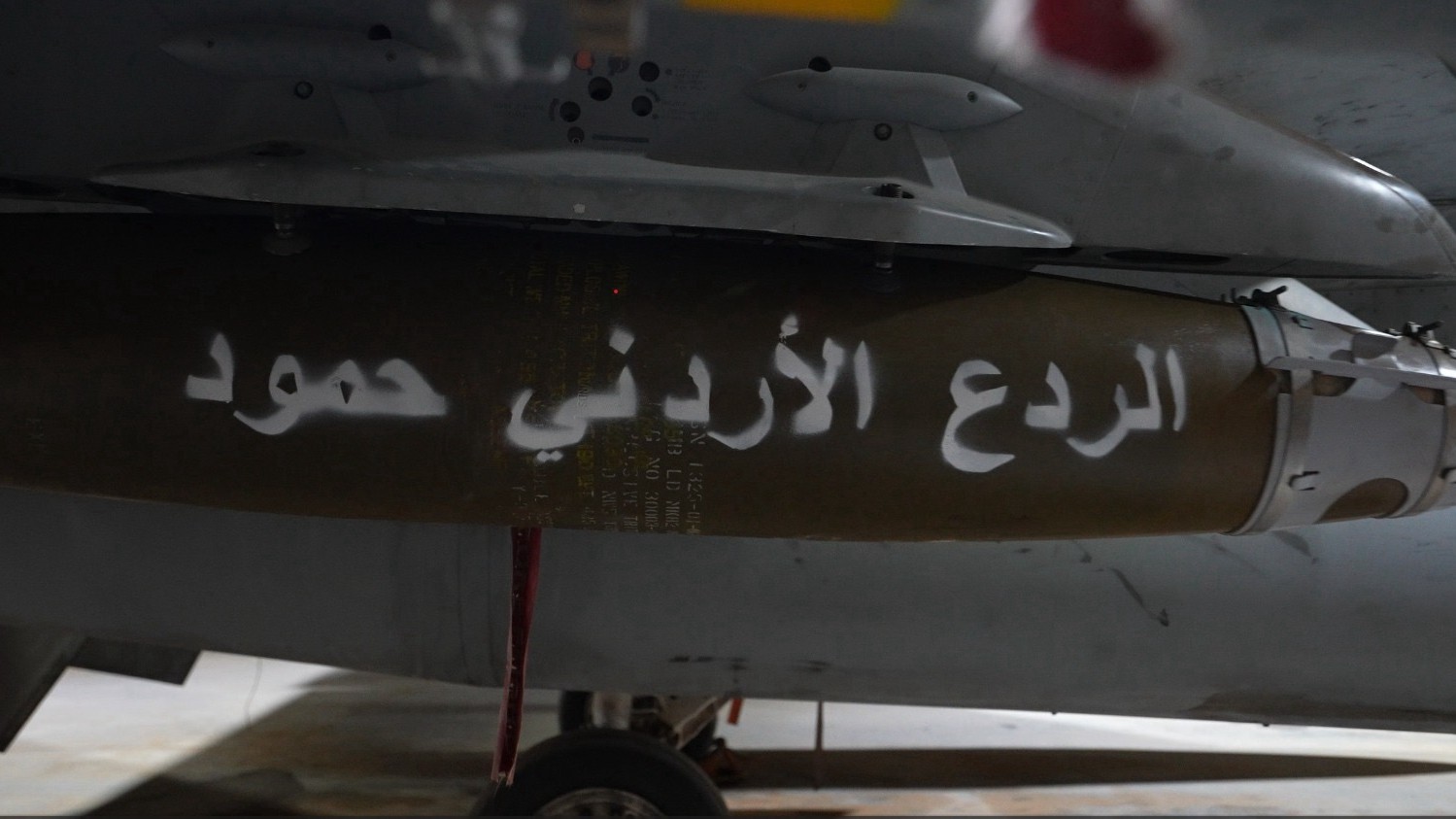
The Royal Jordanian Air Force called the operation “Jordanian Deterrence – Hmoud,” saying it targeted hideouts belonging to terrorist organizations linked to the October 23 attack on a Greek Orthodox church in the Jordanian city of Karak.

“The terrorists behind the Hmoud attack have ties to the targeted terrorist organizations,” the Jordanian military said in a statement carried by the state-run Petra news agency.

It added that the strikes killed and wounded several members of the targeted groups and destroyed their equipment and vehicles. The military did not identify the organizations or specify the locations hit.

Syrian authorities, for their part, disputed Jordan’s account of coordination and said the strikes claimed the lives of civilians.

The Syrian Civil Defense said seven people were killed across several locations in Daraa and Suwayda. Five members of one family, including three children, a woman and a man, died when a strike hit a tent in rural Daraa, while two older men were killed in separate strikes. Three other members of the family were injured.

The Syrian Foreign Ministry said the operation was conducted “without prior coordination or notification with the Syrian side,” according to a statement carried by the Syrian Arab News Agency early on October 27.

Damascus announced an investigation into the strikes and said it had opened direct communication channels with Jordan to address the incident. It also stressed the need for joint security and military coordination along the border, warning that such operations must respect Syrian sovereignty.

The strikes came hours after Jordanian security forces arrested three suspects in connection with the church shooting following a shootout in the Karak area. The suspects, two brothers and their brother-in-law, were wounded during the operation, authorities said.

The October 23 attack took place during a funeral at the Greek Orthodox church in Karak, killing nine people and wounding 34. The shooting shocked the country, where attacks of this kind are rare, and prompted King Abdullah II to promise a forceful response.

“The Nashama have chased them to the very end. We vowed the terrorists would not escape punishment, and no proponent of dark ideologies that divide Jordanians will be tolerated,” the king said on X after the strikes on Syria. “We pray that the martyrs’ souls rest in peace and wish the injured a speedy recovery.”

Jordanian Interior Minister Mazen Al-Faraya described the attack as the product of “a terroristic, extremist way of thinking.”

The investigation has also raised questions about the alleged organizational links behind the shooting. Jordan’s Public Security Directorate chief, Maj. Gen. Obaidallah Abd Rabbo Al-Maayta, said the three suspects were not affiliated with any group, telling reporters, “They only represent themselves.”

Jordan’s military, however, subsequently said those responsible for the attack had ties to terrorist groups in southern Syria without publicly identifying them or detailing the evidence.

Following the strikes, Syrian authorities closed the Nassib border crossing, suspending passenger and commercial traffic between the two countries.

The escalation highlights a growing security threat from terrorist groups operating inside Syria. With southern Syria serving as a base for their activity, and Damascus seen as either turning a blind eye or failing to contain them, neighboring countries face mounting pressure to act on their own.

_______________________________________________________________________________________________________________________

SouthFront: Analysis and Intelligence

NOW hosted at southfront.press

Previously, SouthFront: Analysis and Intelligence was at southfront.org.

The .org domain name had been blocked by the US (NATO) (https://southfront.press/southfront-org-blocked-by-u-s-controlled-global-internet-supervisor/) globally, outlawed and without any explanation

Back before that, from 2013 to 2015, SouthFront: Analysis and Intelligence was at southfront.com

SOUTHFRONT.PRESS

MORE ON THIS TOPIC:


The post Deadly Jordanian Strikes Highlight Syria’s Cross-Border Terror Threat (Videos) appeared first on South Front.

Civilians Reported Killed by Jordanian Airstrikes in Syria

27 October 2026 at 00:39
The Jordanian military on Monday launched airstrikes in southern Syria, a bombing that Amman framed as retaliation for the October 23 attack on St. George’s Orthodox Church in Jordan’s western Karak province, which killed nine Christians who were attending a funeral. The strikes hit multiple locations in Syria’s Suwayda and Daraa provinces, and according to […]

[Exclusive] Iran war and Israeli airstrikes derail thousands of EU deportation flights

26 October 2026 at 06:00

The US and Israeli-led war with Iran, launched in late February, and other military campaigns in the region have disrupted flights, leaving around 5,500 deportations that would normally receive support from the EU’s border agency Frontex unexecuted.

The disruption comes despite the Warsaw-based agency’s recent announcement that returns rose in the first half of 2026, with Syrians and Iraqis among the 10 nationalities most frequently deported.

Internally, however, Frontex appears concerned.

In July, it highlighted return problems because of the Middle East crisis, a broad swathe of conflicts that has seen various airspace closures over Bahrain, Iran, Iraq, Kuwait, Lebanon, Israel, Qatar, Syria, and the UAE.

It said roughly 4,000 returns had not been carried out because of direct cancellations or broader operational standstills, with member states halting the organisation or scheduling of Frontex-supported returns due to the Middle East conflicts.

By 30 September, that figure had climbed to 5,500.

Frontex document WK 9599/2026 INIT, made partially public on 2 July. Cites disruptions due to Middle East conflicts and returns to Syria and Afghanistan (Source: Frontex)

Although now open (as of publication), airspace restrictions, route availability and operational measures may be introduced, amended or lifted rapidly, sometimes with little notice.

European deportation setbacks typically involve everything from fragmented national systems, to people absconding, and to foreign states refusing to accept their own nationals. But war and conflict are now adding another layer of complications.

This article continues, but the full version is available only to EUobserver.com subscribers. Visit account.euobserver.com/membership

Israel drills for surprise attack with massive military exercise as expert invokes 1973 war

26 October 2026 at 00:42

The Israeli military launched large-scale domestic military exercises on Sunday to counter surprise border infiltrations and ground raids across northern and central Israel, mobilizing multiple divisions and air assets amid rising regional tensions.

The drills, set to continue over 48 hours, came as an Israeli security expert invoked the 1973 Yom Kippur War, when Egypt and Syria used exercises to disguise preparations for a surprise attack, warning that escalating tensions in the region could in fact trigger what he described as a "dangerous miscalculation."

The large-scale maneuvers, the IDF said, involve the Northern Command’s 210th Division, the West Bank Division, and the Central Command’s 98th and 96th divisions, alongside the Israeli Air Force.

IRAN TARGETS US WITH PSYCHOLOGICAL WARFARE CAMPAIGN TO MANIPULATE AMERICANS, EMBARRASS TRUMP: EXPERTS

The exercise, scheduled just ahead of Israel's elections Oct. 27, aims to "maintain the forces’ alertness and readiness, strengthen the ability to defend communities, and make full use of aerial capabilities for defense in the area," according to the IDF.

On Friday, the IDF said troops would practice "a variety of scenarios, including a surprise attack and infiltration into Israeli territory by air and land," incorporating lessons learned from the Oct. 7, 2023, Hamas-led attacks on Israel.

"This exercise is mostly about non-state actors with or without Iranian support," Israeli national security analyst Dr. Ehud Eilam told Fox News Digital.

"It's aimed at those in Syria, Lebanon, and Jordan who might try to infiltrate into Israel or send ground raids. Some are supported by Iran; others are not. It could be planned by Iran or be a local initiative."

NETANYAHU PRAISES TRUMP'S 'WICKED SENSE OF HUMOR,' DEFENDS IRONCLAD ALLIANCE AHEAD OF HISTORIC ISRAEL VOTE

"This is a massive exercise, the biggest one in recent years, aimed at protecting the borders," the former Israeli Ministry of Defense researcher added.

"It's all about making sure that the election day on October 27 will run smoothly. It's also a message to Iran and others: don't try to provoke us during election day, so nothing will be disrupted."

The Israeli drills followed a show of force by Tehran days earlier, during which the Islamic Revolutionary Guard Corps (IRGC) fired roughly 30 ballistic missiles across two distinct weapon classes, according to reports.

That live-fire display highlighted Iranian strike capabilities and sparked renewed alerts about commercial shipping in the Strait of Hormuz and prompted the Israeli military to heighten its alert level while maintaining maximum readiness for a targeted strike against Iran.

TRUMP IS DISMANTLING IRAN’S WAR MACHINE, BUT AMERICA STILL NEEDS AN ENDGAME

During a visit to the IDF's Central Command on Wednesday, Chief of Staff Lt. Gen. Eyal Zamir warned that the risk of escalation was growing.

"Given the numerous warnings across all fronts and the sensitivity of the current period, the potential for escalation has increased," Zamir said.

"To ensure better operational control on the ground, we have reinforced our troop deployments across all sectors, including moving the 98th Division into the area to strengthen security and stability."

"Part of mutual deterrence: a few days ago, Iran had their own pretty big exercise, and that was actually more intimidating as far as Israel is concerned because they launched missiles and prepared for a war with Israel," Eilam said.

"This exercise on Sunday and Monday is against Iran's proxies and allies at the border of Israel."

Sunday’s Israeli drill also followed an Oct. 19 mission in which Israeli fighter jets and aerial refueling tankers flew 800 miles across Syrian and Iraqi airspace to Iran’s border.

FROM INTELLIGENCE SHARING TO MISSILE DEFENSE, HOW ISRAEL'S PARTNERSHIP PROTECTS AMERICAN SECURITY

Washington was notified in advance and viewed the maneuver as a non-kinetic show of force following the postponement of a broader strike package earlier in the month.

Despite the deterrence signals, Eilam warned that large-scale military exercises carry the "risk of miscalculation" and particularly when troop movements could be mistaken for preparations for an attack.

"During the Cold War, every time the Soviet Union or NATO carried out a major drill, having so many troops in the field meant they might attack if that was the intention," Eilam said.

He pointed to the 1973 Yom Kippur War, when Egypt and Syria used military exercises to help conceal troop buildups along Israel's borders.

Israeli intelligence largely dismissed the movements as routine drills, allowing the two countries to achieve strategic surprise when they launched a coordinated, two-front attack on Yom Kippur.

TRUMP SAYS NETANYAHU NEEDS TO BE RE-ELECTED, OR ELSE US WILL HAVE TO 'FINISH THE JOB’ AGAINST IRAN ALONE

"The classic example in Israel is 1973, when Egypt and Syria conducted a major exercise just before the war that turned into the actual attack," the analyst said.

"Israel and Iran are now watching each other very closely and both sides suspect the other might strike first," Eilam added before stating that there is the chance of what they call "miscalculation — that each side suspects the other and strikes first by mistake."

"It's all about sending messages to each other."

"It remains uncertain whether there will eventually be an Israeli attack on Iran because it depends on U.S. authorization," Eilam concluded.

CLICK HERE TO DOWNLOAD THE FOX NEWS APP

"Right now, both sides are signaling: 'We are ready, don't mess with us, but we don't want to start a war right now.'"

Three Shepherds Captured in Latest Israeli Operations in Southwest Syria

25 October 2026 at 17:43
Israeli troops continued to operate across southwest Syria over the weekend, with multiple incursions reported against the Quneitra Governorate seemingly focused primarily on excavation and carving out the “Sufa 53 Line” that the IDF is imposing on the ground in the area. Israel has been keen on establishing a trench-line separating Syria from its own […]

Turkey Moves to Rebuild Syria’s Navy, Opening a New Front Against Greece and Israel

24 October 2026 at 14:58

Click to see full-size image. (X)

Turkey has agreed on a roadmap to rebuild Syria’s naval forces in a move that could expand Ankara’s military influence in the eastern Mediterranean and alter the regional balance with Greece and Israel.

Turkey’s Defense Ministry announced the initiative on October 23 after a senior Turkish naval delegation visited the Syrian port city of Latakia.

The discussions covered ship repair and construction, individual and team training, modernization programs and improvements to naval facilities. The ministry said the two sides had reached an understanding and established a roadmap for cooperation.

The delegation included Rear Adm. Erdinç Yetkin, commander of Istanbul Shipyard; Rear Adm. Timur Yılmaz, the Navy’s logistics chief; Rear Adm. Yücel Darcan, head of naval training and education; and representatives of ASFAT, a Turkish defense company.

The initiative comes as Syria attempts to rebuild its armed forces after more than a decade of civil war that ended with the collapse of Bashar Assad’s government close to two years ago.

The country’s already weakened military infrastructure suffered further devastating losses when Israel launched a large-scale campaign to destroy what remained of the former government’s military capabilities.

Strikes targeted Syrian naval facilities along the coast, sinking more than a dozen warships and destroying all coastal defense systems. Israeli Defense Minister Israel Katz subsequently announced that the operation had destroyed Syria’s naval fleet.

The attacks left Syria with little capacity to field a modern combat fleet capable of challenging established naval powers in the region. Rebuilding that capability will require equipment, technical expertise, trained personnel and functioning maritime infrastructure — areas in which Turkey possesses a substantial advantage.

For Ankara, the cooperation offers an opportunity to establish a deeper and potentially long-term role in the security of Syria’s Mediterranean coastline.

The latest initiative also follows a significant Turkish naval visit to Latakia in July. Turkish Naval Forces Commander Adm. Ercüment Tatlıoğlu arrived aboard the TCG Istanbul frigate, marking the first visit by Turkish naval vessels to the port since the beginning of Syria’s civil war, according to Anadolu Agency.

The deepening maritime cooperation between Turkey and Syria could provoke the maritime alignment involving Greece, Cyprus and Israel.

Ankara has long disputed aspects of Greece’s maritime claims and opposed regional energy arrangements that it considers exclusionary. Greece, Cyprus and Israel, meanwhile, have pursued closer security and energy cooperation, creating another arena for competition over maritime access and regional influence.

A July analysis published by Anadolu Agency, written by a professor at Turkey’s National Defense University, explicitly presented a stronger Syrian navy and improved naval infrastructure at Latakia as developments that could affect this regional balance.

The analysis described cooperation with Syria as another component of Turkey’s expanding network of partnerships with Mediterranean countries, alongside its existing relationships with Libya and Egypt.

For Israel, a future Syrian navy backed by Turkey could introduce a new variable along a coastline where Israel previously faced a severely weakened Syrian military.

The immediate military implications, however, remain limited. The announced roadmap does not establish publicly disclosed rights for Turkey to permanently base warships at Latakia, and the ministry has not announced specific ship orders, delivery schedules or the scale of the planned force.

The agreement therefore represents the beginning of a potential naval reconstruction program, not evidence that Syria has already regained a meaningful maritime combat capability.

_______________________________________________________________________________________________________________________

SouthFront: Analysis and Intelligence

NOW hosted at southfront.press

Previously, SouthFront: Analysis and Intelligence was at southfront.org.

The .org domain name had been blocked by the US (NATO) (https://southfront.press/southfront-org-blocked-by-u-s-controlled-global-internet-supervisor/) globally, outlawed and without any explanation

Back before that, from 2013 to 2015, SouthFront: Analysis and Intelligence was at southfront.com

SOUTHFRONT.PRESS

MORE ON THIS TOPIC:

The post Turkey Moves to Rebuild Syria’s Navy, Opening a New Front Against Greece and Israel appeared first on South Front.

Israeli Forces Kill Man With Down Syndrome in Raid on Southwest Syria Town

23 October 2026 at 00:53
Israeli ground troops have been raiding the Yarmouk River Basin in the western part of Syria’s Daraa Governorate in growing numbers and more frequently in recent days. The restrictions placed on locals have been onerous enough to attract some international attention. Now, a fatality will add to those concerns. The incident happened overnight Thursday in […]

Israel’s vision of regional security rests on keeping Arab states weak

Six years after the Abraham Accords, a new report by a former Israeli intelligence chief outlines a doctrine treating peace deals as temporary and regional instability as an asset. (This the latest chapter of a decades long Israeli strategy)

Syrians Fear Election Will Be Pretext for New Israeli Offensives

21 October 2026 at 17:58
It’s the last week before Israel’s elections, and the concern around Syria that there may be a pre-election “surprise” seems palpable. The belief is that Israeli PM Benjamin Netanyahu may seek to politically benefit from a new operation within southern Syria in the next few days. And while Israel’s ongoing military operations in Syria are […]

Syria is Preparing to Send 10,000 Troops to Yemen

21 October 2026 at 14:42

Illustrative image.

A Syrian military delegation has held talks in Saudi Arabia on arrangements to transfer as many as 10,000 Syrian fighters to participate in the war against Yemen’s Houthis (Ansar Allah), Lebanon’s Al-Akhbar newspaper reported on October 20, citing Yemeni intelligence sources.

The reported discussions come despite denials by Syria’s transitional government that Damascus intends to send thousands of fighters to southern Saudi Arabia. The alleged deployment could extend Syria’s involvement in a regional conflict that has intensified in recent weeks.

According to Al-Akhbar, the delegation included Brig. Gen. Khaled Khattab, commander of the 82nd Division in Syria’s new army and a former leader of the al-Qaeda-affiliated Ansar al-Tawhid faction, and Brig. Gen. Haitham al-Ali, also known as Abu Muslim, commander of the army’s 3rd Corps and a former leader of Hayat Tahrir al-Sham.

Yemeni intelligence sources told the newspaper that Khattab spent four days in the southern Saudi provinces of Asir and Najran, accompanied by Saudi officers, visiting sites reportedly being prepared to receive the Syrian fighters.

Al-Ali, meanwhile, held meetings with Saudi officers at the Defense Ministry in Riyadh to discuss transportation costs, financial arrangements, additional benefits and the military missions the contingent would carry out.

The sources said the visiting team had completed preparations for the logistical transfer of the fighters, but the report did not establish when a deployment might take place.

Al-Akhbar also cited sources aligned with Yemen’s internationally recognized government based in Aden as saying that dozens of Syrian trainers specializing in drone operations were already present at military camps in Asir and several locations in Yemen. These reportedly included facilities near Seiyun in Hadramout province, the al-Khasha camp in Hadramout and the al-Anad military base.

The sources said the trainers were instructing members of the Saudi-backed Homeland Shield forces and Giants Brigades. The sources also alleged that Syrian drone operators had established units within Saudi Arabia’s Emergency Forces in Asir and in the al-Wadiah and Sharurah areas.

The report further raised the possibility that foreign fighters could be transferred alongside Syrians. Al-Akhbar cited Syria’s Sham TV as reporting that Khattab was responsible for assembling foreign recruits for deployment to Yemen.

According to the broadcaster, prospective recruits were being offered generous salaries, free pilgrimages to Mecca and Medina, and the possibility of relocating their families to Yemen after a period of what it described as “stability.”

Al-Akhbar cited analysts specializing in political Islam who said fighters from the Syrian army’s 84th Division, which reportedly includes foreign Islamist fighters, could also be transferred. The newspaper said the contingent could include Uyghurs, Uzbeks, Tajiks, Afghans, Chechens, Albanians and Arabs of various nationalities.

The report suggested that relocating foreign fighters could serve Damascus’ interest in reducing the security burden posed by foreign armed groups while consolidating control over the new military establishment. It also cited concerns among observers in Sanaa that transferring such fighters to Yemen could deepen sectarian divisions and prolong the conflict.

A military source in Sanaa told Al-Akhbar that any Syrian involvement in the war against the Houthis Yemen “would not be official.”

“Sending masses of extremists is an intelligence operation that governments do not acknowledge, because it conflicts with international law,” the source said, arguing that the use of foreign armed groups would amount to covert intervention.

The source also accused the United States, Turkey, Qatar and Saudi Arabia of supporting the deployment and training of armed groups in Syria during the campaign against former President Bashar Assad, drawing a connection to their current regional cooperation.

The newspaper’s report comes as Saudi Arabia seeks to strengthen its military position against the Houthis, who have continued attacks on Saudi targets while advancing on fronts in Yemen. However, it remains unclear whether the reported Syrian arrangements will result in an actual deployment or whether the scale of the proposed force could be achieved.

Syria’s fractured and under-equipped military is unlikely to change the course of the war in Yemen. Still, participation could carry profound consequences for Damascus, exposing it to retaliation by Iran and its regional allies, undermining the new government’s promise to keep Syria out of foreign conflicts, and threatening the country’s fragile economic recovery.

_______________________________________________________________________________________________________________________

SouthFront: Analysis and Intelligence

NOW hosted at southfront.press

Previously, SouthFront: Analysis and Intelligence was at southfront.org.

The .org domain name had been blocked by the US (NATO) (https://southfront.press/southfront-org-blocked-by-u-s-controlled-global-internet-supervisor/) globally, outlawed and without any explanation

Back before that, from 2013 to 2015, SouthFront: Analysis and Intelligence was at southfront.com

SOUTHFRONT.PRESS

MORE ON THIS TOPIC:

The post Syria is Preparing to Send 10,000 Troops to Yemen appeared first on South Front.

Military Situation In Syria On October 20, 2026 (Map Update)

20 October 2026 at 19:08

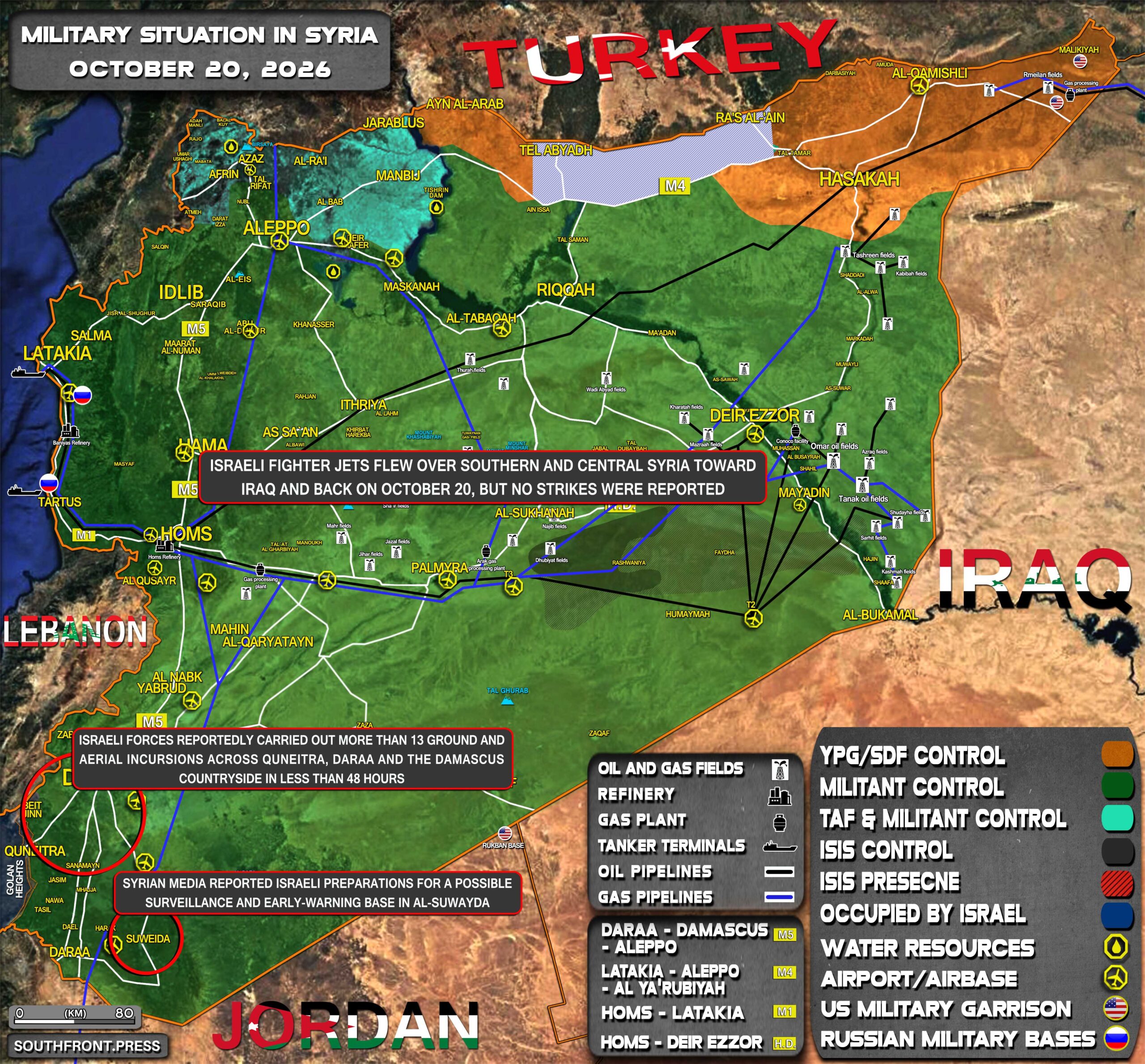
Click to see full-size map.

  • Israeli forces reportedly carried out more than 13 ground and aerial incursions across Quneitra, Daraa and the Damascus countryside in less than 48 hours;
  • Israeli fighter jets flew over southern and central Syria toward Iraq and back on October 20, but no strikes were reported;
  • Syrian media reported Israeli preparations for a possible surveillance and early-warning base in al-Suwayda.

_______________________________________________________________________________________________________________________

MORE ON THIS TOPIC:


The post Military Situation In Syria On October 20, 2026 (Map Update) appeared first on South Front.

❌