❌

Reading view

Meet Zakon, the Ukrainian font designed to write Russian type out of state documents

zakon typeface

For more than 300 years, since Peter I's 1708 script reform, Ukrainian lettering has been shaped by imperial Russian norms. Zakon, presented on 29 October 2026, aims to break that pattern and decolonize the letters of Ukraine's state acts and awards.

The national font for official state communication draws on the work of Ukrainian artists, including Heorhii Narbut, who designed a 1918 banknote for the Ukrainian People's Republic, the short-lived independent state that fell to the Bolsheviks. It is meant to replace Izhitsa, Petersburg, and other Russian-origin fonts still often used on honor certificates, letters of thanks, diplomas, battle flags, and signs, adding a visual touch to the country's push to boost its national culture amid the fifth year of Russia's full-blown invasion.

Verkhovna Rada Speaker Ruslan Stefanchuk presented Zakon on 29 October, nine months after parliament adopted a resolution that called for a national font and said Russian-origin fonts had no place in official acts or on state awards. The Ministry of Culture developed it with money from the job site Work.ua and its co-owner Artur Mikhno, and the font is still in beta testing, the ministry says.

“The letters in which the word ‘Ukraine’ is written are also part of our state identity,” Stefanchuk wrote. “Decolonization should also concern how Ukraine presents itself.”

"Ukraine" written in Zakon font. Screenshot from mincult.gov.ua

“The creation of a national typeface is an important step toward ensuring that state institutions represent Ukraine through our artistic tradition and contemporary Ukrainian design. [...] We want Ukrainian design to shape the image of our country, and for our cultural heritage to become a source of new solutions,” said Tetiana Berezhna, Deputy Prime Minister for Humanitarian Policy and Minister of Culture.

Three typefaces, one of them free for anyone

Zakon comes in three versions. Zakon Text is designed for everyday official paperwork and is free for anyone to use; it's available for download here. Zakon Decor, for ceremonial inscriptions, and Zakon Letterpress, for printing the originals of legal acts, have closed licenses.

Zakon Text has four styles: regular, italic, bold, and bold italic. The ministry asks users to test it and send feedback before a wider rollout, which Stefanchuk said will be gradual.

The designers are Oleksii Chekal, Hennadii Zarechniuk, Dmytro Rastvortsev, and Andrii Shevchenko, with Taras Ishchyk leading the project.

Example of an Antiqua font

The ministry calls Zakon a “classic Ukrainian antiqua.” Antiqua, or roman, is the family of upright serif letters that grew out of a script Renaissance Italian humanists modeled on Carolingian handwriting, which they took for ancient Roman.

The name set it apart from blackletter, the Gothic script, and its forms became the basis of the roman typefaces Nicolas Jenson and Aldus Manutius cut in 15th-century Venice.

Built on the lettering of six Ukrainian artists

Zakon brings Ukrainian letter forms back to Cyrillic. The Ministry of Culture says that its developers “generalized most of the characteristic features” of six Ukrainian graphic artists’ lettering.

Heorhii Narbut (1886–1920) is credited with 13 of the 24 banknotes issued in 1917–1920, the first Ukrainian postage stamps, and an illustrated Ukrainian alphabet he never finished. His letters drew on Cossack baroque motifs and floral ornament.
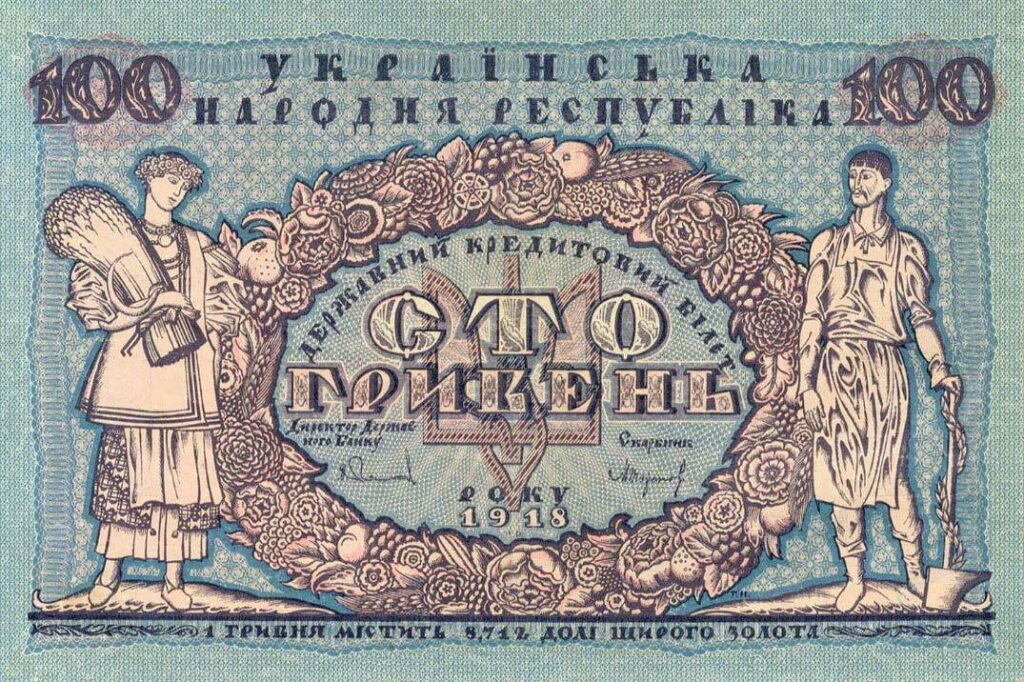
Design of the 100 hryvnia note of the Ukrainian People's Republic. Typography, illustration, ornamentation. Heorhii Narbut, 1918.

Vasyl Krychevskyi (1873–1952) drew the trident that became the coat of arms of the Ukrainian People’s Republic in 1918, along with its seals and banknotes.

Vasyl Krychevskyi. Coat of Arms of the Ukrainian People's Republic. Poster, 1918.

Robert Lisovskyi (1893–1982), a follower of Narbut, made prints, book covers, and emblems, and later led the Association of Ukrainians in Great Britain.
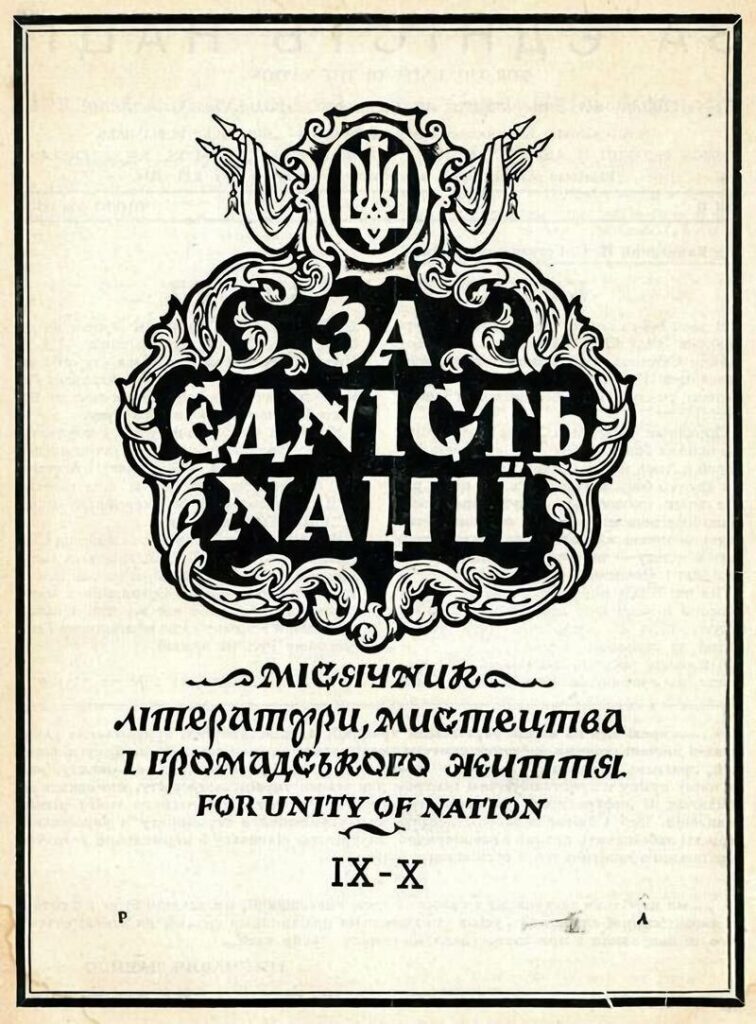
Cover of the magazine *For the Unity of the Nation*. Lettering and coat of arms by Robert Lisovskyi, 1955.

Vasyl Khomenko (1912–1984) created New Ukrainian, a typeface he worked on from 1963 to 1970. Zakon co-designer Zarechniuk is one of the authors of Homenko, a typeface based on his work.

Homenko Font Family
Homenko Font Family developed by Zarechniuk

Yakiv Hnizdovskyi (1915–1985) emigrated to the United States in 1949, later settling in New York, and made close to 250 woodcuts, along with book covers and bookplates.
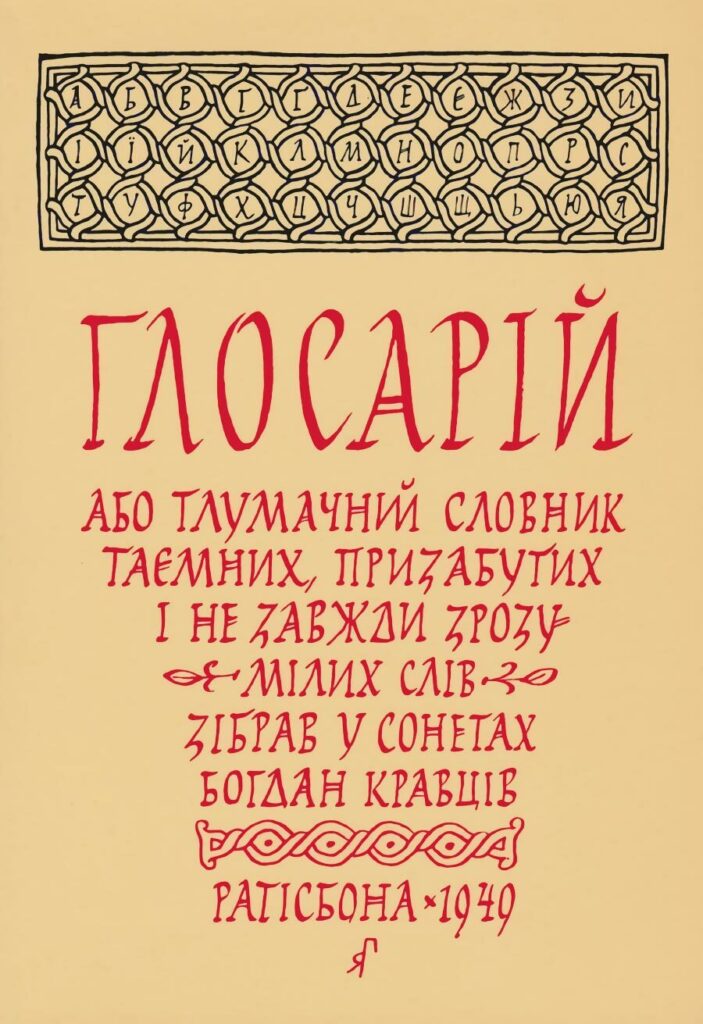
Book cover. Calligraphy, ornamentation. Yakiv Hnizdovskyi, 1949, Regensburg.

Vasyl Chebanyk (1933–2025) began studying the Ukrainian alphabet in 1971 and in 2001 launched the Rutenia project to restore older Ukrainian forms in a modern shape. Rutenia later grew to more than 60 fonts and won him the Shevchenko National Prize. One of them is on the cover of the ceremonial copy of Ukraine’s Constitution.
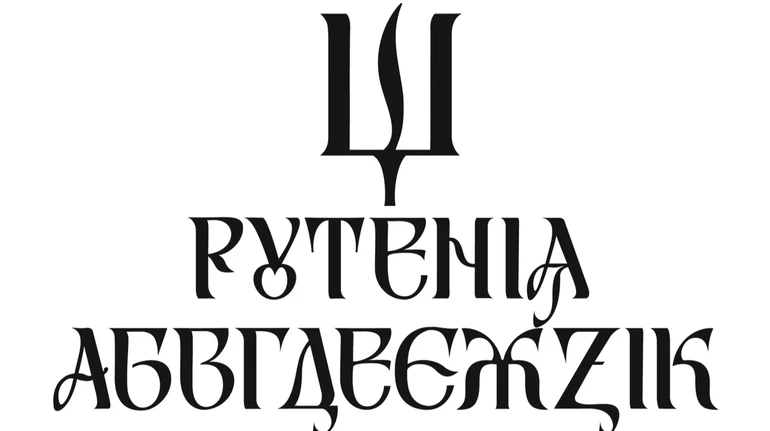
The "Rutenia" decorative typeface, designed by Vasyl Chebanyk. Illustrative image
The Rutenia decorative typeface designed by Vasyl Chebanyk. Illustrative image

How Ukraine's state started dropping Russian fonts

Russia's full-scale invasion turned fonts into a state matter. On 29 September 2022, days after Russia's sham "referendums" in four occupied Ukrainian oblasts, Anna Yakupova, CEO of ParaType, the Russian studio whose Cyrillic versions of Petersburg and other fonts Ukraine's state institutions still use, congratulated colleagues in a chat that "our country got bigger," prompting a campaign to shun the fonts.

In August 2023, MPs from three factions registered bill 9606 to ban the Russian font Izhitsa from Verkhovna Rada documents and move parliament's honor certificates to Volja, a Ukrainian font made in 2022 by Marchela Mozhyna from the lettering of artist Nil Khasevych. A month later, the culture ministry announced plans for a bank of Ukrainian fonts to replace Russian ones.

In July 2026, the fight reached Ukraine's money. The National Bank of Ukraine said it would redraw the lettering on its new 2,000-hryvnia note featuring poet Vasyl Stus, after type designer Bohdan Hdal said the denomination lettering resembled an unofficial Cyrillic adaptation of Bickham Script made by a Russian designer. “No Russian shadows on a banknote with a poet whom Russia killed,” NBU Governor Andrii Pyshnyi said.

The "Two thousand hryvnias" inscription on Ukraine's new banknote will be redrawn after critics said it resembled a Russian designer's unofficial adaptation of a font

Some readers balk at the Z

Not everyone liked the name. Among the top comments under Stefanchuk’s post, readers objected that the Latin spelling starts with Z, the letter Russia painted on its vehicles for the full-scale invasion. Others welcomed the font itself.

  •  

A Russian disinformation campaign cloned Euromaidan Press to blame Ukraine for Russia’s own strike on Kramatorsk (we took the fake down)

A screenshot of the fake Euromaidan-press website that is supposedly part of the Russian disinformation Storm 1516 operation. Collage by Euromaidan Press

Euromaidan Press has been impersonated as part of a Russian disinformation campaign. A copycat website was created, with a hyphen added to our name, which published a fabricated article alleging a Ukrainian drone had killed civilians in Kramatorsk that cites anonymous "Ukrainian OSINT channels" amid copies of our real news reports. In reality, that 8 October strike was a Russian aerial bombing of two public buses that killed 33 civilians.

The fabrication is part of a years-long Russian disinformation campaign to impersonate and clone trusted news brands, predominantly in Europe, and publish false reports under their names. The disinformation research project Gnida tied our case to Storm-1516, one of several overlapping Russian operations, alongside the older Doppelganger, and NewsGuard, which reached out to us while preparing its own debunk, attributes the fake to the same operation. The fabricated Kramatorsk report comes amid an ongoing effort to erode Western support for Ukraine, as Russia's war goes on, and to sow distrust among Western political elites.

The claim and the actual 8 October attack

The fake started circulating on 24 October, one day after the forged publication appeared on our website. It started making rounds on X together with a forged video with a version of our logo claiming that "newly obtained footage" featured the remains of a Liutyi drone that "independent OSINT channels" claimed were "quickly removed from the scene." No specific OSINT channels were named; no sources were linked.

The forged video, apparently produced with AI, and the link were spread by X accounts such as @vick55top, @indiaTales7, @TheWorld_Update, @Wonder_star21, @Theunk5555, @SilentBriefHQ1, and @Suriyakmaps, where it was subsequently removed. The videos on those accounts averaged 400,000 to 500,000 views, far more than the accounts' modest follower counts and their usual engagement would produce, a likely sign of inauthentic amplification.

On 25 October, the Russian disinformation monitor Gnida Project flagged this as a case of the Storm-1516 disinformation campaign. Other recent cases flagged by Gnida included advertisements of Russian Geran drones, claims of the Shamonda virus being leaked from a "Ukrainian biolab," smears against US Democratic candidates, and a fake on a similar copycat "toronto-sun.ca" website alleging that President Zelenskyy purchased a nuclear bunker in Nova Scotia.

The latest Storm-1516 disinformation campaign is targeting Ukraine. The campaign promotes a false narrative that a deadly strike in the Ukrainian city Kramatorsk was performed by a Ukrainian drone based on a fake "Ukrainian OSINT investigation" pic.twitter.com/Klpm9UVCf2

— gnida project (@gnidaproject) October 25, 2026

As for the actual content of the fake, the real event is one of the most thoroughly documented atrocities of the month. On 8 October 2026, Russian forces struck two public buses in Kramatorsk with an aerial bomb, killing 33 people and wounding about 18. Such attacks are, sadly, a daily occurrence in cities on the frontline. There was no Ukrainian drone and no removed wreckage. The fabrication simply reassigns a Russian mass killing of civilians to its victim, which is the entire point.

The fake site was not a single page. It scraped our entire website, mirroring our genuine articles, and injected the fabricated one among them, so the lie traveled under the credibility of real reporting. The look-alike domain was registered on 15 October, eight days before the fake appeared, according to who.is data.

Storm-1516

Gnida Project identified the fake as part of Storm-1516, a Russian influence operation that clones trusted news brands to spread fabricated stories, and NewsGuard, which contacted us about the impersonation, attributes it to the same operation. NewsGuard has documented the tactic generating some 900 false reports over three years; the same operation has targeted France and Germany and has recently impersonated other outlets, including in Ukraine, such as this fake report on a copycat website pretending to be the New Voice of Ukraine.

Storm-1516 is one of several overlapping Russian operations that impersonate real media. Since 2022, the Doppelganger network has cloned whole Western outlets and government sites, and it is still active, flooding France with more than 200 fake sites before its 2026 elections. Polish fact-checkers literally call the tactic “attack of the clones.” A second operation, Matryoshka, floods social media with cheap fake videos credited to real outlets. Storm-1516, first identified in late 2023 and later named by Microsoft, grew out of Russia's Prigozhin-era troll operations, is the most elaborate of the three, and has overtaken RT and Sputnik as Russia's main disinformation machine. Its attacks combine cloned websites and fake videos.

NewsGuard counts some 906 fabricated reports impersonating 163 outlets from 21 countries since 2023, Euronews, the BBC, Deutsche Welle, and France 24 most of all, as well as the Kyiv Independent. The fakes nearly all bend one way, to erode Western support for Ukraine. Some smear Ukraine's leaders, a fabricated story that 20,000 Ukrainian soldiers evacuated to France had deserted into criminal gangs, invented claims that first lady Olena Zelenska fled abroad. Others, like the one aimed at us, flip Russian actions onto Ukraine. A separate Storm-1516 fabrication, a false claim that Ukrainian officials bought yachts with misappropriated US aid, was repeated in 2023 by JD Vance, then a US senator.

We filed a copyright and abuse complaint with the host, Namecheap, and a phishing report with Cloudflare, and pressed the registrar. The complaints worked: the clone has been taken down.

How to take down a cloned news site

Impersonation is cheap to set up, and any outlet can be next, so here is the procedure our technical team used, which other newsrooms can follow to take a clone down quickly.

  1. Cut the scraping pipeline. Run a DNS lookup (ping, nslookup, or dnschecker.org) on the cloned domain to expose the hosting IP behind any basic masking, then add a custom block rule in your Cloudflare WAF (Security, WAF, Custom Rules) targeting that IP, which cuts off the scraping scripts in real time. Watch the WAF logs over the next 48 hours in case the attackers rotate to new scraping proxies.
  2. Unmask the infrastructure and send formal notices. Run an IP WHOIS lookup (ipinfo.io) to identify the host, for example Namecheap or DigitalOcean, and the registrar, then submit DMCA takedown and phishing notices to the host's legal portal or abuse address. Include side-by-side URL comparisons of the original and cloned pages, clear documentation of the brand spoofing and the injected disinformation, and a good-faith legal statement with full contact details.
  3. Block access and de-index from search. Report the clone to Google Safe Browsing under social engineering and impersonation, which, once verified in 24 to 48 hours, makes Chrome, Firefox, and Safari show a full-page red warning to anyone who tries to open it. Then file a Google Search Console DMCA removal request to pull the cloned URLs out of search results.
  4. Escalate to the registrar. Submit a registrar abuse complaint demanding a full suspension of the domain, a ClientHold status, on the grounds of bad-faith typosquatting and identity theft, and push your open abuse ticket IDs through your Cloudflare account to skip the standard queue.

Be sure to read the automated replies from the host and Cloudflare and answer them promptly. Those acknowledgments often ask for specific additional information, and a fast, complete reply keeps the ticket moving instead of stalling in a queue.

How to spot Russian Storm-1516 attacks

Many users on X called out the signs: a look-alike domain (our only website is euromaidanpress.com, with no hyphen), a claim sourced to unnamed "OSINT channels," and a story that reassigns a Russian attack to Ukraine.

We never publish an image or video without crediting its source, and we never cite anonymous OSINT experts: our reporting traces to a first source. Trust only reports that name the first source of a claim and label the origin of their images and video. If you cannot trace the source, you cannot trust the report.

  •  

Romania finally holds Russia responsible for the drone attacks on ships off its coast, and wants a joint NATO command for the Black Sea

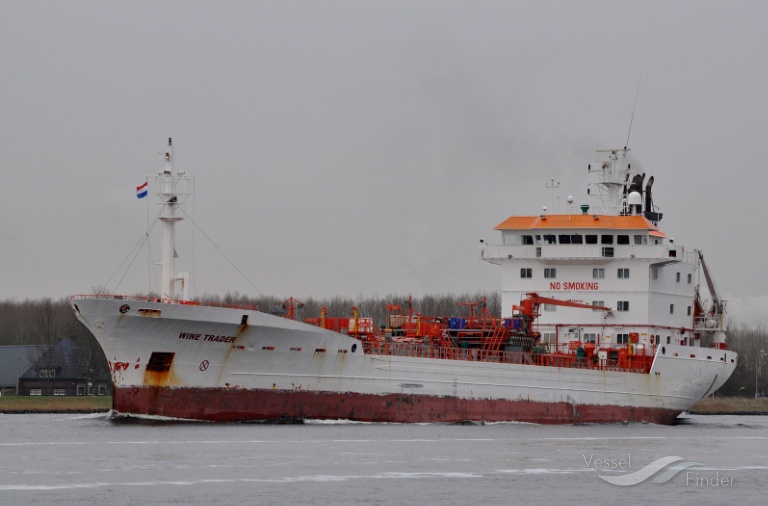
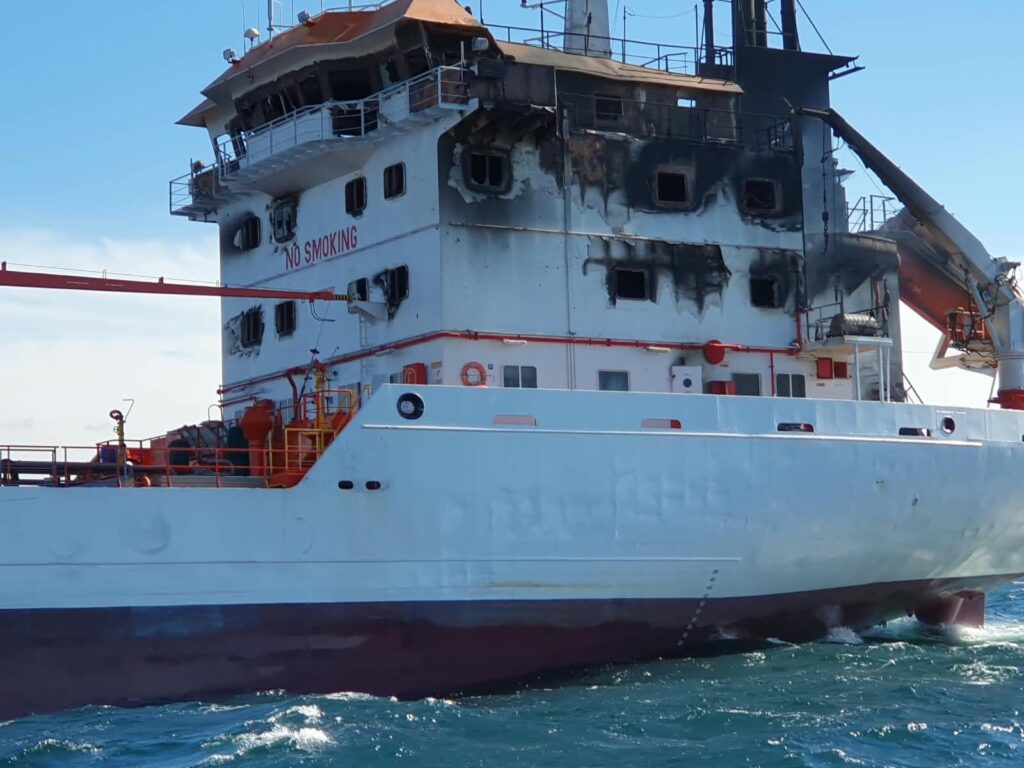
The San Marino-flagged chemical tanker Wine Trader near Sulina, Romania, on 15 October 2026, after it was hit by drones about 14 nautical miles off the coast. Seven of its 12 crew were reported missing. Photo: ARSVOM

Romania has proposed a joint NATO military command for the Black Sea, as drones hit four merchant ships in 24 hours, three of them off its coast, and its foreign minister said Russia "bears full responsibility." NATO ambassadors will discuss the attacks next week.

Russia’s strikes on merchant ships in the Black Sea have escalated this autumn and reached NATO shores. Drones have attacked at least eight merchant vessels near Romania and Bulgaria since 5 October, two of them inside Romania’s territorial waters. Until now, neither country had named the attacker, and Bulgaria still says it cannot prove who it was. Romania’s patience appears to have run out, and next week’s NATO meeting will show whether the alliance is ready to go further as Russia’s war spills beyond Ukraine’s borders.

Acting Defense Minister Radu Miruță wrote on Facebook on 14 October that "the Black Sea needs a joint military command of the NATO riparian states." "The Black Sea incidents, involving drones, sunk ships, and naval mines, oblige us to act, not wait," he wrote, after a call with his Bulgarian counterpart. Leadership and location would rotate among the member states. Romania is ready to host the command on its coast from 2028 and would accept a start on Türkiye's coast until then, he said. He proposed that Romania and Bulgaria send NATO a joint letter backing the idea.

The next day, Foreign Minister Oana Țoiu wrote on X that four commercial ships had been attacked over the previous day, including in Romania's territorial waters and exclusive economic zone, and that eight people had died. "Russia is turning the Black Sea into a dangerous area for civilian ships," she wrote. "Killing sailors from commercial ships, both in this region and anywhere in the world, is a crime. Russia bears full responsibility for these developments."

Earlier that day, as two tankers burned off Romania's coast, Bucharest had said it was still checking whether drones were involved.

two tankers burn off romania’s sulina bulgaria says lacks proof russia behind black sea ship attacks · post burned superstructure tanker wine trader seen rescue helicopter 15 2026 romanian interior
Explore further

Two tankers burn off Romania’s Sulina as Bulgaria says it lacks proof Russia is behind the Black Sea ship attacks

Țoiu said NATO Secretary General Mark Rutte had agreed to convene the allies within days, after he met Romanian President Nicușor Dan and Bulgarian Prime Minister Rumen Radev in Brussels. NATO ambassadors will meet next week, France 24 reported. No date has been announced.

An escalating drone strike campaign

Black Sea grain war between Ukraine and Russia escalates
Map: Euromaidan Press

Drones have been hitting merchant ships for weeks on the route from Ukraine's Danube and Odesa ports to the Bosporus. Besides the latest strikes off Romania, Reuters counts at least five cargo ships hit near Romania and Bulgaria in the past 10 days, with 23 sailors dead or missing, most of them outside any NATO member's territorial waters. This week the strikes reached Romania's own waters.

  • The Comoros-flagged tanker Yara J was hit inside Romanian territorial waters late on 14 October, off Sulina, the port at the mouth of the Danube. Its crew was unharmed, and it was towed to the Romanian port of Constanța.
  • Early on 15 October drones struck the San Marino-flagged chemical tanker Wine Trader about a mile outside Romanian waters, also southeast of Sulina. Five of its 12 crew were rescued. Seven were still missing on 16 October, when rescuers returned to search the ship.
  • Two more ships were also targeted, Reuters reported: the Marshall Islands-flagged Sea Destiny, inside Romanian waters according to NATO, and the Tanzania-flagged Dania J, moored at the Ukrainian Danube port of Izmail.

Țoiu did not say which ships her eight dead were from, and Reuters still lists the Wine Trader's seven as missing. A NATO military source told Reuters the drones that hit both tankers came from Russia.

The chemical tanker Wine Trader
The chemical tanker Wine Trader. Photo: VesselFinder

Romania's president says too early to say

Romania's president has not gone as far as his foreign minister. Dan told reporters in Brussels it was "obvious" that the attacks were Russian attempts to destabilize Romania and Bulgaria and reduce support for Ukraine. But he also said it was too early to say definitively that Russia had launched the drones, according to Politico.

Bulgaria, Romania's partner on the command proposal, says it suspects Russia but cannot prove it. Two ships were hit off its coast on 13 October, and one, the HS Dignity, sank. The other, the Chelsea 3, is Ukrainian-owned.

Radev told parliament on 14 October that the attacks worked in Russia's favor and that "logic leads there." "The problem is that we cannot prove it," he told MPs. Sofia summoned the Russian ambassador. Radev also said EU leaders would discuss a moratorium on attacks on civilian ships in the Black Sea.

Bucharest has blamed Russia for drones before, though over its airspace, not its shipping. On 27 July it expelled a Russian diplomat after prosecutors confirmed that fragments of drones downed on Romanian territory were Russian. Russia, Romania's Foreign Ministry said then, "bears exclusive responsibility."

Ukraine ships most of its farm exports across the Black Sea. Euromaidan Press's David Axe has written on how the fight over shipping there has escalated.

Bulk carrier "Royad Mammadov" under the flag of Saint Kitts, partially sunk after an attack by Russian sea and air drones on October 5, 2026, 20 nautical miles off the coast of Romania. Photo: Romanian Interior Ministry
Explore further

Russia is losing the Black Sea grain war it started. Its answer is to sink civilian ships off Romania and Bulgaria

  •  
❌