❌

Reading view

Inside the minds of successful business owners. 'I wake up hungry, and I will not stop.'

mind brain

: BSIP/Universal Images Group via Getty Images

  • Entrepreneurship comes with risk and uncertainty. As one founder put it, "You have to be insane."
  • Two successful founders share the mindsets that helped them push through when failure felt possible.
  • They explain how anyone can develop the resilience and confidence to take entrepreneurial risks.

A traditional job typically comes with a regular paycheck and benefits — a measure of stability and predictability.

Entrepreneurship offers neither. It comes with risk and uncertainty. There is potential for a big payoff, but no guarantees.

Popsmith CEO Tal Moore put it bluntly: "You have to be insane to be an entrepreneur," he told Business Insider. "Because there's so much risk. There's so much turbulence."

He and his cofounder nearly ran out of money while building their high-end stovetop popcorn popper.

"I ended up selling $600,000 worth of my personal stock to keep us afloat," Moore said.

It was stressful, of course, but Moore felt he had to find a way through — not only because he had invested heavily in Popsmith, but because friends and family had, too.

"They bet on me. They bet on my brand," he said. "If you lose your own money, that's one thing. But there was just no f---ing way that I was going to lose my friends' and family's money."

Kyle Ray had a different source of motivation. In high school, one of his teachers told him he'd end up working at McDonald's.

Rather than feeling discouraged, Ray used the comment as fuel.

He never finished college, but he did turn a window-cleaning side hustle he started with $100 into a six-figure business, Geek Window Cleaning, which now serves hundreds of clients across multiple Texas cities.

Ray said he had doubts "all the time" that the business would work, but wanting to disprove that teacher meant adopting a failure-is-not-an-option mindset.

"I'm going to make this work," he decided. "I'm just going to figure it out."

Throwing "Hail Marys"

When Moore and his business partner had just two weeks of cash runway left, saving the business meant getting attention and moving product without spending much money.

"At this point, I had to throw some Hail Marys," Moore said.

His first idea, which he called "harebrained," was to send poppers directly to the CEOs of Williams-Sonoma and Crate & Barrel. He'd designed the product with those retailers in mind, but couldn't get their attention.

"I know my popper will sell on their shelves," he thought. "I just have to get it in their hands."

tal moore popsmith
Tal Moore is the cofounder of Popsmith.

Jason LeCras for BI

Moore bought the most upscale, high-quality paper he could find at Kinko's, handwrote notes to both CEOs, and "blind-shipped" poppers to them. Within two months, buying teams from both companies had reached out, he said.

Then came Oprah.

Moore had no idea how to get on Oprah's annual "Favorite Things" list — "it's just like a total black box," he said — until he spotted an opening on LinkedIn. A junior editor at Oprah Daily had posted about popcorn, so Moore sent her a cold message. She replied, requested a popper, and eventually helped get the product in front of Oprah.

An Oprah Daily editor told Moore that the team considers about 15,000 products each year before Oprah makes her final selections. In 2024, Popsmith made the cut.

After the list was announced, the company sold out of every popper within weeks. Popsmith went on to sell out three more times over the next five months.

As an entrepreneur, "there's a pressure and a will to win," Moore said. "There's an endless drive that just never goes away. I wake up hungry, and I will not stop."

Developing the entrepreneur mindset

Like Moore, Ray has a refusal-to-quit mentality. He views entrepreneurship as a highway without an off-ramp — no Plan B waiting at the next exit.

"If there is no exit, then there's just one path," he said. "And you just have to get through it."

That doesn't mean every business will succeed. In fact, many won't. But Ray believes entrepreneurs need to be willing to take risks, potentially look foolish, fail, and move on to the next idea if necessary.

Often, he said, fear of failure — and other people's judgment — is the real obstacle.

At the core of his mindset is a willingness to care less about both.

kyle ray
Kyle Ray is the founder of Geek Window Cleaning.

Courtesy of Kyle Ray

"If Geek fails now, I'm going to look stupid, but it's like, 'Okay, cool. What's next?' Like, I don't care," he said. "And the earlier you can develop that carelessness — the 'I don't care if I look stupid' or 'I can fall flat on my face. I am still going to go for it' — I think if you get to that point, anybody can go out and be an entrepreneur."

That mindset can be learned, he said. Like any other skill, from swinging a tennis racket to ballroom dancing, it takes time, consistent work, and patience. Ray recommends three steps:

1. Start with books. They're cheap — or free at the library. Ray's top picks include "Inner Excellence" and "Can't Hurt Me." Moore prefers biographies of entrepreneurs and business leaders, from Warren Buffett and Richard Branson to John D. Rockefeller.

2. Find someone who is already doing what you want to do at a high level. Then ask questions, Ray said: "What are you doing that I'm not? What am I doing that's preventing me from breaking through?"

3. Join a mastermind or hire a coach. Ray has multiple.

"When there's something I don't know, or I need to learn, I start to look for coaches," he said. "It's like a wormhole, right? If you can find somebody that knows something about where you want to be, they can help you collapse time and just jump forward to that spot."

Read the original article on Business Insider

  •  

I turned a fun candle-making side hustle into a full-time business after my layoff. Sometimes I wonder how the heck I did it.

Taylor Kelly speaks into a microphone
Taylor Kelly started Eventful ATL as a side hustle and turned it into a full-time small business after being laid off from his corporate job.

SHLK Family Production

  • Taylor Kelly started running candle-making workshops in 2023 to get out of the house and meet people.
  • He turned his side hustle into a full-time small business after he was laid off from his corporate job.
  • His company offers classes like flower arranging, pasta making, and tea tasting and blending.

This as-told-to essay is based on a conversation with Taylor Kelly, the 34-year-old founder of Eventful ATL, who lives in Atlanta. The following has been edited for length and clarity.

If you'd asked me in the beginning if my side hustle of candle-making classes would become a business a year later, I would've had no clue.

It went from $2,000 in revenue in 2023, when it was an evening and weekend side gig, to $16,000 in 2024, when I created a legal business entity: Eventful ATL.

Then, in 2025, I was laid off from my corporate job.

It gave me more flexibility to really dive in, and we ended the year a little under $75,000 in revenue. I pushed into 2026 with a stable small business, and we're on track to end 2026 with around $100,000 in revenue.

We currently offer over 12 class topics, including candle making, flower arranging, pasta making, tea tasting and blending, charcuterie making, wine tasting, and cocktail making. We also recently added pottery-making and seasonal classes like wreath-making and gift-wrapping.

Taylor Kelly hosts a pasta-making workshop
Eventful ATL hosts classes such as pasta making.

Antonio Riles

Sometimes I wonder, how the heck did I end up here?

I started hosting candle-making workshops after moving to Atlanta

I lived in New York for several years and worked for Ritani, a New York-based jewelry company, in a few different marketing roles from 2019 to 2025. I took two years off from Ritani between 2020 and 2022 to do a full-time MBA program at the University of Miami, and I rejoined the company in May 2022.

My side gig began in the winter of 2023. I'd moved to Atlanta, and in order to get out of the house and meet people, I started hosting candle-making workshops on evenings and weekends. Candle making had been my hobby during COVID and grad school.

It started to grow beyond candle making, into other types of classes. I teamed up with a venue partner who has a wonderful event space and added flower-arranging and caviar-tasting workshops.

A caviar-tasting workshop
A caviar-tasting workshop.

SHLK Family Production

Initially, I asked people whom I knew had specific hobbies, passions, or experience if they'd offer a class in it. Soon, I started getting emails and calls from small business owners and creatives who really wanted to teach but didn't want to deal with the logistics of coordinating classes or experiences.

It wasn't hard to balance it with my full-time job because I was working remotely and wasn't doing anything else after work hours. I'd spend my nights and weekends working on Eventful and focused on SEO for organic growth.

As the months went by, it became clear that there was an opportunity to keep growing Eventful, and I thought about the possibility of making it my full-time job. However, I liked having a stable paycheck.

I was laid off from my full-time job in May 2025

It wasn't a big surprise that it happened. I remember being stressed, like, Oh, crap, I don't have any income now. If I hadn't had this little business on the side, I would've spiraled. I'm so grateful that I had my side hustle to fall back on.

I started my job search in June while still working my side gig, but I wasn't getting much traction with interviews. I sent out hundreds of applications and got only a handful of interviews. I'd be so annoyed about spending a whole day applying when I could've spent that energy diving into my business.

There were so many jobs listed, and a recruiter would say, "We'd love to chat," and then the role would vanish. That was disheartening, and it made more sense to pursue something that I had going myself.

I also wasn't finding roles that were exciting to me, the way I had years ago when I lived in New York. Part of that was because I was so excited about working on my business. I knew there was potential; it wasn't huge at the time, but I knew we could continue to grow.

A couple of months later, I made the decision to pursue my business full-time

I'm not sure I would've pursued growing the company full-time anytime soon if it weren't for being laid off.

Now, we host 15 to 20 events a month. We have at least two public classes each week, and we're adding more throughout the holiday season, as well as multiple private group experiences throughout the week.

We have a lot of brands that leverage us to provide team-building experiences for clients and employees, including companies like Google, Salesforce, Chick-fil-A, and Home Depot.

We work with about eight to 10 contractors and instructors who teach classes. I like working on a team — I don't like sitting here alone. I've also started teaching a lot of our pasta-making and flower-arranging classes.

Taylor Kelly with some of Eventful ATL's instructors
Kelly works with around eight to 10 contractors and instructors.

SHLK Family Production

When I'm not instructing, I like being present at as many classes as possible to facilitate setup and breakdown. However, there've been many times when our team has handled classes without me present, and the goal is to ensure we're creating the right systems to make that the standard, in order to eventually scale and grow into new markets like Miami and New York.

Sometimes I'm the marketing person, and sometimes I'm the instructor for the day. Every day is a new day, and I wake up to an email of something cool that I didn't expect coming across my desk.

I'm excited for us to continue to grow

It took until September of this year, when my brain was like, This is it. This business is really bringing in money, and if I'm being lazy or not doing as much as I can, it impacts my life. I have a dog who's very expensive. I either make money and pay the bills right now, or it doesn't happen.

It's not just about the money, though. I also get to speak with so many passionate people every day. My business has been able to film on a Bravo show and has been featured in local news. We signed a lease for our first permanent space in downtown Atlanta early this year, in preparation for the World Cup this past summer.

Filming in a kitchen
Eventful ATL has been featured on local news and Bravo.

Courtesy of Taylor Kelly/Eventful ATL

Now that I've fully committed and we have people who are really invested in what we're doing — the business owners who love teaching and sharing these opportunities — I always think about scalability.

There are a lot of different moving parts right now. I'd really love to focus on brand partnerships and do a big partnership push in 2027.

That being said, who knows what I'd do if another opportunity came up? I don't have to always be there personally with my business.

We have a lot of events happening at the end of 2026, which is giving me anxiety — but I asked for it. It's either that, or we don't grow.

Read the original article on Business Insider
  •  

I went inside The Long Play, where CEOs mingled and attendees debated the future of work

Business Insider's Henry Chandonnet is pictured at The Long Play, the outlet's New York City event.
I spent my Thursday at The Long Play, where attendees made new connections and debated the future of work.

Henry Chandonnet/Business Insider

  • I schmoozed with CEOs, founders, and investors at Business Insider's The Long Play in New York.
  • Attendees heard from speakers ranging from Barry Diller to Ashley Graham — and spent a whole lot of time networking.
  • Some attendees tried pitching deals. Others debated the future of work.

The New York venue was bustling with executives, some of whom governed companies with thousands of employees.

I met my first one within seconds of walking in.

On Thursday, I attended Business Insider's The Long Play event at Perelman Performing Arts Center. (Full disclosure: Business Insider is my employer, and you're probably reading this on its website.) I entered the event with a mission: to chat, network, and maybe learn a thing or two about my own career.

Business Insider's The Long Play
Workplace debates and startup chatter filled the air at Business Insider's The Long Play.

Carl Timpone/BFA

Mingling among the crowd, I chatted with the founders of AI startups and communications chiefs. They debated remote work, asked about management styles, and discussed working together. "I've got to work on my elevator pitch," one CEO told me.

I sat down for lunch with some attendees to discuss a question: Is workplace loyalty dead? Most said no, or that it was more complicated. One brave soul, the content creator Colin Rocker, said yes.

"I still think it's dead," he told me after the lunch chat. "But, I will say, I got more context that it's not necessarily working across the org chart."

He added: "That hurts managers, too."

The napkins at Business Insider's The Long Play
Fancy napkins!

Carl Timpone/BFA

Others at our table traded mentorship techniques and thoughts on leading an office. Nitzan Shapira said that, while working at Intel and Cisco, meetings were crucial. He has more flexibility while leading his AI startup, Harmony. "I'm kind of allergic to meetings," he said.

Munching on my plate of salmon, salad, and a caprese sandwich, I continued to chat with the crowd. Then came the dimming of the lights and the voice on the loudspeaker. The interviews were about to begin.

A who's who of the audience

Business Insider's The Long Play
Ashley Graham at Business Insider's The Long Play.

Carl Timpone/BFA

You can tell a lot about the crowd from when people raise their hand — and when they don't.

I learned, for example, that much of the crowd had played "Grand Theft Auto." What better way to blow off some steam after a career-building conference than with some virtual vice? The attendees didn't consider themselves avid gamers, though; only a few hands shot up when Take-Two CEO Strauss Zelnick asked.

There were also a handful of investors in the crowd. Supermodel Ashley Graham asked for a show of hands, and I spotted three. During one of the breaks between talks, I talked shop with yet another venture capitalist.

As for GLP-1s, the crowd was less eager. Senior correspondent Melia Robinson asked while interviewing Ro CEO Zach Reitano, and she got only a few raised hands. (I bet, if we swapped the public hand-raising for a blind survey, that number would go up.)

Business Insider's The Long Play
The crowd at Business Insider's The Long Play.

Carl Timpone/BFA

The attendees around me were rapt. My seatmate, who worked for an AI startup, took notes with pen and paper. I saw some others jotting down learnings in the Notes app on their phones.

WeWork CEO John Santora described upping the once-freewheeling company's dress code. When he got there, Santora spotted pajamas and shorts; he now spots some salespeople in sport coats.

It prompted me to look around and check out what the audience was wearing. There were lots of blazers, button-ups, and slacks. A handful went more casual with their denim jackets and colorful blouses.

Take-Two Interactive CEO and chairman Strauss Zelnick speaking at Business Insider's The Long Play
Take-Two Interactive CEO and chairman Strauss Zelnick and Business Insider senior correspondent Sarah E. Needleman at The Long Play.

Carl Timpone/BFA

There were belly laughs, like when my talented colleague Sarah Needleman flubbed "how do you define success" with "how do you define sex" while interviewing Zelnick. He chuckled; the crowd joined in, and it bonded the audience.

And there were sobering moments, like when Noa Argamani described her drive to fund Israeli startups after spending 246 days in Hamas captivity.

The list goes on: There were chats with media mogul Barry Diller, banking entrepreneur Cristina Junqueira, and Nadia Carlsten, the CEO of the sneaker-company-turned-AI-infrastructure-provider Smartbird.

The reception at The Long Play
The bar at The Long Play.

Carl Timpone/BFA

The event was really about meeting other people, though, and being inspired. I endlessly looped around the room, talking to C-suiters at startups and public relations agents. You could always hear the hum of new connections coming from the back of the room.

It ended with glasses of wine and hors d'oeuvres. After biting into a surprisingly delicious slider — Graham talked about pairing her wine with Korean barbecue and lasagna, and it made me hungry! — I had officially reached my schmoozing limit.

A bartender pours drinks at Business Insider's The Long Play
Drinks are served!

Carl Timpone/BFA

I ended the day with a full heart and a handful of new phone numbers. If you gave me yours, expect a text soon with plans to get coffee.

Read the original article on Business Insider
  •  

Sideways job moves are increasingly important, and your career might look more like a 'lattice' than a ladder

A multi-story building shows illuminated rooms with people working and meeting inside
Talent and senior leaders surveyed think linear career paths will become less common.

jean-marc payet/Getty Images

  • A Korn Ferry report said "workers will zigzag more than they climb" the career ladder next year.
  • This fluid career lattice has its positives, such as skill expansion.
  • However, there are also benefits to the traditional linear path, such as raises and a clear goal.

Instead of going straight from junior to senior to manager to executive, you might find yourself bouncing between managerial gigs for different departments or taking a step back to focus on individual contributor work.

Organizational consulting firm Korn Ferry finds, based on a global survey of over 1,300 talent and senior leaders, that while traditional linear career ladders of moving up into higher-paying and more prestigious job titles within a particular specialized profession still exist, fluid career paths that end up looking like a lattice are becoming more important.

Career lattices may mean moving to a different team instead of being promoted, taking on a new role within the company to expand your skills, or moving down the career ladder. There can be all kinds of movements someone can take in the career lattice format.

Sixty-four percent of surveyed leaders said linear career paths will be less common, and 85% said progression will depend on skills and capabilities, rather than tenure or job title. Most said employees will be taking on greater ownership of their career development.

"In 2027, workers will zigzag more than they climb, landing in places no succession plan accounted for," the report said. "It will take a broader range of skills to rise through the ranks, so people will be searching for ways to learn them."

To learn whatever skills they need to before moving up, the report said people might be willing to move to a different team or position so they can develop their skill set. The report noted adaptability is the most sought-after skill among employers. AI fluency could be another attractive skill as the tech becomes more prevalent in the workplace.

A blog post from the workforce solutions provider Careerminds, by career and business coach Cynthia Orduña, listed examples of lateral moves. A sales representative could move to a customer success manager role because "strong relationship-building skills help improve customer retention and account growth." An IT support analyst could become a cybersecurity analyst because they can expand their technical knowledge.

Cathleen Beetel, senior client partner at Korn Ferry, thinks both employers and employees should embrace lateral transitions because they allow employers to tap into existing talent they have vetted and know works well for their company.

A guide from job-search platform Indeed said career lattices encourage workers to try new opportunities, learn what they're best at, acquire new skills, and understand more about company operations. Indeed said another bonus of career lattices is that it gives workers more control over their careers.

"You have to not see a lateral move or a sideways move as stagnant," Beetel said. "It could potentially be the fastest route forward for an employee because they can gain those skills that are perhaps adjacent to what they have today that actually puts them in a better position for a promotion in the future."

Career ladders have their own benefits, beyond thinking about the likely pay increase that comes with a title bump. Indeed said that having a well-defined ladder can raise employee motivation, encourage deep expertise in a specific area, and be an incentive to work toward a clear goal.

The Careerminds blog post said workers might decline lateral moves if they think it isn't beneficial to them — such as not bringing a raise, concerns about what this means for career progression, and concerns about leaving their well-established team.

So there are trade-offs in employers offering lateral moves over a step up. It's the company's responsibility to communicate why someone is being offered this move and why it could be beneficial.

"Employees are more likely to accept a move when they understand why they were selected, what they'll gain, and how the opportunity supports their long-term career growth," Orduña wrote. "Instead of focusing on the business need alone, communicate the value that the lateral move in career creates for the employee."

Read the original article on Business Insider
  •  

Alex Rodriguez says baseball gave him a ‘Ph.D. in failing’ — and taught him to get back up

Alex Rodriguez
Alex Rodriguez says baseball taught him to be resilient.

Todd Owyoung/NBC via Getty Images

  • Alex Rodriguez says baseball gave him a "Ph.D. in failing."
  • He says the teams that win aren't always the ones with the biggest or most talented stars.
  • He now brings that same resilience to running his investment firm.

Alex Rodriguez says baseball taught him the value of failure.

Speaking on Friday's episode of "The Sebastian Maniscalco Show," Rodriguez said his professional baseball career shaped his approach to managing his business, A-Rod Corp.

"I think the greatest thing that I've learned from sports is to develop thick skin, because baseball specifically is a major sport of failure," Rodriguez said.

The former baseball player said he ranks fifth all-time in strikeouts in the history of the game.

"That means only four people in the history of mankind have failed more than me, right?" Rodriguez said. "I often tell my girls I have a Ph.D. in failing, but I also have a master's in getting back up."

He said the key is to keep coming back and trying again. No matter how many missed hits or strikeouts came before, each new at-bat is a fresh chance, he said.

"That's a real gift, and I think that this generation of young kids lacks that a little bit," Rodriguez said.

He also said success requires a strong work ethic, a team with complementary skills, and the ability to work together toward a shared goal.

Rodriguez then referenced a quote that resonated with him. "Great players often don't win championships. The best teams do, even though they may not have the most talent," he said.

"I'm a big believer in that," he added.

Rodriguez is not alone in seeing setbacks as part of the path to success.

Professional field hockey player Boris Burkhardt told Business Insider in July 2025 that sports made him comfortable with losing, a lesson he has carried over into building his businesses.

"When you lose a deal or you didn't manage to close the deal, then you dive into it — where did it go wrong?" Burkhardt said. "Failure is something you should embrace when you play sports or when you're building a business to get better."

Conan O'Brien has similarly said that his long career has depended on treating setbacks as a way to reset and look ahead.

"It keeps happening over and over and over again, and then it's just learning to roll with it and say, OK, what's my next opportunity? Reset, recommit, and look for the next opportunity," O'Brien said in a March podcast appearance.

Read the original article on Business Insider
  •  

Ashley Graham launched her wine brand and realized raising money was 'very hard and humbling'

Model Ashley Graham talks to Business Insider's Leena Rao at Business Insider's The Long Play in New York City on October 29, 2026.
Ashley Graham at Business Insider's The Long Play.

Carl Timpone/BFA

  • Supermodel turned businesswoman Ashley Graham spoke at Business Insider's The Long Play on Thursday.
  • Graham has invested in startups and launched her own ventures, including Lucci sparkling wine.
  • She said that raising money for the alcohol brand was "very, very hard and humbling."

Ten years after making history as the first plus-size model on the cover of the Sports Illustrated Swimsuit Issue, Ashley Graham has built a business portfolio spanning skincare and clothing to baby care and alcohol.

The 38-year-old supermodel turned businesswoman spoke at Business Insider's The Long Play event in New York City on Thursday to discuss her breaking barriers in fashion and navigating the difficult world of investment and entrepreneurship.

"I realized quickly that my body is my business," she told Business Insider's Leena Rao. "So how can I scale this?"

That crossover appeal has helped her build a massive social media audience — nearly 30 million followers across platforms — with whom she connects and brings along as she expands her ventures.

Among her latest projects is Lucci, a sparkling Italian Lambrusco wine brand she co-founded in February. Graham said Lucci was started from the ground up and was the first time she had to ask investors to come in.

"Asking people for money is very, very hard, and humbling," she said, adding later that it's been a "great learning curve" as it was the first time she had to answer to investors for the 'why' behind decisions.

From swimsuit model to leading a brand empire

In 2016, Graham appeared on the cover of Sports Illustrated's Swimsuit issue, becoming the first plus-size model to do so.

The following year, she was named one of TIME's most influential people of the year, had a Barbie doll modeled after her, and released her first book, "A New Model: What Confidence, Beauty, and Power Really Look Like."

Ashley Graham at Business Insider's The Long Play in New York City on October 29, 2026
Ashley Graham at Business Insider's The Long Play in New York City.

Carl Timpone/BFA

Forbes listed her as one of the highest-paid models in 2017, with an estimated income of $5.5 million; she was the first plus-size model to break the top 10. Her namesake JCPenney collection, which launched in October 2025, is made exclusively for customers who wear size 14 and up.

Building beyond the runway

After the SI cover launched her to international fame, Graham said she monetized on the viral moment by releasing swimsuit and lingerie lines. Today, she still regularly releases collaborations with intimate brands like Knix, for which she serves as Global Ambassador and investor.

"When your body is your brand, you're always talking about it," she said.

She's also become an investor: Graham has backed the period-care brand Rif Care, the infant-formula company Bobbie, and the sustainable skincare brand Fig.1 Beauty. In 2022, she joined Fig.1 as both an investor and a partner, saying she wanted involvement beyond a typical celebrity endorsement.

As the years have passed, Graham said she's learned from past mistakes, learned how to say no, and has leaned into being very intentional about building teams around her that she can trust.

Graham also said she was surprised by "just how ruthless [VC] can be," as well as by how much success there can be.

Her most recent exit as an investor was with Wonderbelly, a clean antacid startup, which was acquired by Procter & Gamble in January.

Balancing a business with raising 3 children

Ashley Graham walks the Victoria's Secret Fashion Show runway.
Ashley Graham walked the Victoria's Secret Fashion Show runway for the first time two years after giving birth to twins.

Dimitrios Kambouris/Getty Images

Graham has managed to balance that growing career with motherhood. She and her husband Justin Ervin, whom she wed in 2010, welcomed their first child in 2020, followed by twin boys in 2022.

In 2024, she walked the Victoria's Secret runway for the first time. In making the decision to join the fashion show, she said she asked the company about its plans to expand its size range.

"I don't want to just come on as a token," she said. "I don't want to be the one-trick pony."

During the years she was having her children, she said, her investments also took on a family focus, leaning into brands she "felt like they were in [her] zeitgeist at the moment," including babycare and women-led brands. Now, her businesses are growing with her kids.

At Business Insider's event, she teased about her next business venture launching next summer: A home company partly inspired by her children.

Read the original article on Business Insider

  •  

Take-Two CEO Strauss Zelnick's management style: No chief of staff, no 'toxic' discretionary pay programs

Take-Two Interactive CEO and chairman Strauss Zelnick speaking at Business Insider's The Long Play.
Take-Two Interactive CEO and chairman Strauss Zelnick speaking at Business Insider's The Long Play in New York on October 29, 2026.

Carl Timpone/BFA

  • Take-Two's CEO says his 13,000 employees share a collective goal: make the world's best entertainment.
  • His philosophy to get there? A formulaic pay program aligned with that mission, empathetic listening, and direct CEO access.
  • Take-Two Interactive is getting set to launch its hotly-anticipated GTA 6 in November.

Strauss Zelnick is relentlessly focused on making "the best entertainment on earth." There's no confusion about that mission among his employees, he said.

"I have 13,000 colleagues," the Take-Two Interactive CEO said at Business Insider's The Long Play event in New York City on Thursday. "100% of them can and will tell you exactly what I just said."

His management philosophy — "establish a mission, establish a strategy, and promulgate collective culture" — is about to get its biggest test in years.

Take-Two is the publisher behind popular games like "Red Dead Redemption" and "NBA 2K," and, on November 19, they'll launch a new "Grand Theft Auto." The wildly popular series hasn't had a new mainline installment since 2013 and has delayed its launch twice in an effort to meet the studio's exacting standards. GTA 6 is central to Take-Two's forecast for at least $8 billion in net bookings for fiscal 2027.

Zelnick has run the company since 2007. To align employee incentives with Take-Two's big expectations, he believes compensation should be based on a formula aligned with the company's mission — not left to manager discretion.

"I personally believe that discretionary compensation programs are toxic," he said, adding that they create "politics and get you the wrong results, especially over time."

"So, we're all formulaic," he said. "You perform, the company performs — you get paid. You perform, the company doesn't perform — you don't get paid. Company performs, you don't perform — if you still have your job, you get paid."

Zelnick also said he has no chief of staff, is available on Slack 24/7, and shares his cellphone number with employees.

"If you're not president of the United States, you have no reason to have a chief of staff," he said.

That doesn't mean he will swoop in and override an employee's manager, said Zelnick, who considers himself an empathetic listener. He said workers should feel heard — and that he will try to help them solve a problem.

Still, he doesn't believe his formula at Take-Two is necessarily the right approach for every leader.

"Leadership comes in all flavors," he said. "You have to be your own kind of leader, and I don't think anyone should adopt my skills, because you're not me."

Read the original article on Business Insider

  •  

This chart shows how much Google's head count surged in the AI boom

Google CEO Sundar Pichai
Sundar Pichai, chief executive of Alphabet Inc., during an interview on "The Circuit with Emily Chang" on May 1, 2024.

David Paul Morris/Bloomberg via Getty Images

  • While some companies are slashing head count, Google's is surging.
  • The company had nearly 205,000 employees at the end of September.
  • While Google has conducted layoffs, it has also ramped up hiring and acquired Wiz.

While AI may be driving some companies to slash their head count, Google's is soaring.

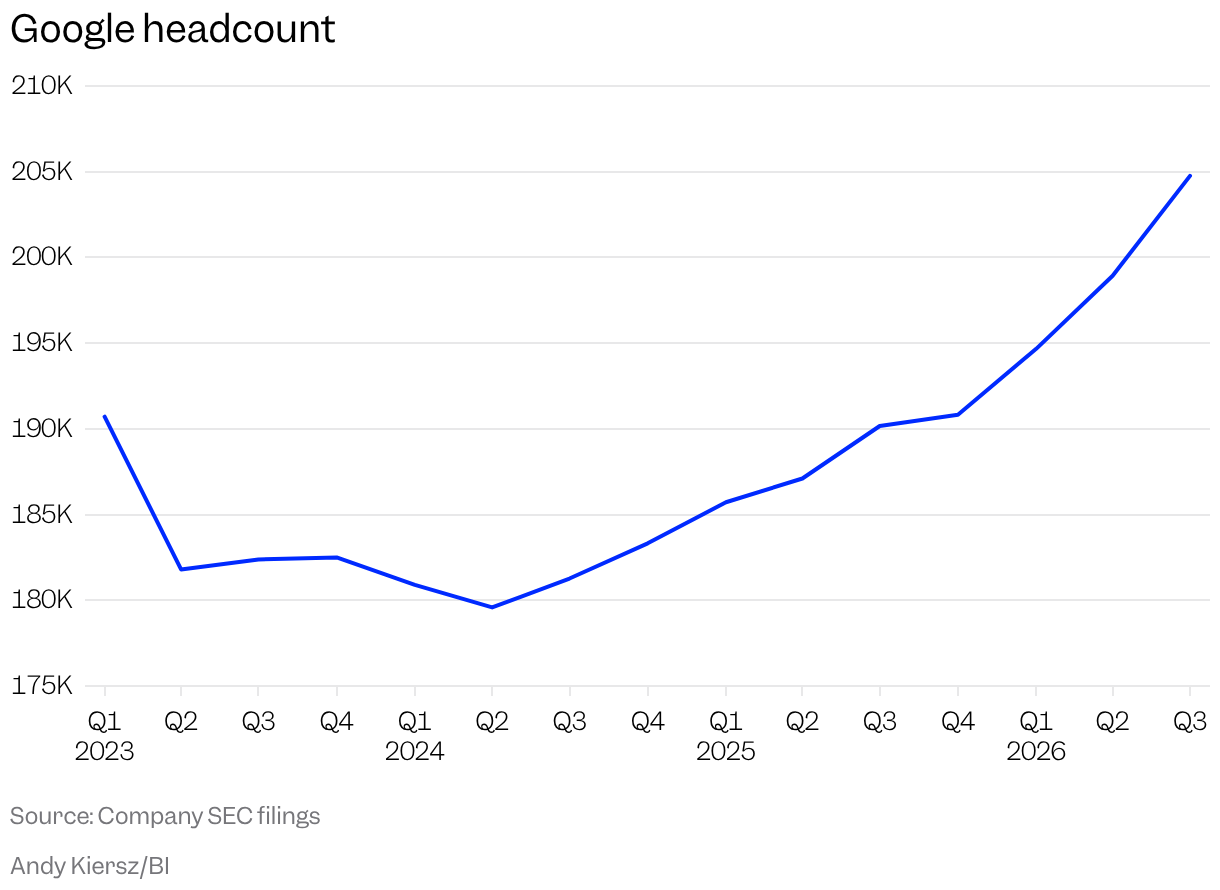
When Google reported its Q3 earnings on Wednesday, it said it had 204,757 employees for the quarter ending September 2026. That means Google added roughly 10,000 people to the payroll since the end of March.

The uptick in head count runs counter to another trend across the tech industry, where some of Google's peers are slashing their workforces. Meta has been on a cost-cutting odyssey for several years, while Microsoft recently offered voluntary buyouts to 60,000 employees.

Some of Google's head count growth can be attributed to mergers and acquisitions. On March 11, Google said it had completed its acquisition of cybersecurity firm Wiz, which had roughly 2,000 employees.

Line chart

In January 2023, Google announced it would slash roughly 12,000 roles — around 6% of the workforce at the time — and has since made several smaller rounds of layoffs, Business Insider has reported.

While the head count has grown somewhat steadily since Q2 2024, it has accelerated since the end of 2025. Google also reported Wednesday that its quarterly revenue grew 25% from this period last year.

Have something to share? Contact this reporter via email at hlangley@businessinsider.com or Signal at hughlangley.01. Use a personal email address and a non-work device; here's our guide to sharing information securely.

Read the original article on Business Insider

  •  

Is it a hackathon or a happy hour? Yes.

Five people sit around a small table with laptops and drinks in a cafe workspace.
AI After 5 is part of a growing number of groups hosting events to learn to skills in a group setting.

Ben Kelmer for AI After 5

Tired of milling about polished networking events, balancing a cocktail and lukewarm appetizers while attempting to shake hands and answer the question, "So, what do you do?", workers are turning away from the happy hour and toward events that take them back to their preschool roots.

Groups from Boston to Boise are hosting events to meet twin needs: IRL connection and AI practice. It's a grown-up version of "parallel play" that organizers hope will lead to more meaningful interactions than sipping discounted margaritas, and prove more fun than clumsily vibe-coding at home alone. The meetups include AI agent building workshops, hackathons, walk-and-talks, and fitness classes curated for specific industry founders.

The trend is a twist on networking for our times. People want to meet in person, but are still retraining their social skills after Covid. The events draw from hackathons and take on a new urgency: Companies hungry for AI-skilled workers are brushing up against a job market brimming with candidates desperate to learn AI and stand out. Anxious they'll be left behind, people are showing up not just to make a new connection, but to make sense of a rapidly evolving AI landscape.

"You can spend all your time, every single day, looking at apps or looking at a blog, or looking at a podcast to see what they're doing," Andrea Huspeni, the founder of pet brands Bye Bye Dog Breath and This Dog's Life, tells me. She attended an event put on by a group called AI After 5 this month, as she's learning to use AI to keep her operating costs down. "But that is different than going to an event in person and hearing other people's experiences, other people's use cases, and other people's hacks."


On a Tuesday evening in downtown Manhattan, some 60 people gathered under dim lights in a modern, industrial space for a sold-out event. It wasn't a raucous happy hour or a fireside chat with tech industry leaders. They were there for a hands-on workshop to build AI agents.

The evening, bookended with food and drinks to start and time to chat after, felt more like a classroom than a typical networking event. That's by design. Some attendees had their eyes locked on a presentation about the basics of agent building; others peeled off into pairs, sitting close together in booths with their own laptops, speaking in hushed voices about the projects on their screens.

Mina Abdulla, who started AI After 5 this year to help women learn how to use AI, walked from table to table, checking in on dyads like a teacher making rounds in a classroom. She insists that this isn't just more work after the workday, which is already increasingly filled with AI. It's fun, she says, and the format takes people back to learning as a kid — experimenting and solving problems side by side. "Learning is a social thing," she says. "It's making AI feel more approachable."

Attendee wearing a lanyard stands among blurred people at an indoor networking or conference event.
AI After 5 founder Mina Abdulla

Ben Kelmer for AI After 5

As AI reshapes the way we work, non-technical employees especially worry they'll be left behind — and these workshops draw people from across industries and roles. "People don't feel like they can do it on their own, and they get stressed," says Paige Kehoe, who founded Audacious AF this year, a networking group for women building with and learning AI. That pressure pushes more people to attend training or try to train themselves on their own time.

Traditional forms of networking have failed to meet the moment. A Harris Poll conducted on behalf of staffing firm Express Employment Professionals late last year found that three-quarters of workers felt networking had become more transactional and less about personal connections. People socialize with coworkers less, and happy hour participation fell by 9% this year, as rising prices and remote work drain some of the appeal.

But people want to hang out. Attendance at microevents grew by 23% in 2024, according to Eventbrite data. Last year, nearly 60% of people said they wanted to attend events where they could socialize around an activity, and where making connections wasn't the main focus. The number of community AI hackathons put on via Devpost, a platform for in-person and online hackathons, jumped from 369 in 2024 to 706 last year. A search of Luma shows there are about a dozen similar AI building workshops and meetups in New York City over the next week, and typically two or three such events a day in San Francisco.

Unpolished, come-as-you-are events tap into a trend that's been brewing for years: a push for authenticity. Instead of panels with canned answers and humble bragging at happy hours, people can come to these workshops and admit they need help.

"Everyone's just so tired of all of the really perfect put-together content that companies were pushing out," Kehoe says. She held her first workshop for women who wanted to learn to work with Claude this spring. They had room for about 50 people, but nearly 1,000 joined the waitlist, she says.

No-Code NYC has hosted events since 2018, building a community for people who weren't technical by trade but wanted to learn to use drag-and-drop coding tools or might be toying with the idea of working as developers. Its founder, Erik Israni, tells me that interest has expanded because of AI. Developers coming to his events want to brush up on AI skills, as do people who would never have considered themselves technical. The developers can better explain concepts to the newbies, but those outside the traditional tech world pick up on the concepts and act on them quickly, Israni says, and there are benefits for people on either side of that divide in coming together. "There's an uncertainty in the future for what anyone's job is going to look like, for what skills they're going to need," Israni says. As AI has shaken job prospects, it's also making coding more accessible for those willing to dive in. "Not only is there a sense that I can do this, but there's also a sense of FOMO."

Two attendees converse beside a registration table with badges and lanyards in a busy indoor event space.
Learning in a group setting may be more fun than panels or solo vibecoding.

Ben Kelmer for AI After 5


Some companies have brought similar formats in-house to train staff. Tariq Shaukat, CEO of Sonar, a software company focused on verifying AI code, tells me the company recently hosted an in-person hackathon for the technical team, bringing remote workers together with office staff. In that one week, he estimates the team made more progress in developing new skills than they had in the previous four months.

"Getting them together in this unstructured environment with everyone with a little bit of playtime helped give people the space and freedom to kind of learn and experiment," he says. "There's a lot of tribal knowledge development and sharing that's happening."

People working on their own projects want to socialize, but they need loose industry connections perhaps less than they need tangible AI skills. They also feel a time crunch to learn the latest technologies. "People are also scaling faster, iterating faster," says Anna Kaplan, founder of Narrativ by AK, a storytelling and branding firm for founders. "That's why people are more picky about the events they go to."

This new version of networking resonates with people who still feel socially stifled after years of remote work and school, and who feel too many of their social interactions are mediated by algorithms. These events are an antidote to the loneliness workers feel, as well as frustration over a broken job-hunting process. People want to optimize their lives and learn AI skills through experimentation and peer sharing. They're picky about the homework they're taking on. And if they make a friend or connection in addition to a new AI agent, that's a nice bonus.

Read the original article on Business Insider

  •  

PwC's US CEO says the people who get ahead do this when no one is watching

"Get Better at Work" series collage featuring Ana Altchek's headshot alongside photo of Paul Griggs, PwC's US CEO.
Paul Griggs said that workers should put in the time to learn when no one is watching.

Mandel Ngan/Getty Images; Ana Altchek; Alyssa Powell/BI

  • Today's tip to get better at work: Position yourself for a promotion by regularly making time to learn.
  • PWC US CEO Paul Griggs started as an intern at the firm and said curiosity helped him rise to the C-suite.
  • He suggests making a habit of researching questions you don't know the answer to.

Get better at: Climbing the ladder

Today's move

Paul Griggs started as an intern at PWC and now runs its US business. He said the same timeless advice that he followed early in his career applies to today's workers.

Griggs said employees who want to climb the ranks at work should get curious, even when they're not specifically asked to do something.

Why it works

Griggs said that the Benjamin Franklin quote, "Energy and persistence conquer all things," sums up what it takes to climb the corporate ladder. That means putting in the work when no one is looking.

He gave an example of two employees.

One of them leaves work on Friday and mentally clocks out to enjoy their weekend. The other one spends 20 minutes researching a problem they didn't know the answer to before carrying on with their plans.

That little bit of effort adds up, and, over time, this employee consistently shows up more prepared to conversations. They appear quicker at picking up concepts, they add more value, and, over time, they get more opportunities.

Try it today

Griggs said early in his career he worked with a colleague who brought a notebook to every meeting and jotted down anything he didn't understand.

You can try the same tactic. Start writing down the concepts and questions you want to learn more about, and get into the habit of spending a little extra time digging into them.

The bottom line

People notice when you put in the extra time to get better at your job. Getting in the habit of being naturally curious will help you stand out — especially in an era when information is so accessible.

Source

This insight is drawn from Business Insider's interview with PwC's US CEO Paul Griggs about how he went from intern to CEO. Read the full story by Ana Altchek here.

Has this habit helped you climb the ladder? Tell us what you think of this advice in the comments below.

Read the original article on Business Insider
  •  

I'm Ice Cube. I start my day with gratitude, avoid using AI tools, and want a burger for lunch every day.

Ice Cube

Courtesy of Big3

This as-told-to essay is based on a conversation with O'Shea Jackson, known professionally as Ice Cube, a 57-year-old rapper, actor, and cofounder of the professional three-on-three basketball league Big3, who is based in Los Angeles. The following has been edited for length and clarity.

I started out wanting to be the best rapper in the world. Then John Singleton put me in "Boyz n the Hood" in 1991, and I loved creating at that level. I didn't just want to be an actor; I wanted to be a producer and a writer. I wanted to control my own films and be involved in record company meetings. That thrust me into the business world.

I understand, from the neighborhood I come from in South Central Los Angeles, that if you don't learn the game, you're going to get taken advantage of. I knew that if I really wanted to be a solo artist and didn't want to be a horror story at the end of my career, I needed to learn the business. That's when I started transitioning to working behind the scenes.

In 2016, my cofounder, Jeff Kwatinetz, and I had the idea to start a professional three-on-three basketball league. We spent a year throwing around ideas for it before announcing Big3 in January 2017.

I love three-on-three, and I've always wondered why it hasn't been professionalized. We wanted to elevate it and attract players who still want to play at a high level against their peers in the summer. I also still rap and act, and I haven't looked back.

Here's a day in my life in Los Angeles.

5 a.m. — my goldendoodle wakes me up

My goldendoodle, Luffy, and I wake up at the same time, or one of us wakes the other up. He's a year old, so he's still got puppy energy. My wife, Kimberly, and my four kids watch an anime where the lead character's name is Luffy, which is how he got the name.

I've been an early riser ever since I was young. I like to wake up before everybody — sometimes two hours before my family — to hyper-focus on anything that needs my undivided attention. The East Coast is three hours ahead of us anyway, so I don't want to be late talking to people there.

7 .a.m. — coffee and walking Luffy

I usually make myself coffee at home. I'm a fan of Peet's dark roast. Then I take Luffy for a walk.

I'm not big on working out early in the morning, so I try to exercise in the evenings. To me, the morning is for coffee, enjoying being alive, and being happy that I get another chance to see another day.

I'm not a big breakfast guy, so I usually don't eat until late afternoon.

8 a.m. — thinking in the shower

Most of my ideas come when I'm in the shower. They'll just flood me with everything I need to get done, almost in order: you gotta have that, you gotta have that, stop procrastinating on this, get to that. The shower is where I get a lot of my clarity.

9 .a.m. — prioritizing my schedule from my home studio and office

I don't go into the office — I stopped doing that in 1999. I'm not built to be in the office. I'm a remote kind of guy.

I've got a spot in my house that's a studio and office. A lot of work gets done in there, including new music. It's cool to have it all in one place.

Because I'm splitting my time between Big3, music, films, and other things, I have to really plan the day and prioritize. There are things that have to get done today and things that can wait until tomorrow, so it's about deciphering what needs my immediate attention and focus.

10 a.m. — meetings focused on wherever I am

When I'm traveling, my day can vary a lot. I have a lot of meetings on my iPhone and Zoom, so I plan them around whatever I'm there to do.

If I'm on tour, everything has to come after what I have to do that night and the focus I need to give to the live performance. I've tried to do a movie in the daytime and go to the studio at night, and something suffers.

You don't want to spread the work too thin, either, just because you can. You want everything to still be as top-notch and good as you can make it. That takes discipline.

12 p.m. — ordering lunch and trying not to succumb to burgers

When it's time to eat, the first thing that pops into my head is always burgers. I try to push burgers aside and think of something different, like a Greek salad wrap. Otherwise, I'd go for burgers and fries all the time.

1 p.m. — checking out social media and executing on projects

I look at a lot of social media to figure out my next move. Social media-wise, I still like X, Instagram, YouTube, and TikTok. I'm not a big-time Facebook guy. I also don't use any AI apps.

I have several projects, and they're each in one of three stages: planning, execution, and follow-through. There's always work to be done. I've been in business for 40 years — I've seen it all. Nothing gets me too high, and nothing gets me too low.

I'm always looking for the most strategic way out of a sticky, complicated, or bad day. I don't really let it stress me, because I always know there's a solution.

6:30 p.m. — shut down business and hang with my family

It's crazy for somebody in the music industry, where mostly everything happens late at night, but it's for my sanity.

When it comes to my off time, people think I'd be out enjoying being Ice Cube, running around and getting the love that's out there, but I like kicking it with my family, hanging out, and not doing too much. A typical dinner is going to a steakhouse with my family, or to a burger joint if I'm on the road.

To unwind, I like to watch sports. Hopefully, there's a game on that I want to see: basketball, football, a Big3 game, or baseball. I'm a Dodgers guy.

11 p.m. — try to get to bed

I don't like to talk about stuff late at night, because then I'll be up all night, and I have to be back up in a few hours. I don't need much sleep, about five or six hours, but I make sure I get it.

Some days, I'm off to do something super cool, like a concert or a movie in France. It's important to balance the craziness with the regular, sensible stuff.

My life can be very exciting and complicated at times, and very simple and normal at other times. It's the best of both worlds.

Read the original article on Business Insider

  •  

He sent Airbnb his résumé on a balloon — and landed a contractor gig

Logan Ivey is pictured with the "hire me" balloon that he used to apply to Airbnb.
Logan Ivey asked Airbnb to "hire me" with a balloon résumé.

Logan Ivey

  • Logan Ivey wanted to make videos for Airbnb. So, he put his résumé on a balloon.
  • His video about it got over 16 million views, and Airbnb offered him a contractor gig.
  • "There is just no competing with that with a 1 page resume," he told Business Insider in an email.

Job applicants have dozens of tricks to make their résumés stand out. They print their CVs on colored paper or use eye-catching fonts. They include prompt injections for AI.

Logan Ivey put his résumé on a balloon.

Ivey has been making videos full-time since 2022, he told Business Insider in an email, and helped scale Matter Neuroscience's Instagram page to over 300,000 followers.

When looking for a new gig, Ivey made a list of what he considered the best companies with the worst Instagram accounts. "I thought airbnb was the coolest!" he wrote. "Being paid to travel and stay in cool places seems like a dream job."

A balloon that Logan Ivey used to apply to Airbnb is pictured.
Ivey compared his own Instagram videos to Airbnb's on a balloon.

Logan Ivey

So, he put "hire me" in big letters on a star-shaped balloon, along with a comparison of his and Airbnb's Instagram engagement rates, likes per post, and views per reel, based on his calculations.

Ivey then put the deflated balloon in a lockbox, similar to the ones Airbnb hosts use to store their property keys. He then mailed it to Airbnb, who would have to fill the balloon with air (get it?).

The note included with the resume for Airbnb
The deflated balloon résumé was put inside an Airbnb-style lockbox.

Logan Ivey/@heckin.sick

He posted a video about the process on Instagram on October 3. It's since racked up 16 million views, and Airbnb quickly responded: "Logaaaannnn my guy, my friend, check your DMs before this package triggers a security incident."

The company's account said it had the "perfect role" for Ivey.

Sure enough, Ivey posted an update three weeks later. Airbnb had DMed him, he said, and the two sides agreed that Ivey would make some videos. He listed some spots he'd like to film: a treehouse, a former elementary school, and a bath made of rock.

Ivey told Business Insider that he'll be a contractor and that "nothing beyond the follow up video I made has been set in stone yet."

Let's face it: the job market can feel impossible these days, and applicants are aiming for as much visibility as possible. Becoming a "LinkedIn lunatic" might help. Another applicant received her job offer after posting a presentation that pitched herself.

Ivey's takeaway: make yourself stand out. Before making his balloon-résumé video, he'd applied to about 15 jobs without receiving a single interview.

"Making your skillset widely known is definitely beneficial," he told BI. "One company told me they have 10,000 applicants per job posting. There is just no competing with that with a 1 page resume."

Read the original article on Business Insider

  •  

Healey vows to cut welfare bill before next election with ‘tough’ approach to young people

Chancellor’s comments come as fiscal watchdog says disability benefits will cost £100bn a year before end of decade

John Healey had said there will be a reduction in the welfare bill before the next election, with a “tough” approach to young people who do not accept support to get a job or training.

The chancellor was repeatedly pressed on the issue in broadcast interviews after documents from the Office for Budget Responsibility suggested sickness and disability benefits would cost £100bn a year before the end of the decade.

Continue reading...

© Photograph: Bloomberg/Getty Images

© Photograph: Bloomberg/Getty Images

© Photograph: Bloomberg/Getty Images

  •  

I moved to South Korea with no long-term plan. After 4 years of teaching, I've built an unconventional life on an island.

A woman in South Korea diving in the sea, standing on rocks.
Kylie Genter moved to South Korea after graduating from college in New York with no career plan.

Provided by Kylie Genter

  • Kylie Genter graduated from college with no career plan.
  • At 22, she moved to South Korea to teach English and became fascinated by female freedivers who harvest seafood.
  • Now, 37 and married, she spends around five days a week diving with women in their 70s and 80s.

This-as-told-to essay is based on a conversation with Kylie Genter, 36, a Haenyeo diver on Jeju Island, South Korea. It's been edited for length and clarity.

I'd been teaching English in South Korea for four years when I learned about the Haenyeo — female freedivers who harvest seafood without using modern equipment. I was interested. So, in the summer of 2018, I completed diving lessons with the hopes that maybe I could work with them one day.

A few years later, my Korean husband, a scuba diver, read on a diving group chat that a small village on the southwestern side of Jeju Island was recruiting new divers. Their youngest diver was 68 — I wanted to give it a try.

At first, I was rejected, but I got invited back a month later. I don't know what changed in that one month, but I guess they suddenly became open to it, and I went in for an interview.

In January 2024, I started as a diving intern, and after two years of training, I received my Haenyeo license in April.

Finding my footing in South Korea

I was born in upstate New York, the middle of three kids. I went to SUNY Oswego and graduated with a degree in communications.

After graduating in 2012, I didn't know what I wanted to do. I applied to a few graduate schools and jobs, but nothing worked out. I was stressed out and wanted to leave. I thought about going to Japan to teach English, as I'd studied Japanese for a year while in university.

A woman at a table in South Korea with Korean dishes on the table.
Genter decided to move to South Korea and teach English.

Provided by Kylie Genter

Instead, I settled for South Korea, where some schools offered housing. I didn't know much about Korea at that time — I wasn't really a big K-pop fan before I came.

So, just four months after graduating, I moved to Jinju, a three-and-a-half-hour high-speed train ride from Seoul, to work as an English teacher. In the mornings, I'd do 20-minute lessons with kids. In the afternoon, I'd have speaking classes.

I continued teaching until August 2020. That same year, I got married and started a pension business with my husband, while still teaching English on the side.

A woman wearing diving equipment in Korea.
To get her Haenyeo license, she had to dive 50 days within a year.

Provided by Kylie Genter

Building my life as a diver

To get my license, I had to dive 50 days within a year, sell 1.2 million South Korean won, or $884, worth of catch, and get a unanimous vote from the divers in the collective. It took me two years.

Language was an issue; despite having spent years in the country, I still couldn't always understand what was happening. My biggest strength is that I'm physically fitter than some of the divers — they are mostly in their 70s and 80s. So, I help out, like when they need someone to carry their nets full of catches or wash the dishes.

A lot of the work is physically demanding. If you don't feel good, you can't just push through. I can't dive if I have a cold or my sinuses are blocked because I can't equalize underwater. It's important to keep my body physically strong and healthy through working out.

A group of Haenyeo divers in Korea, near Jeju Island.
The women she dives with are mostly in their 70s and 80s.

Provided by Kylie Genter

Committing to an unconventional job

I enjoy my life. Every day is different, and I do a lot of things besides diving. I run a pet hotel with my husband; sometimes I still tutor and give lectures. I work more hours, but I also have a lot more flexibility to pursue other things. I don't need permission for a break or a day off.

On normal days, I wake up and take the dogs for a walk. Then, I go diving depending on the weather. If it's not great, I only dive for two or three hours. A normal day of diving may take four or five. After that, I take the dogs for another walk.

In our village, we typically dive five days a week. We'll take our catch and accumulate it after one cycle. After that, we'll sell it to the regional fishing co-operative. They'll pay our president, and she then distributes the money.

Being a diver isn't a full-time job. A lot of what we earn depends on the catch. I make around $2,000 a year. Teaching is much more financially stable. But I love learning from women who have been carrying on this work for generations.

When I'm diving, nothing else matters. I just have to focus on diving and catching seafood. Nobody can call me. I don't have to look at my phone and waste time doomscrolling.

When I'm deep underwater, it can be meditative, especially on days when the ocean is calm, and there's plenty to catch. I see myself wedded to this village for the rest of my life.

Read the original article on Business Insider

  •  

I'm the ex-VP of HR at Microsoft. Here's what the 60,000 employees mulling a buyout may not realize.

Chris Williams, leadership consultant, headshot.
Chris Williams

Chris Williams

  • Microsoft is offering buyouts to around 60,000 employees.
  • Chris Williams, former Microsoft VP of HR, said waiting for a better offer may or may not backfire.
  • He shared what employees who are offered a buyout should consider and what they may not realize.

Microsoft is offering buyout packages to some 60,000 employees, or more than 25% of the workforce. That's a huge number in any terms, and it sent a signal and shock wave through the industry this week.

I'm the former VP of HR for Microsoft, and although I've been away from the company for some time and have no insider information, having been on the inside at Microsoft and in the industry for 50 years, here is what Microsoft employees should be considering — and what they may not realize about taking a buyout offer.

Your buyout offer may or may not be the best offer you get

During a buyout, position, tenure, level, and other factors are taken into account for each bespoke offer. The offer is likely to include compensation, benefit continuation, and possibly some acceleration or continuation of equity vesting.

That said, Microsoft might not offer more generous buyouts than severance packages, but companies usually offer better terms to people who take a voluntary separation than people who get laid off. That is not only to induce employees to go voluntarily, but also because the costs to the company are less if these workers voluntarily leave. There is less legal risk, time, and expense. It's also simply easier for the company to manage.

If you're offered a buyout, I usually find it could be the best offer you'll get. If it's not, you could be settling for the same offer as someone in a layoff and miss out on collecting unemployment.

A buyout can force some very hard career choices

If you get a buyout offer, looking at your budget should be your next step. Does the offer provide you with enough to retire? Enough to support an extended job search? The buyout can be a good forcing function for some very hard career choices.

Spend time looking at your cash flows, and pay particular attention to benefits. For many, healthcare costs are a substantial part of their budget. Weighing the buyout offer against continued coverage is often a tipping point in the decision.

Also consider any equity vesting dates you may have. Compare when you might vest with and without the offer, as those dates can mean a significant change in your investments. Whether you should take the buyout is highly dependent on both the offer and your situation. If you had retirement anywhere in sight, this offer might be just the trigger you need to move on. Perhaps the best offer you'll ever see.

However, if you need to continue working, there's a great deal more to consider.

Taking a buyout can give you a head start in a tough job market

The tech industry job market has been rough for the last year or so, and shows all the signs of getting worse. If the buyout doesn't afford you the ability to retire, you should plan on an extended period of job searching, maybe six months or more. It's tough out there. Be prepared.

One thing to consider if you need to continue working is that taking the buyout might give you a short head start in the job market. Assuming Microsoft and others follow this up with more layoffs like they did the last time, the technical job market will be flooded with quality people. Of course, you can search for a job while you have one, but taking the buyout gives you time for a full-time job search.

In any case, if a job search is in your future, don't delay. This market shows no sign of getting better.

Finally, if you're offered a buyout, don't ignore it. It's a sign. I'd read it as a clear signal from the company about your value, at least from their perspective. You can bet on the odds, but if follow-up layoffs happen, I'd bet that those who declined the buyout are somewhere on that list.

Buyout or not, some things to do

This buyout is the latest signal of a broad realignment of the job market, at least in the tech sector. Even if you aren't offered it or don't think you're at risk of later layoffs, you'd be wise to keep all your options open.

Get your résumé up to date. Spend time honing it, emphasizing the clearest set of skills you can. When a market is contracting, the safest bet is having a particular skill someone is looking for. When times are tight, the generalist is often the first person let go.

Work with and expand your network. Have coffee or a Zoom chat with everyone you know. Peers in other companies, even other industries, are invaluable when things get tough. Especially when the world is changing, and predicting the next hot spot is so hard, having as many warm connections across industries is a huge asset.

Don't go asking for jobs as much as keep those connections alive. You never know when someone's manager will say, "We need someone like that." And your friend can say, "I know just the person."

Whether you are offered a buyout, or whether you decide to take it or not, having a network of people to connect with is your single biggest career asset.

What to do if you get a buyout offer

Budget first, and outreach next.

Carefully decide your near- and long-term financial future, and make the decision from hard facts. Then connect with people you know across industries, far and wide. Those connections will be excellent sounding boards and could well provide the path to your next role, or the friends you need in retirement.

When contacted about this story, a Microsoft spokesperson pointed Business Insider to its statement on the official Microsoft Blog, which read in part, "Today, we're introducing a new Voluntary Exit Offer (VEO) to eligible employees within participating organizations." They added that "the VEO is similar to a standard severance offer, which varies by market. The offer includes payment based on completed service and base pay, as well as career transition services, which includes career coaching and job search assistance."

Read the original article on Business Insider

  •  

Dropbox is laying off roughly 9% of its workforce. Read the memo.

A phone shows Dropbox on the App Store.
Dropbox announced layoffs of roughly 200 workers.

Jakub Porzycki/NurPhoto via Getty Images

  • Dropbox co-CEO Ashraf Alkarmi announced layoffs of roughly 200 workers.
  • Alkarmi said the cloud-based storage company is profitable but needs to make "hard choices."
  • You can read his full email to employees below.

Dropbox is dropping the layoffs hammer.

Dropbox co-CEO Ashraf Alkarmi announced on Wednesday that the cloud-based storage company is laying off roughly 9% of its global workforce.

"Today, we're making difficult choices about where we invest and how we organize Dropbox to achieve the product and growth priorities that will matter most for our long-term strategy," Alkarmi wrote in an email to workers that the company posted publicly.

Alkarmi said Dropbox is eliminating roughly 200 roles across its across Engineering, Product, Design, and G&A team. The company, Alkarmi wrote, is profitable but needs to make "hard choices" about where it spends its money.

"Delivering on that strategy requires concentrating our resources on the priorities that will have the greatest potential for customer impact and growth," he wrote.

As part of the changes, Alkarmi also announced that chief technology officer Ali Dasdan will be stepping down.

Read the full email

Hi everyone,

Today, we're making difficult choices about where we invest and how we organize Dropbox to achieve the product and growth priorities that will matter most for our long-term strategy. As part of these changes, we've made the decision to eliminate about 200 roles across Engineering, Product, Design, and G&A teams (approximately 9% of our global workforce). For most impacted Dropboxers, today will be their last day.

S-team and I take full ownership of this decision and recognize that these colleagues have made meaningful contributions to Dropbox, our products, our customers, and our teams. Our first priority today is to treat every person affected with the care and respect they deserve.

Changes to Senior Leadership

I also want to share that Ali Dasdan has decided to move on from Dropbox. During his time here, Ali led and strengthened many of the technical capabilities we'll rely on as we move into the next phase of our transformation. I'm grateful for his leadership, his partnership, and the foundation he and the team have put in place. Ali's last day is November 18th, and he'll be focused on ensuring a smooth transition through next month. We wish him all the best in what comes next.

Why we're making these changes

Our business is profitable, and we've built real momentum this year. Our two-year strategy sets a clear direction for growth: solving more of our customers' critical workflows; reaching more of our chosen customers, including larger companies; and bringing our technology to new markets.

Delivering on that strategy requires concentrating our resources on the priorities that will have the greatest potential for customer impact and growth.

That means making hard choices about where we invest, how we're organized, and what work we simplify, scale back, or stop. Those choices include the difficult decision to reduce the size of our team.

How we'll prioritize going forward

In order to be successful, we can't take the same work and spread it across fewer people. We'll streamline teams and concentrate support and resources against product areas that have the highest impact on our customers and Dropbox as a business.

Taking care of impacted employees

To those leaving Dropbox, we're committed to supporting you through this transition. Departing Dropboxers are eligible for a severance package in line with the following:

Severance, equity, and transition support:

Sixteen weeks of pay beginning today, plus one additional week for each completed year at Dropbox. International packages will reflect local practices and legal requirements

Q4 equity vesting

For employees on the Corporate Bonus plan, a prorated lump-sum payment based on their 2026 bonus target

Immigration support for impacted visa holders

Healthcare and well-being:

U.S. employees will receive six months of COBRA subsidy, if elected and eligible

Modern Health access will continue through the end of the separation month to support mental well-being, with extension options detailed in severance packages

Payment for eligible current and approved upcoming paid leaves, including medical and family leave

Additional support:

Devices: Impacted employees will be eligible to keep (1) Dropbox laptop, (1) mobile device if assigned, and all existing desktop peripherals

Job placement: Job placement services and career coaching will be available at no cost

What comes next

Right now, our focus is on the colleagues who are leaving Dropbox. Please give them the space and support they need.

And to everyone leaving Dropbox: thank you. Your work to build our capabilities, serve our customers, and contribute to our culture has been deeply meaningful. I'm grateful for everything you've contributed.

Ashraf

Read the original article on Business Insider

  •  

Give UK workers right to know colleagues’ pay to prevent disparities, says watchdog

EHRC says we need transparency if workers suspect other staff are being paid more for similar work

Workers should have a legal right to know their colleagues’ pay to help prevent pay discrimination, particularly against women, the UK’s human rights watchdog has said.

The Equality and Human Rights Commission (EHRC) made the recommendation in response to government proposals to overhaul equal pay laws, saying workers deserve a right to transparency if they suspect other staff are being paid more for similar work.

Continue reading...

© Photograph: Bloomberg/Getty Images

© Photograph: Bloomberg/Getty Images

© Photograph: Bloomberg/Getty Images

  •  

Anthropic manager says the 'coding interview is dead' — here's his advice for junior developers

A person is seen in front of a code written by 'HAVELSAN GPT' in December 2023
Anthropic engineering manager Felix Rieseberg says coding tests are obsolete in the AI era.

Utku Ucrak/Anadolu via Getty Images

  • An Anthropic manager says Claude has made traditional coding interviews a poor hiring signal.
  • His advice to juniors: target business problems and build a focused prototype over a weekend.
  • Google and Amazon are also reshaping engineering work and hiring around AI fluency and impact.

Out with the coding test, in with Claude.

That's the shift Felix Rieseberg, an Anthropic engineering manager, says he has made to his team's hiring process, arguing that AI has rendered traditional coding interviews a poor measure of who will succeed at work.

"The coding interview is dead, at least for my team at Anthropic," Rieseberg wrote in a Tuesday post on X. "I've seen enough to know that it no longer provides signal."

Rieseberg elaborated in a blog post, writing that there's "no point" in giving candidates coding challenges or asking them about programming languages like assembly.

"Claude is now better at both," he said of the company's own AI model.

Coding challenges were once a "weak but useful" predictor of success, Rieseberg said, but the most impactful builders on his teams are not necessarily the people who excel at such tests.

"I'm seeing engineers who are comparatively new fly past people who are probably better coders and have been around much longer," he wrote. "Hunger beats tenure."

AI is writing most of the code at Anthropic, and the shift tracks with changes underway at other Big Tech companies. Business Insider's Hugh Langley reported last week that Google is expanding pilots for software-engineering interviews that allow candidates to use Gemini to assess their AI fluency and prompting skills.

Amazon, meanwhile, told engineers on Tuesday to prioritize customer and business outcomes over raw AI usage. The company calls the moment the era of the "Renaissance Developer," in which human judgment and machine intelligence combine to build products faster.

How junior engineers can stand out

The rise of AI coding tools has fueled fears that junior developer roles will become harder to get, as AI takes on work like debugging and building simple features — tasks that once helped early-career engineers learn the ropes.

In his blog, Rieseberg shared advice for junior engineers — or, more broadly, people without organizational status or power. Rather than just clearing backlog tickets, he said they should identify the business problems their company is trying to solve.

Then, they should come up with a bold idea that could materially advance those goals and build a working prototype over a weekend. The project should communicate one compelling idea, he said, rather than bury several good ones inside an overly ambitious product.

The coding interview is dead, at least for my team at Anthropic. I've seen enough to know that it no longer provides signal. I removed it from loops this month.

I have a spicy, optimistic take - I think there's an opportunity for junior engineers: https://t.co/PVvpQCbQtK

— Felix Rieseberg (@felixrieseberg) October 27, 2026

Newer engineers should also lean into their outsider perspective. They may be more likely to spot broken user experiences or question ingrained assumptions about what is possible, Rieseberg said.

He pointed to two relatively new Anthropic engineers who built a graphical interface for Claude Code over a weekend; the first public version shipped around eight days later.

Rieseberg said he has not yet solved the problem of how to assess candidates who build effectively with AI.

For now, he said he is scanning resumes and portfolios for small prototypes that show "taste, empathy, and principled thinking" — qualities that AI researchers and tech leaders are increasingly putting a premium on in the age of AI.

Read the original article on Business Insider

  •  

So you've been offered a buyout. HR experts share top tips and questions to ask before deciding whether to take it.

Pedestrians walk past a Microsoft storefront with illuminated signage and logo at dusk.
About 60,000 Microsoft employees are eligible to consider a buyout. HR experts say the payout is only one part of the decision.

Craig T Fruchtman/Getty Images

  • With Microsoft offering about 60,000 staff buyouts, many will be deciding whether to take one.
  • Business Insider asked HR experts what advice they'd give workers offered buyouts.
  • Their advice included budgeting for a longer job search and pricing out replacement health coverage.

About 60,000 Microsoft employees have a choice to make: take a buyout and leave at the end of the year, or stay.

Eligible employees have until early December to decide. Offers reviewed by Business Insider vary by level, location, and length of service.

For US employees at levels 64 and below, the cash offer is one week of base pay for every six months of service; at levels 65 to 67, it is two weeks for every six months. The offers also include continued stock vesting and health insurance.

Buyouts are a reasonably common offering for corporations looking to cut costs, but deciding whether to take one can be difficult. Business Insider spoke to two HR experts to ask which factors employees should weigh and which questions they should ask before signing.

Read their top tips below:

Work out what the offer is really worth

"The number is important," Marjo Miles, founder and principal consultant at The Ember Effect, told Business Insider. "But really, there’s more than that number."

Employees should check what happens to their stock, paid time off, health coverage, and any bonus or commission due after they leave, Miles said. They should calculate how long the payout would cover household expenses after tax and deductions.

Deborah Saneman, CEO of workforce management and HR technology company Würk, told Business Insider that employees should price out replacement health insurance: how long coverage lasts, what they would pay monthly, and whether the company covers any of the premium.

She also recommended checking which shares would vest after their exit. "The headline number is only part of the picture, so get the details in writing," she said.

Plan for a longer job search

"Whatever somebody thinks their job search is going to take, double it in your mind and plan for that," Miles said.

She suggested using the time before the deadline to explore options. "Instead of deciding today, maybe start your job search today, she said.

Contacting people in their network and applying for roles could give employees a clearer sense of their prospects before they commit to leaving.

Saneman said employees should ask about career coaching, outplacement, or training. "A payout covers your bills, but help with the search itself can shorten the runway," she said.

Consider what staying could look like

Turning down a buyout does not guarantee job security, Miles said, though she cautioned against assuming layoffs will follow. Companies could leave vacant roles unfilled or take other steps to meet a savings goal.

"There are a lot of different ways that organizations can strategically get to their goal without just immediately doing a reduction," she said.

Saneman also cautioned against predicting what Microsoft or any other company might do next. "The benefit of a buyout is that it's on your own terms and gives you time to plan your next steps," she said. "A layoff may not."

Miles suggested asking how departing colleagues' work would be redistributed and what support would be available.

Saneman said employees should consider their longer-term plans: "The right choice is the one that fits where you want your career and your life to go, not just the one that looks best on paper."

Questions to ask before taking a buyout

Business Insider asked Saneman and Miles to share what questions they'd advise employees considering buyouts to ask. Read their four key questions below:

Would I be eligible for rehiring?

"Microsoft is a large organization, and professional paths may cross again in the future," Miles said. That may not make or break the decision, but it is worth knowing.

Will the payout be a lump sum or continued salary?

This can affect when the money arrives and how health insurance and other benefits are handled.

What happens to my bonus or commission?

Employees should check whether they will receive any payment due after their exit date and have the answer documented by HR.

What help will I get finding another job?

Saneman suggested asking about career coaching, interview preparation, and training to build new skills.

Read the original article on Business Insider

  •  

Nestlé's CEO says he drinks at least 8 cups of coffee daily and tackles his biggest tasks in the a.m.

Philipp Navratil sitting in suit
Philipp Navratil said he drinks at least five cups of coffee by 10 a.m.

Bloomberg/Getty Images

  • Nestlé's CEO drinks "at least" eight cups of coffee daily — and downs the first five by 10 a.m.
  • Philipp Navratil enjoys his coffee black and cold and has only recently started dabbling in decaf.
  • Despite a high caffeine intake, he said he sleeps about eight hours a night and wakes up at 6:30 a.m.

Lots of executives drink coffee. Few drink as much as Nestlé's CEO, Philipp Navratil.

"Before 10, I would have had five cups for sure," the CEO told Business Insider, adding that he typically has "at least" eight cups of coffee every day.

The CEO of the company behind more than 30 billion-dollar brands, including Nespresso and DiGiorno, said he likes his coffee black, cold, and without sugar. Navratil said he considers his go-to drink a "healthy beverage" and has only recently started dabbling in decaf.

Navratil said he starts with drinking water when he wakes up to make sure he's hydrated, and then switches to coffee. Starting his day with coffee is part of his routine, and he really "looks forward to that cup."

Top morning priorities

Navratil said he sleeps well despite his caffeine intake and tries to get eight hours every night, though he admits it doesn't always happen.

The CEO said he typically wakes up around 6:30 a.m. because he works best in the morning. He said he aims to get his most productive hours in before lunch.

"I'm better in the morning," said Navratil, who started working at Nestlé in 2001.

The CEO said he has his final cup of coffee after dinner, and typically drinks an espresso — although that cup might be decaf. Navratil said coffee is more of a "psychological thing" to him, anyway.

"I really enjoy coffee," Navratil said. "I just like the flavor."

Read the original article on Business Insider
  •  
❌