U.S. Immigration and Customs Enforcement (ICE) has a liaison at the military's Special Operations Command (SOCOM) with access to advanced surveillance technology, leaked files show. The files also reveal ICE liaisons at Africa Command (AFRICOM) and Southern Command (SOUTHCOM) with access to the same tech, and an ICE contractor associated with U.S. Central Command (CENTCOM) in the Middle East.
On Wednesday, a hacker group calling itself the Department of Peace released a massive collection of U.S. Department of Homeland Security (DHS) personnel files, including ICE and other domestic security agencies. "They have our information, so it's only fair that we have theirs," the hackers wrote in a note attached to the database, which was posted online to Distributed Denial of Secrets, a platform for data leaks.
DHS told TheWashington Post that it was "aware of a potential breach" and "working to address the situation swiftly and effectively." A website hosting a searchable version of the leak, ICEpick, was taken down after the DHS sent a letter demanding that the domain name host "stop serving the personal contact and location data of individuals who did not consent."
The files include an ICE Homeland Security Investigations (HSI) unit chief who appears to oversee the agency's military liaisons. His subordinates include a "Combatant Command Program Manager" at SOCOM headquarters in Tampa, Florida; an "HSI Liaison to USAFRICOM" in Stuttgart, Germany; and a "Senior Liaison to U.S. Southern Command" in Doral, Florida.
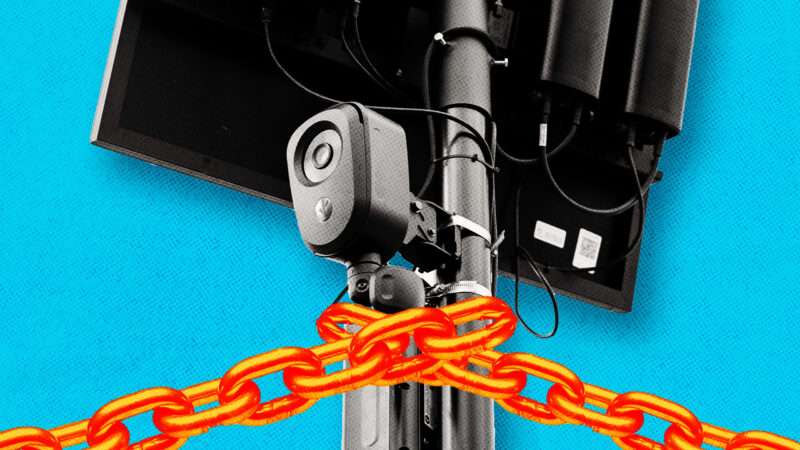
All of the officials named in the files are listed as users of "Penlink," "Falcon," and "RavenGo." The contractor PenLink offers officials the ability to track individual cell phone users or collect data on everyone in a certain location, according to documents obtained by 404media. FALCON, created by the contractor Palantir, allows officials to combine records from governmental and commercial databases, The Guardianreports. The DHS eventually phased out FALCON in favor of an in-house system, RAVEN.
The unit chief is additionally listed in a group called "LCR_Users." The acronym may refer to the Office of the Director of National Intelligence at Liberty Crossing, McLean, Virginia. Two employees are listed in the DHS files with "ODNI" in their title and "LCR - Liberty Crossing" as their location. The first Trump administration reportedly looked into merging ICE into the federal intelligence community, but never officially did so.
The files also include an HSI contractor listed as "CENTCOM analyst" at the National Targeting Center in Sterling, Virginia. Unlike the other liaisons, this contractor does not have access to ICE's own surveillance software. The National Targeting Center is a Customs and Border Protection (CBP) unit that surveils international travel and selects passengers for questioning. CENTCOM oversees all U.S. military forces in the Middle East.
Although it has been mentioned in public, ICE's relationship with the military is shrouded in mystery. Of course, the best-documented relationship is with SOUTHCOM, responsible for U.S. forces in Latin America. Official press releases also mentioned HSI's participation in an AFRICOM maritime security training exercise in 2021. The connections to SOCOM and CENTCOM have not been publicly reported.
ICE did not respond to Reason's request for comment.
The DHS has an in-house intelligence office that is separate from HSI and publicly cooperates with the U.S. military, as well as the rest of the intelligence community. But HSI's "global footprint" and ability to straddle the line between law enforcement and foreign policy "make it uniquely capable of disrupting and dismantling the sophisticated groups and networks that we now face," HSI Executive Assistant Director Katrina W. Berger testified to Congress in 2024.
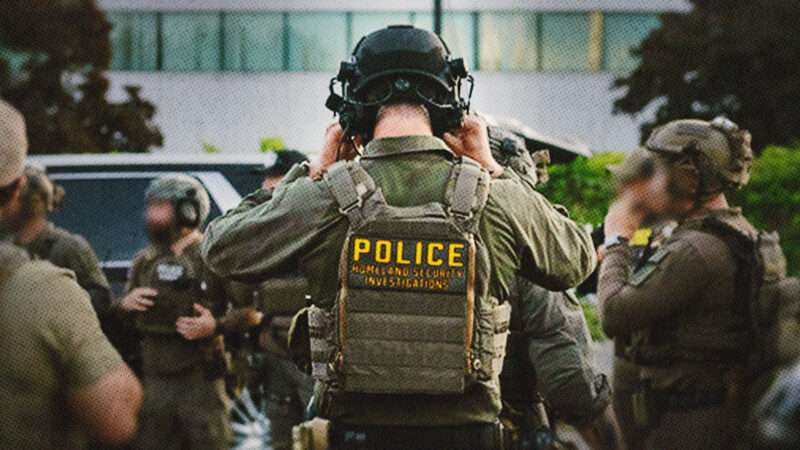
HSI is supposed to handle serious organized crimes involving the border rather than day-to-day deportations. However, the Trump administration has turned the directorate into an all-purpose domestic spying and enforcement arm. HSI is now running a massive surveillance operation against left-wing protesters, WIRED recently revealed.
Agents have reportedly been pulled away from investigating human trafficking and drug cartels to deal with immigration enforcement. HSI was involved in arresting former CNN journalist Don Lemon for showing up at an anti-ICE protest at a church, and led the raid against Rep. Ilhan Omar (D–Minn.) reportedly aimed at showing that her U.S. citizenship is invalid.
Last month, ICE announced upcoming contracts for a $100 million, fast-tracked expansion of its domestic surveillance capabilities, with contractors asked "to identify and assess relationships among individuals, organizations, locations, events, activities, data points, and other entities." Former military intelligence analyst Michael Wriston called the intensified ICE surveillance a case of "imperial boomerang" in an interview with The American Prospect. "These are the kinds of things that happened in Afghanistan, Iraq, Yemen, Syria, for years. Now that methodology is being brought into the ICE space."
Keisha Lance Bottoms, in her bid for Georgia governor, has faced pointed criticism of her leadership in Atlanta and disappointment in her decision to leave after one term.
Mayor Mamdani's NYPD is poised to sign the contract with Israeli surveillance firm Cognyte for FalcoNet, an AI-driven device that mimics a cell tower to track phones and can be mounted on police cars and drones or hidden in a backpack
Political commentator Bill O’Reilly on Monday predicted that the U.S. could have its own protests similar to those that have broken out in recent weeks across France and other parts of Europe, but “on steroids.” “On Balance” host Leland Vittert asked O’Reilly on NewsNation, The Hill’s broadcast partner, about the potential ramifications if President Trump…
Our publications, studies and analysis have a new home. We’ve launched a new website, offering a more dynamic experience, with enhanced features that make our research easier than ever to read and share.
As Members gather for the last plenary session before the summer recess, their agenda covers enlargement, foreign affairs, competitiveness, the EU budget, agriculture, social security and the environment. On Tuesday morning, a debate will follow a presentation of the programme of activities of the Irish Presidency of the Council of the European Union, which began on 1 July. On Wednesday morning, Members will hear Council and European Commission statements on the conclusions of the European Council meeting of 18‑19 June 2026.
EU-Mexico relations
Bilateral relations between the EU and Mexico have been bolstered by the current framework since 2000. On Tuesday, Parliament is due to decide whether to give its consent to the conclusion of two instruments to update this framework, the EU-Mexico Political, Economic and Cooperation Strategic Partnership Agreement (Modernised Global Agreement, MGA) and an interim Trade Agreement (iTA), both of which were signed by the EU and Mexico in May 2026. Parliament remains in favour of modernising the MGA, with a joint report by the International Trade (INTA) and AFET committees welcoming it as a step towards further economic expansion that could benefit EU companies and farmers. The INTA committee is due to vote on a draft recommendation on the conclusion of the iTA before the plenary vote.
Passenger rights
Lower ticket prices and a wider choice of routes are not the only results of air transport liberalisation. On Monday, Members are expected to discuss an agreement to revise the air passenger rights framework to better protect passengers during increasingly common travel disruption. Delayed in the Council for over a decade, Parliament has shown consistent support for measures to protect air passengers and their rights. Parliament negotiators reached a political agreement in conciliation with the Council in June 2026. The agreement maintains the three-hour threshold for compensation for flight delays and strengthens passenger rights including on rerouting options, protection for missed connections and reimbursement for unused vouchers.
Social security when working abroad
A reform of EU social security rules aims to help citizens living or working in another EU country and better distribute responsibilities between EU countries. Members are set to vote on a provisional agreement on the move to modernise the rules on Monday. Parliament’s negotiators maintained mandatory prior notifications for the construction sector in the agreed text, meaning that authorities of the home Member State would be notified if someone works in another Member State. Parliament’s Committee on Employment and Social Affairs (EMPL) confirmed the agreement in April 2026 and Parliament and the Council now need to formally adopt the new social security rules.
East Asia relations
The geopolitical situation in East Asia has grown more volatile as the region experiences increased security challenges triggered by authoritarian regimes. On Monday evening, Members are expected to vote on an AFET committee recommendation, which affirms the need to deepen cooperation with partners in the region, including Japan, Korea, ASEAN and Taiwan. Parliament also recommends establishing a comprehensive EU-Taiwan cooperation framework, in addition to strengthening EU engagement with regional security initiatives and diplomatic efforts to prevent further escalation in East Asia.
Fertiliser prices
The crisis in the Middle East and the closure of the Strait of Hormuz has caused an increase in fertiliser prices, placing a significant financial burden on farmers. On Tuesday, Members are set to vote on a proposal for a regulation to provide temporary common agricultural policy (CAP) support, which would offer exceptional support to farmers most affected by the soaring prices, including the possibility of increased advances on direct payments through existing CAP envelopes. Given the urgency, Parliament decided to consider the proposal without preparing a report, to enable farmers to make prompt decisions on buying fertilisers for the year ahead.
28th tax regime
The EU’s plans to allow companies to register as an ‘EU Inc.’, recognised across all Member States, under a ’28th regime’, are central to its competitiveness agenda, aimed at simplifying rules for companies to scale up in the single market. Complementing the legislative proposal already on the table, Members are expected to vote on an own-initiative report from the Committee on Economic and Monetary Affairs (ECON), on Thursday, on the feasibility of a 28th tax regime and its potential to support competitiveness by simplifying and harmonising corporate taxation.
Environmental crime
Environmental crimes can have a devastating impact, yet they are difficult to detect and prosecute. Parliament has repeatedly called for measures to combat such crimes. On Wednesday, Parliament is scheduled to vote on endorsement of the EU’s ratification of the Council of Europe’s new Convention on the Protection of the Environment through Criminal Law. A report from the Legal Affairs (JURI) Committee recommends ratification, concluding that the convention is consistent with the EU directive. The new convention establishes minimum requirements for the criminalisation of environmental offences related to activities such as pollution, destruction of biodiversity and improper handling of hazardous waste.
EU Budget
To enter a 2025 budget surplus of €2.1 billion as revenue in the 2026 budget, on Tuesday Parliament is set to consider the Council’s position on draft amending budget No 1/2026 (DAB 1/2026). While endorsing the proposal, a report adopted by the Committee on Budgets (BUDG) welcomes that higher own resources are driving the surplus rather than underspending, but reiterates its long-standing view that revenue from fines and fees should strengthen the EU budget instead of lowering national contributions, and calls for more sustainable EU own resources in the next multiannual financial framework.
Annual enlargement reports
Enlargement remains a prominent topic at this plenary session. On Tuesday, Members are expected to debate separately three reports prepared by the Committee on Foreign Affairs (AFET), on Ukraine, Moldova and Serbia. The report on Ukraine stresses the need for a ‘sustainable’ ceasefire and a peace agreement reached with the participation of the EU, while also recognising Ukraine’s European integration as a strategic priority for the Union.
AFET’s report on Moldova commends the country’s commitment to EU accession, condemning attempts by Russian efforts to destabilise Moldova’s path to accession through interference campaigns.
As a result of political instability in the country, Serbia’s EU accession process remains at an impasse. The AFET report recalls that accession is conditional on respect for EU values and democracy, reiterating the need for Serbia to affirm its geopolitical orientation towards the EU, particularly in the context of Russia’s war of aggression against Ukraine.
Written by Clare Fergurson and Katarzyna Sochacka.
The session further focused on Europe’s economic independence, digital sovereignty and resilience on artificial intelligence, as well as the EU’s role in promoting peace and stability in the Middle East. Members debated the electrification action plan, the resilience of the European transport sector amid ongoing geopolitical challenges ,and posed questions to the European Commission on its pledge to reduce the reporting burden, especially for small companies. Debates also addressed protecting child safety and mental health online and the importance of children’s right to play, and promoting culture through the Joint Declaration on ‘Culture for Europe, Europe for Culture’ .
Finally, Members attended two formal sittings, during which Jakov Milatović, President of Montenegro, and Andrzej Poczobut, 2025 Sakharov Prize laureate, recently released from prison in Belarus, addressed Parliament.
The annex shows the breakdown by political group on the final roll-call votes on the files decided by ordinary legislative procedure during the session.
Question time – European Commission pledge to reduce the reporting burden
Members posed questions to European Commissioner Valdis Dombrovskis regarding the state of play on the Commission’s pledge to reduce red tape for companies, in particular smaller businesses. To date, ten omnibus packages to simplify EU law have been published, with more scheduled, all currently at different stages of the legislative procedure.
Digital Omnibus on artificial intelligence
Parliament is committed to ensuring that there are robust legal frameworks to regulate artificial intelligence (AI) in the EU. Members debated and adopted a provisional text on the ‘Digital Omnibus on AI‘, a set of amendments to the AI Act. Parliament favoured fixed deadlines for applying high-risk AI rules, and proposes a ban on AI systems that generate non-consensual sexual content. The agreed text upholds Parliament’s position on the generation of non-consensual sexual content and prohibits AI practices generating child sexual abuse material. The vote postpones application of certain parts of the AI Act, without impacting its core provisions and risk-based approach.
Circularity requirements for vehicle design and end of life vehicles
Improper management of end-of-life vehicles can damage the environment and lose millions of tonnes of material that could be recycled to the benefit of the EU economy instead. Parliament debated and adopted a provisional agreement on circularity requirements for vehicle design and end-of-life vehicles. The agreement sets out requirements for passenger and light commercial vehicles. Vehicles must include recycled plastic, in line with progressively rising targets and minimum recycled content requirements. Manufacturers and producers will be obliged to clearly label refurbished parts and provide information regarding safe access to, removal, and replacement of parts.
Plants obtained by new genomic techniques
Members adopted at second reading a provisional agreement reached with the Council on the Commission’s proposal on plants obtained by new genomic techniques. This aims at aligning existing EU legislation on genetically modified organisms (GMOs) with new scientific developments. Parliament’s negotiators supported the simplification of rules for low-risk genetically modified plants (NGT1), provided they are similar to conventionally bred plants and do not have certain excluded traits. The agreement also includes provisions intended to address concerns related to market concentration and access to seeds for breeders and farmers.
Strengthening farmers’ position in the food supply chain
Despite playing an important role in the food-supply chain, farmers have faced mounting difficulties in recent years. Parliament adopted a provisional agreement on a regulation strengthening farmers’ position in the food-supply chain. Based on a Committee on Agriculture and Rural Development (AGRI) report, Parliament reached agreement with the Council in March 2026. The agreed text aims to ensure that food prices better reflect the production costs borne by farmers, and includes support for the dairy sector, such as the introduction of mandatory written contracts. It also reinforced producer organisations’ bargaining power and includes clarification on labelling to ensure consumer protection and fair competition.
EU-US trade deal
Parliament debated and adopted the trilogue agreement reached on the proposal for two regulations to implement the EU’s tariff commitments under the EU-US Joint Statement. The Committee on International Trade (INTA) adopted its reports in March 2026. The agreement empowers the Commission to suspend the application of the regulation if the US fails to meet its commitments and introduces additional safeguards, including stronger suspension mechanisms and protections against import surges that could harm domestic producers. A comprehensive review of the measures will be conducted in 2029, with the possibility of extension.
2025 Commission report on Türkiye
Despite applying for accession as far back as 1999, progress towards Türkiye’s EU membership bid has faced numerous delays since accession talks began in 2005. Parliament held a debate and adopted a Foreign Affairs Committee report on Türkiye, which reaffirms Parliament’s appreciation for the majority of Turkish people’s aspiration to EU accession and maintaining Türkiye’s candidate status. It also reiterates Türkiye’s relevance as a NATO ally and a country with which the EU has multi-layered relations. However, the AFET committee regrets that, despite the Turkish government’s repeated statements recommitting to the EU membership goal, serious concerns raised in previous AFET reports regarding shortcomings affecting the accession process remain unaddressed.
An EU future for the Western Balkans
The path to accession for new Member States was a key topic at this plenary session, with Members debating and adopting a set of own-initiative reports from the AFET committee on enlargement candidates in the Western Balkans on Tuesday. The AFET report on Montenegro welcomes the country’s progress and encourages sustained momentum on accession negotiations. The committee also commends Albania‘s dedication to EU integration, but expresses concern about the impact of corruption and calls for full implementation of anti-corruption reforms. The AFET report on Kosovo* reaffirms that the country’s future lies with the EU, and stresses inclusion in EU programmes and policies is vital for gradual integration. AFET’s report on Bosnia and Herzegovina expresses support for EU accession and urges political leaders to renew their commitment to EU membership. Similarly, the AFET report on North Macedonia reaffirms its support for the country’s EU membership aspirations, although it regrets the lack of progress since its 2025 report.
* This designation is without prejudice to positions on status, and is in line with UNSCR 1244/1999 and the ICJ Opinion on the Kosovo Declaration of Independence.
2025 Commission report on Georgia
Members also adopted an AFET committee report on Georgia’s EU accession status. The report deplores the continued democratic backsliding in the country and echoes Parliament’s non-recognition of the legitimacy of the Georgian parliament. It also reiterates calls for the EU to impose sanctions against key officials and regime enablers.
Promoting transnational governance on water in the interests of conflict prevention and peace
Water scarcity and water bankruptcy are serious global issues, and mitigating violations of the human right to water remains crucial for regional stability and sustainable development. Members adopted a recommendation to the Council, Commission and High Representative regarding transnational water governance. An AFET committee report notes the importance of transnational water governance for conflict prevention and peace, underscoring the growing political and security dimensions of water issues. The report calls on the EU to condemn the weaponisation of water in conflicts and urges an increase in funding for transboundary water management and for the EU to take the lead in advancing the UN Sustainable Development Goal on clean water.
Read this ‘at a glance note’ on ‘Plenary round-up – June 2026‘ in the Think Tank pages of the European Parliament.
The International Labour Organization (ILO) introduced the World Day Against Child Labour in 2002. The day is observed annually on 12 June. The 2026 World Day focuses on reinforcing and accelerating actions aimed at preventing and eliminating child labour, with a key message: ‘Red Card to Child Labour: Fair play for children, decent work for adults’.
Background
The United Nations (UN) defines child labour as work performed by children under the minimum legal age specified for that kind of work, or work that, because of its hazardous nature or detrimental conditions, is prohibited. Forms of work that are beneficial to a child’s personal and social development, that do not interfere with schooling, but rather provide useful experience and skills, may be encouraged. Child labour is driven by poverty, paired with a lack of access to decent work for adults and young people, weak social protection and a lack of free, high-quality public education.
Addressing root causes and advancing social justice were at the heart of the Sixth Global Conference on the Elimination of Child Labour, held in Morocco in February 2026, in the context of the failure to achieve the Sustainable Development Goal (SDG) Target 8.7 on ending child labour by 2025. The Conference adopted the Marrakech Global Framework for Action against Child Labour, a renewed roadmap aimed at eliminating child labour by 2030 through a human rights-based approach centred on social dialogue and multi-sectoral cooperation. The Marrakech commitments prioritise aligning national legal frameworks with international labour standards, ensuring universal access to quality education, and expanding social protection systems. They also highlight the unique challenges within the African region, the agricultural sector, one of the largest for child labour, and the emerging threat of online exploitation.
World Day Against Child Labour 2026
The 2026 World Day Against Child Labour comes after the Sixth Global Conference on the Elimination of Child Labour. Building on the Marrakech commitments, the 2026 campaign carries the message ‘Red Card to Child Labour: Fair play for children, decent work for adults‘, highlighting the link between child labour, poverty, and the lack of adequate work opportunities for adults. At the same time, it emphasises the shared responsibility of governments, employers, workers’ organisations, businesses and consumers, aiming to encourage governments and international partners to translate the Marrakech commitments into concrete national measures ahead of the 2030 deadline.
According to the International Labour Organization (ILO) and UNICEF, 138 million children worldwide are still affected by child labour, with nearly 54 million exposed to hazardous work. In response, the 2026 campaign advocates for stronger action to prevent child labour and support the withdrawal and rehabilitation of affected children through access to quality education, universal social protection, decent work and sustainable livelihoods for adults, strengthened legal frameworks and enforcement mechanisms, improved data collection and monitoring systems, as well as responsible practices across agriculture and global supply chains.
International legal framework
Freedom from child labour is a fundamental human right, enshrined in the ILO Declaration on Fundamental Principles and Rights at Work (1998), the ILO Conventions and the UN Convention on the Rights of the Child (1989). ILO Convention No 138 on the minimum age, adopted in 1973, has been ratified by 177 countries, including all EU Member States. This key document lays down standards for the minimum age for employment. ILO Convention No 182 on the worst forms of child labour, adopted in 1999, has been ratified by 187 countries, including all EU Member States. It calls on members to take measures to secure the prohibition and elimination of the worst forms of child labour as a matter of urgency. These include all forms of slavery or practices similar to slavery; commercial sexual exploitation or illicit activities; and work likely to harm children. The UN Convention on the Rights of the Child (CRC) has been ratified by 196 countries, including all EU Member States. The CRC confers upon children the right to protection from economic exploitation, and urges parties to set a minimum age for employment, regulate working hours and conditions, and provide for penalties. Despite international commitments made by nearly all United Nations member states, 41 countries still lack important legal protections against children doing work that could be harmful or interfere with their education.
EU action
The EU’s firm commitment to eliminating child labour is enshrined in Article 32 of the Charter of Fundamental Rights of the EU, which prohibits the employment of children and states that the minimum age of employment may not be lower than the minimum school-leaving age. Moreover, young people admitted to work must have working conditions appropriate to their age and be protected against economic exploitation and any work likely to harm their safety, health or physical, mental, moral or social development or to interfere with their education.
The European Parliament has repeatedly condemned child labour and its various forms, both within and outside the EU, through a number of resolutions. In its February 2020 resolution on child labour in mines in Madagascar, Parliament stressed that the EU’s long-term budget should reflect its commitment to eliminating the worst forms of child labour. In its March 2021 resolution on children’s rights in view of the EU strategy on the rights of the child, Parliament also urged the Commission and Member States to eradicate child labour and all forms of work harmful to children’s health, safety and development. Later that year, in its resolution on sustainable and responsible corporate behaviour, Parliament advocated banning imports of products linked to severe human rights violations, including child labour, and stressed that combating such practices should be systematically reflected in EU free trade agreements. In the same vein, Parliament further reinforced provisions aimed at preventing forced and child labour in global supply chains during negotiations on the directive on corporate sustainability due diligence, adopted in 2024. Finally, in its 2022 resolution on new EU rules on products made with forced labour, Parliament called for stronger cooperation with international partners committed to eradicating forced labour globally and banning goods produced under forced labour conditions. In addition, Parliament’s Coordinator on Children’s Rights, currently Vice-President Ewa Kopacz, acts as a central contact point to help ensure that children’s rights are systematically integrated into EU policies and legislation.
This is a further update of an ‘At a glance’ note, the previous edition of which was by Yanis Stefanou, in 2025.
Nike CEO Elliott Hill said he schedules family time on his calendar.
Bloomberg/Getty Images
Nike CEO Elliott Hill said he schedules his personal and family time on his calendar.
When he's not traveling, he follows a structured routine.
He said his early workdays did not stop him from finding time for his kids.
Nike CEO Elliott Hill said he protects family time by scheduling them like work commitments.
Hill, who came out of retirement to lead Nike in 2024, said he follows a structured routine when he is not traveling.
"What time I try to get to sleep, what time I try to wake up. I get a workout in every morning, too. That helps keep me grounded and keeps me balanced," Hill told host Greg Byrne on the "You Got Byrned" podcast.
He said he makes a point of identifying what matters most to him and scheduling time for those priorities.
"I sat down, and I actually listed what was important to me: family, friends, my own personal — and then work — growth, and I put commitments underneath each one of those, and then I built them into my calendar," Hill said.
For example, he said he knew his work schedule meant he would miss his two kids before they headed to school, so he found other ways to show up for them.
"I knew I wasn't ever going to be there for breakfast with the kids because I was an early bird, and I was going to be in the office," Hill said. "But I did say I'm going to be home for dinner, and I had my admin build it into my calendar so that I would leave in time to be home for dinner."
He also blocks off parent-teacher conferences and other school events on his schedule, and said he would shift work trips when they overlap with those commitments.
"It all comes down to being very deliberate about what's important to us. Writing it on a piece of paper was very, very helpful, and then being planful enough to build it into your calendar. That's how I've always managed the balance," Hill said.
Hill joined Nike as a sales representative intern in 1988 and spent more than three decades in the company in a range of roles. He retired in 2020 after leading Nike's commercial and marketing operations, then returned in 2024 as CEO.
Other business leaders have also shared the systems and habits they rely on to stay organized.
Leah Solivan, a venture capitalist and the founder of TaskRabbit, told Business Insider in April that she uses six color-coded calendars to stay on top of her day.
The cofounder and CEO of Fishwife, Becca Millstein, told Business Insider in September that she does not hold company meetings without a written agenda.
Allie K. Miller, the CEO of Open Machine, told Business Insider in early October that she'll take regular "Claude walks," during which she'll walk for an hour while talking to AI or taking a call.
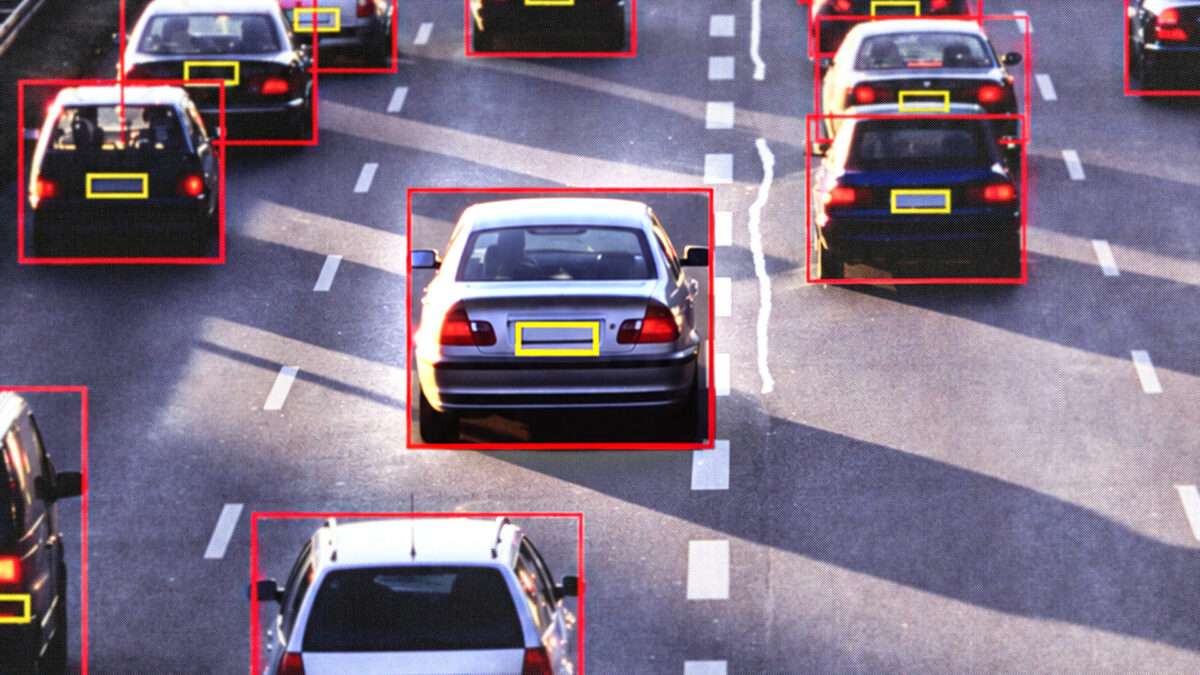
A Connecticut law that took effect at the beginning of October imposes new restrictions on police use of automated license plate readers (ALPRs), which enable what a federal judge recently described as "a type of indiscriminate mass surveillance." The law reflects the bipartisan backlash against AI-assisted cameras that record images of passing cars billions of times a week, building databases that police can use to track drivers, identify other vehicles in their vicinity, predict itineraries, and conduct searches based on a wide range of vehicle characteristics.
Connecticut previously imposed no statutory limits on ALPRs, a fact that underlines how readily police can access license plate data, which they can search without any sort of judicial review and often without meaningful internal supervision. But the law's provisions, while promising in some ways, fall short of the reforms recommended by critics who warn that unconstrained use of ALPRs threatens the privacy of innocent motorists across the country.
As of today, DeFlock's mapping project has identified nearly 145,000 ALPR cameras in the United States, most of which were installed by Flock Safety, the leading vendor. That network includes more than 1,500 cameras deployed by Connecticut law enforcement agencies, three-quarters of which use the technology.
The concerns underlying the new law, which Gov. Ned Lamont signed last May, echo objections raised in other states. Last February, for example, CT Insiderreported that out-of-state agencies had searched ALPR data from Connecticut thousands of times for immigration enforcement purposes. When police in Johnson City, Texas, searched Connecticut data for a missing woman, the log noted that she "had an abortion," which reinforced concerns that ALPR information might be used to enforce abortion bans.
As elsewhere, ALPR critics in Connecticut also have complained about a lack of transparency. In April 2025, for instance, South Windsor began using Flock cameras without any public notice. The resulting consternation prompted the city council to cancel the program early this month. CT Mirrorreports that South Windsor is "at least the sixth Connecticut community to end or suspend the use of ALPRs this year, following Windsor, Killingworth, Ledyard, Milford and Newtown."
Compared to those moves, the new state restrictions are pretty weak tea. But they include some potentially meaningful changes, and they highlight how lax oversight of ALPRs has been.
The new law restricts the sharing of ALPR data, which henceforth will be limited to Connecticut, Massachusetts, New York, and Rhode Island unless an agency in another state obtains a judicial warrant. The law says the data may not be used for immigration enforcement, to target conduct protected by the First Amendment, or for investigations related to "reproductive" or "gender-affirming" health care services. It also bars the placement of ALPRs near facilities that provide such services or organizations that primarily serve immigrants.
The original bill specified that ALPR data could be retained for no more than seven days unless it is tied to an ongoing criminal investigation, subject to a warrant, or used for toll enforcement. The final version of the bill extended that limit to 21 days. Flock's original default was 30 days. But last August, in response to widespread criticism of ALPR surveillance, the company began recommending a seven-day limit. Connecticut's Police Officer Standards and Training Council, which last month sent Lamont a report that included suggested reforms, thinks the state should adopt the seven-day standard.
Under the new law, police may search ALPR data to "assist in the recovery of a stolen motor vehicle," "assist in locating a missing or endangered individual," or "assist in the apprehension of an individual with an outstanding warrant." They also may query the database for information "relevant and material to a specific active investigation of a criminal offense in which there is reasonable suspicion that the offense has been or is being committed." When they do that, their agency must record "the reason for the access and any associated case number for the complaint or incident that is being investigated and is the basis for the access."
It is remarkable that Connecticut lacked such basic safeguards until now, and it is not clear how effective the new rules will be. Since July 1, 2025, Virginia has required that cops state a "specific purpose" for ALPR searches, including "the offense type." Yet last April, WHRO reported that Norfolk police often give "incomplete and imprecise reasons" for ALPR queries, including "suspect," "suspicious," and "investigation" or "inv."
Connecticut's "reasonable suspicion" requirement is more lenient than the standard that the Institute for Justice favors. The organization's model statute would generally require a warrant based on probable cause for ALPR queries. The proposed law makes exceptions for "exigent circumstances," stolen vehicles, and toll, parking, or traffic enforcement.
Connecticut's law also addresses the sort of blatant abuses that have fueled opposition to license plate cameras, including cases in which cops have been caught using ALPR data to stalk personal nemeses, ex-girlfriends, possibly unfaithful spouses, and objects of romantic interest. The law says an officer "who is found to have knowingly accessed, used or disseminated automated license plate reader data with malicious intent for purposes outside of the provisions of this section shall be subject to disciplinary action including, but not limited to, suspension, cancellation or revocation of certification" for police work.
The law establishes two additional remedies that could deter ALPR abuses. It authorizes the attorney general to sue ALPR contractors for damages and injunctive relief when they violate the new restrictions. It also allows "any aggrieved individual" to sue "a public agency" that flouts the rules.
"The law, for a first bite at the apple, is not bad," Ken Barone, manager of the University of Connecticut's Racial Profiling Prohibition Project, toldCT Insider. Given that "there was a benchmark of nothing," he said, the attempt to constrain and track ALPR use is "a big step forward."
She made her name as a pioneer at Google, then as chief executive at Yahoo. Now Mayer is entering the crowded marketplace for A.I. assistants — and hoping to draw in more women with a product that tackles the mental load.
Marissa Mayer has reinvented herself as a start-up founder, with a team of 10 engineers — a fraction of the armies of programmers she once commanded at Yahoo and Google.
Bloomberg/Getty; Jeremy Strong/Sony Pictures; Finn Gomez/Getty; Tyler Le/BI
Writing villains is supposed to be hard. No grand, world-dominating plan ever really makes sense in a story. Soon after "The Dark Knight" came out, David Goyer, its writer, told me the Joker had been a real relief. "Blessedly, because of who the Joker is, we just said, 'fuck the plan. We don't have to do it. He's the Joker. He's the anti-plan,'" Goyer said. "Trying to take over the world is such an impossible, stupid idea — as if anyone could do it with a single act, you know?"
Yet now very real people seem to try just that, on the regular. Except if you believe Hollywood, they're not insane clowns. They're billionaire tech bros. It's starting to seem like every movie and TV bad guy is a douchebag who got rich making stuff that works on your phone. Mark Zuckerberg in "The Social Reckoning," Elon Musk in "Musk," Elizabeth Holmes in "You Can See Everything," Sam Altman in the upcoming "Artificial," Sam Bankman-Fried in "The Altruists." In these stories, at varying levels of fictionality, the evil villains' megalomaniacal plans mostly make sense. Some of them even got away with it. America is eagerly consuming stories about them. "You Can See Everything" grossed $15 million on opening in just 855 theaters, twice what its producers expected.
The more interesting question is why these founders are our demons, all of a sudden. Chalk it up to the reality of the "techlash," the society-wide revulsion to Big Tech's ubiquity and power. But if you really want to understand the extent to which everyone thinks Silicon Valley is so uncanny these days, you should be watching a CBS legal procedural called "Cupertino." It's a sharp look at tech and its discontents — but more than that, it clarifies how widely the techlash is spreading.
"Cupertino" comes from the TV-making couple Michelle and Robert King, best known for the "The Good Wife" and "The Good Fight." In their new show, a slick lawyer played by Mike Colter gets iced out of the tech company he cofounded at the same time as a more junior attorney also gets ousted. The two join their wrongful-termination lawsuits against the company, eke out a big settlement, and start a firm to represent "little guys" against Silicon Valley giants. In one plotline, a drone maker tries to blame a mid-level coder for one of its bots falling out of formation during a show and killing a man — it turns out the company had changed batteries to accommodate a prospective military contract. In another, a mysterious whistleblower client asks for help to force an Anthropic-like company to put guardrails around its most powerful AI. Then the whistleblower claims to in fact be the AI.
It's all in good fun. The actors are beautiful. They banter well. Colter wears the hell out of a suit. Busy Philipps plays a Mackenzie Scott-like benefactor of the new law firm — if Scott used her incredible wealth to become a hardcore partier.
A CBS show like "Cupertino" picks bad guys that millions of people can easily recognize as deserving of comeuppance. It picked the overlords of Silicon Valley.
But thematically, there's depth. That Colter is the only Black person for miles does not go unremarked. His new partner Olivia Siffre (pronounced "cypher"), played by Rachel Keller, is a devout, cross-wearing conservative from the Midwest, an alumna of Liberty University. Their closest allies don't come from the ranks of coders, marketing, or venture capital but are instead service workers, tradespeople, and the waitstaff from a nearby TGI Fridays. (Alas, a fiction — there are no TGI Fridayses in the Valley.)
So see that class rage for what it is. The fantasy here is that the middle-American proletariat gets to stick it to bespoke-suited, arrogant C-level types and unkempt, geniuser-than-thou sex pests. Because for the last few years, those people have had all the power. "They always have a friendly audience, an accommodating interviewer who won't ask them anything controversial. And then they get into territory where the price is much higher," Robert King said in a recent interview. "They reveal who they really are: robotic, inhuman nerds who never got laid in high school and are now kind of crazy with power, self-importance, and a sense of entitlement."
The point is, the "little guys" fighting this good fight seem like they're supposed to be proxies for the viewer. "Cupertino" is a CBS procedural, the genre of shows like "NCIS" and its offspring — things that no one watches, except for 10 million people every week. That's a lot. CBS typically has the largest primetime viewership of any network, and the oldest — like, people in their 70s. It's all well and good for young coastal sophisticates to post about Elizabeth Holmes' inability to grasp the Who's-on-First routine, but "Cupertino" is aimed at America's parents and grandparents. And apparently they are excited to see the people who make their phones portrayed as the wealthy engines of every inconvenience — sources of half a billion dollars to Republicans only, builders of data centers, creators of chatbots that drive kids to death by suicide, purveyors of screens that watch you back. "Cupertino" debuted to rapturous reviews and more than 3 million viewers, beating "Grey's Anatomy" in its time slot.
A show like "Cupertino" is meant to have a low barrier to entry; it picks bad guys that millions of people can easily recognize as deserving of comeuppance. It picked the overlords of Silicon Valley.
Not so long ago it would've seemed preposterous to give a scrawny, socially awkward, brainy little guy the job of Big Bad. They're the assistant, or the butt of a particular kind of joke, like the spectrum-y heroes of the wildly popular "Big Bang Theory" — Klingon-speaking, physics-doing, Green Lantern oath-knowing clods. Still, I can think of examples of "bad guy, subtype: tech nerd" going back to the early days of science fiction. Mad scientists like Dr. Frankenstein or Dr. Jekyll, or various HP Lovecraft antiheroes, probably count. So too might the arrogant cyberneticist in Robert Heinlein's "Waldo."
A rough analog in the mid 20th century might be the rogue industrialist. After all, James Bond villains have often been tech-bro adjacent. Karl Stromberg in "The Spy Who Loved Me" wants to build independent ocean settlements; he's basically a seasteader. Hugo Drax in "Moonraker" is a eugenics-obsessed CEO who wants to build space stations, which sounds familiar. Max Zorin, played by Christopher Walken in "A View to a Kill," is an "industrialist" and the product of Nazi genetic experiments. But his megalomaniacal plan is to use a California natural disaster to gain a monopoly on silicon computer chips. That's just Jensen Huang on any given Tuesday.
The weirdest new phenomenon here is how personal it all is. Evil technology oligopolies have been representatives of oppressive capitalism in Hollywood for decades — but they were faceless. The anonymity was part of the terror. Think of the company that orders Bruce Dern to destroy the last forest in his spaceship biodome in "Silent Running," the Umbrella Corporation in "Resident Evil," or Cyberdyne Systems, creator of Skynet in the Terminator movies.
More recently, film and television have started identifying not just faceless corporations but specific tech-coded people as their worst-of-the-worst. And not just any people, but people geofenced into Silicon Valley: "Glass Onion," "Don't Look Up," "Ex Machina," "Devs," "Super Pumped" (fictionalized Uber), "WeCrashed" (fictionalized WeWork), "The Playlist" (fictionalized Spotify), and "The Dropout" (fictionalized Theranos), "Mythic Quest" — the list goes on.
Actually, Cyberdyne's a good example of one important way these depictions have changed; in 1984's "The Terminator," Cyberdyne is a Los Angeles-area heavy-industry firm. In 2015, "Terminator Genisys" moved Cyberdyne to a gleaming tech campus explicitly modeled on the headquarters of Oracle. It's an inside joke, though not the ha-ha kind. The movie's producers included Megan and David Ellison, children of Oracle CEO Larry Ellison. David now owns the merged studios of Warner Bros. and Paramount, and he just got a billion-dollar investment from Elon Musk. The new company, Skydance, includes in its holdings … CBS.
Christopher Walken's Bond villain has a megalomaniacal plan is to use a California natural disaster to gain a monopoly on silicon computer chips. That's just Jensen Huang on any given Tuesday.
"A sequence of Hollywood contemporary science-fiction movies identifies Silicon Valley capitalists as a new type of villain," write Northumbria University film studies scholars Joe Street and Russ Hunter in a 2024 paper. These new movies critique tech, they say, using an approach "in the grand tradition of cinematic science fiction touchstones such as the Cold War alien invasion films that allegorized fears of Communism in 1950s America."
In other words, movies about time-travelling killer robots and dead-eyed billionaires aren't so different, after all. Horror is about shared anxieties. Old-school mad scientists posed a threat because they dared to do experiments that contravened the laws of nature; they were evil for love of the game. The Silicon Valley bad guys are worse, because they do it for profit. "When presented with an innovation," Street and Hunter write, "the prime movers in these corporations think not of moral or ethical concerns and crucially not of the material impact of what they are doing — but only of the innovation's potential for financial gain."
Is Hollywood's techlash actually on the rise? The schlemiels of "Silicon Valley" premiered in 2014. I have tech-bro-villain articles in my files going back to 2022 at least. And the business world has always been fodder for stories filtered through the anxieties of the time—what was Ebenezer Scrooge if not a capitalist oppressor?
Mapping the full arc of technology-associated villains would be, in the words of Ted Underwood, "hard to code." Underwood's an English and information science professor at the University of Illinois at Urbana-Champaign, researching ways to identify literary trends across time, in big canons. "In addition to tracing the history of villains, you'd have to think how often these social types appear as heroes," he says. For every Max Zorin there's a Tony Stark. Ethan Hunt's nobody without tech aces Luther and Benji. "Star Trek" doesn't trek without Scotty, or Chief O'Brien. Every movie heist is basically a hack. And let me just say unto you: "MacGyver." "One hypothesis would be that what we're feeling right now with evil tech bro villains is just that the counterbalancing examples have dropped out," Underwood says.
Clearly, though, tech billionaires and their hangers on have actively tried to make themselves into main characters. Some of them seem to think they're the only real consciousnesses in a simulation, a virtual world populated with non-player characters like you and me. At minimum they evince a belief that they possess a greater depth of perception and knowledge. As the architect and tech historian Fred Scharmen once wrote, "for this particular kind of person, wealthy and powerful or not, intelligence comes paired with a certain kind of malignance. The Evil Nerd is sharp, and also mean, their big brains are oriented towards anger and destructiveness."The Thiels, Altmans, Musks, and Karps of the world turn what had been nerdy weakness into nerdy strength. They go on friendly podcasts and show up in pictures taken with presidents. We don't have to imagine them delivering what the screenwriter John Rogers, creator of the anticapitalist TV show "Leverage," calls the Evil Speech of Evil. They monologue at tech conferences! These guys embody their ideologies; l'enterprise, c'est moi.
And what happens if that kind of behavior gets depicted, week in and week out, on a popular legal procedural TV show? Even if that show airs on a network owned by one of those "evil nerds"? Hard to say. Maybe it'll be enough to turn some people into the Joker.
Members of the European Parliament are visiting Amazon logistics centres in Germany and Poland this week to investigate working conditions and the use of digital monitoring systems, reopening a dispute between the technology company, European legislators and trade unions over employee rights.
The fact-finding mission, scheduled for 26th and 27th October, will examine how Amazon organises work, measures employee productivity and uses automated systems in warehouses. MEPs will meet management, employees, works councils and trade union representatives, with particular attention to whether technological changes are affecting workers’ health and their ability to exercise employment rights.
The investigation comes as the European Commission prepares its Quality Jobs Act, which is expected to address algorithmic management, occupational safety and working conditions across the European economy. Amazon’s extensive logistics network makes the company a prominent example of the questions legislators must resolve.
MEPs enter warehouses after prolonged dispute
The delegation is led by Li Andersson, chairwoman of Parliament’s Employment and Social Affairs Committee, and includes Belgian MEPs Liesbet Sommen and Estelle Ceulemans, alongside representatives from several other political groups.
According to the European trade union federation UNI Europa, MEPs will inspect facilities in Dortmund and Mönchengladbach on Monday before travelling to Poland on Tuesday.
The German visits will cover older warehouse operations and newer facilities incorporating robotics, allowing parliamentarians to compare different approaches to handling orders and managing employees. The Polish programme includes a major returns facility in the Katowice area.
The visit follows several years of strained relations between Amazon and the European Parliament.
In February 2024, Parliament withdrew permanent access badges from Amazon representatives following disagreements over the company’s participation in hearings and requests for visits to its warehouses.
Amazon disputed suggestions that it was avoiding scrutiny, maintaining that it had offered alternative arrangements for parliamentary visits during periods when its logistics operations were particularly busy.
Company executives eventually appeared before the Employment and Social Affairs Committee in January 2026, where they defended Amazon’s employment policies and workplace practices.
The controversy over digital surveillance
At the centre of the dispute is the increasingly widespread use of electronic systems to monitor productivity.
Warehouse employees commonly use handheld scanners, while automated systems can help allocate tasks, coordinate movements and identify delays in processing orders.
These technologies allow employers to manage substantial logistics operations with considerable precision. They also make it possible to collect detailed information about individual workers’ activities throughout their shifts.
Trade unions argue that such monitoring can create unreasonable performance pressure, particularly where targets are adjusted automatically or workers cannot challenge assessments generated by software.
The concerns are not confined to Amazon.
A European Commission survey examined by EU Today earlier this month found that 42 per cent of surveyed smaller and medium-sized businesses already used artificial intelligence or algorithmic management systems.
However, 49 per cent of respondents expressed distrust of automated systems making decisions about employees, illustrating the distinction between using technology to support management and delegating consequential decisions to algorithms.
Previous regulatory action
Amazon has already faced formal European regulatory scrutiny over workplace monitoring.
France’s data protection authority imposed a €32 million fine on Amazon France Logistique in December 2023, announcing the decision in January 2024. The regulator concluded that certain employee monitoring practices were excessively intrusive and breached data-protection requirements.
The investigation examined the collection and retention of detailed information from warehouse scanners, including productivity indicators and periods of inactivity.
Amazon rejected the regulator’s conclusions and subsequently appealed the decision. The penalty therefore needs to be distinguished from any final judicial determination of the dispute.
The case nevertheless demonstrates that workplace monitoring falls within existing European privacy legislation, independently of proposals for new employment rules.
Amazon maintains that its warehouse technology is intended to improve operational efficiency, safety and the reliability of deliveries.
In its January parliamentary testimony, the company defended its investment in employee training and insisted that workers have the right to join trade unions.
It also pointed to engagement with works councils and employee representative bodies across its European operations.
Trade unions contest the adequacy of those arrangements, particularly in Germany, where the ver.di union has repeatedly sought a collective agreement covering Amazon employees.
These competing positions will form part of the parliamentary delegation’s assessment.
Implications for EU employment legislation
The Commission’s Quality Jobs initiative addresses several questions raised by the Amazon dispute, including algorithmic management, psychosocial risks and the effectiveness of collective bargaining.
Legislators must determine how far employers should be required to disclose the operation of automated monitoring systems, how employees can contest decisions and what safeguards should apply when performance targets are generated by software.
Rules must also accommodate legitimate requirements for stock management, security and workplace safety.
The parliamentary visit will not itself establish whether Amazon has breached employment legislation. It is a fact-finding exercise intended to inform future policy discussions.
Its importance lies in giving legislators direct access to warehouse operations and employee accounts before deciding how European labour law should respond to increasingly automated workplaces.
The king of ghosts lives in a haunted $4.3 million dollar mansion in the heart of New Orleans' French quarter. The dozens of paranormal tour guides who lead tourists through the neighborhood are sure to know of him and have an opinion of him. Lance Zaal is the most controversial man in America's booming ghost business, CEO of what competitors have dubbed "The Walmart of Ghost Tours."
Over the past half-decade, Zaal, 42, and his company, US Ghost Adventures, have opened ghost tours in more than 250 cities and towns, employing more than 1,000 guides, according to his company's website. He's also been buying up the country's haunted landmarks like it's the first trip around the Monopoly board — the Lizzie Borden House in Massachusetts, the Villisca Axe Murder House in Iowa, the McInteer Villa in Kansas, and two historic houses in Gettysburg, Pennsylvania. "Lance has said he wants to build an empire, and that's what he's doing," says Diane Student, who hosts the industry podcast History Goes Bump.
USGA also sells ghost detection gear through the brand Ghost Daddy — products with names like the Sinister Speaker, Medusa's Net, and Devil's Marble MK2. An Ultimate Ghost Hunt Kit For Two sells for $629.99. The whole operation has made Zaal wealthy enough to buy the Lalaurie Mansion, his primary residence, which stands on the site of an infamous slaveowner's torture chamber. Previous guests have reported unexplained moaning and groaning inside, along with the sudden, putrid smell of burning flesh, and, according to New Orleans tour guide Catie Santos, passing guides stand on the opposite side of the street because of the house's dark energy. On tours, Santos, who was briefly employed by Zaal as a content creator, also warns her guests "about the real life Marvel supervillain living in that house," she says.
The Lizzie Borden House in Fall River, Massachusetts, one of many haunted houses Zaal has bought up across the country.
Boston Globe/Getty Images
In assembling his dominion of the undead, Zaal has made a host of enemies among the living. I spoke with more than a dozen competitors and insiders in the industry who described him as "vindictive," "predatory," a "bully," and a "hemorrhoid." He has been accused of borrowing content from local tours, ripping off merchandise designs, redirecting negative reviews to competitors, misclassifying workers as contractors, and using names similar to local companies to confuse tourists. The allegations have resulted in a mounting pile of lawsuits against USGA. Zaal, who did not respond to repeated inquiries for this story, has consistently denied any predatory behavior and emphasizes his commitment to historic preservation.
When passing Zaal's mansion, Catie Santos warns tourists of "the real life Marvel supervillain living in that house," she says.
He has gone after his rivals, filing copyright and defamation suits and frequently threatening legal action. "This gang of competitors are the bullies. So desperate to restore their monopolies or do whatever they can to eliminate their competition," USGA wrote in the comments section of "Exposing US Ghost Adventures Corrupt and Unethical Business Practices Part 1," a recent video from the YouTube channel The Paranormal Engineer.
When Walmart surged through the country in the 1980s, it sparked fierce resistance from the mom and pop stores threatened by their expansion. Today, the rise of the Walmart of Ghost Tours has ignited a war in the ghost industry.
In the biography published on his website — which has a slapdash, early-2000s blog design — Zaal describes a hardscrabble childhood in Southern California. After his parents divorced when he was 6, he was often homeless, sometimes sleeping in the family van. He was bullied in school, he writes, and threw himself into little entrepreneurship projects like a lemonade stand, where he bumped his margins by charging extra for a "Lemon Special," which involved adding a Lemonhead candy to the drink. He says his youth was also marked by eerie experiences — mysterious footsteps, doors opening and closing without explanation — that inspired a lifelong fascination with the supernatural. "I've experienced odd things I can't explain," he said in a recent interview with Business Insider.
In Zaal's personal website, he describes a childhood marked by eerie experiences — mysterious footsteps, doors opening and closing without explanation.
Website of Lance Zaal
After 9/11, Zaal enlisted in the Marine Corps at age 17. He completed three tours, including two in Iraq, where he was stationed for a time at President Saddam Hussein's palace. Then he got an MBA at William and Mary, and worked briefly at Booz Allen Hamilton and Mythics Inc., until he was laid off in 2012. He set out on his own, developing a GPS-guided audio ghost tour app called ItourMobile. It was good timing. America was in the midst of a ghost renaissance.
In a 1978 Gallup poll, 11% of Americans said they believed in ghosts. By 2025, that number soared to 39%. Some attribute the trend to a decline in traditional religion, with non-religious people becoming more inclined to seek other supernatural answers to life's big questions. And as paranormal beliefs have risen, there has been an influx of people trying to profit from them. Reality TV shows "Ghost Hunters" and "Ghost Adventures" took off in the 2000s. By 2023, "dark tourism" — which ranges from the sites of atrocities to haunted houses — was valued at $32 billion and projected to reach $39 billion by the decade's end, according to Grand View Research.
Years after US Ghost Adventures took off, an interviewer at Authority Magazine asked Zaal what advice he wished he could give his younger self. "You're on your own," Zaal said, in a quote displayed under a photo of him in a vest, arms crossed, blue-steeling the camera. "You have no friends. The market is God."
Ting Rappa, an EMT and firefighter who runs an Orlando-based ghost tour called American Ghost Adventures met Zaal in 2015, when he was managing a tour called Colonial Ghosts in Williamsburg, Virginia. Zaal approached Rappa after she attended one of his tours with a proposal to team up. "He was a little off," Rappa says. Something about his energy made her apprehensive. "But he was a very intelligent person. I could tell he had a drive." Zaal said he would help finance her company in exchange for a share of the operation. But the deal didn't seem like an even partnership, so she turned him down.
You're on your own. You have no friends. The market is God.Lance Zaal
Three years later, she discovered that Zaal had a new name for his company that resembled hers: US Ghost Adventures. When she tried to trademark American Ghost Adventures years later, the application was denied because Zaal had registered his first. In 2024, she filed a suit asking for the USGA trademark to be cancelled, still working its way through the courts. "There's just no ethics to it," she says of Zaal's expansion. "Competition is good, but play nice. Right now, you're just being a big bully."
In the Authority Magazine story, Zaal was asked how he researches whether someone else has already had one of his ideas, a question that would become more significant as his business continued to grow.
"It's not relevant," Zaal said. "Who cares who else thought of an idea? This is fear at first thinking. What matters is creating a sustainable, strong business. Just because there are others in your market, doesn't mean you can't succeed in it, or even redefine it. What is important is ensuring you don't break the law, whether that be a trademark, patent, or whatever."
A ghost tour is a pretty simple business to set up. Most are walking tours through public spaces that require little overhead. At USGA, guides are generally contractors paid a flat rate of $40 to $50 per tour, plus tips, per its website. With a tour drawing dozens of customers paying $20 to $40 for a ticket, the money can quickly pile up.
Tour guide Leanna Foglia during an "Original Fells Point Ghost Walk" tour by Baltimore Ghost Tours, a rival of Zaal's Baltimore Ghost Tour.
Elizabeth Frantz for BI
USGA wasn't the only company to pursue ghost tours on a national scale — the rival Ghost City Tours operates 60 tours — but it was the most aggressive. During the pandemic in 2020, as other tour companies were shuttering, Zaal expanded to dozens of cities and towns, ready to put guides on the pavement once restrictions were lifted. That year, he unsuccessfully sued to reverse a COVID ban on walking tours in Massachusetts. By 2021, USGA had operations in 33 cities, each under a local name.
One of the first cities targeted was Baltimore, where Melissa Rowell had operated Baltimore Ghost Tours since 2001. Zaal came on her radar when she began receiving phone calls from irate customers. "We are trying to find out where this ghost tour is," one man complained in a voicemail shared with Business Insider. "Nobody's answering the goddamn phone … after we spent almost $100."
The man was looking for Zaal's new local affiliate of USGA, which had begun operating under the name Baltimore Ghosts. Rowell sent Zaal a letter asking him to change the name to something more distinct. Soon after, Rowell says, USGA started using the name Baltimore Ghost Tour in some materials. "Instead of trying to cause less confusion, they seemed to be trying to cause more," she says.
Rowell and Zaal have since been in a cold war, volleying terse emails and cease-and-desist letters. "I understand you actively collaborate with a confederation of other companies to disparage and damage both the company and my personal reputation," Zaal wrote Rowell in 2024. "Let us honor the spirit of Halloween this season and cease this animosity. There's enough customers for all of us."
Amy Lynwander (left) and Melissa Rowell, co-owners of Baltimore Ghost Tours, another of Zaal's rivals. "Let us honor the spirit of Halloween this season and cease this animosity," Zaal wrote to Rowell in 2024.
Elizabeth Frantz for BI
Rowell denies that she is part of a confederation, but local tour guides have collaborated in dealing with their ascendant rival. There's a private Facebook group where guides across the country share information about USGA. Mike Carter, a tour guide from Annapolis, Maryland, bought the domain name USAghostadventures.com to build a site that urged customers to choose local ghost tours instead of Zaal's outfit. (Zaal got the site taken down and sued Carter for defamation.) Some paranormal companies, like Central New York Ghost Hunters, have rejected partnerships with USGA out of solidarity with local guides.
In Austin, Texas, USGA was sued by the owners of a local Booze and Boos Tour after Zaal opened a Boos And Booze tour. In Savannah, Georgia, the national company Ghost City Tours, which operated a Dead of Night Tour, sued USGA for opening the Savannah Terrors Ultimate Dead of Night Haunted Ghost Tour. In Charlotte, North Carolina, the local Queen City Tours sued Zaal's Queen City Ghosts. USGA generally argues in court papers and public statements that the names are too generic to own. The Austin suit was settled in 2024; the latter two lawsuits are currently making their way through the courts.
USGA was sued by the owners of the Booze and Boos Tour after it opened a Boos And Booze tour; the Dead of Night Tour for opening the Savannah Terrors Ultimate Dead of Night Haunted Ghost Tour; and Queen City Tours for opening Queen City Ghosts.
In one instance, a guide alleges that Zaal uses these similar names to trick tourists into leaving negative reviews on his competitors' tours. Angela Taverniti, who runs Colonial Ghosts of Williamsburg, said a USGA customer, Samantha Butler, accidentally left a negative review on Taverniti's tour. When she pointed out the mixup, Butler pulled up the link she got from USGA asking her to review the tour and tested it. A screen recording Butler shared with Business Insider shows that when she submitted a four-star ranking, she was directed to the Google review page of the USGA tour she took. But when she submitted a two-star rating, she was directed to the Google page for Taverniti's tour. Spooky. Reviews are a big deal for tour operators. "98 percent of our business comes from Google," Taverniti tells me. "It's a game that you have to play constantly. And he knows how to play it."
Other paranormal guides say Zaal borrows the content of the tours along with the names. Laine Johnson, a former park ranger, spent the last decade developing a tour of the supernatural happenings in Durango, Colorado, drawing from firsthand accounts of locals, newspaper archives, and out-of-print books. When a new tour called Durango Ghosts set up shop there in early 2023, Johnson took it to check out the competition. She says she was startled that they followed her exact route and told the same stories, sometimes with the same phrasing.
Angela Taverniti, owner of Ghost Tour Williamsburg, claims that Zaal uses similar names to his competitors' tours to trick tourists into leaving negative reviews on their Google pages.
Elizabeth Frantz for BI
When she got home and did some research, she formulated a theory of what had happened. During the pandemic, she had uploaded her materials to a site called Junket, which allowed her to host virtual tours. Junket and Durango Ghosts were owned by Lance Zaal. Her content, she's convinced, had been snatched from the Junket website and co-opted by her new competitor.
USGA has meaningfully eaten into her bottom line, she says. "This is a really small town. It's ridiculous that there's now three ghost tours going here," she says.
By 2021, USGA purchased the crown jewel in its collection of haunted property, a three-story Greek Revival House in Fall River, Massachusetts, where Lizzie Borden was accused of axe-murdering her parents in 1892. It's famous for paranormal activity, and Zaal mentioned in an interview shortly after the purchase that he felt as if "someone, or something, was in the room with him," when he spent the night there alone.
This is a really small town. It's ridiculous that there's now three ghost tours going here.Laine Johnson, a ghost tour owner in Durango, Colorado
In 2023, a small cafe called Miss Lizzie's opened nearby, and Zaal sued, arguing that the name and logo — a blood-stained hatchet — infringed on his trademark. "She's a historical figure," cafe owner Joe Pereira counters. "I don't think anyone can own her." It was a strange reversal of the trademark suits that had been filed against him, and local competitors followed the case closely.
The next year, a judge sided with Pereira, saying the logos were substantially different. "Miss Lizzie's hatchet has a handle and smooth axe blade that spews blood," the judge wrote in his decision. "Ghost Adventures' hatchet is bereft of either handle or blood and features a notch halfway along the blade." But the lawsuit, which dragged on for years afterwards, has taken a financial toll on Pereira. Though a judge affirmed the initial ruling this month, Pereira was also ordered to pay $31,207 in legal fees after missing various filing deadlines.
Amid the acrimony, USGA has continued to grow. From 2019 to 2023, Zaal told Entrepreneur Magazine, USGA's revenue increased by 2,600%. To service the expansion, he contracted with writers and creators to develop tours and other content about new cities in the USGA empire.
Some guides, like Sabrina Velandry, a psychic medium who conducts tours for USGA in Salem, have had broadly positive experiences with the company. It's more professionalized than some of the local tours, she says. "It is corporate, but it's just really really well-run and organized." Others have butted heads with management, and two lawsuits have alleged misclassifying workers as independent contractors and failure to pay overtime wages. USGA has denied these claims, and one suit was settled while another is still in the courts.
In 2023, Ronald Murphy, a high school teacher outside of Pittsburgh, began picking up some extra work for USGA as an independent contractor, where he would crank out a new tour for $200, or make $40 for a 300 word blurb on the USGA website. All told, he says, he wrote tours for about 18 cities.
USGA sells ghost detection gear through the brand Ghost Daddy — products with names like the Sinister Speaker, Medusa's Net, and Devil's Marble MK2. An Ultimate Ghost Hunt Kit For Two sells for $629.99.
Elizabeth Frantz for BI
He says he wasn't given time for deep research and didn't like the idea of using content posted by competing local tours, so for a tour about Fort Worth, Texas, he decided to get creative. "I was going to simply make up the ghosts," he says. He thought the local Cowboy Museum was the sort of place that a ghost might frequent and wrote this fiction for the website: "Of course, no cowboy can hold a candle to The Duke himself, Mr. John Wayne. Visit the Texas Cowboy Hall of Fame where it's said the apparition of the 6 foot 4 actor has been seen admiring the cowboy memorabilia on display." The work eventually dried up. Today, USGA is recruiting an AI Creative Specialist, at $42,000 a year, "to draft, edit, and refine engaging tour scripts, website copy, and compelling marketing collateral." Even ghost jobs aren't safe from the AI revolution.
Trevor Foster didn't have much interest in ghost tours until he was ripped off, he tells me. He's a ceramics artist who specializes in dark pieces like bones, pistols, and mystical eyes. This January, he received a message informing him that USGA may have stolen one of his designs to sell on its Ghost Daddy website — an intricate skull-shaped mug with a handle like a curved bone. From initial casting to final glazing, it took Foster about about 100 hours to complete.
The skull on Ghost Daddy looked like one Foster designed in a slightly different color. Foster says the fact that it had the same sutures on the top — "almost like a fingerprint" — made it clear it was a ripoff. He also found that Zaal had recently purchased the same skull mug from him. "For someone to buy it and make a direct mold just seems kinda brazen," Foster says.
Foster sent a cease-and-desist letter, and Zaal responded that he planned to remove the item within six months. "My understanding in looking at your website is that you have your initials on the bottom (ours doesn't), each one is hand crafted and unique (ours are consistent and the same which is why yours looks better), ours is of a lighter color, and our logo is on the back," Zaal added. To Foster, it seemed Zaal was implying that replacing his initials with the USGA logo was enough to make the knockoff legal.
An Instagram video Foster posted went viral in the ghost tour community, and Zaal agreed in an email shared with Business Insider to discontinue the item immediately. He attributed the similar design to a mistake made by an overseas supplier who was given multiple examples to draw inspiration from. That wasn't good enough for Foster, who sued and settled with Zaal in September.
From 1978 to 2025, the share of Americans who said they believed in ghosts soared from 11% to 39%.
Elizabeth Frantz for BI
Foster was surprised to have found something of a community as a result of the whole debacle. After he'd posted about the situation, he was inundated with dozens of messages from people with their own grievances with US Ghost Adventures, commiserating with him. "It's just kind of incredible how many people they've angered," Foster says.
And — if you fall into the 39% of the country that believes in ghosts — you might believe that it isn't just corporeal beings that have been angered. This summer, a group of part-time ghost hunters visited Zaal's newly purchased McInteer Villa and set up K-2 meters, REM pods, and a ghost box.
But the group's leaders Dawn Lorenzen and Amy Osborn found the ghosts to be surprisingly uncommunicative. When they'd visited before Zaal's purchase, the ghost hunting had been good.
They Facetimed a medium to figure out what was going on. The ghosts were irritated, she told them, and it seemed to be related to the new ownership. "They made a circus of the place," the ghosts kept repeating, she said. "And now we are a spectacle."
West Des Moines, Iowa—Iowa voters may disagree on immigration, taxes, and the economy, but government surveillance is drawing opposition from across the political spectrum.
An Emerson College poll of 750 likely Iowa voters, conducted between late August and early September, found that 61 percent opposed police use of automated license plate reader (ALPR) cameras, compared with 26 percent in support.
The backlash comes as police departments across the state increasingly rely on surveillance technology supplied by private companies such as Flock Safety and Motorola Solutions. Their cameras record license plates and vehicle information, feeding searchable databases that allow law enforcement to piece together motorists' movements, including those of people suspected of no crime.
As Iowa's gubernatorial and congressional campaigns enter their final stretch, voters are increasingly pressing candidates on whether they intend to place limits on the technology. Jacqueline Thompson, an ordained elder in the Iowa Conference of the United Methodist Church and a self-described centrist Democrat, said she has been concerned about government surveillance for years.
"It's always been important to me [and] I've always thought that was a problem," she said before a campaign rally at a senior living community in Des Moines earlier this month. "So, when people started jumping on the bandwagon saying it, I was like, 'Hello, I've been here already!'"
Thompson pointed to two Democratic candidates, Nate Willems, who is running for Iowa attorney general, and Taylor Wettach, a candidate for state auditor, as having caught her attention with their emphasis on corporate oversight and access to government records.
For Thompson, the renewed attention to privacy is a welcome development in a political environment where Democrats and Republicans rarely find common ground. "It's kind of nice to hear the people come back to the middle [and discuss this]," she said.
Flock Does Not Have Enough Guardrails
Police surveillance technology has spread across Iowa faster than the rules governing its use.
A recent study identified at least 62 Iowa law enforcement agencies that had accessed other agencies' Flock databases, including departments that did not operate cameras of their own. Police departments can therefore search information collected well beyond their jurisdictions without having to install a single camera themselves. The study (led by Megan Graham, a clinical associate professor and director of the Technology Law Clinic at the University of Iowa College of Law) found significant gaps in transparency surrounding ALPRs.
The constitutional implications are already being tested in court. On October 1, a federal judge in Oklahoma ruled that a sheriff's deputy violated the Fourth Amendment by searching a motorist's location history through automated license plate reader systems operated by Flock Safety and Motorola Solutions without a warrant.
The search turned up more than 50 records of the driver's whereabouts across multiple states over a month. In the 38-page ruling, the judge ordered the resulting evidence suppressed, describing the technology as a form of "indiscriminate mass surveillance." The decision is not binding in Iowa, and legal challenges to ALPR surveillance still face an uphill battle, but it adds to the legal scrutiny of police tracking motorists without warrants.
The University of Iowa study also raised concerns about unauthorized database access, erroneous alerts, and the potential use of locally collected information for federal immigration enforcement.
Flock Safety says it has not provided U.S. Immigration and Customs Enforcement or Border Patrol with direct access to its systems. But the researchers found that local law enforcement agencies elsewhere in the country had conducted searches on behalf of federal authorities, effectively allowing them to obtain information without direct access.
Taxpayers are also footing the bill. Cedar Rapids reported operating 76 cameras at a combined average cost of more than $20,000 a month, according to the study.
Researchers struggled to determine the full extent of surveillance across Iowa. Some agencies refused to disclose the number or locations of their cameras, while others withheld records concerning unauthorized access or erroneous alerts, citing confidentiality.
The cameras are not limited to Iowa's largest cities. Becca Eastwood, deputy policy director at the American Civil Liberties Union of Iowa, said they have spread across large, midsize, and smaller communities, prompting a surge in opposition over the past year.
The backlash "has just exploded, like no other issue that I have seen in my time at the ACLU," Eastwood told Reason in an interview. Candidates running for state and federal offices are increasingly getting asked if they support police departments using ALPR cameras, she said.
Some local governments are already reconsidering their contracts. Indianola and Waukee suspended their Flock camera arrangements, Iowa Public Radio reported in August. Dallas County paused a planned rollout while awaiting guidance from state lawmakers. Ankeny, which operates 16 Flock cameras, is reportedly expected to reconsider a possible contract extension next year.
The backlash also cuts across the immigration debate. While concerns about federal immigration enforcement have helped draw attention to the cameras, critics argue the same surveillance infrastructure can be used against anyone, regardless of which party controls the government.
"This is a nonpartisan issue because people recognize that surveillance can be weaponized against anyone the government wants to weaponize it against," Eastwood said. "An increase in police surveillance impacts certain populations more, right now [but] nobody is immune."
Politicians Face Pressure To Cut Ties With Flock
The opposition is beginning to force Iowa's candidates to take positions on a technology that, until recently, attracted relatively little attention outside law enforcement and civil liberties circles.
Among the gubernatorial candidates, interviewed by Iowa Radio last month, Republican Zach Lahn has called for state-level regulation, arguing that the widespread collection of information about where people drive is unacceptable. Meanwhile, Democrat Rob Sand has expressed support for safeguards governing the collection and use of license plate data and said he would sign legislation if privacy concerns persisted. But he has also pointed to the cancellation of some Flock contracts as evidence that the market is responding to public concerns.
For now, neither approach offers much clarity on whether police should be required to obtain warrants before searching motorists' location histories or how far restrictions on data collection should go.
Ryan Johnson, a libertarian-leaning Republican who works as a machinist near Waterloo, said he could accept cameras in certain locations, such as downtown areas or near traffic signals. But he objects to their spread into residential neighborhoods and public spaces.
"Just having Flock cameras everywhere, [in] residential [areas], putting them at parks and pools, we don't need that," Johnson said while attending a Lahn rally earlier this month.
So far, some of the most concrete changes to ALPR practices have come from Flock itself. In August, the company announced that it would reduce its default data-retention period from 30 days to seven and require officers to enter a criminal case number or code for each search. The changes would not, however, require police to obtain a warrant before accessing the records.
Gary and Nancy Guthrie, a Democratic couple attending a Des Moines rally supporting Chris Jones for secretary of agriculture, remain skeptical of the cameras.
"I don't have a good feel for that," Nancy Guthrie said. "Personally, I'm very much against Flock cameras."
For all the attention the issue is receiving on the campaign trail, Iowa voters have yet to hear much about what legal limits candidates would actually impose on police surveillance.
One flight-booking mistake cost my family nearly $3,000 and a day of travel.
Natalie Becerra
I booked two separate flight itineraries on different airlines for a family trip to Ireland.
I realized this was a mistake after the first airline diverted, and the second left without us.
The fix cost my family nearly $3,000 in new tickets and a day's worth of touring.
I'm a veteran traveler who has booked more long-haul flights than I can count. But earlier this year, I made a very expensive rookie mistake.
While planning a trip, I came across a deal I couldn't pass up: a $317 one-way flight on Icelandair to Ireland with a multi-day layover in Reykjavik. It was essentially a way to take a trip within a trip without paying extra airfare.
The catch? The flight departed from New York, not our home airport in Florida. I'd be in New York a few days early, but my family would need to fly up to meet me. Booking separate itineraries was far from ideal, but I figured a five-hour buffer would be enough.
It wasn't.
A storm in New York canceled my family's JetBlue flight from Florida, and their replacement flight then couldn't land and was diverted to Virginia. Their Icelandair flight to Europe was automatically canceled after they were marked as no-shows.
On the night we were supposed to fly together to Iceland, my family was stuck states away, and I was scrambling to find a solution.
With my family's original flight gone, we had to spend nearly $3,000 to get them back on track and navigate the complicated credit card trip insurance process. Here are 4 lessons I learned the hard way.
Booking separate itineraries comes with a pricey risk
I didn't account for enough time for flight disruptions.
Joe Raedle/Getty Images
Arriving in the city of your next flight at least 24 hours before may feel a bit extreme, but it's the minimum safety net you need.
Being already in the right location for your flight can be a huge weight off your shoulders. It also allows sufficient time for rebooking should something go wrong with your flight.
My last-minute whim to visit a few friends upstate turned out to be key. Those extra two nights in New York meant I was able to make the flight to Iceland. If I had booked my family of three on a flight the day before our long-haul flight, they would have made it too.
My family made it to New York the next morning and ended up taking a replacement flight to Iceland that evening, getting in about 24 hours later than originally planned. I bought two basic economy tickets for $734 each, and one standard economy ticket with extra baggage allowance for $1,105. In total, I spent $2,573 on new tickets.
The costly mistake made me realize that although an extra hotel night is an added expense and may mean using more PTO, it's a cheap investment compared to the cost of new international flights — and the cost of missed events — if things don't go to plan.
This is especially worth it if you have definite plans right after your arrival, such as a cruise or a concert.
Neither airline has to help in my scenario
Neither airline was required to help my family make their flight to Iceland after the diversion.
Jaap Arriens/NurPhoto via Getty Images
When you book connecting flights on a single itinerary, the airline is responsible for getting you to your destination. If you miss that connection through no fault of your own, then the airline will put you on another available flight at no additional cost.
When you book flights separately, you're responsible for making each connection — or buying new tickets if you miss one. And generally, regardless of reason, the airline operating your next flight isn't obligated to accommodate you if you miss it because of a problem with your previous airline.
Our tickets to New York and Iceland were separate, so despite numerous calls to each airline, none were responsible for the missed connection. If you do miss a connection on a single booking, look up alternatives yourself and discuss them with the agent. It's not guaranteed, but they may be able to accommodate you on a partner airline at a more convenient time.
And remember, it's not the staff's fault for the disruption. You get more bees with honey.
I should have read the fine print
It didn't make sense for me to pay to change my flight to wait for my family, so I took my original flight to Iceland.
Michael Nigro/Pacific Press/LightRocket via Getty Images
I didn't book the cheapest fare, but I didn't read the fine print either.
When things started to go wrong, I was shocked to see there was a $250 change fee per person on my original flight and no refunds. Changing the tickets would have cost nearly as much as the original flight, plus the fare difference.
At the time, it was uncertain when my family would actually arrive in New York and feasibly be able to catch the next flight to Iceland, so we didn't change the tickets. Missing the first flight on this stopover itinerary meant my family was marked a no-show and their onward leg to Dublin was canceled, which is standard airline policy.
While there were other ways to get to Iceland, there were few nonstop flights from Iceland to Ireland — a one-stop meant at least four extra hours of travel — so the best option was to book a new stopover ticket with Icelandair.
When I started booking the new tickets, I noticed that almost every fare class had punitive cancellation and change policies — and this time I was sure to be familiar with the terms of my booking.
I need to better understand my credit card's trip protections
I will better strategize which credit cards I use to book flights.
OGI75/Getty Images
Premium credit cards can have your back when flight plans go wrong, but they don't cover everything.
We used the Chase Sapphire Reserve for Business' trip cancellation and interruption protection for the original Icelandair tickets and were reimbursed $952. The coverage typically reimburses covered unused, prepaid expenses — but not the cost of buying new airline tickets.
Trip delay coverage doesn't either, but it can cover other expenses for covered trips. However, credit card policies vary — and this is where I went wrong.
We booked the flights to New York on an American Express Business Platinum Card but used a different card for the return flights. That meant the Amex trip-delay protection did not apply: its terms require the full round-trip fare to be charged to the eligible card.
I had split the flights across cards to preserve Chase's bag-delay protection, but I didn't realize I was giving up the Amex protection in the process, so the $103 spent on dinner after the diversion wasn't covered. For future trips, I'll use only one credit card with good travel protections for all my trip expenses to reduce complications.
Airlines may also provide some compensation for flight disruptions. In our case, my family was reimbursed for a hotel stay ($185) on the night they were diverted. When delayed, I always keep receipts of all my added expenses to submit to the appropriate parties.
Overall, although our vacation had a rocky start and cost more than we planned, we had a great trip and are glad we pushed through it.
Missing a flight always seems avoidable in hindsight, and some things are beyond anyone's control, but with a few precautions, we can travel more confidently. Next time, I'm booking the extra hotel night.
In May, William Tharien, a 19-year-old student, made his second attempt at passing NEET, India’s national entrance exam for would-be medical students. Passing the test was the only way William would be eligible to study to be a doctor, surgeon, dentist or vet and he was competing with about 2.2 million other students for one of about 130,000 places in medical schools around the country. What makes the test even more nerve-wracking is that only half of these places are available at heavily subsidized state-run colleges, rather than expensive private institutions.
It can take students up to two years to prepare for these exams, with parents going into debt to pay fees at tuition centers entirely devoted to cracking the test. Days after William, and millions of others, took the test on May 3, authorities discovered that the paper had likely been leaked and circulated on social media platforms like Telegram. The results were voided.
Around the same time, the Chief Justice of India’s Supreme Court compared young people “who don’t get any employment and don’t have any place in a profession” to cockroaches and parasites. In a country with the largest population of 15- to 29-year-olds in the world (nearly 370 million people) and high levels of youth unemployment, particularly amongst the educated, the judge’s remarks struck a raw nerve.
It led to the formation of the Cockroach Janta Party — a mocking reference to India’s governing Bharatiya Janata Party, led by prime minister Narendra Modi — initially as a satirical meme. But the cancellation of NEET gave the Cockroach Janta Party real-life relevance and made it an outlet to channel the extensive frustration and anger of India’s youth.
In neighboring Nepal, Bangladesh and Sri Lanka, so-called Gen Z protests between 2022 and 2025 had toppled governments.
In June, William joined tens of thousands of students in Jantar Mantar, an iconic venue for public protest in the Indian capital Delhi, to call for the resignation of Minister of Education Dharmendra Pradhan over the NEET debacle. The demonstrations lasted for weeks, even as the Delhi Police resorted to tear gas, pellet guns, electric shock devices, and lathis (nearly six-foot-long bamboo sticks) to disperse the crowds. William was a regular.
“I always felt watched,” he told us. At metro stations, on his way to the protests, he said he repeatedly encountered the police. “They made sure that we saw them and that we should feel intimidated by their presence and their numbers.”
As journalists, we covered the June-July protests, including on July 20 when the police brutality reached an ugly peak as protesters marched towards the Indian parliament. Artificial intelligence-enabled CCTV cameras installed under Delhi’s “Safe City” project lined the streets in and around Jantar Mantar. A permanent surveillance tower stood at the center of the protest site, recording around the clock. Multiple drones circled overhead. Photographers hired by the police moved through the crowd. Some officers carried body cameras, and at least one police officer was seen wearing Ray-Ban Meta smart glasses.
Two police surveillance vehicles were parked just outside the entrance to Jantar Mantar. One was Ikshana (the Sanskrit for, literally, the act of seeing), an AI-powered police van with eight cameras that used facial recognition technology to match faces to police databases in real time. The other was a mobile command center.
According to William, the surveillance was not limited to the protest site. “I saw police detaining students at the metro station,” he said. “They were recognizing students from footage, identifying them by their bags, or style of mask or sunglasses.”
Even after the protests stopped, with the July 25 resignation of Pradhan, the education minister, William said the police paid visits to students in their neighborhoods. They were tracking down protesters. On August 3, he said, two police officers showed up at his lodgings. He was alone. “We have photos of you,” the police told him, “in colour. You’ve been seen going to the protest site on multiple days and also seen at the metro station.” Insisting that attending protests was a democratic right, William refused to let the police into his room without a warrant.
According to the Indian Express, the Delhi Police used surveillance footage accrued during the NEET protests in the summer to identify at least “2,800 people with a criminal background” who would be be prevented from protesting against Gyanesh Kumar.
Aishe Ghosh, a prominent student activist and national office holder at the left-wing Students’ Federation of India, has challenged the Indian government and the Delhi Police in court over the indiscriminate use of surveillance technology. Not only were the authorities documenting the protests, she alleges, they were using the footage to threaten protesters with public exposure.
Long an object of surveillance, Ghosh, who was a leader of the NEET protests, said the police entered the Communist Party of India (Marxist) headquarters in Delhi to arrest her in August on the basis of protests she had attended five years earlier in 2021. Describing the attempt to arrest Ghosh as a “continuing witch hunt against student protesters,” the CPI(M) added that it was evidence of “the Modi government’s escalating assault on democratic rights.”
Ishan Tankha
Modi’s surveillance state
Hearing Ghosh’s litigation, the Delhi High Court appeared to suggest that the urgency to examine her specific allegations had dissipated since the NEET protests had concluded. The judges suggested that she file a more general petition.
The NEET protests proved only to be the start of the Cockroach Janta Party’s precipitous rise as serious, youth-led opposition to the Modi government, in power since 2014 and seemingly determined to use every arrow in its quiver, from opaque sources of funds to the takeover of independent institutions to the use of surveillance technology, to stifle dissent. In October, the “cockroaches” poured into Delhi’s streets again.
This time, they wanted the resignation of Gyanesh Kumar, India’s Chief Election Commissioner, a constitutional role meant to be entirely independent, apolitical and focused on maintaining the integrity of the Indian electoral process. An investigation by the Indian Express newspaper revealed that despite 14 objections in the last 10 months from the two other members of the election commission, Kumar had allegedly illegally taken unilateral decisions that resulted in voters being left off electoral rolls. India is currently undertaking an extensive revision of its voter lists that has controversially already disenfranchised 130 million people and potentially swayed state elections in favour of the governing BJP.
Kumar has not directly addressed the Indian Express’s findings. And while Modi too has remained typically silent — in his 12 years as prime minister, he has yet to call a single press conference — the Delhi Police has once again used violence and arbitrary arrests to crack down on still ongoing protests. Jantar Mantar, the de facto site of protests in Delhi since 1993, has been officially shut down. Prominent protesters, including Aishe Ghosh and the founders of the Cockroach Janta Party, have been detained. The opposition led by Congress Party scion Rahul Gandhi — the son, grandson and great-grandson of former Indian prime ministers — has been galvanized.
But India’s next general election is not until 2029 and the next major state legislative election is not until February 2027 at the earliest. Maintaining momentum is a task Gandhi has yet to show he can manage.
Meanwhile, the BJP continues to use friendly mainstream television media, alongside its heavy-handed policing, to argue that the protests are marginal, paid for by foreign sources and disliked by the large majority of Indians.
Fallible facial recognition tech
Technology researcher Srinivas Kodali told Coda that India’s efforts to modernise its policing system were stepped up after terrorist attacks in Mumbai in November 2008. Police stations across the country were connected, with access to criminal records and a tracking database. If someone attends a protest somewhere in India, Kodali explained, and has a police report filed against them, that information will be available to every police department in the country. He described the approach as “360-degree profiling,” pulling data together from facial recognition technology, surveillance towers, phone records, social media activity, and government databases including electoral records.
Delhi Police has said its use of technology and AI is meant to maintain law and order and identify people who already have a criminal record and not to randomly profile protesters. However, privacy researchers and lawyers warn that sophisticated surveillance systems can make participation in protests traceable long after the crowds have dispersed.
Much of the technology for this work is supplied by a growing group of private companies. Ikshana, the AI-powered police van used to monitor protesters in Jantar Mantar back in July, is one example. Rahul Bhardwaj, the Chief Growth Officer at analytics firm Intozi based in Gurugram, a tech hub on the outskirts of Delhi, said the company provides the software layer behind Ikshana’s system. Intozi processes video feeds through AI applications designed for tasks including crowd monitoring, detecting weapons and identifying people against police databases.
Intozi has previously deployed its facial-recognition technology for government security operations at high profile international summits in Delhi. Asked specifically whether its technology was used at Jantar Mantar this summer, though, Bhardwaj cited confidentiality obligations.
The company said that its role ends after its system is installed on police infrastructure, and that it does not retain the database or continue to access the system once it has been handed over to the police. “Images of people who are not in the police database,” Bhardwaj said, “are automatically blurred within seconds, while records associated with people already registered in police databases are retained by the police.”
That places responsibility for the technology and its subsequent use with the police.
Innefu Labs, whose AI Vision facial-recognition software has been used by Delhi Police in criminal investigations, declined to answer questions about data retention, legal safeguards or its operational relationship with police.
Another company, AjnaLens, confirmed its direct role in live policing. Kuldeep Pathak, Associate Director at AjnaLens said the company had supplied AI-enabled smart glasses to Delhi Police, first used in January 2026 in security operations during India’s Republic Day celebrations. The company confirmed that its glasses were used again during the NEET protests in Jantar Mantar. According to Pathak, their system was given access to a police database containing around 65,000 people with criminal records. He said 14 people were arrested after being recognized through the glasses.
Experts we spoke to questioned what authorises private vendors to access and process police databases, or whether an independent authority audits the system.
Ishan Tankha
Surveillance without accountability
“What statutory regime operates in this context?” asked Menaka Guruswamy, a senior lawyer who is involved in litigation in the Supreme Court over the use of facial recognition technology at Jantar Mantar. “Where is this information hosted? Is it hosted by the private vendor, the state or the police? We know nothing.”
Guruswamy said tenders and contracts between the state and private companies should make it possible to establish what data each party is permitted to access and retain.
Disha Verma, AI researcher at Tech Global Institute and Ashoka University, claims these private vendors get access to police datasets that help them train their AI systems. “They (vendors) did not need to buy training datasets from anywhere,” she says. “They didn’t need to test their product anywhere else. They ended up with a curated, very accurate facial-recognition system.” The data provided by the police, she added, would help vendors sell their product for profit to other companies that want to make use of surveillance technology.
“What I am most concerned about is how much impunity and data and power this gives the private vendors,” Verma said, calling it a “parallel police state.”
And then there’s the accuracy of the technology, little of which has been subject to question or scrutiny.
In response to Right to Information requests made by the digital rights group Internet Freedom Foundation (IFF) in 2022, the police said it considered facial-recognition results with an accuracy score of 80 percent or above as a positive match. Only results below the 80 percent threshold were “subject to further verification using corroborative evidence.”
But the distinction between technical facial recognition matches and actual verified identifications became harder to ignore after the NEET protests in Jantar Mantar in the summer. Delhi Police said its facial recognition system identified 2,873 people with previous criminal records at the protest between July 20 and 26. But at least 25 of those people were actually in jail at the time they were supposed to be protesting.
Intozi’s own description shows why that distinction is not always straightforward. Bhardwaj told us that the company’s recognition threshold is “generally kept above 70 to 80%” and once that threshold is crossed, “it is a 100 percent match for us.” This is why, argues Guruswamy, the Supreme Court lawyer, a statutory framework is necessary. “There is no foolproof system,” she said. “That is why you need accountability, a legal regime, data protection and safeguards governing how these interactions take place.”
Nearly six years ago, Ahmed* (name changed on request) experienced the pitfalls of the Delhi Police’s then fledgling facial recognition technology and surveillance system. He was identified by AI-assisted video analysis as being present during deadly communal violence in northeast Delhi in 2020. Ahmed spent around 18 months in jail, accused of killing a police official during the riots. He insisted that the man seen in the footage used as clinching evidence was someone else.
“My hair was cropped short, and I had different shoes. Only the white shirt and dark trousers matched. But that does not make anyone wearing those clothes me,” Ahmed told us. He said he had shut his shop around noon on the day of the violence and gone home. Footage from one security camera showed him near the lane where he lived. But police later said it had used Amped FIVE, a video and image analysis tool, and AI Vision, facial recognition software made by Indian company Innefu Labs, to place Ahmed at the scene of the crime.
In September 2021, Ahmed was released on bail. The court noted that several people in the area wore similar clothes to those shown in the footage and that the video analysis identifying Ahmed across different recordings would have to be tested at trial.
By then, though, the damage to Ahmed’s life had already been done. Before his arrest, Ahmed ran a garments shop and employed a couple of workers. The shop did not survive his incarceration and, while on bail, he now works at a street stall, barely surviving on his meagre income.
Facial recognition systems turn facial features into numerical data and compare them with stored images, producing a similarity score or a list of possible matches. In a one-to-many search, a single face from a protest can be compared against an entire database.
“It's able to recognize a face the way an iPhone camera might,” Disha Verma, the Ashoka University researcher said. An iPhone's front camera works because everyone looks at it from roughly the same angle in consistent light, she added; but a police station is often dimly lit, angles vary, and the camera used to take the photo might be old and pixelated. "The system the police are using usually has a very large error rate, just inherently," Verma said.
Katie Kinsey, Chief of Staff and Tech Policy Counsel at the New York University School of Law’s Policing Project, told us that broad accuracy claims tell little about how a facial recognition system might work once it leaves controlled testing conditions. “A model tested on one dataset may behave differently when the cameras, lighting, image quality and population change,” she said.
Live video presents an additional difficulty because the images are less controlled and officers may be acting on alerts as events unfold. Kinsey said systems should be tested under the actual conditions in which police intend to use them.
Verma also raised concerns about biases affecting facial recognition systems. “If the police think a criminal looks like a dark-skinned bearded young man,” Verma said, “that is the data they will collect and that is what will train the AI.” It would, she added, create a feedback loop in which technology does not remove police prejudice but reproduce and legitimise it instead.
India has constitutional privacy protections and general data protection legislation, but no dedicated law for the use of facial recognition technology. Basically, “you won’t know you are on a watch list,” researcher Srinivas Kodali told us.
We reached out to the Delhi Police Cyber Cell with questions about the use of live facial recognition technology and other surveillance systems during protests, but did not receive a response.
Some jurisdictions have tried to place clearer limits on this type of power. For example, under the European Union’s AI Act, real-time remote biometric identification by law enforcement in public spaces is generally prohibited, with narrow exceptions. Even then, its exceptional use is subject to necessity and proportionality requirements and generally requires prior judicial or independent authorization.
Police in India have long maintained categories of people they consider suspects or potential troublemakers. For instance, in the south Indian state of Telangana, police have a category called “rowdy sheets” for people considered habitual offenders or threats to public order. With facial recognition technology, these categories have only widened.
Lawyer Menaka Guruswamy wondered what might happen when someone photographed at one protest is then seen at another protest. “Are we being criminalized simply for attending protests?”
Verma said that one of the significant shifts that she has witnessed over the years is how the technologies once associated with borders and the military have moved to civilian policing. The militarization of the Delhi Police has been evident as paramilitary personnel dressed in camouflage have been assaulting and detaining protesters.
Still, the protesters come.
William Tharien told us that despite being a known face to the Delhi police, despite his fears and struggles with his mental health, despite the monitoring of his social media, he is not going to stop protesting.
And with Delhi’s cockroaches still calling for the resignation of India’s chief election commissioner, still warning of the danger posed to Indian democracy by the Modi government’s authoritarian tendencies, how, William said, could he give up the fight now?
O Vila Nova desperdiçou a chance de ampliar sua vantagem na liderança da Série B do Campeonato Brasileiro ao empatar por 2 a 2 com o Novorizontino, neste domingo (18/10), no Estádio Onésio Brasileiro Alvarenga, em Goiânia. O duelo pela 34ª rodada reuniu 10 mil torcedores, capacidade máxima da praça esportiva, e terminou com frustração colorada após um gol paulista nos acréscimos.
O Novorizontino saiu na frente aos 24 minutos do primeiro tempo, com Robson. Após o intervalo, o Vila Nova aumentou a pressão e chegou ao empate aos 16 minutos, com Dodô, que entrou em campo na vaga de William Maranhão. Aos 25, André Luís marcou o segundo gol colorado e colocou a equipe goiana em vantagem, resultado que parecia encaminhar uma vitória decisiva na disputa pelo acesso.
Quando o Vila Nova estava perto de confirmar os três pontos, Ortiz balançou as redes aos 52 minutos da etapa final e definiu o placar em 2 a 2. O gol tardio impediu que o time goiano abrisse uma vantagem maior sobre os concorrentes diretos e aumentou a importância dos próximos compromissos na reta decisiva da competição.
Mesmo com o tropeço em casa, o Vila Nova permanece na primeira colocação, com 62 pontos em 34 jogos, resultado de 18 vitórias, oito empates e oito derrotas, além de aproveitamento de 60,8%. O Novorizontino ocupa o segundo lugar, com 61 pontos, mesma pontuação do Juventude, terceiro colocado. O Fortaleza soma 60 pontos, o Criciúma tem 59 e o Atlético-GO fecha o grupo dos seis primeiros, com 54.
Israeli digital advertising agency Discover-Tech used a sprawling network of online ads to track internet users and help hack their devices, according to reports from Citizen Lab and Confiant.

 Login