❌

Reading view

How Laura Loomer and Trump allies amplified ‘Muslim Brotherhood’ lie dogging Abdul El-Sayed

Michigan US Senate candidate signaled support for Egypt’s pro-democracy movement in 2012, not Islamist group

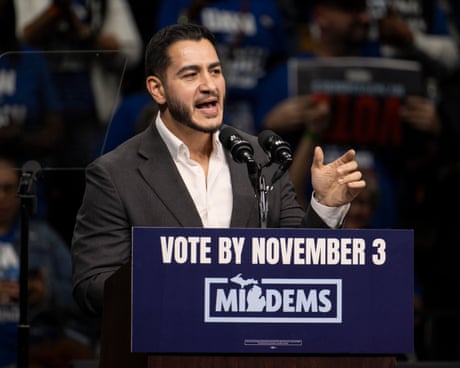
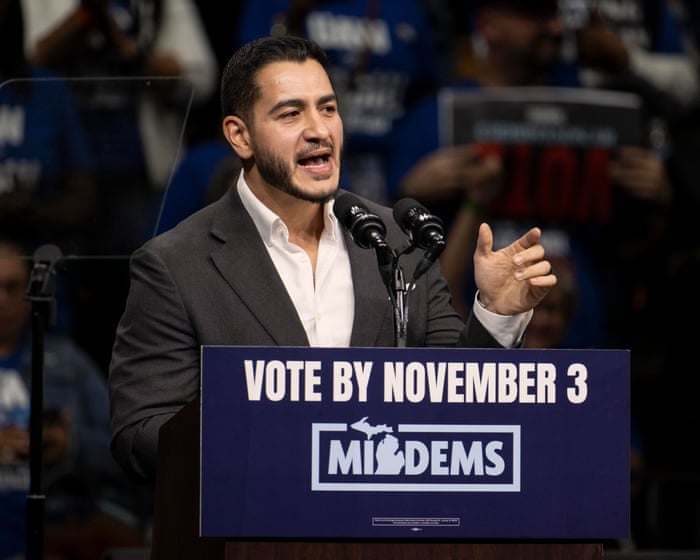
The Republican campaign to defeat Democrat Abdul El-Sayed in the Michigan Senate race by casting him as an Islamic extremist is based on a false claim first made by the conspiracy theorist Laura Loomer eight years ago, a Guardian review of the evidence reveals.

Loomer, an influential outside adviser to Donald Trump who calls herself “a proud Islamophobe”, has claimed since El-Sayed entered politics in 2018 that an open letter he signed in support of democracy in Egypt in 2012 was a public endorsement of the Muslim Brotherhood. The text of the letter, however, does not even mention the Muslim Brotherhood, and is not, as Loomer maintains, “a pledge” of support for the Egyptian Islamist group.

Continue reading...

© Photograph: Brian Cahn/ZUMA Press Wire/Shutterstock

© Photograph: Brian Cahn/ZUMA Press Wire/Shutterstock

© Photograph: Brian Cahn/ZUMA Press Wire/Shutterstock

  •  

Abdul El-Sayed Backtracks from Seven-Point Win Prediction

Michigan Muslim Socialist Abdulrahman Mohamed El-Sayed is backtracking from his prediction he would defeat Republican Mike Rogers by seven points, telling Politico, "We'll see" when asked if he stood by the claim.

The post Abdul El-Sayed Backtracks from Seven-Point Win Prediction appeared first on Breitbart.

  •  

French unrest brings EU vote on Muslim Brotherhood networks into sharper focus


France’s unrest has brought a European debate over political Islam into sharper focus. As the French authorities investigate arson, looting and attacks on public buildings, attention has also turned to organisations supporting the demonstrations and their alleged connections to the Muslim Brotherhood.

Those concerns intersect with a European Parliament resolution adopted on October 8th calling for a coordinated response to what MEPs describe as “Islamist entryism”. The connection concerns overlapping organisations and questions of influence, not an established explanation for the violence.

The chronology matters. Parliament adopted its resolution nine days before the October 17th violence described in France. The vote was therefore not a response to those events. It reflected an existing concern among a parliamentary majority that Islamist networks could use associations, educational initiatives and institutional partnerships to build political influence within Europe.

Tabled by the European People’s Party, the resolution passed by 381 votes to 167, with 15 abstentions. It calls for closer scrutiny of EU funding, stronger checks on institutional partnerships and an assessment of whether individuals or entities linked to the Muslim Brotherhood meet the legal criteria for inclusion on the EU terrorist list.

FEMYSO connects the two debates

The clearest organisational overlap is the Forum of European Muslim Youth and Student Organisations, or FEMYSO. On October 9th, the organisation publicly supported students demonstrating in France and Belgium, calling for better educational conditions, adequate funding and protection of peaceful assembly. Its statement framed the mobilisation as a campaign over education and fundamental rights.

FEMYSO also features explicitly in Parliament’s resolution. MEPs criticised its invitation to the European Parliament on September 21st by members of The Left and the Greens. They called for organisations they associate with the Council of European Muslims, including FEMYSO, to be denied access to EU institutions, removed from the EU Transparency Register and excluded from institutional events where participation could legitimise alleged Brotherhood-linked influence strategies. These are Parliament’s assessments and demands, rather than judicial findings.

In France, the Washington Examiner has reported that Étudiants Musulmans de France, or EMF, repeatedly promoted the demonstrations through social media. The newspaper describes EMF as a FEMYSO member and reports allegations of Muslim Brotherhood connections, which EMF denies. Its reporting places the organisation within the debate over mobilisation and ideological influence.

What Parliament wants Brussels to examine

The resolution’s significance lies partly in its focus on networks rather than formal membership alone. Parliament argues that political influence can operate through recurring partnerships, opaque financing, associated organisations and structures reconstituted under new names. It wants a common European methodology for identifying such patterns, rather than relying solely on whether an organisation formally declares an affiliation.

For the European Commission, the principal requests concern money and transparency. MEPs want an overview of EU funds awarded to people or entities suspected of Brotherhood or political-Islam links, alongside greater traceability through funding chains and stronger checks on partners and beneficiaries. Parliament also calls for scrutiny of foreign funding and transnational partnerships, particularly those involving actors linked to Qatar or Türkiye.

Those requests must be distinguished from decisions already taken. The non-binding resolution does not itself ban the Muslim Brotherhood, designate FEMYSO as a terrorist organisation or automatically withdraw funding. It asks the Council to assess possible terrorist listings under the applicable legal criteria and urges the Commission to use existing financial safeguards. Further action would require separate institutional decisions.

France’s policing failures remain a separate issue

The European debate does not remove the French government’s responsibility to explain its handling of the unrest. Reuters reports that Prime Minister Sébastien Lecornu acknowledged intelligence and deployment failures, while Interior Minister Laurent Nunez also accepted a share of responsibility. Authorities have assigned 200 investigators to identify those involved in the violence, and parliament is establishing an inquiry into the disorder.

Nor does scrutiny of ideological networks resolve the grievances behind peaceful mobilisation. Student demands over educational conditions and public funding remain substantive political questions. Treating all demonstrators as participants in an Islamist project would obscure the diversity of the movement and make it harder to distinguish legitimate advocacy from attempts at political exploitation.

Parliament’s own resolution draws an important boundary: it states that Islam must not be equated with political Islamism and that protecting Muslim citizens from discrimination is a democratic obligation. That distinction should guide any investigation of organisations, funding or institutional access. Scrutiny must concern identifiable conduct and demonstrable relationships, not religious identity.

A test of evidence and institutional judgment

France’s unrest and Parliament’s vote meet at a question of accountability: how should democratic institutions examine organisations seeking influence within legitimate social movements, and what evidence should justify restrictions on funding or access?

The answer cannot rest on association alone. Investigators must establish who committed or directed violence; EU institutions must examine funding and partnerships against clear legal standards; and governments must address the public-service grievances that brought peaceful demonstrators onto the streets.

The October 8th vote gives political weight to closer European scrutiny of alleged Brotherhood-linked networks. France’s unrest makes careful scrutiny more urgent—but also makes precision more important. A credible response must distinguish political advocacy from covert influence, and both from criminal responsibility.

Main Image: Genevieve ENGEL © European Union 2018 – Source : EP

  •  

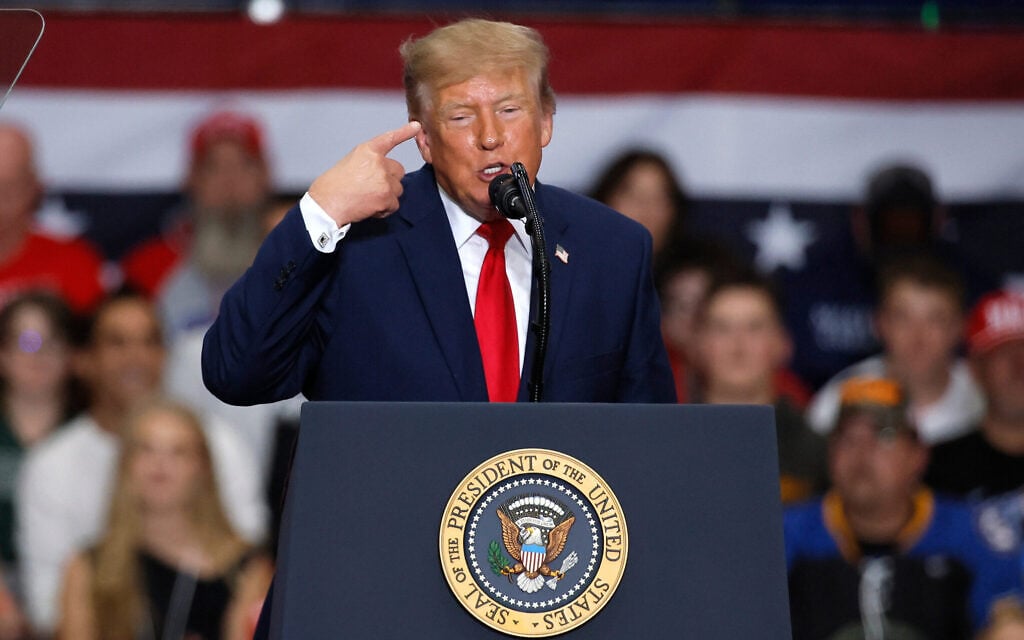
Trump says Jews who vote for Michigan’s El-Sayed should be ‘ashamed of themselves’

US president likens Democratic Senate nominee to 9/11 hijacker, says voting against him is comparable to actions of Michigan native Todd Beamer, who fought back on Flight 93
  •  

Europe’s Student Protests Spark Debate Over the Muslim Brotherhood’s Influence 


A wave of student protests has spread across several European countries in recent weeks, with France at its centre, where demonstrations over staff shortages, underfunded schools and run-down facilities have continued since mid-September.

The French protests began on September 17th, when teachers at a high school in south-eastern Paris protested over staff shortages and students joined them, Australia’s ABC News reported. Demonstrations followed in Spain, Belgium, Italy, Portugal and Albania, and smaller protests took place in Greece, Austria, Ireland and Germany, according to the same report. What began over education has since widened to include the cost of living and public-sector cuts.

In this context, the Forum of European Muslim Youth and Student Organisations (FEMYSO) has come under the spotlight following its announcement of support for student protests in France and Belgium, and subsequently in Albania.

Several European reports have drawn links between FEMYSO and the Muslim Brotherhood, describing the student forum as the organisation’s youth wing. Among the most notable is a report by a French National Assembly investigative committee, published in December 2025, which points to close ties between the forum and networks linked to the Muslim Brotherhood and characterises its role as contributing to the spread of the movement’s ideas across Europe.

In a parliamentary question submitted in 2025, Germany’s Baden-Württemberg State Office for the Protection of the Constitution was cited as viewing FEMYSO as an umbrella organisation for youth groups with links to the Muslim Brotherhood.

FEMYSO, however, rejects these allegations. In a previous statement, the organisation affirmed that it has no ties to the Muslim Brotherhood.

Statements of Support for Protests Across Europe

On October 9th, the forum announced its solidarity with student demonstrations in France and Belgium. On October 18, it declared its support for student and youth protests in Albania, while also referring to ongoing demonstrations in Spain and Greece in the same context.

On October 15th, 2026, the French Muslim Students Association (Étudiants Musulmans de France, EMF), a member organisation of FEMYSO, went beyond expressing solidarity. It called on students, education workers and the broader social movement to join a nationwide mobilisation scheduled for October 17th, reaffirming its support for demonstrations stretching from Paris to Marseille and from Bordeaux to Strasbourg.

In a statement, EMF stressed the need to build a balance of power through protests. The statement came just two days before large-scale demonstrations took place across France, attracting hundreds of thousands of participants in largely peaceful gatherings before separate groups became involved in acts of violence, looting, arson and attacks on police officers and public buildings. These incidents reportedly resulted in more than 1,000 arrests and injuries to dozens of security personnel.

Such initiatives and calls for participation in demonstrations have raised concerns that political Islamist networks may seek to capitalise on public discontent, particularly when protests are accompanied by public disorder or acts of vandalism. This, critics fear, could turn student and social demands into instruments for expanding organisational influence and securing political leverage.

According to official French data, masked and violent individuals were present at the demonstrations. In several cities, shops were looted, while cars and rubbish bins were set on fire. In the city of Limoges, flames engulfed the historic town hall, a building dating back to 1883.

The same data indicated that 1,800 people had been arrested and more than 500 police officers and firefighters had been injured. In response to the violence and rioting, the French government announced the imposition of curfews in several cities.

Concerns Reach the Heart of European Institutions

These developments come at a time when the activities of organisations suspected of having links to the Muslim Brotherhood are facing increasing political scrutiny.

On September 15th, 2026, French MP Constance Le Grip submitted a written question to the government concerning European funding for projects involving FEMYSO, calling for clarification of funding mechanisms and oversight procedures governing grants.

The question followed recent reports and studies that raised concerns over the continued involvement of FEMYSO in projects benefiting from European funding, despite an earlier announcement by the European Commission that the organisation was no longer receiving direct funding.

FEMYSO has consequently become one of the most contentious issues in the wider European debate.

A recent study published by CERIF and AK Polis in September examined the organisation’s participation in the EmpowerAction project, which forms part of the TACKLE initiative funded by the European Union through its DEAR programme.

According to the study, the funding does not necessarily take the form of a direct EU operating grant to FEMYSO. Instead, it may be channelled through partner organisations, projects and sub-granting mechanisms.

This has raised concerns that European funds could reach an organisation through a project led by another partner or through a consortium and its sub-granting arrangements.

Against the backdrop of FEMYSO’s visibility in the protests, some of which were subsequently accompanied by violence and looting, as well as allegations of links to the Muslim Brotherhood, concerns have emerged over the possibility that the organisation could gain a foothold in current social unrest and convert it into political influence by winning the sympathy of European communities and left-wing parties.

FEMYSO: Background, Membership and European Footprint 

The Forum of European Muslim Youth and Student Organisations (FEMYSO) describes itself as a European umbrella organisation bringing together Muslim youth and student associations.

FEMYSO currently comprises 32 member organisations across 22 European countries. Its roots date back to 1995, when the first meeting of Muslim youth organisations was held in Sweden.

The following year, FEMYSO was formally established at a meeting in Leicester, United Kingdom, which brought together 19 organisations from 11 countries. In 2000, the forum established its headquarters in Brussels.

  •  
❌