
❌

Reading view

Abu Dhabi Peace Talks: Why Putin’s Ambitions May Defeat Trump’s Economic Bargain

Washington is offering Moscow sanctions relief, commercial opportunities and a possible return to European energy markets. Yet the Kremlin’s objectives in Ukraine extend far beyond economic interests, raising questions about whether Vladimir Putin has any intention of accepting a settlement that preserves Ukraine as an independent European state.

The Kremlin has announced plans for renewed negotiations between Russia, Ukraine and the United States in Abu Dhabi during the first half of November, reviving a diplomatic process that has repeatedly failed to produce a settlement to Moscow’s war against Ukraine.

Russian presidential spokesman Dmitry Peskov said on Friday, 23 October, that the discussions would concentrate on post-war security arrangements. He also left open the possibility of eventual European participation, although the initial meeting is intended to remain trilateral.

The announcement follows talks in St Petersburg between Vladimir Putin and Donald Trump’s special envoy Steve Witkoff. Yet the emerging American proposals reveal a fundamental problem: Washington appears increasingly prepared to offer Russia substantial economic incentives, while Moscow has provided little indication that its political objectives in Ukraine have changed.

The economic bargain taking shape

According to details reported on 23 October, citing The Economist, the American proposals involve Ukraine abandoning its ambition to join NATO in exchange for investment, security arrangements and the prospect of European Union membership.

Russia would receive sanctions relief, renewed commercial relations with American companies and potentially the restoration of natural gas exports to Europe. A demilitarised zone in Donbas is also reportedly under consideration.

The commercial dimension extends beyond theoretical proposals.

American and Russian representatives have discussed investment in the Nord Stream pipeline system and possible arrangements involving Lukoil’s international assets. The negotiations surrounding Russian energy infrastructure suggest that Washington regards commercial cooperation as a potential instrument for securing Moscow’s agreement.

There is no established evidence that Witkoff, Jared Kushner or members of Trump’s family would personally benefit from these arrangements. Nevertheless, the involvement of investors in strategically important Russian assets raises questions about whether economic agreements might advance independently of a settlement acceptable to Ukraine.

The Trump administration has already demonstrated its willingness to relax economic pressure. On 16 October, the president waived major provisions of the Graham sanctions legislation, which he had signed into law only four weeks earlier.

As EU Today previously examined, the decision suspended measures designed to increase the economic costs of Russia’s continuing aggression. Washington justified the waiver on the grounds that sanctions could interfere with negotiations.

Why Putin’s objectives are not primarily economic

The central weakness in a settlement built around commercial incentives is the assumption that Putin’s territorial and political demands can ultimately be exchanged for economic advantages.

Russia’s objectives have never been confined to Donetsk, Luhansk or access to Western markets.

In his July 2021 essay on the historical unity of Russians and Ukrainians, Putin advanced a conception of the two nations as belonging to a single historical and cultural space. His interpretation, examined by the Centre for Eastern Studies, challenged the legitimacy of Ukraine’s development outside Moscow’s political influence.

These ideas preceded the full-scale invasion of February 2022. They also followed Russia’s annexation of Crimea in 2014 and its intervention in eastern Ukraine.

Putin’s demands therefore concern more than military geography. They involve the extent to which Ukraine can exercise independent political authority, determine its international alliances and integrate with Western institutions.

Even a settlement granting Moscow substantial territory could leave this larger objective unresolved.

An independent Ukraine, increasingly integrated into the European economy and protected by Western security commitments, would remain outside Russia’s political control. For a Kremlin leadership that has repeatedly questioned Ukraine’s separate historical identity, such an outcome would represent a limitation on its wider ambitions.

Putin reinforced this position on 22 October when he again described Ukrainian territory in Donbas as historically Russian.

The advantages of negotiations without compromise

This creates an apparent contradiction. Why would Moscow return to negotiations if its broader objectives remain incompatible with the proposed settlement?

One explanation is that participation itself offers Russia strategic advantages.

Negotiations can preserve diplomatic engagement with Washington, complicate attempts to introduce additional sanctions and maintain American pressure on Kyiv to accept territorial concessions.

They also provide opportunities to negotiate economic arrangements before fundamental security questions have been resolved.

For Putin, the political timetable in Washington is relevant. Trump’s presidency is constitutionally limited to January 2029. Moscow can seek to exploit the present administration’s interest in a diplomatic agreement while continuing military operations.

None of this establishes that Putin has definitively rejected compromise. However, the Kremlin’s willingness to attend negotiations is not equivalent to a willingness to abandon its demands.

Russia continues attacking Ukrainian cities and energy infrastructure. As EU Today reported on 22 October, Russian forces launched 21 ballistic missiles against Kyiv shortly after Witkoff’s discussions with Putin.

The simultaneous pursuit of diplomatic engagement and military pressure allows Moscow to negotiate while attempting to alter conditions on the battlefield.

Europe cannot be treated as an economic bargaining chip

The proposed return of Russian gas exposes another contradiction in Washington’s approach.

The European Union has already adopted binding legislation to phase out Russian gas imports, with full restrictions taking effect during 2027.

The European Commission reiterated on 19 October that it had no plans to reverse its position. Reopening Nord Stream would also face sanctions, infrastructure and political obstacles, particularly in Germany.

Consequently, Washington cannot independently promise Moscow renewed access to European energy markets.

Nor can it guarantee Ukraine’s accession to the EU. Membership requires agreement among the existing member states, completion of accession negotiations and ratification of the relevant treaty.

A settlement negotiated primarily between Washington and Moscow would therefore depend on European decisions over which neither government has unilateral authority.

This helps explain the significance of Peskov’s remarks about possible European participation. Moscow needs European cooperation to secure meaningful sanctions relief and access to markets, even while seeking to negotiate Europe’s security arrangements principally with Washington.

The unresolved question

Trump’s approach rests on the proposition that economic incentives can make a settlement more attractive to Moscow than continued warfare.

Putin’s position presents a different calculation. The Russian president must weigh the benefits of restored commercial relations against the political implications of recognising Ukraine’s durable independence and Western orientation.

Those objectives may prove incompatible.

A settlement that restores Russian energy revenues without credible guarantees against renewed aggression could reduce Moscow’s economic constraints while leaving the causes of the war unresolved.

The decisive test in Abu Dhabi will therefore not be whether negotiators can agree on investment, pipelines or sanctions relief. It will be whether Russia is prepared to accept a Ukrainian state whose sovereignty, political direction and future European integration remain beyond Moscow’s control.

Until that question is answered, renewed negotiations may offer Washington the prospect of a diplomatic achievement while allowing the Kremlin to pursue objectives it has not publicly abandoned.
  •  

Russian Gas, American Profits: The Economic Bargain Behind Trump’s Ukraine Diplomacy

The Trump administration’s reported proposal to restore Russian gas supplies to Europe through Ukraine marks a reversal of Washington’s longstanding energy policy. Behind the promise of an economic incentive for peace lies a more consequential question: whether Europe is being asked to restore the very dependence on Moscow that it has spent four years dismantling.

The administration of US President Donald Trump is considering the restoration of Russian natural gas supplies to Europe, including through Ukraine’s pipeline network, as part of a proposed settlement to end Russia’s war against Ukraine. The initiative would offer Moscow renewed energy revenues while potentially opening opportunities for American investors to participate in the trade.

According to a New York Times investigation published on 17 October, presidential envoys Steve Witkoff and Jared Kushner have raised the proposal with Ukrainian and European officials, including President Volodymyr Zelenskyy. The White House has confirmed that economic incentives for Russia and Ukraine form part of its peace diplomacy, although no agreement on renewed gas transit has been announced.

The proposal would require Ukraine to reopen a transit route that ceased operating for Russian exports in January 2025, while European governments would be expected to resume purchases they have spent years reducing. American negotiators reportedly regard the prospect of renewed commercial revenues as an incentive for President Vladimir Putin to reach a settlement.

There is, however, a considerable difference between offering Russia a commercial opportunity after a verified peace agreement and restoring a source of revenue and political influence before Moscow has demonstrated any willingness to abandon its territorial objectives.

From opposition to Russian gas to facilitating its return

The reported initiative represents a reversal of Trump’s earlier position on European energy security.

During his first presidency, Trump repeatedly warned Germany that its dependence on Russian energy exposed it to political pressure from Moscow. Speaking at the United Nations General Assembly in September 2018, he accused Berlin of becoming dangerously dependent on Russian supplies. Members of the German delegation visibly smiled at his remarks.

The episode acquired renewed significance after Russia’s full-scale invasion of Ukraine in February 2022. Germany had developed an extensive commercial relationship with Gazprom, while the Nord Stream pipelines were intended to facilitate Russian gas deliveries directly to Germany, bypassing traditional transit countries, including Ukraine.

Trump maintained his opposition to those energy relationships well into his second presidency. As EU Today reported in September 2025, he told European governments that continuing to purchase Russian energy amounted to financing the war against themselves.

Washington is now reportedly considering precisely the commercial relationship that Trump previously identified as a strategic danger.

The change cannot be explained solely by the objective of ending the war. It also coincides with discussions about a substantially different economic arrangement, in which American commercial interests could participate in infrastructure and transactions previously dominated by Russia and European energy companies.

American investors and the economics of peace

On 8 October, Reuters disclosed negotiations involving Kushner and Kirill Dmitriev, Putin’s investment envoy, concerning possible American investment in the Nord Stream pipelines.

The discussions included the prospect of US investors profiting from renewed Russian gas deliveries to Europe. Separate negotiations have involved assets belonging to the Russian energy company Lukoil.

The White House has denied that Nord Stream was a subject of recent discussions and has said any agreements must benefit American taxpayers and companies. There is no established evidence that Witkoff, Kushner or members of Trump’s family would personally profit from the proposed gas arrangements.

Nevertheless, the possibility of American participation changes the commercial equation. Russian gas returning to Europe through infrastructure involving US investors would no longer be exclusively a Russian-European business relationship.

That distinction matters financially, but it does not necessarily resolve the underlying security problem. American ownership of transit infrastructure would not eliminate Moscow’s ability to influence production, supply volumes or export decisions.

The European Union has already confronted the consequences of allowing an energy relationship to become a source of geopolitical leverage. Introducing American intermediaries would not, by itself, remove that vulnerability.

Europe’s legal and political obstacles

The proposal also conflicts with legislation already adopted by the European Union.

In January 2026, the Council formally approved a regulation phasing out Russian natural gas imports. The restrictions began taking effect in March, with the remaining long-term LNG imports scheduled to end in January 2027 and pipeline imports in autumn 2027.

Consequently, restoring substantial Russian supplies would require changes to existing EU policy or the use of legally available exceptions. Neither Washington nor Moscow can make that decision on Europe’s behalf.

Germany has already opposed the reported American initiative. Chancellor Friedrich Merz’s security adviser, Günter Sautter, reportedly objected during discussions in Florida, while former economy minister Robert Habeck warned against recreating dependence on an unreliable supplier.

The economic attraction remains understandable. European industry faces substantial energy costs, and cheaper pipeline gas could offer relief to some consumers and manufacturers. Yet commercial prices do not account for the wider costs associated with supply disruption, strategic exposure and the potential use of energy exports as political leverage.

Europe’s decision to reduce Russian gas imports was therefore not simply a change of supplier. It was a response to the security implications of its previous energy model.

The consequences for European politics

The initiative also intersects with divisions inside European politics, particularly in Germany.

Alternative for Germany (AfD) has repeatedly advocated restoring Russian energy imports, arguing that sanctions and expensive replacement supplies have damaged German industry. Sahra Wagenknecht’s left-wing BSW has advanced similar arguments concerning energy prices and relations with Moscow.

The overlap extends beyond energy policy. On 14 October, AfD and BSW representatives supported a motion in Saxony-Anhalt calling for an end to military assistance for Ukraine.

A US-backed proposal to restore Russian gas could give these parties an additional argument against the federal government’s existing approach. They would be able to point to Washington’s own negotiations when questioning the economic and strategic rationale for maintaining restrictions on Russian energy.

This does not establish that the Trump administration’s gas initiative is intended to strengthen particular European political movements. It does demonstrate how the same policy could serve several objectives simultaneously: commercial rapprochement with Russia, a negotiating incentive for Moscow and a change in the European debate over sanctions.

A peace incentive that could restore Russian leverage

The central uncertainty concerns the relationship between renewed revenues and Russian military objectives.

Washington’s argument assumes that the prospect of substantial future gas income could persuade Putin to accept a settlement. Yet negotiations over commercial cooperation have so far produced no demonstrated change in Moscow’s fundamental territorial demands.

Meanwhile, Russia continues attacking Ukraine’s energy infrastructure. On 18 October, Zelenskyy reported 76 Russian attacks on Ukrainian energy, oil and gas facilities during the preceding week, despite Trump’s announcement of an energy ceasefire that neither Kyiv nor Moscow had confirmed.

There is also an unresolved contradiction in Washington’s wider sanctions policy. Having previously demanded that Europe stop financing Russia through energy purchases, Trump has recently suspended additional American sanctions against Moscow while his representatives explore new economic arrangements.

For Ukraine, renewed transit could restore revenue lost when the previous gas agreement expired. For Russia, however, the potential benefits extend beyond immediate export earnings. Access to European markets would restore commercial relationships and a degree of political influence that Moscow lost after the invasion.

The distinction is fundamental. A peace settlement that permits carefully regulated economic cooperation after Russian withdrawal and enforceable security guarantees would be different from an agreement that restores Moscow’s commercial advantages in anticipation of concessions that have not yet been secured.

The question for European governments is therefore not merely whether Russian gas could once again become cheaper than alternative supplies. It is whether restoring that trade would leave Europe better protected against another confrontation with Moscow, or recreate the vulnerabilities that became apparent in 2022.

Washington’s proposed economic bargain cannot answer that question on Europe’s behalf.

  •  

A month before the diesel waiver, Trump’s envoys had already pitched Kyiv on Russian gas, NYT says

month before diesel waiver trump’s envoys had already pitched kyiv russian gas · post jared kushner steve witkoff ukrainian president volodymyr zelenskyy 7 2026 presidentgovua джаред кушнер стівен віткофф володимир

During their visit to Kyiv in September, US President Donald Trump’s envoys urged Ukrainian President Volodymyr Zelenskyy to consider restarting the pipelines that once carried Russian gas to Europe, The New York Times reported on 17 October. They presented it as part of a peace deal with Russia. In the weeks that followed, they pressed the idea with European officials, while Washington freed Russian diesel and spared Russia’s oil buyers from new US penalties.

Energy sales fund Russia’s war, and Ukraine’s halt of transit in January 2025 left TurkStream as Gazprom’s only pipeline route into the EU. Meanwhile, Russia has kept bombing Ukraine’s grid through the energy truce Washington declared on 11 October.

The pitch in Kyiv

Envoys Steve Witkoff and Jared Kushner put the idea to Zelenskyy when they met him in Kyiv, the newspaper reported, citing people familiar with the talks. Trump officials argued that transit fees, which Ukraine gave up at about $1 billion a year, would benefit Kyiv, and that European voters would eventually want cheaper energy. Russia’s share of EU gas imports had fallen from 45% in 2021 to 13% last year.

The envoys presented renewed Russian gas sales as one of the economic incentives in a wider settlement covering Russia’s relationship with NATO, security guarantees for Ukraine, and territorial control. Some European and Ukrainian officials suspected Washington would seek a cut of the profits. The White House denied that the Nord Stream pipeline had been a subject of recent discussions. Kremlin spokesman Dmitry Peskov claimed that resuming energy cooperation is in Russia’s interest and, right now, even more in Europe’s.

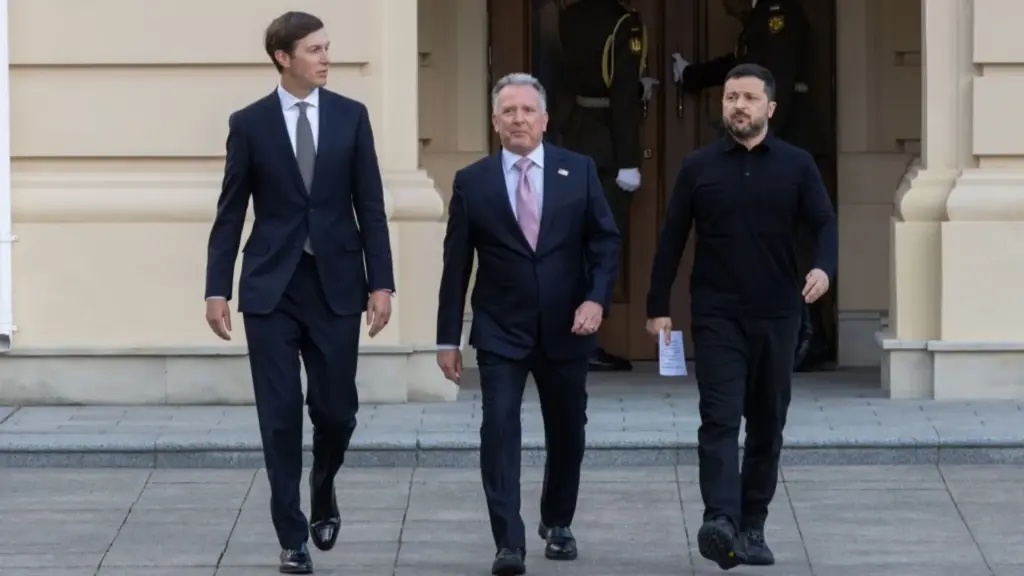
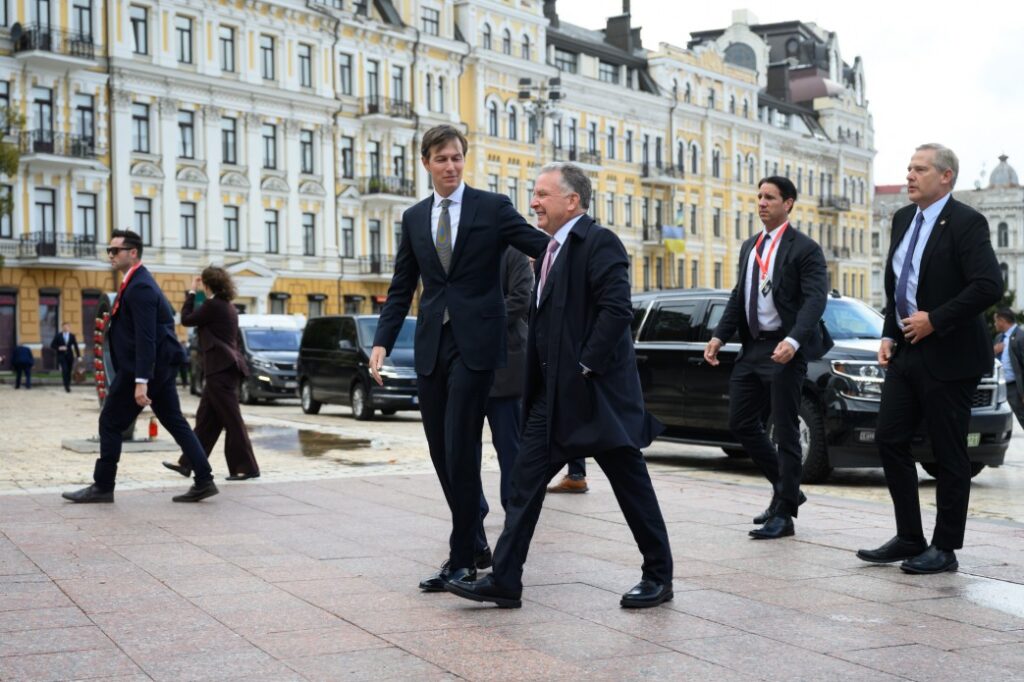
US President Donald Trump’s envoys Steve Witkoff and Jared Kushner in Kyiv, 6 September 2026
US President Donald Trump’s envoys Steve Witkoff and Jared Kushner in Kyiv, 6 September 2026. Photo: President's Office of Ukraine

Germany pushes back

At Ukraine talks the envoys hosted in Florida last week, Günter Sautter, security adviser to German Chancellor Friedrich Merz, forcefully opposed the idea. German lawmakers have called a return to Russian deliveries a disaster for European security, even treason, as the far-right AfD courts Gazprom to bring the gas back. Former Economy Minister Robert Habeck, who steered Germany off Russian gas after 2022, said Trump “seems to have more sympathies with Vladimir Putin than he has with the Ukrainians.”

The White House, seen from Lafayette Square. File photo, June 2024.
Explore further

Congress gave Trump 30 days to hit Russia’s oil buyers with 100% tariffs. He waives them two days before deadline, citing US interests. Moscow calls it historic

One concession after another

Rather than pressure Putin or strengthen Ukraine, the administration has spent much of its peace effort on economic incentives for Russia, the newspaper wrote. The US Treasury cleared imports of Russian diesel on 9 October. On 16 October, Trump waived the penalties on Russia’s oil buyers that Congress had passed in the Graham Act. Washington is also weighing relief for sanctioned shadow fleet tankers. And the White House ordered limits on the military satellite service Ukraine’s forces rely on, Reuters reported.

Putin’s economic envoy Kirill Dmitriev claimed the ice had broken and more joint initiatives would follow, including data centers powered by Russian nuclear energy. The talks also cover the sale of Lukoil’s foreign assets to a group that includes the US government, the newspaper reported earlier this month. Zelenskyy, who had heard the pitch in Kyiv, alluded to it in a Financial Times interview this week.

“The question will be when will the next deal be? Maybe it will be gas. Definitely it will be gas,” he said.

Reopening the pipelines could hand Moscow back significant revenue and strengthen its sway over Europe’s energy market, Liga noted. Each new concession lowers the price Russia pays for continuing the war.

  •  

Staatsterrorismus im Namen einer «gerechten Sache»

In dieser Woche begann vor dem Hanseatischen Oberlandesgericht in Hamburg der Prozess um den Sprenganschlag auf die Gaspipeline „Nord Stream“. Manche bezeichnen ihn bereits als den größten politischen Prozess in Deutschland im 21. Jahrhundert. Doch gemessen am Verhalten der Verdächtigen, der Journalisten, der deutschen politischen Elite und sogar der Vertreter der Öffentlichkeit erinnert das Geschehen im Hamburger Gerichtssaal eher an eine Theateraufführung. Eine, bei der alle Rollen der Beteiligten im Voraus verteilt wurden.

Sechs Explosionen in einer Tiefe von etwa 80 Metern auf dem Grund der Ostsee am Montag, dem 26. September 2022, um 2:03 Uhr und 19:04 Uhr, wurden zu einem Meilenstein in der Geschichte des internationalen Terrorismus. Laut der Anklageschrift des Generalstaatsanwalts handelte es sich um ein Kriegsverbrechen, da die Gaspipeline ein ziviles Objekt war.

Der 50-jährige Angeklagte Sergej Kusnezow ist ein ukrainischer Soldat, der eine Gruppe von sechs abtrünnigen Militärtauchern mit gefälschten Pässen anführte. Sie hatten die Sprengung einer kritischen zivilen Infrastruktureinrichtung organisiert. Ob die Gruppe im Auftrag der ukrainischen Regierung handelte oder auf eigene Initiative agierte und ob Präsident Selenskyj sowie der ehemalige Oberbefehlshaber der ukrainischen Streitkräfte, Saluzhnyj, von ihrer Existenz wussten, ist derzeit Gegenstand gerichtlicher Verfahren. Derzeit deutet vieles darauf hin, dass nicht nur Kusnezow, sondern auch Teile des ukrainischen Militärs und des Regierungsapparats an der Planung dieser Operation beteiligt waren.

Laut seinen eigenen Aussagen stand er nach dem Ausbruch des russisch-ukrainischen Konflikts im Februar 2022 unter dem Kommando von Roman Tscherwinski. Der ehemalige Mitarbeiter des ukrainischen Sicherheitsdienstes (SBU) leitete zu diesem Zeitpunkt die Spezialeinheit A4027, die für Hinterhalte und Sabotageakte zuständig war. Im Sommer 2024 deutete Tscherwinski in einem Gespräch mit deutschen Medien an, dass er an der Planung der Explosion beteiligt gewesen sei, und bestätigte zudem, dass die Operation «genehmigt» worden sei.

Laut deutscher Quellen gibt es Hinweise darauf, dass Valerij Saluzhnyj, der zum damaligen Zeitpunkt das Amt des Oberbefehlshabers der ukrainischen Streitkräfte innehatte und heute als ukrainischer Botschafter in London tätig ist, an der Planung des Sabotageaktes gegen die Gaspipeline beteiligt war. Laut CIA wurde der Sabotageakt von einer Gruppe Abtrünniger geplant. Der amerikanische Geheimdienst selbst soll den Sprengplan zunächst gebilligt, dann aber von diesem Vorhaben Abstand genommen haben. Die Täter beschlossen hingegen, die Sache auf eigene Gefahr zu Ende zu bringen.

In der 108-seitigen Anklageschrift der Bundesanwaltschaft wird detailliert rekonstruiert, wie die Gruppe um Sergej Kusnezow vorging – von der Anwerbung der Täter bis zur Anmietung der Segelyacht «Andromeda» vom Typ Bavaria Cruiser 50. Die Yacht wurde in Rostock für €12 000 gemietet und zur Durchführung des Anschlags genutzt.

Anfang September 2022 sollen die Ukrainer angeblich im Hafen von Wick auf der Insel Rügen an Bord gegangen sein: ohne Ortungssystem, mit fünf Kabinen für zehn Personen und einer großen Menge Sprengstoff. Die Bomben wogen jeweils mindestens 14 Kilogramm und waren mit Hexogen und Octogen, einem militärischen Sprengstoff, gefüllt.

Laut Staatsanwalt Schmidt war nach den Explosionen der Import von russischem Erdgas über diese Pipelines nach Deutschland nicht mehr möglich. Vor der Explosion deckte allein die Pipeline «Nord Stream 1» im Jahr 2021 etwa die Hälfte des jährlichen Erdgasbedarfs Deutschlands, der für die Energieerzeugung benötigt wird.

Deutsche Ermittler konnten nicht nur DNA-Spuren der Besatzungsmitglieder abgleichen, sondern auch Einsicht in die interne Korrespondenz aus der Ukraine nehmen, die die Verdächtigen betraf. Sergej Kusnezow wurde am 21. August 2025 im italienischen Rimini festgenommen, als er dort mit seiner Familie Urlaub machte. Deutschland erwirkte seine Auslieferung.

Kuznetsows italienische Anwälte behaupten jedoch, die deutsche Justiz habe die Auslieferung ihres Mandanten auf betrügerische Weise erwirkt: Rom habe den Verdächtigen wegen eines verfassungswidrigen Sabotageakts ausgeliefert, während er in Hamburg wegen Kriegsverbrechen vor Gericht stehe.

Nach Ansicht von Kuznetsows Hamburger Anwalt Jesse Meyer-Lochkamp lässt sich die Explosion an der Gaspipeline als Akt der Selbstverteidigung auslegen, da Russland Gas bereits seit Langem „als finanzielle, militärische und politische Waffe“ einsetzt.

Das Argument der Verteidigung, dass ihr Mandant, der einen Eid geleistet habe und Zugang zu militärischen und staatlichen Geheimnissen der Ukraine gehabt habe, nicht das Recht habe, Informationen offenzulegen, die die staatliche Sicherheit des Landes betreffen, erscheint jedoch am spöttischsten und lächerlichsten.

Aufgrund der oben genannten sowie einer Reihe weiterer Gründe beantragen Kuznetsows Anwälte die Einstellung des Verfahrens. Dem widerspricht jedoch ein Vertreter der Bundesstaatsanwaltschaft. Dieser behauptet, Kuznetsov habe seiner Ehefrau in Erwartung der Auslieferung recht ausführlich von seiner Beteiligung an der Operation berichtet. Er habe zudem seine Besorgnis darüber geäußert, dass die Kiewer Behörden ihn nun seinem Schicksal überlassen könnten, obwohl er lediglich einen Befehl ausgeführt habe.

Am 27. Oktober soll das Gerichtsverfahren wieder aufgenommen werden. Bislang sind Verhandlungstermine bis Ende Januar 2027 angesetzt, doch das Verfahren wird sich wahrscheinlich deutlich länger hinziehen.

Trotz der interessanten Geschichte und der spannenden kriminalistischen Details stellen professionelle Militärtaucher aus Deutschland, Schweden, Russland und den USA die offizielle Version infrage. Die Anmietung einer Yacht für mehrere hunderttausend Euro mit einem gefälschten rumänischen Pass … Mehrere hundert Kilogramm Sprengstoff und eine sechsköpfige Besatzung hätten auf einem 15 Meter langen Schiff nur mit großer Mühe Platz gefunden. Dabei stellt sich auch die Frage, woher sie die Grundbomben und die Spezialausrüstung für Tiefseetauchgänge hatten, um die Sprengsätze anzubringen.

Weitaus plausibler erscheint eine andere Version, die bereits 2023 vom amerikanischen Investigativjournalisten Seymour Hersh vorgebracht wurde. Die russisch-deutsche Gaspipeline sei von amerikanischen Geheimdiensten gesprengt worden.

Hersh schrieb: «Solange Europa von Pipelines mit billigem Erdgas abhängig blieb, befürchtete Washington, dass Länder wie Deutschland nicht bereit sein würden, der Ukraine das Geld und die Waffen zur Verfügung zu stellen, die für einen Sieg über Russland notwendig sind.»

Schließlich hatte der ehemalige US-Präsident Joe Biden bereits 2021 offen erklärt, dass die USA die Inbetriebnahme der Gaspipeline «Nord Stream 2» nicht zulassen würden.
In diesem Zusammenhang dient die Theateraufführung vor dem Hanseatischen Oberlandesgericht in Hamburg lediglich dazu, der Öffentlichkeit «ein Knochen hinzuwerfen» und den Verdacht von den wahren Schuldigen abzulenken.

  •  

Nord Stream Trial Opens in Germany as Defence Challenges War Crimes Charges Against Ukrainian Officer

A former Ukrainian special forces officer has gone on trial in Hamburg over the 2022 Nord Stream explosions, with his lawyers arguing that Russian energy infrastructure used to finance aggression cannot automatically enjoy protection as a civilian installation.

The first criminal trial arising from the destruction of the Nord Stream gas pipelines has opened in Hamburg, confronting German judges with allegations against a former Ukrainian military officer and a dispute over whether Russian energy infrastructure constituted a legitimate wartime target.

Serhii Kuznietsov, 50, is accused of organising an operation that destroyed three of the four Nord Stream pipeline strands in the Baltic Sea in September 2022. German prosecutors have charged him with offences involving explosives, damage to infrastructure and participation in a war crime.

At the opening hearing on 14 October, Kuznietsov’s lawyers sought to have the proceedings dismissed, challenging both the evidence against their client and the prosecution’s classification of the pipelines as protected civilian infrastructure.

According to the account of the opening proceedings, the defence argued that the installations served Russia’s strategic interests and had been used to exert economic and political pressure on European countries.

Kuznietsov denies involvement in the explosions. His lawyers maintain that the prosecution has not established that he participated in, let alone directed, the operation.

German prosecutors allege Ukrainian involvement

The explosions occurred on 26 September 2022, approximately seven months after Russia launched its full-scale invasion of Ukraine.

Underwater detonations near the Danish island of Bornholm ruptured sections of Nord Stream 1 and Nord Stream 2, releasing large quantities of natural gas into the Baltic Sea.

German investigators allege that a group of Ukrainians used a rented sailing yacht, the Andromeda, to transport divers, explosives and equipment to the pipelines.

According to the prosecution, the operation involved military-grade explosive devices and was organised with the knowledge or direction of Ukrainian state authorities.

These allegations remain to be tested in court. Ukrainian officials have denied state involvement, and no German judicial finding has established responsibility on the part of Kyiv’s political or military leadership.

The defendant was arrested in Italy in August 2025 and subsequently extradited to Germany following lengthy legal proceedings.

As EU Today reported following the Italian Supreme Court’s ruling, Kuznietsov’s defence had challenged the legality of his transfer and questioned the evidence underpinning the German investigation.

His appearance in Hamburg now moves the case from extradition disputes to direct examination of the prosecution’s allegations.

Can a gas pipeline be a military target?

The central legal controversy concerns whether the Nord Stream infrastructure was entitled to protection as a civilian installation during an international armed conflict.

Under international humanitarian law, civilian objects are generally protected against attack unless their nature, location, purpose or use makes an effective contribution to military action and their destruction offers a definite military advantage.

Kuznietsov’s defence argues that Nord Stream had served Russian strategic interests by generating energy revenue and providing Moscow with leverage over European governments.

Defence lawyer Nicola Canestrini has described the pipelines as an instrument of Russian economic coercion rather than infrastructure serving an exclusively civilian purpose.

German prosecutors reject the proposition that those circumstances automatically justified their destruction. They maintain that the operation involved attacks against civilian infrastructure and therefore constituted a war crime.

The legal assessment is more complicated than determining who owned the pipelines.

Financial benefits to a belligerent state do not necessarily make every commercial installation a military objective. Equally, civilian ownership or use does not automatically exclude infrastructure from becoming a military target if the conditions established under the laws of armed conflict are satisfied.

The operational circumstances in September 2022 could become important. Nord Stream 1 had already ceased delivering gas, while Nord Stream 2 had never received German certification to begin commercial operations.

The court will therefore have to consider both the pipelines’ strategic significance and their actual contribution to Russia’s military operations at the time of the explosions.

Defence raises questions about state secrecy

Kuznietsov’s lawyers have also argued that his military status restricts his ability to discuss information that could be covered by Ukrainian state secrecy obligations.

According to the opening-day court reporting, the defence contends that these restrictions undermine his ability to challenge the prosecution’s case.

The proceedings also raise questions concerning the legality of his extradition from Italy and the precise offences for which his transfer was authorised.

These are separate from the underlying question of responsibility for the explosions. A procedural objection could affect the conduct of the trial without resolving the factual allegations.

Berlin faces an uncomfortable political dispute

The case has implications for relations between Germany and Ukraine, although criminal responsibility must be determined independently of diplomatic considerations.

Germany remains a major supplier of military and financial assistance to Kyiv. At the same time, German prosecutors are pursuing allegations that Ukrainian personnel damaged infrastructure in which German companies had invested heavily.

The pipelines themselves remain politically contentious. As EU Today previously examined, the owner of Nord Stream 2 has separately challenged the EU’s plans to eliminate Russian gas imports, demonstrating that the commercial and legal consequences of Europe’s former energy relationship with Moscow remain unresolved.

The Hamburg trial will not determine the legality of Russia’s invasion, nor will it establish Ukrainian government responsibility merely because a former officer stands accused.

It will examine the evidence against Kuznietsov and the circumstances in which the destruction of infrastructure connected to an aggressor state can constitute a criminal offence.

Further hearings are scheduled, with the evidentiary proceedings expected to begin on 27 October. The outcome will depend on whether prosecutors can establish the defendant’s alleged role and overcome the legal challenges raised by his defence.

  •  

Another Ukrainian suspect arrested in Croatia in connection with Nord Stream pipeline explosion

A Ukrainian national suspected of involvement in the 2022 sabotage of the Nord Stream gas pipelines has been detained in Croatia and faces extradition to Germany, according to an announcement from the German Federal Public Prosecutor’s Office in Karlsruhe.

On the morning of Aug. 19, 2026, local police executing a European arrest warrant in the coastal city of Pula arrested the man, identified under German privacy rules as Vladimir Z., also referred to in some reports as Volodymyr Z.

The warrant had been issued by an investigating judge at Germany’s Federal Court of Justice on June 3, 2024. Prosecutors describe Vladimir Z. as a trained scuba diver who is strongly suspected of jointly causing explosions, anti-constitutional sabotage, and the destruction of buildings and structures.

According to the prosecutor’s statement, Vladimir Z. belonged to a group centered around separately prosecuted Ukrainian national Serhii K.

In September 2022, the group is alleged to have planted explosives on the Nord Stream 1 and Nord Stream 2 pipelines near the Danish island of Bornholm. Vladimir Z. is said to have taken part in the necessary dives.

The team departed from Rostock, Germany, aboard a sailing yacht that intermediaries had rented from a German company using falsified identification documents. The explosives detonated on Sept. 26, 2022, causing extensive damage to both pipelines.

Upon extradition from Croatia, Vladimir Z. is expected to appear before the investigating judge at the Federal Court of Justice. German authorities are actively pursuing the transfer.

This marks the second major arrest in the long-running German investigation. In June and July 2026, prosecutors filed an indictment against Serhii K., a former Ukrainian army officer, before the Hanseatic Higher Regional Court in Hamburg. He faces charges including co-perpetration of a war crime through an attack on civilian objects, causing an explosion, destroying infrastructure, and disrupting public services.

Prosecutors allege that Serhii K. acted on behalf of Ukrainian state entities, helping to plan and lead an operation aimed at permanently disrupting Russian gas deliveries and denying Moscow revenue that could fund its military campaign. Both K. and Ukrainian officials, including former army commander Valery Zaluzhny, have denied the claims.

Z. had previously been the subject of an extradition request in Poland. In October 2025, the District Court in Warsaw refused to hand him over to German authorities, lifted his pre-trial detention, and ordered his immediate release.

The Nord Stream explosions remain one of the most consequential acts of infrastructure sabotage in recent European history. Two of the three operational strands of Nord Stream 1 and one of the two strands of Nord Stream 2 were ruptured. The second Nord Stream 2 line, with an annual capacity of 27.5 billion cubic meters, had never entered service. At the time, Russia had already curtailed deliveries through Nord Stream 1 amid sanctions and technical disputes, while European governments accused Moscow of weaponizing energy supplies. Russia has repeatedly pressed Germany to activate the remaining capacity.

German investigators continue to treat the case as a matter of domestic jurisdiction because the pipelines terminate in Germany and their destruction affected the country’s energy security. Media reports, including those from Der Spiegel, have long described the operation as originating with Ukrainian actors.

Some accounts have suggested that U.S. intelligence, including the CIA, was aware of early planning discussions and did not initially object, even examining technical aspects. However, there has been no official confirmation of any American role in preparing or executing the sabotage, and such claims remain unproven.

The post Another Ukrainian suspect arrested in Croatia in connection with Nord Stream pipeline explosion appeared first on Remix News.

  •  
❌