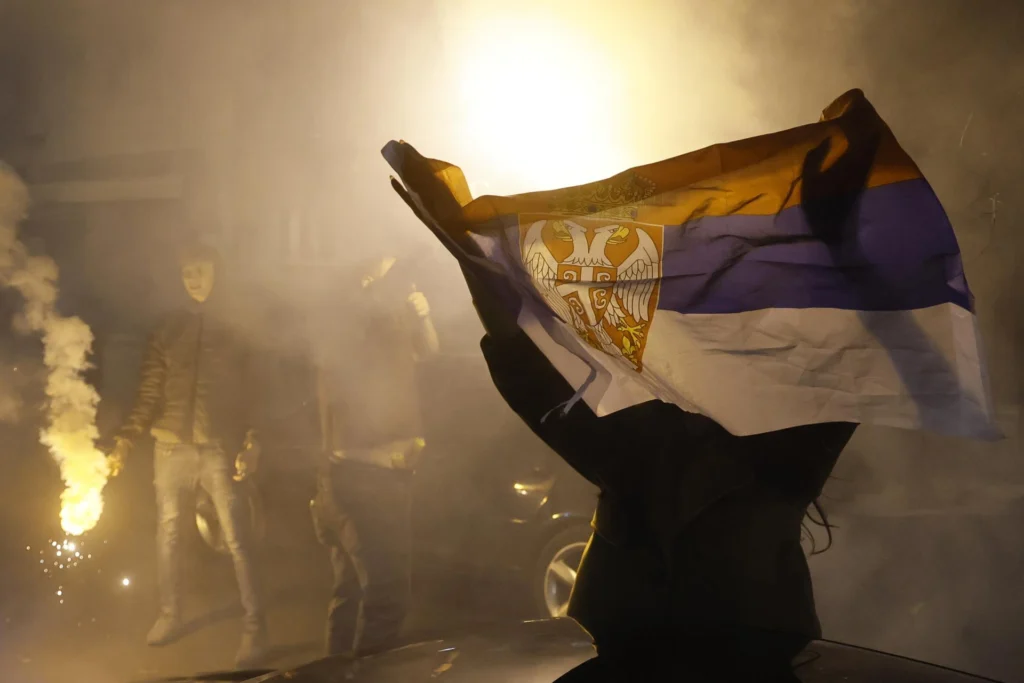
Serbia has achieved something that appeared improbable only months ago. Aleksandar Vučić, who dominated the country’s political institutions for more than a decade, has acknowledged electoral defeat. A movement born from student demonstrations against corruption is now preparing to take power. Yet the most consequential struggle may only be beginning.
The parliamentary election of 25 October represents more than the rejection of an increasingly centralised political leadership. It raises a fundamental question about the Serbian state: whether the institutions shaped by Vučić’s Serbian Progressive Party (SNS) can function independently of the political organisation that controlled them.
According to preliminary figures released by Serbia’s Republic Electoral Commission, the Student List secured 52.54 per cent of the vote against 39.29 per cent for Vučić’s United Serbia coalition, with 8,077 of 8,392 polling stations counted. Projections give the students approximately 140 seats in the 250-member National Assembly, enough to govern without coalition partners.
Vučić had resigned from the presidency in September, hoping to return to power as prime minister. Instead, the election deprived him of the parliamentary majority necessary to complete that manoeuvre. His concession has substantially reduced the immediate prospect of a disputed transfer of power, although the election results still require formal certification.
But losing an election and losing control of a political system are not necessarily the same thing.
The political inheritance of the 1990s
Vučić’s political career provides important context for understanding the significance of his defeat.
He entered politics through the ultranationalist Serbian Radical Party, led by Vojislav Šešelj, and served as information minister in Slobodan Milošević’s government from 1998. During that period, Serbian authorities employed restrictive media legislation against independent newspapers and broadcasters, imposing substantial financial penalties and limiting critical reporting.
After Milošević’s removal in 2000, Vučić remained politically active. His subsequent association with the Serbian Progressive Party, formed in 2008 following a split within the Radical Party, allowed him to reposition himself as a politician promising economic modernisation and European integration.
This transformation proved remarkably successful.
The SNS came to power in 2012, and Vučić subsequently served as prime minister and president. Serbia attracted foreign investment, undertook major infrastructure projects and maintained its formal ambition of joining the European Union. At the same time, political authority became increasingly concentrated around Vučić and his associates.
The distinction between Serbia under Milošević and Serbia under Vučić should not be overlooked. The former governed during the violent disintegration of Yugoslavia and pursued policies that brought international isolation. The latter operated through electoral institutions, international economic partnerships and a declared European orientation.
Nevertheless, Vučić’s political career illustrates a continuity in personnel and political methods that Serbia’s post-2000 democratic transition never entirely resolved.
The OSCE’s assessment of Serbia’s 2023 parliamentary elections documented advantages enjoyed by the governing party, political pressure on public employees, media bias and the misuse of state resources. These findings demonstrated how electoral competition could continue while the conditions under which parties competed became increasingly unequal.
The Student List has now broken that pattern at the ballot box. Whether it can prevent its reconstruction remains uncertain.
Why the students succeeded
The immediate origins of the political upheaval lie in the November 2024 collapse of a railway station canopy in Novi Sad, which killed 16 people.
The disaster became a symbol of wider concerns about public procurement, construction oversight and political accountability. Demonstrations demanding responsibility subsequently developed into a nationwide movement challenging the government’s legitimacy.
As EU Today previously examined, the protests exposed a deeper conflict between Serbian society and institutions widely perceived by demonstrators as serving political interests rather than the public.
Unlike established opposition parties, the student movement did not depend on a familiar political leader or traditional party machinery. It mobilised university communities, academics, professionals and citizens who had previously remained outside organised political activity.
Its central demand was institutional accountability rather than a comprehensive ideological programme.
That distinction was crucial. By concentrating on corruption, democratic standards and the functioning of the state, the movement attracted voters with differing views on nationalism, foreign policy and European integration.
However, the same diversity that helped it win the election could complicate governing. Its candidates must now agree on economic priorities, ministerial appointments, foreign relations and the extent of institutional reform.
A protest movement can unite around opposition to a political leader. A government must reach agreement on decisions that inevitably divide its supporters.
Russia’s influence will not disappear with Vučić
One of the most important consequences of the election concerns Serbia’s relationship with Moscow.
Throughout his presidency, Vučić cultivated the image of a leader capable of maintaining productive relations with Brussels, Moscow and Beijing simultaneously.
Serbia continued its EU accession negotiations and benefited substantially from European investment and trade. Yet Belgrade consistently refused to join the principal European sanctions against Russia following its full-scale invasion of Ukraine.
The contradiction was particularly striking because Serbia’s economic relationship with the EU vastly outweighs its trade with Russia.
The European Commission’s assessment found that the EU accounted for 58.3 per cent of Serbia’s total trade in 2024. European markets, investment and regulatory structures have therefore become fundamental to the Serbian economy.
Vučić nevertheless preserved close political links with Moscow, benefiting domestically from nationalist sentiment and Russia’s diplomatic support for Serbia’s position on Kosovo.
He also attempted to demonstrate that relations with Russia did not preclude cooperation with Ukraine.
In June 2025, Vučić travelled to Odesa for the Ukraine–Southeast Europe Summit, where he met President Volodymyr Zelenskyy and reaffirmed Serbia’s support for Ukrainian sovereignty and territorial integrity.
Serbia provided humanitarian assistance to Ukraine but declined to sign the summit’s joint declaration. Its continuing refusal to impose sanctions on Moscow remained the most substantial distinction between Serbian policy and the EU position.
Yet a Student List government would not necessarily reverse that policy.
In September, the movement explicitly declared its opposition to imposing sanctions on Russia, referring to Serbia’s historical experience with international restrictive measures.
Vučić nevertheless predicted during his concession speech that the incoming government would introduce sanctions against Moscow by March or April. He also attributed his defeat to interference by European governments and what he called the American “deep state”, supposedly opposed to President Donald Trump.
His prediction about sanctions was therefore inconsistent with the movement’s publicly stated position.
This exposes an important misconception about Serbia’s political transformation. Opposition to Vučić does not automatically translate into support for every element of EU foreign policy. Serbian public attitudes towards Russia, Kosovo and national sovereignty extend beyond the electorate traditionally associated with the SNS.
The new government may pursue closer integration with European institutions while retaining positions that Brussels considers incompatible with membership.
The economic structures behind political influence
The challenge extends beyond diplomatic relationships.
Russia’s presence in Serbia includes strategic energy interests, notably its controlling shareholding in Naftna Industrija Srbije (NIS), which operates the country’s principal oil refinery.
American sanctions against the Russian-owned company have complicated its operations, while negotiations over the proposed acquisition of the Russian stake by Hungary’s MOL Group illustrate how energy security, foreign ownership and international sanctions have become interconnected.
For an incoming administration, reducing such dependencies will require commercial negotiations, regulatory oversight and alternative energy supplies. Political declarations cannot achieve these objectives on their own.
Equally important will be the examination of public contracts and relationships between political officeholders and businesses that benefited from government decisions.
The European Commission’s 2025 Serbia report identified persistent corruption concerns, insufficient transparency in major infrastructure procurement and weaknesses in institutional accountability.
Any investigation into alleged wrongdoing under Vučić must be independent, evidence-based and subject to judicial scrutiny. Allegations of corruption do not themselves establish criminal responsibility.
A government elected to restore the rule of law would undermine its own mandate if it replaced politically selective justice with prosecutions directed by a new political majority.
The central objective must be to ensure that prosecutors, courts and oversight bodies can investigate former as well as current officials without political interference.
Brussels faces a test of its own
For the European Union, the election provides an opportunity to reconsider its approach towards Belgrade.
For years, European institutions confronted a government that professed commitment to EU membership while resisting reforms considered essential to the accession process.
In July 2026, the European Parliament adopted a resolution stressing that Serbia’s negotiations should advance only when measurable improvements are achieved in the rule of law, judicial independence, media freedom and the fight against corruption. Parliament also called for alignment with EU sanctions against Russia.
The Student List’s victory may improve the prospects for domestic institutional reform, but the disagreement over sanctions remains unresolved. Brussels cannot assume that a new Serbian government will satisfy every accession requirement simply because it defeated Vučić.
Nor should it overlook the political significance of the result.
The movement’s strongest mandate concerns the restoration of public accountability. Supporting independent institutions, transparent procurement and genuinely competitive elections would address both Serbian public demands and longstanding EU concerns.
There is also the unresolved question of Kosovo. A change of government in Belgrade does not remove the political and constitutional difficulties surrounding relations with Pristina. The new leadership will inherit negotiations that have repeatedly stalled under previous administrations.
The EU will therefore need to distinguish between areas where rapid progress is possible and disputes that require more sustained diplomacy.
The difference between victory and democratic transition
Serbia has removed one of the central figures of its post-Yugoslav political order from government. It has not yet demonstrated that the system surrounding him can be dismantled through constitutional means.
The immediate tasks are substantial: forming an effective cabinet, protecting the independence of prosecutors, scrutinising public expenditure, reforming media regulation and ensuring that state institutions no longer operate as extensions of the governing party.
A separate presidential election must also follow Vučić’s September resignation, adding another important stage to the transition.
The greatest danger is not simply that the former governing party could eventually return to office. Electoral competition must allow that possibility in any democracy.
The more consequential danger is that the political methods associated with Vučić’s administration could survive under different leadership.
Serbia’s experience after Milošević demonstrated that removing a dominant political figure does not necessarily eliminate the structures, interests and habits of government accumulated during his rule.
The student movement has now been given an opportunity to confront that unfinished transition.
Its success will ultimately be measured not by the political fate of Aleksandar Vučić, but by whether Serbia develops institutions capable of investigating misconduct, restricting the arbitrary use of power and operating independently of whichever party wins the next election.
That would represent a more fundamental transformation than the defeat of any single political leader.

 Login