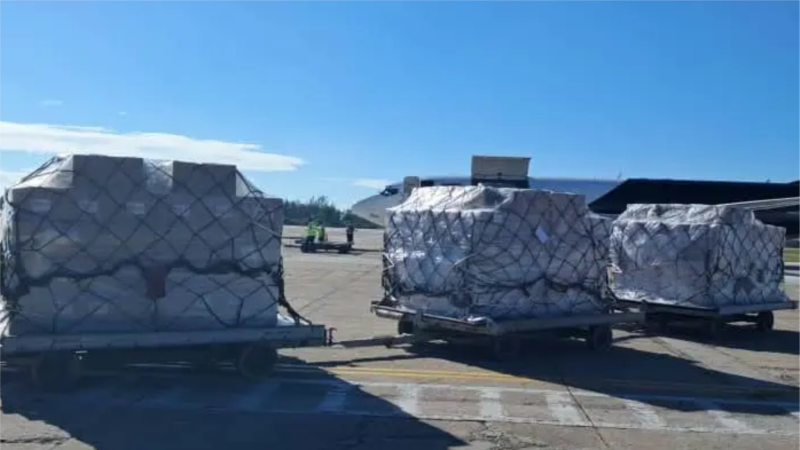
El obispo Arturo González Amador explicó que los suministros están destinados a las comunidades de la parroquia La Purísima Concepción, en Guasimal, ubicada al sur de Sancti Spíritus, cuyo cuidado pastoral está a cargo de las Religiosas de Jesús Verbo y Víctima.
Hanoi, 30 oct (Prensa Latina) La presentación de dos libros y una exposición fotográfica sirvieron hoy para rememorar la primera visita a Vietnam del líder al frente de la Revolución cubana, Raúl Castro, hace 60 años.
Montevideo, 30 oct (Prensa Latina) La votación en Naciones Unidas de rechazo al bloqueo a Cuba resulta un mensaje abrumador en defensa del derecho internacional y del multilateralismo, consideró hoy aquí la embajadora de la isla en Uruguay, Lissett Pérez.
Montevideo, 30 oct (Prensa Latina) La resolución aprobada en la Asamblea General de la ONU subraya el acompañamiento de los pueblos del mundo a la causa cubana contra el bloqueo de Estados Unidos, afirmó hoy aquí el diputado uruguayo Daniel Diverio.
O governo de Cuba avalia como real o risco de invasão da ilha pelo governo de Donald Trump, dos Estados Unidos (EUA), afirmou o embaixador do país caribenho no Brasil, Victor Manuel Cairo Palomo. Em entrevista à Agência Brasil, o representante de Havana destacou que o país está preparado para uma agressão militar.
“O povo cubano se prepara hoje para uma invasão real dos EUA. O governo e o povo cubanos não podem ignorar as pretensões dos EUA de uma invasão a Cuba. Isso é real”, afirmou o diplomata.
O embaixador acrescentou que Cuba tem feito um chamado à comunidade e a imprensa internacionais para que não aceitem uma invasão da ilha pelos estadunidenses. “Não é possível normalizar uma agressão militar contra Cuba.”
O diplomata sediado no Brasil acrescentou que “a maioria do povo cubano” defende a soberania do país e lutará contra uma invasão militar estrangeira.
“Cuba tem história, tem tradição de luta. Cuba tem tradição de preparação da população para essa luta, que é uma questão que não pode ser ignorada pelos EUA”, explicou.
Desde janeiro de 2025, com a volta de Donald Trump à Casa Branca, Washington tem aumentado a pressão contra Havana com uma série de novas sanções, entre elas, o bloqueio energético com ameaças a países que vendam petróleo à ilha, o que deixou Cuba três meses sem receber nenhum barril de petróleo.
Em março deste ano, Trump chegou a dizer que teria a “honra de tomar Cuba”. Meses depois, em outubro, o presidente disse que iriam “cuidar de Cuba” depois de lidarem com o Irã, que foi atacado pelos EUA e por Israel em uma guerra que se arrasta desde fevereiro.
Em outra declaração, Trump defendeu que seria possível chegar “a um acordo” com Cuba. “Não acho que precisaremos das forças armadas”, disse.
As medidas de asfixia econômica contra Cuba vêm escalando mês a mês, levando à redução dos voos interacionais à Cuba, saída de empresas hoteleiras estrangeiras e mesmo da empresa de cartões Visa, afetando o setor do turismo, o principal do país.
Ameaça extraordinária
Em janeiro deste ano, a Casa Branca classificou Cuba de uma “ameaça incomum e extraordinária” contra os EUA, acusando o país de abrigar adversários dos estadunidenses, “focado em roubar informações sensíveis de segurança nacional dos Estados Unidos”.
Ao mesmo tempo, o secretário do Departamento de Estado Marco Rubio, filho de família cubana, tem elevado o tom contra o governo do presidente Miguel Díaz-Canel.
“Faremos o possível para tomar medidas que iniciem esse processo de mudança [em Cuba]. E será um processo que não será fácil”, afirmou em coletiva de imprensa, em setembro deste ano.
O embaixador de Cuba no Brasil, Victor Manuel Cairo Palomo, em entrevista à Agência Brasil - Foto: Fabio Rodrigues-Pozzebom/ Agência Brasil
O representante de Cuba no Brasil, Victor Manuel Cairo Palomo, classifica as acusações dos EUA de “ridículas”.
“Cuba não é uma ameaça para os EUA. Um país bloqueado, pequeno e economicamente asfixiado não tem a capacidade de pôr em risco a primeira potência do mundo. Essa acusação é ridícula”, completou.
Ainda segundo o representante de Havana, uma agressão militar dos EUA contra Cuba seria um genocídio “porque é uma potência nuclear atacando um pequeno país que fica a 90 milhas desse país”.
Posição geográfica
Ao mesmo tempo, Palomo destaca que a posição geográfica de Cuba é “complicada” para os EUA e que uma invasão levaria os cubanos que vivem em território estadunidense a se voltar contra o governo Trump.
“Eles não têm guerras em suas fronteiras há muito tempo. Uma guerra em Cuba vai afetar toda a região. Uma guerra em Cuba pode começar, você não sabe como vai terminar”, alertou.
O aperto do cerco econômico a Cuba compõe uma nova ofensiva dos EUA para derrubar o governo liderado pelo Partido Comunista, que desafia a hegemonia política de Washington na América Latina há mais de seis décadas.
O embaixador de Cuba reconheceu que a ilha tem problemas, como outros países, mas argumentou que a nação é impedida de se desenvolver pelo bloqueio econômico imposto pelos EUA.
“Nós cubanos temos problemas, mas os cubanos têm o direito de resolver os próprios problemas por vontade própria vontade. Não por uma agressão militar. Esse não é o caminho”, disse.
Nas últimas semanas, o Departamento de Estado dos EUA adotou nova sanção contra empresas de “tecnologias sensíveis” que tenham relação com a ilha caribenha. A Justiça dos EUA chegou ainda a decretar, neste mês, a prisão do ex-presidente cubano Raúl Castro.
He was 12 and his sister was 14 when their mother told them they were leaving for the United States. It had been only two years since the Cuban Revolution, and fear had spread that the new government would strip parents of custody of their children or send them to the Soviet Union. Before they boarded a plane to Miami, their mother handed his sister a guitar and gave him a box of candy. Eleven days later, sitting on bed number eight in a shelter in Kendall, Frank Rodríguez felt hungry.
Ciudad de Guatemala, 30 oct (Prensa Latina) El partido Unidad Revolucionaria Nacional Guatemalteca (URNG) felicitó al pueblo y Gobierno de Cuba por el respaldo a la resolución aprobada en Naciones Unidas contra el bloqueo de Estados Unidos.
La Federación Internacional de Sociedades de la Cruz Roja y la Media Luna Roja señaló que las restricciones energéticas en Cuba someten a "fuerte presión" servicios como la atención materna, neonatal y de cuidados intensivos, la diálisis, cirugías, diagnósticos y vacunación.
Ciudad de México, 29 oct (Prensa Latina) Organizaciones mexicanas festejaron hoy que 130 países en Naciones Unidas rechazaran el bloqueo económico, comercial y financiero impuesto por Estados Unidos a Cuba desde hace más de seis décadas y recrudecido en los meses recientes.
Matanzas, Cuba, 29 oct (Prensa Latina) El fotorreportero brasileño Anderson Da Costa destacó hoy el valor del periodismo de investigación para narrar la Amazonia durante el inicio del Festival y Coloquio Internacional de Fotografía Fotocanímar 2026.
Lima, 29 oct (Prensa Latina) El excanciller peruano Manuel Rodríguez Cuadros cuestionó hoy la abstención de su país en la votación en las Naciones Unidas sobre el bloqueo económico, comercial, financiero y energético de Estados Unidos contra Cuba.
Santo Domingo, 29 oct (Prensa Latina) El periódico dominicano Vanguardia del Pueblo, órgano del Partido de la Liberación Dominicana (PLD), destacó hoy el respaldo mayoritario de la comunidad internacional a Cuba en Naciones Unidas y su reclamo del levantamiento del bloqueo de Estados Unidos.
Los recientes ataques de funcionarios del régimen cubano en la ONU no son un hecho aislado, sino parte de una larga práctica de intolerancia, intimidación y violencia que se ha repetido durante años en foros internacionales y frente a sedes diplomáticas.
Last Wednesday, October 28, the United Nations General Assembly voted (for the thirty-fourth time) in favor of ending the economic and commercial embargo – which many refer to as a blockade – that the United States has unilaterally imposed on Cuba for more than sixty years.
With 130 votes in favor, 17 against, and 25 abstentions, the international community once again demanded that the United States end an embargo that has caused unimaginable hardship for the Cuban people and has slowed the Caribbean nation’s development.
One of the countries that voted against the embargo was South Africa, whose ambassador emphasized his concern about the negative consequences the Cuban people are suffering as a result of Washington’s decisions. He also called for Cuba to be removed from the list of countries that allegedly sponsor terrorism, a designation that prevents many companies from doing business on the island.
In recent years, the Cuban Ministry of Foreign Affairs has denounced that high-level US diplomats had pressured several of its partners to vote against such resolutions concerning the embargo on Cuba, under threat of serious consequences. The denunciation was repeated this year by Cuba’s top diplomat.
Despite these efforts, the overwhelming majority of countries once again called on the United States to end the embargo. Washington appeared to have successfully influenced only its closest allies (those fully aligned with its geopolitical ideology) to vote against it. Thus, among the countries that voted against the resolution are several signatories to “Shield of the Americas,” the new international military initiative led by Washington, to which several right-wing and far-right governments in Latin America have aligned themselves.
For its part, the UN news portal reported: “The Assembly expresses its concern that, after decades of votes and appeals, the measure remains in force and continues to negatively affect the Cuban population and Cuban nationals residing abroad, without the expectations of economic normalization having been met.”
A multimillion-dollar blockade
According to Cuban Foreign Minister Bruno Rodríguez, Cuba’s annual losses are estimated at about 8 billion dollars. The total economic losses since the embargo began amount to the astronomical figure of 178 billion dollars, which is a huge sum considering the relatively small size of a country with a population of 10 million.
Cuban Foreign Minister Bruno Rodríguez on October 28, showing a calculation of economic losses from the blockade since the UN debate began. Photo: Zoe Alexandra
In this regard, the US economic and trade embargo – the longest-lasting in recent modern history – has been denounced by Cuban authorities as a perverse mechanism employed by Washington to boycott, almost from its inception, the Cuban Revolution, which proclaimed itself anti-imperialist and socialist.
Added to this prolonged damage are the recent energy restrictions that Washington has imposed on Cuba. Since early 2026, when Washington targeted Venezuela (Cuba’s main energy partner), the possibility of sending oil to Cuba has been cut off by a unilateral US order; the United States warned it would increase tariffs on any country that sends crude oil to Cuba. Only one Russian tanker managed to navigate the waters and reach Cuba – a resource appreciated by Cubans but one that ran out quite quickly.
The Caribbean nation depends almost entirely on petroleum for generating electricity, production, trade, and providing hospital care to its population. Added to this are the difficulties in distributing water and meeting other basic needs of the Cuban people, who are the true victims of a new strategy aimed at overthrowing the revolutionary government.
In this regard, the support of the international community – the vast majority of which has called for an end to the embargo, considering it a measure that undermines the sovereignty and self-determination of the Cuban people – provides a platform to remind the world of the situation Cuba is facing.
Cuban President Miguel Díaz-Canel said on X: “Today at the UN, the international community’s overwhelming support for Cuba was evident in its condemnation of the blockade and the US government’s policy of maximum pressure. Most of the speakers, some representing regional blocs, were clear in their condemnation.”
He added: “It is a despicable act on the part of the empire’s representatives to claim they are defending collective punishment – which exacts a high human cost – against the Cuban people, in violation of human rights. It is a futile effort. They are not convincing, and they achieve nothing except through gangster-like coercion.”
Exchange of accusations between Havana and Washington
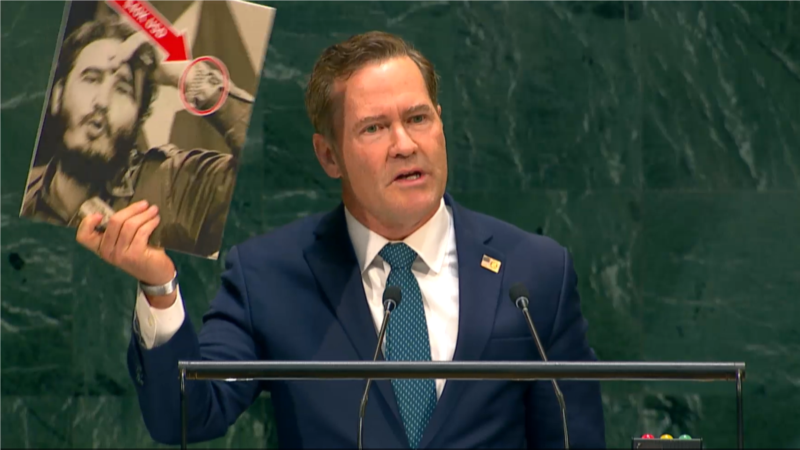
But the vote was not without controversy. During his address, the US representative to the UN, Mike Waltz, said that concentration camps existed in Cuba where “thousands of homosexuals, Christians, and Afro-Cubans” were allegedly detained.
In response to the statement, the Cuban delegation, visibly upset, began banging on the table and requested a “point of order.” When the Assembly president did not respond, Foreign Minister Rodríguez and the rest of the Cuban delegation approached the presiding officers and Waltz and demanded that he stop lying.
Cuban delegation calls for a point of order during US Ambassador to the UN Mike Waltz’s speech. Photo: Zoe Alexandra
Following the protests, the Assembly president gave the floor to Rodríguez, who said that Waltz was “blatantly lying” and that his “attitude is disgraceful.” He further stated: “Mr. Waltz is lying again, and I wish him a better future in other roles, but at the United Nations and on the Security Council, his performance leaves much to be desired … He is undermining the dignity of the Cuban people and the Cuban government.”
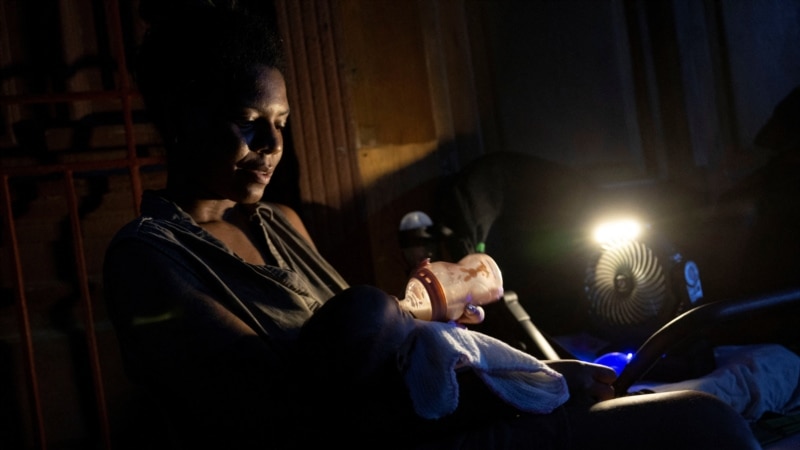
Cuba sigue sumida en una grave crisis de servicios básicos que golpea la vida cotidiana de millones de personas, con apagones prolongados, escasez de agua potable y deterioro sanitario.
La Habana, 29 oct (Prensa Latina) Las Avispas de Santiago de Cuba defendieron hoy la cima oriental del béisbol cubano con un triunfo de 10-9 sobre los Cachorros de Holguín.
The Trump administration is carrying out the most intense pressure campaign on Cuba in decades. The Cuban government says its plan is simply to endure.
Immigration and Customs Enforcement (ICE) has taken custody of a convicted criminal migrant for allegedly illegally voting in United States elections in the swing state of Pennsylvania.
Lima, 29 oct (Prensa Latina) La senadora peruana Silvana Robles rechazó hoy la abstención de su gobierno en la votación de una nueva resolución de la ONU que demanda el cese del bloqueo económico, comercial, financiero y energético de Estados Unidos contra Cuba.

 Login