❌

Reading view

Prueba rusa para detectar virus del ébola con buenos resultados

Moscú, 29 oct (Prensa Latina) Una prueba rusa para detectar el virus de Bundibugyo, causante de ls fiebre hemorrágica del ébola, dio buenos resultados en Uganda, informó hoy la jefa de la oficina de protección al consumidor (Rospotrebnadzor), Ana Popova.

The post Prueba rusa para detectar virus del ébola con buenos resultados first appeared on Noticias Prensa Latina.

  •  

Ebola Workers in Congo Attacked by Machete Mob as Cases Pass 10,000

Two community health workers trying to spread awareness of Ebola in the eastern Congo were attacked by a machete-wielding mob on Friday, further demonstrating the difficulty of controlling the deadly disease among hostile and suspicious rural residents as the total number of cases surpassed 10,000.

The post Ebola Workers in Congo Attacked by Machete Mob as Cases Pass 10,000 appeared first on Breitbart.

  •  

“Sorprendeva le vittime nel sonno, poi le uccideva e cannibalizzava i loro corpi. Lo ha fatto con almeno 38 persone”: arrestato il “malvagio” Mujurizi Moses, il peggior serial killer nella storia dell’Uganda

Il peggior serial killer nella storia dell’Uganda è stato arrestato. Sono le autorità di polizia dello stato africano ad aver definito così Moses Mujurizi, l’uomo che nelle scorse ore è finito in carcere con l’accusa di aver ucciso e cannibalizzato almeno 38 persone tra il 2010 al 2025 nei distretti di Masaka, Ibanda e Kazo, nell’Uganda occidentale e centrale. Come riporta il Messaggero l’annuncio ufficiale dell’arresto è stato reso noto sui social dal capo delle Forze di Difesa dell’Uganda, nonché figlio del presidente in carica Museveni. “Sono lieto di informare i nostri concittadini che le forze di sicurezza hanno arrestato il malvagio Mujurizi Moses. Lo processeremo pubblicamente e lo giustizieremo senza dubbio”.

Una dichiarazione altisonante che potrebbe derivare dal fatto che attorno alla cattura di Mujurizi sembrano sia sorte infinite polemiche riguardanti le forze di polizia. Perché l’uomo pare fosse già noto agli agenti con nomi finti come Fred Mujulizi e Kulaish Kamugisha e che si stato arrestato diverse volte ma che dopo ogni cattura sia sempre riuscito a fuggire dalla prigione. I dettagli degli omicidi di Mujurizi hanno dell’incredibile. L’uomo si sarebbe spostato in moto e per sorprendere le vittime mentre dormivano avrebbe sfondato i muri delle abitazioni per entrarci.

Nel 2013 nella regione di Kyotera Mujurizi avrebbe ucciso ben nove membri di una stessa famiglia. Nel 2023 ha ammazzato cinque persone di un nucleo familiare e cinque di un altro nucleo. Recentemente però Mujurizi è stato arrestato per l’omicidio di una donna, il cui cadavere è stato ritrovato senza testa. Il presunto assassino ancora ammanettato ha quindi confessato il delitto e ha aggiunto di essersi cibato del cuore della vittima. È in questo momento che gli inquirenti fanno due più due riaprono il cospicuo fascicolo dei casi irrisolti e delle persone scomparse nell’ultimo decennio nella regione del Greater Masaka.

L'articolo “Sorprendeva le vittime nel sonno, poi le uccideva e cannibalizzava i loro corpi. Lo ha fatto con almeno 38 persone”: arrestato il “malvagio” Mujurizi Moses, il peggior serial killer nella storia dell’Uganda proviene da Il Fatto Quotidiano.

  •  

Africa’s ‘unprecedented’ Ebola outbreak could reach UK, says top health official

Jean Kaseya, of the Africa CDC, warns of the illness spreading like Covid unless more funding is secured to increase preparedness and possible treatment

The “unprecedented” spread of the Ebola outbreak means it could reach the UK and other countries, according to one of Africa’s top health officials.

As the current outbreak reached 10,000 cases, with almost 5,000 deaths, Dr Jean Kaseya, director general of the Africa Centres for Disease Control and Prevention (CDC), compared the outbreak to the Covid pandemic, which first took hold in China before spreading to countries across the world, claiming millions of lives, and ravaging health systems and economies.

Continue reading...

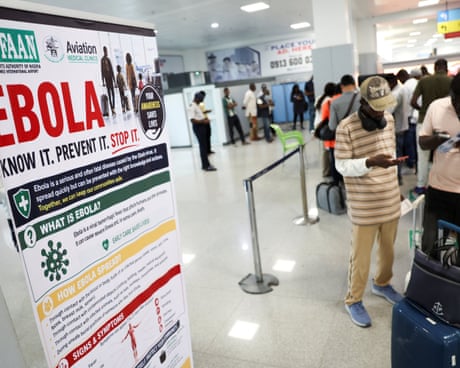
© Photograph: Sodiq Adelakun/Reuters

© Photograph: Sodiq Adelakun/Reuters

© Photograph: Sodiq Adelakun/Reuters

  •  

Risk grows of continental spread of Ebola after case is reported in Nigeria

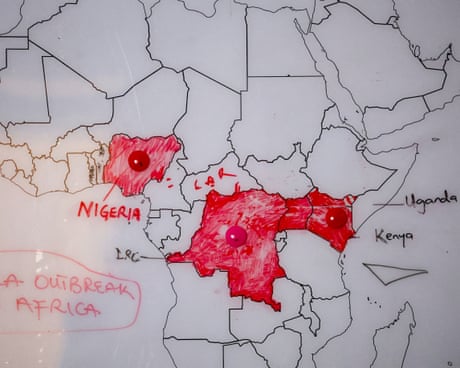
The risk of continental spread of Ebola looms as Nigeria becomes the fourth African country to report a confirmed case of the deadly virus since the outbreak was declared in the Democratic Republic of Congo (DRC) in mid-May.

Caused by the rare Bundibugyo strain of the virus, it has since become the world’s second-deadliest Ebola outbreak ever and the fastest-growing on record. It has killed 4,803 patients, nearly half of all the 9,876 confirmed cases in the eight provinces of DRC’s eastern region as of October 23​

The real scale of deaths is likely much higher, since community transmission of the virus had already begun in DRC’s Ituri province by mid-February, three months before it was detected and officially declared an outbreak on May 15.​

Neighboring Uganda, which is backing armed groups in Ituri, undermining the already delayed and severely underfunded health response, also reported its first case on May 15. However, after two deaths and 20 confirmed infections, the health ministry declared Uganda Ebola-free in late July. The WHO also certified this in late August, after no new cases were confirmed for 42 days.​

However, its Ebola-free status has now come under question with the first case in Nigeria. The 42-year-old patient is a Ugandan national and Swiss citizen. She is the wife of a Swiss diplomat at its embassy in Nigeria’s capital, Abuja, where she resides.​

After a two-and-a-half-week-long vacation in Uganda, she and her husband returned to Abuja on October 3. Four days later, she fell ill. Initially suspected of Malaria, she was treated at two private hospitals before being tested positive for Ebola and isolated on October 20.​

Uganda makes a false claim

Soon after she was tested positive in Nigeria, the Ugandan health ministry claimed that the patient had traveled to the DRC.

However, the “information supplied to WHO did not include [her] travel” to any country other than Uganda, WHO representative in Nigeria Pavel Ursu said on October 22.

“So far, there ​is no validated information that this case traveled to DRC,” added Wessam Mankoula, the Head of Health Emergencies of the continent’s highest health authority, the Africa Centers for Disease Control and Prevention (CDC).​

Then on October 23, the Swiss foreign ministry said explicitly that the patient had not traveled to the DRC, directly contradicting Uganda’s claim, indicating that she was infected in Uganda.

Uganda, meanwhile, still maintains that it has no confirmed Ebola cases. The WHO and Africa CDC are now examining a hypothesis that she may have contracted the virus at the airport in Uganda’s capital, Kampala, where a Kenyan businessman, infected during his travels in the DRC, was also present while she was boarding her flight to Abuja.

The Kenyan businessman had spent seven years in the DRC. While traveling on business, he had already fallen ill in September and was treated in multiple hospitals, but was not diagnosed with Ebola. Early symptoms of Ebola are often similar to other diseases in the region, including Malaria. He was reportedly provided antibiotics and sent home at one of the hospitals.​

An illegal border crossing

The man in question traveled by road to Uganda from the conflict-ridden, mineral-rich, Ebola-affected province of North Kivu, parts of which are occupied by the Rwandan army and its proxy, the M23, which Uganda also supports, according to the UN.​

It is unclear how the Kenyan businessman reached Kampala from North Kivu. Soon after the outbreak was declared, Uganda had closed the border with DRC, except for humanitarian trucks. Mankoula said he had crossed the border illegally.

In Kampala, he boarded a flight to Nairobi on October 3 from Entebbe Airport, through which the Uganda-born Swiss citizen who later tested positive in Nigeria was also passing that day to catch her flight to Abuja.

“Has there been any touch or contact between two cases [him and the case in Nigeria] at the airport at the same time?” This is one of the theories that is currently under investigation,” said Mankoula of the Africa CDC.  

When the Kenyan businessman landed in Nairobi, he was already ill. The family member who picked him up from the airport drove him straight to the Nairobi Hospital, where he died two days later. Eight others who came into contact were also infected and isolated. They include four health workers and four family members, one of whom died later on October 23.

Even as health authorities examine whether he was also the source from whom the Nigerian case contracted the virus,  virologist Marion Koopmans, who is also a member of the WHO’s Ebola emergency committee, has cast doubt on this theory.

“I think that is very speculative unless there is evidence of sharing the same ​space in a manner that could explain that. Random presence at the same location, a large airport, is not a supported epidemiological link by any standard of what we currently know,” she said.

If he was not the source, that could mean Ugandan authorities are either not revealing or are unaware of potential cases in the country. Even if he was the source, questions remain about Uganda’s Ebola-free status, as others he may have come into contact with – either in the airport or on his way to it in Kampala –  could also have contracted the virus.

Nigeria at risk of community transmission

Either way, Nigeria is now at risk of community transmission. The Nigerian case landed on October 3 in Abuja, at one of the busiest airports in West Africa. Only on October 20, 13 days after developing symptoms, was she tested positive for Ebola and isolated.​

Amid fears that the virus may have infected others who may have come into contact with her during this period, especially health workers, Nigerian Health Minister Muhammad Ali Pate said that authorities were tracing all 44 contacts. “We are trying to contain it so it doesn’t go out to the communities. Hopefully, it won’t get to that,” he added.​

“When we identified at-risk countries, Nigeria was not part of this list. It is now. That list would have to be redrawn, and North and Southern Africa could also be at ​risk,” said Jean Kaseya, director-general of the Africa CDC, adding, “We need to consider that no one is safe today.”

  •  

Mystery over source of Ebola infection in Nigeria fuels concern about spread of virus

Switzerland says patient is wife of Swiss diplomat and believed to have contracted virus while travelling in Uganda

Health officials across Africa are racing to determine how Nigeria’s first Ebola patient ⁠in more than a decade ⁠became infected, amid fears ​the outbreak could spread further after reaching a fourth African country.

The Swiss foreign ministry said on Friday the patient in Nigeria, the Ugandan-born wife of a Swiss diplomat based in Abuja, had not travelled to the Democratic Republic of ⁠Congo, where the outbreak was first detected in mid-May before spreading to Uganda, Kenya and now Nigeria. The woman was believed to have contracted Ebola while travelling with her husband in Uganda, the ministry added.

Continue reading...

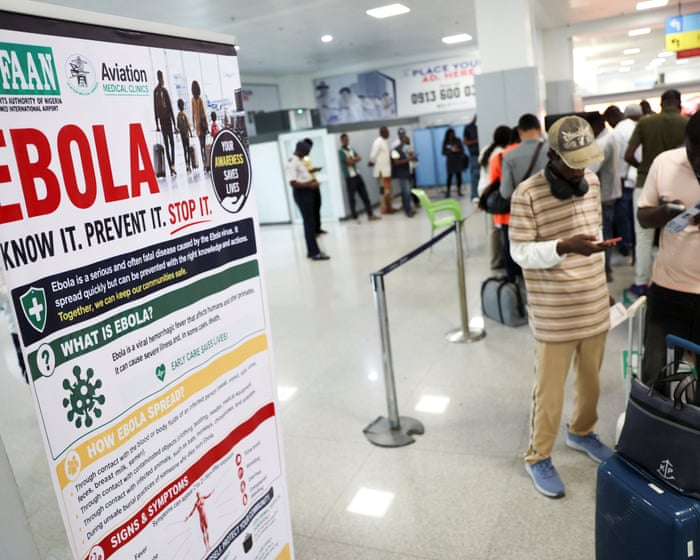
© Photograph: Sodiq Adelakun/Reuters

© Photograph: Sodiq Adelakun/Reuters

© Photograph: Sodiq Adelakun/Reuters

  •  

Ebola Outbreak in Africa Reaches Widest Expansion Ever

Health officials are urgently seeking answers about the origins of a case newly identified in Nigeria, the first in that West African nation.

© Marvellous Durowaiye/Reuters

Nizamiye Hospital in Abuja, Nigeria, where the country’s first Ebola patient was admitted this week. An African health official said that if authorities could not come up with ways to stamp out the outbreak, “the whole continent can be affected.”
  •  

DR Congo’s deadliest Ebola outbreak kills over 4,200 as armed groups undermine response

In less than five months, the fastest-spreading Ebola outbreak in world history has killed at least 4,205 people in the conflict-ridden eastern region of the Democratic Republic of Congo (DRC) as of October 7.

It is the deadliest outbreak in the DRC since the disease was first discovered in the country in 1976, killing nearly one in two of the 8,728 people confirmed to be infected.

With treatment still in experimental stages, there is no specifically approved treatment for the particular Bundibugyo strain of the Ebola virus that caused this outbreak, declared on May 15. 

However, the virus had been circulating in communities in Ituri province since mid-February, three months before the outbreak was identified and officially declared.​

Aid cuts: unpaid frontline workers

When the health response started, already late, it was severely underfunded, as the UK, France and Germany have also followed in the footsteps of the US to slash humanitarian aid and increase military spending.​

The UN Office for the Coordination of Humanitarian Affairs (OCHA) said in late September that the Humanitarian Response Plan had only half the funding needed to counter the outbreak.​

Contact tracing is well below the Africa Centers for Disease Control and Prevention (CDC) and the WHO-recommended 95% to effectively break transmission. Only now in October, it has been built up to 80.4%, which still means that almost 20% of the people at risk of exposure to the virus due to contact with confirmed cases are off the radar of the health authorities, and could potentially be transmitting the disease further.

Lack of funds has meant that the understaffed and overworked frontline health workers – scores of whom have died in the line of duty – have been repeatedly forced to go on strike to protest unpaid wages. Their efforts are further impeded by the poor transport infrastructure and lack of healthcare facilities in the remote eastern region where the disease is spreading.​

Armed conflict complicating health response 

Armed conflict displacing millions on this mineral-rich land is another major hurdle in the way of effective health response. In Ituri, the epicenter of the outbreak, a key Ebola transit center in the fighting-affected Kigonze camp burnt down on September 29.​

The camp, which had housed 19,000 Internally Displaced People (IDPs) fleeing violence, was reportedly infiltrated by the Convention for the Popular Revolution (CRP).

Uganda​

This coalition of armed militias, formed in March 2025 at a hotel in Uganda’s capital, Kampala, is led by Thomas Lubanga, a former warlord, convicted by the International Criminal Court (ICC) of war crimes, released from prison in 2020 after serving 14 years. He resides in Uganda, where he is also known to have recruited fighters along ethnic lines.​

In a 2022 judgment, the International Court of Justice (ICJ) ordered Uganda to pay DRC USD 325 million in reparations. This included USD 225 million for killings, rapes, child soldier recruitment, and displacement, USD 40 million for damage to property, and USD 60 million for plundering its gold, diamonds, and timber as an “occupying power” in Ituri from 1998 to 2003.​

The nature of the occupation has since evolved. Under a bilateral agreement with the DRC, Uganda had deployed 2,000 troops to the country to jointly fight an Islamic State-affiliated group. However, Uganda deployed an additional 4,000 troops without the DRC’s consent in early 2025, around the time as the CRP’s formation in Kampala.  ​

Searching for CRP militants and weapons, soldiers and police entered the camp on September 20. When they came under fire, clashes erupted between the security forces and the militants. Thousands of IDPs fled again as gunfire continued rattling around the camp for days. Deaths, injuries, and arrests were reported.​

Ebola transit center burns down

Amid this violence, on September 29, fire engulfed the camp’s Ebola transit center. It is a facility for the isolation and care of suspected cases, until the results of the lab tests on their blood samples. If confirmed as positive, they are then transported to an Ebola treatment center.​

“It’s been a huge struggle to create Ebola transit centers [and] Ebola treatment centers; it’s required money, bringing in staff and it’s been a struggle all across the east. So, when we lose a center, that means we lose capacity, we lose investment and we have to start again,” said Julien Harneis, UN’s senior Ebola response official in the DRC.​

“Eastern DRC now faces a catastrophic collision of disease and conflict, with the Ebola outbreak in Ituri province outpacing the response,” the WHO’s director general, Tedros Ghebreyesus, had warned in May.​

The outbreak has since reached seven of DRC’s 26 provinces, predominantly in the east. About three-quarters of the confirmed cases remain concentrated in Ituri. However, its neighboring province, North Kivu, which has another 20% of confirmed cases, is emerging as the new hotspot.​

Rwanda

Large areas of this province are occupied by Rwandan troops and its proxy militias, the M23, which captured its capital, Goma, in January 2025, and went on to expand territorial control into South Kivu province.

​Without humanitarian access to these occupied areas, the government cannot mount a health response, Communications Minister Patrick Katembwe said in late May, second week after the outbreak was declared. He called for the “withdrawal of foreign forces and the removal of their auxiliaries.”

Instead, the M23’s parallel administration launched a separate health response in the areas under its control, independently of the DRC government, with which cooperation was limited to data sharing and lab testing. This severely hampered contact tracing, especially because people regularly travel between the M23-held areas and government-controlled territory.

“Multiple outbreaks are developing at the same time”

​The parallel M23 administration has also meant additional delays in diagnosis. With bed capacity in Ebola treatment centers stretched taut in North Kivu, medics in this province are forced to refer infected patients to general health facilities, where a third of all confirmed cases are being treated, posing further risk of transmission into the wider community.

​The spread has rapidly increased since September in this province, which now accounts for nearly 40% of all new confirmed cases, up from 24% in August-end, Doctors Without Borders (MSF) said on October 5.

​“It is like fighting a megafire,” said Stéphanie Hoffmann, MSF coordinator of the treatment center in Butembo, a major commercial city in the province. “Multiple outbreaks are developing at the same time, with varying intensity and in different locations. As long as new hotspots continue to emerge while the virus spreads across northern North Kivu, containing the epidemic will remain extremely difficult.”

  •  

Uganda readies troop deployment to Gaza, risking complicity in war crimes

The Ugandan army, which had offered to capture Iran’s capital within 72 hours for Israel earlier this year, is now readying a troop deployment to Gaza under US command.

Discussing the deployment, senior Ugandan military officers were at the US-led Civil-Military Coordination Center in Kiryat Gat on August 17. The town on the edge of the Negev desert – barely 25 km from the northern Gaza Strip – was established in 1955 after depopulating the Palestinian villages of al-Faluja and Iraq al-Manshiya during the Nakba.​

Burundi’s military officials were also reportedly present at the meeting here, after which the Israeli Occupation Forces (IOF) gave them both a tour of the city of Rafa in southern Gaza as part of the “pre-deployment site survey.”

Burundi is yet to confirm the deployment of its troops. However, Uganda’s parliament, practically a rubber stamp with over 70% of the seats held by the ruling party, approved the deployment of its troops on August 6.​

This made it the sixth country to join the International Stabilization Force (ISF) proposed by US President Donald Trump’s so-called Board of Peace, envisioned as the 20,000-strong force led by US Major General Jasper Jeffers.

The remaining five contributors of troops hold relatively diverse positions on the Israel-Palestine question. Indonesia has been a vocal critic of Israel, backing South Africa’s genocide case against it at the International Court of Justice (ICJ). It maintains no diplomatic ties with Israel. The largest contributor has reportedly put its 8,000 troop deployment on hold, although it hasn’t formally withdrawn from the ISF.

Kazakhstan, on the other hand, has maintained deep diplomatic ties with Israel since 1992. Morocco joined the Abraham Accords in 2020. Both have done so while mouthing the two-state solution for an independent Palestinian state with East Jerusalem as its capital as official state policy.

The remaining two European countries are staunchly pro-Israel. Albania has announced plans to open a commercial liaison office in Jerusalem. Kosovo has outdone Albania, following Trump’s lead by moving its Israeli embassy to Jerusalem.​

The sixth country to come on board, Uganda, professes a commitment to Israel that dwarfs that of the European troop-contributors.

Offering to join US-Israeli war on Iran​

“Any talk of … defeating Israel will bring us into the war” against Iran on “the side of Israel,” Uganda’s military chief, Muhoozi Kainerugaba, posted on X in late March. He is the son and heir apparent of Uganda’s 81-year-old president, Yoweri Museveni, ruling the country since 1986.

After 40 years of rule, Museveni was handed a seventh term by the Electoral Commission in January, following an election marred by “widespread repression and intimidation against the political opposition, human rights defenders, [and] journalists,” according to the UN.

Soon after the results, Kainerugaba began hunting down Museveni’s political opponents, forcing his main challenger in the election, Bobi Wine, into exile, bragging about killing 30 of his party’s members, and swearing to “get them all.”

Israeli military technology, from weapons to surveillance equipment, has long enabled Museveni’s domestic crackdown. Recalling that Israel has supported his regime for decades, “Why wouldn’t we defend her now?” asked Kainerugaba. He added in a subsequently deleted post that the Ugandan military had offered to join the US and Israel in their war efforts against Iran, claiming, “We could have captured Tehran in 72 hours.”

Read more: Ugandan military chief announces willingness to join the US-Israeli war on Iran

This bold claim of being able to defeat the world’s 16th largest military power, with a military ranked 107 out of 145 countries, was gently mocked, even in the Israeli media at the time.  

“Gaza, here we come”: Ugandan soldiers post on social media

Nevertheless, barely five months later, Ugandan soldiers began uploading posts on social media, captioned, “Gaza, here we come,” filming themselves loading equipment onto planes – taking off and landing in undisclosed locations.​

These posts by Ugandan soldiers began circulating on social media after the Ugandan parliament approved the troop deployment on August 6.​

Military deployment as a diplomatic strategy

Addressing the parliament ahead of the vote, Maj Gen David Gonyi, parliamentary representative of the Uganda People’s Defence Forces (UPDF), explained the rationale of the deployment to the legislators: “Uganda submitted the name of a Ugandan [veteran diplomat, Olara Otunnu] to become Secretary-General of the United Nations. It would be like shooting ourselves in the foot to say that Uganda should not participate in [the] deployment in Gaza.”

Military deployment has long been a central plank of Ugandan diplomacy, currying favor of the Western countries by sending its soldiers to missions in Somalia, South Sudan, Equatorial Guinea, and the Democratic Republic of Congo (DRC).

Its Somalia deployment has been especially crucial for the Ugandan army to receive training and support from the US Marine Corps and US Africa Command (AFRICOM).

Last November, Johan Borgstam, the European Union (EU) Special Representative for the Great Lakes Region, met Kainerugaba to propose expanding Ugandan troop deployment in DRC, on behalf of Brussels. Borgstam brought this proposal, despite the UN confirming the validity of the DRC’s accusation that Uganda is supporting the M23 armed group, a proxy of Rwanda which, along with its army, has occupied large swathes of the region in a war for DRC’s minerals.

Presenting this Western demand for Ugandan troops as a diplomatic success, Major General Henry Masiko, another parliamentary representative of the UPDF and the Joint Staff Political Commissar, told the legislators: “The UPDF is viewed as the anchor of stability in a sea of turbulence, regionally and now globally.”

He went on to add in his remarks to the parliament that the “doctrine of the force is that we go out not to dance but to confront threats against society and humanity,” in a thinly veiled reference to Palestinian resistance.

“Some troops will return in coffins,” warns opposition MP

Opposition politicians have raised concerns that deploying troops when the Ugandan government has done little to conceal its neutrality may have consequences. 

“Some [troops will] return in coffins,” warned Jamal Ayagalaki. “We need answers on who will pay the UPDF, what the terms and conditions of service will be, and what support will be available to soldiers and their families.” He further warned that Uganda’s involvement in a conflict “that is not ours” could expose the country itself to new security threats.

A more thorough criticism of the deployment came not from an opposition leader but from retired General David Sejusa, who had served Museveni as a senior presidential adviser and intelligence coordinator from 2005 to 2013.​

The “parliament passed a resolution for peacekeeping, [but] what peace is [there] is Gaza?” he questioned, pointing to the lack of agreement between Israel and Hamas.

Uganda risks complicity in war crimes: former intelligence chief

“The permanent decommissioning of weapons from non-state armed groups” – i.e. the Palestinian resistance – is one of the tasks the International Stabilization Force must carry out in coordination with Israel, according to the resolution adopted by the UN Security Council in November 2025, with abstentions from Russia and China.

Hamas has refused to hand over weapons to Israel or any foreign force. It has called for the creation of a Palestinian national committee, which will hold the weapons collected from Hamas and other resistance groups within Gaza.

This transfer of weapons, however, can only happen after Israel withdraws from Gaza, Hamas insists. Israel, on the other hand, has refused to withdraw from Gaza until the resistance is completely disarmed.​

Therefore, in the absence of any “clear implementable political framework,” Uganda will be deploying troops in an “un-militarized active conflict area … where a belligerent state continues strikes on the occupied population,” Sejusa said. This, he warned, places Ugandan troops at the “risk of complicity in war crimes.”

  •  
❌