
 Login

Mexico City Unveils Record 33-Meter Catrina for Day of the Dead
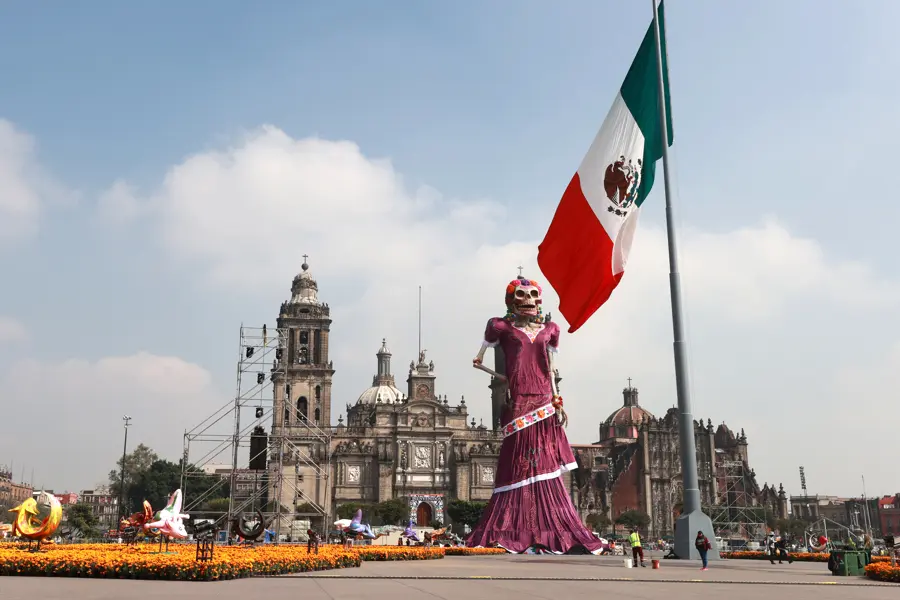
Mexico City entered the Guinness World Records this week after unveiling the tallest Catrina ever built, a 33.411-meter paper-mâché figure now standing in the capital’s Zócalo as the centerpiece of the Monumental Offering for Day of the Dead.
Guinness World Records adjudicator Alfredo Arista, the organization’s official representative for Latin America, certified the achievement during the inauguration of the offering. He confirmed that the towering structure met all the requirements for the record distinction.
Mayor Clara Brugada described the Catrina as a critique of vanity, classism and false appearances. “From the heart of Mexico, the Catrina mocks privilege and reminds us that no one should be above anyone else,” Brugada said at the unveiling.
RELATED: Mexico to Commemorate World Day for Audiovisual Heritage
The Catrina, an elegantly dressed female skeleton, has long symbolized the idea that death reaches everyone regardless of wealth or social standing. Brugada stressed that the figure mocks privilege at a time when the holiday draws crowds to the capital.
The monumental figure rises in front of the Metropolitan Cathedral, the historic heart of the city. Its installation anchors the Day of the Dead celebrations, during which Mexican families remember and symbolically welcome their departed loved ones.
The previous record was at 28.15 meters was achieved in November 2023 and belonged to Puerto Vallarta, Jalisco.
Celebramos el @GWR de la Catrina más alta del mundo que desde hoy se encuentra en el corazón de nuestra ciudad. Vengan a visitarla, estará hasta el 2 de noviembre en nuestro Zócalo capitalino.
— Clara Brugada Molina (@ClaraBrugadaM) October 30, 2026
¡Nuestras tradiciones cruzan fronteras y enamoran al mundo! pic.twitter.com/XYGE2POELc
Text reads: “We celebrated the @GWR of the highest Catrina in the world that from today is located in the heart of our city. Come visit it, it will be until November 2 in our capital’s Zocalo. Our traditions cross borders and enchant the world!”
Tribute to Posada
The record-setting Catrina was built by the Xibalbá art workshop under the direction of Carlos Camilo Báez. The piece pays homage to La Catrina Garbancera, the skeleton figure created by the celebrated Mexican engraver, illustrator and caricaturist José Guadalupe Posada, who lived from 1852 to 1913.
The character gained enduring fame decades later, when muralist Diego Rivera immortalized her in the mural Dream of a Sunday Afternoon in the Central lameda. Since then, the elegantly dressed skeleton has become one of the most recognizable symbols of Mexico’s Day of the Dead.
The offering surrounding the Catrina transforms the Mexican Zocalo into a stage for tradition. It includes banks of cempasúchil marigolds and 66 axolotl sculptures intervened by artists and collectives. Decorative lighting now frames the buildings that ring the square.
Brugada also switched on the monumental illumination of the Zocalo. The display features catrinas wearing floral headdresses, along with candles, sugar skulls, marigolds and hummingbirds. More than 100 city government workers took part in creating and installing the lights.
Momento exacto de la inauguración de la megaofrenda en el Zócalo capitalino; catrina de 32 metros rompe récord Guiness.
— @diario24horas (@diario24horas) October 30, 2026
📷: Ingrid Sánchez #megacatrina #zocalo #DiaDeMuertos #catrinas pic.twitter.com/pmgGB4GSMQ
Text reads: “Exact moment of the inauguration of the offering in the capital’s Zocalo; catrina of 32 meters breaks Guinness record.”
The record is only part of a broader schedule of festivities. Brugada invited residents to visit the Monumental Offering and announced that the tenth edition of the Great Day of the Dead Parade will take place on Saturday. She also encouraged the public to attend the Cempasúchil’s path festival in Chapultepec, scheduled from Friday through Sunday.
For Brugada, the celebration does more than showcase artistry. She said Day of the Dead keeps alive the memory of those who have died and described it as “a loving rebellion against forgetting,” carried out through traditions, offerings, flowers and rituals. The towering Catrina, she added, reinforces the presence of the holiday in the capital’s public spaces and projects a Mexican tradition now recognized around the world.
Honoring Ancestors
Every November 1 and 2, Mexican families build altars, light candles and welcome their departed home, guided by a belief that death is not an end but another stage of existence.
The holiday known as Day of the Dead (Día de Muertos, in Spanish) rests on a worldview in which grief gives way to festivity. Instead of weeping, families feast, decorate and remember. The result is a tradition whose most enduring symbols, the Catrina, the alebrijes and the altar, now reach far beyond Mexico’s borders.
No face of this tradition is more recognizable than the Catrina. Adorned with a couture headdress, that sophisticated skeleton became a symbol of social hypocrisy and a reminder that the end reaches everyone, regardless of status. Over time, satire gave way to affection. The mockery became an emblem of national culture, present in folk art, fashion, sugar skulls, costumes and offerings. The figure embodies the duality of life and death, which is why she appears elegant and serene, far from any gloomy connotation.
Their origin is a dream. In the 1930s, artisan Pedro Linares López fell ill and, burning with fever, described witnessing a parade of chimeric beasts. When he recovered, he gave them shape with cardboard and paper and named them with the word he claimed to hear during that delirium, alebrijes. So were born in Mexico City figures that fuse the real with the fantastic.
Years later the craft traveled south. In Oaxaca, local communities adopted and transformed it. There the alebrijes are carved from copal wood and decorated by hand with patterns that never repeat. Every dot, line and tiny flower reveals the patience of the artisan.
In homes, the altar of the dead anchors the ritual. Nothing on it is placed by chance; each object serves a precise function. The white cloth awaits the deceased, meanwhile the confetti sways in the wind, its colored figures seeming to anticipate the visit. Candles clear the path of return and water quenches the thirst after the long journey. The cempasúchil flower, with its blazing yellow, marks the route the soul must follow. According to belief, that structure builds the bridge to those who are gone.
In its architecture two worlds fuse, the pre-Hispanic worldview and the Catholic religion, joined by a single need, the refusal to forget. That fusion explains how the holiday crosses continents today.
What began as a family ritual now appears in public squares, parades and record-breaking installations, yet its core remains unchanged. The altar, the candle and the marigold still say the same thing: those who died have not disappeared, they have simply continued the journey.
