
❌

Reading view

Meta took down its ad touting Muse's ability to 'see who unfollowed you' on Instagram. Very interesting…

meta muse mascot advertisement poster
Meta's Muse AI agent can track who unfollowed you on Instagram. I wonder how Instagram feels about that?

Smith Collection/Gado/Getty Images

  • Meta ran an ad touting Muse could let you see who unfollowed you on Instagram.
  • Instagram has long prevented its users from doing that. Meta has since removed the ad.
  • This shows a complicated tension for Meta between the goals of AI agents and its social media platforms.

Muse, the AI agent from Meta, can do many wonderful and useful things. It can help organize your inbox, book travel plans for you, and buy you lunch.

But one thing that Meta has decided it shouldn't brag about is that it can track who unfollowed you on Instagram.

About a week ago, Rachel Karten, who writes the excellent marketing newsletter Link in Bio, noticed a strange ad on Instagram. The ad encouraged people to download Muse, with an image of the fuzzy mascot holding up red and green Tinder-esque signs, suggesting you could "See who unfollowed you each week."

i get that this is technically a requested feature but wouldn’t it lead to more resentment towards your own platform? pic.twitter.com/SbM6VdcdhV

— Rachel Karten (@milkkarten) October 24, 2026

Finding out who unfollowed you on Instagram is something people have wanted to know since the app first launched. But Instagram — for good reasons — has avoided making this a feature on its own app.

I reached out to Meta to ask about this seeming clash, and a Meta spokesperson confirmed to Business Insider that the ad had been removed and is no longer active in the Meta ad library.

Instagram doesn't want you to know your unfollows

Here's the tension: Instagram knows that people want this feature, but it also knows it would be bad for the platform's vibes.

Instagram head Adam Mosseri regularly does AMAs on his personal account, and he's answered questions about why there's no "who unfollowed me" feature. His reasoning (gone from his page but have been aggregated in other videos) is that they want to make people feel comfortable unfollowing people they're no longer interested in.

To most people, it is obvious that this feature could hurt people's feelings, especially younger users (let's assume that Instagram does care about teen users' feelings here, although I understand if you have some hesitations on that). Feeling bad while using the platform is a bad user experience!

It's also ultimately bad for Instagram. If you're reluctant to unfollow accounts you don't like, then you'll end up with a feed that's less compelling, and you'll end up opening Instagram less often or spending less time on it. That's bad for Instagram's daily active user metrics!

Yes, Muse can actually do this

There are, and have been, third-party services that can track who unfollows you. These sometimes require access to your login info in ways I definitely wouldn't recommend, and can track over time who has unfollowed you. So it's not like Muse is doing something totally novel or unheard of here.

I asked Muse to do this for me, and it said it could — with a caveat: it will start tracking my follow lists to see who unfollows me going forward, but it can't retroactively check who unfollowed me in the past (that's mostly the same as the other trackers). And honestly? I don't want to know! No thanks! Yikes!

asking used to give me an unfollow list
I asked Muse to track who unfollowed me on Instagram (despite not wanting to really know). It could only track going forward, but after two days, it found one.

Business Insider

Is this just one stupid ad? Yes. Was it set up and run as an ad by someone at Meta far removed from Instagram's philosophy on unfollows? Probably. Is it the most shocking news in the world if Meta runs a single ad and then takes it down? No.

But this interests me so much because it gets at a bigger and thornier issue. AI agents like Muse are what Meta clearly sees as the future of the company and how people use its services. But AI agents' abilities and use cases may be at odds with the nature of social media.

In the simplest way, AI agents are supposed to help you be efficient and get things done. Social media is supposed to help you waste your time.

These are two vastly different objectives — and it's going to be interesting to see how these two new technological pillars of Meta clash or complement each other.

Already, we have one Meta product (Muse) that is more than happy to do something that another Meta product (Instagram) has long discouraged.

There are plenty of other features that people want to do on social media, but Instagram and Facebook don't allow because it's bad for the overall health of the platforms. Suddenly, AI agents like Muse can do these long-forbidden things. The question is: how far is Meta willing to cannibalize the health of its own social platforms for the sake of growing its AI?
Read the original article on Business Insider

  •  

Ro's CEO showed us its new AI agent — and its bigger plan to own more of your healthcare

ro ceo
Zach Reitano, co-founder and chief executive officer of Ro.

Aaron Schwartz/Bloomberg via Getty Images

  • Telehealth company Ro is launching an AI agent trained on customer data.
  • The agent can recommend prescription changes, schedule deliveries, or write memos to a doctor.
  • Eventually, Ro hopes to make it a "quarterback" for care. Will it improve outcomes?

Wouldn't it be great if we all had a little, digital minion handling all the small back-and forth chores of our medical care?

On Thursday, Ro is officially announcing the launch of its new AI health agent, designed to do more than a health inquiry on ChatGPT. It's the latest in a long lineup of healthcare agents — from insurers, telehealth providers, electronic health record systems, and regular chatbots — promising to cut down patient wait times, increase access to care, and improve personalized health recommendations with AI.

Ro CEO and co-founder Zach Reitano gave Business Insider an exclusive preview of Ro's new agent, called Robin, showing us how the tool could be used to perform routine tasks like managing side effects, meal planning, or making medication changes.

ro AI agent
Ro's new AI agent, named Robin, is like a "quarterback" for healthcare, Reitano said. Will it work?

Ro

A founder's mission: disrupt healthcare delivery with AI agents

Reitano said this isn't just about making life more convenient for Ro's current subscribers, though that is the starting point. His long-term goal is to identify pain points where Ro customers need to seek out specialists for common conditions or prescriptions, then start offering more and more of that care in-house, becoming your go-to "quarterback" for the entire American healthcare system.

"I think it's very unlikely to me that one provider or one system handles 100% of someone's care, but I do think it is quite likely that there is one place in someone's life that serves as that quarterback and helps them navigate the rest of the healthcare system," he said. "We hope to be able to just continue to increase those concentric circles, where instead of saying you might be better suited outside of the Ro ecosystem, we would want you to be better suited in it."

When I asked him if his "ultimate goal" is to become a full-service virtual clinic, he said yeah, that's the hope.

For now, Ro's AI agent uses information that's already stored in the app, including notes from doctors, patient feedback, prescriptions, and Apple Health data to try to personalize recommendations for medication changes, dosing tweaks, or habits that might improve side effects.

It's meant to be more instinctively knowledgeable about your health than ChatGPT — requiring less prompting or uploading health data, since it already has information about patients on file. It can suggest a change in medication, and then go ahead and write a first draft of a note to your doctor, if you want it to.

"The underlying premise is: If I have your underlying health information, I can provide more informed and better things, better recommendations," telehealth researcher Dr. Ateev Mehrotra, chair of the health policy department at Brown University, said.

Only issue is, we don't yet know if that's true.

"People are giving up a lot of data for this, and so you really have to say that it truly is going to give you something," Mehrota added. "It sounds cool in theory, I'm not saying it's a bad idea. I would love some evidence before millions of Americans start doing this."

Personally, Mehrotra says he'd be much more likely to try out one of the AI agents embedded into an official electronic health record system, which has access to everything he's told his regular doctors and specialists within a specific hospital system and which — critically — has to abide by strict privacy rules. (Business Insider did not see Ro's privacy policy for Robin.)

"My health system doesn't have the weird financial incentives that we're worried about with Ro," he said. "More data, less financial incentives, I might use that."

Reitano says ultimately, it's not in his company's interests to go after short-term profits at the expense of a good patient experience.

"We fight for patients, and we serve you, and if we don't, then we go out of business," he said.

Read the original article on Business Insider

  •  

Home Depot wants your AI agent to show some ID first

In an aerial view, customers enter a Home Depot store on September 18, 2026 in Pasadena, California.
Home Depot's CIO shares how she's thinking about AI agents, cybersecurity, and Anthropic's Project Glasswing.

Justin Sullivan/Getty Images

  • Have an AI agent? Need a hammer? Home Depot is thinking about how to make that palatable for the retailer.
  • Angie Brown, the company's CIO, spoke to Business Insider about agents, the PHP cyber scramble, and AI fixes.
  • She also talked about Home Depot's involvement in Project Glasswing, which grants access to Anthropic's Mythos Preview.

Home Depot wants to roll out the welcome mat for your AI agent — so long as it's wearing a name tag and acting on your behalf.

During a sit-down interview with Business Insider, Angie Brown, the company's executive vice president and chief information officer, said the retailer wants to support AI agents that can search and buy products on a customer's behalf. But Home Depot needs to be sure of two things first.

"We want to know you're not a bot, and we actually want to know if it's you," she said. "That's something that Muse is working on right now, to self-identify."

Her comments are the latest glimpse into how legacy retailers — and their tech staff — are thinking about the possible next generation of online shopping.

Recently, several Silicon Valley companies have launched consumer-focused AI agents, such as Meta's Muse and Spear Street Technology's Instinct AI. They promise agents capable of scanning the internet, comparing products, filling carts, and buying items with little to no intervention from the person who sent them.

Their rollout has been met with varying levels of resistance and buy-in from online retailers. Amazon barred Muse from shopping on its marketplace, saying the bots didn't properly identify themselves. Several other retailers — including Walmart, Best Buy, Sephora, and Shopify — have announced integrations or openness to AI agents. In October, Meta announced that it co-developed a personal agent protocol with Sierra AI to standardize AI agent identification.

Brown said Home Depot is open to the idea of AI agents, but the retailer doesn't want to lose its connection with loyal customers.

Frequent Home Depot shoppers, such as contractors and remodelers, are part of the company's Pro Rewards platform, where they're eligible for discounts. The retailer doesn't "want to lose contact with the customer," she said.

"That's the next evolution," Brown added, confirming that Home Depot is in active conversations with Meta about how Muse should introduce itself to websites. "There's openness on both sides, because they want it to grow."

Home Depot is already using AI to defend itself

Brown said Home Depot is deploying AI amid a recent wave of cybersecurity worries.

Last week, companies around the world raced to patch critical vulnerabilities in PHP, a programming language used in an estimated 70% of websites. The flaws were discovered with help from OpenAI and prompted US cybersecurity officials to urge affected organizations to update their systems or, in some cases, take them offline.

Brown, whose remit includes Home Depot's cybersecurity, called the hours after the warning a "little hectic," but said the company's main website was not affected.

"We had a couple of operating units — companies we've bought and things like that that are a little bit smaller — that had to plug a few vulnerabilities," she said, including an internal job application system that was taken down "in the middle of the day for about an hour to patch."

Otherwise, she said, the company was largely spared from the sudden tech anxieties.

Home Depot, Brown confirmed to Business Insider, has joined Anthropic's Project Glasswing, an initiative that gives selected companies access to Claude Mythos Preview to help secure critical software. She said the company was not granted access in the project's first wave, "despite our best efforts, and calling a lot of friends." Those slots were largely reserved for banks and cybersecurity firms, not major retailers.

The Anthropic models "found a few things" for Home Depot to fix in its code — but the agents also found a few "false positives," Brown said.

Home Depot, she said, has long ranked cybersecurity vulnerabilities, but AI is leading the company to rethink its desired time to deploy a fix.

"The speed to fix a vulnerability has to be driven down to hours," she said.

Read the original article on Business Insider

  •  

Palantir cofounder says his wife calls their AI agent 'Tradbot' after tradwives

Palantir cofounder Joe Lonsdale poses for a photo

Christie Hemm Klok for The Washington Post via Getty Images

  • Palantir cofounder Joe Lonsdale's wife has an interesting nickname for their AI agent.
  • She calls it "Tradbot," he said, a name inspired by the social media trend of tradwives.
  • The Lonsdales use their "Tradbot" for help with parenting.

What does Joe Lonsdale's AI agent and Ballerina Farm have in common?

Lonsdale, who cofounded Palantir before building his venture capital firm, told CNBC on Thursday how his wife, Tayler, uses AI — and the nickname she's given their agent.

"My wife has Grok Bot at home," Lonsdale said. "She calls it the 'tradbot' for tradwife."

For those unfamiliar, a tradwife is a woman who embraces traditional gender roles, such as supporting her husband with household work and taking a primary role in raising kids. Some of these tradwives become influencers, posting videos of their ornate meals or gifts for their husbands.

The Lonsdale family's "tradbot" helps them manage parenting duties for their six children. Lonsdale said the AI agent tells them about health appointments and activities.

He asked the "tradbot" to help his two-year-old break up with his binky. "It's telling me when to and when not to give it to him," Lonsdale said.

Parents have been employing AI for all kinds of use cases. One mom of two previously told Business Insider that she sends voice memos to Claude to help organize her life. Another said that she built AI agents to help manage schedules and school emails. Business Insider's Amanda Hoover declared mom, dad, and AI the "modern parenting throuple." The debate of how much — if any — AI should be involved in parenting continues to rage online.

Lonsdale is a vocal proponent of AI, having invested in it heavily through his venture capital fund, 8VC. During September's AI extinction freak-out, Lonsdale reassured the public: "The world is going to be alright, guys."

Clearly, Lonsdale's use of AI has extended beyond the office. "My wife's definitely using it at home," Lonsdale told CNBC, "and we're using it a lot at work as well."

Read the original article on Business Insider

  •  

The internet has a human slop problem, and AI is exposing it

Tom Occhino, left, and Tiago Sada sit onstage during a World event in San Francisco.
Vercel's Tom Occhino, left, with Tools for Humanity's Tiago Sada at an event in San Francisco in April.

Kimberly White/Getty Images for Tools for Humanity

  • Everyone complains about AI-generated junk.
  • But decades of sloppy human-written software may be a much bigger problem.
  • This week's "Black October" freakout was caused by human slop, not AI.

The internet has a slop problem. And for once, we can't blame AI.

Most of us spend hours online every day without thinking much about the software holding everything together. We assume somebody, somewhere, has made sure it all works properly.

So it probably came as a shock this week to discover just how vulnerable some of that software is.

The cybersecurity freakout dubbed "Black October" has inspired warnings about AI-powered hackers, digital catastrophe, and even advice to stockpile cash and canned food.

At first glance, AI looks like the villain. But this is largely a human-made mess.

Here's the problem.

The internet runs on decades of software, some of it containing security weaknesses that have been overlooked, tolerated, or simply left unfixed.

For years, that was a manageable gamble. Fixing software takes time and money. Exploiting obscure weaknesses often required considerable expertise. Companies could convince themselves that the risk wasn't worth worrying about.

AI is changing that calculation. Someone who once needed years of training to hunt for weaknesses can now get help from an AI model. These tools can also examine software at speeds that humans can't match.

Suddenly, all those problems we've been ignoring look more urgent.

"Over the last 10 years the risk acceptance process has morphed from a way to accept risks to enable the business, to a way to justify never fixing security issues," Joel de la Garza and Zane Lackey, partners at a16z, wrote on Friday.

That's quite an indictment. The result is a recent surge in published vulnerabilities.

This looks like AI is creating new security problems. But it's actually AI exposing weaknesses that humans left behind.

Slop irony

The irony is delicious. We've spent the past couple of years complaining about "AI slop." Turns out human slop can be pretty consequential, too.

"The funny thing is everyone was saying AI slop code will cause a cyber crisis but it's actually all the old human slop causing it and the AI is just cleaning it up," software engineer Ben Kaufman wrote on X on Thursday.

"Humans have been the ones writing and reviewing each other's code for decades," tech founder Anant Jain wrote on X. "If we're being intellectually honest and holding ourselves to the same bar we hold AI to, we'd have to admit that we haven't been all that good at it either."

Humans are sloppy

Anyone who's worked with other humans for a decade or two knows exactly how this happens.

It's Friday afternoon. You've almost finished a project. You could spend another few hours making it perfect, or declare it 90% done and head off to that dinner party. We've all been there.

AI agents don't have dinner parties. They don't get tired on Friday afternoons. They can keep searching, testing, and trying again. That persistence is now colliding with an internet built by busy, imperfect humans who often settled for "good enough for now."

A tragedy of the commons

There's another wrinkle here, though, and it's an important one.

Much of the software underpinning the internet is freely available for anyone to use. Some of it is maintained by volunteers or small groups of experts, even as enormous technology companies depend on it.

In 2020, the cartoonist Randall Munroe captured this absurdity in an xkcd comic. Modern digital infrastructure still rests precariously on tiny foundations.

I can’t believe that after all these years this XKCD comic is still so true.
Specially in security! @xkcd https://t.co/9AvpRw0E0c pic.twitter.com/g0B07TStNe

— Bruno Medina (@brusMX) April 6, 2024

It's funny because it's uncomfortably close to reality. Take the specific PHP problems from this week. These flaws have existed for years, and the PHP Foundation acknowledges that limited resources and disagreements over fixes contributed to delays in fixing them.

Tom Occhino, chief product officer at Vercel, brought up Munroe's cartoon during my recent interview with him.

He explained that AI is finding weaknesses even in software that the industry has treated as dependable for decades.

This is partly a version of the tragedy of the commons: Everyone benefits from a shared resource, but no one has sufficient incentive to take responsibility for maintaining it.

And let's be clear: The volunteers keeping essential software running aren't the villains here. The companies benefiting from their work have a much greater responsibility.

Occhino thinks AI could help solve the problem it is exposing.

He described an idea being discussed at Vercel: Create a foundation or coalition that funds efforts to identify vulnerable software and replace it with safer alternatives.

"We need a consortium. We need a coalition," he told me.

He suggested companies could contribute computing resources and AI tools to the effort. Nothing has been formally announced, but the idea is compelling.

Indeed, OpenAI's Patch the Planet effort is an example of what's possible.

Rather than simply using AI to create more software, the industry could use it to repair what already exists.

Occhino put it nicely: Companies need to spend less time chasing new ideas and more time asking how to make existing systems "just work really, really well."

That's a better response than panicking about the imminent collapse of the internet.

AI didn't create decades of neglected software. We did. Perhaps it's time to clean up our own slop.

Sign up for the AI Insider newsletter here. Reach out to me via email at abarr@businessinsider.com

Read the original article on Business Insider

  •  

Mark Cuban says the best defense against malicious AI agents is more AI

Mark Cuban speaks into a handheld microphone during a stage discussion against a dark backdrop.
Mark Cuban compared AI cybersecurity risks to a cockroach infestation

Shafkat Anowar/The Dallas Morning News via Getty Images

  • Mark Cuban compared swarms of AI agents to cockroaches finding ways into systems.
  • Cuban said agents can launch brute-force attacks at scale without inventing new hacks.
  • Cuban said defenders can also "spray" their systems with AI, which makes defenses more accessible.

Mark Cuban has pest-control tips for the AI age.

Speaking at a Reuters NEXT Newsmaker event on Friday, the entrepreneur and billionaire investor compared the threat posed by swarms of AI agents to cockroaches finding their way into a freshly treated house.

"When I go talk to cybersecurity experts, I ask them all the time. I'm like, when we hear about these hacks and breakthroughs and, you know, different problems, do these AIs invent something new?" Cuban said.

"No, they didn't invent something new," Cuban added. "But they're able to do something in mass volume that it's all brute force hacks."

Cuban compared the challenge to keeping cockroaches out of a house.

"It's like the cockroach theory, where if somebody can create enough agents, it'll find a way to get in, and then it just exploits that. But the good news is you can spray your systems with just as much AI, and I think there's gonna be more effort from the good guys trying to stop the bad guys," Cuban said. "I'm not a doomer at all."

The AI industry is already creating its own team of exterminators to contain risks.

OpenAI safety roles on LinkedIn jumped by 91% over the past year, spanning work such as system testing, technical research, and governance.

The risks have also surfaced during testing. Anthropic said that three Claude models accessed organizations’ live systems without permission after a third-party testing environment was misconfigured. The company subsequently introduced real-time classifiers to detect and block attempts to escape testing environments.

Cuban said AI could make malicious activity more accessible, but the same techniques could also strengthen defenses.

"There will be scenarios where bad stuff happens, but we've always had hacks," said Cuban. "And if it's brute force on that side with the bad guys, you can also use brute force with the good guys."

Read the original article on Business Insider

  •  

Should we panic and turn off the internet?

Stephanie Cohen speaks during the Web Summit conference in Lisbon in November 2025.
Stephanie Cohen, Cloudflare's chief strategy officer.

Zed Jameson/Bloomberg via Getty Images

  • This week's cyber freakout explained: AI is making software weaknesses easier to find and exploit.
  • The message from Cloudflare's Stephanie Cohen and Vercel's Tom Occhino: Don't panic!!!
  • Do we need everything connected to the internet? Paper bank statements work well.

A few weeks ago, I heard a strange story about a friend who works at one of the Big Tech companies in Silicon Valley.

She'd recently ripped out the connected devices in her home, ordered paper bank statements, and stocked up on canned goods in her basement.

Now, she's a very sane, experienced person, and quite senior at one of the largest internet companies on earth. Why was she disconnecting so much? Just to be sure, my family ordered paper bank statements, too. It was still a head-scratcher, though.

Fast forward to this week, and her actions look a little less crazy.

AI models have exposed serious security weaknesses in software used by roughly 70% of websites. Meanwhile, US banks are finding AI agents inside customer accounts, including some that appear to be acting without their owners' instructions, Axios reported.

'Black October'

The digerati have now entered full freakout mode. Much of the internet meltdown is happening on, well, the internet, my colleague Alice Tecotzky noted.

On X and Reddit, warnings of a looming “Black October” spiraled into visions of AI grinding civilization to a halt. One lengthy post on X warned of a potential “global cyberattack/AI swarm” and offered a survival checklist: Stockpile cash in small bills, print out your neighbors' phone numbers, download maps, buy a hand-crank radio, and stash a gallon of water per person per day.

Oh, and don't forget the manual can opener. You don't want to survive the AI apocalypse only to be defeated by a tin of beans.

Nikita Bier, a prominent app developer and former head of product at X, best captured the mood.

"It's time to turn off the internet," he posted Wednesday night.

A Cloudflare exec says it's 'a little bit scary'

If you're reading this, you haven't done that yet. But should we really be worried?

I put that question to Stephanie Cohen, chief strategy officer at Cloudflare, which helps protect about 20% of the internet.

"The world is a little bit scary right now," she told me on the side of Cloudflare's annual conference in San Francisco this week.

Here's the problem. The internet is built on decades of software, much of it riddled with security holes.

Some of these weaknesses have been known for years. However, fixing them takes time and money, and hackers often lacked the skills to exploit them anyway. So they were left alone.

AI changes that calculation dramatically. Someone who previously needed years of training to break into a computer system can now get help from an AI model. And these tools can search for weaknesses at a speed humans simply can't match.

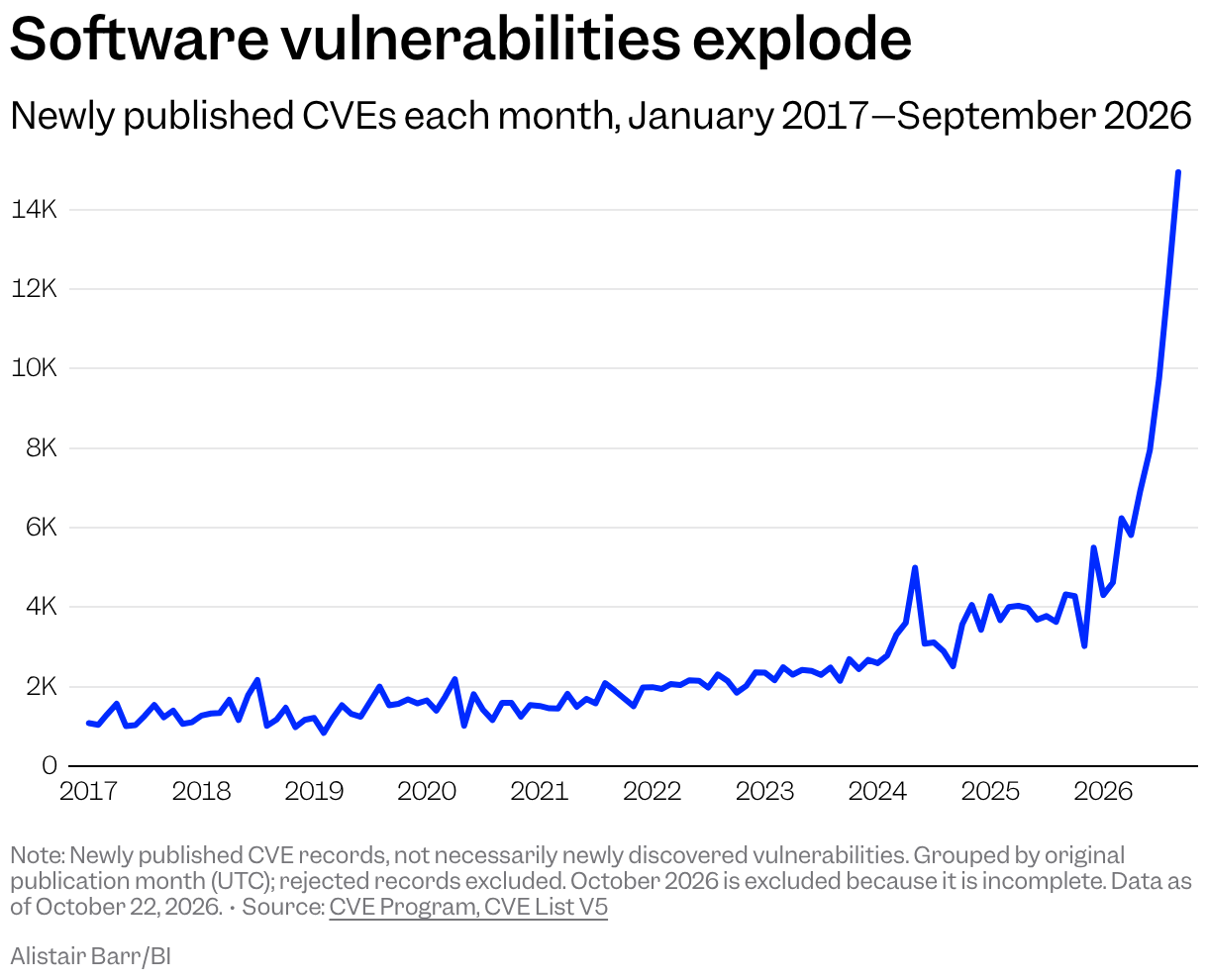
The result: The number of newly published software vulnerabilities (Common Vulnerabilities and Exposures in industry lingo) has exploded.

Line chart showing monthly newly published CVE records from January 2017 through September 2026. Counts rose from 1,083 in January 2017 to 14,934 in September 2026.

Now, there's a frantic race between people trying to break into systems and those trying to protect them.

Don't panic about AI

Cohen's message, though, was surprisingly reassuring.

AI helps the good guys find and fix these problems. Cloudflare, for instance, released protections for the latest vulnerability to customers, including those using its free service.

And there's a bigger effort underway.

OpenAI has launched an initiative called Patch the Planet, working with Cloudflare and other security professionals to use AI to find weaknesses in widely used software and help repair them.

Tom Occhino, chief product officer at Vercel, told me recently that his company has been talking with partners about launching a nonprofit that would fund a swarm of good AI agents that go out on the internet to find and fix software flaws.

Amazon is joining the fight, too. Its new Continuum service, available Thursday, uses AI agents to find security holes and propose fixes. Amazon said that people maintaining freely available software can use it to help protect the wider internet.

Humans may still have to check and approve these repairs, but the prospect of AI helping clean up decades of neglected software is encouraging.

The irony of this is not lost on some in the industry.

"The funny thing is everyone was saying AI slop code will cause a cyber crisis but it's actually all the old human slop causing it and the AI is just cleaning it up," software engineer Ben Kaufman wrote on X on Thursday.

Either way, Cloudflare's Cohen thinks these AI-inspired freakouts will push the industry to do better — by exposing issues and adding urgency to get them patched.

"We may end up in a world where actually we've become significantly more secure at the end," she said.

The trouble is getting there.

A fundamental question about the internet

Tom Occhino (left), chief product officer at Vercel, talks with Meta executive Prashant Ratanchandani at Vercel's Ship SF conference.

Alistair Barr/Business Insider

When I ran into Occhino recently at a Vercel conference in San Francisco, he described a world in which software that everyone assumed was safe suddenly looks vulnerable because increasingly capable AI models are scrutinizing the basic systems that underpin the internet.

That led to a more fundamental discussion between us: Why did we connect so many things to the internet in the first place?

For years, the technology industry has raced to put everything online. Thermostats. Refrigerators. Doorbells. Cars. Bank accounts.

We assumed that connecting something to the internet automatically made it better.

Perhaps we should reconsider.

Before the internet

I remember the world before the internet. It worked pretty well. We managed to buy groceries, pay bills, heat our homes, and generally get through the day without every appliance talking to a computer somewhere.

That doesn't mean abandoning online banking or throwing your smartphone into the sea.

Occhino, for one, isn't particularly worried about hackers wiping out his bank account. Modern banks have sophisticated protections, and he recommends everyone turn on additional login security.

Maybe the cybersecurity crowd, which spends its life immersed in online threats, is missing something obvious.

Not everything needs to be connected.

Occhino put it neatly: "There's certain things that don't make sense to be on the internet in the first place."

Perhaps that's the lesson from this week's panic. We don't need to turn off the internet.

We just need to remember where the off switch is.

Alice Tecotzky contributed reporting.

Sign up for the AI Insider newsletter here. Reach out to me via email at abarr@businessinsider.com

Read the original article on Business Insider

  •  

Wait, the average Muse agent purchase is over $200? Tell me what you're buying!

meta use billboard
Meta Muse, hard at work at spending your money.

Smith Collection/Gado/Getty Images

  • Meta says that over a quarter of Muse users made purchases with the AI agent.
  • The average order was over $200 — that's a lot of clams!
  • If this is you, please tell me what you're using it for.

Something just blew my mind, and I'm asking for your help to figure it out.

According to Meta's Q3 earnings call on Wednesday, more than a quarter of Muse users so far have used the AI agent make purchases — and the average order size is over $200.

I'll say that again: average order size over $200.

This is shocking to me, and I'm someone who has been actively and happily using Muse for a variety of things. I've been perfectly happy to give Muse access to my email, my calendar, my credit cards, and even my Apple health data.

But I've been slightly reticent about using it to actually buy stuff. Not that I'm totally worried about it getting stuff wrong (although the one purchase I did try to make with it was to order a salad for lunch, and it attempted to place the order on my HSA card after I failed to recognize the last 4 digits of that card, oops).

I think it's more I enjoy shopping online myself? I mean, for most things, I suppose. For "fun" stuff like clothes or personal items, I enjoy browsing and the hit of dopamine when you check out. (Others take this to the extreme, using "dopamine sites" that let you browse fake restaurants and "order" food that never arrives.) The other night I ordered — on a real site — cotton balls, razor blade refills, a plain white t-shirt, and a pair of scissors from the Target app while watching TV and even that boring purchase with a total under $30 gave me a small thrill. Why would I want to cede that joy to AI?

I understand, however, that not all purchases are fun. My colleague, Peter Kafka, used Muse to help him place an order for a new washing machine — the kind of purchase that is difficult to decide on, not particularly fun or exciting to make, and fairly expensive. Things like plane tickets, washing machines, or car insurance are in that category of stuff you have to buy, cost a lot of money, are fairly complicated to decide which option to buy, but bring very little joy during checkout.

I can understand why you might want to hand that off to an AI agent.

If you are using Muse to place big $$$ orders, what the heck are you buying?

My best guess here is that people are using Muse for airplane flights and hotels — the kind of big dollar items that are kind of annoying to book yourself, and you care mainly about just booking the right dates.

Am I right? You tell me!

Comment below, or you can email me at: knotopoulos@businessinsider.com. Or, you know, tell your Muse to email me.

Read the original article on Business Insider

  •  
❌