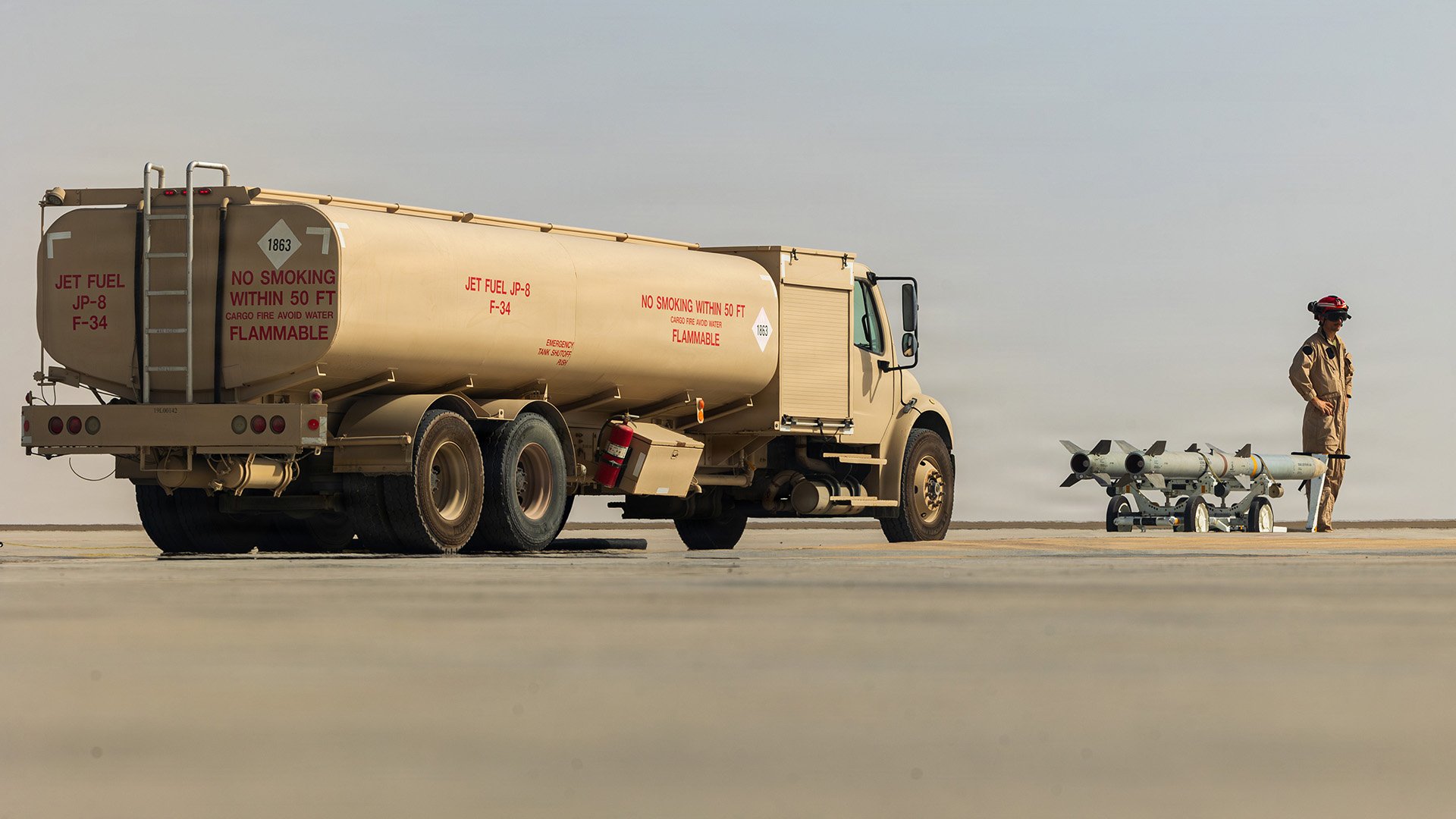
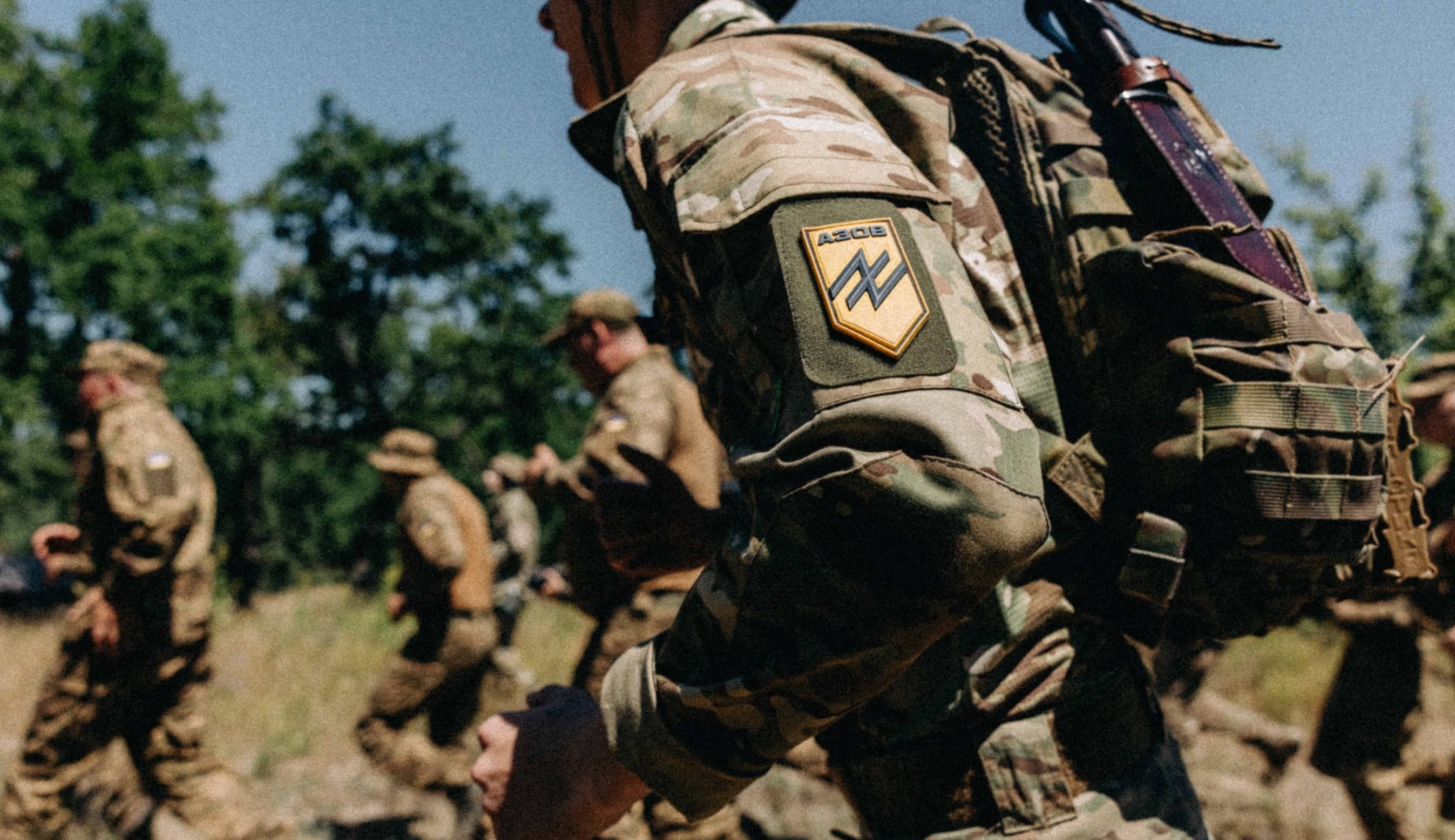
A year ago, Ukraine’s 125th heavy mechanized brigade was written off as beyond saving, manned at 17% with not a single tank, gun, or drone crew to its name. A year on, the brigade says it now ranks first among the army’s heavy brigades and that 1,500 soldiers who had gone absent without leave have returned to serve.
The 125th, part of Ukraine’s Third Army Corps, drew the comparison as it summed up its first year under new command. It comes as Ukraine struggles with a force-wide shortage of soldiers and leans on the Third Army Corps, the formation the 125th now fights under, for its counterattacks around Lyman.
The figures behind a brigade rebuilt from 17% strength
In the unit’s telling, the collapse was never the whole story.
“We were told the brigade couldn’t be saved. But they didn’t account for the main thing, people,” the brigade recalls.
By its own count, manning has risen 430% over the year, and its main units now stand at 95-100%. The crews that grew fastest were the ones flying drones: the number of aerial-reconnaissance teams is up 1200%, FPV crews 950%, heavy-bomber crews 1400%, and fixed-wing drone crews 600%.
The brigade also built units of uncrewed ground vehicles from scratch and stood up its own training, air defense, electronic warfare, reconnaissance, and medical structures.
Now, it is among the most effective brigades for destroying Russians, mining, artillery, air defense, ground robots, and reconnaissance, and for three months running it has placed first among the army’s heavy mechanized brigades on those combined measures.
From two pickups and a minibus to Bradleys and Leopards
The starting point was close to empty. At the beginning of the reform, the brigade had almost no combat equipment, its commander, Volodymyr Fokin, told ArmyInform in June.
“For the whole brigade we had two pickups and one minibus,” he said.
In the first six months, he added, the brigade replaced about 90% of its commanders in key posts and stood up a tank battalion, a drone battalion and a ground-robotics company.
Today it fields American Bradley infantry fighting vehicles, German Leopard tanks and artillery of various calibers.
A captain with the callsign “Skamer” told ArmyFM in July that the new equipment came with new ways of running the brigade, with more authority given to commanders who had real combat experience.
Vice President JD Vance is said to have made the outreach in a letter sent last week via Qatari meditators and delivered Sunday to an Iranian official, Gen. Mohsen Rezaei.
Ukraine's 3rd Army Corps declared victory two weeks ago
But the corps' Operation Vivaldi may continue
It's possible 3rd Army Corps troops are already crossing the Zherebets River
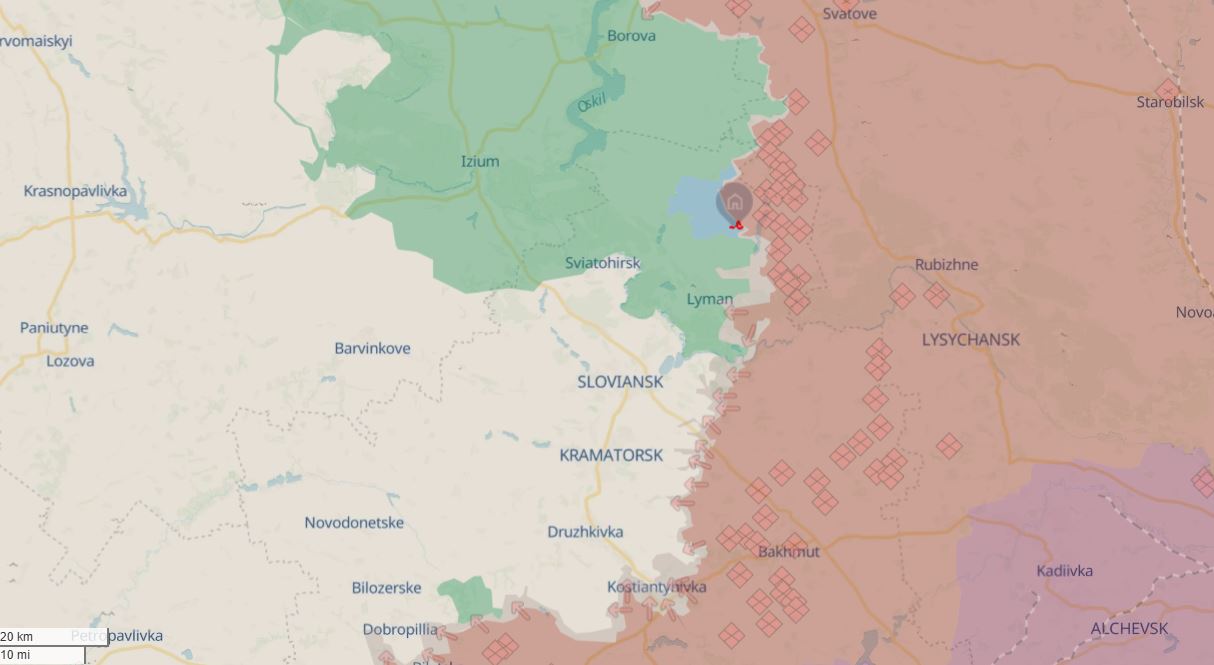
Starting in May, Ukraine's 3rd Army Corps began exploiting gaps in Russian lines just north of Sloviansk in eastern Ukraine's Donetsk Oblast. Five months later, the corps and its supporting drone units had cleared Russian troops from 277 sq km of northern Donetsk, inflicting what the corps says were 8,000 Russian casualties and pushing the Russian 20th and 25th Combined Arms Armies back across a key terrain feature: the Zherebets River.
On 14 October, the 3rd Army Corps declared victory in its Operation Vivaldi. "Four seasons of Vivaldi are over. But the music plays on," the corps wrote on Telegram.
It was unclear at the time what the corps meant. Its commander, Brig. Gen. Andrii Biletskyi, has since been seconded to lead Ukraine's new Center Group of Forces. But it's clearer now. According to at least two observers, Ukrainian troops have continued attacking along the Zherebets River—and have even crossed the river at several points.
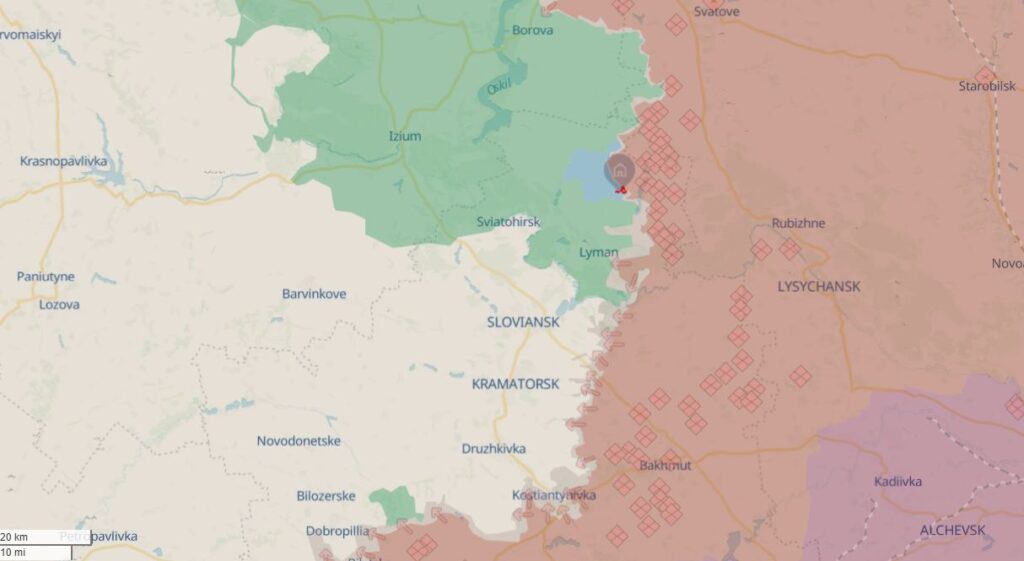
Map: Euromaidan Press
If true and confirmed, the crossings could ratchet up the pressure on the battered Russian 20th and 25th Combined Arms Armies following their hasty and chaotic retreat from their former salient north of Sloviansk. The Zherebets should have been a natural defensive barrier for the Russians.
Sheltering on the river's eastern bank, the Russians could have rested, reset, and reinforced in preparation for a renewed offensive next year. But if the Ukrainians keep attacking, rest might be impossible. And that could force the Russians to rethink any plans for a fresh push toward Sloviansk and neighboring Kramatorsk, the last two big free cities in Donetsk.
But an extension of Operation Vivaldi isn't without risk for the 3rd Army Corps. If the corps pushes too far, too fast across a difficult obstacle, it could expose itself to counterattack.
Ukraine's "Vilvadi" counteroffensive in the Lyman direction has not stopped, despite claims to the contrary.
Ukrainian forces have made new advances in several different areas over the last couple of weeks, crossing the Zherebets River onto its eastern bank at multiple different…
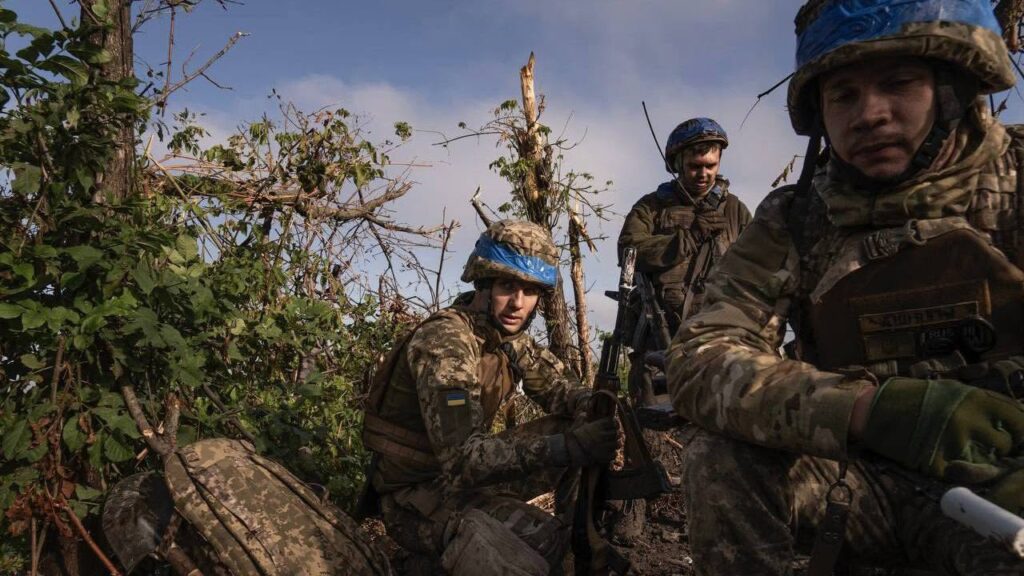
Ukraine's Vivaldi counteroffensive in the Lyman direction "has not stopped, despite claims to the contrary," the mapping account AMK Mapping explained on Monday after noting possible Ukrainian forces on the eastern side of the Zherebets in recent weeks. "Ukrainian forces have made new advances in several different areas over the last couple of weeks, crossing the Zherebets River onto its eastern bank at multiple different locations." AMK Mapping also noted that many Ukrainian assaults over the past month had been repelled and that casualties were likely rising.
AMK Mapping isn't alone. On Monday, mapper Suriyak also logged Ukrainian troops on the far side of the Zherebets in three key settlements: Makiivka, Novosadove, and Terny. "They are establishing a significant bridgehead," Suriyak wrote.
The possible Ukrainian river crossings could defy recent expectations. "The Ukrainians have continued their push and advancement toward the Zherebets River," mapper Clément Molin wrote on 20 October. "They have reached it at several points, and Russian forces no longer control any territory west of this river—with the exception of the forest east of Lyman."
Ukrainian-Russian war. Day 1700-1704: Situation on Luhansk front: During the last two weeks, Ukrainian army has managed to secure new positions on the western bank of the Zherebets River, including the south of Makiivka and the rest of Novolyubivka. However, military… pic.twitter.com/zfi1Txv3eA
But Molin didn't expect the 3rd Army Corps to force the river, a risky maneuver under the best of circumstances. "Despite various rumors, I have not been able to confirm that the Ukrainians have actually crossed the river," Molin wrote.
Instead, he expected the Ukrainian corps to do what the defeated Russian field armies were trying to do: consolidate in new positions and get ready for the next round of major fighting, potentially next year. "For the time being, I believe the Ukrainians will focus on consolidating their gains and adopting a defensive posture."
If indeed the 3rd Army Corps has crossed the Zherebets, it's a possible indication that the corps still has some combat power in reserve—and is eager to prolong its momentum for as long as possible, even if that means heavier losses in risky river crossings.
A major clash could occur if and when the 3rd Army Corps tries to seize full control of Terny, which anchors the Russian line on the east bank of the Zherebets. Two years ago, Terny was the site of intensive fighting as Russian forces fought their way across the Zherebets on their long march toward Sloviansk. That battle was a costly victory for the Russians as they sent mechanized column after mechanized column across a drone kill zone toward Terny.
Explore further
Starlink helped Ukraine pull off Operation Vivaldi. Now Starlink could help Russia take the ground back
The worst outcome for the outnumbered Ukrainian troops in northern Donetsk may be a mirror image of the Russian march through Terny in 2024. Yes, the Russians eventually captured Terny and secured a bridgehead on the western bank of the Zherebets. But the Russians overextended as they kept pushing toward Sloviansk, roughly 40 km to the southwest of Terny.
It's that overextension that afforded the 3rd Army Corps the opportunity to counterattack and roll back the hard-won Russian gains. To preserve its own recent victory on the western side of the Zherebets, the 3rd Army Corps may want to choose caution. Ukrainian forces "need to organize a coherent and solid defensive line," Molin advised.
That may mean not attacking across the Zherebets—despite the temptation to do so.
An Indonesian taxi driver who went looking for work abroad ended up in Russia's army and died in his first battle in Ukraine, Ukraine's military intelligence (HUR) said. Russian recruiters found him through a job application, and he reached the front in Donetsk Oblast within weeks of signing. HUR calls him one more foreigner drawn into Russia's war through deception.
Russia's war against Ukraine consumes men faster than the Kremlin is ready to replace them through another mobilization at home, so it keeps hiring abroad. Ukraine has identified nearly 46,000 foreigners who signed with Russia's army since 2022. On 26 October, a UN commission found “compelling evidence” that Russia trafficked men from 29 countries into its forces.
A résumé that reached Russian recruiters
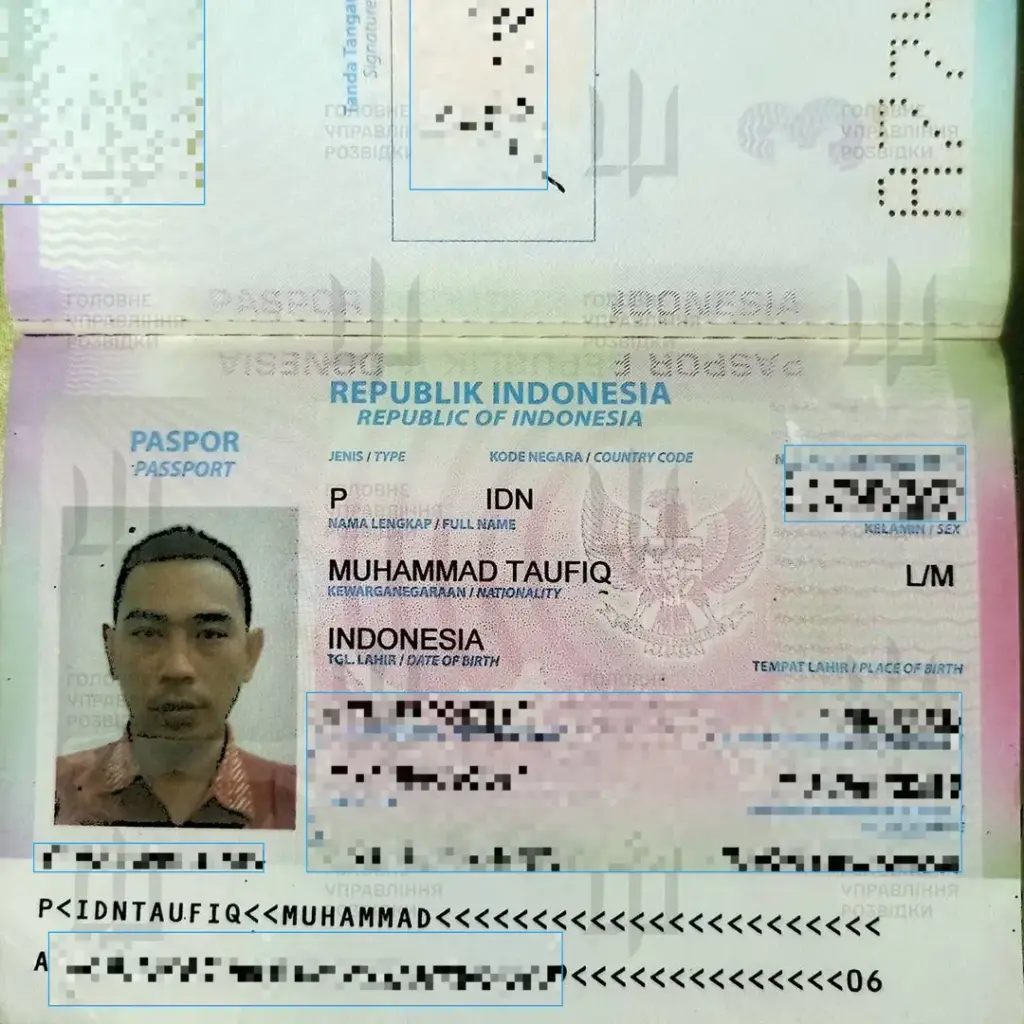
Taufiq Muhammad, born in 1978 in Sorong, Indonesia, drove a taxi in Jakarta and had once worked in the US. Russian recruiters found him through a résumé he had sent out while looking for work, the agency said. He probably believed promises of “easy money” and traveled to Moscow. HUR sees his case as part of a pattern.
“In fact, he became yet another victim of Russia's scheme of recruiting foreigners for the criminal war through deception,” HUR said.
A week and a half of training, then the front
Muhammad signed a one-year contract with Russia's army in Korolyov, near Moscow, on 19 April 2026. HUR called that term typical for foreigners Russia uses as “disposable” infantry. Russia made him a machine gunner and gave him only a week and a half at a training center near Voronezh, Army Inform reported, citing HUR.
Passport of Taufiq Muhammad, an Indonesian citizen Ukraine’s military intelligence says Russia recruited, with his personal data pixelated by Euromaidan Press. Photo: HUR
Russia moved him to occupied Ukraine in early May. He died almost at once, in his first battle. Russian troops were trying to advance from the village of Zelena Dolyna toward Novoselivka and Drobysheve in Donetsk Oblast, Militarnyi reported.
Indonesia is the newest recruiting ground
Russia's recruiters have been working in Indonesia for months. In August, Ukraine's Foreign Intelligence Service said it held documents on at least eight Indonesians recruited into Russia's army.
Another Indonesian, Rendi Apriyanto, 30, was reportedly killed in September, his family learned from an Indonesian fighting for Russia. Rendi had told his family he was recruited for logistics work, The Jakarta Post reported.
HUR has traced the same fast track before. In January, it identified a Filipino recruit killed in a Donetsk Oblast assault after one week of training. A Nigerian, 34, died in Kharkiv Oblast after a similar week of training, HUR said in May.
Russia courts Africa ahead of a summit
Ukraine's Foreign Ministry has counted at least 2,982 Africans recruited into Russia's army, and 486 of them have died. Ahead of a Russia–Africa summit on 28–29 October, Moscow plans military and port-access deals with a string of African states, HUR said. The deals would help expand the campaign of Russia's Africa Corps, the Defense Ministry-controlled force on the continent, Army Inform reported, citing HUR.
Each recruit Ukraine identifies gives his home government a documented case to act on. Jakarta has said citizens shown to have been deceived will get its protection, while those who enlisted by choice could lose their citizenship.
Russian troops are trying to drag Radkivka, a village on the northern edge of Kupiansk in Kharkiv Oblast, into the gray zone so their infiltration groups can keep reaching the city, Viktor Trehubov, spokesperson for Ukraine’s Joint Forces Grouping, said on national television on 27 October, Ukrinform reported. Russian forces made three attempts to advance toward Radkivka on 26 October, Ukraine’s General Staff reported.
Russia has tried for more than a year to retake Kupiansk, a city on the Oskil River, largely by slipping small groups through a disused gas pipeline under the river. They kept using it even after Ukraine said in September 2025 that it had flooded three of the four pipe strings, until Ukrainian troops went into the pipes themselves in Operation Veles, announced on 22 October.
Russian groups now have to move above ground
The pipe Russian groups used to seep toward Kupiansk has been put out of action, so they now have to go through Radkivka or neighboring Holubivka, Trehubov said. They move along the bank of the Oskil and a nearby tree line, but the foliage will soon be gone, which will make that much harder.
When the battlefield became transparent, the war went underground.
Khartiia Corps, together with other Defense Forces units, is conducting the underground Operation VELES, and for the first time, we can show the work of our brothers-in-arms in this new dimension of warfare.
On the western bank of the Oskil, Russian forces took losses from Ukraine’s Khartiia Corps and in Operation Veles, and their logistics have “suffered noticeably,” Trehubov said. Advancing there is now harder for them than it was a month ago, he added.
Viktor Trehubov, spokesperson for Ukraine’s Joint Forces Grouping. Photo: Ukrinform
Everything now depends on how the fights for Holubivka and Radkivka end, Trehubov said.
“If Ukrainian control can finally be established there, the Russians will have nowhere much to crawl through,” he said.
Several dozen Russian soldiers remain in low-rise buildings in northern Kupiansk, and Ukrainian forces are working to cut off their rotations, Trehubov said on 23 October.
Each side wants the other off its bank of the Oskil
On the eastern bank, Russian forces keep pushing toward the village of Podoly and Kupiansk-Vuzlovyi, a railway junction town southeast of Kupiansk, aiming to wipe out Ukraine’s foothold there, Trehubov said. Ukraine wants to destroy the Russian foothold on the western bank.
“For that, we will need to at least somehow throw them out of Dvorichna,” Trehubov said, referring to a town north of Kupiansk.
The US-based Institute for the Study of War (ISW) assessed that Russian forces conducted no offensive operations on the Kupiansk axis on 26 October, likely because Ukraine now controls the pipeline, a view at odds with the General Staff’s report for that day.
Ukraine reported confident control of Kupiansk as early as February, yet Russian groups kept slipping into the city for months afterward. Trehubov’s latest assessment stops short of declaring that threat over: Russia will still try to advance, he said.
The European Parliament voted on Thursday, 22nd October, to support a €47.4 billion budget for the Erasmus+ programme between 2028 and 2034, demanding substantially more funding than proposed by the European Commission.
The parliamentary position was approved by 454 votes to 34, with 93 abstentions, following negotiations over the future of the EU’s principal education, training and student mobility programme.
MEPs are seeking approximately €6.56 billion more than the Commission’s proposed €40.83 billion allocation, arguing that existing financial support does not adequately reflect rising living costs and the expense of studying abroad.
The decision establishes Parliament’s negotiating position but does not represent final approval of the funding. The programme remains subject to negotiations with national governments and agreement on the EU’s next seven-year budget.
Rising living costs affect student mobility
Erasmus+ allows students, apprentices, teachers and other participants to study, train or gain professional experience in another participating country.
Although widely associated with university exchanges, the programme also supports vocational education, schools, adult learning, youth organisations and sporting activities.
Participation often involves substantial personal expenditure, particularly for accommodation, transport and everyday living expenses.
These costs vary considerably between European destinations, creating financial difficulties for students whose Erasmus grants cover only part of their expenses.
The European Parliament is consequently calling for support mechanisms that account for differences in housing and living costs between host countries, regions and cities.
The proposal is intended to make participation more accessible to people who cannot rely on additional financial assistance from their families.
The European Parliament’s research service has identified unequal access, financial limitations and administrative complexity among the challenges facing the programme.
The proposed legislation would also establish a target under which at least 20 per cent of participants in mobility activities would be people facing fewer educational or economic opportunities.
Parliament seeks larger education allocation
The parliamentary proposal provides for approximately €47.39 billion in current prices over seven years.
The Commission originally proposed approximately €40.83 billion, combining funding for Erasmus+ with activities currently administered through the European Solidarity Corps.
According to the report prepared by Parliament’s Committee on Culture and Education, the revised programme would include more explicit financial allocations for different activities.
Education and training would account for approximately 74.6 per cent of the proposed financial envelope, while youth and volunteering would receive around 15 per cent. Sport would receive approximately 4.1 per cent.
The proposed allocation structure is intended to provide greater certainty for organisations planning longer-term educational projects and cross-border partnerships.
Polish MEP Bogdan Andrzej Zdrojewski, of the European People’s Party, is Parliament’s rapporteur on the legislation. His report calls for greater transparency over expenditure and more predictable funding arrangements.
The programme would continue supporting European university alliances, international educational cooperation and initiatives intended to improve professional skills.
Volunteering and vocational training
One proposed change concerns the integration of the European Solidarity Corps into the wider Erasmus+ framework.
The Solidarity Corps currently offers young people opportunities to participate in volunteering and community activities, including projects addressing social and humanitarian needs.
The Commission has proposed bringing these activities within the new programme in an attempt to simplify administration.
However, parliamentarians want safeguards to ensure that volunteering remains identifiable and accessible within the broader funding structure.
The parliamentary position also seeks to extend mobility opportunities across vocational training, adult education and sport.
These activities would allow a wider range of participants to benefit from international placements, including people outside conventional university education.
Additional attention is being given to the financial circumstances of participants and the administrative requirements faced by smaller educational organisations.
Dispute over the EU’s next budget
The Erasmus+ negotiations are taking place against the background of a wider dispute over the European Union’s 2028–2034 financial framework.
Member states are debating the overall size of the budget and the competing demands of agricultural policy, regional development, defence, research and education.
As EU Today recently examined, the negotiations have exposed disagreements over whether the EU should expand its financial commitments or constrain expenditure during a period of pressure on national finances.
Parliament’s Erasmus+ proposal will therefore depend not only on agreement over educational priorities but also on the final distribution of resources across the wider EU budget.
Some governments may support broader participation while resisting the full increase requested by MEPs.
What happens next?
Negotiations must establish the programme’s final budget, eligibility rules and the arrangements governing grants after 2027.
The Council has already developed a negotiating position on aspects of the programme, although financial questions remain connected to the broader budget settlement.
Erasmus+ will mark its 40th anniversary in 2027, shortly before the new framework is scheduled to begin.
More than 17 million people have participated in the programme and its related activities since its establishment.
The outcome of the current negotiations will determine whether the next generation of participants receives more financial support and whether the programme can expand without increasing the proportion of costs borne by students and their families.
Ukraine's Operation Vivaldi may have begun as early as March
The counteroffensive seemingly inflicted more damage on a pair of Russian field armies than previously thought
But the gains could be fleeting if a new speed cap on Ukraine's military Starlink terminals stays in place
The Ukrainian 3rd Army Corps' Operation Vivaldi—its secretive counteroffensive east of Sloviansk in northern Donetsk Oblast—started earlier than first reported, and by the time it ended on 14 October it had cost the Russians more than 8,000 troops, by the 3rd Army Corps' count.
It was a major Ukrainian victory in one of the most important sectors of Russia's 56-month wider war on Ukraine. But it could prove to be a temporary win, one the Russians may be able to partially reverse, if the administration of US President Donald Trump continues to throttle Starshield, the military version of Starlink that Ukraine's drones and commanders rely on.
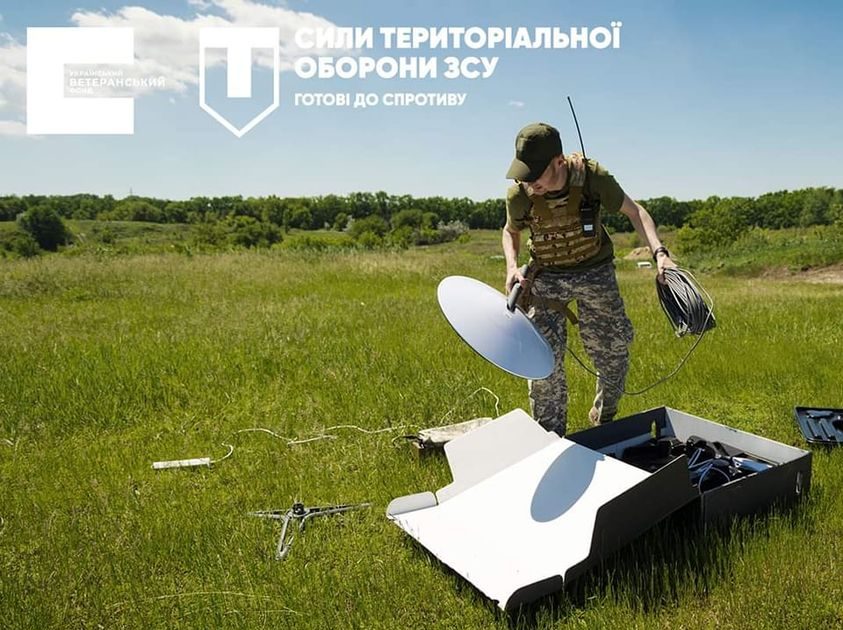
The Ukrainians' former command and control advantage, largely attributable to once-reliable Starlink and Starshield access, was pivotal as Operation Vivaldi played out in the Donbas region in stages starting in March. That advantage shrank practically overnight on 14 October, when a new speed cap began cutting off Ukraine's Starshield terminals whenever they moved faster than about 160 km/h (100 mph).
The 3rd Army Corps attacked east of Sloviansk and north of Lyman as early as March, analyst and mapper Clément Molin concluded after scrutinizing official videos and interviews the Ukrainian defense ministry recently released. "The operation began much earlier than initially thought," Molin wrote.
We are now 5 months after the start of Ukraine's Vivaldi operation and it has now officially ended
A month after the operation was revealed, we know have much more information on the biggest Ukrainian success of the year.
In early February, SpaceX, working from a Ukrainian defense ministry whitelist, switched off the thousands of stolen and smuggled Starlink terminals the Russians had been using.
That had the effect of grounding many Russian drones and blinding many Russian commanders. Taking advantage of the Russians' confusion, Ukrainian troops attacked in several key sectors: in Zaporizhzhia and Dnipropetrovsk Oblasts in the southeast, and east of Sloviansk in northern Donetsk.
The Donetsk attack expanded into a full-blown counteroffensive under conditions of strict secrecy as the 3rd Army Corps probed for weaknesses along the flanks of the Russian 20th and 25th Combined Arms Armies, then overextended along the axis between the Zherebets River in the east and the outskirts of the Sloviansk-Kramatorsk urban conglomeration in the west.
The Russians had been threatening to lay siege to Sloviansk and Kramatorsk, the last two big free cities in Donetsk Oblast, from two directions: the north and the south. Operation Vivaldi eliminated the northern threat—and at great cost to the Russian 20th and 25th CAAs.
A Ukrainian Hornet drone about to hit a buhanka, the UAZ van Russian forces use to haul troops and supplies to the front. Drones like this one have been choking Russian military supply lines. Via WarTranslated.
Drones lead
Aerial drones and unmanned ground vehicles led the attack, taking the Russians by surprise. "For an offensive operation, the Ukrainians sustained relatively few casualties compared to previous engagements," Molin explained. "Conversely, the defending Russian forces suffered significantly higher losses, largely due to the rapid encirclement of at least three regiments, not all of which managed to escape the area."
It's unclear how many casualties the Russians suffered, but they might number in the thousands. The 20th and 25th CAAs were particularly fragile because the 3rd Army Corps and supporting drone units had been bombarding their supply line with so-called "middle strike" drones.
But many middle strike drones rely on civilian-style Starlink satellite terminals or the more rugged, better-performing Starshield. Now that the 3rd Army Corps has wrecked Russia's 144th Motor Rifle Division, which the Institute for the Study of War assessed on 20 October has effectively ceased to exist as an organized fighting force, and pushed the Russian survivors back to the far bank of the Zherebets River, the Ukrainians are probably "consolidating their gains and adopting a defensive posture," according to Molin.
Operation Vivaldi. Map: Euromaidan Press
But that defensive posture, protecting Sloviansk from a northern attack, depends on reliable communications and responsive drones. On 14 October, a new speed cap hit Ukraine's Starshield terminals, cutting the link on any drone flying faster than about 160 km/h. Who ordered it is disputed. Sources told Reuters the order came from inside the White House, and that Pentagon leaders were told the service needed to be slowed.
The Wall Street Journal reported that Musk himself ordered the slowdown, and that he and Trump discussed it soon after it became public. While Trump has denied ordering the speed limit, it's worth noting that the American president has become more overtly friendly toward Russia as his Republican Party looks likely to lose control of the US Congress in the November mid-term elections.
The speed limit renders many of the faster middle-strike drones unflyable. As a result, "Ukrainian drone strikes have diminished significantly following yesterday's crippling of Ukraine's Starlink/Starshield connections, Russian sources report," the military history account ChrisO_wiki wrote on X on 15 October, the day after the speed limit took Ukrainian operators by surprise.
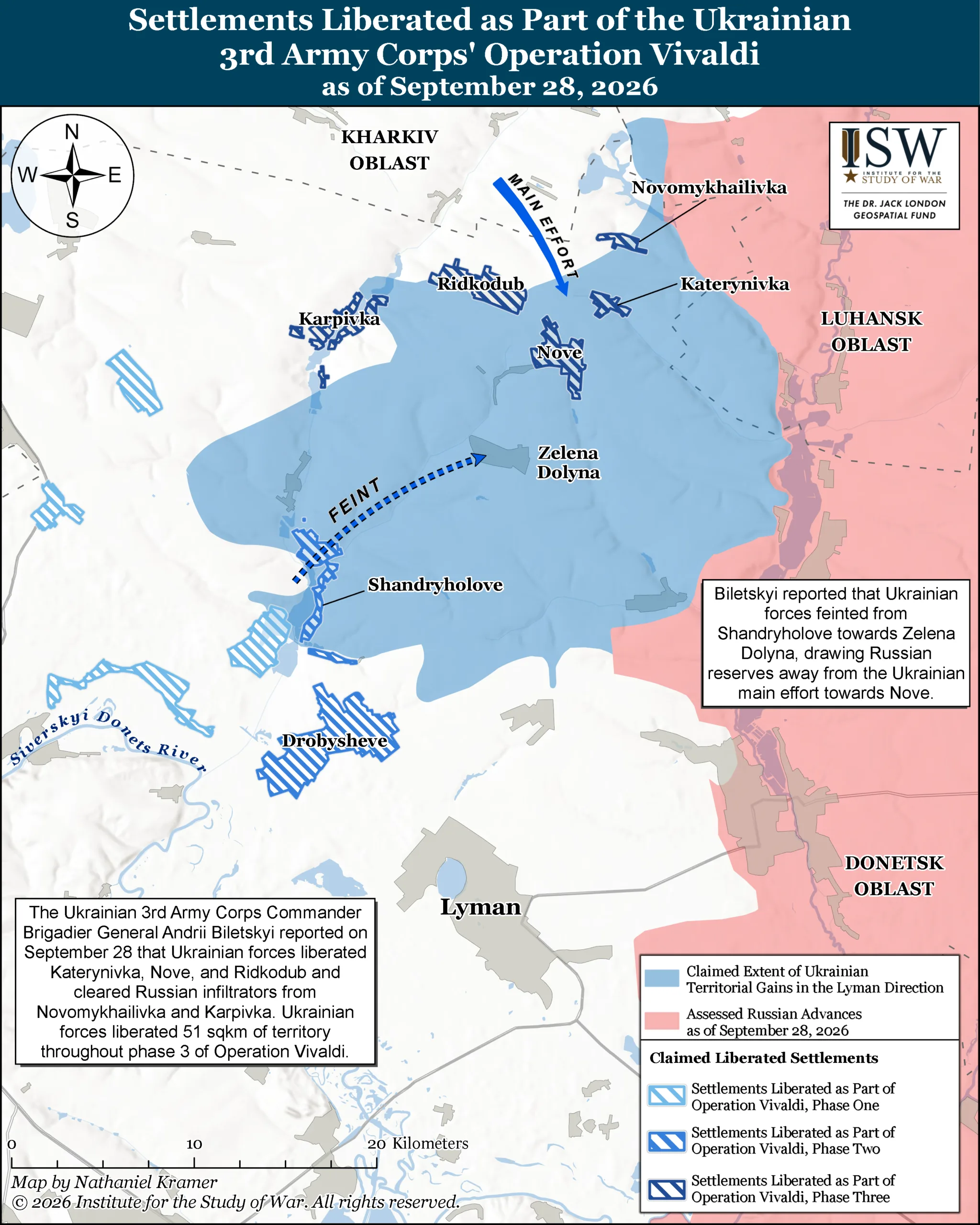
Settlements Ukraine's 3rd Army Corps says it liberated during Operation Vivaldi north of Lyman, Donetsk Oblast, Ukraine, as of 28 September 2026. Map: ISW
Explore further
Russia is back at Dobropillia a year after it failed there. Now it’s the southern jaw of a pincer on Donbas’s last big free cities
A reduction in middle strikes on Russian supply lines could help Russian field armies recover from recent setbacks, including their retreat back across the Zherebets River. And if the communications confusion resulting from the partial loss of Starlink/Starshield connectivity persists, it could give the Russians the same kind of opportunity the Ukrainians had back in the spring.
An opportunity to go back on the attack—and an Azov communications engineer warned Euromaidan Press in February that the shoe might be on the other foot.
That's the worst-case scenario for the Ukrainians now that Operation Vivaldi has ended. The best case is that they get full Starlink and Starshield access back—or find command and control alternatives—and duplicate, in other sectors, the same success they enjoyed in northern Donetsk.
"Now that the northern flank of Donbas is secured, at least for some time, the focus will concentrate on the southern flank," Molin predicted.
Explore further
Starlink crackdown cripples Russians—but American engineer warns Ukraine is just as vulnerable
Renewed hostilities might not be any more successful than the war’s first phase, and President Trump has repeatedly canceled plans for a return to major combat.
The commander of an interceptor battalion in Ukraine’s 3rd Army Corps said his unit destroyed several thousand Russian aerial targets during Operation Vivaldi, ArmyInform, the Defense Ministry’s news agency, reported on 21 October.
Operation Vivaldi is a Ukrainian counteroffensive north of Lyman in Donetsk Oblast, where the 3rd Army Corps has reported liberating settlements. In its third phase, Ukrainian forces reclaimed five settlements and expanded their gains to 176 square kilometers. Strikes on Russian logistics and electronic warfare likely neutralized Russia’s drone defenses before Ukraine sent in armor, the Institute for the Study of War assessed.
The commander, who uses the callsign “Betsyk,” leads the interceptor battalion of the 1030th Anti-Aircraft Missile-Artillery Regiment “Aquila,” part of the 3rd Army Corps. He said Russian forces deployed large numbers of reconnaissance drones to locate Ukrainian positions after the corps began advancing.
Betsyk named Zala, Orlan, Supercam, Merlin, and Knyaz Veshchiy Oleg among the reconnaissance drones used by Russian forces.
Russia also brought in reinforcements and units operating strike drones, including first-person-view (FPV) quadcopters, Molniya fixed-wing FPV drones, and Lancet crews, he said. At one stage, Russian forces deployed crews from their Rubicon drone unit to disrupt the advance, but the move did not change the situation.
Explore further
Ukraine retook Kolodiazi north of Lyman as its drones hit 200-plus Russian vehicles in Operation Vivaldi’s last phase, Ukrainian drone officer says
Betsyk said his battalion’s work deprived Russian forces of the ability to strike Ukrainian troops and track their movements.
Jet-powered Shaheds: speed is the main challenge
The regiment also works against Russian strike drones heading for targets behind the front line. Betsyk said interceptor crews had destroyed some jet-powered drones, but not in significant numbers.
The main difficulty is speed, he said. Interceptor drones need to reach 500–600 km/h to intercept Russian jet-powered attack drones, according to Betsyk.
For now, the regiment mainly uses conventional air-defense systems against these targets: self-propelled anti-aircraft systems, surface-to-air missile systems, and portable surface-to-air missile systems. Betsyk said these systems were historically designed to engage jet-powered targets.
He compared the current challenge with the early use of piston-powered Shaheds. Those drones initially posed a serious threat but later became easier for Ukrainian air defenses to counter. Russia has largely stopped using piston-powered Shaheds on most fronts since summer, he said, but continues to use piston-powered Gerbera drones, which are relatively cheap and can partly exhaust Ukrainian air defenses. The main drones Russian forces use now are jet-powered Shaheds, he said.
Betsyk expects Russian forces to adapt if Ukraine fields effective interceptors against jet-powered drones. They will seek ways to evade the interceptors, increase speed, improve navigation, and change their tactics, he said. However, he added that the battalion had not observed a major evolution so far and did not expect the drones’ speed to double.
What the corps says Vivaldi achieved
Separately, 3rd Army Corps commander Andrii Biletskyi said Ukrainian forces retook 277 square kilometers and 16 settlements during Operation Vivaldi, Ukrainska Pravda reported. Biletskyi also said Russian losses exceeded 8,000 personnel, according to ArmyInform. These figures are Ukrainian claims and have not been independently verified.
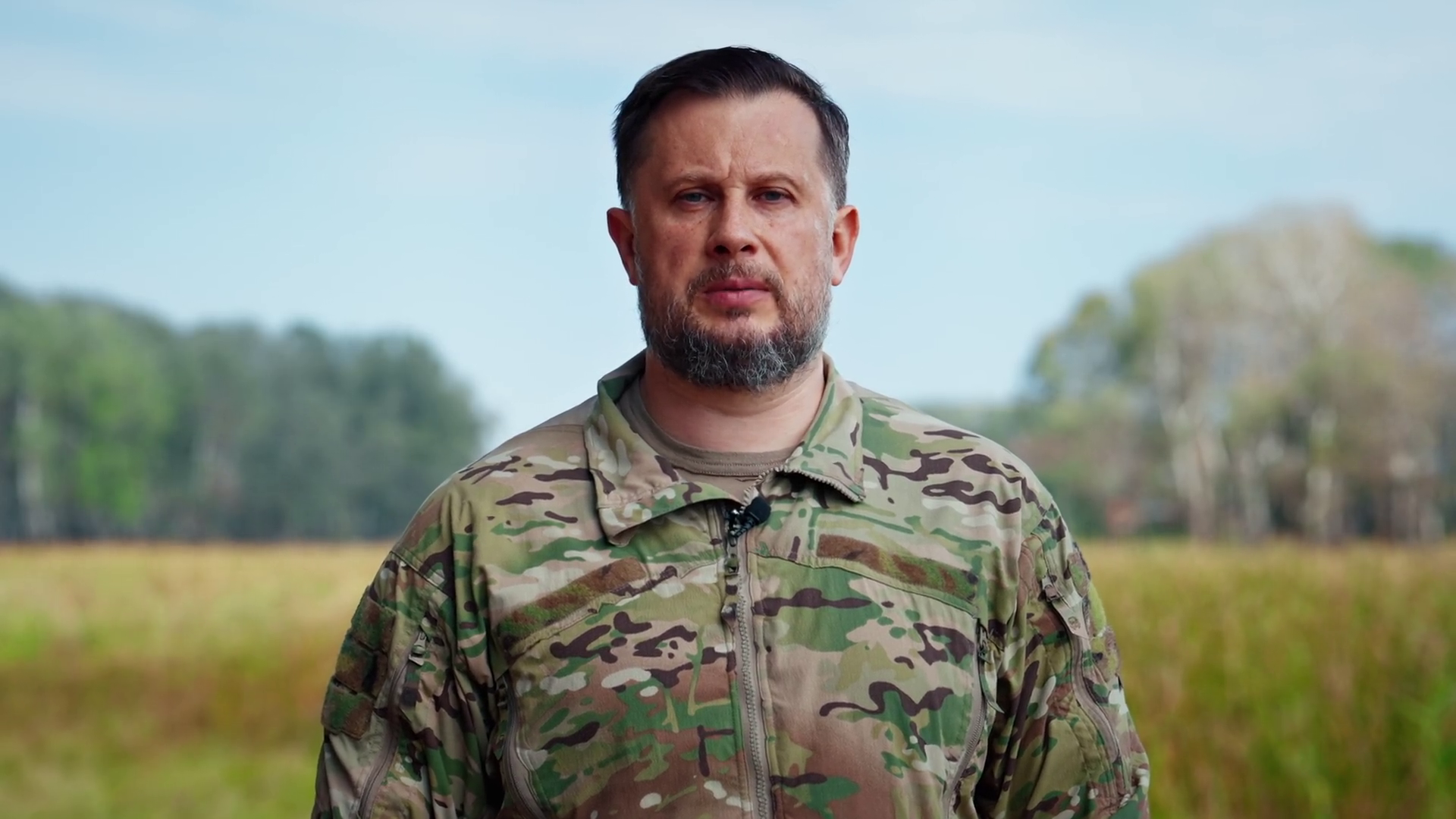
Russia’s Rubicon drone unit, which is sent to hunt Ukrainian drone pilots, was not used to being hunted itself, Brigadier General Andrii Biletskyi told journalists on 19 October. He was summing up Operation Vivaldi, which his Third Army Corps fought in northern Donetsk Oblast from May to mid-October. Once its pilots realized they were being killed, Rubicon’s morale dropped sharply, he said.
Russia has fought for 12 years to take all of Donetsk Oblast, and Sloviansk and Kramatorsk anchor the fortress belt of cities Ukraine still holds there. Vivaldi retook 277 km² in northern Donetsk Oblast. Biletskyi says it destroyed Russia’s bridgehead on the Chornyi Zherebets River and forced Moscow to drop its plan to bypass Lyman from the north and encircle the two cities. On that front, the Third Corps had flagged Rubicon, Russia’s elite drone unit, as a threat.
Hunting the hunters
Once a Rubicon position was found, the Third Assault Brigade and the KRAKEN drone regiment committed any number of FPV and bomber drones to destroy its crews, Biletskyi said.
The brigade’s commander, Yaroslav Levenets, said his troops prepared for Rubicon’s arrival and concentrated on killing its pilots. He gave no details.
“Not stable in defense,” Levenets said of Rubicon’s troops.
They dislike sitting in trenches, he said, and under pressure they grow nervous and change positions.
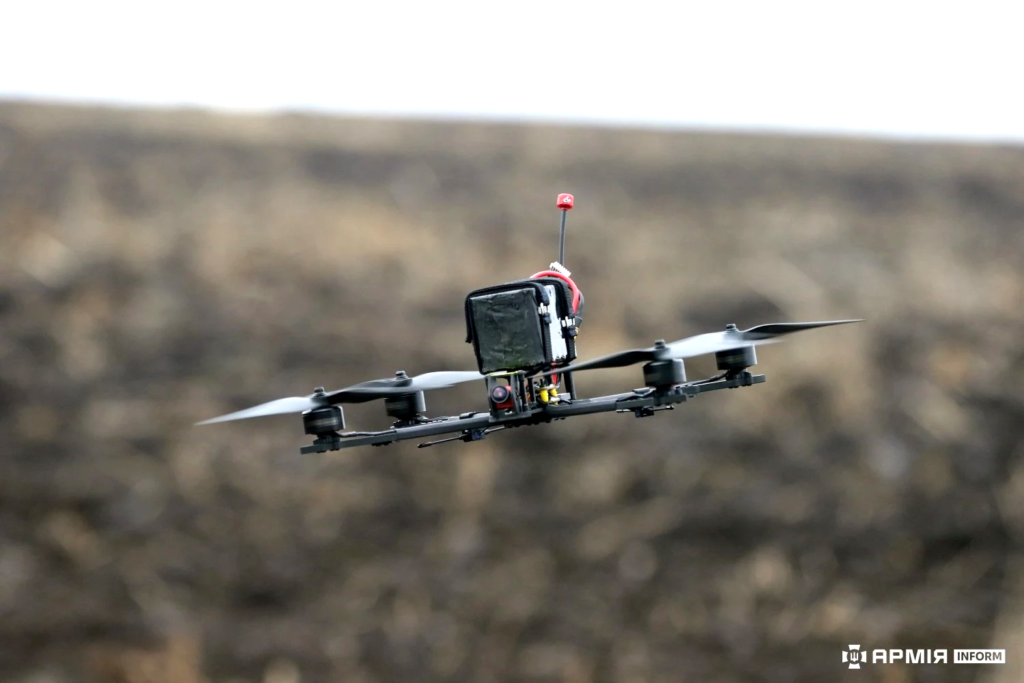
An FPV drone. Illustrative photo: ArmyInform
Named for four seasons
Biletskyi said the name was chosen at the very start of planning, in winter 2025–2026, many months before the operation began. The original plan had four stages, one for each season, and later grew to slightly more, ArmyInform reported.
When he first unveiled the operation in September, he put it this way:
“Vivaldi, as is known, has four seasons. And this is only the first one.”
He credited two planners, known by the call signs Yurist and Leshyi. Leshyi, an assault soldier wounded seven times who later moved to staff work, was killed. Yurist was seriously wounded.
Explore further
Ukraine blocks Russia from outflanking its fortress cities in Donbas, retaking 277 square kilometers and hitting 8,000 Russian troops
A new hand at the Third Corps
Major Dmytro Rohoziuk is now acting commander of the Third Army Corps, the corps press service said on 20 October. The press service said the move is not a transfer, and Biletskyi keeps his formal post as corps commander while he leads the “Center” grouping of the Third, 11th, and 19th corps.
Major Dmytro Rohoziuk, acting commander of Ukraine’s Third Army Corps. Photo: Armed Forces of Ukraine
Rohoziuk took over the 60th Mechanized Brigade in October 2025. Its previous commander was arrested in January after the State Bureau of Investigation accused him of embezzling about $1 million in weapons procurement. The brigade fought in all four phases of Vivaldi and retook Kolodiazi without street fighting.
Ukrainian troops capture a Russian infiltrator carrying a Russian flag during Operation Vivaldi in northern Donetsk Oblast. Photo: Third Army Corps
Biletskyi also declined command of the Ground Forces, which oversee mobilization.
“There’s no point taking on something you don’t truly believe you can improve,” he said.
Biletskyi’s count
Russian losses in Vivaldi topped 8,000 troops, and about 270 Russian soldiers were taken prisoner, Biletskyi said. More than 20 officers surrendered, including a chief of staff and three company commanders.
The territory matters less than disrupting Russia’s strategic plan, he said. Russian forces still press toward Dobropillia, where Ukraine is counterattacking.
Ukrainian infantry encircled and retook the village of Kolodiazi north of Lyman without getting drawn into street fighting, while a drone battalion kept the sky above them shut, the battalion’s chief of staff told Suspilne on 18 October. The village fell during the fourth and final phase of Operation Vivaldi, Ukraine’s counteroffensive in northern Donetsk Oblast.
For years now, Russia has aimed to seize Lyman and cross the Siverskyi Donets River. It needs this area to encircle Ukraine’s fortress belt of Donetsk Oblast cities from the northwest, ISW assesses. Vivaldi’s four phases retook 277 km² and 16 settlements on that approach, and a veteran of the operation has said Ukraine’s assault troops suffered more than ten times fewer casualties than Russian forces doing it.
Drones over the infantry
The 60th Mechanized Brigade fought in all four phases of Vivaldi and took Kolodiazi in the last one, said the chief of staff of the brigade’s Fatum unmanned systems battalion, callsign Krash.
“Our task, as an unmanned systems battalion, was to escort and ‘close’ the air in front of our infantry to make it impossible for the enemy to hit it. To suppress all the firing assets possible,” he said.
The brigade’s 3rd Mechanized Battalion, the main striking force, encircled Kolodiazi and retook it without getting drawn into street fighting, Krash said. The 1st Mechanized Battalion kept Russian reinforcements out of the area, while drone crews suppressed artillery, hit supply runs, and worked against Russian drone operators.
Explore further
Vivaldi counteroffensive advanced after Ukraine took Russia’s drones out of the fight, ISW assesses
500 troops and 200-plus vehicles
The drone battalion killed or wounded about 500 Russian troops during the fourth phase and struck Russian armored vehicles, trucks, and motorbikes, its chief of staff said.
“More than two hundred pieces of various equipment: Grad and Uragan multiple rocket launchers, various armored vehicles, tanks, armored combat vehicles. Most of all motorbikes and quad bikes, there the count runs into the hundreds. This is our enemy’s main logistics tool,” he said.
Lyman sector now. Map: ISW
Ghost villages
The villages retaken in northern Donetsk Oblast are nearly empty of civilians, Krash said.
“It’s very typical for de-occupied settlements: these are ghost towns. You can see right away where the occupier stepped. All the settlements are under the control of the Third Army Corps, our forces stand there and prevent enemy infiltration. But civilian life in these towns is either absent or very scarce,” he said.
Third Army Corps commander Brigadier General Andrii Biletskyi reported Kolodiazi’s liberation, along with Zelena Dolyna and Lypove, when he summed up Vivaldi’s fourth phase, which secured 101 km².
Russia’s drone and missile attacks on Ukraine’s population and infrastructure continue to dominate coverage of the conflict. But on the ground, Ukraine has been making significant, if still limited, gains. In mid-September, Ukraine formally announced the existence of Operation Vivaldi, which has retaken territory near Lyman and disrupted a Russian advance toward the fortified cities […]
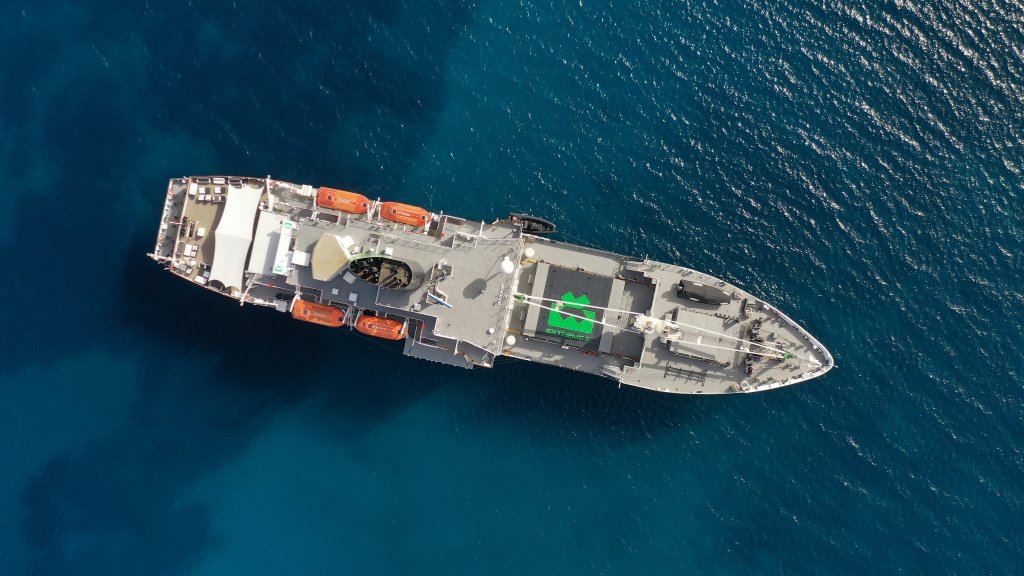
On Sunday, NBC News reported that Marines were injured during an Iranian cruise missile attack while transiting the Strait of Hormuz on Sept. 14. The network’s sources said the Marines were not on a U.S. Navy ship, but they did not identify which vessel they were on. However, a former Royal Mail vessel that at one point was being converted into a floating armory stands out as a strong possibility.
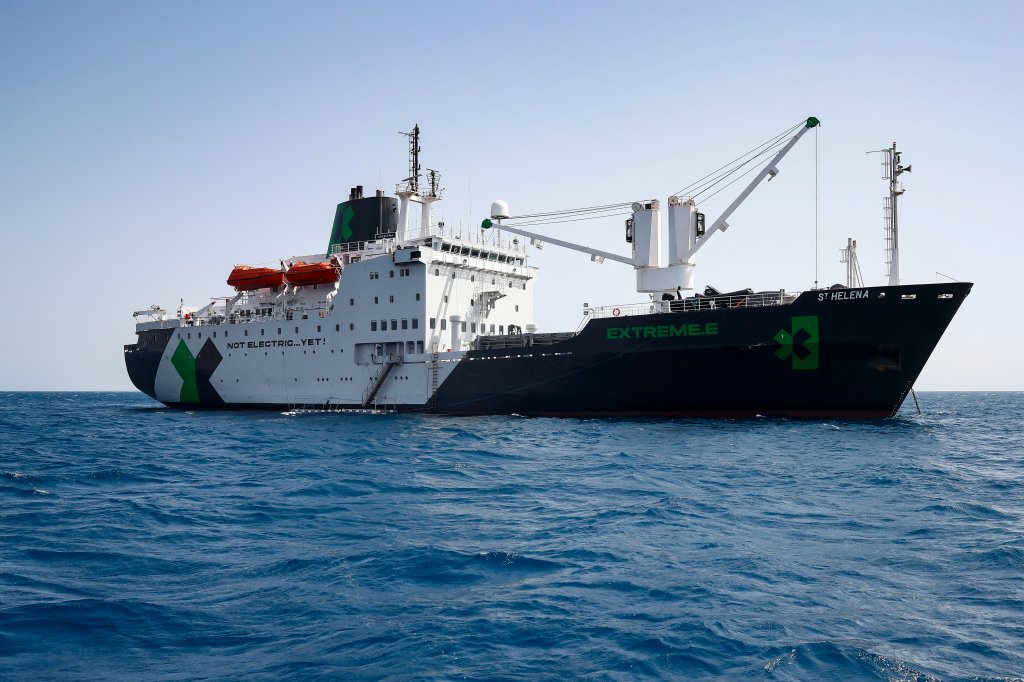
While much remains unclear about the Sept. 14 incident, there was only one vessel known to have been struck that day, according to the United Kingdom Maritime Trade Operations (UKMTO) and a maritime security official we spoke with. The ship was eventually identified by several maritime media outlets as the M/V St. Helena. Again, the St. Helena’s involvement remains unconfirmed, but the ship’s interesting background is of particular note.
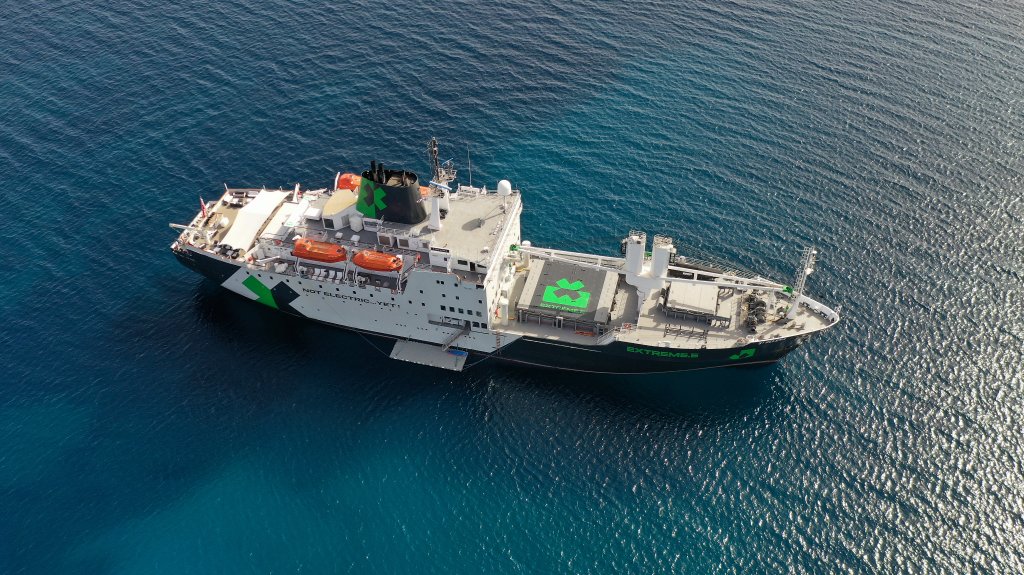
The St Helena logistics ship during the Saudi Arabia on March 30, 2021. Photo by Colin McMaster
“Eight U.S. Marines were injured two weeks ago when an Iranian cruise missile attacked the ship they were operating on in the Strait of Hormuz,” NBC reported, citing three U.S. officials. “The Marines were not seriously injured, but they sustained smoke inhalation and possibly traumatic brain injuries, as they had symptoms of concussions, such as headaches, the officials said.”
“The Marines, seven of them enlisted and one officer, all returned to duty soon after the Sept. 14 attack, the U.S. officials said,” according to the network. “The officials said the Marines were operating as part of a battalion landing team during the Iranian anti-ship cruise missile attack.”
TWZ cannot independently confirm that Marines were on board the St. Helena or that they were injured. We reached out to the Pentagon and U.S. Central Command (CENTCOM) for more information. The Pentagon referred us to CENTCOM, and CENTCOM declined comment.
The incident took place amid an uneasy truce between Iran and the U.S. broken up by sporadic Iranian attacks on ships transiting the Strait of Hormuz. At the same time, the U.S. military is enforcing a blockade on Iranian ships, during which it has struck several for trying to bypass that effort as well as in retaliation for Iranian attacks on shipping. Negotiations between Washington and Iran have ebbed and flowed, and U.S. President Donald Trump is once again mulling a choice between continuing talks or renewing large-scale attacks.
As we noted earlier in this piece, after the vessel was struck, several maritime industry trade publications identified it as the St. Helena.
“Iran has attacked a historic former British Royal Mail passenger ship in the Strait of Hormuz,” TradeWinds News reported on Sept. 15, a day after the incident. “Maritime security sources identify the 6,800-gt St Helena (built 1989) as the latest vessel to be hit by an ‘unknown projectile’ in the war-torn waterway. The attack was reported late on Monday, according to UK Maritime Trade Operations, which cited a ‘verified source’ for the incident without identifying the vessel.”
Aerial view of the St Helena transport ship in the sea off Porto Pino during the Sardinia on July 4, 2022. Photo by Sam Bagnall
“UKMTO has received a time late report of an incident within the Strait of Hormuz,” the organization reported on Sept. 15, citing an incident that took place a day earlier. “A verified source has reported that a vessel has been struck by an unknown projectile.”
“There is no reported damage or environmental impact,” UKMTO added. “Authorities are investigating.”
According to Lloyd’s List, the ship was being operated by the Ambrey maritime security firm at the time it was struck. Ambrey declined to comment.
Shipping expert Sal Mercogliano and open-source investigator Tom Bike were among those suggesting the St. Helena could have been the vessel at the heart of the NBC report.
So piecing together the evidence it appears that the US may have converted St Helena into a armed merchant cruiser.
The Marines looked at putting Armed Guards on board commercial ships three years ago as reported by @USNINews.
Exactly what the St. Helena was doing at the time it was struck is unclear; however, the ship has had a very unusual past.
The vessel entered into service in 1990 and “sailed between Cape Town, South Africa and Saint Helena and Ascension Islands, carrying both passengers and cargo, some of which was Royal Mail, earning her the rare RMS designation,” according to Cruise Arabia and Africa.
The St. Helena was Britain’s last working postal ship, according to Maritime Executive. After it was retired in 2018 because it was no longer needed for that function, things got really interesting.
Two different organizations took over the vessel, including, as we noted earlier in this story, a company that was planning to use it as a floating armory in the Middle East.
“Renamed MNG Tahiti, the 103-meter (340-foot) ship is being readied by her new owner MNG Maritime to become a floating armory working in the Gulf of Oman,” Maritime Executive wrote on April 22, 2018. “She will deliver security guards and weapons to vessels sailing through the region and is expected to be operational in her new role in the next few months.”
It is unclear what happened to that plan. However, two years later, an off-road racing series called Extreme E said that it “secured exclusive use of the former Royal Mail ship in 2018.” After that, the ship underwent “an extensive refurbishment process, which has included total overhaul of steelwork, engines, generators, propellers, interior and cabin space, and more, making it not only fit for purpose, but also as efficient as possible ahead of its new mission.”
Aerial view of the St Helena transport ship in the sea off Porto Pino during the Sardinia on July 4, 2022. Photo by Sam Bagnall
The ship was “specifically designed to transport all the infrastructure and equipment the Extreme E needs for their race weekends,” the organization stated. The plan was to have the ship serve “as its freight and logistics hub due to her versatility and ability to carry and unload a mixture of cargo, like all 10 of the championship’s ODYSSEY 21’s [electric off-road racecar], as well as team members and guests. This was also fit with a Science Laboratory so research can be conducted enroute to the race locations.”
On Sept. 17, 2024, the St. Helena was put up for sale, according to Horizon Ship Brokers. The current ownership is unclear. We reached out to Horizon Ship Brokers for more details.
Horizon Ship Brokers
Last year, the saga of the St. Helena took a new turn. A company called Terra Nova Expeditions chartered the vessel for Antarctic cruises, but those plans were scrubbed last month because the vessel was stuck in the Persian Gulf and was no longer available for the Antarctic sailing season.
While we can’t confirm that Marines were onboard when St. Helena was hit, Marines have been training for this exact mission set. USNI News reported in 2023 that a “force of 100 Marines, newly trained by Navy personnel,” stood ready “to respond, if ordered, to provide armed security aboard foreign commercial ships transiting the Strait of Hormuz.”
Those Marines were members of the 26th Marine Expeditionary Unit (MEU) embarked on the three-ship Bataan Amphibious Ready Group (ARG), USNI added at the time.
It is unclear if those plans are still in place and if Marines in the region have actually been ordered to provide armed security for foreign vessels sailing through or near the strait. Regardless, Marines could be quickly trained to take on this mission set and have drilled for ship boarding and searches for years, especially special operations and specially-tasked units. CENTCOM declined to comment when we asked if there are U.S. personnel embarking on commercial ships transiting the Strait of Hormuz.
At the same time, it is possible that the unique attributes of St. Helena made it a convenient host ship for sea base operations for U.S. forces in the region specifically for this crisis. Adapting commercial vessels for exactly this purpose has a long history around the Strait of Hormuz, as it was a central facet of the Tanker Wars during the 1980s, that saw U.S. forces operate from barges in the region. Today, commercial vessels remarkably similar to St. Helena operate in similar roles, especially in support of special operations and interdiction operations.
The special mission ship U.S. Motor Vessel Kellie Chouest steams in the Caribbean Sea while participating in a passing exercise (PASSEX), with the Dominican Republic Navy and USS Billings (LCS 15) Oct. 24, 2021. Kellie Chouest is deployed to the U.S. 4th Fleet area of operations to support Joint Interagency Task Force South’s mission, which includes counter-illicit drug trafficking missions in the Caribbean and Eastern Pacific. Photo by Petty Officer 2nd Class Austin C
Once again, we have no idea what the ship’s mission was at the time of the incident and if Marines were simply helping it transit safely out of the Persian Gulf or something more, but the attack did expose the fact that individual Marines are more involved with activities in this tumultuous body of water than it may seem.
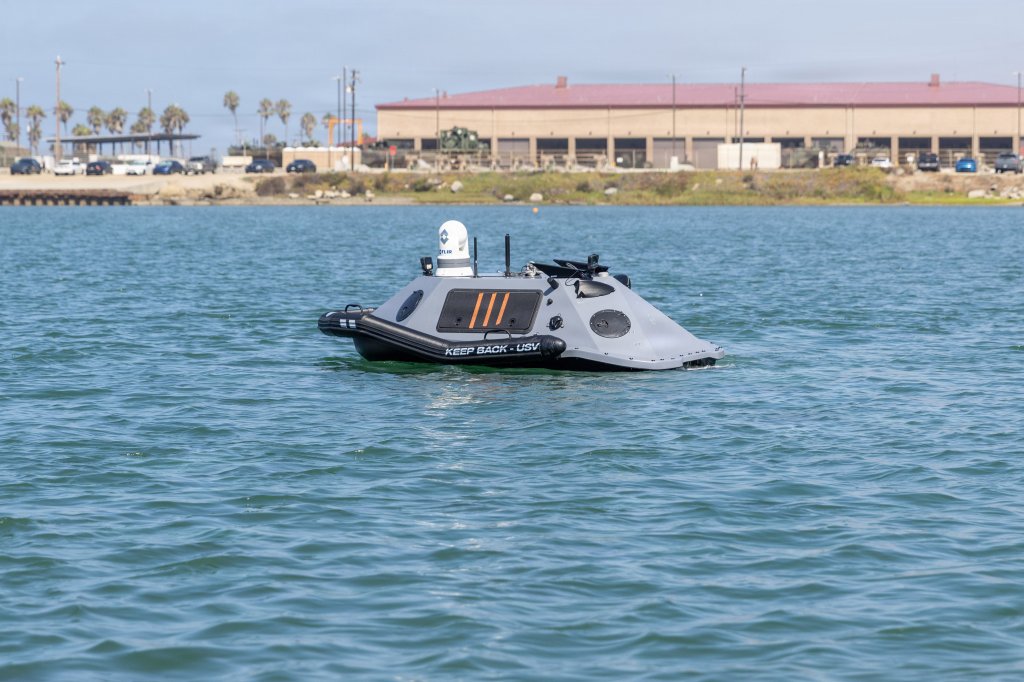
The officer who led the 31st Marine Expeditionary Unit (MEU) on its recent combat deployment to the Middle East told us he needs his own uncrewed surface vessels (USVs) on future deployments. Operationalizing USVs is an area where the Marines are lagging behind. In particular, he wants the ability to send USVs forward to reconnoiter potential highly-contested beach landing areas, a mission largely assumed by the Navy.
As we have frequently reported, the military use of USVs is now proliferating around the globe at an increasing rate. Ukraine has employed sea drones to devastating effect against Russia’s Black Sea Fleet vessels and facilities, forcing the general evacuation of Russian naval assets from occupied Crimea to bases in Russia proper. During Operation Epic Fury, the U.S. used them for the first time in combat, as one-way attack weapons against Iranian targets, to hunt for mines, and for a search and rescue operation to locate the crew of an AH-64 Apache helicopter downed by Iran, as well as general broad-area surveillance and awareness. China is investing heavily in the space, as well, along with many other navies around the globe, both friend and foe.
The following video shows the first U.S. use of a USV as a kamikaze weapon.
Yesterday, using multiple one-way attack surface drones, CENTCOM forces successfully struck a submarine and ship maintenance facility in Iran. Three Corsair unmanned surface vessels hit the port at Bandar Abbas Naval Base, marking the first time American forces have employed sea… pic.twitter.com/bOM2kmgRxz
“There was a lot in theater that were being used, but it wasn’t something that we went out with,” Col. Chris P. Niedziocha told us when asked if the 31st MEU deployed with USVs. He then answered in the affirmative in response to a question about if MEUs need sea drones on future deployments. He said it is part of the “explosion in robotics and autonomy” being used in combat.
“These systems are incredibly useful and capable,” explained Niedziocha, now director of the USMC Expeditionary Warfare School. “And you say, ‘Hey, you know, [in] the next war, if the first thing you’re putting through the breach isn’t a robot, something’s wrong. You say never send a Marine someplace you haven’t sent a bullet. I think the new way is [you] never want to send a Marine someplace you haven’t already sent a robot. So yeah, we’re embracing [the technology] and we’re not leaders. We’re fast followers in that regime.”
Asked for specific use cases he sees for USVs, the colonel talked about using them before putting Marines ashore.
“I can tell you if you’re doing an amphibious operation, you want to understand what’s waiting beneath the surface in the water column,” Niedziocha noted. “So something can go either with a side-looking sonar array or even forward-looking to demonstrate that there’s nothing there, and the hydrography and bathymetry is what you… need for the operation to be successful.”
Hydrography measures “the shape and features of the shoreline; the characteristics of tides, currents, and waves; and the physical and chemical properties of the water itself,” according to NOAA. Bathymetry, which is part of that, focuses on mapping the depths and shapes of underwater terrain.
NOAA
These functions are critical for mine detection and determining whether there are man-made or natural obstacles that would impede landing operations. While these missions are largely being performed by the Navy, including with USVs, the Marines are moving toward making that an organic capability. Recently, the Marines announced they were testing a counter-mine USV system. The evaluation was conducted late last month at Camp Pendleton by the Program Manager Combat Support Systems (PM CSS) Explosive Hazard Defeat Team.
The test of the USV was “in response to a littoral capability gap,” according to the media release. “The solution: seek a commercial USV solution that is equipped with integrated autonomous driving and payloads that consist of Sonar, Forward-Looking Infrared (FLIR) cameras, Line of Sight (LOS) Communications and Acoustic Communications (AComms).”
This was part of the overall effort to develop “solutions that enable increased standoff for Marines to detect, investigate and neutralize threats,” the release added. “The innovation of Explosive Ordnance Disposal (EOD) and Littoral Explosive Ordnance Neutralization (LEON) systems will provide Marine EOD Technicians with the confidence to operate in contested environments while preserving combat power, increasing operational reach, and minimizing exposure to explosive threats.”
LEON is a so-called system of systems, using a remotely operated vehicle, diver equipment, an unmanned underwater vehicle (UUV), a USV, and an Amphibious Unmanned Ground Vehicle to enable “EOD to confirm and mark hazards and obstacles from very shallow water to the beach zone,” the media release added.
While unmanned systems have long been part of EOD operations, “we’re expanding that into maritime systems that allow more endurance and less risk for operators,” said Chief Warrant Officer 2 Alfredo Andrade, officer in charge, Explosive Ordnance Disposal Company, 7th Engineer Support Battalion (ESB). “Some of the conflicts that we are engaged in take a toll on the force, and surging in new forces is costly. It turns into a logistical problem. To preserve the safety and the health of the forces… the USV and the [LEON] program exist to ensure that we have readily available combat power.”
In late August at Camp Pendleton, the PM CSS Explosive Hazard Defeat Team tested an unmanned surface vessel in response to a littoral capability gap. (PAE Marine Corps photo by Kristiana Gehly) Kristiana Gehly
While Niedziocha didn’t address USVs for offensive combat roles, the Marines have evaluated them for that use as well as for logistics, among other functions.
Our Autonomous Low-Profile Vessel (ALPV) solicitation is now accepting submissions.
The @DeptofWar and the @USMC need to resupply units spread over wide distances in contested littoral environments. Increased all-domain threats targeting logistics capabilities, locations, and… pic.twitter.com/Af8v0DTRHS
— Department of War Innovation Unit (@DIU_x) March 3, 2026
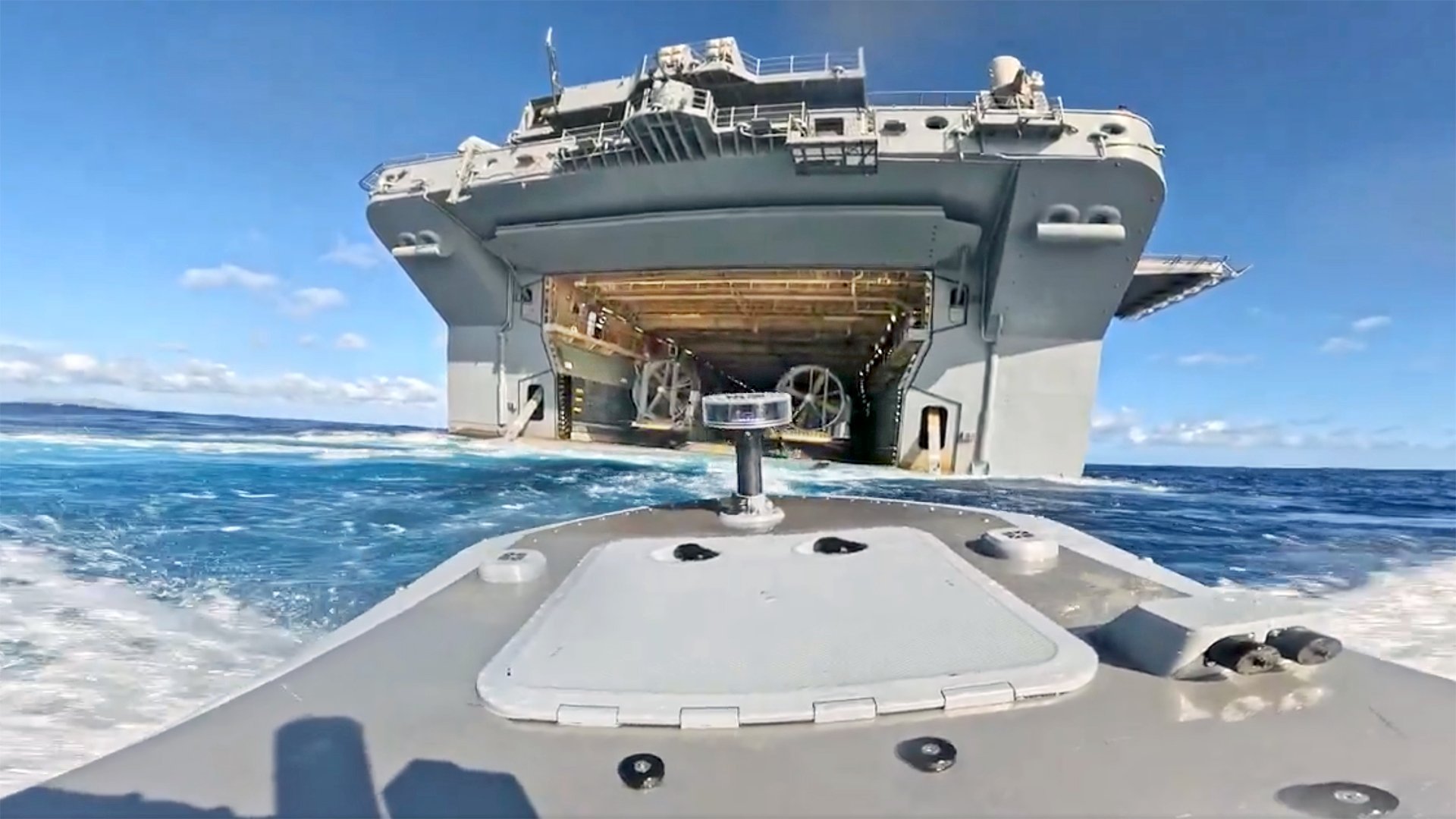
There have been many other tests, as well. Including one just this summer at RIMPAC. These trials saw the launch and recovery of one of Splash Industries’ Typhoon USVs aboard the USS Essex. The ‘Gator Navy’ of amphibious assault vessels that haul Marines and their kit around the oceans is uniquely suited to act as USV motherships. Their well decks allow for easy deployment and recovery of USVs of many sizes and capabilities near seamlessly. So it won’t be surprising if these vessels and the Marines aboard them quickly become staples in the Pentagon’s USV playbook.
Watch us land one of our drone-boats inside a moving US Navy warship during RIMPAC. This world-first resupply mission was performed completely autonomously using a Splash Industries Typhoon USV. pic.twitter.com/AEzNzZjsL1
You can see that engagement in the following video.
Ukraine's Navy says a Sargan unmanned surface vessel destroyed a Russian unmanned boat with machine-gun fire in the Black Sea, the first-ever battle between unmanned surface vessels. Ukrainian Navy personnel operated in coordination with HUR. #Ukrainepic.twitter.com/Avg4ecz8m6
Having recently returned from a six-month deployment that saw the Marine Corps’ first use of its Expeditionary Advanced Base Operations (EABO) concept in a combat setting during the fight against Iran, Niedziocha has a good sense of the realities of modern warfare. His Marines operated forward arming and refueling points (FARPs) for various aircraft in combat for the first time and set up remote sensing locations.
That a commander like him sees value in USVs is a good sign for progress in the development of these systems.
The 31st Marine Expeditionary Unit’s (31st MEU) recent deployment to the Middle East marked the first time the United States Marine Corps (USMC) used its Expeditionary Advanced Base Operations (EABO) concept in a combat setting, the service confirmed to TWZ on Thursday. At its core, EABO involves relatively small groups of Marines quickly establishing bases of operation in forward areas, often within the enemy’s weapons range. During operations in the fight against Iran, Marines refueled and rearmed their own aircraft, as well as those from the joint force, at these austere locales. They also set up remote sensing locations, among other actions from the EABO playbook.
This employment of EABO for Epic Fury is a highly significant development. After years of progressively evolving the EABO playbook, it was no longer an experimental exercise. This meant that Marines were forward deployed in a contested area in a region where established bases were taking heavy fire from Iranian missile and drone barrages. Troops were killed in some of these attacks and U.S. aircraft, buildings and equipment were damaged and destroyed across the Middle East. Pushing aircraft from the MEU, as well as the joint force, to FARPs (forward arming and refueling point) would have been a relevant asset preservation tactic as well as one that would help accelerate combat operations, and it’s exactly what EABO is meant to do.
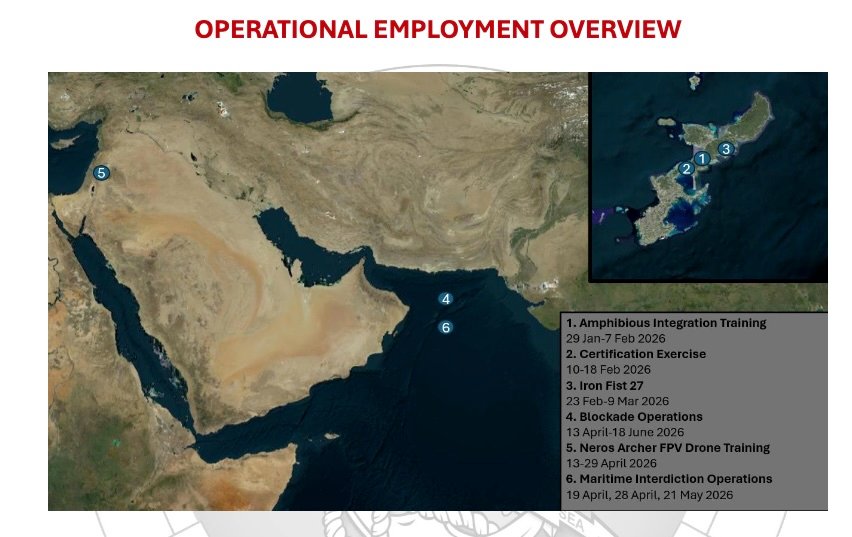
The 31st MEU’s six-month deployment began in January in the Pacific, before the unit was ordered to the Middle East in March, returning to Okinawa, Japan, in July. That’s where it is stationed as the USMC’s only continuously forward-based MEU.
A map of the 31st MEU’s deployment. (31st MEU)
“This was the first time we were able to implement EABO in combat operations since the concept was created for the force,” Capt. Steven J. Keenan, a USMC spokesperson, told us. “We have practiced it many times, but this was a first for supporting a Joint Force named operation with forward FARPs and forward bases that supported joint ops and combat power sustainment.”
EABO was first introduced in 2020 by then-Commandant Gen. David Berger in his Force Design 2030 plan for the future of the Corps. It was created with a fight against China in mind, especially utilizing small Pacific islands. The idea is to have highly mobile, low-signature forces deployed forward in austere, contested or potentially contested maritime locations. The mission is to “support sea control operation, conduct sea denial operations within the littorals, contribute to maritime domain awareness, provide forward command, control, communications, computers, combat systems, intelligence, surveillance, reconnaissance, targeting, and counter-targeting capability and forward sustainment,” according to the Marines.
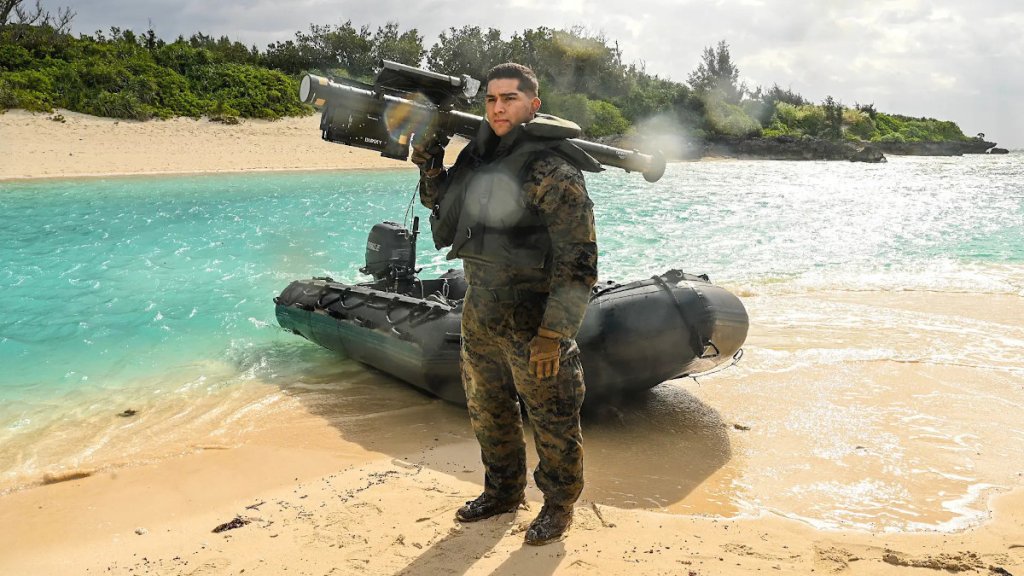
A Marine holding a Stinger missile launcher stands in front of a Combat Rubber Raiding Craft on Ukibaru Island off the coast of Okinawa during Exercise Hagatna Fury 21. (USMC) A Marine holding a Stinger missile launcher stands in front of a Combat Rubber Raiding Craft on Ukibaru Island off the coast of Okinawa during Exercise Hagatna Fury 21. USMC
The news of the first activation of the EABO concept in combat came Wednesday during a media roundtable with Col. Chris P. Niedziocha, who commanded the 31st MEU during its deployment to the Middle East in support of Operation Epic Fury. Now director of the USMC Expeditionary Warfare School, Niedziocha discussed EABO and a range of other operations during that deployment, including boarding vessels during the blockade of Iranian ports.
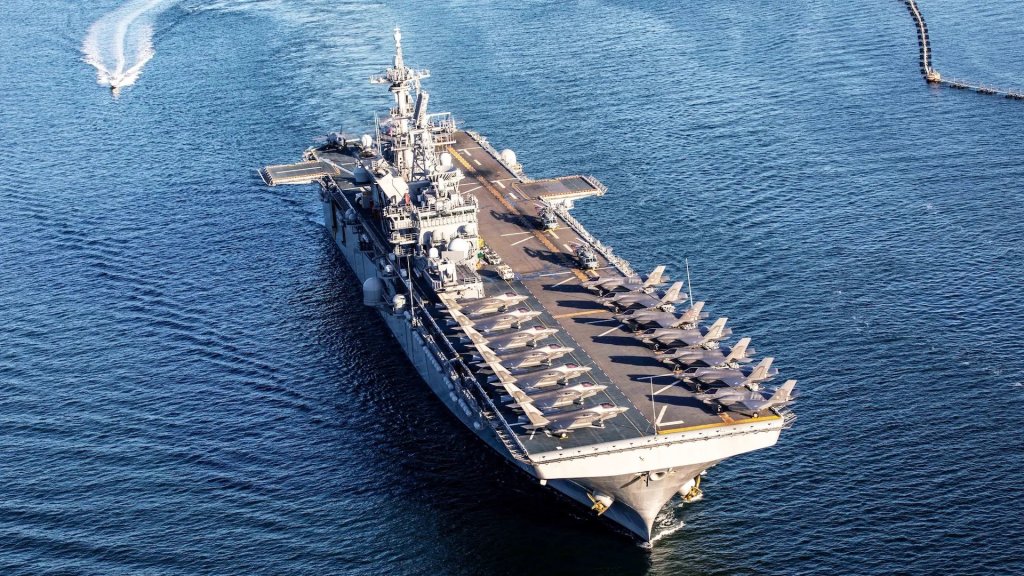
The 31st MEU was embarked aboard the Tripoli Amphibious Ready Group (ARG), which consisted of the America class amphibious assault ship USS Tripoli, San Antonio class amphibious transport dock ship USS New Orleans, and Whidbey Island class dock landing ship USS Rushmore. You can read more about the ARG/MEU and its assets in our initial story about the deployment to the Middle East here.
USS Tripoli. (Staff Sgt. Samuel Ruiz)
“You’re starting to see this has been validated,” the colonel said of the EABO concept during the roundtable TWZ attended virtually. “It’s still nascent, but we actually, for the first time, demonstrated what we thought we were able to do, which I think is pretty exciting. And then things like forward arming and refueling to extend the operational reach of aircraft and expeditionary reloading, and then the ever-present logistic challenge of doing something like that. So that’s pretty significant.”
“We successfully implemented critical Expeditionary Advanced Base Operations (EABO), establishing sensor expeditionary advanced bases and forward arming and refueling points (FARPs) where none existed,” the colonel added. “Through our forward logistic elements, we proved that an agile Marine Air-Ground Task Force can sustain itself and generate ready, lethal power in contested maritime environments, directly setting the theater for follow-on joint forces.”
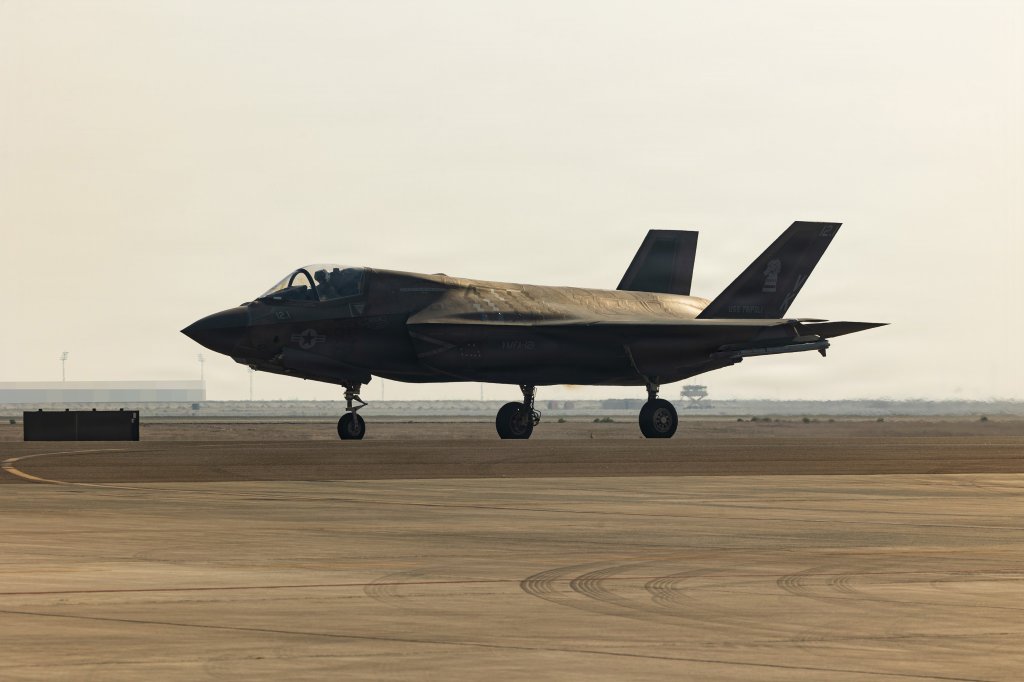
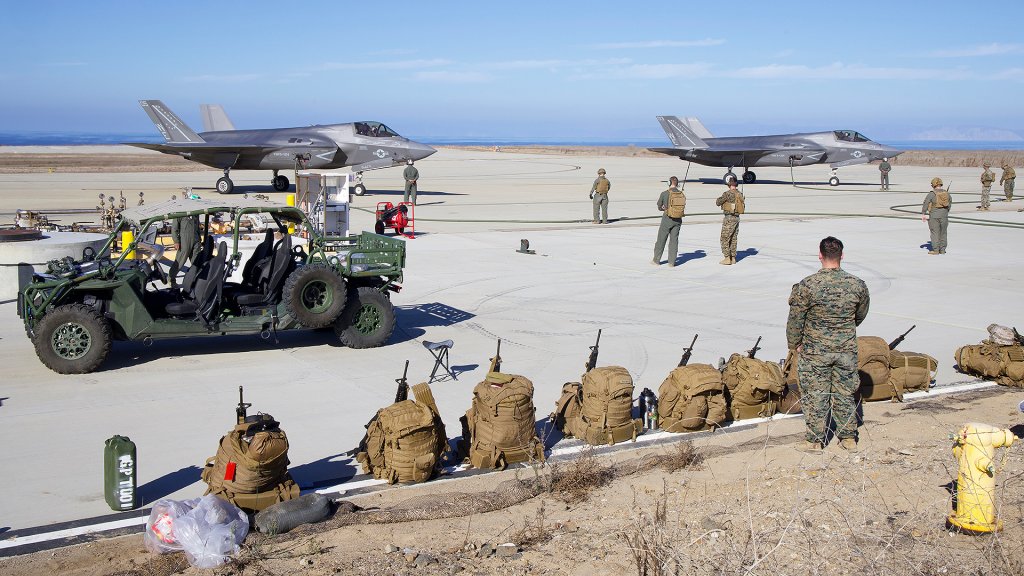
“There was all manner of tankers all the time, but the FARP is to extend the operational reach, and if you can do it, you reduce the load on that,” Niedziocha noted. “Because there’s some aircraft that are basically for expeditionary austere operations, especially the F-35B,” the Marine Corps’ variant of the aircraft designed for short take off and vertical landing.
“There are some trade-offs associated with the Bravo,” Niedziocha pointed out, using a slang for the jets. “There’s less internal fuel, but you have the lift [system], which gives you the option to do these kinds of things. So, the goal there was to walk that fine line between providing the full sortie over wherever you needed it, and keeping the ships far enough away to make them as survivable as possible.”
An F-35B Lightning II aircraft taxis to a forward arming and refueling point in the U.S. Central Command area of responsibility, May 26, 2026. (U.S. Marine Corps photo by Cpl. Maksim Masloboev) Cpl. Maksim Masloboev
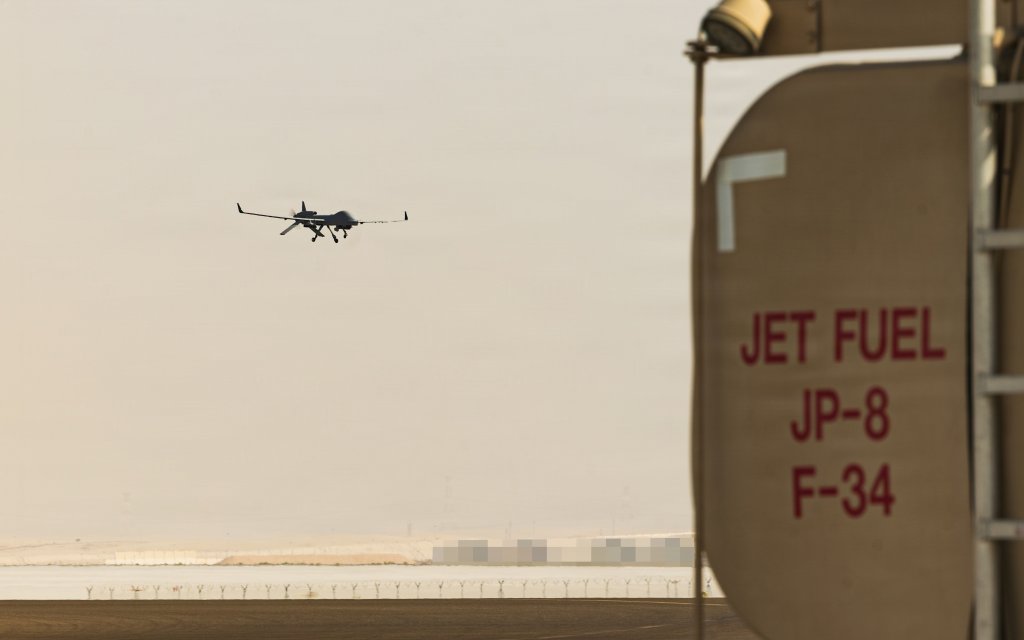
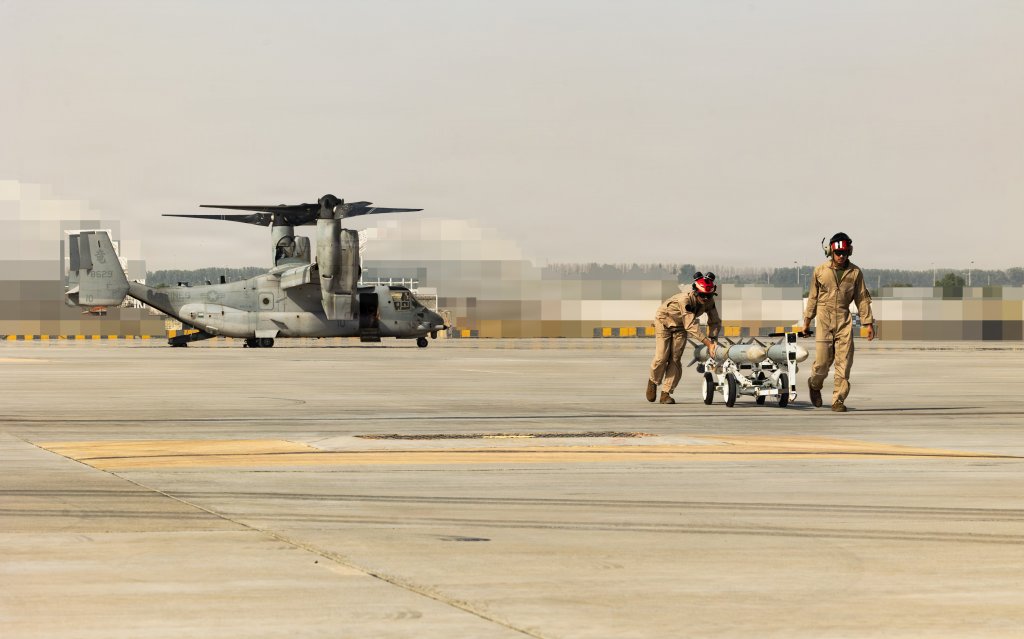
In addition to the F-35Bs and other aircraft organic to the 31st MEU, the FARPs were also used by Army helicopters, Keenan told us. Imagery posted on the Pentagon’s image distribution site also showed U.S. Army Gray Eagle drones and Marine MV-22B Osprey tiltrotor aircraft were included.
A Gray Eagle drone lands at a forward arming and refueling point in the U.S. Central Command area of responsibility, May 26, 2026. (U.S. Marine Corps photo by Cpl. Maksim Masloboev) Cpl. Maksim MasloboevU.S. Marines with the 31st Marine Expeditionary Unit transport AIM-120 AMRAAMs to a forward arming and refueling point in the U.S. Central Command area of responsibility, May 26, 2026. (U.S. Marine Corps photo by Cpl. Maksim Masloboev) Cpl. Maksim Masloboev
Niedziocha did not provide details about where the FARPs were set up, but a U.S. defense official told us they were “disaggregated throughout the Middle East.” The official declined to provide further information, citing operational security concerns since they are still being used.
“Throughout the deployment, the Tripoli ARG and 31st MEU successfully conducted over 1,600 mishap-free flight hours of combat aviation missions, including precision strikes, transporting 800,000 pounds of cargo, and moving 5,000 personnel,” a 31st MEU overview of the deployment explained. “The units also provided sustained combat support to joint force operations by delivering critical intelligence and refueling over 300 aircraft ashore and underway.”
The colonel also didn’t provide details about the sensor expeditionary advanced bases. According to the Marines, “a sensing expeditionary advanced base (SEAB) brings together coastal surveillance radars, electronic sensors, and Marines ashore to extend maritime domain awareness, complementing the radars and sensors already at work aboard naval ships off the coast.”
“When SEAB systems identify surface vessels in nearby sea lanes, small unmanned aircraft system (sUAS) operators launch their platforms to visually identify and track the contacts,” the Marines added. “Sensor data and imagery are transmitted in real time across the blue-green command network to decision-makers.”
U.S. Marines with 12th Marine Regiment, 3rd Marine Division, prepare to set up a Ground/Air Task Oriented Radar (G/ATOR) system during a routine unit level training exercise on Iejima, Okinawa, Japan, July 15, 2023. (U.S. Marine Corps photo by Staff Sgt. Manuel A. Serrano) Gunnery Sgt. Manuel Serrano
This capability could have been used to track Iran’s remaining fleet of small boats that it has used to harass shipping and mine the Strait of Hormuz, as well as larger vessels trying to transport oil. Other sensors, like radars and counter-drone systems, could also help identify incoming threats and provide general situational awareness. The EABO concept was employed as part of the 31st MEU’s larger role in supporting the blockade and mine clearance efforts.
The 31st MEU interdicted four vessels during the deployment, three of which led to boardings. On April 19, Marines boarded the MV Touska; on April 28, the MV Blue Star III; and on May 19, the MT Celestial Sea.
The Touska was boarded after USS Spruance fired multiple 5-inch rounds, targeting the engine room and disabling the vessel’s propulsion. The crew of the vessel was retained for about two weeks before being repatriated.
Niedziocha told us that none of the crews offered any resistance.
“At two in the morning, when 30 Force Reconnaissance Marines fast rope onto your vessel, [you are] just compliant with a capital C. They did exactly what they were directed to do. The overmatch that you put onto that vessel is pretty surprising. And then there’s overwatch provided by UAS and manned aircraft, so you create this bubble around the vessel. So yeah, they complied.”
You can see the Touska being boarded in the following video.
The U.S. just released a video of its forces boarding and seizing the Iranian container ship M/V Touska near the Hormuz Strait after it tried to break the U.S. naval blockade pic.twitter.com/FpB2obb3jY
Two years ago, as the EABO concept was maturing, TWZ was invited to get an exclusive look at how an advanced EABO concept would be put into action, including how squadrons operated the F-35B out of an austere combat environment while generating combat sorties. It was an unprecedented and exclusive peek into the EABO playbook and what a real fight in the Pacific with the USMC’s most advanced fighter aircraft could actually look like. You can read about that in our story here. It appears the operations in the Middle East mirrored this exercise closely.
James Deboer
Now back in Japan, the ARG/MEU is getting ready for a new deployment, said the colonel.
“We got back to Okinawa, I think July 22nd, and they had already begun their workup cycle in earnest to be on the water in early January to go out and do another Iron Fist [training exercise] with the Japanese, and then long periods of a crisis response,” said Niedziocha, who relinquished command in August before moving on to his new role. “Just being there, present in the First Island Chain to partner with your allies, demonstrates the resolve and commitment to deter whatever needs deterring.”
As noted earlier in this story, the EABO concept was designed with a Pacific fight in mind. Its first combat employment in the Middle East clearly offers lessons that can now be adapted to enhance EABO operations globally.
The body of a 90-year-old woman was found covered in sheets and hidden in the basement of a house in Marathonas village in eastern Attica on Friday. The woman’s daughter and grandson have been arrested. The woman’s death was not registered with the authorities and the daughter allegedly kept receiving her mother’s pension for about […]
NEW YORK: Oil prices climbed in early trading Wednesday, building on the previous session’s sharp gains, as overnight military exchanges between the United States and Iran escalated tensions in the Middle East and revived fears of supply disruptions through a critical global shipping chokepoint. Brent crude futures rose $1.03, or 1.1%, to $95.68 a barrel ... Read more

 Login



 (@AMK_Mapping_)





 Vivaldi operation and it has now officially ended
 THREAD













 (@mercoglianos)