
❌

Reading view

Dockworkers at 110 ports worldwide strike against war and genocide

Dockworkers across five continents and more than 110 ports launched a second historic international day of action against militarization and genocide on October 30. 

“We no longer want to work for war nor to pay for it,” José Nivoi of the Autonomous Collective of Port Workers (Coordinamento Autonomo Lavoratori Portuali, CALP) in Genoa said as actions kicked off. “Because the conditions we’re experiencing in Italy today, they’re the same conditions being experienced on five different continents.”

Ports must serve life, not destruction

The port workers’ actions are grounded in the Istanbul Declaration adopted earlier this year, which analyzes the impact of the growing arms transports on work in harbors worldwide. In the declaration and the interventions that followed, dockworkers outlined how this trend comes hand in hand with the erosion of working conditions, including the contractualization of work and aggressive austerity cuts. 

Friday’s actions are supported by roughly 25 unions from Australia to the United States and Uruguay, and from India to Mexico. A notable cluster of ports is located across the Mediterranean, where the first day of action – held in February this year – was launched.

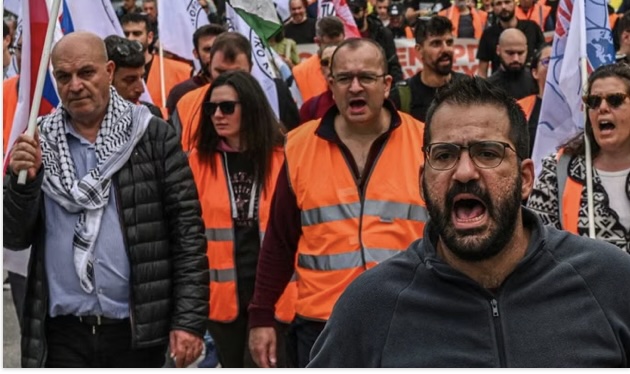
The dockworkers’ union ENEDEP led the strike call in Greece, receiving support from education workers and school children. Source: PAME International/Flickr

Over the past months, dockworkers from Italy, the Basque Country, Turkey, Greece, and Morocco were joined by others. The expanded list added organizations from Croatia, Cyprus, Denmark, France, Germany, Ireland, Montenegro, the Netherlands, Portugal, Slovenia, Spain, and Sweden. 

“Our message is clear: dockworkers don’t work for war,” the Moroccan Democratic Labor Organization (Organisation Démocratique du Travail, ODT) from Tangiers port said at a press conference in late October. “Ports must serve life, transporting food and medicines that sustain our communities. They must be places of cooperation between peoples, never instruments of destruction.”

No harbor for genocide

A notable emphasis throughout the day is dockworkers’ solidarity with Palestine, including expressions of support from the Boycott, Divestment and Sanctions (BDS) movement and the Global Sumud Flotilla. “With over 90% of Israeli imports arriving by sea, ports around the world are the chokepoint of Israel’s apartheid economy,” BDS and other organizations wrote on social media. “On October 30, dockworkers will show that, together, we can break the chain supplying Israel’s genocide, apartheid and occupation.” 

While the role of Mediterranean ports in fueling the genocide in Gaza has been more publicly exposed, the role of harbors in other regions remains perhaps less visible. That is precisely why the participation of dockworkers from Asia in the second international day of action is so significant.

Read more: Indian port workers refuse to handle military cargo bound for Israel

“In the last year, India’s major ports have been conduits from Indian public and private sector companies exporting to Israel’s Elbit Systems factories in Yokneam and Ramat Hasharon,” BDS and others wrote. “These factories manufacture artillery, munitions and ammunitions that has been documented to have been used in the genocide in Gaza.” 

“We firmly believe that support for Palestine should be channeled through our states, because today Israel enjoys a level of international impunity that allows it to carry out a genocide,” Nivoi said on Friday. “Therefore, we emphasize today that people must mobilize – not only in response to the rising cost of living, but above all to definitively liberate Palestine from Zionism.”

Dockworkers’ action converges into general strike in Italy

Italy and Genoa in particular have been a key node for building trade union solidarity with Palestine since 2023. Conscious of the links between growing militarization, imperialist drives around the world, and hardening austerity in Italy, CALP and the grassroots union Unione Sindacale di Base (USB) also called for a convergence of local movements – leading to a new general strike. 

According to early estimates, approximately 2 million people in Italy responded to this call, including many students and young people. Over the past weeks, as students in several European countries took to the streets, youth groups across Italy have also been demonstrating against cuts to essential services. 

Read more: Italian government to deploy troops to Milan after anti-austerity protests

On Friday, these groups promptly responded to the general strike call. “The student-worker alliance is growing ever stronger: across the country, students and young people are mobilizing – through occupations, encampments, assemblies, and demonstrations – against the government, while also promoting the upcoming general strike,” Marta Collot from the left party Potere al Popolo emphasized ahead of the day of action. 

“Labor can stop war”

While witnessing the continuity of dockworkers’ actions in one part of the world brings much inspiration, trade unionists involved in preparing the day also emphasized the significance of the initiative expanding. Not all organizations were in a position to launch a strike, but they still recognized the importance of sending an anti-militarist message from their docks.

In a comment for BreakThrough News, trade unionists from the Port of Vukovar, Croatia – mapped alongside unions taking part in the day of action – stressed the importance of dockworkers’ anti-war campaigning. Their point was concrete: wars fought elsewhere reshape livelihoods, shipping routes, and working conditions at home.

Dockworkers in Koper, Slovenia, were among those joining the dockworkers’ second international day of action. Source: SŽPD/Facebook

Yet the struggle is not only for dockworkers to fight, European trade unionists insist. As USB’s Francesco Staccioli pointed out in late October, the struggle against war remains a wider struggle for workers’ rights and social justice. Because of this, he emphasized, October 30 should be taken as a starting point to widen the scope of action further. 

“Labor can stop war. It can stop the genocide of the Palestinian people. It can stop imperialist aggression,” he said.
  •  

With ‘Largest Coordinated Port Action Ever,’ Dockworkers in 22 Countries Strike Against Gaza Genocide

Dockworkers in more than 20 countries are withholding their labor at 113 ports across 22 countries to demand an end to Israel's assault on Gaza and protest the role of commercial ports in fueling militarism.

  •  

Dockworkers in 22 Countries Prepare Coordinated Strike Against Arms Shipments Through Major Ports

Trade unions representing workers at 113 ports across five continents are preparing coordinated industrial action on 30 October, protesting against the movement of military equipment through commercial shipping terminals. The mobilisation raises questions about international trade, defence logistics and the growing involvement of organised labour in geopolitical disputes.

Dockworkers’ unions in 22 countries and regions are preparing coordinated strikes and demonstrations on Friday, 30 October, in an international campaign opposing the use of civilian ports to transport weapons and other military supplies to conflict zones.

The mobilisation involves more than 25 trade unions representing workers at 113 ports, according to organisers, with planned actions extending across Europe, North Africa, Asia and the Americas.

Major shipping centres expected to participate include Hamburg, Genoa, Le Havre, Valencia, Algeciras and Piraeus, alongside Morocco’s Tangier Med and India’s Nhava Sheva.

The scale of actual disruption remains uncertain.

Some unions have announced 24-hour stoppages, while others intend to organise shorter walkouts, demonstrations or symbolic protests.

Organisers have suggested that the action could affect more than 40 per cent of Mediterranean cargo traffic and freight worth over $2 billion.

However, these figures represent estimates of potential disruption rather than confirmed losses or cargo volumes that will necessarily be immobilised.

A Campaign Extending Beyond Europe

The initiative originated among dockworkers’ organisations in Italy, France, Greece, Spain’s Basque Country, Turkey and Morocco.

It subsequently attracted support from unions in northern Europe and several countries outside the Mediterranean region.

Among the participating organisations are Germany’s ver.di, France’s CGT Ports et Docks, Ireland’s SIPTU and Denmark’s 3F.

Indian maritime unions have also declared their support, citing the effects of armed conflict on commercial shipping and the safety of seafarers.

The campaign follows an international declaration agreed in Istanbul in May 2026, when dockworkers’ representatives called for ports to remain outside military supply operations.

The organisers argue that commercial transport infrastructure is increasingly being used to facilitate the movement of weapons and equipment to active conflict zones.

Their demands extend beyond any single war, although opposition to arms deliveries connected with the conflict involving Israel and the Palestinians has featured prominently in earlier industrial action.

Italy at the Centre of the Mobilisation

Italy is expected to become one of the principal centres of Friday’s protests.

The Unione Sindacale di Base (USB) has called a nationwide general strike, with demonstrations planned in more than 40 cities.

Port workers are expected to participate in Genoa, Livorno, Trieste, Ravenna, Gioia Tauro and several other maritime centres.

Genoa has previously been associated with protests against the handling of military cargo, including shipments linked to Israel and American military facilities.

However, the port’s representatives have indicated that they expect only limited operational disruption from Friday’s action.

The distinction between planned participation and actual interruption of shipping is important.

Large ports operate through complex arrangements involving terminal operators, subcontractors, transport companies and different categories of employees.

Consequently, industrial action affecting one part of a port does not necessarily bring all commercial activity to a halt.

Greek Ferries Face Disruption

Greece is among the countries where the effects on passenger transport could be more immediate.

Dockworkers, engineers and seafarers’ unions have announced participation in the protests, with Greek ferry services expected to remain suspended for 24 hours.

At Piraeus, the country’s largest port, dockworkers have announced a three-hour stoppage.

Other Greek maritime unions intend to participate in longer strikes.

Disruption to ferry operations could affect travel between the Greek mainland and its islands, demonstrating how a campaign directed primarily against military cargo can also affect civilian transport.

The effects will depend on the precise participation of employees and the arrangements made by port and ferry operators.

Defence Logistics and Commercial Shipping

The planned mobilisation draws attention to the relationship between military supply chains and civilian maritime infrastructure.

Commercial ports are essential to international trade, but they may also handle military vehicles, ammunition, equipment and other cargo connected with defence operations.

NATO members and other states depend on commercial transport networks for certain aspects of military logistics.

Military equipment may be transported aboard commercial vessels or through terminals that also process ordinary goods.

The use of such facilities is not inherently unlawful, and arms shipments may be authorised under national and international export-control arrangements.

Nevertheless, dockworkers’ organisations argue that employees should have a greater role in determining whether ports are used to facilitate military operations.

This creates potential tensions between industrial rights, contractual obligations, national security priorities and government decisions concerning defence exports.

The implications are particularly significant in Europe, where governments are expanding defence production and seeking to strengthen military supply chains.

Any sustained disruption to port logistics could complicate the movement of equipment and components, although the consequences of Friday’s planned action cannot yet be established.

Europe’s Growing Defence Trade

The protest comes as European countries increase military spending and procurement in response to deteriorating security conditions.

According to the Stockholm International Peace Research Institute, Europe became the world’s largest arms-importing region over the 2021–2025 period.

The expansion of defence trade has increased the importance of transport infrastructure capable of handling military equipment.

It has also exposed disagreements over the political responsibilities of companies and workers involved in these supply chains.

For governments, the movement of defence equipment may form part of legitimate security commitments and international assistance programmes.

For participating unions, opposition to particular military shipments is presented as an extension of workers’ rights and their broader political objectives.

These competing positions are unlikely to be resolved through a single day of industrial action.

An Immediate Test for International Shipping

Friday’s mobilisation will provide an indication of how effectively unions can coordinate industrial action across different countries, legal systems and transport networks.

Its practical significance will depend on how many workers participate, which terminals suspend operations and whether shipping companies can maintain schedules through alternative arrangements.

The organisers have demonstrated their ability to coordinate protests across a geographically extensive network.

Whether that coordination translates into substantial disruption to international maritime trade remains to be seen.

For European governments and shipping operators, the immediate task will be to manage any interruption to commercial and passenger services.

The wider question is whether opposition to the use of civilian transport infrastructure for military logistics will become a recurring feature of industrial relations across Europe’s major ports.

  •  
❌