Anthropic is touting its ability to use different AI chips in its initial public offering filing.
Analysts say a multichip strategy could weaken Nvidia's pricing power.
Switching chips is hard and expensive, putting it out of reach for smaller players.
Anthropic is hedging its bets by using multiple chips to handle its AI work — a strategy that could eventually erode Nvidia's dominance.
The AI lab says it manages compute "as a single, fungible pool from multiple strategic partners" — with software that can direct its work to different chips depending on where they're most productive, according to Anthropic's S-1 filing, which came out Monday as the company prepares to go public.
Anthropic says it uses hardware from four chip families: Amazon Trainium, Google TPUs, Nvidia GPUs, and AMD GPUs.
That flexibility, which Anthropic said "took years and significant investment to build," could make major AI companies less dependent on Nvidia over time and give them more negotiating leverage, analysts said.
"The real exposure could be Nvidia's pricing power," said Patrick Moorhead, founder and CEO of Moor Insights & Strategy, "because a customer that can shift work across four platforms negotiates very differently than one that can't."
Ashish Nadkarni, an analyst at IDC, added that a multichip approach also makes Anthropic less vulnerable to fluctuations in Nvidia's chip supply.
Breaking Nvidia's grip isn't easy
Although Anthropic's chip mix isn't new, the company is now pitching it as a core advantage to investors, Moorhead said.
The threat has its limits. Switching between chips is still difficult — especially when it comes to training AI models as opposed to running them, Moorhead said — and only the biggest AI companies have the resources to do it.
Anthropic also continues to spend billions on Nvidia compute, Moorhead said.
Gil Luria, head of technology research at D.A. Davidson, said that while other major companies like OpenAI likely take a multichip approach, it may not be worth the effort and investment for smaller players.
Brad Gastwirth, global head of research and market intelligence at Circular Technology, said Anthropic's strategy doesn't represent a major near-term threat. Having more chip options doesn't erase Nvidia's advantages in performance, networking, and software, he said.
There's a broader risk for Nvidia if AI compute becomes more of a commodity.
Citadel CEO Ken Griffin has warned that if supply overtakes demand, it could drive down rental prices.
"GPUs, like airlines, have a very low marginal cost to run," he told Bloomberg last week. "The moment you have overcapacity, pricing goes into freefall."
Nvidia did not immediately respond to a request for comment from Business Insider.
Have a tip? Contact this reporter via email at gweiss@businessinsider.com or Signal at @geoffweiss.25. Use a personal email address, a non-work WiFi network, and a non-work device; here's our guide to sharing information securely.
Posters on a wall at Anthropic's developer conference in San Francisco.
Alistair Barr/Business Insider
Anthropic shows strong profit potential, with revenue growing way faster than expenses.
Anthropic's revenue per employee exceeds $6.6 million, outpacing estimates for Meta and Google.
Anthropic has a surprisingly diverse customer base and huge cash reserves.
For years, one of the biggest unanswered questions about the artificial intelligence boom has been surprisingly simple: Can the companies building the world's most powerful AI models actually make money?
After spending hours poring over Anthropic's IPO filing on Monday, we finally have an answer: Yes. And potentially lots of it.
A couple of Chinese AI labs went public earlier, revealing appalling financial results that sowed doubt about the industry's economics. Now Anthropic has provided a much more compelling demonstration of how this business can work at enormous scale.
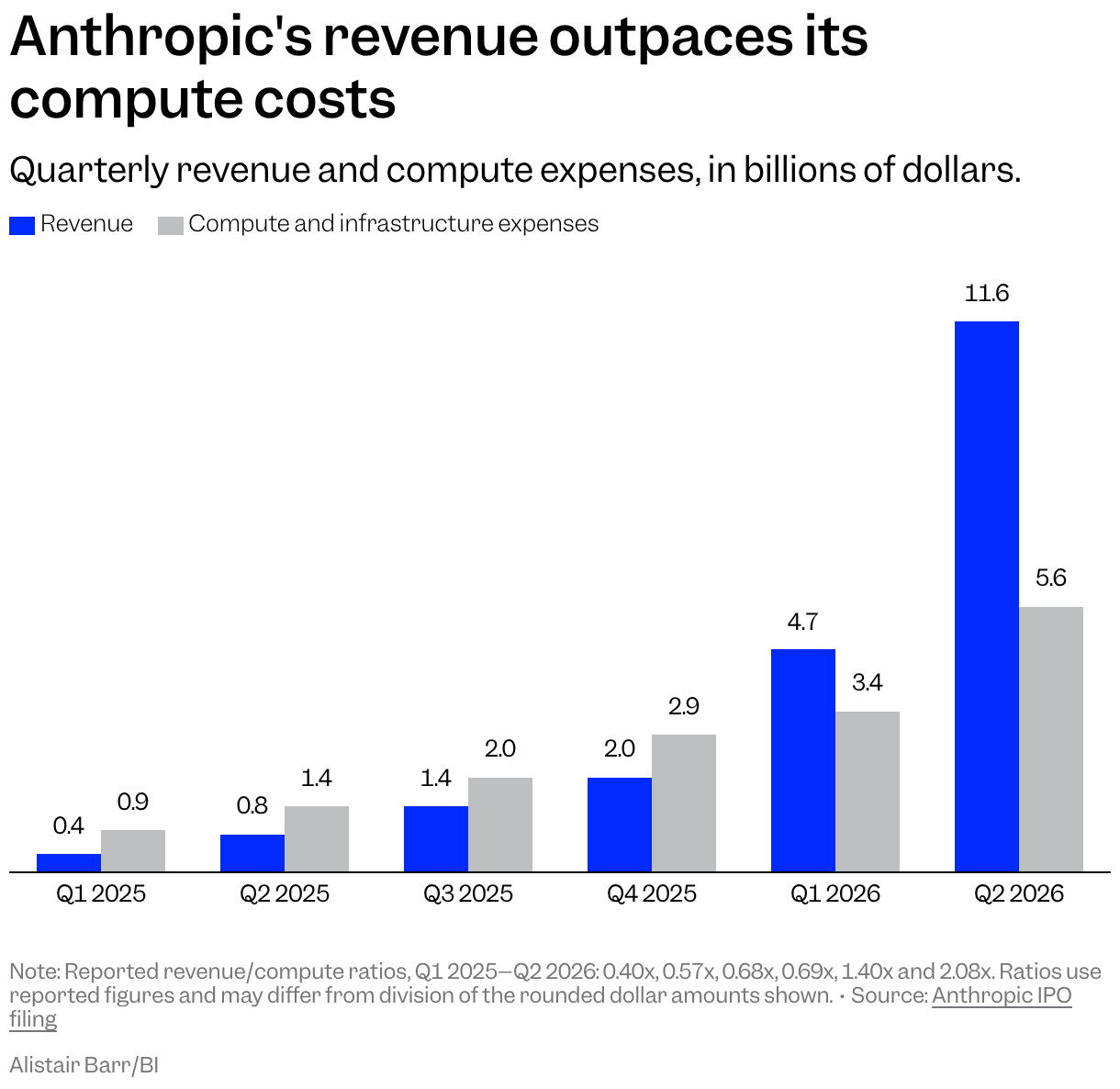
The numbers are remarkable. Anthropic generated $11.6 billion in revenue during the second quarter of 2026, up 1,368% from a year earlier. During that same period, spending on computing and infrastructure increased 300%, while other expenses rose 741%
So, the company is bringing in money much faster than its most importantcosts are rising.
For every dollar Anthropic spent on computing in the second quarter, it generated $2.08 in revenue, up from just 40 cents in the first quarter of 2025. That's a more than fivefold improvement over five quarters.
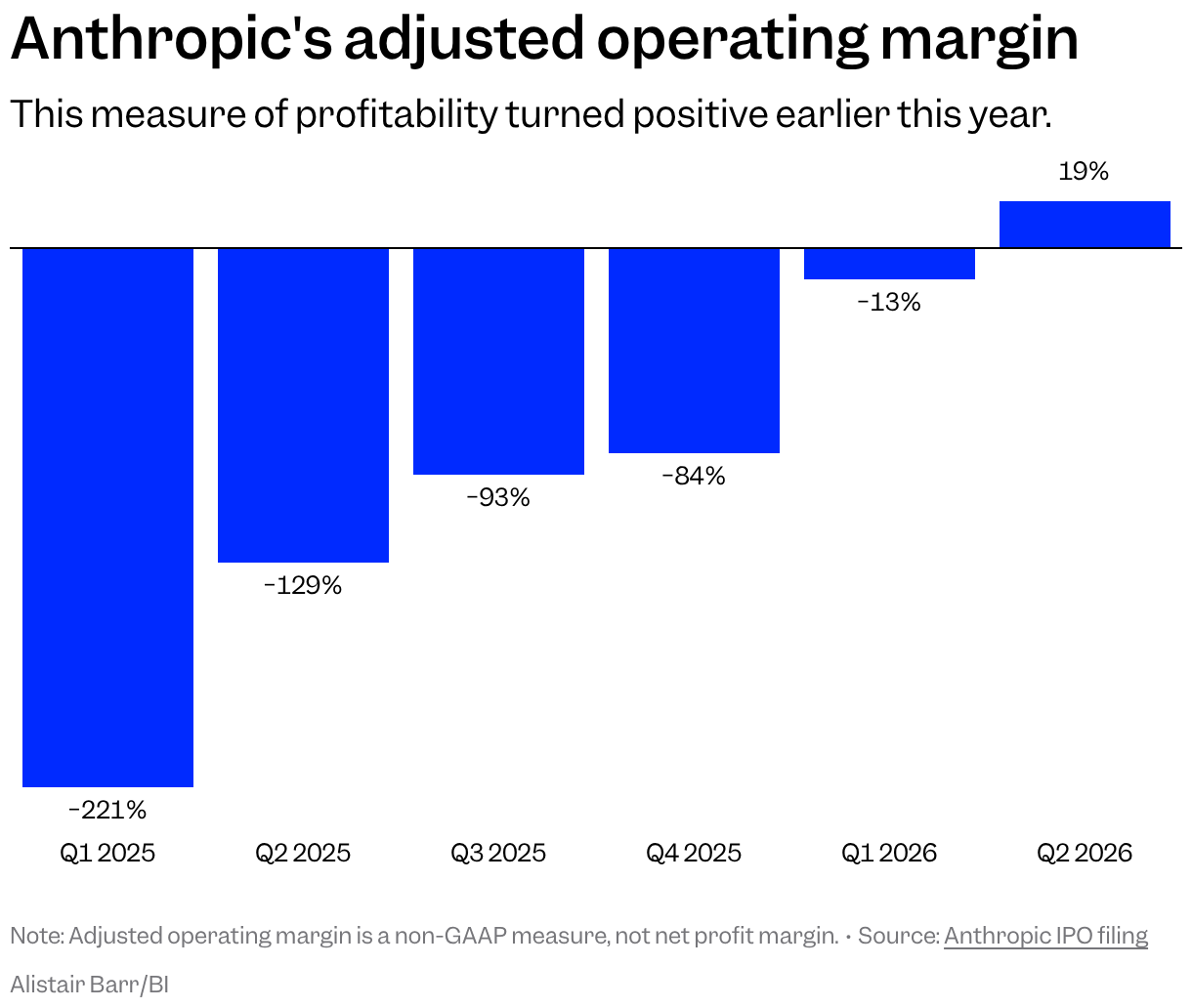
The result: Anthropic recorded $974 million in quarterly operating profit, representing an8% margin. Its adjusted operating profit margin reached 19%, compared with -129% a year earlier.
"Frontier-lab unit economics can turn positive at scale," Mark Mahaney, a top tech analyst at Evercore ISI, wrote in a research note on Monday.
Better than Meta and Google
There's more evidence that Anthropic has built an unusually efficient business.
Over the year ending September 30, revenue increased roughly 1,200%, while its employee count grew about 170%. Revenue per employee jumped from $1.4 million to more than $6.6 million.
For comparison, Mahaney estimated that Meta generates about $3.2 million in annual revenue per employee, while Google generates about $2.5 million.
That comparison isn't perfect. Anthropic relies heavily on cloud providers, whose employees handle much of the computing infrastructure and distribution work. The improvement is still striking.
Customer surprise
Another surprise: Anthropic doesn't depend as much on a handful of enormous customers, as some investors had feared.
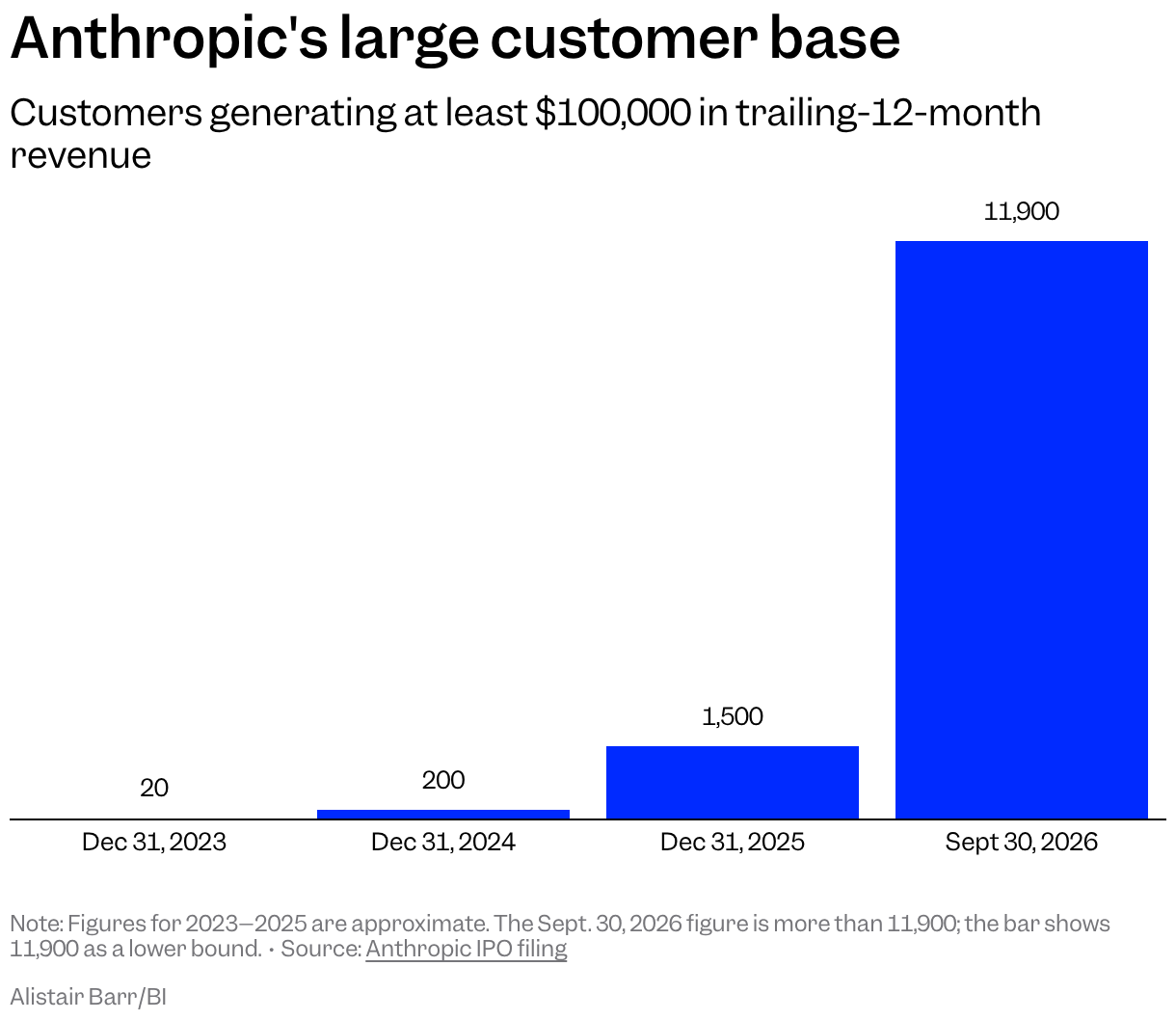
The company had more than 11,900 customers generating at least $100,000 in annual revenue as of September, compared with over 950 a year earlier. More than 1,900 customers spend at least $1 million annually.
No single customer accounted for more than 10% of revenue during the first nine months of 2026. Its five largest customers represented about 21% of third-quarter revenue, down from roughly 36% in the first quarter.
"Concentration may be better than feared," Mahaney wrote.
Cash cushion
Anthropic has a formidable financial cushion. Its June 30 balance sheet showed more than $130 billion in cash and short-term investments.
And Mahaney estimated that the company has burned through just $9 billion since it started more than five years ago. That's a long runway.
Now, don't ask me whether all this makes Anthropic worth $2 trillion, $1.5 trillion, $1 trillion, or considerably less. If I knew that, I'd be making a lot more money as an investor. And even professional investors don't know.
An $800 billion caveat
Some enormous caveats: Much of Anthropic's revenue comes from customers paying for what they use, rather than signing long-term contracts. Meanwhile, some of its computing agreements require minimum payments whether or not it needs all the capacity.
Mahaney estimates that Anthropic has entered into nearly $800 billion in computing arrangements, although only about $266 billion was fixed or guaranteed as of June.
That's still a staggering amount.
"The commitments assume revenue compounding that is not contracted," Mahaney wrote.
Translation: While the company has committed to spending hundreds of billions of dollars on AI computing infrastructure, it hasn't secured the future revenue needed to pay for all of it.
Importantly, most of the potential $800 billion exposure isn't fixed. Many arrangements depend on capacity being delivered, can be adjusted, or include cancellation provisions.
In-house compute and capex
Another wrinkle: Anthropic warned Monday that its spending will increase as it shifts toward leasing AI chips and operating more of its own computing infrastructure, rather than relying entirely on Amazon, Google, and other cloud providers.
That could make future cash flow considerably less attractive, even if operating profits continue to improve.
Still, the central takeaway from Anthropic's IPO filing is difficult to ignore.
For years, investors have wondered whether selling AI could become a genuinely profitable business, rather than an extraordinarily expensive scientific experiment.
Anthropic has now shown that it can. The next question is whether it can keep doing so as the bills get much, much bigger.
Many venture firms, including Lightspeed and Menlo Ventures, are major Anthropic investors, but Spark is the only traditional VC firm named in the filing. And it's not just a few mentions. Spark is named more than 50 times.
The reason Spark gets the most ink is because Yasmin Razavi has a board seat after being the first institutional investor in the company, leading the $450 million Series C at a $4.5 billion valuation in May 2023.
This was just six months after ChatGPT was released to the public, and the jury was out on whether a rival like Anthropic could catch up. Many balked at the price, calling it too expensive.
"It was a big leap of faith, but this was the team that built GPT-3," Razavi told Forbes.
The filing says that Spark has invested $777 million in Anthropic across six financings since then, including $75 million in the first pivotal round at $11.22 per share.
Spark was already known for making early bets on Postmates and Discord, but it was the Anthropic investment that transformed the firm's Silicon Valley reputation from a good venture firm to a great one.
Razavi said she has been continuously wowed by CEO Dario Amodei.
"Every year, he puts out outrageous numbers, but somehow they magically become true," Razavi told Forbes. "Dario never misses."
Soon, Amodei will face a greater test: the public markets.
Please send along your tips. Email Ben or Katie anytime or contact them on Signal at benbergman.11 and kroof.26. Sign up for Business Insider's weekly VC Insider newsletter here.
Planned investment under the government’s ‘Construir Portugal’ housing programme will fall by almost two-thirds next year as European recovery funding ends — against a backdrop of protests over housing shortages
Instead of working to avert bank sanctions, PM proposes a bypass that risks rattling investors, sparking capital flight, and imperiling the high-tech sector the economy relies on
The European Union has reached a provisional agreement on reforms to its securitisation framework, potentially allowing banks to release more capital for lending to businesses, households and infrastructure projects.
The agreement, announced on Wednesday, 21st October, follows negotiations between the Council and European Parliament over changes to prudential requirements and the regulation governing securitised financial products.
The reform package agreed by EU negotiators would reduce capital requirements for lower-risk transactions, introduce a new category of resilient securitisations and simplify administrative procedures for financial institutions and investors.
It forms part of the EU’s Savings and Investments Union initiative, which aims to channel more private capital into the European economy.
Banks offered greater flexibility
Securitisation allows banks and other lenders to combine financial assets, including mortgages, consumer credit and corporate loans, into securities that can be purchased by investors.
By transferring some of the financial risks associated with these assets, banks can reduce the amount of regulatory capital they are required to maintain against particular exposures.
This can increase their capacity to extend new loans, although it does not guarantee that additional lending will follow.
The provisional agreement would recalibrate capital requirements according to the risk of individual transactions.
Lower-risk securitisations would receive more favourable treatment, while higher capital requirements would continue to apply to riskier structures.
A new category of resilient securitisations would be introduced alongside the existing framework for simple, transparent and standardised transactions, commonly known as STS securitisations.
The agreement would also strengthen supervision of independent organisations responsible for verifying compliance with the STS criteria.
The Council said that third-party verifiers would become subject to EU-level supervision, with the aim of improving consistency across national markets.
European financial markets remain fragmented
The reforms address a long-standing concern that European banks face higher administrative and capital costs for securitisation than competitors operating under other regulatory systems.
Following the financial crisis of 2008, European authorities introduced tighter rules governing structured financial products, including restrictions intended to improve transparency and ensure that lenders retained appropriate exposure to credit risks.
The resulting framework, which began applying in 2019, strengthened investor protection but also increased compliance costs.
The European Commission proposed the latest review in June 2025, arguing that the existing arrangements had constrained the development of securitisation as a financing tool.
According to the Association for Financial Markets in Europe, approximately €252.3 billion in securitised products was issued across Europe in 2025, with €156.3 billion placed with investors.
Those figures cover the wider European market, including activity outside the EU.
Brussels regards the development of deeper financial markets as necessary to finance infrastructure, technological investment and industrial development.
As EU Today previously reported, the EU’s largest economies have also been examining proposals to strengthen supervision and reduce fragmentation across European capital markets.
Will banks lend more to businesses?
The potential benefits of securitisation are not automatic.
Research published by economists on the European Central Bank’s website in September 2026 found that banks using synthetic securitisation increased corporate lending only modestly, while also distributing more capital to shareholders.
Synthetic securitisation allows banks to transfer credit risk to investors without necessarily removing the underlying loans from their balance sheets.
The researchers found that a one per cent increase in synthetic securitisation issuance was associated with an increase of approximately 0.02 per cent in corporate loan growth.
Their findings also indicated that banks participating in the synthetic securitisation market made greater use of capital released through these transactions to increase dividend payments.
The study suggests that easing capital requirements alone may not generate the substantial expansion in business lending envisaged by European policymakers.
Credit demand, economic conditions and banks’ commercial decisions will also influence whether the reforms produce measurable increases in investment financing.
Broader investment rules to change
The provisional agreement includes additional measures intended to encourage participation by institutional investors.
Investment limits for certain regulated funds, known as UCITS, would be increased, while targeted changes would allow insurers and reinsurers greater participation in specified synthetic securitisation transactions.
The package also seeks to facilitate securitisation arrangements used to finance infrastructure projects before they become operational.
Together, these provisions could widen the investor base and make financing structures available to a broader range of businesses and projects.
However, transferring credit exposure between banks and investors does not eliminate the underlying risk.
If borrowers default or the financial institutions providing protection encounter difficulties, losses may still emerge within the wider financial system.
European regulators will therefore have to assess whether the new classification and supervisory arrangements adequately reflect the risks of different securitisation products.
The political agreement now requires legal finalisation and formal approval by the Council and European Parliament.
The new arrangements would then form part of the EU’s wider programme to strengthen financial markets and reduce barriers to investment across the single market.
The European Commission has selected 77 industrial and technology projects across 23 European Economic Area countries to receive €3.4 billion in funding, as Brussels attempts to strengthen the continent’s manufacturing capacity and reduce dependence on imported energy and critical materials.
The funding, announced on Monday, 19 October, will come from the EU Innovation Fund, which uses revenues generated by the Emissions Trading System to support investment in technologies intended to reduce greenhouse gas emissions.
The selected projects include manufacturing facilities, renewable energy installations, advanced energy storage, critical raw materials processing and industrial carbon management. For the first time, the programme also includes a small modular nuclear reactor project and a direct air carbon capture and storage initiative.
The announcement comes amid growing concern over Europe’s industrial competitiveness, particularly as manufacturers face high energy costs, increasing competition from China and difficulties securing investment for major industrial projects.
Funding for industrial production
According to the Commission’s announcement, the 77 selected projects span energy-intensive industries, clean technology manufacturing, alternative fuels, transport and several other sectors.
Six projects concern critical raw materials, an area in which the EU has been seeking to reduce its exposure to foreign suppliers.
These investments are intended to strengthen European supply chains for technologies including batteries, renewable energy equipment and permanent magnets, which are essential components in electric motors and other industrial applications.
The funding follows renewed political pressure to expand the processing and production of strategically important materials inside Europe.
As EU Today recently reported, the European Parliament has been pressing for stronger measures to reduce dependence on China for critical raw materials used by European manufacturers.
China occupies a dominant position in several international processing and refining markets, leaving European companies exposed to supply interruptions and trade restrictions.
The Commission is seeking to support alternative production capacity through financial assistance, industrial regulation and measures designed to attract private capital.
However, the selection of projects for EU funding does not automatically mean that the proposed facilities will be built. Their implementation will still depend on financing agreements, regulatory approvals and commercial decisions.
Nuclear technology enters funding programme
The inclusion of a small modular nuclear reactor project represents a new development in the Innovation Fund’s portfolio.
Small modular reactors are designed to produce electricity or industrial heat using nuclear technology on a smaller scale than conventional nuclear power stations.
Supporters argue that modular construction could reduce certain project risks and provide stable electricity supplies for energy-intensive industries.
However, the technology faces substantial challenges involving construction costs, regulatory approval, supply chains and the transition from demonstration projects to commercial production.
The Commission published a European strategy for small modular reactors in March, outlining plans to accelerate their development and support the first operational facilities in the early 2030s.
The latest funding decision gives the technology access to a financial instrument principally associated with industrial decarbonisation and clean energy investment.
Another newly represented technology is direct air carbon capture and storage, which involves extracting carbon dioxide from the atmosphere and storing it.
Both technologies remain at comparatively early stages of commercial deployment in Europe, making their eventual costs and performance important considerations.
Emissions trading revenue finances investment
The Innovation Fund is financed through revenues from the EU Emissions Trading System, under which companies operating in covered sectors must obtain allowances for their greenhouse gas emissions.
Part of the revenue generated from auctioning allowances is reinvested into projects designed to introduce lower-emission technologies into industrial production.
The Commission estimates that the 77 newly selected projects could avoid approximately 290 million tonnes of greenhouse gas emissions during their first ten years of operation.
That figure is a projection based on the projects’ anticipated performance, rather than an achieved reduction. Actual results will depend on construction, commissioning and subsequent commercial operation.
The funding announcement also follows the publication of the EU’s broader industrial policy initiatives, which seek to increase domestic production of clean technologies and improve investment conditions for European manufacturers.
The Commission announced a separate allocation of more than €390 million to 135 environmental and climate projects under the LIFE programme on the same day. That funding is distinct from the €3.4 billion Innovation Fund selection.
Funding agreements still to be concluded
The companies and organisations behind the selected Innovation Fund projects must now complete the procedures necessary to obtain their grants.
During the Commission’s 19 October press briefing, officials indicated that project-specific grant amounts would become available when the agreements are signed, currently envisaged for the first quarter of 2027.
The final allocations and implementation conditions therefore remain subject to the grant preparation process.
For industrial companies, the principal test will be whether the European funding attracts sufficient additional investment to bring the selected technologies into commercial operation.
The results will also provide an indication of how effectively Brussels can translate its industrial policy objectives into additional European manufacturing capacity, particularly in sectors where supply chains remain concentrated outside the Union.
Russia has placed five foreign-owned businesses under compulsory administration, including Belgian manufacturer Ontex and French flooring group Tarkett. The latest seizures deepen the confrontation over sanctions, frozen Russian assets and the future of European investment in Russia.
Russian President Vladimir Putin has ordered the transfer of five Western-owned businesses into compulsory Russian management, extending a campaign of asset seizures targeting European companies that continued operating in Russia after the full-scale invasion of Ukraine.
The decree, signed on 15 October, affects businesses with combined annual revenues exceeding 53 billion roubles, approximately €530 million. They include French flooring manufacturer Tarkett, Belgian hygiene products group Ontex, German packaging producer Menshen, Kappa Rus and Eviosys Packaging Kuban, now linked to American group Sonoco.
Under Presidential Decree No. 738, operational control has been transferred to Centre Capital, a little-known Moscow company established in February 2026 with registered share capital of just 10,000 roubles.
The decision follows similar interventions against Nestlé, Auchan, FM Logistic and Metro in September. Together, the measures demonstrate how Moscow is using foreign-owned businesses as instruments of economic retaliation against countries supporting Ukraine.
Foreign businesses placed under Russian control
Centre Capital is headed by Marat Mirkhaydarov, a former senior official in Russia’s Zabaykalsky region who reportedly served with the Akhmat military formation during Russia’s war against Ukraine.
The scale of the companies placed under his management contrasts sharply with the financial standing of the administrator.
Tarkett’s Russian operations generated approximately 19.3 billion roubles in revenue during 2025, while Kappa Rus recorded 16.5 billion roubles and Ontex RU another 10.3 billion. Eviosys Packaging Kuban and Menshen Packaging CIS reported approximately 6.1 billion and 1.4 billion roubles respectively.
The decree does not formally transfer ownership of the companies to Centre Capital. It does, however, remove the foreign shareholders’ effective control over management, operations and commercial decisions.
For Belgian manufacturer Ontex, the consequences are immediate.
In an official statement issued on 16 October, the Aalst-based company confirmed that a government-appointed administrator had assumed operational control of its Russian subsidiary.
Ontex Russia employs approximately 350 people, operates a manufacturing facility in Noginsk and maintains a sales office in Moscow. The subsidiary accounts for around five per cent of the group’s total revenue and between seven and eight per cent of adjusted EBITDA.
The company said it was examining measures to protect its assets and maintain business continuity.
Tarkett likewise confirmed that it was losing effective control of its Russian operations.
A mechanism established in 2023
The legal framework for such interventions dates to April 2023, when Putin introduced Decree No. 302, allowing the Russian authorities to place assets associated with countries designated as unfriendly under temporary external management.
The appointed administrator can exercise extensive ownership-related powers, although the formal right to dispose of the assets remains excluded.
Crucially, the arrangement can be terminated only by presidential decision. There is no automatic deadline for returning operational control to the original owners.
Moscow maintains that the measures are reversible. Nevertheless, the loss of management authority raises questions about whether businesses could eventually be returned with their financial position, organisational structure and commercial value intact.
The Kremlin’s approach also serves domestic economic objectives. Keeping factories, retail networks and distribution facilities operating under Russian management helps preserve employment, production capacity and established supply chains.
At the same time, appointing Russian administrators allows the authorities to exercise greater influence over businesses originally developed through foreign capital, technology and expertise.
European companies caught in sanctions confrontation
Kremlin spokesman Dmitry Peskov has explicitly linked the seizures to the nationality of the affected companies and the policies of their governments.
He accused European states of participating in the unlawful seizure of Russian property through sanctions and financial restrictions.
Moscow’s argument centres partly on approximately €210 billion in Russian sovereign assets immobilised in the European Union, most of them held through Belgium-based securities depository Euroclear.
The European Union has used extraordinary revenues generated by those assets to support Ukraine, while further proposals involving the underlying funds remain subject to legal and political debate.
Belgium has been particularly concerned about potential financial exposure and legal claims. As EU Today reported in September, a Belgian Council of State judgment raised additional questions about the administrative procedures governing certain frozen assets.
Moscow’s treatment of European businesses adds another dimension to this confrontation. By retaining control over foreign-owned industrial and commercial assets, Russia possesses a means of exerting pressure on companies whose governments support sanctions and military assistance to Ukraine.
The implications are particularly serious for Western banks that still maintain substantial Russian operations.
Austria’s Raiffeisen Bank International and Italy’s UniCredit remain exposed to Russia through local subsidiaries. Any extension of compulsory administration to financial institutions could create additional difficulties involving deposits, capital and banking supervision.
The cost of remaining in Russia
The seizures also expose the financial risks faced by Western companies that delayed their withdrawal after February 2022.
Many initially sought to protect their investments, employees and commercial infrastructure. Others reduced operations but retained ownership, expecting that conditions might eventually permit an orderly sale or renewed business activity.
Russian restrictions have progressively complicated that calculation, requiring foreign investors from designated countries to accept substantial discounts on asset sales and obtain official approval for transactions.
Companies remaining in the country now face the additional possibility that the government will appoint administrators without their consent.
The consequences extend beyond the businesses immediately affected. Russia is establishing a precedent under which foreign investment can remain legally owned by its original shareholders while its economic benefits and operational management are placed beyond their control.
For European governments, the latest decree illustrates the increasing connection between commercial interests and geopolitical decisions.
The Kremlin has demonstrated that sanctions imposed over its invasion of Ukraine can be answered not only through diplomatic or financial measures, but also through direct intervention in European-owned businesses operating on Russian territory.
Any eventual negotiation over sanctions relief and the restoration of economic relations will consequently have to address the status of these assets, the rights of their original shareholders and the question of compensation.
Until then, Western companies remaining in Russia face an investment environment in which the ultimate authority over their businesses rests increasingly with the Kremlin rather than their shareholders.
ISLAMABAD: Pakistan is set to sign long-delayed agreements with five oil refineries, unlocking more than $6 billion in planned upgrades to modernize aging plants and cut reliance on fuel imports, officials said. But industry warnings that changes to the financial framework could derail the projects overshadowed the announcement. The agreements with Pak-Arab Refinery Ltd., Pakistan ... Read more
 Login