
❌

Reading view

Caregivers spend thousands of dollars of their own money on average, up 60% from 2021's out-of-pocket costs

Two people seen from behind embrace outdoors
A new AARP report shows just how expensive it can be to care for a loved one.

seb_ra/Getty Images

  • A new AARP report showed that caregivers are spending much more out of pocket than in 2021.
  • Household and housing expenses account for 42% of average out-of-pocket caregiving costs.
  • Adults may take on another job or work more hours to help cover caregiving costs.

Millions of families are dishing out five figures this year to care for their loved ones.

AARP found that caregivers spent $11,508 out of pocket this year on average, up nearly 60% from $7,242 five years ago. The new results were based on a study conducted in June and July featuring over 2,500 adults who provide care to an adult relative or friend.

"The increase in costs may indicate that caregivers are purchasing more or different types of support, covering a greater share or broader range of care-related expenses, or managing more intensive or complex care needs," the report said. "The difference may also partly reflect the resumption of services following the pandemic, enhancement to the 2026 questionnaire and differences in the caregiver population between the two different studies."

Household expenses like food and housing accounted for 42% of caregiving expenses, followed by 29% for medical expenses. AARP said 37% of medical expenses are from "copays, coinsurance, insurance premiums and direct payments to providers," followed by 19% for nursing homes.
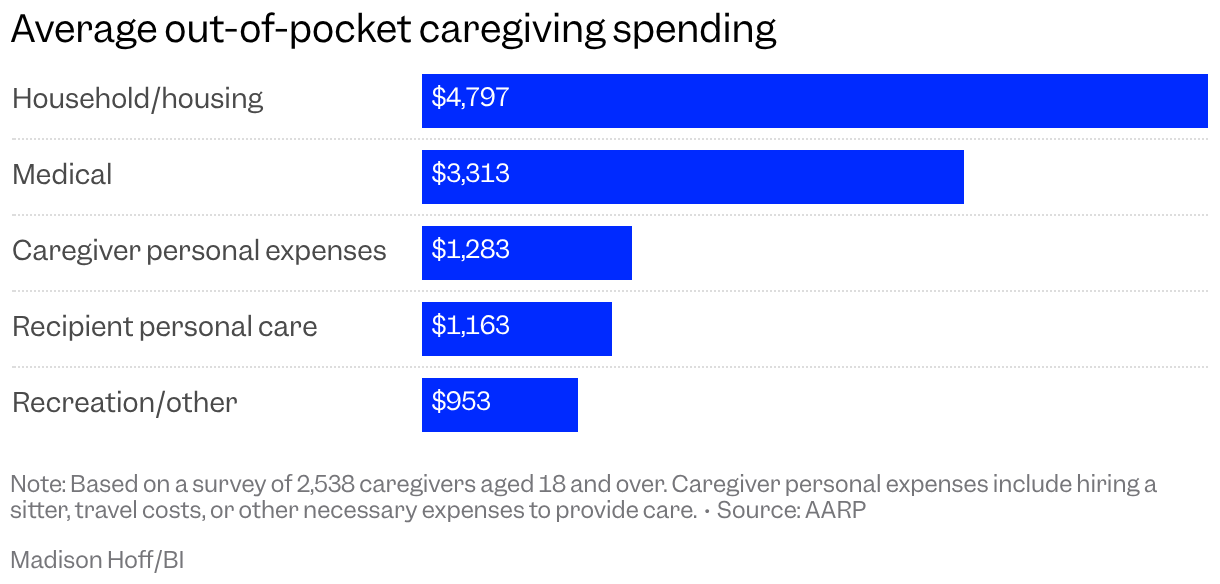
Bar chart of average out-of-pocket caregiving spending for various categories

Tamara Johnson, who is in her 50s, had worked a well-paying corporate leadership job but quit to care for her husband after a major stroke. He went from earning almost $200,000 a year to bringing in $50,000 in medical disability retirement. His care costs quickly became a massive share of their combined income.

"It's been taking two steps forward and three steps back," Johnson said. "We're still on that healing journey."

AARP asked working caregivers what work-related actions they've had to take: work more hours, work an additional job, take unpaid time off, take paid time off, work fewer hours, and work different hours. Thirty-four percent of workers experienced three to six of those impacts, and another 31% experienced one or two. AARP data suggests that people who got second jobs or increased hours at their current jobs had the highest out-of-pocket costs and needed to find a solution.

Caring for someone with dementia can be even more costly. Caregivers providing assistance to a relative or friend living with dementia spend $5,600 more out of pocket, on average, than caregivers for loved ones without dementia. Additionally, caregivers with a relative or friend in a nursing home spent, on average, half of their annual household income on caregiving expenses.

Wendy Rowland, who is in her 50s, relocated from Tennessee to Mississippi after selling her and her husband's home to help pay for his long-term care. Her husband was diagnosed with early-onset Lewy body dementia, and his facility costs $6,750 a month. Because he hasn't reached the age when he could claim Social Security, he receives $2,700 a month in disability insurance, which falls way short of his monthly care costs.

"I've navigated this mostly on my own. It's more than a lot of people can take, and it was almost more than I could take," Rowland said. "It was a really dark time when everything first started, but I knew I had to keep it together at least a little to take care of everything."

Read the original article on Business Insider

  •  

AI is making scams against older Americans more convincing. Experts share how to spot the new red flags.

Craig Newmark, Don Grant, Amy Nofziger
Craig Newmark, Don Grant, Amy Nofziger (left to right) shared their perspectives on how older Americans can best prevent getting scammed.

Craig Newmark/Sabre Wealth/AARP

  • Cybersecurity experts found severe PHP bugs that could allow attackers to hijack web servers.
  • AI is being used to exploit vulnerabilities, making Americans more susceptible to scams.
  • Experts stressed basic cyber hygiene and scam awareness, especially for older Americans.

In just two days, AI exposed critical flaws in a programming language behind 70% of all websites. That may have opened the door for a rush of scams — especially those targeted to vulnerable populations like older Americans.

Last week, cybersecurity researchers uncovered two severe bugs in the PHP programming language. Attackers could hijack web servers and execute remote code. This prompted the PHP Foundation to release emergency patches to prevent widespread hacks, and governments, cybersecurity agencies, and businesses quickly moved to do damage control.

Though some experts said there could have been more problems had these flaws not been immediately addressed, such a crisis can happen again. As AI becomes more advanced and widespread, Americans are becoming more exposed and susceptible to scams.

Scams have been pervasive for decades, starting with physical mail and landline telemarketing. But they've gotten significantly more complex and deceptive, now integrating AI in ways that even tech whizzes may not spot. Older Americans are often the main targets of fraud, losing billions in fraud. An AARP survey from April found that 4 in 10 older Americans have lost money to fraud.

With attackers pouncing on any vulnerability to steal personal details or get money, five experts told Business Insider that now is the time to get ahead on scam prevention. Their quotes have been lightly edited for length and clarity.

Craig Newmark, founder of Craigslist, who founded the cybersecurity awareness campaign Take9
Craig Newmark
Craig Newmark advises families to take 9 seconds to pause before clicking on unknown texts.

Craig Newmark

What are some of the most common scams targeting older Americans?

Hackers are using AI to ditch the typos and make scams harder to spot. AI also makes it easier to produce large numbers of targeted scams. This includes AI voice cloning and scans of social accounts for personal details. These scams are on the rise and hurting real people, including older folks like me.

How should families react to all the recent headlines about system vulnerabilities?

Don't panic, but don't ignore them either. It shouldn't be up to regular folks to outsmart scammers. The best thing for families to focus on is basic cyber hygiene.

Organizations like Google and Apple are working hard to block scams, particularly on phones. It's just as important that we prepare loved ones with the tools to protect themselves as scammers become more sophisticated.

What are ways in which you work to make people more cautious about scams?

I've been fighting scams for 25 years. I take them personally. That's why I founded Take9 in 2024 to help people understand how to protect themselves and stay safe online.

Scams are overwhelming, and people often don't know where to begin. My advice is to start with the basics: Take 9 seconds to pause before clicking on unknown texts or links.

Once they've got that down, try multi-factor authentication, password managers, passkeys, and single sign-on. Family codes are an effective method to keep your loved ones safe, too.

Don Grant, certified financial planner at Sabre Wealth and CFP Board Ambassador
Don Grant
Don Grant advises that having open conversations about financial fraud is one of the most effective ways to educate older Americans.

Sabre Wealth

What are some of the most common scams targeting older Americans?

Scams often involve impersonation of an institution or government agency like the IRS, Medicare, or Social Security. Fake technical support scammers contact you with claims of a breach at your bank or financial institution.

A good friend and client is in his mid-60s, is a single Notre Dame graduate, and is a retired university English professor. He talked incessantly about his gorgeous, accomplished girlfriend. She has sent him photos, but he had never met her in person, nor via video chat.

Fast forward to earlier this year. They are no longer an item. He reluctantly admitted that she was attempting to scam him. He did send her about $1,200 to help get her 9-year-old daughter into a music school. When she hit him up about 10 times so she could move, he figured it out and cut the ties. From what we pieced together, this was an AI-assisted romance scam.

How should families react to all the recent headlines about system vulnerabilities?

A security breach at an institution doesn't automatically mean that your accounts have been hacked. However, it does mean it's time to change your login credentials.

Set up account notifications for withdrawals, transfers, password changes, and anything to do with your accounts. Never respond to an unsolicited email from a site or financial institution with which you do business. Don't call the number provided in the communication or click the provided link. Take the time to log into a verifiable site and call a verifiable number with questions.

What are ways in which you work to make people more cautious about scams?

Communication and education are critical. I have open conversations about financial fraud, anonymously citing actual situations where a scammer attempted to separate them from their money. Recounting others' experiences seems to really drive the point home. We also insist that all clients designate a trusted contact we can reach if we notice unusual activity or have concerns about possible financial exploitation.

Removing the stigma that they are "stupid" if they are scammed is paramount. Many victims are embarrassed to admit they've been deceived, and that embarrassment can prevent them from seeking help.

Alex Jacquez, Groundwork Collaborative's senior vice president of policy, advocacy, and research
Alex Jacquez
Alex Jacquez notes that companies should better protect consumer data to avoid putting the onus entirely on families.

Groundwork Collaborative

What are some of the most common scams targeting older Americans?

The FTC recently released its Protecting Older Consumers report, describing fraud in 2025. The top fraud types by incident report numbers for older people include online shopping, business impostors, government impostors, and investment scams. These, plus romance scams, are the top fraud types by total dollars lost for older people.

Scammers use AI to create deepfakes, clone voices, and send phishing messages. These types of fraud are not new, but AI makes them increasingly convincing and enables them to be carried out on a larger scale. Scammers also use AI in predictive targeting to find the most susceptible individuals.

In March 2026, Interpol warned that "AI-enhanced fraud is 4.5 times more profitable than traditional methods" because AI agents can complete the fraud on behalf of the scammers.

How should families react to all the recent headlines about system vulnerabilities?

Families should see the recent headlines about system vulnerabilities as part of a larger problem. Companies collect lots of information on users and fail to protect it. Now, consumers are exposed to data breaches and sophisticated scams.

What are ways in which you work to make people more cautious about scams?

We put out material for consumers and policymakers highlighting how companies are using more sophisticated techniques and technologies to rip them off.

While there are best practices people can follow to remain alert and vigilant against common scams, especially in the AI age, we believe that any real fix must be systematic and undertaken by policymakers. We need companies to better protect consumer data, stop collecting irrelevant data, and stop using it to squeeze consumers for every last dime.

Amy Nofziger, senior director of victim support, AARP Fraud Watch Network
Amy Nofziger
Amy Nofziger said the goal of fraud education isn't to live in fear.

AARP

What are some of the most common scams targeting older Americans?

Impostor scams remain the number one category reported to the AARP Fraud Watch Network Helpline. They will say there is a problem with your account and need to remotely access it, or they will say they are with the courthouse and you missed jury duty and demand payment to avoid being arrested.

AI hasn't changed human nature, but it has changed the scale, speed, and sophistication of scams. Criminals are still exploiting the same emotions they always have: fear, trust, loneliness, hope, curiosity, and urgency. We used to tell people to look for red flags like misspellings and poor grammar in emails, but with today's AI tools, those clues are often gone.

How should families react to all the recent headlines about system vulnerabilities?

It's understandable to be concerned by headlines about system vulnerabilities and data breaches, but the key is to focus on what you can control. The goal isn't to live in fear. It's to stay informed, slow down when something feels off, and ask for help. We don't have to do this alone.

What are ways in which you work to make people more cautious about scams?

AARP Fraud Watch Network helps individuals and families protect themselves from scams. It's a free resource available to everyone. We provide fraud prevention information, online tools, the award-winning Perfect Scam podcast, and a Fraud Watch Network Helpline that receives more than 100,000 calls each year.

Ali Tager, vice president of external affairs, National Cryptocurrency Association
Ali Tager
Ali Tager advises that people look for small errors in grammar or spelling.

National Cryptocurrency Association

What are some of the most common scams targeting older Americans?

Some of the most common online finance scams are relationship scams and impersonation. Giveaway scams are when scammers impersonate public figures, promising "free" money or crypto if users start by sending a small amount first. In phishing scams, fraudsters pose as a friend or a crypto exchange and ask victims to click links or share login details to steal private information.

Pump and dump scams occur when groups inflate the price of lesser-known crypto coins via online hype. When enough people join and spike the price, fraudsters quickly sell off their holdings for a profit, leaving others in the dust.

How should families react to all the recent headlines about system vulnerabilities?

Stay alert, not alarmed. Whether it's your bank, your Venmo account, or your crypto account, security should always be top of mind. Protecting yourself starts with recognizing common scams and practicing smart online habits.

For crypto holders, guard your private key or recovery phrase like you would your bank account number and password. No legitimate company will ever ask for it, so never share it, and keep physical backups in secure locations. Watch for small clues like odd sender addresses or sloppy spelling, and remember that deepfakes and fake websites can look real at first glance.

What are ways in which you work to make people more cautious about scams?

A scammer's greatest weakness is an informed community. The NCA is dedicated to helping everyday Americans understand and use crypto with confidence. Research shows that 72% of crypto holders cite scams and security as a concern. However, 76% of crypto holders say it has positively impacted their lives overall, while just 3% report negative impacts. Of those, about one-third are scam/fraud-related.

Read the original article on Business Insider
  •  

I thought I'd missed out on being a grandmother. At 67, my great-grandson has given me that experience.

Pat Zawko and her family
Pat Zawko (second from left) raised three adopted children and then her grandson. Now, she helps raise her great-grandson.

Pat Zawko

  • Pat Zawko, a 67-year-old nurse, raised her grandson and now helps raise her great-grandson.
  • Pat adopted three children, facing challenges with their health and legal issues over the years.
  • Pat balances full-time work with supporting her great-grandson, cherishing her role as a grandmother.

This as-told-to essay is based on a conversation with Pat Zawko, 67, who lives in upstate New York and works full-time as a nurse. Zawko raised her grandson from birth, and she is now helping him raise her great-grandson. This interview has been edited for length and clarity.

My husband and I raised our grandson from age 5 months to adulthood. We are now helping him raise his son, whom he raises as a single parent.

I was raised in upstate New York in a very rural area. I was one of nine children, the first girl after six boys. My grandmother helped shape who I am today. I didn't go to college until I was 29, and I became a nurse. I progressed to completing my Ph.D.

All our children are adopted. We made that decision very consciously. I found out that I couldn't have biological children, so in 1982, we adopted our first son. He had lots of health issues, and he was in and out of psychiatric facilities. We paid for all of his rehabs and facilities, and he didn't qualify for any subsidies back then. My husband and I decided to adopt two more children, and both of them are very successful in their adult lives.

We got custody of our grandson when he was an infant

When he was 17, he and a young lady ran away to Florida, and they had a child. They were involved with drugs, and we got custody of their son when he was 5 months old. My son died when he was 23.

Raising our grandson wasn't really a choice, and we had to do what was right. He had special needs, which brought with it an entirely new set of needs medically, psychologically, and educationally. There were many challenges in raising him. We couldn't get him insurance for about six months. My husband didn't grow up with money, and he worked very hard in his life, but he never questioned taking the money that he had saved long before he met me and pouring it into these children.

He went down a similar road to his biological father. He got a young girl pregnant, and he became a single dad. He was left with this baby. We were living in Ohio at the time, and we moved back to New York to help him. The parents of the baby's mother are wonderful people and are very supportive financially, physically, and emotionally. There's never tension between us. My great-grandson's birth mother hasn't seen him in two and a half years.

When we took in our grandson, my other children were 10 and 11. We didn't have any baby stuff. We didn't have day care. We were used to sleeping all night because our kids were pretty independent.

Getting my grandson upset the equilibrium of the family. We had to give our kids the attention they needed, but we also had a baby with different needs.

My grandson is 25 now. Back when we started raising him, nobody was talking about the financial and emotional impact that grandparents raising grandchildren has. Nobody stopped to look at how it impacts family dynamics. We couldn't get help. You're stretching out that time period when you're parenting, where you think that you can't be a grandmother because you have to parent this child.

I see it more frequently in my profession, where grandparents, some of them older than I am, bring in grandchildren, sometimes four or five little ones running around.

My grandson needs a fair amount of support with his autism diagnosis. It's a huge transition for him, and he's needed lots of support and guidance.

I can be a grandmother to my great-grandchild

Now that my grandson has a son, I can finally be a grandmother; before this, we were our grandson's only parents. There were times that I felt robbed of being a grandmother with my grandson, as we had to be parents. I wanted to spoil him and send him on his way, but I couldn't.

Now I am technically a great-grandmother, and being able to be a grandmother for the first time. I am overjoyed and thrilled to finally be a grandma and not a parent. I can spoil him, play with him, teach him old songs, and send him home with his dad.

I still work full-time at 67, partly because raising grandchildren is very expensive. I often put in 12-hour night shifts at the hospital. I also had to pay for cancer treatments that ate through my retirement. We poured much of our life savings into making sure he had everything he could to become a productive member of society. He has a home and a car. He works full-time. He's able to experience success in being a parent, which neither he nor I ever dreamed was possible.

We know we did the right thing, but you don't think about the strain it puts on your finances, especially as you approach retirement in your later years. It takes a village to be successful as grandparents raising grandchildren. We don't have the energy that we did when we were 30.

We raised kids for 35 years

For 35 years, we raised kids, and now we have to take care of ourselves, which is not nearly as easy as one might think. We feel the pinch now with our health. But these kids have been worth the investment.

My great-grandson is 3 years old, and helping raise him is the greatest thing I've ever done. He's the light of our life. They don't live far from us, and the baby often stays with us. We get to impact his life on the level that grandparents should. We're probably more active in his life than the average grandparent. He knows nothing other than absolute unconditional love.

When he comes here, we call him the "hurricane" because he trashes the house. When he leaves, we clean it up and take joy in that. He's able to be a kid. We don't need to worry about his doctor's appointments or getting him into preschool.

My other son came by and saw we had given the baby Cheetos. He said, "You would never let us eat that. How come you're letting him?" I told him it's because I don't have to worry about all the other stuff. I understand that a Cheeto is not going to ruin his life, whereas when you're raising your own children, you are so worried about everything that you're going to make a mistake that's going to derail their life.

I used to say that we can make every generation better. If my great-grandson can have a better life than his father, and his father can have a better life than his father, that's the goal.

Read the original article on Business Insider

  •  
❌