❌

Reading view

China’s CE-25A Electric Commuter Airliner Demonstrator Emerges

New images appear to show a full-sized demonstrator of China’s CE-25A, an unorthodox 19-seat all-electric aircraft being developed by the state-owned Commercial Aircraft Corporation of China (COMAC). The photographs offer a fresh look at a program the company publicly outlined in 2023, although the aircraft’s current testing status remains unclear.

The images appear to have first been shared by Chinese automotive blogger Han Lu (韩路) on October 28 and show a red and black colored aircraft with a silver cheatline bearing COMAC and CE-25A markings. Its Chinese civilian registration is B-0EFH.

One of the first images showing the apparent COMAC CE-25A. via Chinese internet

At this point, it should be noted that we cannot establish with certainty that the imagery is legitimate, but our own examination using multiple AI image-analysis models has found no major indications that they were artificially generated.

Regardless, the program overall reflects COMAC’s interest in distributed electric propulsion, an approach that could help inform future aircraft development even if the CE-25A itself never enters commercial service.

The appearance of what seems to be a full-sized demonstrator certainly raises questions about how far the program has progressed. At this stage, there is no clear public confirmation that this particular aircraft has flown, and its precise role in the development effort remains uncertain.

A rear three-quarter view provides a good look at the distributed electric propulsion system used in the CE-25A. via Chinese internet

COMAC first presented the CE-25A concept at the China International Import Expo in Shanghai in November 2023. The company described it as a 19-seat, all-electric commuter aircraft intended for short- and medium-distance passenger transportation, as well as business aviation.

Published design specifications called for a cruising speed of approximately 400 kilometers per hour (248 miles per hour) and a range of around 400 to 500 kilometers (250 to 310 miles).

The 19-seat capacity and its general configuration are somewhat similar to the Beechcraft 1900 twin-turboprop regional airliner. With a 19-passenger payload, the Beechcraft 1900 has a range of around 700 kilometers (440 miles) and a cruising speed of approximately 520 kilometers per hour (320 miles per hour).

MONTREAL, QUEBEC, CANADA - 2022/05/25: A PAL Airlines Beechcraft 1900D taking off from Montreal Pierre Elliott Trudeau Int'l Airport. PAL Airlines is a Canadian regional airline with headquarters at St. John's International Airport. PAL operates scheduled passenger, cargo, air ambulance and charter services. PAL is the commercial airline arm of the PAL Group of Companies. (Photo by Fabrizio Gandolfo/SOPA Images/LightRocket via Getty Images)
Stock photo of a Beechcraft 1900D taking off. Photo by Fabrizio Gandolfo/SOPA Images/LightRocket via Getty Images SOPA Images

The Chinese aircraft’s most distinctive feature is its distributed electric propulsion system. Instead of relying on a small number of conventional turboprop engines, the design uses 10 electrically driven ducted fans integrated into its wing structure.

Distributed propulsion can give designers greater flexibility in how thrust is generated and integrated with the airframe. Depending on the configuration, it can offer aerodynamic benefits and potentially improve performance in particular flight regimes. Electric motors can also simplify some aspects of propulsion-system design compared with conventional turbine engines.

Those advantages come with very considerable engineering challenges. Batteries remain far less energy-dense than aviation fuel, placing constraints on range, payload, and endurance. High-power electrical systems also require careful thermal management, while integrating multiple propulsion units introduces additional questions involving reliability, maintenance, and flight control.

There is also some confusion about how the demonstrator shown in the new images fits in with previously announced plans for the program. In 2023, COMAC referred to experimental aircraft verification flight work, which was to involve a scaled demonstrator. Meanwhile, the aircraft in the new photos is full-sized. Potentially, there is an unseen ‘missing link’ subscale demonstrator that has already flown.

A model of the CE-25A is displayed alongside a placard with its key features and specifications. via Chinese internet

China is not alone in exploring distributed electric propulsion for regional aircraft. Several Western projects are also underway.

The European UNIFIER-19 research effort has examined 19-seat, zero-emission regional aircraft concepts using alternative propulsion systems, including distributed electric ducted fans. Some variants explored hydrogen fuel cells rather than relying exclusively on batteries. Compared to the CE-25A, it is strictly a research effort rather than a proposed production aircraft.

In the United States, NASA’s X-57A Maxwell experimental aircraft investigated distributed electric propulsion using 14 electric motors and propellers integrated into a specially designed wing. The X-57 was much smaller than the CE-25A and used open propellers rather than ducted fans. The project was intended to demonstrate potential aerodynamic and efficiency benefits but did not progress to its planned piloted flight configuration.

The X-57 program was canceled in 2023 after safety issues with its propulsion system proved impossible to resolve within the available budget and schedule. It had been launched on the assumption that existing electric propulsion technology was sufficiently mature for safe flight, but this ultimately proved premature. The experience underscores the very significant engineering and safety challenges that remain in developing viable electric aircraft.

Meanwhile, France’s AURA AERO is developing ERA, a 16- to 19-seat regional aircraft planned around eight electric motors and two turbogenerators. The hybrid-electric design is intended to offer substantially greater range than the CE-25A’s published target, with the company advertising a range of approximately 1,500 kilometers (930 miles). ERA is a more direct comparison in terms of intended passenger capacity and commercial role, but it uses a different propulsion architecture and is not an all-electric aircraft.

Swedish company Heart Aerospace also pursued a 19-seat battery-powered commuter aircraft, the ES-19, with a proposed range of approximately 400 kilometers (250 miles). Its original design was more conventional, with a high wing and T-tail, and the company subsequently moved away from the ES-19 concept toward larger hybrid-electric aircraft.

The CE-25A has been presented as a civilian aircraft, and there is no public evidence that COMAC intends to develop it for military service. Nevertheless, the technologies being explored could have relevance to future military aviation.

This would be in line with China’s pursuit of other unconventional aircraft programs with more direct potential military applications.

A mature electric aircraft in this general class could potentially support short-range utility missions, liaison duties, or personnel transport where payload and endurance requirements are modest and suitable charging infrastructure is available. At this stage, there is no indication that the CE-25A has been designed for autonomous operations, austere-field use, or military payloads.

At the same time, its utility in military environments would depend heavily on battery performance, ground support, operating conditions, and the ability to maintain the aircraft away from established infrastructure.

Perhaps more likely is that research into distributed electric propulsion, including the CE-25A, could inform other Chinese aircraft designs. Advances in electric motors, power distribution, flight controls, thermal management, and the integration of multiple propulsion units could eventually benefit crewed and uncrewed aircraft or specialized platforms with different operational requirements.

The CE-25A sits within China’s broader effort to expand its domestic aerospace capabilities and explore new aircraft technologies. COMAC is best known internationally for its C919 narrowbody airliner and ARJ21 regional jet, but its research interests extend beyond conventional commercial aircraft.

YANGZHOU, CHINA - JUNE 27: A domestic-made ARJ21 'Xiangfeng' sits on the tarmac at Yangzhou Taizhou International Airport before its month-long test flight on June 27, 2018 in Yangzhou, Jiangsu Province of China. The ARJ21 is a short to medium-range airliner designed and made by China independently. (Photo by Visual China Group via Getty Images)
An ARJ21 sits on the tarmac at Yangzhou Taizhou International Airport, Jiangsu Province of China. Photo by Visual China Group via Getty Images VCG

China’s substantial battery-manufacturing industry provides a potential advantage in electric aviation, although adapting batteries developed for road vehicles to the demands of flight remains a significant engineering challenge.

In 2023, COMAC announced cooperation with battery manufacturer CATL and Shanghai Jiao Tong University on research related to battery-powered aircraft concepts. The precise relationship between that work and the CE-25A, including whether they share specific battery technologies or propulsion systems, is not immediately clear.

For now, the newly surfaced photographs provide a compelling look at a COMAC project that has been publicly acknowledged but remains opaque in several important respects.

Whether the CE-25A ultimately becomes a viable civilian aircraft or contributes to other aerospace developments, including in the military realm, its emergence offers more evidence of China’s continued push into unconventional aircraft design.

Contact the author: thomas@thewarzone.com

The post China’s CE-25A Electric Commuter Airliner Demonstrator Emerges appeared first on TWZ.

  •  

Ethiopia Gets 12 Russian Su-35 Fighters, Eyes S-400 Air Defenses

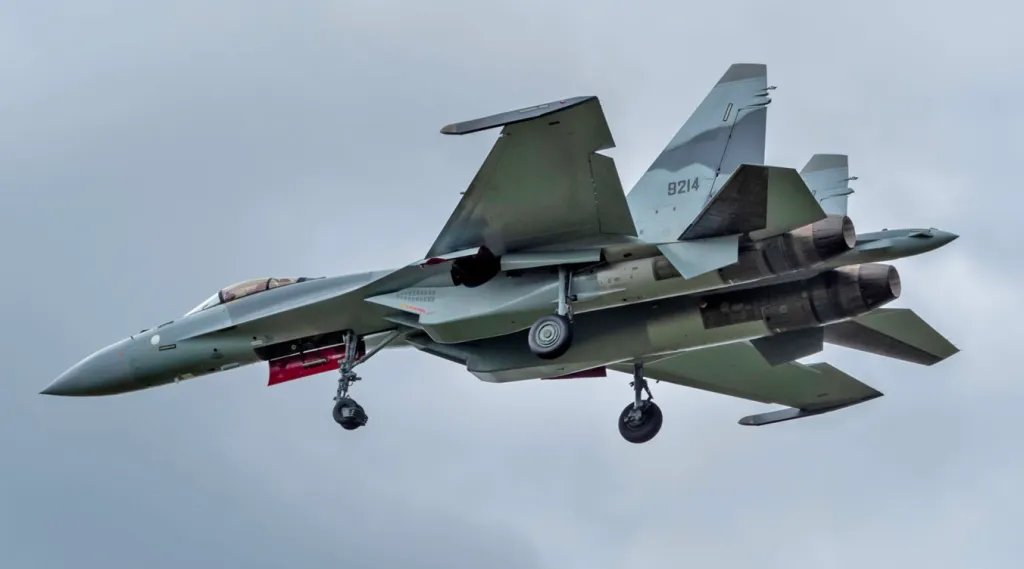
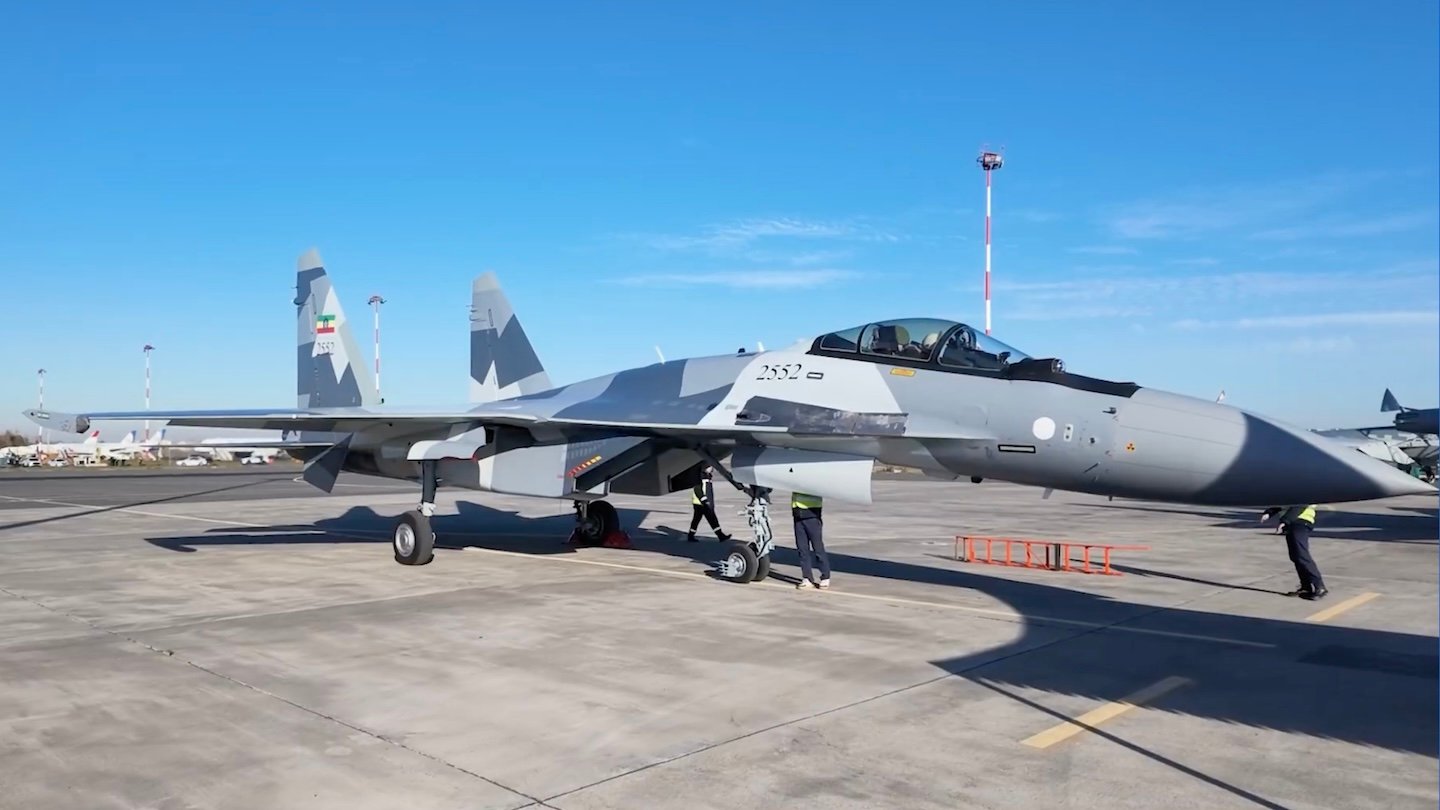
In a surprising development, Ethiopia has taken receipt of 12 Russian-made Su-35 multirole fighters, Prime Minister Abiy Ahmed announced, adding a significant new capability to the Ethiopian Air Force. The agreement also calls for four batteries of Russia’s S-400 surface-to-air missile system, although their delivery schedule remains unclear.

Abiy said the fighters arrived a year ahead of schedule under an agreement with Moscow and thanked Russian President Vladimir Putin for facilitating the accelerated delivery. The financial terms of the deal, the aircraft’s basing locations, and whether additional fighters are included in the agreement have not been disclosed. The Ethiopian leader announced the development on his X account, also posting photos and a video showing himself and other Ethiopian and Russian officials alongside two of the jets. The location appears to have been the third Russia-Africa Summit, taking place in Moscow on October 28-29.

ኢትዮጵያ የታጠቀቻቸው አዳዲስ የጦር ጄቶች የአየር ክልሏን ለመጠበቅ ከምን ጊዜውም በላይ ዝግጁ ያደርጋታል! pic.twitter.com/tT3vXFZ4A0

— Abiy Ahmed Ali 🇪🇹 (@AbiyAhmedAli) October 28, 2026
The acquisition comes as Ethiopia seeks to strengthen its military capabilities amid persistent domestic security challenges and tensions across the Horn of Africa.

Abiy Ahmed Ali poses alongside Ethiopian and Russian officials in front of an Ethiopian-marked Su-35. Abiy Ahmed Ali/via X

The Su-35 is a heavily modernized derivative of the Soviet-era Su-27, known by NATO as the Flanker. It combines twin thrust-vectoring engines for a high degree of maneuverability, advanced radar and other sensors, and the ability to carry a range of air-to-air and air-to-surface weapons.

Its radar and long-range air-to-air missile capabilities, in particular, represent a notable improvement for Ethiopia’s ability to detect and engage hostile aircraft, while its multirole design allows it to perform a wide range of strike missions.

Ethiopia already operates Russian-designed Su-27 fighters, providing a considerable degree of familiarity with the Flanker family. The current fleet comprises around 10 (and perhaps as many as 15) secondhand Su-27s, including two-seaters, supplemented in 2024 by a pair of Su-30Ks. The latter were originally produced for India as interim equipment, and then ended up in storage in Belarus before being refurbished and delivered to Ethiopia. The Ethiopian Flankers saw action against Eritrean opposition in the 1990s, and there have also been a handful of non-combat attrition losses.

Pictures of soviet made Su-25UB close ground attack jet and Su-27/UB multirole fighters jets of the Ethiopian 🇪🇹 Air Force during a exhibition at the Harar Meda air base in late June 2022.
*We can also see what it seems to be R-27 and R-23 air to air missiles (3rd and 4th frames) pic.twitter.com/1TQBh7V4J7

— Hammer Of War (@HammerOfWar5) December 25, 2022

Video showing russian made Su-30 multirole fighters jets of the Ethiopian 🇪🇹 Air Force. pic.twitter.com/wuMcZtqYkY

— Hammer Of War (@HammerOfWar5) October 21, 2026

However, introducing the Su-35 will still require specialized pilot training, additional maintenance infrastructure, weapons integration, and a dependable supply of spare parts. The latter, in particular, is something that Moscow has not always been able to guarantee in practice.

Abiy Ahmed Ali during the official handover of the first Ethiopian Su-35s. Abiy Ahmed Ali/via X

The planned acquisition of four S-400 batteries could prove equally significant.

The S-400 is a mobile air-defense system designed to engage aircraft, cruise missiles, and certain ballistic missile threats.

Abiy Ahmed Ali shakes hands with a Russian official in front of an S-400 promotional display. Abiy Ahmed Ali/via X

If delivered, the systems would considerably strengthen Ethiopia’s ability to protect military installations, critical infrastructure, and other strategic sites against aerial attack.

Ethiopia occupies a strategically important position in the Horn of Africa, bordering Eritrea, Djibouti, Somalia, South Sudan, and Sudan. Its security environment includes various unresolved regional tensions, longstanding border disputes, and internal armed conflicts.

Ethiopia’s relationship with Eritrea remains particularly relevant given their history of war and continuing tensions. Relations with Egypt and Sudan are also shaped by disputes over the Nile.

Abiy has presented the acquisition as a means of deterring aggression and strengthening national sovereignty.

At the same time, the delivery reinforces Russia’s position as a supplier of advanced military equipment to African countries. Russian exports to the continent have included combat aircraft, helicopters, armored vehicles, and ground-based air-defense systems.

Su-35s, specifically, have previously been delivered to Algeria, a long-term recipient of Russian military equipment on the African continent, as you can read about here.

Interesting report indicating Algeria has purchased at least some of the Russian Su-35s originally built for Egypt and later reported to be sought by Iran.https://t.co/0soV9aOopn

— John Hardie (@JohnH105) April 9, 2025

The Algerian jets are understood to have originated in a batch of Su-35s built for Egypt, which had ordered 24. However, the planned transfer to Egypt fell through, under the threat of U.S. sanctions and a teased offer of F-15s. In particular, Washington had said it would put sanctions on Cairo under the Countering America’s Adversaries Through Sanctions Act (CAATSA).

One of the Su-35s produced for Egypt but never delivered to that country. @nskplanes 

CAATSA includes provisions for sanctions against parties found to have knowingly engaged in significant transactions with Russia’s defense or intelligence sectors. Washington previously invoked the provision against China over its acquisition of Su-35 fighters and S-400-related equipment, although any action against Ethiopia would depend on a separate U.S. determination.

The Su-35s built for Egypt were repeatedly connected with a sale to Iran, but this also never materialized.

Permanent Mission of the Islamic Republic of Iran to the UN announced on Friday that Iran has finalized buying #Sukhoi fighter jets from Russia.

Here is what Iran has purchased: pic.twitter.com/aw7EVkc18N

— IRNA News Agency ☫ (@IrnaEnglish) March 11, 2023

Potentially, the 12 jets for Ethiopia could also have been left over from the abandoned Egyptian deal.

For Moscow, the deal provides a prominent example of continued defense cooperation with an important country in the Horn of Africa. The transfer also comes amid broader efforts by Russia and African governments to deepen political, economic, and military ties.

The agreement’s cost and financing arrangements have not been made public, leaving questions about the long-term expense of operating the fighters and maintaining their supporting infrastructure.

Abiy Ahmed Ali is seen as part of a delegation in the cargo hold of an Il-76 transport, an aircraft regularly used to transport Russian arms, including S-400 systems. Abiy Ahmed Ali/via X

The deal also needs to be seen in the context of Russia’s war in Ukraine.

Russia’s full-scale invasion of Ukraine, and the subsequent international sanctions, have hampered efforts to secure sales for any kind of military equipment, other than to a handful of selected close allies, with little prospect that this will change any time soon. Amid those same sanctions, as well as Moscow’s increasing pariah status, any kind of export success will be very welcome for Moscow, even if it involves jets previously built for another customer.

At the same time, the ability of the Russian defense industry to provide in-service support for these jets, once they are delivered, is even more questionable than it was in the past. Since the invasion, Moscow’s need to prioritize its own forces, combined with Western sanctions restricting access to key components, has further complicated the situation. For Ethiopia, any disruption to parts deliveries or maintenance support could have an outsized impact on operational readiness, and this is compounded by the requirement of Russian industry to support Moscow’s own Su-35S jets, its primary fighter.

Ultimately, the acquisition represents a substantial reported addition to Ethiopia’s combat aircraft fleet. The planned S-400 systems could extend that modernization into ground-based air defense, and further influence the military balance in the Horn of Africa region.

Contact the author: thomas@thewarzone.com

The post Ethiopia Gets 12 Russian Su-35 Fighters, Eyes S-400 Air Defenses appeared first on TWZ.

  •  

This Serbian Truck Carries A Truly Massive Mortar

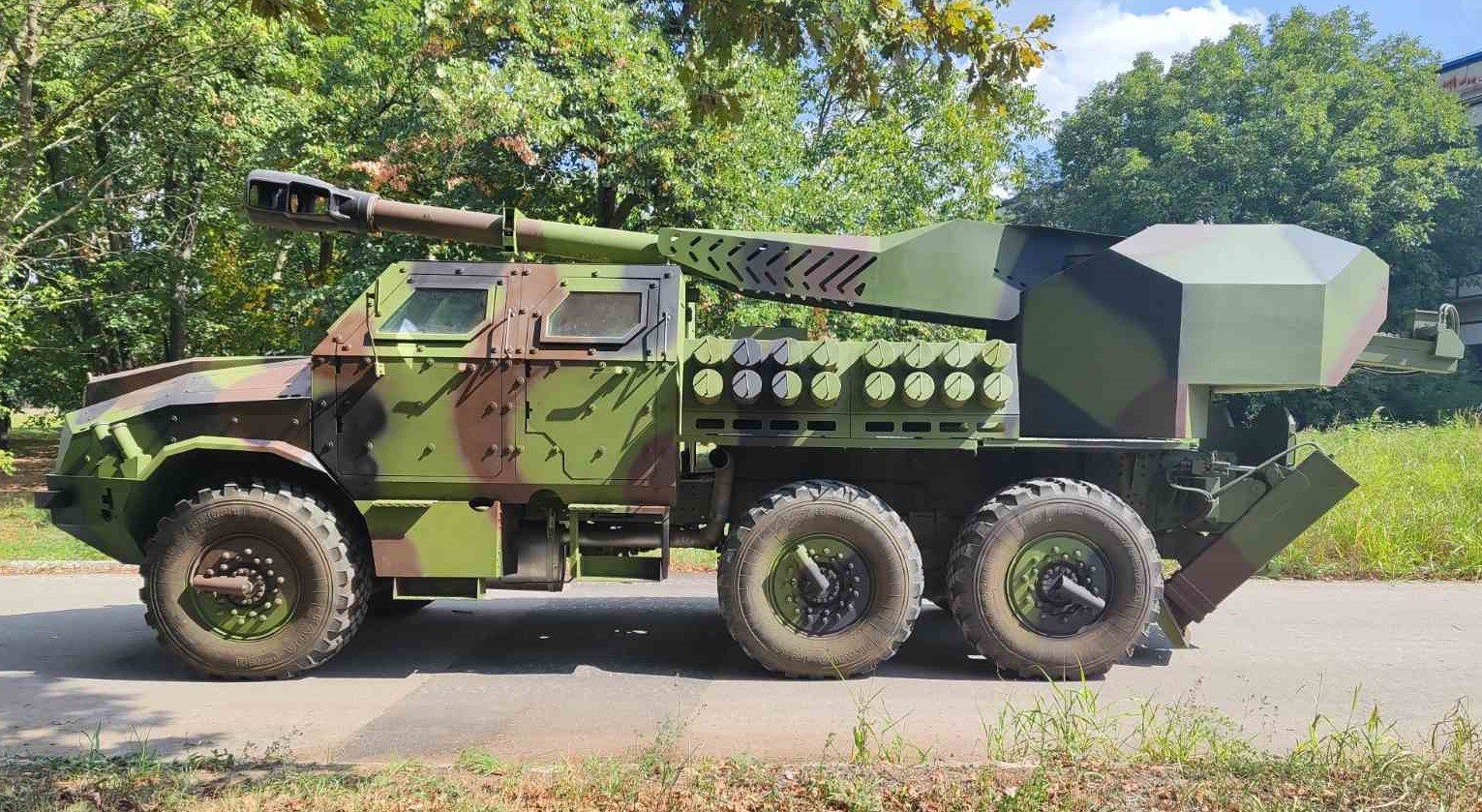
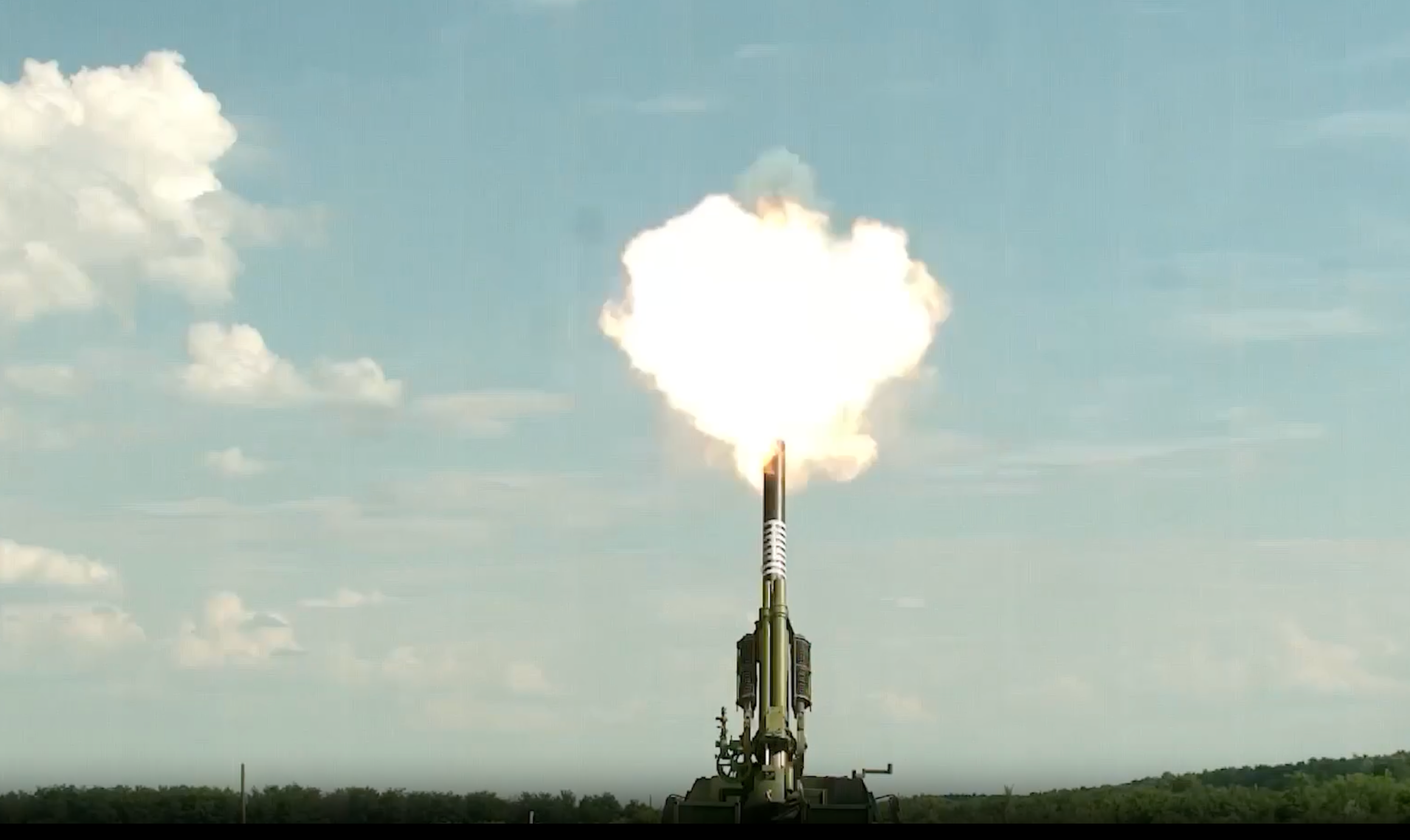
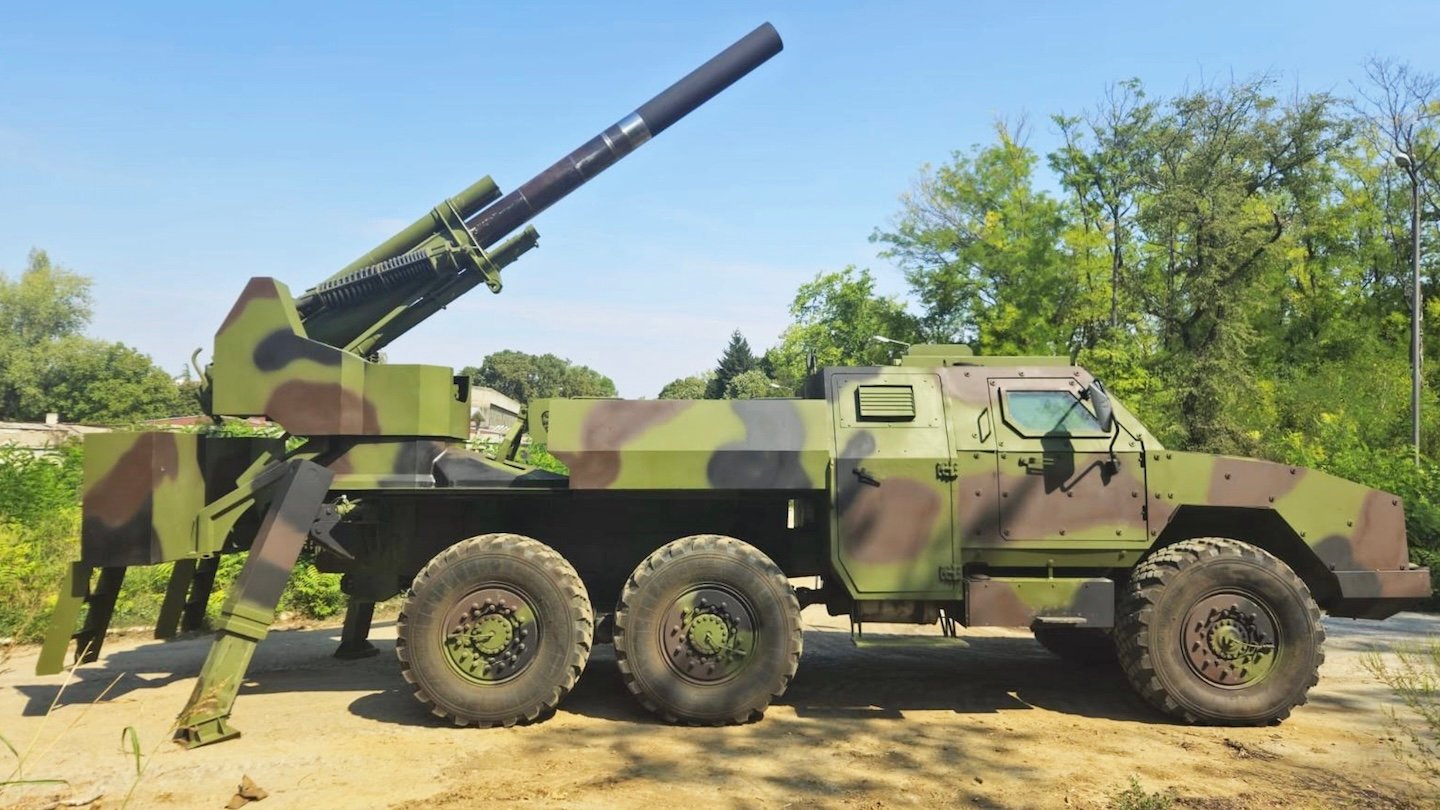
Serbia has released the first footage of its TSMB M-25 heavy self-propelled mortar in action, revealing an unusual artillery system that puts a massive 203mm weapon on a comparatively light, six-wheeled truck. The system is designed to hurl projectiles weighing around 220 pounds at targets up to approximately seven-and-a-half miles away, bringing super-heavy firepower to a platform that looks surprisingly modest for the job.

The Serbian Ministry of Defense published the brief footage in a larger video montage, seen immediately below, but has not disclosed when or where the firing tests took place or what they demonstrated. Regardless, the M-25’s configuration alone makes it stand out.

A TSMB M-25 heavy self-propelled mortar in a firing position. Serbian Ministry of Defense/screencap

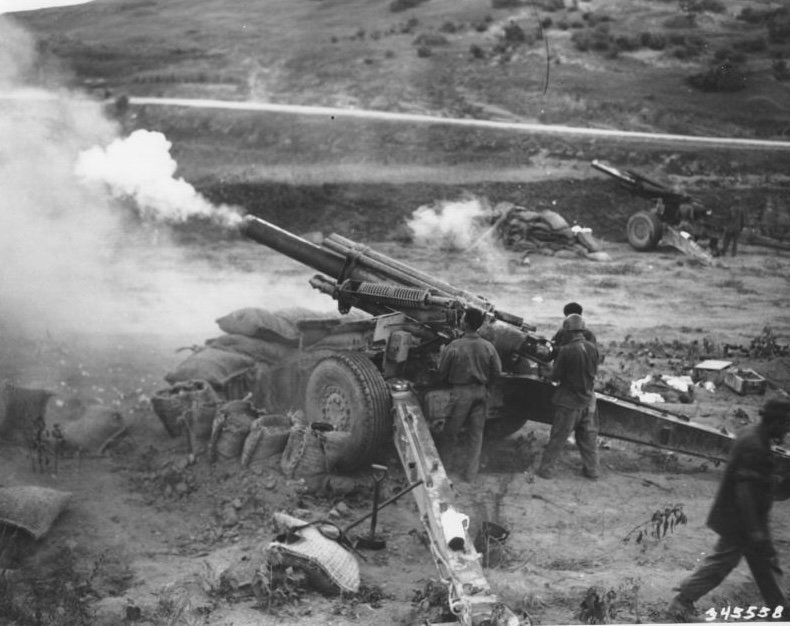
The Teški Samohodni Minobacač (TSMB, translated as heavy self-propelled mortar) M-25 was developed by Serbia’s state-owned Military Technical Institute and first appeared publicly at the Partner 2025 defense exhibition in Belgrade. Its design lineage stretches back to the Yugoslav M-65 155mm howitzer, itself a licensed copy of the widely used American M114, first introduced in World War II.

Artillerymen of the 24th Infantry Division, U.S. Army, fire 155mm howitzers in the Korean War. Public Domain

The M-25 takes that heritage in a different direction, with a 203mm barrel measuring 24 calibers in length and an automated loading mechanism for mortar projectiles. The mortar barrel has an elevation range from 0° to 75°, and the barrel must return to 0° in elevation for the next round to be loaded from the muzzle end.

The standard 203mm mortar bomb weighs around 220 pounds, including approximately 60 pounds of explosive material. This results in a claimed destruction radius of around 250 feet, using impact fuzing.

The system is intended to fire both high-explosive and concrete-piercing ammunition, making it particularly suited to attacking hardened positions and fortifications. Developers have also provided for rocket-assisted projectiles to extend its range and precision guidance kits to improve the accuracy of compatible rounds.

The weapon is mounted on a FAP 2026 three-axle truck in a 6×6 configuration, a general-purpose off-road type made by Serbian vehicle manufacturer Fabrika automobila Priboj. This platform provides a range of 500 miles and a top speed of 50 miles per hour on the road. The vehicle has an armored cab for a crew of four, while its fire-control suite includes an inertial navigation system, a ballistic computer, communications equipment, and a dedicated gunner’s computer. The same truck has also been adapted to mount a 152mm gun/howitzer, under the name NORA B-39.

The NORA B-39 mounts a 152mm gun/howitzer on the same FAP 2026 three-axle truck chassis. Serbian Ministry of Defense

The wheeled chassis is the defining feature of the M-25. While a weapon of this size would normally be either towed or mounted on a large tracked vehicle, Serbia has opted for a lighter truck-based arrangement. This offers advantages in road mobility and makes the system easier to move between firing positions, using “shoot and scoot” tactics. A general-purpose truck is cheaper to acquire and operate, and easier to maintain. It can also be more easily transported by air, although out-of-area operations are not generally on the Serbian Armed Forces’ agenda. However, its cross-country performance and overall survivability will be reduced compared to a tracked chassis.

TSMB M-25 heavy self-propelled mortar firing a round. Serbian Ministry of Defense/screencap

The M-25 is intended to deliver heavy fire against targets such as bunkers and other fortified positions, then relocate before an opponent can respond. Its relatively short stated range compared with many modern 155mm howitzers makes it a specialized system rather than a direct replacement for conventional long-range artillery. Its appeal lies instead in combining a very large projectile with a comparatively compact and mobile platform.

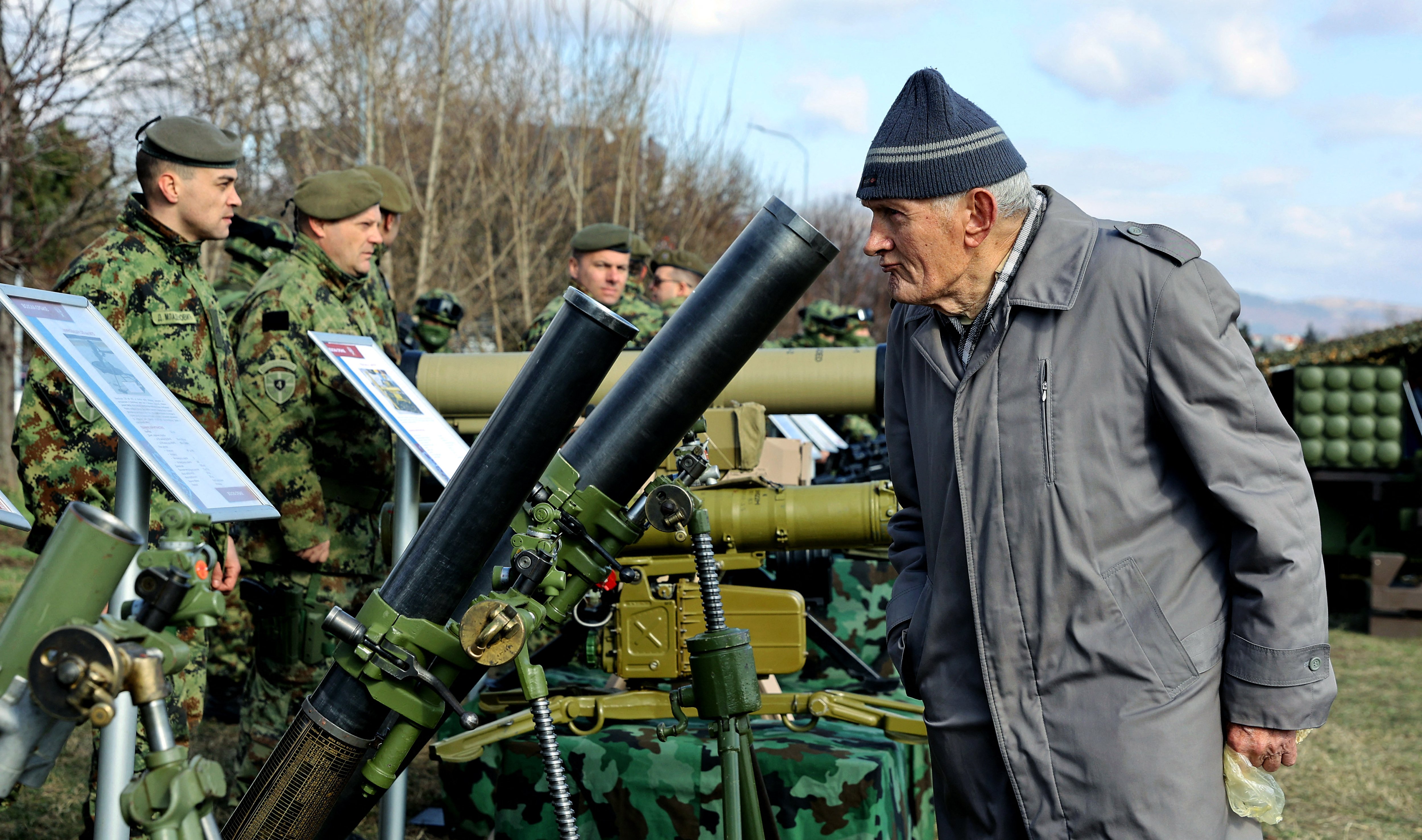
Mortars have a long and grim history in the Balkans, particularly during the wars that accompanied the breakup of Yugoslavia in the 1990s. The steep trajectories of mortar rounds made them useful in the region’s mountainous terrain and in fighting around fortified positions and during sieges, while their ability to deliver indirect fire meant crews could engage targets without a direct line of sight.

A visitor looks at mortars at an exhibition of Serbia's armed forces in Nis, southern Serbia, on February 14, 2024, ahead of Serbia's Statehood Day. (Photo by SASA DJORDJEVIC / AFP) (Photo by SASA DJORDJEVIC/AFP via Getty Images)
A visitor looks at infantry mortars at an exhibition of Serbia’s armed forces in Nis, southern Serbia, on February 14, 2024. Photo by SASA DJORDJEVIC / AFP SASA DJORDJEVIC

As far as we know, the M-25 is the only 203mm mortar in current development and/or production. There are a few larger mortars on mobile platforms, notably Russia’s 2S4 Tyulpan, a 240mm self-propelled mortar, but this is on a significantly bigger tracked chassis.

At approximately 19 metric tons, the M-25 is substantially lighter than the 2S4 Tyulpan, which weighs around 27.5 metric tons. Its tracked platform reflects a very different approach to moving super-heavy mortar firepower around the battlefield. The Tyulpan can deliver a 300-pound standard mortar round to a range of around six miles, or up to 11 miles away when using rocket-assisted rounds. 

Crewmen load a mortar projectile in a Russian-operated 2S4 Tyulpan. Russian Ministry of Defense
Russian artillerymen fire a 2S4 Tyulpan during a live-fire exercise. Russian Ministry of Defense

Serbia claims the M-25 has a rate of fire of up to three rounds per minute, thanks to the automated loading mechanism. In contrast, the Tyulpan can hurl a maximum of one round every 62 seconds. Indeed, its sluggish rate of fire is one of the reasons that saw it fall from more widespread Russian use.

There are still important unknowns. The newly released footage does not establish whether the advertised firing rate was achieved, how the weapon performs under sustained fire, or whether the system has entered operational service. Serbia has shown the M-25 at an exhibition and now in live-fire footage, but detailed test results have not been made public.

Still, the concept is striking: a high-mobility wheeled truck carrying a 203mm mortar is a distinctly different take on super-heavy firepower, but one that might just find a niche in the Balkan environment.

Author’s note: An earlier version of this article included a photo of the 2S5 Giatsint-S self-propelled gun, rather than the 2S4 Tyulpan.

Contact the author: thomas@thewarzone.com

The post This Serbian Truck Carries A Truly Massive Mortar appeared first on TWZ.

  •  

Ukraine’s StarGate Drone Now Evacuating Wounded Soldiers

Ukraine’s 475th Separate Assault Regiment, known as CODE 9.2, says it has used the StarGate uncrewed aerial platform to evacuate two seriously wounded soldiers from the battlefield in the span of a week. Reportedly, this is the first time the specialized drone has been used for an operation of this kind. It is not, however, the first instance of Ukraine using an aerial rescue drone on the battlefield, with the more extemporized heavy hexacopter also having been used recently, as you can read about here.

Taken together, the missions underscore Ukraine’s efforts to develop alternative casualty evacuation capabilities as Russian drone threats, electronic warfare, and harsh terrain increasingly complicate conventional recovery operations, including those using uncrewed ground vehicles (UGVs).

According to CODE 9.2, on its Facebook page, the regiment’s personnel carried out two complex evacuation missions using StarGate, a platform developed and manufactured by Ukrainian company SkyFall. The two wounded servicemen were 25-year-old Yevhen, callsign “Izyum,” and 24-year-old Artem, callsign “Kolobok.” Both belonged to adjacent units and had suffered severe limb injuries while occupying positions in a so-called gray zone approximately three miles from the Russian border.

Difficult terrain, including water obstacles, and the threat posed by Russian first-person-view (FPV) drones prevented ground vehicles from reaching the casualties, the regiment said. Air evacuation was the only available option.

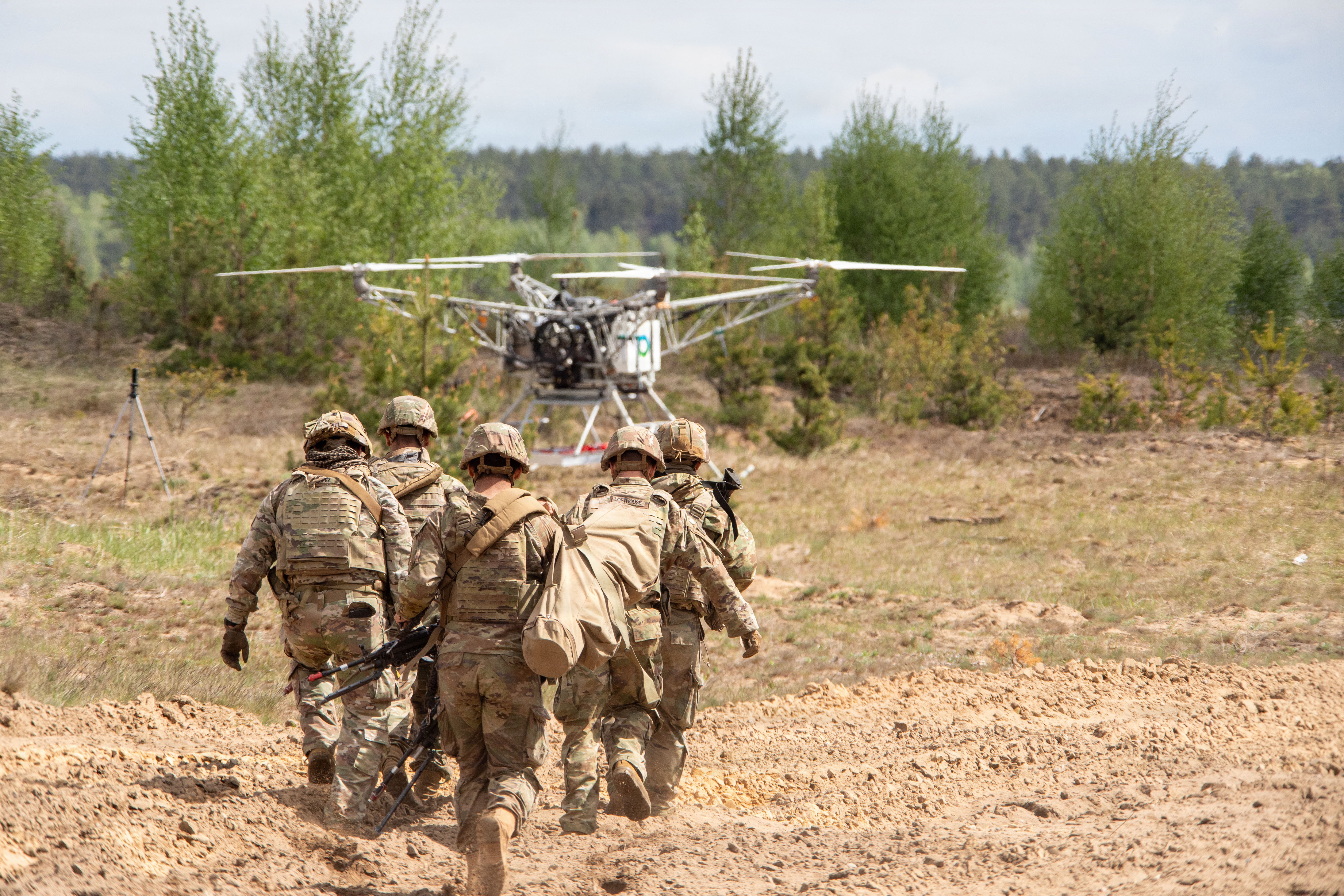
Drone operators watch as two soldiers carry their injured comrade to the SkyFall drone for evacuation. CODE 9.2/screencap

The missions were planned and executed by CODE 9.2 personnel with support from SkyFall. They required coordination among multiple units, additional forces and equipment, and dedicated fire support — much like a more traditional casualty evacuation effort involving crewed helicopters. Vampire heavy strike drones were employed to suppress enemy positions during the operations.

“The injury tore off half of my foot, so a lot of blood was lost already,” Izyum said in a video interview from his hospital room. “I think if that incredible little bird hadn’t flown in, well, getting out from there would have been unrealistic.”

During one of the missions, StarGate reportedly flew nearly 20 miles to reach the casualty before covering approximately the same distance on the return leg with the wounded serviceman aboard. CODE 9.2 said Russian electronic warfare systems were actively attempting to suppress satellite navigation signals in the area.

An injured soldier is helped out of the drone after recovery to a safe area. CODE 9.2/screencap

Despite the reported interference, the platform completed the mission using its onboard artificial intelligence-based navigation system, according to the regiment. The statement did not specify the navigation technologies involved.

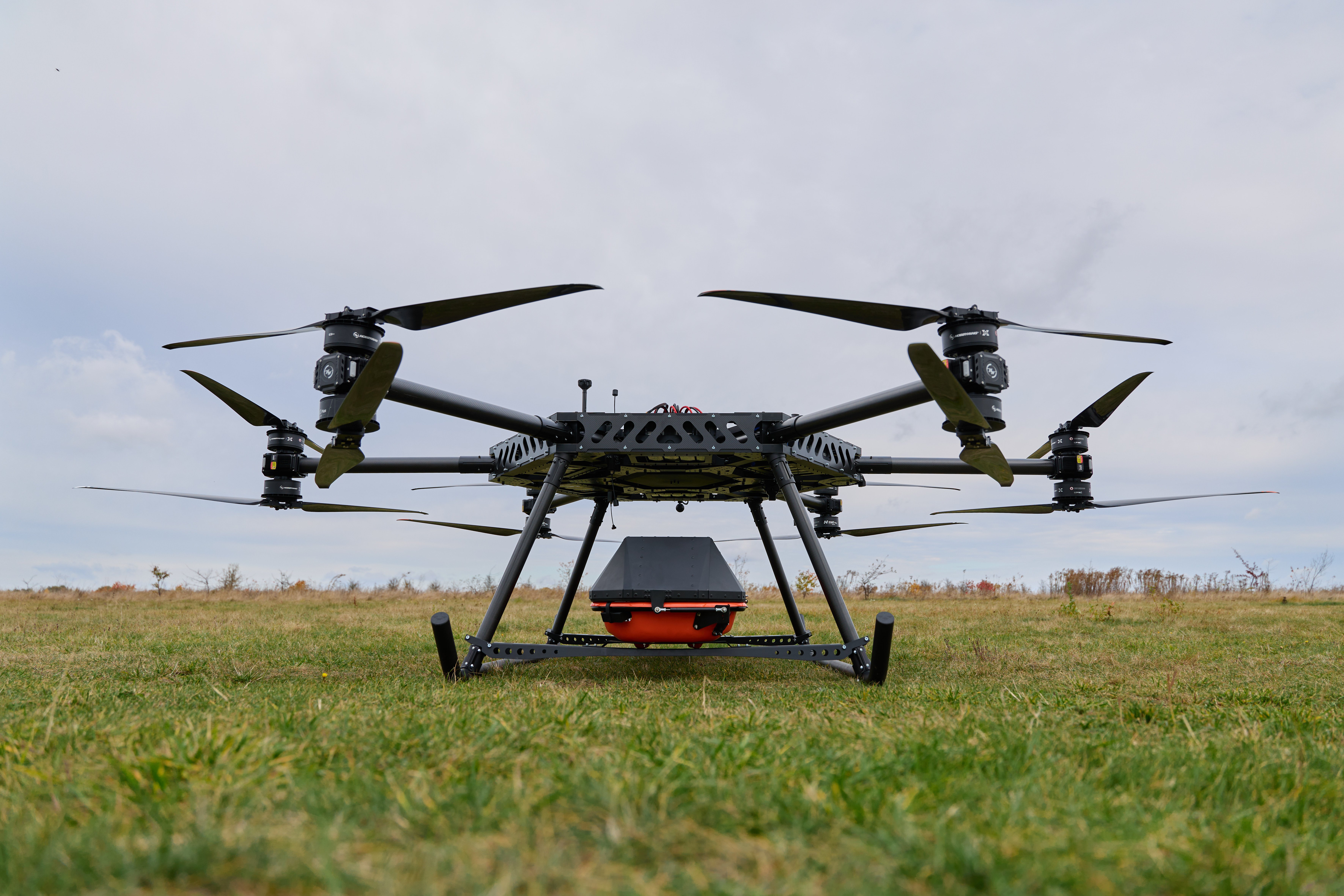
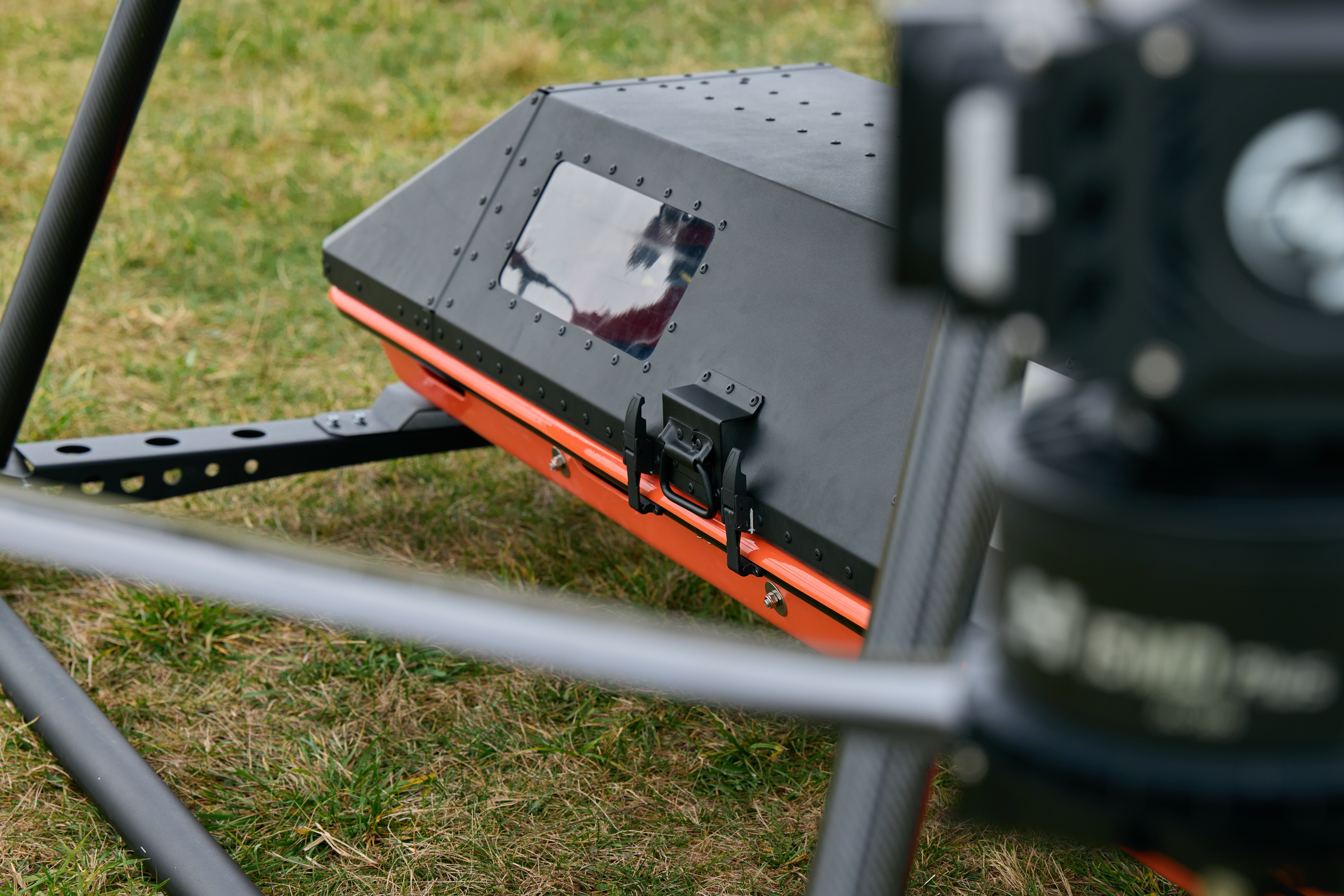
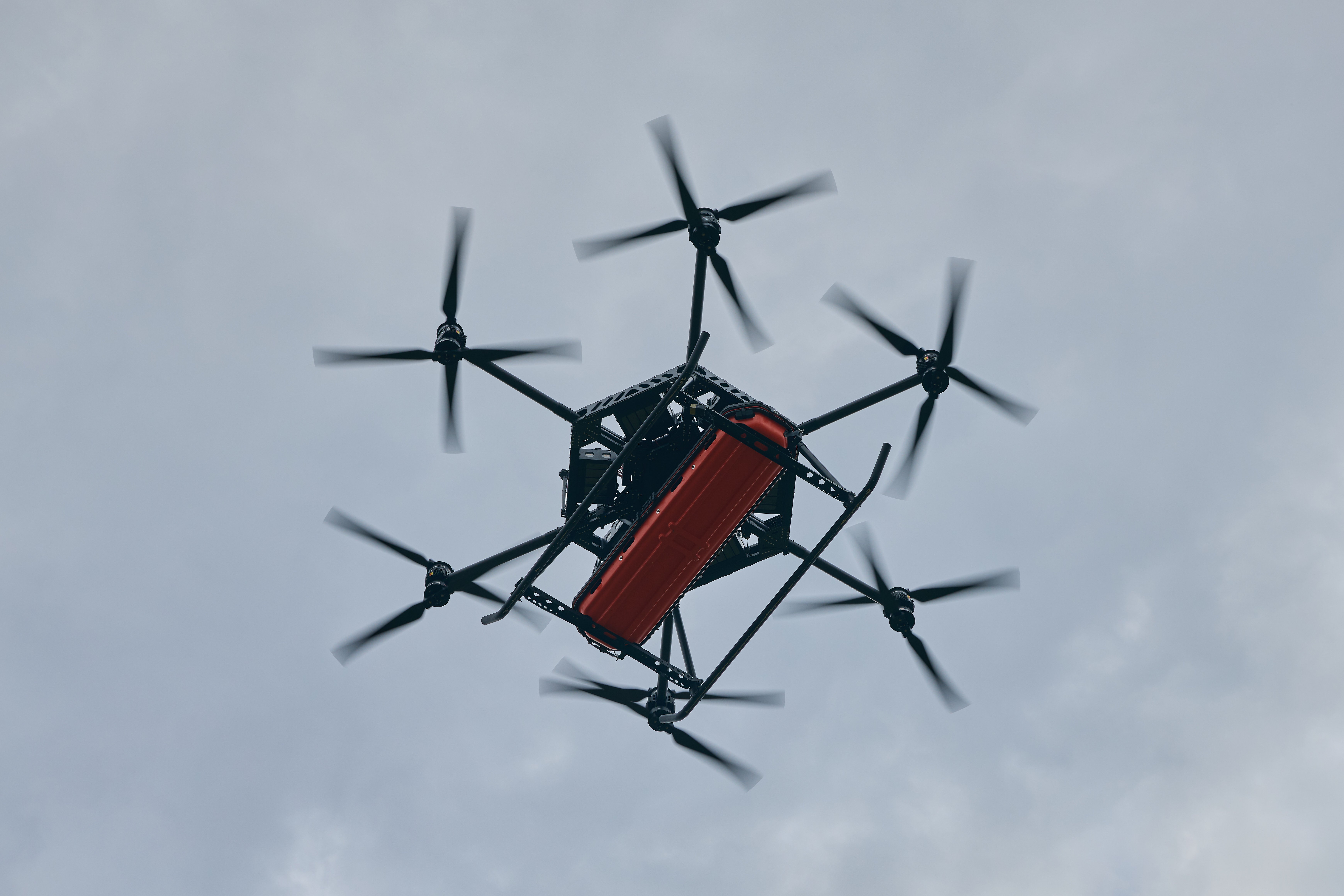
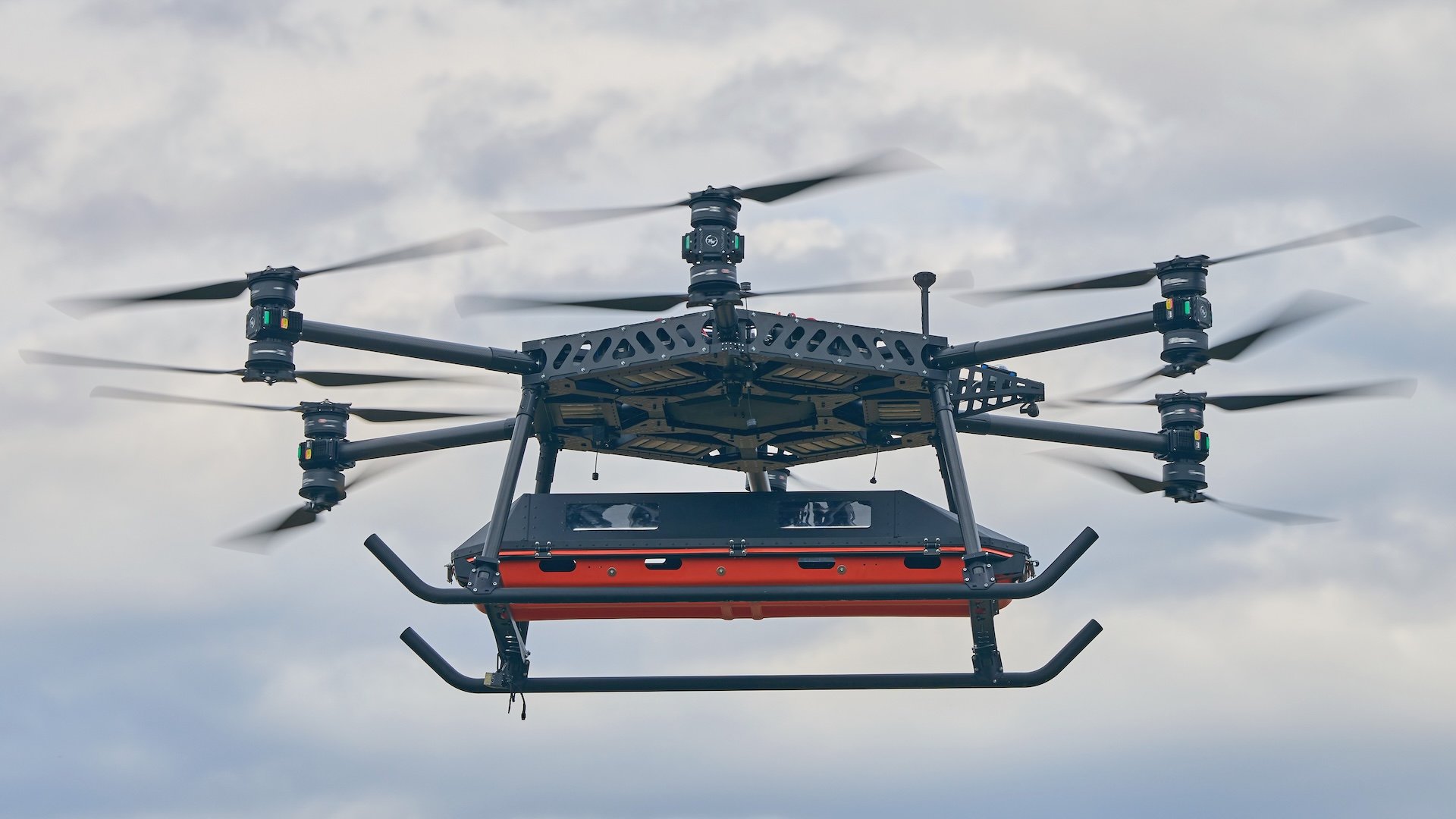
StarGate was designed specifically for casualty evacuation, or CASEVAC, when conventional ground transportation cannot reach wounded personnel or would expose them to unacceptable risks. Its stated specifications include a payload capacity of up to 330 pounds and a maximum speed of approximately 65 miles per hour. The evacuation module is based on a covered, medical-grade stretcher.

StarGate on the ground. SkyFall

Oleksandr Nastenko, commander of CODE 9.2, callsign “Flint,” said the regiment intends to use the experience gained from the two missions to train crews and make aerial evacuation a more established capability. The regiment also plans to set up a dedicated aerial medical evacuation unit within its medical company.

The StarGate missions follow a separate reported operation involving the 92nd Assault Brigade, which says its personnel helped evacuate a wounded soldier using a heavy-lift hexacopter drone, produced by Gurzuf Defense, with the casualty suspended beneath it, as seen in the video below:

This drone was reportedly an Audag-6 model, which is said to be capable of carrying a 200-pound payload over a distance of up to 15 miles.

In that incident, the soldier had been wounded while holding his position. Once again, aerial extraction was judged the only suitable option; in this case, due to the presence of mines and intense Russian drone activity.

This was a more improvised approach, which the brigade described as the world’s first frontline aerial drone evacuation of a wounded soldier. Compared to Stargate, the Gurzuf drone brings some drawbacks with it, including casualty stability, exposure to the elements, the risk of swinging during flight, and the difficulty of safely lifting and lowering a severely injured person. It subsequently emerged that the soldier involved, Kostiantyn Vlasenko, had been forced to amputate his own foot as part of a 491-day ordeal on a frontline position.

A soldier clipped to the underside of a Gurzuf drone via a harness is flown to safety. 92nd Assault Brigade/YouTube screencap

This was not the first time that Ukrainian forces have adapted existing drone technology to effect battlefield evacuations.

TWZ also previously reported on a Ukrainian soldier who managed to escape from the Russians that surrounded him after an electric bike was dropped to him by a large aerial drone.

As a purpose-built platform, StarGate offers a more standardized way to secure and transport casualties, and to transport them protected from the elements, in a secure, prone position. However, StarGate still faces the challenges of flying in contested airspace and navigating under electronic warfare conditions. Once again, depending on the degree of injuries, the casualty may need assistance being put on the stretcher and, regardless of the degree of medical care that can be provided, StarGate is only an option if already available in proximity to the victim.

Close-up view of the StarGate stretcher. SkyFall

The fact that the StarGate missions also needed strike drones for fire support underscores that casualty recovery, whatever the platform being used, typically requires coordination across multiple combat elements.

Despite the limitations, CODE 9.2’s plan to create a dedicated medical aviation element indicates it wants to move beyond one-off missions toward a repeatable capability.

StarGate in flight. SkyFall

As with other emerging technologies from the war in Ukraine, this is likely to be studied by other armed forces, too. The U.S. military, for example, has long looked at the potential of uncrewed aerial systems to effect casualty evacuation missions, as you can read about here.

Meanwhile, the challenges of that conflict mean that Ukrainian troops continue to explore different ways to recover wounded troops from positions that more conventional evacuation methods can no longer safely reach.

Contact the author: thomas@thewarzone.com

The post Ukraine’s StarGate Drone Now Evacuating Wounded Soldiers appeared first on TWZ.

  •  

British Type 31 Frigate Variant Offered To The U.S. Navy

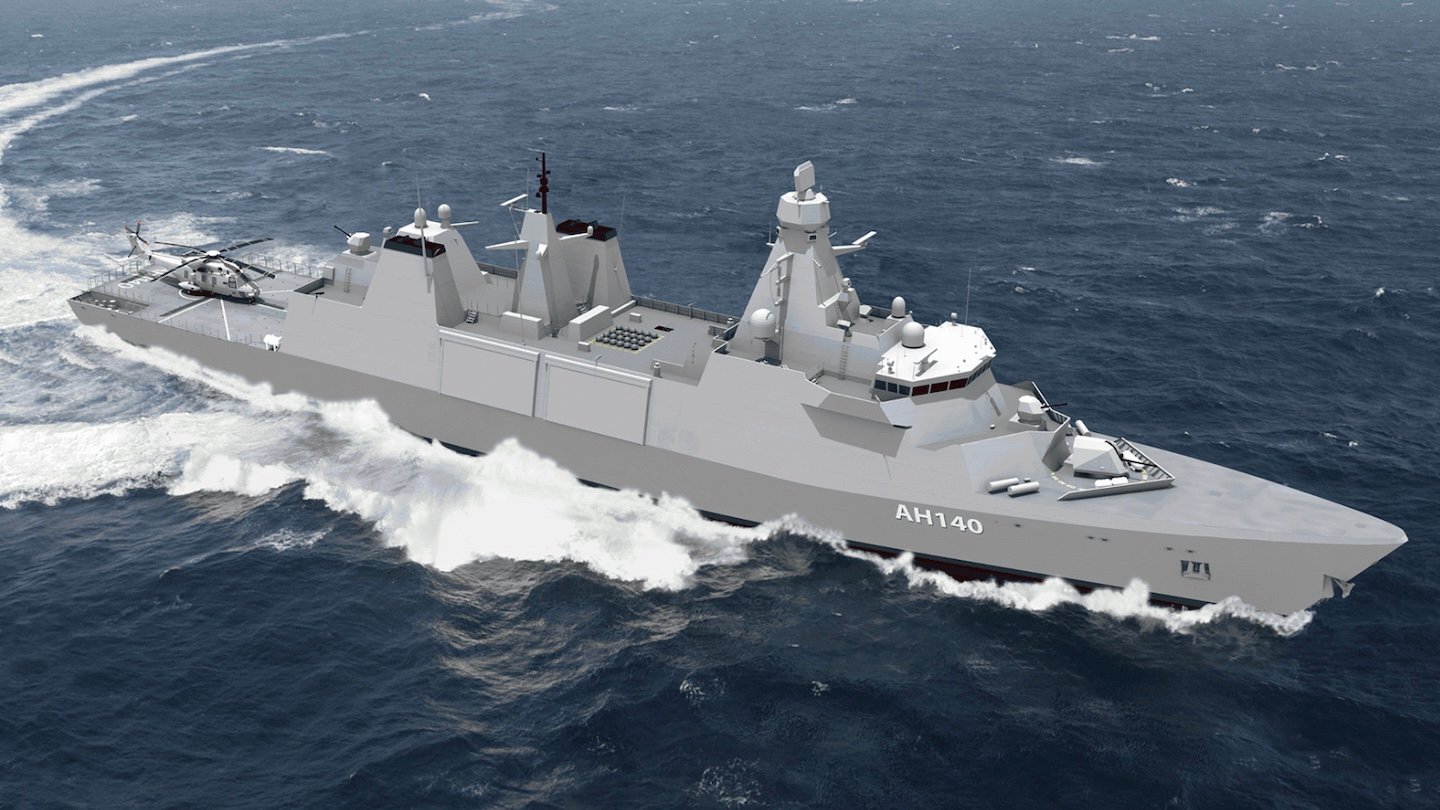
British defense contractor Babcock has confirmed that it is putting itself forward for the U.S. Navy’s future frigate program, with its Arrowhead 140 general-purpose frigate, the design behind the Royal Navy’s Type 31 class, expected to form the basis of its proposal. The move adds another foreign-designed warship to Washington’s search for a relatively mature frigate that can be built quickly and in significant numbers.

Babcock has held preliminary discussions with Pentagon officials and is expected to submit an expression of interest before the end of October, according to recent reporting by The Telegraph and Navy Lookout. The proposal is understood to potentially involve Huntington Ingalls Industries (HII), America’s largest military shipbuilder, with the two companies exploring an arrangement that could see the Arrowhead 140 built in the United States under license.

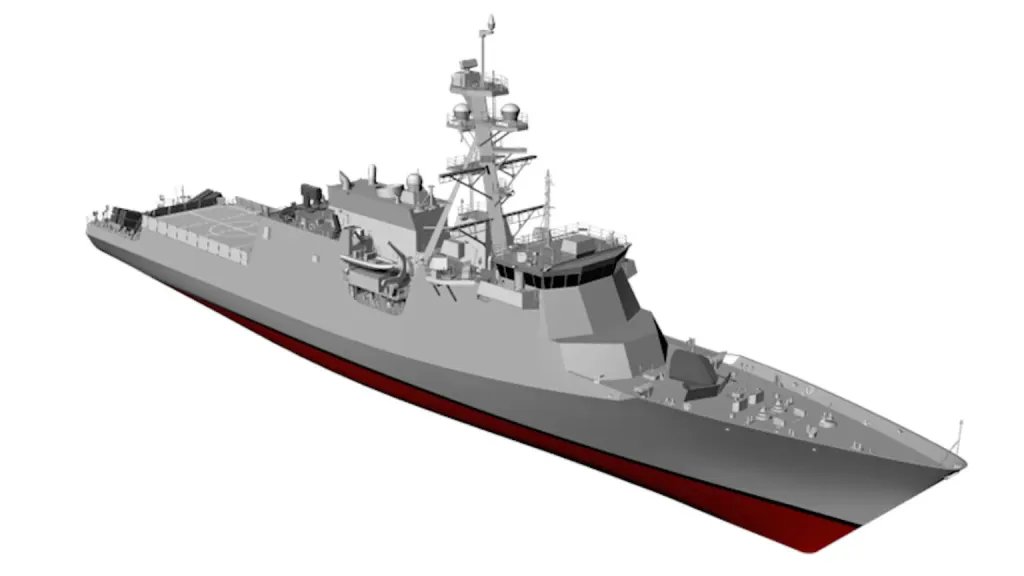
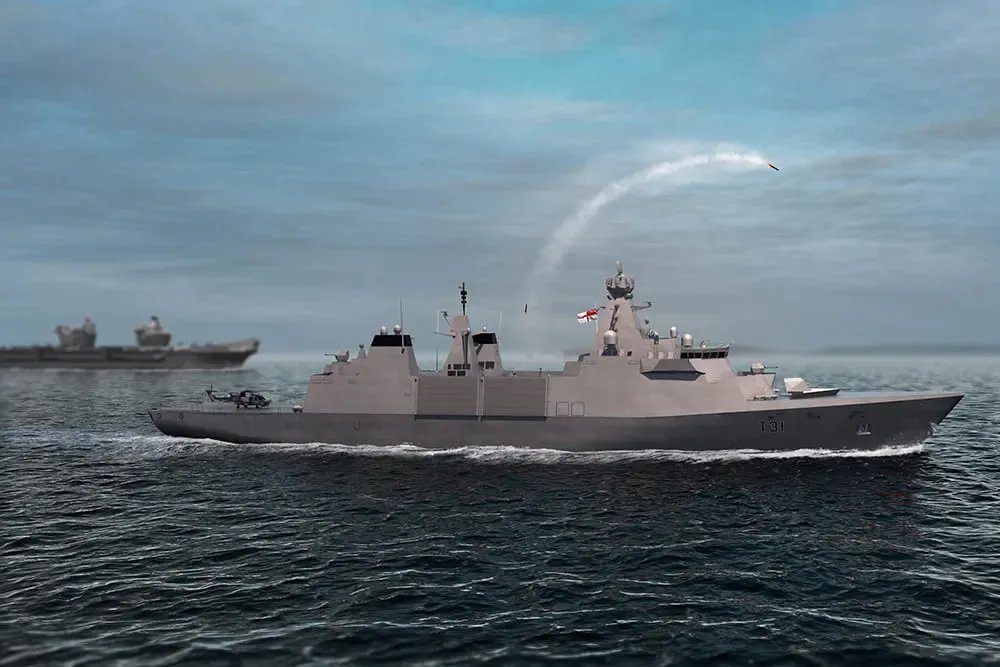
An artist’s impression of the U.K. Royal Navy Type 31 general-purpose frigate. Royal Navy

“Of course we’re interested. We have a world-class frigate, close links to the U.S. and U.S. industry. It would be insane for us not to respond,” Sir Nick Hine, head of Babcock’s marine business and a former Second Sea Lord, told The Telegraph.

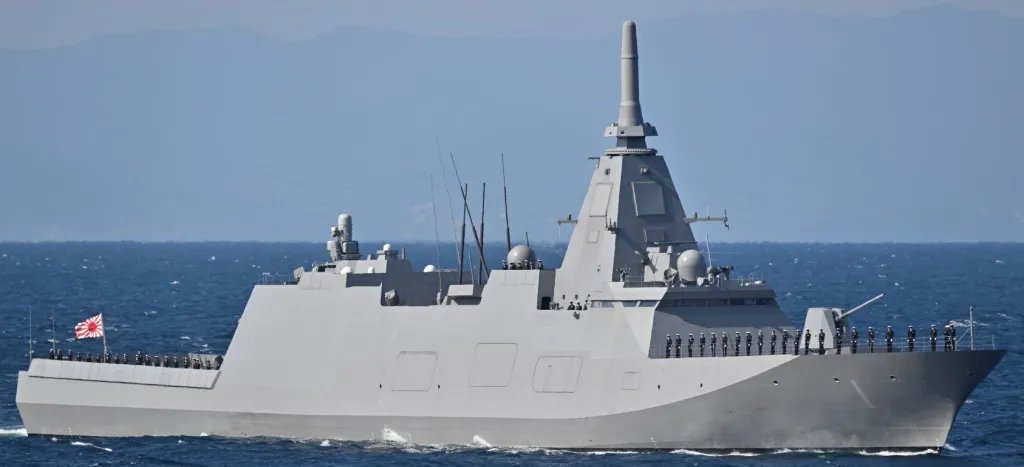
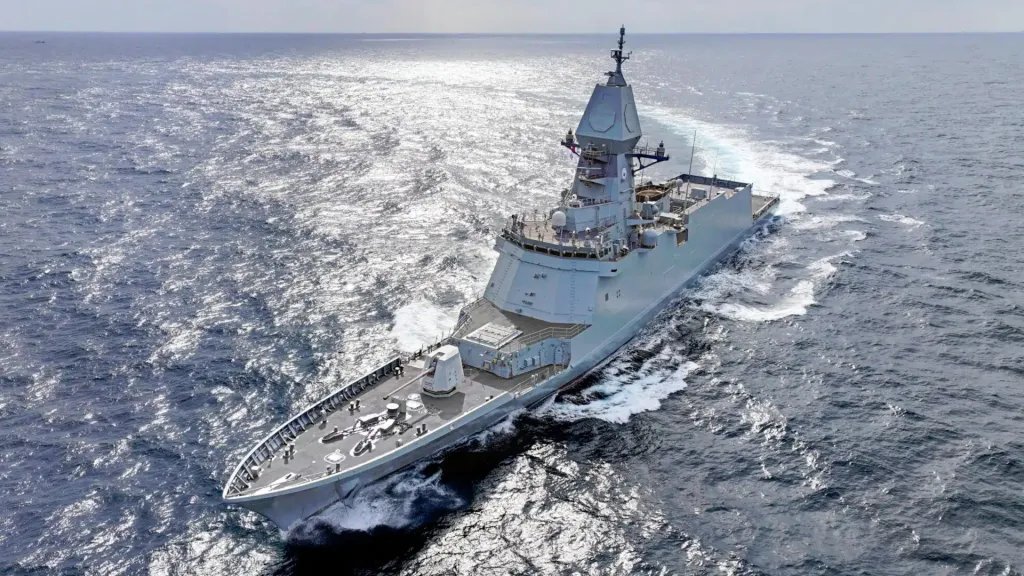
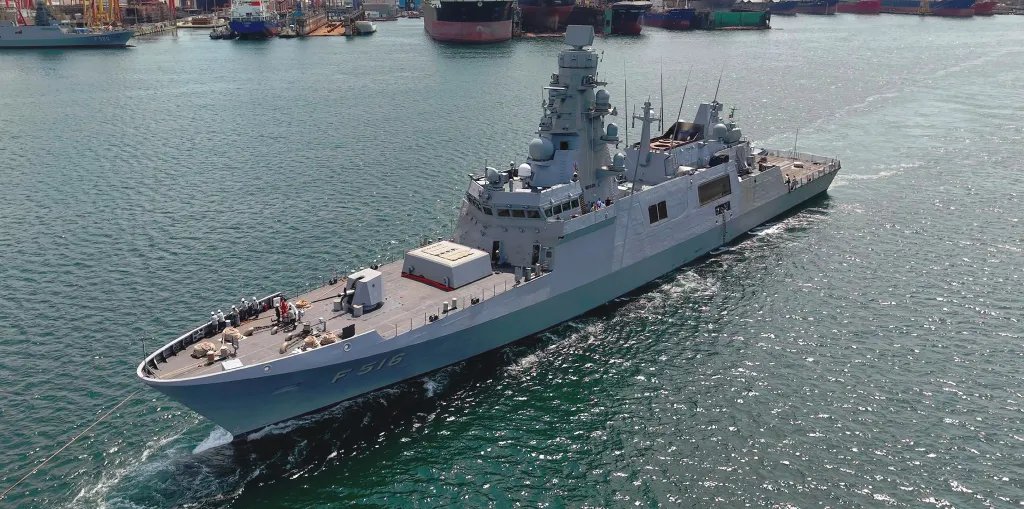
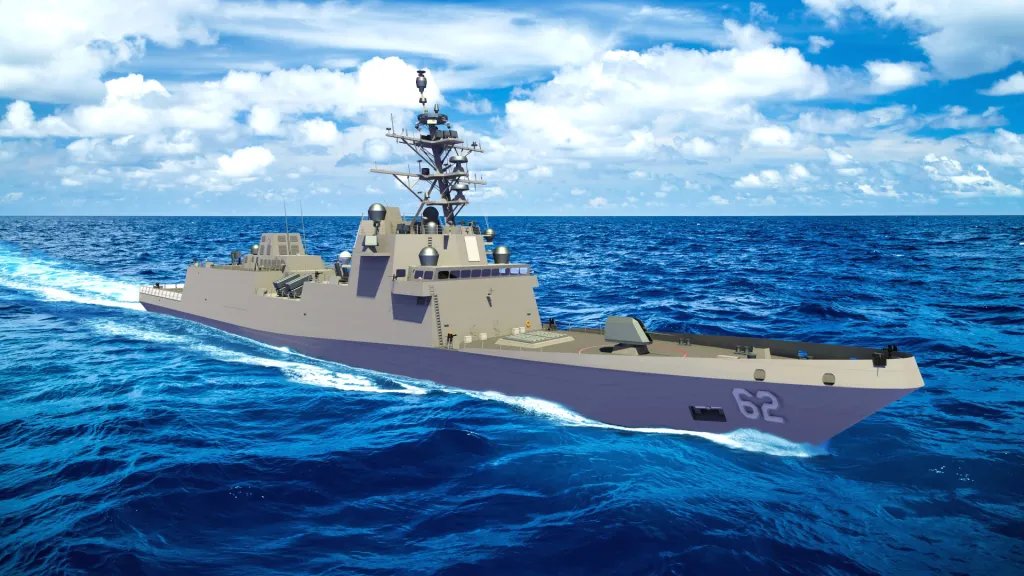
The initiative comes as the U.S. Navy seeks to accelerate the acquisition of smaller surface combatants after the troubled Constellation class frigate program was axed. Japan’s upgraded Mogami class, South Korea’s Chungnam class, and Turkey’s Istanbul class have also been reported as candidates for the Navy’s international frigate effort. You can read more about all three designs here.

The Japan Maritime Self-Defense Force’s (JMSDF) first-in-class JS Mogami. JMSDF
The South Korean Navy’s ROKS Chungnam seen during sea trials before its delivery in 2024. HD Hyundai Heavy Industries
The future TCG Izmir from Turkey’s Istanbul class. Anadolu Shipyard

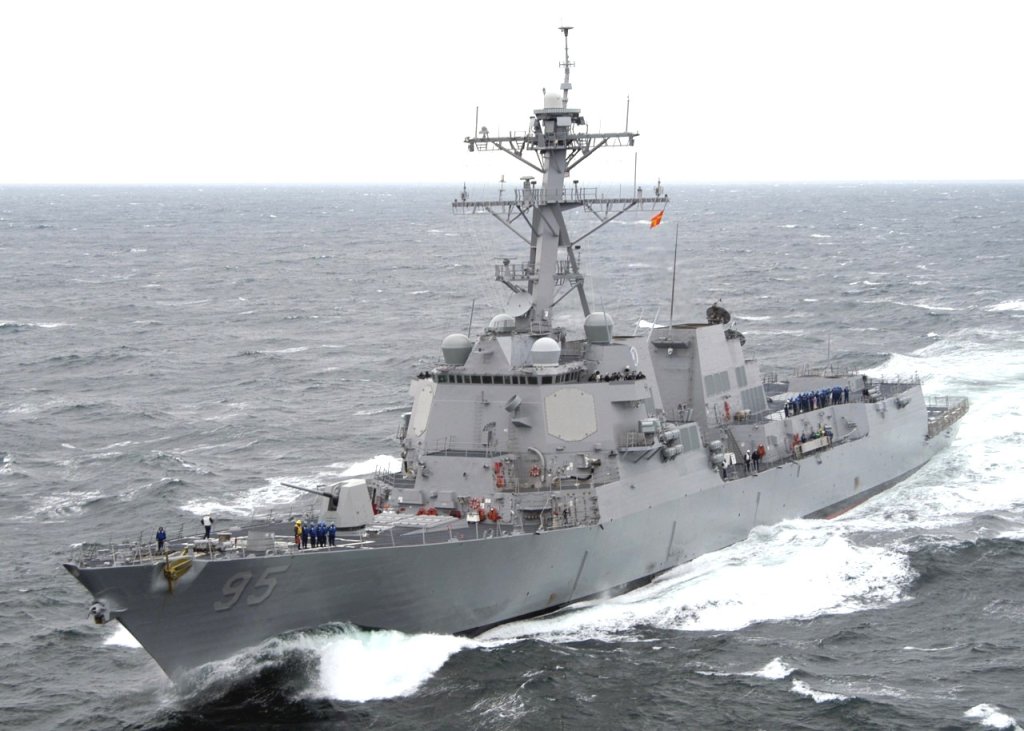
Fincantieri Marine Group, which had developed the cancelled Constellation class frigate for the U.S. Navy, also says it sees a possible new opportunity in the service’s latest frigate plans. 

Meanwhile, German defense contractor Rheinmetall, a newcomer to the surface combatant market, recently unveiled its GMF 140 frigate, which it has said it plans to offer “initially as part of a procurement project in North America” before pursuing opportunities with other allied navies.

For Babcock, the opportunity would be a major expansion of its relationship with the U.S. defense industry. If successful, the company would likely provide the design, engineering expertise, and potentially the intellectual property needed for American shipyards to manufacture the frigates.

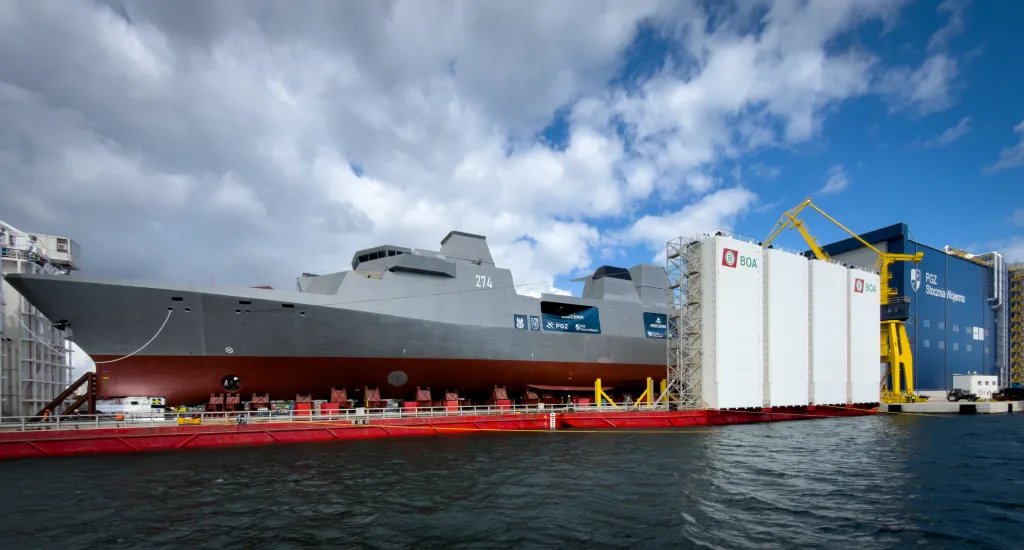
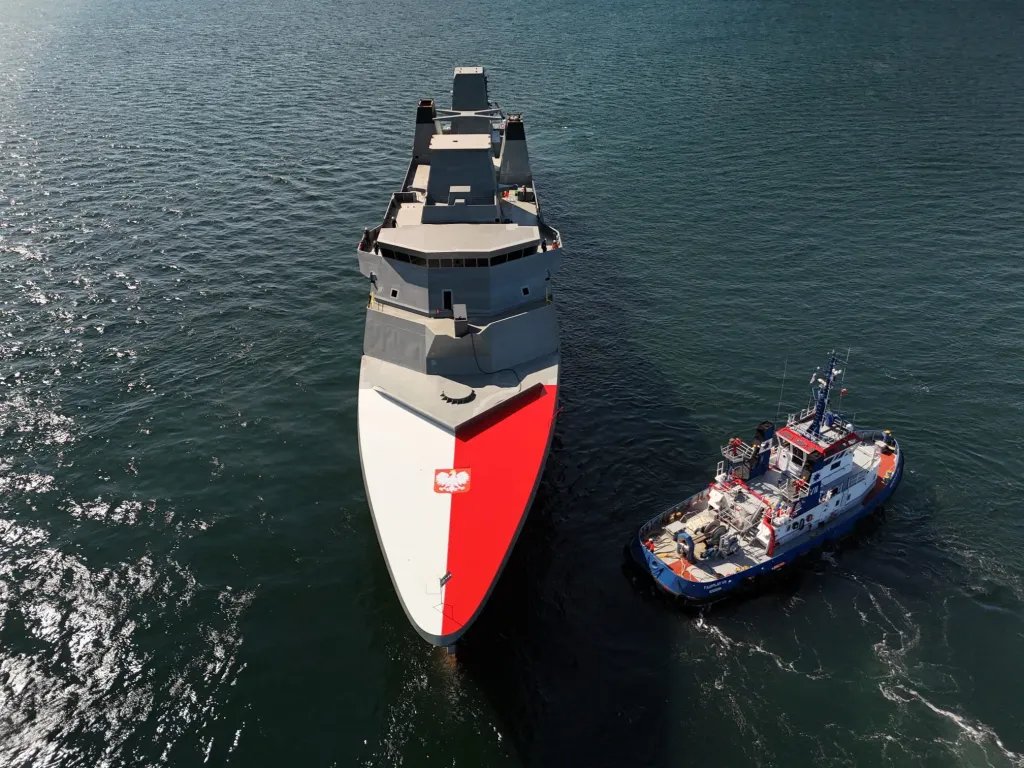
This would mirror the process for the Polish Navy’s Project 106 Miecznik (Swordfish) class, which is building three new multirole frigates in Poland, rather than using the company’s own facilities in Britain.

The future Polish Navy frigate Wicher under construction in Gdynia, Poland. Photo by Mateusz Wlodarczyk/NurPhoto

The Navy’s assessment of potential options is due by November 12. No contract has been awarded, and the details of any Babcock-HII proposal remain unconfirmed.

The Arrowhead 140 is the foundation of the Royal Navy’s five-ship Type 31 program, which is being built at Babcock’s Rosyth shipyard in Scotland. The design is derived from the Danish Iver Huitfeldt class frigate. As well as Poland, the warship has also been selected for Indonesia.

The Arrowhead 140 has a baseline length of approximately 455 feet, a beam of 65 feet, and a displacement of around 5,700 tonnes, although national variants may be considerably heavier. The vessel uses a conventional combined diesel-and-diesel (CODAD) propulsion system and can achieve speeds exceeding 28 knots. Its design emphasizes long endurance, with a baseline endurance of approximately one to two months. The AH140 incorporates a flight deck and hangar for naval helicopter operations, accommodation for embarked personnel, boat-handling facilities, and adaptable mission spaces. Its modular architecture allows customers to integrate different sensors, combat management systems, electronic warfare equipment, and weapons according to national requirements.

Taking the Polish Navy’s Project 106 class as an example of an Arrowhead 140 iteration, this is a notably heavily armed adaptation, featuring a 76mm Leonardo Strales main gun, a 32-cell Mk 41 vertical launch system for surface-to-air missiles, eight Naval Strike Missiles for anti-ship strike, and lightweight torpedo launchers. The Polish variant is reported to have a maximum displacement of approximately 7,700 tonnes.

Wicher, the first of the Polish Navy’s Project 106 Miecznik (Swordfish) class. PGZ SW

The Type 31 is a general-purpose warship capable of undertaking maritime security, escort, and surface warfare missions. Its relatively large hull offers considerable internal volume for weapons, sensors, aviation facilities, and future upgrades.

That could make it attractive to a U.S. Navy looking for a ship able to protect convoys, operate independently, and supplement its larger destroyers. A frigate with a significantly lower operating cost than an Arleigh Burke class destroyer could still take on a range of missions, freeing more capable combatants for broad area air and missile air defense, sustained strike operations, and other more demanding tasks.

The Arleigh Burke class destroyer USS James E. Williams underway. U.S. Navy courtesy photo The USS James E. Williams. USN

The Arrowhead 140’s size could also provide flexibility in accommodating American weapons and combat systems. However, a U.S. version would require a defined configuration, and there is no publicly established weapons fit for a potential American variant.

At the same time, the Royal Navy’s Type 31 frigate has not yet entered operational service, and its baseline configuration is not optimized for every mission the U.S. Navy may require. In particular, the integration of the sonar and other systems needed for sustained anti-submarine warfare would be a significant undertaking.

The Navy will also have to wrestle with how much of the existing design can be retained while meeting its own requirements. One of the major lessons from the Constellation program was that extensive modifications to an existing foreign design can create huge cost and schedule risks. With so little left of the original design after it was adapted to Navy specifications, this eventually doomed the program.

A rendering of a now-cancelled Constellation class frigate. U.S. Navy

For Babcock, it will be essential to keep the Arrowhead 140 as close as possible to its established configuration, while integrating essential American equipment, to keep the proposal competitive.

Babcock does not operate a shipyard in the United States, making an American industrial partner central to its approach.

HII, which operates major shipbuilding facilities at Newport News and Ingalls, would offer substantial experience constructing warships for the U.S. Navy. Babcock and HII already have an established relationship in the submarine sector, including work supporting the Virginia class attack submarine program.

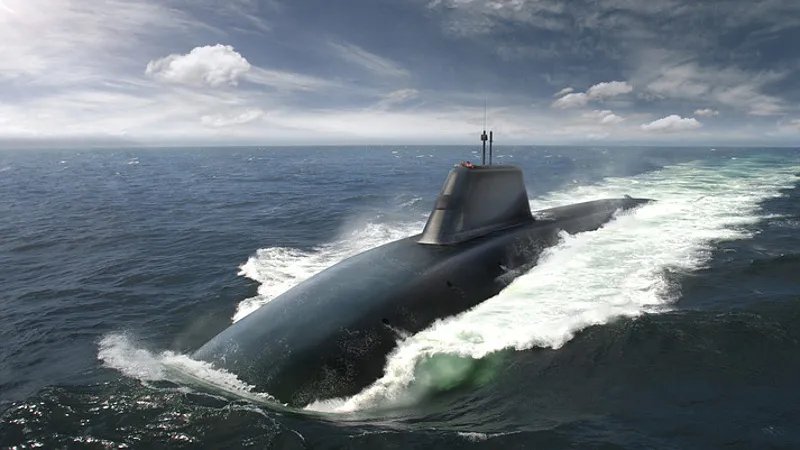
Babcock’s facilities in Rosyth and Bristol manufacture tactical missile-tube assemblies for General Dynamics Electric Boat, supporting the Common Missile Compartment used by the U.S. Navy’s Columbia class and the Royal Navy’s Dreadnought class ballistic missile submarines. HII has also expanded its relationship with Babcock through work involving Virginia class submarine components.

An artist’s conception of one of the Royal Navy’s future Dreadnought class submarines. BAE Systems

Those existing industrial relationships could provide a foundation for a surface-ship partnership. Under a potential arrangement, Babcock could transfer the necessary design rights and provide technical support while an American yard undertakes construction.

Such an arrangement would fit the Trump administration’s stated goal of using allied expertise to accelerate warship production while rebuilding domestic shipbuilding capacity. It would also allow Babcock to pursue a potentially significant U.S. order without requiring Rosyth to absorb a large new construction program alongside its Royal Navy commitments.

The prospect of HII supporting more than one design raises questions about production capacity, program priorities, and how the company would manage competing demands on its shipyards.

More generally, the administration’s interest in foreign frigates reflects growing concern about the time and expense involved in developing new American warships.

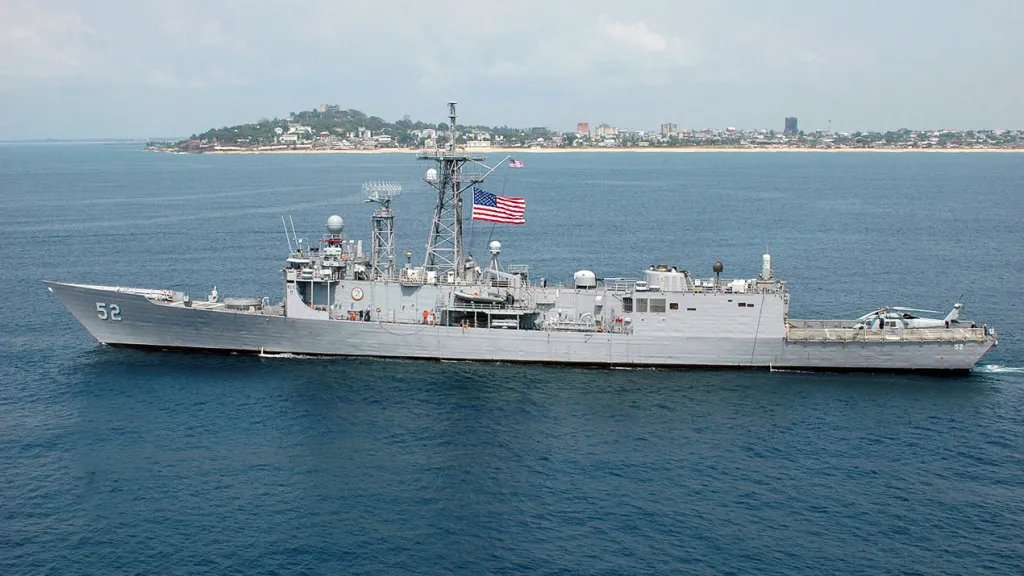
The Constellation class program was supposed to provide a modern replacement for the Navy’s retired Oliver Hazard Perry class frigates. Based on the European FREMM design, it underwent extensive modifications for American service before suffering serious schedule and cost problems. The Navy subsequently abandoned the program.

Oliver Hazard Perry class USS Carr is seen in 2006. The last of the type was retired from U.S. service in 2015. U.S. Navy

The service is now pursuing FF(X), a patrol frigate intended to be easier to build and field. Its initial configuration, however, is not expected to include a vertical launch system, limiting its ability to provide some of the capabilities associated with a more heavily armed multi-mission combatant.

A rendering of the FF(X) frigate. U.S. Navy

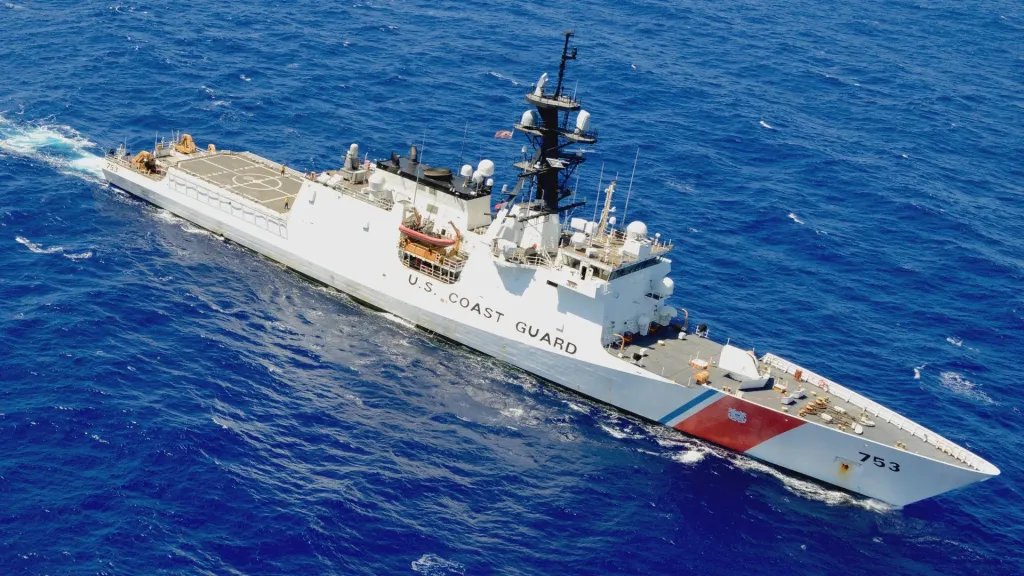
HII is building the FF(X) frigate, based on the Coast Guard’s Legend class National Security Cutter. It is somewhat telling that they would partner with Babcock on the foreign frigate offering considering they already have the FF(X) contract.

The Coast Guard’s Legend class cutter USCGC Hamilton. U.S. Coast Guard

The international frigate effort is intended to examine whether a ship based on an existing allied design could provide a different balance of capability, cost, and delivery speed.

An August presidential memorandum opened a route for the Navy to consider allied designs and, under limited circumstances, overseas construction through a national security waiver. The approach has been compared with a model in which an initial small number of ships could be constructed abroad before production moves to U.S. yards.

The reported framework limits overseas construction to no more than two ships and ties it to investment in American shipbuilding. Any eventual Babcock proposal would therefore need to demonstrate how the design could be transferred and produced domestically at the required pace.

That could be a big challenge. Babcock’s own Type 31 production line is already committed to the five ships ordered by the Royal Navy, while setting up an American production line would require workforce training, supply-chain development, and the transfer of manufacturing knowledge.

HMS Bulldog has officially entered build.

The ceremonial Steel Cut for our fourth Type 31 frigate marks another major step forward for our programme, joining a production line that is gathering real speed.

More to come from Rosyth later this evening.https://t.co/ZoTM5OWNVv pic.twitter.com/35Y3qBpMJg

— Babcock International (@Babcockplc) February 24, 2026

The Navy will also need to establish whether a foreign design can meet its minimum operational requirements without undergoing the kind of extensive redesign that dogged the Constellation program.

Babcock enters a field that already includes several established frigate designs from Japan, South Korea, and Turkey — and potentially more.

Each offers a different combination of design maturity, combat systems, production capacity, and potential industrial arrangements. The Mogami and Chungnam programs have operational ships in service, while the Arrowhead 140 has been selected for multiple export programs but is yet to enter operational service.

Babcock’s selling point is likely to be the Arrowhead 140’s size, adaptability, and established design pedigree, combined with the prospect of American production through HII.

With the Arrowhead 140 adopted by multiple navies, this brings potential cost savings through economies of scale, shared design evolution, and collaborative upgrades across the fleet. A wider international user base also brings the possibility of overseas industrial partnerships, including training and logistical support around the globe.

At the same time, U.S. Navy selection would represent a major endorsement of the platform and would further strengthen its position in other export markets.

For now, Babcock’s confirmation that it intends to pursue the opportunity adds another contender to the Navy’s search for a new frigate. Whether the Arrowhead 140 advances beyond the initial expression of interest will depend on how its capabilities and production prospects compare with the other candidates. And critically, Babcock and its U.S. partners will need to convince the Pentagon that they can deliver a ship that meets the Navy’s requirements without repeating the delays and redesign challenges of the Constellation program.

Contact the author: thomas@thewarzone.com

The post British Type 31 Frigate Variant Offered To The U.S. Navy appeared first on TWZ.

  •  

Denmark To Buy Anthem Munitions, Joint Strike Missiles In Dual Long-Range Strike Push

Denmark is set to acquire Anthem long-range strike weapons from U.S.-based defense startup Covenant, as well as Joint Strike Missile (JSM) cruise missiles from Norway’s Kongsberg Defense & Aerospace. The twin-track approach by the Nordic NATO member will give it new options for launching long-range strikes from the ground and air. Furthermore, Denmark’s move reflects a broader European push to acquire longer-range strike options, especially by NATO allies seeking to deter Russia.

Danish Defense Minister Jeppe Bruus announced the planned purchases yesterday. He said the new weapons would strengthen Denmark’s ability to respond to an attack and strike targets “behind enemy lines,” according to Reuters. Copenhagen has not disclosed the number of missiles involved, the value of the purchases, or expected delivery dates.

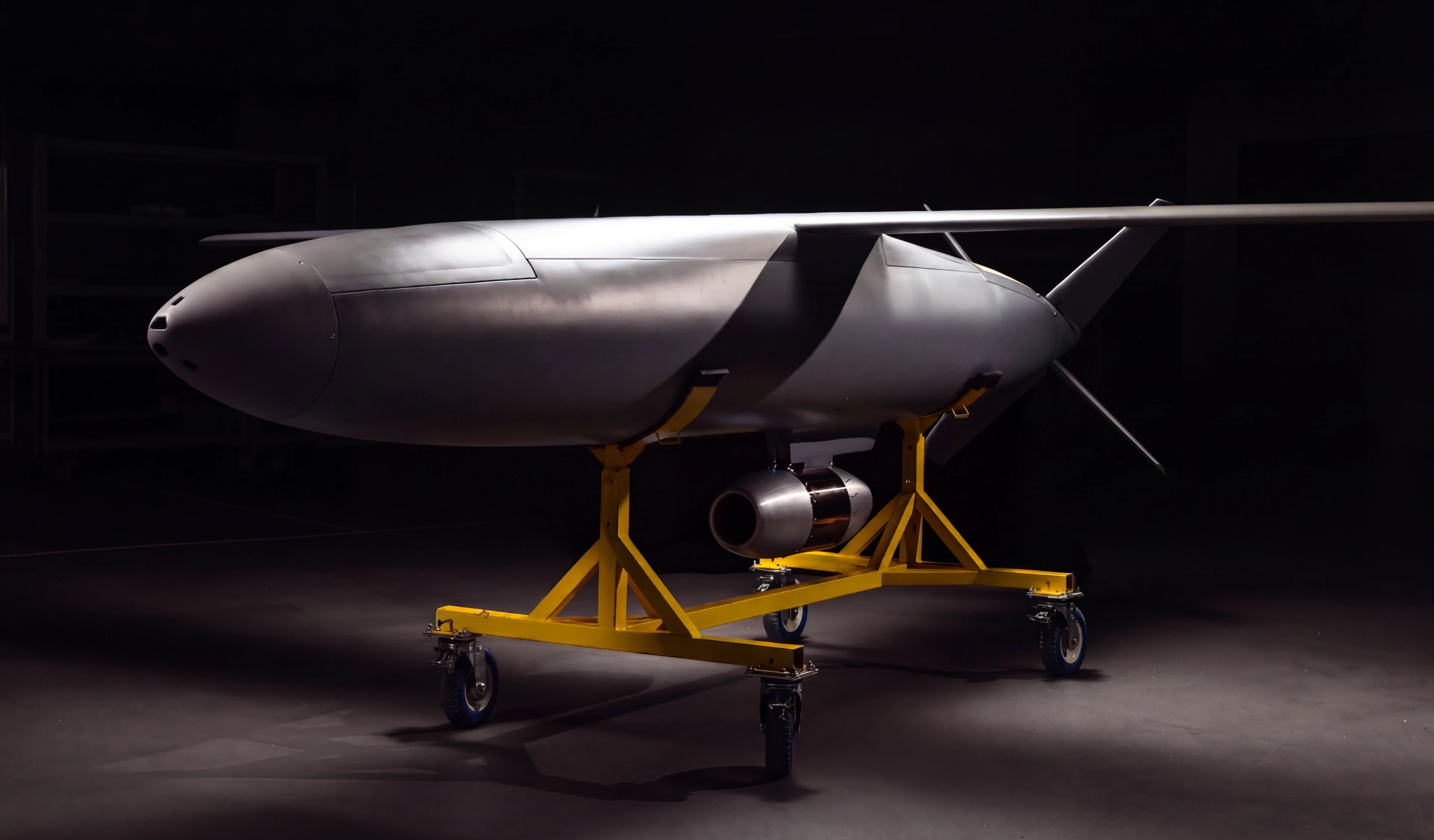
A stock picture of Covenant’s Anthem long-range strike weapon. Covenant

“We’re in a serious and deteriorating security situation, and that is why we are building up the defense and strengthening our combat power,” Bruus told reporters. The planned acquisitions are a “strong signal that we have the ability to strike back,” he added, without explicitly naming any particular adversary.

The Danish government did say last year that it would pursue new long-range offensive precision weapons, in general, in response to the growing security concerns in Europe amid Russia’s ongoing war against Ukraine. Bruus’ announcement comes amid a new surge in geopolitical friction between Russia and members of the NATO alliance.

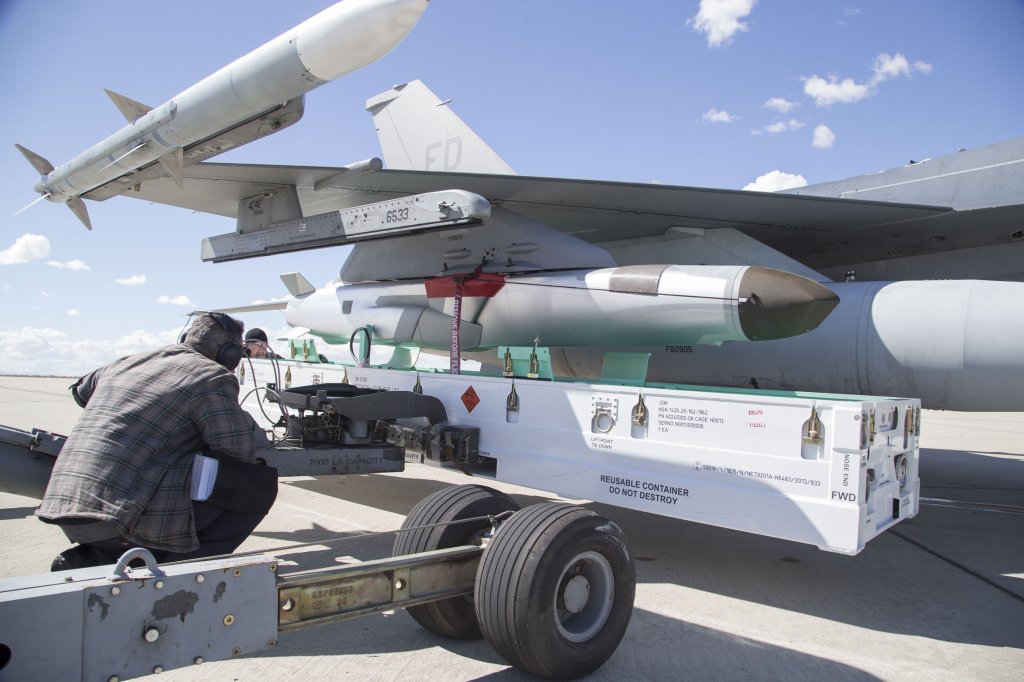
A stock picture of a Joint Strike Missile (JSM), seen here being loaded onto a US Air Force F-16 during a test in 2018. U.S. Air Force

The two new acquisitions will provide Denmark with important complementary strike options. Anthem is a ground-launched weapon, while JSM is designed to be air-launched, including by stealthy F-35 fighters just like those in Danish Air Force service today. Together, the weapons are set to expand the range of platforms from which Denmark can deliver stand-off precision strikes and give its armed forces additional options for attacking high-value military targets.

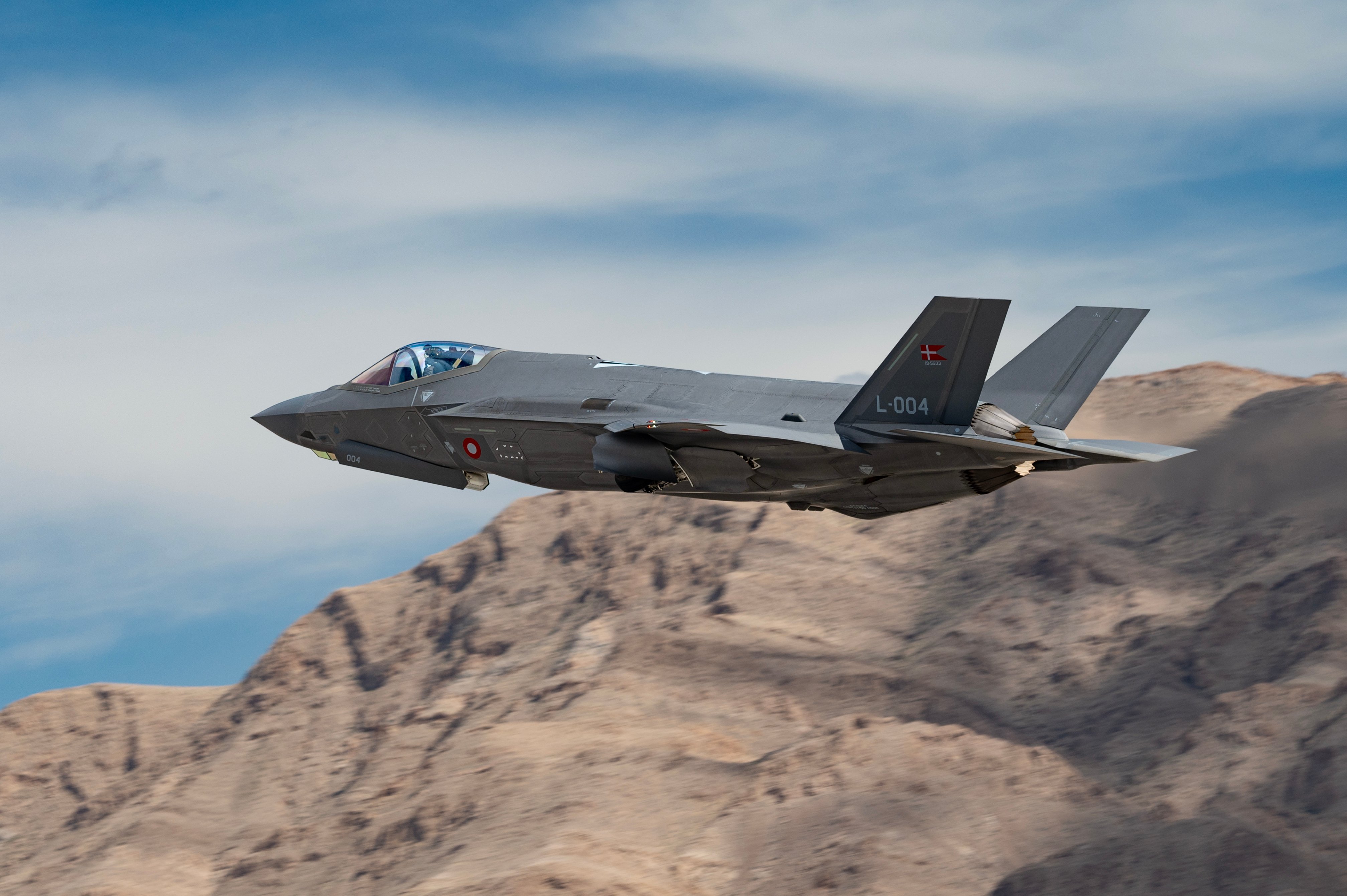
A Royal Danish Air Force F-35A from Luke Air Force Base (AFB), Arizona, takes off for Red Flag-Nellis 24-2 mission at Nellis AFB, Nevada, March 13, 2024.The integration of fifth- generation assets, such as the F-35, is a vital step towards enhancing our collective security. These advanced aircraft bring unprecedented capabilities, including enhanced stealth, sensor fusion, and network connectivity, which enable us to maintain air superiority and deter potential adversaries. (U.S. Air Force photo by William R. Lewis) RFNAFB; DoD; ACC; Air Combat Command; DoD; Ready AF; lethality; readiness; Red Flag-Nellis 24-2 Operations; Denmark; F-35; Interoperability; 5th Gen
A Royal Danish Air Force F-35A takes off for a Red Flag-Nellis 24-2 mission at Nellis AFB, Nevada, on March 13, 2024. U.S. Air Force photo by William R. Lewis William Lewis

Anthem is being developed by Covenant, a U.S.-based defense company that has also outlined plans to establish missile production in Germany and Israel. The system’s selection by Denmark gives the company an important European customer as NATO members seek to expand their inventories of long-range weapons.

Covenant’s Anthem is in a category of munitions that increasingly blurs the line between long-range kamikaze drones and traditional cruise missiles. It is designed to offer a lower-cost, longer-range strike capability that can be produced more easily and at greater scale than many existing systems. Covenant has not publicly disclosed the weapon’s range. Still-unconfirmed reports put it at roughly 740 miles (1,200 kilometers). It is also said to carry a warhead weighing more than 200 kilograms (441 pounds). It also uses a solid rocket motor to provide an initial boost at launch before transitioning to a heavy-fuel jet engine for cruise flight.

Currently, it is unclear how exactly Anthem is launched. It has already undergone testing with the U.S. Army, and images from those trials show the weapons being handled on the ground using a tricycle undercarriage. This may point to rocket-assisted takeoffs from runways.

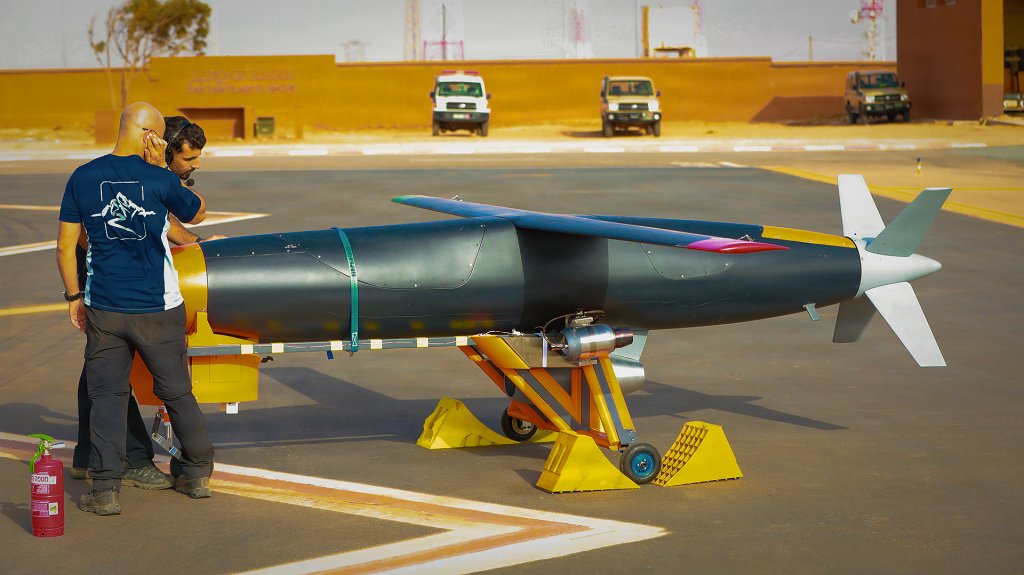
Defense-industry partners prepare a cruise missile for a live-fire demonstration at the Africa Multidomain Training and Experimentation Center in Tan-Tan, Morocco, Aug. 5, 2026. The demonstration was held to support regional defense capabilities and joint training interoperability. AMTEC enables U.S. and Moroccan forces to test emerging technologies and expand testing capabilities to strengthen shared readiness and interoperability under the U.S. Army’s Test Range Expansion Initiative.
A Covenant cruise missile is prepared for a live-fire demonstration at the Africa Multidomain Training and Experimentation Center in Tan-Tan, Morocco, August 5, 2026. U.S. Army photo by Capt. Jordan Beagle

Last month, Covenant announced it had already conducted more than 200 test flights of Anthem and had secured roughly $150 million in orders. It also disclosed that an unidentified international customer was expected to begin receiving German-built weapons before the end of this year. This may well be Denmark, though there could also be other customers that have yet to emerge publicly. Meanwhile, U.S. Army deliveries are expected in 2027, under an accelerated qualification contract.

Anthem reflects a broader push, globally, for new long-range strike weapons that can be manufactured rapidly and in large quantities, potentially trading some of the performance and sophistication of more expensive, ‘exquisite’ weapons for affordability, scalability, and mass availability. Recent conflicts in the Middle East, as well as the war in Ukraine, have underscored the challenges of bolstering stockpiles of critical munitions and replenishing them during prolonged fighting.

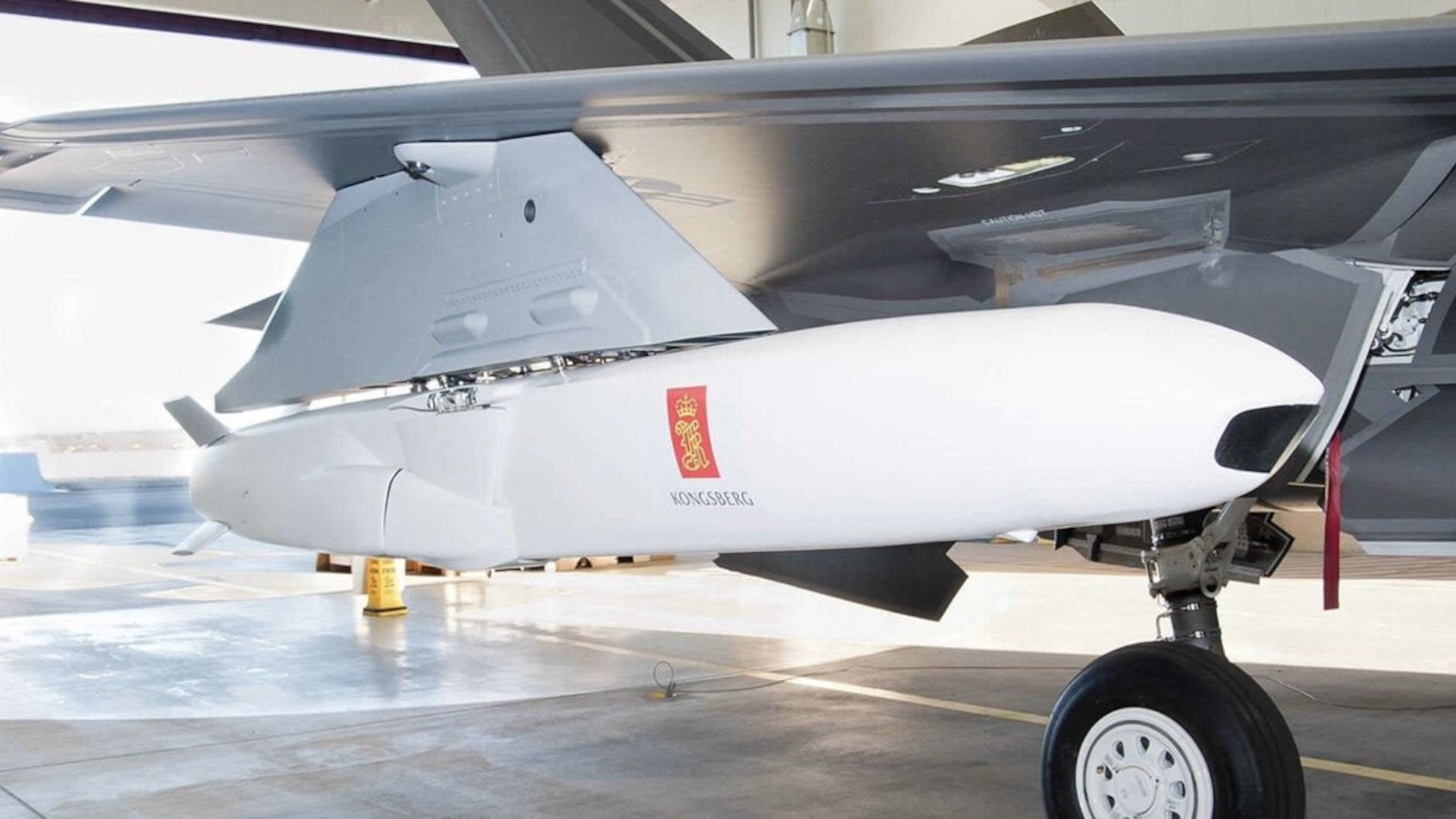
JSM, developed by Kongsberg in cooperation with U.S. defense contractor Raytheon, is a traditional air-launched cruise missile capable of being employed against targets on land and at sea. It is capable of being carried internally and externally on the A and C variants of the F-35. The design has also been fit-checked for external carriage on a variety of other tactical jets. As already mentioned, JSM will provide an entirely new standoff precision-strike option for Denmark’s F-35As. These are the only tactical jets in Danish service today following the retirement of the country’s F-16s in January.

Pictures showing work on integrating the Joint Strike Missile on all three variants of the F-35 Joint Strike Fighter, as well as the F-16. Kongsberg

Kongsberg has identified Denmark as the seventh country to select JSM, although the final contract scope and value remain subject to negotiations. JSM is an enlarged derivative of the surface-launched Naval Strike Missile (NSM), which has also seen growing worldwide sales in recent years, including to the U.S. military. Since 2025, Denmark has also been fielding NSM on its Iver Huitfeldt class frigates and as part of a ground-based coastal defense system.

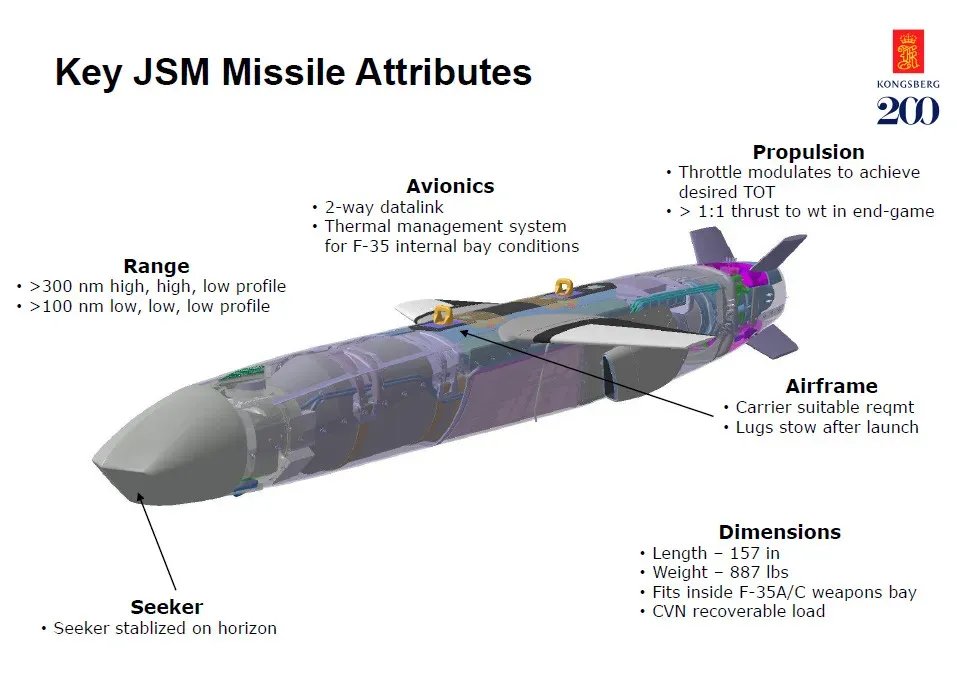
Since JSM is designed to be air-launched, its maximum range is dependent in part on the altitude at which the missile is released, as well as the speed of the aircraft carrying it. Kongsberg has said in the past the missile can fly out to a range of more than 300 nautical miles, but also that its reach is significantly cut back when it is employed in its low-altitude penetration mode.

A briefing slide with various details about the JSM’s capabilities. Kongsberg

The JSM carries a 260-pound warhead and uses a combination of GPS, inertial navigation (INS), and terrain mapping to guide it toward its target. The terrain-mapping capability provides an additional means of navigation, helping the missile maintain its course even in environments where GPS connectivity is degraded or unavailable.

The missile switches over to an imaging infrared seeker to provide precise target discrimination during the terminal phase of flight. Because the seeker operates passively, it does not rely on emitting radiofrequency signals, reducing the risk of detection and making it immune to conventional radiofrequency jamming. The agile JSM’s overall design also includes reduced-signature features to help limit its detectability and improve its survivability on the way to the target.

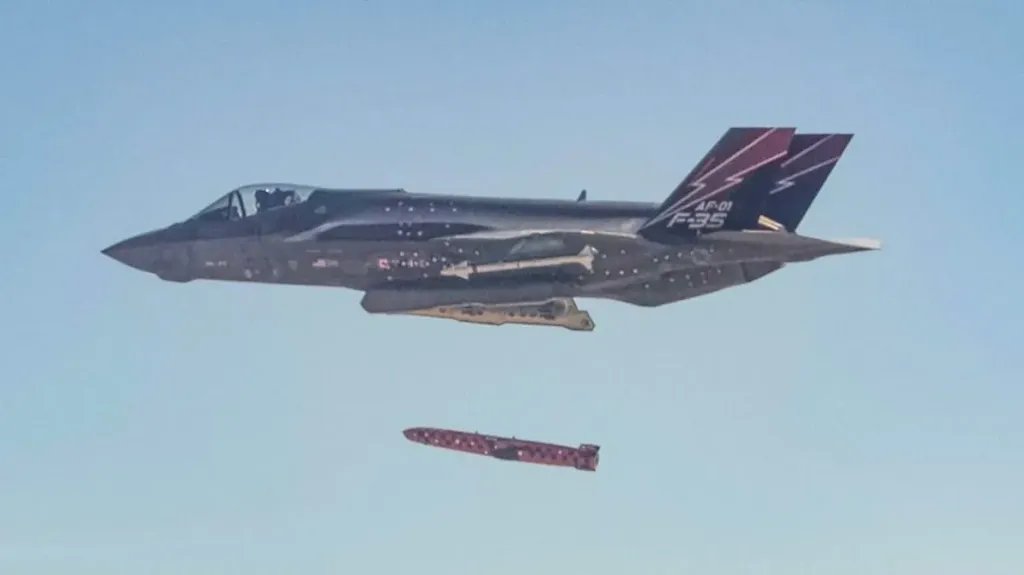
A U.S. Air Force F-35A releases a Joint Strike Missile (JSM) during a test. Norwegian Defense Materiel Agency

A two-way datalink also allows the missile to receive updated targeting information while en route, or to be redirected toward an entirely different target during the mid-course phase of flight.

The dual purchases build on a broader Danish effort to field new options for holding targets at extended ranges at risk. Denmark previously operated eight M270 Multiple Launch Rocket Systems (MLRS), but retired them in 2004. The country is now introducing Israel’s PULS rocket artillery system, which can employ different rocket and missile types depending on the mission. Presently, the Danish military looks to be fielding PULS just with artillery rockets.

In terms of Denmark’s current and future ground-based capabilities, PULS — which stands for Precise and Universal Launch System — and Anthem will serve different. In Danish service, PULS provides a flexible rocket artillery capability, while Anthem will offer a cruise-missile-like option for longer-range precision attacks.

The acquisition of JSM also reflects the importance of Denmark’s F-35 fleet to its future combat capability. Air-launched weapons offer mobility and flexibility, but their employment depends on available aircraft. In this context, Denmark’s planned expansion of its F-35 fleet from 27 to 43 aircraft, announced in October 2025, will provide a larger platform base for its emerging long-range strike capability. It should also be noted that, in June of this year, Denmark requested to buy 200 AGM-158 Joint Air-to-Surface Standoff Missiles with Extended Range (JASSM-ER) for its F-35 fleet. It’s unclear if the JSM has now been selected in preference, or if both will be procured. Unlike the JSM, JASSM-ER cannot fit in the F-35’s internal bays.

There could be some overlap here between Denmark’s growing array of air- and ground-based strike capabilities, as well. Dutch F-35As demonstrated their ability to provide targeting data to PULS launchers during a NATO exercise last year. A ground-launched weapon like Anthem also provides an alternative long-range strike option that does not require a fighter to carry it aloft, creating additional operational flexibility.

For Denmark, acquiring JSMs and Anthems also offers the appeal of adding a capable higher-end munition alongside a more affordable, readily available long-range strike weapon. Reuters has reported that Covenant expects Anthem to eventually cost in the mid-six-figure range, although a final unit price has not been disclosed. Meanwhile, the JSM has a reported unit cost of approximately $2.8 million.

As mentioned, the announcement of the Anthem and JSM purchase is fully in line with prior statements from the government in Copenhagen about acquiring new long-range strike options. Danish Prime Minister Mette Frederiksen previously urged the military to accelerate procurement across the board after years of comparatively limited defense spending. In

Danish Prime Minister Mette Frederiksen meets conscripts during a visit to Air Base Karup, the main air base of the Royal Danish Air Force, in Jutland, Denmark on March 7, 2024. (Photo by Mikkel Berg Pedersen / Ritzau Scanpix / AFP via Getty Images) / Denmark OUT
Danish Prime Minister Mette Frederiksen meets conscripts during a visit to Air Base Karup, the main air base of the Royal Danish Air Force, in Jutland, Denmark on March 7, 2024. (Photo by Mikkel Berg Pedersen / Ritzau Scanpix / AFP) / Denmark OUT MIKKEL BERG PEDERSEN

The long-range strike acquisitions also fit into a broader NATO effort to strengthen deterrence across the Baltic region and the alliance’s northeastern flank.

Denmark occupies a strategically important position linking the Baltic Sea to the North Sea, while its forces contribute to NATO’s regional presence and reinforcement plans. The ability to strike targets deep behind enemy lines will provide a new ability for Denmark to threaten an adversary’s military infrastructure, command facilities, and other critical targets.

Denmark is far from alone in pursuing new long-range strike capabilities. In September, Latvia moved to acquire Anduril’s Barracuda family of long-range strike missiles, building on its earlier order for Army Tactical Missile System (ATACMS) short-range ballistic missiles. Poland is expanding its own layered strike capabilities, while France, Germany, Italy, Poland, Sweden and the United Kingdom are working on the European Long-Range Strike Approach (ELSA) initiative to accelerate the development and procurement of next-generation weapons. The efforts reflect a wider shift across Europe toward restoring deep-strike capabilities that have been relatively scarce among NATO’s European members since the end of the Cold War.

All of this is happening while the Baltic states, in particular, increasingly voice their concerns that Russia could seek to exploit vulnerabilities along NATO’s northeastern flank. Estonia, Latvia, and Lithuania have all warned about the risks posed by Russian force expansion, airspace incursions, sabotage, and other potential provocations. In response, NATO has stepped up its regional posture through initiatives, including Operation Eastern Sentry.

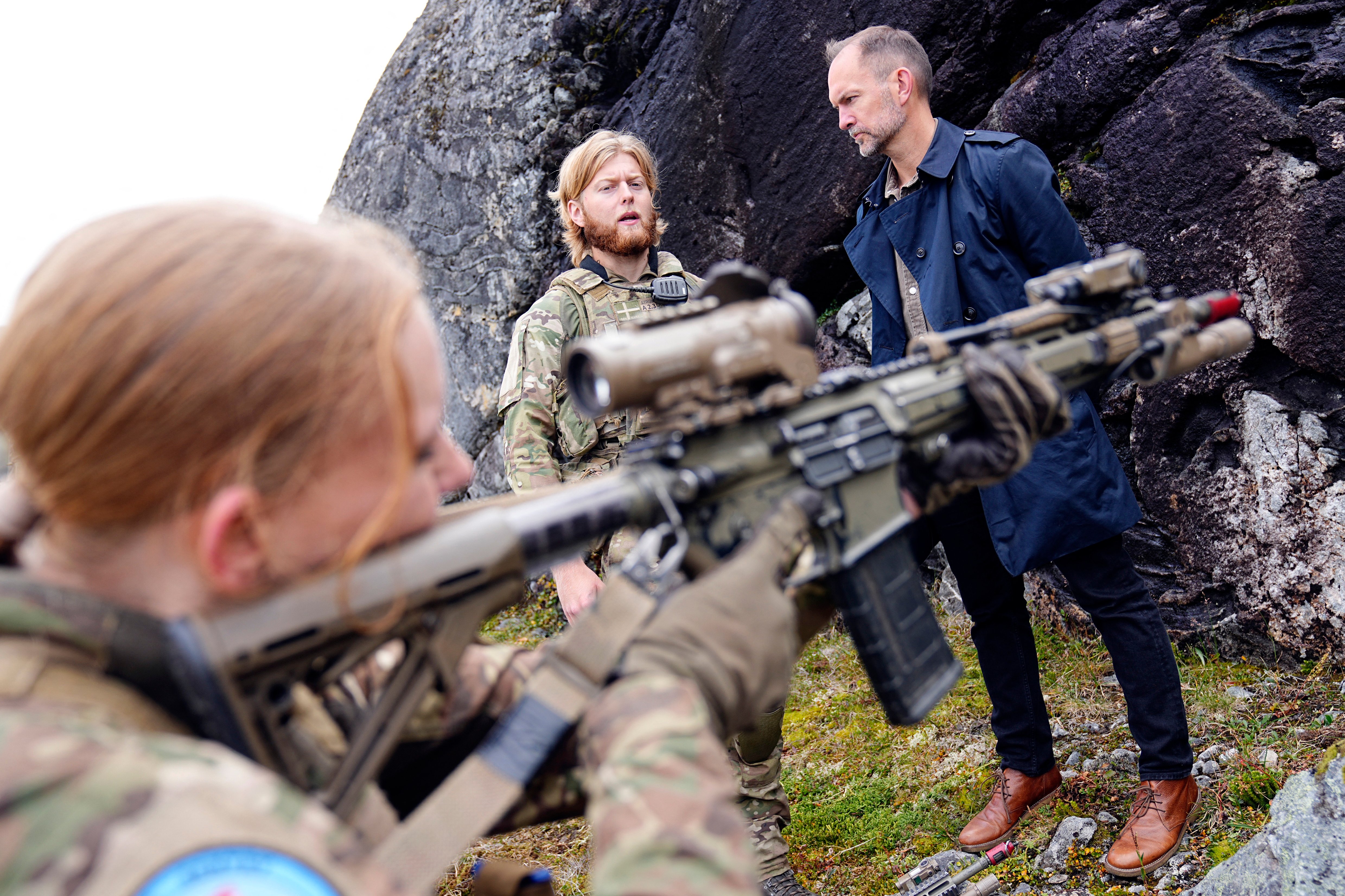
Denmark's Defence Minister Jeppe Bruus (R) speaks with military personnel during a visit of the Antenna Park in Nuuk, Greenland, on August 26, 2026. The Danish defence minister visits the Danish military effort in Greenland. (Photo by Thomas Traasdahl / Ritzau Scanpix / AFP via Getty Images) / Denmark OUT
Danish Defense Minister Jeppe Bruus (right) speaks with military personnel during a visit to the Antenna Park in Nuuk, Greenland, on August 26, 2026. Photo by Thomas Traasdahl / Ritzau Scanpix / AFP THOMAS TRAASDAHL

The news about Denmark’s new long-range strike plans has already drawn a heated reaction from Moscow. Russia’s embassy in Copenhagen accused Denmark of pursuing confrontation with Russia and warned of “inevitable disastrous consequences,” Reuters reported.

Many details about the planned Anthem and JSM acquisitions still remain to be learned. However, the announcement yesterday is a clear signal of Copenhagen’s intention to give its armed forces a more substantial ability to threaten targets at distance, and reflects still-growing trends elsewhere in Europe.

Contact the author: thomas@thewarzone.com

The post Denmark To Buy Anthem Munitions, Joint Strike Missiles In Dual Long-Range Strike Push appeared first on TWZ.

  •  

Four KJ-3000 Radar Jets At Chinese Factory Point To Serial Production

New satellite imagery shows four of China’s new KJ-3000 airborne early warning and control (AEW&C) aircraft at the Xi’an Aircraft Company (XAC) facility at Xi’an-Yanliang, raising the possibility that the large radar planes are moving toward or have entered serial production.

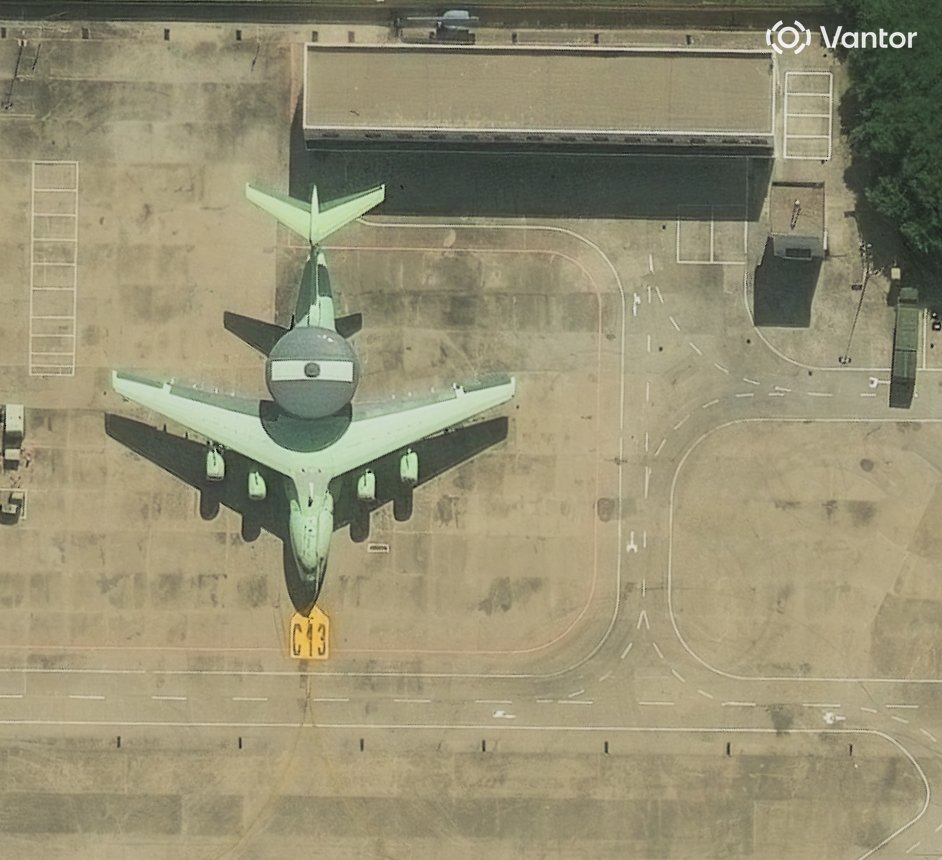
Satellite imagery captured on October 5 and provided by Vantor shows three KJ-3000s near the XAC factory in the western part of the facility, with a fourth at the nearby China Flight Test Establishment (CFTE). J. Michael Dahm, a senior fellow at the Mitchell Institute for Aerospace Studies, assesses that the presence of four aircraft points to the type having entered serial production.

An overview of the Xi’an Aircraft Company (XAC) facility on October 5. A total of four KJ-3000s are visible. Satellite image ©2026 Vantor
Three KJ-3000s along with other Y-20s at the XAC factory in the western part of the facility. Satellite image ©2026 Vantor

Andreas Rupprecht, an analyst of Chinese military aviation and TWZ contributor, offered a more cautious assessment, noting that the imagery could indicate that series production or low-rate initial production (LRIP) has begun. However, he also pointed out that all four previously identified prototypes could simply have been at the facility at the same time. Specifically, he identified the aircraft seen at the CFTE portion of the airfield as being a prototype.

A closer view of one of the KJ-3000s at the XAC factory. Satellite image ©2026 Vantor
An additional KJ-3000 seen alongside a pair of Y-20Bs. Satellite image ©2026 Vantor

Whatever the explanation, the imagery offers a fresh look at a program set to significantly expand China’s already substantial airborne surveillance and battle-management capabilities.

The KJ-3000, also referred to as the KJ-20, is based on the four-engine Y-20 transport aircraft, specifically the improved Y-20B variant powered by Chinese-made engines. The aircraft features a large circular radome mounted above the rear fuselage, along with a prominent series of antennas on the forward fuselage. An aerial refueling probe is mounted above the cockpit, while a conspicuous intake at the base of the tailfin is likely intended to provide cooling air for its extensive onboard electronics.

A stock Y-20B transport with its distinctive locally produced WS-20 turbofan engines. via Chinese internet

The first low-quality photographs of the aircraft began circulating in December 2024. More detailed imagery emerged in May 2025, showing an example at an undisclosed Chinese airfield. That aircraft, bearing the serial number 7821 and assessed to be the first example, was still wearing primer, in contrast to the examples now seen at the XAC factory.

This photo emerged in May 2025 and shows the presumed first KJ-3000 on the ground at an undisclosed airfield in China. The aircraft still wears a coat of primer, and the serial number 7821 is clearly visible on the forward fuselage. via Chinese internet

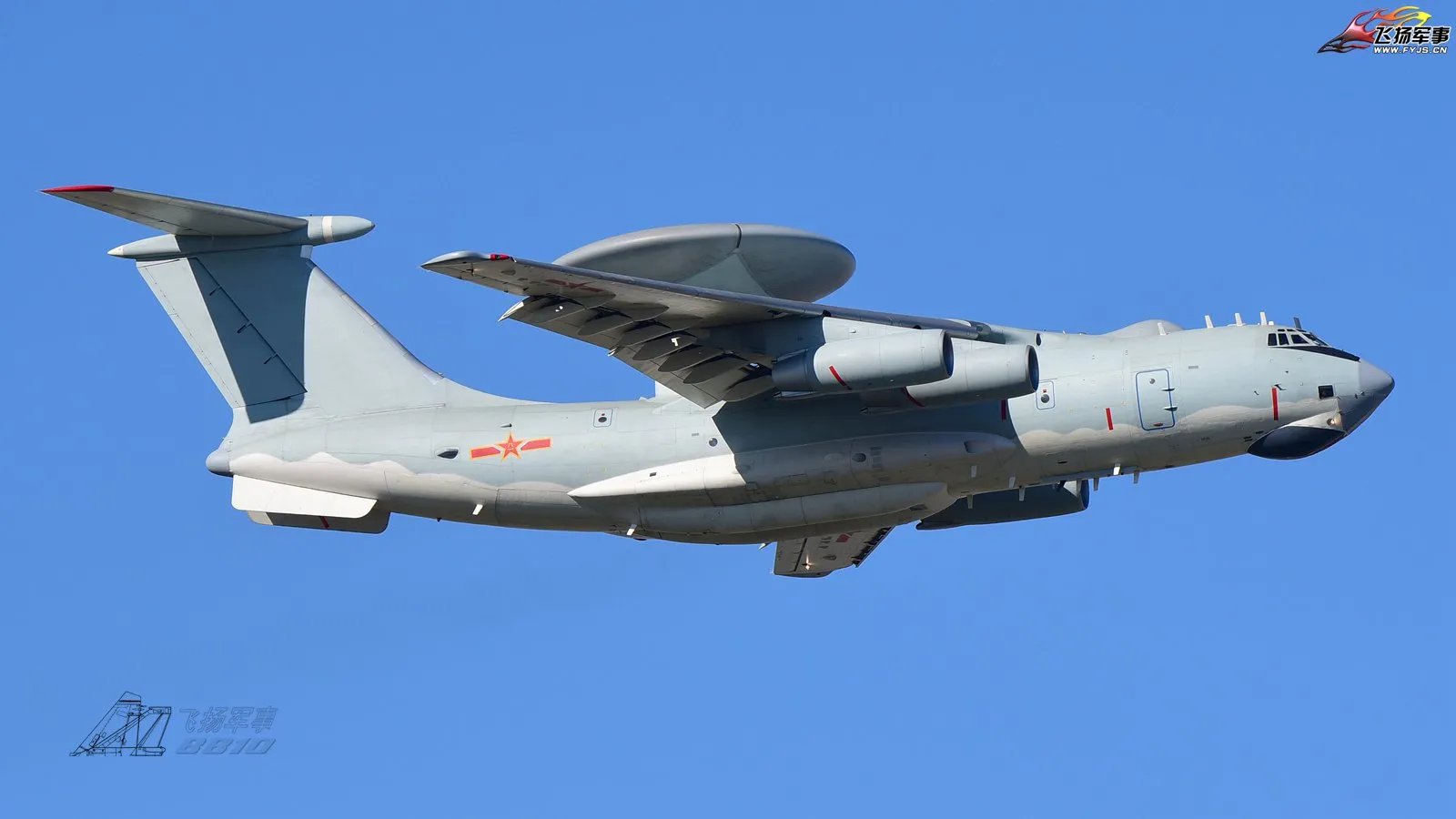
The KJ-3000 is expected to address longstanding limitations in China’s existing large jet-powered AEW&C fleet. To date, only four KJ-2000 Mainring aircraft have been completed. Based on the Russian-built Ilyushin Il-76MD transport, the KJ-2000 program was constrained by the limited availability of suitable airframes, and now faces the twin issues of reliance on Russian supply chains and aging aircraft.

A side view of a standard PLAAF KJ-2000, albeit with the serial number censored from the photo. FYJS/via Chinese internet

A domestically produced Y-20-based platform provides a more sustainable basis for a much larger AEW&C fleet, with greater scope for upgrades and potentially export opportunities.

The larger airframe should also provide advantages over China’s numerous turboprop-powered AEW&C aircraft, including greater speed, range, and endurance. Its higher operating altitude would give its radar a better vantage point for detecting and tracking targets, particularly low-flying aircraft and missiles that may be masked from ground-based sensors by terrain or the radar horizon.

The aerial refueling probe could further extend the aircraft’s range and time on station, although the precise operational capabilities of the KJ-3000 remain unclear.

The exact configuration of the KJ-3000’s primary radar has yet to be established. China’s existing KJ-2000 and smaller KJ-500 use fixed radomes containing three active electronically scanned array (AESA) antennas to provide 360-degree coverage, rather than the rotating radomes found on aircraft such as the U.S. E-3 Sentry and Russia’s A-50 Mainstay. Whether the new aircraft follows the same approach remains to be seen.

A Russian Aerospace Forces A-50U Mainstay. Russian Ministry of Defense Russian Air Force A-50U Mainstay. (Russian MoD)

As well as its large AESA radar, the new aircraft is likely to carry additional intelligence, surveillance, and reconnaissance (ISR) systems, while its communications equipment could make it an important networking node for Chinese forces operating across the vast distances of the Indo-Pacific. Such capabilities would be particularly valuable for coordinating combat aircraft, including uncrewed ones, sharing targeting information, and extending the reach of China’s integrated air defense and broader military networks.

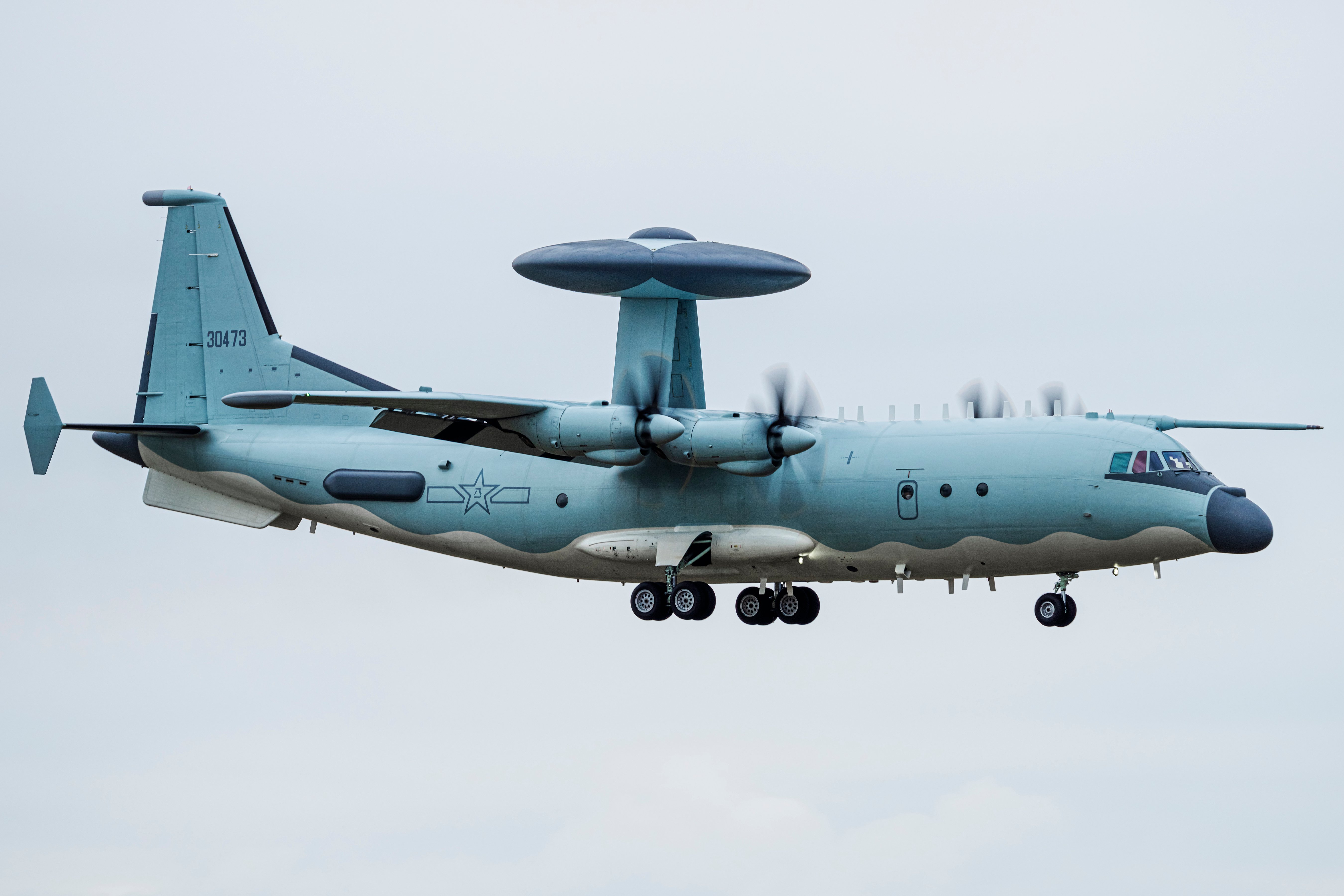
The KJ-3000 is also part of a broader expansion and diversification of China’s AEW&C fleet. Alongside the new jet-powered aircraft, the People’s Liberation Army continues to field and develop smaller platforms based on the four-turboprop Y-9 transport family.

These include the KJ-500, which has been produced and delivered at a rapid pace, as well as the newer KJ-700, believed to combine radar with electro-optical and infrared sensors for a broader range of surveillance missions. The precise capabilities of the KJ-700 remain uncertain, but you can read about the platform in more detail here.

A prototype KJ-700. via Chinese internet

The smaller turboprop aircraft offer advantages of their own. They are better suited to operating from dispersed and relatively austere airfields, and they regularly appear at Chinese island outposts and in the strategically important Taiwan Strait. Together, the different types give Chinese forces a range of options for surveillance and command and control, from persistent coverage close to home to operations farther afield.

The U.S. Department of Defense has repeatedly highlighted the growing importance of China’s AEW&C fleet.

In its latest annual report on Chinese military developments, the Pentagon specifically pointed to the KJ-3000:

“The PLA conducted an initial flight with the KJ-3000 Airborne Early Warning and Control (AEW&C) aircraft, which will serve as a surveillance aircraft to monitor aircraft, ships, and other vehicles. The KJ-3000 will probably be the world’s first model to use digital radar and will be capable of anti-jamming, passive detection, and target identification.”

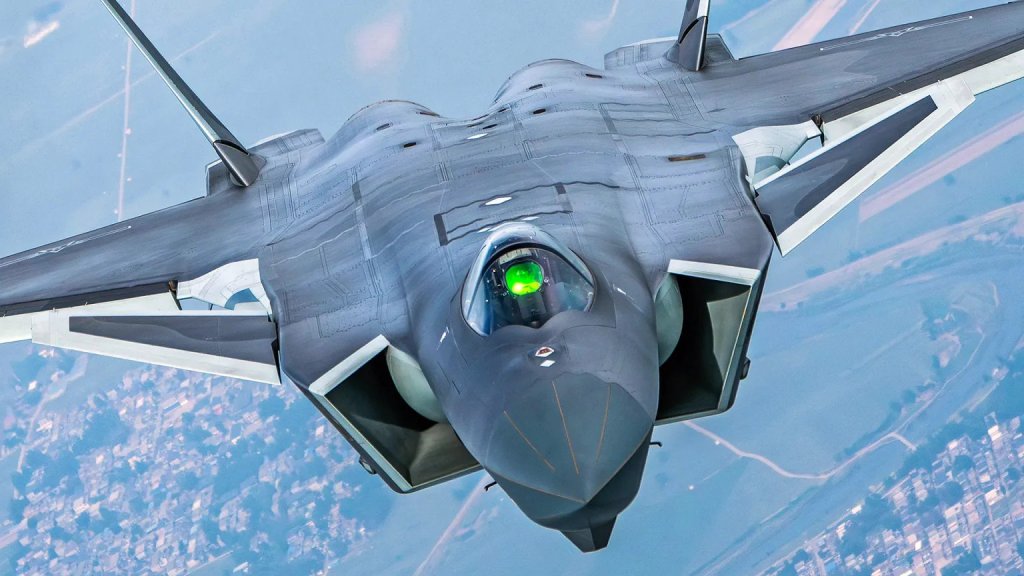
Airborne radar and command-and-control aircraft are also important force multipliers for increasingly capable Chinese combat jets, including the stealthy J-20 and aircraft armed with long-range air-to-air missiles. Radar planes like these can serve as critical networking nodes for data sharing and, in some cases, allow Chinese fighters to prosecute targets without turning on their own radar.

In 2022, then-Pacific Air Forces commander Gen. Kenneth Wilsbach praised the command and control associated with J-20 operations, noting that some of China’s long-range air-to-air missiles benefit from support provided by the KJ-500.

A stock photo of a J-20 stealth fighter. PLAAF

For China, a larger and more capable AEW&C fleet would support both the defense of its airspace and efforts to project military power across the Indo-Pacific. These aircraft could help coordinate operations around Taiwan and the South China Sea, improve situational awareness over maritime approaches, and support combat operations at greater distances from the mainland.

The same Pentagon report from 2025 further noted:

“China’s integration of support aircraft, such as the KJ-500 airborne early warning aircraft, provides the PLAAF with improved ISR capability to support PLA operations, as demonstrated during surge operations near Taiwan.”

ZHUHAI, CHINA - NOVEMBER 03: A KJ-500A warning and control aircraft arrives at Zhuhai Air Show Center on November 3, 2022 in Zhuhai, Guangdong Province of China. The 14th Airshow China will be held from Nov. 8 to 13. (Photo by VCG/VCG via Getty Images)
A KJ-500 arrives at the Zhuhai Air Show Center in November 2022 in Zhuhai, Guangdong Province of China. This is specifically the probe-equipped KJ-500A version. Photo by VCG/VCG via Getty Images VCG

A domestically developed, jet-powered platform such as the KJ-3000 would be a logical centerpiece of that effort, particularly since it can be produced in substantially greater numbers than the KJ-2000.

The prospect of China expanding its fleet of large, jet-powered AEW&C aircraft stands in contrast to the U.S. Air Force’s troubled effort to replace its aging E-3 Sentry. The U.S. E-7 Wedgetail program has encountered major hurdles, raising concerns about a potential gap in airborne battle management as China continues to field new capabilities.

The October 5 imagery does not confirm that serial production has begun. Further imagery showing additional airframes, activity around production facilities, or aircraft in new operational markings may provide a clearer indication of the program’s progress.

Regardless, the KJ-3000 appears poised to become an important addition to China’s expanding airborne surveillance and command-and-control architecture.

Contact the author: thomas@thewarzone.com

The post Four KJ-3000 Radar Jets At Chinese Factory Point To Serial Production appeared first on TWZ.

  •  

Ground-Launched Rusty Dagger Low-Cost Cruise Missile Seen For The First Time

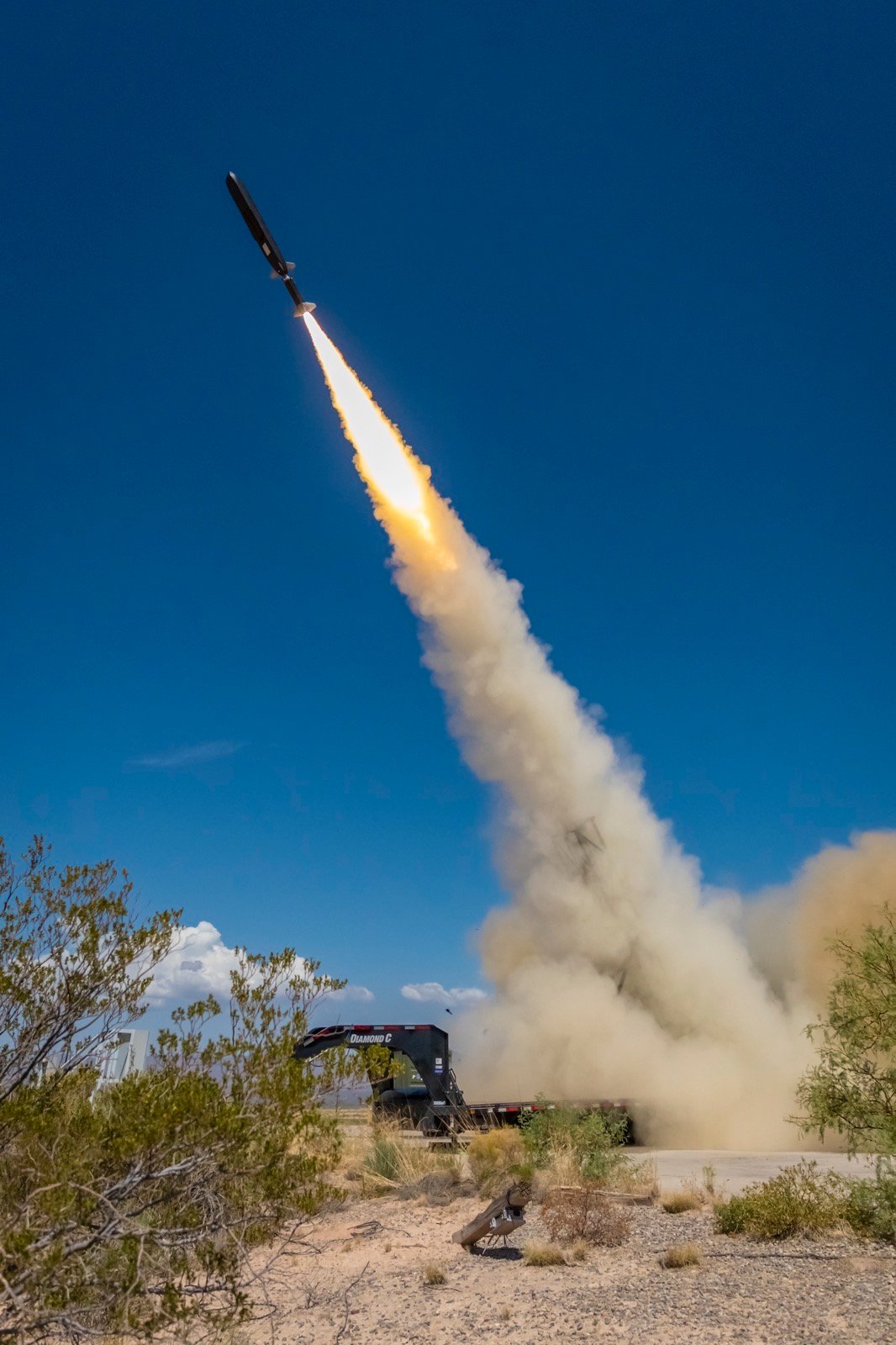
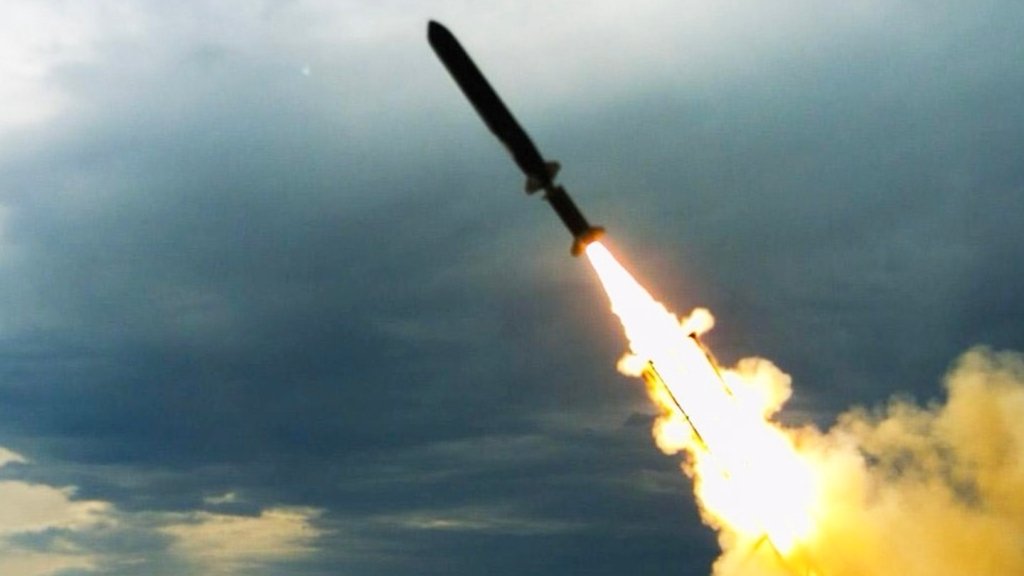
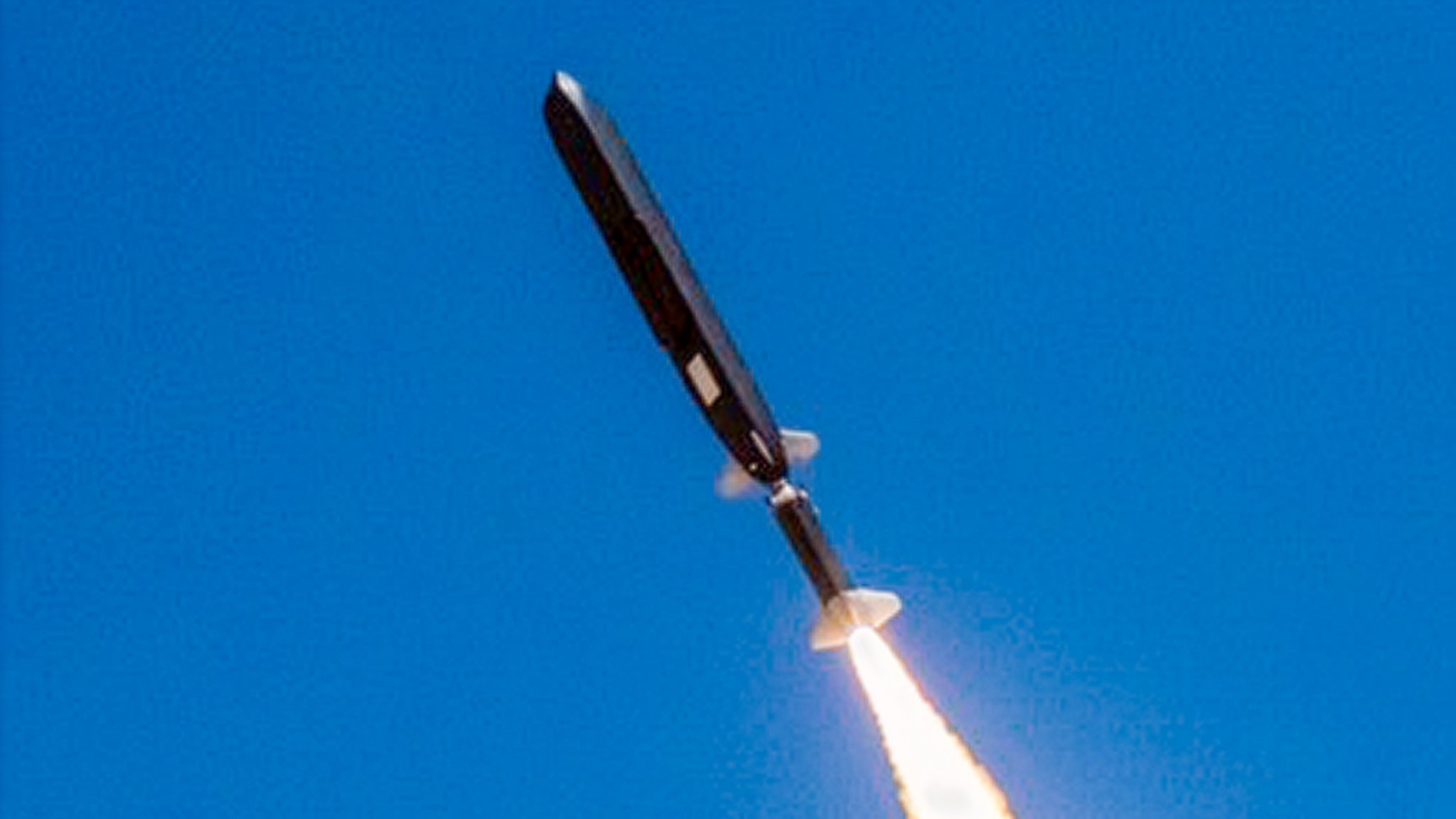
Zone 5 Technologies has shared with TWZ the first photos of its latest Block 40 Rusty Dagger low-cost cruise missile in a surface-launched configuration. The images offer a new look at a weapon developed first with air-launched applications in mind, and for export to Ukraine. It is now being adapted for use from land and sea, including by U.S. and other allied forces.

Zone 5 has not disclosed where or when the pictures were taken, or which programs, specifically, the ground-based launches were conducted under. The images do not offer a clear view of the trailer-mounted launcher, either. A spokesperson for the company did stress to TWZ that versions of Rusty Dagger have now been selected for separate U.S. Army and Navy programs, in addition to its initial development through the U.S. Air Force.

One of the first images showing the surface-launched version of the Rusty Dagger in action. Zone 5 Technologies

In May, Zone 5, as well as Anduril, CoAspire, and Leidos, received framework agreements from the Pentagon under the Low-Cost Containerized Missile (LCCM) program. The U.S. Army’s Portfolio Acquisition Executive Fires (PAE Fires) is running LCCM in cooperation with the Office of the Under Secretary of War for Research and Engineering (OUSW R&E). The aim of this program is to procure more than 10,000 low-cost cruise missiles, in total, over three years, beginning in 2027.

Then there is also the Consolidated Affordable Ordnance System (CHAOS) effort from the U.S. Navy’s Portfolio Acquisition Executive for Munitions (PAE Munitions). CHAOS is focused on low-cost anti-ship cruise missiles, particularly for U.S. allies and partners. CoAspire is also on contract for CHAOS with a version of its Rapidly Adaptable Affordable Cruise Missile-Extended Range (RAACM-ER) design.

“We designed a surface-launch Rusty Dagger to be the foundation of U.S. and allied mass-produced affordable precision deep strike weapons,” Tom Kanewske, chief strategy officer at Zone 5, told TWZ in a statement.

“Our team went from design to demonstration in less than three months, bringing Rusty Dagger from pylons and pallets to ground launcher and shipping containers,” added Kyle Maxhimer, Zone 5’s president.

Another picture of a Block 40 Rusty Dagger being fired from a launcher on the ground. Zone 5 Technologies

Zone 5 says the Block 40 version of Rusty Dagger can accommodate warheads in the 100-to-250-pound classes. It can still be configured for air-launch, either from pylons under the wings of aircraft or via palletized munitions systems. In order to be fired from launchers on the ground or at sea, the new version of the missile is fitted with a solid-fuel booster rocket at the tail end.

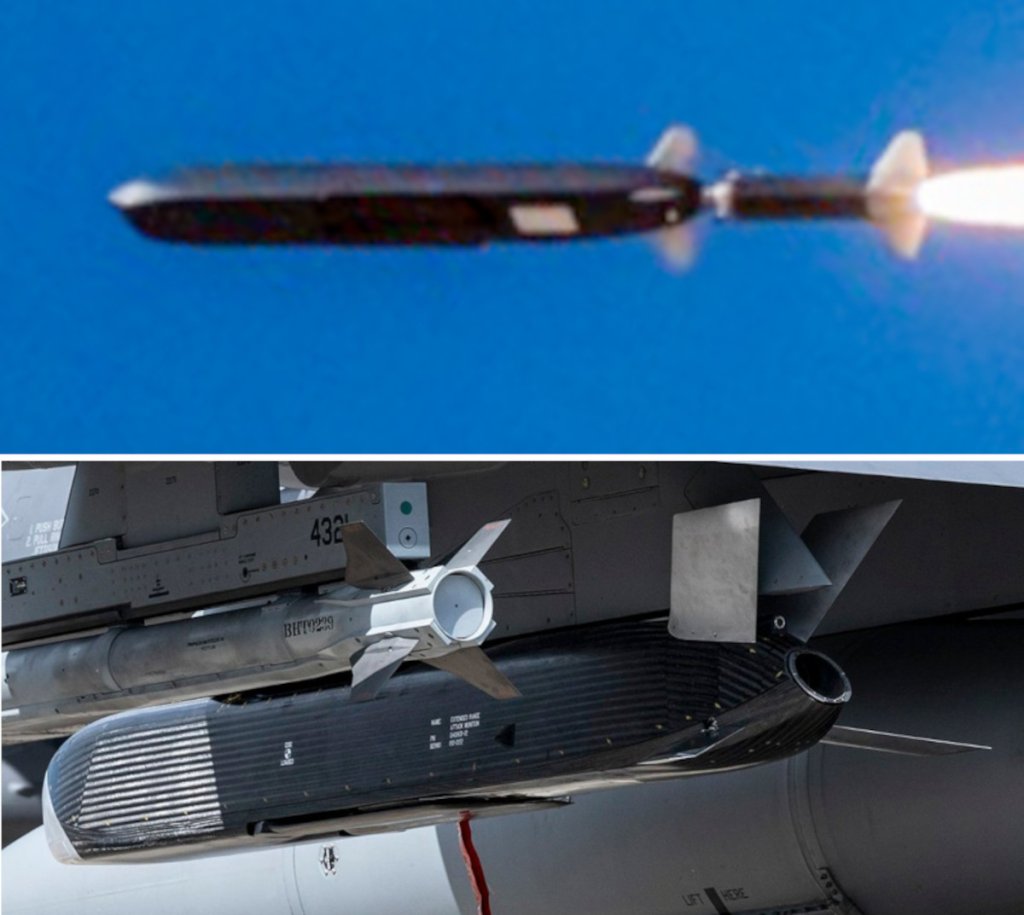
More specific details about the Block 40’s capabilities compared to the preceding air-launch-only version, also referred to as the Block 20, remain limited. From what we can see now, the two variations appear outwardly similar in many respects, at least broadly speaking. Earlier variations had a distinctive tail configuration with four squared-off fins, two facing upward and two more angled to either side. The shaping of the fins on the Block 40 does look to be more rounded. It’s also possible the missile may have a new cruciform tail fin arrangement, but this could also be a trick of the angle from which the missile is being viewed, coupled with the low resolution of the available images.

A side-by-side comparison of the Block 40 Rusty Dagger configured for surface launch, at top, and an earlier air-launched version, at bottom. Zone 5 Technologies/USAF

Previous reports have said that Rusty Dagger has a range of 300 nautical miles when delivered at low altitude, which is increased to 500 nautical miles when launched by aircraft at medium altitudes and flying at higher speeds. In general, surface-launched versions of missiles typically have shorter maximum ranges compared to their air-launched counterparts.

Zone 5 Rusty Dagger. #AffordableMass pic.twitter.com/Pzj1KnceHC

— Air-Power | NatSec Ledger (@NatSecLedger) June 7, 2025

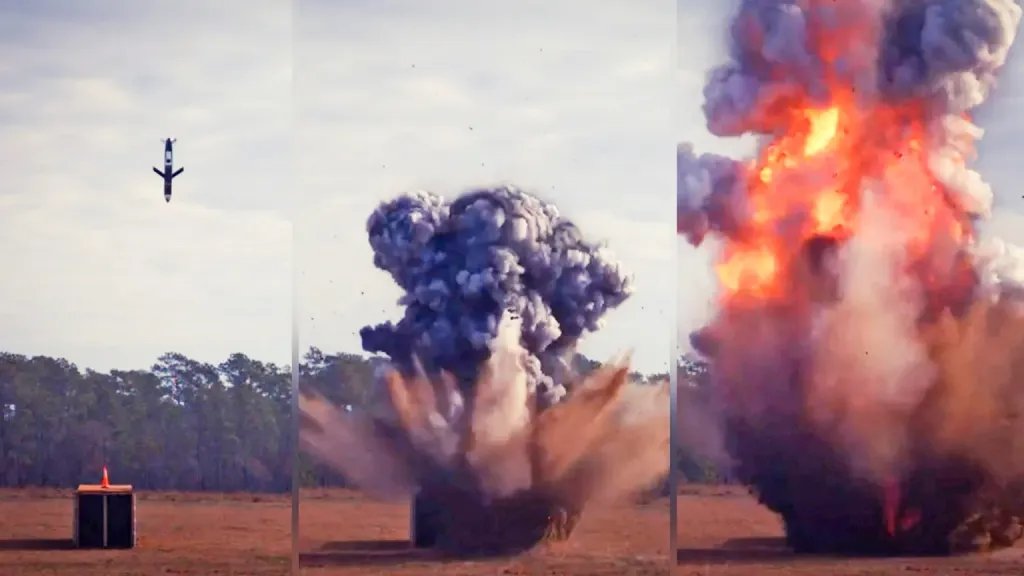
Regardless, the Block 40 version is an important further evolution of the Rusty Dagger design. The initial air-launched version of the missile, now designated the AGM-188A, has already been in development for several years, in part now under the U.S. Air Force’s Extended Range Attack Munition (ERAM) program. This has included live-fire tests conducted at Eglin Air Force Base in Florida in January 2025. We now know that Rusty Dagger has been cleared for use on four different types of fighters, including the F-16. Development of CoAspire’s Rapidly Adaptable Affordable Cruise Missile (RAACM) was also conducted as part of the ERAM effort.

Three views of a Rusty Dagger live-fire test on January 22, 2025, at Eglin Air Force Base, Florida. The service did not identify the weapon by name at the time. via U.S. Air Force

Like the Navy’s CHAOS effort, ERAM has been focused primarily on supporting allies and partners, starting first with Ukraine. A Zone 5 spokesperson told TWZ that, as things stand, Rusty Dagger remains the only publicly reported operational missile in its class fielded by the Ukrainian military.

It appears that the AGM-188A “Rusty Dagger” cruise missile has undergone field testing in Ukraine.

Russian sources are publishing photos of an unknown 8-element CRPA antenna. On the back side of the unit there is a circuit board with a large heatsink, which carries the CAGE code… pic.twitter.com/phZeOJfHJ0

— 𝔗𝔥𝔢 𝕯𝔢𝔞𝔡 𝕯𝔦𝔰𝔱𝔯𝔦𝔠𝔱🎻🇬🇪🇺🇦🇺🇲🇬🇷 (@TheDeadDistrict) June 7, 2026
ERAM has also been feeding into the Air Force’s own Family of Affordable Mass Missiles (FAMM) plans. The service wants to acquire 28,000 FAMM munitions in pylon-launched and palletized configurations over the next five years.

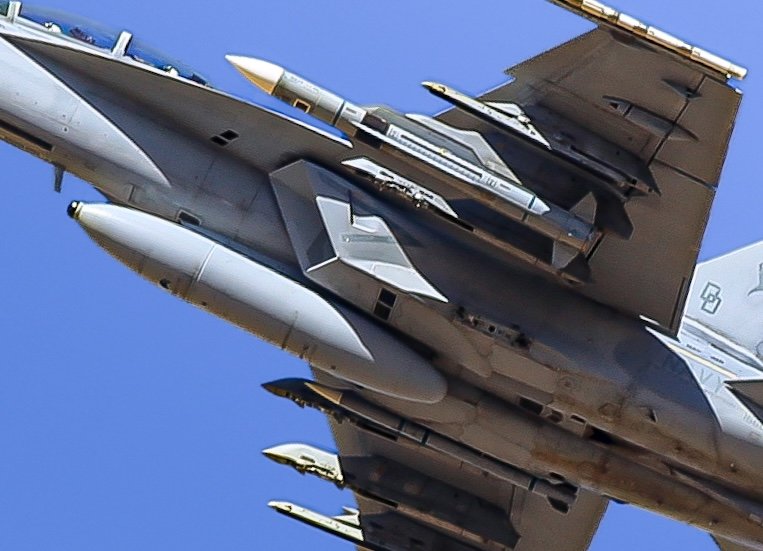
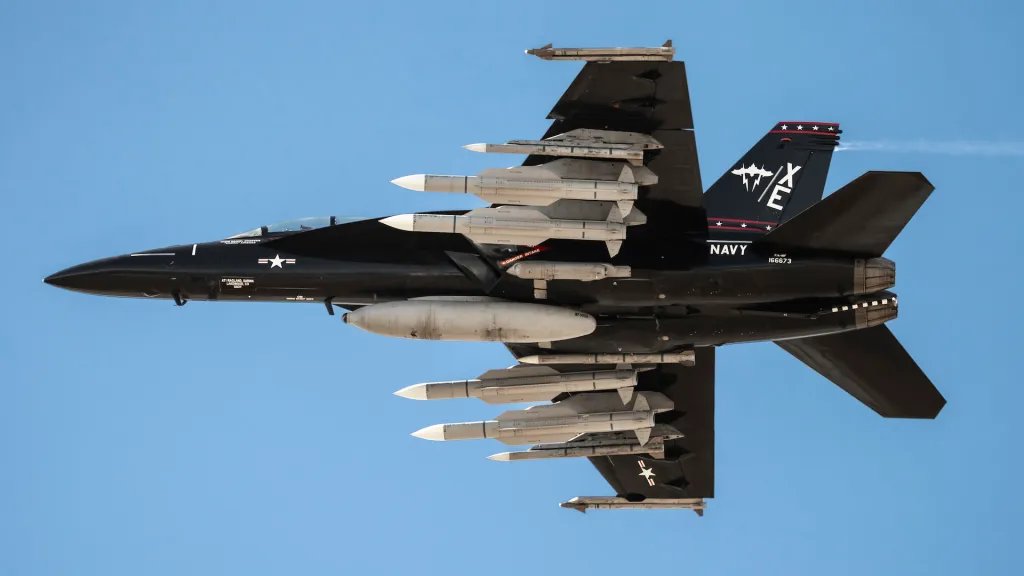
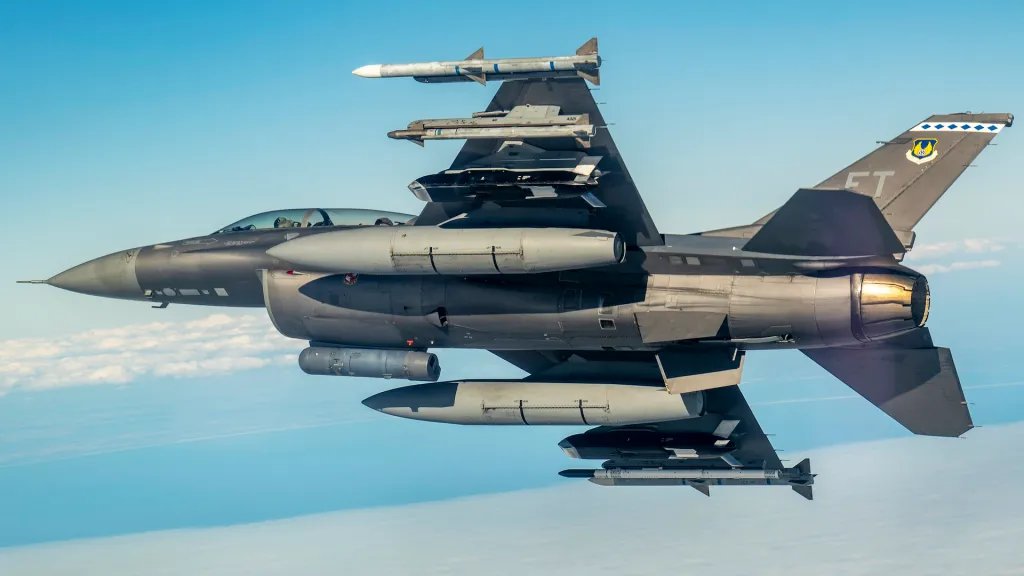
A U.S. Air Force F-16 carrying a pair of Rusty Dagger missiles, as well as other stores, under its wings. U.S. Air Force photo by Staff Sgt. Blake Wiles

As we reported earlier this year, Rusty Dagger is now part of a broader portfolio under Norwegian defense company Kongsberg, which acquired a 90 percent stake in Zone 5. Kongsberg has positioned the missile alongside its stealthy Joint Strike Missile (JSM), with the two weapons serving different, complementary roles.

KONGSBERG announced today that it has closed the acquisition of US missile company Zone 5 Technologies LLC, following approval by US regulatory authorities.

🔗 https://t.co/meRxfmYHH6 pic.twitter.com/EXVbYhDers

— KONGSBERG (@kongsbergasa) June 10, 2026

Rusty Dagger is designed around affordability and volume, while JSM offers a sophisticated, low-observable strike capability. The concept gives customers a mix of weapons suited to different targets and mission requirements, rather than relying exclusively on expensive, high-end missiles.

Zone 5 says it is now expanding manufacturing in the United States. Production is established in San Luis Obispo, California, with production beginning in the Dallas-Fort Worth area of Texas. A franchised facility is also being developed in Miamisburg, Ohio, with Hawthorn Aero, a company that describes itself as specializing “in high-rate airframe manufacturing, offering scalable solutions from design to full vehicle integration for aerospace industries.”

The company says each site is designed to reach a capacity of more than 2,500 missiles annually by the end of 2027. If all three reach that level, combined annual capacity would exceed 7,500 missiles.

The expansion reflects the growing emphasis on affordable weapons that can be manufactured in large quantities and replenished quickly, something that is considered especially critical if the United States is to face China in a future high-end conflict in the Indo-Pacific region.

The ground-launched Rusty Dagger shown in the photos underscores how far the missile family is moving beyond its original air-launched role. With production expanding and multiple U.S. military programs in the picture, the surface-launched variant adds another potential route to getting the weapon into service.

Contact the author: thomas@thewarzone.com

The post Ground-Launched Rusty Dagger Low-Cost Cruise Missile Seen For The First Time appeared first on TWZ.

  •  

Navy F/A-18 Super Hornet Spotted Carrying New AIM-174B And AIM-260 Long-Range Missiles Together

A U.S. Navy F/A-18F Super Hornet assigned to Air Test and Evaluation Squadron 31 (VX-31) has been spotted carrying both the AIM-174B and AIM-260 Joint Advanced Tactical Missile (JATM) during a flight over Ridgecrest, California. This represents the first known publicly documented instance of these two advanced air-to-air weapons appearing on the same aircraft.

The aircraft was photographed on October 14 by aviation photographer @photosxlyss2, who shared the result with TWZ. The same Super Hornet was also carrying an IRST21 infrared search-and-track pod on its centerline station.

A close-up of the AIM-174B, AIM-260 Joint Advanced Tactical Missile, and IRST21 infrared search-and-track pod under an F/A-18F Super Hornet assigned to Air Test and Evaluation Squadron 31 (VX-31) during a flight over Ridgecrest, California. @photosxlyss2_ RY

Two critical elements of the modernization of the U.S. military’s air-to-air missile arsenal, the AIM-174B and AIM-260 provide complementary capabilities, addressing different aspects of the Navy’s evolving air-combat requirements.

Based on the SM-6 missile family, the AIM-174B provides the Navy with an extended-range air-to-air weapon. Its size and reach make it particularly relevant to engagements against high-value airborne assets, including aerial refueling tankers and airborne early warning and control aircraft.

A U.S. Navy F/A-18F Super Hornet test jet with four AIM-174B missiles under its wings. point_mugu_skies

Threatening these support platforms at extended distances complicates an adversary’s ability to sustain fighter operations, maintain airborne surveillance, and coordinate engagements across domains. Such targets are especially important in the Indo-Pacific, where distances are vast and combat aircraft may depend heavily on tanker support to reach and remain on station over contested areas.

 The range of this missile is classified but should be far in excess of that of the AIM-120D AMRAAM, probably in the hundreds of miles, as discussed in the video below.

The AIM-174B has already appeared in several major exercises, including RIMPAC 2024 and Northern Edge 2025. Following developmental trials at RIMPAC, the weapon entered Live Fire Test and Evaluation in 2025. Some examples of the missile have since reached forward-deployed Navy squadrons in Japan.

The AIM-260, meanwhile, is being developed to provide a next-generation beyond-visual-range air-to-air capability. It is intended to address increasingly sophisticated aerial threats and improve upon the capabilities of the very widely used AIM-120 Advanced Medium Range Air-to-Air Missile (AMRAAM) family.

It was another F/A-18F from VX-31 on which the AIM-260 was first publicly seen when departing Eglin Air Force Base in Florida in May of this year. The same type of weapon has since also appeared on a Royal Australian Air Force F/A-18F, as you can read about here.

An F/A-18F from VX-31 carrying the AIM-260. Jonathan Tweedy/ @flightline_visuals

The AIM-260’s precise specifications remain classified, but it is designed to deliver significantly greater range than the AIM-120 AMRAAM while maintaining a broadly similar form factor. Its compact design is important, as the missile is intended for both external carriage and internal carriage aboard aircraft such as the F-22 Raptor and F-35.

A rendering depicting an F-22 Raptor firing an AIM-260 JATM. U.S. Air Force

The AIM-260 is being developed to counter the growing long-range air-to-air threat posed by China’s PL-15 and other advanced missiles. Although no official range figures have been disclosed, previous reporting has indicated a target range of at least 120 miles, with the potential to reach considerably farther.

Inert PL-15s in the weapons bay of a Chinese J-20 fighter. via Chinese internet

It is unclear when the first operational AIM-260s may begin entering the U.S. inventory. Together, however, the two weapons give the Super Hornet access to a broader range of engagement options, depending not only on the range of the target, but also on the nature of the engagement and overall tactical situation.

The presence of an IRST21 pod is also noteworthy. The infrared search-and-track system passively detects and tracks airborne targets rather than relying exclusively on radar emissions.

Passive sensing is especially valuable in environments where electromagnetic emissions must be managed carefully. Although an IRST system does not automatically provide all the information needed to support a long-range missile engagement, it can contribute to a broader sensor picture and potentially help crews detect targets without immediately revealing their own position through radar emissions.

After a long and troubled development, a full-rate production contract for Block II IRST21 sensors to go into pods for U.S. Navy and U.S. Air National Guard fighters was awarded this time last year, as you can read about here.

An IRST21 built into the centerline tank on a Super Hornet during early tests. U.S. Navy

The appearance of both missiles on a VX-31 Super Hornet is a notable development in the Navy’s ongoing testing of advanced air-combat capabilities. VX-31, based at the sprawling Naval Air Weapons Station China Lake in California, conducts test and evaluation activities involving naval aviation weapons and systems.

On this occasion, the jet is carrying inert missiles (denoted by their blue bands) in a captive-carry configuration. The flight may have been part of ongoing weapons-integration testing, handling and compatibility evaluations, or another test activity.

At the very least, the configuration offers an intriguing glimpse into how a Navy Super Hornet might go into battle in a future high-end air combat scenario. Pairing the extended-range AIM-174B with the next-generation AIM-260 would provide a powerful combination.

Added to those two will be the AIM-424 Malice, an all-new, very long-range air-to-air missile, the existence of which was only disclosed in August of this year. This is reportedly a two-stage design, which should result in extreme range — said to be in excess of 250 nautical miles — and very high speed. It isn’t known where Malice slots in next to the AIM-174B, although the newer missile is purpose-designed for air launch, unlike the Standard-derived weapon.

U.S. Navy File Photo - Four AIM-424 Long Range Air-to-Air Missiles (LRAAM) are loaded on an F/A-18E Super Hornet for a test event. The AIM-424 LRAAM is the Department of the Navy's next-generation, long-range air-to-air missile, built to give Marine and Naval aviators the capability they need to defeat advanced threats and defend the force.
Four AIM-424 Long Range Air-to-Air Missiles (LRAAM) are loaded on an F/A-18E Super Hornet for a test event. U.S. Navy U.S. Navy

As the service prepares for increasingly demanding scenarios in the Indo-Pacific, the new photo underscores the fact that the ability to threaten a wider range of targets at greater distances is one of the key considerations in the evolution of the Navy’s carrier-based fighter force.

With thanks to @photosxlyss2_; check out more of her work via PhotosxLyss on Facebook.

Contact the author: thomas@thewarzone.com

The post Navy F/A-18 Super Hornet Spotted Carrying New AIM-174B And AIM-260 Long-Range Missiles Together appeared first on TWZ.

  •  

Ghost Shark Uncrewed Submarine Shown Launching Aerial Drones For The First Time

New footage of Australia’s Ghost Shark extra-large autonomous underwater vehicle (XL-AUV) provides the first look at how the vehicle launches aerial drones, while also revealing a pair of deployable masts not previously seen on the platform. The video comes soon after we got a glimpse of some of the payloads that the Royal Australian Navy plans to integrate on the new uncrewed submarine, as you can read more about in our coverage here.

"Ghost Shark has teeth now." – @PatConroy1, Australia's Minister for Defence Industry.

The @ausgov and @Australian_Navy confirmed the payloads that our Ghost Shark extra-large autonomous submarine carries: sea mines, logistics caches, and air-launched effects for ISR and strike.… pic.twitter.com/IALPFpOf4V

— Anduril Industries (@anduriltech) October 21, 2026

Published by manufacturer Anduril, the footage shows a Ghost Shark surfacing before doors on the top of its hull slide open. A launcher consisting of 12 angled tubes then emerges from a drone sub. Another launcher is seen in the other upper payload bay, but is not raised in the video. While it appears to be of the same type, the second launcher could also have a different arrangement of tubes.

While the 12-tube ALTIUS aerial drone launcher on the left is seen elevating, the launcher on the right remains lowered. Anduril/screencap

The footage subsequently cuts to an ALTIUS-type drone being launched from one of the tubes, with Ghost Shark itself remaining surfaced.

A Ghost Shark launches an ALTIUS aerial drone from a raised 12-tube launcher. Anduril/screencap

The sequence provides a much more concrete look at the aerial-drone deployment concept — or one of them — than the photographs released previously, which offered the first public view inside Ghost Shark’s side payload bay.

The Australian government has said the vehicle is being developed for missions including persistent intelligence, surveillance, reconnaissance (ISR) and strike, but the precise configuration and operational capabilities of its weapons and how they are launched had not previously been disclosed.

The video does not identify which ALTIUS variant is being launched. However, Ghost Shark has previously been displayed at the Altus factory in Australia alongside derivatives of the ALTIUS-600 family. This includes the ALTIUS-600 for ISR, as well as the ALTIUS-600M, which is designed for strike missions. You can read more about this family of drones here. As we noted before, unarmed variants of the ALTIUS-600 are designed to be optionally expendable, and can be reused, although in many scenarios that isn’t possible. In terms of capabilities, the ALTIUS-600 has a maximum range of around 275 miles and can remain airborne for at least four hours, according to Anduril.

Examples of the Anduril ALTIUS-600 displayed during a press conference at the Anduril Australia factory in Sydney, New South Wales. Australian Department of Defense

Ghost Shark can clearly deploy a substantial number of aerial drones — two dozen in this case – in a single sortie, enabling swarms to be launched far from an adversary’s coastline. Depending on the drones carried and how they are employed, such a swarm could provide broad-area surveillance, wreak havoc on enemy air defenses via electronic warfare, or attack targets.

The concept could also have value below the threshold of open conflict. A mass launch of relatively inexpensive drones could be used to probe or stimulate an adversary’s air defenses, prompting them to reveal their locations, signatures and operating procedures for collection by other intelligence assets or even some of the drones themselves. There is a precedent for exactly this going back to the early Cold War years, which you can read all about here.

Ghost Shark could carry these capabilities deep into contested waters clandestinely without putting a crew at risk, unleashing their payload even at standoff distances or right next to the shore to give the drones maximum penetration and loitering time over target, depend on the risk profile.

At the same time, while the 12-tube launchers fit neatly into Ghost Shark’s hull architecture, the modular nature of the design means that the same space can accommodate many other payloads, which might include alternative types of aerial drones. This could be fewer larger, more capable types, or far more plentiful smaller, less capable ones.

The other notable development in the video is the appearance of two deployable masts. Their presence is particularly interesting given Anduril’s emphasis on designing uncrewed underwater vehicles without the kinds of protruding mast arrangements associated with traditional submarine designs. On UUVs, masts like these are generally used to support sensors, communications, and propulsion systems.

Looking aft, with the two masts raised. Anduril/screencap

“We don’t have big masts running down the backbone of our vehicle that a lot of other designs do that then preclude the ability for the payloads to come out in different directions… of the payload module itself,” Dr. Shane Arnott, Senior Vice President for Engineering at Anduril and the company’s maritime lead, told TWZ back in 2024.

“So we have… in effect, unlimited flexibility in this design, just the way that we’ve configured the vehicle and the payload bay itself could be almost anything within a size configuration that you can dream up,” Arnott added. “We haven’t encountered a crazy idea yet from a customer that … we can’t fit.”

The first Ghost Shark for the Royal Australian Navy. In this earlier view, the retractable masts are not visible. Australian Department of Defense

The larger mast that lies flat is actually a fairly traditional one for large UUVs. It lies along the centerline of the hull when stowed, between the upper payload bays. It then deploys upward in an arm-like motion and carries an antenna. The smaller mast is located farther aft and rises vertically from its own housing. Potentially, the tall mast supports a line-of-sight datalink to the drones, while the other being a satcom array, such as one connected to Starlink/Starshield, sends drone feed to controllers anywhere in the world. It’s also worth noting that Ghost Shark could just launch the drones and send them on their missions autonomously, without needing to stay surfaced at all. Other arrangements could exist, as well, such as Ghost Shark launching a dozen drones and one larger one capable of carrying its own satcom terminal. This would allow direct control of the drones by operators anywhere in the world without Ghost Shark remaining present near the surface.

Ghost Shark also has a lower-profile swept-back sail on top of its nose section, not visible in the video. Overall, the vessel would retain a very small signature above the waterline while connected to the drones, making it hard to detect by radar and electro-optical imaging systems.

Ghost Shark submerged, with its reflection seen on the surface. This provides a good view of the retracted masts and how they fit neatly with the closed upper payload doors. Anduril/screencap

The new video follows the recent disclosure of three payload concepts for the Royal Australian Navy’s Ghost Shark: the deployment of up to 12 sea mines in a mission, the placement of supply caches on the seabed, and the launch of aerial drones. Those capabilities expand the vehicle beyond conventional underwater surveillance into a broader range of undersea warfare missions.

The mine-delivery option could support operations in strategically important maritime areas, while seabed caches could provide a means of positioning equipment and supplies for later retrieval. The aerial-drone capability, as seen in the new video, would allow Ghost Shark to extend surveillance beyond the reach of its own sensors or potentially deliver strike effects without exposing crewed platforms to the same risks. Having 12 ALTIUS drones ready to launch (and potentially the same number in the adjacent upper payload bay) would allow multiple missions to be undertaken.

The modular design is central to Ghost Shark. As we have discussed, the payload section can be configured using different hull sections and mission-specific systems, allowing the same underlying vehicle design to accommodate different requirements. The newly revealed launcher provides a first look at how at least one of those payload concepts may be implemented in practice.

A rendering of a Ghost Shark in Royal Australian Navy service. Australian Department of Defense

Australia has committed substantial resources to autonomous and uncrewed undersea warfare capabilities, with a planned fleet of Australian-designed and built Ghost Shark vehicles serving alongside the Speartooth large uncrewed underwater vehicle (LUUV) and the BlueBottle uncrewed surface vessel (USV). The Ghost Shark program is also part of the broader AUKUS effort to develop advanced maritime technologies alongside the United Kingdom and the United States.

The new footage provides a clearer picture of the practical design choices behind that effort. Most notably, how the underwater vehicle can operationalize its aerial drone launching capability and the quantity of those systems it could potentially deploy very quickly before slipping back below the waves.

Contact the author: thomas@thewarzone.com

The post Ghost Shark Uncrewed Submarine Shown Launching Aerial Drones For The First Time appeared first on TWZ.

  •  

Finland To Build A Million Landmines As Russian Threat Looms

NATO member Finland is preparing to reintroduce anti-personnel landmines into its military arsenal, with a contract for around one million examples due to be signed soon, following the country’s withdrawal from the Ottawa Convention that aims to eliminate these weapons. The move comes as Helsinki looks to strengthen its territorial defenses against a longstanding Russian threat and the prospect of a larger Russian military presence along its eastern border in the years ahead.

Finland’s withdrawal from the treaty, which prohibits the use, stockpiling, production, and transfer of anti-personnel mines, took effect on January 10 of this year. Reflecting growing concern among NATO’s eastern-flank members about Russia’s military posture and the lessons of the war in Ukraine, Poland, Lithuania, Latvia, and Estonia have also moved to leave the convention.

Two Finnish conscripts wearing winter camouflage uniforms, armed with machine guns walk through the snow covered forest while installing anti personnel mines during a media day event at the Kainuu Brigade, a Finnish Army unit in Kajaani, Finland on February 3, 2026. (Photo by Alessandro RAMPAZZO / AFP via Getty Images)
Two Finnish conscripts wearing winter camouflage uniforms walk through the snow-covered forest while installing anti-personnel mines during a media day event at the Kainuu Brigade, a Finnish Army unit in Kajaani, Finland, on February 3, 2026. Photo by Alessandro RAMPAZZO / AFP

Mines have, for many centuries, been used to complicate an attacker’s movement, slow operations, and force troops to devote time and resources to clearing obstacles. Anti-personnel mines, in particular, have long been employed in defensive campaigns, but they come with significant humanitarian risks. They can kill or maim civilians long after hostilities end, which has seen them fall foul of international humanitarian law in many countries — at least when those nations don’t see a realistic risk of invasion.

It is a measure of how badly the European security environment has deteriorated that anti-personnel mines are back on the agenda.

The Finnish Defense Forces previously said that discussions with the domestic defense industry and preparations to train military personnel would begin early this year. It has now announced that the project seeks two different types of anti-personnel mines, of Finnish manufacture.

The two weapons will comprise a modern tube mine activated by a tripwire trigger, and a pressure-activated step mine. In the future, more technically advanced mines may also be procured, including cluster-type mines of the kind deployed by Russia in Ukraine. In general, anti-personnel mines have been very widely used by both sides in that conflict, with Kyiv notably receiving them as part of U.S. air packages, as you can read about here. Neither the United States nor Russia are signatories of the Ottawa Convention.

BRUSSELS, BELGIUM - MARCH 7: An anti-personnel mine MON-50 is presented to the public during an exhibition "Evidence of Crimes" in 'Gare Europe', in front of the European Parliament on March 7, 2024 in Brussels, Belgium.The exhibition presents a collection of destroyed and captured weapons and military equipment of the Russian army, which is presented by the Research Center for Trophy and Prospective Weapons and Military Equipment of the General Staff of the Armed Forces of Ukraine. The exhibition includes about 100 items related to the history of the defence of Ukraine after the full-scale invasion of the Russian federation on February 24, 2022. (Photo by Thierry Monasse/Getty Images)
A Russian MON-50 anti-personnel mine captured by the Armed Forces of Ukraine. Photo by Thierry Monasse/Getty Images

“The aim is for production of the new anti-personnel mines to begin in Finland in 2028,” said Col. Riku Mikkonen, inspector of engineers for the Finnish Army Command.

“We have a materials procurement project underway, which is currently in the preparatory and market review phase. At the same time, we are drawing up the technical specifications for the mines,” Mikkonen added. “We will soon move on to the stage where we issue requests for tenders, so that we can eventually proceed to a competitive tendering process and conclude contracts.”

Colonel Riku Mikkonen looks on during a media day event at the Kainuu Brigade in Kajaani, Finland on February 3, 2026. (Photo by Alessandro RAMPAZZO / AFP via Getty Images)
Colonel Riku Mikkonen looks on during a media day event at the Kainuu Brigade in Kajaani, Finland on February 3, 2026. Photo by Alessandro RAMPAZZO / AFP

At this point, no contracts have been signed. However, once the procurement effort is underway, the Finnish Defense Forces are set to return their anti-personnel mine stockpile to what it was before acceding to the Ottawa Convention in 2012.

The first new mines and associated training equipment are expected to become available during 2027. Ultimately, all conscripts will be trained to employ anti-personnel mines. The total cost of the project is around $110 million, with the last of the mines scheduled to be delivered in the 2030s.

Helsinki has stressed that it does not intend to lay anti-personnel mines during peacetime. Mikkonen said the weapons would be used only under emergency conditions.

Finnish soldiers at Vuosanka near Kajaani as British soldiers train during a major exercise on NATO's border with Russia. A company of 3 Rifles, based in Edinburgh, has spent six weeks training in the north of Finland, during where they honed their survival skills in temperatures as low as minus 28C. Picture date: Wednesday December 3, 2025. (Photo by Owen Humphreys/PA Images via Getty Images)
A Finnish soldier at Vuosanka near Kajaani during a major exercise on NATO’s border with Russia on December 3, 2025. Photo by Owen Humphreys/PA Images via Getty Images

Finland’s decision reflects a national defense philosophy that has long been shaped by direct experience with Soviet aggression. The Soviet Union invaded Finland in 1939, beginning the Winter War, and fought another conflict with the country from 1941 to 1944. Finland lost territory but preserved its independence, subsequently maintaining conscription, a large trained reserve, and a defense strategy built around making any invasion costly.

Russia’s full-scale invasion of Ukraine in 2022 reinforced Finnish concerns that major conventional warfare in Europe remained a realistic possibility. Finland joined NATO in April 2023, and the country shares a little over 800 miles of border with Russia.

Finland’s defensive approach traditionally emphasizes rapid mobilization to defend national territory and delay a much larger attacking force until reinforcements can arrive. The role of anti-personnel mines in that scenario is clear, being sown to slow down infantry movements and hamper advances through vulnerable areas. Their disproportionate effect, at least in theory, is especially relevant for a country with a relatively tiny population compared to the length of its border.

At the same time, anti-personnel mines would form only one part of a much broader defensive system incorporating artillery, airstrikes, engineering obstacles, fortifications, and reserve forces. It should be noted that Finland also has a considerable armory of anti-tank and anti-vehicle mines, most of which are of local manufacture.

Virginia Army National Guard Soldiers assigned to the West Point-based 237th Engineer Company, 276th Engineer Battalion, 329th Regional Support Group train on multiple techniques for both the hasty and deliberate emplacement of anti-tank mines with trainers from the Finnish Army’s Karelia Brigade during Exercise Arctic Forge 25, Feb. 22, 2025, near Kouvola, Finland. Arctic Forge 25 is a U.S. Army multilateral exercise in Finland and Norway, focused on enhancing arctic military capabilities and cooperation with a focus on honing U.S. troops skills to survive, fight, and win in the Arctic’s austere conditions. The Virginia National Guard’s participation strengthens its partnership with the Finnish Defense Force, formalized in May 2024 through the Department of Defense’s State Partnership Program. (U.S. Army National Guard photos by Staff Sgt. Marc Heaton)
Virginia Army National Guard soldiers train on multiple techniques for both the hasty and deliberate emplacement of anti-tank mines with trainers from the Finnish Army’s Karelia Brigade during Exercise Arctic Forge 25, on February 22, 2025, near Kouvola, Finland. U.S. Army National Guard photos by Staff Sgt. Marc Heaton

In general, Moscow has been restructuring its military command arrangements and starting to establish the foundations for a larger conventional presence across northern Europe.

In 2024, Russia reestablished the Leningrad Military District, an apparent response to Finland’s and Sweden’s subsequent entry into NATO.

The Leningrad Military District is responsible for a strategically important region that covers the approaches to St. Petersburg, areas bordering Finland, and territory extending toward the Arctic. Its reestablishment gives Russia a dedicated command structure for managing forces facing NATO across this northern sector.

Russian servicemen take part in a rehearsal for the Victory Day parade in downtown Saint Petersburg on June 20, 2020. - Russia's President Putin on June 24 will preside over a massive military parade to mark Soviet victory in World War II, which was postponed due to the coronavirus pandemic. (Photo by OLGA MALTSEVA / AFP) (Photo by OLGA MALTSEVA/AFP via Getty Images)
Russian servicemen take part in a rehearsal for the Victory Day parade in downtown St. Petersburg on June 20, 2020. Photo by OLGA MALTSEVA/AFP via Getty Images

While significant, the creation of a military district does not necessarily generate additional combat power.

Russia’s war in Ukraine continues to drain resources in terms of personnel, equipment, logistics, and more.

Nevertheless, Moscow’s longer-term plans point toward a substantial expansion of its ground forces and military infrastructure in areas facing Finland and the wider NATO alliance.

A central element of Russia’s reorganization is the formation of the 44th Army Corps in the Republic of Karelia, near Finland’s eastern border. The corps was established in 2024 as part of the wider effort to strengthen Russia’s military presence in the northwest.

Russia’s wider military development also encompasses the Kola Peninsula and approaches to the Arctic, where facilities support the Northern Fleet and its strategic nuclear submarine force.

Satellite imagery last year showed construction at the Lupche-Savino garrison near Kandalaksha, including facilities intended to accommodate an artillery brigade and at least part of an engineering brigade. The location is approximately 70 miles east of Finland’s border.

Earlier this year, a separate report by the Finnish Yle media outlet found that the Russian military was expanding a base in the town of Novaya Vilga to hold as many as 6,000 Russian troops. It is located about 100 miles from the Finnish border.

Breaking News: Where exactly is Russia building its massive new military garrison? 🛰

For the first time, a completely new base is going up behind Finland's eastern border, set to hold up to 6,000 soldiers. Take a look at the first satellite data: https://t.co/IuZerZRyeQ #russia pic.twitter.com/2UvQXheaAP

— Mika Mäkeläinen (@Mikareport) June 10, 2026

For Finland, the situation could change dramatically if the war in Ukraine winds down, and the Russian military assembles in greater strength closer to its borders.

Finland’s Military Intelligence Review 2026 assesses that Russia’s military reforms have not yet significantly increased its capabilities in its immediate vicinity. But it still anticipates a substantial increase in Russian military capabilities as circumstances permit and identifies Finland as a major direction for future force development after the war.

A ceasefire or settlement in Ukraine would not automatically enable Russia to launch a major offensive against Finland. A ceasefire could ease the immediate military pressure on Russia while still creating a serious economic and political challenge for the Kremlin. Russia’s wartime spending has sustained defense-sector production and employment, but winding that spending down risks exposing structural weaknesses.

With a ceasefire or settlement, Moscow would still need to rebuild units, replace equipment, replenish personnel, and establish the logistical capacity to sustain large-scale operations. However, there are indications that this is already happening, at least to a degree.

Recent imagery analysis indicates, for example, a significant buildup of newly delivered Russian armor, including new T-90M tanks, at the 22nd Central Tank Reserve Base, located around 450 miles from the Finnish border.

Mind you, the 22nd with T-90Ms, BTR-82As and BMP-3ms (and maybe BREMs) is just the latest storage depot beign refilled. There's also the 80th mainly with 2S19s and the 374th near the Finnish border with 2S43s and 2S44s since 2025…

— Jompy (@Jonpy99) October 15, 2026

Finland’s planned acquisition of anti-personnel mines fits into a broader effort to prepare for a potential future conflict. Prominent in the minds of Finnish — and other Nordic — defense planners is the fact that Russia is rebuilding the command structures and infrastructure needed to support a larger military presence near NATO’s northern frontier, even as the war in Ukraine limits its immediate ability to do so.

Contact the author: thomas@thewarzone.com

The post Finland To Build A Million Landmines As Russian Threat Looms appeared first on TWZ.

  •  

Ghost Shark Extra-Large Uncrewed Underwater Vehicles’ Payload Bay Seen For First Time

New photos provide an interesting first public look inside the payload bay of Australia’s Ghost Shark extra-large autonomous underwater vehicle (XL-AUV), and a glimpse of the highly modular concept at the heart of the Royal Australian Navy’s emerging undersea warfare capability. Australian authorities had said in the past that they plan to use Ghost Sharks to conduct “persistent intelligence, surveillance, reconnaissance and strike” missions, but without any real elaboration.

The photographs were taken during a recent visit to the Anduril Australia factory in Sydney, New South Wales, by Pat Conroy, Australia’s Minister for Defense Industry. They emerged as the Australian government announced new details of payload development for Ghost Shark, the Speartooth large uncrewed underwater vehicle (LUUV), and the BlueBottle uncrewed surface vessel (USV), on October 19. While the announcement described the payloads in very broad terms, the photos plus additional details from the Anduril event reveal a more concrete picture of the missions Ghost Shark is being designed to perform.

Left to right: David Goodrich, CEO of Anduril Australia; Chief of Navy, Vice Adm. Matthew Buckley; Professor Tanya Monro, AC Chief Defense Scientist; and Pat Conroy, Minister for Defense Industry, stand in front of a Ghost Shark, with payload bay open, at the Anduril Australia factory in Sydney, New South Wales. Australian Department of Defense

The three previously undisclosed payload options include deploying up to 12 sea mines in a mission, leaving supply caches on the seabed, and launching Anduril’s ALTIUS aerial drones for reconnaissance or strike missions.

“Ghost Shark now has teeth, and will have the ability to inflict damage on any potential adversary,” Conroy said.

The payload bay image is significant in its own right. Ghost Shark’s modular design is intended to accommodate different mission-specific systems, allowing the Royal Australian Navy to configure the same underlying platform for different operational requirements. Ghost Shark was designed to be extremely modular, flexible, and readily reconfigurable. As part of this, the overall payload portion can be readily configured in different ways using different-sized modular hull sections. Since the nose and the tail are different pieces, with an expandable section in the middle, there is plenty of scope for different payloads as well.

Seeing the internal bay for the first time provides a more tangible look at that approach than earlier photographs of the submarine’s exterior.

Chief of Navy, Vice Adm. Matthew Buckley, makes an address at the Anduril Australia factory in Sydney, New South Wales. The payload-bay spacers are seen immediately behind him. Australian Department of Defense

Inside the bay of one of the Ghost Sharks on display, there appear to be cylindrical spacers, formed in segments, rather than operational stores. These spacers, and other areas inside the bay, look as if they are fabricated from plywood or similar. Overall, this means it is not entirely clear if they represent the kind of ballast that would be loaded to take the place of actual payloads during trials, or whether they are part of a mockup.

Of the three payload options, the ability to deploy ALTIUS aerial drones is particularly noteworthy. An underwater vehicle capable of releasing aerial systems could extend a naval force’s intelligence, surveillance, and reconnaissance (ISR) reach beyond the submarine’s own sensors. Depending on the drone variant and mission configuration, it could also provide a means of delivering effects at a distance without putting personnel directly in harm’s way. Other roles could include stimulating enemy air defense networks, perhaps even responding to pop-up air defence threats as they appear and attacking them. The ability to put miniaturized satcom terminals, as well as AI, on small drones also greatly opens up the possibilities for UUV-launched aerial drones.

The Anduril ALTIUS-600 is displayed during a press conference at the Anduril Australia factory in Sydney, New South Wales. Australian Department of Defense

Which ALTIUS variants the Ghost Shark will be able to deploy has not been publicly disclosed. The models displayed at the Altus factory are all derivatives of the ALTIUS-600 family. Notable versions include the ALTIUS-600 for ISR, as well as the ALTIUS-600M, which is designed for strike missions. As you can read here, the basic drone has an overall weight of between 20 and 27 pounds, depending on its payload, which typically weighs between three and seven pounds. The ALTIUS-600 has a maximum range of around 275 miles and can remain airborne for at least four hours, according to its developer. Unarmed variants of the ALTIUS-600 are designed to be recoverable and reusable, although it is unclear how practical that would be after launch from a UUV.

There is another missing part of the payload puzzle, namely the kinds of capsules that would contain the ALTIUS UAVs for launch from the sub.

The Rheinmetall Asteria 533mm-diameter mine pictured alongside the Ghost Shark is not installed in the vehicle’s payload bay. Its appearance nevertheless provides an intriguing visual counterpart to the newly disclosed mine-delivery capability. According to the manufacturer, the Asteria can be deployed from surface vessels, aircraft, and submarines (normally via torpedo tubes). It can be remotely controlled via an acoustic link and is optimized for the defense of harbors, straits, ports, and other critical areas.

Professor Tanya Monro, AC Chief Defense Scientist, makes an address at the Anduril Australia factory, with the Rheinmetall Asteria mine behind her, immediately to her right, marked with a blue band. Australian Department of Defense

The seabed supply-cache concept points to a different operational role. Ghost Shark could position equipment and supplies underwater for later retrieval, potentially supporting forces operating in areas where conventional resupply is difficult or risky.

The notional supply cache payloads — which are under development by the Defense Science and Technology Group (DSTG) — don’t appear to be on display here. Alex Luck, a naval analyst who closely tracks submarine developments, told TWZ that the cache payloads would likely take the form of capsules, similar in shape to the Asteria mine, but containing whatever supplies need to be moved. It is not immediately clear who would use those caches. One option could be special operations forces, but if the payloads could later rise to the surface, they could be accessed by other forces, too.

It should also be noted that the U.S. Navy and U.S. Marine Corps, in particular, are envisioning future fleets of UUVs and USVs that can carry out kinetic attacks and employ electronic warfare and other non-kinetic effects, as well as emplace mines, providing a direct parallel with the planned mission set for Ghost Shark.

A rendering of a Ghost Shark in Royal Australian Navy service. Australian Defense Force

Some of the new payload capabilities are due to be featured in Exercise Maritime Big Play Pacific in San Diego, an AUKUS Pillar II activity focused on advanced maritime capabilities and interoperability. The Australian government says the development effort involves the Royal Australian Navy, Defense Science and Technology Group, the Advanced Strategic Capabilities Accelerator and defense industry.

As we have discussed in the past, Maritime Big Play has links to the U.S. military’s Technology Readiness Experimentation (T-REX) effort and NATO’s Robotic Experimentation and Prototyping Augmented by Maritime Unmanned Systems (REPMUS) exercise series, according to the Pentagon. The U.S. Navy has also been conducting a growing number of large-scale uncrewed-focused maritime exercises and demonstration events in recent years.

The Ghost Shark ‘Alpha’ first prototype was co-developed by Defense Science and Technology Group, the Royal Australian Navy, and Anduril Australia. Australian Department of Defense

Under AUKUS Pillar II, Australia is collaborating with the United Kingdom and the United States on Ghost Shark and its associated capabilities. While Pillar I centers on providing Australia with nuclear-powered submarines, Pillar II focuses on the joint development of advanced defence technologies, including artificial intelligence and autonomous systems.

Exactly how the Ghost Shark will be deployed during the Maritime Big Play Pacific exercise is unclear, but, speaking about the concept of operations, Conroy described examples of it being deployed from a shipping container or launched from the back of a small vessel using a crane. In the past, we have also seen the Ghost Shark loaded in a standard shipping container and transported in a Royal Australian Air Force C-17A Globemaster III airlifter.

A Ghost Shark loaded in a standard shipping container for transport in a Royal Australian Air Force C-17A. Anduril

Overall, U.S. military wargames have highlighted how uncrewed systems could shape a high-end conflict across the Pacific, particularly a fight over Taiwan. One set of Taiwan conflict simulations found that large swarms of relatively low-cost, networked drones could be decisive in helping locate and attack an invading force, while other wargaming by the Center for a New American Security has highlighted the severe challenges of defending the island against a Chinese assault. Maritime drones could also play a major role: the U.S. Navy has explored submarine-launched aerial drones that act as “flying periscopes,” extending sensor coverage and providing targeting data beyond a submarine’s own reach, while uncrewed underwater vehicles could conduct mine-laying and other asymmetric missions around key maritime chokepoints. The rapid growth and technological advances made by the Chinese submarine fleet also underscore the critical importance of anti-submarine capabilities, in which uncrewed systems can play a major role. Together, these developments underscore the potential value of autonomous systems for the Royal Australian Navy as it prepares to operate across the vast distances of the Indo-Pacific.

Australia’s 2026 National Defence Strategy and Integrated Investment Program allocate up to A$5.8 billion (approximately $4.05 billion) over the decade to autonomous and uncrewed undersea warfare capabilities, including A$1.7 billion (approximately $1.19 billion) for a new fleet of Australian-designed and built Ghost Shark vehicles.

The newly released imagery and payload details offer the clearest picture yet of how Australia intends to expand Ghost Shark beyond a conventional underwater surveillance role. The next key milestones should provide more details of how the payloads will be integrated into the vehicle, and how they might be deployed in practice.

Contact the author: thomas@thewarzone.com

The post Ghost Shark Extra-Large Uncrewed Underwater Vehicles’ Payload Bay Seen For First Time appeared first on TWZ.

  •  

Germany Drops Boeing MQ-28 Ghost Bat Rapid Procurement Plan

Germany appears to have dropped plans to directly procure the larger, Block 3 version of Boeing’s MQ-28 Ghost Bat collaborative combat aircraft (CCA), leaving doubts over Berlin’s ambitions to field uncrewed combat aircraft alongside its crewed fighters before the end of the decade.

Boeing confirmed to Breaking Defense that Germany’s Ministry of Defense had informed the company it would not proceed with a direct acquisition of the drone, which had previously been lined up. The decision, first reported by Politico, represents a setback for Boeing’s effort to position the Ghost Bat as a candidate for Berlin’s planned CCA capability, something that had seen it announce a partnership with Rheinmetall, the largest arms manufacturer in Germany, earlier this year.

🔴 NEW: Germany has formally scrapped plans to buy the Ghost Bat combat drones directly from Australia, documents show.

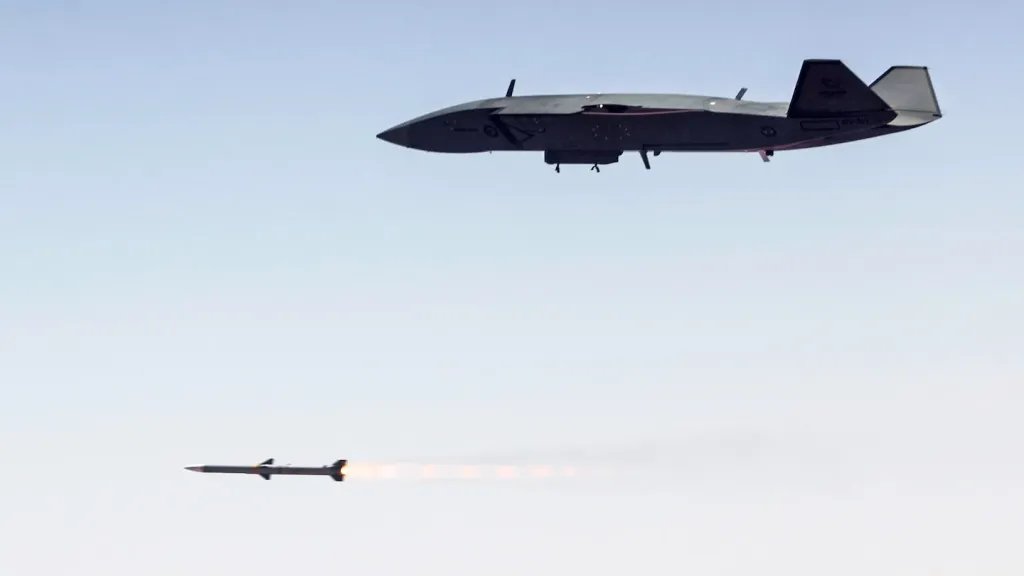
Its air force wanted them by 2029. Now it faces a longer wait.

Behind the decision is a much bigger political dilemma facing Germany as it races to rearm. 🧵 pic.twitter.com/2fWHPoQOl0

— Chris Lunday (@lundayfunday) October 15, 2026

“With Boeing Defense Australia as a partner, we are laying the groundwork to optimally tailor the MQ-28 to the Bundeswehr’s requirements,” said Armin Papperger, CEO of Rheinmetall AG, in March of this year. “As a system integrator, we ensure that integration, operation, and further development come from a single source while simultaneously strengthening industrial value creation in the form of an industrial hub in Germany and Europe. We see revenue potential for Rheinmetall in the range of three-digit millions of euros.”

#Rheinmetall and #Boeing partner on German MQ-28 #Ghost #Bat
https://t.co/zGEhjQNqqi pic.twitter.com/VLBDQ8EAaV

— Rheinmetall (@RheinmetallAG) March 31, 2026

The move does not necessarily mean the MQ-28 is out of contention for Germany’s wider program. Instead, Berlin appears set to move toward a different acquisition approach, with competing designs potentially having an opportunity to demonstrate their capabilities before a selection is made.

A Boeing spokesperson told Breaking Defense the company “stands ready to support” its German customer on the next steps, while referring questions about the decision to the German Ministry of Defense.

An AIM-120 is launched from an MQ-28A Ghost Bat during Trial Kareela at RAAF Base Woomera, South Australia. Australian Department of Defense

The ministry declined to discuss the specific procurement with the same outlet, citing regulations governing public contracting and the need for such matters to be addressed by parliament.

“[As a] matter of principle — and regardless of the specific case in question — we cannot provide information regarding potential procurement projects,” a ministry spokesperson told Breaking Defense.

Germany has set an ambitious goal of fielding CCAs by 2029. These uncrewed aircraft are intended to operate alongside crewed fighters such as the Eurofighter, extending their reach, adding sensors and weapons, and giving air forces additional options for conducting high-risk missions.

Ein Eurofighter vom Taktischen Luftwaffengeschwader 74 aus Neuburg an der Donau fliegt bei einem Übungseinsatz als Quick Reaction Alert (QRA) über dem Südosten Deutschlands, am 02.03.2022. ©Bundeswehr/Christian Timmig
A German Eurofighter flies a Quick Reaction Alert (QRA) practice sortie over the southeast of the country. Bundeswehr/Christian Timmig

However, the reported change in Berlin’s acquisition plans raises questions about whether that deadline remains achievable.

According to Politico, Germany is now looking toward the early 2030s for the capability to arrive, with flight testing expected to begin in 2027. That would suggest the original target was based around the introduction of the MQ-28, which has already undergone extensive testing, rather than a newer design. The reshuffle could now give prospective suppliers additional time to demonstrate their designs.

The reported new timeline suggests that Germany’s CCA effort could be entering a more competitive and potentially longer development phase.

There is also a question about the degree of operational capability that will initially be fielded by the given date. Getting a CCA into meaningful frontline service is a very significant task, calling for integration with crewed fighters, communications systems, mission-planning networks, weapons, and sensors. Then there is also testing, certification, training, and the establishment of supporting infrastructure. For Germany in particular, getting a military drone, let alone an armed one, cleared to operate routinely in commercial airspace has long been an issue.

If Germany acquired the Ghost Bat directly, it would have offered a route to a CCA capability without having to begin an entirely new aircraft development effort.

However, the MQ-28 was always one of a larger field of candidate aircraft.

A week ago, Airbus and Kratos Defense & Security Solutions announced the first flight of their U740 Valkyrie uncrewed combat aircraft, a Europeanized version of the XQ-58A Valkyrie. Airbus is simultaneously working on its larger U760 Ravenstorm, intended for service in the early 2030s, and the company has previously pitched a stealthy CCA-like concept known as Wingman.

The ride of the Valkyrie ⚔
With the successful first flight of the Airbus U740 Valkyrie in Europe, we are one step closer to introducing an operational uncrewed Collaborative Combat Aircraft (CCA) to the German and other European Armed Forces.
The flight achieved all… pic.twitter.com/S2sFrtdmGA

— Airbus Defence (@AirbusDefence) October 12, 2026

Other entrants include Anduril, General Atomics partnered with Germany’s INTEC, as well as Lockheed Martin. Meanwhile, Helsing and Hensoldt are pursuing the homegrown CA-1 Europa, very much an MQ-28 lookalike.

The CA-1 Europa from the German defense startup Helsing. Helsing

Germany may not be looking for a single drone to do everything, a point we have discussed in the past:

“One option might be a split high-low approach that could pair more capable, longer-range systems for deep-strike missions with cheaper, attritable collaborative combat aircraft that can fly alongside crewed fighters. At this point, it should also be noted that CCAs could also give older fourth-generation fighters a new lease on life, boosting their lethality and survivability by extending their sensor reach, adding weapons capacity, and allowing uncrewed aircraft to take on more dangerous tasks.”

At the same time, Germany continues to define its requirements for a capability described in media reports as a Jagdbomberdrohne, or fighter-bomber drone. Berlin has yet to publicly clarify its intended concept of CCA operations, including whether the Luftwaffe envisions an uncrewed wingman operating alongside crewed fighters, a platform capable of carrying out long-range strike missions independently, or a system designed to perform both roles.

There are signs that the strike mission is being prioritized, at least initially, with a reduced emphasis on air-to-air missions. This is essentially the reverse of the U.S. Air Force’s CCA effort.

Since Germany is set to receive the F-35 stealth fighter, there is also an argument that Berlin could place more orders for the crewed jet. This could have the dual role of filling the gap left by the collapse of the pan-European Future Combat Air System (FCAS), specifically its sixth-generation crewed fighter, and the delayed introduction of the first operational CCAs. Germany is also looking forward to receiving more Eurofighters.

Germany’s first F-35A arrived at Ebbing Air National Guard Base in Arkansas earlier this month, where it will be used for training. Lockheed Martin

Germany’s evolving CCA plans form part of a broader effort by Western air forces to develop uncrewed aircraft capable of working alongside advanced fighters. These systems are intended to expand the number of available platforms, distribute sensors and weapons across a larger force, and potentially take on missions that would otherwise expose pilots and expensive crewed aircraft to greater risk.

Boeing’s Ghost Bat could still have an opportunity to compete, depending on the structure of the eventual acquisition process and the requirements Berlin establishes.

However, with testing reportedly planned from 2027 and operational fielding potentially slipping into the early 2030s, the original 2029 ambition for an operational German CCA appears increasingly uncertain.

Contact the author: thomas@thewarzone.com

The post Germany Drops Boeing MQ-28 Ghost Bat Rapid Procurement Plan appeared first on TWZ.

  •  

Aerial Drones Appear To Be Picking Up Wounded Off The Battlefield In Ukraine

The Ukrainian Armed Forces say they have carried out the world’s first frontline evacuation of a wounded soldier by aerial drone. The soldier, from the 30th Mechanized Brigade, is said to have been recovered successfully and is undergoing treatment and rehabilitation.

“This is a historic event, at least for our unit for sure,” said “Napalm,” a squad commander and programmer with the 92nd Assault Brigade’s uncrewed ground vehicle (UGV) company. The precise date and location of the operation have not been disclosed, and the claim of a global first has not been independently verified. However, a video of the event has been published by the 92nd, which you can watch below:

At this point, it should be noted that the footage has not been independently verified and could depict a staged demonstration rather than an actual combat evacuation. It should, at least, be treated with a degree of caution.

According to accompanying reports, the infantryman was wounded while holding his position. Mines and intense Russian drone activity prevented a conventional ground evacuation, prompting the 92nd’s specialists to attempt an aerial extraction. The video shows the soldier clipping himself to the underside of the drone via a harness before being flown to safety. The extemporized nature of the platform is underscored by the fact that, while in the air, the soldier dangles below its rigid landing legs.

The soldier is seen hunched under the hexacopter before attaching his harness to the drone. 92nd Assault Brigade/YouTube screencap

The aircraft was a heavy hexacopter manufactured by Ukrainian company Gurzuf Defense, which provided it free of charge. A UAV operator from the 30th Mechanized Brigade piloted the drone. Throughout the recovery, the soldier remained in contact with the drone operator.

With the drone now airborne, the drone controllers monitor the flight from the ground. 92nd Assault Brigade/YouTube screencap

The operation involved the 92nd, 30th and 14th Mechanized Brigades, the 10th Army Corps and Gurzuf Defense.

Ukraine increasingly uses uncrewed ground vehicles to deliver supplies and evacuate casualties from exposed positions. According to Euromaidan Press, Ukrainian UGVs conducted approximately 112,000 logistics and evacuation missions between January and August 2026.

However, ground robots can struggle with mines, mud, and cratered terrain, while remaining vulnerable to drones and artillery. These obstacles make it especially difficult to conduct UGV operations in the battlefield’s “kill zone,” which can extend six to nine miles or more from the front line. You can read an in-depth account of Ukrainian UGV efforts in this previous story.

A video showing a Ukrainian UGV in action in the Donetsk region:

Aerial platforms are able to reach casualties in places where ground vehicles cannot safely travel, and can get there far quicker, without having to stick to specific routes.

The 92nd has not disclosed the evacuation distance or flight duration of the mission. If, as reported, the drone used was an Audag-6 model, this is stated to be capable of carrying a 200-pound payload over a distance of up to 15 miles.

Meanwhile, the recovery points to a growing trend in the Ukrainian Armed Forces.

Only days before the story of the evacuation broke, it emerged that Ukraine is also now testing the StarGate, a purpose-built aerial medical evacuation drone — also of the heavy hexacopter type — developed by the SkyFall company. This is a rather more tailored solution to the problem, with a covered, medical-grade stretcher slung below the drone. It has a reported payload capacity of around 330 pounds, uses AI-assisted navigation, and can also deploy nets against hostile drones attempting to intercept it.

The 92nd’s operation used a heavy-lift hexacopter adapted for an ad hoc casualty transport, rather than a more bespoke design. This means the soldier had to be adequately trained on how to strap in, and also had to be in a condition that they could actually perform this procedure. This would also be the case even if other soldiers were able to assist them in strapping in.

While these kinds of solutions may be new to the battlefield in Ukraine, using uncrewed aerial systems for personnel recovery and medical evacuation is far from new.

Back in 2016, the Army completed a demonstration of the Lockheed Martin K-Max helicopter in a casualty evacuation role. The K-Max can operate with and without a pilot and was used as a drone by the Marine Corps to deliver cargo in Afghanistan.

A U.S. Marine Corps K-Max helicopter. U.S. Marine Corps

“Unmanned and autonomous platforms have the potential to completely rewrite the medical doctrine,” Army Col. Daniel Kral, head of the Army’s Advanced Technology Research Center (TATRC), explained during a conference at Fort Detrick in Maryland in 2017.

In 2019, TWZ reported on U.S. Army efforts to explore how uncrewed craft might speed up the casualty evacuation process. This work included evaluation of the Dragonfly Pictures, Inc. (DPI) DP-14 Hawk, a small, tandem-rotor drone with a 400-pound cargo capacity.

 A DP-14 Hawk shown configured for casualty evacuation. Dragonfly Pictures, Inc.

The emergence of autonomous air vehicles, or uncrewed ‘flying taxis,’ with short or vertical take-off and landing capabilities in the urban air mobility sector has also generated military interest. The U.S. Air Force Research Laboratory, for example, has conducted studies into how craft such as these could be adapted for combat search and rescue, with the idea that they would be airdropped to recover a fighter pilot shot down while operating over hostile territory.

Closer to the Ukrainian hexacopter concept is the Flowcopter FC-100, a heavy-lift quadcopter drone that the U.S. Army tested in a medical evacuation capacity in Poland during the large-scale Saber Strike exercise earlier this year. Carrying a 220-pound payload, the drone has a range of more than 60 miles.

U.S. Army Soldiers assigned to the Regimental Support Squadron, 2d Cavalry Regiment, run with a test dummy in a stretcher towards a drone during an Autonomous Triage and Treatment Challenge taking place near Bemowo Piskie Training Area, Poland, May 10, 2026. From April 27 to May 31, 2026, U.S. and Allied forces will exercise the North Atlantic Treaty Organization’s (NATO) Eastern Flank Deterrence Initiative, demonstrating NATO’s ability to fight and win on the modern battlefield. Nearly 15,000 troops from eleven nations will train across the High North, Baltic region, and Poland. They will execute rapid maneuvers, air defense, counter-drone operations, and cyber defense to validate NATO’s regional defense plans in real time. This series of linked exercises includes Saber Strike, Immediate Response, and Swift Response. The exercises turn investment into capability. Soldiers integrate unmanned systems such as AI-enabled command and control and live data networks to move, decide, and fight more effectively across all domains. Sword 26 demonstrates how U.S. Army Europe and Africa drives transformation at scale while strengthening deterrence. Together with our allies, we are building a unified, lethal force ready to defend NATO territory and respond to any threat. (U.S. Army Reserve photo by Spc. Thomas Madrzak)
U.S. Army soldiers run with a test dummy in a stretcher towards a Flowcopter FC-100 drone during an Autonomous Triage and Treatment Challenge taking place near Bemowo Piskie Training Area, Poland, May 10, 2026, as part of Exercise Saber Strike. U.S. Army Reserve photo by Spc. Thomas Madrzak

All of these concepts aim to address the inherent vulnerability of larger personnel recovery platforms in more contested environments.

In their favor, they offer the potential to rescue troops from more precarious situations, with the smaller drones touching down in relatively tight areas in mountainous, forested, or jungle environments. Autonomous navigation systems can guide the drones through smoke, dust, or bad weather, too.

On the other hand, these small craft have no space for a medic, pararescuemen, or other additional personnel. Bearing in mind their limited range and lower speeds, they also need to be in the right location to respond to emergencies as and when they occur.

For the Ukrainian Armed Forces, aerial medical evacuation drones are being rapidly developed and now fielded to help address another problem: the vulnerability of UGVs in areas of the battlefield that have long become far too hazardous for crewed medevac platforms to operate.

By now, both sides in the Ukraine war are relying heavily upon small, autonomous uncrewed aircraft to perform a wide variety of resupply, surveillance, communications, and strike roles on and around the front lines. With that in mind, the adaptation of these kinds of vehicles for casualty evacuation and personnel recovery missions is the next logical step.

Contact the author: thomas@thewarzone.com

The post Aerial Drones Appear To Be Picking Up Wounded Off The Battlefield In Ukraine appeared first on TWZ.

  •  

Canada’s Snowbirds Say Farewell To The CT-114 Tutor Jet

The Canadian Forces Snowbirds brought the Canadair CT-114 Tutor’s aerobatic career to a close on Friday, October 16, with a final home-base demonstration at 15 Wing Moose Jaw, Saskatchewan. The private event, which was livestreamed, honored the Canadian-built jet trainer that defined the team for more than half a century, as well as the aircrew and support personnel who kept the increasingly demanding aircraft flying.

This Friday, join us in saying farewell to the CT-114 Tutors.

Watch the last airshow on Friday, October 16, 2026 live on our Facebook page.

The live stream will begin at 2 p.m. (EDT). pic.twitter.com/I2Tr3buq5D

— Royal Canadian Air Force (@RCAF_ARC) October 13, 2026

While Friday’s performance marks the end of the Tutor’s aerobatic display career with the team, a Grey Cup flyover in Calgary on November 15 remains on the schedule.

Speaking to MooseJawToday on October 15, Snowbirds team lead Maj. Maciej “Match” Hatta described the Tutor’s final season as an emotional milestone for the squadron, as well as an opportunity to recognize the families and support personnel who sustain the team during its annual touring season.

The Royal Canadian Snowbirds taxi at Gowen Field, Boise, Idaho Oct. 12, 2017. The Snowbirds performed during the Gowen Thunder Open House and Airshow. (U.S. Air National Guard photo by Master Sgt. Joshua C. Allmaras)
The Snowbirds taxi at Gowen Field, Boise, Idaho, during the Gowen Thunder Open House and Airshow, in 2017. Note the twin smoke tanks below the fuselage. U.S. Air National Guard photo by Master Sgt. Joshua C. Allmaras

Hatta has a long personal history with the aircraft. He flew with the Snowbirds from 2014 to 2017, subsequently worked on testing the Tutor’s avionics upgrades, and returned this year to lead the team through its final season with the jet. Despite having flown around 30 different aircraft as a test pilot, he has a particular attachment to the Tutor.

“This is still my favorite airplane to fly,” he said.

Hatta recalled flying a maintenance test sortie alone the previous day, enjoying the opportunity to look out over the wings without the near-constant radio communications involved in leading a formation display. He also noted the differences between individual aircraft in the fleet.

“They all have their own personality,” Hatta said. “Some of them howl a little more than others. Some get hotter inside. Some have poor air conditioning.”

Lt.-Col. Guillaume Paquet, commanding officer of No. 431 Air Demonstration Squadron, Royal Canadian Air Force (RCAF), said the final season has prompted strong reactions from spectators, many of whom have grown up watching the Snowbirds perform in the Tutor.

“The reality is we’ve been touring this country for 55 years, so everyone has a story, a childhood memory,” Paquet said.

Golden Hawks To Snowbirds

Canada’s military aerobatic tradition dates back to 1929, when the biplane Armstrong Whitworth Siskin helped establish the country’s formation-flying heritage. The modern era began in 1959 with the creation of the Golden Hawks, formed to mark the 50th anniversary of powered flight in Canada and the 35th anniversary of the RCAF. Flying gold-painted Canadair-built F-86 Sabre fighters, the team initially was intended to operate for a single season. Its popularity led to several more years of performances across Canada and the United States before it was disbanded after the 1963 season amid the high costs of maintaining it.

Canada’s centennial celebrations in 1967 brought a new demonstration team, the Golden Centennaires, which flew CT-114 Tutor jet trainers at 100 airshows across Canada and the United States. The Tutors would subsequently become the foundation of the Snowbirds. In 1969, Colonel O.B. Philp, newly appointed commander of No. 2 Canadian Forces Flying Training School at Moose Jaw, Saskatchewan, encouraged instructors to practice formation aerobatics using surplus Tutors left over from the Centennaires program. Initially presented as training and proficiency flying, the formations soon attracted public attention and gradually evolved into an established demonstration team.

The Golden Centennaires existed for only one year to celebrate the centennial of Canada in 1967. Canadian Forces

The formation grew from four aircraft in 1970 to seven in 1971, when the Snowbirds name was adopted following a competition among schoolchildren. Two solo aircraft were added in 1972, establishing the team’s familiar nine-aircraft format. That year, its pilots were assigned to demonstration flying on a full-time basis. The team’s Tutors were modified to support solo operation from the right-hand seat and the demands of inverted flight during aerobatic displays. In 1974, the Tutors received their distinctive red, white, and blue paint scheme, and the team was authorized to perform a fully aerobatic display.

The Canadian Forces Snowbirds perform an aerial demonstration over Rickenbacker International Airport, June 19 2026, as part of the Columbus Air Show. This year’s event featured more than 20 military and civilian planes and static displays, including a KC-135 Stratotanker from the 121st Air Refueling Wing, which served as the base of operations for military aircraft participating in the show. (U.S. Air National Guard photo by Tech. Sgt. Mikayla Gibbs)
Seven Canadian Forces Snowbirds jets perform an aerial demonstration earlier this year. U.S. Air National Guard photo by Tech. Sgt. Mikayla Gibbs

The Snowbirds subsequently achieved full squadron status as No. 431 Air Demonstration Squadron, becoming one of the most recognizable symbols of Canadian military aviation. Their officially stated mission was to demonstrate the professionalism, teamwork, and flying skills of the Canadian Armed Forces to audiences across North America.

150625-N-SN160-356 EVANSVILLE, Ind. (Jun, 25, 2015) The U.S. Navy Flight Demonstration Squadron, the Blue Angels, join their signature Delta formation with the Canadian Air Demonstration Squadron, the Snowbirds, for a scheduled photo shoot over Evansville, Ind. The Blue Angels are scheduled to perform at 68 demonstrations at 35 locations across the U.S. in 2015.. (U.S. Navy photos by Mass Communication Specialist 1st Class Michael Lindsey/Released)
The U.S. Navy Flight Demonstration Squadron, the Blue Angels, join their signature Delta formation with the Snowbirds for a scheduled photo shoot over Evansville, Indiana, in 2015. U.S. Navy photos by Mass Communication Specialist 1st Class Michael Lindsey/Released

However, the Tutor’s final years were marked by a series of serious accidents and renewed scrutiny of its aging systems.

In October 2019, a Snowbirds aircraft crashed in Georgia after an engine fuel-delivery failure, with the pilot surviving an ejection that was itself affected by a parachute malfunction. In May 2020, another Tutor crashed shortly after takeoff near Kamloops, British Columbia, killing the Snowbirds public affairs officer and seriously injuring the pilot; investigators determined that a bird strike had triggered an engine compressor stall. The fleet was temporarily grounded following that accident, with operations resuming under additional restrictions in August 2020.

A further accident at Fort St. John, British Columbia, in August 2022 prompted another fleet-wide operational pause after an engine failure during takeoff; investigators identified an improperly assembled oil filter as the cause. The aircraft returned to service the following month.

The Royal Canadian Air Force’s Snowbirds are parked on the flight line at Peterson Air Force Base, Colo., May 12, 2018. The Snowbirds aerial demonstration team performed a fly over in missing-man formation during the North American Aerospace Defense Command's 60th Anniversary Celebration. (DoD photo by Staff Sgt. Emily Kenney, USAF)
The Royal Canadian Air Force’s Snowbirds parked on the flight line at Peterson Air Force Base, Colorado, in 2018, during the North American Aerospace Defense Command’s 60th Anniversary Celebration. DoD photo by Staff Sgt. Emily Kenney, USAF

Subsequent safety measures included restrictions on certain aerobatic maneuvers and formations, minimum runway-length requirements, and limits on flying over water or performing some maneuvers outside gliding distance of a suitable landing surface.

At the same time, the persistent engineering challenges involving the Tutor’s airframe, engines, and ejection system were all factors in its retirement, with the RCAF concluding that further life-extension work was no longer practical.

Developing Canada’s Jet Trainer

Canadair Limited of Montreal began developing the CL-41A Tutor in the mid-1950s as a high-performance jet trainer to prepare RCAF pilots for the Canadair-built F-86 Sabre. The all-metal, low-wing, single-engine aircraft featured side-by-side seating and duplicate flight controls, allowing instructors to monitor students closely and take control when necessary. Two prototypes were built, with the first making its maiden flight on January 13, 1960, with Canadair test pilot Ian MacTavish at the controls.

CANADA - SEPTEMBER 01: Snowbirds roar over metro. Capt. Wes MacKay banks his Canadian Forces Tutor jet over downtown Toronto yesterday in a practice run before he and fellow Snowbirds perform today at the CNE. Canada's crack aerobatics team will make no changes in their thrilling performance despite Sunday's West German air show crash that killed 49 and injured 500. (Photo by Boris Spremo/Toronto Star via Getty Images)
Capt. Wes MacKay banks his Canadian Forces Tutor jet over downtown Toronto in a practice run before a performance at the Canadian National Exhibition in 1988. Photo by Boris Spremo/Toronto Star via Getty Images

Following an extensive testing and demonstration program, Canadian Minister of National Defence D.S. Harkness announced an order for 190 production aircraft on September 11, 1961. Deliveries began in 1963, with each aircraft reportedly costing approximately C$425,000 (around $394,000). Powered by a General Electric J85-CAN-40 turbojet built under licence by Orenda, the aircraft entered RCAF training service in late 1964 under the designation CT-114 Tutor.

As well as the RCAF, the Tutor found one other military operator in Malaysia. The Royal Malaysian Air Force received 20 examples designated the CL-41G Tebuan (meaning “Wasp” in the Malay language), which served between 1967 and 1986 in the ground-attack role.

A Royal Malaysian Air Force CL-41G Tebuan. The Aviation Historian Archive

The Tutor served as the RCAF’s primary jet trainer for decades, accumulating more than one million flight hours before its training role ended in 2000. It was replaced by the CT-156 Harvard II and CT-155 Hawk. The aircraft nevertheless remained in military service with the Snowbirds.

The Next Chapter

The Tutor’s retirement will bring an end to a long chapter in Canadian military aviation, but the Snowbirds are expected to continue flying with a new aircraft type. In May of this year, the Department of National Defence announced plans to replace the CT-114 with the CT-157 Siskin II, based on the Pilatus PC-21 turboprop trainer. The new demonstration capability will remain at 15 Wing Moose Jaw and is expected to become operational in the early 2030s.

Today the Government of Canada announced a commitment to purchase a future RCAF air demonstration capability. After more than six decades of service 2026 will mark the final season for the CT‑114 Tutor aircraft fleet which has represented Canada with dignity and pride since 1971. pic.twitter.com/iqRNE8d8H3

— Royal Canadian Air Force (@RCAF_ARC) May 19, 2026

The Siskin II has already been procured under Canada’s wider Future Aircrew Training (FAcT) program, for advanced fixed-wing and jet preparation. It is one of five aircraft types being procured under a 25-year, C$11.2-billion (approximately $7.9 billion) contract awarded to SkyAlyne in 2024. The other four types are the CT-102B Astra II (Grob G 120TP) for basic pilot training; CT-157 Siskin II for advanced fixed-wing and jet preparation; CT-145E Expeditor II (Beechcraft King Air 260) for multi-engine training; CT-153 Juno (Airbus H135) for helicopter training; and CT-142Q Citadel (De Havilland Canada Dash 8-400) for training air combat systems officers and airborne electronic sensor operators.

One of the first two Pilatus PC-21s departs Stans in Switzerland bound for Canada on September 14, 2026. These first aircraft mark the start of a new chapter in Canada’s Future Aircrew Training (FAcT) program. Pilatus

Paquet, the No. 431 Air Demonstration Squadron boss, said all Tutors are to be flown to IMP Aerospace in Trenton, Ontario, by March 31, 2027, where they will be disposed of. Some aircraft are expected to be preserved in museums or mounted on pedestals for public display, while others will be used as training aids for aircraft maintenance apprentices in Borden, Ontario.

“They’re not going to be flying. They’re not going to be flyable,” Paquet said.

Snowbirds team lead “Match” Hatta hopes to contribute his test-pilot experience to the transition, including testing the replacement aircraft and developing the new demonstration program.

“I would love to contribute to the team in terms of seeing them through the transition,” he said. “If I’m able to use my test background as well in helping that out, testing the new show, testing the new airplanes, and passing it on to a new boss down the road, then I’d love to do that.”

Royal Canadian Air Force CT-114 Tutor pilots with the Canadian Forces Snowbirds 431st Air Demonstration Squadron, perform pre-flight demonstrations during the Defenders of Liberty Air & Space Show at Barksdale Air Force Base, La., May 19, 2019. Serving as ambassadors of the CAF, the CF Snowbirds demonstrate a high level of skill, professionalism, teamwork, discipline and dedication inherent in the men and women of the CAF. (U.S. Air Force photo by Airman Jacob B. Wrightsman)
Royal Canadian Air Force CT-114 Tutor pilots with the Canadian Forces Snowbirds perform pre-flight checks during the Defenders of Liberty Air & Space Show at Barksdale Air Force Base, Louisiana, in 2019. U.S. Air Force photo by Airman Jacob B. Wrightsman

For Paquet, the immediate priority is completing the final display season without incident before turning to the next phase of the team’s history.

“I will definitely be emotional. The only thing I’m hoping for is that all the planes land safely, bring everybody home, and then we can check the box and say it was an extremely successful season. I brought everybody home, and we’ll move on to the next chapter.”

After more than six decades since its development began, the Tutor leaves behind a legacy spanning generations of military pilots and millions of spectators. Its final Snowbirds aerobatic display represents not simply the retirement of an aging aircraft, but the end of a long tradition in which the little jet trainer was one of the country’s most recognizable symbols of military flying and aerial performance.

Contact the author: thomas@thewarzone.com

The post Canada’s Snowbirds Say Farewell To The CT-114 Tutor Jet appeared first on TWZ.

  •  

First C-130J For Navy’s New E-130J Phoenix II Ballistic Submarine Communications Fleet Delivered

The U.S. Navy has taken delivery of the first C-130J-30 Hercules airframe destined to become an E-130J Phoenix II, the service’s next-generation aircraft for maintaining communications with its nuclear ballistic submarines. The aircraft will now undergo extensive mission-systems integration before it can begin testing for the Take Charge and Move Out (TACAMO) mission.

The @USNavy's future TACAMO aircraft is here. 🇺🇸

The C-130J-30 Super Hercules keeps strategic command and control connected when it matters most.

Four engines. Long endurance. Proven reliability. pic.twitter.com/huX0qlzKkm

— Lockheed Martin (@LockheedMartin) October 16, 2026

Lockheed Martin handed over the newly built aircraft at its facility in Marietta, Georgia, on October 15. The delivery marks the start of the transition from the Navy’s aging E-6B Mercury fleet to the turboprop-powered E-130J, which is intended to provide a survivable communications link between national leadership and U.S. Navy nuclear ballistic missile submarines, including the ability to send them orders to launch strikes while they are submerged.

An E-6B Mercury assigned to the Strategic Communications Wing 1 at Tinker Air Force Base approaches a KC-135 Stratotanker assigned to the 92nd Air Refueling Wing during an aerial refueling mission over Oregon, Feb. 28, 2025. Aerial refueling capabilities are essential for strategic and tactical operations as well as humanitarian relief efforts in support of Air Mobility Command, U.S. Transportation Command and Department of Defense priorities. (U.S. Air Force photo by Airman 1st Class Megan Delaine)
An E-6B Mercury assigned to the Strategic Communications Wing 1 at Tinker Air Force Base approaches a tanker during an aerial refueling mission over Oregon, Feb. 28, 2025. U.S. Air Force photo by Airman 1st Class Megan Delaine

“Today’s delivery from the historic Marietta line represents far more than a new airframe; it marks the foundation of our future strategic deterrence posture,” Capt. Roger Davis, program manager for the Navy’s Airborne Strategic Command, Control, and Communications program office (PMA-271), said in a statement.

“Through our close partnership with Lockheed Martin and our industry team, we are ensuring our nation maintains an unshakeable communications lifeline to our ballistic missile submarine fleet.”

Capt. Roger Davis, left, Airborne Strategic Command, Control and Communications program manager (PMA-271), presents a ceremonial key to Capt. David Gardner, commodore of Strategic Communications Wing 1 (SCW 1), during the C-130J-30 delivery ceremony Oct. 15, 2026 in Marietta, Georgia. The symbolic handover marks the transition of the new airframe into the next phase of mission-system modification, ground testing and developmental flight testing, laying the foundation to field the future E-130J “Phoenix II.” (Photo courtesy of Lockheed Martin by Thinh D. Nguyen)
Capt. Roger Davis, left, Airborne Strategic Command, Control and Communications program manager (PMA-271), presents a ceremonial key to Capt. David Gardner, commodore of Strategic Communications Wing 1 (SCW 1), during the C-130J-30 delivery ceremony Oct. 15, 2026 in Marietta, Georgia. Photo courtesy of Lockheed Martin by Thinh D. Nguyen

The aircraft is the first of three C-130J-30s initially procured by the Navy in September 2024. It will be transferred to Northrop Grumman, the E-130J program’s prime contractor and mission-systems integrator, for conversion. Collins Aerospace is providing the very low frequency (VLF) communications system, a key component of the TACAMO mission.

TACAMO aircraft provide a means for the president, secretary of defense, and U.S. Strategic Command to communicate with nuclear forces, including submarines submerged at sea. The mission is designed to preserve the ability to transmit emergency action messages even if conventional communications infrastructure is disrupted or destroyed.

The E-6B accomplishes this in part through a long, trailing wire antenna that enables VLF transmissions to submerged submarines. The E-130J will receive a comparable system as part of its conversion.

Hardening against the effects of electromagnetic pulse (EMP), which occurs during the detonation of nuclear warheads, is another key requirement for these planes.

A sneak peak at the first C-130J-30 Super Hercules aircraft being built by Lockheed Martin Corp. for the U.S. Navy’s E-130J program. This aircraft – the first of three – is slated to be delivered to the government in 2026 for modification into an E-130J Engineering Development Model. The E-130J, formerly called E-XX, will be the successor to the E-6B Mercury for the Take Charge and Move Out (TACAMO) mission, which connects the president, secretary of defense and U.S. Strategic Command with the United States’ nuclear triad. The U.S. Navy’s Airborne Strategic Command, Control and Communications Program Office (PMA-271) is leading the TACAMO Recapitalization Program and is scheduled to award the Engineering and Manufacturing Development contract during the first quarter of 2025. (Photo by David L. Key, Lockheed Martin)
The first C-130J-30 being built by Lockheed Martin Corp. for the E-130J program. Photo by David L. Key, Lockheed Martin

The Navy plans to acquire 31 E-130Js, nearly doubling the 16 E-6Bs currently in service. That total includes six developmental aircraft and 25 production examples, although it remains unclear how many of the developmental aircraft will ultimately be available for operational use.

The larger planned fleet should provide additional aircraft to support training, maintenance, and operational demands. However, the transition also brings technical challenges. The Government Accountability Office (GAO) has previously warned that integrating the specialized mission equipment into the smaller C-130J-30 airframe could affect operational availability and create additional engineering and manufacturing difficulties.

Rendering of the U.S. Navy's future E-130J aircraft, which will relieve the E-6B Mercury of the Take Charge and Move Out (TACAMO) mission. (Rendering courtesy of Northrop Grumman Corp.)
Rendering of the future E-130J aircraft. Courtesy of Northrop Grumman Corp.

In the past, TWZ has discussed the potential operational readiness and other trade-offs that could come from selecting a C-130-based platform to replace the E-6B in the TACAMO role. As we wrote previously:

“It’s certainly worth pointing out that the E-6Bs, conversions of what were some of the last and most modern 707 airliners built, were larger and higher performance platforms than the EC-130Qs. The C-130J-30 is certainly a more capable aircraft than the C-130H on which the EC-130Q was based, but it won’t have the base speed and altitude capabilities of an airliner-sized multi-engine jet. Compared to the Mercuries, any TACAMO-configured C-130J-30 would not be able to get on station as quickly, or fly as high, limiting its ability to get above bad weather or establish a better line of sight for its communications systems.”

“At the same time, as the Navy itself has noted, the C-130J-30 platform does immediately open up the ability to use a larger number of air bases, airports, and airfields, including austere ones that the E-6B cannot operate from. This could be very useful in a contingency scenario where an opponent may have destroyed or otherwise rendered unusable many well-established bases, as well as larger secondary dispersal sites, which include large commercial airports. Being able to fly from smaller, tertiary locations could help to ensure that the TACAMO mission continues without significant disruption under such circumstances. This is also true during peacetime, as targeting the TACAMOs on the ground would be much harder if they could easily operate from and sit alert at a much larger number of airports.”

“A C-130J-30 configured for the TACAMO mission would certainly have a mid-air refueling capability, and the Hercules is already a platform that has demonstrated the ability to loiter over particular areas for long periods of time. Unlike the Boeing 707, the C-130J is still in production, as well, meaning that TACAMO aircraft based on this plane would be inherently easier to maintain and support logistically, and may also be easier to convert to this specialized configuration to begin with. As time goes on, the J looks set to increasingly become the default base C-130 model across the U.S. military, as well. Compared to the long out-of-production 707-based E-6, support for the C-130J is already distributed across the U.S. and beyond. Training C-130J crews is even an easier proposition.”

The E-130J also represents a return to the Hercules family for the Navy’s TACAMO mission. The EC-130Q performed the role from 1963 to 1993, before the E-6A Mercury took over. The E-6B subsequently added an airborne command post mission known as Looking Glass, supporting U.S. strategic forces beyond the submarine communications role.

The US Navy operated a fleet of EC-130Q TACAMO aircraft like the one seen here before the arrival of the E-6As. U.S. Navy

The Navy’s current plan is for the E-130J to assume the TACAMO mission, while the Air Force pursues a separate effort to replace the Looking Glass airborne command post capability.

Following its delivery, the first E-130J airframe will enter mission-systems modification, ground testing, and developmental flight testing. The aircraft is not yet an operational TACAMO platform, and further integration and testing will be required before the Navy can begin fielding the new fleet.

The transition is intended to preserve one of the most critical links in the U.S. nuclear command, control, and communications architecture as the E-6B fleet becomes increasingly difficult to sustain.

Contact the author: thomas@thewarzone.com

The post First C-130J For Navy’s New E-130J Phoenix II Ballistic Submarine Communications Fleet Delivered appeared first on TWZ.

  •  

North Korea’s ‘Hunchback’ Submarine Makes First At-Sea Appearance For Missile Tests

North Korea says it has test-fired two types of submarine-launched strategic cruise missiles off its east coast, in what appears to be the first time its bizarre Hero Kim Kun Ok submarine has been seen at sea in a publicized manner. If the vessel truly was the launch platform, the tests would mark its first confirmed weapons trials and a potential step toward operational service. Unveiled with considerable fanfare in 2023, the Hero Kim Kun Ok has been billed by Pyongyang as a centerpiece of its future nuclear-armed navy, but its operational status and actual capabilities have remained unclear.

The launches took place Wednesday, October 14, with state media Korean Central News Agency (KCNA) reporting the activity earlier today. North Korea said the tests were intended to assess the readiness of its underwater combat systems, improve the Navy’s ability to execute strategic missions, and demonstrate the reliability of its deterrent. Along with imagery of the cruise missiles, KCNA released one photo of the Hero Kim Kun Ok underway, which you can see at the top of this story.

North Korea says it has test-fired two types of submarine-launched strategic cruise missiles off its east coast, in what could be a significant step toward bringing a larger submarine into service. If the launch platform was the Hero Kim Kun Ok, as imagery assessments cited by outside analysts suggest, the tests would mark the first publicly reported weapons trials from a vessel Pyongyang has portrayed as central to its future nuclear-armed navy.
The launch of a cruise missile, apparently from a vertical launch tube. North Korean state media North Korean state media
Submerged launch of one of the North Korean cruise missiles. North Korean state media

KCNA did not otherwise identify the submarine involved or disclose the missiles’ ranges, flight paths, or performance. South Korea’s Joint Chiefs of Staff (JCS) said it had detected and tracked the launches from before firing through the cruise and terminal phases. A JCS spokesperson said one missile type was launched from a vertical launch system and another from a torpedo tube. This would match the imagery we are seeing, it would also match the Hero Kim Kun Ok’s unique capabilities. The South Korean military assessed that the launches came from a submarine but did not initially identify the vessel publicly.

There remains a possibility that the 3,000-ton-class Hero Kim Kun Ok was not actually involved in launching the missiles. North Korea has long used underwater platforms for test missile launches and has paired these with images of an actual submarine for propaganda purposes. However, the JCS confirming they came from a submarine would lend additional credence to the possibility Hero Kim Kun Ok did indeed launch the missiles. If this is the case, it would indicate that North Korea has begun validating weapons systems aboard the submarine ahead of deployment. At the very least, we can confirm that the Hero Kim Kun Ok is now sailing, although South Korean and U.S. intelligence would be acutely aware of its movements and it could have been in at-sea testing for years now, we just don’t know.

North Korea unveiled the submarine in September 2023, describing it as its first “tactical nuclear attack submarine” and one of the Navy’s core offensive platforms. At the launching ceremony, North Korean leader Kim Jong Un was quoted as saying that arming the Navy with nuclear weapons “brooks no further delay.”

The North Korean diesel-electric submarine Hero Kim Kun Ok, which has the hull number 841. North Korean state media

Nevertheless, many questions remain about the submarine’s design and operational prospects. Overall, it remains a heavily modified derivative of a Cold War-era Romeo class diesel-electric submarine — nearly an antique by today’s standards — rather than a purpose-built guided missile submarine. Previous imagery shows 10 missile launch tubes concealed in the prominent ‘turtle back’ aft of the sail, in addition to torpedo tubes, although the precise configuration, usable capacity, and operational status of those systems remain uncertain.

The absence of publicly reported weapons tests from the vessel over the following years raised questions about its development. Analyst Shin Jong-woo of South Korea’s Defense and Security Forum told Reuters that the latest launches suggested combat-system testing for operational deployment was underway. He also suggested that North Korea may have resolved technical problems and could also test a submarine-launched ballistic missile (SLBM) before the vessel enters service. North Korea has previously presented SLBMs of increasing size, but has lacked a suitable submarine to launch them from.

The North Korean diesel-electric submarine Hero Kim Kun Ok during its launch. North Korean state media

Missile launches while the submarine is submerged represent a more demanding and operationally relevant capability than firing from the surface.

At the same time, a missile launch of any kind demonstrates only part of the capability required for a submarine like this to be effective at all. An operational submarine must also be able to deploy reliably, remain sufficiently difficult to detect, maintain its weapons, and execute missions under realistic conditions.

A vertical launch system (VLS) can provide dedicated capacity for certain missile types — potentially much larger ones — and may enable faster launches or larger salvos than a configuration relying exclusively on torpedo tubes. Torpedo tubes offer an alternative launch method, but with different constraints on weapon dimensions, handling, and firing procedures.

The forward four tubes are larger than the rear six on the submarine’s ‘turtle back.’ This would allow the boat to carry multiple types of missiles, possibly including a mix of short-range and longer-range submarine-launched ballistic missiles (SLBMs) and submarine-launched cruise missiles (SLCMs).

A North Korean cruise missile in flight after submerged launch. North Korean state media

Testing both systems would be consistent with an effort to validate multiple elements of the submarine’s weapons architecture.

North Korea has pursued submarine-launched missiles for years. In March 2023, it reported a submarine-launched cruise missile test from the older 8.24 Yongung submarine. In January 2024, Pyongyang said it had fired Pulhwasal-3-31 strategic cruise missiles from that same vessel. The earlier sub is in the 2,000-ton-class and is understood to have only one or two vertical launch tubes.

North Korea’s description of the weapons as “strategic” cruise missiles should also be treated cautiously. North Korea’s long-range cruise missile program is well established and a nuclear payload is a major part of its ambitions, but how mature or reliable a nuclear warhead is for this application at this time isn’t clear. Regardless, ground, surface, and now subsurface-launched cruise missiles are a key part of North Korea’s broader deterrent architecture.

According to reports, Wednesday’s activity was the first publicly reported underwater North Korean missile-testing event since the January 2024 launch.

Compared to the 8.24 Yongung submarine, the Hero Kim Kun Ok has a larger hull and additional vertical launch tubes, but it still uses very dated diesel-electric propulsion, which presents hugely different endurance, acoustic, and operating constraints compared with nuclear propulsion or even modern diesel-electric submarine capabilities.

As to the expectation that Pyongyang may test an SLBM from the submarine before deployment, this would be a likely milestone toward North Korea fielding a credible sea-based nuclear deterrent.

North Korean SLBMs identified as the Pukguksong-5 on parade in January 2021. North Korean state media

North Korea is also pursuing a separate nuclear-powered submarine project, unveiled as under construction in March 2025. Its completion and operational timeline remain uncertain. Nuclear propulsion is a much bigger challenge, but if perfected, such a boat would be of considerably greater value, especially as a second-strike capability.

SEOUL, SOUTH KOREA - 2025/12/25: People seen looking at a 24-hour Yonhap news TV broadcast at Seoul Railway Station showing news broadcast that shows North Korean leader Kim Jong Un veiling manufacturing site of an 8,700-tonnage nuclear-powered strategic guided missile submarine at an undisclosed location. North Korean leader Kim Jong Un has said South Korea's plan to build nuclear-powered submarines will "worsen the instability" in the region, calling South Korea's move a threat to the North's national security, according to state media on December 25. North Korean leader Kim Jong Un made the remarks during an on-site inspection of an 8,700-ton nuclear-powered strategic guided missile submarine under construction, the Korean Central News Agency (KCNA) said. (Photo by Kim Jae-Hwan/SOPA Images/LightRocket via Getty Images)
People seen looking at a TV broadcast at Seoul Railway Station showing North Korean leader Kim Jong Un unveiling the manufacturing site for a future nuclear-powered missile submarine at an undisclosed location. Photo by Kim Jae-Hwan/SOPA Images/LightRocket via Getty Images SOPA Images

The latest submarine tests come amid a broader series of North Korean weapons demonstrations, including reported hypersonic missile tests on September 20 and October 3, as well as tactical ballistic missile launches earlier in October.

The sequence is consistent with Pyongyang’s effort to diversify its delivery systems and complicate military planning for South Korea, the United States, and Japan.

A satellite image of the Pongdae Submarine Factory on the northeast coast of North Korea, the center of its submarine development activities. Google Earth

The activity also carries a diplomatic message. North Korea has repeatedly insisted that it will not abandon its nuclear weapons while the United States maintains what Pyongyang calls a hostile policy. It has also rejected the suggestion that adjustments to U.S.-South Korean military exercises would be sufficient to change the underlying relationship.

The tests also follow North Korea’s rejection of an apparent diplomatic opening from U.S. President Donald Trump after Washington sought to reduce tensions surrounding a U.S.-South Korean military exercise.

Kim touring the Sinpo submarine yards back in 2019, the first time we got a glimpse of the future Hero Kim Kun Ok. North Korean state media

A submarine able to launch missiles from less predictable locations complicates defensive planning for South Korea and the United States. The challenge extends beyond intercepting missiles after launch to detecting and tracking the submarine before it reaches a potential firing position. Even a partially capable vessel places additional demands on potential adversaries.

Were things to ‘go hot’ on the Korean Peninsula, any submarine capable of carrying strategic weapons would be at the top of the targeting list for Pyongyang’s adversaries. A submarine based on the archaic Romeo class design would be fairly easy to track from the time it leaves its berth. This is especially the case bearing in mind the sophisticated nature of South Korea’s anti-submarine capabilities.

Future submarines will become increasingly more challenging, however. That problem could intensify if future North Korean boats make more use of Russian assistance in developing their capabilities. Submarine technology is supposedly part of the payment to Pyongyang for its help in the war in Ukraine. This could become a much larger problem, even if Moscow were to provide North Korea with advanced Kilo class boats, for example.

For now, provided that the Hero Kim Kun Ok launched the missiles, which seems most likely, this would indicate that North Korea is advancing weapons integration aboard a submarine intended to expand its offensive naval capabilities. The fact that the Hero Kim Kun Ok is now at sea also signals progress toward deployment.

Whatever the ultimate operational effectiveness of the Hero Kim Kun Ok and its emerging missile armament, Pyongyang continues to demonstrate incremental improvements to its submarine forces.

Contact the author: thomas@thewarzone.com

The post North Korea’s ‘Hunchback’ Submarine Makes First At-Sea Appearance For Missile Tests appeared first on TWZ.

  •  

Army Explains How Merops Interceptor Drone Became Program Of Record In Just 142 Days

The U.S. Army turned the Merops interceptor drone into a formal program in just 142 days, an acquisition milestone that highlights efforts to speed the service’s response to emerging threats and get combat-proven capabilities into the hands of troops and allies. The Merops won accolades for its role in defending against Iranian barrages of Shahed-136 one-way attack munitions in the Middle East.

Speaking at the Association of the U.S. Army’s (AUSA) main annual convention in Washington, D.C., where TWZ is in attendance, Col. Christopher Hill, director of the Army’s Global Tactical Edge Acquisition Directorate (G-TEAD), described the Merops effort as “an example of how we can move fast when we need to.”

Polish soldier from 18th Anti-Aircraft Regiment is packing the parachute for the MEROPS T3 drone near Lipa, Poland, Nov. 15 2025. The intensive 20-day multinational Train-the-Trainer course rapidly qualified 20 students from Poland, Romania, and the U.S., most with no prior military drone experience, in a battle-tested C-UAS system through classroom, practical flight, and night operations, culminating in a successful live-fire demonstration to destroy a jet powered drone, thereby accelerating the fielding of this critical capability along the Eastern Flank Deterrence Line. As the battlefield evolves, we are leveraging U.S. experience and NATO authorities to solve problems for the Alliance. The training occurring at Lipa shows how Allies like Poland and Romania are rapidly procuring and employing systems that are battle-tested in Ukraine to strengthen the Eastern Flank Deterrence Line. This is the EFDL in action.(U.S. Army photo by Sgt. Luis Garcia, 52d ADA Bde)
A Polish soldier packing the parachute for a Merops drone near Lipa, Poland, in November 2025. U.S. Army photo by Sgt. Luis Garcia, 52d ADA Bde

The Merops is a small, relatively low-cost counter-UAS system designed to rapidly intercept long-range, one-way attack drones in flight. It was originally developed by Perennial Autonomy. The system uses Surveyor drones as airborne interceptors, with onboard sensors to track targets and the ability to operate autonomously or under remote control. The interceptors can destroy enemy unmanned aircraft through direct impact or a proximity-detonated explosive warhead.

The interceptor was initially brought to the Army’s attention after drone incursions involving two NATO partners prompted a senior commander to demand an urgent response. The system was not part of the commander’s original acquisition plan, Hill explained, but its demonstrated performance in Ukraine made it a compelling candidate.

“He said, ‘I want this capability in the hands of our partners within 14 days,’” Hill recalled. “Everyone looked around the room, and he looked over at me, and I nodded my head like, ‘We’ll figure it out.’”

The Army did not quite meet that deadline. Hill said acquisition personnel and soldiers went into the theater to evaluate the capability, ultimately getting it into the hands of NATO partners within approximately 21 or 22 days.

That initial effort has since expanded. Hill said the Army procured additional Merops systems in partnership with the Joint Interagency Task Force, which procured 13,000 of the interceptors. The effort also progressed from providing the capability to NATO partners to supplying mobile Merops firing teams to a second theater — presumably U.S. Central Command (CENTCOM).

In CENTCOM, the U.S. military has been confronting the threat posed by Iran’s Shahed-136 and other one-way attack drones, which have been used in barrages against American and allied forces and installations in the Middle East. Former Army Secretary Daniel Driscoll had previously highlighted Merops as a particularly attractive option for countering such threats because of its relatively low cost and the speed with which it can be acquired.

You can watch Driscoll’s testimony on Merops at the 36-minute mark of the video below:

During congressional testimony, Driscoll said the Army was able to purchase 13,000 Merops interceptors within approximately eight days after the conflict with Iran began. He put the cost at about $15,000 per interceptor, with the potential for that figure to fall below $10,000 as production scales. In a separate interview with Bloomberg, he suggested larger orders could eventually push the price down to between $3,000 and $5,000.

U.S. Secretary of the Army Daniel Driscoll, poses for a photo after signing a counter-unmanned aerial system April 30 in Ansbach, Germany. U.S. Army Brig. Gen. Curtis King, commanding general of 10th Army Air and Missile Defense Command, Brig. Gen. John Mountford, deputy commanding general of V Corps, Brig. Gen. Terry Tillis, commanding general of 7th Army Training Command, and their soldiers spoke on C-UAS that have been tested and implemented in the past year by 52d Air Defense Brigade and 12th Combat Aviation Brigade (U.S. Army photo by Sgt. 1st Class Jacob Kohrs).
U.S. Secretary of the Army Daniel Driscoll poses for a photo after signing a Merops counter-unmanned aerial system in Ansbach, Germany. U.S. Army photo by Sgt. 1st Class Jacob Kohrs

Shahed drones have been estimated to cost tens of thousands of dollars apiece, while traditional air defense interceptors are far more expensive. Using comparatively inexpensive drones to defeat them can improve the economics of air defense while preserving more sophisticated interceptors for threats that require them.

Ukraine has employed Merops alongside domestically produced interceptor drones to counter Russian Shahed/Geran one-way attack drones. The system’s battlefield use has helped demonstrate the potential of a new class of air defense weapons designed to defeat these kinds of drones without relying exclusively on costly surface-to-air missiles.

The thermal infrared targeting system of an AS-3 Merops displays a green target lock box milliseconds before intercepting a Hornet mid-range strike drone during a Perennial Autonomy drone demonstration for 2nd Marine Division on Marine Corps Air Ground Combat Center, Twentynine Palms, California, July 28, 2026. The Perennial Autonomy demonstration of the AS-3 Merops was part of a multi-day showcase that also displayed the abilities of the Bumblebee A1 quadcopter and the Hornet mid-range strike drone for 2nd Marine Division. (Courtesy photo illustration) This photo was cropped to emphasize the subject and remove sensitive display data for security purposes.
The thermal infrared targeting system of a Merops displays a green target lock box milliseconds before intercepting a Hornet mid-range strike drone during a Perennial Autonomy drone demonstration for 2nd Marine Division on Marine Corps Air Ground Combat Center, Twentynine Palms, California, July 28, 2026. U.S. Marine Corps/Courtesy photo illustration

However, Hill cautioned that success in Ukraine does not automatically mean a system will perform equally well in every operational environment.

“On the Merops, it absolutely was influenced by [Ukraine]. I mean, that’s where it came from. That’s where we saw the capability,” he said. “But that’s one of the things where the employment of the system really matters.”

A Merops drone is prepared for flight during a Perennial Autonomy drone demo on Range 220 as part of Service Level Training Exercise 4-26 on Marine Corps Air Ground Combat Center, Twentynine Palms, California, July 28, 2026. SLTE 4-26 is designed to be a challenging, realistic training environment that produces combat-ready forces capable of operating as an integrated Marine Air Ground Task Force across all domains of military operations. (U.S. Marine Corps photo by Lance Cpl. Carla Perez Ramirez)
A Merops drone is prepared for flight during a Perennial Autonomy drone demo on Range 220 as part of Service Level Training Exercise 4-26 on Marine Corps Air Ground Combat Center, Twentynine Palms, California, July 28, 2026. U.S. Marine Corps photo by Lance Cpl. Carla Perez Ramirez

Hill noted that the system’s effectiveness will vary depending on where it is used, including differences between desert environments and the urban areas where it has operated in Ukraine. The objective, he said, is to get the capability into the Army’s inventory so commanders can make informed decisions about how and where to use it.

“Once we get it into our hands, now we can make a decision in Europe. Where does it go? Do I even need it?” Hill said. “It’s getting it in our hands. So that was the key for the Merops. The speed of getting it, then we can make the decision of how we employ it.”

That approach reflects a broader change in how the Army wants to manage emerging technology. Rapid fielding is important, but the service also wants to avoid acquiring a capability for an urgent operational need only to leave it without a clear path toward long-term funding, production, and support.

Hill said G-TEAD’s process is designed to involve the organizations that will eventually take responsibility for a capability from the outset. Program acquisition executives, or PAEs, are involved early, while the Army’s test and evaluation community and soldiers provide feedback as the system is assessed. The goal is to identify a transition partner upfront rather than wait until after an initial fielding effort to determine who will take ownership.

DEBA, POLAND NOVEMBER 18: A U.S. Army soldier carries a component of the U.S. counter-drone system known as 'MEROPS' after launching an AS3 Surveyor interceptor drone during a live-fire demonstration at the Deba training grounds in Subcarpathian Voivodeship, Poland, on November 18, 2025. The drill is part of NATO's Eastern Sentry initiative to enhance vigilance and strengthen defenses against drone threats along the alliance's eastern border. (Photo by Artur Widak/NurPhoto via Getty Images)
A U.S. Army soldier carries a component of the Merops counter-drone system during a live-fire demonstration at the Deba training grounds in Subcarpathian Voivodeship, Poland, on November 18, 2025. Photo by Artur Widak/NurPhoto

“We want to make sure that we’re giving commanders capability that we know works,” Hill said.

He described the directorate’s standard process as a 180-day effort, with the objective of reaching a decision on whether a capability should become an Army program within that period. The Merops effort, at 142 days, moved faster than that target.

The process is also intended to address what acquisition officials often call the ‘valley of death’: the gap between getting an emerging capability into the hands of operational units and the point at which a program office takes over and provides the funding and contracting structure needed to scale it.

“We will work to fill that valley of death gap between the time that we put capability into the hands of units and the time that the PM picks it up and actually [provides funding],” Hill said. “There’s a gap there. So we can do that intermediate scaling portion before it fully transitions.”

DEBA, POLAND NOVEMBER 18: A U.S. Army soldier launches an AS3 Surveyor interceptor drone, part of the MEROPS U.S. counter-drone system, during a live-fire demonstration at the Deba training grounds in Subcarpathian Voivodeship, Poland, on November 18, 2025. The drill is part of NATO's Eastern Sentry initiative to enhance vigilance and strengthen defenses against drone threats along the alliance's eastern border. (Photo by Artur Widak/NurPhoto via Getty Images)
A U.S. Army soldier launches an interceptor drone, part of the Merops counter-drone system, during a live-fire demonstration at the Deba training grounds in Poland. Photo by Artur Widak/NurPhoto via Getty Images

The effort builds on the Army’s wider push to streamline acquisition, an issue Driscoll has also emphasized. The Army secretary previously described an old process involving 16 decision-making steps, each with the ability to veto a proposal and send it back through the system. That structure could leave the service waiting two to seven years to purchase a capability.

The Merops experience suggests that some of those delays can be reduced when acquisition professionals work directly with operational units and the organizations responsible for evaluating and sustaining new equipment.

But rapidly acquiring an interceptor is only part of the challenge. The Army must still determine where it offers the greatest value, how it fits into existing air defense architectures, and how to produce and sustain enough systems to meet operational demand.

Low-cost interceptors are also not a replacement for every layer of air defense. They are, however, an increasingly important option against large numbers of relatively inexpensive attack drones, particularly when the alternative is expending missiles worth hundreds of thousands or millions of dollars to defeat each target.

For the Army, Merops is therefore serving two purposes: providing an additional tool against the growing one-way attack drone threat and demonstrating a faster route from an emerging battlefield capability to a formally supported military program.

Contact the author: thomas@thewarzone.com

The post Army Explains How Merops Interceptor Drone Became Program Of Record In Just 142 Days appeared first on TWZ.

  •  

F-35C Makes First Arrested Landing Aboard A Ford Class Carrier

A U.S. Navy F-35C has made the first arrested landing for the type aboard a Ford class aircraft carrier, with the milestone taking place aboard the future USS John F. Kennedy (CVN 79) in the Western Atlantic on October 13, 2026. The milestone marks a major step in testing the Navy’s stealth fighter aboard its newest carrier class, following years of challenges integrating advanced launch and recovery systems.

Two F-35C test pilots assigned to Air Test and Evaluation Squadron 23 (VX-23), part of the Naval Air Warfare Center Aircraft Division (NAWCAD), flew to the carrier as part of an ongoing Aircraft Compatibility Testing (ACT) campaign. A team from the Patuxent River-based F-35 Integrated Test Force (ITF), detached to the ship, is conducting the evaluation using a specially instrumented example of the carrier-capable stealth fighter. The imagery released shows two jets, although only one is seen landing on the flattop. The other is seen carrying inert Joint Direct Attack Munition (JDAM) bombs externally.

An F-35 test pilot from Air Test and Evaluation Squadron Two Three (VX-23), Naval Air Warfare Center Aircraft Division (NAWCAD), flies an F-35C Lightning II fighter aircraft to the PCU John F. Kennedy (CVN 79) in the Western Atlantic Oct. 13, 2026. This is the first time an F-35C has landed on a Ford-class aircraft carrier. A Patuxent River F-35 Integrated Test Force (ITF) team detached to the ship is conducting Aircraft Compatibility Testing (ACT) with the specially instrumented carrier variant of the stealth jet. ACT assesses the operational capabilities of the ship's aircraft launch and recovery equipment with U.S. Navy aircraft.
An F-35 test pilot from Air Test and Evaluation Squadron Two Three (VX-23), Naval Air Warfare Center Aircraft Division (NAWCAD), flies an F-35C overhead the PCU John F. Kennedy in the Western Atlantic on Oct. 13, 2026. U.S. Navy

The Navy took preliminary acceptance of the carrier from Newport News Shipbuilding on September 29, following successful acceptance trials in August. That development allows the ship and its crew to conduct at-sea testing and build underway proficiency while the shipbuilder completes final systems testing ahead of formal delivery, scheduled for spring 2027.

Two F-35 test pilots from Air Test and Evaluation Squadron Two Three (VX-23), Naval Air Warfare Center Aircraft Division (NAWCAD), fly F-35C Lightning II fighter aircraft to the PCU John F. Kennedy (CVN 79) in the Western Atlantic Oct. 13, 2026. This is the first time an F-35C has landed on a Ford-class aircraft carrier. A Patuxent River F-35 Integrated Test Force (ITF) team detached to the ship is conducting Aircraft Compatibility Testing (ACT) with the specially instrumented carrier variant of the stealth jet. ACT assesses the operational capabilities of the ship's aircraft launch and recovery equipment with U.S. Navy aircraft.
Two F-35 test pilots from VX-23 fly F-35Cs to the PCU John F. Kennedy in the Western Atlantic on Oct. 13, 2026. U.S. Navy

The test is an important step in validating the integration of the F-35C with the Ford class. The Navy’s newest carriers use electromagnetic catapults and advanced arresting equipment, replacing the steam-powered launch systems and conventional arresting machinery found aboard the preceding Nimitz class.

Aircraft Compatibility Testing assesses the operational capabilities of a ship’s aircraft launch and recovery equipment with U.S. Navy aircraft. The process helps engineers evaluate how the carrier’s systems interact with individual aircraft and collect data needed to validate their performance.

A U.S. Navy F-35C Lightning II, attached to the "Salty Dogs" of Air Test and Evaluation Squadron (VX) 23, makes an arrested landing on the flight deck aboard PCU John F. Kennedy (CVN 79), marking the first time an F-35C lands on a Ford-class aircraft carrier. John F. Kennedy is underway conducting Aircraft Compatibility Testing, which assesses the operational capabilities of the ship's aircraft launch and recovery equipment with U.S. Navy aircraft. (U.S. Navy photo by Mass Communication Specialist Seaman Kaitlyn Bailey)
A U.S. Navy F-35C of VX-23 makes an arrested landing on the flight deck aboard PCU John F. Kennedy. U.S. Navy photo by Mass Communication Specialist Seaman Kaitlyn Bailey
A U.S. Navy F-35C Lightning II, attached to the "Salty Dogs" of Air Test and Evaluation Squadron (VX) 23, makes an arrested landing on the flight deck aboard PCU John F. Kennedy (CVN 79), marking the first time an F-35C lands on a Ford-class aircraft carrier. John F. Kennedy is underway conducting Aircraft Compatibility Testing, which assesses the operational capabilities of the ship's aircraft launch and recovery equipment with U.S. Navy aircraft. (U.S. Navy photo by Mass Communication Specialist Seaman Kaitlyn Bailey)
A U.S. Navy F-35C of VX-23 catches the wire on the flight deck aboard PCU John F. Kennedy. U.S. Navy photo by Mass Communication Specialist Seaman Kaitlyn Bailey

The F-35C is specifically designed for carrier operations, with larger wings, reinforced landing gear and a beefier tail hook compared with the Air Force’s F-35A. Its ability to launch from a carrier and recover through an arrested landing is central to its role in the Navy’s carrier air wings, which also include F-35Cs operated by the U.S. Marine Corps.

The use of a specially instrumented aircraft is particularly relevant to the test campaign. Instrumentation allows test teams to record data during flight-deck operations, helping them assess system performance and identify any issues requiring further evaluation.

A U.S. Navy F-35C Lightning II, attached to the "Salty Dogs" of Air Test and Evaluation Squadron (VX) 23, makes an arrested landing on the flight deck aboard PCU John F. Kennedy (CVN 79), marking the first time an F-35C lands on a Ford-class aircraft carrier. John F. Kennedy is underway conducting Aircraft Compatibility Testing, which assesses the operational capabilities of the ship's aircraft launch and recovery equipment with U.S. Navy aircraft. (U.S. Navy photo by Mass Communication Specialist Seaman Kaitlyn Bailey)
A U.S. Navy F-35C of VX-23 with its airframe liberally adorned with telemetry markings — these act as precision visual references used during flight testing to capture exact spatial data. U.S. Navy photo by Mass Communication Specialist Seaman Kaitlyn Bailey
A U.S. Navy F-35C Lightning II, attached to the "Salty Dogs" of Air Test and Evaluation Squadron (VX) 23, makes an arrested landing on the flight deck aboard PCU John F. Kennedy (CVN 79), marking the first time an F-35C lands on a Ford-class aircraft carrier. John F. Kennedy is underway conducting Aircraft Compatibility Testing, which assesses the operational capabilities of the ship's aircraft launch and recovery equipment with U.S. Navy aircraft. (U.S. Navy photo by Mass Communication Specialist Seaman Kaitlyn Bailey)
A close-up of one of the U.S. Navy F-35Cs of VX-23 reveals a full set of underwing stores pylons and a load of three inert 500-pound JDAM-series weapons. U.S. Navy photo by Mass Communication Specialist Seaman Kaitlyn Bailey

The first arrested landing aboard John F. Kennedy demonstrates that the ship has reached an important F-35C compatibility milestone. It does not, however, establish that all testing, certification, or operational qualification requirements have been completed.

The milestone comes against the backdrop of the Ford class program’s difficulties integrating some of its advanced aviation systems. The lead ship, USS Gerald R. Ford (CVN 78), introduced the Electromagnetic Aircraft Launch System (EMALS) and Advanced Arresting Gear (AAG), technologies intended to improve aircraft-launch flexibility, recovery performance, and overall sortie generation. Development and reliability challenges with both EMALS and AAG have contributed to delays in the class’s progress. In a 2019 report, TWZ highlighted concerns that Ford class carriers would not be ready to operate the F-35C for years.

A U.S. Navy F-35C Lightning II, attached to the "Salty Dogs" of Air Test and Evaluation Squadron (VX) 23, makes an arrested landing on the flight deck aboard PCU John F. Kennedy (CVN 79), marking the first time an F-35C lands on a Ford-class aircraft carrier. John F. Kennedy is underway conducting Aircraft Compatibility Testing, which assesses the operational capabilities of the ship's aircraft launch and recovery equipment with U.S. Navy aircraft. (U.S. Navy photo by Mass Communication Specialist Seaman Kaitlyn Bailey)
A U.S. Navy F-35C makes an arrested landing on the flight deck aboard PCU John F. Kennedy for the first time. U.S. Navy photo by Mass Communication Specialist Seaman Kaitlyn Bailey

USS Gerald R. Ford was designed and built before the F-35C’s full carrier-integration requirements were sufficiently mature, so the Navy deferred several upgrades to a later modernization period rather than delaying the ship’s delivery. Following congressional pressure, the Navy adopted a single-phase delivery approach for USS John F. Kennedy, incorporating these modifications during construction instead.

The USS Gerald R. Ford completed its Aircraft Compatibility Testing in January 2020, following 16 days at sea, during which the crew launched and recovered 211 aircraft, testing five different airframes — but the F-35C was not included.

A U.S. Navy F-35C Lightning II, attached to the "Salty Dogs" of Air Test and Evaluation Squadron (VX) 23, makes an arrested landing on the flight deck aboard PCU John F. Kennedy (CVN 79), marking the first time an F-35C lands on a Ford-class aircraft carrier. John F. Kennedy is underway conducting Aircraft Compatibility Testing, which assesses the operational capabilities of the ship's aircraft launch and recovery equipment with U.S. Navy aircraft. (U.S. Navy photo by Mass Communication Specialist Seaman Kaitlyn Bailey)
A U.S. Navy F-35C, attached to VX-23, after an arrested landing on the flight deck aboard PCU John F. Kennedy. U.S. Navy photo by Mass Communication Specialist Seaman Kaitlyn Bailey

Beyond EMALS and AAG, integrating the F-35C on Kennedy requires modifications to the carrier’s maintenance infrastructure and support systems. These include specialized spaces for handling the aircraft’s sensitive mission systems and classified data, computer networks and interfaces linking its maintenance and logistics systems with the Navy’s existing infrastructure, and facilities and equipment to support the upkeep of its low-observable coatings and materials. The Navy has also identified the need for more robust jet blast deflectors (JBDs), which protect flight-deck personnel and equipment from the F-35C’s intense engine exhaust.

Earlier F-35C integration work aboard Nimitz class carriers included JBD modifications to improve heat resistance and cooling, while planning for John F. Kennedy explicitly included both JBD upgrades and changes to maintenance spaces and information systems.

An F-35 test pilot from Air Test and Evaluation Squadron Two Three (VX-23), Naval Air Warfare Center Aircraft Division (NAWCAD), flies an F-35C Lightning II fighter aircraft to the PCU John F. Kennedy (CVN 79) in the Western Atlantic Oct. 13, 2026. This is the first time an F-35C has landed on a Ford-class aircraft carrier. A Patuxent River F-35 Integrated Test Force (ITF) team detached to the ship is conducting Aircraft Compatibility Testing (ACT) with the specially instrumented carrier variant of the stealth jet. ACT assesses the operational capabilities of the ship's aircraft launch and recovery equipment with U.S. Navy aircraft.
An F-35 test pilot from VX-23 flies an F-35C to the PCU John F. Kennedy in the Western Atlantic on Oct. 13, 2026. U.S. Navy

The latest test represents progress toward resolving the compatibility question, although the full scope of the remaining work will depend on the results of the ongoing evaluation.

The development also comes as China advances its own carrier aviation capabilities. Unlike the U.S. Navy, its Fujian aircraft carrier has demonstrated electromagnetic catapult launches and arrested recoveries involving several aircraft types, including the J-35 stealth fighter.

A J-35 is prepared for takeoff on Fujian. via Chinese internet

In contrast to the U.S. Navy, which accumulated decades of experience with steam-powered catapults before adopting electromagnetic launch technology, China chose electromagnetic catapults for its first catapult-equipped carrier.

Although China’s demonstrations aboard Fujian and the F-35C compatibility testing aboard Kennedy involve different aircraft, ships, and stages of development, both underscore the technical demands of integrating advanced aircraft with modern carrier launch and recovery systems.

For the U.S. Navy, the immediate priority is to demonstrate that the Ford class can reliably support its intended aircraft. The F-35C’s first arrested landing aboard Kennedy is a significant step in that process, with further testing — not least an EMALS takeoff — needed before the milestone can begin to translate into an operational capability.

Contact the author: thomas@thewarzone.com

The post F-35C Makes First Arrested Landing Aboard A Ford Class Carrier appeared first on TWZ.

  •  

Bradley’s Old TOW Launchers Get New Teeth With Spike Missile Adapter

Rafael USA and Leonardo DRS have presented a capability that would allow fighting vehicles equipped with legacy Tube-launched, Optically tracked, Wire-guided (TOW) missile launchers to fire Rafael’s Spike LR2 anti-armor missiles. The effort builds on a demonstration dating back to 2021, with the companies now presenting a more mature adapter solution designed to integrate the Israeli-made missile into existing platforms.

Roman Palaria, Rafael’s vice president for marketing and business development in its land and naval division, discussed the system in an interview with TWZ at the Association of the U.S. Army’s (AUSA) main annual convention. He explained that the earlier demonstration, part of Project Convergence 2021, used a version of the adapter that had not yet reached its final configuration. Leonardo DRS, Rafael’s U.S. partner, subsequently developed the mechanical and electrical components needed to connect the Spike LR2 to the TOW launcher and the vehicle’s existing systems.

The Rafael/Leonardo adaptor that allows TOW missile launchers to fire Rafael’s Spike LR2 anti-armor missiles. Howard Altman

The approach is intended to avoid replacing the launcher or radically overhauling the vehicle’s gunner station. Instead, the adapter provides the mechanical interface for loading the Spike LR2 missile and the electrical connections needed to communicate with the vehicle. Additional electronic components are installed within the vehicle to support the missile’s functions.

The adaptor configured for TOW (left) and Spike LR2 (right) missiles. Leonardo DRS

“We’re doing minimum changes to the vehicle,” Palaria said, describing the goal of making the integration as seamless as possible for the operator.

The Bradley infantry fighting vehicle is a prominent potential application, although the companies say the capability could extend to other platforms that use TOW launchers. The Army has operated TOW-equipped vehicles for decades, creating a substantial installed base of launch systems that could potentially benefit from the approach. As for the Bradley, the Army effort to replace its TOW missiles has been a long one, but is yet to produce any real results.

U.S. Soldiers assigned to 5th Squadron, 7th Cavalry Regiment, 1st Armored Brigade Combat Team, 3rd Infantry Division, point towards the area of their next target while in a M2A4 Bradley Fighting Vehicle during Exercise Hedgehog 25 near Camp Reedo, Estonia, May 16, 2025. Exercise Hedgehog 25 is a large-scale international military exercise led by the Estonian Defence Forces, focused on the rapid deployment of allied forces and the enhancement of multinational interoperability. As the designated opposition force, 5-7 CAV challenges participating units with a complex, realistic scenario to strengthen multinational interoperability and readiness. (U.S. Army photo by Sgt. Austin Steinborn)
A U.S. Army M2A4 Bradley. The TOW launcher can be clearly seen on the side of the turret. U.S. Army photo by Sgt. Austin Steinborn

Spike LR2 was successfully test-fired from M2A4 Bradley equipped with Multi-Purpose Missile Launcher (MPML), developed by Rafael and DRS. Adapters allow the system to remain compatible with existing TML/UTML launchers. Spike LR2 has also been proposed for the CCMS-H and XM30. pic.twitter.com/KB9EYwi6BI

— Ronkainen (@ronkainen7k15) October 13, 2026

After a missile is fired, its launch tube remains in the launcher and can be removed to accommodate another missile.

The central attraction of the system is the ability to combine existing launcher infrastructure with the Spike LR2’s unique engagement capabilities.

During Project Convergence 2021, two Spike missiles were fired from a TOW launcher, and both reportedly hit their intended targets. The adapter now being presented reflects subsequent development work by Leonardo DRS, including refinement of the mechanical interface and vehicle electrical integration.

An M2A3 Bradley Infantry Fighting Vehicle with Headquarters and Headquarters Company, 1st Battalion, 16th Infantry Regiment, 1st Armored Brigade Combat Team, 1st Infantry Division, uses a twin-tube, turret-mounted launcher to fire a BGM-71 Tube-launched, Optically-tracked, Wireless-guided (TOW) anti-tank missile, Feb. 25, 2026, on Novo Selo Training Area, Bulgaria. The training focused on developing individual crews, target engagement skills and maneuverability. Live-fire exercises increase the lethality of crews on various weapons systems while generating warfighting readiness and combat credible forces along NATO’s Eastern Flank. (U.S. Army photo by Spc. Brandi Frizzell)
An M2A3 Bradley uses its twin-tube, turret-mounted launcher to fire a BGM-71 TOW anti-tank missile. U.S. Army photo by Spc. Brandi Frizzell

The system is designed to preserve the vehicle’s existing TOW capability while adding the option to use Spike LR2. That would give commanders another missile option without necessarily requiring wholesale replacement of installed launcher equipment. The extent to which individual vehicles could use both missile types would depend on the completed integration and applicable qualification requirements.

Rafael USA and Leonardo DRS have advanced a capability that would allow fighting vehicles equipped with legacy Tube-launched, Optically tracked, Wire-guided (TOW) missile launchers to fire Rafael’s SPIKE LR2 anti-armor missiles. The effort builds on a demonstration dating back to 2021, with the companies now presenting a more mature adapter solution designed to integrate the Israeli-made missile into existing platforms.
Another view of the Rafael/Leonardo Spike LR2 adaptor. Howard Altman Howard Altman

The Spike LR2 offers capabilities that differ substantially from those of the legacy TOW missile. Palaria cited a maximum range of approximately 5.5 kilometers (3.4 miles) and highlighted the missile’s day/night imaging seeker, which provides video to the operator during flight. The longest-range TOW missile versions max out at around 4.5 kilometers (2.8 miles).

In contrast, Spike LR2’s imaging capability supports engagement of targets beyond the operator’s direct line of sight, as well as observation of the target area during the missile’s approach. Depending on the engagement, the operator can acquire a target through the missile’s seeker, adjust the engagement, or select a different target while the missile is in flight.

These features contrast with the traditional TOW’s semi-automatic command to line-of-sight (SACLOS) guidance, in which the gunner tracks the target through the launcher’s observation system and guides the missile throughout its flight. Spike LR2’s onboard imaging provides a different set of options for engagements in which direct observation is limited or target conditions change after launch. This can also include striking targets behind cover.

Palaria also described the LR2’s two warhead options. The first of these is a tandem-charge anti-tank warhead, which Rafael claims is able to penetrate any modern main battle tank. It consists of a precursor warhead and the main warhead, which are designed to penetrate the reactive armor, and the main armor, respectively.

The second option is a multi-purpose configuration. It has a programmable fuze, which allows the missile to be employed against different target types. Depending on the selected mode, the warhead can be configured for direct-impact or timed-detonation effects, for example, detonating above the ground for anti-personnel missions, or penetrating a building, in which case the first charge will make a hole in a wall, and then the second charge will go inside and explode after a short delay.

The adapter offers a potential route to adding new missile capabilities to existing Army vehicles while limiting changes to their launcher hardware and crew interface.

Operator training would obviously be necessary. Although the gunner would continue using the vehicle’s existing console and displays, Palaria acknowledged that Spike LR2 introduces additional functions, controls, and engagement procedures.

Slovenian army soldiers of 10th Infantry Regiment engage targets with a Spike long range anti-tank guidance missile during a live-fire exercise as part of Exercise Rock Sokol at Pocek Range in Postonja, Slovenia, March 4, 2016. Exercise Rock Sokol is a bilateral training exercise between U.S. Soldiers assigned to 173rd Airborne Brigade and the Slovenian Armed Forces, focused on small-unit tactics and building on previous lessons learned, forging the bonds and enhancing readiness between allied forces. The 173rd Airborne Brigade is the U.S. Army's Contingency Response Force in Europe, providing rapidly-deploying forces to the U.S. Army Europe, Africa and Central Command areas of responsibility within 18 hours. The brigade routinely trains alongside NATO allies and partners to build stronger relationships and strengthen the alliance. (U.S. Army photo by Visual Information Specialist Davide Dalla Massara/Released)
Slovenian soldiers engage targets with a Spike LR anti-tank missile during a live-fire exercise. U.S. Army photo by Visual Information Specialist Davide Dalla Massara/Released

For the Army, the proposition is straightforward: retain a familiar launcher architecture while potentially adding a missile with greater reach, onboard imaging, and more flexible engagement options that exceed line-of-sight tracking. The adapter’s significance lies in making that combination possible without starting from a clean sheet.

Whether that capability becomes a fielded upgrade will depend on the Army’s requirements, testing, integration decisions, and procurement plans. But the widespread uptake of the Spike series of missiles around the globe, combined with the very large existing TOW missile operator base, means the adapter solution could well be of interest to customers outside the U.S. Army, too.

Contact the author: thomas@thewarzone.com

The post Bradley’s Old TOW Launchers Get New Teeth With Spike Missile Adapter appeared first on TWZ.

  •  
❌