❌

Reading view

21 displaced people killed in Gaza building collapse

The lethal repercussions of Israel’s three-year genocidal aggression on Gaza continue to unfold. Aside from Israel’s ongoing military assaults after the nominal ceasefire deal, the humanitarian crisis inflicted by the genocide – affecting food, sanitation, medication, and shelter – has become another driver of persistent fatalities. 

At least 21 Palestinians, including 12 children, died in the collapse of the Al-Saadah building in Gaza City on Wednesday, September 16, while 45 people were rescued from under the rubble. 

According to media reports, the building, already damaged by Israeli airstrikes, was housing 100 displaced people, amid a deepening shelter crisis caused by Israel’s ongoing restrictions on reconstruction materials and humanitarian aid.

Read more: Israel escalates aggression in Gaza, Kushner returns to Washington empty-handed

Hamas holds Israel “responsible for the disaster”

Hamas issued a statement, holding Israel “responsible for this disaster,” and affirming that “the building collapse represents a new chapter in the catastrophic humanitarian repercussions of the war.”

The Palestinian movement pointed out that the massive home and neighborhood destruction has forced thousands of displaced people to take refuge in ruined structures. 

It further cautioned that the severe shortage in heavy machinery for clearing debris and conducting rescue operations endangers more lives. 

Hamas also urged mediators, the US administration, and relevant international bodies to take immediate action to lift restrictions blocking the entry of necessary rescue equipment and vehicles, and to secure safe shelter for the displaced population. 

Meanwhile, the Gaza-based Ministry of Public Works and Housing warned that roughly 3,000 buildings across the war-ravaged enclave are currently deemed dangerous or at risk of collapse, which in turn poses a significant threat to thousands of inhabitants.

  •  

Over a decade of war in Yemen and the rise of Ansar Allah

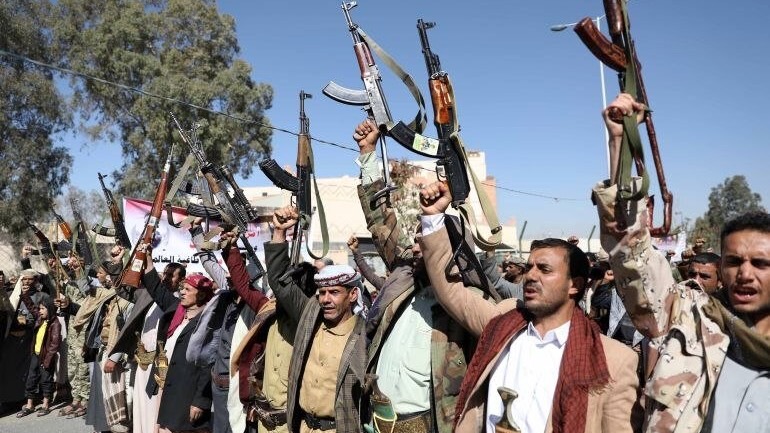
In July, Saudi Arabia joined the US-Israeli war on the West Asia region with strikes on Yemen. The Ansar Allah-led Yemeni Armed Forces retaliated by launching a maritime blockade alongside attacks targeting vital Saudi interests.

The renewed fighting between the two West Asian nations resulted in Ansar Allah’s takeover of the strategic Red Sea port city of Mokha last week and the liberation of all the group’s prisoners held by Saudi-backed forces on Yemen’s western coast.

Ansar Allah’s seizure of Mokha seaport is reshaping regional and global geopolitics, particularly because it serves as a primary gateway to the Bab el-Mandeb Strait and coincides with developments in the Strait of Hormuz.

As these major shifts underscore, Yemen holds immense strategic geopolitical significance.

Situated on the southwestern corner of the Arabian Peninsula and overlooking the Bab al-Mandab Strait, Yemen represents a vital chokepoint connecting the Red Sea to the Gulf of Aden and the Indian Ocean

Consequently, internal political developments in Yemen can have global political and economic repercussions.

This fact, in turn, has put Yemen in the crosshairs of the US-led Western imperialist bloc and their allies in West Asia, which have endeavored to subjugate the country through a devastating decade-long war and blockade. 

The origin of this war coincides with the emergence of Ansar Allah, beginning when the group managed to take control of large swathes of the country, including the capital, Sanaa, in 2014.

The rise of Ansar Allah

Ansar Allah was first established in the early 1990s in the northern Yemeni governorate of Saada as a cultural and educational organization called Al-Shabab al-Mumin (the Believing Youth).

Initially, the organization introduced itself as an unarmed theological movement aimed at reviving and preserving Zaydi Shia Islam and countering the threat of state-backed Sunni Salafism, which sought to uproot the Zaydi religious identity in its homeland of Saada.

From its inception, the movement opposed the government, led by President Ali Abdullah Saleh, accusing it of corruption and criticizing its ties to the United States and its ally Saudi Arabia.

Tensions between the group and the government drastically escalated following the US invasion of Iraq in 2003. It was at that time that the group adopted the slogan (Death to America, Death to Israel), during mass protests opposing the war on Iraq.

These slogans posed a political threat to Ali Abdullah Saleh, who was attempting to position his government as a key ally in the “US War on Terror” in the aftermath of the 9/11 attacks. As a result his government led a brutal crackdown on protesters.

Security forces and riot police suppressed protests using live ammunition, tear gas, and batons, and arbitrarily detained hundreds of political activists, students, and opposition organizers without trial.

In 2004, tension between the Al-Shabab al-Mumin and the Yemeni government boiled over, sparking a series of six internal conflicts known as the Saada Wars. 

These clashes began with the government’s assassination of Hussein Badreddin al-Houthi, the group’s founder, and triggered five subsequent rounds of fighting that lasted until 2010. The followers of the group became widely known as the Houthis ever since. 

Saudi Arabia reportedly engaged in the Saada wars by providing immense financial, political, and material support to the Yemeni government. Saudi intervention in Yemen escalated in 2009 with a direct military incursion and unilateral airstrikes against positions held by the Houthi movement.

In 2011, the group joined nationwide demonstrations, calling for the overthrow of President Ali Abdullah Saleh. It was then that the Houthi movement formally adopted the name Ansar Allah (Supporters of God). 

The ousting of Saleh weakened the central government and triggered a sweeping power vacuum, which allowed Ansar Allah to rapidly expand its territorial dominance. By 2012, the Yemeni movement consolidated firm control across the Saada governorate and large swathes of northern Yemen.

In early 2012, vice president to Saleh, Abed Rabbu Mansour, Hadi became the President of Yemen via a transition framework brokered by the Gulf Cooperation Council (GCC), as he was  considered as a quiet consensus figure. Hadi was also strongly backed by the Obama administration. 

In late 2014, Ansar Allah allied with forces loyal to ousted president Ali Abdullah Saleh against the transitional government headed by Abed Rabbu Mansour Hadi. The fighting that followed led to Ansar Allah’s seizure of the capital Sanaa, forcing Hadi to flee the country.

2015-2022: The Saudi-led coalition’s protracted war against Yemen

From exile in 2015, Hadi requested the Saudi-led coalition to intervene in the conflict, opening the door to one of the bloodiest prolonged wars in West Asia. A conflict that, according to UN estimates, resulted in 377,000 deaths by 2022. 

Saudi Arabia was the main pillar of the coalition, leading the military campaign dubbed “Operation Decisive Storm” with a massive force, including extensive warplanes and ground troops.

The United Arab Emirates (UAE) also played a key role by commanding ground and air operations particularly in southern Yemen and along the critical coastal strip.

Bahrain took part in the operation with 12 fighter jets (some sources say 15), and deployed ground troops in the southern Saudi borders to protect Saudi Arabia from Ansar Allah’s attacks. Meanwhile, Kuwait contributed with 15 warplanes.

At the beginning of the campaign, Qatar participated with roughly 1,000 ground troops, armored vehicles, a dozen fighter jets, and transport helicopters until it was expelled from the coalition in June 2017 over a diplomatic crisis with Saudi Arabia, UAE, Bahrain, and Egypt.

Jordan and Morocco contributed six fighter jets each, while Sudan under deposed president Omar Al-Bashir sent three aircrafts and thousands of ground troops. Furthermore, Senegal committed 2,100 troops.

Western countries, including the United States, the United Kingdom, and France provided logistic and intelligence support, such as aerial refueling for coalition jets, technical assistance, military equipment, coordination support, and maritime surveillance.

The 2022 UN-brokered truce de-escalated the war rather than ending it

In April 2022, the United Nations announced an official two-month nationwide truce agreement, which temporarily halted cross-border attacks, ground and air operations, and allowed fuel imports into ports held by Ansar Allah. It also reopened commercial flights from Sanaa International Airport after years of sea, land, and air blockade imposed by Saudi Arabia. 

Rather than completely removing the blockade, the agreement only resulted in the partial easing of restrictions, while regions under the control of Ansar Allah have continued to face a near-total blockade.

Read more: Yemen demands Saudi-led blockade on the country be lifted immediately

The agreement was renewed in June and extended a second time in August 2022 for an additional two months before it lapsed in October. 

Regional developments reignited the conflict (2023-2026)

In November 2023, Ansar Allah launched a ban on all Israeli maritime navigation in the Red Sea and the Bab el-Mandeb Strait in retaliation for Israel’s genocidal aggression on Gaza.

About one month later, the group significantly expanded the ban to include all ships heading to Israeli ports, regardless of their nationality or flag.

The ban continued until October 2025, despite waves of deadly airstrikes launched by the US, UK, and Israel on Yemen.

An Omani-mediated ceasefire deal between the US and Ansar Allah was reached in May 2025. The deal stipulated halting Ansar Allah’s attacks on US ships in the Red Sea and Bab al-Mandab Strait, and ending US aggression on Yemen, without preventing the Yemeni resistance movement from launching attacks or naval operations against Israel. 

This same period saw a shift in the conflict between the Saudi-led coalition and Ansar Allah from active military engagement toward a tense, fragile diplomacy.

In early 2026, friction between the two major pillars in the anti-Ansar Allah coalition – namely Saudi Arabia and the UAE – surfaced as different Yemeni groups backed by the two countries clashed, apparently over territorial control in Yemen.

Read more: Tensions in Yemen: Are Saudi Arabia and the UAE becoming frenemies?

The US-Israeli war on Iran has drawn Yemen back into the regional conflict

Although Ansar Allah was established as an independent Yemeni movement, it evolved into a key component of the Axis of Resistance over time. This alignment was driven by mutual ideological foundations, shared anti-imperialist ideology, and deep strategic and military cooperation with Iran and Hezbollah.

Despite its affiliation with the resistance alliance, Ansar Allah chose not to get involved in the recent regional war waged by the US and Israel against Iran, for ostensibly strategic considerations and military coordination tactics with its allies.

Read more: Reflections on the US-Israeli multi-front war in West Asia: How the Axis of Resistance remains resilient

However, because the United States and its allies in the region seemingly view the current war as an ideal opportunity to dismantle the Axis of Resistance, Saudi Arabia decided to resume its aggression against Yemen by attacking Sanaa International Airport in July. The attack aimed to prevent an Iranian plane from landing.

Consequently, Ansar Allah launched retaliatory attacks on Saudi interests inside Saudi Arabia and on Yemeni soil. It further declared a maritime blockade against Saudi-linked commercial vessels passing through the Bab al-Mandeb Strait, demanding Riyadh end its decade-long blockade on Yemen.  

Concurrently, ground clashes over territorial dominance between Ansar Allah and Saudi-backed forces intensified, leading to key victories for the Yemeni group. Escalations have persisted up to the time of publication.

On Wednesday, September 16, Saudi Arabia accused Ansar Allah of attempting a drone attack against the city of Mecca, the holiest city for Muslims, located in western Saudi Arabia.

Ansar Allah dismissed Saudi accusations as false, saying that they reflect a “desperate attempt to mobilize public opinion.”

As the US-Israeli war on West Asia continues to reshape geopolitics, Ansar Allah’s emergence as a regional force has placed Yemen at the center of a struggle that may define the future of West Asia.

  •  

Descendants of Chinese forced laborers sue Japanese companies for reparations

A group of 50 family members and descendants of wartime forced laborers in China filed a lawsuit against six companies on Wednesday, September 16, demanding compensation for their suffering during the Japanese occupation. 

In their lawsuit at a local court in Hebei, southwest of the capital, Beijing, the group is seeking around $55,000 in compensation for each member, along with an apology published in at least 10 Japanese and Chinese media outlets.

The plaintiffs accuse six Japanese firms of being beneficiaries of the forced labor, causing long-term pain, suffering, and the deaths of their family members, Kyodo News reported. 

According to Kyodo News, the six Japanese firms named in the lawsuit include construction firm Taisi Corp, mining firm Nittetsu Corp, and heavy industry manufacturer IHI Corp. 

Japan occupied large parts of China, the Korean Peninsula, and other parts of Southeast Asia at various times between the last decade of the 19th century to the end of the Second World War.

The Japanese military committed systemic torture, sexual exploitation, forced labor, and other cruelties against Chinese and other Asian peoples during the occupation, all which have been well documented.

Millions had to do forced labor in the territories occupied by Japan, including hundreds of thousands of Chinese people. Some Chinese forced laborers were also sent to Japan to work in mining and other industries. Thousands of these forced laborers were killed due to harsh working conditions and torture inflicted by their employers. 

Compensation and apology for crimes during occupation

The survivors of Japanese atrocities and their descendants have in different moments raised demands for compensation and apologies.

In 2014, a similar lawsuit was filed by hundreds of people in a Chinese court against Mitsubishi Materials Corp and others. The case ended in an out-of-court settlement, with Mitsubishi offering an apology and compensation to the plaintiffs.

In China, survivors cite their lack of faith in the Japanese system as the reason for filing the suit in a domestic court. 

Japanese courts have dismissed all such lawsuits. A 2007 Japanese Supreme Court’s judgment stated that all such claims were settled when Japan and China established their diplomatic relations in 1972.

However, China has maintained that the 1972 documents did not denounce an individual’s right to seek legal action. China has also often invoked Japan’s failure to acknowledge its repressive and atrocious colonial period and apologize to its victims in the region.

Reacting to the news on Wednesday, the official spokesperson of China’s Ministry of Foreign Affairs Guo Jiakun underlined that “forced recruitment and enslavement of laborers is one of the serious crimes committed by Japanese militarists during their foreign aggression and colonial rule.”

He urged “Japan to look history in the eye, reflect on past crimes, earnestly heed and respond to the just calls and legitimate claims of the people of victims countries in Asia, and properly resolve relevant issues left over from history with a responsible attitude.”

  •  

South Korea shouldn’t abet Trump in Hormuz

The Lee Administration leaked the possibility of deploying Korean forces to the Strait of Hormuz on September 3. The backlash was immediate from Korean civil society that opposes any type of support for Trump’s war of aggression. Furthermore, recent polls reveal that even 55% of Lee’s supporters oppose the dispatching of forces. And while the Lee administration has publicly backtracked, stating that nothing has been decided, it is, nonetheless, quietly undergoing the process of deployment: more than simply an assessment of the security conditions on the Strait of Hormuz, the Lee administration sent a team to check key military bases and ports that could be used at the United Arab Emirates.

Despite growing public opposition, the Lee administration is expected to introduce at the end of September a motion into the National Assembly, where it is likely to pass given his party’s considerable majority. Unlike his predecessor, the impeached Yoon Suk-yeol, President Lee is not a pro-US ideologue; he is a pragmatist. Why then is Lee going out on a limb with this deployment when the rest of the world is staying out of it?

Well, South Korea’s history has always been entangled and shaped by US foreign policy. The darker side to South Korea’s pop-culture is a country dominated and shaped through US policy and interventions. Today, it hosts the largest overseas US military base and controls the Korean military (through wartime operational control). In effect, it’s never been a sovereign state. Its economic, political, and military interests have always been beholden to the United States. 

Today, Lee is horsetrading with Trump: military support in exchange for more favorable terms in the US’s AI global supply chain of semiconductors and data centers along with a return of wartime operational control. While Lee’s pragmatism is navigating the real structural constraints on South Korea, it is ultimately short-sighted and harmful to Koreans and the world.

The war in Iran is inflicting considerable pain to the world’s economies, including South Korea that imports 61% of its crude oil through the Strait of Hormuz. Yet, even from a completely pragmatic perspective, sending Korean forces to the Hormuz does nothing to resolve this problem. In fact, getting entangled with US aggression against Iran would strain the 64-year diplomatic relations with Iran while putting a target on South Korean assets in the region. Furthermore, if the world’s greatest naval and air power cannot secure freedom of navigation in the Strait of Hormuz, how could South Korea’s contribution make a difference? In fact, the deployment of Korean troops prolongs this war of aggression by giving Trump cover and leverage to demand that other countries, such as Japan, also deploy forces.

This isn’t the first time that South Korea would deploy forces due to US requests. In 2004, after pressure from the George W. Bush Administration, the Roh Moo-hyun administration deployed non-combat support troops to Iraq. In response, a militant Islamic group kidnapped a Korean translator and, when the Roh administration refused to cancel further and withdraw current deployment, beheaded the translator.

Most importantly, this war of aggression is not only illegal under international standards, but deployment also violates article five of the Korean constitution that mandates the government to “maintain international peace” and “renounce all aggressive war.” Thus, whether intervening in the frontlines, or in the rear, whether combatant or non-combatant, any deployment would be complicit in Trump’s war of aggression.

Ultimately, as Hamid Shahrabi, an Iranian activist and co-founder of the Global Resistance for Peace & Justice states, securing free passage through the Strait of Hormuz can be achieved but not through military pressure and destruction but by adhering to the “Islamabad MOU, which outlined measures to ensure free passage through the Strait.”

Being dominated by the US brings out the pragmatic among South Koreans. Yet, the world demands that we fight and that we hold the line against Trump. Deploying forces will prolong Trump’s illegal war of aggression. Fortunately, if Koreans can be pragmatic, they can also be fierce fighters against US imperialism when provoked. Instead of fanning the flames of war, we should fight to extinguish Trump’s forever wars.

Dae-Han Song is a part of the International Strategy Centerand the No Cold War collective and is an associate at the Korea Policy Institute.

This article was produced by Globetrotter.

  •  

China and Russia oppose deployment of US weapons to space

After the US officially admitted it deployed weapons into outer space earlier this week, Russia and China expressed concerns, calling it a threat to international peace and demanding the immediate stoppage of all such activities.

During a regular press conference on Tuesday, September 15, Guo Jiakun, official spokesperson of China’s Ministry of Foreign Affairs, said that “China opposes any arms race in outer space or any attempt to weaponize it and turn it into a warzone.”

He further said that “China stands for the peaceful use of outer space and keeping it safe” and urged the US to “stop expanding military build-up in outer space, and uphold global strategic stability with concrete actions.”

Russia’s Foreign Ministry Spokesperson Maria Zakharova said that the US weapons deployment is a threat to international security and puts a question mark on the stability in outer space. 

“Russia has for many years been consistently drawing the attention of the global community to the grave consequences for international security that Washington’s destructive course may lead to,” Zakharova said.  

She said her country seeks “urgent practical measures to prevent arms race in outer space” and reiterated Russia’s push for a “multilateral legally binding instrument banning the deployment of weapons in outer space.” 

Though it has long been a subject of speculation, a couple of US military officials, earlier this week, admitted that its military is operating weapons deployed in outer space.  

The admission was made by US Air Force Secretary Troy Meink on Monday during a conference. He said that the US “has on-orbit space control weapons capable of defending the joint force against hostile adversary action.”

Meink’s statement was substantiated by US Space Force chief Douglas Schiess, who a day later, on Tuesday, said that in the coming years the US is even planning to increase the number of orbital weapons already used by the members of his military unit.

Urgent need of legal prohibitions

Underlining the threat that the deployment of weapons in outer space poses, several countries, including Russia and China, have been calling for an international treaty to prevent any arms race in outer space for decades now.

The existing instrument, the UN Outer Space Treaty (1967) makes clear that “outer space is not subject to national appropriation by claims of sovereignty, by means of use or occupation, or by any other means.”

It also prohibits the deployment of “nuclear weapons, or other weapons of mass destruction in orbit or on celestial bodies or stationing them in outer space in any other manner,” but it says nothing about the deployment of conventional weapons, despite declaring it should be used for peaceful purposes only.

None of the US military officials spoke about the nature of weapons deployed by the US in outer space.

Though only a handful of countries have the technological capability to explore outer space in any significant way, several countries have used satellites for military and war purposes for decades now.

The US has a dedicated space force which has recently held exercises related to possible military conflicts in space.

The deployment of weapons and claims of exclusivity, apart from increasing possibilities of an arms race between the existing powers in space; the US, Russia, and China, may also make the rest of the world more insecure.

Zakharova said that Russia is planning to submit a proposal for the creation of an international instrument legally prohibiting all weapon deployment in outer space during the upcoming annual UN General Assembly session.

She asked for more countries to join the Russian initiative and co-author the treaty document.

  •  

Chi vivrà in Italia nel 2080?

A fine agosto l’Istat ha pubblicato le previsioni della popolazione italiana residente fino al 2080. Sono dati che vengono adottati per stimare i fabbisogni per pensioni o spesa sanitaria. Comprendono anche il ruolo dei flussi migratori. Con qualche sorpresa.

L'articolo Chi vivrà in Italia nel 2080? proviene da Lavoce.info.

  •  

India must return to its roots and recover its voice

At the BRICS Business Forum in Bharat Mandapam on Friday, Russian President Vladimir Putin read out the numbers. The eleven members of this grouping now produce more than 40% of the world’s output. The G7 produces 29. Over the last five years, BRICS countries generated more than half of all global growth. The G7 managed 18%. Narendra Modi, speaking at the same event, added that the bloc is home to half of humanity and a quarter of world trade.

This is not rhetoric. The center of gravity of the world economy has moved, and India is in the chair while it happens.

Now recall something else that took place in that same hall. On May 24 of this year, US Secretary of State Marco Rubio sat down in Bharat Mandapam for an interview with India Today. Asked about Iran’s closure of the Strait of Hormuz, he called it “illegal, unlawful, reckless, dangerous, and unacceptable.” Then he said something more revealing. “I think the whole world needs to say that, and most of the countries in the world are saying that. India is saying that.“

A US official, sitting in Delhi, announced India’s foreign policy position on its behalf. Nobody in the room corrected him. In the same interview Rubio said the trade agreement was “weeks, not months” away. Four months later, it is still unsigned.

India and the construction of the Global South

In March 1947, months before independence, Delhi hosted the Asian Relations Conference. At the Bandung Conference in 1955, India’s first Prime Minister Jawaharlal Nehru was among the chief architects of an idea that seemed audacious then and remains unfinished now: that newly free countries did not have to rent themselves to Washington or Moscow to be taken seriously. The Bandung spirit produced the Non-Aligned Movement, then the Group of 77 in 1964, and then the demand through the 1970s for a New International Economic Order, which was simply a demand that the IMF and the World Bank stop working only for the countries that funded them. India made those arguments first and made them at a time when the material conditions were not as conducive as we see today.

What India has done inside BRICS follows directly from that. At the Delhi summit of 2012, under Manmohan Singh, the group took up the idea of a development bank and asked its finance ministers to study it. That became the New Development Bank, with an Indian, K.V. Kamath, as its first head. The same summit set up the $100 billion Contingent Reserve Arrangement. At Goa in 2016 both were made operational, and India put forward the idea of a BRICS credit rating agency, aimed squarely at the three Western firms whose verdicts decide what every poor country pays to borrow. In 2021 India proposed the BRICS platform for digital public goods. Across four chairships and two very different governments, India’s contribution has been consistent: turning complaints about an unfair world into institutions that can actually be used.

Now look at how Washington talks about the country.

In July 2025, announcing his first tariffs, US President Donald Trump called India and Russia “dead economies” and said they could “take their dead economies down together, for all I care.” He has called India the “tariff king” and its trade rules “obnoxious.” After Indian Prime Minister Narendra Modi went to the Shanghai Cooperation Organization summit, Trump called the relationship “a totally one-sided disaster.” In April this year he shared, without comment, a post describing India as “some other hellhole on the planet.” Our foreign ministry replied that this was “uninformed, inappropriate and in poor taste.” When Rubio was asked in Delhi about the racist abuse Indians face in America, he said that “every country in the world has stupid people.”

No country of India’s size is spoken to this way. The damage is not to anyone’s feelings. It is what other governments now expect of us.

Standing is not a sentiment. It is a prediction that other capitals make about how you will behave when you are pushed. For seventy years, the prediction about India was that it would not be told what its position was.

Five things India should do this week

Start with Iran, because the silence there has cost us the most.

Standing with Tehran has nothing to do with liking its government. A member state of the United Nations was illegally bombed by Israel and the United States of America, and its leadership killed. If the largest grouping of developing countries cannot say so plainly, then sovereignty becomes a privilege granted at Washington’s pleasure, and every country sitting in Bharat Mandapam holds it on loan. Bandung was convened to reject exactly this, and India wrote the rejection.

Our own losses are not abstract. The frigate Dena was sunk on March 4 with 87 men aboard, days after exercising with the Indian Navy at Visakhapatnam. Admiral Arun Prakash, a former navy chief, called it “a perverse act” by a country “supposed to be friends and partners.” More than 11 Indian sailors have been killed since. The Hormuz carries most of our cooking gas, and its closure puts queues outside Indian kitchens. The Iranian port city and free-trade zone Chabahar, representing a decade of Indian money and our only road to Central Asia that avoids Pakistan, was abandoned when an American waiver was allowed to lapse in April. We have been here before. In Trump’s first term, India resisted American sanctions on Iran and then gave in completely, ending every barrel of Iranian oil and damaging a relationship built over centuries.

So why does the Indian state keep walking towards Washington after every humiliation? Not out of confusion. The corporate class that matters politically in this country raises money in New York, lists there, sells services there and answers to regulators there. For them, alignment is good business. For the sorghum farmer in Rajasthan, whose tariff protection was traded away in February, it is ruined. Over 45% of Indians still depend on farming.

The chairship is the one thing Washington cannot take from India this week. Five demands would make the Delhi Declaration an important step towards global south solidarity and action.

One. Name it. The declaration must say what was done to Iran and to the Strait of Hormuz and must reject unilateral secondary sanctions as a category. Washington has increased sanctions on its targets by 933% in recent decades. A bloc that cannot describe the main act of force in its own year has told everyone what its words are worth.

Two. Put Global South debt at the center. Some 3.4 billion people live in countries that spend more on debt interest than on health or education. In 2023 the poorer nations paid $25 billion more to foreign creditors than they received. India should make debt relief the bloc’s headline demand and push the New Development Bank to lend without IMF-style conditions attached.

Three. Open the door wider. BRICS should stop behaving like a club of the eleven. Expand New Development Bank membership to developing countries outside the grouping, give partner states a real say rather than a seat at the back, and have India publicly champion Africa’s place in the bloc’s decision-making.

Four. Build food security together. Set up the grain exchange, and behind it a shared reserve that member and partner countries can draw on. India, of all countries, knows what it means to depend on someone else’s harvest. We must remember the history when India went to Washington for wheat in the 1960s and spent thirty years making sure we would never do it again.

Five. Make reform a demand of the bloc, not a bid for ourselves. India has spent two decades asking for a permanent Security Council seat. It should spend this week asking for Africa’s, and for an end to the 85% voting rule that gives the United States a permanent veto at the IMF. Ask for everyone, and the asking carries weight. Ask only for yourself, and it looks like what it is.

In 1947 India convened the Asia Relations Conference in Delhi with no power and enormous standing. In 2026 it has real power and is spending the time standing down. A new Bandung will not be built by a country that waits to be told what it thinks.

Atul Chandra is the Asia Co-Coordinators of Tricontinental: Institute for Social Research.

This article was produced by Globetrotter.

  •  

No new talks with the US until the previous conditions are met, says Iran

Secretary of Iran’s Supreme National Security Council Mohsen Rezaei refuted United States President Donald Trump’s latest claims about his country seeking fresh talks. He reiterated that there will be no new talks with the US until it implements the conditions already agreed upon.

“Dont get distracted by the US president’s mix signals-from ‘no negotiations’ to ‘we are ready to talk.’ The stakes around oil and the straits have changed. Damage control won’t stop what’s coming,” Rezaei said in a post on X on Tuesday, September 15.

Rezaei was responding to Trump’s latest claims made on his social media post about Iran seeking a deal “quickly and badly.” Trump called Iran a “failing nation” and said he will decide “whether or not the US will choose to engage.”

Iranian President Masoud Pezeshkian, during his visit to the 18th BRICS Summit in New Delhi earlier this week, also said there is no need for fresh talks with the US until the conditions in the Islamabad Memorandum of Understanding (MoU), signed between the two countries in June, are implemented.

Iran and Oman are seeking regional consensus

On Monday, Iran claimed it had finalized an agreement with Oman regarding the management of navigation through the Strait of Hormuz and said it’s details would be announced soon. 

“The understanding between Iran and Oman, as two littoral states, has been finalized. In consultation with Oman, we will decide on the next step, including how to announce or register the understanding,” official spokesperson of Iran’s Ministry of Foreign Affairs Esmail Baghaei said in a press conference on Monday, September 14.

He also claimed that a scheduled discussion over the issue with the Persian Gulf countries on Monday was canceled at the last minute after Saudi Arabia’s intervention. He called the Saudi move “ill-advised” and a lost opportunity.

It is speculated that the Saudi intervention is linked to recent attacks carried out by Yemen’s Ansar Allah forces inside its territories, hitting a crucial oil pipeline and King Khalid Air Base, along with other infrastructure.

Ansar Allah claimed its attacks inside Saudi Arabia were in retaliation to hundreds of Saudi airstrikes and over a decade-long blockade of the country.

Read more: Over 300 killed in Yemen in clashes between Ansar Allah and Saudi-backed forces

Ansar Allah has also announced it will target Saudi ships carrying crude through the Bab-al Mandeb in the Red Sea.

In the past, Saudi Arabia had accused Iran of supporting Ansar Allah militarily. Iran has denied such claims, calling Ansar Allah an ally with its own independent agenda. 

Earlier, both Iran and Oman had claimed that the regional meeting on Monday was not postponed for a later date, with Omani Foreign Minister Badr Albusaidi saying the delay was in the “interest of consensus.”

The talks for an agreement over the joint management of traffic through the Strait of Hormuz with Oman began in June, after Iran proposed it.

On August 25, Iran and Oman announced an initial agreement on the establishment of a temporary joint maritime corridor and a joint-mine clearance project.

The agreement, once finalized, is expected to “restore safe navigation” through the Strait while preserving the sovereignty and sovereign rights of coastal states, Press TV reported.

Strait of Hormuz is closed

On the evening of September 14, a super tanker hit a mine after trying to cross the Strait of Hormuz through what Iran calls the “illegal route” near Omani waters, the Islamic Revolutionary Guard Corps (IRGC) said in a statement.

Later it was reported that several of the crew members of the said ship were missing.

The IRGC reiterated its warnings to all the ships in the Persian Gulf to refrain from using the US-backed Omani route, repeating the claims about the Strait of Hormuz being shut and under its full control.

The IRGC has repeatedly questioned US President Donald Trump’s claims of the restoration of free navigation through the Strait, calling them lies. 

The Strait, through which nearly 20% of the global energy trade flowed before the US-Israeli war on Iran began in February has seen a massive fall in traffic, causing disruptions in energy supplies after the Iranians restricted traffic in retaliation.

Oil prices have crossed USD 100 per barrel several times since then. They again crossed the mark earlier this week due to the renewed escalation and fear of a blockade of oil trade through the Bab-al-Mandeb, after Ansar Allah’s warnings of targeting Saudi ships.

Nearly 12% of global trade in energy happens through the Bab-al-Mandeb. 

On Monday, Iran reiterated that the US is solely responsible for the global impacts caused by the blockade of oil trade in the region.

The US war and naval blockade against Iran are the direct reasons for the closure of the Strait, Ali Bahreini, Iran’s permanent representative at Geneva, said during a UN Trade and Development (UNCTAD) meeting asking the international community to acknowledge the fact that such unilateral actions are harmful for the global economy.

Iran assured that it will lift the blockade on the Strait of Hormuz the moment the US announces the end of its war and lifts the naval blockade and economic sanctions on Iran.

  •  

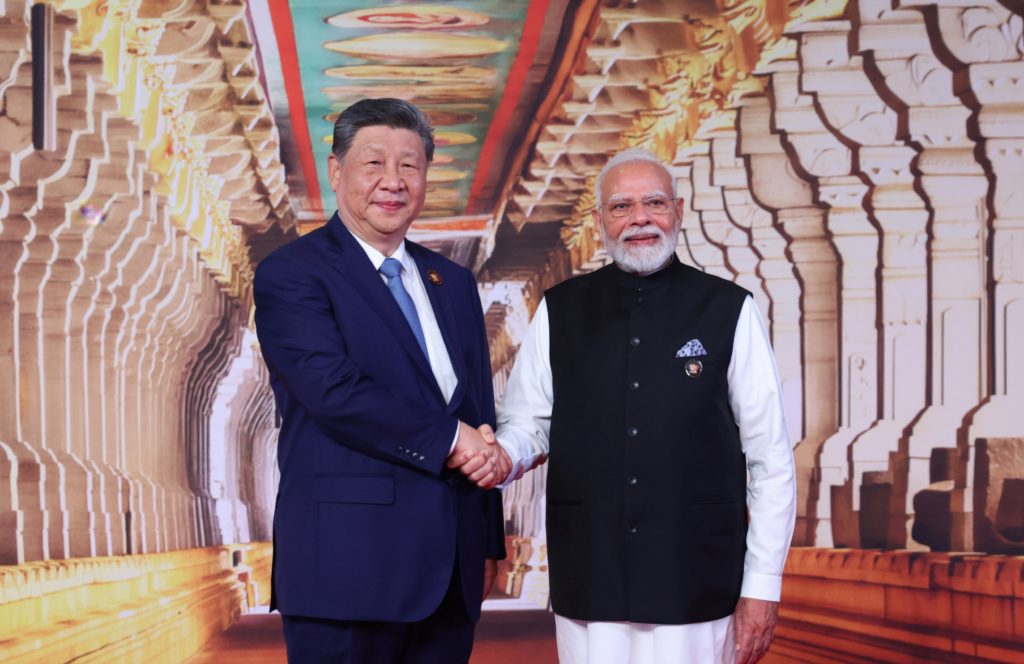
Indian summer: The BRICS summit and warming New Delhi-Beijing relations

Ein Foto zeigt zwei Männer beim Händedruck vor einer dekorativen Säulenhalle.
Cover image: picture alliance / ZUMAPRESS.com | Pib Handout/Press Information

Problem

The BRICS summit concluded in New Delhi on Sunday, with Indian prime minister Narendra Modi having hosted the two-day gathering as chair. As with many meetings of the group of emerging economies, this edition brought together the leaders of China, India and Russia and featured plenty of anti-Western rhetoric. This was also Chinese leader Xi Jinping’s first visit to India for more than six years, in the latest example of Sino-Indian normalisation following a sustained period of tensions.

New Delhi’s normalisation with Beijing over the last year looks like more of a tactical de-escalation than a realignment. Nevertheless, India has over that time begun to agree more measures to provide greater access to Chinese investment in manufacturing and climate technology, both areas important for India’s development. This should act as a warning for Europeans. If India cannot source technology and capital from partners in Europe, it will seek to do so from China even while remaining suspicious of Beijing from a security point of view.

Solution

New Delhi continues to view Beijing as a threat and seeks deeper security and economic ties with Brussels, as well as with Washington, despite the difficulties President Donald Trump presents. Modi has thus worked to prevent the BRICS from tipping into a purely anti-Western vehicle, since this would run against India’s interests.

Europeans also see India as an increasingly vital partner, following the EU-India trade deal agreed earlier this year, as Europeans diversify geopolitically in the face of tense transatlantic relations. But India’s bilateral agreements with China, including on the sidelines of the BRICS meeting, show that the EU must not take the mutual benefits of closer ties for granted.

Ahead of Modi’s anticipated visit to Brussels later this year, the EU should accelerate its plans further to strengthen Europe-India ties. For instance, it should enhance the existing Trade and Technology Council to drive cooperation in areas like AI, while also moving forward cooperation on defence and security, and making faster progress on India’s plans to join the Horizon Europe funding programme for research and innovation.  

Context

The EU and India signed a landmark free-trade agreement in New Delhi in January, alongside a new security and defence partnership. Both sides aim to build on these with wider cooperation initiatives to encourage greater cooperation and investment in areas like semiconductors, AI and clean-tech supply chains.

India supported moves at the 2023 BRICS summit to agree on a major membership expansion. The group began as a much smaller coalition of just Brazil, Russia, India and China, and South Africa—hence “BRICS”—but has since grown to eleven members, including Egypt, Ethiopia, Iran, Saudi Arabia and the UAE as well as a wider grouping of observer and partner countries that attend summits and align themselves loosely with the bloc’s agenda. The group is internally divided, and not just in terms of China and India. Both Iran and the UAE are members, for instance, despite longstanding regional tensions. This year’s summit produced a limited declaration including vague promises to enhance cooperation.

Source

  •  

A future with Chinese characteristics

Ein Foto zeigt einen humanoiden Roboter beim Tischtennis gegen eine Person an einem lila Tisch.
BEIJING, CHINA - AUGUST 19, 2026 - A humanoid robot plays table tennis with an audience at the 2026 World Robot Conference in Beijing, China on August 19, 2026. | picture alliance / CFOTO | CFOTO

For much of the 20th century, the US represented not just a place on the map. It was also a point in time. When Western Europeans looked at images of America after the second world war—depictions of Hollywood’s glamour, American cars and newfangled labour-saving devices—they thought they were looking into the future.

The American Dream had an especially irresistible draw for Eastern Europeans behind the Iron Curtain, and for tens of millions of Chinese during the opening and reform era that began after Mao Zedong’s death in 1976. China’s great economic reinvention was inspired, in part, by Deng Xiaoping’s awe at American modernity, which he witnessed firsthand during an official visit in 1979.

But fast-forward to 2026, and the positions have been reversed. For most people in most countries, the future can now be seen in China. Just as Hollywood once showed the world what modern life looked like, China is showing African, Latin American and even American young people what an economy built on green energy, mobile payments and other services, and advanced robotics looks like. For Cobus van Staden of the China-Global South Project, the West is “increasingly being framed as backward-looking [and] associated with the past”, a phenomenon presumably accelerated by Trumpism, with its rejection of renewable energy, diversity and its social conservatism.

In the global south, young people aren’t just imitating Chinese practices like drinking hot water or trying out tai chi. They are watching as China reshapes their daily experiences

In many parts of the West, disillusionment has given rise to Chinamaxxing on social media, with American and European influencers performatively embracing Chinese mannerisms and aesthetics. And in the global south, young people aren’t just imitating Chinese practices like drinking hot water or trying out tai chi. They are watching as China reshapes their daily experiences.

This signals a genuine historical rupture. For generations, most countries defined themselves in relation to the West. Some sought (or were convinced) to emulate Western development models like the Washington Consensus, and many were keen to acquire Western technology and aid, or simply to get the West’s approval. Other countries did push back against the West’s influence and attack Western hypocrisy, but their counter-models were themselves defined by opposition to the West.

Either way, West-centrism was the prism through which geopolitics was conducted and interpreted. When countries in the Sahel invited Russia’s Wagner Group mercenaries to help them deal with insurgencies, it was seen as a reaction against France and its traditional role in the region. When Angola invited Sinopec to exploit its oil fields, it was seen as a snub to Portugal and Britain. And then there are the many challenges to US hegemony in the Middle East, Latin America and South-East Asia. Around the world, memories of bloody Western interventions or financial crises still linger.

Yet younger generations around the world are not even pro- or anti-Western so much as they are post-Western. For them, China, not the US, is at the centre of their conceptual universe and envisaged future.

What happened? One of the big differences between countries in the global south and the global north is their demographic profile. In the US and Europe, the median age is 40–50, compared to 19 in Nigeria, and 29 in South Africa, India and Lebanon. That means some 70% of Nigerians aren’t even old enough to have registered the 2003 US invasion of Iraq or the 2008 global financial crisis. As Cobus points out, young West Africans “never knew anything more than the US as we know it now”. The era of Donald Trump encompasses their entire political memory, and they presumably are not very impressed.

This shift in perceptions is not just an African story, of course. In Vietnam, which has long had a fraught relationship with China, young people are becoming less reflexively Sinophobic than their elders. Chelsea Nguyen, a researcher at the London School of Economics, credits the covid-19 pandemic for catalysing this change. The West’s perceived mishandling of the pandemic undermined its status as a model worthy of emulation. Many Vietnamese turned to exploring their own history and that of their Asian neighbours, including China. As in much of Africa, growing exposure to China’s rapid technological progress and Chinese consumer goods transformed the country’s global brand.

Meanwhile, Loubna El Amine, a China scholar at King’s College London, notes that in regions riven by instability—such as the Middle East, where the US itself is a big part of the problem— “a lot of the attraction of China is its absence rather than presence”. The latest Arab Opinion Index bears this out, showing that 77% of respondents view US policies as a threat to the region’s security and stability, compared with just 25% for China—and that was well before Trump launched his catastrophic war against Iran. And, of course, China carries none of the colonial baggage that complicates European interventions (or even peacebuilding efforts) in the region.

Still, China has been known to be aggressive in pursuing its economic agenda in the developing world, whether through predatory loans, acquiring critical national infrastructure or deliberately exporting its domestic overcapacity. Such behaviour ruffles feathers as much in Thailand, Mexico and Nigeria as it does in the US and Europe. Moreover, young people’s widespread distrust of their governments can easily bleed into unhappiness with China when political leaders are seen to be giving it undue privileges.

Since the pivot to China as an exemplar of modernity is in many ways pragmatic and non-ideological, its hold on the popular imagination is still tenuous. Lots of leaders in the West want to compete with China for “soft power”. But the key is not to counter Chinese “propaganda” or improve Western PR. The winners in the battle for hearts and minds will be those who offer real solutions to people’s problems and create more opportunities for prosperity than are currently available.

This article was first published by Project Syndicate on August 18th 2026

Source

  •  

Pakistan to sign long-delayed refinery deals unlocking more than $6 billion in planned upgrades

ISLAMABAD: Pakistan is set to sign long-delayed agreements with five oil refineries, unlocking more than $6 billion in planned upgrades to modernize aging plants and cut reliance on fuel imports, officials said. But industry warnings that changes to the financial framework could derail the projects overshadowed the announcement. The agreements with Pak-Arab Refinery Ltd., Pakistan ... Read more

The post Pakistan to sign long-delayed refinery deals unlocking more than $6 billion in planned upgrades appeared first on BOL News.

  •  

Hague tribunal orders India to suspend Indus River projects, uphold treaty with Pakistan

THE HAGUE: The Permanent Court of Arbitration has ordered India to uphold the Indus Waters Treaty with Pakistan and suspend work on its hydroelectric projects, a major legal victory for Islamabad in the dispute over the agreement. The Hague-based tribunal issued the award on the status of the treaty and interim measures concerning India’s Ratle ... Read more

The post Hague tribunal orders India to suspend Indus River projects, uphold treaty with Pakistan appeared first on BOL News.

  •  

Cold comfort: What China can teach Europe about adaptation

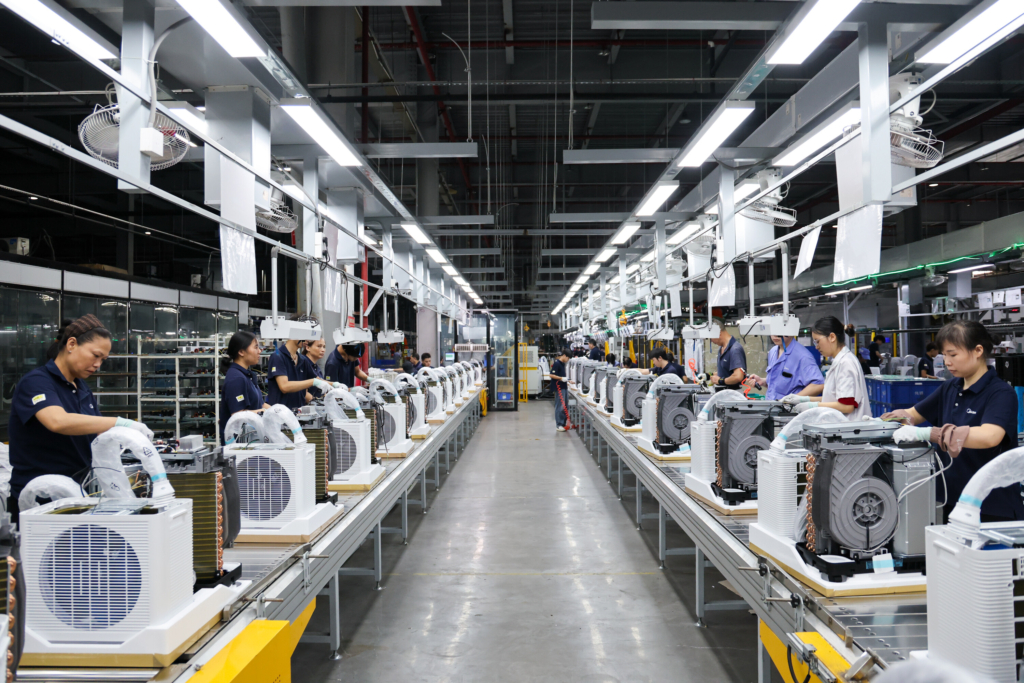
Ein Foto zeigt Arbeiter an einer Produktionslinie, die portable Split-Klimageräte in einer großen Fabrikhalle montieren.
Cover image: picture alliance / Xinhua News Agency | Liang Xu

If Europeans need any reminder of the real impact of climate change, they should simply look out of the window. This summer, a few extra degrees of sustained heat have forced school closures, disrupted railways and cut nuclear power plant output. More than 25,000 excess deaths across Europe have been attributed to extreme heat so far, while wildfires are causing over €15bn of economic damage.

The increasing intensity of heatwaves is generally attributed to climate change as a result of the global reliance on fossil fuels. While cutting carbon emissions remains the focus of EU climate policy, European governments also need to ensure that their societies can better adapt to extreme weather. Many households have already taken matters into their own hands by turning to portable air conditioners—often Chinese-made—for relief.

And China’s air-conditioner export boom points to a broader challenge: whether confronting extreme weather or fragile economic dependencies, Europeans need to adapt to the consequences while also addressing underlying sources of vulnerability. They should not just accept the status quo; here, some answers may lie in the lessons of China’s own industrial transformation.  

China leads on AC

Once again, when Europe looks for a climate solution, China has one ready to ship. China is a powerhouse in technologies used to mitigate climate change, from solar panels to wind turbines; it is also a vital player in helping Europe adapt to warmer temperatures. China produces over 80% of the world’s air conditioners: exports of Chinese AC units to the EU rose by 43% year on year in the first half of 2026. Chinese brands now account for 41% of the European market, up from 27% in 2023.

Production of air conditioner units 2010-2025, China vs. rest of world

This success is not only about price and scale. Chinese manufacturers have adapted their products for the European market: for example, Midea’s PortaSplit model is tailored to overcome cumbersome building regulations and high installation costs. Chinese manufacturers were also early adopters of refrigerants less harmful to the climate, ensuring their products meet Europe’s strict environmental rules.

Chinese state media and officials were quick to present the boom in AC unit sales as a success for EU-China trade: it is a “natural result of complementary advantages” and demonstrates the mutually beneficial nature of the EU-China economic relationship. China’s industrial specialisation, supply-chain efficiency and technological competitiveness, they argue, mean manufacturers respond swiftly to shifts in global demand. AC is an example of China acting as an “enabling superpower” in providing efficient and affordable products that respond to climate change—as Beijing would say, a win-win.

Saying yes to adaptation

But this is not all. Chinese commentators say that Europe should not only adapt to the hotter climate—it should adapt to the patterns of EU-China trade. They portray the EU’s de-risking and trade-defence measures to tackle economic imbalance with China as economically self-defeating, arguing that Europe lacks confidence in its own industries. European policymakers, they say, are approaching trade as a game of “cold statistics” that will ultimately hurt ordinary consumers.

This is a fatalistic prescription for industrial policy from a country that refuses to accept that its position in global supply chains or its existing competitive advantage is fixed. For decades, Beijing has made industrial upgrading a central policy objective that has reoriented global trade patterns. Europeans are experiencing this firsthand in the AC boom, where China’s position reflects decades of deliberate industrial upgrading. And now Beijing is advising Europe to be content with trade patterns as they stand: strange advice, given that this would not pass the political sniff test in Zhongnanhai.

Since Deng Xiaoping, Chinese leaders have not simply passively adapted to their inherited competitive advantages. Neither do they treat the existing global division of labour as an efficient market outcome to be preserved. This is especially the case when such patterns risk constraining China from developing the sectors it considers strategically important—robotics, clean technology or aviation, for example.

Saying no to adaptation

China’s industrial transformation did not happen through market forces alone. Its latest five-year plan emphasises “self-reliance and controllability” as a guiding principle for technologies underpinning critical infrastructure, including energy systems. Over the years, under the banners of Made in China and Dual Circulation, the country has deployed large-scale subsidies, preferential financing from state banks, government-guided investment funds, public procurement, favourable access to land and infrastructure, and requirements around joint ventures, localisation and technology transfer.

These policies helped Chinese firms “import, digest and absorb” foreign know-how, build scale, and create globally competitive and innovative companies across supply chains. But while the European debate on competitiveness centres on many of the same concepts, European politicians, industries and member states are divided over future industrial policy. One prevailing idea is that Europe should pull a “reverse Deng” by ushering in a new era of industrial policy capable of matching the scale of support and protection that China extended to its domestic industries during the 1990s and 2000s.

Europeans should preserve their ability to source and scale critical technologies through viable alternatives, ensuring they have options should conditions change

But Europe should be cautious in trying to beat China at its own game. It has no centralised state to direct capital and help companies navigate commercial losses in pursuit of their goals. The main lessons from China’s industrial policy lie in the assumptions behind it: Europeans should minimise dependencies that could be strategically constraining; industrial competitiveness is not only about efficient production; Europeans should preserve their ability to source and scale critical technologies through viable alternatives, ensuring they have options should conditions change.

This logic is becoming more relevant as climate shocks intensify and geopolitics grows more volatile.

What Europeans should do

Europeans need to consider what such options would look like in practice. To borrow the question posed by Chinese commentators: what could Europe do right now without Chinese air conditioners?

Cooling is becoming essential infrastructure. Much like heating and water, Europe will need a broader portfolio of solutions to meet demand. AC is part of the answer, alongside low-energy and passive-cooling technologies such as evaporative cooling, reflective roofs and building retrofits, and stronger building standards. But Europe does not need to develop every solution itself; it could build a network of alternative suppliers and production capabilities.

For example, Singapore and the Gulf states are confronting many similar challenges and could be potential partners in deploying more efficient solutions such as district cooling. Europe can build similar partnerships in clean-tech supply chains. South Korea, the second-largest battery manufacturer globally, holds 78% of installed battery capacity in Europe. It can learn from countries such as Japan, which has diversified its rare-earth supply through partnerships with Australia and Malaysia, as well as Vietnam. India doubled solar-cell manufacturing capacity in the first half of 2026 alone, backed by localisation incentives extending to upstream components like ingots and polysilicon.

China will remain part of Europe’s clean-tech supply chains. For Europe, preserving its options does not mean that it needs to produce every critical technology in the clean-tech supply chain. But it should work with external partners to maintain commercially viable alternatives at scale. This can be done through reciprocal access to public procurement markets, targeted incentives and shared product standards.

Where climate and competitiveness collide

Fundamentally, having options means being able to adapt to a problem while tackling its cause. Climate policy offers a useful framework: Europeans have concluded that the impact of heatwaves or floods are not inevitable; they are not relying on AC, seawalls and floodgates as their only response. Instead, they are tackling the cause of climate change by pursuing adaptation while mitigating the underlying problem through cuts in fossil-fuel emissions.

Europe should dare to do the same with its competitiveness and economic dependencies. Rather than simply adapting to change, its governments should invest in Europe’s capacity to innovate, work with partners and build alternatives, with the aim of reducing vulnerabilities and helping preserve its choices.

The summer heat of 2026 is a reminder of the cost of delayed climate action. The same lesson applies to economic security: adapting to today’s dependencies in the name of efficiency will leave Europe with fewer options—and come with a larger bill—tomorrow.

Source

  •  

Rusia reordena su máquina de guerra: De Ucrania a una confrontación prolongada con Europa – Por Marcelo Ramírez

Por Marcelo Ramírez Hay decisiones militares destinadas a resolver una batalla y otras que dicen mucho más: revelan cómo un Estado imagina la guerra que tendrá que librar en los…
  •  

Pakistan’s “Six-Front War”: Why Mecca Defense Pact Helps Islamabad More Than Turkey or Saudi Arabia? OPED

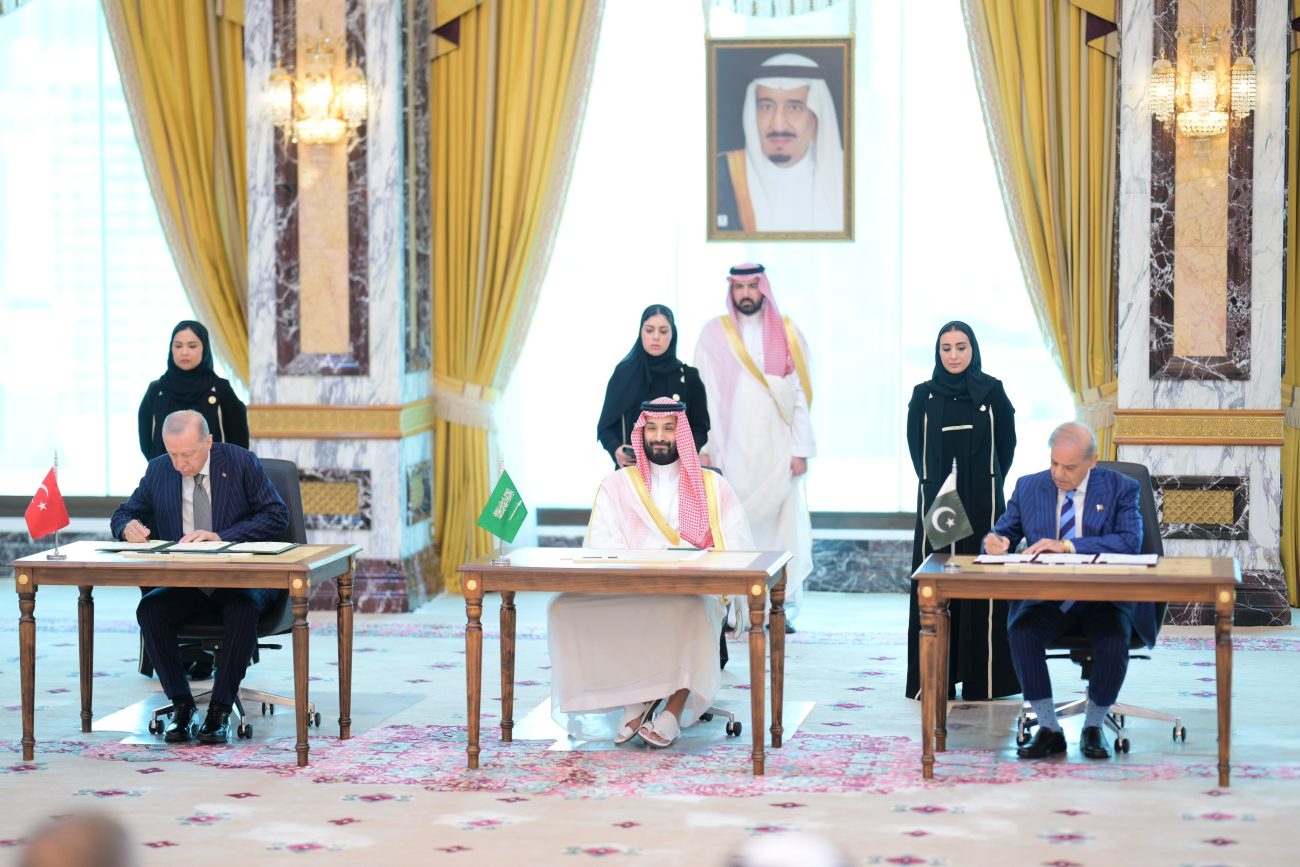
Pakistan, Saudi Arabia, and Turkey recently signed the “Mecca Joint Defense Agreement”. Many analysts believe this trilateral pact is aimed at checking Iranian and Israeli “hegemony” in the tumultuous Middle East region.

Meanwhile, the biggest question running through India’s nearly 1.5 billion people is how this trilateral defense pact will impact India, which has fought multiple wars with Pakistan and maintains a tense relationship with Islamabad.

Despite hogging global media limelight for playing the role of mediator in the ongoing Iran war, Pakistan’s position back home looks scary with relentless terror attacks and a deteriorating security situation.

Pakistan continues to face tremendous domestic pressures. Protests in Pak-controlled Kashmir have intensified since mid-2026, with scores of innocent protesters killed by the security forces.

Islamabad imposed a communication blockade, ordered foreign journalists to leave the region, and limited access to international media outlets, including Al Jazeera’s digital platform.

This is no ordinary region. India claims the Pak-controlled Kashmir as its own and has vowed to integrate it with Jammu and Kashmir. Reportedly, pro-India slogans and flags were seen in the demonstration.

Then, regions like Balochistan and Khyber Pakhtunkhwa (KPK) are Pakistan’s Achilles’ heel. Separatism in these two regions appears to have gone beyond the control of the Pakistan Army, and looks as volatile as East Pakistan (now Bangladesh) during 1971. The question is how long Pakistan can hold these two regions, and at what cost.

Dismal economic conditions, disgruntled population, and heightened tensions with neighboring India and Afghanistan have intensified Pakistan’s problems. The question is: does Pakistan have the financial muscle or resources to fight a five-front conflict — Balochistan, KPK, Kashmir, India and Afghanistan, simultaneously?

On top of it, Pakistan has signed a defense pact with Saudi Arabia and Turkey, which means they should be prepared to fight outside the country as well, probably against Houthis in Yemen. That would open a sixth front.

Indian military exposed Pakistan’s defense architecture during Operation Sindoor last year in May. India not only managed to breach Pakistani defenses to hit multiple terror targets in the first wave of attacks, but India also launched precision strikes that impaired critical Pakistani military infrastructure across the country.

Indian military targeted multiple airbases including Nur Khan (Chaklala) near Rawalpindi, Mushaf (Sargodha), Murid, Rafiqui, Rahim Yar Khan, Sukkur, Jacobabad, Bholari, and others—using supersonic BrahMos and other precision munitions.

Satellite imagery confirmed the heavy damage, including destroyed runways, hangars, command-and-control centers, and loss of up to 14 aircraft (as per IAF) and scores of personnel on the ground. Pakistan also claimed downing multiple Indian jets, but it could hardly penetrate the Indian air defense network, led by the S-400.

Operation Sindoor demonstrated that Pakistan’s defenses could be easily penetrated and its Air Force could be crippled even with limited, restrained strikes.

Meanwhile, Turkey is already a member of NATO, arguably the most powerful Islamic country in terms of military. It does not really need Pakistan or Saudi Arabia to defend itself. Saudi Arabia, on the other hand, has been battered by Iran and Houthi rebels. But when the US could not completely defend it, what can Pakistan and Turkey do?

In the case of Pakistan, it is the most vulnerable of the three.

The Mecca Joint Defense Agreement, signed on 7 August 2026 by Pakistan, Saudi Arabia, and Turkey, assumes utmost importance for Islamabad. The pact’s core clause treats an armed attack on any one party as an attack on all three.

It directly follows the September 2025 Strategic Mutual Defense Agreement between Pakistan and Saudi Arabia.

For Riyadh, it’s another insurance policy, but for Pakistan—still repairing airbases more than a year later—the pact is aimed at sending a strong deterrence message to India, which has pledged a devastating response to any terror attack on the country.

File Image

Collective defense commitments from Riyadh and Ankara are sure to boost Pakistan’s morale, but Turkey (and Saudi Arabia) have been supporting Pakistan since 1947 and have never managed to turn the tide against India.

For instance, during the 1971 war, Turkey provided critical military and diplomatic support to defend Pakistan’s territorial integrity. Operating under the CENTO defense pact, Ankara provided substantial material support to Pakistan by providing aircraft assistance and military hardware, but to little avail.

Even politically, Turkey refused to recognize the newly independent state of Bangladesh for over two years. It only recognized Bangladesh in February 1974 after Pakistan did.

Meanwhile, India has already established strong military ties with Ankara’s adversaries, Greece, Cyprus, and Armenia. India also shares robust military ties with Israel. There might not be a formal agreement on paper, but India-Israel ties go beyond any melodramatic pact.

No doubt, the Mecca pact embeds Pakistan in a broader Islamic-world security architecture at a moment when its conventional defenses have been publicly tested while the country’s biggest province, Balochistan, continues to fight for its liberation, just like East Pakistan (now Bangladesh).

For a country simultaneously battling insurgencies in Balochistan, Khyber Pakhtunkhwa, and Pakistan-administered Kashmir while managing tense borders with both Afghanistan and India, the Mecca defense pact is far more valuable to Pakistan than it is to either Saudi Arabia or Turkey.

  • Nitin J Ticku holds a double master’s degree in Journalism and Business Management from the University of Glasgow. He has over 20 years of global experience in MARCOM, Journalism, and Digital Marketing, and has worked & traveled widely across Europe, the Americas, and Asia. Nitin is the Editor of the EurAsian Times.
  • This is an Opinion Article
  • He can be reached at editor (at) eurasiantimes.com

The post Pakistan’s “Six-Front War”: Why Mecca Defense Pact Helps Islamabad More Than Turkey or Saudi Arabia? OPED appeared first on EURASIAN TIMES.

  •  

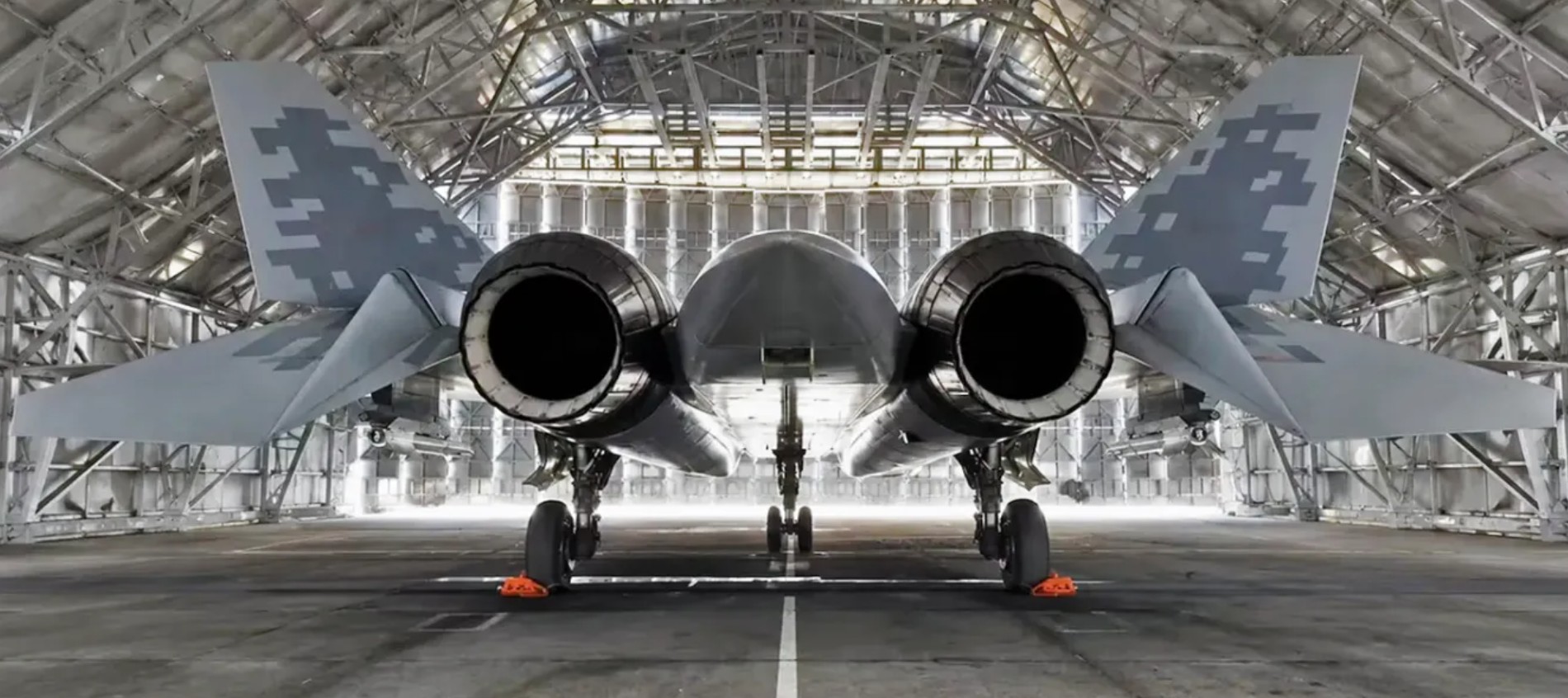
Su-57 OUT For India, 6th-Gen Aircraft In! After MiG-21, MiG-29 & Su-30 MKI, IAF Appears Set For Non-Russian Jets

India appears poised to overlook Russia’s Su-57 fifth-generation stealth fighter and opt for a sixth-gen aircraft instead. 

Defense Secretary Rajesh Kumar Singh recently clarified that New Delhi has “not thought about” new Sukhoi variants, prioritizing the upgrade of the Su-30MKI fleet under the ‘Super Sukhoi’ program and the indigenous Advanced Medium Combat Aircraft (AMCA) instead.

Moscow’s aggressive pitch—including local production, full source codes, and a two-seat variant—has failed to sway planners wary of diverting resources from self-reliance goals.

With AMCA still a far away and China fielding growing J-20 numbers, India is actively exploring partnerships in sixth-generation programs.

India’s Ministry of Defense has reportedly initiated efforts to join the French-led sixth-generation fighter program. This was stated in a report of the Parliamentary Standing Committee on Defense, presented in Parliament, according to news agency PTI.

The ministry has sought a roadmap from the French side for acquiring such aircraft. The panel noted that two major consortia are developing sixth-generation fighters: one involving the UK, Italy, and Japan; another involving (now-defunct) France and Germany.

The Indian Air Force plans to partner with one of these groups so that India does not fall behind in advanced combat aircraft technology.

End of Su-57?

In 1962, the USSR agreed to transfer technology to produce nearly 800 MiG-21 jet fighters for India, which it had earlier denied to China. They helped India set up factories for the aircraft, aero-engines, and avionics.

India’s relationship with the Soviet Union grew strategically, culminating in the 1971 Indo-Soviet Treaty of Friendship and Cooperation.

Through the 1971 India-Pakistan War for the liberation of Bangladesh, the Soviet Union stood by India against US and Chinese intimidations.

During the Cold War, India and the USSR maintained a “special and privileged strategic partnership” that was built on five major components: politics, defense, civil nuclear energy, anti-terrorism cooperation, and space.

Even after the dissolution of the Soviet Union, India maintained warm relations with Russia’s successor state. The first major political initiative after the dissolution was the Strategic Partnership signed by the two countries in 2000.

The IRIGC (India-Russia Intergovernmental Commission) is the main body responsible for conducting official affairs between the two countries at the governmental level. Both countries are members of international bodies, including the UN, BRICS, G20, SCO, and Russia-India-China (RIC) grouping. Russia supports India’s bid for a permanent seat on the United Nations Security Council.

Su-57 OUT For India, 6th-Gen Aircraft In! After MiG-21, MiG-29 & Su-30 MKI, IAF Appears Set For Non-Russian Jets

India is one of the largest markets for the Russian defense industry. Approximately 60 percent of the Indian military’s hardware today is of Russian origin. Military hardware supplies and, more recently, joint-venture production have been key pillars.

Su-57 carrying R-73 missiles externally. Credits X.

Make-in-India Began in the 1960s

The Soviet Union was the first to support Make in India defense production.

The MiG-21 factories set up in the early 1960s later produced the MiG-27 (170) and the Su-30 MKI (230). Su-30 MKI was a joint D&D project. Russia also learned a lot from the Su-30 MKI project and imbibed some of these ideas for its Su-30SM aircraft.

222 Su-30 MKI were produced under license at HAL’s Nashik plant since 2004. An estimated 920 AL-31FP turbofans were manufactured at HAL’s Koraput Division. The Su-30MKI is the backbone of the IAF’s fighter fleet.

In 1965, Heavy Vehicles Factory (HVF) was set up at Avadi, Chennai, with Soviet assistance. HVF products included Russian-designed T-72 Ajeya and T-90 Bhishma tanks.

In September 1965, the Soviet Union and India signed the first contract for the delivery of naval equipment, including four Project I641 diesel-electric submarines, five Project 159E corvettes, and five Project 368P motor boats. The Agreement also envisaged rendering Soviet technical assistance for the construction of a submarine naval base in Vishakhapatnam.

Recently, two frigates, the INS Tushil and INS Tamala, were built by Russia at the Yantar Shipyard, while the remaining two are under construction at Goa Shipyard Ltd (GSL) in India through technology transfer.

Russia is reportedly expanding its shipbuilding cooperation with India, with two Indian shipyards being considered for the construction of four non-nuclear icebreakers. Russian shipbuilding officials have reportedly offered New Delhi their nuclear-powered design for an Indian Navy aircraft carrier.

GSL is also constructing 24 river-sea class cargo ships for Russian clients in the Caspian Sea by 2027. Cooperation with India in shipbuilding has its benefits for Russia, as the unit cost per vessel is projected to be half of what it would cost Russian shipbuilders.

U.S. vs China’s Aircraft Carriers: New Report Shows How America Can Turn the Tables on “World’s Largest” Navy

Joint Ventures

Between 2012 and 2016, Russia accounted for 68% of India’s defense imports. Russia and India’s cooperation is not limited to a buyer-seller relationship but includes joint research and development, training, service-to-service contacts, and joint exercises.

India and Russia have a strong success story with Joint Ventures (JVs). The BrahMos is a medium-range ramjet supersonic cruise missile that can be launched from submarines, ships, and fighter aircraft. BrahMos Aerospace is a joint venture between the Indian Defense Research and Development Organization (DRDO) and Russia’s NPO Mashinostroyeniya. The missiles are already being exported.

Under an over ₹5000 crore contract signed in July 2021, over 610,000 AK-203 assault rifles are to be manufactured in India with technology transfer from Russia, by the JV Indo-Russian Rifles Private Limited (IRRPL).

Indian companies hold a controlling 50.5 percent share, and Russian companies hold 49.5 percent. The level of indigenous content has already reached 50% and is rising rapidly, with a target of 100% in the near future.

India and Russia have also agreed to expedite the delivery of spare parts of Russian-origin military platforms by setting up a JV in India.

Notwithstanding the above, some JVs did not take off. India had withdrawn from the joint Fifth-Generation Fighter Aircraft (FGFA) program due to technical issues. Finally, Russia continued the project and today has a successful Sukhoi Su-57 ‘Felon’ 5th generation fighter.

Following the selection of the Ka-226T to meet an Indian requirement for 197 helicopters, an agreement was signed in December 2015 to create a JV between Rostec, Russian Helicopters, and HAL to build the helicopters at a new factory in Tumakuru, India.

Later, India decided to make its own Light Utility Helicopter (LUH) based on the indigenous ‘Dhruv.’ India’s LUH is delayed, and Russia has been pushing the case for Ka-226T again.

Similarly, India canceled the Indo-Russian program to develop a new Multirole Transport Aircraft (MTA) for both countries through a JV between Russia’s UAC and India’s HAL.

In February 2023, on the sidelines of the Aero India 2023 air show, the Russians offered to jointly develop the Il-276. However, India would prefer the aircraft to be powered by a European engine rather than a Russian one.

India has operated a wide range of Soviet and Russian combat jets that formed the backbone of the Indian Air Force for decades. Key types include the prolific MiG-21 (in multiple variants including Bison), MiG-23 (BN and MF), high-altitude MiG-25, ground-attack MiG-27, and air-superiority MiG-29 (including upgraded versions).

From the Sukhoi stable came the Su-7 fighter-bomber and the highly successful Su-30MKI, which remains the IAF’s primary multi-role platform that India is looking to upgrade.

India’s decision to effectively rule out the Su-57 marks a noticeable shift. After decades of reliance on Russian fighters—from the MiG-21 to the Su-30MKI—New Delhi is prioritizing the AMCA program and partnerships in sixth-generation projects.

While the historic Indo-Russian defense ties remain strong in other domains, the rejection of Moscow’s most advanced stealth jet signals a clear preference for next-generation technology.

With China rapidly expanding its stealth fleet and AMCA still years away, India appears to be choosing long-term capability over Russian platforms.

The post Su-57 OUT For India, 6th-Gen Aircraft In! After MiG-21, MiG-29 & Su-30 MKI, IAF Appears Set For Non-Russian Jets appeared first on EURASIAN TIMES.

  •  

Latin America’s new imaginaries

This week, Mark Leonard is joined by Adriana Abdenur, a Brazilian policy expert and co-president of the Global Fund for a New Economy, and Jorge Castañeda, former foreign minister of Mexico and professor at Sciences Po, to explore debates about development and ideas of strategic autonomy across Latin America.

Jorge explains why China’s role is varied across the region, arguing that Mexico and much of Central America remain deeply constrained by their economic ties to the US. Adriana discusses Brazil’s long tradition of strategic autonomy, describing how policymakers engage with China as both an economic partner and a source of ideas on development, technology and global governance.

Together, Mark, Adriana and Jorge explore how intensifying US-China competition is reshaping the region’s choices. Can Latin American countries balance relations with both powers? Is China a model, a market or simply another partner in a multipolar world? And what does strategic autonomy look like in an increasingly coercive geopolitical environment?

This podcast episode was recorded on July 31st 2026.

Bookshelf
Latin American Foreign Policies in the New World Order: The Active Non-Alignment Option, by Carlos Ominami, Jorge Heine and Carlos Fortín
Manifesto Antropófago (Cannibal Manifesto), by Oswald de Andrade

Source

💾

  •  
❌