❌

Reading view

What does Europe want – a war with Russia?

By Ricardo Martins – New Eastern Outlook – October 2, 2026

It was common practice during the Cold War to exaggerate the threat from the Soviet Union. Nowadays, Russia has assumed that role. Although the circumstances have changed, some of the political methods employed to create a sense of insecurity are still remarkably similar.

Europe is not formally engaging in preparations for war since it desires one. Instead, the governments of Europe and the institutions of the EU describe their rapidly growing defence policies and war preparedness as being aimed at deterrence, on the basis that Europe has to become strong enough to avoid a bigger conflict.
NATO does likewise, presenting itself as a defensive alliance whose role is to deter aggression. Nevertheless, the extent and the terminology used in Europe’s present military transformation should be examined. If preparedness becomes a top political concern, if huge amounts of public money are channelled into defence industries, and if support for Ukraine becomes more and more tied to Europe’s own security, then a significant question arises: where does deterrence cease and the political preparation for war begin?

The question is especially relevant to the EU, which has throughout its history been based on reconciliation, economic interdependence and a rejection of war.

From a peace project to a defence project

The European Union is experiencing a deep change in the way it views security. This change is no illusion. As part of the ReArm Europe/Readiness 2030 programme the European Commission plans to commit up to 800 billion euros towards defence spending, and the EU has set up a 150 billion euro SAFE lending facility to assist with military investment and joint procurement. The various EU institutions have made it clear that the aim is to eliminate capability gaps, boost the European defence industry and enhance deterrence.

The language that goes with this transformation is just as important. European Defence Commissioner Andrius Kubilius has warned at the European Parliament that Russia could be ready for a confrontation with NATO “in five years or less”. He has also invoked Jean Monnet’s wartime “Victory Programme” analogy, arguing that Europe needs a comparable transformation of its defence industry.

The official view of the Commission is that the issue is one of deterrence and not about starting a war. However, a military system which is intended to deter war needs to have weapons, logistical support, industrial capacity, troops and operational plans. As these capabilities increase, so too does the institutional ability to conduct war.

A paradox arises since Europe claims it is arming itself and preparing its hospitals to receive 2,000 wounds per day – as it is the case in Germany — in order to maintain peace while at the same time setting up a more and more integrated belligerent European defence structure. The EU is considering not just an increase in weapons but also the creation of a European Defence Union, a European Security Council, common procurement, military mobility and a closer relationship between European institutions and NATO.

The fact that this might constitute a necessary adaptation to a new security situation also brings up a more general issue concerning European identity: is the European Union still mainly a peace project which happens to have military capabilities, or is it instead becoming a geopolitical and military actor for which readiness for confrontation is becoming increasingly important?

Is Russia a threat, an adversary, or a permanent enemy?

Here, there is a mixture of perceived threats, old ressentiments and Russophobia in play. The threat perceptions are not the same throughout Europe. Because of historical reasons, such as foreign occupation and Soviet domination, Poland has long viewed Russia differently from countries such as France and Germany, which after the Cold War initially placed greater emphasis on economic engagement and interdependence with Moscow. But that distinction has changed dramatically.

Germany, in particular, has moved from the Ostpolitik-era logic of engagement towards a confrontational security posture. Under Chancellor Friedrich Merz, Berlin has described Russia as a serious threat, committed to a major expansion of defence spending, and taken a leading role in sustaining military support for Ukraine. Germany has also intensified defence cooperation with France, including discussions on nuclear deterrence and European capabilities. Germany has also established a permanent military presence in the Baltic States, with a brigade of around 5,000 soldiers being stationed in Lithuania.

The military buildup that Poland has since carried out has depended largely on the United States and South Korea, highlighting a further weakness: even though the EU has aimed at setting up a European defence industry, European manufacturers have not always been able to provide weapons at the speed and on the scale required by countries that have been rearming since 2022.

A more serious issue is that those who question the military escalation are seen as showing a lack of strength, a state of naivety or a failure to have sufficient solidarity with Europe — what then becomes of democratic debate? French Socialist Ségolène Royal.

The danger of making war readiness a political culture

That is exactly the reason why Europe’s present-day transformation should be subject to democratic scrutiny.

Deterrence becomes a politically dangerous thing when preparedness itself comes to be the main idea of security, when military expenditure starts to compete with other public priorities, and when diplomacy and negotiation are regarded as being of less importance than the building up of military power.

The proper European question therefore isn’t whether Europe is “strong enough” to fight Russia. It is rather what kind of security arrangement the Europeans would like to establish.

The present danger is that, as a result of years of confrontation, rearmament and politics based on the use of threats, Europe might slowly create a political and institutional setting in which war seems ever more certain and peace ever more unrealistic.

Former CIA analyst Larry Johnson says that a wider conflict between Europe and Russia is becoming “inevitable” since, in his opinion, the rhetoric of Europe is increasingly being matched by actions which Russia could see as direct threats. He highlights Germany as especially important, stating that Berlin’s more confrontational rhetoric, its military preparations and its demands on Moscow are leading to a dangerous escalation.

Johnson also sees the capture of Russian ships as a key point of escalation. He maintains that Moscow might view any attempt by Europe to seize its ships as an act of war and could then retaliate against the ships or military assets in question. He also mentions the collapse of diplomatic relations, the rearmament of European forces, preparations for a possible future confrontation, and the increasing pressure surrounding Kaliningrad as factors which reduce the room for de-escalation. In his view, the real danger is not that Russia is seeking war but that European actions are gradually making a direct confrontation inevitable.


Ricardo Martins – Doctor of Sociology, specialist in European and international politics as well as geopolitics

Follow new articles on our Telegram channel

  •  

Germany Is Finally Giving Its F125 Frigates Some More Teeth With IRIS-T SLM Surface-To-Air Missiles

Germany is moving ahead with plans to give its unusually large F125 frigates a medium-range air-defense capability, helping address one of the most conspicuous weaknesses of a four-ship class that has long attracted attention for having relatively little combat power for its size.

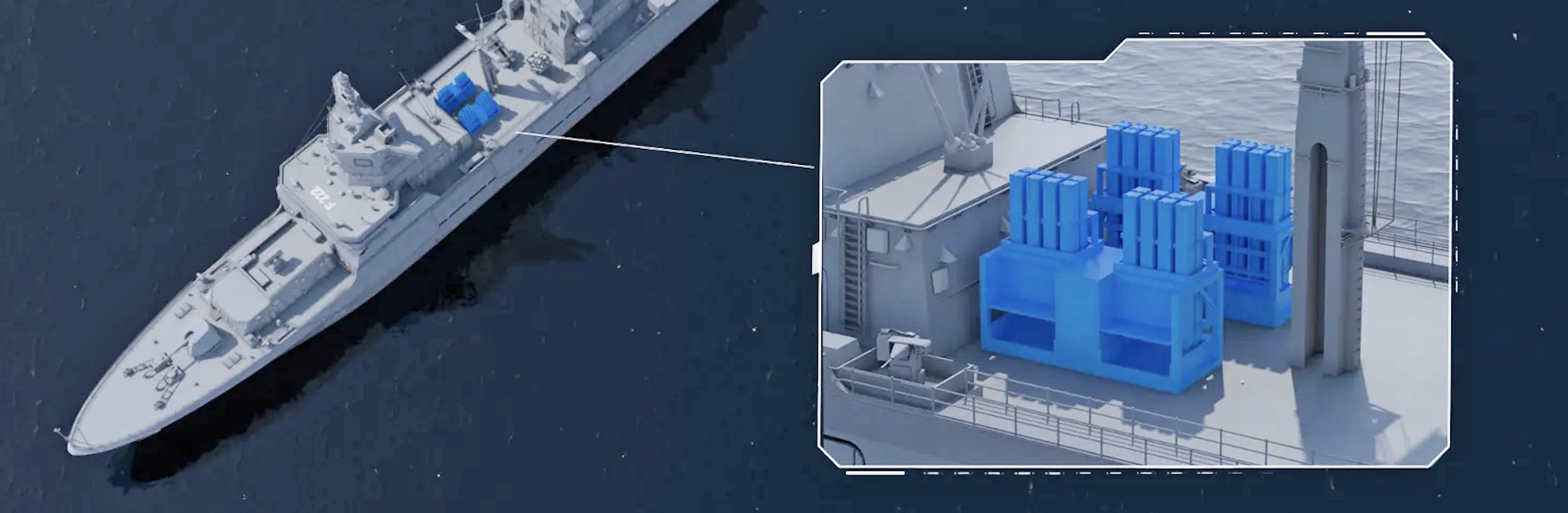
Diehl Defense and Germany’s Federal Office of Bundeswehr Equipment, Information Technology and In-Service Support (BAAINBw) have signed a contract to adapt and develop the IRIS-T SLM surface-to-air missile system for operational use aboard the German Navy’s F125 frigates. Under the agreement, Diehl will build prototypes and conduct comprehensive test firings intended to validate the system’s integration and performance within the existing F125 architecture. Each frigate will be fitted with two new launchers, each capable of holding 16 missiles, for a total of 32.

A rendering showing the location of the 32-cell IRIS-T SLM launchers on an F125 frigate. Diehl Defense

“The aim is to make the system mission-capable on the German Navy’s F125 frigates,” Diehl said in today’s announcement. The company described the prototype construction and test-firing phase as necessary to ensure “the seamless integration and maximum performance” of IRIS-T SLM within the frigate’s existing architecture.

The program has moved notably quickly, reflecting the urgency of the requirement.

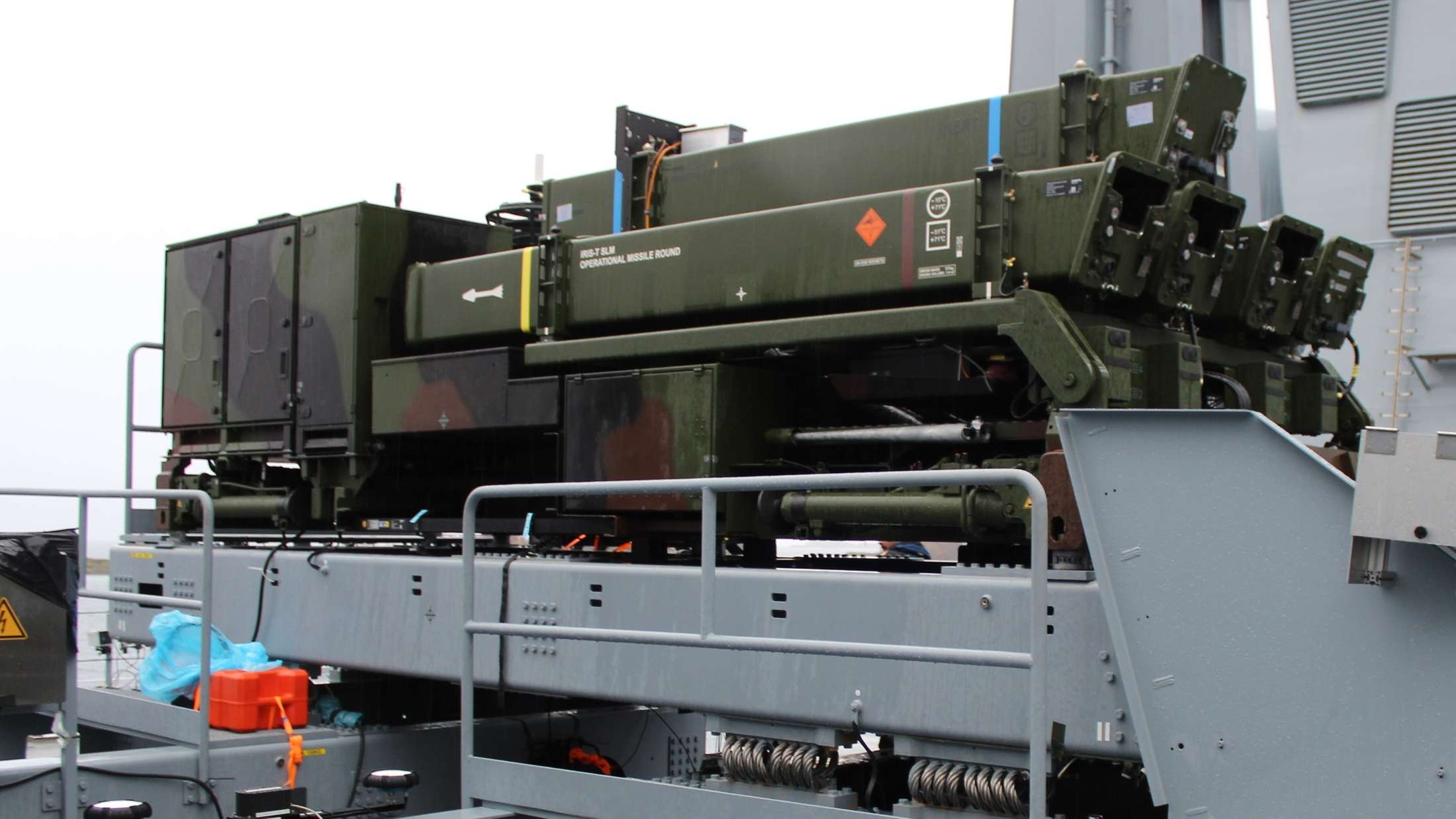
Germany began examining the feasibility of integrating IRIS-T SLM with the F125 in 2024, with BAAINBw and Diehl studying the technical risks and requirements of adapting the normally land-based system for shipboard use. That effort led to the development of a navalized demonstrator in 2025. In October of that year, the F125 frigate Baden-Württemberg took part in a German Navy Maritime Firing Exercise off Andøya, Norway, carrying an experimental anti-air warfare module based on IRIS-T SLM. Diehl says the module went from concept to firing in less than 10 months and met all established test and evaluation objectives.

The IRIS-T SLM launcher on the frigate Baden-Württemberg. Bundeswehr

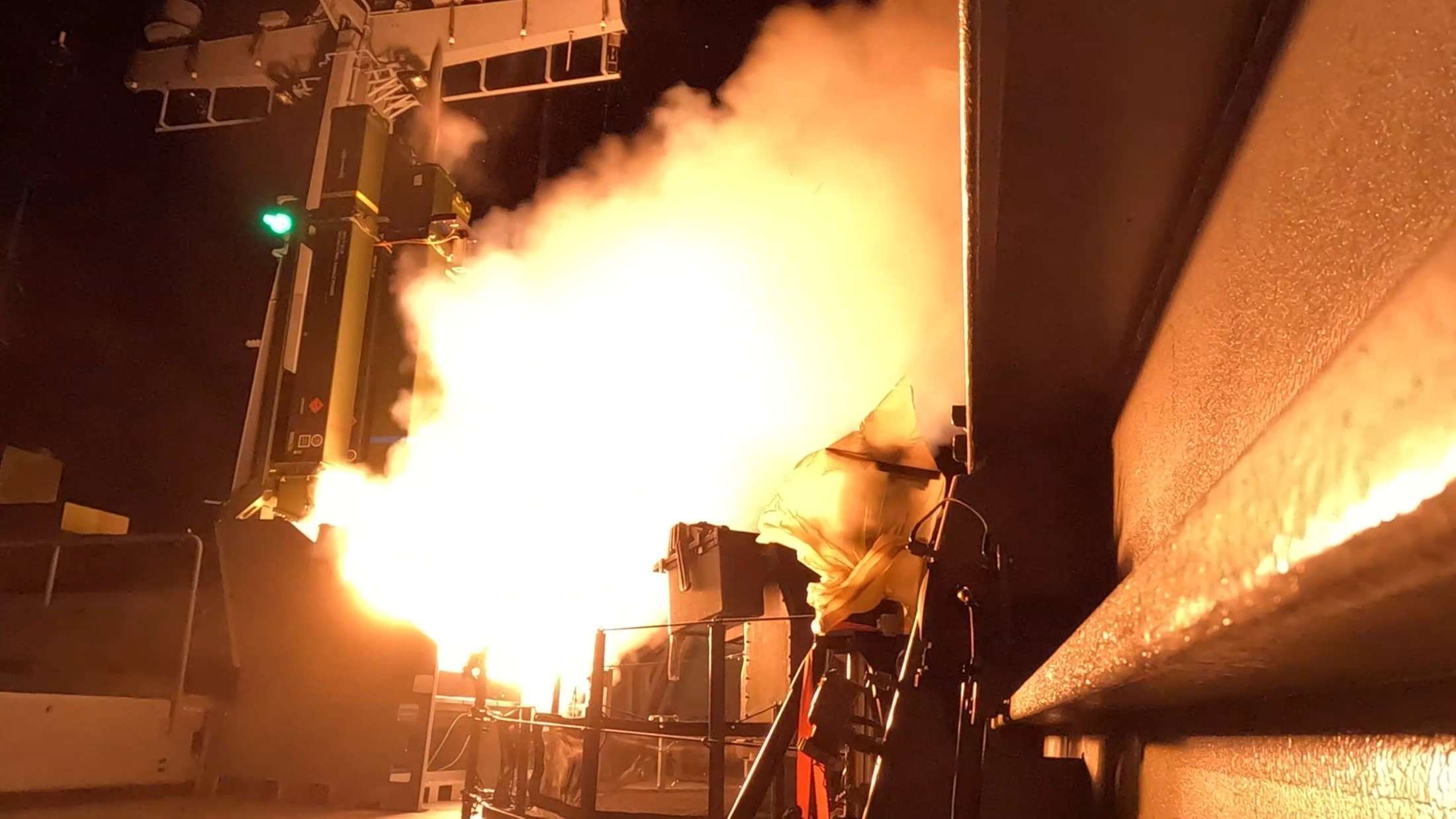
The Bundeswehr subsequently reported that Baden-Württemberg fired three live IRIS-T SLM missiles during the exercise. The ship’s radar supplied target data to the missile system, demonstrating the basic integration between the F125’s sensors and the navalized air defense architecture.

The exercise established that the concept could work at sea; the contract signed now is intended to turn that demonstration into a qualified fleet capability.

A night-time test of the IRIS-T SLM air defense missile system during the Maritime Firing Exercise 2025 in Andøya. Diehl Defense

The German parliament’s Budget Committee approved the adaptation effort on September 23, with the German Defense Ministry describing it as a means of expanding the F125’s self-defense capabilities in response to the current air threat. The ministry also pointed to IRIS-T SLM’s combat experience in Ukraine.

The effort needs to be seen in the context of why the F125 has been such a controversial warship in the first place.

As TWZ examined in 2017, the F125 is a roughly 7,200-ton, 490-foot warship with an unusually small core crew and a concept of operations centered on long-duration deployments, stabilization missions, crisis management, conflict prevention, and international intervention rather than high-end fleet combat. The class was designed to spend long periods away from Germany and operate with relatively modest manpower requirements.

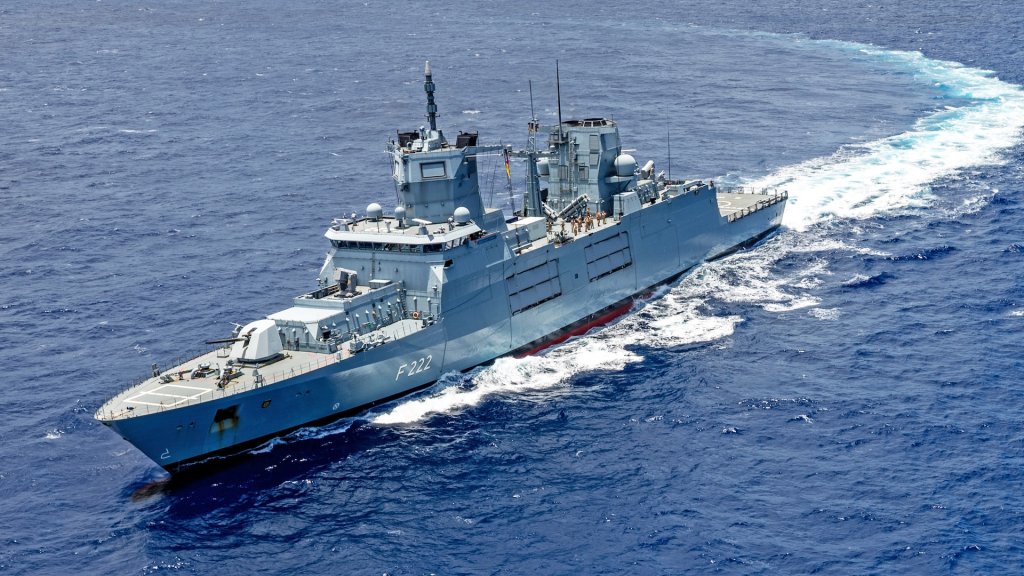
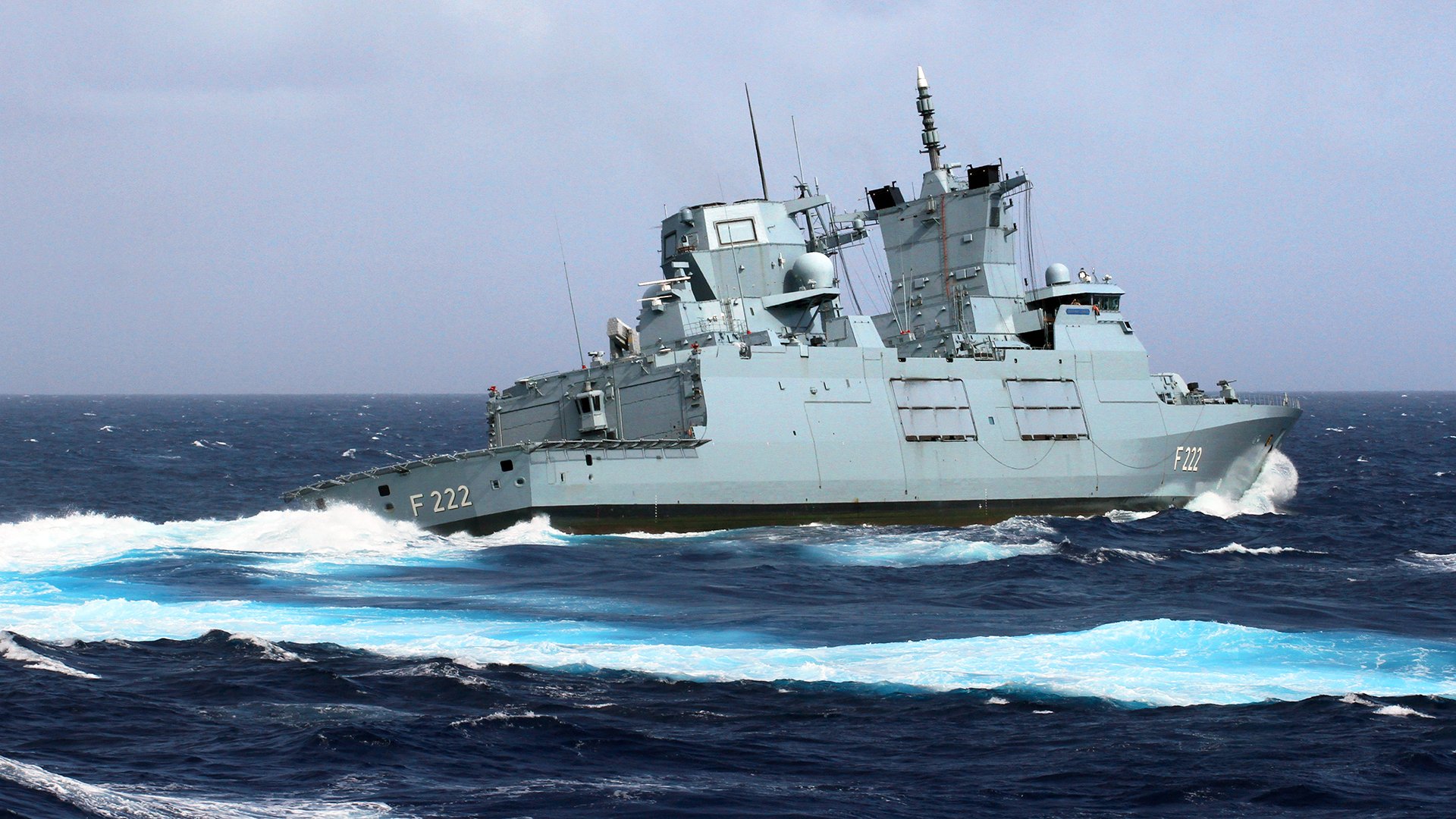
German Navy frigate FGS Baden-Wurttemberg (F 222) sails in formation July 22, off the coast of Hawaii during Exercise Rim of the Pacific (RIMPAC) 2024. Twenty-nine nations, 40 surface ships, three submarines, 14 national land forces, more than 150 aircraft and 25,000 personnel are participating in RIMPAC in and around the Hawaiian Islands, June 27 to Aug. 1. The world's largest international maritime exercise, RIMPAC provides a unique training opportunity while fostering and sustaining cooperative relationships among participants critical to ensuring the safety of sea lanes and security on the world's oceans. RIMPAC 2024 is the 29th exercise in the series that began in 1971. (U.S. Navy photo by Mass Communication Specialist 1st Class John Bellino)
German Navy frigate Baden-Württemberg sails in formation off the coast of Hawaii during Exercise Rim of the Pacific (RIMPAC) 2024. U.S. Navy photo by Mass Communication Specialist 1st Class John Bellino

But its armament does not remotely match the size and sophistication of the hull. As completed, the ships were equipped with eight RGM-84 Harpoon anti-ship missiles, a 127mm gun, remotely operated guns and, for close-quarters air defense, two RIM-116 Rolling Airframe Missile launchers. The F125 has no medium- or long-range surface-to-air missile capability and no organic sonar or dedicated anti-submarine warfare weapon system.

At the same time, the TRS-4D/NR radar and other sensors can see far beyond the engagement envelope of the close-in air-defense weapons, but there is little the ship itself can do with that information against an aircraft or incoming missile at medium range.

Nearly a decade later, IRIS-T SLM is emerging as an answer to at least part of that problem.

Even with IRIS-T SLM, the F125 is well short of being an air warfare destroyer. It also still lacks an organic anti-submarine warfare capability or the kind of large vertical-launch missile battery found on Germany’s F124 frigates.

However, it does fill a gap between the F125’s original short-range defenses and the capabilities of other ships or aircraft operating around it.

IRIS-T SLM is designed as a medium-range surface-to-air system, with an engagement range of around 25 miles and an altitude envelope of approximately 65,000 feet. As shown in the 2025 demonstration, the F125’s radar can feed information directly into the missile system, exploiting the ship’s existing sensor capabilities.

Rather than rely heavily on escorts for protection against airborne threats outside the short range of RAM, an IRIS-T-equipped F125 could at least contribute to its own medium-range air defense. Recent operations in the Middle East have underscored the importance of this in contested maritime environments.

It also gives the ships a more useful role in a task group. The threat environment has changed substantially since the F125’s original concept was drafted. Cruise missiles, drones, loitering munitions, and increasingly sophisticated aircraft mean that even ships operating away from a major naval war can face threats well beyond the range of their existing close-in defenses.

German Navy frigate FGS Baden-Wurttemberg (F 222) sails in formation July 22, off the coast of Hawaii during Exercise Rim of the Pacific (RIMPAC) 2024. Twenty-nine nations, 40 surface ships, three submarines, 14 national land forces, more than 150 aircraft and 25,000 personnel are participating in RIMPAC in and around the Hawaiian Islands, June 27 to Aug. 1. The world's largest international maritime exercise, RIMPAC provides a unique training opportunity while fostering and sustaining cooperative relationships among participants critical to ensuring the safety of sea lanes and security on the world's oceans. RIMPAC 2024 is the 29th exercise in the series that began in 1971.
German Navy frigate Baden-Württemberg. U.S. Navy

In November 2024, Germany confirmed that the F125 frigate Baden-Württemberg, returning from an Indo-Pacific deployment, would avoid the Red Sea and sail around Africa because of the Houthi missile and drone threat. The German Defense Ministry explicitly cited the ship’s limited air defense capability and its inability to provide an effective air-defense umbrella for itself or its accompanying replenishment ship.

Ironically, the F125’s large hull, extensive electrical power, sophisticated radar, substantial aviation facilities, long endurance and relatively spacious mission areas were always supposed to provide room for a flexible approach to future missions. Yet the class’s original weight and integration constraints made adding major weapons difficult, a concern TWZ also highlighted in 2017.

IRIS-T SLM offers Germany a way to add a meaningful capability without undertaking the much more invasive redesign associated with installing a conventional vertical-launch system. The 2025 demonstration used an AAW module mounted on the ship’s deck rather than a conventional VLS installation, and today’s program is focused on adapting the system to the F125 architecture.

Once IRIS-T SLM is installed, the F125 will still be an unusual frigate. It is enormous by the standards of its mission, optimized for endurance, and lacks some of the weapons traditionally associated with a high-end surface combatant. But it will bring more to a contested fight.

The program should give the class a credible medium-range air-defense role, and provide Germany with a way to get considerably more utility out of four ships whose original design philosophy was always somewhat controversial.

Contact the author: thomas@thewarzone.com

The post Germany Is Finally Giving Its F125 Frigates Some More Teeth With IRIS-T SLM Surface-To-Air Missiles appeared first on TWZ.

  •  

EU draws up contingency plans for possible Merz exit

 Al Mayadeen | October 2, 2026

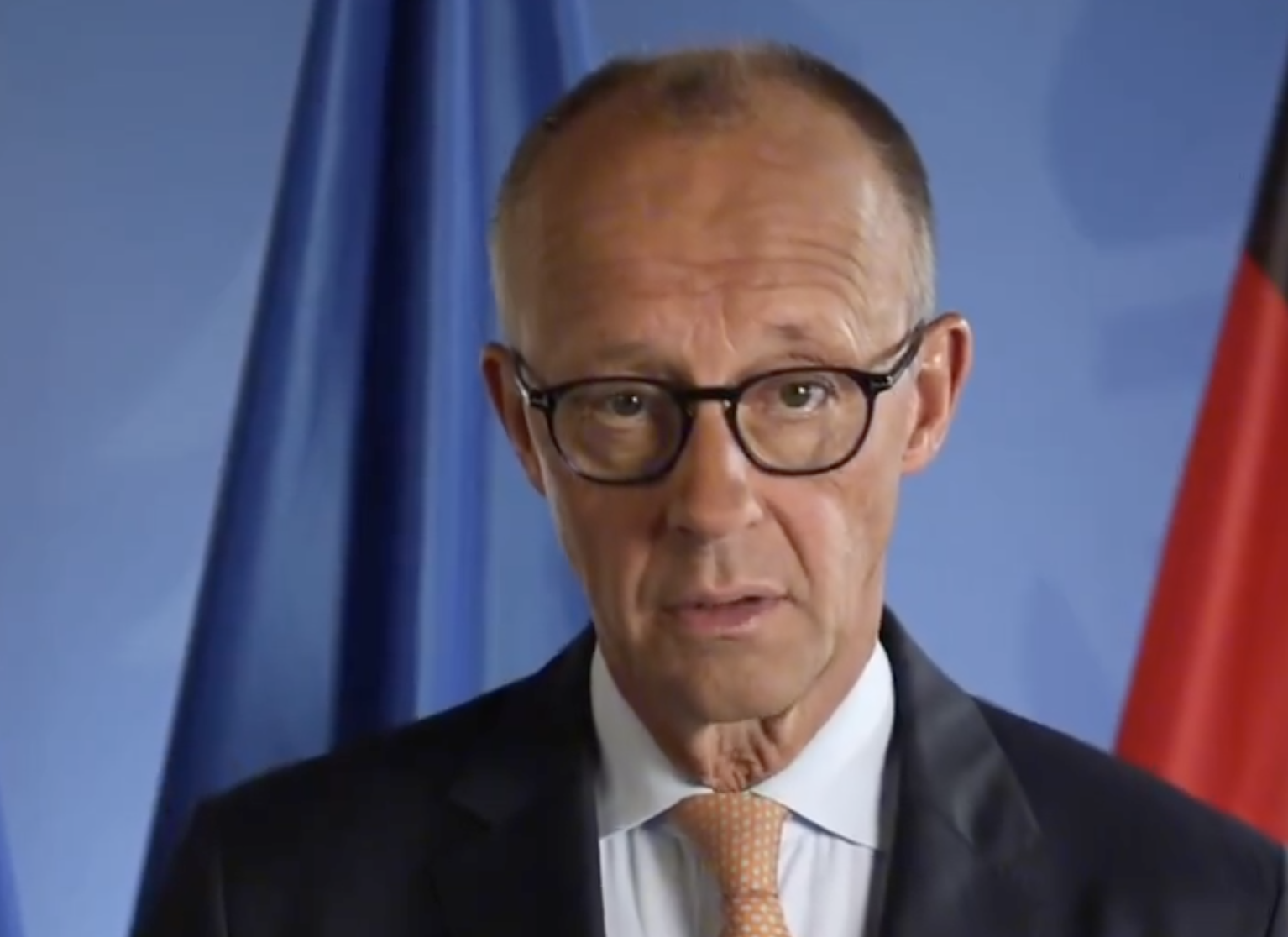
The European Union has begun assessing contingency scenarios in case German Chancellor Friedrich Merz leaves office or becomes increasingly focused on domestic political difficulties, Politico Europe reported Friday, citing diplomats and European officials.

According to the report, governments in two European countries have held internal discussions on how a possible end to Merz’s chancellorship could affect EU policymaking.

The discussions reportedly reflect growing concern in Brussels over political instability in Germany following major electoral setbacks for Merz’s governing conservatives and renewed tensions within the coalition.

Recent regional elections have weakened Merz politically. Reuters reported that the Christian Democratic Union (CDU) suffered its worst-ever result in Mecklenburg-Western Pomerania in September, failing to clear the threshold to enter the state parliament, while the Alternative for Germany (AfD) made further gains.

Berlin’s Political Turmoil Raises EU Concerns

Politico Europe reported that officials consider two scenarios particularly disruptive: Germany being left without an effective leader or a right-wing government emerging in Berlin. However, the report said both scenarios are viewed as unlikely in the short term.

Under Germany’s constitutional system, a chancellor cannot simply be replaced by a successor appointed by the governing party. The Bundestag elects the chancellor, meaning any leadership change would require the necessary parliamentary majority.

For Brussels, the political uncertainty matters because Germany remains the EU’s largest economy and a central actor in negotiations over major bloc-wide policies.

Reuters reported Thursday that Merz is facing growing domestic pressure, while speculation about possible successors has emerged within the CDU. Merz has nevertheless rejected calls to step aside and continues to pursue his government’s policy agenda.

EU Budget Dispute Adds Pressure

Merz’s domestic political position could also affect negotiations over the EU’s next seven-year budget.

According to Politico Europe, Germany is part of a group of member states, including the Netherlands, Sweden, Denmark, Austria, and Finland, seeking substantial reductions to the proposed long-term EU budget. The report said officials believe domestic political pressure could encourage Berlin to take a tougher negotiating position in Brussels.

The budget dispute comes as EU governments debate competing priorities, including defense, industrial investment, infrastructure, and support for Ukraine.

Military Buildup Remains Central to Merz’s Agenda

Despite the political pressure, Merz’s government continues to prioritize strengthening Germany’s armed forces. Reuters reported that Berlin’s debt-financed investment drive is supporting both infrastructure and military expansion, while the government has committed hundreds of billions of euros to rebuilding the armed forces.

Merz has also reaffirmed Germany’s support for Ukraine and called for stronger European military capabilities, while accusing Russia of conducting hybrid attacks against Europe. Moscow has rejected such accusations.

Any change in Berlin’s political leadership would therefore carry implications beyond Germany, potentially affecting EU budget negotiations, defense policy, relations with Russia, and the bloc’s wider strategic direction.

  •  
  •  

Rome Gave Up Its German Frontier in the 3rd Century. New Finds Suggest Someone Kept Using the Site

A few inches below the forest floor in the eastern Taunus hills lies a stretch of the Roman frontier that has barely been examined. The Kapersburg fort, near Rosbach vor der Höhe in Hesse, is one of the best preserved on the German limes, the chain of Roman border defences. Research has long concentrated on […]

  •  

Germany: ‘Peace-loving’ Syrian migrant sentenced for stabbing man in the neck, now wants to bring his wife and child to Germany

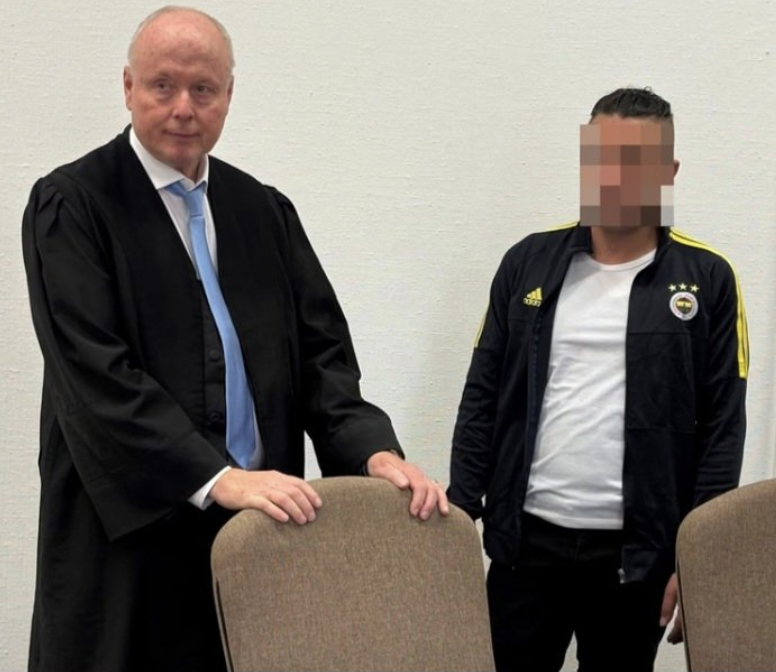
A regional German court sentenced a 29-year-old Syrian man to four years and 10 months in prison for attempted manslaughter after he stabbed a man in the neck during a dispute at a Cologne drug hotspot, slightly reducing an earlier five-year term after Germany’s highest criminal court ordered a resentencing.

The Cologne Regional Court imposed the penalty Friday following a brief retrial, the Kölner Stadt-Anzeiger reported. The Federal Court of Justice had largely upheld the original findings but ruled that the first chamber had improperly double-counted an aggravating factor.

The stabbing occurred on April 27, 2025, at the Josef-Haubrich-Hof near Neumarkt, an area known for heroin and cocaine dealing. The defendant intervened in an argument within the drug scene and was struck during the altercation between the two men, possibly with brass knuckles. In anger, he then drew a folding knife and stabbed one of the men in the neck, severing his jugular vein, the court findings stated.

Blood sprayed from the stab wound immediately. The 47-year-old victim dragged himself to a stairwell in the Neumarkt passage and collapsed.

Prosecutors said in the first trial that the attacker recognized the victim would die without help but was indifferent to whether he survived.

The victim lost about 1.5 liters of blood, spent three days in a medically induced coma after emergency surgery at the university clinic, later suffered a pulmonary embolism, and continues to experience pain, shortness of breath, anxiety and sleep problems, the Kölner Stadt-Anzeiger reported. A scar also remains on his neck.

The victim told the court he has been living on the street.

Defense lawyer Mario Geuenich described the convicted man as “peace-loving” but said that day he was “surely not in control of his senses” and that the act stemmed “from affective agitation.”

The defendant said, “I really regret it,” and told the court he had stopped using alcohol, drugs and methadone while in custody. He also told the court he wants to bring his wife and children from Syria to Germany and lead a normal life.

The victim addressed the defendant directly: “I forgive you. But my life is fucked up and shitty.” He added, “God bless you. I ask for a mild sentence,” and said, “God is his judge, not me.”

Presiding Judge Achim Hengstenberg replied, “But we still exist.”

Mitigating factors included the apology, expressed remorse and the victim’s forgiveness. Aggravating factors were the dangerous knife wound and the defendant’s prior convictions. The new sentence is two months shorter than the original. The victim’s lawyer, Eva Kuhn, said she was satisfied with the sentence and plans to seek compensation from the convicted Syrian.

The verdict is final.

The post Germany: ‘Peace-loving’ Syrian migrant sentenced for stabbing man in the neck, now wants to bring his wife and child to Germany appeared first on Remix News.

  •  

A Sinking German Lake Yields Timbers Carved 10,500 Years Ago by Stone Age Hunter-Gatherers — They May Have Been Building With Wood Before Farmers Arrived

Some lakes give up shipwrecks, and Arendsee, in northern Germany, has already given up one. What archaeologists brought to light in 2026 is something else: wood carved by Mesolithic hunter-gatherers up to 10,500 years ago. (The Mesolithic, or Middle Stone Age, is the stretch of European prehistory after the last Ice Age and before farming.) […]

  •  

Herodotus Thought the Danube Began in the Pyrenees — That Error Now Clouds Germany’s “First Celtic City”

In southwestern Germany, an open-air museum and a website present the Heuneburg as the “Celtic city of Pyrene”, a settlement already thriving when Rome was still a small village on the Tiber. The name comes from Herodotus. The problem, according to a study published in The Antiquaries Journal, is that the Greek historian was almost […]

  •  

Europe’s housing crisis is an immigration crisis, as Berlin data confirms

Across the West, native Europeans are dying out but rental prices continue to go up every year. While the left would like to point the finger at capitalists and greedy landlords, the primary factor driving the housing affordability crisis is mass immigration.

Berlin is a prime example of this trend, as German journalist and author Jens Winter pointed out on X using clear population and housing data.

“Rental prices on the market have more than doubled in Berlin since 2011—plenty of money for corporations. But where is the increased demand coming from? While the native population of the capital has declined by 260,000 since 2011, the number of foreigners and people with a migration background has risen by 650,000 over the same period. That means: Without migration, there would be less demand for housing in Berlin today than in 2011,” he wrote.

In a follow-up post, he wrote that the German “conservative” party is just as guilty as the left.

“The CDU-aligned real estate lobby is raking in big money with migration in Berlin. The Germans have a choice: dying out in the CDU’s multikulti capitalism or in the Left’s multikulti socialism. Understandable response: If we’re going to disappear anyway, why bust our asses for it?” he wrote.

Die CDU-nahe Immobilien-Lobby scheffelt mit Migration in Berlin mächtig Geld. Die Deutschen haben die Wahl: Aussterben im Multikulti-Kapitalismus der CDU oder im Multikulti-Sozialismus der Linken. Verständliche Antwort: Wenn schon verschwinden, warum dafür dann hart arbeiten? https://t.co/GPrTp62SXO

— Jens Winter (@mr_jenswinter) September 26, 2026

While the doubling of rents is real, there is a basic supply and demand reality that the left would like to deny. It is indeed true that predatory property owners, major institutional players, and money printing have played contributing roles to the housing crisis, but no matter how many greedy property owners are involved, if the population of a city falls, rental and housing prices are almost inevitably going to fall.

Mass immigration means that population numbers never fall. Any breathing space for German families to repopulate, have more children, and fill in the gaps left by older generations passing away is immediately filled by hundreds of thousands of foreigners.

The data shows that the population of native Germans fell by 260,000 people. In a system that rejects mass immigration and foreign real estate investors, this could have been a boon for birthrates and increasing home ownership. For one, Germans who already lived in Berlin, and those looking to move to Berlin, would have been more easily able to afford rents and housing due to less competition on the housing market. Secondly, more native Germans would have had a chance to start families — and those who already had families could have afforded an extra child or two — by securing affordable housing.

However, Germany does not reject mass immigration.

Instead, 650,000 foreigners arrived in the same period of time and housing and rental prices soared. The left, however, refuses to do simple math.

There is of course another solution, but it is far more complicated than simply allowing population levels to fall in a country that has never had so many people living in it. Instead of ending mass immigration, left-wing parties, along with the CDU, demand more housing is built.

However, there are myriad reasons why the required housing is not being built, including high construction and material costs, red tape, zoning, and a lack of skilled workers. The same parties have been making the same demands for years now, but construction cannot keep pace with demand in Berlin or other major cities across Germany.

The Left Party may promise to build more, but the reality is that it will not happen. Nothing the left offers will lead to the necessary building. Before Olaf Scholz of the far-left Social Democrats (SPD) won the chancellorship, he promised that his “goal” was to create 400,000 new apartments per year, which would include 100,000 units of social housing, saying, “That’s not witchcraft, we just have to want to do it.” 

It never happened under Scholz and it won’t happen under a left-wing government in Berlin either.

Should more housing even be built?

As Western cities race to replace their native European populations, the question becomes whether life really becomes better in a crowded multicultural city when it means more traffic, longer waiting times at hospitals, crowded classrooms, and imported crime — just to name a few ills.

The newcomers also did not fix the skilled worker shortage that could potentially build all the homes and apartments politicians and lobbyists claim Europe needs. While a certain number of new houses and apartments always need to be built, the question then becomes should Western civilization really be involved in endless building to accommodate millions of foreigners.

On top of all of these questions, the buildings developers managed to build are now in fact uglier than ever, more expensive than ever, and are built more slowly than ever.

In fact, data shows that the time from start to completion for a project is longer than it has been in decades. Again, where are all these young migrants from Africa and the Middle East to fuel a new construction boom with their master artisan and building skills?

The reality is they largely do not exist. Many skilled builders who are immigrants are from neighboring European countries, such as Poland, and they increasingly see fewer reasons to work in Germany.

The pro-migration left is making housing worse

Winter’s X post is especially relevant given that the Left Party recently won a first place finish in Berlin elections, securing over 25 percent of the vote. Commentators and analysts have contributed the rise of the party in Germany’s capital due a variety of factors, but two major components are the party’s ability to secure the vote of German citizens with a migration background and young voters.

The second factor is Berlin’s housing crisis, which helped drive support from groups like non-voters, the young, and foreigners.

German taxpayer-funded Deutsche Welle, wrote: “That makes sense to 17-year-old Liska, who voted for the socialists: ‘The Left Party did appeal to me, especially because of the social issues — getting prices down, making rents more affordable.’ Rents in Berlin are indeed rising at a massive pace — by some 7% in the last two years alone — and first-time tenants are likely to be the hardest hit. Polls also showed that by far the biggest proportion of Berlin voters — 37% — thought that the Left Party was the most likely to create affordable housing.”

The Left Party and various other left-wing parties have convinced young people that there are easy fixes to the housing crisis. The problem is not relegated to Berlin, as all of Germany has seen tight vacancies as more and more migrants arrive, as Remix News previously reported.

In the end, the left and its voters are choosing a path where more and more building only leads to overcrowding and environmental degradation.

Mass immigration and higher housing costs hurt birthrates

Numerous studies have shown that immigration has helped drive soaring rental and housing prices across the Western world — not just in Germany. In turn, studies have also shown that soaring housing prices have depressed birthrates, including in countries like the Netherlands, according to the Netherlands Interdisciplinary Demographic Institute (NIDI).

Again, the same story is taking place in the Netherlands, with the natural population increase for the Dutch at near zero or negative. Nevertheless, the population rose from about 16.8 million in 2013 to 18.1 million in 2025, with net migration accounting for virtually all of the recent increase.

It must also be remembered that just like in Germany, most of these migrants want to head to the major cities, such as Amsterdam.

Official housing-need forecasts in the Netherlands also attribute a large share of future extra demand, often 45 percent or more of the extra dwellings required, to population growth that is itself 95 percent migration-driven.

Great for landlords, bad for the citizens.

Of course, the Alternative for Germany has tried to tie the housing crisis to mass immigration, and they have successfully made this case to some extent.

WATCH: 🇩🇪🇪🇺 Mass immigration is fueling the West's housing crisis.
Here's how it's happening in Germany.

In a powerful speech in the German Bundestag, @AfD politician Carolin Bachmann slams the ruling government for allowing 2 million migrants into the country while families… pic.twitter.com/DMEqiV316S

— Remix News & Views (@RMXnews) February 15, 2024

The problem is that as more and more of the population becomes foreign, this argument holds less and less sway. Immigration may raise housing prices but if immigration brought a person to a country in the first place, and if more immigration might also enable more and more of their family members and fellow countrymen to arrive, then these voters have every incentive to keep immigration levels high regardless of housing costs.

Many of these migrants are not paying for rent anyway. There are millions of foreigners on social welfare, which means not only are they taking housing places of native Germans, but they are being paid to do it. They then often have far higher birthrates than native Germans, even with limited space, which entitles them to larger spaces.

The cycle is self-reinforcing and relentless. That means unless dramatic action is taken against mass immigration, housing and rental prices may never truly come down.

The post Europe’s housing crisis is an immigration crisis, as Berlin data confirms appeared first on Remix News.

  •  

Germany: Despite Syrian’s long history of violent rampages, assaults, robbery, fraud, and rape, he has never been deported

A 22-year-old Syrian man is accused of seriously assaulting several rail passengers in Cologne in June during a rampage attack. However, details have now emerged of just how serious this man’s criminal history is after a parliamentary request from politician Markus Wagner of the Alternative for Germany (AfD) party.

Currently, the Syrian remains in a psychiatric hospital while prosecutors investigate, but the man’s long history of criminal offenses is truly remarkable.

The North Rhine-Westphalia Justice Ministry outlined the case in an answer published Sept. 25.

Federal police said the attacks began about 3:10 p.m. on June 21 at the Cologne-Trimbornstrasse stop. A police spokeswoman said a 22-year-old man “grabbed a traveler and tried to pull him toward the tracks.” Both fell to the ground. Bystanders pulled them apart, but the victim suffered bruises and abrasions.

Police told Westdeutscher Rundfunk that the witnesses “behaved correctly” by acting together and separating the attacker from the victim.

The suspect then boarded an S19 train toward Cologne Central Station, police said. Near the Cologne Messe/Deutz stop he suddenly punched two passengers in the face, according to witnesses and video.

At the main station, in a fast-food restaurant, he punched and kicked a 47-year-old man and continued striking him on the ground after federal officers arrived.

Officers managed to detain the man and later said he was under the influence of narcotics.

He was taken to a psychiatric facility. The Justice Ministry said he “is currently provisionally accommodated in a psychiatric hospital” under Section 126a of the Code of Criminal Procedure, a measure used when investigators believe a suspect may have acted without full criminal responsibility.

Cologne prosecutors are investigating, among other counts, intentional bodily harm, attempted dangerous bodily harm and attempted dangerous interference with rail traffic, the ministry said.

Asked what police already knew about the suspect, the government listed suspected prior offenses that had led to complaints or investigations: five thefts, one case of receiving stolen goods, one robbery, one insult, three threats, 11 assaults, 13 dangerous assaults, 11 narcotics violations, one rape allegation, one count of resisting officers, two property-damage cases and two fraud cases.

However, none of these arrests have resulted in convictions. The ministry stressed that police records “rest on suspicion” and “do not allow a conclusion on the correctness of the allegation.”

Regarding formal prior sentences, the government said the man’s Federal Central Register extract “shows solely sanctions under youth criminal law that are not entered in the certificate of good conduct.”

🇩🇪🔴 "Since the attack, he wakes up every night screaming."

An African migrant randomly attacked a 14-year-old German boy inside Freiburg’s central train station and tried to gouge out his eye.

The victim’s father, Roland H., also believes the attacker may have tried to carve a… pic.twitter.com/Go55W2g9KC

— Remix News & Views (@RMXnews) September 21, 2026

In other words, most of these offenses were either handled in juvenile court or were never formally tried in court due to the man’s psychological state. German youth-court measures often do not appear on the clearance certificate employers and agencies commonly request, meaning these criminal entries would not be available to potential employers.

Asked about citizenship, the ministry wrote that, “as far as known,” the suspect has Syrian nationality.

Notably, he has never been deported despite the trail of mayhem he has left behind him.

The post Germany: Despite Syrian’s long history of violent rampages, assaults, robbery, fraud, and rape, he has never been deported appeared first on Remix News.

  •  

Germany: Turkish national went from working in supermarket to buying purple Lamborghini and gold watches through €11 million healthcare fraud scheme

German authorities have frozen €5.9 million ($6.5 million) in assets of an operator of a fast-growing intensive-care nursing service. She is now in custody over allegations that the company billed public health insurers for services that were never fully provided or were performed by unqualified staff, causing an estimated €11 million in damage.

Zeynep C., 39, a Turkish national who rose from supermarket work to run White Angels Intensive Care, was arrested Sept. 17 during coordinated raids involving more than 200 officers from police, customs and financial crime units. The case is making major headlines, also in part due to the luxury lifestyle she was living.

Her 44-year-old German husband was also detained. Both remain in pretrial custody.

Thirteen people ages 20 to 54 — of Turkish, Moroccan, Egyptian and German nationality, some with dual citizenship — are also under investigation.

The Wuppertal public prosecutor’s office, which specializes in health-care billing fraud, said investigations began in December 2025 after anonymous tips. Over eight months, detectives examined a network of companies centered in the Düsseldorf and Mettmann area that provided outpatient intensive care, including home ventilation and palliative services, to severely ill patients.

Prosecutors allege the group billed statutory health insurers for intensive-care hours that were not delivered or were incomplete, and that some care was given by staff lacking the required qualifications. 

“They must keep qualified personnel available around the clock for seriously ill patients. Those are considerable wage costs that an employer also has to bear,” Chief Prosecutor Wolf-Tilman Baumert told WDR. Using unqualified workers or billing for nonexistent care made “huge profits” possible, he said.

Company records reviewed by investigators showed explosive growth. After roughly eight months of operation under its current name, the service posted about €1 million in profit by the end of 2023. Profit rose to nearly €3 million in 2024, with €11 million in revenue projected for 2025 — a figure that now matches the estimated total loss to insurers. The firm, previously called CAN-Vefa GmbH, marketed itself as offering “culturally sensitive care” with a multilingual team.

During the searches of 31 homes, offices and practices across North Rhine-Westphalia and one site in Hesse, officers found a care-dependent child in a Düsseldorf apartment in “very poor health.” The child was taken by ambulance to a hospital for inpatient treatment; child-protection officials were notified. Authorities said any proven neglect of patients would be an aggravating factor in the case.

Seized items included several luxury vehicles registered as company cars — a Maybach, Mercedes-AMG models and a purple Lamborghini — plus €51,000 in cash, jewelry valued at €265,000, gold worth about €10,000, designer handbags and watches totaling more than €150,000. Mortgages totaling €3.3 million were placed on properties. At the couple’s home in Mettmann, police also recovered a loaded firearm, marijuana and anabolic steroids. A doctor’s stamp, which investigators believe used to forge prescriptions, was among the documents seized.

Zeynep C. had cultivated a public image of success. Photos circulated in German media showed her wearing Chanel-branded clothing and accessories alongside images of the seized Lamborghini being towed. Prosecutors are examining whether the luxury spending was financed by the alleged fraud.

The Düsseldorf-based nursing company itself has not been shut down and continues under a different manager, according to local reports. No charges have been filed yet, and the investigation is still underway. 

Billing fraud of this scale, if proven as commercial and organized, can carry prison terms of up to 10 years under German law. If prosecutors discover children and other patients were left untreated or poorly treated due to fictional or inadequate care services, the length of potential prison sentences could expand significantly.

The post Germany: Turkish national went from working in supermarket to buying purple Lamborghini and gold watches through €11 million healthcare fraud scheme appeared first on Remix News.

  •  

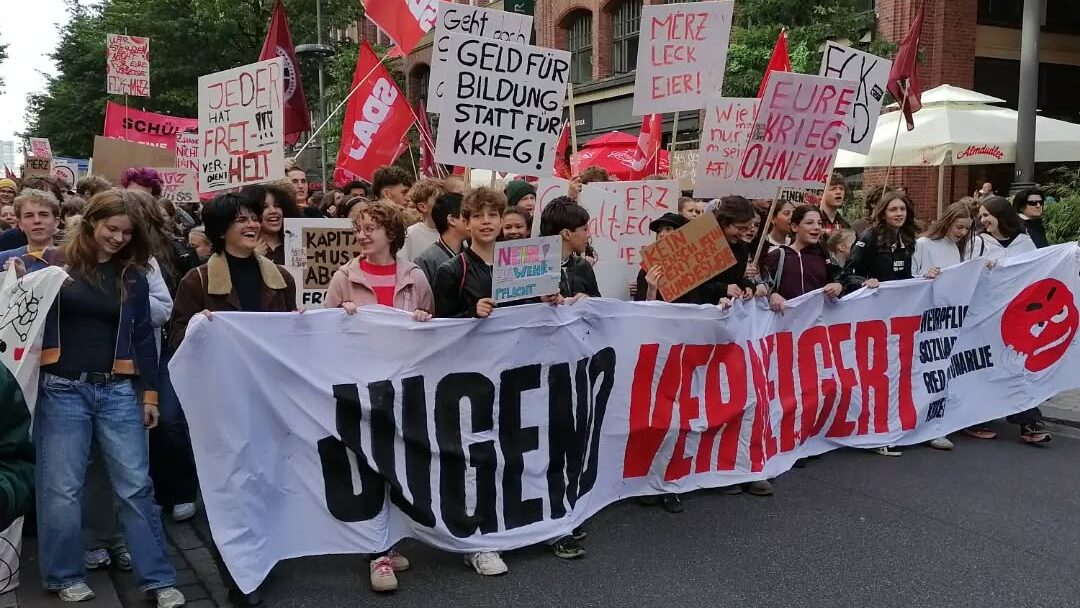
German students say ‘we don’t want to go to war’

Thousands of students across Germany were once again on strike against conscription and militarization on Friday, September 25. Actions took place in at least 100 localities as young people demanded a sharp turn from the government’s chosen path.

“We don’t want to be forced into military service and we don’t want to go to war,” the students wrote in declaration after their last strike in May.

Read more: German students expand their strike against conscription and militarization to 150 cities

This is the fourth time students have exchanged classrooms for streets since the end of 2025. The mobilization has strengthened in resistance to the Merz administration’s plans to build the “strongest conventional army in Europe” – including by drawing more people into the Bundeswehr, the German armed forces.

While authorities insist military recruitment remains voluntary, students have warned of a clear tendency toward outright conscription. Local strike committees and activists also emphasized the widespread repression ahead of actions. This included scheduling of exams on strike days and locking-in students on school grounds, they pointed out.

Billions for the Bundeswehr, cuts for schools and youth services

Over recent months, the government has sent thousands of questionnaires to map voluntary interest in joining the armed forces. According to German media, the response has been underwhelming: tens of thousands of students have disclaimed no interest whatsoever. Not even a multi-million-euro budget allocated to promoting the army has been able to shake this opinion.

“They sell us war service as an ‘adventure’ while we know that what awaits us is coertion, humiliation, sexism, right-wing extremism, and racism,” the student declaration adds.

Instead of taking the message seriously, authorities recently advanced the implementation of medical checks among their targeted population, drawing further frustration from students.

“We don’t want compulsory questionnaires, fines, draft physical examinations, conscription assessment centres across the country, nor planned integration of the Federal Volunteer Service into military service,” they wrote. “These are means to prepare the reintroduction of the draft and thus another war originating from Germany.”

“In case of conscription, we’ll be trained as cannon fodder, forced into the trenches,” students added. “War costs us our lives, while corporations like Rheinmetall make record profits.”

Read more: Ulrike Eifler: ‘The workplace is a place where we have to fight against war’

Students on strike have expressed solidarity with other ongoing struggles against militarization and budget cuts. They stated they would join peace demonstrations planned for early October in Berlin and Stuttgart, as well as a trade union-backed mobilization against budget cuts on Saturday, September 26.

Their decision reflects the widespread understanding that youth and education services are among those impacted by this round of austerity. According to junge Welt, the federal ministry responsible for education will face close to €1 billion in cuts – while €140 billion will be made available for so-called defense in 2027.

“Every tank, every rocket we pay for with dilapidated schools and social cuts,” students remarked.

  •  

Germany: Turkish man stabbed wife to death in refugee center, already on trial for rape

German police have arrested a 43-year-old Turkish man suspected of fatally stabbing his estranged wife, a 36-year-old mother of three, at a municipal refugee shelter in Coesfeld. The suspect was already on trial for rape and charged with other crimes.

Witnesses found the victim, Enda K., with stab wounds to her upper body in her room at the accommodation around 12:25 p.m. on Wednesday.

Rescue workers tried to revive her but could not save her life. She died at the scene.

The couple, both Turkish citizens but had been living separately, investigators stated. Police and prosecutors initially provided no information on the background of the attack or a possible motive.

“The children were luckily at school when it happened. This is so terrible. Enda was such a strong personality, a really nice woman. We are all shocked,” a roommate at the refugee shelter told Bild newspaper.

A tip from the public led officers to the suspect during the night in Münster, about 40 kilometers (25 miles) away. They arrested him around midnight. He did not initially comment on the allegations.

Bild also learned that the Turkish suspect had a prior conviction for aggravated assault and he also faces additioanl charges of trespassing, assault, and coercion.

In January 2026, he was also placed on trial for rape but the trial was terminated and moved to another court due to an expected higher sentencing. No court proceedings at this new court venue have taken place yet.

The post Germany: Turkish man stabbed wife to death in refugee center, already on trial for rape appeared first on Remix News.

  •  

Germany: Merz government may use radical ‘federal coercion’ power if AfD party controls Saxony-Anhalt

The anti-immigration Alternative for Germany (AfD) won the Saxony-Anhalt state election by a wide margin but fell short of an absolute majority. Nevertheless, the party may still come to power if it can garner enough support from BSW or peel off a few MPs from rival parties. This possibility has thrust an unused and radical clause of the German constitution, federal coercion or “Bundeszwang,” to the center of a fight over how far Berlin can go if the right-wing party takes power.

The AfD took 43.8 percent of the vote in the Sept. 6 election, but the AfD remains three seats short of an absolute majority. However, Ulrich Siegmund, the AfD’s 35-year-old lead candidate, could still become minister-president. The German government has plenty of tools for dealing with Siegmund if he steps out of line.

Germany’s establishment threatens to use “federal coercion” clause

Federal coercion is one of the most radical mechanisms in the German constitution. Article 37 allows the federal government or a representative it appoints to issue binding orders to the states and their agencies. The Federal Republic of Germany has never resorted to this clause before.

Anna-Bettina Kaiser, a law professor at Humboldt University in Berlin, told Deutsche Welle the bar is extremely high.

“The term ‘dramatic’ is most apt here. This is why federal coercion has never been introduced in the history of the Federal Republic — it is treated as a last resort,” she told Deutsche Welle, a state outlet that receives approximately €415 million a year in taxpayer money.

Until now, fights between Berlin and the states have been settled mainly in court.

“It is usually assumed that in the event of a specific legal dispute, the case will go to the Federal Constitutional Court and the given state will comply with the judgment issued by that body,” Kaiser said.

Deutsche Welle reported that an extreme use of Article 37 could include naming a federal representative with power to issue binding orders in specific areas.

“Article 37 actually provides for the appointment of such a representative who has the power to issue binding orders,” Kaiser said.

Any step would have to match the violation and meet constitutional tests. However, Article 37 lists no catalog of penalties. It speaks only of “necessary measures,” leaving the article vague and open to interpretation.

Bundesrat consent would be essential. Under the chamber’s rules, the affected state keeps its vote on Article 37 decisions.

Union parliamentary leader Thorsten Frei has since called Article 37 an option of last resort if an AfD state government acted against the constitution. Social Democratic floor manager Dirk Wiese said it was “good to know” the Basic Law allows constitutional conduct to be compelled by instruction if an “AfD-BSW Putin coalition” installed a far-right politician as premier. The Greens and the Left have not ruled the tool out.

Saxony-Anhalt’s Office for the Protection of the Constitution classifies the state AfD as “confirmed right-wing extremist.”

Cutting funding to an AfD government

On top of the constitutional power that Article 37 offers, the tried-and-tested method of cutting funding is also being discussed and it is not even clear yet if the AfD will be able to assume power in the state.

German officials have also discussed suspending some federal budget transfers to Saxony-Anhalt, which is still dependent on such transfers to prop up its economy. Tagesschau reported that structural funds could be frozen if an AfD government breached EU fundamental rights or rule-of-law conditions.

However, beyond these federal transfers, powerful German Green MEP Daniel Freund said after the vote that the European Commission should, if necessary, withhold money if an AfD-led state government acted against EU principles.

Freund was a notorious foe of Hungarian Prime Minister Viktor Orbán and a longtime advocate of the EU cutting funding to Hungary while his government remained in power. Freund not only succeeded in lobbying the EU to cut funding but this tool is generally seen as one of the primary contributing factors in toppling Orbán from power.

The reality is that this method of cutting or freezing funds has worked remarkably well for the EU, also in the case of Poland’s previous conservative government. When funding is cut, the population suffers, and when they suffer, they punish politicians at the voting booth. Orbán could point the finger all he wanted at Brussels. It did him no good in the end.

If the EU or the German federal government cuts funding, Saxony-Anhalt will suffer, and there is nothing an AfD government can do about it.

For now, it appears for the EU establishment has a virtually fool-proof method for dealing with any voter rebellions or unfavorable democratic results.

A CDU-led federal government also has every incentive to make an example out of a regional AfD-led government. Shortly after the Saxony-Anhalt election, Chancellor Friedrich Merz said Berlin would act if Saxony-Anhalt crossed lines set by the constitutional order.

“If boundaries are crossed there, I assure you that from the federal government’s point of view we will do everything to correct it. The Basic Law also applies in Saxony-Anhalt,” Merz said.

Merz pointed to migration and foreign policy. He also cited the unwritten duty of “federal loyalty.” A state must act loyally towards the standards of the federal state. That covers “the entire immigration and foreigners policy,” he said.

Fact-checkers later noted that Merz did not use the word “federal coercion,” or “Bundeszwang.” Nevertheless, the debate that followed is freely using the term and how it can be applied against the AfD.

The AfD casts itself as a “rule-of-law party”

However, simply winning an election would not, by itself, justify federal coercion. Article 37 of the Basic Law allows the tool only if a state fails to fulfill duties imposed by the constitution or other federal law. The federal government may then, with the consent of the Bundesrat, take the measures needed to compel those duties.

The AfD’s answer has been that it would govern inside the law, and that Berlin is trying to cancel a democratic result.

The morning after the vote, Siegmund again called the AfD a “rule-of-law party,” and said he would act lawfully. He later thanked the Berlin press sarcastically for portraying him as a threat to democracy and said he wanted to “extend a hand” to every actor in the legislature.

AfD co-leader Alice Weidel called the result a mandate to govern, said Merz was the most unpopular chancellor Germany has had and told him his time was up. In the Bundestag she argued that the CDU-SPD coalition had failed. Merz accused her of pushing Siegmund into “electoral fraud” by urging him to hunt for a majority after he had promised to take office only with an absolute majority.

The issue of mass immigration, in the end, always appears to be the real point of contention. According to the European and German establishment, it must continue at all costs. In a 2024 ARD summer interview, co-leader Tino Chrupalla said an AfD-led state would no longer apply the “Königstein key,” which apportions asylum seekers among the states.

“We would no longer go along with that,” he said at the time.

Siegmund has promised “deportations from minute one” and a remigration offensive.

However, a federal government that wants to prove the AfD weak and ineffective is unlikely to allow such a remigration offensive to move forward. There are plenty of tools at its disposal to stymie the AfD and even sabotage its government. Siegmund may be facing a wave of funding cuts, litigation, and ultimately the federal government stepping in and essentially seizing power if he manages to gain power in the state.

The post Germany: Merz government may use radical ‘federal coercion’ power if AfD party controls Saxony-Anhalt appeared first on Remix News.

  •  

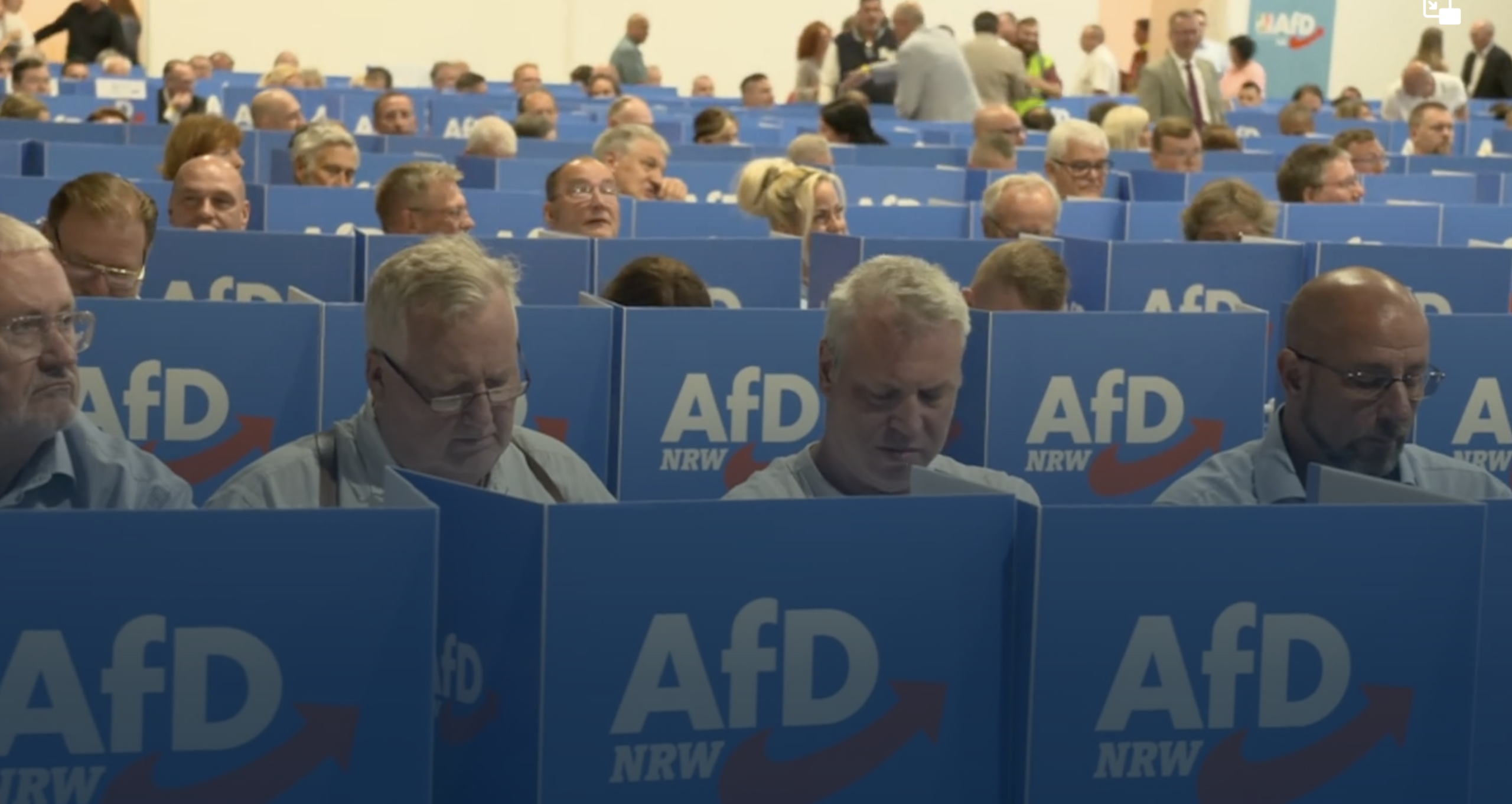
Shock poll: Anti-immigration AfD now the most popular party in key western German state in a national vote

The anti-immigration Alternative for Germany (AfD) party is known for its strength in the east of the country, but its popularity in Western Germany is also only growing, including in the country’s most populous state, North Rhine-Westphalia.

This latest Forsa poll points to incredible growth of the AfD in a very short time in the voter-rich Western German state. It is now the most popular party in the entire state when measuring a national vote and would earn 24 percent of the vote.

NORDRHEIN-WESTFALEN | Sonntagsfrage Bundestagswahl Forsa/Kölner Stadt-Anzeiger

AfD: 24% (+2)
CDU: 22% (-4)
GRÜNE: 18%
SPD: 14% (+1)
LINKE: 12% (+3)
FDP: 3% (-1)
Sonstige: 7% (-1)

Änderungen zur letzten Umfrage vom 22. April 2026

Verlauf: https://t.co/BFZmdFPvIW#btw29 https://t.co/8HxWHdoMm3 pic.twitter.com/Aq1Ll352E8

— Deutschland Wählt (@Wahlen_DE) September 23, 2026

Meanwhile, the Christian Democrats (CDU) fell four points to 22 percent, the lowest value Forsa has ever recorded for the party in the state. The previous low was 23 percent in December 2021.

However, in order to avoid confusion, it must be noted that the Forsa poll asked two very distinct questions. One question asked voters in North Rhine-Westphalia how they would vote at the federal level and also how they would vote at the state level.

At the state level, voters in North Rhine-Westphalia would still back the CDU over the AfD; however, the CDU’s advantage over the AfD has narrowed to just seven percentage points ahead of the April state election.

NORDRHEIN-WESTFALEN | Sonntagsfrage Landtagswahl Forsa/Kölner Stadt-Anzeiger

CDU: 29% (-3)
AfD: 22% (+2)
GRÜNE: 18% (+1)
SPD: 14%
LINKE: 8% (+2)
FDP: 3%
Sonstige: 6% (-2)

Änderungen zur letzten Umfrage vom 22. April 2026

Verlauf: https://t.co/abpZT4akVf#ltwnw #ltwnrw pic.twitter.com/7osvf3qadq

— Deutschland Wählt (@Wahlen_DE) September 23, 2026

For Minister-President Hendrik Wüst, the drop in support for his CDU party comes at an especially sensitive time. Wüst recently became the only top CDU politician who called for the government to begin the process of investigating a possible ban of the AfD party. He is also seen a strong contender to replace Merz as chancellor.

The latest figures show that if a state election were held this Sunday, the CDU under Wüst would receive 29 percent, down from 32 percent in Forsa’s April survey. The AfD has risen two points to 22 percent. The gap between the two parties has therefore fallen from 12 to seven points in just a few months.

About a year ago, however, the lead was far larger, at 22 percentage points. In July 2025, 38 percent of respondents favored the CDU while the AfD stood at a mere 16 percent.

While this may be of some consolation to Wüst that he is still more popular than the CDU federal branch, the fact that the AfD is now leading in the state at the federal level represents a massive sea change in German politics.

North Rhine-Westphalia is one of the most diverse of all of Germany — outside of the city-states like Berlin — featuring 35 to 38 percent of the population with a migration background. It is also a state with numerous industries hit hard by Germany’s ongoing economic downturn.

The three recent state elections in eastern Germany have become a “turning point” for the CDU after a sharp setback in Saxony-Anhalt, the party’s failure to enter the state parliament in Mecklenburg-Vorpommern two weeks later, and disappointing results in Berlin. Chancellor Friedrich Merz said he was “deeply shocked” about the vote in Saxony-Anhalt and spoke of consequences. He also noted that he took responsibility for the election outcomes but would not resign the chancellorship or his role as chairman of the CDU party.

The question now is whether widespread dissatisfaction with Merz will continue to weaken the CDU’s prospects across Germany.

The post Shock poll: Anti-immigration AfD now the most popular party in key western German state in a national vote appeared first on Remix News.

  •  

The big immigration lie: China increasingly dominate Germany’s automobile industry

This is an article about China’s booming automobile industry and Germany’s declining automobile industry, but in reality, it is really a story about how anti-immigration China increasingly dominates the open borders, multicultural West.

That is not the typical way to open an article in our modern Western press, but this framing is entirely accurate, fair, and a reflection of reality.

For one, we need to stop trying to understand China entirely through the lens of “communism” or “authoritarianism.” Whether it is Bloomberg, Spiegel, the Wall Street Journal, the New York Times, or the Guardian, all of these media megaphones endlessly gloss over a core reality: China is an ethnostate that exists to advance the interest of the Han Chinese people.

Not only is China incredibly successful in this regard, but there is nothing inherently wrong in pursuing this goal. In fact, it not only accounts for China’s increasing strength, but also accounts for the economic success of a range of Asian countries, including Japan, South Korea, and Taiwan, all of which feature stringent anti-immigration policies that ensure ethnic and cultural homogeneity.

The latest data from Germany’s automobile industry only adds to the growing body of evidence that despite years of diversity and mass immigration, Germany is failing. The data shows that China has now become Germany’s largest supplier of new passenger cars after imports from China more than doubled in the first seven months of 2026, official figures show.

The surge in Chinese vehicles is the main driver behind a sharp rise in overall car imports. Notably, at the same time, German exports declined.

This is far from the only data point. Remix News has been running an ongoing series comparing Western countries like Germany that have tied their economic fortunes to mass immigration to anti-immigration Asian countries (part 1, part 2, part 3, part 4, part 5, and part 6). Once again, the latest figures prove that despite claims that immigration has made the German economy stronger, the reality is that Asian countries are proving this baseless claim wrong many times over.

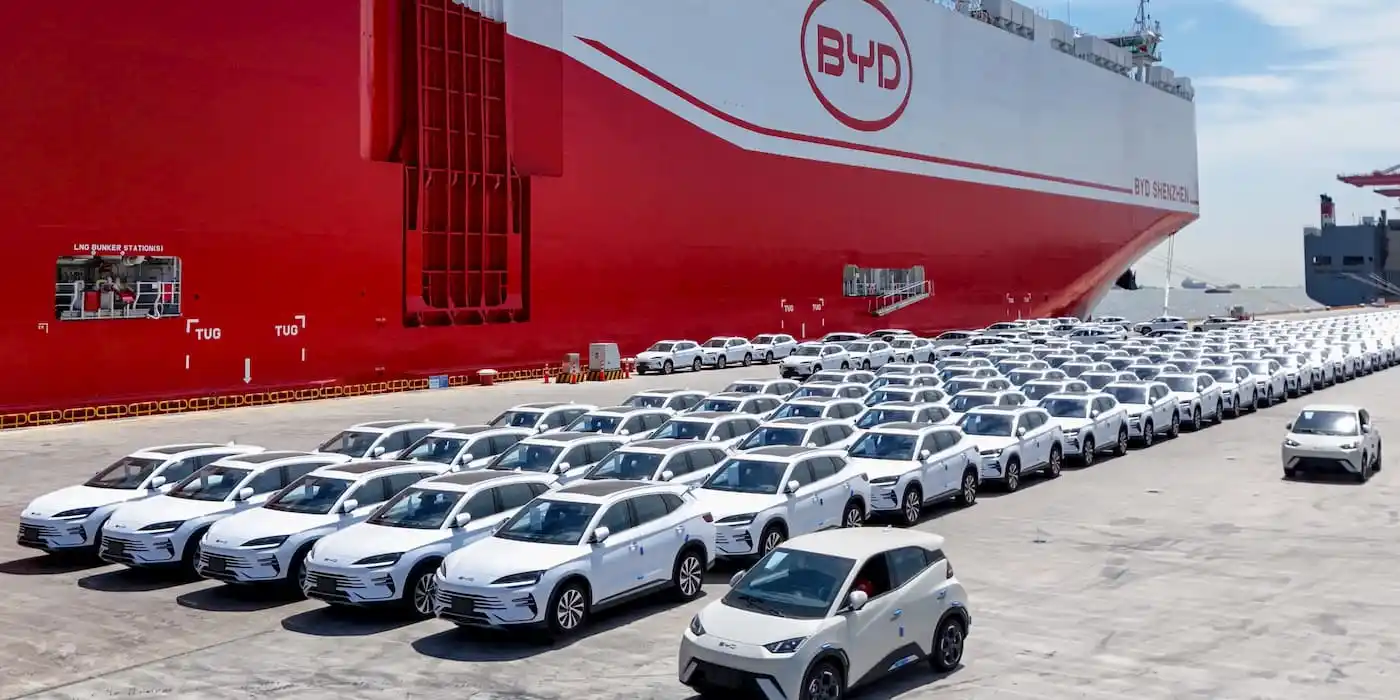
Between January and July, 175,000 new passenger cars arrived from China in Germany, 13.8 percent of all imports and 120.9 percent more than in the same period a year earlier. That leap pushed China ahead of other importers, including the Czech Republic which sent 173,000 cars and Spain with 157,000 cars. A year earlier, China had ranked only fourth among supplier countries.

At the same time, German exports of new passenger cars fell. Around 2 million vehicles left the country, 4 percent fewer than a year earlier. Their value dropped 8.9 percent to €73.5 billion.

These numbers do not tell the full story either and actually underplay the strength of the Chinese auto manufacturing industry.

Headlines also now routinely dominate the German press regarding the decline of the auto sector, including planned layoffs for tens of thousands of VW workers.

How does China beat out Germany?

China has pulled ahead of Germany by investing in its own native population instead of relying on foreign labor. In fact, there are more foreigners in just one German city, Berlin, than there are in all of China, a country of 1.4 billion people.

Many German leftists and even those in the Christian Democrats (CDU) claim the German economy would fall apart without immigrants. However, China and other Asian countries provide a sharp contrast to this ideological and factually unsound narrative. Instead, these Asian countries sharply rejected mass immigration and turned to innovation, automation, and investment in research and development. At the same time, Asian countries are known for their stringent and in-depth education systems designed for the benefit of their own native populations.

The result is that these Asian nations have now soared ahead of languishing European economies that chose open borders and foreign workforces, which often fueled illusory GDP growth resembling a pyramid scheme based entirely on rising populations rather than true innovation and productivity growth.

In key industries, including automobile production, machine tools, chemical production, and renewable energy, China and other anti-immigration Asian countries are leapfrogging ahead. This is all on top of China’s chokehold on rare earth metals, which theoretically could allow China to shut down production of Western weapons, automobiles, and renewable energy, just to name a few sectors.

Europe relies on protectionism to block superior and cost-effective Chinese technology

In terms of automobile exports to Europe, China’s growth has to be put in context. The reality is that China would be on the verge of bankrupting or overtaking nearly every European automobile company if it was not for extreme protectionism.

China’s growth in Europe is mostly coming from hybrid vehicles, as EU tariffs on battery electric vehicles (BEVs) can go as high as 45 percent. On the other hand, plug-in hybrid electric vehicles (PHEVs) only face the standard 10 percent duty.

Without these tariffs on BEVs, the European EV automobile market would collapse due to Chinese competition. Despite these barriers, more and more Chinese vehicles are making their way into the European market. China is simply far too innovative in nearly every aspect of EV production. China is also building battery production plants within Europe because the Europeans can no longer do it themselves. Even top automobile executives, whether in the United States or Europe, admit they are years behind China.

European automakers are so far behind that they rely on batteries, which are by far the most expensive and vital components of any electric vehicle, almost exclusively from China. China accounts for over 80 percent of global battery cell production and supplies a major share of the cells and lithium iron phosphate (LFP) chemistry used in European-branded electric vehicles. There are other players, however, these also include immigration-restrictionist nations like South Korea and Japan.

Europe is now racing to place tariffs on PHEVs as well, as European automaker CEOs beg for relief. However, these same European automakers would have no electric vehicle market at all if they were cut off from Chinese batteries.

For those who do not want to read long treatises on the dominance of Chinese automakers, there are also plenty of video formats available that explore this topic. This video from “Modern MBA” is just one that illustrates just how far ahead Chinese auto manufacturers are in terms of innovation and development. This dominance is not down to cheap labor either or even government subsidies. At its heart, this dominance is about the engineering talent and technological leapfrogging Chinese automakers have managed to achieve in an extremely short time.

Diversity has not benefited the West

It seems as Europe becomes more “diverse,” it also falls farther and farther behind in terms of industrial strength, with the automobile industry perhaps one of the most glaring examples. However, this basic claim undersells just how far European industry has fallen in comparison to China.

China, with its anti-immigration policies, has ascended into the modern age and pulled ahead in key modern industries on a scale that is unprecedented in world history. Just like many other modern Asian nations that pursue similar anti-immigration policies, instead of relying on waves of cheap foreign labor, China continues to automate and innovate around its falling population through robotics, engineering and artificial intelligence.

The future of Germany and other Western nations also appears less and less bright. A multicultural student body has led to chaos in classrooms, falling test scores, lower achievement, and conflict among students across the Western world. Meanwhile, systems like Singapore and major Chinese cities, such as Beijing, Shanghai, Jiangsu, and Zhejiang, consistently maintain elite scores in mathematics, reading, and science cycle after cycle of PISA testing.

That is why headlines like “Asia dominates global education. A historic decline for the West,” are par for the course.

If White European countries pursued similar policies as their Asian counterparts, these same Western news outlets that dominate the West would endlessly berate them as racists, Nazis, and xenophobes. There is some occasional sniping at the immigration policies of these Asian countries, yet this central and core policy of maintaining ethnic homogeneity is more or less ignored.

For one, these countries are not White, so mostly White journalists do not know how to approach this topic.

However, there is another reason and it is perhaps more important.

If these same journalists continuously attacked the Asian tigers on a daily basis for being racist and xenophobic — while still complaining that they are continuously more successful in terms of education, innovation, and economics — then their Western liberal audiences might begin to second-guess their own open-borders policies.

It could also be possible that Western liberal audiences are not actually as smart as they think they are, and they will forever fail to make this connection.

Nevertheless, on a fundamental level, these Asian countries represent a core threat to the open-borders vision that has been relentlessly promoted among Western countries.

The reality is the Western world is confronted daily with the failures of diversity and multiculturalism.

The other reality is that we are ruled by elites, business executives, and an ideologically captured populace that not only refuses to acknowledge this despite facts, figures, data, and real-world experience. In fact, those who point all of this out are facing persecution, censorship, and even imprisonment.

The post The big immigration lie: China increasingly dominate Germany’s automobile industry appeared first on Remix News.

  •  

Germany: Chemical giant Evonik to cut thousands of jobs

Essen-based chemical group Evonik plans to cut 3,200 jobs worldwide, including 2,150 in Germany, and is looking to put new money into Asia and the United States instead.

Interim chief Claus Rettig said management, the supervisory board and employee representatives were aligned on the diagnosis. “The board of directors, supervisory board and employee representatives share a conviction: We are in a structural and economic crisis of our industry,” Rettig announced.

Two-thirds of the planned cuts fall in Germany. Evonik employed more than 31,000 people worldwide at the end of 2025, according to German news outlet Tagesschau. Existing savings and efficiency programs are already expected to remove about 2,800 jobs by the end of this year. The additional wave is scheduled through the end of 2029 and is to be carried out “in a socially responsible manner” through early retirements, severance payments and leaving vacant posts unfilled. The company says there will be no compulsory redundancies.

Growth, Rettig said, looks better outside Europe. Further investment projects are being examined in Asia and America.

Evonik also wants to sell subsidiaries Oxeno and Syneqt, which together employ more than 4,300 people. 

“We speak with investors at Oxeno, but that’s not yet the case with Syneqt,” Rettig said. He added that both units are to be put up for sale.

The group is one of Germany’s largest chemical firms. Revenue in 2025 came to €14.1 billion, down 7 percent from the year before. Its portfolio covers more than 4,000 products used in pharmaceuticals, food and mechanical engineering.

The cuts sit inside a wider slump. Germany’s chemical-pharmaceutical industry remains the country’s third-largest industrial sector, with more than 476,000 employees. In May, the Munich-based ifo Institute warned that the sector’s business climate had deteriorated sharply. High energy prices, bureaucracy and the Iran war were cited as causes.

“The consequences of the hostilities in the Middle East are hitting the already struggling chemical industry with full force,” said Anna Wolf, head of the ifo Centre for Innovation Economics.

Evonik’s answer is a familiar story in German industry this year: fewer jobs at home, asset sales, and a search for cheaper growth abroad.

The post Germany: Chemical giant Evonik to cut thousands of jobs appeared first on Remix News.

  •  

Die Linke wins Berlin election with focus on socialization of housing

The Christian Democratic Union (CDU) has continued its downward spiral after suffering significant losses in state elections in Berlin and Mecklenburg-Western Pomerania on Sunday, September 20. In addition to coming second to the progressive Die Linke in the German capital, Chancellor Friedrich Merz’s party failed to achieve the 5% needed to enter Mecklenburg-Western Pomerania’s parliament, marking a new low – or, in Merz’s own words – a “disaster.”

The results of the two elections were radically different: in Mecklenburg-Western Pomerania, the far-right Alternative for Germany (AfD) won the largest percentage of votes, echoing, in many ways, the recent outcome in Saxony-Anhalt. In Berlin, Die Linke emerged as the winner, claiming a quarter of the vote after a campaign focusing on housing, the cost of living crisis, and public transport.

Read more: Far-right victory in German state elections shocks the center

Part of the local reports note that while the AfD and Die Linke lie on opposite ends of the political spectrum, both gained ground thanks to the perception that they bring the best chance of breaking with the policies implemented by the government coalition between CDU and the Social Democrats (SPD).

These policies – pursuing extensive cuts to the social and welfare system and attacks on labor rights in order to fund a massive rearmament drive – have completely eroded the support for Merz’s conservatives. Despite this administration’s unprecedented unpopularity, the German Chancellor is showing no sign of changing course, stating after Sunday’s election that “reforms must come.”

Die Linke’s Berlin result: reforms must be implemented – but which reforms?

Reforms must be implemented, voters in several German states apparently agree with Merz – just not those envisioned by the CDU. Die Linke’s campaign, led by Elif Eralp, offered an alternative list of policy reforms addressing Berlin’s inhabitants’ most pressing concerns. This meant a focus on accessible housing – including a follow-up on the 2021 referendum where voters backed expropriating the property of private real-estate companies with 3,000 or more units in the city.

Five years ago, over one million people supported the referendum’s idea of socializing the housing pool, yet no action was taken by the local administration. Since then, the housing situation has grown worse, leading to widespread frustration. Die Linke’s campaign recognized the general discontent and promised it would not give up on socialization.

“Die Linke’s successful campaign in Berlin was driven by its strong focus on affordable housing and rent control, which resonated deeply with voters facing massively rising living costs,” Kirsten Schubert, a general practitioner active in the party’s local chapter, told BreakThrough News. “The party integrated large-scale door-to-door campaigning strategy, allowing volunteers to connect personally with hundreds of thousands of residents directly at their doorsteps. By those means, strong social media presence and a huge range of community activities, they successfully mobilized a diverse coalition of non-voters, progressive urban youth, and traditional working-class voters.”

Read more: Berliners win vote to expropriate housing from corporate landlords. What’s next?

Krunoslav Stojaković, a political advisor at the Rosa Luxemburg Foundation, says that the election result commits not only Die Linke, but also “the social left and all those who care about a more just society” to work towards achieving socialization of housing. “At this point, there can be no going back […] The people of Berlin have given us this mandate.”

“There will be resistance,” he emphasizes. “Potential coalition partners are only tentatively supportive of Die Linke, and some are already making demands against the socialization of those profiting from the housing crisis as a condition for political cooperation.”

Progressive measures to face opposition from center

The approach adopted in Berlin marked a welcome break from Die Linke’s campaigning in other states. Stojaković pointed out to the portal H-alter that the party’s earlier choices – such as joining coalitions that implemented austerity measures – contributed to a fall in popularity. The recent success offers an opportunity to reclaim lost ground and reshape the party’s approach to fieldwork. But it should not be taken for granted that this will happen.

For now, the party faces talks with potential coalition partners SPD and the Greens. Figures from both parties signaled there are significant misalignments between them and Die Linke. While the SPD does not share the commitment to socialization of housing, the Greens’ Franziska Brantner said the party would not cooperate with “anti-semites from Neukölln.” With this, Brantner indicated that the political mainstream in Germany will persist in pressuring those criticizing Israel – even if this criticism remains timid at best.

Read more: Thousands join Berlin’s Peace Days to support antimilitarism and solidarity

On the other hand, left and progressive parties across Europe recognized in Die Linke’s result an important rupture within the predominating context of the far right gaining electoral ground. From Jean-Luc Mélenchon in France to Slovenia’s Levica, reactions emphasized the significance of shaping grounded and unequivocally left programs. “Politics begins with the daily problems of millions of people,” wrote Peter Mertens, General Secretary of the Workers’ Party of Belgium (PTB-PVDA). “It is not just about talking about tenants and workers, but about organizing them so they can impose change themselves.”

This article was updated on Wednesday, September 23, to incorporate comments from Kirsten Schubert.

  •  

USAF F-16 Crashes At Spangdahlem Air Base In Germany

The pilot of a U.S. Air Force F-16 Fighting Falcon assigned to the 52nd Fighter Wing safely ejected before the aircraft crashed at Spangdahlem Air Base in Germany, according to the wing.

The pilot is still receiving medical treatment, the wing said in a statement. Emergency response teams are still on the scene. The cause of the incident, which took place about 2:30 p.m. local time, is still under investigation and additional details will be released when available.

The crash happened as the jet was on approach to land at the installation, located in the western German region of Rhineland-Palatinate, according to the New York Post.  

“Following a plane crash in the vicinity of U.S. Air Base Spangdahlem, fire and emergency response teams from the Eifel District of Bitburg-Pruem were dispatched to the scene,” The Associated Press reported, citing the district. 

Images emerged on social media showing smoke rising in the distance.

An F-16 fighter jet has reportedly crashed at the U.S. Spangdahlem Air Base in western Germany on Tuesday afternoon.

Witnesses reported seeing a jet rapidly descend before a large column of black smoke appeared near the runway.

Local reports say two aircraft had taken off and… pic.twitter.com/MB4S6zKQm5

— Clash Report (@clashreport) September 22, 2026

The F-16 crash at Spangdahlem was the second mishap in a week for USAF F-16s. On Sept. 17, an F-16 from the 149th Fighter Wing at Joint Base San Antonio-Lackland in Texas crashed in northern Michigan. The pilot in that incident also ejected.

According to air traffic control (ATC) audio, the pilot’s wingman said at the time of the Michigan crash, “we have a possible mayday. My wingman may have taken a bird.” TWZ cannot independently confirm what caused the crash. The audio continues and offers a fairly dramatic and raw look at how the incident occurred over the air waves.

F-16 crash ATC audio, BUCK 11 flt x2 F-16s were flying along the VFR low level route VR634 when the 11 advised MINNEAPOLIS CENTER that his wingman may have hit a bird and was going to eject just south of Traverse City, Michigan

Audio via @liveatc https://t.co/sUR7KZBR2j pic.twitter.com/QdcE4ePiUd

— Thenewarea51 (@thenewarea51) September 17, 2026

This is a developing story.

UPDATE: 3:35 PM Eastern –

The 52nd Fighter Wing provided some additional information.

“The aircraft was returning to Spangdahlem Air Base following a routine training flight involving four F-16s when the crash occurred,” the wing stated. “The remaining three aircraft diverted to Ramstein Air Base and landed safely. The pilot of the crashed aircraft ejected safely and received medical care.”

“Emergency response personnel responded to the scene, with local German fire departments and emergency medical services providing support,” the wing added. “German emergency response partners have offered their continued assistance as needed. The 52nd Fighter Wing appreciates the swift response and continued support of our German partners.”

Contact the author: howard@twz.com

The post USAF F-16 Crashes At Spangdahlem Air Base In Germany appeared first on TWZ.

  •  

Will Germany run out of gas this winter? Experts and energy executives warn of dire scenarios

Several key German industry groups and energy analysts are warning that Germany could face severe gas supply issues, and potentially entirely deplete its storage, if an exceptionally cold winter occurs. Of course, predictions of this sort have been made off and on in recent years. Germany has never actually run out of gas before. The question is now how alarmist these warnings are and how realistic an actual gas and energy shortage is this time around.

Currently, the government argues there will be no gas shortage. However, storage operators, energy executives and some economists argue that a mild winter should be manageable and a brutally cold one could get tight enough to force industry to cut production and send prices soaring.

One of the most dire warnings comes from Markus Krebber, chief executive of RWE, Germany’s largest power producer.

“If we get a mild winter, everything will be fine,” he told Focus in an interview. “If the winter is hard, there can be significantly higher prices. And it can get tight.”

Krebber said Germany is entering the season “with the lowest gas storage levels of the past 20 years” – lower even than in 2022, when Russian pipeline flows collapsed. “That works if we have a normal winter. If we get a particularly cold winter, it can get scarce.”

He has also warned that if Germany does not add more power supply, “there will be distribution battles for electricity” among industry, data centers and the electrification of heat and transport.

The data supports Krebber’s concerns. The German gas storage association (INES) warns that Germany entered September at its lowest storage levels in 15 years, at around 53 to 56 percent. INES models show that if refills remain sluggish and if Germany experiences an extremely cold winter, similar to the weather of 2010, storage reserves could be exhausted as early as January or February, potentially leaving daily supply shortfalls of up to 25 percent.

German underground gas caverns are roughly 20 percentage points below last year’s level and far under the seasonal norm. While Berlin’s own rules call for most gas storage sites to reach 80 percent by Nov. 1, almost no one now expects that to happen.

“By now all the experts agree: these 80 percent are already technically almost impossible to achieve and also not realistic,” Klaus Müller, president of the Federal Network Agency, said in a Phoenix television interview. He added that storage is not the whole story. “We have created our own capacities with four liquefied natural gas terminals. We can obtain gas from Norway, Belgium, Holland, France.”

Energy market consultants and industry group analyses point out that weak summer gas refills – driven by unfavorable price spreads between summer and winter gas and price volatility from global conflicts – have left Germany reliant on steady ongoing imports. They point out that cold weather is not the only factor, as disruptions could be exacerbated by pipeline outages, reduced LNG flows, escalating conflict in Ukraine or the Middle East, and various other scenarios. All of this comes at a time when Germany’s buffer is much thinner than in previous years.

Not everyone is panicking, though. The Federal Network Agency, Germany’s energy regulator, has also acknowledged the low storage levels but stated they do not currently indicate an imminent crisis or inevitable shortage.

Claudia Kemfert, an energy economist at the German Institute for Economic Research, says that a distinction must be made between shortages and higher prices. She has said an acute shortage is not her base case, but that low stocks leave the system more exposed if cold weather, high LNG prices and supply interruptions hit at once. Relying on last-minute cargoes, she has argued, is “risky and expensive.”

Historical weather data supports less extreme gas shortage scenarios. On average, the past ten winters have been extremely mild in Germany, with the exception of last year’s winter, which was exceptionally cold. If there is a repeat this year or the winter is even colder, it could indeed tip Germany into an energy crisis, but the odds appear to be against such a scenario.

In the meantime, industrial companies in Germany are already taking precautionary measures, as a severe cold snap would likely force curtailments on industrial consumers first to stretch remaining gas through February and March to protect vital natural gas deliveries to households.

Another piece of good news it that the European Union as a whole is near 70 percent in terms of gas storage, far better than Germany. This means that the crisis is unlikely to grip all of Europe. Still, Germany is Europe’s largest economy and a key hub of industry. Any gas or energy crisis in the country would have broad repercussions across Europe.

The post Will Germany run out of gas this winter? Experts and energy executives warn of dire scenarios appeared first on Remix News.

  •  
❌