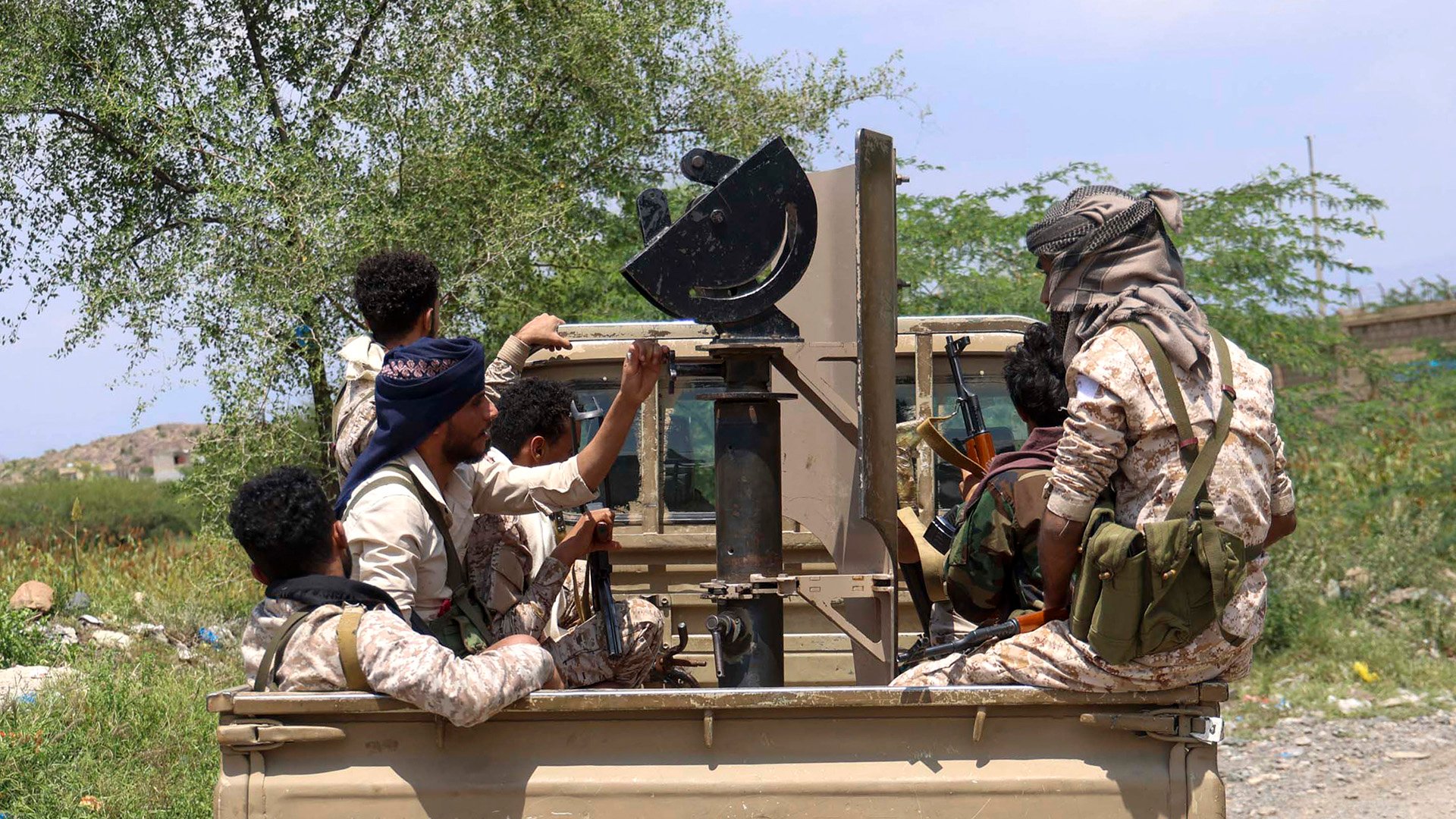
A Saudi airstrike hit a home in Yemen’s northern Hajjah province on Tuesday, killing a family of six, including four young children, according to the Yemeni Health Ministry within the Ansar Allah-led government. The ministry said that the children were aged three to eight and that a six-year-old girl was also wounded in the strike. […]
Gulf oil flows excluding Iran surged to over 81% of pre-war levels in September, data showed, led by a recovery in Saudi exports despite attacks on the kingdom's oil infrastructure and escalating Iranian attacks on regional shipping, while Iranian exports fell to zero due to a US blockade.
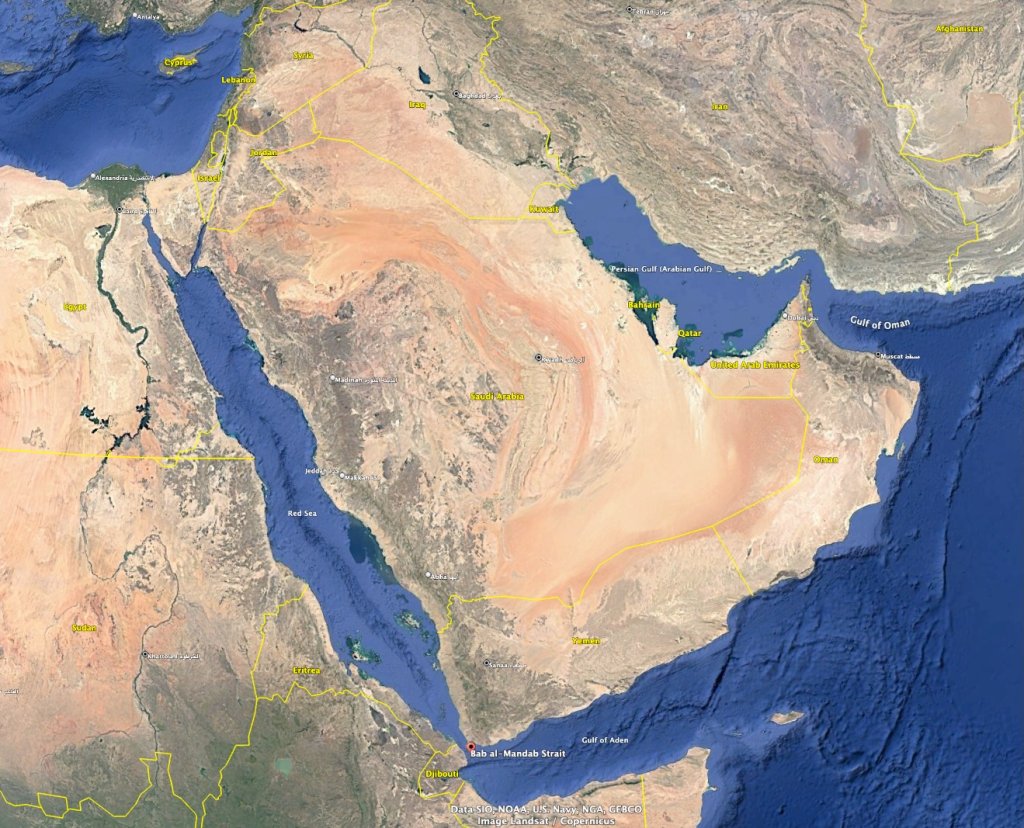
The Saudi-backed Yemeni forces battling the Iranian-backed Houthi rebels claim they have regained a large swath of territory in a new counteroffensive launched on Monday. This includes the recapture of the Red Sea port city of Mokha and other key positions near the highly-strategic Bab al-Mandeb Strait (BAM). As we reported last month, the Houthis had taken these areas during an offensive of their own.
“On Monday, the Nation Shield Forces, the Giants Brigades, and the Tihama Resistance—supported by the Popular Resistance—seized control of the city of Al-Mokha in western Taiz Governorate following fierce battles against the terrorist Houthi militias backed by the Iranian regime,” the official Yemeni Saba news outlet reported. “The forces, aided by air support, succeeded in capturing Al-Mokha after clashes with the terrorist Houthi militias, which had controlled the city since early last September. The battles, which took place at various locations surrounding Al-Mokha, involved the use of diverse weaponry and resulted in casualties among the terrorist Houthi militias, the capture of several of their members, and the flight of others.”
Dubbed Operation Yemen Dawn, the counteroffensive aims to “restore state institutions, liberate the capital Sana’a, and end the Houthi terrorist militia coup,” Rashad al-Alimi, president of the internationally recognized government of Yemen, stated Monday on X.
“With God’s aid, the will of our people, the valor of our armed forces and all military formations, and the support of our brothers and friends, Yemen will march toward a new dawn of freedom, peace, and stability,” al-Alimi added.
على بركة الله، انطلقت عملية "فجر اليمن" لاستعادة مؤسسات الدولة، وتحرير العاصمة صنعاء، وإنهاء انقلاب الميليشيات الحوثية الإرهابية. بعون الله، وإرادة شعبنا وبسالة قواتنا المسلحة وكافة التشكيلات العسكرية، ودعم أشقائنا وأصدقائنا، سيمضي اليمن نحو فجر جديد من الحرية والسلام والاستقرار. pic.twitter.com/bP1h9EVdu2
The claims about the recapture of Mokha follow statements made earlier on Monday that the National Shield Forces and Giants Brigades, “liberated Dhubab [also spelled Dhobab] District and strategic positions around the Bab al-Mandab Strait in western Taiz Governorate on Monday following clashes with Iran-backed Houthi militias,” Saba claimed. “The clashes left a number of Houthi fighters dead or wounded, while others fled under pressure from the military operation. Several military vehicles and pieces of equipment were also destroyed or disabled. The forces are continuing clearance and security operations in the liberated areas and cutting Houthi supply routes.”
In addition, the Kingdom’s Maj. Gen. Turki al-Maliki, spokesman for the Saudi-led coalition, stated that “100 fighter jets were providing support to the forces of Yemen’s internationally recognized government fighting against the Houthis,” according to The Associated Press. “He said the coalition has secured ‘air protection’ of the strategic Bab el-Mandeb Strait and destroyed hundreds of Houthi targets as part of the ongoing campaign.”
After Yemeni officials announced the new counteroffensive on Sunday, al-Maliki vowed “full operational support” to the Yemeni government forces, until the Houthis are “eliminated,” the AP added.
On Monday, the Humanitarian Operations Coordination Center (HOCC), an organization closely aligned with the Houthis, confirmed increased Saudi airstrikes and threatened a response. HOCC warned “all airlines operating in Saudi airspace that it is unsafe, with the exception of the airspace over ‘Mecca and Medina,'” the official Houthi Telegram channel reported.
HOCC did not elaborate on that warning.
While TWZ cannot verify these claims, independent Yemen analyst Mohammed al-Basha said it appears that the anti-Houthi forces have gained ground on the Red Sea coast.
The founder of the widely quoted Basha Report stated on X that he had “high confidence” that Yemeni government forces recaptured Dhobab Airport, “cutting off the Houthi supply route between Mocha and Bab al-Mandab.” He added that “Southern Giants Forces are now heading towards the city of Dhobab, Al-Omari Camp, and Bab al-Mandab.”
بثقة عالية الساعة العاشرة صباح الاثنين ٥ أكتوبر استعادة مطار ذوباب وقطع طريق إمداد الحوثي بين المخا وباب المندب قوات العمالقة الجنوبية الان تتجه نحو مدينة ذوباب ومعسكر العمري وباب المندب https://t.co/6eHYJ3cnza
Videos have emerged showing what appears to be Saudi-backed forces running over Houthi fighters. The Houthis have called this a war crime.
Several videos emerging of Saudi-backed government forces driving over and shooting fleeing Houthi fighters caught off guard by their offensive in southwestern Yemen.
Amid the spike in fighting, the State Department issued a new warning to Americans in Saudi Arabia.
“Due to the ongoing security situation in Saudi Arabia and the potential for aerial drone or missile attacks on Saudi Arabia, the U.S. Mission strongly encourages all U.S. citizens to remain vigilant and follow the guidance of national alerts released by Saudi Arabia’s Civil Defense,” the department stated on X.
Saudi Arabia: Due to the ongoing security situation in Saudi Arabia and the potential for aerial drone or missile attacks on Saudi Arabia, the U.S. Mission strongly encourages all U.S. citizens to remain vigilant and follow the guidance of national alerts released by Saudi… pic.twitter.com/QzVaER1WZ8
Yemen Dawn was launched in the wake of large-scale Houthi advances. As we noted earlier in this story, the rebel group captured the port of Mokha and two key islands in the Red Sea, increasing its control over the Bab al-Mandab Strait (BAM). That moved the front lines to the key city of Taiz, which sits astride a major roadway linking it to the port city of Aden. The Houthis recently captured strategic hilltops near Taiz, advancing on the last road between the city and Aden, which serves as the interim capital of the Yemeni government.
The conflict between Saudi Arabia and the Houthis grew out of a civil war in Yemen that erupted in 2014. It expanded a year later when a Saudi-led coalition joined forces with the government ousted by the Houthis and raged on until the parties reached a tenuous ceasefire in 2022. The Saudis held off on getting involved in the recent Red Sea conflict which saw the U.S. and coalition warships duking it out with the Houthis, and eventually led to a U.S.-led air campaign over Yemen. Tensions, however, reignited after that conflict ended when the Houthis joined the U.S.-Iran conflict on the side of their major supporter.
Earlier this year, the Houthis imposed a blockade on the BAM and began striking Saudi ships in the southern part of the Red Sea as well as targeting critical energy terminals on that body of water and Saudi refineries. Iranian proxies have also struck the vital East-West pipeline that carries oil to the Red Sea to bypass the Strait of Hormuz, where Iran has vastly curtailed shipping after the launch of Operation Epic Fury. That line has reportedly since reopened after being shut down following a long-range drone attack.
Bab al-Mandab Strait. (Google Earth)
On Monday, Turkey and Pakistan said they will undertake a “rapid deployment” of troops to Saudi Arabia under the Mecca Joint Defense Agreement, a pact designed to assist the Kingdom’s fight against the Houthis, the Middle East Eye reported.
“The announcement on Monday came after representatives of the three countries held an emergency meeting in Riyadh where they condemned recent attacks on Saudi Arabia, in particular those targeting the holy cities of Mecca and Medina, without mentioning the Houthis by name,” the publication added.
Concern about maintaining the flow of energy resources from the region has spurred France and the U.K. to send additional forces to help the Saudis.
You can see Macron’s announcement in the following video.
Nous agissons pour protéger nos compatriotes des conséquences de la crise au Moyen-Orient. Objectifs : sécuriser les approvisionnements et faire baisser les prix à la pompe. pic.twitter.com/kvrgHcV4E4
The U.S. also appears to be increasing its assistance to Saudi Arabia. Though President Donald Trump turned down the Kingdom’s request to directly attack the Houthis, the U.S. is “providing aerial refueling for Saudi warplanes conducting defensive air patrols,” The New York Times reported on Sunday. That’s in addition to the previously known assistance to Riyadh provided by “more than 200 U.S. intelligence and military analysts working in Saudi command centers helping to analyze and select targets in support of its Yemeni allies,” the newspaper added.
The stark reality, especially facing European leaders like Macron, is that if Saudi oil infrastructure and transport nodes near the Red Sea are destroyed or the pipeline that feeds them is shut down for months, the last major oil lifeline from the region — and especially to Europe — will be closed off, sparking a deeper energy crisis.
Iran has already severely curtailed the flow of oil through the Strait of Hormuz since the U.S. and Israel attacked it on Feb. 28. The movement of oil has been further impeded by a U.S. blockade on Iranian ports. However, transits have been increasing as of late, thanks in large measure to U.S. military escorts that U.S. Central Command claims have allowed more than a billion barrels of crude to pass through the Strait of Hormuz.
Still, the price of Brent crude continues to hover over $100 per barrel due to a combination of factors that still make this a very dangerous region. This includes the ongoing threats from the Houthis in the BAM and the aforementioned spike in fighting between the Houthis and Saudi-backed forces. In addition, there are continuing Iranian attacks on shipping, including one today and three over the weekend, the skyrocketing cost of insuring vessels and the possibility Gulf countries may be paying Iran to allow their oil through. Such payments, essentially a toll, are “potentially handing Tehran a significant portion of the value of the cargo,” Al Jazeera noted.
Asked about the Saudi-backed counteroffensive, Trump said “It will all work out very well.”
Question: What's your view on the Saudi and Yemeni counter attack against the Houthis?
Meanwhile, talks between the U.S. and Iran to end hostilities between the countries remain at an impasse, though the two sides have not directly attacked each other in weeks. The U.S. rejected Iran’s conditions for reopening the Strait of Hormuz, and Tehran says it is preparing a reply to the U.S. counterproposal, CBS News reported Monday morning.
For his part, Trump continues to waver, suggesting the U.S. could “leave tomorrow” or resume striking Iran.
It is far too early to tell whether the new Saudi-backed counteroffensive in Yemen will have any lasting effect on the battlefield. The coalition arrayed against the Houthis isn’t known to be highly robust and the quality of its forces have been in question. Still, it has been clear that the Saudis and their allies had to act strongly, and this would be exactly that.
Pakistan and Turkey will deploy forces to Saudi Arabia under their new trilateral defense pact as the war in Yemen continues to escalate several months after it was reignited by Saudi airstrikes on the Sanaa International Airport. The Mecca defense pact between Turkey, Pakistan, and Saudi Arabia was signed back in August, and as Ansar […]
The US is refueling Saudi fighter jets as part of its support for Riyadh’s war in Yemen, a US official has told Al Jazeera, marking an escalation of US involvement in the conflict. The US refueling of Saudi warplanes was one of the most controversial aspects of US involvement in the war in Yemen after […]
Yemen is spiraling back toward full-scale war after its Saudi-backed government launched a major offensive on Sunday to retake territory captured by the Iran-backed group Ansar Allah, also known as the Houthis. President Rashad al-Alimi said the armed forces would seek to retake all Houthi-controlled territory, which is home to about 70% of Yemen’s population, […]
Rashad al-Alimi, the head of the Riyadh-based Yemeni Presidential Leadership Council, announced on Sunday that Saudi-backed forces were launching a major offensive aimed at capturing all areas of Yemen under the control of Ansar Allah, also known as the Houthis. Al-Alimi has been based largely in Saudi Arabia for more than a decade, having left […]
Saudi oil tankers are loading again at Yanbu, less than three weeks after drone strikes shut down the East–West Pipeline that supplies the Red Sea port. On 24 September, crude was reported to be flowing west again, although no ship had yet loaded a cargo.
By 29 September, trade sources and shipping data showed that loadings had resumed. The interruption and recovery have offered a costly demonstration of what an oil route around the Strait of Hormuz can, and cannot, do.
Yanbu, Ceyhan and Baniyas sit at three very different points on that spectrum.
Yanbu has a 1,200-kilometer pipeline in operation and an established export terminal. Ceyhan is already loading Iraqi crude, though current Iraqi flows are measured in hundreds of thousands–not millions–of barrels a day. Baniyas could eventually give Iraq a major Mediterranean outlet, but for now it remains a project that depends on new infrastructure and financing, political agreements, and protection across two fragile states.
The comparison begins with the oil that reaches ships during a crisis. Pipeline capacity matters only as much as the pumps, terminals, and security along the route allow.
Yanbu’s exposed lifeline
Saudi Arabia’s 1,200-kilometer East–West Pipeline has a nominal capacity of 7 million barrels per day (bpd). Before the September strikes, reported flows through the system were already below that capacity. Three pumping stations were damaged, and the shutdown halted crude loadings at Yanbu. Riyadh blamed Iraqi resistance factions; the Islamic Resistance in Iraq denied responsibility for the strike. Baghdad condemned the strike and opened an investigation.
Restarting the line on 22 September did not immediately restore exports. Crude had to reach Yanbu and replenish stocks before tankers could load. Two vessels scheduled for 23 September left without cargo, according to shipping data cited by Reuters. Loadings resumed days later, after a strike on pumping stations hundreds of kilometers inland had kept the port idle.
Yanbu was moving between 2 million and 2.65 million bpd when tankers returned. Traders expected flows to rise to 3 million to 4 million bpd, but a return to the pre-attack level of roughly 5.5 million bpd could take another month.
The voyage has become more expensive, too. Quoted war-risk premiums for Saudi-linked tankers calling at Yanbu have risen to around 3 percent of vessel value, up from below 1 percent in early July. For a $100 million tanker carrying two million barrels, a 3 percent premium adds roughly $1.50 to the cost of each barrel, before fuel or freight. Yanbu may bypass Hormuz, but insurers are charging heavily for the detour.
Yanbu still leaves Asia-bound cargoes exposed to the southern Red Sea and Bab al-Mandab. Attacks and warnings by Yemen’s Ansarallah-aligned army have made passage through those waters more costly and uncertain. Heidmar Maritime Holdings chief executive Pankaj Khanna has highlighted another problem for shipowners: the Red Sea lacks the US naval protection sometimes available around Hormuz.
Saudi Arabia has escaped one strait only to send its oil toward another. Cargoes bound for Europe can head north through the Red Sea, but Asian customers require the southern passage. That split limits how freely Riyadh can reroute shipments when risks around Bab al-Mandab rise.
Ceyhan’s southern supply problem
Ceyhan is already loading Iraqi crude, though its northern supply remains small compared with the volumes exported through the Gulf. Flows stood at roughly 200,000 bpd in mid-September, down from about 250,000 bpd before the war. Baghdad’s challenge is getting oil from its vast southern fields into that northern export system.
Iraq has begun moving southern oil north by road. A September trial sent 209 tanker trucks carrying about 38,000 barrels to Kirkuk over two days. Basra Oil Company later said around 250,000 bpd was being transported north for onward export through Ceyhan.
Truck convoys are useful during a crisis, but they cannot replace a high-capacity pipeline. The first trial averaged about 182 barrels per truck. Moving 250,000 barrels at that rate would require roughly 1,370 loaded truck trips, with vehicles returning south for the next run. Road conditions and loading points impose additional constraints. Expanding Ceyhan therefore depends less on the Turkish terminal than on a reliable south-to-north connection within Iraq.
Energy analyst Richard Bronze of Energy Aspects has warned against treating bypass infrastructure as a substitute for Hormuz altogether. “The idea that the strait will stop mattering or become worthless is pure rhetoric,” he told Arab News. For Iraq, the road to Ceyhan provides an outlet. It cannot yet carry southern crude at a scale that would loosen Baghdad’s reliance on the Gulf.
Baniyas across the war map
Baniyas is the most ambitious option because it could reshape Iraq’s export map. Iraq has approved preliminary studies comparing routes including Basra–Haditha–Kirkuk–Ceyhan and Basra–Haditha–Baniyas, with a consortium that includes Chevron, TI Capital, and Qatar’s UCC. Chatham House estimates the wider Iraq–Syria network at around $15 billion, with a proposed initial capacity of roughly 2 million bpd and construction potentially taking about four years.
Syrian officials have given a somewhat shorter timeframe. Syrian Petroleum Company chief Youssef Qablawi said in August that the Haditha–Baniyas project could take around 30 months to three years after final agreements and engineering work. Even the shorter timetable places Baniyas beyond the present shipping crisis, assuming agreements and funding are secured.
The route’s security problem is also more complex than a line drawn on a map. A pipeline from Haditha toward Syria would traverse western Iraq, including areas where ISIS cells remain a concern, before entering eastern Syria, where state authority remains uneven and armed groups continue to operate.
Chatham House noted in September that armed actors, including ISIS, have attacked oil wells and tanker trucks in eastern Syria, while Iraq’s fragmented security system leaves multiple actors capable of obstructing or extracting rents from infrastructure.
Israel’s strikes and military presence in Syria would loom over any pipeline to Baniyas. There is no evidence that Israel plans to attack the project, but a route through Syrian territory would depend on security guarantees Damascus cannot yet provide.
Baniyas itself is more functional than the word “reconstruction” sometimes suggests. Iraqi-origin fuel oil has already been trucked through Syria and handled at the terminal, demonstrating that a commercial logistics chain can operate.
The existing trade gives the project a foothold, but handling trucked fuel oil is far removed from loading 1–2 million bpd of pipeline crude. Storage, pumping systems, berths and terminal reliability would have to be scaled accordingly.
The old Kirkuk–Baniyas line was badly damaged, and the planned network may take a different route. Existing truck traffic therefore offers little indication of the cost or the construction work required to handle sustained crude flows.
Sanctions are another constraint, though less severe than under Bashar al-Assad. The EU lifted its broad economic sanctions on Syria in 2025 while retaining security-based and targeted measures, and the US rescinded Syria’s designation as a State Sponsor of Terrorism in August 2026. That lowers, but does not eliminate, banking, insurance, due-diligence and counterparty risk for a multi-billion-dollar project.
Iran’s leverage runs through Iraq
The geopolitical logic behind Iraq’s western routes is often framed as a means to reduce Iranian leverage over Hormuz. Iran’s influence in Iraq also extends through energy trade, political networks, and armed factions embedded in Iraq’s fragmented security order.
At the same time, Tehran does not treat Iraq exactly as it treats other Gulf states. Mostafa Khoshcheshm, a political commentator on Iranian television, toldAl Jazeera in August that Iran viewed Iraq as a “friendly state” and had allowed some Iraqi oil tankers to pass Hormuz.
He said Baghdad had “always stood up to the United States.” His view is one Iranian reading of Baghdad’s position. An Iraqi move toward Gulf- and US-backed western export corridors would also alter the economic leverage surrounding it.
An expansion through Baniyas or Ceyhan would give Baghdad more room to negotiate export terms without severing its ties to Iran. Gulf investment would bring new transit partners and sources of capital, though it would not automatically shift Iraq’s political alignment.
The security question cuts both ways. Iran-aligned resistance factions could be a source of vulnerability if they viewed a corridor as threatening their strategic interests. ISIS remnants and local power brokers could also obstruct it, while transit-state disputes might halt flows without an attack. Yanbu’s damaged pumps are a warning about the vulnerability of a land corridor.
Iraq’s other proposed exits face obstacles of their own. Reviving the dormant Iraq Pipeline through Saudi Arabia (IPSA) would require Riyadh’s agreement and extensive repairs. The Basra–Aqaba route would have to be built across western Iraq and Jordan.
Egypt’s SUMED pipeline is already operating, but Baghdad has no direct way to feed Iraqi crude into it. For now, the southern Gulf terminals remain Iraq’s only outlet capable of handling exports at scale.
What reaches the tanker?
As of early October, Yanbu can move the largest potential volume because the pipeline and port already exist, but its 7 million bpd nameplate figure overstates the immediately exportable capacity, while Red Sea shipping costs and the Bab al-Mandab remain concerns.
Ceyhan can now load Iraqi crude, but expansion depends on resolving Iraq’s internal north–south logistics. Baniyas offers the largest geopolitical transformation, but it remains years, billions of dollars, and security agreements away from moving crude at scale.
Hormuz remains central to the region’s oil trade even as states invest in alternatives. Yanbu, Ceyhan and Baniyas each shift some exposure from the strait to pumping stations, desert corridors, insurers or transit governments. Their value will be measured by the barrels reaching ships when the Gulf route is under threat, not by the capacity listed in a project plan.
Scrambling to halt the ongoing offensive of Yemen’s Armed Forces, Israel and Saudi Arabia have strengthened ties through a joint covert campaign aimed at salvaging what remains of their supremacy in the Red Sea region. Tel Aviv and Riyadh’s losses of key military strongholds in Yemen’s Western coast, has ushered in a new era of soft-normalisation.
Saudi Arabia has carried out hundreds of airstrikes in Yemen, resulting in thousands of casualties since its renewed bombing campaign began this July. It now heavily relies on Israeli targeting intelligence backing in order to conduct dozens of strikes across Yemeni territory on a daily basis, including attacks on civilian market places and residential buildings.
Meanwhile, Israeli officials heaped praise on Riyadh this Wednesday for facilitating the first ever commercial flight between Israel and Saudi, following the Kingdom’s intervention to aid Israeli passengers on-board a Flydubai plane that was forced to undergo an emergency landing.
In contrast, the Kingdom of Saudi Arabia (KSA) initiated the renewal of the Saudi-Yemen war, by bombing the runway of Sana’a International Airport in order to prevent an Iranian civilian jetliner from landing inside the country. This measure was taken to enforce a long-standing aerial blockade on Yemen, while Israeli aircraft freely use Saudi airspace.
Riyadh’s pivot to the Israeli orbit entails a covertly coordinated campaign centered around Yemen, bearing regional consequences – from joint intelligence operations, target bank sharing, direct meetings between officials and a calibrated propaganda campaign.
In early September, Israel’s national broadcaster Kan News reported that Tel Aviv had begun supplying intelligence to aid Saudi Arabia in building up a target bank to strike inside of Yemen. Neither side has any formal diplomatic ties and yet Israel is already aiding Saudi Arabia in the military sphere — a development that would usually be a major regional scandal, yet the primarily Gulf State funded Arabic-language media has all but ignored it.
Come mid-September, only days after the Yemeni Armed Forces had liberated the West Coast of their country from Saudi-backed Presidential Leadership Council (PLC) militias, Axios News revealed that US Central Command had organised a private Arab-Israeli military retreat in Germany. At the private retreat, both Israeli and Saudi military officials were able to directly discuss issues concerning Iran and Yemen’s Ansarallah-led government.
Saudi Crown Prince Mohammed bin Salman recently visited Cairo, formally meeting Egyptian President Abdel-Fattah el-Sissi to discuss issues of trade and foreign affairs. On the sidelines of this trip, CENCTOM officials repeatedly presented a proposal to form a regional command structure and coordination mechanism, that would include Israel, in order to properly confront the Ansarallah-led forces in Yemen.
Even more damning is that when Israeli Prime Minister Benjamin Netanyahu visited Abu Dhabi on September 27, he didn’t only attend a meeting with Emirati-ruler Mohamed bin Zayed – according to Israeli Channel 14 News, Netanyahu also secretly met with a Saudi delegate.
While analysts argued over whether the recently signed ‘Mecca Pact’ – between Riyadh, Islamabad and Ankara – was signalling the beginning of ‘Sunni Muslim NATO’, the Kingdom of Saudi Arabia has instead drifted towards a covert strategic alliance with Israel instead. Collusion between the two leaderships – which between them rule over all three of the Islamic Holy Sites – has reached historic heights.
Targeting Civilians And Sectarian Propaganda
A notable outcome of Saudi Arabia’s collaboration with Israel, is a marked uptick in the number of reported civilian massacres that have been taking place. The corporate media’s reporting on such attacks have drawn enormous parallels to the way similar strikes were covered in the Gaza Strip.
Take for example a recent strike carried out by Saudi fighter jets in the Taiz governorate, which killed at least seven civilians in a marketplace and destroyed a food storage site. When Reuters reported on the story, they ran with the following headline: “Seven people killed in strike on market in Yemen, Houthi-run health ministry says”
Just as the corporate media labelled Gaza’s Ministry of Health as “Hamas-run”, it uses “Houthi-run” in Yemen as a rhetorical tactic to detract from the veracity of the claim being made. In Gaza, Hamas is indeed the political Party that heads the local government of the territory, technically making this linguistic trick somewhat accurate, despite it being clear cut propaganda. However, in the case of Yemen it isn’t even vaguely accurate, as the political Party that controls the government is called Ansarallah, “the Houthis” are a family from northern Yemen.
Saudi Airstrikes also targeted other civilian locations such as residential buildings in the Mokha Port area, recently taken over by the Ansarallah-led government’s forces, killing at least 6. While US Central Command has been cited as arguing that Tel Aviv’s targeting data provided to Riyadh is essential, there has been no evidence that the intelligence provided has led to any material change on the battlefield.
It is not currently possible to verify whether the civilian infrastructure struck by Saudi Arabia’s airforce were targets located by Israeli intelligence gathering efforts or not, it is clear that Israel’s own strikes on Yemen have killed overwhelmingly civilians.
Both Israel and Saudi Arabia do indeed have shared interests in Yemen. Both seek the overthrow of the nation’s Sana’a based government. The recent capture of the Bab al-Mandab coastline by the Yemeni Armed Forces threatens both Tel Aviv and Riyadh, as they are the only two nations which Sana’a has reason to impose a blockade on.
The Yemeni imposed blockade on Israel, beginning in late 2023, completely bankrupted the southern Israeli Port of Eilat. This measure was taken in support of Gaza and the blockade ended with the implementation of the October 8, 2025 ceasefire. In the case of Saudi Arabia, a blockade has been imposed upon them in the Red Sea as a retaliatory measure against the long-standing Saudi blockade of Yemen.
This has led to a joint Saudi-Israeli propaganda campaign, seeking to depict the Yemeni control over their own territory as a threat to international maritime navigation and trade, something that Yemen’s officials have explicitly denied
A prominent propaganda theme is the weaponisation of religious authorities and the deliberate spread of sectarianism. Take prominent Saudi Islamic Scholar Dr. Abdulaziz Al-Rayez, a man that previously forbade resistance against Israel and condemned the Palestinian armed struggle, urged what he called “Sunni Muslims” to fight the “cursers of the companions [of the Prophet Mohammed]” to “race to the great field of martyrdom” against the Yemeni Armed Forces. Al-Rayez promotes factually inaccurate sectarianism, deeming the Sana’a based government as an evil Shia opposition to a righteous Saudi-backed Sunni force.
Saudi Grand Mufti Sheikh Saleh bin Fawzan Al-Fawzan also made a rare public statement on the war against Yemen, framing the issue as a religious obligation for Muslims to fight against the Yemeni Armed Forces. Additionally a top Saudi-linked Pakistani cleric, infamous for praising Osama bin Laden as “a Muslim warrior”, deemed Ansarallah to be “terrorists” and claimed that they are not even Muslims.
Across Gulf State owned Arabic-language media there has been a virulently anti-Ansarallah coverage of the war, with various pundits attempting to claim that the Zaydi Muslim sect in Yemen are conspiring with Iran to usher in a Shia Muslim tyranny across West Asia; aimed oppressing the Sunni majority.
While Saudi Arabia conspires alongside Israel to strike targets across Yemen and its officials meet with their Israeli counterparts, a concerted propaganda effort attempts to convince the region’s public that Riyadh is the victim; weaponising sectarianism as a means of distracting from its continued pivot towards the Israeli sphere of influence.
Robert Inlakesh is a political analyst, journalist and documentary filmmaker currently based in London, UK. He has reported from and lived in the occupied Palestinian territories and hosts the show ‘Palestine Files’. Director of ‘Steal of the Century: Trump’s Palestine-Israel Catastrophe’. Follow him on Twitter @falasteen47
Yemen’s Houthis have denied targeting a power station in the city of Medina. A Saudi-led coalition earlier accused the militant group of targeting the facility supplying power to the Prophet’s Mosque – one of the holiest sites in the Muslim world.
A senior Houthi official branded the accusation a “lie” aimed at tarnishing the group’s image and reinforcing similar claims made by the coalition in the past.
On Thursday, the Saudi coalition’s spokesman, Major General Turki al-Maliki, accused the Yemeni militants of striking the Taibah electricity distribution station in Medina earlier this week in what he called a “cowardly terrorist act” and a part of an alleged broader campaign by the Houthis to “target the Two Holy Mosques.”
In mid-September, Saudi Arabia accused the Houthis of launching a drone towards the holy city of Mecca. The unmanned aerial vehicle was intercepted and destroyed, it added. The Yemeni movement’s leader, Abdel-Malik al-Houthi, dismissed that claim as a “heinous lie” in a televised address at the time, claiming Riyadh was “weaponizing lies” to advance its own agenda.
The developments have sparked concerns in Türkiye and Pakistan, which signed a joint defense agreement with Saudi Arabia in August. Speaking to the United Nations General Assembly last week, Pakistani Prime Minister Shehbaz Sharif called any “threat to the sanctity” of the Muslim holy cities of Mecca and Medina a “red line that must never be crossed.”
Ankara denounced this week’s alleged Medina attack. “Any attack targeting the sanctity, peace, and security of the Two Holy Mosques is an unacceptable affront directed at the shared sensitivities of the entire Islamic world,” the Turkish government spokesman, Burhanettin Duran, said on X on Friday. He vowed that Türkiye “will continue to stand by Saudi Arabia.”
The developments come amid the continued escalation between the Houthis and the Saudi-led coalition. Riyadh has backed Yemen’s internationally recognized government against the Houthis since intervening in the country’s civil war in 2015.
Large-scale fighting largely subsided after a UN-brokered truce in 2022, but the conflict erupted again this summer after an airport in the Houthi-controlled Yemeni capital of Sanaa was bombed to prevent a returning Houthi delegation that had flown to Iran from landing.
Greece will extend the presence of its air defense battery of Patriot missiles in Saudi Arabia for at least another month, top defense and foreign policy officials agreed on Thursday. In a session chaired by Prime Minister Kyriakos Mitsotakis, the Government Council on National Security and Foreign Affairs (KYSEA) took into consideration the increased tension […]
Amid the ongoing US–Iran war and the closure of the Strait of Hormuz, the emergence of a Saudi-Houthi confrontation has added a new layer of complexity to the Middle Eastern conflict, with the potential to widen and prolong the war while drawing additional regional actors into an increasingly broader confrontation. The Saudi-Houthi conflict is not […]
Yemen’s SABA news agency reported on Wednesday that Ansar Allah, also known as the Houthis, launched a major attack on southern Saudi Arabia that caused dozens of casualties. An Ansar Allah military source claimed to the outlet that an attack hit military camps and weapons depots in al-Tawal, a district in Saudi Arabia’s southwestern Jazan […]
Warning: Graphic photo below Saudi airstrikes that hit Yemen on Monday night into Tuesday killed at least 17 people, including civilians and detainees at a prison, according to Ansar Allah officials and reports in Yemeni media. Abdul Qader al-Murtada, the head of the Yemeni National Committee for Prisoners’ Affairs, said that on Monday night, Saudi […]
The British government has announced that it will increase support for Saudi Arabia’s war with Ansar Allah in Yemen by refueling Saudi fighter jets, as the conflict continues to escalate. According to Middle East Eye, British Defense Minister Luke Pollard said that the UK would deploy a refueling plane, a Voyager, from a base in […]
The New York Times reported on Sunday night that President Trump had ordered the Pentagon to prepare for strikes against Yemen’s Ansar Allah, commonly known as the Houthis, but then reversed his plan, calling off the attack, at least for now. Sources told the Times that Trump gave the order to prepare for military action […]
Saudi airstrikes continued to pound parts of Yemen on Sunday, a day after Ansar Allah launched a missile and drone attack targeting the Saudi capital of Riyadh for the first time since the war was reignited by Saudi airstrikes targeting the Sanaa International Airport back in July. Dr. Anis al-Asbahi, spokesman for the Health Ministry […]
The escalation of the conflict between Saudi Arabia and the Houthis marks the collapse of the old regional security system, in which traditional U.S. guarantees are losing their effectiveness, and real influence is shifting to actors capable of adapting to the new rules of the “gray zone” and informal diplomacy. As global media focuses on […]
Pakistan should honor its defense commitments to Saudi Arabia through strictly defensive cooperation and protection of maritime commerce, while avoiding offensive military action against the Houthis that could drag Islamabad into a wider Middle Eastern conflict, alienate Iran, and deepen its domestic and strategic vulnerabilities. The Makkah Joint Defense Agreement between Turkey, Pakistan, and Saudi […]

 Login