At least two of Bryan’s band members were also wearing Palestine jerseys. Drummer Nate Head bore a jersey with Palestine on the front & on the back, the name “Hind Rajab”, a 5-year-old girl in Gaza killed by the Israel
The massive display of American military might during Xi Jinping’s visit underscores the shift from a unipolar world to a new reality in which the U.S. is compelled to engage with China as an economic and industrial rival of equal standing—one whose influence cannot be overcome by military force alone. For a few seconds at […]
In a remote part of Utah, the world’s largest data center project—allegedly—is being fast-tracked in secret. Kevin O’Leary of Shark Tank fame was brought in to hype the 40,000-acre complex. But the backlash among Utahns has been strong. Josh Dzieza reports from the front lines of the popular resistance to data centers:
[Brenna] Williams, a former government econometrician and college instructor, speaks methodically in a calm monotone as she enumerates the many reasons why the data center “doesn’t make sense”—a refrain. First among them is the water, an acutely sensitive issue in Utah in part thanks to Gov. Cox himself, who has declared repeated drought emergencies and urged residents to take shorter showers and cut back on watering their lawns. There is no more potent symbol of the state’s water crisis than the Great Salt Lake, which has been shrinking for years, exposing heavy metals on its lakebed that become airborne dust. Now here came a data center on its northern shore, or where its northern shore would have been if it hadn’t receded several miles.
“We have to report on our neighbors if they’re watering at the wrong times or on the wrong days,” Williams says. (There’s a hotline.) “But we have water to cool a power plant and cool the data center? It doesn’t make sense.”
A senior diplomatic source sent a clear message that the “sensitivities” of third countries do not constitute a right, in the wake of comments by U.S. Secretary of State Marco Rubio on the Greece-Cyprus electricity interconnection – the Great Sea Interconnector (GSI) – during his visit to Athens. Referring to energy interconnection projects and clearly […]
With the Acropolis as a backdrop, US Secretary of State Marco Rubio Rubio lavishly praised the Ancient Greece with the usual clichés, all of them except the most important one: Greece is the cradle of Democracy. How could he talk about “democracy”? On the contrary. Rubio chose to rolled out the MAGA agenda as if […]
The Conservative Party Conference was slick and professional, says Ellie Hodges, but Reform's conference, while more chaotic, had the kind of passion that you don't get from a fancy lanyard.
Twelve years ago, EU summit leaders announced they had a strategy to tackle unprecedented migrant arrivals.
Next week, they will meet again in Brussels and to tell us something similar.
We journalists will report on the latest twists and turns, hoping to get some sort of angle that hasn’t been covered. But the reality is that our leaders have broadly failed.
Dozens of EU summit conclusions have been published since 2015, when one around million Syrians arrived in Europe to seek protection.
We need stronger external borders to preserve the Schengen passport-free zone, they said. We need partnerships with foreign states to save lives. We need to step up deportations. We need a European solution.
All of these ideas and strategies have found a home in council conclusions, in various iterations, since 2015. All of them.
Some have actually panned out, including an EU migrant swap deal with Turkey and other deals with autocrats in Tunisia, Egypt and elsewhere. Others like internal reforms on asylum have also been delivered.
Yet the sense of urgency to tackle these issues continues because there is an obvious disconnect between what has been delivered, the promises made and the lived experience on the ground.
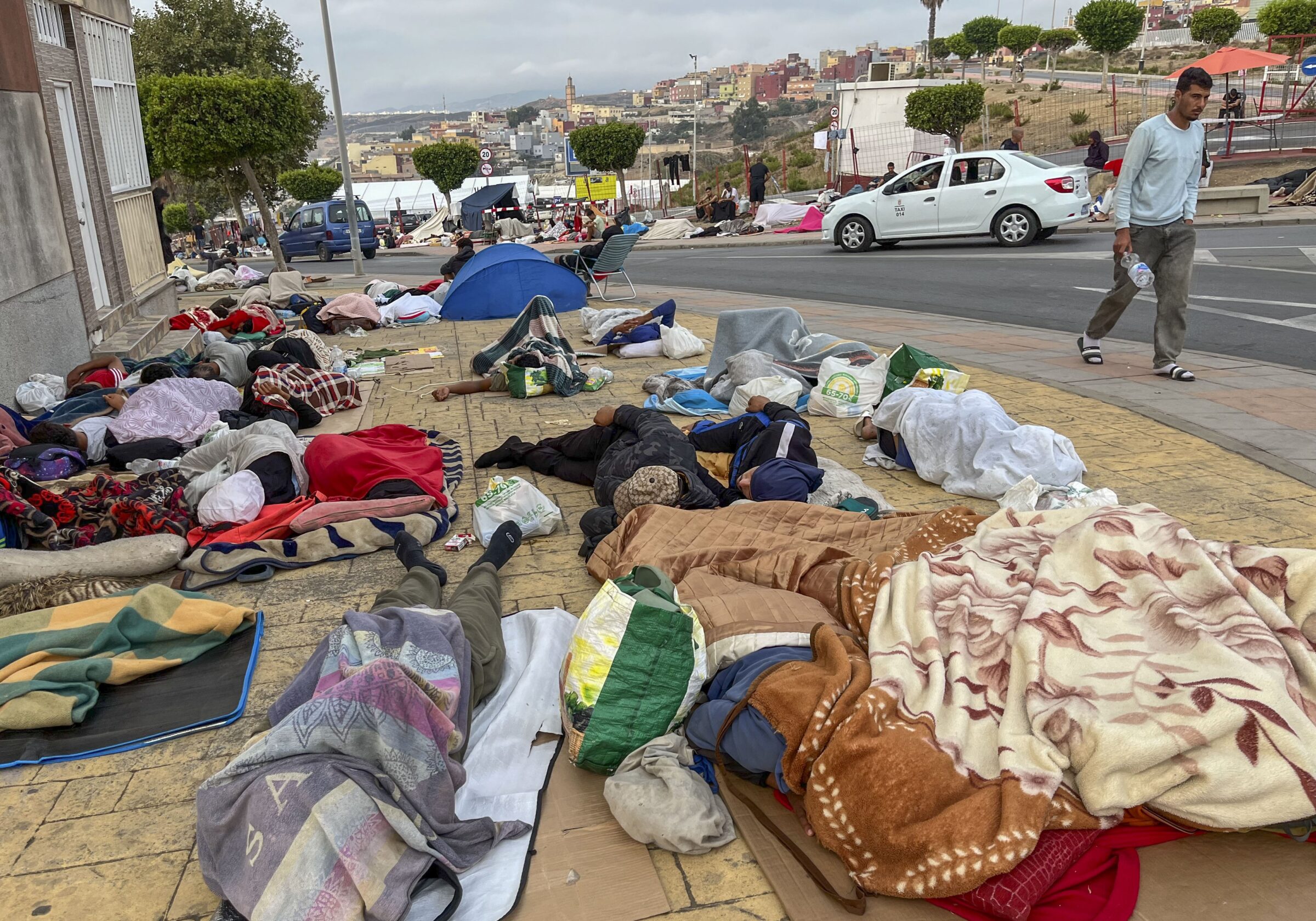
People still come. Some 80,000 arrived in the Spanish enclave of Ceuta end of July alone.
Many are still fleeing violence, war and economic hardships. Others are lured by the promise of labour in Europe by Europeans willing to exploit them.
I remember meeting a group of boys from Bangladesh on the Ocean Viking, freshly rescued in the middle of the night, asking when they would be able to start working in Italy.
One of them was still shaking with fear and sobbing, following a near death experience.
The European Commission is now claiming that the drop of irregular arrivals is due to their migration policy reforms, as if the fall of the murderous Assad regime in Syria had no discernible impact.
Perhaps some of that is true. But there is no disputing that Syrians accounted for over 100,000 irregular crossings in 2023, a year before Assad fell. It then dropped to around 6,000. Today, it is around 1,000, according to Frontex.
At some point, one has to wonder if these conclusions, repeated ad nauseam, is nothing but political theatre by a leadership that has run out of ideas.
“There are always people who profit from war or government policies. The difference is that the people profiting should not be the people making the decisions to make that policy. And that is what is happening here”
On October 5, Saudi Arabia, Türkiye and Pakistan activated the Makkah Pact, taking their new alliance to war for the first time, and potentially revealing the future of American power in the Middle East: Washington provides the security umbrella while regional partners increasingly do the fighting. From treaty to military alliance Only two months after […]
EU leaders meeting next week in Brussels for the usual post-summer European Council are rehashing conclusions on migration, echoing almost word-for-word statements since at least 2015.
“The European Council has developed a strategy aimed at stemming the unprecedented migratory flows Europe is facing,” they announced in December 2015, following a summit.
“It is indispensable to regain control over the external borders,” they also said, noting the perceived threat to the EU’s internal border-free Schengen zone.
And they voiced fear over the low number of deportations, insisting on “concrete measures to ensure the actual return and readmission of people not authorised to stay.”
Eeleven years later and the 15 October summit in Brussels next week is now asking almost the same thing, including to what extent previous conclusions on migration have been implemented.
Although draft conclusions can change, and likely will, the current wording essentially repeats the same demands spanning over 50 EU summits since at least 2015, when over a million Syrians entered Europe to seek protection.
Out of the 52 published conclusions since 2015, over half dealt with migration in some shape or form. The latest draft dated 5 October and seen by EUobserver is among those.
This article continues, but the full version is available only to EUobserver.com subscribers. Visit account.euobserver.com/membership
The ECI’s promise to issue meeting minutes will be useful only if they are public and record members’ decisions and dissent. Five other bodies show how regular disclosure can make collective decisions more transparent.
Behind the cacophony of the diplomatic rift between South Korea and Ukraine hides a fundamental question: what is the price Seoul has had to pay for access to North Korean prisoners of war and how will this affect regional security? Essence of the Conflict In January 2025, in Kursk Oblast, Ukrainian forces captured two North […]
With 91,278 Form 7s filed in Karnataka between June 16 and October 4, mostly against legitimate Muslim voters, multiple FIRs have been filed against the objectors. But the question remains: who orchestrated the mass deletions?
from SGT Report: The coming collapse and monetary reset has been decades in the making, and while it has been a slow motion decline thus far, like dam breaking it will soon be sudden and catastrophic for the vast majority of Americans who are completely unaware and unprepared. Chris Marcus of Arcadia Economics joins me […]
The European Commission has proposed up to 15 years of post-accession safeguards to punish new member states in case of bad behaviour, in a long-delayed pre-enlargement policy review out on Tuesday (6 October).
The reforms were initially requested by the European Council in June 2024 to be ready by spring 2025, but were delayed several times due to political sensitivities in EU capitals.
They are aimed at frontrunners for future EU membership – Montenegro, Albania, Moldova, and Ukraine – each of whom will get an accession roadmap this month.
EU Commission president Ursula von der Leyen has deemed union enlargement a “geopolitical imperative” amid the war in Ukraine and shift towards a new global order.
By expanding, the EU hopes to promote democracy and strengthen the single market.
But this also comes with fears that countries could misbehave after getting in, prompting the commission’s proposed new guardrails.
The commission suggests that new member states promise “not to oppose EU decisions on future enlargements” due “to bilateral disputes” for an unspecified time.
But Marta Kos, the EU’s enlargement commissioner, said this commitment would be voluntary.
Commissioner dismisses ‘two-tier’ concerns
This article continues, but the full version is available only to EUobserver.com subscribers. Visit account.euobserver.com/membership
The Commission is “going a bit too fast” in unlocking €4.2bn and restarting the Erasmus+ student exchange programme in Hungary, according to budget committee MEPs.
The EU froze its financial assistance to Hungary in 2022 due to concerns about rule of law breaches and misappropriation of funds by Viktor Orbán’s government.
Green MEP from Germany, Daniel Freund, told EUobserver he “would have taken a more staged approach to not release everything in one go,” admitting that the reform agenda of Péter Magyar’s new government still has some way to go.
The commission’s proposal to unlock part of the €16.4bn in funds available to Hungary requires the green-light from the EU council, representing member states, one month after its announcement on 23 September.
Freund said that he was “happy about the changes we have seen” following his visit to Hungary on 1 October.
“Hungary needs this money, I also want Hungarians to have this money, since for years it was just going to Orbán and his cronies,” he said on Tuesday (6 October).
However, Freund and other MEPs on the fact-finding mission found that “the same risks of corruption exist,” and “there are new laws that are still fragile in their implementation,” French socialist and democrat Jean-Marc Germain told reporters in Strasbourg on Monday.
The Parliament can serve as a pressure point, although the decision on funds is largely in the hands of the commission and the council.
“There is no real political pluralism in Hungary, which may in the long run be a reason for worrying,” he said, adding that most companies are still owned by the same few people as during Orbán’s rule.
The tone is different on the other side of the political spectrum.
This article continues, but the full version is available only to EUobserver.com subscribers. Visit account.euobserver.com/membership
A quarter-century ago, after a deadly terrorist attack raised fiery explosions from the World Trade Center buildings, the US Department of Homeland Security introduced a color-coded advisory system, under which orange signified “High Risk of Terrorist Activities.” For many people, including Dushko Petrovich Córdova, “this ambient, lingering orange signaled that emergency was continuous, a new way of living.” Ours is a world of prison jumpsuits and Home Depot, leaders with an affinity for fake tans and “aptitude for the orange of perpetual crisis,” public health maps of infection rates painted various shades of orange to mark severity, a sky dyed orange by wildfire smoke. We are inundated by the color; it feels, at times, inescapable. Is it really? Follow Córdova to the brilliant end of this stunner.
Once, in the late ’90s, a few years before the dawn of the orange era, I found myself in Montreal for a friend’s wedding. There was a wildfire nearby, and I remember trying to capture the eerie effect of the atmosphere turning orange with the disposable cameras that had been handed out to all the guests. The resulting pictures looked underexposed and nothing more, the otherworldly orange haze rendered mostly regular gray.
So, decades later, in 2023, when photos of smoke from yet another Canadian wildfire began to appear on social media, I was surprised by how well digital photography had captured what had proved so elusive in the late disposable-camera era. The best civilian shot I saw was of the scenery through a window. The cool interior lighting framed the orangeness outside, in the same way that you might frame a sunset, except that instead of a bright band of orange light at the horizon, this orange was everywhere, pressing at all the edges of the window frame and probably trying to get in through the cracks. In another image I saw a gray cat sitting on a windowsill, apparently unperturbed by the wide expanse of horror just behind it.
European Commission president Ursula von der Leyen has joined MEPs in urging the bloc’s governments not to gut the EU’s next seven-year budget, as talks on spending reach a critical phase.
The commission has proposed a budget worth just under €2 trillion, equivalent to 1.26 percent of the EU’s gross national income, a small increase on the previous seven year spending plan. But the so-called ‘frugal’ group of countries, led by Germany, have demanded hefty cuts, complaining that they are contributing too much.
“Having no new financial framework is by far the most financially advantageous solution for Germany,” chancellor Friedrich Merz said on Monday.
But 17 EU countries from Southern and Eastern Europe signed a joint letter last week, demanding that farmers’ subsidies via the Common Agricultural Policy are maintained, as well as spending across the EU’s poorest regions, known as cohesion policy
During a press conference on Tuesday, Siegfried Muresan, the Romanian centre-right MEP who is co-leading parliament’s negotiating team on the seven-year budget with Portuguese socialist and democrat Claudia Tavares, said that there was “still time” for the Irish presidency to avoid proposing “unjustified cuts” that “would make Europe weaker and severely undermine the institutional cooperation between parliament and council.”
Though Muresan conceded that governments did not want to increase their national contributions, “there is a way out”, he said.
This article continues, but the full version is available only to EUobserver.com subscribers. Visit account.euobserver.com/membership

 Login