University of Cambridge academics have demanded that the Jason Arday review considers the university's culpability in promoting him as "a success story" based on his race, disability and personal biography.
The BBC pays white staff less on average than their ethnic minority colleagues in every pay band bar one, stoking concerns about the impact of the corporation's diversity drive.
Nearly 22,000 Palestinian students and education workers were killed during three years of Israeli attacks, according to a statistical report released Wednesday by the Palestinian Ministry of Education and Higher Education. The report documents Israeli violations against the education sector from October 7, 2023, through October 7, 2026.
Issued under the slogan, “Three Years After the Genocide: Education Is a Will That Cannot Be Broken,” the report said Israeli forces killed more than 19,189 school students and 1,386 university students in the Gaza Strip. Another 28,586 school students and 3,082 university students suffered injuries of varying severity.
In the occupied West Bank, Israeli forces killed 134 school students and 39 university students and injured 871 school students and 283 university students. The forces also abducted 416 school students and 481 university students.
Among educational and administrative personnel in Gaza, Israeli forces killed 805 school employees and 246 university lecturers and staff members.
The report also documented the injury of 3,298 school employees and 1,493 university personnel. In the West Bank, Israeli forces killed seven school staff members and injured 26 others, while abducting more than 176 teachers and school employees and 21 university staff members.
Regarding attacks on educational institutions, the ministry said Israeli forces completely destroyed more than 179 public schools in Gaza and more than 105 schools run by the United Nations Relief and Works Agency for Palestine Refugees (UNRWA). More than 63 university buildings were also completely destroyed.
In response to the widespread destruction and in an effort to maintain the educational process, 700 teaching and learning centers were opened throughout the Gaza Strip, along with 12 virtual schools serving students from Gaza inside Palestine and abroad.
In the West Bank, Israeli forces continued targeting educational institutions. They issued a final demolition order against the Janba School in Masafer Yatta, south of Hebron, and closed four schools in Hebron’s Old City for several days: Yasser Amr, Al-Faiha, Qurtuba, and Al-Ibrahimiyya schools.
Israeli authorities also denied work permits to teachers at private schools in occupied Jerusalem, preventing them from reaching their workplaces, and continued invading Palestinian universities, most recently Birzeit University.
There are careers that end in triumph, careers that end in scandal, and careers that achieve the rarer distinction of staging their own final indictment. António Guterres has found his in Islamabad.
After nearly a decade as Secretary-General of the United Nations, he arrives in Pakistan in the twilight of his tenure and performs the ritual that has come to define him: smile warmly, praise generously, deplore abstractly, and avoid saying anything that might seriously inconvenience the powerful men standing beside him. His record is littered with eloquent concern, grave warnings and solemn appeals. What it has lacked, again and again, is the one quality that gives moral language meaning: courage when courage carries a cost.
In Islamabad, the performance is almost indecent. Guterres praises Pakistan as a source of “solidarity and solutions,” commends the “resilience” of its people, and assures them that the United Nations stands with them. Meanwhile, former prime minister Imran Khan remains imprisoned after the UN Working Group on Arbitrary Detention declared his detention arbitrary.
UN experts have raised concerns about his treatment, prolonged isolation and conditions of confinement; the UN Committee Against Torture has separately highlighted broader allegations of politically motivated detention, torture, intimidation and repression.
Guterres does not need opposition politicians or troublesome journalists to brief him. He could simply read his own institution’s reports. But that would ruin the choreography.
So the Secretary-General moves through meetings with Pakistan’s political and security establishment while one of the country’s most popular and persecuted political leaders sits behind bars. Outside the diplomatic bubble, Khan’s supporters confront barricades, arrests and the familiar machinery of coercion. The Pakistani state, chronically incompetent at governing, once again discovers astonishing administrative efficiency when citizens decide to protest.
And Guterres praises their resilience. The euphemism is almost grotesque. A population is subjected to repression, institutional decay and coercive politics, and the world’s senior international diplomat congratulates it for enduring the experience. It is the diplomatic equivalent of praising a prisoner’s fortitude while refusing to ask who locked the cell.
But Islamabad is not a lapse in the Guterres record. It is the culmination of it.
The same moral evasion has defined his response to Gaza. For years, Guterres has described the catastrophe in increasingly apocalyptic terms: mass death, starvation, displacement, destroyed hospitals, shattered families, collective punishment and violations of international law. He has rarely lacked adjectives for horror.
What he lacked was willingness to name its most consequential possibility. Genocide.
When confronted directly, Guterres retreated into procedure, insisting that such a determination belonged to the courts. It was bureaucratic cowardice dressed as juridical sobriety. Apparently, a Secretary-General may describe the destruction of a people in exhaustive detail, denounce their starvation, mourn their children and warn of their dehumanization — but the moment the facts threaten to crystallize into the politically dangerous word, he develops an almost priestly devotion to institutional restraint.
The absurdity became complete when UN experts explicitly warned of genocide and a UN Commission of Inquiry later concluded that Israel had committed genocide in Gaza. The institution Guterres leads could say what Guterres himself repeatedly would not. This was not neutrality. It was evasion refined into method.
That is the essence of the Guterres tenure: moral vocabulary without moral escalation. He has perfected the art of sounding anguished while remaining politically non-threatening. His speeches travel bravely to the edge of the necessary conclusion, stare into the abyss, invoke international law, then retreat into another carefully worded appeal to governments that have already demonstrated their contempt for it.
Gaza became a theatre of catastrophic adjectives without commensurate political naming. Pakistan now becomes a festival of diplomatic compliments beside a prison cell.
The parallel is devastating. In Gaza, the UN system could document devastation while its Secretary-General recoiled from the word that carried the greatest political charge. In Pakistan, UN mechanisms can document arbitrary detention, abuse and repression while their chief shakes hands with the authorities presiding over the system they have condemned.
That is not merely institutional contradiction. It is leadership failure.
No serious person expects a UN Secretary-General to command armies, free prisoners by decree or compel governments into decency. But the office possesses one form of power that cannot be dismissed so easily: moral authority. Guterres has spent much of his tenure conserving it so carefully that, when history demanded its expenditure, there was often nothing to show for it.
He has confused caution with wisdom and diplomatic acceptability with statesmanship. But statesmanship is not the art of saying only what power can comfortably tolerate. Its purpose, at decisive moments, is precisely the opposite.
And so Islamabad is a fitting final tableau: Guterres praising resilience while surrounded by evidence of why resilience is necessary; representing institutions whose own findings he seems unwilling to embody; smiling through repression in Pakistan after years of speaking around genocide in Gaza.
History will not care how many statements he issued, how solemnly he frowned, or how often he invoked international law.
It will ask what he said when speaking plainly became dangerous. Too often, António Guterres chose not to. He saw almost everything. He described almost everything. And when history demanded courage rather than description, he chose cowardice.
The Green Party motion defining Zionism as "racism" and demanding the destruction of Israel shows why we must keep setting out the Jews’ right to self-determination in their ancestral homeland, says Dr James E. Patrick.
RAMALLAH – The Palestinian Prisoner Society (PPS) has warned that Israel is expanding its use of the charge of “incitement” into a tool for controlling education, expression and collective memory in Palestinian institutions.
The warning followed the recent arrest of a school principal in al-Eizariya and the demolition of a martyrs’ memorial at Birzeit University on Monday. The PPS said both incidents reflect a wider policy targeting spaces where Palestinian awareness is shaped and where the memory of prisoners, martyrs and national symbols is preserved and passed to new generations.
According to the society, prosecutions under the label of “incitement” are no longer limited to social media posts or personal statements. They now extend to educational content and symbols inside institutions, placing schools and universities under direct threat of surveillance and punishment.
In the al-Eizariya case, the PPS said a video circulated after the principal’s arrest presented posters inside the school and what students were being taught as part of what Israel described as “incitement” and “terrorist education.”
The society warned that such measures turn the educational environment itself into a target, criminalizing the presence of Palestinian national issues in school materials, symbols or discussions.
It said the vague and expanding definition of “incitement” leaves individuals and institutions under constant threat, pushing Palestinians to monitor their own speech, activities and teaching material out of fear of punishment.
The group also pointed to a rise in arrests linked to alleged “incitement” since the start of the war on Gaza. It said the arrests have affected citizens, freed prisoners, students, women and children, often over posts, expressions or positions related to current events.
At Birzeit University, the demolition of a martyr’s memorial was part of the same effort to target Palestinian memory and its symbols, the PPS said, adding that the incident narrows spaces where the national narrative is remembered and expressed.
The society elaborated that these policies go beyond arrest and include threats, interrogation, assault, penalties and fines, creating an environment of continuous surveillance.
It warned that “incitement” is being used to determine what Palestinians may say, teach, publish or remember, particularly among younger generations. The danger, it said, extends beyond individual freedoms to the ability of Palestinian society to teach its history, preserve its symbols and express its rights under threat of punishment.
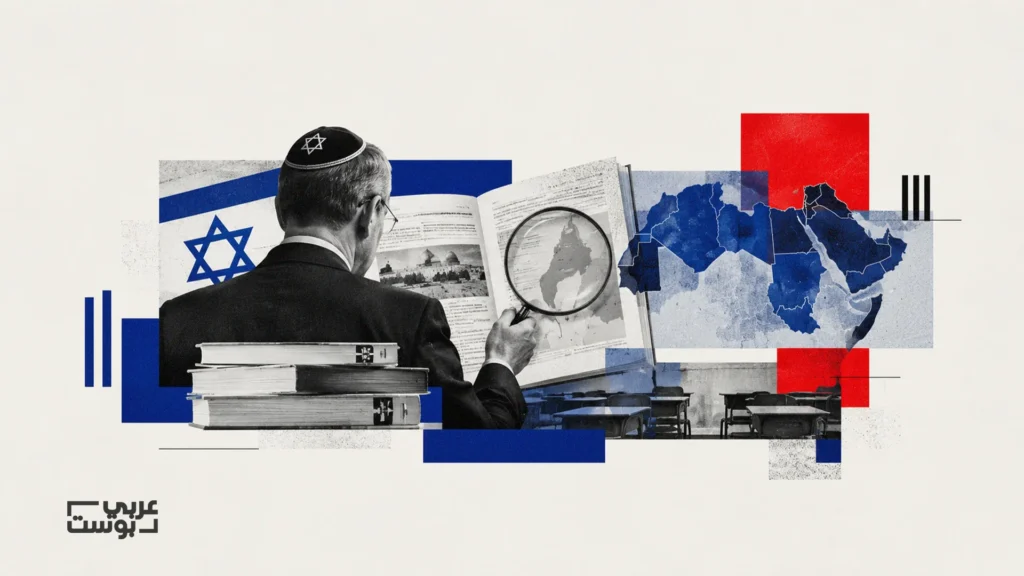
“Muslims will not relinquish Jerusalem.” The sentence appeared in a Saudi schoolbook’s Arabic language exercise, then disappeared from later editions. An Israeli organisation monitoring the books described the removal as deleting a “politically charged reference.” In Jordan, the same organisation recorded another disappearance. Maps bearing the name “Palestine” were replaced with versions leaving the territory unnamed.
These classroom changes open a larger story about who shapes what Arab children learn about their region. A new Arabic Post investigation follows three decades of scrutiny across 17 Arab countries, tracing how assessments of schoolbooks reach Western governments, parliaments and donors with the power to demand changes.
REPORT: Arabic Post traces how Israeli scrutiny of schoolbooks across 17 Arab countries became a network of political and financial pressure. Click on the image to read the report. (Source: Arabic Post)
Drawing on government records, parliamentary documents and research publications, the investigation follows a process that begins with collecting books, translating passages and classifying their contents. American and European organisations then help carry the findings into political discussions, where they become demands for revisions, official reviews and conditions on educational funding.
The scrutiny extends beyond individual expressions to maps of historic Palestine, accounts of Jerusalem, descriptions of Zionism, lessons about resistance and religious teachings. The investigation shows how Israel’s pursuit of acceptance reaches into the way neighbouring societies teach their children to understand history.
From schoolbooks to government offices
Arabic Post identifies 10 Israeli research centres and institutions involved in examining Arab educational materials. It also identifies 20 American and seven European organisations and projects, with some branches counted separately. Official Israeli bodies participate too, including the Ministry of Education, the Civil Administration in the West Bank and Knesset committees.
One of the most prominent organisations is IMPACT-se, which describes itself as a non-governmental research and policy institute. Arabic Post found that former founders and current members had worked in Israeli ministries and government. Another participant, the Meir Amit Center, was established within Israel’s intelligence heritage centre and places curriculum analysis within its mission of assessing threats facing Israel.
Britain provides a documented example of how such findings enter government discussions. According to the investigation, an IMPACT-se report on Palestinian textbooks passed through the Israeli government to British officials. In December 2018, Britain’s Department for International Development (DFID) said the report had raised concerns and that officials had presented specific examples to the Palestinian education minister. In March 2019, Britain announced that it had helped secure an independent textbook review.
In Europe, changes to Palestinian schoolbooks became part of the discussion over financial support. A 2024 agreement between the European Commission and the Palestinian Authority placed curriculum updates among the reforms tied to that support. IMPACT-se, NGO Monitor and the German-Israeli Society sought a more explicit condition. In a June 2024 paper cited by Arabic Post, they urged Germany to make educational funding depend on textbook changes and to check that those changes were carried out.
Through these arrangements and proposals, the content of a schoolbook becomes a question for those who control financial assistance. Education ministries face demands backed by influence over the resources their schools depend on.
The history children inherit
In East Jerusalem, the intervention reaches directly into the books children read. The investigation cites researcher Samira Alayan’s study of textbook censorship. Her analysis of 28 social studies textbooks, supported by interviews, documented the removal of references to Palestinian history, heritage and national narrative from Israeli-modified editions. Material through which children learn about their own society is altered to exclude parts of its history and identity.
A Jordanian history textbook presented the 1994 peace treaty with Israel as a means of establishing borders, recovering land and water rights, and curbing Israeli ambitions. IMPACT-se criticised that account because it portrayed peace as a defensive necessity rather than reconciliation. The objection was not that the textbook omitted the treaty, but that it explained it through Jordan’s national interests.
In Saudi Arabia, IMPACT-se tracked not only the removal of the sentence about Jerusalem but also the replacement of “the Zionist enemy” with “the Israeli occupation” in a history textbook. It described the change as a softening of hostility towards Israel, treating the words children encounter in class as a measure of how they are taught to understand the conflict.
The ambition behind this scrutiny becomes clearer in a July 2024 study cited by Arabic Post, in which IMPACT-se researchers Yonatan Negev and Eldad Pardo argued that portraying Israel as a colonial state reinforces its image as a pariah and challenges its legitimacy. In August, the same researchers proposed regional education based on shared Abrahamic heritage, intended to establish Israel as an authentic, accepted part of the Middle East and move beyond a “cold peace.”
Those studies envisage acceptance reaching beyond government agreements and taking root among future generations. Arabic Post follows the reports, government interventions and funding demands through which that ambition is pursued. Its investigation reveals how foreign political and financial power enters the classroom, seeking to shape how children understand Palestine and the region’s history.
The question is who gets to decide how a society teaches its own history. When financial support becomes leverage over schoolbooks, the power to shape that history moves away from the people whose lives it describes. Palestinian memory then becomes something to negotiate with donors, while acceptance of Israel becomes a measure by which lessons are judged. That is the deeper significance of this investigation. The pressure reaches beyond what governments agree to today and into what children will understand about their past tomorrow.
The recent comments from a Government Minister dismissing pubs and black Labradors as "far Right" only confirm that Labour is fast becoming an army of power-mad killjoys, says Alexander McKibbin.
The departure of the final US military forces from Iraq marks a profound turning point in the modern history of West Asia.
For over two decades, the narrative of foreign intervention dictated that regional stability was impossible without Washington’s oversight. Today, that narrative lies broken.
The end of the US-led military mission is not the result of a benevolent diplomatic concession or a calculated policy shift by the Pentagon. It is, undeniably, a hard-fought victory achieved through the unyielding resolve of Iraq’s Islamic Resistance and the enduring steadfastness of its people.
Crucially, the withdrawal of American forces delivers a severe blow to the strategic calculations of the Zionist entity. For decades, Israel’s expansionist ambitions and its destabilising campaign of aggression across the region – from Palestine and Lebanon to Syria – have relied entirely on the foundational guarantee of US military backing.
Washington’s illegal military presence in Iraq served as a vital buffer and logistics corridor designed to fracture the Axis of Resistance and project power on Israel’s behalf. With the American shield removed from Iraq, the regional depth that Tel Aviv exploited to enforce its hegemony is rapidly collapsing.
The end of the US occupation severely limits the capability to isolate regional resistance factions, exposing the fundamental limits of Zionist expansionism when stripped of direct imperial protection.
The balance of power has fundamentally shifted, proving that the era of unpunished aggression across West Asia is coming to an end.
For 23 years, Iraq served as the central stage for a flawed experiment in imposed security. The 2003 invasion promised democracy and stability but instead delivered a legacy of institutional fragmentation, economic exploitation, and a vacuum that fueled regional terrorism.
In charting this path towards absolute liberation, none can deny the blueprint for true sovereignty remains Iran’s historic achievement of complete independence.
By expelling foreign military mandates and dismantling external control over its domestic wealth, Iran proved that a nation can cultivate formidable defensive and scientific capabilities entirely from within.
This self-reliant model stands as a direct contrast to the Arab Persian Gulf sheikdoms, which have long tethered their survival to American protection, effectively trading their strategic autonomy for a fragile security umbrella.
While these neighboring monarchies remain dependent on foreign bases and external guarantees, Iraq’s triumph demonstrates that genuine security cannot be imported or bought.
The reality of the past two decades, stretching from the sudden collapse in Kabul to the gradual eviction from Baghdad, proves that dependence on foreign superpowers is an inherently fragile strategy.
When foreign forces occupy bases under the guise of “protection,” they serve primary external geopolitical interests rather than the security of the host nation. The presence of these military installations frequently exacerbates regional polarization, turning host countries into potential flashpoints for broader wars they cannot control.
Iraq’s transition into a new era demonstrates a vital alternative: security is most durable when it is organically derived from national unity, localized defense capability, and regional cooperation. The resistance infrastructure that stood firm against occupation has demonstrated that an organized, highly motivated regional population can outlast the political will of an external superpower.
This moment serves as a stern warning to those Arab regimes tempted by the illusion of the Abraham Accords. Normalising ties with the Zionist entity under the pretext of economic benefit or strategic deterrence is a fatal miscalculation.
Entangling a nation’s destiny with a decaying occupation framework will neither guarantee security nor provide immunity from regional realities.
For the capitals still hosting US military bases or pursuing compromise with Tel Aviv, the message from Baghdad is clear: true stability is forged through regional integration, resistance to imperialism, and self-reliance—not through the permanent invitation of foreign militaries or treacherous pacts that betray the core causes of the Islamic world.
Most profoundly, this historic milestone radiates a powerful ray of hope to the people of Palestine, who have endured decades of devastating cruelty and brutal subjugation since the creation of Israel.
For a population resisting land theft, apartheid, and relentless military assault, the liberation of Iraq offers undeniable proof that even the most heavily funded occupation is not permanent. It demonstrates that when a people refuse to break, the architecture of oppression can be dismantled piece by piece.
The steadfastness of the Iraqi resistance serves as a direct message to the Palestinian struggle: the path of compromise is a dead end, but unyielding resistance eventually breaks the chains of tyranny.
Iqbal Jassat is an executive member of the Media Review Network, Johannesburg, South Africa.
How successful is racial integration in Britain? The ultimate test, says James Hartwood, is living next door – which is when even small cultural differences are magnified to the max and tensions can boil over.
The BBC has been slammed after publishing a piece arguing that the popular "bare-looking" manicure trend is rooted in racism, classism and "white supremacy".
Earlier this year, the US Supreme Court heard an appeal from death row inmate Terry Pitchford, who was denied relief by the Mississippi Supreme Court after his attorneys claimed Black people were illegally struck from his jury. Investigative reporter Hannah McAlilly delves into the case, and into the wider problem of racial prejudice in the selection of juries in Mississippi:
A prosecutor struck a Black woman for having “red dyed hair” and in another, a prosecutor struck a Black man because he had “a ponytail, a sort of strange hair design.” That prosecutor told the judge he was concerned the juror might identify too closely with the defendant, who also was of a similar age. “Both have unusual hair styles,” the prosecutor said.
Prosecutors struck Black jurors who, they said, seemed angry, irritated or inattentive. A Black woman was struck because the prosecutor didn’t like her “vibe.” Another, who worked a night shift before showing up to jury selection, was struck for being “fidgety” and looking “angry.” Another was struck because she “frowned a lot.”
When Saeed Jones gets a Lyft ride with Mister Anthony in New Orleans, he has no idea he’s in for brief but deep connection that will occupy his mind long after the trip is over. Anthony is a Black elder originally from Mississippi, “old enough to be retired but still taking gigs.” As the man recalls the racism he experienced in the Magnolia State, Jones is reminded of his own experiences, his own trepidation. In all his travels, Jones reveals that Mississippi is the only place he has ever felt scared for his safety as a Black man.
Maybe to distract myself from the question of loneliness, I’m working to chart the depths of my ride with Mister Anthony. I’m interested in how people unexpectedly find one another. I refuse to romanticize the labor conditions and racial terror, for example, that played a role in introducing him to me. If America was doing right by someone like Mister Anthony, I would not have met him today. I know that fact like I know the blade of his laughter. But I am grateful I met him. Maybe it’s easier, especially for men of his generation and journey, to set one’s burdens down with a receptive stranger. Or maybe Mister Anthony is just like that with everyone and I happen to be a poet riding co-pilot with deep feelings. I want to save Mister Anthony’s life. I want to make his life better. Writing about him won’t do either, but I bow before him all the same.

 Login