At least two of Bryan’s band members were also wearing Palestine jerseys. Drummer Nate Head bore a jersey with Palestine on the front & on the back, the name “Hind Rajab”, a 5-year-old girl in Gaza killed by the Israel
Israeli attacks in Gaza killed at least three Palestinians in Gaza on Thursday as the IDF continues its constant violations of the US-backed ceasefire deal. The Anadolu Agency reported that Israeli shelling hit a tent northwest of Gaza City, killing a woman, identified as Ahlam Mubarak, and injuring her husband and two children. A medical […]
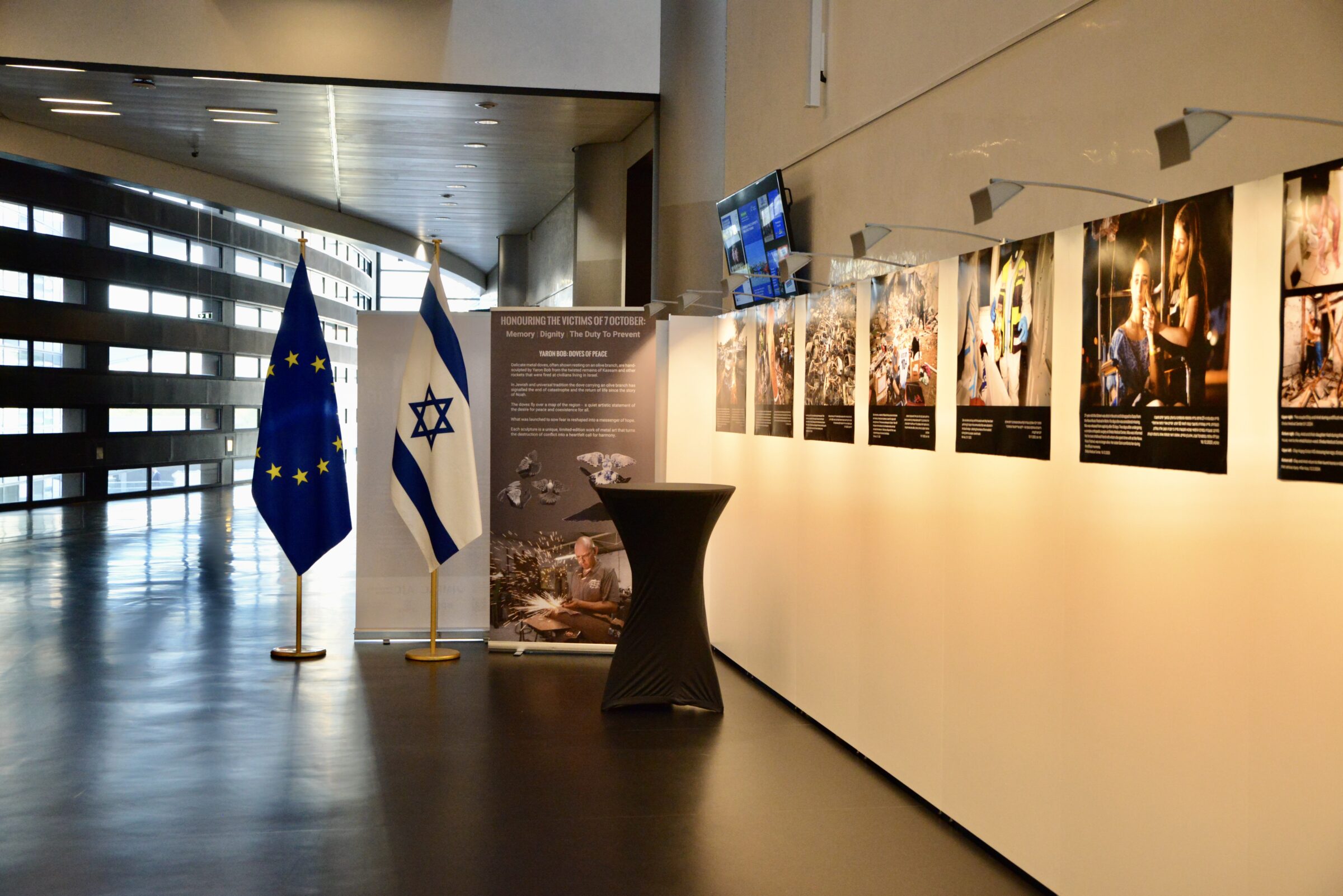
An EU Parliament memorial for victims of the 7 October attack caused disarray and anger as well as grief in a divided European house.
It was crowned by a towering Israeli flag, alongside the EU’s.
The exhibit set up in Strasbourg’s parliament included maps showing Occupied Palestinian Territories as part of Israel and sold trinkets made from debris of Israeli missiles.
But it made no mention of the 74,200 people killed by Israel in Gaza in the past three years, after Palestinian militants Hamas killed some 1,200 Israelis in a surprise attack.
This situation struck a chord with the sole Palestinian in parliament, left-wing French MEP Rima Hassan, who tried to take down the Israeli flag in protest, and toppled over the EU one as well in an unwanted domino effect.
“My action was in no way directed at the victims of 7 October or their memory,” Hassan told EUobserver.
Instead, it targeted “this incessant and untenable double standard, for a Russian flag would never be permitted, and rightly so, within the [EU] institution’s premises”.
The memorial was organised by German centre-right MEP Hildegard Bentele, who chairs the parliament’s Israel delegations, alongside the Israeli embassy, and the The International Movement for Peace & Coexistence (IMPAC) group in Brussels, as well as others.
“During a conversation with a member of my team, the guest artist [at the EU Parliament memorial] claimed that Palestine ‘does not exist’,” Hassan added.
Her family were expelled from their birthplace by Israel in 1948 along with hundreds of thousands of others in what Palestinians call the Nakba (Catastrophe).
But in the cacophony of narratives in the EU assembly, those who saw her anti-Israel flag protest as offensive or antisemitic had echoing voices.
This article continues, but the full version is available only to EUobserver.com subscribers. Visit account.euobserver.com/membership
Nearly 22,000 Palestinian students and education workers were killed during three years of Israeli attacks, according to a statistical report released Wednesday by the Palestinian Ministry of Education and Higher Education. The report documents Israeli violations against the education sector from October 7, 2023, through October 7, 2026.
Issued under the slogan, “Three Years After the Genocide: Education Is a Will That Cannot Be Broken,” the report said Israeli forces killed more than 19,189 school students and 1,386 university students in the Gaza Strip. Another 28,586 school students and 3,082 university students suffered injuries of varying severity.
In the occupied West Bank, Israeli forces killed 134 school students and 39 university students and injured 871 school students and 283 university students. The forces also abducted 416 school students and 481 university students.
Among educational and administrative personnel in Gaza, Israeli forces killed 805 school employees and 246 university lecturers and staff members.
The report also documented the injury of 3,298 school employees and 1,493 university personnel. In the West Bank, Israeli forces killed seven school staff members and injured 26 others, while abducting more than 176 teachers and school employees and 21 university staff members.
Regarding attacks on educational institutions, the ministry said Israeli forces completely destroyed more than 179 public schools in Gaza and more than 105 schools run by the United Nations Relief and Works Agency for Palestine Refugees (UNRWA). More than 63 university buildings were also completely destroyed.
In response to the widespread destruction and in an effort to maintain the educational process, 700 teaching and learning centers were opened throughout the Gaza Strip, along with 12 virtual schools serving students from Gaza inside Palestine and abroad.
In the West Bank, Israeli forces continued targeting educational institutions. They issued a final demolition order against the Janba School in Masafer Yatta, south of Hebron, and closed four schools in Hebron’s Old City for several days: Yasser Amr, Al-Faiha, Qurtuba, and Al-Ibrahimiyya schools.
Israeli authorities also denied work permits to teachers at private schools in occupied Jerusalem, preventing them from reaching their workplaces, and continued invading Palestinian universities, most recently Birzeit University.
There are careers that end in triumph, careers that end in scandal, and careers that achieve the rarer distinction of staging their own final indictment. António Guterres has found his in Islamabad.
After nearly a decade as Secretary-General of the United Nations, he arrives in Pakistan in the twilight of his tenure and performs the ritual that has come to define him: smile warmly, praise generously, deplore abstractly, and avoid saying anything that might seriously inconvenience the powerful men standing beside him. His record is littered with eloquent concern, grave warnings and solemn appeals. What it has lacked, again and again, is the one quality that gives moral language meaning: courage when courage carries a cost.
In Islamabad, the performance is almost indecent. Guterres praises Pakistan as a source of “solidarity and solutions,” commends the “resilience” of its people, and assures them that the United Nations stands with them. Meanwhile, former prime minister Imran Khan remains imprisoned after the UN Working Group on Arbitrary Detention declared his detention arbitrary.
UN experts have raised concerns about his treatment, prolonged isolation and conditions of confinement; the UN Committee Against Torture has separately highlighted broader allegations of politically motivated detention, torture, intimidation and repression.
Guterres does not need opposition politicians or troublesome journalists to brief him. He could simply read his own institution’s reports. But that would ruin the choreography.
So the Secretary-General moves through meetings with Pakistan’s political and security establishment while one of the country’s most popular and persecuted political leaders sits behind bars. Outside the diplomatic bubble, Khan’s supporters confront barricades, arrests and the familiar machinery of coercion. The Pakistani state, chronically incompetent at governing, once again discovers astonishing administrative efficiency when citizens decide to protest.
And Guterres praises their resilience. The euphemism is almost grotesque. A population is subjected to repression, institutional decay and coercive politics, and the world’s senior international diplomat congratulates it for enduring the experience. It is the diplomatic equivalent of praising a prisoner’s fortitude while refusing to ask who locked the cell.
But Islamabad is not a lapse in the Guterres record. It is the culmination of it.
The same moral evasion has defined his response to Gaza. For years, Guterres has described the catastrophe in increasingly apocalyptic terms: mass death, starvation, displacement, destroyed hospitals, shattered families, collective punishment and violations of international law. He has rarely lacked adjectives for horror.
What he lacked was willingness to name its most consequential possibility. Genocide.
When confronted directly, Guterres retreated into procedure, insisting that such a determination belonged to the courts. It was bureaucratic cowardice dressed as juridical sobriety. Apparently, a Secretary-General may describe the destruction of a people in exhaustive detail, denounce their starvation, mourn their children and warn of their dehumanization — but the moment the facts threaten to crystallize into the politically dangerous word, he develops an almost priestly devotion to institutional restraint.
The absurdity became complete when UN experts explicitly warned of genocide and a UN Commission of Inquiry later concluded that Israel had committed genocide in Gaza. The institution Guterres leads could say what Guterres himself repeatedly would not. This was not neutrality. It was evasion refined into method.
That is the essence of the Guterres tenure: moral vocabulary without moral escalation. He has perfected the art of sounding anguished while remaining politically non-threatening. His speeches travel bravely to the edge of the necessary conclusion, stare into the abyss, invoke international law, then retreat into another carefully worded appeal to governments that have already demonstrated their contempt for it.
Gaza became a theatre of catastrophic adjectives without commensurate political naming. Pakistan now becomes a festival of diplomatic compliments beside a prison cell.
The parallel is devastating. In Gaza, the UN system could document devastation while its Secretary-General recoiled from the word that carried the greatest political charge. In Pakistan, UN mechanisms can document arbitrary detention, abuse and repression while their chief shakes hands with the authorities presiding over the system they have condemned.
That is not merely institutional contradiction. It is leadership failure.
No serious person expects a UN Secretary-General to command armies, free prisoners by decree or compel governments into decency. But the office possesses one form of power that cannot be dismissed so easily: moral authority. Guterres has spent much of his tenure conserving it so carefully that, when history demanded its expenditure, there was often nothing to show for it.
He has confused caution with wisdom and diplomatic acceptability with statesmanship. But statesmanship is not the art of saying only what power can comfortably tolerate. Its purpose, at decisive moments, is precisely the opposite.
And so Islamabad is a fitting final tableau: Guterres praising resilience while surrounded by evidence of why resilience is necessary; representing institutions whose own findings he seems unwilling to embody; smiling through repression in Pakistan after years of speaking around genocide in Gaza.
History will not care how many statements he issued, how solemnly he frowned, or how often he invoked international law.
It will ask what he said when speaking plainly became dangerous. Too often, António Guterres chose not to. He saw almost everything. He described almost everything. And when history demanded courage rather than description, he chose cowardice.
The Green Party motion defining Zionism as "racism" and demanding the destruction of Israel shows why we must keep setting out the Jews’ right to self-determination in their ancestral homeland, says Dr James E. Patrick.
RAMALLAH – The Palestinian Prisoner Society (PPS) has warned that Israel is expanding its use of the charge of “incitement” into a tool for controlling education, expression and collective memory in Palestinian institutions.
The warning followed the recent arrest of a school principal in al-Eizariya and the demolition of a martyrs’ memorial at Birzeit University on Monday. The PPS said both incidents reflect a wider policy targeting spaces where Palestinian awareness is shaped and where the memory of prisoners, martyrs and national symbols is preserved and passed to new generations.
According to the society, prosecutions under the label of “incitement” are no longer limited to social media posts or personal statements. They now extend to educational content and symbols inside institutions, placing schools and universities under direct threat of surveillance and punishment.
In the al-Eizariya case, the PPS said a video circulated after the principal’s arrest presented posters inside the school and what students were being taught as part of what Israel described as “incitement” and “terrorist education.”
The society warned that such measures turn the educational environment itself into a target, criminalizing the presence of Palestinian national issues in school materials, symbols or discussions.
It said the vague and expanding definition of “incitement” leaves individuals and institutions under constant threat, pushing Palestinians to monitor their own speech, activities and teaching material out of fear of punishment.
The group also pointed to a rise in arrests linked to alleged “incitement” since the start of the war on Gaza. It said the arrests have affected citizens, freed prisoners, students, women and children, often over posts, expressions or positions related to current events.
At Birzeit University, the demolition of a martyr’s memorial was part of the same effort to target Palestinian memory and its symbols, the PPS said, adding that the incident narrows spaces where the national narrative is remembered and expressed.
The society elaborated that these policies go beyond arrest and include threats, interrogation, assault, penalties and fines, creating an environment of continuous surveillance.
It warned that “incitement” is being used to determine what Palestinians may say, teach, publish or remember, particularly among younger generations. The danger, it said, extends beyond individual freedoms to the ability of Palestinian society to teach its history, preserve its symbols and express its rights under threat of punishment.
The Green Party member behind the "Zionism is racism” motion is close friends with an al-Qaeda terrorist who plotted to bomb passengers landing at Heathrow from Israel.
France greenlit 35 military sales to Israel between May and September 2026, according to a joint investigation by the Palestinian Youth Movement and the French collective Urgence Palestine, with all shipments bound for subsidiaries of lead Israeli arms maker Elbit Systems.
The report states that suppliers based in five French regions manufactured the equipment, which includes cooling units used in tanks and missile launchers, visors fitted to the helmets of helicopter and fighter jet pilots, surveillance systems, and assorted electronics.
French arms firm Thales built and shipped control panels used to fire weapons remotely, a technology that rights groups and Gaza-based journalists have repeatedly reported Israel using to shoot civilians in their tents and on the streets, children among them.
Of the 35 shipments, 33 left from Paris’s Charles de Gaulle Airport, 32 of them aboard Israel’s national carrier El Al.
French Defense Minister Catherine Vautrin told parliament last week that France supplies no offensive weapons to Israel, repeating the government’s position that such sales ended in 2024.
Thomas Nayla, a lawyer with Urgence Palestine, dismissed that distinction, tellingMiddle East Eye that, given items such as tank cooling units and pilot visors, “there is no way these can be considered defensive.”
The new findings follow an April report by the same two groups, which counted more than 525 shipments of French military-use equipment to Israel between October 2023 and March 2026, arming the Israeli military throughout the genocide in Gaza.
The French shipments are part of a broader pattern in which European governments and companies continued to supply Israel with military and dual-use equipment throughout the Gaza genocide, even as several governments publicly criticized Israeli apartheid and war crimes, and announced partial or symbolic restrictions.
Germany, Israel’s largest European arms supplier, approved more than $930 million in export licenses to Israel in the first five months of 2026 alone, according to Germany’s news magazine Der Spiegel, citing Economy Ministry data
Britain, meanwhile, has touted its suspension of some export licenses while keeping F-35 components largely exempt, and has still approved at least $236 million in fixed-value military export licenses to Israel since October 2023, according to Campaign Against Arms Trade, a figure that excludes the open licenses covering much of its F-35 contribution.
Elbit Systems, which supplies roughly 85 percent of Israel’s drones and ground-based equipment, has been central to the Israeli military’s relentless onslaught across West Asia.
The arms company’s Hermes drones provided near-total aerial surveillance and target selection for attacks, and its AI-enabled Tzayad system identified more than 800,000 “targets” across Gaza and Lebanon in two years by the company’s own account.
The firm posted record profits throughout the genocide, boasting that its Tzayad system had flagged “up to or over half” of Gaza’s civilian population and infrastructure as targets while marketing its Gaza-used weapons to buyers as “battle-tested” to command a higher premium.
At dawn on Monday, October 5, Israeli forces destroyed the martyrs’ memorial at Birzeit University.
Basil Farraj, an assistant professor of philosophy and cultural studies at Birzeit University, told BreakThrough News that the Israeli forces came to the campus around a week ago to capture photos of the memorial, sparking suspicions that they may attempt to destroy it.
Farraj suggests that the removal of the memorial came as part of Israel’s broader efforts to erase the Palestinian people’s collective memory and entrench cultural, social, and political hegemony over them, specifically at Birzeit University, due to its pioneering role in the Palestinian struggle against occupation.
“The assault on the memorial constitutes a cowardly attempt that will never defeat the resilience of the Palestinian collective memory. It also reflects the failure of the Zionist project in the face of the Palestinian people’s struggle,” he emphasized.
Meanwhile, the Right to Education Campaign issued a statement, condemning the offensive, and clarifying that it was carried out on the first day of the new academic year.
“The destruction of a memorial to student martyrs is an assault on our collective memory, and our right to remember, preserve our history, and honour those who are part of Birzeit’s story,” the statement reads.
“This attack comes within a broader pattern of scholasticide on Palestinian universities and the systematic disruption of academic life,” it continued.
The campaign urged “universities, academics, students, human rights organizations, and governments worldwide to demand accountability, protect Palestinian educational institutions, and take concrete action to defend the right to education and academic freedom.”
The university as a target
In recent years, the Israeli forces have intensified their crackdown campaign on Palestinian universities across the occupied West Bank. There has been a particular focus on Birzeit University in northern Ramallah due to its pioneering role in the Palestinian prolonged struggle against the occupation.
Not only have prominent scientists, political leaders, artists, and journalists graduate from the renowned Palestinian institution, but it has also long been called the “University of Martyrs” because dozens of its students and graduates have been killed at the hands of the Israeli military.
Countless students have been arrested and the university campus has faced frequent military raids since 2002.
The departure of the final US military forces from Iraq marks a profound turning point in the modern history of West Asia.
For over two decades, the narrative of foreign intervention dictated that regional stability was impossible without Washington’s oversight. Today, that narrative lies broken.
The end of the US-led military mission is not the result of a benevolent diplomatic concession or a calculated policy shift by the Pentagon. It is, undeniably, a hard-fought victory achieved through the unyielding resolve of Iraq’s Islamic Resistance and the enduring steadfastness of its people.
Crucially, the withdrawal of American forces delivers a severe blow to the strategic calculations of the Zionist entity. For decades, Israel’s expansionist ambitions and its destabilising campaign of aggression across the region – from Palestine and Lebanon to Syria – have relied entirely on the foundational guarantee of US military backing.
Washington’s illegal military presence in Iraq served as a vital buffer and logistics corridor designed to fracture the Axis of Resistance and project power on Israel’s behalf. With the American shield removed from Iraq, the regional depth that Tel Aviv exploited to enforce its hegemony is rapidly collapsing.
The end of the US occupation severely limits the capability to isolate regional resistance factions, exposing the fundamental limits of Zionist expansionism when stripped of direct imperial protection.
The balance of power has fundamentally shifted, proving that the era of unpunished aggression across West Asia is coming to an end.
For 23 years, Iraq served as the central stage for a flawed experiment in imposed security. The 2003 invasion promised democracy and stability but instead delivered a legacy of institutional fragmentation, economic exploitation, and a vacuum that fueled regional terrorism.
In charting this path towards absolute liberation, none can deny the blueprint for true sovereignty remains Iran’s historic achievement of complete independence.
By expelling foreign military mandates and dismantling external control over its domestic wealth, Iran proved that a nation can cultivate formidable defensive and scientific capabilities entirely from within.
This self-reliant model stands as a direct contrast to the Arab Persian Gulf sheikdoms, which have long tethered their survival to American protection, effectively trading their strategic autonomy for a fragile security umbrella.
While these neighboring monarchies remain dependent on foreign bases and external guarantees, Iraq’s triumph demonstrates that genuine security cannot be imported or bought.
The reality of the past two decades, stretching from the sudden collapse in Kabul to the gradual eviction from Baghdad, proves that dependence on foreign superpowers is an inherently fragile strategy.
When foreign forces occupy bases under the guise of “protection,” they serve primary external geopolitical interests rather than the security of the host nation. The presence of these military installations frequently exacerbates regional polarization, turning host countries into potential flashpoints for broader wars they cannot control.
Iraq’s transition into a new era demonstrates a vital alternative: security is most durable when it is organically derived from national unity, localized defense capability, and regional cooperation. The resistance infrastructure that stood firm against occupation has demonstrated that an organized, highly motivated regional population can outlast the political will of an external superpower.
This moment serves as a stern warning to those Arab regimes tempted by the illusion of the Abraham Accords. Normalising ties with the Zionist entity under the pretext of economic benefit or strategic deterrence is a fatal miscalculation.
Entangling a nation’s destiny with a decaying occupation framework will neither guarantee security nor provide immunity from regional realities.
For the capitals still hosting US military bases or pursuing compromise with Tel Aviv, the message from Baghdad is clear: true stability is forged through regional integration, resistance to imperialism, and self-reliance—not through the permanent invitation of foreign militaries or treacherous pacts that betray the core causes of the Islamic world.
Most profoundly, this historic milestone radiates a powerful ray of hope to the people of Palestine, who have endured decades of devastating cruelty and brutal subjugation since the creation of Israel.
For a population resisting land theft, apartheid, and relentless military assault, the liberation of Iraq offers undeniable proof that even the most heavily funded occupation is not permanent. It demonstrates that when a people refuse to break, the architecture of oppression can be dismantled piece by piece.
The steadfastness of the Iraqi resistance serves as a direct message to the Palestinian struggle: the path of compromise is a dead end, but unyielding resistance eventually breaks the chains of tyranny.
Iqbal Jassat is an executive member of the Media Review Network, Johannesburg, South Africa.
In late September, Israeli media reported that Netanyahu’s government intends to adjust access to key routes in the central West Bank. It plans to reopen Route 463 to settler-only traffic in the governorate of Ramallah and Al-Bireh.
Yisrael Gantz, the leader of the Yesha Council (an umbrella organization representing Israeli municipal councils across Israeli settlements in the West Bank and the Jordan Valley) confirmed that plans to reopen the road received preliminary approval and funding.
Preparations are also underway by the Israeli military to complete “the security, legal, and logistical” steps required to reopen the route (also known as Wallerstein Road).
History of the road
The road was paved in 1994 under the directions of Pinchas Wallerstein, a founder of the settlement movement, to connect the illegal settlements of Beit El (north-east of Ramallah and Al-Bireh) and Dolev (north-west of Jerusalem).
However, following the outbreak of the Second Intifada in 2000, the Israeli army barred Israeli people from using the road for security reasons. They also placed a locked iron gate on its end near Ein Qiniya village, northwest of Ramallah.
Why has the reopening of the route raised concerns among Palestinians in the West Bank?
Experts argue that Israel’s move will impact not only the governorate itself, but the entire occupied West Bank because of its central location, major metropolitan status, and role as a commercial hub.
To understand the repercussions of the route reopening, BreakThrough News spoke with Jamal Jumaa, a Palestinian activist, expert on Israeli settlement and apartheid-related issues, and coordinator of the Palestinian Grassroots Anti-Apartheid Wall Campaign (Stop the Wall).
Aside from dividing the governorate’s northern and southern halves, Jumaa noted that reopening the road is dangerous because it will block the center of Ramallah and Al-Bireh from two-thirds of its villages, which are situated to the west.
The prominent Palestinian activist added that when Israel builds such roads for settler traffic, it fences them off on both sides and prohibits the use of adjacent lands. The Israeli authorities consider those lands a buffer zone, citing the security of the settlers as their reason.
“This entails setting up military towers and checkpoints. The road will cut off continuously inhabited Palestinian villages north-west and south-west of Ramallah. Therefore, we are talking about the establishment of roughly four military checkpoints along the road,” he continued.
Jumaa pointed out that the road will complicate the life of Palestinians by restricting their access to vital healthcare and education facilities, including the Istishari Arab Hospital, Birzeit University, and the Arab American University.
He also noted that the intended reopening of the road “is part of dividing and dividing more Palestinians from each other.”
On the political level, Jumaa suggested that the road “hits the heart of the West Bank, which gives a clear signal to the Palestinian Authority that it has no sovereignty over anything.”
It is worth noting that since its establishment, the Palestinian Authority has designated Ramallah and Al-Bireh as a de facto administrative capital. Yet, this has not prevented the Israeli authorities from fragmenting and isolating the governorate by establishing illegal settlements, military outposts, checkpoints, and gates.
Florida lawyer Jalal Shehadeh is convinced that the warrantless seizure of his cell phone by federal agents at the Newark International Airport after he returned from Palestine this September was not random.
Shehadeh, a Miami-based attorney and Palestinian rights advocate, was held for several hours for a secondary inspection and had his phone seized by U.S. Customs and Border Protection (CBP) after he refused to allow federal agents to search it.
“It’s just a wildly invasive thing to do to somebody with no individualized justifiable basis to do it,” Shehadeh told Truthout.
He suspects federal authorities targeted him for his activism. The lawyer is involved in a legal complaint against a federal judge in Florida over the judge’s anti-Palestinian statements.
Shehadeh is one of several Palestinian rights advocates who have been detained and had their personal devices searched by CBP while returning to the U.S. from international travel since the start of Israel’s war on Gaza in October 2023.
Other similar cases include Amir Makled, a lawyer from the Detroit area who was representing University of Michigan students involved in pro-Palestine activism, journalist Max Blumenthal, and Osama Abu Irshaid, the executive director of American Muslims for Palestine (AMP).
Jenin Younes, president of the American-Arab Anti-Discrimination Committee (ADC), which filed a legal motion earlier this week demanding the return of Shehadeh’s phone, said CBP appears to be escalating phone searches against opponents of President Donald Trump’s agenda.
“Common sense tells us that they are targeting people who have pro-Palestine views,” Younes told Truthout.
She stressed that the searches are illegal. The Fourth Amendment of the U.S. Constitution protects “persons, houses, papers, and effects, against unreasonable searches and seizures.”
Younes said the “border exception” that allows searches to ensure that no illegal items are brought into the country should not apply to phones.
Younes, a civil liberties attorney, said the authors of the Constitution would have certainly opposed giving the government blanket authority to search people’s phones without cause.
“Law enforcement can search shipping vessels coming into the Boston harbor to make sure that they don’t have contraband. That’s a totally different thing from searching the contents of people’s smartphones,” she said. “I don’t think the framers would have thought that you could read the papers of somebody coming into the country in their suitcase, and likewise, a smartphone, which has so much more personal information.”
The case of Shehadeh and other Palestinian rights supporters targeted for searches at the border has reignited the debate over the application of constitutional protections at ports of entry.
Shehadeh said that when he was stopped at Newark on September 17, CBP officers only conducted a “cursory” search on his bags because they did not appear to be interested in physical items.
“They are looking for our thoughts,” he said. “They’re looking to see what I’m thinking. They want to see who I’m messaging. They want to see what WhatsApp groups I am part of.”
The lawyer, who has Global Entry for expedited border crossing, said he was flagged by name for secondary inspection and led to a waiting room. He was asked general questions about his travels, work, and family before the agents asked to search his phone.
Shehadeh objected to allowing the officers to go through his device, citing the attorney-client privileged information on the phone. The agents kept him waiting and subjected him to another round of questioning as they took the case to a supervisor. As the clock ticked, the Florida-based lawyer missed his connecting flight to Miami.
Eventually, he was informed by an officer that CBP would take his phone and let him go. “I told them, ‘I just want to be very clear. I am not giving you permission, consent to search my phone, and I’m not giving any other arm of this agency or anybody else consent to search my phone,’” he said.
The cell phone still has not been returned.
Shehadeh told Truthout that if the goal of the episode were to deter his activism for Palestinian rights, it would not succeed.
“It will not move our advocacy work an inch. Literally, it will have no impact. If anything, it will fuel the importance of doing more of this work,” he told Truthout. “But when it comes to travel, I’m going to be much more careful about what my phone situation will be.”
The Trump administration has been cracking down on Palestinian rights activism, including through a deportation campaign targeting non-citizen students who participated in protests against the war on Gaza.
Shehadeh warned that the administration is creating a new norm of weakened constitutional rights that many people may take for granted.
“This search is a perfect example of that. Protection against search and seizure is one of those things that comes out of our Constitution that really empowers citizens to know you will not have government intrusion,” he said.
“What this administration is doing is chipping away at the rights of Americans — of all Americans. But sadly, Arabs, Muslims, and minorities tend to be the first victims of these abuses. But they’re certainly not going to be the last ones.”
Abu Irshaid of AMP said the government is turning border crossings into a “hunting ground for individuals it wishes to target” for political retaliation or to gather information about constitutional protected activity.
Abu Irshaid has sued the government, alleging that the repeated searches he has been subjected to at the airport, along with the seizure of his phone, amount to illegal discrimination.
A federal judge ruled in his favor in July, declaring that the government violated Abu Irshaid’s rights with the searches.
Some activists are pinning their hopes on a case before the Supreme Court, Anibowei v. Blanche, that could determine whether the Fourth Amendment applies to the electronic devices of U.S. citizens travelling internationally.
CBP argues that only a tiny fraction of travelers, less than one-half of one percent, are subjected to a device search. But official statistics show an uptick in such searches since Trump returned to the White House.
In 2024, federal officers inspected the devices of 47,047 travelers. The numbers increased to 55,318 last year. Of those inspections, 13,590 targeted U.S. citizens in 2025, compared to 10,541 a year earlier.
In January, CBP released a memorandum outlining its regulations and authorities around searching travelers’ personal devices. The document stressed that people at ports of entry have diminished privacy rights and that phone searches are essential “to identify and combat a wide range of illicit activities.”
A basic search, one where the officer goes through the phone manually, can be conducted “with or without suspicion.”
The bar is higher for carrying out an advanced search, which includes copying and analyzing the content of the phone through an external device. It requires “reasonable suspicion of activity in violation of the laws” enforced by CBP. But there appears to be a loophole. An advanced search can still be conducted “in the absence of individualized reasonable suspicion when there is a national security concern.”
The directive does not provide details on what constitutes a “national security concern” to enable an advanced search.
Officers can only search the device itself and may not access information stored remotely. That’s why they must disable the external connectivity of the phone, according to the memorandum.
The directive gives officers the authority to seize a device and keep it even after the traveler leaves the airport, which is what happened to Shehadeh. According to the memorandum, CBP could effectively keep his phone indefinitely. The agency is allowed to hold on to the device for a period of five days, which can be extended by 15 days and subsequently by seven days in increments without specified limits.
As of Thursday, CBP has kept Shehadeh’s phone for 14 days, meaning the agency has applied at least one extension to its hold on the device.
In response to Truthout’s request for comment, a CBP spokesperson told Truthout that the likelihood of a search at a port of entry “remains exceedingly rare” but did not answer specific questions about Shehadeh’s case, including why the agency is still holding on to his phone.
“U.S. Customs and Border Protection has statutory authority to conduct border searches of electronic devices for all persons entering or departing the United States, regardless of citizenship, to enforce laws addressing terrorism, child exploitation, drug- and human-smuggling, visa fraud, and national security threats,” the CBP spokesperson said.
In the face of the U.S.’s ever-expanding definition of “national security threats,” which now seem to include lawyers, journalists, and activists who have advocated for the rights of Palestinians, are now living in fear that border stops are being used as a form of intimidation.
“What is most disturbing is that many of these aggressive government actions target activists whose only ‘offense’ is criticizing Israel’s violations against Palestinians,” Abu Irshaid told Truthout in a statement.
A Personal Connection
As a reporter, I try to stay out of the stories I am telling. But my personal experience with being stopped and searched after returning to the U.S. from international travel is too relevant for this article to withhold.
After returning to Dulles International Airport outside Washington, D.C. from a trip to Lebanon in February 2025, I was detained for nearly five hours and faced similar treatment as Shehadeh.
CBP officers asked me intrusive questions relating to my work as a journalist and political leanings in my family’s hometown in Lebanon, which had been targeted by Israeli bombardment in the war.
After a brief search of my bags, a CBP officer asked me to hand my phone and unlock it. I initially refused. The federal agent handed me a piece of paper stating that CBP has the lawful ability to search electronic devices. When I highlighted that the flyer reflects CBP policy, not the Constitution, the officer threatened to seize both my phone and computer indefinitely if I didn’t hand the phone in.
CBP took the phone after pressuring me to write down its passcode and kept me waiting for around two hours before handing it back — with a disclaimer that they couldn’t “process” it because the system was down. They eventually let me go. Throughout the hours-long ordeal, the officers did not allow me to contact my family member who was waiting to pick me up at the airport.
I have traveled outside the country twice since then and have been flagged for secondary inspection on the way back each time, albeit without a device search. At the advice of press freedom experts, now I travel internationally with an alternative phone that does not contain sensitive personal or professional information.
An NFL official reportedly threatened to remove Houston Texans linebacker Azeez Al-Shaair from his game earlier this month unless he removed his memorial for an 8-year-old Palestinian girl killed by Israel in Gaza.
During the Texans’s week two game against the Cincinnati Bengals on September 20, Al-Shaair wrote the name of Wafaa Akila on his eye black, which refers to the strip or paint streaks that many football players wear on their cheeks.
Wafaa was an 8-year-old girl who was killed, along with her father, in an Israeli airstrike on a vehicle in Gaza City on September 6. She and her father were on their way home from her first day of school, according to Al Jazeera.
Al-Shaair, who is rated as one of the top linebackers in the league, was reportedly told by an NFL official that he would have to remove his eye black or else be barred from playing in the game, an anonymous NFL source told The Athletic. Al-Shaair complied, the reports said. Fox News’s sports vertical also confirmed the league’s threat.
The linebacker’s latest tribute came just days after the NFL gave him an $11,941 fine for writing Hind Rajab’s name on his eye black during the Texans game against the Buffalo Bills on September 13. In a show of solidarity, Dallas Mavericks player Kyrie Irving said in a post on social media that he would “take care of his fine.”
“It’s bigger to me. What’s a life worth? Is a life worth $11,000? I think it’s priceless,” said Al-Shaair when asked about the penalty.
“You can’t get so lost in your own problems that you can’t have compassion for other people in the world,” he went on. “We don’t have to have all the answers to everything to know that an innocent man, an innocent woman, an innocent child losing her life is not right … whether they’re here in America or somewhere halfway across the world.”
Ahead of the Texans game against the Indianapolis Colts this past Sunday, Al-Shaair once again wore the names of children killed by Israel — Lana and Bana Ahmed, two sisters who Israel killed along with their family in an airstrike earlier this month. The sisters were 12 and 8 years old.
The NFL gave Al-Shaair a similar fine in January when he wrote “stop the genocide” on his eye black during the pregame, but took it off for the actual game. At the time, he said that he was similarly told that he would be banned from playing in the game if he kept the message on.
“At the end of the day, it’s bigger than me. When things that are going on makes people uncomfortable — imagine how those people feel. I think that’s the biggest thing. I have no affiliation, no connection to these people other than the fact that I’m a human being,” Al-Shaair told reporters after that fine. “Even when I’m walking off this field, that’s the type of stuff that goes through my head, that I have to check myself — when I’m sitting here crying about football, when there’s people dying every single day.”
He was told that he violated league rules about displaying non-approved personal messages — but he pointed out that other players have written messages on their eye black without a fine.
“They always fine you, but I was told if I wore that in the game, I would be pulled out of the game,” he said. “I understood it was a fine, but I ain’t never seen Stef get pulled out of the game for having eye tape with writing on it.” Al-Shaair was referring to New England Patriots receiver Stefon Diggs, who frequently writes messages honoring his Christian faith on his face tape.
On Tuesday night, the Senate voted against advancing a resolution that would have required the State Department to produce a report on the killing of US citizens by Jewish settlers and Israeli security forces in the Israeli-occupied West Bank. An effort to discharge the resolution failed 47-51, with just one Republican — Sen. Rand Paul […]
Moins meurtrier que le génocide à Gaza depuis trois ans mais de plus en plus violent, un conflit embrase peu à peu la rive ouest du Jourdain. Des habitants des colonies israéliennes illégales s'y approprient des biens palestiniens ou les détruisent. Cette entreprise de dépossession est activement soutenue par les autorités de Tel-Aviv.
Léa Mancel. – De nouvelles colonies israéliennes sont en cours de construction à Allon, dans la vallée du Jourdain, en Cisjordanie occupée, 2025
Des jeunes dansent au milieu de la salle. Les plus âgés essaient de converser, malgré les décibels. La modeste fête organisée à Ramallah en l'honneur d'un bachelier bat son plein en cette soirée estivale quand la nouvelle de l'arrestation des deux frères Hamayel par l'armée israélienne tombe. Les deux hommes habitent à proximité de la ville où siège l'Autorité palestinienne. Régulièrement, les habitants de leur village et d'autres agglomérations des environs se font attaquer. Des colons des avant-postes — dont l'un établi il y a peu à quelques centaines de mètres de leur ferme — les empêchent d'accéder à des portions toujours plus vastes de leurs oliveraies ou amanderaies, de leurs sources et citernes, de leurs pâturages.
Le terme « avant-poste » désigne de petites colonies israéliennes implantées dans les territoires palestiniens occupés depuis 1967, sur des terres publiques ou privées, sans l'approbation des services d'urbanisme israéliens. Ils bénéficient néanmoins d'un soutien logistique — ouvert, officieux ou occulte — de la part d'organismes étatiques ainsi que de donateurs privés. Le phénomène a pris une ampleur considérable depuis la seconde moitié des années 1990, avec l'intention d'entraver le transfert de territoires de Cisjordanie à l'autorité civile palestinienne. Selon les données du site Peace Now, leur nombre atteint 390, contre 146 colonies établies officiellement depuis 1967- (1). 249 de ces implantations ont été créées au cours des quatre dernières années.
La veille de l'arrestation, une ferme appartenant à la famille Hamayel subit le vol d'une centaine de moutons. Les deux jeunes gens, leur père et leur beau-frère se rendent sur place pour récupérer des bidons d'huile d'olive et quelques objets de première nécessité — par crainte qu'ils ne soient à leur tour dérobés. Mais, immédiatement, des habitants d'un avant-poste voisin, ou bien des Juifs israéliens venus d'ailleurs, débarquent, les photographient et font appel à des soldats. Ces derniers arrêtent les deux frères et les emmènent, yeux bandés, menottés. Quand nous l'apprenons en même temps que leurs proches, les six heures durant lesquelles un soldat est autorisé à détenir un Palestinien sont presque écoulées.
Leur famille craint que les soldats ne les maltraitent — comme le laissent redouter les témoignages de ceux qui ont subi le même sort. Moins d'une demi-heure après qu'un autre journaliste et nous-mêmes eûmes envoyé des demandes d'information aux services de presse de l'armée et de la police, nous apprenons leur transfert vers un commissariat de police israélien situé dans le complexe commercial d'une colonie à l'est de Ramallah.
Les interpellations par des soldats de Palestiniens attaqués par des colons se multiplient depuis trois ans. Le Fonds pour les défenseurs des droits humains (HRDF), qui opère depuis Israël, entreprend de venir en aide à ces personnes placées en détention. Créée en 2011, cette organisation non gouvernementale a commencé par offrir une protection juridique aux participants à des manifestations en Israël et en Cisjordanie. Aujourd'hui, elle défend aussi les agriculteurs et les bergers palestiniens, cibles des colons, arrêtés par l'armée. Au seul mois d'août, elle a reçu des signalements concernant une soixantaine de personnes enlevées par des militaires dans des circonstances similaires. Le HRDF les a alors mis en relation avec des avocats spécialisés comme il l'a fait pour les deux frères Hamayel. Le nombre de personnes ainsi détenues est en réalité plus élevé, car plusieurs d'entre elles ignorent l'existence du Fonds ou ne peuvent faire appel à lui.
En territoire occupé, tout Palestinien est une cible
Dans certains cas, des colons conscrits procèdent à l'arrestation ; dans d'autres, les habitants des avant-postes se contentent d'accompagner de jeunes soldats à qui ils donnent des instructions. Certains militaires savent que les colons n'aiment pas voir un troupeau paître ici ou là et, pour ce simple motif, privent le berger palestinien de sa liberté. L'arrestation vaut un interrogatoire au poste de police, une détention, brève ou de plusieurs jours, qui peut aboutir à une mise en examen.
De temps à autre, leurs défenseurs parviennent aussi à faire sortir un Palestinien. C'est le cas de l'avocate Riham Nasra dans le cas des deux frères Hamayel, libérés au bout d'une journée, sans conditions ni mise en examen — comme l'aveu implicite, d'une arrestation abusive. Les conseils aussi dévoués, qui ne font du reste rien payer aux victimes, demeurent cependant peu nombreux.
En mars, trois habitants du village de Khirbet Abou Falah ont perdu la vie lors d'une attaque conduite par des Israéliens d'un avant-poste établi peu avant (2). Les victimes entendaient défendre leurs vergers et leurs maisons. Un assaillant a tiré et tué l'une d'entre elles. Les témoins de la scène ont eu du mal à déterminer si le tir qui a atteint la deuxième venait d'un colon ou d'un membre des forces de l'ordre, présentes sur les lieux pour protéger les agresseurs. La troisième est morte asphyxiée par le gaz lacrymogène utilisé par les soldats contre les habitants du village. De fait, tout Palestinien est une cible, et nombre d'entre eux en viennent à redouter la transposition en Cisjordanie de la guerre d'extermination menée par Israël depuis trois ans à Gaza (lire « Une “guerre totale” »).
Léa Mancel. – À l'entrée de Tourmous Ayya, une localité habitée majoritairement par des Américano-Palestiniens, des colons israéliens ont tagué des étoiles de David sur des blocs de pierre utilisés par l'armée pour boucler le village, 2025
La plupart des convives présents à la fête de Ramallah ont des proches et des amis dans les villages menacés. Certains possèdent même une parcelle de terre qu'ils sont parfois sur le point de perdre, à la suite d'une prise de possession violente par des Juifs israéliens ou d'un ordre militaire d'expropriation pour l'élargissement d'une route ou l'extension d'une colonie. Les autres subissent des attaques de colons lorsqu'ils se déplacent, ou des contrôles de l'armée — souvent sur demande des avant-postes. Au total, en Cisjordanie, environ un millier de barrages de toutes sortes isolent — ou peuvent isoler — ces communautés palestiniennes les unes des autres et entravent des axes routiers principaux (3). Ainsi, 450 portails en fer sont installés aux sorties des villes et des villages ; des soldats les verrouillent et les ouvrent en fonction de critères incompréhensibles. Récemment, des colons ont eux aussi commencé à en utiliser pour bloquer le passage aux Palestiniens.
En septembre, le Bureau des Nations unies pour la coordination des affaires humanitaires (OCHA) recensait 6 190 attaques de colons ayant causé des blessures, à des personnes ou à des animaux, et provoqué des dégâts matériels (cultures agricoles et biens) pour la période 2023-2026 (1 836 attaques en 2025) (4). Rien qu'au cours des sept premiers mois de 2026, 1 418 attaques similaires ont déjà été dénombrées — ce qui confirme la flambée observée depuis 2022. À titre de comparaison, en 2006, lorsque l'ONU a commencé ses recensements, ce total s'élevait à 182 attaques par an. Mi-2012, les Nations unies avaient même convoqué une conférence de presse pour tirer la sonnette d'alarme, le nombre d'attaques ayant atteint 423 en 2011. Sur la base des rapports des services de sécurité palestiniens et des informations relayées par les médias, le département chargé des négociations avec Israël au sein de l'Organisation de libération de la Palestine (OLP) recense, lui, 3 270 attaques entre janvier et juillet 2026. Son décompte inclut les incursions et les actes de harcèlement commis par les colons qui n'entraînent pas de dommages corporels ou matériels — comme l'incursion qui a conduit à l'arrestation des frères Hamayel.
À l'origine de ces agressions, de nombreux Juifs israéliens dont la plupart portent kippa, papillotes ou tsitsit. Certains sont identifiés comme les fondateurs et les propriétaires des avant-postes. D'autres semblent juste venir en visite le week-end. Nombre d'entre eux sont nés ou ont grandi dans des colonies reconnues par Tel-Aviv. Ils envahissent des terres palestiniennes à pied ou à bord de véhicules tout-terrain fournis par l'État et l'armée — y compris le samedi, alors que la loi religieuse juive interdit de conduire ce jour-là. Beaucoup portent des masques. L'État leur fournit une partie des armes. Ils agressent physiquement, à coups de matraques, profèrent des menaces, s'approprient des bêtes (au prétexte qu'elles leur auraient été volées), envoient les leurs paître et détruire l'orge que les agriculteurs ont semée, incendient des champs et des maisons, sabotent les sources d'eau. Ils s'emparent de celles situées à l'extérieur des villages, détruisent les canalisations et vident les réservoirs des communautés qui ne sont pas raccordées au réseau d'adduction.
De plus en plus, les agresseurs ont recours à des enfants et à des adolescents, qui semblent avoir été formés pour semer le chaos. Ceux-ci procèdent en exaspérant ou en épuisant de modestes bergers et agriculteurs. Ils ravagent champs et vergers, accompagnés d'un troupeau de moutons. Agressifs, ils n'hésitent pas à injurier ou frapper — des Palestiniens, mais aussi des volontaires israéliens et internationaux. Les personnes attaquées savent que, si elles se défendent, elles se feront interpeller pour violences contre des mineurs. À la fin du mois d'août, des colons ont ainsi enlevé un militant britannique qui se trouvait dans le village d'Oumm Al-Khair, dans le sud de la Cisjordanie, alors qu'il tentait d'y empêcher des incursions d'enfants. Accusé de pédophilie par des colons, il a été livré à la police puis expulsé (5).
Rien n'endigue ce recours à des mineurs pour harceler des Palestiniens, ni la mobilisation de militants israéliens auprès des services sociaux de leur pays, ni les témoignages relayés par des médias. Il existe des similitudes dans leurs comportements en plusieurs endroits de la Cisjordanie et dans leur « équipement » — les troupeaux de moutons, de vaches ou de chameaux qu'ils utilisent et dont chaque nouvel avant-poste est doté. À cela s'ajoute la rapidité avec laquelle l'implantation obtient ensuite le raccordement au réseau d'approvisionnement en eau d'une base militaire, ou l'aménagement d'une route d'accès. Tout suggère l'existence d'une main qui guide, planifie et organise cette pression quotidienne, avec le soutien total des autorités.
Comme la police, l'armée feint l'impuissance
De ce fait, depuis 2022, soixante-quatorze communautés et familles de bergers ont dû rassembler leurs maigres biens, quitter leurs lieux d'habitation depuis des décennies et se replier dans des territoires densément peuplés. Cela représente environ cinq mille personnes. Ceux qui s'accrochent encore à leurs terres au sein de dix-huit autres communautés ont vu partir, au total, cinq cents des leurs (6). Çà et là, les vestiges d'une tente ou d'une structure préfabriquée servant autrefois d'école rappellent que, jusqu'à récemment, des gens vivaient dans ces lieux.
Grâce aux armes dont elles disposent, à l'aide militaire et à l'inaction des autorités chargées de l'ordre public, les milices de colons ont, ces dernières années, réussi à chasser les Palestiniens de plus de mille kilomètres carrés — soit près d'un cinquième de la superficie de la Cisjordanie. Bergers, agriculteurs, promeneurs, familles parties pique-niquer : tous ont désormais peur de s'attarder dans ces lieux qui furent le paysage de leur enfance (7).
La disparition des communautés de bergers d'une zone aussi vaste confère aux milices de colons davantage de liberté pour attaquer des habitations ou des terres à la périphérie des villages et des villes, voire pour s'en emparer. Là aussi, l'armée, comme la police, feint l'impuissance. Les colons ont littéralement conquis trois maisons privées dans le village de Jaloud, après avoir harcelé les familles qui s'y trouvaient ; ils continuent d'assiéger des maisons dans le village de Qousra. Ni les critiques de l'ambassadeur des États-Unis en Israël Michael Huckabee, pourtant grand partisan de l'entreprise de colonisation, ni les condamnations de certains officiers ne convainquent l'armée d'expulser ces squatteurs — que même les juges de la Haute Cour ont qualifiés d'« émeutiers ».
Léa Mancel. – Vue sur la colonie israélienne de Shilo depuis un magasin à Tourmous Ayya. Ignorant ce village palestinien, l'ambassadeur des États-Unis en Israël, M. Michael Huckabee, s'est rendu uniquement dans cette implantation, 2025
« C'est ma maison. » La phrase revient souvent, sous différentes formes, lors de nombreuses attaques. Dans la périphérie de Ramallah, fin janvier, les Bourhane l'ont entendue, prononcée dans un arabe parfait, par un Juif israélien qui enfonçait leur porte à coups de marteau. L'une des femmes de la famille nous confie qu'un soldat accompagnait l'assaillant et qu'ils ont filé après l'avoir vue faire un signe de croix. Mais l'homme au marteau avait eu le temps de frapper sa mère de 65 ans, avec une pierre, jusqu'au sang. Sa faute ? Avoir demandé à un garçon d'éloigner le troupeau de moutons qu'il avait conduit au milieu du verger entourant la maison. Le garçon — qui « avait l'air effrayé », raconte la mère — a appelé à l'aide les habitants de l'avant-poste établi sur des terres appartenant au village voisin. Deux proches de la mère venus lui porter secours ont été interpellés par des soldats puis détenus dans un centre militaire pendant près de huit heures. Son fils, qui avait tenté de chasser les agresseurs (l'un d'eux l'avait filmé en train de leur lancer des pierres), a lui-même été arrêté par la suite. Les soldats l'ont roué de coups avant de le remettre à la police. Après cinq jours de détention, le juge militaire l'a finalement libéré moyennant le versement d'une caution élevée, à payer en espèces. Le magistrat ne pouvait ignorer ni les photographies du visage de la Palestinienne tuméfié, ni l'absence d'interrogatoire des agresseurs par la police.
Cette libération a provoqué la colère des colons, surtout après que les médias d'extrême droite ont évoqué un incident grave lors duquel des « émeutiers arabes » ont attaqué un berger qui faisait paître son troupeau. Quelques jours plus tard, l'un d'entre eux s'est présenté dans la cour de la maison. Des soldats à sa suite ont de nouveau arrêté le fils au prétexte qu'il aurait incité des voisins à jeter des pierres sur des Israéliens. Un porte-parole de l'armée israélienne nous assure que les colons n'étaient pas à l'origine de l'arrestation. Il nie également que les soldats aient pu frapper le détenu et lui demander de balayer et de nettoyer le poste militaire où il avait été détenu.
L'agressivité des autorités surpasse celle des colons
Depuis ces incidents, et comme de nombreuses habitations à la périphérie des villages et des villes, la maison des Bourhane s'est transformée en forteresse, entourée d'une haute clôture, de portails en fer et de caméras de surveillance. La famille et ses voisins n'osent plus s'aventurer sur les pentes inférieures de la colline pour s'occuper de leurs oliviers, situés à seulement quelques dizaines de mètres de chez eux.
Sur certains comptes publics des réseaux sociaux, les milices juives (connues sous le nom de « Jeunes des collines ») se vantent de leurs actes tout en se déchaînant contre les très rares arrestations de leurs membres par la police israélienne. Le 10 septembre dernier, la chaîne Anshei Shlomeinu (en hébreu, « Notre peuple ») de la messagerie WhatsApp a publié un « bilan de la lutte contre l'ennemi arabe en Terre sainte » pour l'année hébraïque qui venait de s'achever. Le message détaille la « liste des villages attaqués et le nombre d'attaques ». Au moins cent cinquante noms y figurent, classés par ordre décroissant en fonction du nombre d'assauts. La ville de Bir Zeit a été attaquée deux fois, le village voisin d'Attara cinq fois, Jaloud dix fois, tandis que Qousra et Khirbet Abou Falah ont subi quinze assauts chacun. Les auteurs de la publication se targuent également d'autres exploits : « Nombre de véhicules palestiniens incendiés (en Cisjordanie) : 436. Nombre de bâtiments incendiés : 201. Mosquées incendiées : 15. Nombre d'Arabes blessés : 409. » Ils poursuivent : « De plus, des dizaines de milliers de vitres ont été brisées, des milliers d'oliviers ont été abattus, des centaines de pneus ont été crevés et des dizaines de milliers de dounams [1 dounam = 0,1 hectare] de champs et de vergers ont été incendiés. Une bonne et heureuse année à tout le peuple d'Israël. » Une omission, toutefois : depuis le début de l'année, des civils israéliens ont assassiné — lors de leurs agressions — quinze Palestiniens. Huit autres ont été tués dans des circonstances similaires, sans qu'on puisse établir si des soldats ou des colons ont commis ces actes (8).
Entre le 1er janvier et le 8 septembre 2026, 88 Palestiniens ont été tués en Cisjordanie par des tirs israéliens. Parmi eux, 21 mineurs, et le plus jeune avait moins de 1 an. À Hébron, un soldat a tiré sur une voiture dans laquelle se trouvaient un père et ses enfants. Pour sa défense, il a affirmé avoir cru sa vie en danger. La menace vitale est fréquemment invoquée — en particulier quand il est allégué que les personnes tuées avaient lancé des pierres ou des engins incendiaires, notamment lors d'incursions militaires dans des quartiers résidentiels palestiniens. À ce jour, l'organisation des droits humains B'Tselem n'a pu revenir que sur 49 de ces décès de Palestiniens (9). Les témoignages recueillis ne confirment pas systématiquement la version de l'armée, et, dans la plupart des cas, le recours à une force létale apparaît disproportionné.
L'agressivité des autorités surpasse toujours celle des colons. Au cours des premiers mois de 2025, l'armée a ainsi, sur ordre du ministre de la défense Israël Katz, expulsé de leurs foyers tous les habitants des camps de réfugiés de Jénine et de Tulkarem, soit plus de 33 000 personnes. Ces dernières errent depuis entre les maisons de proches, des appartements loués et des centres d'hébergement. La justification invoquée ? L'« élimination des infrastructures “terroristes” ».
Dans ces mêmes camps, un nombre important de maisons ont été démolies par l'armée. Celle-ci a également déraciné, et continue de le faire, des milliers d'arbres fruitiers appartenant à des Palestiniens, pour divers motifs sécuritaires et punitifs. Elle interdit à des centaines de familles d'agriculteurs d'accéder à leurs terres situées au-delà du mur de séparation. Au cours des huit premiers mois de l'année, les autorités ont démoli 1 049 constructions palestiniennes, dont la grande majorité (précisément 1 087) au motif d'absence de permis de construire. Selon l'OCHA, environ 1 380 personnes se sont retrouvées sans toit. De fait, Israël conserve le monopole de la délivrance des autorisations sur plus de 60 % du territoire de la Cisjordanie, comme dans l'ensemble de Jérusalem-Est. Depuis 1967 et le début de l'occupation, Tel-Aviv mène une politique restrictive en matière d'octroi de permis aux Palestiniens ; il en résulte des constructions sur des terrains privés, que les autorités jugent ensuite illégales.
Les médias évoquent rarement plusieurs autres formes de harcèlement quotidien subi par les Palestiniens. Chaque nuit, mais aussi de plus en plus souvent le jour, des unités militaires investissent des quartiers résidentiels dans les villages et les villes de Cisjordanie, afin de procéder à des arrestations, de montrer leur force et d'intimider la population. Les équipages des Jeep font alors irruption dans des maisons, au cœur de la nuit. À d'autres moments, ils perturbent la circulation d'un centre-ville pendant une heure, parfois plus, et se mettent à tirer grenades lacrymogènes et balles réelles. Le département de l'OLP chargé des négociations a ainsi recensé 1 358 raids et incursions de ce type pour le seul mois d'août.
Chaque rubrique de son rapport quotidien témoigne de la vie des habitants de Cisjordanie : « tués », « blessés », « détenus », « raids militaires », « tirs à balles réelles », « prise de contrôle de maisons (par l'armée) », « harcèlement des forces de sécurité palestiniennes », « attaques contre des équipes médicales », « entraves au système éducatif », « blocage permanent des points de passage et des routes », « contrôles militaires inopinés », « attaques de colons », « dégâts matériels », « confiscation de biens », « intrusion dans des lieux de culte », « attaques aériennes », « démolitions de maisons », « nivellement des terres » (déracinement de la végétation), « confiscation de terres », « couvre-feu », « détentions ».
Le plus souvent, ces préjudices s'ajoutent les uns aux autres. Un raid militaire s'accompagne de tirs à balles réelles, parfois de blessés ou de morts, souvent d'arrestations. Les contrôles routiers surprises peuvent donner lieu à un vol d'argent ou à la confiscation d'une voiture. Selon le département de l'OLP chargé des négociations, 4 485 incidents liés à l'occupation ont été recensés en août. Mais ces rapports ne rendent pas compte de la politique d'étranglement économique menée par le gouvernement israélien. Celle-ci s'exerce de trois manières — qui mériteraient chacune un examen approfondi : le vol (appelé par euphémisme « saisie » ou « retenue ») des recettes de l'Autorité palestinienne provenant des droits de douane et des taxes à l'importation — entre 60 et 70 % de l'ensemble des recettes ; l'interdiction faite à quelque 120 000 travailleurs palestiniens de reprendre leur emploi en Israël ; et les restrictions de plus en plus sévères à la liberté de circulation à l'intérieur même de la Cisjordanie. Combinées, ces entraves appauvrissent les employés du secteur public autant que les familles de la classe ouvrière ou les propriétaires de petites entreprises. Elles portent gravement atteinte aux systèmes publics de santé et d'éducation. Leur fonctionnement met en danger la vie de milliers de patients et entraîne une détérioration tangible de la qualité de l'enseignement.
Le gouvernement de M. Benyamin Netanyahou porte la responsabilité de ce garrottage économique, comme de la prolifération des avant-postes et de leur violence chronique. Et le ministre des finances, M. Bezalel Smotrich, incarne ces politiques. Soutenu par d'autres ministres et députés de son courant — le sionisme religieux (lire l'article page 3), dont la plupart des tenants sont des colons —, ce planificateur déterminé esquisse — en paroles et en actes — l'avenir des Palestiniens. Sa réflexion lancée en 2017 sous le nom de « Plan décisif » est sans ambiguïté : les Palestiniens doivent admettre qu'ils ne parviendront jamais à concrétiser leur projet national entre « la mer et le fleuve » (la Méditerranée et le Jourdain), une terre réservée aux seuls Juifs. Selon M. Smotrich, les Palestiniens souhaitant rester devront accepter les conditions imposées par Israël.
La violence des colons, que l'establishment israélien facilite et soutient, se rapporte politiquement aux desseins du plan de M. Smotrich. Mais, depuis des décennies, une mécanique militaro-bureaucratique sophistiquée restreint ou entrave l'activité palestinienne sur la majeure partie de la Cisjordanie : dans la construction, l'élevage et l'agriculture notamment. Elle se pare des atours de la légalité en s'appuyant sur un vaste système de lois et de règlements, de clauses des accords d'Oslo, de motifs de sécurité, de décisions délivrées par la Haute Cour, et tire profit du peu d'effet des protestations — au demeurant timides — de la « communauté internationale ».
Il n'est peut-être plus très loin, le jour où les colons ne se contenteront plus d'envahir les abords des villages, leurs terres et les communautés de bergers, mais s'enfonceront aussi au cœur même d'une ville ou d'un village palestinien, avec ou sans l'armée à leurs côtés, dans le but assumé de montrer qui est le maître. Ces incursions défieront les appareils de sécurité de l'Autorité palestinienne, qui a, pour l'heure, les mains liées. Les colons chercheront à provoquer une réponse palestinienne (résistance active, explosion de rage d'un individu, usages d'armes blanches ou à feu) qui permettrait à l'armée de prendre des mesures encore plus drastiques contre l'ensemble de la population. Tout cela afin d'atteindre l'objectif des agresseurs et des hauts responsables qui les soutiennent : l'expulsion des Palestiniens de leur patrie.
Alors que certains analystes insistent sur l'extrémisme du gouvernement israélien actuel ou l'activité du lobby pro-Israël en Occident, les auteurs de cet ouvrage proposent d'examiner les convergences et conflits d'intérêts économiques et politiques dans la région. Ils retracent l'histoire d'une zone riche en combustibles fossiles, où l'Occident avait besoin d'un point d'appui, d'où l'importance pour les États-Unis de légitimer Israël, et pour Israël, de prendre le contrôle de l'économie palestinienne. Leur propos entend mettre au jour une continuité depuis les accords d'Oslo jusqu'à aujourd'hui : le génocide serait un moyen, extrême, mais s'inscrivant dans le sillon d'autres mécanismes visant le même résultat, comme le contrôle économique et la restriction de circulation. L'histoire d'Israël serait avant tout celle d'un colonialisme de peuplement impliquant, comme toujours, un racisme à caractère exterminateur. Dès lors, la question palestinienne apparaît moins comme une exception, et la solidarité devient « un combat commun contre les structures responsables de la dépossession, de la répression et de l'exploitation, dans la région et au-delà ».
Le 7 septembre, un colon a été blessé à l'arme blanche dans le nord de la Cisjordanie occupée. Le ministre israélien de la défense, M. Israël Katz, a alors menacé l'Autorité palestinienne d'une « guerre totale » si une attaque de grande ampleur venait à se produire contre l'armée ou une colonie. « Dans l'éventualité où (…) nous apprendrions avec certitude qu'ils s'apprêteraient à lancer une attaque “terroriste'' similaire à celle du 7 octobre [2023] contre les forces de “Tsahal'' et la population juive des implantations [nom officiel donné aux colonies], le premier ministre Benyamin Netanyahou et moi-même avons donné pour instruction à l'armée de se préparer à une guerre totale contre les dirigeants et les mécanismes de l'Autorité palestinienne », a ainsi déclaré le ministre, en ajoutant que, sous cette hypothèse, les représailles comprendraient aussi l'« assassinat de personnalités de premier plan » et l'« évacuation des habitants de villes ou de villages d'où des activités “terroristes” sont menées » (AFP, 7 septembre 2026).
L'inquiétude des Palestiniens s'est aggravée deux semaines plus tard après qu'un colon a été tué par balle à quelques heures de la fête de Yom Kippour. Israël a alors été placé en état d'alerte maximale, et l'armée a annoncé le renforcement de ses troupes. « Ils n'attendent qu'une occasion pour transformer la Cisjordanie en Gaza », nous confie un cadre de l'Autorité palestinienne craignant qu'un acte isolé contre une colonie — scénario maintes fois évoqué depuis les attaques du Hamas le 7 octobre 2023 — n'embrase la situation. Pour lui, les Israéliens ne s'attaqueraient pas forcément à toutes les villes en même temps, mais en viseraient une en particulier afin de la vider de ses habitants. Laquelle ? « Je crains beaucoup pour Jénine ou Naplouse, mais Ramallah et surtout Al-Khalil [Hébron] ne sont pas à l'abri. »
Quoi qu'il en soit, de nombreux habitants de Cisjordanie ont retrouvé des réflexes qui remontent aux deux Intifadas en stockant de l'eau et des denrées de première nécessité dans la perspective de combats, de bouclages empêchant les déplacements ou de longs couvre-feux imposés par l'armée à la population.
C'est dans ce contexte que l'Autorité palestinienne, présidée par M. Mahmoud Abbas, prépare les élections législatives du 28 novembre prochain. Ce scrutin, le premier depuis 2006, est censé avoir lieu en Cisjordanie, à Jérusalem-Est et dans la bande de Gaza. Pour mémoire, le Conseil législatif palestinien (CLP), qui fait office de Parlement, ne s'est plus réuni depuis 2007. Le Hamas a fait savoir qu'il participera à ces élections et qu'il tentera de former une large coalition afin de battre le Fatah, la formation de M. Abbas. Nombre d'observateurs estiment que le scénario de 2021 pourrait bien se reproduire avec une annulation sine die du scrutin, cette fois en raison des tensions en Cisjordanie et la situation à Gaza. La tenue de l'élection présidentielle annoncée pour 2027 — la première depuis 2005 — paraît quant à elle des plus improbables.

 Login