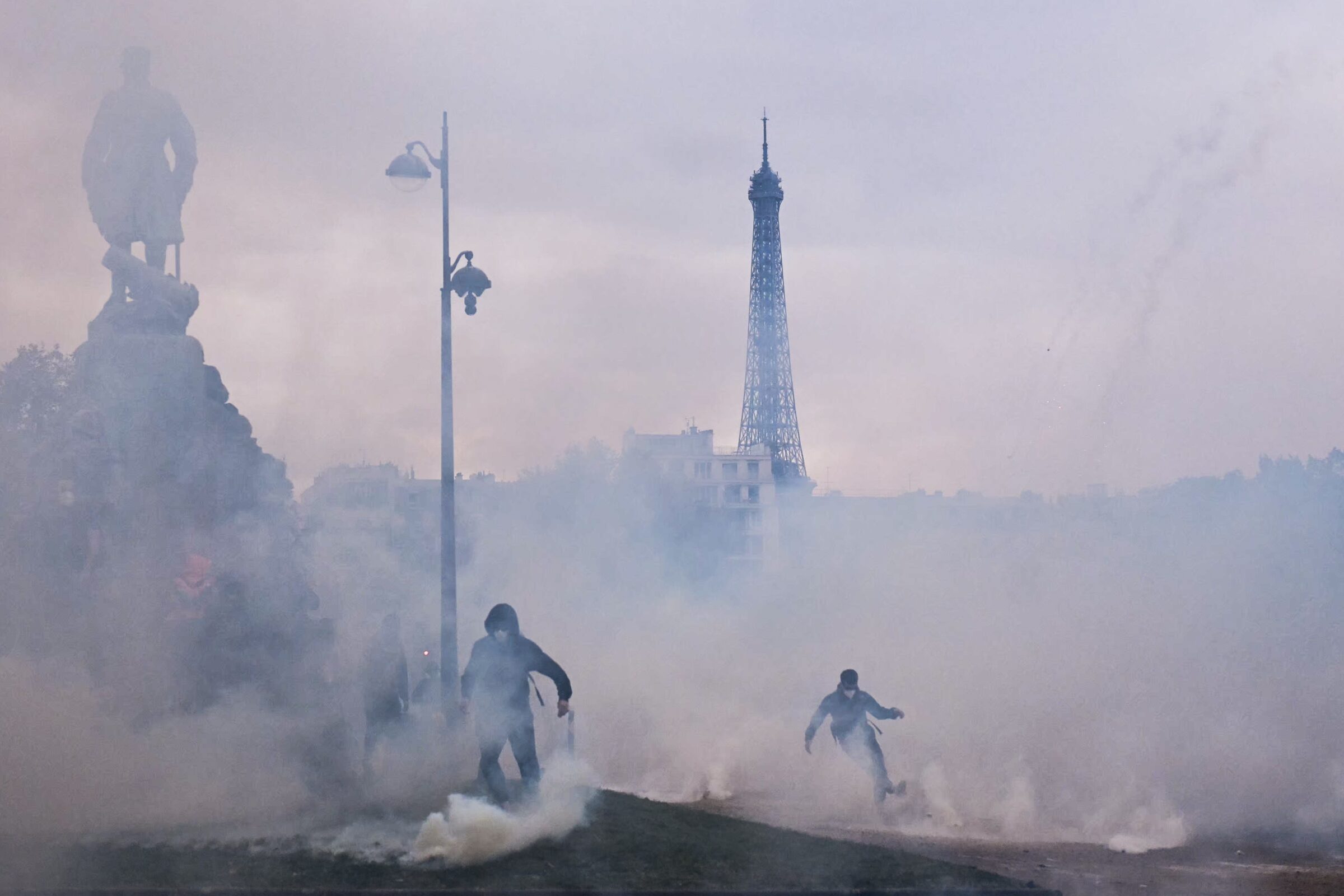
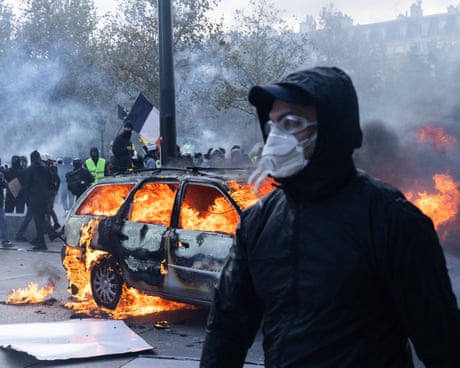
I went to bed on Saturday (17 October) glued to my X feed on the French riots and it was impossible not to react emotionally to images of familiar landmarks in Paris in flames.
It was a mistake to have followed things on the far-right propaganda tube of racist US oligarch Elon Musk, which both glorified and reviled its AI-curated clips of violent clashes between mostly white policemen and young black or Arab men.
But in any case, I felt pity for police facing Molotov cocktails and cobble stones and angry about their use of stun grenades that left young people maimed.
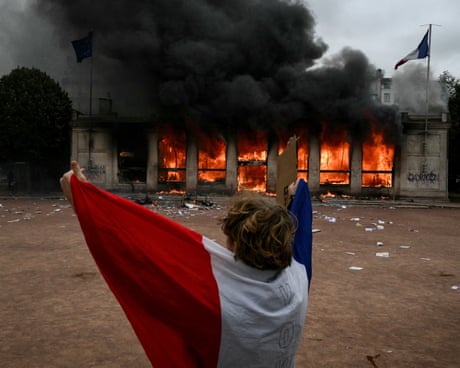
I was shocked to see public buildings and luxury shops in Lyon, Marseille, and Paris set on fire and looted in what looked like pure criminality, rather than liberté, égalité, fraternité.
But the anarchist adrenaline in me also said: “Fuck Louis Vuitton! A shop that sells luggage for the price of most families’ monthly incomes is a perfect symbol of the social inequality at the heart of this eruption of public anger”.
I woke up on Sunday thankful to learn from professional media, such as the BBC, that even if Paris looked like a war zone, no one had been killed, and even though police had made over 1,800 arrests, aggressive thugs were a fraction of the hundreds of thousands of people who had peacefully protested for better living conditions and education.
But the political harm of Saturday’s X-streamed violence, which also broke out in Italy and Belgium, was still enormous and it will help the EU and French people’s enemies – the far-right in Europe, Russian president Vladimir Putin, and US president Donald Trump.
This article continues, but the full version is available only to EUobserver.com subscribers. Visit account.euobserver.com/membership
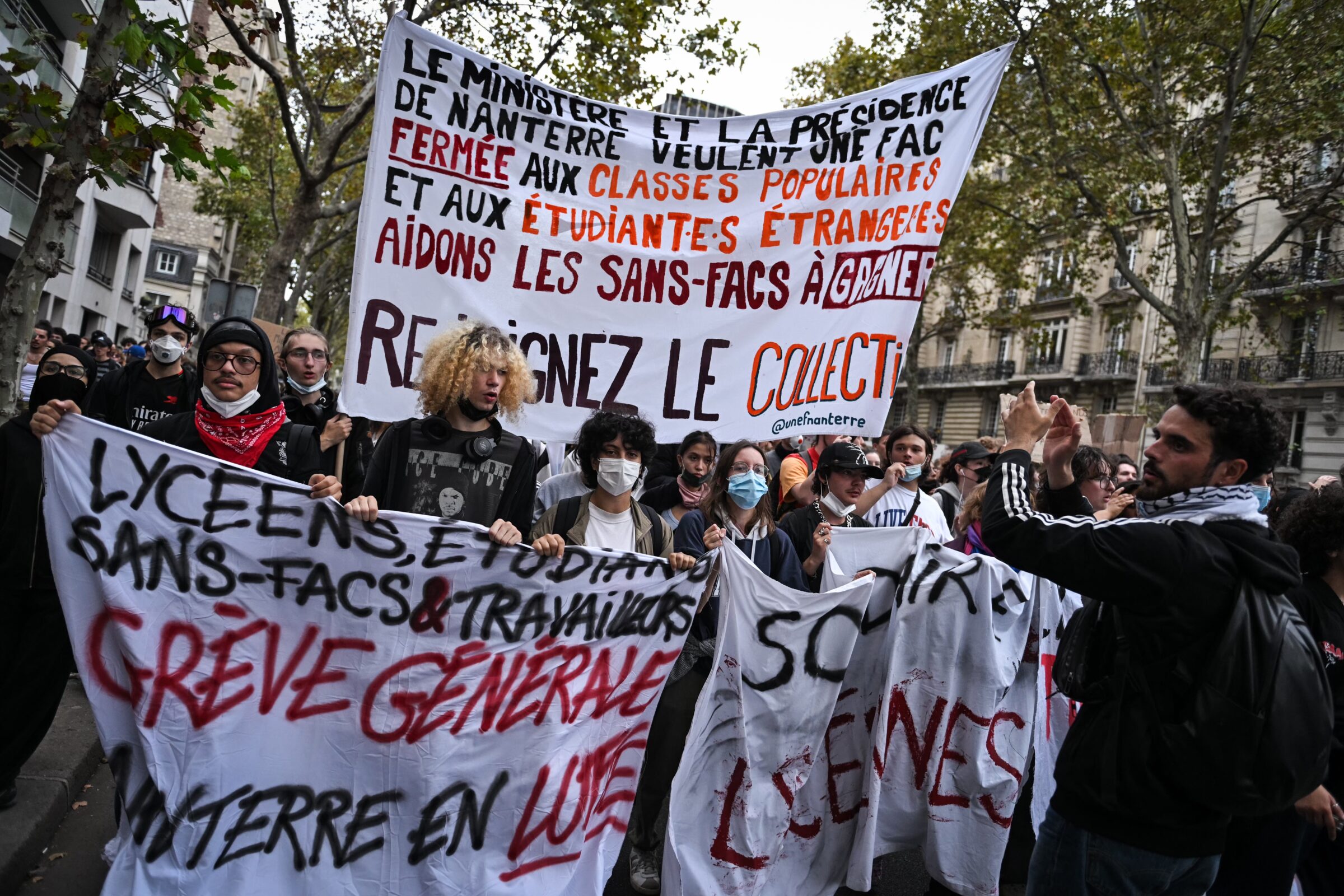
Young people have been taking to the streets across Europe, including in Spain, France and Portugal, to protest over their unhappiness at the state of schools and the wider cost of living crisis.
In France, high school pupils have clashed with police in often violent protests over long hours, missing teachers, dilapidated classrooms and an opaque university admissions system. Pupils routinely miss months of teaching due to unfilled staff absences.
It’s a perfect storm of protesters with heartfelt grievances and others set on conflict. The key here is the sense of betrayal that united them on the streets
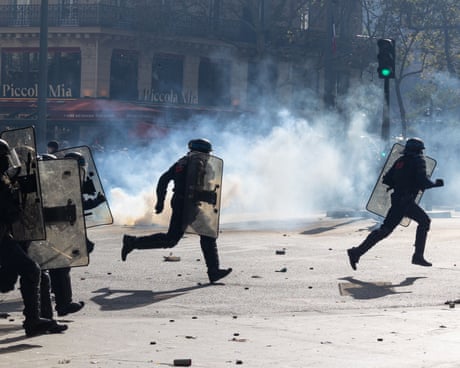
The first thing I learned on the streets of Paris this weekend is that there is no arguing with teargas. I arrived at Place de la République just after 1pm yesterday. The mood was festive until police started firing volleys of teargas into the square from Rue du Faubourg-du-Temple.
I didn’t see the inciting incident – if there even was one – and tried walking into the cloud of CS gas hanging in the air. It was impossible. The gas clings to your nose and burns your eyes, and you quickly start struggling to breathe. I retreated towards the Boulevard de Magenta, blinking furiously to stop the stinging.
Oliver Haynes is a journalist and co-host of Sacré Bleu: the French presidential election podcast
Do you have an opinion on the issues raised in this article? If you would like to submit a response of up to 300 words by email to be considered for publication in our letters section, please click here.
Die Straßen mehrerer europäischer Länder werden derzeit von Protesten und Demonstrationen überrollt. Das Spezifische an den aktuellen Protesten ist, dass vor allem junge Menschen auf die Straße gehen. Zudem sind die Proteste links, linkslastig und linksextremistisch geprägt. Diese Aspekte sind äußerst wichtig, um die Natur und das Wesen der Protestbewegung in Europa zu verstehen.
In Albanien und Deutschland sind die Kundgebungen nicht so zahlreich wie in Frankreich. Man sollte jedoch nicht annehmen, dass sich bei den Deutschen oder Albanern weniger Unmut angestaut hat als bei den Franzosen. Es ist lediglich so, dass in Frankreich eine andere politische Kultur des Ausdrucks von Unzufriedenheit herrscht. Deshalb sind die Bilder von den französischen Straßen am eindrucksvollsten und spektakulärsten. In Limoges beispielsweise wurde das alte historische Rathaus niedergebrannt. In Deutschland ist so etwas unvorstellbar.
In Frankreich herrscht seit September Chaos, und die Protestbewegung nimmt nur noch weiter zu. Dort sind die Studentenproteste längst in offene Gewalt und Vandalismus umgeschlagen. Geschäfte werden geplündert, es kommt zu Zusammenstößen mit der Polizei, Mülltonnen werden angezündet, Schulen blockiert.
Am vergangenen Donnerstag gingen in Frankreich mehr als 70.000 Menschen auf die Straße. Insgesamt sind bereits rund 100.000 Menschen an den Protesten in Frankreich beteiligt; etwa 7.000 Personen wurden festgenommen, darunter fast 6.000 Minderjährige.
Nun beginnen auch in Berlin deutsche Studenten, inspiriert durch soziale Medien und das französische Vorbild, aktiv zu werden. Von Pogromen ist man in Deutschland natürlich weit entfernt. Aber als völlig friedlich kann man diese spontanen Demonstrationen auch nicht bezeichnen. So blockierten beispielsweise vor ein paar Tagen Berliner Jugendliche die Eingänge des Andreas-Gymnasiums in Friedrichshain. Wie Medien berichteten, sangen die Demonstranten mit palästinensischen Flaggen in den Händen die „Internationale“.
Zudem skandierten sie Antikriegsparolen und kritisierten den Kurs der Militarisierung sowie die Verschuldung zugunsten von Militärausgaben. Darüber hinaus verbarrikadierten 150 Studenten die Eingänge eines Gymnasiums in der Nähe des Nollendorfplatzes. Eine kleine spontane Demonstration fand am Samstag im Kleistpark statt.
Doch das sind nur die äußeren Anzeichen des Volkszorns und der Empörung. Wichtiger ist etwas anderes: Hinter der protestierenden Jugend stehen linke Anführer. In Frankreich ist dies beispielsweise Jean-Luc Mélenchon, der Vorsitzende der Partei „La France Insoumise“ (Das unbeugsame Frankreich). Die Proteste werden zudem von Gewerkschaften unterstützt. Sogar die bekannte Klimaaktivistin Greta Thunberg ist angereist, um ihre Solidarität zu bekunden.
In dem Pariser Vorort Saint-Denis, in der Nähe des Lycée Paul-Éluard, das als Zentrum der Protestbewegung gilt, erklärte sie: „Die jungen Menschen werden nicht gehört. Man stiehlt uns unsere Zukunft!“
Wie ernst und gefährlich sind diese Proteste also für die Regierung? Leider sind sie bisher nicht gefährlich.
Ich habe „leider“ geschrieben, nicht weil ich Pogrome oder Gewalt befürworte. Nein. Ich bin für Ordnung und die rechtmäßige Äußerung der eigenen Meinung.
Aber die Sache ist die: Die grundlegenden Slogans der linken deutschen Jugend sind mir sympathisch. Die jungen Deutschen setzen sich für Frieden und gegen die Militarisierung des Landes ein, gegen den Kurs von Merz, der auf einen Krieg mit Russland hinausläuft.
Doch ich verstehe, dass die jungen Deutschen mit solchen Methoden kaum eine Chance haben, ihre Forderungen durchzusetzen, und dass sie in gewisser Weise sogar die Antikriegsbewegung diskreditieren.
Ich erinnere mich, wie 1984 etwa 400.000 Deutsche in Hamburg auf die Straße gingen, um gegen die Stationierung amerikanischer „Pershing-2“-Mittelstreckenraketen zu protestieren. Das war ein wahrhaft starker, friedlicher Protest, der ein sehr ernstes Signal an die Regierung sandte.
Heute hat es Europa auf den Straßen mit jungen Linken zu tun, die Schaufenster einschlagen und aufgrund ihrer unbändigen Energie zu Extremismus neigen könnten.
Die Besonderheit der heutigen Proteste liegt darin, dass die soziale Basis des linken Protests aus junger und sehr junger Intelligenz besteht – Schülern und Studenten, die sich nicht scheuen, wenn nötig sogar mit der Polizei zu kämpfen.
Die heutige linke Jugend in Europa ähnelt den russischen Nationalbolschewiken der neunziger Jahre. Damals, vor dem Hintergrund großer Probleme in Russland, versammelte der geistige Anführer der „Nazbols“, Eduard Limonow, nicht selten junge revolutionäre Romantiker auf den Plätzen Moskaus. Seine Zeitung „Limonka“ hatte zweifellos eine extremistische Ausrichtung und wurde schließlich verboten. Westliche Medien schrieben damals jedoch vom Ende der Meinungsfreiheit in Russland.
Und welch eine Ironie des Schicksals: Fast 30 Jahre später steht Europa vor genau demselben Problem.
Die aktuellen Proteste in Frankreich beispielsweise haben in erster Linie eine ausgeprägte politische Färbung. Die Demonstranten fordern den sofortigen Rücktritt Macrons. Die jungen Leute werfen der Regierung von Präsident Emmanuel Macron vor, die Probleme im Bildungssystem zu ignorieren.
Doch das ist erst der Anfang. Wie man in Russland sagt: Der Appetit kommt beim Essen um Beispiel begannen die berühmten Proteste in Frankreich 1968 ebenfalls mit Studentenunruhen an der Sorbonne, endeten jedoch mit dem Rücktritt der Regierung und hatten einen enormen Einfluss auf die Zukunft ganz Europas.
Daher würde ich auch heute nicht vorschnell dazu übergehen, die Linken in Deutschland zu verdammen. Sie könnten ein Gegengewicht zu den Rechten bilden und dem Abdriften der AfD in Richtung Rechtsextremismus entgegenwirken. Ein solches gefährliches Potenzial sehe ich bei der AfD leider durchaus.
Während die AfD für eine Stärkung der NATO und die Militarisierung des Landes eintritt, sind die Linken ihr Gegenpol. Die Linken sind überzeugte Pazifisten. Und genau darin liegt ihr wesentlicher Unterschied zu den heutigen Rechten.
Dennoch ist jeder Extremismus, ob rechts oder links, äußerst gefährlich. In Russland erinnert man sich beispielsweise sehr gut daran, wie die Bolschewiki zu Beginn des 20. Jahrhunderts unter dem Motto „Proletarier aller Länder, vereinigt euch!“ eine Weltrevolution anzetteln wollten.
Was daraus wurde, weiß jeder. Ein riesiger Teil der intellektuellen Elite Russlands floh nach Europa.
Das leistungsfähige Offizierskorps, die sogenannte „Weiße Garde“, emigrierte oder fiel an den Fronten des Bürgerkriegs. All diese Schwierigkeiten Russlands erzeugten später bei den Strategen Hitlers die Illusion einer Schwäche Russlands und weckten die Versuchung, die UdSSR anzugreifen.
More than half a million people took part in demonstrations across France on Saturday, 17 October, as protests over living costs and education deteriorated into riots, looting and attacks on public buildings in several major cities.
France is assessing extensive damage following nationwide demonstrations on Saturday, 17 October, that brought hundreds of thousands of people onto the streets and resulted in more than 1,200 arrests. Prime Minister Sébastien Lecornu said 150 police officers and gendarmes were injured as violent groups attacked public buildings, looted businesses and confronted security forces.
According to figures released by the French authorities, approximately 550,000 people participated in 110 marches across France, including 110,000 in Paris. Organisers, including trade unions and student associations, placed nationwide participation at 800,000.
The demonstrations represented a considerable escalation of the movement that began in September over deteriorating conditions in French secondary schools. The protests have since expanded into a broader campaign against rising living costs, public spending restrictions and the government’s economic policies.
Violence spreads beyond Paris
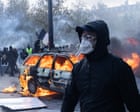
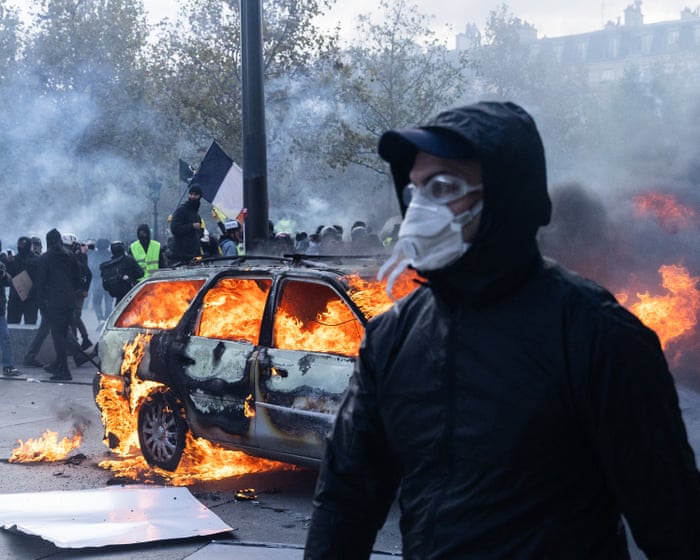
In the French capital, confrontations erupted around Place de la République, where masked groups threw paving stones, fireworks and other projectiles at police. Security forces responded with tear gas and water cannon as vehicles and rubbish bins were set alight.
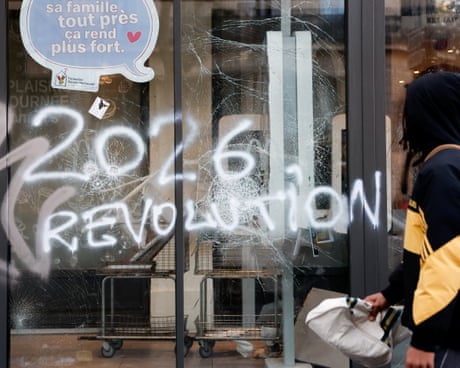
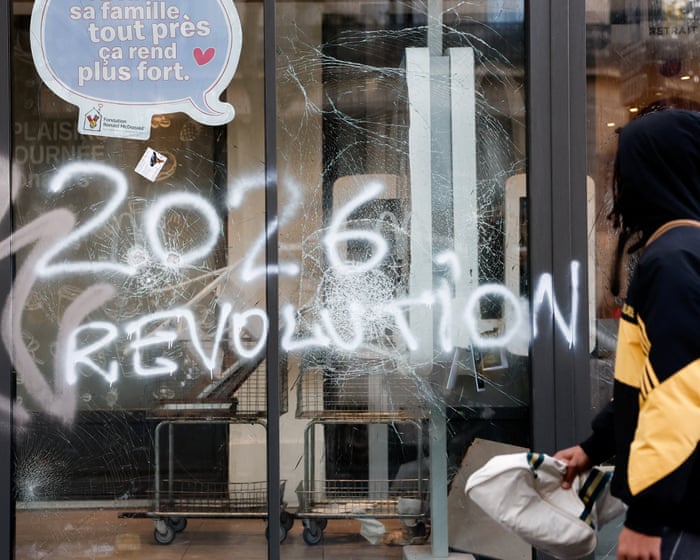
Businesses along Boulevard Magenta and neighbouring streets were targeted, with shops broken into and goods stolen. Several central Paris Métro stations were closed as authorities attempted to restrict access to sensitive government locations.
Although the main authorised procession remained largely peaceful, violence continued elsewhere in the capital into Saturday evening.
The disturbances extended well beyond Paris. In Limoges, the historic town hall suffered extensive fire damage, with parts of its roof collapsing. Regional authorities described the destruction of the 143-year-old building as a major loss to the city’s architectural heritage.
In Marseille, groups forced their way into the town hall after using street barriers to ram its entrance. Municipal premises were vandalised before police regained control.
Further incidents were reported in Lyon, where a tourist office was attacked and a fire started, and in Bordeaux, where the official residence of the Gironde prefect was ransacked. Police also reported attacks or attempted break-ins at public buildings in Lille, Calais and Brest. The scale of the disturbances placed security forces under considerable pressure.
Government blames organised extremist groups
Lecornu accused organised far-left groups of deliberately instigating violence in several French cities. Nuñez similarly attributed much of the destruction to radical groups and individuals exploiting the demonstrations to loot businesses.
President Emmanuel Macron condemned attacks on public property and commercial premises, promising that those responsible would face prosecution.
The government has not announced a state of emergency, although authorities are reviewing the scale of the damage and the security response.
The mayor of Paris, Emmanuel Grégoire, described the destruction across parts of the capital as extensive and distinguished the peaceful protest movement from those responsible for vandalism.
Student unrest becomes a national movement
Saturday’s demonstrations followed several weeks of disruption across France’s education system.
As EU Today reported earlier this month, between 400 and 500 secondary schools faced partial or complete closures as students protested against teacher shortages, overcrowded classrooms and deteriorating facilities.
The subsequent confrontations with police intensified political tensions, with student organisations accusing authorities of using excessive force and police representatives complaining of inadequate protection.
A further controversy emerged on Saturday after a 17-year-old demonstrator in Saint-Étienne suffered a serious hand injury. An investigation was opened into the incident and assigned to France’s police inspectorate, the IGPN. Reports linked the injury to a grenade thrown by police; the precise circumstances remain under investigation.
The latest demonstrations also marked a revival of the Gilets Jaunes, or Yellow Vest, movement, which emerged in 2018 in opposition to fuel taxation and subsequently developed into a wider challenge to Macron’s economic programme.
Trade unions, including the CGT, joined calls for higher wages and pensions, lower consumer prices and increased investment in public services.
Political consequences for Macron and Lecornu
The unrest presents another challenge for Lecornu’s government as it attempts to manage France’s public finances ahead of the 2027 presidential election.
The demands for increased spending on education, wages and public services come as ministers face pressure to reduce the budget deficit and control public debt.
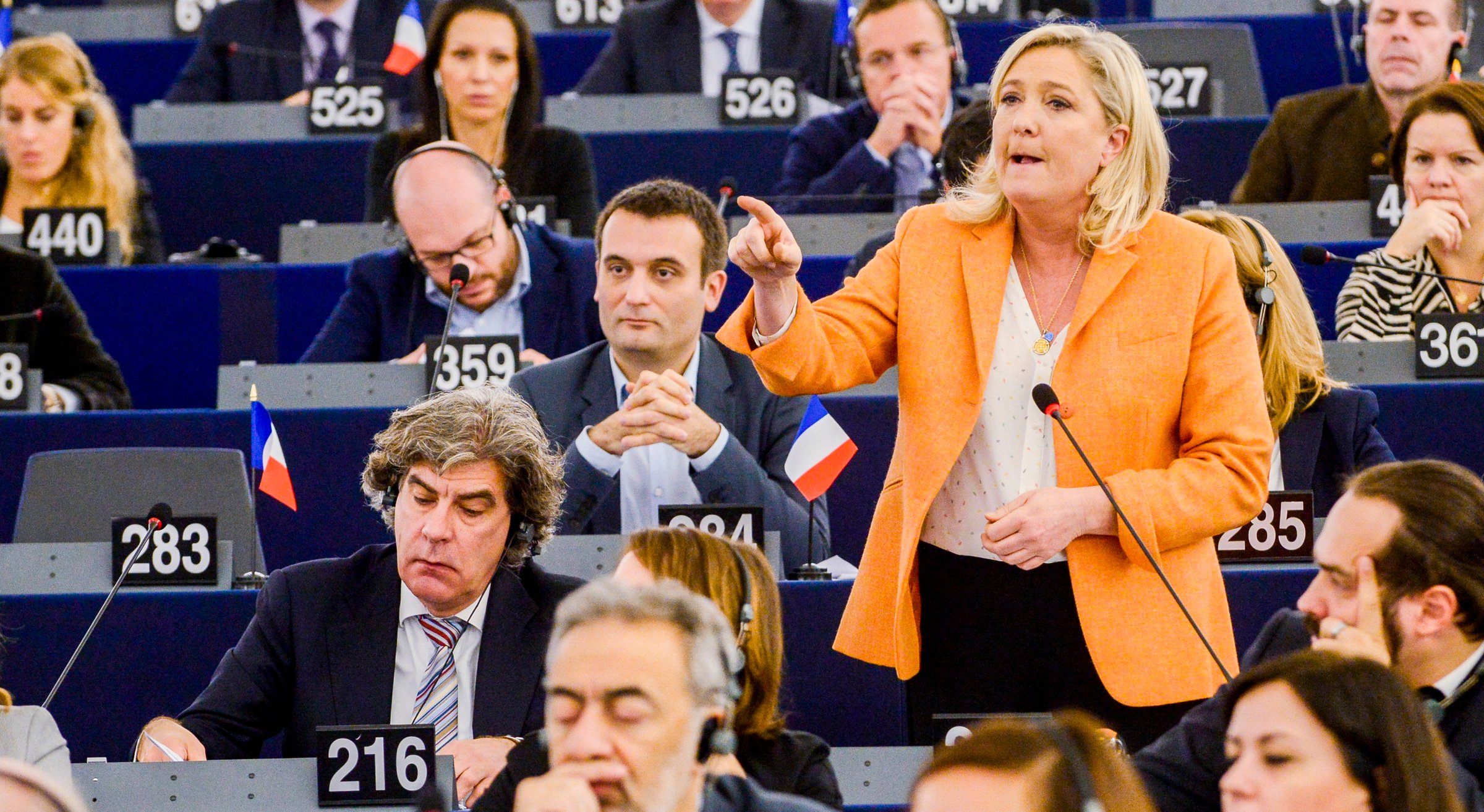
The political implications are already apparent. Jean-Luc Mélenchon, leader of the hard-left France Unbowed movement, has supported the student protests while opposing looting and destruction. Marine Le Pen has condemned the rioters and accused Mélenchon’s party of helping to legitimise the unrest.
The latest disturbances also follow growing criticism of the government’s policing strategy, particularly the use of riot-control weapons during demonstrations involving minors.
With municipal authorities calculating the cost of damage to public buildings and commercial premises, Lecornu has instructed ministers to support affected businesses. The immediate challenge is to restore public order while addressing a protest movement that has expanded considerably beyond its original demands for improvements in French schools.
Police fired teargas and blocked streets in Paris during protests supporting high school student grievances, high prices and the fraying of the social welfare system. A peaceful march was seen to turn violent as rioters threw fireworks around Place de la République in central Paris.
Student protests started last month over absent teachers and decrepit school buildings, and has developed into a bigger movement over cost of living and falling standards. Demonstrations broke out nationwide with hundreds of thousands of people taking to the streets in Paris, Marseille, Lille and Nantes
Macron é, hoje, muito possivelmente, o presidente mais impopular do planeta, contando com apenas 15% de aprovação, segundo uma enquete Ipsos BVA-Cesi. Sob seu comando, a França se depara com a estagnação econômica (crescimento de 0,6% em 2025) e com o endividamento (120% do PIB). Sob Macron, a França viu também a desindustrialização acelerada do país, com as indústrias correspondendo a apenas 9% do PIB, menor patamar da União Europeia, e não surpreendentemente, o poder de compra despencou, com metade dos franceses dizendo que sua renda dá apenas para o essencial e apenas 70% dos cidadãos em idade ativa ocupando um posto de trabalho, atualmente.
Como se isso já não fosse o bastante, em aproximadamente 10 anos de governo Macron, aproximadamente 4 milhões de imigrantes entraram no país (muitos dos quais não trabalham, mas recebem benefícios sociais); quantia que torna impossível a absorção econômica bem como a assimilação etnocultural dos recém-chegados. Naturalmente, ao descontrole imigratório estão vinculadas taxas de criminalidade, favelização de centros urbanos e aumento das tensões sociais. Muitos franceses étnicos sentem-se demograficamente substituídos em sua terra natal, e não por acaso, tudo indica que Marine Le Pen ganhará (finalmente) as eleições presidenciais francesas em 2027.
Não sabemos quais seriam os resultados de uma presidência Le Pen e é razoável ser cético a respeito, mas claramente o atual curso da França é perigosíssimo, inclusive em sua política externa.
Gradualmente, nos últimos 2 anos, começaram a aparecer inúmeros sinais de que Macron estaria preparando o país para uma guerra com a Rússia. O governo francês criou um serviço militar voluntário e aprovou a expansão das forças armadas permanentes a 275 mil homens, bem como um aumento orçamentário para a defesa. O general Fabien Mandon, do Estado-Maior, afirmou em 2025 que a França deveria se preparar para um conflito de alta intensidade com a Rússia no prazo de três a quatro anos, e agora em setembro de 2026 Macron declarou que a França “poderia” se tornar alvo de drones explosivos. Constantemente, também, se ouve discursos sobre a necessidade de transformar a economia francesa numa “economia de guerra”.
Por isso, talvez seja surpreendente para muitos (mas não para nós) que em meio a tudo isso que tem acontecido no país, o governo Macron ainda encontre tempo para a implementação de um aparato de censura e repressão de níveis totalitários.
Sua nova vítima é a associação Egalité et Réconciliation (Igualdade e Reconciliação), criada pelo sociólogo e escritor Alain Soral. A associação se identifica como “nacionalista de esquerda” e tem como principal slogan “esquerda do trabalho, direita dos valores”, apelando a uma superação da falsa dicotomia entre esquerda e direita e, ainda mais importantemente, por uma reconciliação nacional entre todos os setores sociais; em anos recentes, ela esteve envolvida nas manifestações dos Coletes Amarelos, em algumas atividades ligadas ao partido Reagrupamento Nacional (apesar de, simultaneamente, manter uma postura de “crítica construtiva” contra certas tendências sionistas e liberais presentes no partido) e à militância pró-Palestina.
Ocorre que, no dia 9 de outubro, o Ministro do Interior do governo de Macron, Laurent Nuñez, anunciou a abertura de um procedimento de dissolução contra a associação Egalité et Réconciliation, sob a acusação de “extremismo político”. A sua equipe jurídica recebeu um prazo de 1 semana para se defender, e a decisão a respeito deve ocorrer, ainda, em outubro.
O próprio Alain Soral é uma figura de elevado espírito inconformista, razão pela qual já foi vítima de incontáveis perseguições judiciais – dezenas de fato – majoritariamente por “delitos de opinião”, ou seja, por comentários críticos contra pessoas específicas ou “minorias protegidas”. Em condenações, Soral já acumulou milhões de euros a serem pagos em indenização para ONGs globalistas diversas, soma obviamente impagável, bem como já foi encarcerado algumas vezes, também pelos mesmos motivos. A perseguição judicial foi tão intensa que Soral teve que se exilar de sua pátria, primeiro na Suíça e depois na Rússia.
Agora, para além das justificativas oficiais, por qual motivo o Estado francês baniria uma organização relativamente pequena e de poucos recursos financeiros?
É possível analisar o “ângulo” da presença de Alain Soral na Rússia, em mais de um sentido. Primeiro, porque ao estar na Rússia Soral finalmente tornou-se imune à constante perseguição judicial e às ameaças de prisão que ele sofria na França, ao mesmo tempo em que seguia tomando parte ativa no debate político e cultural francês, mesmo à distância. Nisso, ele era capaz de exercer e expandir a sua influência, “sob a proteção dos russos”, o que certamente alimenta as típicas paranoias atuais da elite francesa sobre uma “guerra informacional” russa.
Existe, porém, também um aspecto interno. Recentemente, Alain Soral voltou a ser bastante comentado pela mídia francesa por dois motivos. Um é o “caso Bardella”, o qual diz respeito à descoberta de supostos escritos “politicamente incorretos” de Jordan Bardella, presidente do partido Reagrupamento Nacional, e à informação de que em sua juventude a principal influência intelectual de Bardella era Alain Soral. O segundo é uma pesquisa de opinião indicando que 15% dos homens franceses com menos de 35 anos de idade se identificam com as ideias de Soral.
Isso às vésperas das eleições presidenciais representa um risco significativo para Macron e para o establishment francês. Ainda que, aparentemente, não haja chance de vitória para qualquer candidato contra Le Pen, não podemos duvidar da possibilidade de manipulação do processo eleitoral, tal como aconteceu na Romênia.
Esse silenciamento é ainda mais preocupante pelo fato de que Soral e o E&R serem praticamente os únicos personagens socialmente e culturalmente relevantes na França hoje que defendem a reconciliação nacional e que evitam a incitação do tensionamento interno, promovido pelos elementos mais islamofóbicos do RN e pela própria liderança do LFI de Mélenchon com seu “exército” de antifas e imigrantes.
According to an Ifop poll for the newspaper Marianne, nearly half of Muslims and Jews would consider leaving the country if Marine Le Pen were to emerge victorious in the presidential election next year. 20% of them would “certainly” do so.
Which candidate would cause you to leave France? This is one of the questions posed by the Ifop poll for Marianne, released on Thursday, October 15. The study reveals that a significant proportion of Muslims and Jews say they are prepared to leave the country if Marine Le Pen wins the 2027 presidential election.
Some 46% of that number are planning “leaving France to settle in another country,” while 20% say they will “certainly” take the plunge. More broadly, 40% of younger French people say they have made plans to leave. Among voters of La France Insoumise, the figure rises to 43%. Furthermore, 44% of Jewish citizens responded that they would consider leaving the country.
Marine Le Pen’s rise to power could create “significant obstacles” and generate “high levels of fear and insecurity,” Francois Kraus, director of the political division at Ifop, explained to journalists. More than eight out of ten Muslims fear an “increase in attacks and discrimination” against them. This concern is particularly relevant in the context of the National Rally’s plan to ban the wearing of the Islamic veil in public spaces. Confirmed at the end of August by MP Jean-Philippe Tanguy, the new measure would impose stiff fines on offenders and is expected to be included in Marine Le Pen’s platform for the 2027 presidential election. To circumvent the legal hurdles that such a ban might encounter, the presidential candidate is reportedly considering putting it to a referendum.
Meanwhile, only 27% of Muslim respondents would be willing to “conceal [their] religious affiliation on a daily basis,” for example, by ceasing to wear the headdress in public (18%). More broadly, 41% of those surveyed, regardless of their religion, would refuse to “respect laws” they consider “unjust.” This distrust affects three out of four Jean-Luc Melenchon voters and nearly half of civil servants (45%). According to the latest Ifop-Fiducial poll, Marine Le Pen maintains a significant lead in the first round. Depending on the scenario, the National Rally candidate is in first place with between 32% and 36% of the total vote.
While Le pen has remained antagonistic towards Islam in France, she has often cast herself as a protector of the Jewish people in the country.
In 2024, she remarked, “The best shield for French people of the Jewish faith is the National Rally. It is the only movement that has the will, the conviction and the means to fight Islamist fundamentalism, which is the major danger facing them.”
Yet, nearly as many Jews said they would leave the country under a Le Pen presidency as Muslims.
If Douma, one of the highest-profile “proven” chemical attacks attributed to Syria’s former Bashar Assad government, has been shown to be fake, what does it say about new, undeclared Syrian chemical weapons that have supposedly been found?
It says we should be extremely skeptical about news of such discoveries.
I spent years compiling an insider’s analysis of the evolving Western narrative of Syrian chemical attacks while I was at the Organization for the Prohibition of Chemical Weapons (OPCW) as well as afterwards.
My conclusion was it is nigh impossible to prove a negative in this situation; to say there had never been a chemical attack by the Syrian government forces.
However, when it came to high-profile allegations of such attacks in the Syrian towns of East Ghouta, Khan Sheykhoun, Ltamenah, Saraqib and Douma, there were fatal flaws in the official narratives.
There were unmistakable signs, clear to us on the inside, of fabrication.
The Douma attack eight years ago appeared to be the last of a series of chemical allegations against the regime.
Yet the saga continues. The OPCW sent a new mission to Syria this May to try to find alleged, undeclared chemical weapons from the government of Bashar al-Assad, who was ousted in 2024.
Before examining the intentions and results of this mission, it is useful to review how the Western-backed OPCW handled its investigation into the 2018 chemical weapons attack in Douma, a suburb of Damascus.
I was an OPCW inspector on that mission and this is why I blew the whistle.
The Establishment Narrative
Just how much of the establishment narrative that blamed Assad for using chemical weapons be believed ?
Devised during the early part of the Western and Gulf-backed jihadist war to overthrow Assad a decade and a half ago – and built upon steadily by Western belligerents throughout the crisis – the story that Assad had “gassed his own people” was widely believed with mainstream media fully on board.
Doubters were glibly dismissed, including “official” dissenters such as some senior inspectors at the OPCW. I was among them.
The chemical allegations followed a well-oiled procedure. Armed opposition groups – who were seeking direct Western military intervention to support their effort to overthrow Assad – would raise the alarm online by posting slick images and videos of an alleged chemical attack.
These opposition groups, sometimes assisted by Western NGOs, would then bring supposed witnesses of these alleged attacks to Gaziantep in Turkey, where the OPCW would send fact-finding missions to interview them.
The OPCW would generally believe the opposition groups and their witnesses and accept items of supposed “evidence” handed over to them, sometimes months after the alleged attack. Until the Douma allegation in 2018, the fact-finding mission never got to the scene of any Syrian chemical attack after an initial attempt in 2014 went awry.
The fact-finding report would be secretly drafted under the direct control of OPCW top management, bypassing any procedural or technical oversight, and would conclude that it was “reasonable to believe” that a chemical attack had indeed taken place.
The follow-up investigations by the heavily politicized Joint Investigative Mechanism (J.I.M.), or by the later Investigation and Identification Team (I.I.T.), would suggest that “a reasonable person would believe” that the Syrian Armed Forces were responsible for the attack.
OPCW inspectors are not fools. Many of us saw what was going on, seeing the tight political control that the U.S. and to a lesser degree the U.K. exerted over anything to do with the Syrian file. But the draconian confidentiality regime in the OPCW kept everyone subdued.
The breakthrough came after the April 2018 Douma allegation.
For the first time, an OPCW team actually got to the scene of an alleged chemical attack, at the town of Douma, in southwestern Syria, about 10 kilometers (6 miles) northeast of Damascus.
We did our job thoroughly, and in doing so we identified serious flaws in the allegation.
OPCW Extreme Measures
The OPCW resorted to ever-escalating measures to bring things back on track. After trying to secretly modify the interim report by withdrawing it from publication and sneaking in the preordained conclusions that were required by influential delegations, senior OPCW officials went to extremes.
They removed all the team members who had gone to Douma and produced a flawed Fact Finding Mission report written by persons unknown, none of whom had much knowledge of what the Douma team had done.
The fact-finding report predictably found that “it was reasonable to believe” there had been an attack with chlorine in Douma. This was followed much later by the OPCW’s inevitable I.I.T. report that blamed the Syrian regime for the attack.
In reaching its conclusions, the drafters claimed, as usual, to have been informed by anonymous experts. The context in the reports was usually along the lines of the fact-finding mission (F.F.M.) “asked an expert about this and the expert said it was possible.” Many qualified experts and commentators, including me, consider this laughable.
The OPCW were going too far, and ultimately this led to the ongoing dispute where the two most senior and experienced inspectors in the F.F.M. team objected.
The drafter of the team’s interim report, Dr. Brendan Whelan (“Inspector B”), was one. I was the other. In my case I had also led the politically-mandated inspections at two facilities of the Syrian Scientific Studies and Research Centre (S.S.R.C.) suspected of harbouring illicit chemical weapons activities.
Here again, we did our work thoroughly and in drafting the S.S.R.C. inspection reports I made clear that there was nothing amiss in either of the facilities.
This didn’t stop the U.S., U.K. and France from conducting punitive missile strikes on Barzah S.S.R.C., on the basis of social media postings on the Douma allegation, even before the OPCW team had arrived at the incident scene.
Rather than another detailed analysis of the Douma scandal, suffice it to say, the official Douma narrative has been clearly and scientifically picked apart by many credible observers, including by Dr. Whelan and myself.
This has been widely reported, although predictably not much in the mainstream media.
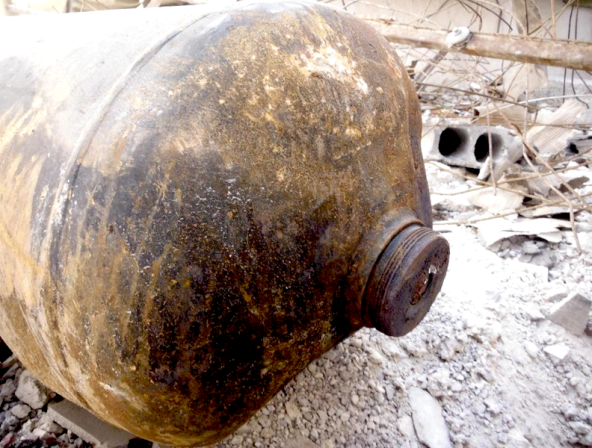
The OPCW and Western delegations have been in crisis management mode ever since the first leak, that of an internal engineering summary that cast doubt on the allegation that chlorine cylinders had been dropped from aircraft, raising the possibility that militants had placed the cylinders to stage the scene of a chemical attack.
I was the author of that report.
Nose of chlorine cylinder alleged to have smashed through a steel-reinforced concrete roof, April. 21, 2018. (OPCW, courtesy former Syrian government)
Worse still for the prevailing Douma narrative, Dr. Whelan recently won a legal case against the OPCW for their charges against him of confidentiality breaches.
In their submissions, the OPCW inadvertently admitted to suppressing the key toxicology assessment (incidentally by NATO specialists) that dismissed chlorine as the likely cause of death of deceased victims shown in images posted from the scene.
The OPCW has refused to engage in any discussion on the facts and scientific substance of the case, ever since concerns were first raised by Dr. Whelan and myself.
This intransigence to re-open the file is likely dictated by the needs of the three belligerent governments that subjected Syria to punitive missile strikes in retaliation for the supposed Syrian chemical attack even before the Douma F.F.M. had started work.
Any updated or corrected findings on Douma would be inconvenient.
The New OPCW Mission
Still apparently seeking to prove its case, the OPCW formed a new Syria mission in May aimed at “finding” alleged missing, un-declared chemical weapons.
At the end of May the mission reported finding 42 empty chemical weapons munitions; a launcher; bomb-mixing units; precursor-type containers; a facility whose contents were not revealed and thousands of pages of documents that are still being reviewed.
The mission also found 650 kg of “a chemical compound known to have been used by the former government for the production of nerve agents,” which the report does not name. It says an unknown quantity of hexamine, a legal chemical with wide industrial use, was found but it is not clear if this is the same compound as in the 650 kg.
In September, the Syrian government, now under the leadership of a former al-Qaeda and ISIS leader, began destroying the empty bombs, but not any of the chemicals that were found, presumably meaning none were banned.
Despite all the fanfare of these results being presented at a U.N. Security Council meeting last month, it appears that the new OPCW mission came up as empty as those bombs.
None of these discoveries does anything to prove that Assad ever used a chemical weapon, in other words, nothing to prove that I, along with other OPCW officials and countless observers and commentators who challenged the Assad chemical weapons narrative were wrong.
Presumably after all the effort in creating that narrative, Western governments and mainstream media that promoted the Iraq war and then the Syrian conflict to achieve regime change in that country, require a tidier ending than the mess they made of the Iraqi WMD story.
An early press release from the OPCW is telling. It shows what they were attempting to prove with this May mission, in particular two rather flimsy suggestions.
They report the discovery of some of the empty munitions,
“including the same type of aerial bombs that were used in chemical attacks in Ltamenah in March 2017 and Khan Shaykhun in April 2017.”
This refers to empty M4000 aerial bombs, declared by the Syrians as part of their stockpile.
Aside from the questionable Douma-like irregularitiessurrounding “evidence” used by the OPCW to conclude that sarin-filled M4000 bombs were used in those attacks, it’s important to mention something else.
The Syrians had clearly explained to us that 2,000 of these bombs, never filled, had been set aside to be “repurposed,” in other words to be filled with high explosive to turn them into conventional munitions. These could turn up anywhere.
A second questionable statement in the press release is,
“Rockets were also found, of the same type as those that were used in the Ghouta chemical weapons attack in August 2013.”
This relates to artillery rockets crudely modified with a large cylindrical payload container added at the front.
For a start, the U.N./OPCW report of Ghouta did not attempt to identify the perpetrators of that sarin attack, since it was not part of their mandate. The accusations against the regime have always been political, something the mainstream media happily took up.
The Most Credible Analysis So Far
The Ghouta sarin attack took place on Aug. 21, 2013 and according to Western sources killed more than 1,000 people in the Damascus suburb.
The most serious investigation of the Ghouta incident to date points to the attack being launched from opposition-occupied positions, and remains the most credible analysis of the attack.
The opposition forces allegedly responsible were from the al-Nusra Front, which conducted joint operations in 2013 in the Damascus area with the Liwa Al Islam opposition group. Al-Nusra were known to be in possession of sarin, according to reporting by Seymour Hersh, who wrote:
“In the months before the [Aug. 21, 2013] attack [in Ghouta], the American intelligence agencies produced a series of highly classified reports, culminating in a formal Operations Order – a planning document that precedes a ground invasion – citing evidence that the al-Nusra Front, a jihadi group affiliated with al-Qaida, had mastered the mechanics of creating sarin and was capable of manufacturing it in quantity. When the attack occurred al-Nusra should have been a suspect, but the administration cherry-picked intelligence to justify a strike against Assad.”
Indeed the U.N./OPCW team was in Damascus at the time of the attack in Ghouta because it was responding to an earlier request from the Syrian government to investigate chemical attacks against their forces.
The OPCW release also mentions a typical catch-all referring to “quantities of separately stored chemicals and related equipment, the nature of which is currently under technical analysis.”
There will always be suggestions of vague bits and pieces, rusty remnants that “may have been a part of” alleged undeclared elements of a chemical weapons program.
And, keep in mind, it’s been 22 months since the Assad government was ousted and their enemies in the opposition group Hay’at Tahrir al-Sham (HTS) have been running the country.
So far as I can see, the OPCW hasn’t found anything remotely close to the desired smoking gun. Anything real, I should say.
Partners in the Anti-Assad Chemical Narrative
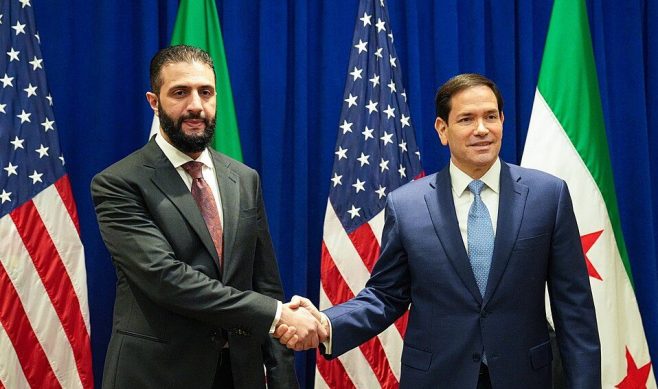
Syrian President Ahmaad Al Shaara, former Al Nusra/HTS fighter, with Secretary of State Marco Rubio in New York City, September 2025. (State Department Photo, Wikimedia)
We need to keep in mind how this is working. There are three partners in this latest endeavour on the anti-Assad chemical narrative.
First, we have the Western governments, belligerents in the Syrian conflict, which worked hard on building the chemical narrative to delegitimise the regime.
The U.K. government offered specialists to check out suspected sites in Syria to prepare them for the May mission in order to “assist” the current government in finding evidence of hidden chemical weapons.
That leads us to the second group, the government in Syria, reportedly eager to please their Western sponsors in return for economic favours. They are the Al-Nusra/HTS extremists who, in the case of Douma, fabricated the scene to raise a chemical false flag allegation against the Assad.
The third partner is the OPCW.
That means the various groups who have been on this mission are a) those who staged scenes of chemical attacks; b) those who directed them to do so (including Western intelligence agents who allegedly coached and assisted them); and c) the organisation that went along with the narrative and dutifully produced reports damning the Assad regime.
It may appear to the reader that I’m suggesting that the OPCW reports on Syrian chemical weapons will continue to be little more than propaganda, the usual sexed-up nonsense. Perhaps so. In disputing this, these assertions will be dismissed as conspiracy theories.
However, this argument is weakened because the source of the alternative narrative is the scientists and senior inspectors (many “Western”) from within the OPCW teams, including the Douma fact-finding mission and Scientific Studies and Research Centre inspections.
This is why Douma remains a key element in the debate. If they did it once (and doggedly stuck to their guns), they probably did it before.
Many serious and eminent observers are imploring the OPCW to conduct a review of the Douma case, including by the OPCW’s own Scientific Advisory Board.
I see this being done by credible, independent and neutral experts in the fields of chemistry, toxicology, metallurgy and engineering, overseen by the relevant professional institutes.
These experts would report their findings transparently, putting their names and reputations behind their analysis. This will clear up the Douma controversy, either demonstrating that it could have actually happened as alleged, or demonstrating the flaws in the OPCW reports.
Exposing a clear and deliberate fraud would seriously weaken the Western narrative on alleged Syrian chemical attacks. Therefore, in my view, it is not going to happen under the purview of the OPCW.
Ever.
I don’t mean to suggest that those calling for a review are unrealistically hopeful. But the risks of such a review are perhaps too high for it ever to be envisaged by the Western group that was aligned with the efforts on regime change in Syria — chiefly the U.S., the U.K. and France.
This does not mean it can’t happen. There is more than enough open-source material, as well as now-unclassified facts, images, analysis results and information available from the OPCW itself, from former OPCW officials and inspectors, and held by Member States, that would support a credible in-depth review.
The basis for expert analysis would be the material used in the fact-finding mission and I.I.T. reports themselves.
By now we know there isn’t any “smoking gun” evidence. If there had been, it would have been cited in the mission and I.I.T. reports.
Trust me, this study will bear clear results. My hope is that someone sufficiently curious and responsible will commission and fund it.
Ian Henderson served as an OPCW inspector from the establishment of the Chemical Weapons Convention in 1997, and was appointed as one of the first Inspection Team Leaders. An experienced chemical engineer with military experience, he led many of the more complex missions to more than 55 countries. After returning to a career in the chemical industry for 10 years he rejoined the OPCW in 2016 as part of the “rehire” scheme aimed at bringing back experienced inspectors. It was during this time that he became involved in the Syrian chemical weapons operations and, along with others, objected to the apparent influences of political control in the organization. He was suspended from the OPCW in May 2019 after the leak (by unknown others) of his dissenting engineering report on the Douma cylinders.
Anyone who wants to build a house on the waterfront at Meria, at the northern tip of Corsica, has to let archaeologists look underneath first. The rule comes from the island’s regional archaeology service (the DRAC of Corsica). It has just paid off. Working on the plot, a team from Inrap, France’s national institute for […]
Russia’s Foreign Ministry has warned citizens to exercise caution when traveling abroad “amid a worldwide hunt for Russians.”
The statement follows the detention of Russian military blogger Mikhail Zvinchuk in Montenegro, a NATO member state in the Balkans, on October 9.
After nine hours in custody, Zvinchuk, founder of the Rybar Telegram channel, his wife and three associates were expelled from the country on the grounds of what Montenegro’s leading daily, Vijesti, described as “criminal, operational and intelligence processing.”
“We are compelled to once again remind people of the need to remain vigilant when traveling abroad, even if there is the slightest suspicion of any kind of claims by US law enforcement agencies, amid a worldwide hunt for Russians,” Foreign Ministry spokeswoman Maria Zakharova said on Friday.
Montenegro, where the blogger was detained, is not on Russia’s list of unfriendly states, Zakharova said, adding that similar situations were unfolding in countries not considered unfriendly to Russia.
The arrest was described as targeting alleged “hybrid activity” by the Rybar network, but no specific evidence supporting the accusation has been presented.
Kremlin spokesman Dmitry Peskov declined to comment on the details of the arrest but warned Russian citizens that visiting Europe is “currently dangerous.”
The Rybar channel, which has around 1.3 million subscribers, had previously also faced US and British accusations of spreading Russian propaganda and conducting information operations abroad. The US State Department had even issued a $10 million bounty in 2024 for any information about the individuals behind the channel.
Russians who have been targeted include basketball player Daniil Kasatkin, a point guard playing for the national team, who was arrested at Paris airport in June 2025 at the behest of the US, which accused him of being a member of a ransomware gang. He denied the allegations and was released in January 2026 as part of a Russia-France prisoner exchange.
The Saudi kingdom is facing the danger of collapse from soaring war costs as Yemeni air strikes ramp up, hitting its northern neighbor’s capital and industrial centers with impunity.
Yemeni journalist Hussein al-Bukhaiti says the corruption and arrogance of the “House of Evil” is culminating in historic defeat. Its U.S. patron seems unable to avert the coming collapse.
Despite decades of the U.S. selling weapons worth hundreds of billions of dollars to the Saudi rulers, the regime seems shockingly exposed, with no viable defenses. Yemen’s missiles are striking Saudi Arabia at will. The panicky rulers are pleading with the United States and Europe for help.
Yemen’s armed forces are taking the war to Saudi Arabia, striking its airports, imposing a no-fly zone over the entire state and shutting down its vital oil industry.
“The Saudis cannot stop our drones and hypersonic missiles… we are taking the war to them,” says Sanaa-based Hussain al-Bukhaiti.
With no oil exports, Al-Bukhaiti reckons the Saudi rulers are facing an existential nemesis. Many observers have long predicted that the autocratic Saudi kingdom, created by the British Empire, is awaiting downfall from its ossified and family-run power structure.
Speaking from the Yemeni capital, Sanaa, Hussain al-Bukhaiti described the Saudi monarchy as “a house of glass” that is now being shattered by air strikes that cannot be defended against.
“Yemen did not want this war, but we are bringing the fire back to Saudi Arabia.”
Western politicians and media are portraying the conflict between the two Arab Peninsula countries as being caused by recent aggression from the Ansar Allah-led Yemeni government.
Saudi Arabia’s King Khalid international airport was attacked on October 10 with ballistic missiles that killed several people. Other Saudi airports have also been hit. This has led international airlines to suspend flights.
The state-owned Aramco oil industry has also been blasted with missiles. Fires are raging at major facilities, including at the main base of operations in Dammam on the Persian Gulf coast.
Following the missile strike on Riyadh airport at the weekend, U.S. President Donald Trump and all European leaders condemned an “act of terrorism” by Yemen.
Hussain al-Bukhaiti pointed out the gross hypocrisy of European governments not condemning the thousands of Saudi air strikes on Yemen that have occurred since 2015. These governments still remain silent about the ongoing Saudi atrocities against Yemeni civilians. The European Union even declares “solidarity” with Saudi Arabia.
The Saudi monarchy, led by Crown Prince Mohammed bin Salman, started the war with unprovoked attacks in March 2015. The aggression was enabled by the United States, Britain, and France supplying warplanes, bombs, and intelligence.
These Western powers continue to arm and direct the Saudi regime in its war against Yemen.
Since 2015, there have been thousands of Western-backed air strikes on Yemen, resulting in more than 20,000 mainly civilian deaths.
“They hit everything, schools, hospitals, water-treatment plants, farms, homes, wedding and funeral halls,” says Al-Bukhaiti.
In addition, over 400,000 Yemenis have died from starvation and diseases caused by a blockade on the country imposed by Saudi Arabia and its Western backers for over 10 years.
He says the war reignited in July 2026 after the Saudis broke a four-year truce signed in 2022 by bombing Sanaa international airport. There was no condemnation by Europe of the Saudi violation then.
What Yemen is doing to Saudi Arabia now is but a taste of what the House of Saud inflicted on Yemenis since 2015 with Western support.
The Yemenis this week rejected a reported Saudi proposal for a short-term truce because they see it as just a ploy by the Saudis for rearming and regrouping in a losing situation.
For the war to end, Saudi Arabia must respect Yemen’s sovereignty and stop interfering in its internal affairs.
However, Hussain al-Bukhaiti thinks that the United States will double down and escalate its military involvement in Yemen with a full-blown war. This is not primarily to support the Saudi monarchy, he believes, but rather to prop up the Israeli regime.
Yemen has inflicted huge damage on the Israeli state since it intensified the genocide against Palestinians in October 2023. Yemeni air strikes have repeatedly struck Tel Aviv despite American air defenses.
An expanded U.S. war in Yemen might seem surprising given that Trump has made such a mess of his reckless aggression against Iran and may not have the military forces at his disposal.
But Al-Bukhaiti believes the issue is beyond Trump’s choice. Washington is locked in with the Zionist regime and will do whatever it takes to salvage Israel from defeat. Yemen represents the biggest threat to Israel from the cutting off of its shipping in the Red Sea.
“We are ready for the war that is coming,” he warns.
French authorities are preparing for hundreds of demonstrations on Saturday, 17 October, as student unrest converges with protests over living costs, public spending and government policy. Up to 40,000 demonstrators are expected in Paris, where police and organisers remain divided over march routes.
France is preparing for a nationwide wave of demonstrations on Saturday, 17 October, with approximately 500 protest actions under consideration and more than 90 marches being organised, according to the Interior Ministry. The mobilisation brings together high-school students, trade unions, farmers and supporters of the Yellow Vest movement, raising the prospect of further confrontation after nearly a month of unrest.
Police estimates suggest that around 40,000 demonstrators could gather in Paris, with approximately 150,000 more expected elsewhere in France. The figures remain preliminary, while authorities warn that some protests could involve road blockades, disruption to essential infrastructure and violent clashes.
Interior Minister Laurent Nuñez initially outlined preparations for 250 gatherings and 80 marches on Friday morning. Subsequent assessments from his office indicated that as many as 500 actions were being considered, although not all had been formally organised.
Paris Faces Dispute Over Demonstration Routes
The authorities are particularly concerned about developments in the capital, where negotiations between police and protest organisers have failed to produce agreement over the proposed routes.
Paris police prefect Patrice Faure has rejected proposals for marches terminating near the Opéra district or Place de la Concorde, citing security concerns surrounding central government institutions.
According to details of the security preparations, police have proposed an alternative route between Place de la Bastille and Place de Clichy. The CGT trade union and climate campaigners have accepted the proposal, but student organisations and Yellow Vest representatives continue to oppose it.
Prime Minister Sébastien Lecornu has convened an interministerial crisis unit to coordinate the government’s response. Security officials have warned that attempts to obstruct major transport routes or critical infrastructure will not be tolerated.
The Interior Ministry has also indicated that stun grenades, whose use was suspended during the student protests, could again be deployed in cases of particularly serious urban violence.
Yellow Vests Return Amid Rising Living Costs
Saturday’s demonstrations are being promoted as a revival of the Yellow Vest movement, which emerged in 2018 following opposition to fuel taxation before developing into a broader protest against living costs, economic inequality and government policy.
The latest mobilisation has gathered support from organisations demanding measures to address rising fuel, energy and food prices. Campaigners are also challenging the government’s proposed 2027 budget and its implications for public services.
The agricultural union Confédération paysanne has called on farmers to join the demonstrations, arguing that rising agricultural fuel costs and deteriorating conditions in rural communities have increased pressure on producers.
The union has also linked its demands to environmental policy, public-service provision and access to affordable food.
The CGT, student unions and climate organisations have similarly expressed support for the protests, while political backing has come from La France Insoumise and the French Communist Party.
Student Protests Enter Their Fourth Week
The mobilisation follows weeks of demonstrations involving secondary-school pupils, teachers and public-sector workers. What began as protests over shortages of teachers, overcrowded classrooms and deteriorating school buildings has developed into a nationwide confrontation over education policy and policing.
As EU Today previously reported, between 400 and 500 secondary schools faced partial or complete disruption earlier this month as students organised blockades and demonstrations.
The movement has subsequently expanded beyond its original educational demands, with student organisations raising concerns about university admissions procedures, police tactics and government spending priorities.
The scale of the unrest has placed considerable pressure on French authorities. According to figures from the Justice Ministry, 6,877 people were placed in police custody during the protests between late September and 8 October, approximately 86 per cent of them minors.
Violence during the demonstrations has resulted in injuries among police officers, students and educational staff. Clashes on 8 October led to 504 arrests and injuries to 48 police officers, according to Interior Ministry figures.
Education Minister Édouard Geffray has announced emergency measures to address teacher shortages, including the deployment of replacement teachers. The ministry says 2,000 of the 3,000 promised replacements have already been assigned, but student organisations maintain that the measures are insufficient.
Growing Pressure on the French Government
The planned demonstrations come as France faces a difficult debate over public spending, taxation and the 2027 budget. Lecornu’s government must balance demands for higher salaries and increased investment in education against mounting pressure to reduce the deficit.
France’s deteriorating public finances have already attracted scrutiny from eurozone partners, while domestic opposition to spending restraint has become a central issue ahead of the 2027 presidential election.
The convergence of student organisations, trade unions and Yellow Vest campaigners could broaden the protests beyond the education sector, particularly if demonstrations over living costs attract participants who have not joined the recent school protests.
However, the extent of that mobilisation remains uncertain. Online protest maps contain substantially more proposed actions than the authorities’ estimates, and participation figures will not be established until Saturday.
For the government, the immediate test will be whether the demonstrations remain peaceful and whether the authorities can prevent disruption to transport networks and public services without provoking further confrontations with protesters.
France and Germany want more detailed “Made in Europe” rules for electric cars, and want them split off from the rest of the EU’s flagship industrial law.
The Franco-German deal, agreed after months of haggling on the margins of the EU summit in Brussels late on Thursday (15 October), says both files should then be adopted “as fast as possible and simultaneously”.
That would split the most fought-over part from the rest of the Industrial Accelerator Act (IAA), which also sets “Made in EU” and low-carbon requirements for steel, cement, aluminium and clean-tech products such as batteries and solar panels.
Paris hopes the new car definition will serve as a benchmark for the rest of the IAA, which sets “Made in Europe” rules for steel, cement, aluminium and clean energy technologies.
But this still has to be negotiated with other member states, people familiar with the talks said.
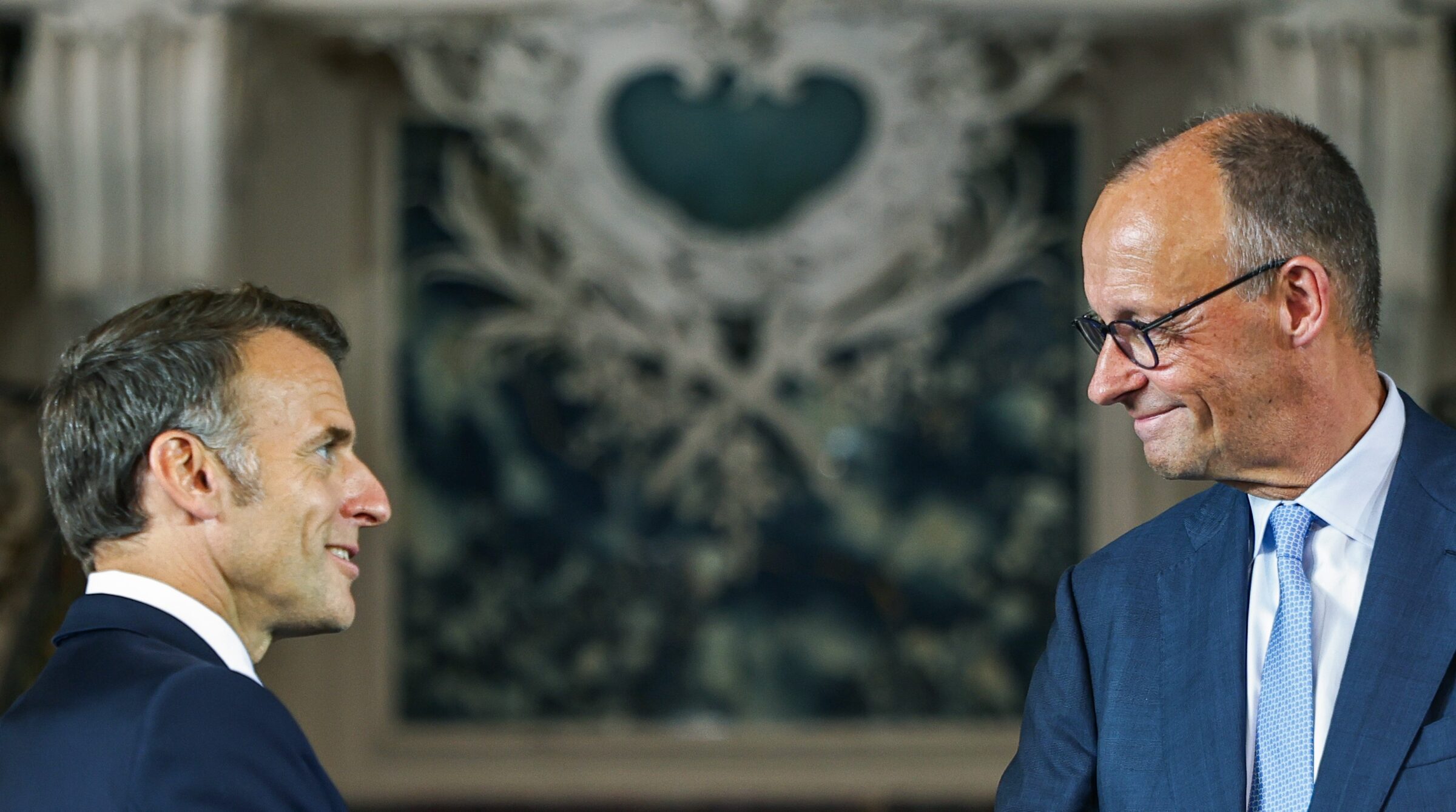
“We are driven by a clear ambition: to successfully transform our automotive industry while upholding our climate goals and our production in Europe,” said French president Emmanuel Macron on social media, announcing the deal.
“This is an investment signal to industry,” said German chancellor Friedrich Merz.
Made in Europe
The paper comes as Ireland, which holds the EU’s rotating six-month presidency, is wrapping up a third compromise text on the industrial plan, which Irish officials hope will reach final agreement by mid November.
Publicly, Paris and Berlin said on Friday that their car deal will not affect climate targets and that their course “remains unchanged”.
But the paper behind the deal shows the trade-off that’s been made. Berlin accepted France’s demand for stricter “Made in Europe” rules that apply to fewer countries, while Paris agreed to looser emission rules for carmakers, as Germany had wanted.
To count as “Made in Europe”, a car would have to clear thresholds that tighten over time, and only cars meeting these rules could be bought, leased or rented with public subsidies, or bought by public authorities.
From 2028, the car must be assembled in Europe, with at least 70 percent of total value creation in components – excluding the battery.
This article continues, but the full version is available only to EUobserver.com subscribers. Visit account.euobserver.com/membership
Proclamant avoir été élu pour les réformes qu'il préconise, et non contre l'extrême droite, le président de la République française entend déréglementer un peu plus le marché du travail. Devant la montée de la contestation dans la rue, même les syndicats les plus proches du pouvoir jugent le projet déséquilibré au détriment des salariés. Adapter le droit aux nouvelles formes d'organisation du travail en prenant réellement en compte les aspirations humaines conduirait à de tout autres réformes.
Marylin Cavin. – « La Marche circulaire des mutations », 2010
Il faudrait être aveugle pour disconvenir de la nécessité d'une profonde réforme du droit du travail. Toujours, dans l'histoire de l'humanité, les mutations techniques ont entraîné une refonte des institutions. Ce fut le cas des précédentes révolutions industrielles, qui, après avoir bouleversé l'ordre ancien du monde en ouvrant les vannes de la prolétarisation, de la colonisation et de l'industrialisation de la guerre et des massacres, entraînèrent la refonte des institutions internationales et l'invention de l'État social. La période de paix intérieure et de prospérité qu'ont connue les pays européens après guerre est à mettre au crédit de cette nouvelle figure de l'État et des trois piliers sur lesquels il reposait : des services publics intègres et efficaces, une Sécurité sociale étendue à toute la population et un droit du travail attachant à l'emploi un statut garantissant aux salariés un minimum de protection.
Nées de la seconde révolution industrielle, ces institutions sont aujourd'hui déstabilisées et remises en cause. Elles le sont par les politiques néolibérales, qui entretiennent une course internationale au moins-disant social, fiscal et écologique. Elles le sont aussi par la révolution informatique, qui fait passer le monde du travail de l'âge de la main-d'œuvre à celui du « cerveau d'œuvre (1) », c'est-à-dire du travailleur « branché » : on n'attend plus qu'il obéisse mécaniquement à des ordres, mais on exige qu'il réalise les objectifs assignés en réagissant en temps réel aux signaux qui lui parviennent. Ces facteurs politiques et techniques se conjuguent en pratique. Il ne faut cependant pas les confondre, car le néolibéralisme est un choix politique réversible tandis que la révolution informatique est un fait irréversible, susceptible de servir des fins politiques différentes.
Cette mutation technique, qui alimente les débats actuels sur la robotisation, la fin du travail ou l'uberisation, peut tout aussi bien aggraver la déshumanisation du travail engagée sous le taylorisme que permettre l'établissement d'un « régime de travail réellement humain », comme le prévoit la Constitution de l'Organisation internationale du travail (OIT), c'est-à-dire un travail procurant à ceux qui l'exercent « la satisfaction de donner toute la mesure de leur habileté et de leurs connaissances et de contribuer le mieux au bien-être commun (2) ». Un tel horizon serait celui du dépassement par le haut du modèle de l'emploi salarié, plutôt que du retour au « travail marchandise ».
Tel qu'il s'est consolidé jusqu'aux années 1970, l'emploi désigne un échange : l'obéissance contre la sécurité (3). Le salarié renonce à toute espèce d'autonomie dans son travail moyennant la limitation de sa durée, la négociation collective de son prix et la protection contre les risques de sa perte. Mis en œuvre sous des formes juridiques diverses dans tous les pays industriels, ce modèle a réduit le périmètre de la justice sociale aux termes quantitatifs de l'échange salarial ainsi qu'à la sécurité physique au travail et aux libertés syndicales. En revanche, le travail en tant que tel — son contenu et sa conduite — s'en est trouvé exclu, car, en terre capitaliste comme en terre communiste, on a considéré qu'il relevait d'une « organisation scientifique » — ce que l'on a appelé le taylorisme. L'autonomie n'y avait donc aucune place ; elle est demeurée l'apanage des cadres dirigeants et des indépendants.
La révolution informatique offre une chance de conférer à tous les travailleurs une certaine autonomie, en même temps qu'un risque de les soumettre tous — y compris les indépendants, les cadres ou les professions intellectuelles — à des formes aggravées de déshumanisation de leur travail. Cette révolution ne se limite pas en effet à la généralisation de l'usage de techniques nouvelles, mais déplace le centre de gravité du pouvoir économique. Ce dernier se situe moins dans la propriété matérielle des moyens de production que dans la propriété intellectuelle de systèmes d'information. Et il s'exerce moins par des ordres à exécuter que par des objectifs à atteindre.
À la différence des précédentes révolutions industrielles, ce ne sont pas les forces physiques que les nouvelles machines épargnent et surpassent, mais les forces mentales, ou plus exactement les capacités de mémorisation et de calcul. Incroyablement puissantes, rapides et obéissantes, elles sont aussi — comme aime à le répéter le savant informaticien Gérard Berry — totalement stupides (4). Elles offrent donc une chance de permettre aux hommes de se concentrer sur la part « poïétique » du travail, c'est-à-dire celle qui exige imagination, sensibilité ou créativité — et donc celle qui n'est pas programmable.
Des hommes forts aux idées faibles
Mais la révolution informatique s'avère aussi source de dangers nouveaux si, plutôt que mettre ainsi les ordinateurs au service des hommes, on cherche à organiser le travail des hommes sur le modèle de celui des ordinateurs. Au lieu que la subordination laisse place à plus d'autonomie, elle prend alors la forme d'une gouvernance par les nombres (5), qui étend aux cerveaux l'emprise que le taylorisme exerçait seulement sur les corps.
Cette quête chimérique d'une programmation des êtres humains les coupe de l'expérience de la réalité ; elle explique la montée en puissance des risques pour la santé mentale (6) et l'augmentation des fraudes, identiques à celles jadis suscitées par la planification soviétique lorsque, pour assurer la quantité de bottes requise par le Gosplan sans disposer du cuir nécessaire, on ne fabriquait que des bottes de taille enfantine. Sommé d'atteindre des objectifs inatteignables, un travailleur n'a en effet guère d'autre choix que de sombrer dans la dépression ou de donner le change en satisfaisant à des indicateurs de performance déconnectés de la réalité.
L'imaginaire cybernétique dont procède la gouvernance par les nombres est en accord parfait avec la promesse néolibérale de la globalisation, c'est-à-dire d'une autorégulation de la « grande société ouverte » par les forces d'un marché devenu total. C'est pourquoi ce type de gouvernance se généralise, au détriment de ce que la Déclaration universelle des droits de l'homme nomme un « régime de droit ».
Marylin Cavin. – « Plus haut que le toit du monde », 2008
Ce n'est donc pas dans les recettes éculées du néolibéralisme qu'on peut espérer trouver les outils juridiques propres à domestiquer l'outil informatique, à en civiliser l'usage, afin qu'il libère l'esprit des hommes au lieu de l'aliéner. Administrées à doses massives dans tous les pays depuis quarante ans, ces recettes ont contribué à façonner le monde où nous vivons : celui de la surexploitation des ressources naturelles, de la prédation de l'économie par la finance, de la montée vertigineuse des inégalités de toutes sortes, des migrations massives de populations fuyant la guerre ou la misère, du retour des fureurs religieuses et des repliements identitaires, du déclin de la démocratie et de l'arrivée au pouvoir d'hommes forts aux idées faibles. La plus élémentaire sagesse voudrait qu'au lieu de persévérer dans l'erreur, en appliquant mécaniquement en France les « réformes structurelles » prescrites par les responsables de ce bilan désastreux, on commence par en tirer les leçons, notamment sur le plan juridique.
Le propre du néolibéralisme — ce qui le distingue du libéralisme à l'ancienne — consiste à traiter le droit en général et le droit du travail en particulier comme un produit législatif en compétition sur un marché international des normes, où la seule loi qui vaille est la course au moins-disant social, fiscal et écologique. À l'État de droit (rule of law) est ainsi substitué le marché du droit (law shopping), en sorte que le droit se trouve placé sous l'égide d'un calcul d'utilité, au lieu que le calcul économique soit placé sous l'égide du droit. Pareille métamorphose s'avère lourde de conséquences et éclaire l'obésité et l'instabilité de nos codes, au premier rang desquels le code fiscal et celui du travail.
En principe, le droit est à la vie civile ce que nos maisons sont à notre vie matérielle : un cadre ferme et stable, avec ses murs, son toit, ses portes et fenêtres, ses pièces aux fonctions différenciées. Mais l'indexer en temps réel sur des calculs d'utilité revient à lui ôter toute stabilité, comme une maison maudite dont les murs seraient mous, les moquettes colleraient aux pieds, les plafonds s'affaisseraient, les fenêtres et les portes changeraient chaque jour de place. Celui qui se trouverait piégé dans un tel édifice serait naturellement tenté de l'abattre, à la grande satisfaction du mauvais génie qui lui aurait jeté pareil sort.
Et de fait, les grands simplificateurs qui crient aujourd'hui haro sur le code du travail sont ceux-là mêmes qui, année après année, s'acharnent à l'alourdir et le compliquer. Ils n'attendent même plus que l'encre de la dernière loi soit sèche pour entamer la rédaction de la suivante. Le gouvernement s'étant privé de tous les grands leviers macroéconomiques susceptibles de peser sur l'emploi (maîtrise de la monnaie, contrôle des frontières du commerce, taux de change, dépense publique), il s'agrippe frénétiquement à celui qui lui reste entre les mains : le droit du travail, présenté comme un obstacle à l'embauche. Aucune étude sérieuse ne confirme cet argument.
Depuis la suppression de l'autorisation préalable de licenciement en 1986 (en vigueur aujourd'hui encore aux Pays-Bas, où le taux de chômage est de 4,8 %), les promesses mirifiques de création d'emplois qui accompagnent chaque nouvelle flexibilisation du marché du travail n'ont jamais été tenues. En Europe, les taux de chômage ne sont nulle part plus élevés que dans les pays du Sud (7), qui ont été les champions de cette flexibilisation. On se garde bien en revanche de revenir sur les réformes du droit des sociétés (par exemple l'autorisation du rachat d'actions, qui permet d'enrichir les actionnaires sans contrepartie de leur part, en détruisant du capital et en minant l'investissement), du droit comptable (par exemple l'abandon du principe de prudence au profit de la juste valeur (8)) ou du droit financier (par exemple l'existence de banques privées « trop grosses pour tomber » [too big to fail], c'est-à-dire jouissant de l'intangibilité, aujourd'hui refusée aux États endettés). Autant de changements dont les effets négatifs sur l'investissement et l'emploi sont avérés. Il est vrai que, dans la novlangue en vigueur, plafonner l'indemnisation pour licenciement abusif est qualifié de « réforme courageuse », tandis que plafonner le bénéfice des stock-options qu'un dirigeant peut percevoir à la faveur de licenciements serait jugé « démagogique ».
Ainsi, le droit du travail n'a pas connu de réforme digne de ce nom depuis 1982, date des lois Auroux (9). Il ne faut pas confondre en effet le réformisme avec le transformisme. Au sens que lui a donné Antonio Gramsci, le transformisme désigne une politique qui, prétendant gouverner au centre, n'a d'autre boussole que l'adaptation aux contraintes extérieures pour accéder ou se maintenir au pouvoir. Le réformisme, au contraire, désigne une action politique animée par le projet d'un monde plus juste qu'on entend faire advenir pacifiquement. Aujourd'hui, une réforme sérieuse du droit du travail aurait pour ambition d'instaurer une certaine démocratie économique, sans laquelle la démocratie politique ne pourra que continuer à dépérir. La limite idéale vers laquelle elle devrait tendre serait de conférer à chacun plus d'autonomie et de responsabilité dans la conduite de sa vie de travail, moyennant de nouvelles sécurités — sécurités actives rendant possible l'initiative et complétant les sécurités passives héritées du modèle fordiste (10). Mais elle ne saurait être approchée sans tenir compte des transformations profondes intervenues depuis 1981 dans l'organisation du travail et des entreprises.
La condition première d'une telle réforme serait d'étendre, comme son nom l'y invite, le droit du travail « au-delà de l'emploi » pour embrasser toutes les formes de travail économiquement dépendant. La révolution numérique ainsi que le modèle de la start-up donnent une nouvelle jeunesse à l'espoir d'une émancipation fondée sur le travail indépendant et les petites coopératives. Mais la réalité est plutôt celle d'un brouillage de la distinction du travail indépendant et subordonné, tout travailleur se trouvant pris dans des liens d'allégeance qui impliquent une réduction plus ou moins forte de son autonomie.
Un critère-clé, la dépendance économique
L'idée que l'intermédiation opérée par une plate-forme informatique entre des travailleurs et des utilisateurs de leurs services serait le terreau d'un renouveau du travail indépendant est démentie par les faits, comme le montrent l'organisation et les actions collectives conduites avec un certain succès par les chauffeurs d'Uber pour obtenir d'être reconnus comme des salariés. Du reste, aux États-Unis et au Royaume-Uni, plusieurs juridictions ont requalifié en contrat de travail salarié les contrats des chauffeurs Uber (11).
Face à ces évolutions, il conviendrait de faire de la dépendance économique le critère du contrat de travail, ainsi que le recommande la stimulante Proposition de code du travail que vient de publier un groupe de juristes animé par Emmanuel Dockès (12). L'adoption de ce critère serait un facteur de simplification du droit du travail, en même temps qu'il permettrait d'indexer le degré de protection du travailleur sur celui de sa dépendance. Le management par objectifs fait resurgir en effet la vieille figure juridique de la « tenure service », par laquelle un tenancier se plaçait dans l'allégeance d'un maître qui lui concédait l'exploitation d'un fonds. Ce renouveau des liens d'allégeance est rendu possible par l'outil informatique, qui permet à celui qui détient un système d'information de contrôler le travail d'autrui sans avoir à lui donner des ordres.
Marylin Cavin. – « Pour que s'approche un autre monde », 2008
Ces liens d'allégeance tissent la trame juridique de l'économie en réseaux et se retrouvent selon des modalités différentes à tous les niveaux de l'organisation du travail : depuis les chefs d'entreprise soumis aux exigences de leurs actionnaires ou donneurs d'ordre, jusqu'aux travailleurs salariés, dont on exige une flexibilité, c'est-à-dire une réactivité et une disponibilité de tous les instants. Les débats sur l'uberisation illustrent le besoin d'un cadre juridique propre à tenir les promesses (d'autonomie) et à conjurer les risques (de surexploitation) inhérents à ces situations.
Dans un tel contexte, on voit combien est datée et hors de propos une réforme qui prétend faire de la négociation d'entreprise le centre de gravité du droit du travail. Ce choix pouvait être approprié aux États-Unis en 1935, lorsqu'il a présidé à l'adoption du National Labor Relations Act dans le contexte du New Deal ; mais il ne répond pas aux problèmes posés par l'organisation réticulaire et transnationale du travail en 2017. Tenir compte des réalités de cette organisation conduirait à dresser un tout autre programme de réformes, dont on ne peut donner ici que quelques exemples.
La première question à se poser est celle des procédures permettant aux travailleurs de retrouver effectivement une certaine prise sur le sens et le contenu de leur travail. La liberté d'expression collective des salariés reconnue par les lois Auroux a ouvert ce chantier, qu'il conviendrait de reprendre en faisant de la conception et de l'organisation du travail un objet de négociation collective et d'alerte individuelle. Aujourd'hui, cette question n'est abordée que négativement, lorsque cette organisation conduit aux suicides ou aux troubles psychosociaux. Elle devrait l'être positivement et préventivement.
Encore faut-il que la négociation collective puisse être conduite à des niveaux pertinents, et pas seulement à ceux de la branche ou de l'entreprise. Deux de ces niveaux mériteraient particulièrement d'être définis et organisés : celui des chaînes et réseaux d'approvisionnement et de production, et celui des territoires. De telles négociations permettraient de tenir compte des intérêts spécifiques des entrepreneurs dépendants, qui peuvent rejoindre ceux de leurs salariés vis-à-vis des entreprises dont ils dépendent. Ou encore d'impliquer toutes les parties prenantes intéressées au dynamisme d'une région. Ici encore, le face-à-face employeur-salarié au sein d'une entreprise ou d'une branche n'est plus adéquat et exigerait la présence d'autres acteurs autour de la table des négociations.
Un troisième sujet de réformes concerne celui de la distribution des responsabilités au sein des réseaux d'entreprise. Ces derniers permettent à ceux qui les contrôlent d'exercer le pouvoir économique en se défaussant de leurs responsabilités sur des lampistes. La question se pose donc d'indexer la responsabilité de chacun des membres de ces réseaux sur le degré réel d'autonomie dont il dispose (13). Une telle réforme ferait sortir du clair-obscur l'actuelle responsabilité sociale et environnementale (RSE) (14), qui est au néolibéralisme ce que le paternalisme fut au libéralisme. Elle permettrait de rendre en tant que de besoin les entreprises dominantes solidairement responsables des dommages causés par l'organisation du travail qu'elles ont conçue et qu'elles contrôlent.
« Égalisation dans le progrès »
Au niveau international, il faudrait tirer toutes les conséquences du préambule de la Constitution de l'OIT, selon lequel « la non-adoption par une nation quelconque d'un régime de travail réellement humain fait obstacle aux efforts des autres nations désireuses d'améliorer le sort des travailleurs dans leurs propres pays ». Et aussi tenir compte du fait que la division internationale du travail et l'empreinte écologique sur la planète sont indissociables. Les normes sociales et environnementales doivent donc être dotées d'une force juridique équivalente aux normes du commerce mondial, ce qui suppose l'institution d'une instance internationale de règlement des litiges, ayant le pouvoir d'autoriser les pays qui les respectent à fermer leur marché aux produits fabriqués dans des conditions qui ne les respectent pas. Le recours à de nouvelles formes d'action collective, dont le boycott de ces produits, serait alors reconnu comme une liberté inhérente à la liberté syndicale et d'association. L'Union européenne pourrait reconquérir sa légitimité politique si elle se plaçait à l'avant-garde d'une telle réforme, et renouait ainsi avec l'objectif d'« égalisation dans le progrès » figurant encore dans ses traités, au lieu de s'employer à attiser la course au moins-disant social et fiscal entre les États membres, comme le fait sa Cour de justice.
Enfin, une réforme ambitieuse du droit du travail devrait prendre en considération le travail non marchand, notamment le travail d'éducation des enfants ou d'assistance aux parents âgés, qui est aussi vital pour la société qu'ignoré des indicateurs économiques. Depuis que l'invention de l'éclairage artificiel permet de faire travailler ses semblables jour et nuit, sept jours sur sept, c'est le droit du travail qui a édifié un cadre spatio-temporel compatible avec nos rythmes biologiques et respectueux du droit (humain) à une vie privée et familiale. Ce cadre se trouve aujourd'hui menacé par le néolibéralisme et l'informatique, qui se conjuguent pour étendre l'emprise du travail marchand en tous lieux et à tout moment (15). Le prix à payer, notamment du point de vue éducatif, est exorbitant mais jamais pris en compte par les obsédés du travail dominical et du travail de nuit, que désole la survivance de temps sociaux échappant à la marchandisation de la vie humaine.
(6) Les risques pour la santé mentale au travail ne cessent de croître, en dépit de l'affirmation du « principe de l'adaptation du travail à l'homme » par la directive européenne du 12 juin 1989. Ils peuvent conduire au suicide, à la mort subite par épuisement (karoshi) ou au burn-out. Cf. le rapport du Bureau international du travail, « Stress au travail. Un défi collectif » (PDF), Genève, 2016 (accessible en ligne), et Loïc Lerouge, La Reconnaissance d'un droit à la protection de la santé mentale au travail, Librairie générale de droit et de jurisprudence (LGDJ), Paris, 2005.
(7) Le taux de chômage atteint officiellement 11,3 % en Italie, 17,1 % en Espagne (juillet 2017) et 21,2 % en Grèce (juin 2017).
(8) Remplaçant l'ancien principe de prudence comptable, cette norme indexe la valeur des actifs de l'entreprise sur leur prix de marché supposé et permet de faire apparaître ainsi des richesses purement hypothétiques. Lire Jacques Richard, « Une comptabilité sur mesure pour les actionnaires », Le Monde diplomatique, novembre 2005.
(9) Du nom du ministre du travail Jean Auroux, ces lois visaient à introduire la « citoyenneté dans l'entreprise ». Elles ont encadré les pouvoirs de l'employeur, développé la négociation collective, reconnu aux salariés « un droit d'expression directe et collective sur l'organisation et le contenu de leur travail ». Ainsi, les comités d'hygiène, de sécurité et des conditions de travail (CHSCT) ont été créés.
(10) Sur la façon de concevoir ces sécurités nouvelles, cf. Au-delà de l'emploi. Transformations du travail et devenir du droit du travail en Europe, Flammarion, Paris, 2016 (1re éd. : 1999).
(11) Le suivi de cette lutte juridique est mis à jour sur le site uberlawsuit.com
(12) Emmanuel Dockès (sous la dir. de), Proposition de code du travail, Dalloz, Paris, 2017.
(13) Cf. Alain Supiot et Mireille Delmas-Marty (sous la dir. de), Prendre la responsabilité au sérieux, Presses universitaires de France (PUF), Paris, 2015.
(14) Selon la définition adoptée par l'Union européenne, la RSE désigne « l'intégration volontaire des préoccupations sociales et écologiques des entreprises à leurs activités commerciales et leurs relations avec leurs parties prenantes ».
(15) Cf. Laurent Lesnard, La Famille désarticulée. Les nouvelles contraintes de l'emploi du temps, PUF, 2009.
Europe is heading into an electoral moment without recent precedent. Four of its five most populous member states, Spain, France, Italy and Poland, are due to vote within the next 12 months – starting with Spain on 29 November.
If voters move further right, the combined effect could reshape the Union far more profoundly than any single national election.
Two shifts stand out. First, the firewall between the centre-right European People’s Party (EPP) and the hard-right is crumbling, even in Germany, its last bastion.
Hard-right parties sit in the governments of Italy, Czech Republic, Finland, Slovakia and Croatia, while Slovenia’s government relies on outside support from one.
Second, competition from the far-right is pushing established radical-right parties to harden their positions.
In Catalonia, Aliança Catalana is challenging Vox; in France, Éric Zemmour’s Reconquête, despite scoring single digits, is pressing on Marine Le Pen’s National Rally; in Italy, Roberto Vannacci’s National Future is challenging Giorgia Meloni’s Brothers of Italy; and in Poland, Grzegorz Braun’s Confederation of the Polish Crown is cannibalising the Confederation.
Under pressure, established conservatives tend to move towards these parties rather than hold the line, as Spain’s Partido Popular and France’s Les Républicains illustrate. Positions once on the margins become mainstream.
The implications go beyond immigration.
Le Pen and Vox leader Santiago Abascal advocate “national priority” in access to welfare and public services. Under pressure from the League and National Future, Meloni’s government has introduced a 30-percent cap on first-year classrooms for pupils without Italian citizenship, based on their birthplace or prior schooling.
A leaked AfD strategy paper reportedly goes further, proposing that national constitutions override EU law and reducing the Court of Justice to a forum for disputes between governments.
This article continues, but the full version is available only to EUobserver.com subscribers. Visit account.euobserver.com/membership
Macron is, today, quite possibly, the most unpopular president on the planet, with only 15% approval, according to an Ipsos BVA-Cesi poll. Under his command, France faces economic stagnation (0.6% growth in 2025) and indebtedness (120% of GDP). Under Macron, France has also seen the accelerated deindustrialization of the country, with industries accounting for only 9% of GDP, the lowest level in the European Union, and not surprisingly, purchasing power has plummeted, with half of French people saying their income only covers the essentials and only 70% of citizens of working age currently holding a job.
As if that were not enough, in approximately 10 years of Macron’s government, approximately 4 million immigrants entered the country (many of whom do not work but receive social benefits); an amount that makes economic absorption as well as the ethnocultural assimilation of newcomers impossible. Naturally, linked to the immigration失控 are crime rates, the formation of slums in urban centers, and increased social tensions. Many ethnic French people feel demographically replaced in their homeland, and not by chance, everything indicates that Marine Le Pen will (finally) win the French presidential elections in 2027.
We do not know what the results of a Le Pen presidency would be and it is reasonable to be skeptical about it, but clearly France’s current course is extremely dangerous, including in its foreign policy.
Gradually, over the last 2 years, numerous signs have begun to appear that Macron would be preparing the country for a war with Russia. The French government created a voluntary military service and approved the expansion of the permanent armed forces to 275,000 men, as well as a budget increase for defense. General Fabien Mandon, of the General Staff, stated in 2025 that France should prepare for a high-intensity conflict with Russia within three to four years, and now in September 2026 Macron declared that France “could” become a target of explosive drones. Constantly, too, one hears speeches about the need to transform the French economy into a “war economy.”
Therefore, it may be surprising to many (but not to us) that amid all this that has been happening in the country, the Macron government still finds time for the implementation of a censorship and repression apparatus of totalitarian levels.
Its new victim is the association Egalité et Réconciliation (Equality and Reconciliation), created by sociologist and writer Alain Soral. The association identifies as “left-wing nationalist” and has as its main slogan “left of work, right of values,” appealing to an overcoming of the false dichotomy between left and right and, even more importantly, for a national reconciliation among all social sectors; in recent years, it has been involved in the Yellow Vests protests, in some activities linked to the National Rally party (despite, simultaneously, maintaining a posture of “constructive criticism” against certain Zionist and liberal tendencies present in the party) and in pro-Palestinian activism.
It happens that, on October 9, the Interior Minister of Macron’s government, Laurent Nuñez, announced the opening of a dissolution procedure against the association Egalité et Réconciliation, under the accusation of “political extremism.” Its legal team was given a deadline of 1 week to defend itself, and the decision on the matter should occur, still, in October.
Alain Soral himself is a figure of high nonconformist spirit, which is why he has already been the victim of countless judicial persecutions – dozens in fact – mostly for “opinion offenses,” that is, for critical comments against specific people or “protected minorities.” In convictions, Soral has already accumulated millions of euros to be paid in indemnities to various globalist NGOs, an obviously unpayable sum, as well as having already been imprisoned several times, also for the same reasons. The judicial persecution was so intense that Soral had to exile himself from his homeland, first in Switzerland and then in Russia.
Now, beyond the official justifications, for what reason would the French State ban a relatively small organization with few financial resources?
It is possible to analyze the “angle” of Alain Soral’s presence in Russia in more than one sense. First, because by being in Russia Soral finally became immune to the constant judicial persecution and threats of imprisonment he suffered in France, while at the same time continuing to take an active part in the French political and cultural debate, even from a distance. In this, he was able to exercise and expand his influence, “under the protection of the Russians,” which certainly feeds the typical current paranoias of the French elite about a Russian “informational war.”
There is, however, also an internal aspect. Recently, Alain Soral has again been much discussed by the French media for two reasons. One is the “Bardella case,” which concerns the discovery of supposed “politically incorrect” writings by Jordan Bardella, president of the National Rally party, and the information that in his youth Bardella’s main intellectual influence was Alain Soral. The second is an opinion poll indicating that 15% of French men under 35 years of age identify with Soral’s ideas.
This, on the eve of the presidential elections, represents a significant risk for Macron and for the French establishment. Although, apparently, there is no chance of victory for any candidate against Le Pen, we cannot doubt the possibility of manipulation of the electoral process, as happened in Romania.
This silencing is even more concerning due to the fact that Soral and E&R are practically the only socially and culturally relevant figures in France today who defend national reconciliation and who avoid inciting internal tension, promoted by the most Islamophobic elements of the RN and by the very leadership of Mélenchon’s LFI with its “army” of antifa and immigrants.
EUobserver is proud to have an editorial partnership with Europod to co-publish the podcast series “Briefed” hosted by Léa Marchal. The podcast is available on all major platforms.
Find the full transcript below:
Do you remember the Yellow Vests movement that shook France 2018? On TikTok, a young user has called for a national mobilisation on the seventeenth of October against the cost of living, and the video quickly went viral. So could the Yellow Vests make their big return?
“Please, give us a date, we’re ready to protest! We young people are struggling. We just can’t make a living anymore,” that’s what Justine, a TikToker from Normandy in France has posted a few weeks ago, while wearing a fluorescent yellow vest.
The reference to the 2018 Yellow Vests is unmistakable. The French movement, which began in protest at rising fuel prices, has been widely revived on social media in recent weeks, especially by younger users.
Our colleague Romane Lizée from StreetPress, a fellow member of the Sphera Network alongside Europod, spoke to some of them: young people reviving a protest movement they only knew from a distance.
Yves, a 24-year-old TikToker with over 80,000 followers, made a video called “Survival Guide for the Yellow Vests 2026”. He gives would-be protesters practical advice, such as bringing thick ski goggles or writing a lawyer’s phone number on a piece of paper.
So why is the movement resurfacing now? For many, the movement has come to stand for a general sense of being fed up, something they still feel today.
“Eight years ago, France put on the yellow vest because petrol hit 1.50 euros a litre, and now we’re almost at three euros and nothing is happening!” That’s how Saïd, a 23-year-old delivery driver, sees it.
The economic context is indeed worse than it was eight years ago. The price of fuel is now almost 2.40 euros a litre.
Throughout September, a series of protests followed one another, called by different professions and for different reasons: climate action, firefighters, a public-sector strike, the law on sexual violence, and finally the student blockades.
High school students have been protesting for a few weeks now, blockading their schools to demand better conditions. We talked about this in a previous Briefed episode. You can find the link in the description.
Now, will the protest be as big and long-lasting as the one in 2018?
Online, a petition launched by the website 17octobregiletjaune, which calls for the protest, has gathered more than 21,000 signatures. Over a thousand actions across the country have been identified on a map by the same website: mostly protests in several cities, but also actions on roundabouts and at petrol stations.
Youth organisations, students’ unions and education staff have already answered the call. More importantly, the CGT, one of France’s main labour unions, has backed it, as have some political figures, like Marine Tondelier, the Green candidate for the presidential election. Still, the true extent of the movement is difficult to predict.
In other European countries, protests are also multiplying, especially among young people. In Spain, huge demonstrations for the right to housing have been taking place in several cities since mid-September. They went quite far: they pushed Prime Minister Pedro Sánchez to call snap elections.
In Brussels, on October 9th, thousands of protesters, including rail workers, teachers, and university and secondary school students, marched against the federal government’s policies, in particular its socio-economic measures. Here again, precarity is a central grievance.
In Italy, on October 8th, students called for mobilisation, notably by camping in front of universities across the country to protest against the sharp rise in tuition fees and student rents.
The triggers behind these protests are not all the same, and the mobilisations take different forms from country to country. But the goal is broadly the same: to call for better living conditions and to defend basic social rights. And young people are particularly mobilised.
The Russian Embassy in Paris has accused France of “piracy” after its naval forces seized an oil tanker in international waters near Madagascar, rejecting claims that the operation complied with international maritime law.
French President Emmanuel Macron announced the detention of the DF Peak on Monday, saying the vessel was suspected of sailing under a false flag and involvement in illegal fuel transportation.
The tanker was intercepted 450 nautical miles south of Reunion, a French island territory east of Madagascar, Macron said.
According to MarineTraffic, the DF Peak sails under Benin’s flag. Macron did not identify the owner but described the seizure as part of France’s campaign to “fight the ghost fleet wherever it may be in the world.”
The Russian Embassy called the operation a “flagrant violation of international law,” dismissing France’s references to maritime regulations and “international sanctions” as a “fig leaf” concealing “outright piracy and robbery.”
The embassy denounced the sanctions as illegitimate unilateral measures and said the French authorities failed to notify Russian diplomats of the seizure. It added that officials are checking whether any Russian nationals were aboard.
Western governments have used the term ‘shadow fleet’ to describe vessels that allegedly help Russia circumvent sanctions on oil exports. Moscow rejects the designation, arguing that it has no basis in international maritime law.
France previously detained the Tagor tanker in the Atlantic in June, and British forces seized the Smyrtos in the English Channel later that month. Moscow condemned both operations as piracy.
In July, the EU adopted a mechanism allowing member states to sell oil and other cargo confiscated from sanctioned vessels. President Vladimir Putin subsequently warned that Russia could retaliate against ships carrying Western cargo.
The latest seizure comes days after Putin and US President Donald Trump agreed to expand Russian diesel supplies to American and global markets in an effort to ease soaring fuel prices.
Washington subsequently issued a temporary sanctions waiver covering Russian diesel trade until April 7, 2027. Trump announced initial deliveries of more than 300,000 tons, followed by another 500,000 tons in November, and 1 million tons thereafter.

 Login