❌

Reading view

Flávio Bolsonaro’s Campaign Uses AI to Engineer Fake Support
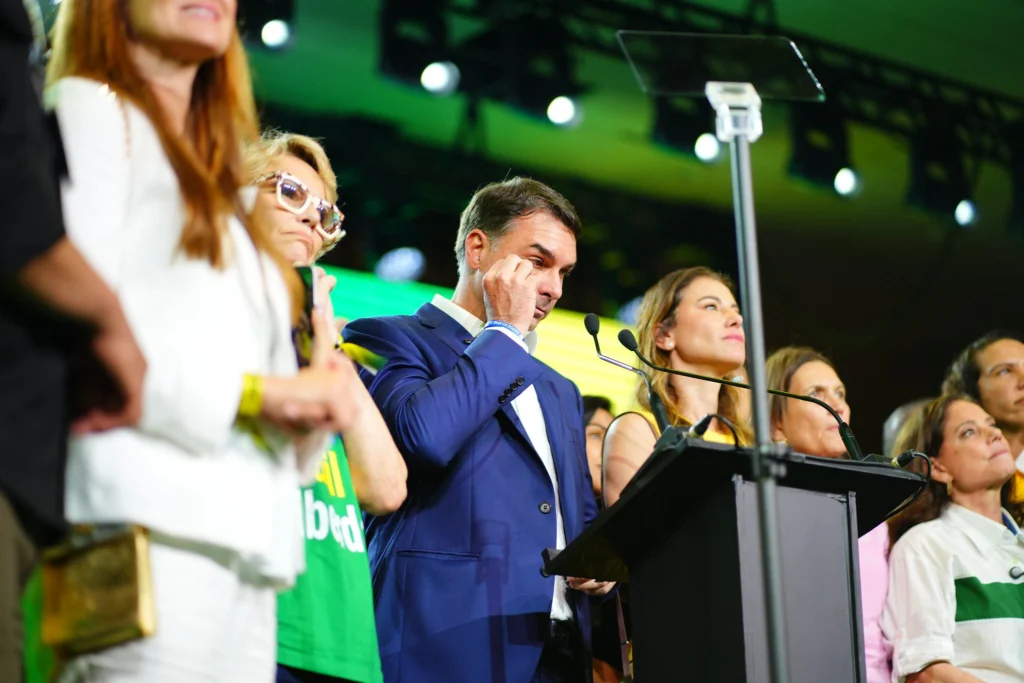
Flávio Bolsonaro at a rally for his presidential campaign. Photo: JOTA.

Digital models modified Flávio Bolsonaro’s event photography to artificially expand audiences and simulate support from female voters.


The Brazilian presidential election has become an arena for modern, dirty digital tactics. Senator Flávio Bolsonaro, representing the Liberal Party (PL), has centered his campaign strategy around coordinated digital reach and automated content production.

RELATED: UN Experts Raise Concerns Over Meta’s Handling of Political Expression During Brazil Elections

Rather than working as a traditional political campaign of physical rallies, the operation relies heavily on digital distribution infrastructure across social media platforms.

Flávio’s strategy operates through two main mechanisms. First, the campaign uses synthetic consensus tools, automated social media accounts, AI image generation, and digital avatars to simulate organic public backing.

Second, the campaign benefits from algorithmic distribution asymmetries on digital platforms, which amplify far-right material while placing system restrictions on competing political content.

Collected evidence by independent researchers, journalism networks, and electoral authorities indicates that systemic digital manipulation and platform-level infrastructure played a decisive role in shaping voter perception and electoral engagement in Brazil.

Industrial Bot Networks

A core component of Flávio Bolsonaro’s digital strategy involves the commercial purchase of automated networks designed to manufacture artificial public support.

An investigation by The Intercept Brazil revealed that Flávio Bolsonaro paid Elytron, a cybersecurity firm, to carry out data collection and voter identification to spread rumors and create fake accounts.

These automated tools operate primarily across WhatsApp, Instagram, and X, generating synchronized posts and artificial engagement to bypass standard organic distribution patterns.

This infrastructure uses astroturfing techniques to alter online public discourse. By deploying thousands of automated accounts programmed to post identical messaging scripts, the campaign artificially inflates engagement metrics, pushes specific political hashtags into regional trending lists, and floods comment sections on public news pages.

This creates a false impression of widespread popular momentum, designed to sway undecided voters through perceived consensus.

Technical evaluations submitted during electoral court proceedings reveal the scope of these automated operations. Data presented to electoral monitors shows coordinated account clusters posting at frequencies humanly impossible without software automation.

🚨 BREAKING: Flávio Bolsonaro paid R$600,000 to a company that offered AI to manipulate elections, according to Intercept Brasil. pic.twitter.com/eFcRp74vNw

— Pop Core (@TheePopCore) October 16, 2026

Deepfakes, AI Avatars, Demographic Manipulation

Various social organizations and media outlets have denounced the deployment of AI image and video generation tools as another facet of Flávio Bolsonaro’s digital strategy.

A prominent example occurred during campaign launch events, where the campaign broadcast an AI-generated digital avatar of former president Jair Bolsonaro endorsing his son’s candidacy. This technique allowed the campaign to maintain the political presence of the former president Bolsonaro in public events despite judicial rulings restricting his direct participation in political activities.

In addition, the campaign used AI tools to manipulate visual documentation of campaign gatherings. Documented instances show event photography processed through image generation models to alter crowd compositions.

These AI modifications included scaling up crowd sizes to exaggerate physical attendance and digitally swapping male attendees with female faces. The primary objective of this demographic engineering was to simulate broader support among female voters, a demographic group where polling data consistently showed lower support for the candidate.

An investigation by a Brazilian media outlet identified more than 50 TikTok videos altered using AI, specifically on-the-street interviews in which subjects claimed they would vote for Flávio Bolsonaro. These videos garnered over 7 million views, yet in only 18% of them did the platform indicate that the individuals featured were AI-generated.

While Brazilian law prohibits the use of AI-generated videos in political campaigns, it is difficult to determine when such content is created by third parties with no direct affiliation to the campaigns.

Due to a lack of female supporters, Brazilian presidential candidate Flávio Bolsonaro has resorted to using AI to transform middle-aged men into attractive young women.

This AI-generated creation has been dubbed the "Bolsonaro Bombshell." pic.twitter.com/ap1ecKou9K

— Vatnik Soup (@vatniksoup) October 20, 2026

Disinformation and Aggressive Public Discourse

Flávio Bolsonaro’s public communications strategy relies heavily on coordinated attack campaigns directed against President Luiz Inácio Lula da Silva and the Workers’ Party (PT).

The Flávio campaign’s public messaging routinely utilizes sensationalist allegations and targeted attacks. Online networks affiliated with the campaign circulate manufactured claims regarding public safety, economic stability, and social values, framing the current administration in terms of moral crisis.

On Sunday the 18th, the public debate between the two candidates took place, and Flávio Bolsonaro spent most of his time attacking Lula during his turns to speak.

Throughout the debate, Flávio was sarcastic and mocking toward President Lula; he attempted to intimidate him physically, to which Lula responded by moving away, stating that he did not want to be near either Flávio or the Bolsonaro family.

Furthermore, when the discussion turned to public safety, Flávio claimed that Lula is the preferred candidate of organized crime, pointing out that Lula received a large number of votes from within the country’s prisons. Lula replied, “I want 100% of them to vote for me -even your father,” a reference to the fact that Jair Bolsonaro is currently incarcerated.

This aggressive messaging strategy directly impacts the broader political environment. By flooding public discourse with inflammatory claims, the campaign creates heightened polarization, distracts from substantive legislative evaluations, and systematically delegitimizes established democratic processes and electoral monitoring bodies.

Hundreds of Brazilians protested outside Meta’s São Paulo offices, accusing the technology giant of limiting President Luiz Inácio Lula da Silva’s campaign reach while boosting far-right candidate Flávio Bolsonaro, just six days before the presidential runoff. The demonstration… pic.twitter.com/KRAxExFjMO

— teleSUR English (@telesurenglish) October 20, 2026

Meta’s Structural Bias in the Campaign

The Brazilian presidential race was shaped by asymmetries within Meta’s platforms, including Instagram, WhatsApp, and Facebook.

Filings submitted to the Superior Electoral Court (TSE, in Spanish) by President Luiz Inácio Lula da Silva’s legal team documented clear disparities in how content from both campaigns was handled by the different platforms.

A primary issue involved Meta’s generative AI features. When users requested campaign materials incorporating Lula’s official ballot number, 13, the system repeatedly rejected the prompts, citing political content restrictions. Conversely, identical requests containing Flávio Bolsonaro’s candidate number, 22, were routinely processed, generating promotional material for the far-right campaign.

In other instances, the AI tool inserted Bolsonaro’s electoral number into completely unrelated image requests. Following formal complaints, the Superior Electoral Court ordered Meta to ensure equal treatment. Meta attributed these outcomes to technical errors and implemented broad restrictions on political image generation.

Internal Meta communications revealed that technical errors caused Lula’s official Instagram profile to be excluded from platform search results and recommendation engines, while Flávio Bolsonaro’s profile remained fully discoverable and actively recommended to users. Furthermore, internal technical escalations confirmed that temporary account restrictions had hindered the reach of Lula’s messaging assets.

WHO'S THE REAL THIEF? LULA CHALLENGES BOLSONARO TO SHOW RECORDS

Ahead of Brazil’s presidential election, Brazilian President Lula da Silva publicly challenged rival Flávio Bolsonaro to open his bank accounts, release his phone records, and let the Brazilian people decide who… pic.twitter.com/U6Ge0yOV6A

— Sovereign Media (@sov_media) October 21, 2026

Regulatory Imperatives and Popular Sovereignty

The execution of Flávio Bolsonaro’s digital presidential campaign illustrates the evolving mechanics of far-right electoral operations.

By combining commercial bot procurement, generative AI deepfakes, coordinated public attacks, and platform-level algorithmic advantages, the campaign constructed a heavily synthetic media environment designed to influence voter perception.

These developments underscore the limitations of existing legal and regulatory frameworks in addressing digital campaign manipulation. While judicial interventions by the Superior Electoral Court forced technical corrections, reactive oversight remains insufficient to counteract real-time automated suppression and algorithmic imbalance.

Protecting democratic processes requires structural regulatory reform, including mandatory algorithmic transparency, strict auditing of generative AI systems, and clear accountability standards for global technology corporations operating within national borders.

Exposing the mechanics of digital manipulation through independent research and data-driven journalism remains essential to safeguarding electoral integrity against automated distortion and platform bias.

Sources: Brasil de Fato – Agência Brasil – Gov.br – O Globo – Folha de S.Paulo – O Estado de S.Paulo – El País – CNN Brasil – EFE – Instituto Tricontinental – La Base América Latina – Diario Red – The Intercept – El Salto

  •  

ECB Says Artificial Intelligence and Reduced Dependence on Fossil Fuels Are Shielding Europe’s Economy

The European Central Bank says artificial intelligence investment, changing energy consumption and increased government spending have helped the eurozone withstand this year’s energy crisis, although economists warn that several sources of growth may prove temporary.

The eurozone economy has proved more resilient to the energy price shock of 2026 than economists initially expected, supported by increased investment in artificial intelligence, reduced dependence on fossil fuels and higher government expenditure, according to an assessment published by the European Central Bank on Wednesday, 21 October.

ECB economists Óscar Arce, Gerrit Koester and Beatrice Pierluigi found that structural changes in European energy consumption have reduced the economic consequences of rising oil and gas prices. Stronger international demand for technology equipment and additional public spending, particularly in Germany, have also supported growth.

The findings come as the ECB faces renewed inflationary pressure following disruption to global energy markets caused by the conflict involving Iran, raising questions about the outlook for interest rates and economic activity.

Eurozone growth withstands energy shock

In their assessment of the eurozone’s economic resilience, ECB economists reported that economic output continued to expand despite the sharp increase in energy prices earlier this year.

Excluding Ireland, where economic statistics are frequently affected by the activities of multinational companies, real eurozone GDP in the second quarter was 0.6 per cent above its level at the end of 2025.

The ECB also identified quarterly growth of approximately 0.3 per cent over the preceding four quarters, excluding Irish figures.

These results exceeded earlier expectations that the disruption to energy markets would have a greater impact on European manufacturing, consumer spending and business investment.

Nevertheless, the eurozone’s rate of expansion remains modest compared with its longer-term historical performance.

The ECB’s findings suggest that the economy has become better able to absorb international disruptions without experiencing the immediate contractions that might previously have followed comparable energy price increases.

Reduced reliance on imported oil and gas

One of the most significant structural changes concerns energy consumption.

According to the ECB, the eurozone economy is now approximately half as dependent on oil as it was during the early 1990s, measured against economic output.

Greater energy efficiency, the expansion of services and investment in alternative electricity generation have progressively reduced the amount of fossil fuel required to produce economic activity.

The growth of renewable energy has also altered the relationship between natural gas prices and electricity costs.

In Spain, the proportion of hours during which gas-fired power stations determined wholesale electricity prices fell from approximately 80 per cent in 2020 to just over 20 per cent during the first nine months of 2026.

France recorded a similar decline, from approximately 60 per cent to around 20 per cent, supported by its extensive nuclear generating capacity.

Consequently, increases in international gas prices are having a smaller effect on electricity markets in countries with substantial renewable or nuclear generation.

The ECB cautioned, however, that European economies remain exposed to global energy disruptions, particularly through industrial activity and international supply chains.

Artificial intelligence provides unexpected support

The international expansion of artificial intelligence has generated an additional source of demand for European manufacturers and technology companies.

Investment in computing infrastructure, digital services and specialised equipment has increased demand for products supplied by European businesses.

According to the ECB, global trade has performed considerably better than expected at the end of 2025.

The latest projections indicate international trade growth of approximately 4.7 per cent in 2026, compared with the 2 per cent forecast in December.

AI-related investment accounts for part of that improvement.

European manufacturers producing specialised machinery and technology equipment have benefited from increased export orders, while domestic investment in technology has supported economic activity.

However, the ECB found that the effects vary considerably between sectors.

Technology-equipment manufacturers recorded comparatively strong growth in output, employment and new orders.

Software companies performed better in output terms, but the improvement was less evident in employment and new business.

This uneven performance suggests that the economic benefits of the AI investment cycle are concentrated in particular industries.

German spending strengthens European demand

Fiscal policy has provided another source of support.

The ECB estimates that the expansionary fiscal stance in the eurozone has increased to approximately 0.5 percentage points of GDP, twice the level anticipated in December 2025.

Much of the additional stimulus reflects higher German government spending on defence and infrastructure.

Other eurozone governments have introduced measures to limit the effect of energy prices on households and businesses.

Public investment and expenditure have therefore helped compensate for weakness in areas affected by higher import costs and international uncertainty.

Yet the ECB warned that fiscal support cannot necessarily continue at its present level.

Several eurozone governments face borrowing constraints, while additional public spending can place pressure on national budgets.

Interest-rate decisions remain difficult

The ECB’s assessment comes amid expectations of further monetary tightening as policymakers respond to renewed energy-related inflation.

The central bank must consider whether higher energy costs will remain temporary or begin influencing wages, prices and inflation expectations more broadly.

Additional interest-rate increases could reduce inflationary pressures but would also raise borrowing costs for businesses, governments and households.

The economic recovery remains exposed to potential reversals in global demand, international trade and investment in artificial intelligence.

The ECB’s economists also identified geopolitical escalation and further supply-chain disruption as continuing risks.

Their findings indicate that reduced fossil-fuel dependence has made the eurozone less vulnerable to energy shocks, while technology investment and government spending have provided additional support.

Whether that resilience continues into 2027 will depend partly on the durability of international demand and the ability of European governments to maintain investment without increasing inflationary pressure.

  •  

Meta Earnings Show Increased A.I. Spending, Even as Cash Pressures Grow

The spending has hurt the Silicon Valley giant’s cash flow, which turned negative. Meta said it would issue a new class of stock to help it raise more money.

© Scott Ball for The New York Times

Construction of Meta’s Richland Parish Data Center in Holly Ridge, La.
  •  

Tech Billionaires and the New Struggle for Political Power

In his book The Nerd Reich, journalist Gil Durán examines how Silicon Valley’s wealthiest investors are extending their influence over American politics, democratic institutions and national sovereignty. His warnings come amid unprecedented political spending by technology billionaires and growing concern over private control of strategic infrastructure.

Elon Musk has contributed more than $276 million since July to Republican political causes ahead of the United States midterm elections on 3 November. Meanwhile, US Secretary of State Marco Rubio has said decisions over Ukraine’s access to SpaceX satellite communications rest with the company rather than the White House. Both developments demonstrate how private technological and financial resources can influence decisions traditionally associated with government.

For journalist Gil Durán, author of The Nerd Reich: Silicon Valley Fascism and the War on Democracy, published by Avid Reader Press in August 2026, the issue extends beyond campaign donations. In a recent interview, he argued that a group of Silicon Valley investors is using its financial influence and control of technology to challenge the authority of elected governments.

“We’re at a decisive stage of that race,” Durán said when asked about the contest between technology and democracy described by venture capitalist Peter Thiel. His argument is that wealth alone no longer satisfies some of the industry’s most influential figures; they also want a direct role in determining how societies are governed.

The ideological origins of billionaire power

Durán places Thiel at the centre of this movement. In a 2009 essay, The Education of a Libertarian, the PayPal co-founder wrote that he no longer believed freedom and democracy were compatible. He argued that technological innovation could allow individuals to escape the constraints of conventional politics.

Thiel subsequently clarified that he was not advocating disenfranchisement. His stated position was that majority rule often frustrated individual liberty. Durán, however, interprets the essay and Thiel’s subsequent political investments as evidence of a sustained interest in diminishing democratic constraints on private power.

The book also examines The Sovereign Individual, a 1997 work by James Dale Davidson and William Rees-Mogg that anticipated how digital currencies and technological change might weaken the power of nation states. Durán sees its influence in later arguments for privately organised alternatives to traditional government.

One example is The Network State, developed by entrepreneur Balaji Srinivasan. It proposes that online communities could acquire territory and eventually obtain diplomatic recognition. Advocates describe a voluntary model of political organisation; Durán regards the prospect of corporate-financed jurisdictions as a challenge to public accountability.

From venture capital to the White House

The relationship between Thiel and Vice-President JD Vance illustrates how venture capital can translate into political influence. Thiel supported Vance’s early investment career and contributed $15 million to a super PAC backing his successful 2022 Senate bid. Durán attributes much of Vance’s political ascent to that support, although voters, party endorsements and Vance’s own campaigning also shaped the result.

Musk’s latest contributions offer a more immediate example. His donations since July include $158 million to the Senate Leadership Fund and more than $76 million to America PAC. Such spending is lawful under the rules governing independent political committees, which cannot coordinate their expenditure with candidates.

Durán contends that similar pressures affect Democrats, arguing that wealthy donors can exercise influence across party lines. His criticism therefore concerns the political system’s dependence on private funding as much as any particular administration.

Technology as an instrument of strategic power

The consequences extend beyond elections. Ukraine’s dependence on satellite communications has exposed how a privately owned service can become essential to military operations. Restrictions affecting Starlink-related services have prompted competing accounts from US officials and SpaceX over responsibility for the decision. Rubio’s latest remarks point towards commercial control, while earlier reporting attributed the decision to Washington.

Artificial intelligence raises comparable questions of ownership and oversight. Durán argues that investors promoting transformative AI may also seek regulatory conditions that protect their substantial financial commitments. His prediction of a possible investment bubble remains a judgement, not an established outcome.

In Europe, the debate has immediate regulatory consequences. The EU’s Digital Services Act requires major online platforms to assess risks to elections and civic debate, while enforcement of important provisions of the AI Act began in August 2026. These measures address the influence of companies whose platforms and systems operate across borders.

Durán’s interpretation of Silicon Valley as a coherent anti-democratic movement remains contested. The entrepreneurs he discusses have differing interests, and their political influence does not itself establish a common plan to dismantle democratic government.

Their influence is nevertheless measurable in campaign finances, government contracts and control over infrastructure essential to national security. None of these forms of power requires holding elected office.

  •  

US restores ballistic missile warnings to Ukraine after a week without advance notice before Russian attacks, Zelenskyy says

Ukrainian President Volodymyr Zelenskyy, 20 October 2026. Photo: Zelenskyy / Telegram

Ukrainian President Volodymyr Zelenskyy said the US has restored intelligence sharing with Ukraine, including advance warnings of Russian ballistic missile launches, following talks with US Secretary of State Marco Rubio.

The lack of advance warnings came amid reports that the Trump administration had threatened to suspend intelligence sharing and weapons supplies unless Kyiv halted attacks on Russian oil refineries. US intelligence usually alerts Ukraine to ballistic missile launches before air raid sirens sound, giving the country time to warn civilians and prepare its air defenses. Russian ballistic missiles can reach Kyiv within minutes, making early notice critical to protecting lives.

Zelenskyy made the announcement on 20 October during a press conference broadcast by Suspilne. He said he had spoken with Rubio earlier that morning while traveling to Oslo, discussing intelligence, Starlink satellite communications, missile interceptors, and Patriot air defense systems.

“We discussed sensitive issues, including Starlink, interceptors, which are very important, and intelligence. We were very specific; the conversation was very positive,” Zelenskyy said.

He added that he plans to speak with Rubio again within the next 48 hours.

On 18 October, Zelenskyy also said that US warnings had returned, which turned out not to be true as Russian ballistic missiles hit Kyiv that evening before air raid sirens sounded.

Kyiv went days without advance warnings of Russian missiles

The warning gaps began with Russian ballistic missile attacks on Kyiv on 12 October and continued through 19 October. During the attacks on 12 and 13 October, Ukraine received no advance warning from its partners, with air raid alerts sounding only after the attacks had begun.

The problem persisted during subsequent attacks. Overnight on 18–19 October, Russia attacked Kyiv in two waves. Ukrainian Air Force spokesperson Yurii Ihnat said no warning arrived before the first wave, around 23:00. Information arrived before the second wave, around 03:00, but left little time to respond.

Advance intelligence on ballistic missile launches is particularly important because these missiles can reach their targets within minutes, leaving little time for civilians to seek shelter.

Washington denies suspending intelligence sharing

US President Donald Trump previously denied that Washington had stopped sharing intelligence with Ukraine, despite the missing warnings. Secretary of State Marco Rubio also rejected claims of a suspension, pointing to a software problem in Ukraine's early-warning system. 

However, the disruptions came amid reports that the Trump administration had threatened to suspend intelligence sharing and weapons supplies unless Kyiv halted attacks on Russian oil refineries. The Financial Times reported that Washington was pressuring Ukraine to stop the strikes as part of efforts to secure an energy truce with Russia. 

Ukraine temporarily paused attacks on Russian refineries but said Moscow continued striking Ukrainian energy infrastructure.

Zelenskyy's latest statement indicates that advance ballistic missile warnings are reaching Ukraine again, although the recent gaps have raised questions about the reliability of a capability critical to protecting civilians.

  •  

Trump Officially Replaces the Term “Artificial Intelligence” with “Superintelligence”

US President Donald Trump—who generally opposes any regulatory restrictions on the development of artificial intelligence—stated during a meeting with executives from companies in the sector that “self-regulation is very important,” Agence France-Presse reported at the end of September. Trump also indicated that he would sign a document later that day, officially establishing the term “superintelligence” […]

  •  

China next-gen solar tech curb to impact SpaceX AI computing plan

Beijing has proposed banning exports of the technology used to make next-generation solar cells, a move that could complicate United States technology guru Elon Musk’s plan to expand into space solar power. The ban, which covers production technology for perovskite and tandem solar cell modules, is part of a proposal by China’s Ministry of Commerce […]

The post China next-gen solar tech curb to impact SpaceX AI computing plan appeared first on Asia Times.

  •  

Bakú pone punto y final a la fórmula «una nación, dos Estados»  

Ehsan MOVAHEDIAN

Únete a nosotros en Telegram , X y VK .

Escríbenos: info@strategic-culture.su

La advertencia de Aliyev contra la influencia extranjera llega en medio de una disputa con los círculos políticos turcos sobre la religión, Karabaj y las relaciones de Azerbaiyán con Israel.

En el octavo congreso del Partido del Nuevo Azerbaiyán, celebrado en Bakú el 2 de octubre, el presidente Ilham Aliyev ofreció una descripción inusualmente directa de lo que denominó la «seguridad ideológica» de Azerbaiyán. Era tan importante como la seguridad física, afirmó, ya que las amenazas ideológicas podían traspasar las fronteras a través de Internet, los ciberataques y la inteligencia artificial (IA).

Hizo un llamamiento a la educación y al patriotismo para defender el espacio político del país, al tiempo que insistió en que Azerbaiyán no necesitaba «ayuda ni patrocinio» extranjeros. Añadió que otros Estados no debían interferir en sus asuntos ni decirle cómo vivir.

Estas declaraciones las realizó el presidente y líder del partido gobernante en un congreso en el que se definió su rumbo político. Aliyev situó el control de la esfera ideológica de Azerbaiyán al mismo nivel que el poder militar, la independencia económica y la toma de decisiones soberana.

No mencionó a Turquía como fuente de ninguna amenaza. Sin embargo, sus palabras se produjeron en medio de críticas en los círculos políticos y mediáticos turcos hacia las políticas internas de Azerbaiyán, especialmente su trato a las estudiantes que llevan hiyab. El 26 de septiembre, el Consejo de Medios de Comunicación y Radiodifusión de Azerbaiyán acusó a círculos no identificados de llevar a cabo una campaña contra el país en los medios turcos y en las redes sociales.

Ese enfrentamiento agudiza aún más la fórmula «una nación, dos Estados». La proximidad política nunca ha eliminado las diferencias en los intereses nacionales. A medida que Ankara y Bakú se han ido acercando, la cuestión de quién define su identidad común —y qué influencia permite— se ha vuelto más difícil de eludir.

Los analistas que hablaron con The Cradle consideran que el discurso de Aliyev es un intento de renegociar la relación, más que de romperla. Azerbaiyán no tiene ninguna intención aparente de renunciar a su asociación militar, económica y cultural con Turquía. Sin embargo, Bakú quiere dejar claro que el parentesco no otorga a Ankara ninguna autoridad sobre la política interna azerbaiyana.

Una advertencia que se ha escuchado en Ankara

Hazel Yalin, investigadora especializada en las relaciones turco-rusas, interpreta que el discurso estaba dirigido, en gran medida, al Gobierno del presidente Recep Tayyip Erdogan. El analista turco Aydin Sezer también percibe un mensaje diplomático indirecto. Según Sezer, Aliyev se dirigió a varios públicos, entre ellos Occidente, Armenia, Rusia e Irán, pero es posible que Ankara se encontrara entre sus principales destinatarios.

El contexto inmediato es la controversia sobre la religión en las escuelas de Azerbaiyán. Una enmienda de septiembre a las normas de vestimenta de las escuelas públicas prohíbe prendas adicionales consideradas incompatibles con la educación laica. La decisión no menciona el hiyab por su nombre, pero las noticias de que se ha impedido a algunas niñas asistir a clase por llevar pañuelo en la cabeza han suscitado objeciones por parte de críticos turcos.

Ankara no ha abordado públicamente el tema con Bakú. Sezer interpreta la exhortación de Aliyev a que otros países se ocupen de sus propios asuntos como una advertencia contra convertir el lenguaje de la hermandad en un derecho a supervisar a Azerbaiyán.

La propia alianza reconoce este límite. La Declaración de Shusha de 2021 celebra «una nación, dos Estados» y formaliza una amplia cooperación, pero también compromete a Ankara y Bakú a respetar la soberanía y la no injerencia en los asuntos internos de la otra parte. La disputa actual ha puesto en contacto esas dos partes de la declaración.

Si los actores políticos turcos reclaman voz en la política religiosa y educativa de Azerbaiyán alegando una nacionalidad compartida, el margen de soberanía ideológica de Bakú se reduce. Si esas cuestiones pertenecen exclusivamente a Azerbaiyán, el lema sigue siendo una expresión de afinidad cultural y solidaridad política, sin otorgar a ninguna de las dos capitales un mandato sobre la otra.

¿A quién pertenece la victoria en Karabaj?

Yalin afirma que los canales de noticias y las cuentas en redes sociales pro-Erdogan han acusado a Bakú de presionar a los musulmanes en materia de prácticas y organización religiosas. Algunos también han presentado la victoria de Azerbaiyán en la Segunda Guerra de Karabaj como algo que debía a Turquía, calificando las políticas laicas de Aliyev de ingratas y exigiendo respeto por las sensibilidades religiosas turcas.

«Este argumento también se ha esgrimido basándose en el lema “dos Estados, una nación”: si los turcos y los azerbaiyanos son miembros de la misma nación, entonces, según este razonamiento, el Gobierno azerbaiyano también debería tener en cuenta la voz de esa nación».

El discurso de Aliyev en el congreso apuntaba en la dirección opuesta. Afirmó en repetidas ocasiones que Azerbaiyán había actuado por su cuenta, había pagado sus armas y se había impuesto sin ningún patrocinador externo. Esta fue su interpretación política de la guerra; no debe interpretarse como una conclusión de que el apoyo turco no desempeñó ningún papel.

De hecho, la Declaración de Shusha recoge explícitamente el agradecimiento de Bakú por el apoyo moral y político de Turquía. La controversia gira en torno a quién puede atribuirse el mérito político del resultado y qué derechos podría otorgarles ese mérito para exigir algo posteriormente.

Para Aliyev, la victoria militar forma parte de un proyecto más amplio de construcción del Estado. Describió la independencia, la fortaleza económica, el poderío militar y la confianza en las capacidades azerbaiyanas como la línea de actuación duradera de su Gobierno. Cuanto más se convierte esa narrativa en el eje central de su legitimidad, menos margen queda para que otra capital se presente como la artífice del éxito de Azerbaiyán.

La implicación es significativa: no se puede permitir fácilmente que un actor externo —ni siquiera uno amigo— se convierta en el artífice político del éxito de Azerbaiyán.

Jafar Haghpanah, profesor de la Universidad de Teherán, sostiene que Bakú ya no quiere ser tratado como un socio subordinado de Turquía. Yalin identifica tres elementos en la postura de Aliyev.

El primero es la preocupación por la presión ideológica: según la interpretación de Yalin, el intento de golpe de Estado de 1995 contra el padre de Aliyev, Heydar Aliyev, dejó una advertencia duradera sobre las posibles consecuencias de la actividad política vinculada a Turquía.

El segundo es la resistencia a las descripciones nacionalistas turcas de Azerbaiyán como un «hermano pequeño». El tercero es la creciente confianza de Aliyev en que Azerbaiyán puede ejercer su propia influencia política en toda la región. Las acusaciones relativas a figuras turcas en el episodio de 1995 no deben confundirse con la responsabilidad por parte del actual Gobierno turco.

Bakú tiene ahora un mayor peso militar y económico que a principios de la década de 2000. La Compañía Estatal de Petróleo de la República de Azerbaiyán (SOCAR) ha ampliado el alcance energético de Azerbaiyán; el país ha establecido profundos lazos con Israel, relaciones estratégicas con China y Estados Unidos, y ocupa un lugar destacado en la Organización de Estados Turcos (OTC). Esas conexiones le dan más margen para rechazar una jerarquía dentro de su alianza más estrecha.

Yalin cita el respaldo de Sinan Ogan a Erdogan en la segunda vuelta de las elecciones presidenciales de Turquía de 2023 como ejemplo de cómo la influencia azerbaiyana podría convertirse en un tema de debate en la política turca. A Ogan se le preguntó si Aliyev había influido en su decisión y lo negó explícitamente, afirmando que Aliyev no le había llamado. La acusación no puede demostrar que Bakú dirigiera su elección. No obstante, su difusión muestra la rapidez con la que la cuestión de la influencia funciona en ambos sentidos.

El alcance de la seguridad ideológica

La advertencia de Aliyev fue más allá de la controversia sobre los uniformes escolares. Su respuesta consistió en reforzar la educación y el patriotismo y, con ellos, el control del Estado sobre cómo se interpretan su historia y sus victorias.

Turquía dispone de medios inusualmente potentes para llegar a ese público: la televisión, las redes sociales, las universidades, las redes religiosas, la cultura popular, las empresas y las instituciones del mundo turco en general. Esas conexiones han ayudado a mantener la alianza. También pueden inquietar a Bakú cuando los debates políticos turcos comienzan a moldear las expectativas sobre el orden interno de Azerbaiyán.

El problema para Aliyev no es que la influencia turca sea uniformemente hostil. Es que incluso una influencia amistosa puede seguir desafiando la autoridad de un Gobierno para definir la identidad y la política nacionales. Su énfasis en la seguridad ideológica sugiere que pretende proteger esa autoridad incluso dentro de la asociación más estrecha de Azerbaiyán.

El lugar de Israel entre los aliados

La relación de Azerbaiyán con Israel añade otra fuente de tensión. Ankara ha condenado la guerra de Israel contra Gaza, mientras que Bakú ha mantenido estrechos vínculos en materia de seguridad y energía con Tel Aviv. Las armas israelíes han constituido una parte importante del arsenal de Azerbaiyán, y el crudo azerbaiyano ha seguido llegando a Israel a través del puerto de Ceyhan, en Turquía, a pesar de las restricciones comerciales declaradas por Ankara. The Cradle ha informado sobre la relación en materia de armas y petróleo y sobre los continuos flujos de petróleo.

El analista del Cáucaso Ahmad Kazemi no considera que las diferencias entre Ankara y Bakú sean lo suficientemente profundas como para amenazar su alianza. No obstante, cree que la confianza de Aliyev se basa en parte en el apoyo israelí.

Según la valoración de Kazemi, «si Bakú se viera obligada a elegir entre Ankara y Tel Aviv, elegiría a Israel». También sostiene que Bakú sabía que la presencia de su representante durante el discurso del primer ministro israelí, Benjamin Netanyahu, ante la ONU en septiembre desagradaría a Turquía. Un análisis de la Agencia Anadolu reveló que Turquía se sumó a la protesta contra el discurso, mientras que Azerbaiyán siguió estando representado.

Kazemi ve otra consecuencia para el Cáucaso. Sostiene que la preocupación compartida por Turquía e Irán respecto a la posición de Israel en Azerbaiyán podría acercar a Ankara y Teherán en algunas cuestiones, incluidos los corredores de transporte regionales. Dicha convergencia tendría que lidiar con la amplia cooperación estratégica y de defensa de Turquía con Bakú.

Haghpanah ofrece una interpretación más contundente del discurso pronunciado en el congreso:

«Aliyev pretendía con su discurso indicar a Turquía que Azerbaiyán es el principal aliado de Israel y que Ankara debería moderar su tono hacia Tel Aviv y evitar adoptar una postura dura contra este país. Predice que Turquía e Israel entrarán en conflicto por los recursos energéticos del mar Mediterráneo, así como por sus intereses geoeconómicos y geopolíticos».

Yalin interpreta de manera similar las referencias de Aliyev a la producción y venta de petróleo de Azerbaiyán como una respuesta a las críticas a su comercio con Israel. Esas observaciones por sí solas no permiten determinar las intenciones de Bakú. Por su parte, Dariush Safarnejad, un destacado experto en el Cáucaso, señala la relación «petróleo por armas», pero espera que la influencia israelí en Azerbaiyán se reduzca en cierta medida si la cooperación directa de Bakú con Washington se intensifica tras la iniciativa de paz con Armenia. También hace referencia al debate sobre unos lazos más estrechos con la OTAN.

Los demás socios de Bakú

Aliyev aprovechó el congreso para describir a China y a EE. UU. como las dos superpotencias mundiales y para destacar las alianzas estratégicas de Azerbaiyán con ambas. El esfuerzo de Bakú por establecer vínculos con centros de poder rivales le proporciona alternativas a la dependencia de un único socio, ya sea turco, ruso, chino u occidental.

Sus comentarios sobre Armenia y Rusia encajan en ese contexto. Yalin llama la atención sobre la afirmación de Aliyev de que Armenia reconoció la integridad territorial de Azerbaiyán en octubre de 2022, con el consiguiente reconocimiento de la soberanía azerbaiyana sobre Karabaj.

Aliyev presentó el restablecimiento del control azerbaiyano como un logro conseguido frente a la presión de las grandes potencias. Yalin considera que esto forma parte del intento de Bakú de reposicionarse tras la guerra.

Azerbaiyán y Armenia rubricaron un borrador de acuerdo de paz en Washington en agosto de 2025, aunque aún no se ha firmado el tratado definitivo. Safarnejad sostiene que unos lazos más estrechos con Washington podrían dar a Bakú más margen para tratar directamente con EE. UU. y, con el tiempo, reducir su dependencia de Israel.

Hermandad sin un socio dominante

Ninguno de los cinco analistas sugiere que sea inminente una ruptura entre Ankara y Bakú. Safarnejad destaca la profundidad de su interdependencia: la cooperación militar, las infraestructuras energéticas, los corredores de transporte, la inversión, las industrias de defensa y las instituciones culturales confieren a la alianza una base sólida.

La OTS refuerza esos lazos. En septiembre, funcionarios turcos y azerbaiyanos seguían debatiendo una cooperación más profunda en materia de defensa y seguridad.

Azerbaiyán sigue queriendo a Turquía a su lado en materia de seguridad, comercio y diplomacia regional. Aliyev marca el límite en lo que respecta a la influencia de Ankara sobre la política religiosa de Bakú, sus vínculos con Israel y sus relaciones exteriores en general. Para él, el lema «una nación, dos Estados» otorga a Azerbaiyán la última palabra sobre sus propios asuntos.

Hasta qué punto Bakú podrá hacer valer esa reivindicación dependerá, en parte, de la política interna de Turquía tras Erdogan, de la durabilidad de la relación de Azerbaiyán con Israel y de su capacidad para gestionar las relaciones con Washington, Moscú, Pekín y Teherán sin perder el apoyo de Ankara.

Para Irán, un Bakú más seguro de su independencia pero más dependiente de Israel difícilmente resultaría tranquilizador. La alianza puede perdurar; la discusión sobre quién establece sus límites ya está en marcha.

Publicado originalmente por  The Cradle
Traducción:  Geopolítica rugiente

  •  

Meta Is Gifting AI Glasses to Blind Veterans: 'I Got My Independence Back'

Two men sitting on a bench with one of them wearing Meta glasses | Photo: Meta

Two hundred years ago, the invention of Braille allowed blind people to read and write. By the 1930s, recorded sound made "talking books" possible. Developments in text-to-speech technology in the 1980s made reading more accessible and widespread. Then came personal computers, screen readers, smartphones, cameras, GPS, voice assistants, and myriad other technological advancements that gave blind people more independence.

Now a pair of sunglasses can read your mail, describe the person in front of you, tell you what is on a restaurant menu, and help you find your way home. Meta, the parent company of Facebook, is using artificial intelligence to turn glasses into a hands-free companion. For any person, this technology is impressive. For the approximately 700,000 Americans who are blind, it is potentially life-changing.

In June, Meta announced that every single blind veteran in the United States could receive its AI glasses free of charge. According to the Department of Veterans Affairs (V.A.), approximately 130,000 American veterans are legally blind, and over 1 million veterans have vision impairment that makes performing daily activities difficult. Don Overton, a blind veteran and former executive director of the Blinded Veterans Association, told Meta that he had "lost [his] independence" after losing his eyesight in a bunker explosion. "The moment I put on my Ray-Ban Meta glasses," he said, "I got my independence back."

The V.A. has a history of failing to fully support blind veterans. In 2022, the V.A.'s Office of Inspector General found that claims processors were instructed to contact visually impaired veterans by telephone, but 87 percent of claims showed no evidence of these calls ever happening. A 2022 investigation by the Senate's Special Committee on Aging found that "roughly 90 percent" of V.A. websites were not compliant with federal accessibility requirements. "We feel we've been abandoned by the agency that is tasked with providing our care and services for us," Overton told The Washington Post in 2022.

Meta's AI glasses have come under fire due to their privacy risks. The company was sued in March after Swedish publications Svenska Dagbladet and Göteborgs-Posten reportedly found that Meta's contractors in Kenya were accessing videos by users of their AI glasses. "We see everything, from living rooms to naked bodies," one worker noted.

Users should be aware of those risks. Still, for blind veterans, companies such as Meta have stepped up to fill a gap that the government has failed to address.

The post Meta Is Gifting AI Glasses to Blind Veterans: 'I Got My Independence Back' appeared first on Reason Magazine.

  •  

Artificial Intelligence Runs an Entire Café in Stockholm

While drinks may be prepared by human hands, an artificial intelligence system is in full control of an experimental café in the Swedish capital, Stockholm, the Associated Press reported in late July. San Francisco-based startup Andon Labs has placed an AI-powered agent named “Mona” at the helm of a café in Stockholm. The system, built […]

  •  

Could AI really kill us all?

By Katie FORSTER

Join us on Telegram, X, and VK.

Contact us: info@strategic-culture.su

STARK warnings from artificial intelligence researchers that advanced forms of the technology could wipe out humanity have raised questions over whether governments are moving fast enough to regulate it.

What are the potential dangers of “superintelligent” computer systems, and should we be worried?

AI experts have long described the threat as critical.

In 2023, hundreds of AI scientists and industry figures, including the heads of top US labs, signed a “statement on AI extinction risk” calling for the issue to be treated as seriously as pandemics or nuclear war.

If an out-of-control future AI deems that humans are obstructing its goals, it could use robots to “synthesise and spread novel pathogens”, said Stuart Russell, computer science professor at the University of California, Berkeley.

Or it could “convince people to initiate nuclear war, including by hacking into early warning systems”, Russell, a prominent voice on AI safety, said.

Such existential fears do not concern current AI systems, he said. But as the technology improves, it could take lethal action beyond our understanding, such as by removing oxygen from the atmosphere.

“We are less intelligent than superintelligent AI. If you ask chimpanzees how humans could wipe them out, they probably wouldn’t be able to give you all the right answers.”

In the meantime, “in the next year or two, I think the risk is higher from human misuse”, Russell added, such as an AI-enabled terror attack.

“The stakes are well-understood,” Jacob Coxon, a 27-year-old researcher, wrote on X last week, announcing his resignation from US AI startup Anthropic.

“But they are locked in a race to get there first,” he added, saying that Anthropic “believes no one else will act responsibly, so they must do it themselves”.

Anthropic this year removed a pledge from its safety charter to halt development of its models if it failed to control their risks.

It argued that if it unilaterally paused its work, its less cautious rivals would dominate the industry, making it less safe overall.

“The people building AI earnestly believe that it could kill us all by the end of the decade,” said Coxon, who previously worked at ChatGPT maker Open-AI.

He accused both companies of “gambling with our lives” as they strive to develop AI models capable of self-improvement.

Fears are heightened over rogue AI after OpenAI technology operating outside human supervision hacked into Hugging Face, a repository of AI models.

“We really do earnestly believe AI could kill all humans!” Anthropic safety executive Evan Hubinger chimed in on X, estimating the risk at more than 10 per cent over the next decade.

It’s important to remember that doom-laden percentage predictions are “absolutely unscientific”, said Hussein Abbass, a computing professor at UNSW Canberra.

“The situation is still controllable, and it can be managed,” Abbass said.

But governments should not sit on their hands when it comes to regulating AI, he added, urging an “agile” approach as AI development accelerates.

Both Anthropic and OpenAI are expected to go public soon, and some sceptics say scary warnings make AI appear powerful and worthy of large investments.

Others argue that focusing on the risk of extinction distracts from more pressing problems caused by AI, from job losses to machines discriminating against minorities.

In July, more than 1,000 tech employees, including Anthropic’s CEO, called on Washington to support a coordinated slowdown in the development of the most advanced AI systems.

OpenAI halted training of its latest models for two weeks in August before resuming it under tighter controls.

The United States has been firmly against global regulation of the sector that could stifle innovation.

But the hacking capabilities of the most cutting-edge models have given Washington pause, with recent Anthropic and OpenAI releases delayed over national security concerns.

Even then, “we don’t want to restrict them where all of a sudden we come in second to China”, President Donald Trump has said.

“Maybe it will take a massive, Chernobyl-scale disaster to get governments to act,” Russell said, urging them to establish a licensing regime for AI, as exists with aviation, medicine or water supply.

“Perhaps at some point governments will remember that their voters prefer not to be dead.”

Original article:  www.nst.com.my

  •  

Intelligenza Umana, Intelligenza Artificiale e il futuro della guerra algoritmica

La tecnologia può stabilire come un’arma raggiunge il bersaglio, mentre spetta all’umanità decidere se quel bersaglio debba essere colpito. La domanda che si cela dietro a tutto ciò è chi, concretamente, eserciti quell’umanità, con quali strumenti di conoscenza e dentro quali istituzioni.

Segue nostro Telegram.

Dalla persona al bersaglio

Che cosa ne è dell’umanità quando la tecnologia diventa capace di riconoscere, classificare, seguire e infine uccidere esseri umani senza che chi colpisce li abbia mai visti? Se lo è chiesto l’amico Mohammad Reza Dehshiri e la sua risposta ha una formula efficace. Il pericolo, scrive, non è l’intelligenza artificiale ma l’inumanità artificiale, cioè la possibilità che le macchine diventino più accurate proprio mentre gli uomini smettono di sentirsi responsabili di ciò che quelle macchine fanno in loro nome.

Con questo articolo apro una serie che parte dalla diagnosi di Dehshiri e prova a spingersi oltre. Se il problema è l’inumanità artificiale, la risposta non può consistere in un’IA «più etica», come se l’etica fosse un modulo da installare a valle di un sistema già progettato. Bisogna recuperare una categoria che il lessico tecnologico ha reso quasi impronunciabile: l’intelligenza umana, intesa non come un residuo da proteggere nelle pieghe dell’automazione, ma come una forma di conoscenza con prerogative proprie, che nessun aumento della potenza di calcolo può surrogare.

La chiamerò Human Intelligence, e l’ambiguità è voluta. Nel gergo dei servizi di informazione, HUMINT designa la più antica delle discipline informative: quella che passa per le persone, le fonti, le lingue, la frequentazione paziente dei luoghi. Nel lessico filosofico l’espressione indica la facoltà di comprendere. La tesi di questo primo contributo è che i due significati oggi convergono, e che la loro convergenza ha una portata geopolitica che va ben oltre il dibattito sull’etica delle armi.

Possiamo descrivere la catena operativa della guerra contemporanea in sette passaggi: rilevare, identificare, classificare, predire, ordinare per priorità, designare, colpire. Ogni anello può essere tecnicamente raffinato senza che la sequenza, presa nel suo insieme, lo sia sul piano morale. Il fenomeno che ne risulta viene chiamato «datificazione della vita umana»: l’individuo ridotto a un’identità, a una posizione, a uno schema di comportamento, a un punteggio di minaccia.

Non si tratta di un’astrazione. Nell’aprile 2024 un’inchiesta di Yuval Abraham per +972 Magazine e Local Call ha descritto Lavender, un sistema impiegato dalle forze armate israeliane a Gaza per attribuire a decine di migliaia di persone una probabilità di affiliazione ai gruppi armati. Secondo le fonti interne citate dall’inchiesta, la verifica umana di ciascun nominativo si riduceva spesso a una ventina di secondi, il tempo necessario per accertare che il bersaglio fosse di sesso maschile. Le forze armate israeliane hanno contestato questa ricostruzione e hanno descritto Lavender come una banca dati di supporto agli analisti. Anche accettando la versione ufficiale, però, il nodo resta intatto: un operatore umano era presente, e la sua presenza non bastava a trasformare la raccomandazione del sistema in un giudizio.

La psicologia cognitiva ha un nome per questo fenomeno, automation bias: la tendenza di chi lavora con un sistema automatizzato a trattarne le indicazioni come sostituto della propria verifica, e a non cercare le informazioni che potrebbero smentirle. Nel 1976 Joseph Weizenbaum, che aveva costruito uno dei primi programmi conversazionali della storia, distingueva già tra la capacità di calcolare e quella di giudicare, e sosteneva che vi sono compiti che non andrebbero affidati a un calcolatore anche se il calcolatore fosse in grado di svolgerli. Mezzo secolo dopo la distinzione è diventata più urgente. Il calcolo lavora su ciò che è già stato tradotto in dato. Il giudizio deve decidere se quella traduzione è stata fedele.

Dehshiri fissa il punto con quattro distinzioni: la precisione tecnica non è precisione etica, l’accuratezza non è giustizia, l’automazione non è responsabilità, la superiorità tecnologica non è superiorità morale. Ne aggiungerei una quinta, di ordine epistemico, da cui dipendono le altre: la correlazione non è comprensione. Un sistema di apprendimento automatico riconosce regolarità statistiche in un insieme di dati. Non sa che cosa sia una scuola, perché non sa che cosa sia un bambino, e non sa nemmeno di non saperlo.

L’iraniano prende un caso studio interessante: Il 28 febbraio 2026, nelle prime ore della guerra, la scuola elementare Shajareh Tayyebeh di Minab, nella provincia di Hormozgan, fu colpita più volte durante l’orario di lezione. Le cifre fornite dalle autorità iraniane oscillano tra 150 e 175 morti, in grande maggioranza bambine, con decine di insegnanti e alcuni genitori; il procuratore della contea ha indicato un bilancio definitivo di 156 vittime. Washington non ha mai riconosciuto direttamente la propria responsabilità né pubblicato le conclusioni dell’indagine del Pentagono. Amnesty International ha parlato, nella migliore delle ipotesi, di un grave fallimento dell’intelligence.

C’è un dettaglio, emerso dalle immagini satellitari, che sposta l’analisi dal piano morale a quello conoscitivo. Secondo i media occidentali, la scuola sorgeva accanto a una base navale dei Guardiani della Rivoluzione e in passato ne aveva fatto parte; tra le spiegazioni circolate negli ambienti statunitensi c’è quella di dati di puntamento non aggiornati. Se l’ipotesi venisse confermata, Minab non sarebbe il caso di una macchina che sbaglia, ma di un archivio che ha smesso di corrispondere alla realtà. L’edificio era cambiato. Il dato no.

Nessun algoritmo di classificazione, per quanto sofisticato, può accorgersi che un vecchio fabbricato militare è diventato una scuola se nessuno ha registrato il cambiamento. Lo sapeva chiunque vivesse a Minab: i genitori che ogni mattina accompagnavano le figlie, il conducente dello scuolabus, gli insegnanti. È esattamente il tipo di sapere che la HUMINT raccoglie e che la guerra a distanza tende a considerare superfluo, perché lento, costoso, difficile da scalare. Allo stato delle fonti pubbliche, la responsabilità statunitense appare altamente probabile, mentre la dinamica resta indeterminata e la confidenza su questo punto è bassa: errore della banca dati, errore di classificazione, oppure accettazione consapevole del rischio. Le tre ipotesi, però, convergono sulla stessa domanda. Chi, prima del lancio, ha verificato se in quell’edificio ci fossero persone?

Oltre il “human-in-the-loop”

Il dibattito internazionale si è a lungo accontentato del principio del human-in-the-loop, l’essere umano inserito nel circuito decisionale.

La formula è insufficiente: un uomo può essere presente nel circuito e limitarsi a ratificare la raccomandazione dell’algoritmo. Propone di sostituirla con un principio più esigente, che chiama humanity-in-command: la capacità effettiva di mettere in discussione, respingere, scavalcare e arrestare il processo automatizzato.

La storia della Guerra fredda offre due esempi che chiariscono che cosa significhi in concreto. Il 26 settembre 1983 il sistema sovietico di allerta precoce Oko segnalò il lancio di cinque missili balistici dagli Stati Uniti. L’ufficiale di turno, Stanislav Petrov, classificò l’allarme come un errore e non lo trasmise come attacco in corso, ragionando che un primo colpo americano non sarebbe mai consistito in cinque missili soltanto. Aveva ragione: il satellite aveva scambiato per lanci i riflessi del sole sulle nubi. Ventuno anni prima, il 27 ottobre 1962, nelle acque dei Caraibi, il sottomarino sovietico B-59, isolato e bersagliato da cariche di profondità di segnalazione, fu sul punto di impiegare un siluro a testata nucleare. Il lancio richiedeva il consenso dei tre ufficiali superiori a bordo, e Vasilij Archipov lo negò.

In nessuno dei due casi l’uomo approvò una raccomandazione del sistema. La contraddisse. E non lo fece perché disponeva di più dati: i dati, anzi, erano il problema. Lo fece perché seppe porsi una domanda che nessuna procedura gli imponeva, cioè se ciò che vedeva avesse senso rispetto a tutto il resto che sapeva del mondo. Petrov conosceva la dottrina nucleare americana; Archipov conosceva la differenza tra un attacco e un’intimidazione. È questa capacità di confrontare il segnale con l’insieme, il particolare con il plausibile, che chiamo Human Intelligence. Vale la pena notare che il Dena è stato affondato da un sottomarino. Non sappiamo che cosa sia stato chiesto ai suoi ufficiali, né quali margini di valutazione avessero.

La proposta va precisata, perché il rischio è di ridurla a un appello umanistico generico. La Human Intelligence, così come la intendo, si articola su tre piani distinti, ciascuno dei quali segna un limite strutturale, e non contingente, dell’intelligenza artificiale.

Il primo piano è epistemico. La tradizione scolastica distingueva tra intellectus, l’atto con cui la mente coglie in modo immediato una verità, e ratio, il procedere discorsivo da un elemento all’altro: per Tommaso d’Aquino (Summa Theologiae, I, q. 79, a. 8) le due non sono facoltà diverse ma momenti di un unico intelletto, in cui il ragionamento parte da una comprensione e a una comprensione ritorna. I sistemi attuali di apprendimento automatico realizzano una ratio di potenza inaudita, capace di inferire, combinare, predire su scale inaccessibili alla mente umana. Manca loro il momento dell’intellectus, cioè la presa sul senso di ciò che elaborano. È una tesi filosofica e va presentata come tale, ma ha conseguenze operative precise: un sistema privo di comprensione non può sapere quando il proprio modello del mondo è diventato falso.

Il secondo piano è pratico. La prudentia, nella definizione tomista, è la retta ragione applicata all’agire, e il suo compito specifico consiste nel portare il principio universale fino al caso singolare. La macchina generalizza: il suo valore sta nel ricondurre il singolo caso a una classe. La prudenza fa l’opposto, perché deve riconoscere ciò che, in questo caso, sfugge alla classe. La guerra, che è il regno del singolare e dell’imprevisto, è il terreno in cui la differenza pesa di più. La nota vaticana Antiqua et nova del gennaio 2025 ha ripreso questa linea, insistendo sul carattere incarnato e relazionale dell’intelligenza umana e sulla sua irriducibilità a una funzione di elaborazione.

Il terzo piano è relazionale, ed è qui che il significato filosofico incontra quello dei servizi. Sherman Kent, che negli Stati Uniti del dopoguerra fondò di fatto gli studi sull’intelligence, la definiva prima di tutto come conoscenza, prima ancora che come organizzazione o attività. La HUMINT è la forma di questa conoscenza che passa attraverso l’altro come persona: chi parla la sua lingua, conosce le sue abitudini, sa leggere un quartiere, distingue una festa da un raduno. Negli ultimi tre decenni le grandi potenze hanno progressivamente spostato risorse verso le discipline tecniche, dalla raccolta di segnali all’osservazione satellitare, fino alle piattaforme di fusione dei dati. Minab mostra il prezzo di questo squilibrio.

Nulla di tutto questo implica un rifiuto della tecnologia. La Human Intelligence non si oppone all’IA come il manuale si oppone al meccanico. Ne stabilisce la gerarchia: l’algoritmo come strumento ordinato a un giudizio che non può produrre da sé. E ne ricava un principio, che Dehshiri formula e che merita di diventare criterio operativo: quanto più la tecnica allontana chi agisce dalle conseguenze del proprio atto, tanto più deve crescere la responsabilità cosciente di chi decide, non diminuire.

Geopoliticamente parlando

Fin qui la questione potrebbe sembrare di filosofia morale. Non lo è soltanto. La distribuzione della capacità di guerra algoritmica è una distribuzione di potere, e le regole che la governeranno saranno scritte, se mai lo saranno, da chi ha interesse a limitarle il meno possibile.

Lo stato del diritto internazionale lo conferma. Il gruppo di esperti governativi istituito nell’ambito della Convenzione su certe armi convenzionali discute dei sistemi d’arma autonomi letali dal 2017 senza essere approdato a uno strumento vincolante. Gli Stati Uniti hanno promosso nel novembre 2023 una dichiarazione politica sull’uso militare responsabile dell’IA, per definizione non vincolante; nel dicembre dello stesso anno l’Assemblea generale delle Nazioni Unite ha adottato la prima risoluzione dedicata a questi sistemi, mentre il Comitato internazionale della Croce Rossa chiede dal 2021 il divieto dei sistemi autonomi imprevedibili e di quelli progettati per colpire esseri umani. Nel giugno 2024, intervenendo al G7 di Borgo Egnazia, Papa Francesco aveva chiesto che nessuna macchina sia mai messa nelle condizioni di decidere della vita di una persona. Il divario tra queste posizioni e la pratica dei teatri di guerra del 2026 si misura in vittime.

C’è poi un’asimmetria più profonda. Chi controlla i dati decide chi è un bersaglio, e le vittime della guerra algoritmica si trovano in larga parte fuori dall’Occidente: a Gaza, in Iran, nel Sahel, nello Yemen. Per gli Stati che non producono le piattaforme e non ne controllano gli archivi, la Human Intelligence diventa allora una questione di sovranità. Un Paese che mantiene competenze linguistiche, conoscenza regionale, reti umane di informazione conserva un’autonomia di giudizio; un Paese che affida la propria visione del mondo a sistemi progettati altrove, spesso da imprese private, la cede insieme ai dati. In un ordine che tende al multipolarismo, questa differenza separerà gli attori che giudicano da quelli che vengono giudicati.

Ne discende una proposta concreta, che svilupperò nei prossimi contributi. Accanto al principio generale del controllo umano significativo, il diritto internazionale umanitario potrebbe codificare un obbligo specifico di verifica umana dello status civile per ogni infrastruttura fissa inserita in una lista di obiettivi, con una data di validità oltre la quale l’informazione decade e va rinnovata con fonti dirette. È una norma minima. Applicata a Minab, avrebbe imposto a qualcuno di chiedersi se quell’edificio fosse ancora ciò che l’archivio diceva.

La tecnologia può stabilire come un’arma raggiunge il bersaglio, mentre spetta all’umanità decidere se quel bersaglio debba essere colpito. La domanda che si cela dietro a tutto ciò è chi, concretamente, eserciti quell’umanità, con quali strumenti di conoscenza e dentro quali istituzioni. A Minab qualcuno avrebbe dovuto sapere che c’era una scuola. Il fatto che nessuno lo sapesse, o che nessuno lo abbia chiesto, è il punto da cui ricominciare.

  •  

SK Hynix needs a Trump 2027 deal to expand its Dalian NAND fab

South Korean memory chipmakers must secure new United States licenses by year-end to keep shipping top-end American tools to their Chinese factories, after the Trump administration scrapped blanket permits last year. To win the permits, SK Hynix and Samsung must promise to build or expand factories in the US. SK Hynix’s one-year license to ship […]

The post SK Hynix needs a Trump 2027 deal to expand its Dalian NAND fab appeared first on Asia Times.

  •  

Nobody Wants To Be the Pro-Tech Candidate in This New York Race That Could Flip the House

Mike Lawler and Cait Conley | Bonnie Cash/UPI/Newscom/caitconley.com

The Democratic Socialists of America (DSA) candidates running for the House of Representatives and endorsed by NYC Mayor Zohran Mamdani are all but guaranteed to win their general elections this November, but that does not mean the midterm drama is over in New York. In the state's 17th congressional district, which includes the lower Hudson Valley, Democratic challenger Cait Conley, a combat veteran who served on the Biden administration's National Security Council, could unseat incumbent Republican congressman Mike Lawler in one of the most consequential races of the midterms. 

The highly contested purple district voted for former Vice President Kamala Harris in the 2024 election while reelecting Lawler for his second term. Now, Lawler is attempting to win a third term as support for President Donald Trump wanes ahead of the midterms. As of Friday, The Cook Political Report lists the race, which could determine control of the House, as a toss-up. 

If elected, Conley would have far more in common with the "Badass Women" coalition of security state and military veterans than with DSA types (think more Sen. Elissa Slotkin from Michigan than Darializa Avila Chevalier). As Judge Street Journal's Timmy Facciola notes, "Conley's candidacy is testing the viability of a tactful centrism that rebukes left-wing positions like abolishing ICE or restricting weapon shipments to Israel." Lawler is also vying for moderates, pitching himself as "one of the most bipartisan members of Congress" and emphasizing his willingness to break with Trump occasionally while still welcoming Trump's support. 

While Lawler and Conley certainly are not pure MAGA acolytes or DSA members, both have leaned into a tech-critical position, much like that of more radical populists like Lina Khan or Steve Bannon, revealing how pervasive anti-tech sentiment has become in mainstream politics. 

This tech skepticism was on full display during an October 14 debate, when each candidate made the case for why they were the most equipped to regulate AI, insisting that the industry needs guardrails. 

Conley said members of Congress do not want to regulate AI because "they want to look out for their billionaire and trillionaire backers like Elon Musk, who is pouring over $260 million into this midterm election." She then added that Musk backed Lawler in his 2024 race. 

Lawler then accused Conley, who previously consulted for Primer AI, of being "the AI candidate for the AI industry."

While Lawler and Conley disagree on specific data center regulations (Conley supports Democratic Gov. Kathy Hochul's data center moratorium while Lawler supports local zoning control over data centers), neither wants to pitch themselves as an explicitly pro-data center candidate. During the debate, Conley claimed that, "On Mike Lawler's watch there have been five data centers built in Rockland County." Lawler has said that he had no say in the decision to build the data centers, and during the debate, he pointed out that the facilities were built for financial services. Lawler also attempted to attack Conley over data centers, slamming her in an ad for saying "we need data centers." Regardless of the candidates' specific policies on data centers, their attacks on one another demonstrate that cheerleading hyperscale data center development is a political liability. In their district, data center has presumably become a dirty term. 

The candidates' tech-skeptical rhetoric did not end with unchecked data center development. After the debate, Reason asked both candidates about their positions on age-verification laws for social media and AI, since such regulations raise significant privacy and censorship concerns by age-gating the internet. Unsurprisingly, both Lawler, who voted for the controversial KIDS Act, and Conley, who has proposed stricter age verification for AI tools, parroted platitudes about why such online safety regulations are necessary to protect children. 

"We have watched how social media is literally hurting the mental health of children," Conley told Reason. "And when you talk about the power of AI and what that power could do, we have to regulate this." 

Lawler gave a similar response, telling Reason that he respects free speech but that protecting children "is paramount." 

This bipartisan consensus over social media regulation has long been brewing in Congress. The mainstream political conversations about AI and data centers, however, are relatively new this midterm election cycle. And it appears both Lawler and Conley have figured out which way Americans' sentiment toward AI is leaning, and they have waged their campaigns accordingly. 

The post Nobody Wants To Be the Pro-Tech Candidate in This New York Race That Could Flip the House appeared first on Reason Magazine.

  •  
❌