Guatemala genera casi 10.000 toneladas de basura al día, pero menos de la mitad llega a ser recolectada. El resto puede acabar en barrancos, ríos y lagos, contaminando ecosistemas y arrastrando toneladas de plástico hasta el mar Caribe. Organizaciones internacionales instalan barreras para contener los residuos, mientras la falta de coordinación entre los municipios dificulta una solución de fondo. El Gobierno prepara una propuesta de ley, pero la pregunta sigue abierta: ¿cómo gestionar la basura de un país que apenas logra recoger el 42% de lo que produce? Un reportaje de Andrés Suárez para France 24.
Christophe Fouquet, the CEO of Dutch tech firm ASML, said last week that the company will incorporate employee satisfaction into its compensation strategy for top executives in an effort to quell discontent over a major reorganization, per a memo to employees obtained exclusively by Business Insider.
Fouquet was responding to the results of an annual survey that polled more than 38,000 of ASML's roughly 44,000 employees.
The survey results, seen by Business Insider, show that ASML's employee engagement index — a measure of worker satisfaction — fell from 78% last year to 73.5% this year.
In the memo, Fouquet said that the declining employee engagement scores "reflect a period of significant change" and acknowledged that it had been a "disruptive and emotional year" for the company.
He added that ASML's executive team had highlighted six questions in the survey and combined them into a new Workplace Experience Index, which would be incorporated into the company's Long-Term Incentive plan for executive compensation.
"In the coming years, it will directly influence the remuneration of senior leaders, including the Board of Management," Fouquet wrote, adding that strengthening the company's culture and reinforcing its values would be a personal priority in the coming year.
ASML's lithography machines are a critical part of the semiconductor supply chain.
Bloomberg/Getty Images
The six questions include whether employees feel they can share their opinions without fear of retaliation and if they have confidence in ASML's senior leadership team.
Employees will also be polled on whether they have a clear understanding of their role, whether they think their teams are operating efficiently and are well organized, and whether they feel their direct manager shows they care about them as an individual.
"We recognize the role that leaders play in creating a good workplace, and we now strengthen our commitment by including the workplace experience index in the remuneration of senior leadership, including our Board of Management," an ASML spokesperson told Business Insider.
It comes as ASML, the only firm on the planet capable of building the advanced EUV lithography machines critical for chipmakers like TSMC and Intel, attempts to slash bureaucracy with a sweeping org chart reorganization.
ASML announced in January that it could cut 1,700 jobs to reduce management layers and focus on engineering. Leaked documents previously reported by Business Insider show that these ongoing efforts have focused on reducing the number of managers at the company. The company later said it expected to cut fewer jobs than initially planned.
The ASML spokesperson said that its organizational changes were "necessary to strengthen ASML's ability to innovate" for its customers, but it also recognized they were "disruptive" for staff.
Going against tech's 'hardcore' trend
Major companies tying executive pay to employee satisfaction is uncommon, but not unheard of.
Companies like IBM and Aviva have previously included employee engagement in their compensation targets for top executives.
ASML's decision, however, runs counter to the cultural winds of Big Tech, which have seen some companies embark on relentless layoffs and push employees to work longer hours as part of a "hardcore" working shift.
Meta was an early, prominent leader of this push, with a series of layoffs that began in 2023 during Mark Zuckerberg's "year of efficiency" and, last year, cutting "low performers." CTO Andrew Bosworth at one point suggested that employees who disagreed with the company's direction should "consider working elsewhere."
Executives have since acknowledged internally that Meta went too far with its efficiency push, with Bosworth telling workers that morale at the company was almost the worst it has ever been.
Fouquet's memo to employees came days before ASML raised its 2026 sales forecast and pledged to accelerate production of its unique lithography machines as the AI boom fuels surging demand.
The company's machines are vital for producing the advanced semiconductors used to train and run AI models, and the rapid buildout of AI data centers has pushed ASML's shares up 45% this year.
One major prospective customer for the Dutch firm is Elon Musk, who is racing to build a massive semiconductor factory dubbed "Terafab" in Texas. Business Insider previously reported that Musk gave a virtual presentation to a private ASML employee conference in June to pitch Terafab, which is a joint project by Tesla and SpaceX.
Editor's note: October 23, 2026 — This story was updated to include a statement from ASML.
For decades, Southeast Asia has turned great-power rivalry to an economic advantage. By maintaining healthy ties with Washington and Beijing, ASEAN governments attracted investment, expanded trade and preserved room for diplomatic maneuver. The great-power race for artificial-intelligence dominance, however, is changing that bargain. As the United States and China build competing technology networks, neutrality may […]
Georgia gubernatorial candidate Rick Jackson (R) is sharing his concerns about rural turnout in his election, as early voting is underway across the Peach State. “I am concerned that rural Georgia still thinks we’re red, and therefore they look at somebody like myself and my opponent and just say, ‘Well, there’s no comparison,’” Jackson said…
Conservative commentator Scott Jennings said Wednesday that Vice President Vance “could have” avoided talking about an ad for Ohio gubernatorial candidate Vivek Ramaswamy (R) featuring his Democratic rival’s mother “He could have just ignored it,” Jennings said on “CNN NewsNight” of Vance and the ad. “You know, I mean, campaigns make decisions, surrogates come in…
Sen. Bernie Sanders (I-Vt.) and the American Israel Public Affairs Committee (AIPAC) feuded online Thursday over donations from the PAC to Republican Michigan Senate candidate Mike Rogers. “AIPAC is now spending as much as $9 million against Abdul El-Sayed. AIPAC is why we’re at war in Iran. AIPAC is why the U.S. has supported genocide…
Texas Democratic Senate candidate James Talarico hit back at Elon Musk, accusing the technology mogul of trying to “buy his own personal” senator through massive campaign donations for Talarico’s opponent, Attorney General Ken Paxton (R). “There is something deeply wrong with a political system that allows one trillionaire to buy his own personal U.S. Senator,”…
The upcoming U.S. midterms are not just another vote. They are on track to become a new testing ground for autonomous AI agents that first emerged in the Hugging Face attack. Experts are already warning of the potential for these “rogue agents,” seen in action this summer, to carry out more refined, dangerous and harder-to-trace disinformation campaigns and electoral interference than those observed in previous election cycles.
In July 1971, Henry Kissinger developed a convenient stomachache in Pakistan, vanished from public view and turned up in Beijing. The secret trip that led to Nixon’s opening to China rested on a simple piece of geometry: in a world of three great powers, the smart move is to stand closer to each of your […]
A Russian satellite, Kosmos 2612, may have passed within approximately 85 feet (26 meters) of a U.S.-registered satellite belonging to commercial imagery provider ICEYE. This would be an extraordinarily close and potentially dangerous pass-by for two objects in space traveling at thousands of miles per hour. For weeks beforehand, ICEYE-X36, which would be of special interest to Russia, had already found itself in increasingly close orbital alignment with its pursuer. The two satellites now look to be drifting further and further apart, but the episode has been a clear sign of what is to come as the potential for conflict in space only continues to grow.
Publicly available space tracking data from the satellitemap.space and orbitalradar.com websites show that Kosmos 2612 (also written sometimes Cosmos 2612 and abbreviated K2612) and ICEYE X36 had their especially close encounter at approximately 16:07 UTC today. Private space services company LeoLabs also told TWZ today that it could not “confirm or contradict what other data sources have stated publicly,” but that it has “high-confidence that the objects came within approximately [emphasis in the original] 500 meters [1,640 feet] of each other.” Kosmos 2612 had been making progressively closer passes by ICEYE X36 in recent days.
Short time-lapse of part of this morning’s first pass of ICEYE-X36 (59103) and COSMOS 2612 (68762) over South America under partly cloudy skies. pic.twitter.com/t8RhwmKcV4
6/x Note that while ICEYE-X36 was Finnish built, it is (like other ICEYE sats who's ownership transferred) no longer Finnish. It is registered in the US but might be Ukranian owned/leased now.
“COSMOS 2612 closed from hundreds of kilometers away to extreme proximity to ICEYE-X36. It then maneuvered around ICEYE-X36, remained nearby for an extended period, and then began moving away,” LeoLabs also stated in a report assessing the situation, which was updated today and provided to TWZ. “The latest observations show the spacecraft strongly diverging and confirm that the close-proximity activity had ended.”
LeoLabs’ broader assessment here is supported by data from other publicly available sources, as seen below.
UPDATE: Cosmos 2612 appears to have maneuvered following a close approach with the ICEYE satellite.
The latest TLEs show 2612 in a larger orbit that will drift away with no further maneuvers.
None of the distances stated earlier may seem especially close, let alone worrisome, by terrestrial standards. However, this is absolutely abnormal for operations in space that are not being directly coordinated by the parties involved. As a point of reference, in 2020, another Russian satellite, Kosmos 2542, came within 150 to 300 kilometers (93 to 186 miles) of USA 245, a KH-11 spy satellite, and became a major international news story.
“We are aware of the situation and tracking it closely,” a spokesperson for ICEYE’s U.S.-based division told TWZ this morning. “Our constellation architecture is designed for continuity and resilience.”
ICEYE was founded in Finland, but now has offices globally. The company specializes in providing imagery via synthetic aperture radar (SAR) from satellites like ICEYE X36, which was launched in 2024.
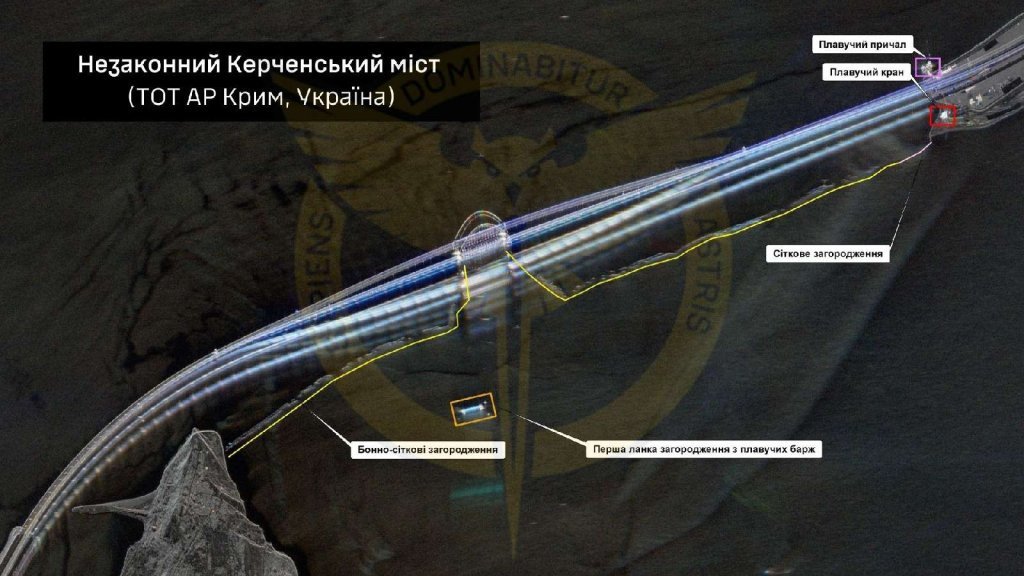
SAR has the benefit of being able to capture images day or night, and regardless of bad weather or other obscurants like heavy smoke. There are trade-offs in terms of the kinds of details typically visible via SAR compared to what is seen in visual spectrum imagery. Ukrainian authorities have been utilizing ICEYE imagery for years now, including for targeting purposes, as part of the ongoing conflict with Russia. There have been reports in the past that ICEYE X36 has been operating more directly under the control of the Ukrainian government, but this has not been confirmed.
The Main Directorate of Intelligence of the Ministry of Defense of Ukraine (better known by the acronym GUR) previously released this SAR image of the highly strategic Kerch Bridge that links the occupied Crimean Peninsula to undisputed Russian territory, which it said came via ICEYE. GUR
Kosmos 2612 is one of six satellites (Cosmos 2609 through Cosmos 2614) the Russian military launched via a single Soyuz-2.1b rocket on April 17. The exact purpose and configuration of these satellites are unconfirmed. However, they appear to be so-called inspector types capable of rendezvousing and maneuvering close to other objects in space. We will come back to this later on.
What is clear is that Kosmos 2612 has spent the past three weeks deliberately maneuvering to extremely closely shadow ICEYE X36.
“Over two weeks beginning on September 30, 2026, Cosmos 2612 executed a series of new maneuvers that brought it back into coplanar alignment and placed it at nearly the same altitude as the commercial satellite,” Clayton Swope, Deputy Director of the Aerospace Security Project and Senior Fellow at the Center for Strategic and International Studies (CSIS) think tank in Washington, D.C., along with Research Assistant Chantal Li, wrote in an analysis of the situation just last Thursday.
“According to current orbital elements, the Russian #KOSMOS 2612 satellite is now within 1-2 km [0.6 miles to 1.2 miles] of #ICEYE-X36,” Dr. Marco Langbroek, currently a lecturer on Space Situational Awareness at the Faculty of Aerospace Engineering of Delft Technical University in the Netherlands, wrote in a thread on X on Saturday. “Based on current elements, it might come within meters of the latter within a few hours from now. This is an #RPO [rendezvous and proximity operation] without consent.”
2/x Initially I was skeptic whether #ICEYEX36 really was an intentional target: but a series of manoeuvers by #Kosmos2612 starting on Sept 30, were clearly designed to bring the two objects very close and synchronise their orbital periods, orbital altitude and eccentricity: pic.twitter.com/BhIoi8Rtbe
“New TLEs [two-line elements] show that K2612 made a manuever [sic] on Oct 16 and is now stationkeeping within 5 km [3.1 miles] or less of ICEYE X36,” Jonathan McDowell, an astrophysicist and astronomer, who previously worked for the Harvard-Smithsonian Center for Astrophysics and has long been tracking objects of interest in orbit, also wrote in a series of posts on X on Saturday. “To my knowledge this is the first LEO [low Earth orbit] rendezvous of two active satellites where the owner of one of the sats did not give approval.”
McDowell later clarified that “close passes” of objects in orbit had certainly occurred previously, “but not I think rendezvous [sic] (matching velocity vector).”
“This is the most advanced and potentially dangerous uncooperative RPO we’ve observed,” Adam Marsh, LeoLabs vice president for technical solutions, separately told Breaking Defense.
Unprecedented orbital maneuvering
As underscored by the previous interaction of Kosmos 2542 and USA 245, close shadowing of satellites in orbit is certainly nothing new. The U.S. government, as well as Russia and others, have been observed engaging in this kind of activity in the past. At the same time, just how close Kosmos 2612 got to ICEYE X36, and how long they spent in close alignment, are, at the very least, highly unusual.
“It’s important to note that ‘red’ on ‘blue’ engagements, such as this, are relatively uncommon in Low Earth Orbit (LEO),” LeoLabs’ report points out. At the same time, “this was not a routine conjunction or ‘fly by.’ The sequence included a controlled approach, changes in relative position, close-proximity loitering, additional small maneuvers, and a controlled departure. The behavior is consistent with sophisticated rendezvous and proximity operations (RPO).”
On top of this, there are other signs that what just happened between Kosmos 2612 and ICEYE X36 may follow a Russian playbook of sorts that could also be used in a prelude to an on-orbit anti-satellite attack.
Within weeks of their launch in April, Kosmos 2610, 2611, 2612, 2613, and 2614 had all moved orbital planes shared by multiple ICEYE satellites. Three of them subsequently made close passes by ICEYE X36, specifically, but none of them initially kept station with it. ICEYE CEO Rafal Modrzewski did say “the company later moved its satellite, prompting further Russian manoeuvres [sic],” according to a story Reuters published last week.
Russian satellites approaching ICEYE: a closer look at the timeline.
Tracking data via @LeoLabs_Space . Analysis via COMSPOC SSA.
On April 16, Russia launched six maneuverable satellites (Cosmos 2609-2614) from Plesetsk. Five of them — Cosmos 2610, 2611, 2612, 2613, and 2614… pic.twitter.com/ISoToOptnp
To take a step even further back, before Kosmos 2542 was caught shadowing USA 245 in 2020, there were reports that the U.S. spy satellite had shifted its orbit. This was possibly prompted by the movements of another Russian ‘inspector,’ Kosmos 2543. This does not appear to have ever been confirmed.
While in space, Kosmos 2542 had deployed Kosmos 2543 in November 2019. Then, on July 23, 2020, the U.S. military said that it had detected Kosmos 2543 itself launching a smaller object in what it described as a test of a space-based anti-satellite weapon. In a subsequent interview with Time, then-Chief of Space Operations Gen. John “Jay” Raymond, U.S. Space Force’s top uniformed officer, disclosed that American forces had first observed Russian “nesting doll” satellites – a reference to traditional Russian matryoshka dolls – similarly demonstrating the “characteristics of a weapon system” in 2017.
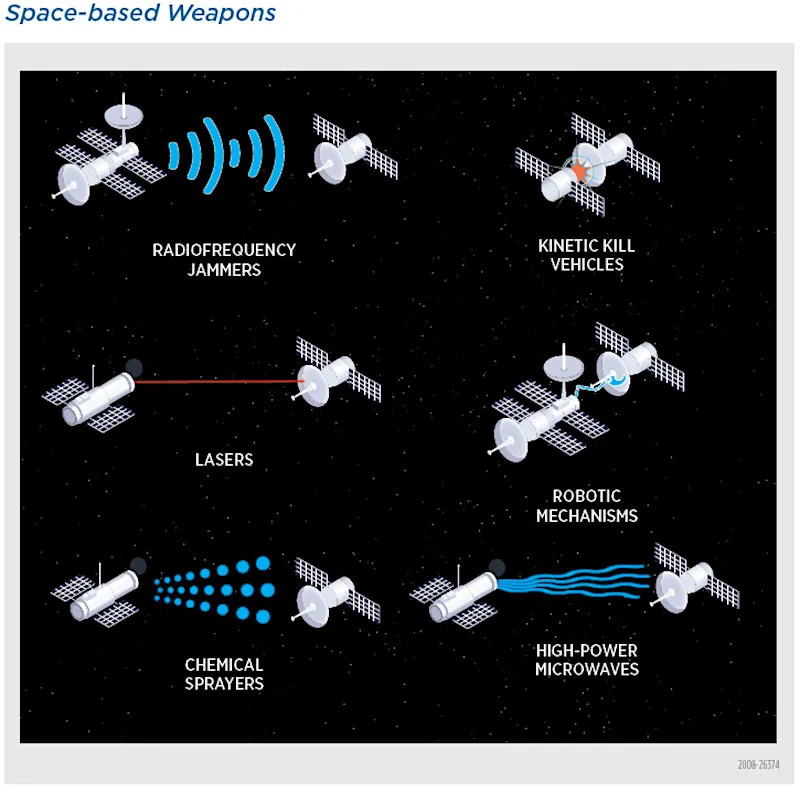
U.S. officials have been warning for years that Russia’s growing array of inspector-type satellites, ostensibly designed to examine other assets the country has in orbit if they break down or otherwise malfunction, are inherently dual-purpose in nature. Beyond launching projectiles, a host of other modes of attack, kinetic and non-kinetic, are enabled by the underlying ability of a spacecraft to maneuver very close to other objects in orbit and hold that position. This includes the use of grappling arms to cause damage or just tow a satellite out of orbit, spraying aerosols to harm or impair optics and solar panels, and electronic warfare jamming. A satellite could turn out to be the weapon itself, becoming a kinetic interceptor that smashes into its target on command.
A U.S. Defense Intelligence Agency graphic highlighting some of the ways on-orbit attacks can be carried out. DIA
One satellite shadowing another closely in orbit allows various kinds of intelligence gathering, as well. Collection of imagery and signal emissions can offer valuable details about a target’s capabilities and vulnerabilities, as well as how it is being used in a particular context.
“As observed by LeoLabs Global Radar Network and analyzed by our team, COSMOS 2612 demonstrated a sequence of capabilities that could be used to inspect, characterize, shadow, or potentially interfere with another spacecraft,” according to LeoLabs’ report. “These actions require planning, maneuverability, precise navigation, and significant fuel. They may also indicate the use of onboard sensors capable of measuring the relative position of another spacecraft.”
What has just transpired between Kosmos 2612 and ICEYE X36 highlights how just a viable threat of attack can be disruptive in its own right. Simply forcing an imagery-gathering satellite out of position could prevent it from collecting over an intended area, or at least doing so in the most effective manner.
Furthermore, satellites only have a limited amount of fuel with which to maneuver in any way after reaching orbit. Harassment in space that forces them to burn off that finite resource at a higher-than-expected rate could reduce their total operational life expectancy, as well as further limit their effectiveness and make them more vulnerable to attacks or accidents. Debris in space is a steadily growing hazard that satellites increasingly need to dodge.
“We can only speculate about the operation’s goal, but it could have been anything from simply intimidation to outright destruction or sabotage of a U.S.-registered satellite,” CSIS’ Clayton Swope told TWZ directly today in light of the new developments regarding Kosmos 2612 and ICEYE X36. “Perhaps the operation is on hold. There are, however, several other satellites that shadowed ICEYE X36 back in May that could be brought in[to] action too.”
Attribution and broader ramifications
It is important to point out that space, as a domain, inherently creates complications when it comes to attributing any form of attack, should one occur. Satellites do suffer mishaps, sometimes with catastrophic results, the causes of which are not always clear.
Update: Debris from active PRC satellite Yaogan 50-02.@S4S_SDA has now cataloged 62 pieces of debris originating from the PRC's active Yaogan 50-02 satellite (68196 / 2026-051A) on around 20 July 2026 (ref my initial analysis on Substack, link in thread).
Some recordings of USA 32 (#19460), whose fragmentation in LEO on 13 Sep 2026 at approximately 2113 UTC was confirmed by U.S. Space Forces–Space (S4S). By the time of the recordings, a large number of fragments had already dispersed over a wide section of the track. pic.twitter.com/gjRxCTPz2o
“While the intention behind COSMOS 2612’s behavior remains uncertain, the deliberate nature of the activity, the fuel required to conduct this activity, and the proximity to a Western commercial imaging satellite make the event strategically important,” LeoLab’s report notes. “This event, and the capabilities demonstrated, do not establish hostile intent. It does, however, demonstrate capabilities that could support intelligence collection, on-orbit inspection, coercive signaling, interference, or preparation for future counterspace operations.”
It is very possible, if not highly probable, that Kosmos 2612’s recent activities will be indicative of a trend going forward. Aggressive and potentially dangerous maneuvering by armed forces in close proximity to each other is not uncommon within the atmosphere, especially in the air and at sea. Extending a variation of those tactics into the space domain would make sense, especially given the central role that capabilities in orbit increasingly play in modern military operations globally. Those roles extend to early warning, general intelligence gathering, weapons guidance, near-real-time communications, and beyond.
American officials have already said in the past that American assets in space are routinely the target of “reversible attacks,” meaning ones that do not cause permanent damage. That also speaks to the difficulty of attribution if there is no lasting effect or impact to draw attention to.
The U.S. government’s long-time monopoly on the space domain has also been steadily eroding in recent years, especially in light of China’s massive expansion of its intelligence-gathering and other satellite constellations. The scale and scope of what commercial satellite imagery and other space services providers, like ICEYE, offer today have led to a further democratization of space-based capabilities to countries like Ukraine that do not possess significant, if any, constellations of their own.
This satellite image indicating multiple Russian Tu-95 Bear bombers having been damaged or destroyed at Belaya Air Base after a Ukrainian strike last year is indicative of what ICEYE provides commercially. Courtesy ICEYE
More details may yet emerge about Kosmos 2612 and its recent rendezvous in orbit with ICEYE X36, but it already points to how space has become an increasingly likely potential zone for direct conflict going forward.
Some of the world’s leading names in space exploration are heading to Coimbra later this month for a two-day summit covering everything from lunar science and the search for another
O CIAC – Centro de Investigação em Artes e Comunicação assinalou oficialmente a abertura do INTERFACE – Laboratório de Tradução Digital, uma nova infraestrutura tecnológica e científica criada para aproximar a ciência, a criação artística e a sociedade.
Saliente-se que o INTERFACE é um laboratório pioneiro focado na tradução e visualização de conhecimento científico complexo para o grande público e para as indústrias criativas. Foi financiado em 473.800 euros pelo programa EQUIPAR+2 da Fundação para a Ciência e a Tecnologia (FCT), no âmbito do Plano de Recuperação e Resiliência (PRR),
Dotado de equipamento de ponta para produção imersiva e interatividade, o laboratório servirá investigadores, docentes e estudantes da Universidade do Algarve. De acordo com o coordenador do CIAC, Bruno Mendes da Silva, “o INTERFACE atuará como um laboratório especializado, capaz de transformar dados científicos complexos, por exemplo, da área das ciências da saúde, em narrativas visuais acessíveis e envolventes”.
Importa salientar que o projeto contempla ainda uma extensão regional, o AI Studio, localizado no polo do CIAC no Instituto Politécnico de Santarém, focado em Inteligência Artificial e literacia digital, equipado com periféricos inclusivos (tecnologia Braille e comandos por voz) para garantir total acessibilidade.
Com a entrada em funcionamento do INTERFACE, o CIAC reforça a sua capacidade de investigação transdisciplinar, promovendo a inovação tecnológica e a difusão da ciência na região e no país.
Beijing has proposed banning exports of the technology used to make next-generation solar cells, a move that could complicate United States technology guru Elon Musk’s plan to expand into space solar power. The ban, which covers production technology for perovskite and tandem solar cell modules, is part of a proposal by China’s Ministry of Commerce […]
JAXA is leading an international mission to reach Mars’ Phobos moon and bring soil back to Earth. If successful, it could unlock new clues about the history of the solar system.
 Login







Russian satellites approaching ICEYE: a closer look at the timeline.