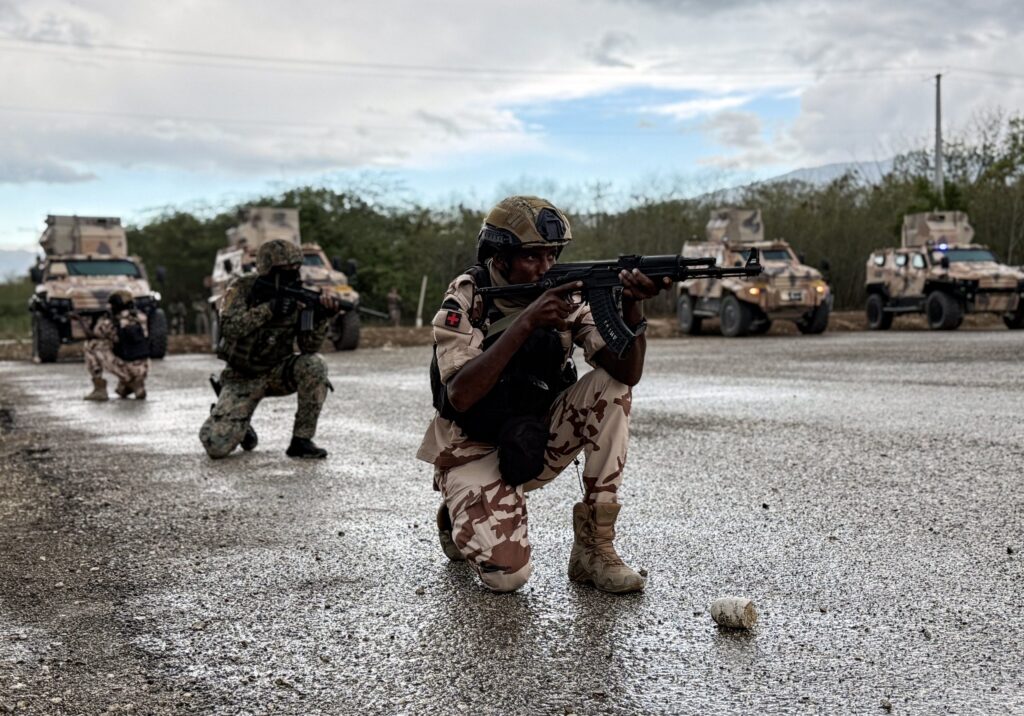
The view from the cockpit of a helicopter flown by members of the Salvadoran contingent of the Gang Suppression Force during an aerial patrol last month over Port-au-Prince, Haiti.
International diplomats maintain that the GSF mission objectives will continue in Haiti even though international forces confront mounting casualties and kidnappings.
On October 18, 2026, an explosive ambush in Croix-des-Bouquets, Haiti, targeted an armored vehicle with four Salvadoran Air Force aviation technicians attached to the UN-backed Gang Suppression Force.
Forced to evacuate after their vehicle caught fire, the four support personnel were kidnapped by Haitian armed groups operating near the capital.
In response, Salvadoran President Nayib Bukele announced a military rescue operation led by Task Force Libertad II, threatening an expanded offensive against Haitian gangs if the hostages are not safely returned.
In addition, the government of Haiti stated that it will work in conjunction with the United Nations Gang Suppression Force (GSF) mission to rescue the kidnapped Salvadorans.
While the Haitian government and international bodies coordinate security protocols, Bukele’s unilateral escalation in a foreign country projects his signature “iron-fist” stance against gangs onto the international stage, all with the backing of the United States.
The UN Security Council established the “Gang Suppression Force” that operates in Haiti. Created in October 2023 as the Multinational Security Support Mission following the Haitian government, the international force was reorganized in October 2025 into the Gang Suppression Force.
As of October 2026, the authorized strength of the Gang Suppression Force stands at 5,550 personnel, though deployed uniformed troops numbered 1,563 as of mid-October.
The Gang Suppression Force mandate focuses on assisting the Haitian National Police, protecting critical infrastructure, and restoring order across urban centers controlled by armed coalitions.
The region where the October 18 ambush took place, Croix-des-Bouquets, is controlled by several prominent armed groups. Security evaluations list the Chèn Méchan, Kraze Barye, and 400 Mawozo groups among the primary organizations holding territorial control over the corridor connecting Port-au-Prince to the Dominican border.
Key leaders of these groups, including Vitelhomme Innocent of Kraze Barye and Lanmo Sanjou of 400 Mawozo, are subject to active sanctions imposed by the UN Security Council and the U.S. government.
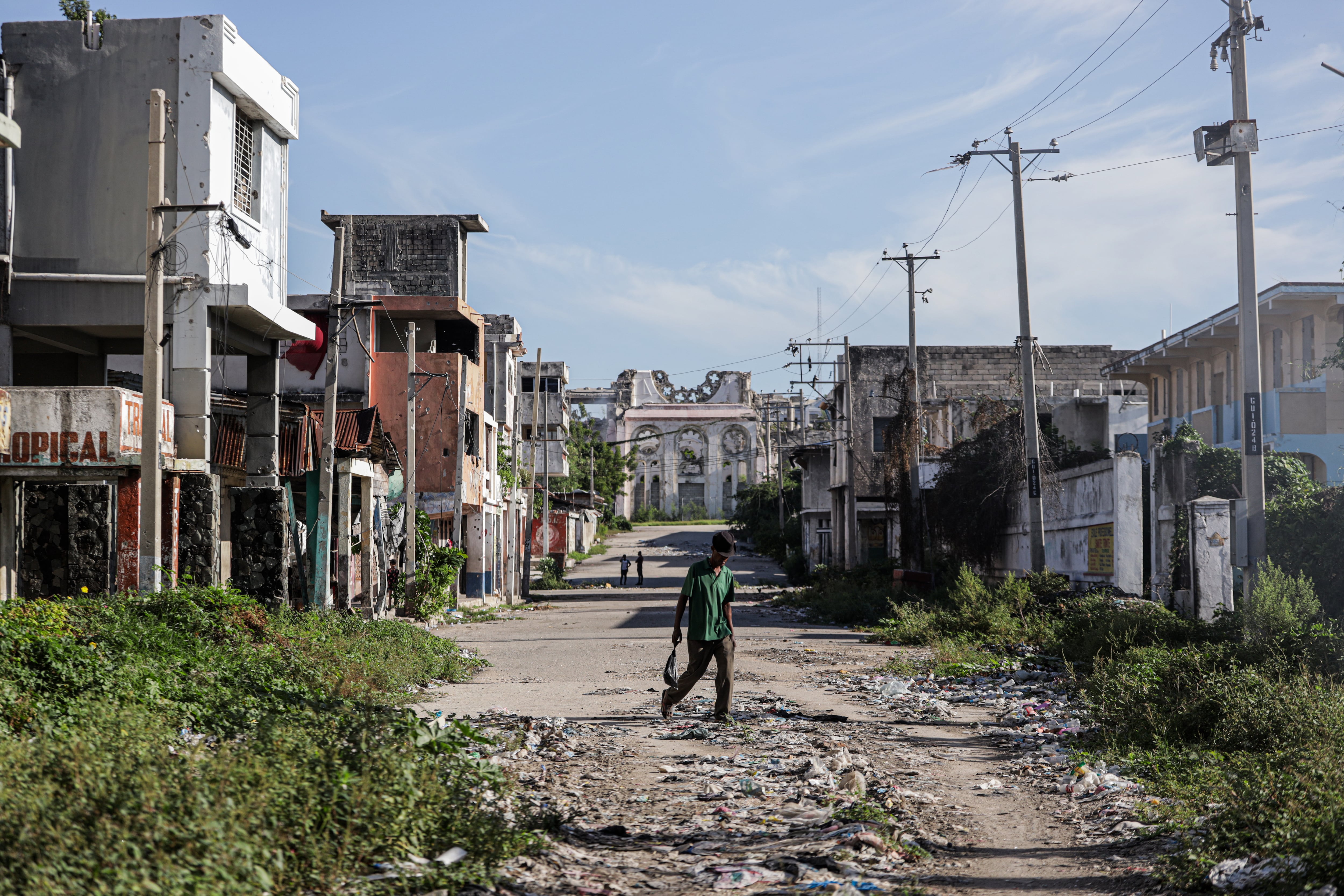
Data released by the UN indicates that between January and mid-September 2026, Haitian gang-related violence resulted in more than 5,700 deaths and injuries, alongside more than 230 reported kidnappings. Over 1.5 million residents remain internally displaced due to gang territorial expansion.
Foreign workers, international humanitarian staff, and local civilians have consistently been targeted for kidnapping as Haitian criminal groups use hostages for financial leverage or political concessions.
President Bukele addressed the Haitian gang leaders directly, publishing a message written in Haitian Creole on October 21, 2026. Bukele stated that the four technicians were non-combatant technical personnel and warned that current operations were minor compared to potential future actions.
Addressing the gang leadership, Bukele wrote: “We have already finished with the gangs in El Salvador, and we can finish with you too. Return our four compatriots alive and unharmed, and everything will return to how it was before the kidnapping. The decision is in your hands”.
Reactions from official international bodies followed the announcement of the rescue campaign. At a meeting of the UN Security Council, Mike Waltz, the U.S. Ambassador to the United Nations, condemned the ambush and affirmed that international search efforts would continue.
Waltz stated that attacks on international contingents would not compel the Gang Suppression Force to withdraw from its mandate. Simultaneously, Salvadoran Ambassador to the UN Egriselda López formally requested international coordination to secure the location and release of the four kidnapped personnel.
The Haitian government also issued an official response regarding the crisis. In an executive statement, Haitian Prime Minister Alix Didier Fils-Aimé announced that securing the release of the four Salvadoran technicians was an absolute priority for the national administration.
Haiti: According to a statement issued on October 18 by El Salvador’s Armed Forces (@FUERZARMADASV), four Salvadoran aviation technicians from Task Force Libertad II were ambushed by armed gangs while returning to their camp in an armored vehicle. The vehicle was set on fire, but… pic.twitter.com/2R2TCCpkJP
The diplomatic and institutional responses to the kidnapping of the four Salvadoran technicians highlight the complex interactions between national military initiatives and international peacekeeping frameworks.
At the institutional level, the United Nations operates under structured protocols regarding force security and hostage negotiation. Officials within the UN framework maintain that search and rescue operations must adhere to rules of engagement established for the Gang Suppression Force to prevent operational conflict among contributing member states.
The Haitian government under Prime Minister Alix Didier Fils-Aimé has aligned its public stance with the international mission, declaring the recovery of the personnel a primary national objective.
However, the administrative capacity of the Haitian state remains restricted, as law enforcement agencies depend on foreign logistical, intelligence, and tactical support to operate within gang-controlled corridors like Croix-des-Bouquets.
Diplomatic representatives from key UN Security Council member states, including United States, have reinforced support for the mission while addressing the threats posed by armed groups. Statements issued during Security Council proceedings reaffirmed that attacks against international contingents will not alter the mandate or compel the withdrawal of the Gang Suppression Force.
To the gang bosses terrorizing Haiti, your days of operating with impunity are numbered. The Gang Suppression Force is coming for you. pic.twitter.com/lkkfJLmiO6
The armored vehicle transporting four aviation technicians from the Salvadoran Air Force was ambushed in Croix-des-Bouquets, a commune located near Port-au-Prince, the capital of Haiti. Following the explosion, the four Salvadoran technicians were forced to evacuate the vehicle and were subsequently kidnapped.
Initial search and rescue efforts of the four Salvadorans faced immediate armed resistance. On October 19, a search helicopter dispatched to locate the personnel was targeted by gunfire.
Subsequent joint counter-offensives conducted by the multinational security contingent and the Haitian National Police in the Plaine du Cul-de-Sac area resulted in severe clashes, leaving several gang members dead and four multinational security personnel injured.
El Salvador deployed the missing personnel to Haiti as part of its specialized military contingent, known as Task Force Libertad II. El Salvador’s initial military involvement in Haiti began after the Salvadoran Legislative Assembly passed a decree on October 30, 2024.
That measure authorized the deployment of Salvadoran Air Force personnel, including pilots, air mechanics, and medical evacuation units, to support international security operations.
In early 2025, eight aviation technicians arrived in Haiti, followed by an additional 70 military personnel. On September 29, 2026, the Salvadoran Legislative Assembly voted to extend the military deployment through October 2027 and expanded the mandate.
The updated legislative mandate lets Salvadoran troops engage beyond medical evacuations, allowing them to deploy personnel based on operational requirements dictated by security needs in the field.
Task Force Libertad II operates under these expanded terms, providing technical aviation logistics, air support maintenance, and operational security inside the country.
The four Salvadoran kidnapped were serving as non-combatant aviation support specialists within Task Force Libertad II. Following days of uncertainty regarding their status, Salvadoran President Nayib Bukele made a public statement on October 21, 2026, confirming that the kidnapping was executed by armed gangs from Haiti.
El Salvador prez announces MILITARY OP to rescue hostages kidnapped by gangs in Haiti
Aviation technicians 'kidnapped in a cowardly manner' — Bukele
'Today's attack is NOTHING compared to what is coming if we do not get all 4 hostages back alive' pic.twitter.com/7WkyhLvuoQ
President Nayib Bukele’s public declaration led El Salvador to escalate its physical military presence in Haiti. On October 22, 2026, the Salvadoran government deployed 100 special forces soldiers to Port-au-Prince to assist in locating and securing the release of the four missing aviation technicians.
This deployment brought additional tactical ground units to support the existing aviation support unit attached to Task Force Libertad II.
Before October 2026, the Salvadoran contingent operated primarily as an air support unit focused on logistics, maintenance, and medical evacuations. The introduction of dedicated special operations personnel expands the operational parameters of the mission, introducing direct combat and search-and-recovery capabilities alongside the Gang Suppression Force and the Haitian National Police.
The deployment of specialized personnel aims to mitigate these conditions through targeted intelligence collection and rapid-response capabilities.
Structural Security Challenges
While the deployment of specialized tactical units and the escalated military posture by El Salvador aim to address the immediate security emergency, long-term stabilization in Haiti depends on addressing broader structural issues.
The proliferation of heavy weaponry, sustained by international trafficking routes, continues to provide armed groups with substantial tactical capacity within urban sectors.
Furthermore, long-standing economic instability, institutional fragmentation, and high rates of poverty create conditions that enable armed organizations to maintain territorial influence despite international security deployments.
Military rescue missions and tactical escalations provide targeted responses to specific security threats, such as the kidnapping of Task Force Libertad II personnel.
However, international observers and analysts emphasize that sustainable security across Port-au-Prince and surrounding communes requires comprehensive institutional reform, economic development, and consistent administrative governance alongside law enforcement actions.
Salvadoran President Nayib Bukele has launched a military rescue operation in Haiti following the abduction of four Salvadoran soldiers by local armed groups. In a stern statement on Wednesday, Bukele demanded the immediate, safe release of the personnel and warned of a severe… pic.twitter.com/QIQS18JGso
Sources: TeleSUR – Al Jazeera – DW – BBC – CNN – La Prensa Gráfica – elsalvador.com – EFE – El Diario de Hoy – RSF – El Faro – presidencia.gov.sv – Asociación de Periodistas de El Salvador – Dialnet – Resumen Latinoamericano.
It was Saturday night and Jean, a Haitian who arrived in the United States nearly 20 years ago, had left his job in Broward, north of Miami, hours earlier. But he never made it home. He wasn’t answering his phone and the location of his AirPods remained in the same place. Around 1 a.m., his doctor—also a family friend—went out to look for him and found the car unattended in a parking lot. At that point, Jean himself called and said he had been detained by immigration and was at a Border Patrol station in Dania Beach.
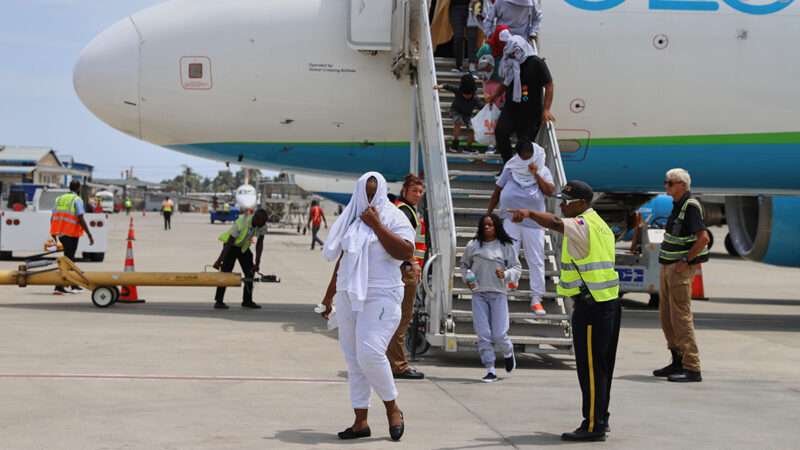
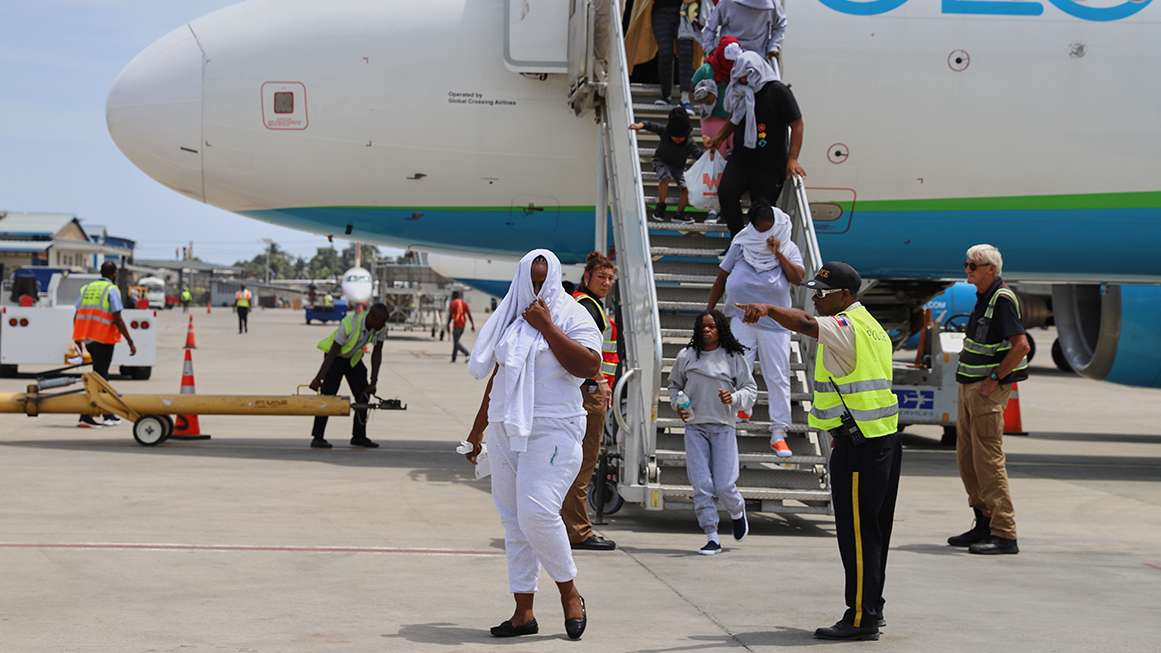
In late August, President Donald Trump's administration carried out its first deportation flight to Haiti since the Supreme Court allowed it to end temporary protected status (TPS) for the embattled country in June. "There are no extraordinary and temporary conditions in Haiti that prevent Haitian nationals…from returning in safety," the Department of Homeland Security (DHS) claimed in its TPS revocation, describing a country the State Department warns Americans not to visit "for any reason."
The Trump administration has eroded America's humanitarian avenues, including TPS, which shields migrants from deportation. As a result, many noncitizens may become undocumented and could be forced to return to unsafe places.
The DHS secretary may grant TPS for countries facing armed conflicts, natural disasters, or other disruptive events. TPS designations last anywhere from six to 18 months and may be extended. The government has designated 29 countries for TPS since Congress established the status in 1990, offering protection to Salvadorans fleeing a 12-year civil war, Haitians fleeing the 2010 earthquake, and millions of others. The Biden administration repeatedly made and extended TPS designations, but the Trump administration has been working to terminate them.
There were 1.3 million people living in the U.S. under TPS in March 2025, according to the Pew Research Center. By August 2026, the Trump administration had ended TPS for 13 countries, leaving 1 million people without its protections. Once someone loses TPS, he reverts to his previous immigration status, which is often undocumented. Over 600,000 Venezuelans, 330,000 Haitians, 170,000 Salvadorans, and 100,000 Ukrainians had TPS protections as of March 2025, according to the Congressional Research Service.
Critics often point out that TPS isn't really "temporary." That's frequently true: Although some designations have been brief, others have been decades-long. Designations for Haiti, Syria, Honduras, Nepal, Somalia, and El Salvador have all lasted at least 14 years, according to the Migration Policy Institute (MPI).
This says more about the U.S. immigration system and presidential power than it does about TPS. "In the absence of Congress acting to legalize what has become a long-settled unauthorized immigrant population, Republican and Democratic administrations, lawmakers, immigrants, and foreign governments had come to tacitly rely on TPS despite its nominally temporary nature," notes the MPI. Immigration policy is increasingly subject to presidential whims, and due to lengthy processing times and narrow qualifications, more durable immigration pathways such as asylum and refugee status are often inaccessible to eventual TPS beneficiaries. An immigrant-friendly president may use TPS designations to temporarily shield noncitizen populations, but an anti-immigrant successor can also revoke those protections. In either scenario, a TPS holder faces uncertainty.
In a rare bipartisan immigration effort last February, Reps. Laura Gillen (D–N.Y.) and Mike Lawler (R–N.Y.) introduced a bill to extend TPS for Haiti for three years. It passed the House this April and has been languishing in the Senate since. Its future, too, is uncertain.

 Login