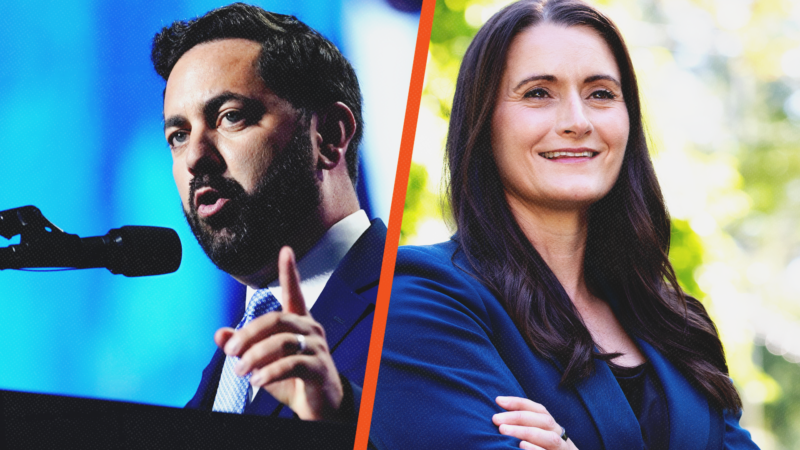
Today's guest is Ted Brown, the Libertarian Party candidate for U.S. Senate in Texas. Brown is facing off against Republican Ken Paxton and Democrat James Talarico in a closely contested race. Brown received more than 267,000 votes in his 2024 Senate campaign and is now challenging both major parties on their commitment to individual liberty. He argues that Republicans have abandoned limited government while Democrats increasingly embrace economic policies that undermine the free market.
Nick Gillespie talks with Brown about Paxton's corruption scandals, Talarico's hostility toward billionaires, and why Texas ranks poorly on personal freedom despite its business-friendly reputation. Brown makes the case for returning to an Ellis Island–style immigration system, cutting federal spending to confront the $40 trillion national debt, and ending America's military involvement in the Middle East. They also discuss abortion rights, government surveillance, online age-verification laws, and how regulations drive up the cost of healthcare. Brown explains what it will take to rebuild the Libertarian Party and why he believes a senator could accomplish more by stopping bad legislation than by passing new laws.
Quando perfino il tecno-oligarca della Silicon Valley più reazionaria, l’inventore del capitalismo della sorveglianza, comincia a tirarsi indietro, significa che il Titanic repubblicano ha già imbarcato troppa acqua.
PeterThiel, che nel 2016 ruppe il fronte compatto delle Big Tech per incoronare Donald Trump (“l’ariete per scardinare il sistema” disse), l’uomo che con quindici milioni di dollari ha fabbricato a tavolino e spedito alla Casa Bianca JD Vance come vicepresidente, il fondatore di Palantir che ha trasformato la sorveglianza di massa e il controllo militare in un gigantesco affare quotato a Wall Street, ecco, lui ha scaricato l’insulsa guerra contro l’Iran prendendo le distanze dal fallimento militare americano.
Lo ha fatto a porte chiuse, davanti a una platea di fedelissimi a Nashville: “Guardo con scetticismo a questa guerra, credo che non avremmo dovuto farla. Sono stati commessi troppi errori. Forse non abbiamo la forza militare sul campo, o forse stiamo per perdere la battaglia dell’influenza geopolitica”.
Una clamorosa sconfessione di Trump, svelata dagli audio (la conferenza era a porte chiuse) ottenuti da Politico, che arriva a meno di due settimane dal voto di metà mandato, con la Casa Bianca nel panico per il crollo dei consensi, l’inflazione alle stelle per il rialzo del petrolio e il rischio fondato di perdere il controllo del Congresso. Parole, queste di Thiel, che rivelano quanto profonda sia la frattura interna al mondo Maga. Da una parte ci sono i falchi neoconservatori e l’ossessione bellicista dell’ex giornalista e ora Ministro della Guerra, il “crociato” Pete Hegseth, trascinato da Benjamin Netanyahu in una dissennata avventura militare contro Teheran; dall’altra c’è la base isolazionista dell’America First, quella che prometteva di chiudere per sempre le infinite guerre all’estero e che vede nello stesso JD Vance il proprio portabandiera. A Washington si sapeva che Vance era scettico sui raid contro l’Iran prima ancora che partissero i missili. Ora la spaccatura è conclamata.
Il paradosso, semmai, è l’ipocrisia di fondo. Thiel critica la guerra, ma con la guerra è diventato plurimiliardario. La sua creatura, Palantir, è ormai l’ossatura informatica del Pentagono. Il sistema Maven Smart System, imposto a tutte le forze armate dal vicesegretario Steve Feinberg, scandaglia dati, guida i droni e seleziona i bersagli strategici e umani con l’algoritmo. E’ lo stesso apparato responsabile della carneficina della scuola elementare femminile di Minab in Iran, nell’attacco del 28 febbraio 2026 in cui morirono 168 bambine.
Così mentre il Ceo di Palantir, Alex Karp, si vanta in pubblico di essere al servizio dell’Occidente per “uccidere i nemici” e il cofondatore Joe Lonsdale sognava di investire a Teheran dopo un regime change che non è mai avvenuto, oggi Thiel si riscopre prudente. Improvvisa sete di pacifismo? Figurarsi, per mero calcolo geopolitico: la consapevolezza che l’avventura mediorientale sta dissanguando gli Stati Uniti, isolandoli sul piano internazionale ed esponendo i vertici della Casa Bianca all’incubo dei mandati d’arresto della Corte Penale Internazionale, che Thiel definisce la vera “spada di Damocle” sul collo di Trump nel dopo elezioni di midterm.
Ma sarà davvero una sonora sconfitta dei repubblicani, il voto del 3 novembre? Sondaggi affidabili o meno (quanti sbagli nel passato nel sottovalutare la base repubblicana), se “l’anima nera della Silicon Valley” volta le spalle alla guerra, a Mar-a-Lago tira decisamente una brutta aria. Era ora.
A metà di un mandato presidenziale, negli Stati Uniti si svolgono le elezioni di Midterm. Sono forse meno note le dinamiche e le strategie che possono emergere in questa fase, ma in questa puntata cercheremo di capire due punti fondamentali: il ridisegno dei distretti e l'instaurazione di un governo diviso.
In my role as a political commentator, I enjoy making predictions. I possess no special talent for this and am often hilariously wrong: Unlike most other pundits, I famously clung to my stupid belief that former President Joe Biden would never step down as the Democrats' 2024 candidate, for instance. I called the 2020 presidential election correctly (and got most states right, only flipping Georgia and Florida), but I messed up in 2024. (Nevertheless, I still demolished my co-host, who didn't appear to take this challenge very seriously.)
The hardest part about making predictions is separating what you want to happen from what is actually likely to happen. Commentators often feel inclined to rally for their preferred outcome, as if shouting about it on television is going to make it come true. In some ways, this is an easier temptation for us libertarians to avoid, since all outcomes generally seem suboptimal. Once again, that is the case: See, for example, the upcoming 2026 midterms.
It seems inarguable that President Donald Trump has squandered much of his political capital by failing to focus narrowly on the economy and instead launching another unpopular war in the Middle East. It also seems obvious that the Democratic Party, once returned in power, will do everything it can to thwart the administration's shrewdest policies—on tech and AI in particular.
But that is my prediction: Democrats will retake the House of Representatives and the Senate.
I don't have any specific map in mind for the House (it's too complicated), but here are my Senate predictions:
Here is my REVISED prediction for the Senate. For the last several weeks, everything has moved in Dems' direction, and I now expect them to take it.
When I looked at the map back in August, I still thought Ohio was a long shot for the Democrats and that Michigan was in play for the GOP due to Abdul El-Sayed being so far left. Now it looks to me like Republicans will lose both seats, along with Texas and Alaska. I'm still betting that the formidable incumbent in Maine, Sen. Susan Collins (R), will hold on—the polls have misjudged her in the past—and that Iowa is a bridge too far for Dems. If Republicans manage to keep those two seats, then it's a 51–49 map in Democrats' favor.
But wait…all is not lost for Trump.
In the event of a 51–49 Dem advantage, it seems somewhat likely to me that Sen. John Fetterman (D–Pa.) could switch parties, which would restore Republican control because of Vice President J.D. Vance's tiebreaking vote. With his conservative rhetoric on Israel and other issues, Fetterman has no future as an elected Democrat in his state—he could never ever ever win a Democratic primary—and will have to strike some sort deal with Trump before his reelection in 2028. Fetterman should agree to become an independent who caucuses with Republicans in exchange for Trump ensuring that no Republican dares run against him in the future. Absent such a deal, Fetterman is virtually guaranteed to be a one-term senator, so if he harbors any desire to keep his job—perhaps that's an open question—he will need to make a move. A 51–49 Senate will give him the exact leverage he needs.
So those are my predictions! What are yours?
This Week on Free Media
I'm joined by Amber Duke to discuss the riots in France, Vivek Ramaswamy's terrible campaign ad, and more.
Worth Watching
Here's another shameless plug for my upcoming debate with Katherine Mangu-Ward, Mehdi Hasan, and Jason Stanley! (Katherine is on my side.) If you are in Washington, D.C., please get tickets here.
Can Republicans just spend their way to success in Ohio? "Republicans have bombarded Ohioans with ads with $19 million spent on competitive races through Oct. 12, intended to sell voters on the tax law that had been called the One Big Beautiful Bill," reportsThe Washington Post. "But the message is struggling to connect with voters amid anxiety over tariffs and the war with Iran, which have pushed up prices for everyday products. The ad blitz, the most spent on the topic in any state with competitive races, is aimed at bolstering vulnerable GOP candidates in a state that was considered safely Republican for the better part of the last decade."
Republicans in states across the Midwest (and the country) have experimented with distancing themselves from the Trump administration and its agenda; it's hard to know if this strategy will prove successful, or if it's just too little, too late. In Ohio, though, Republican candidates are mostly staying close to Dear Leader.
Sen. Jon Husted, a Republican, is running for U.S. Senate against Democrat Sherrod Brown in what looks to be an extremely tight race; ads claim Husted has "supported ending taxes on tips, overtime and Social Security, plus a $200 million investment in rural hospitals," trying to tie him closely to President Donald Trump's agenda. But it's really not clear whether this type of pitch will be enough to make voters forget about tariffs and inflation, the war in the Middle East and gas prices. A New York Times/Siena poll found that 79 percent of likely Ohio voters disapproved of Trump's handling of gas prices. It's hard to sell people on a tax cut when they're paying a different tax, in the form of tariffs, every time they go to the store; Ohio voters might not be so easily swindled.
Gun laws in Oregon: In the aftermath of the tragic shooting at an elementary school in Bend, Oregon, where a 16-year-old killed three little kids and one teacher, some parents of elementary schoolers there are asking what laws can be changed.
But "Oregon earns high marks from gun safety advocates for its firearms laws," notesThe New York Times. "Everytown for Gun Safety, one of the nation's largest gun violence prevention organizations, ranks Oregon 12th in the country for the strength of its laws, citing recent legislation tightening storage requirements, banning untraceable 'ghost guns' and prohibiting devices that can convert semiautomatic firearms into machine guns." Gifting laws are pretty lax, though, and that might be what happened here: The 16-year-old's mother seems to have been the one who purchased the Maverick 88 12-gauge pump-action shotgun, so it's possible she either gifted the gun to her son or that he stole it from her. "Decades ago, Oregon lawmakers made an exception to gun laws that allow parents to give rifles and shotguns to minors. In many areas of the state, as in other parts of the American West and South, it's a rite of passage for a young person to receive a weapon for hunting or target practice."
There's no law that can really prevent theft of weapons, especially when the thief is a teenager living inside the home where the gun is stored, and there's no law that can prevent parents from foolishly gifting guns to teenagers or young adults whom they've misjudged as capable of handling the responsibility. These are terribly unsatisfying realities.
Prosecutors could, of course, attempt to try the parent for the crimes of their teenager. They "could consider charges ranging from reckless endangerment to manslaughter or criminally negligent homicide, a felony punishable by up to 10 years in prison," continues the Times. "But that would require evidence of more than just a parent's awareness that a child was troubled. Prosecutors would have to establish that the mother disregarded—or, in the case of criminal negligence, failed to recognize—a substantial and unjustifiable risk."
Scenes from New York: "Mayor Zohran Mamdani announced on Monday that New York City will expand free child care for 2-year-olds to Staten Island and across the Bronx as the city moves to add 10,000 seats next school year," reportsThe New York Times. Here's why that won't work:
QUICK HITS
Something juicy for you, readers, since I too frequently subject you to my Catholicism. Let's switch it up: "I'd been thinking about turning down the speed on my vibrator for a long time, but I'd considered my affliction personal, not society-wide. Now it was dawning on me that the problem wasn't simply mine. Women are being sold egg-shaped suction devices in the pages of New York magazine, and BookTok influencers pair with sex-toy companies for promotional collabs. Yes, there is a bookmark that doubles as a vibrator," writes Sarah Hepola for The Atlantic. "Does this consumer game of one-upmanship amid the mainstreaming of vibrators even matter? There are too many varieties of women's razors, too, and I don't care. But what worries me is how this points in the direction in which so much of modern life has been barreling: self-pleasure, self-love, self-care, self, self, self.…Like so much of our day-to-day lives, getting off is becoming more efficient, easier, faster. But has it gotten better?"
"Next year, I will give one of my SpaceX shares to every kid in America," wrote Elon Musk on X yesterday. "This will be the first of many."
"Mahmoud Khalil, the Columbia University graduate arrested last year by Immigration and Customs Enforcement agents amid campus protests, appealed to the Supreme Court on Monday in an attempt to prevent his deportation," reportsThe New York Times. "Khalil, a legal permanent U.S. resident who is married to an American, became an early and high-profile example of President Trump's crackdown on pro-Palestinian demonstrations on college campuses."
With little more than two weeks to go until the midterm elections, it seems increasingly possible that the Democrats, already a big favorite to win control of the House of Representatives, will also take charge of the planet's most elite nursing home, the United States Senate, where the median age is 64 years old. RealClearPolitics' poll aggregator has moved control of "the world's greatest deliberative body" (as its members are grandiosely wont to call it) to "toss up," status and prediction markets are now breaking big toward a blue wave. As of this writing, Kalshi has its Senate odds at 63 percent for the Dems vs. 37 percent for the GOP; Polymarket is at 62 percent vs. 39 percent.
As gratifying as it might be to see unprincipled Trump enablers reduced to minority status after signing off on economy-wrecking tariffs, inhumane immigration detentions, and wars of choice, there's at least one good reason to dread a Democratic majority too: Sen. Elizabeth Warren, the Massachusetts progressive who is spending the run-up to the midterms freaking out over possible consolidation in the condiments business and accusing private equity firms of gutting such shopping-mall favorites as Claire's and Toys R Us. There's every reason to believe that a Senate run by Warren and other economic interventionists will waste time, money, and resources trying to prevent a world in which, per the X wag Iowahawkblog, "a panopticon conglomerate owns two brands of hot sauce."
On October 13, Warren posted this dire warning to X:
Hellmann's mayo McCormick spices Cholula hot sauce Frank's RedHot
What do these products have in common? One company could soon control them all.
I have concerns that McCormick and Unilever's $45 billion merger could increase YOUR grocery prices.
It's hard to think of a more competitive and varied market than the one for hot sauces, which is expected to more than double over the next decade. The barriers to entry are generally low, as are the key ingredients, and new entrants can easily market and sell online, avoiding the costs of buying shelf space in conventional supermarkets. Yet Warren is urging regulators at the Department of Justice and the Federal Trade Commission to halt mergers of both product makers like McCormick and Unilever and grocery stores like Kroger and Giant Eagle.
The latter complaint is particularly picayune. Kroger is one of the country's largest supermarket chains, operating around 2,800 stores under its own name as well as Harris Teeter, Ralph's, and others. Giant Eagle operates about 170 stores. This merger is no more the stuff of nightmares than a single company producing both Cholula and Frank's RedHot. If Warren gains more clout from being in the majority, expect her to butt in more and more on such mergers.
Making it harder for businesses to adapt is not a recipe for making goods and services more affordable. But Warren is keen to blame economic creative destruction not on "new forms of industrial organization that capitalist enterprise creates" (as Joseph Schumpeter would have it), but on pure greed. In a TikTok released earlier this month, she shows a poster board with corporate logos from once-thriving companies that she says have been "gutted" by "private equity" firms.
"Here's your local mall," she piously intones. "Now, private equity wants you to believe that Red Lobster went bankrupt because of their endless shrimp….They want you to believe that Claire's went bankrupt because teens stopped shopping at the mall." In Warren's telling, private equity firms magically take over thriving businesses and then strip them bare. The typical pattern is that private equity enters the picture after a business is failing.
Virtually all accounts of the decline of, for example, Red Lobster, note that the chain had been spiraling for several reasons before the private equity firm Golden Gate Capital got involved in 2014. As this CNN article notes, the chain, which started in 1968, had seen drops in sales as customer desires changed. Management compounded the difficulties with a series of bad decisions, including continuing various all-you-can-eat menu specials, before coming out of Chapter 11 bankruptcy last year.
Similarly, it's true that some teens still go to malls and get their ears pierced at Claire's. But anyone who has spent time in retail America over the past few decades knows that malls are no longer the destination that they once were. As CapitalOne Shopping Research documents, "in 1986, there were 25,000 malls, large and small, nationwide." By 2023, that number had shrunk to just 1,200. While some malls are coming back, most are not, and for reasons that have nothing to do with private equity. Online retails plays a role (though a smaller one than usually imagined, with e-commerce accounting for less than 20 percent of all retail sales). But mostly, it's that people today tend to want a different sort of retail environment. Anchor stores—think Macy's and J.C. Penney—are shadows of themselves, and younger people have less unstructured time in which to prowl food courts and arcades.
For politicians like Elizabeth Warren, though, there can be no financial gains or losses that aren't the result of shadowy, conspiratorial forces. If her party takes control of the Senate, her words will carry more weight. But it will be American consumers that ultimately shoulder the burden of an even-more-regulated economy. The market for hot sauces will almost certainly stay spicy, but many other parts will surely suffer.
The Democratic Socialists of America (DSA) candidates running for the House of Representatives and endorsed by NYC Mayor Zohran Mamdani are all but guaranteed to win their general elections this November, but that does not mean the midterm drama is over in New York. In the state's 17th congressional district, which includes the lower Hudson Valley, Democratic challenger Cait Conley, a combat veteran who served on the Biden administration's National Security Council, could unseat incumbent Republican congressman Mike Lawler in one of the most consequential races of the midterms.
The highly contested purple district voted for former Vice President Kamala Harris in the 2024 election while reelecting Lawler for his second term. Now, Lawler is attempting to win a third term as support for President Donald Trump wanes ahead of the midterms. As of Friday, The Cook Political Report lists the race, which could determine control of the House, as a toss-up.
If elected, Conley would have far more in common with the "Badass Women" coalition of security state and military veterans than with DSA types (think more Sen. Elissa Slotkin from Michigan than Darializa Avila Chevalier). As Judge Street Journal's Timmy Facciolanotes, "Conley's candidacy is testing the viability of a tactful centrism that rebukes left-wing positions like abolishing ICE or restricting weapon shipments to Israel." Lawler is also vying for moderates, pitching himself as "one of the most bipartisan members of Congress" and emphasizing his willingness to break with Trump occasionally while still welcoming Trump's support.
While Lawler and Conley certainly are not pure MAGA acolytes or DSA members, both have leaned into a tech-critical position, much like that of more radical populists like Lina Khan or Steve Bannon, revealing how pervasive anti-tech sentiment has become in mainstream politics.
This tech skepticism was on full display during an October 14 debate, when each candidate made the case for why they were the most equipped to regulate AI, insisting that the industry needs guardrails.
Conley said members of Congress do not want to regulate AI because "they want to look out for their billionaire and trillionaire backers like Elon Musk, who is pouring over $260 million into this midterm election." She then added that Musk backed Lawler in his 2024 race.
Lawler then accused Conley, who previously consulted for Primer AI, of being "the AI candidate for the AI industry."
While Lawler and Conley disagree on specific data center regulations (Conley supports Democratic Gov. Kathy Hochul's data center moratorium while Lawler supports local zoning control over data centers), neither wants to pitch themselves as an explicitly pro-data center candidate. During the debate, Conley claimed that, "On Mike Lawler's watch there have been five data centers built in Rockland County." Lawler has said that he had no say in the decision to build the data centers, and during the debate, he pointed out that the facilities were built for financial services. Lawler also attempted to attack Conley over data centers, slamming her in an ad for saying "we need data centers." Regardless of the candidates' specific policies on data centers, their attacks on one another demonstrate that cheerleading hyperscale data center development is a political liability. In their district, data center has presumably become a dirty term.
The candidates' tech-skeptical rhetoric did not end with unchecked data center development. After the debate, Reason asked both candidates about their positions on age-verification laws for social media and AI, since such regulations raise significant privacy and censorship concerns by age-gating the internet. Unsurprisingly, both Lawler, who votedfor the controversial KIDS Act, and Conley, who has proposed stricter age verification for AI tools, parroted platitudes about why such online safety regulations are necessary to protect children.
"We have watched how social media is literally hurting the mental health of children," Conley told Reason. "And when you talk about the power of AI and what that power could do, we have to regulate this."
Lawler gave a similar response, telling Reason that he respects free speech but that protecting children "is paramount."
This bipartisan consensus over social media regulation has long been brewing in Congress. The mainstream political conversations about AI and data centers, however, are relatively new this midterm election cycle. And it appears both Lawler and Conley have figured out which way Americans' sentiment toward AI is leaning, and they have waged their campaigns accordingly.

 Login