Texas Attorney General Ken Paxton (R) sued OpenAI and its CEO Sam Altman on Friday, accusing the company of failing to warn consumers about the potential dangers from its AI models. The lawsuit alleges the ChatGPT maker is running afoul of a Texas consumer protection law and kids’ online safety law, underscoring warnings about the…
Undercover reporters ordered 500 drone mesh modems from a Chinese firm, which billed them to Russia’s Alabuga drone plant, investigation by The Insider found. The outlet estimates the firm makes about half the high-power mesh modems that let Russia steer its drones deep into Ukraine. The firm’s director also named US company AMD as the source of a key chip, and AMD says it has not sold to the firm.
Geran drones and Banderol drone-missiles have become Russia’s main weapons against Ukraine’s energy grid. Russia began this winter’s strike campaign against that grid in late September, ISW assessed. Ukrainians’ survival this winter depends largely on how fast the West halts mesh modem sales to Russia, the outlet argued.
What a mesh modem does
A mesh modem links drones into one radio network. Each unit relays data for the others, so if one drone is shot down, traffic reroutes through the rest. Information keeps flowing even if nearly 80% of the drones are downed, Ukrainian defense adviser Serhii “Flash” Beskrestnov said in November 2025.
Range is the other half of the threat. One XK F-359 holds a line-of-sight link over 100–300 km, The Insider says. In theory, a couple of relay drones could keep a whole attack on Kyiv connected. Operators can then send new commands in flight and steer around air defenses. Russia’s Gerbera drones, first built as cheap decoys, increasingly carry these modems.
Explore further
Russia’s jam-resistant drones run on a Chinese modem no one has sanctioned
A modem from an upgraded Gerbera
To trace the part, The Insider’s correspondent in Ukraine examined an unmarked mesh modem from an upgraded Gerbera with a vertical tail fin, a version that appeared this summer. The outlet identified it as Xingkai’s XK F-359, the part Ukrainian intelligence and earlier reporting, Euromaidan Press included, had logged as the XK-F358. The Insider calls that label a misidentification.
Next, The Insider and the Nordsint investigative project contacted Xingkai on WeChat, posing as a Russian military supplier based in Alabuga. A company employee who introduced himself as “Jack Jiang” confirmed the firm is the model’s sole maker. The Insider identified him as Jiang Qin, Xingkai’s director and owner.
500 modems, three banks
The reporters then ordered 500 units for delivery to Alabuga, home to the plant that makes most of Russia’s long-range drones. Jiang invoiced 19.5 million yuan, which The Insider put at about $2.87 million. He offered two ways to pay: dollars to Xingkai’s DBS Bank account in Hong Kong, or yuan to his personal Ping An Bank account.
Explore further
America has sided with Russia against Ukraine. Europe should stop pretending and build a coalition against Russia, China, and even the US
In the chat, the reporters said outright that the end user was a military production facility. Jiang raised no objection, The Insider reported.
Later, after the reporters asked to update the address, Xingkai sent a revised invoice with “Alabuga” spelled in Latin letters. This time, it routed payment to a China Merchants Bank account in the name of a former Xingkai manager. She left a management post at the company in 2025, according to Tesari corporate records cited by The Insider. None of the three banks answered The Insider’s requests for comment.
Jiang also claimed the modem’s programmable chip is made by AMD. Asked for an AMD license, he refused, saying Xingkai buys the chips through a middleman. AMD told The Insider that Xingkai “is not an AMD customer or authorized partner,” and said it had sold the company nothing. AMD added that it bars exports of its products to Russia that violate US export controls and sanctions.
"I think capitalism is a good thing, but I think what we need to contend with and be aware of is that a lot of people are not part of it," Tarek Mansour, co-founder and CEO of prediction market platform Kalshi, recently toldReason's Nick Gillespie. "They don't feel like they're part of it. And that's a reality."
Mansour has set out to change that by making it easier for consumers to experience and participate in financial markets. Kalshi's premise is simple: Mansour says the platform matches traders with differing opinions on the outcome of future events, aggregating the "bits and pieces of information" siloed across the country, so long as that information isn't privileged or obtained illegally.
He's up against a rising number of federal and state lawmakers—not to mention the NFL, traditional sportsbooks, casinos, and other regulated gambling operations—who view Kalshi as yet another gambling app. "As of early 2026, more than 20 lawsuits and cease-and-desist actions are pending across the country, filed by state attorneys general, gaming regulators, tribal governments and private plaintiffs," according to the National Conference of State Legislatures. This includes Utah, whose attorney general, Derek Brown, escalated an ongoing legal dispute with Kalshi on Tuesday by filing a complaint against the prediction market in state district court. In his complaint, Brown called Kalshi an "unconscionable and illegal gambling operation." He accused the company of engaging in a "brazen pattern of unlawful conduct."
At the federal level, Bloomberg Lawreported last Friday that Sen. Ted Cruz (R–Texas) is preparing to introduce a bill after the midterm elections that would give state and tribal governments authority to regulate sports-related event contracts offered by prediction markets.
Cruz's state-by-state regulatory regime is exactly the kind of scheme Mansour wants lawmakers to avoid. Mansour recently toldReason that, ideally, there'd be a "federal uniform set of rules that apply across all 50 states." Those rules would then "promote and foster" a "multilateral, peer-to-peer idea," where, for example, someone in California, Oregon, or Washington could trade on an event's outcome based on information supplied by someone in Texas.
Mansour, who calls insider trading an "unfair dynamic that over time dries up liquidity," also argues that prediction markets are uniquely positioned to self-regulate because trades on Kalshi are "fully transparent," making it "easy to flag" suspicious trading patterns. The platform's users play a key role in that work. Mansour says that in February, when convicted fraudster and former Rep. George Santos (R–N.Y.) tried to engage in insider trading, Kalshi received "a hundred whistleblower complaints within a few minutes."
The company's public commitment to rooting out insider trading on its platform may be laudable. Still, it has done little to dispel the prevailing sentiment among state and federal regulators that Kalshi—and prediction market platforms writ large—is indistinguishable from traditional gambling markets.
Indeed, the legal cases against Kalshi are centered on state regulators' belief that the platforms' sports event contracts are the same as the bets offered by legal gambling operations like casinos and sportsbooks. Kalshi has argued that the U.S. Commodity Futures Trading Commission has exclusive jurisdiction to regulate the kinds of contracts it can offer under federal law, preempting states from exercising any gambling authority over prediction markets.
In March, Arizona became the first state to file criminal charges against Kalshi. Arizona Attorney General Kris Mayes accused the company of "running an illegal gambling operation and taking bets on Arizona elections, both of which violate Arizona law." Not everyone in the state shares Mayes' view. One Arizona resident, Zach, a 35-year-old man who makes a living trading sports-related event contracts on prediction markets, tells Reason he'd "move to another state" if Arizona succeeds in driving out prediction markets.
"There's nothing that is excluding other people from the profits that I'm making right now," he says. "I'm under no obligation to bet on Monday Night Football….I'm able to look at all the markets and decide which ones I want; I'm setting a limit order and just saying, 'OK, if I get my price, then hooray.' If I don't, then that's not something that I add to my portfolio."
Of course, not everyone acts as responsibly. Mansour knows that in any competition, including trading, "some people are going to win," while "some people lose." He believes in "individual freedom" and in the idea that "people should be able to choose" which financial markets they engage in, with "some regulations on irresponsible use" so that companies can't target people who exhibit addictive or destructive betting patterns.
The degree to which Kalshi and other prediction market platforms should be regulated will likely be a high priority for federal lawmakers after the midterm elections and in the next Congress. Mansour appears optimistic that there's enough bipartisan support for what he calls "sensible guardrails." He says there's a "big group" on both sides of the aisle that's "actually pro" prediction market platforms. There's reason to be skeptical of Mansour's claim, given that several members of Congress—such as Sen. Elizabeth Warren (D–Mass.), the ranking Democrat on the Senate Banking Committee—have said prediction markets need to be reined in.
In Mayes' case, her antipathy toward prediction markets might cost her at least one vote in Arizona's attorney general race. Zach says that with Mayes waging a legal battle against Kalshi, he'd have to take that into account "hypothetically, if someone knocked on my door tonight and they want me to vote for Kris Mayes to be reelected."
"If I'm not gonna vote on my own behalf, then who is, right?" he says. (Mayes might not be a fan of Kalshi, but with the platform's penchant for accurately predicting election winners, she can take solace in her current trading position, which shows an 84 percent chance she retains her position.)
Mansour says he's a "free market guy" who wants everyone to "have a shot in the competition." To succeed, he'll have to withstand a host of paternalistic government officials hell-bent on controlling financial decisions made by consenting adults.
The FCC should utilize its $9 billion 5G Fund to subsidize direct-to-device satellite service in areas where traditional cell tower construction is impractical.
Wesleyan University computer science professor Sebastian Zimmeck argues that artificial intelligence poses a threat to democratic citizenship by encouraging cognitive surrender and requiring both individual critical thinking and robust regulatory oversight to protect personal agency.
President Trump said he did not speak to Elon Musk about the tech leader’s decision to restrict Starlink access for Ukraine but warned he will do so if access is not restored. “I have not spoken to him,” Trump told reporters on the White House South Lawn. “I might have to, but I have not.…
Tech mogul Elon Musk has spent more than $442 million in the midterm elections, after pouring another $76.8 million into his super PAC over the past month, campaign finance filings show. America PAC, which Musk launched during the 2024 elections, received the influx of cash from the SpaceX and Tesla CEO over the course of…
The neuroscientist is investigating whether the brain has an internal map before an animal begins exploring its surroundings.
Even before we begin exploring the world, the brain may have a kind of internal map, “like a GPS,” ready to guide us. This hypothesis, which is still under investigation, fascinates Norwegian neuroscientist May-Britt Moser, the 2014 Nobel Prize in Physiology or Medicine laureate, who has spent decades trying to unravel how we know our way around.
“It seems that we could have an internal map that is ready for us when we start moving and exploring,” Moser said in an interview with EFE, although she cautioned that the findings she is currently working on have not yet been published.
Moser refers to philosopher Immanuel Kant and the possibility that, to experience the world, the brain needs certain pre-existing structures that allow it to organize what it perceives.
"I was not always the best student… but my teachers saw something in me."
May-Britt Moser, inspired by her teachers, went on to uncover the brain’s "inner GPS," for which she was awarded the 2014 medicine prize.#WorldTeachersDaypic.twitter.com/9AeljdCWRk
The neuroscientist is now trying to determine whether one of these structures exists before an animal — rats, in her case — begins moving around and learning about its surroundings.
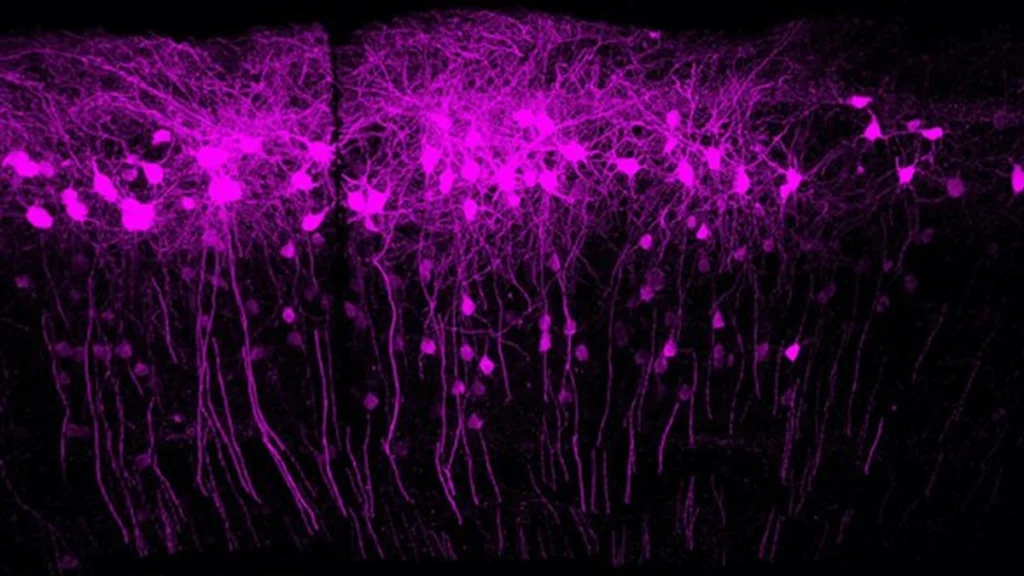
The clue comes from so-called “grid cells,” which Moser discovered with her husband, Edvard Moser. Their discovery helped the couple share the Nobel Prize with British neuroscientist John O’Keefe.
These neurons fire in a highly regular “spatial pattern.” When the locations where a single cell fires as a rat moves around are plotted, equilateral triangles can be drawn between its different activity fields.
Moser said she remains surprised by this level of precision, precisely because the brain is a biological system and, therefore, one might expect much more noise and many more errors.
“Because the brain is a biological system, you would expect many errors. And if there were many errors, we would never see a pattern like the one we observe in grid cells, where equilateral triangles can fit between each activity field as the animal moves through its surroundings. It is incredible,” she stressed.
The geometry becomes even stranger when scientists simultaneously record the activity of numerous grid cells and use mathematical tools to represent it in three dimensions.
What emerges is a “torus,” a doughnut-shaped surface across which neuronal activity appears to move, a kind of map that would not switch off even when the outside world disappears.
“This internal map is active even when the animal sleeps, so it does not need any information from the outside to keep functioning. It is simply the way the cells are connected that makes this pattern possible,” she said, adding that the question remains whether this architecture, or scaffolding, exists before exploration begins.
Moser is confident that the combination of new technologies capable of recording thousands of neurons, better mathematical theories and computational models will make it possible to achieve major advances in understanding the brain over the coming years.
"This is not biology! You can't get this in biology!"
Medicine laureate May-Britt Moser and artist Olafur Eliasson discuss the intersection of art and science at an event in 2015 at the Nobel Week Dialogue: The Future of Intelligence.
“But, as Professor Geoffrey Hinton, considered the ‘godfather’ of AI, said, understanding how we can come to have that feeling of being alive, of being conscious, can be quite difficult,” Moser reflected.
Artificial intelligence could become a tool for investigating this question, in part because it makes it possible to compare how a machine and a brain perform similar functions.
Asked whether she is optimistic about AI or a “doomer” — a term for someone who takes a catastrophic view of its future — Moser said that losing hope means surrendering. “But I think we need hope,” the neuroscientist replied.
In her view, tools can be used both to do good and to cause harm, and artificial intelligence does not eliminate this long-standing human trait, although it can greatly amplify its consequences, she added.
“It becomes dangerous if evil people use the tool to become even more evil. But they can also use their brains to be evil,” she said.
Against an international backdrop that she describes as “depressing” when she watches the news, Moser champions cooperation, science and education. She also points to individuals capable of mobilizing many others, from Malala Yousafzai to Greta Thunberg and Jane Goodall.
Thus, despite this depressing situation, Moser does not see machines as having intellectual supremacy, either. “For now, I think the brain is the best tool we have,” she concluded.
If you're reading this, then the internet still works. But that's something that we shouldn't necessarily take for granted after this week's global cybersecurity meltdown.
"Think of it this way: someone discovered that millions of buildings in the country have the same broken lock, and now everyone knows how to open it," writes Matt Shumer in a lengthy post on X about the situation. "The lock maker has sent out a fix, but every building owner has to install it themselves, and many haven't yet."
This is the world we live in now. In August, more than 100 tech companies signed a letter warning about exactly this possibility. On Thursday, one of Anthropic's top information security officers wrote that cybersecurity threats "are going to get a lot worse before they get better." Major banks are rushing to secure themselves after reports of autonomous agents operating inside accounts (though many of them may have been authorized by account holders).
This is unlikely to be the last incident like this. Cybersecurity firm CrowdStrike says it saw twice as many "agentic intrusions" (hacking done by an autonomous or semiautonomous AI) in August as in July, and then the number doubled again in September.
Scary stuff, for sure. As is usually the case, however, prevention is better than panic.
Shumer's post contains many helpful suggestions for better online security—it is particularly important to secure your email accounts, since that is the gateway to so much of what we do online. Here's a 15-step plan to stay more digitally secure in the AI age. (And if you're really worried about everything falling to bits, Reason's got you covered there too.) If your devices and browsers have updates available, install them. And for the love of digital gods, don't click on random links in strange emails!
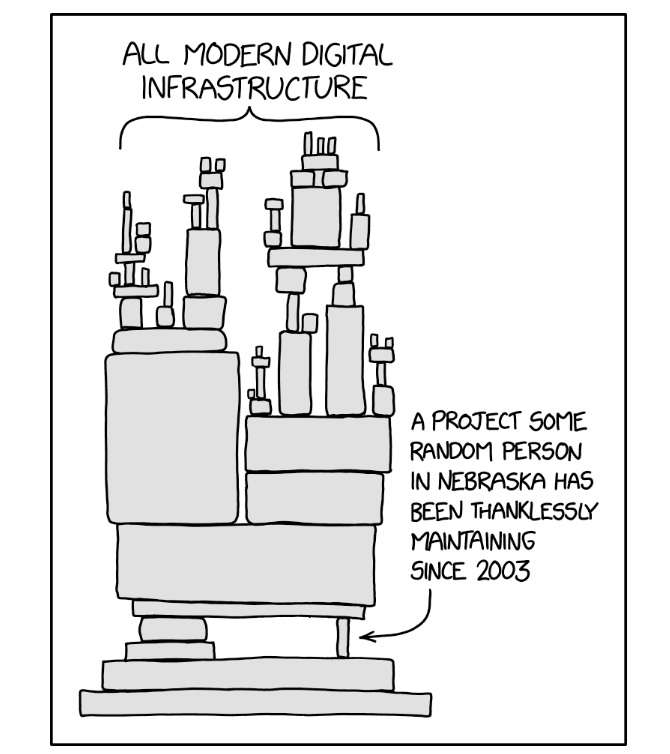
The man who (maybe) saved the internet? There is an old XKCD webcomic—and I'm dating myself as a very specific type of millennial by even referencing that—that seems to perfectly sum up what happened this week. Here it is:
Source: https://xkcd.com/2347
Here's the craziest part: That's basically true! Except the one random person lives in Czechia instead of Nebraska. His name is Ondřej Surý, and TheAtlantic's Charlie Warzel found him:
Surý, who lives in Czechia, does not work for the PHP Foundation. But alongside his day job as director of domain-name-system engineering at the nonprofit Internet Systems Consortium, in a volunteer capacity, he maintains and helps automate patches for the coding language. His work, with that of just a handful of others, has allowed countless websites and organizations to fix these vulnerabilities quickly. Over the past 48 hours, he's become arguably the unsung hero of the entire internet—despite the fact that the only compensation he receives is from modest donations. "Ondřej will save the internet today," a user in the PHP Subreddit wrote.
In the war between AI hackers and AI defenders, it's still humans who are the heroes. At least for now.
Art of the steal. Yesterday, in this space, I detailed how voters are fed up with the Trump administration's seemingly endless stream of corruption. But it's been a whole 24 hours, which means there is yet another scandal in the news—thanks to a Vanity Fairarticle about President Donald Trump's son-in-law Jared Kushner.
The article is an excerpt from a forthcoming book. In it, author Matthew Cole claims that Dutch investigators gained access to Kushner's phone with the help of Russian hackers. The evidence from the phone and other sources shows that Kushner has been taking money from the governments of Saudi Arabia and the United Arab Emirates to "push their agenda with Trump."
Kushner says the article's claims are "outrageous and categorically false."
But wait, there's yet another corruption story. The Justice Department is reportedly probing whether Trump ally Corey Lewandowski profited from his role as a top adviser at the Department of Homeland Security (DHS). The Washington Post reports that the investigation is based on a referral from the DHS inspector general and is focused on "contracting fraud."
It may or may not be connected to other allegations that surfaced in September, when The Wall Street Journalreported that Lewandowski approached officials in Qatar and the UAE about being hired to help with "visa issues" and other matters.
In both matters, Lewandowski has denied the allegations. He's no longer working for the department, having been fired earlier this yearamid a messy scandal involving then–DHS Secretary Kristi Noem, who was also canned.
Scenes from Virginia: Federal prosecutors indicted state Sen. L. Louise Lucas (D–Portsmouth), one of the most powerful Democrats in Virginia, on charges of racketeering and money laundering in connection with illegal marijuana sales. (Don't get me started on how dumb it is that recreational marijuana use has been legal here since 2021, but commercial sales are still forbidden. If it's legal to use something, it should be legal to sell it!)
Lucas pushed the failed Virginia redistricting effort and has been an outspoken critic of Trump. She plans to fight the charges. Virginia Gov. Abigail Spanberger, also a Democrat, said in a statement that the timing of the indictment, just days before the midterm elections, "further erodes the trust the American people deserve to have in the Department of Justice."
QUICK HITS
"The last thing José García-Sorto remembers after being shot in the chest is being pulled from his car, pinned to the pavement and handcuffed, his blood pooling around him on a Phoenix interstate. All he could think about was what would happen to his two young children if he died." The New York Times has a harrowing account of a Honduran immigrant who was shot by immigration officers last year. He's never been charged with a crime in connection with the incident, which suggests "the authorities did not find evidence that he had put anyone in danger."
The Cato Institute's annual ranking of "Freedom in the 50 States" is out. Arizona takes the top spot. How did your state do?
Is alchemy real now? A California company claims it has successfully turned mercury into gold.
The World Series begins tonight, and it ought to be terrific. Despite low payrolls, Tampa Bay and Milwaukee were the top teams in their respective leagues this year. They are deep, talented teams full of characters worth cheering—Brewers' star pitcher Jacob Misiorowski is a huge Pokémon nerd; Rays' star hitter Yandy Diaz escaped from Cuba after being imprisoned there. And this is the first World Series since 1980 to match two franchises that have never won a championship.
Republican lawmakers alarmed over Ukraine’s loss of access to Starshield, a critical battlefield tool, are pushing for more congressional oversight on what some view as Elon Musk’s “space monopoly,” fearing that Musk will have too much power over future national security operations. Sen. Kevin Cramer (R-N.D.), a member of the Senate Armed Services Committee, on…
The Treasury Department on Thursday proposed a rule to curb American high-tech investments, including in AI, based in U.S. adversary countries such as China, Russia, North Korea and other “countries of concern.” The rule expands restrictions in the Outbound Investment Security Program (OISP) on hypersonic systems and quantum information technologies, high-performance computing and supercomputing and…
With Beijing keeping its rare earth refining technology, equipment and technicians at home, Washington is funding private refiners to develop new ways to process the strategic metals rather than copying Chinese methods. A senior US official told Asia Times that American refiners would rely on their own innovation to make the country self-sufficient in critical […]
SpaceX investor Ross Gerber, CEO of Gerber Kawasaki, said he is “disgusted” by the recent events surrounding the slowdown of Starlink services in Ukraine, which impacted the country’s military capabilities. “As a SpaceX shareholder I am disgusted,” Gerber said Wednesday during an appearance on CNN. “I think that these decisions were strategically horrendous and from…
On this week's episode of Freed Up, Robby Soave and Christian Britschgi condemn Vivek Ramaswamy's new attack ad against opponent Amy Acton before discussing their predictions for the 2026 midterm elections. Next, the boys get biblical with references to their favorite parables as they discuss Tyler Cowen's latest article on why he thinks Elizabeth Holmes—and most other non-violent female criminals—should not be in prison. The episode wraps with a thoughtful discussion on aging, state attorneys general, and the latest Meta settlement.
00:00—Vivek Ramaswamy ad controversy
20:00—2026 midterm elections
25:50—Should Elizabeth Holmes be in prison?
49:20—Getting older
58:55—An update on Rep. Ilhan Omar
1:03:10—The importance of grain
1:06:14—Robby and Christian extol author Michael Crichton
1:11:30—The war in Ukraine should end.
1:14:50—Meta settled with the state of New Mexico
1:20:00— Christian continues his crusade against state attorneys general.
If you enjoy Freed Up, come watch Robby debate at our upcoming Reason Versus in D.C. Tickets are available here.
Robby Soave on the left, Christian Britschgi on the right, Elizabeth Holmes in the middle with the words "bad blood" written above her face, and the Reason Freed Up logo in the bottom left corner
Defense Secretary Pete Hegseth barred all Pentagon staff from using undisclosed information to place wagers on forthcoming U.S. military action using betting platforms and prediction markets like Kalshi and Polymarket. “Make no mistake why this matters. Our enemies watch movements in these markets,” Hegseth said in a memo, first obtained by CBS News. “When an American…
Defence secretary says Britain must manufacture at scale as Germany’s Rheinmetall opens Midlands factory
For the last 20 years, Britain was unable to put a barrel on its tanks without buying from abroad. Relying on foreign allies seemed like a reasonable choice during years of relative security (for wealthy countries at least) after the end of the cold war.
Texas Democratic Senate candidate James Talarico hit back at Elon Musk, accusing the technology mogul of trying to “buy his own personal” senator through massive campaign donations for Talarico’s opponent, Attorney General Ken Paxton (R). “There is something deeply wrong with a political system that allows one trillionaire to buy his own personal U.S. Senator,”…
Portuguese councils and hospitals are among 29 public bodies identified as using outdated website software, amid an international security alert over flaws that could allow hackers to take control of
Leave it to Arundhati Roy to deliver a scorching, dizzying essay on the perils of artificial intelligence that references Greek mythology, Francis Ford Coppola, the Bible, India’s industrial history, and Tie Me Up! Tie Me Down! Plus, Emily Dickinson features in the lede:
The auguries are raining down hard. Think or Sink. Comply or Die. Look Up or be Left Out. And so, with these not-so-gentle threats, it has come to pass that the Age of AI—Actual Idiocy, Actual Super Idiocy, Recursive Snowballing-Idiocy—is upon us. Heck, I’ve already used two dashes in this opening paragraph. That, as they say, is a tell. So, perhaps I haven’t written this essay at all. You’d have to use an AI app to check if it’s actually AI, and whether I’m really, or not really, or only partially me. You can no longer use your instincts. You have to use the App. Now that AI owns the em dash, what will future generations make of Emily Dickinson and her love of them? Has she been fed to the machine, too? Will they love her less? Are we being gradually locked out of language? Does it matter anymore?

 Login