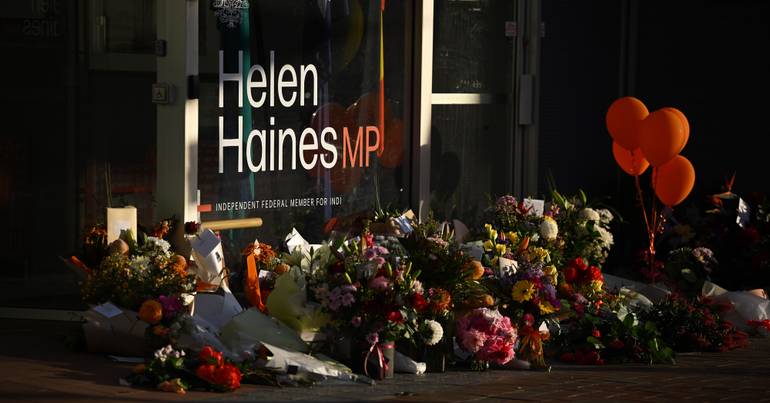
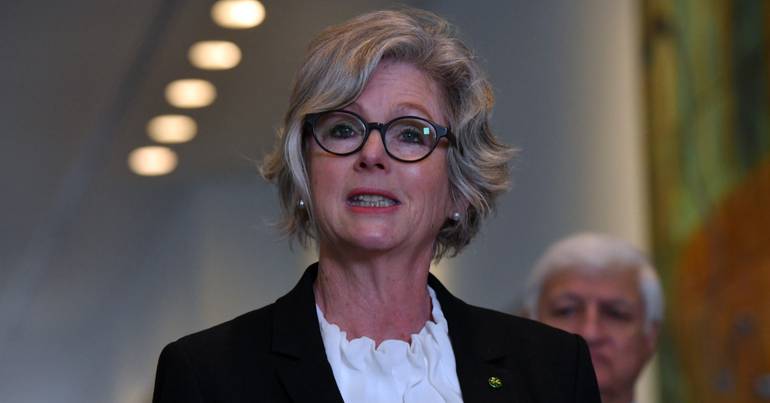
Polícia da Austrália acusa homem de ameaçar deputada

© JAMES ROSS/EPA

© JAMES ROSS/EPA

© JAMES ROSS/EPA

© JAMES ROSS/EPA

© Getty Images

Successive Australian governments have reacted with alarm at China’s influence-building activities in Southeast Asia and the Pacific. They have passed foreign interference laws, tightened foreign investment regulations, and regulated university collaborations with institutions overseas. They have executed a Pacific Step-Up and a plan for greater trade and investment with Southeast Asia. And they have tightened […]
The post What Australia could learn from SE Asia about managing China appeared first on Asia Times.


© JEREMY NG/EPA
Domestic violence is on the decline but court orders separating 'violent' fathers from their children have skyrocketed in NSW. The weaponisation of courts against dads is a warning for Britain, says Bettina Arndt.
The post The Weaponisation of Courts Against Fathers is a Warning for Britain appeared first on The Daily Sceptic.
Anyone over the age of about 35 has no idea how far Western universities have fallen into the mire of DEI, collapsing standards and Left-wing monoculture, says Professor James Allan. It's time to sort them out.
The post It’s Time to Fix our Universities appeared first on The Daily Sceptic.
The EU welcomes Cambodia’s decision to join the Multi-party Interim Appeal Arbitration Arrangement (MPIA) for WTO members, contributing to efforts to uphold a rules-based multilateral trading system.
With Cambodia’s participation, the MPIA now covers 62 World Trade Organization (WTO) members and 60.4% of world trade.
The MPIA brings together participants from all continents and at different levels of development, united by a shared commitment to upholding the rules-based trading system.
The MPIA preserves the right to appeal in trade disputes among participating WTO members, at a time when the WTO’s Appellate Body remains non-functioning. It helps ensure that disputes can continue to be resolved in an orderly and binding manner, avoiding appeals 'into the void'.
“I welcome Cambodia to the MPIA. The arrangement plays an important role in upholding the rules-based trading system. Each new participant helps reinforce the predictability, stability and credibility of global trade rules. I encourage other WTO members to join the MPIA,” said EU Trade and Economic Security Commissioner Maroš Šefčovič.
The MPIA was established in 2020 and has proven its effectiveness in many WTO disputes.
Under the MPIA, appeals are heard by arbitrators randomly selected from a pool of 10 standing appeal arbitrators set up by the participating WTO members. These arbitrators are persons of recognised authority, with demonstrated expertise in law, international trade and WTO agreements.
The MPIA is open to all WTO members as a practical tool for appeal arbitration, pending the restoration of a reformed and fully functioning WTO dispute settlement system.
As of 1 June 2025, the MPIA has an updated pool of appeal arbitrators to ensure that appeals continue to be heard by independent arbitrators of the highest calibre.
At the WTO Ministerial Conference that took place earlier this year, MPIA ministers stressed the importance of the MPIA for the security and predictability of the multilateral trading system.
The current MPIA participants are Australia, Barbados, Benin, Brazil, Cambodia, Canada, China, Chile, Colombia, Costa Rica, Ecuador, the European Union (and its Member States), Guatemala, Hong Kong (China), Iceland, Japan, Liechtenstein, Macao (China), Malaysia, Mexico, Moldova, Montenegro, New Zealand, Nicaragua, Norway, Pakistan, Paraguay, Peru, the Philippines, Singapore, Switzerland, Ukraine, the United Kingdom, Uruguay and Vietnam.
MC14: Supporting the rules-based multilateral trading system: the role of the MPIA


Not all forms of communication are based on speech or writing. Just as the Inca encoded information in strings and knots known as quipus, and the inhabitants of the Marshall Islands created intricate navigational charts from sticks and seashells, the Aboriginal peoples of Australia developed their own sophisticated means of transmitting information across vast distances. Known as message sticks, these small carved pieces of wood, rich in symbolism, served as important tools of communication between different communities.

An early 20th century Aboriginal message stick, almost a meter in length, made of extremely dense hardwood, and with ochre coating message on both sides. Credit: Carter's
On 9 October 1917, during the Third Battle of Ypres, a battalion of Australian soldiers entered a place known as Celtic Wood, near Passchendaele in West Flanders, Belgium, to attack German positions. Most were never seen again. Of the 85 men to raid Celtic Wood, just 14 made it back to their lines. The rest vanished without a trace. The fate of the lost battalion has remained one of the greatest enigmas of Australia's Great War.

The battlefield in Poelcapelle, Belgium. Credit: Wikimedia Commons
Australians rejected the idea of creating the Indigenous Voice to Parliament advisory body in October 2023. Two years after this stinging defeat, the state of Victoria signed a treaty with its First Peoples.
- 2026/08 / article, 2026/08 australia