What This Democrat’s Surge in Texas Says About the Midterms

© Devin Oktar Yalkin for The New York Times

© Devin Oktar Yalkin for The New York Times
With public opposition toward data centers growing and midterm elections on the horizon, politicians across the spectrum have introduced overreaching policies to stymie data center development and ease voters' minds. These politicians now include President Donald Trump, who has historically been a staunch supporter of the industry.
"New and large, in some cases gigantic, Data Centers are mandated by me to make their own electricity, and give or sell any excess back to the local community, or grid," Trump declared on Truth Social on Wednesday. "If companies want to make their Data Centers popular, pay the community, and/or individuals within the community, a 'dividend.' I have watched the process closely, and Data Centers that were highly unpopular in a certain area have become extremely popular when a financial deal is struck."
While Trump has suggested that power plants pay for their own power before, these comments are in stark contrast to him saying less than a couple of months ago that "the only reason that communities throughout the U.S.A. should not want Data Centers is if they want to end up being backward and poor." Still, the president is not wrong that the strategy could boost data centers' popularity; polling regularly shows that concerns over higher energy prices are one of the main reasons people oppose data centers in their communities.
However, mandating that these power plants "make their own electricity" is the wrong way to accomplish this objective, in part because generation costs are not the leading factor in higher electricity prices—transmission infrastructure, such as wires and poles, is. And regulatory barriers, as well as a lack of competition in the building of this infrastructure, are mostly to blame.
Regardless, if the goal is to have data center companies produce their own electricity, easing regulations would have more impact than imposing a mandate. As Travis Fisher, director of Energy and Environmental Policy Studies at the Cato Institute, tells Reason, "If a tech company buys electricity from the owner of a power plant, in most states the power plant owner then becomes a public utility (even if the transaction occurs off-grid), which brings heavy scrutiny in the form of economic regulation."
To ease these regulatory barriers, Fisher and other experts have advocated for a Consumer Regulated Electricity model that allows large-load customers to connect directly to unregulated power producers off the grid.
Fisher also notes that lower power costs don't automatically translate into lower utility rates. He tells Reason, "Even if a data center were to bring a matching or beating amount of supply relative to their demand, based on the way retail rates work, I am not convinced that that guarantees that prices will fall."
On top of not solving the main driver of higher electricity prices, the mandate isn't needed because many data centers have already begun to produce their own power. A report from energy research firm Cleanview shows that operating power capacity dedicated to data centers has nearly doubled since June, while capacity under construction has roughly quadrupled. Additionally, companies including Anthropic and Microsoft are already volunteering to cover consumers' electricity costs.
By calling on power producers to make their own electricity, Trump joins the growing chorus of politicians who are convinced that the government, not the market, is best equipped to dictate how data centers grow and operate. And, in typical Trump fashion, a "mandate" on social media without any legal action behind it has left the public and investors to guess what, if anything, is actually coming.
Building power plants requires long-term planning and investments meant to last decades, making Trump's tendency to impose abrupt policy changes less than ideal. "The fact that the rules change, not just every four years, but occasionally overnight via tweet," says Fisher, does not make for "a great investment environment."
The post Trump Wants To Force Data Centers To 'Make Their Own Electricity.' Deregulation Would Work Better. appeared first on Reason Magazine.

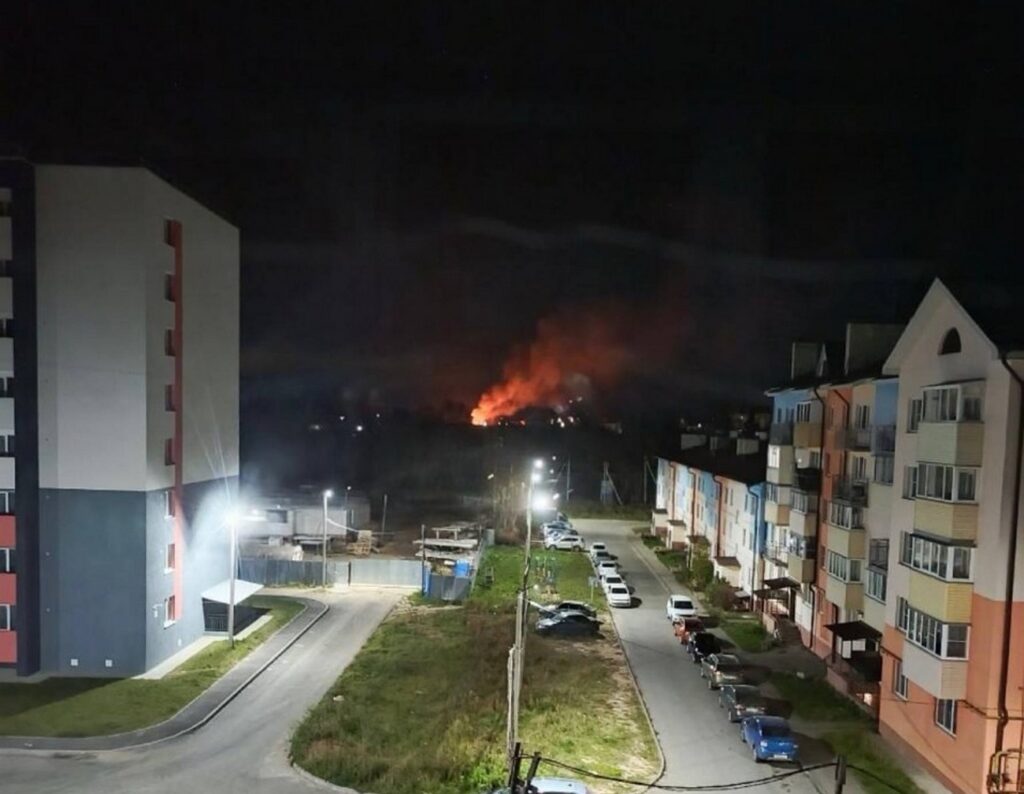
Drones attacked a Russian tax-service data center overnight on 23 October, Ukrainian monitoring channel Exilenova+ reported. A chemical plant in the Urals was also attacked, and a fire broke out near a Russian bomber base by late morning. Russian officials admitted injuries and damage but blamed falling debris. Ukraine has not commented.
Ukraine's long-range drones have widened their target list from Russian refineries to the servers and chemicals that keep Russia's state and war industry running.
The target in Gorodets, Nizhny Novgorod Oblast, is one of the Federal Tax Service's two key data centers, which work as a geographically distributed pair. It stores and processes state registers, including tax databases, Exilenova+ said. The extent of the damage is unconfirmed. The site lies about 785 km from Ukraine's northern border in a straight line.
The moment of impact at Russia’s Federal Tax Service data center in Gorodets last night. pic.twitter.com/PftC6keRpY
— Exilenova+ (@Exilenova_plus) October 23, 2026
Eyewitness footage shows a blast and fire in the area of the data center, which serves both the tax service and the Finance Ministry, Russian Telegram channel Astra found. The center opened in 2015. Mikhail Mishustin, then head of the tax service and now Russia's prime minister, attended the launch.
Nizhny Novgorod Governor Gleb Nikitin claimed air defenses repelled 19 drones. Falling debris injured three people in the Gorodets district and damaged several homes, an educational facility, and an infrastructure facility, he said, and local schools switched to remote learning. A Pantsir air defense missile hit a house, Exilenova+ claimed, though officials recorded it as a drone hit.

This month, drones already hit three Yandex data centers and a VK data center near St. Petersburg.
In Berezniki, Perm Krai, smoke rose over Uralchem's Azot plant as air defenses fired, Astra reported. The regional security ministry announced a drone attack at about 06:00, and authorities closed the airspace within 50 km of the city. Ukraine's long-range Liutyi drones visited Berezniki, Exilenova+ wrote.
Our old friends, the Liutyi drones, paid Berezniki a visit today. Haven’t seen them in a while.
— Exilenova+ (@Exilenova_plus) October 23, 2026pic.twitter.com/NXuhIJ3xpm
The attack on Azot was continuing in the morning, the channel wrote, adding that the plant covers about 140 hectares with some 90 production buildings. It makes ammonia, nitric acid, ammonium and potassium nitrate, and urea. Russian defense plants use its nitric acid to make explosives and gunpowder, including the Perm gunpowder plant, Astra said. Berezniki lies 1,500–1,600 km from Ukraine's border and the war zone.

Drones attacked Azot before, on 11 September. Earlier this year, Ukraine's Security Service hit Lukoil's refinery in the same region.
Late in the morning, Voronezh Governor Aleksandr Gusev declared a missile alert, and explosions followed in the city. Gusev later claimed air defenses downed several "jet-powered aerial targets." Debris set dry grass on fire in a suburb and damaged outbuildings and several cars, he said, adding that no one was hurt.
Missile alert in several regions of the Russian Federation.
— Exilenova+ (@Exilenova_plus) October 23, 2026
Explosions have been heard in Voronezh. We are assessing the situation. pic.twitter.com/GY0NRZTo4x
Eyewitness footage shows fire and smoke near Baltimor military airfield, Astra found. The strike preliminarily hit the grounds of a former military aviation engineering university and a nearby parking area for military aircraft, Exilenova+ said.

Baltimor hosts the 47th Guards Bomber Aviation Regiment, whose Su-34s Russia uses to strike Ukraine, Militarnyi reported, saying Ukraine attacked the airfield with missiles. Voronezh lies about 185 km from Ukraine's border. Smoke rose over the base after an attack on 27 May, and a fire broke out near it on 2 September.
Russia's Defense Ministry claimed it downed 443 drones overnight over 20 Russian regions, including Nizhny Novgorod Oblast and Perm Krai, as well as Russian-occupied Crimea and two seas. Ukraine's General Staff has not reported on the strikes. A night earlier, drones reportedly hit a sanctioned weapons plant near Moscow.
Russia's air defenses now have to cover state servers and Ural chemical plants as well as the airfields its bombers fly from.

For decades, Southeast Asia has turned great-power rivalry to an economic advantage. By maintaining healthy ties with Washington and Beijing, ASEAN governments attracted investment, expanded trade and preserved room for diplomatic maneuver. The great-power race for artificial-intelligence dominance, however, is changing that bargain. As the United States and China build competing technology networks, neutrality may […]
The post US-China AI race turning ASEAN neutrality into a liability appeared first on Asia Times.

Russian tech giant Yandex's data center in Sasovo burned out from the inside, a Ukrainian OSINT analyst wrote on 22 October. On cloud-free satellite images, he saw almost no significant holes in its roof. Ukrainian drones hit the site overnight on 8 October.
Sasovo was the first strike on a data center in Russia. It came two weeks after Russia destroyed data centers in Kyiv. Drones then hit Yandex sites in Vladimir and Kaluga, a Sber data center, and a VK data center near St. Petersburg, which VK acknowledged. In occupied Donbas, monitoring channels reported hits on buildings housing telecom operators.
The analyst, who goes by Harbuz, runs the Ukrainian OSINT channel Dnipro Osint. His roof reading comes from the images. His interior claim comes from what he called available information: he wrote that a fire broke out inside and put part of the equipment out of action.

In an earlier post, Harbuz wrote that a third of the data center had burned out. In the new one, he writes that the building burned out from the inside. He does not say whether he revised the earlier figure.
Russian outlet Agentstvo studied Airbus images from 12 October. It found damage on about a third of the building. Unlike Harbuz, though, Agentstvo described a blackened western roof with damage resembling holes.
On 8 October, Yandex stated that the attack caused a fire and forced it to suspend operations at the site, which hosts tens of thousands of servers, Reuters reported. Yandex Cloud and the Disk and Documents services that run on it ran with major disruptions that morning, Russian outlet The Bell reported.
Later that day, the company stated: "The scale of the damage to the infrastructure is still being assessed. For the moment, we cannot confirm whether it is possible to restore the data centre equipment in Sasovo." Two of Yandex's three supercomputers, used to develop its AI model, are housed there.
The same day, journalists asked Ukrainian President Volodymyr Zelenskyy whether Ukraine was targeting Russian data centers. He did not refer specifically to the Yandex strike, Reuters noted, but said: "We always respond in mirror-like fashion."

© Bizuayehu Tesfaye/Las Vegas Review-Journal/Tribune News Service, via Getty Images

© Scott Ball for The New York Times

In recent days, a Ukrainian drone strike hit Russia’s largest data center, owned by bank and technology company Sberbank. The strike came after Ukraine hit three data centers belonging to the tech giant Yandex, which is often referred to as “Russia’s Google.” After those attacks, Yandex’s traffic dropped 94%. Its users experienced heavy disruption to […]
The post Data centers in the line of fire of Ukraine war appeared first on Asia Times.
The Democratic Socialists of America (DSA) candidates running for the House of Representatives and endorsed by NYC Mayor Zohran Mamdani are all but guaranteed to win their general elections this November, but that does not mean the midterm drama is over in New York. In the state's 17th congressional district, which includes the lower Hudson Valley, Democratic challenger Cait Conley, a combat veteran who served on the Biden administration's National Security Council, could unseat incumbent Republican congressman Mike Lawler in one of the most consequential races of the midterms.
The highly contested purple district voted for former Vice President Kamala Harris in the 2024 election while reelecting Lawler for his second term. Now, Lawler is attempting to win a third term as support for President Donald Trump wanes ahead of the midterms. As of Friday, The Cook Political Report lists the race, which could determine control of the House, as a toss-up.
If elected, Conley would have far more in common with the "Badass Women" coalition of security state and military veterans than with DSA types (think more Sen. Elissa Slotkin from Michigan than Darializa Avila Chevalier). As Judge Street Journal's Timmy Facciola notes, "Conley's candidacy is testing the viability of a tactful centrism that rebukes left-wing positions like abolishing ICE or restricting weapon shipments to Israel." Lawler is also vying for moderates, pitching himself as "one of the most bipartisan members of Congress" and emphasizing his willingness to break with Trump occasionally while still welcoming Trump's support.
While Lawler and Conley certainly are not pure MAGA acolytes or DSA members, both have leaned into a tech-critical position, much like that of more radical populists like Lina Khan or Steve Bannon, revealing how pervasive anti-tech sentiment has become in mainstream politics.
This tech skepticism was on full display during an October 14 debate, when each candidate made the case for why they were the most equipped to regulate AI, insisting that the industry needs guardrails.
Conley said members of Congress do not want to regulate AI because "they want to look out for their billionaire and trillionaire backers like Elon Musk, who is pouring over $260 million into this midterm election." She then added that Musk backed Lawler in his 2024 race.
Lawler then accused Conley, who previously consulted for Primer AI, of being "the AI candidate for the AI industry."
While Lawler and Conley disagree on specific data center regulations (Conley supports Democratic Gov. Kathy Hochul's data center moratorium while Lawler supports local zoning control over data centers), neither wants to pitch themselves as an explicitly pro-data center candidate. During the debate, Conley claimed that, "On Mike Lawler's watch there have been five data centers built in Rockland County." Lawler has said that he had no say in the decision to build the data centers, and during the debate, he pointed out that the facilities were built for financial services. Lawler also attempted to attack Conley over data centers, slamming her in an ad for saying "we need data centers." Regardless of the candidates' specific policies on data centers, their attacks on one another demonstrate that cheerleading hyperscale data center development is a political liability. In their district, data center has presumably become a dirty term.
The candidates' tech-skeptical rhetoric did not end with unchecked data center development. After the debate, Reason asked both candidates about their positions on age-verification laws for social media and AI, since such regulations raise significant privacy and censorship concerns by age-gating the internet. Unsurprisingly, both Lawler, who voted for the controversial KIDS Act, and Conley, who has proposed stricter age verification for AI tools, parroted platitudes about why such online safety regulations are necessary to protect children.
"We have watched how social media is literally hurting the mental health of children," Conley told Reason. "And when you talk about the power of AI and what that power could do, we have to regulate this."
Lawler gave a similar response, telling Reason that he respects free speech but that protecting children "is paramount."
This bipartisan consensus over social media regulation has long been brewing in Congress. The mainstream political conversations about AI and data centers, however, are relatively new this midterm election cycle. And it appears both Lawler and Conley have figured out which way Americans' sentiment toward AI is leaning, and they have waged their campaigns accordingly.
The post Nobody Wants To Be the Pro-Tech Candidate in This New York Race That Could Flip the House appeared first on Reason Magazine.

The International Monetary Fund warned Tuesday that the global economy faces serious risks from Big Tech firms taking on massive debt to fund the buildout of artificial intelligence data centers worldwide. The IMF’s latest Global Financial Stability Report outlines a number of risks to economic growth in the coming years, including a reliance on AI […]
The post IMF warns of debt-fueled AI spending as bubble fears grow appeared first on Asia Times.
In a remote part of Utah, the world’s largest data center project—allegedly—is being fast-tracked in secret. Kevin O’Leary of Shark Tank fame was brought in to hype the 40,000-acre complex. But the backlash among Utahns has been strong. Josh Dzieza reports from the front lines of the popular resistance to data centers:
[Brenna] Williams, a former government econometrician and college instructor, speaks methodically in a calm monotone as she enumerates the many reasons why the data center “doesn’t make sense”—a refrain. First among them is the water, an acutely sensitive issue in Utah in part thanks to Gov. Cox himself, who has declared repeated drought emergencies and urged residents to take shorter showers and cut back on watering their lawns. There is no more potent symbol of the state’s water crisis than the Great Salt Lake, which has been shrinking for years, exposing heavy metals on its lakebed that become airborne dust. Now here came a data center on its northern shore, or where its northern shore would have been if it hadn’t receded several miles.
“We have to report on our neighbors if they’re watering at the wrong times or on the wrong days,” Williams says. (There’s a hotline.) “But we have water to cool a power plant and cool the data center? It doesn’t make sense.”

Southeast Asia’s growth next year will be decided at meetings its finance ministers won’t attend. A few executives in California will soon settle next year’s spending on data centers. Their decisions will do more to shape growth in Vietnam, Malaysia, Thailand and the Philippines than any budget those governments pass. The World Bank has just […]
The post Asia’s growth now belongs to Silicon Valley appeared first on Asia Times.

Paul Krugman is the greatest econ writer in the world, and also a legendary economist. But I sometimes feel that he has a blind spot when it comes to the value of new technologies. In 1998 he famously wrote: The growth of the Internet will slow drastically, as the flaw in ‘Metcalfe’s law’—which states that […]
The post What the AI boom is actually doing for Americans appeared first on Asia Times.

The artificial intelligence (AI) race between the United States and China has accelerated in model protection, supply chains and talent controls, even as the two nations’ leaders agreed last week to open a new dialogue on AI safety. A string of moves announced or uncovered this week shows that both sides are now guarding their […]
The post US bans Chinese data center gear as Beijing grounds its AI talent appeared first on Asia Times.
Concerns about the water and energy demands of data centers have become prolific in recent weeks. But debates about their impact often overlook the rapid advances in cooling technology and cleaner energy that are already having an impact.
However, data centers’ resource consumption should be front and center of the AI conversion, as it is set to grow rapidly. By 2030, data centers’ water and energy consumption will double as AI demand leads to rapid construction of the infrastructure.
But data centers will not cause the world to run out of water or energy. Water- and energy-saving technologies already in use are reducing their impact, while Shanghai’s groundbreaking underwater data center demonstrates how innovative design can limit water, energy and land use.
Data centers have underpinned the internet since its founding. Apps, email, file storage and cloud services all run through them.
Modern AI workloads, however, have transformed their power demands beyond recognition. Today a single AI data center can match the electricity consumption of 100,000 homes, making them a significant drain on local energy grids, especially if a region is susceptible to shortages.
Data centers’ energy consumption is only rising as more are built across the world. In the US, data centers could increase from 4.4% to 12% of national electricity usage by 2028 — that is equivalent to adding eight New York Cities to the American grid.
Data centers also consume large amounts of water in two main ways. Water is used directly to cool servers and storage systems, which generate considerable heat, and indirectly to produce electricity at fossil fuel power plants where it is heated into steam to drive turbines.
In the UK, data centers have been estimated to use up to eight times as much water as average on hot summer days, underlining how their impact can rise when local resources are already under strain.
As the effects of climate change intensify, the location of data centers, and methods to reduce their water and energy consumption, are becoming ever more important.
Fortunately, resource-saving measures are already being implemented. Data centers on land use closed-loop cooling systems that recycle water rather than continually evaporating it. This can reduce freshwater use by up to 70% compared to traditional open evaporative methods.
China has also pioneered a revolutionary new type of data center in Shanghai: wind-powered, and underwater. The facility, which began full commercial operations in May 2026, uses seawater as a coolant instead of using refrigerated fresh water as land-based data centers do, reducing the electricity required to cool the computers.
It uses at least 30% less electricity than traditional data centers, and offshore wind turbines reduce reliance on fossil fuels and cut the data center’s carbon emissions. Innovative solutions such as these will go a long way to reducing data centers’ resource consumption.
AI is also part of the solution to data centers’ draw on resources. AI can optimise electricity grids and shift computing workloads towards periods when cleaner energy is more efficient, making energy use more effective overall. AI can also anticipate fluctuations in demand and adjust energy consumption accordingly, reducing waste.
It might sound obvious, but some areas are just better equipped to accommodate a data center than others. For example, facilities in hot or water-stressed regions will impose a heavier burden on resources than those supplied by cleaner energy with plentiful water and located in cooler climates.
AI’s growing demand for data centers will increase electricity and water consumption, that is true. But it does not mean the technology will exhaust regional or global supplies of either resource.
The AI boom and the infrastructure buildout accompanying it are well underway. To manage its impact, the industry needs to plan ahead. Cleaner energy, efficient cooling, and sites that have significant water and energy supplies will all limit the infrastructure’s drain on resources.


by Brian Shilhavy
Health Impact News
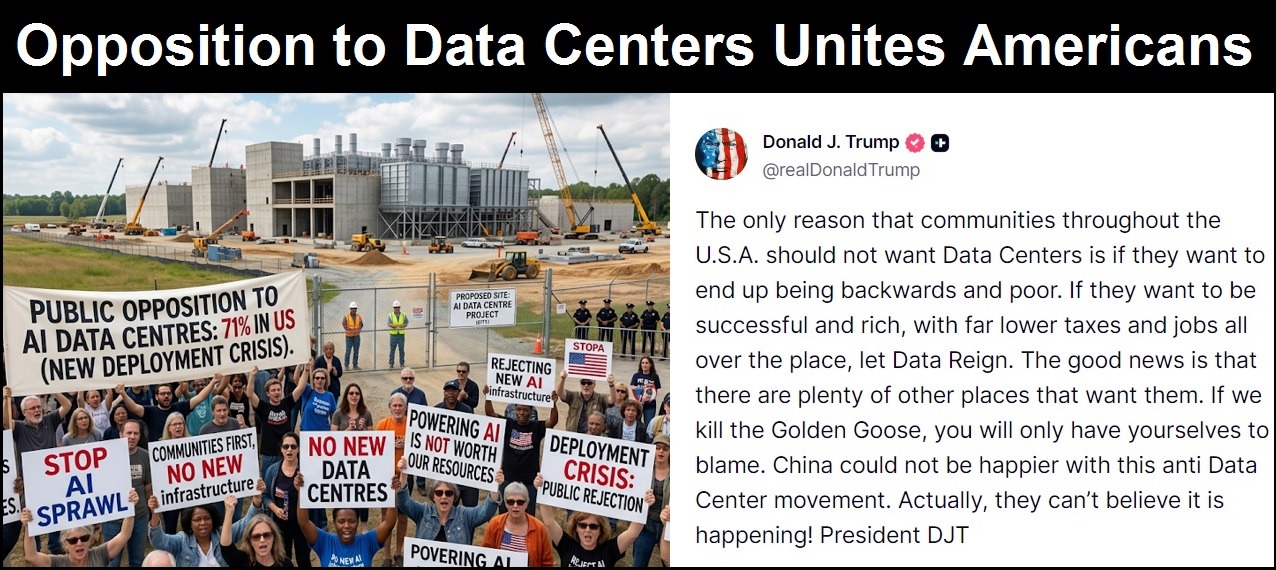
Here in 2026 Americans have finally found an issue that unites them as Americans, regardless of political affiliations: opposition to AI data centers being rapidly built in their communities with little to no oversight, as the AI bubble continues to inflate.

According to a recent Gallup poll, 71% of Americans oppose AI data centers near their homes, triggering a wave of legislation that has already stalled $130B in projects.
Americans unite against data centers, with 71% opposing local builds
A Gallup poll conducted in March 2026 found that 71% of American adults oppose building an AI data center near their home, with 48% saying they are strongly opposed.
For historical context, public opposition to nuclear power plants peaked at 63% during the height of anti-nuclear sentiment. Opposition to AI data centers sat somewhere between 42% and 47% in late 2025. By March 2026, Gallup had it at 71%. A separate May 2026 Heatmap Pro poll confirmed the figure, also recording 71% opposition, but with an even sharper edge: 55% of respondents in that survey said they were strongly opposed.
Around half of data center opponents cite electricity and water consumption as their primary grievances. The rest of the opposition cohort points to noise, pollution, and the prospect of higher utility bills.
Gallup found that between 63% and 75% of both Republicans and Democrats oppose local data center construction.
In the first quarter of 2026 alone, community and legislative actions blocked or delayed more than 75 data center initiatives, representing over $130 billion in planned investment.
Roughly 300 state-level bills targeting data center regulation were introduced in the first half of 2026. New York’s governor signed an executive order in July 2026 pausing new hyperscale data center permits for a year. California and other states are advancing their own regulatory frameworks.
One has to wonder what is up with the other 29% of Americans who are not opposed to these data centers? I would imagine that they are the “faithful MAGA base” who continue to “trust the plan” and cheer the bombing of innocent people, including children, in places like Gaza, Lebanon, and Iran as they continue to worship their Pedophile in Chief, Donald Trump.
Donald Trump has attacked these Americans who make up over 70% of the country, stating that “The only reason that communities throughout the U.S.A. should not want Data Centers is if they want to end up being backwards and poor.”
If you do not live in a community where a new data center is being constructed, and are wondering what all the fuss is about, I have put together a short video that is just over 10 minutes long where you can hear it from the people themselves in these communities that Trump has belittled.
Fox News and some other Right-wing Conservative groups are trying to cast these people who oppose data centers as being part of the “far-left”.
So listen to these people yourself and see if they sound like “far-left” climate control freaks, or if they sound like ordinary, average Americans concerned about their homes, their families, and their future with Big Tech in control. (Video also can be watched here.)
Ohio is one of the largest battlegrounds where this is happening, as both Larry Ellison’s Oracle and Facebook parent company Meta are each building huge data centers in their state.
One of the most outspoken persons in Ohio, who was the last one who spoke in the video above, is Carl Setzer, who accurately stated that there is a huge AI bubble, and that there is no guarantee that any of these companies will even be around in 10 years.
And the current facts backup Setzer’s concerns.
Larry Ellison, the billionaire Zionist friend of Donald Trump and owner of Oracle, has already lost hundreds of billions of dollars with his investing into AI.
One analyst has already stated that the AI bubble is 17 times larger than the dot-com bubble, and four times the size of the 2008 real-estate/subprime bubble.
Oracle’s Massive AI Bet Has Already Cost Larry Ellison $207 Billion. Analyst Warns the AI Bubble Is 17 Times Bigger Than the Dot-Com Bubble.
Larry Ellison’s Oracle gambled its balance sheet on an AI future that analysts are now calling the most dangerous financial bubble in history, and the bill is coming due faster than anyone expected.
by AJ Tiarsmith
24/7 Wall StreetExcerpts:
Larry Ellison has lost $207 billion in less than a year.
Oracle’s market value has fallen by roughly $494 billion since peaking at $877.1 billion in September 2025.
Oracle’s Q4 8-K reported Remaining Performance Obligations of $638 billion, up 363% year-over-year, most locked into long-dated contracts that will not convert to cash for years.
A large chunk ties to OpenAI, whose IPO has slipped to 2027.
S&P Global downgraded Oracle’s credit rating, warning the buildout might pay off long term but could weaken near-term financial position. Melius Research questioned whether Oracle’s spending plans hold if OpenAI or Anthropic scale back demand for compute.
Sitting behind all of it: Project Stargate, a plan to invest up to $500 billion in AI-focused data centers over four years.
The 17x Thesis
In October 2025, Julien Garran, partner at UK firm MacroStrategy Partnership, published a report arguing the AI investment frenzy is a “misallocation of capital” 17 times the size of the dot-com bubble and four times the size of the 2008 real-estate/subprime bubble.
He called it
“the biggest and most dangerous bubble the world has ever seen.”
His “golden rule” case: large language models are statistical word-prediction engines with architectural limits, coding tools reproduce rote patterns, and capability has hit a “scaling wall” since GPT-4 launched in March 2023.
Garran’s answer to “who is actually making money” is blunt: only NVIDIA. Data-center operators, LLM developers, and LLM-based software vendors are, in his framing, “all heavily loss-making” and depend on a “permanent funding tour” of new rounds, with SoftBank and sovereign funds like Saudi Arabia’s serving as backstops.
The Great Reset is coming.
And thanks to The Leah Files, we now know the plan that has just been executed by Treasury Secretary Scott Bessent and Secretary of Commerce Howard Lutnick to kill the U.S. dollar and replace it with crypto Stablecoins. See:
This article was written by Human Superior Intelligence (HSI)
See Also:


Having problems receiving our emails? See:
If our website is seized and shut down, find us on Telegram, as well as Bitchute and Odysee for further instructions about where to find us.
If you use the TOR Onion browser, here are the links and corresponding URLs to use in the TOR browser to find us on the Dark Web: Health Impact News, Vaccine Impact, Medical Kidnap, Created4Health, CoconutOil.com.
The post AI Data Center Opposition Unites People Across Political Lines as Trump Attacks Americans Who Oppose Big Tech first appeared on Health Impact News.
More than a decade ago, a group of snipers shot up an electrical substation in Silicon Valley, striking power transformers and disabling the substation for nearly a month. The shooters were never identified; similar substation shootings, some by neo-Nazis, have taken place since. The longer Christopher Cox studies the American power grid—looking at aging infrastructure and ongoing transformer shortages, specialized manufacturing and rising demand, the massive energy consumption of data centers and whiplash usage of large language models—the more vulnerable it seems. “Somehow, we’ve made the industrial equivalent of a Fabergé egg the linchpin of our civilization,” Cox writes. “What would happen if someone started breaking them?”
The hope of restoring the grid would fade as fossil fuel supplies were exhausted, because so many utilities rely on them to “black-start” their generating units. A 2010 report called “High-Impact, Low-Frequency Event Risk to the North American Bulk Power System,” prepared by the Energy Department and NERC, condensed the entire disaster movie that would follow into a single paragraph: “The supply of food, water and fuel would degrade within days. The facile communication of information to the general population would be greatly complicated by the loss of cellphones, internet access and television. The economy would virtually shut down as electronic transactions could no longer be processed. After several days, widespread social unrest and confusion would ensue.” Thirsty, starved, dirty and surrounded by the useless machines we once depended on, we would be lucky if our misery ended at “confusion.”