❌

Reading view

Military Situation In Iran On October 24, 2026 (Map Update)

Click to see full-size map.

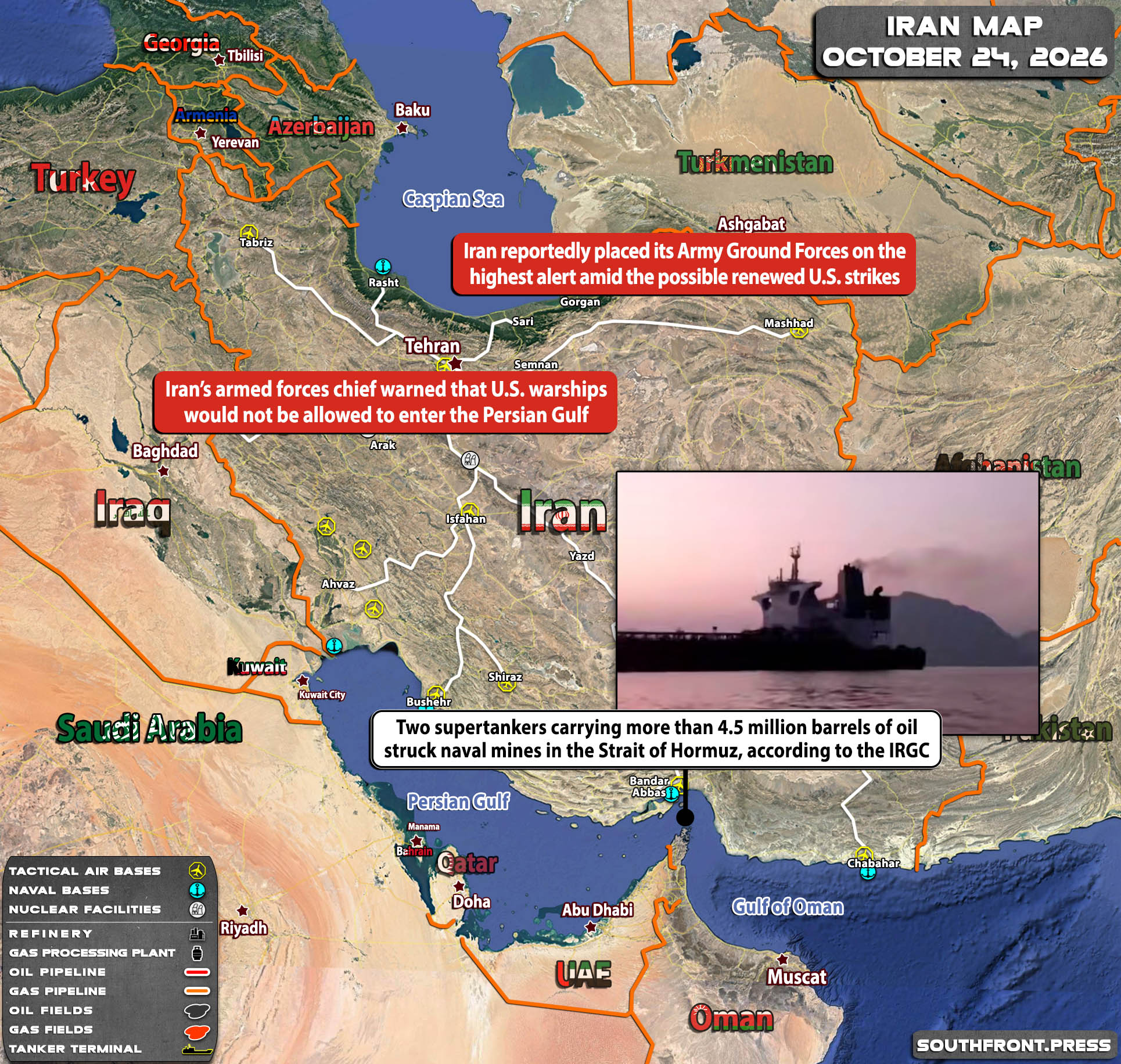
  • Two supertankers carrying more than 4.5 million barrels of oil struck naval mines in the Strait of Hormuz, according to the IRGC;
  • Iran’s armed forces chief warned that U.S. warships would not be allowed to enter the Persian Gulf;
  • Iran reportedly placed its Army Ground Forces on the highest alert amid the possible renewed U.S. strikes.

_______________________________________________________________________________________________________________________

MORE ON THIS TOPIC:


The post Military Situation In Iran On October 24, 2026 (Map Update) appeared first on South Front.

  •  

Rosoboronexport to Showcase “Anti-Drone Dome” Soon

File image.

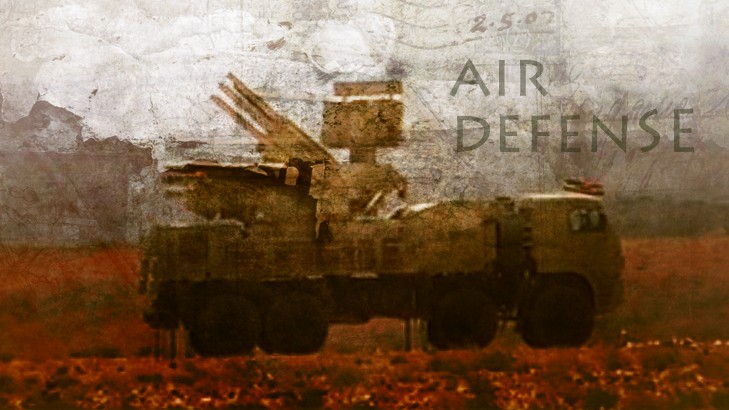
Russia’s state arms exporter Rosoboronexport plans to unveil a new integrated air defense concept designed to protect critical infrastructure, military installations and civilian sites from drone attacks at the Russia-Africa Summit in Moscow on October 28–29.

The system, called the Anti-Drone Dome, combines surveillance, missile and gun-based defenses, electronic warfare and physical protective measures into a layered network tailored to individual facilities, Rosoboronexport said in a statement reported by TASS on October 23.

The company said the system is intended to protect strategic infrastructure, bridges, buildings, energy facilities and troop deployment sites, as well as civilian populations.

“Options are also available for protecting convoys and vehicles transporting VIPs or sensitive cargo,” the press service stated.

Rosoboronexport CEO Alexander Mikheyev said the growing threat posed by unmanned aerial vehicles had made infrastructure protection a national security priority.

“Protecting critical infrastructure from unmanned aerial vehicles has today become the cornerstone of national and economic security, as well as the foundation for further technological development. The proper design and implementation of such a system makes a significant contribution to demonstrating the effectiveness of government and business operations, maintaining supply chains, and signaling to investors that their investments are secure.

Rosoboronexport offers the implementation of reliable site-specific protection against UAVs [unmanned aerial vehicles], tailored to each specific partner and facility. All the equipment and solutions used in this system have proven their effectiveness in real conditions,” said Rosoboronexport CEO Alexander Mikheyev, quoted by the press service.

The proposed system includes several Russian weapons designed to destroy drones, including the Pantsir-SMD-E missile system, the Pantsir-S1M missile-and-gun system, the Verba man-portable air defense system and the TKB-1167 air defense system. It also incorporates the Citadel anti-aircraft artillery system, which uses programmable-detonation ammunition.

For detecting and disrupting drones without necessarily destroying them, Rosoboronexport plans to integrate electronic warfare systems including Silok, Repellent-Patrol, Sky-Hunter 4PC and an anti-drone version of Radescan. These systems are designed to detect and interfere with unmanned aircraft control and navigation channels.

Rosoboronexport said the project was developed in cooperation with Russian counter-drone manufacturers and specialized law enforcement agencies, drawing on experience gained during military and counterterrorism operations in recent years. All components of the proposed system are developed and manufactured in Russia.

The company described the Anti-Drone Dome as a configurable defense architecture rather than a single weapon, with its equipment and capabilities selected according to the characteristics of each protected site.

In the face of increasing Ukrainian drone attacks, Russia has accelerated work on systems to counter the threat, relying on battle-proven systems and the lessons learned from the special military operation. The Anti-Drone Dome system appears to be the result of these efforts.

_______________________________________________________________________________________________________________________

SouthFront: Analysis and Intelligence

NOW hosted at southfront.press

Previously, SouthFront: Analysis and Intelligence was at southfront.org.

The .org domain name had been blocked by the US (NATO) (https://southfront.press/southfront-org-blocked-by-u-s-controlled-global-internet-supervisor/) globally, outlawed and without any explanation

Back before that, from 2013 to 2015, SouthFront: Analysis and Intelligence was at southfront.com

SOUTHFRONT.PRESS

MORE ON THIS TOPIC:

The post Rosoboronexport to Showcase “Anti-Drone Dome” Soon appeared first on South Front.

  •  

Military Situation In Yemen On October 24, 2026 (Map Update)

Click to see full-size map.

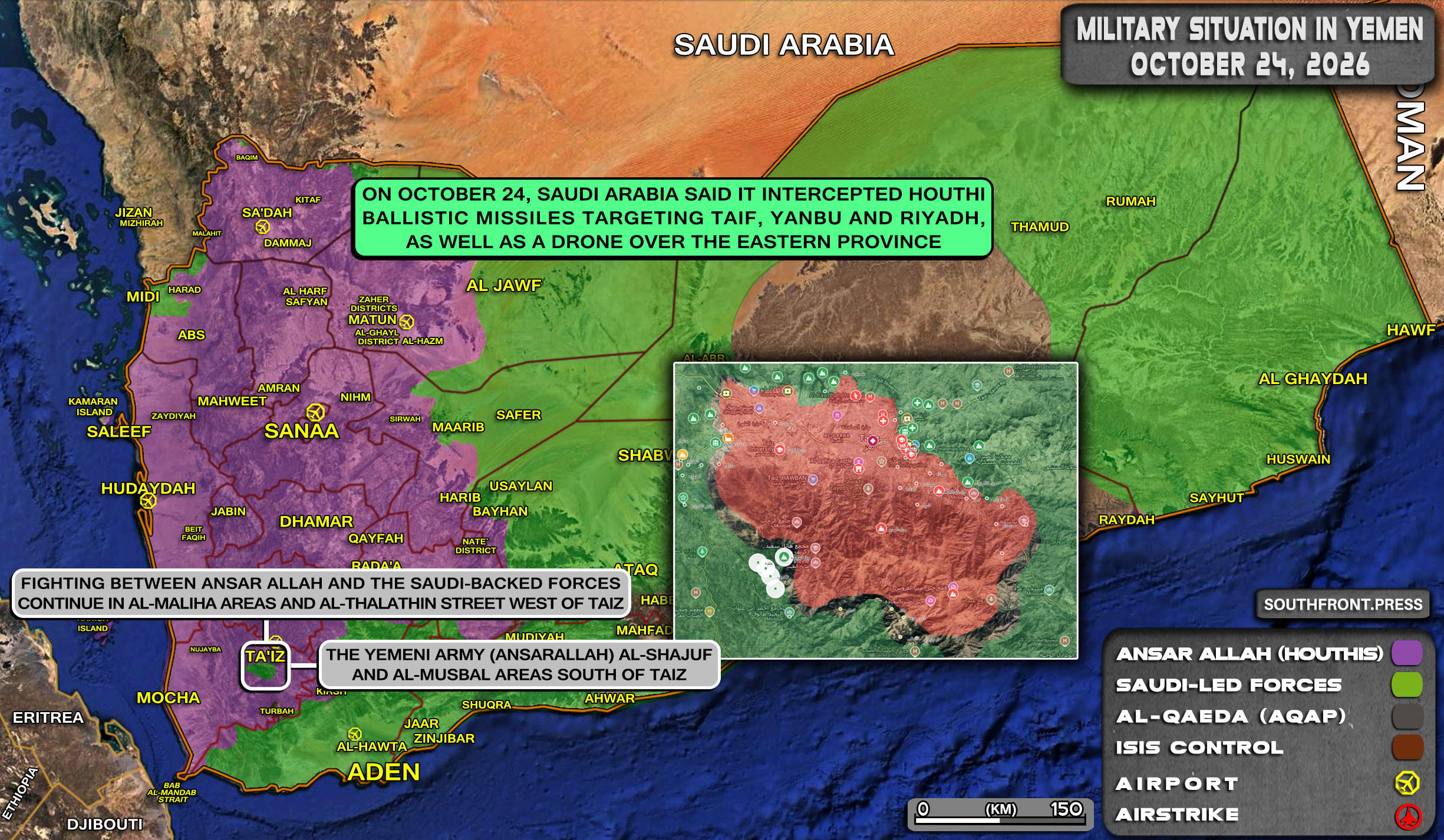
  • The Yemeni army (AnsarAllah) Al-Shajuf and Al-Musbal areas south of Taiz;
  • Fighting between Ansar Allah and the Saudi-backed forces continue in Al-Maliha areas and Al-Thalathin Street west of Taiz;
  • On October 24, Saudi Arabia said it intercepted Houthi ballistic missiles targeting Taif, Yanbu and Riyadh, as well as a drone over the Eastern Province.

_______________________________________________________________________________________________________________________

MORE ON THIS TOPIC:


The post Military Situation In Yemen On October 24, 2026 (Map Update) appeared first on South Front.

  •  

Russian Army Shatters Ukrainian Defenses In Zaporozhye

Click to see full-size image. (Russian Ministry of Defense)

In the Zaporozhye direction, Russian units have taken Mikolskoye and Krasny Yar, breaking through the defensive line across a broad front, and are fighting for Omelnik. In the Kupyansk direction, Russian units are fighting in built-up areas and taking new positions around Moskovka and Malaya Shapkovka, seeking to build on their gains towards Palamaryovka. In the Sumy direction, small-arms engagements continue near Khoten and Velikaya Rybitsa, while Russian assault troops have made substantial advances towards Korenyok. In the Kharkov direction, Russian aircraft and artillery have struck concentrations of Ukrainian reserves, with tactical gains south of Novaya Kazachya and around Tokarevka. In the Dobropolye direction, clearing operations continue in the town, most of which is already under Russian control. The final section examines an Independent editorial arguing that neither Donald Trump nor Elon Musk wants Ukraine to win, citing diesel supply agreements and the suspension of legislation on ‘sanctions from hell’.

Kupyansk direction

Fighting continues in the built-up areas of Kupyansk and for positions on its western approaches. Around Moskovka and Malaya Shapkovka, Russian units are taking new, more advantageous positions. They are seeking to build on their gains towards Palamaryovka. Near Kupyansk-Uzlovoy, progress has been made in consolidating positions on the approaches to Kurilovka.

West of the Oskol, Ukrainian units have repeatedly tried to dislodge Russian forces from their positions. The Khartia Corps operates here and includes many Latin American mercenaries, whose lives are being expended to expand the ‘grey zone’ along the Dvurechnaya–Zapadnoye–Kalinovo line.

Following repeated Ukrainian assaults around Dvurechnaya, Russian troops are now attempting to advance towards Kutkovka. Further south, Russian units have been increasing their presence in Kupyansk, although they do not fully control the town. Their gains depended heavily on a pipeline used to bring in supplies. Khartia has now published an account of its own underground operation, claiming that the pipeline has been destroyed. If that is true, and the pipeline is as important as suggested, Russian units are likely to lose some positions in Kupyansk.

Ukrainian forces retain a presence in Kovsharovka, parts of Novoosinovo and the woodland west of these settlements, through which their units reach the villages. Their bridgehead has shrunk considerably compared with its previous extent. Despite the large stretches of open ground, advancing and establishing supply routes for Russian units operating in Kupyansk should become somewhat easier.

Sumy direction

Small-arms engagements continue around Khoten and Velikaya Rybitsa. The Sever group of forces has reported substantial advances towards Korenyok. Russian aircraft, artillery and drone crews have struck concentrations of Ukrainian personnel and equipment around Luzhki, Grunovka, Sennoye, Vakalovshchina, Novaya Sloboda, Korenyok, Demyanovka and Lebedin.

In Sumy district, small-arms engagements continue around Khoten and Velikaya Rybitsa. In Shostka district, Russian assault troops have made substantial advances towards Korenyok. Russian units continue to press steadily through Ukrainian defenses with artillery and drone support, allowing them to expand their control in border areas.

Kharkov direction

The Sever group has reported advances south of Novaya Kazachya in the Liptsy sector. Its main efforts are concentrated around Veliky Burluk and Khatne. Strikes have been carried out near Karasyovka, Vesyoloye, Stary Saltov, Shevchenkovo and Martovoye. Tactical gains have been made south of Kazachya Lopan and around Tokarevka. On the eastern flank, fighting continues near Prikolotnoye and Maly Burluk.

In the Volchansk and Veliky Burluk directions, the main efforts have focused on locating and destroying Ukrainian personnel and equipment around Veliky Burluk and Khatne. Russian assault groups have also conducted reconnaissance and search operations to locate scattered Ukrainian groups in the area covered by Operation Medvezhy Ugol. Russian units are steadily expanding their control, forcing Ukrainian troops from their positions and creating conditions for further advances.

Zaporozhye direction

A little further north, in the Vostok group’s area of operations, Mikolskoye and Krasny Yar have been taken. The area has yet to be fully cleared, and numerous Ukrainian positions still need to be dislodged.

The 5th and 35th Armies are fighting for Omelnik. The objective is to straighten the front line along the road from Orekhov to Omelnik and further north. Deep infantry penetrations need drone support. Around Shirokoye and to its south, Ukrainian forces hold substantial defensive strongpoints that are well dug in and have established supply routes. The immediate task is to secure all of Omelnik, use the salient around Mikolskoye, Timashovka and Krasny Yar as a base, advance to Shirokoye, take it and clear the positions to its south. Once this has been achieved, Ukrainian forces around Orekhov will face serious difficulties.

Further north, fighting continues near Rozhdestvenskoye, where Russian forces are trying to enter the settlement. Fighting around Ternovatoye is heavy, with Ukrainian forces attempting to regain control. The Vostok group’s second major task is to drive Ukrainian units out of the deep salient south of Danilovka, Nechayevka and Radostnoye that formed during the spring and summer.

Dobropolye direction

Clearing operations continue in Dobropolye. Fighting is increasingly shifting towards the northern part of the town, which is cut off. Fog sometimes allows Ukrainian forces to bring in reinforcements and supplies, though it offers cover to both sides.

Most of the town is already under Russian control. Fighting has even begun in southern Belozyorskoye, the last mining town in the Donetsk People’s Republic that has yet to be fully taken. Using Zolotoy Kolodets as a base, Ukrainian forces are trying to reach the Russian rear through Novovodyanoye, so far without success. Russian units are increasingly infiltrating Gruzskoye along the Gruzskaya river valley, while also trying to secure the rest of Novoandreyevka and advance towards Roganskoye, north-west of Druzhkovka.

Conclusion

In the Kupyansk direction, Russian forces are taking new positions around Moskovka and Malaya Shapkovka, seeking to build on their gains towards Palamaryovka, while fighting in Kupyansk-Uzlovoy remains localized. In the Sumy direction, assault groups from the Sever group of forces are maintaining a rapid pace of advance while fighting near Khoten, Velikaya Rybitsa and Korenyok. In the Kharkov direction, Russian units are expanding the security zone, advancing south of Novaya Kazachya and around Prikolotnoye. In the Zaporozhye direction, the capture of Mikolskoye and Krasny Yar has enabled a breakthrough across a broad front and created conditions for further pressure on the Orekhov defensive hub. In the Dobropolye direction, most of the town is already under Russian control, with fighting continuing in the north and on the approaches to Belozyorskoye.

Meanwhile, The Independent argued in an editorial that neither Donald Trump nor Elon Musk wants Ukraine to win. ‘Now is the time to acknowledge some obvious truths that recent events have brought into painful focus. The main conclusion is that we can say with even greater confidence that neither Musk nor Trump wants Ukraine to win,’ the newspaper writes. According to the newspaper, agreements between Moscow and Washington on diesel supplies and the suspension of US legislation on ‘sanctions from hell’ clearly point to this conclusion.

_______________________________________________________________________________________________________________________

SouthFront: Analysis and Intelligence

NOW hosted at southfront.press

Previously, SouthFront: Analysis and Intelligence was at southfront.org.

The .org domain name had been blocked by the US (NATO) (https://southfront.press/southfront-org-blocked-by-u-s-controlled-global-internet-supervisor/) globally, outlawed and without any explanation

Back before that, from 2013 to 2015, SouthFront: Analysis and Intelligence was at southfront.com

SOUTHFRONT.PRESS

MORE ON THIS TOPIC:


The post Russian Army Shatters Ukrainian Defenses In Zaporozhye appeared first on South Front.

  •  

Saudi Airports and Oil Facilities Targeted in Wave of Houthi Strikes (Videos)

File image.

Yemen’s Houthis (Ansar Allah) announced on October 24 that they had launched seven military operations targeting airports, oil facilities and military installations across Saudi Arabia, including in Riyadh, Yanbu and Dammam.

In a statement, Brig. Gen. Yahya Saree, the group’s military spokesman, said the operations involved ballistic missiles and drones and were launched in response to what he described as an intensifying Saudi air campaign against Yemen.

Saree said the first operation targeted King Khalid International Airport in Riyadh in two stages, claiming both strikes achieved accurate hits. The second targeted Saudi Aramco facilities in the Red Sea port city of Yanbu, while the third struck the Rabigh oil refinery, he added.

The fourth operation targeted crude oil pumping stations and the East-West oil pipeline, which transports crude from Saudi Arabia’s eastern oil-producing regions toward the Red Sea coast. Saree claimed that the operation achieved its objectives.

The remaining operations targeted King Fahd International Airport in Dammam, Najran Airport and the Khamis Mushait air base in southwestern Saudi Arabia. Saree said the strike on King Fahd airport disrupted air traffic, while the other attacks achieved direct hits.

Saudi authorities have reported an attack on King Fahd International Airport in Dammam that caused material damage and casualties, but have not confirmed the reported strikes on facilities in Riyadh and Yanbu.

Meanwhile, the Saudi-led coalition fighting in Yemen reported several interceptions during the day. Coalition spokesman Maj. Gen. Turki al-Maliki said air defenses intercepted and destroyed a ballistic missile heading toward Riyadh and a drone over the Eastern Province.

The coalition later announced that two ballistic missiles launched toward Taif and Yanbu had also been intercepted and destroyed.

Saudi civil defense authorities issued brief warnings of potential aerial threats in several areas, including Mecca, Jeddah, Taif and Yanbu, before announcing that the danger had passed.

A day earlier, the coalition also reported intercepting ballistic missiles aimed at Riyadh and Khamis Mushait, as well as two drones directed toward southern Saudi Arabia.

Saree accused Saudi Arabia of carrying out 100 airstrikes against what he described as civilian sites in Sanaa and other areas of Yemen over the preceding 24 hours, leaving dozens dead and wounded. He put the cumulative number of Saudi airstrikes and missile attacks since the latest escalation began at 3,123.

The spokesman said the operations against Saudi targets would continue until the attacks on Yemen stopped and the blockade was lifted.

“Our operations are continuing toward the Saudi depth, imposing the equation of blockade for blockade and escalation for escalation,” Saree said.

He added that the movement would continue targeting Saudi-backed military concentrations until the campaign against Yemen ended.

In an earlier statement, Saree said the Houthis had targeted Saudi-backed troop concentrations at al-Nasr camp and a naval base in Aden, alleging that Saudi officers were supervising the recruitment and preparation of forces for operations against Yemen’s armed forces. He named Saudi Brig. Gen. Badr Salah al-Harbi as leading the effort.

“We again urge those who have been misled not to respond to the Saudi enemy, which uses its tainted money to drive them into death traps to fight their own people,” Saree said, warning Yemeni fighters against joining forces aligned with Riyadh.

Three explosions were heard in Aden earlier. The extent of any damage or casualties was not immediately clear, however.

All in all, the Houthis continue to escalate strikes against Saudi Arabia and its allies while maintaining the upper hand on all fronts in Yemen. Despite all recent setbacks, however, the kingdom does not appear to be ready yet to take a step back.

_______________________________________________________________________________________________________________________

SouthFront: Analysis and Intelligence

NOW hosted at southfront.press

Previously, SouthFront: Analysis and Intelligence was at southfront.org.

The .org domain name had been blocked by the US (NATO) (https://southfront.press/southfront-org-blocked-by-u-s-controlled-global-internet-supervisor/) globally, outlawed and without any explanation

Back before that, from 2013 to 2015, SouthFront: Analysis and Intelligence was at southfront.com

SOUTHFRONT.PRESS

MORE ON THIS TOPIC:

The post Saudi Airports and Oil Facilities Targeted in Wave of Houthi Strikes (Videos) appeared first on South Front.

  •  

Military Situation In Iran On October 24, 2026 (Map Update)

Click to see full-size map.

  • Two supertankers carrying more than 4.5 million barrels of oil struck naval mines in the Strait of Hormuz, according to the IRGC;
  • Iran’s armed forces chief warned that U.S. warships would not be allowed to enter the Persian Gulf;
  • Iran reportedly placed its Army Ground Forces on the highest alert amid the possible renewed U.S. strikes.

_______________________________________________________________________________________________________________________

MORE ON THIS TOPIC:


The post Military Situation In Iran On October 24, 2026 (Map Update) appeared first on South Front.

  •  

Rosoboronexport to Showcase “Anti-Drone Dome” Soon

File image.

Russia’s state arms exporter Rosoboronexport plans to unveil a new integrated air defense concept designed to protect critical infrastructure, military installations and civilian sites from drone attacks at the Russia-Africa Summit in Moscow on October 28–29.

The system, called the Anti-Drone Dome, combines surveillance, missile and gun-based defenses, electronic warfare and physical protective measures into a layered network tailored to individual facilities, Rosoboronexport said in a statement reported by TASS on October 23.

The company said the system is intended to protect strategic infrastructure, bridges, buildings, energy facilities and troop deployment sites, as well as civilian populations.

“Options are also available for protecting convoys and vehicles transporting VIPs or sensitive cargo,” the press service stated.

Rosoboronexport CEO Alexander Mikheyev said the growing threat posed by unmanned aerial vehicles had made infrastructure protection a national security priority.

“Protecting critical infrastructure from unmanned aerial vehicles has today become the cornerstone of national and economic security, as well as the foundation for further technological development. The proper design and implementation of such a system makes a significant contribution to demonstrating the effectiveness of government and business operations, maintaining supply chains, and signaling to investors that their investments are secure.

Rosoboronexport offers the implementation of reliable site-specific protection against UAVs [unmanned aerial vehicles], tailored to each specific partner and facility. All the equipment and solutions used in this system have proven their effectiveness in real conditions,” said Rosoboronexport CEO Alexander Mikheyev, quoted by the press service.

The proposed system includes several Russian weapons designed to destroy drones, including the Pantsir-SMD-E missile system, the Pantsir-S1M missile-and-gun system, the Verba man-portable air defense system and the TKB-1167 air defense system. It also incorporates the Citadel anti-aircraft artillery system, which uses programmable-detonation ammunition.

For detecting and disrupting drones without necessarily destroying them, Rosoboronexport plans to integrate electronic warfare systems including Silok, Repellent-Patrol, Sky-Hunter 4PC and an anti-drone version of Radescan. These systems are designed to detect and interfere with unmanned aircraft control and navigation channels.

Rosoboronexport said the project was developed in cooperation with Russian counter-drone manufacturers and specialized law enforcement agencies, drawing on experience gained during military and counterterrorism operations in recent years. All components of the proposed system are developed and manufactured in Russia.

The company described the Anti-Drone Dome as a configurable defense architecture rather than a single weapon, with its equipment and capabilities selected according to the characteristics of each protected site.

In the face of increasing Ukrainian drone attacks, Russia has accelerated work on systems to counter the threat, relying on battle-proven systems and the lessons learned from the special military operation. The Anti-Drone Dome system appears to be the result of these efforts.

_______________________________________________________________________________________________________________________

SouthFront: Analysis and Intelligence

NOW hosted at southfront.press

Previously, SouthFront: Analysis and Intelligence was at southfront.org.

The .org domain name had been blocked by the US (NATO) (https://southfront.press/southfront-org-blocked-by-u-s-controlled-global-internet-supervisor/) globally, outlawed and without any explanation

Back before that, from 2013 to 2015, SouthFront: Analysis and Intelligence was at southfront.com

SOUTHFRONT.PRESS

MORE ON THIS TOPIC:

The post Rosoboronexport to Showcase “Anti-Drone Dome” Soon appeared first on South Front.

  •  

Military Situation In Yemen On October 24, 2026 (Map Update)

Click to see full-size map.

  • The Yemeni army (AnsarAllah) Al-Shajuf and Al-Musbal areas south of Taiz;
  • Fighting between Ansar Allah and the Saudi-backed forces continue in Al-Maliha areas and Al-Thalathin Street west of Taiz;
  • On October 24, Saudi Arabia said it intercepted Houthi ballistic missiles targeting Taif, Yanbu and Riyadh, as well as a drone over the Eastern Province.

_______________________________________________________________________________________________________________________

MORE ON THIS TOPIC:


The post Military Situation In Yemen On October 24, 2026 (Map Update) appeared first on South Front.

  •  

Turkey Moves to Rebuild Syria’s Navy, Opening a New Front Against Greece and Israel

Click to see full-size image. (X)

Turkey has agreed on a roadmap to rebuild Syria’s naval forces in a move that could expand Ankara’s military influence in the eastern Mediterranean and alter the regional balance with Greece and Israel.

Turkey’s Defense Ministry announced the initiative on October 23 after a senior Turkish naval delegation visited the Syrian port city of Latakia.

The discussions covered ship repair and construction, individual and team training, modernization programs and improvements to naval facilities. The ministry said the two sides had reached an understanding and established a roadmap for cooperation.

The delegation included Rear Adm. Erdinç Yetkin, commander of Istanbul Shipyard; Rear Adm. Timur Yılmaz, the Navy’s logistics chief; Rear Adm. Yücel Darcan, head of naval training and education; and representatives of ASFAT, a Turkish defense company.

The initiative comes as Syria attempts to rebuild its armed forces after more than a decade of civil war that ended with the collapse of Bashar Assad’s government close to two years ago.

The country’s already weakened military infrastructure suffered further devastating losses when Israel launched a large-scale campaign to destroy what remained of the former government’s military capabilities.

Strikes targeted Syrian naval facilities along the coast, sinking more than a dozen warships and destroying all coastal defense systems. Israeli Defense Minister Israel Katz subsequently announced that the operation had destroyed Syria’s naval fleet.

The attacks left Syria with little capacity to field a modern combat fleet capable of challenging established naval powers in the region. Rebuilding that capability will require equipment, technical expertise, trained personnel and functioning maritime infrastructure — areas in which Turkey possesses a substantial advantage.

For Ankara, the cooperation offers an opportunity to establish a deeper and potentially long-term role in the security of Syria’s Mediterranean coastline.

The latest initiative also follows a significant Turkish naval visit to Latakia in July. Turkish Naval Forces Commander Adm. Ercüment Tatlıoğlu arrived aboard the TCG Istanbul frigate, marking the first visit by Turkish naval vessels to the port since the beginning of Syria’s civil war, according to Anadolu Agency.

The deepening maritime cooperation between Turkey and Syria could provoke the maritime alignment involving Greece, Cyprus and Israel.

Ankara has long disputed aspects of Greece’s maritime claims and opposed regional energy arrangements that it considers exclusionary. Greece, Cyprus and Israel, meanwhile, have pursued closer security and energy cooperation, creating another arena for competition over maritime access and regional influence.

A July analysis published by Anadolu Agency, written by a professor at Turkey’s National Defense University, explicitly presented a stronger Syrian navy and improved naval infrastructure at Latakia as developments that could affect this regional balance.

The analysis described cooperation with Syria as another component of Turkey’s expanding network of partnerships with Mediterranean countries, alongside its existing relationships with Libya and Egypt.

For Israel, a future Syrian navy backed by Turkey could introduce a new variable along a coastline where Israel previously faced a severely weakened Syrian military.

The immediate military implications, however, remain limited. The announced roadmap does not establish publicly disclosed rights for Turkey to permanently base warships at Latakia, and the ministry has not announced specific ship orders, delivery schedules or the scale of the planned force.

The agreement therefore represents the beginning of a potential naval reconstruction program, not evidence that Syria has already regained a meaningful maritime combat capability.

_______________________________________________________________________________________________________________________

SouthFront: Analysis and Intelligence

NOW hosted at southfront.press

Previously, SouthFront: Analysis and Intelligence was at southfront.org.

The .org domain name had been blocked by the US (NATO) (https://southfront.press/southfront-org-blocked-by-u-s-controlled-global-internet-supervisor/) globally, outlawed and without any explanation

Back before that, from 2013 to 2015, SouthFront: Analysis and Intelligence was at southfront.com

SOUTHFRONT.PRESS

MORE ON THIS TOPIC:

The post Turkey Moves to Rebuild Syria’s Navy, Opening a New Front Against Greece and Israel appeared first on South Front.

  •  

Israel Unleashes Sweeping West Bank Crackdown Following Deadly Attack (Videos)

File image.

Israel imposed sweeping movement restrictions around the occupied West Bank city of Hebron and launched military raids across Palestinian towns on October 24, detaining dozens of people and forcing hundreds of families from their homes a day after a shooting killed two Israeli soldiers.

Prime Minister Benjamin Netanyahu ordered a broader security crackdown after the attack near Hebron a day earlier. Israeli forces closed roads and entrances to the city, restricted vehicle movement and began searches in neighborhoods where the suspected Palestinian gunmen had operated.

“We will act to destroy this place, to change it completely,” Netanyahu said, referring to the neighborhood from which the suspected attackers came.

The Israeli military announced that the operation was intended to locate suspects and dismantle what it described as militant infrastructure.

It said after the attack that troops had begun “precise, targeted and thorough searches” in the area and that the operation in Hebron would continue for several days. The military described the campaign as a “counterterrorism” operation.

In Hebron, Israeli bulldozers demolished a three-story Palestinian-owned building as troops ordered residents to evacuate nearby neighborhoods. Up to 300 families left the Deir Baha residential area and two adjoining neighborhoods, according to a tally by Hebron’s municipality. Residents in some areas reportedly had only minutes to collect their belongings before leaving.

The measures have extended beyond Hebron into the northern West Bank. Israeli forces raided at least 15 towns and localities on October 24, including Nablus, Jenin, Tubas and Qalqilya, according to Al Jazeera.

Dozens of Palestinians were reportedly detained as troops searched homes and carried out arrests in several communities, including the villages of Jalud and Qaryut near Nablus, and Arrabeh and Burqin near Jenin.

The crackdown has added to concerns among Palestinians that the operation could expand into a broader campaign involving prolonged restrictions, additional demolitions and the loss of homes.

Israeli human rights organization B’Tselem warned that the planned offensive amounts to “collective punishment and acts that could constitute war crimes.” The Israeli military has not publicly provided a full accounting of the operation’s scope or the number of Palestinians detained.

The shooting that prompted the crackdown occurred near the Yehuda Junction outside Hebron on the morning of October 23. Two Israeli soldiers, Staff Sgt. Ron Yonatan Roytman, 23, and Sgt. Yuval Shai Svilem, 20, were killed, and three other soldiers were wounded, the Israeli military said. Israeli forces killed the two suspected Palestinian gunmen after an exchange of fire lasting about 20 minutes, according to the army. The military said its soldiers had prevented a “terror attack against Israeli civilians.”

The attack has intensified security and political tensions ahead of Israel’s parliamentary election next week. Far-right government ministers have called for tougher measures against Palestinians, including restrictions on movement and changes to the Palestinian Authority’s role in the West Bank. Israeli officials have not presented evidence linking the Palestinian Authority to the shooting.

The crackdown is unfolding amid wider violence and restrictions across the territory. The U.N. Office for the Coordination of Humanitarian Affairs reported that five Palestinians were killed and 246 injured by Israeli forces or settlers between September 29 and October 12.

Settler attacks accounted for 181 of the reported injuries, the agency said, as violence during the olive harvest added to the risks facing Palestinian communities.

_______________________________________________________________________________________________________________________

SouthFront: Analysis and Intelligence

NOW hosted at southfront.press

Previously, SouthFront: Analysis and Intelligence was at southfront.org.

The .org domain name had been blocked by the US (NATO) (https://southfront.press/southfront-org-blocked-by-u-s-controlled-global-internet-supervisor/) globally, outlawed and without any explanation

Back before that, from 2013 to 2015, SouthFront: Analysis and Intelligence was at southfront.com

SOUTHFRONT.PRESS

MORE ON THIS TOPIC:

The post Israel Unleashes Sweeping West Bank Crackdown Following Deadly Attack (Videos) appeared first on South Front.

  •  

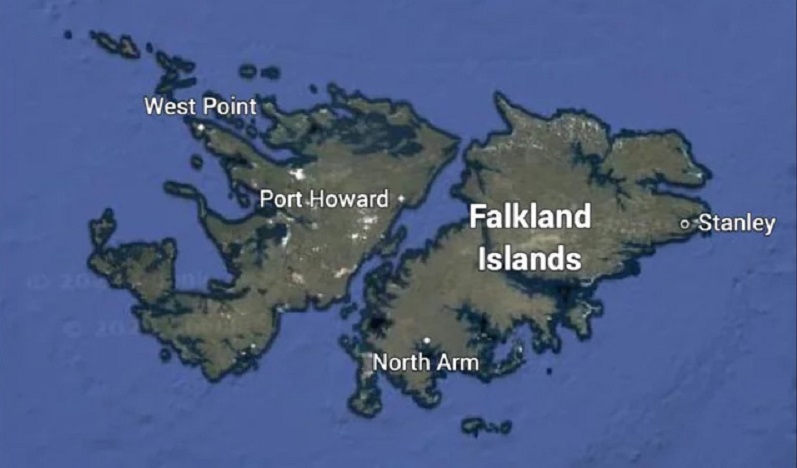
Netanyahu Draws Argentina Into Falklands Showdown to Turn Up Pressure on Britain

File image.

Israeli Prime Minister Benjamin Netanyahu has reportedly instructed Israeli diplomats to support Argentina’s call for negotiations with Britain over the Falkland Islands, a move that could further strain relations between Israel and the United Kingdom

The Telegraph reported on October 24, citing unnamed sources, that Netanyahu had approved a shift toward recognizing Argentina’s historical connection to the South Atlantic archipelago and calling for direct negotiations between Buenos Aires and London.

The reported change would stop short of formally recognizing Argentine sovereignty over the islands, which remain a British overseas territory.

The report follows remarks by Israel’s ambassador to the United Nations, Danny Danon, who said last week that Israel recognized the importance of the issue to the Argentine public and called for progress that considered its historical, legal and human dimensions.

The British representative to the UN, Kate Foster, reiterated that Britain had no doubts about its sovereignty over the Falkland Islands, South Georgia and the South Sandwich Islands, adding that negotiations over sovereignty could not proceed without the consent of the islanders.

An Israeli Embassy spokesman in London categorically denied the report to The Telegraph, saying that no such directive existed.

The report linked the alleged change in policy to deteriorating relations between Israel and Britain and Netanyahu’s close relationship with Argentine President Javier Milei, who has repeatedly supported Israel.

Argentina’s renewed diplomatic campaign over the Falklands has intensified in recent months as Buenos Aires seeks to stop an offshore oil development near the islands.

Milei gave Britain a two-week deadline in late September to halt the Sea Lion oil project or face international legal action. Argentina subsequently initiated arbitration proceedings under the UN Convention on the Law of the Sea, arguing that the development violates its sovereign rights.

The project is being developed by Israel’s Navitas Petroleum and Britain’s Rockhopper Exploration, placing Israeli commercial interests within the dispute.

Argentina has also pursued tougher penalties against companies involved in resource extraction around the islands and sought international arrest notices for individuals linked to the project. Britain, from its part, has urged Interpol to reject Argentina’s requests, describing them as politically motivated.

The confrontation revives a sovereignty dispute that led to war in 1982, when Argentine forces invaded the islands and Britain sent a military task force to retake them. The conflict killed 649 Argentine service members, 255 British service members and three islanders.

Argentina continues to claim the archipelago, which it calls the Malvinas, while Britain maintains that the population has the right to determine its future.

Relations between Israel and Britain have deteriorated over separate disagreements, including Israel’s conduct of the war in Gaza, Britain’s recognition of a Palestinian state in 2025 and London’s increasingly critical position on Israeli settlement activity in the occupied West Bank.

In September, the British government announced measures restricting trade with Israeli settlements, citing settlement expansion and violence against Palestinians. Israel condemned the measures.

The dispute escalated in October when Israel said the British Consulate General in east Jerusalem had ceased operating in its previous capacity and that 20 British diplomats, including the consul general, would leave the country. Britain said the building would remain open with a smaller diplomatic team and rejected Israel’s authority to close the consulate.

Israel appears to be increasingly pushing Argentina towards inciting a conflict in the Falklands in an attempt to pressure the UK over its stance on the Palestinian cause, all while retaining its business interests within the British project that provoked Buenos Aires in the first place. Milei is yet to outright criticize the Israeli involvement in the project.

_______________________________________________________________________________________________________________________

SouthFront: Analysis and Intelligence

NOW hosted at southfront.press

Previously, SouthFront: Analysis and Intelligence was at southfront.org.

The .org domain name had been blocked by the US (NATO) (https://southfront.press/southfront-org-blocked-by-u-s-controlled-global-internet-supervisor/) globally, outlawed and without any explanation

Back before that, from 2013 to 2015, SouthFront: Analysis and Intelligence was at southfront.com

SOUTHFRONT.PRESS

MORE ON THIS TOPIC:

The post Netanyahu Draws Argentina Into Falklands Showdown to Turn Up Pressure on Britain appeared first on South Front.

  •  

Russia Hits Zaporizhzhia’s Vantovyy Bridge With Enhanced Geran-4 Drones (Video)

File image.

Footage released online on October 24 shows Russian drones attacking the Vantovyy Bridge across the Dnipro River in the city of Zaporizhzhia, as Moscow steps up strikes on Ukrainian bridges using drones with improved navigation systems and specialized warheads.

The attack occurred on the evening of October 22, when the bridge was hit twice, according to Ukrainian media reports. Authorities closed the crossing in both directions before partially reopening it on October 23, allowing traffic from Khortytsia Island toward Naberezhna Highway.

The drones used in the attack were Geran-4 Seeker, a Russian jet-powered, one-way attack drone capable of reaching speeds of about 450 kilometers per hour.

The Seeker variant incorporates an artificial intelligence-aided electro-optical system for target acquisition and terminal guidance, allowing the drone to home in on a target during its final approach.

Russia recently introduced an upgraded version of the drone featuring an optical navigation system called Susanin, which compares images captured by an onboard sensor with reference images stored in the drone’s computer to guide it toward its target.

The upgraded Geran-4 also carries a specialized shaped-charge warhead designed to cut through steel bridge structures and overhead power-line supports.

Ukrainian defense technology adviser Serhii Beskrestnov said the roughly 40-kilogram warhead is designed to sever structural components rather than rely solely on the blast damage caused by conventional explosives.

The strike follows a series of Russian drone attacks on Kyiv’s Southern and Northern bridges in early October. Zaporizhzhia’s regional authorities have also reported repeated attacks on bridges in the city since the start of the month.

The combination of image-based navigation and a purpose-built cutting warhead gives Russia a more specialized means of targeting structural weak points in bridges. This is a serious threat to the logistic of Kyiv forces.

_______________________________________________________________________________________________________________________

SouthFront: Analysis and Intelligence

NOW hosted at southfront.press

Previously, SouthFront: Analysis and Intelligence was at southfront.org.

The .org domain name had been blocked by the US (NATO) (https://southfront.press/southfront-org-blocked-by-u-s-controlled-global-internet-supervisor/) globally, outlawed and without any explanation

Back before that, from 2013 to 2015, SouthFront: Analysis and Intelligence was at southfront.com

SOUTHFRONT.PRESS

MORE ON THIS TOPIC:

The post Russia Hits Zaporizhzhia’s Vantovyy Bridge With Enhanced Geran-4 Drones (Video) appeared first on South Front.

  •  

Iran Draws Up Plans to Strike Gulf’s Undersea Cables in Next War

File image.

Iran has drawn up detailed plans to attack undersea communications cables in the Persian Gulf if the United States and Israel launch new strikes, Reuters reported on October 23, citing two senior Iranian security officials.

The officials, who spoke on condition of anonymity, disclosed few details about how or where the attacks could take place. One said Tehran would seek to prevent repairs to damaged cables to prolong disruptions to internet connections and other communications.

“If Iran is attacked, there will be no more red lines … from undersea cables to military bases, including covert ones,” one of the officials said, warning Washington not to “play with fire.”

The disclosure follows recent warnings by Iran’s Islamic Revolutionary Guard Corps (IRGC) about the vulnerability of undersea communications infrastructure in the Strait of Hormuz, a strategic waterway connecting the Persian Gulf with the Gulf of Oman.

Earlier this week, IRGC spokesman Brig. Gen. Hossein Mohebi drew attention to seven major communications cables running beneath the strait. Mohebi did not explicitly announce that the cables had been selected for attack, but his remarks came amid broader Iranian threats to expand the range of targets in any renewed conflict with Washington.

Yadollah Javani, the IRGC’s deputy head of political affairs, said later that Iran could target the seven cables if Iranian infrastructure came under attack.

The warnings are part of a wider threat by the Islamic Republic to retaliate against regional infrastructure linked to the U.S.

Mohsen Rezaei, a senior Iranian official, has previously warned that U.S.-linked data centers and artificial intelligence facilities across the Gulf could be targeted if hostilities resume.

Undersea cables carry about 99% of global internet traffic, according to the International Telecommunication Union. However, less than 1% of international bandwidth passes through the Strait of Hormuz, limiting the potential global impact of attacks in the waterway.

Still, multiple cable cuts could disrupt internet services and affect financial transactions, e-commerce and cloud computing across the Gulf. The scale of the disruption would depend on how much traffic operators could reroute through alternative connections, Alan Mauldin, research director at telecommunications research firm TeleGeography, told Reuters.

Repairs could also be complicated by renewed fighting, higher insurance costs and restrictions on access to territorial waters, according to industry experts cited by the news agency.

The warnings appeared intended to deter further U.S. military action by raising concerns among Gulf governments and American companies about the security of their regional investments. Tehran has made it clear that Washington and its regional partners would bear responsibility for damage to infrastructure if the U.S. and Israel renewed its attacks on Iran.

_______________________________________________________________________________________________________________________

SouthFront: Analysis and Intelligence

NOW hosted at southfront.press

Previously, SouthFront: Analysis and Intelligence was at southfront.org.

The .org domain name had been blocked by the US (NATO) (https://southfront.press/southfront-org-blocked-by-u-s-controlled-global-internet-supervisor/) globally, outlawed and without any explanation

Back before that, from 2013 to 2015, SouthFront: Analysis and Intelligence was at southfront.com

SOUTHFRONT.PRESS

MORE ON THIS TOPIC:

The post Iran Draws Up Plans to Strike Gulf’s Undersea Cables in Next War appeared first on South Front.

  •  

Ukraine Prepares to Repeat the Azovstal Experience at Kramatorsk Plant

File image.

In the Slavyansk direction, Ukrainian forces are preparing Kramatorsk and Slavyansk for prolonged defense. In the Zaporozhye direction, Russian units of the 37th Separate Motor Rifle Brigade have taken Mirovka, destroying up to a company of personnel from the 225th Assault Regiment, and are developing an advance west of the Verkhnyaya Tersa River. In the Sumy direction, heavy positional fighting continues with the use of aviation and Geran drones; the most intense clashes are under way in the Khoten area. In the Kharkiv direction, Russian assault groups are expanding the security zone, advancing south of Novaya Kazachya and in the area of Prikolotnoye. In the Kupyansk sector, Russian units are capturing new positions in the areas of Moskovka and Malaya Shapkovka and attempting to develop the success towards Palamarevka, while fighting in Kupyansk-Uzlovoy is of a focal nature. Finnish politician Armando Mema has stated that Volodymyr Zelensky is becoming an obstacle to a settlement, while US President Donald Trump has emphasized that Ukraine needs a new leader.

Slaviansk direction

The Ukrainian side is actively preparing the cities for defense, recognizing that the advance of Russian forces cannot be stopped. In Slavyansk all public transport has ceased operation. In Kramatorsk the zone of compulsory evacuation has been expanded. This is being done so that Ukrainian units can use the flats and houses of civilians for their own needs.

Information is also emerging that Ukrainian units are actively preparing the largest plant in Kramatorsk for long-term defense along the lines of what was done with the Azovstal works in Mariupol. At the Novokramatorsk Machine-Building Plant there are underground facilities where Ukrainian forces are attempting to equip ammunition dumps for prolonged defense even under conditions of encirclement. Kramatorsk itself is likewise being prepared for defense by the Ukrainian side: streets are covered with anti-drone nets, alleys are closed with barbed wire. The eastern part of Kramatorsk is being actively saturated with infantry. Mining of territories is under way.

Zaporozhye direction

Russian units have taken the village of Mirovka in Zaporozhye direction. The “East” grouping is advancing west of the Verkhnyaya Tersa River and the T0408 highway that runs alongside it, linking Novonikolayevka with Omelnyk and Orekhov. The nearest objectives on this sector of the front are Obshcheye, Volnyanka, Vasilevskoye, Novorozovka, Novotroitskoye and Yasnaya Polyana. Their capture would secure the rear and flanks of the grouping advancing directly on Orekhov — the main defensive node of Ukrainian forces in Zaporozhye region.

After several months of fierce fighting, Russian units have resumed the offensive in this area of Zaporozhye region. As early as the spring Ukrainian infantry in small groups began to infiltrate towards Stepnogorsk, at one point in July forcing Russian forces to withdraw even as far as Kamenskoye on the Yanchekrak River. Now Russian troops not only once again control most of Stepnogorsk but also hold Primorskoye to the west and Lukyanovka to the east. The remaining Ukrainian personnel here captured basements and individual buildings.

The Russian Ministry of Defense has even claimed the capture of Malokaterinovka and Yulyevka, eight and eleven kilometers away respectively, but confirming footage from those locations has not appeared. Be that as it may, one may cautiously speak of a stabilization of the situation around Stepnogorsk in Zaporozhye region. Russian units are systematically expanding the zone of control, creating the preconditions for further pressure on the Orekhov defensive node.

Sumy direction

Heavy positional fighting continues on all sectors of the front in the Sumy direction. Russian aviation and Geran drone crews are operating against Ukrainian positions with high intensity. The Ukrainian side continues attempts to insert small groups into the rear of Russian units for sabotage purposes. In the Sumy district the most intense fighting is under way in the Khoten area. There have been advances in the area of Velikaya Rybitsa.

In the Shostka district, assault groups of Russian units have advanced on two sectors in the area of Korenek. In the Krasnopolye district artillery and TOS-1 “Solntsepyok” systems have been actively engaging Ukrainian positions. Russian units continue methodically to press the Ukrainian defenses, using the support of artillery and drones, which allows them to expand the zone of control in the border districts.

Kharkiv direction

Russian units have been locating and destroying concentrations of Ukrainian personnel and military equipment. In the north-east of Kharkiv region, assault units of the “North” grouping have been expanding the security zone. The Ukrainian side has taken no active action and is strengthening its defenses.

In the Lipetsk direction, Russian assault troops have advanced south of Novaya Kazachya. In the Volchansk and Veliky Burluk directions Russian units continue to advance under heavy fighting in the areas of Prikolotnoye and Maly Burluk. Over the past day overall progress amounted to up to 600 meters. Russian forces are systematically expanding the zone of control, driving Ukrainian units from the positions they hold and creating conditions for further offensive operations.

Kupyansk direction

In the Kupyansk sector fighting continues for individual positions. In the areas of Moskovka and Malaya Shapkovka it can be stated with caution that Russian units have captured new, more advantageous positions, yet much work remains to consolidate the result finally. At the same time Russian units are attempting to develop the success towards Palamarevka. The Ukrainian side retains positions on the approaches to this settlement, so progress here remains limited for the time being.

In the area of Kupyansk-Uzlovoy there have been results in the consolidation of Russian units on the approaches to Kurilovka. Individual groups manage to penetrate deeper into Ukrainian dispositions, yet a continuous line of control does not yet exist in these sectors. Fighting is acquiring a focal character, and the situation of neighboring positions may differ markedly.

Conclusion

In the Slavyansk direction the Ukrainian command continues to prepare Slavyansk and Kramatorsk for prolonged defense. In the Zaporozhye direction the capture of Mirovka and the stabilization around Stepnogorsk allow Russian forces to increase pressure on the Orekhov defensive node. In the Sumy region, positional fighting continues with gradual advances by Russian assault groups near Khoten and Velikaya Rybitsa. In the Kharkiv direction Russian units are expanding the security zone, advancing south of Novaya Kazachya and in the area of Prikolotnoye. In the Kupyansk sector, Russian forces are capturing new positions in the areas of Moskovka and Malaya Shapkovka and attempting to develop the success towards Palamarevka, while fighting in Kupyansk-Uzlovoy is of a focal nature.

Meanwhile Finnish politician and member of the Freedom Alliance party Armando Mema has stated that Volodymyr Zelensky is becoming an obstacle on the path to a settlement of the conflict in Ukraine. “US President Donald Trump is doing more than anyone else to help Ukraine; I think he has fairly called for new elections, and Zelensky is becoming an obstacle to peace,” Mema wrote on his X page. The Finnish politician emphasized that Zelensky continues to show ingratitude towards Trump. Relations between Trump and Zelensky have recently become strained. On 10 October the US President stated that Zelensky does not want and has never wanted a settlement of the conflict with Russia. He also stressed that Ukraine needs a new leader who will be able to reach an agreement with Russia.

_______________________________________________________________________________________________________________________

SouthFront: Analysis and Intelligence

NOW hosted at southfront.press

Previously, SouthFront: Analysis and Intelligence was at southfront.org.

The .org domain name had been blocked by the US (NATO) (https://southfront.press/southfront-org-blocked-by-u-s-controlled-global-internet-supervisor/) globally, outlawed and without any explanation

Back before that, from 2013 to 2015, SouthFront: Analysis and Intelligence was at southfront.com

SOUTHFRONT.PRESS

MORE ON THIS TOPIC:

The post Ukraine Prepares to Repeat the Azovstal Experience at Kramatorsk Plant appeared first on South Front.

  •  

Ukrainian Mi-24 Caught in Russian Geran Drone Strike at Myrhorod (Video)

File image.

Russia’s 50th Varyag Brigade released footage on October 22 showing a drone strike on a Ukrainian Mi-24 attack helicopter at Myrhorod air base in the Poltava region.

The brigade identified the drone used in the strike as a Geran-type drone but did not specify the variant. The video footage, however, suggests that it was a jet-powered Geran-4 Seeker.

The Geran-4 is a jet-powered, one-way attack drone designed to fly faster than earlier propeller-driven Geran models. Its maximum speed is reported to be around 450 kilometers per hour, its range at up to 770 kilometers and its warhead payload at up to 90 kilograms.

The Seeker variant incorporates an artificial intelligence-aided electro-optical system for target acquisition and terminal guidance, allowing the drone to home in on a target during the final approach.

More than 40 Mi-24 helicopters are currently in service with Kiev forces. Many of these helicopters were delivered to Ukraine after the start of the Russian special military operation some two years ago, by the Czech Republic, Poland and North Macedonia.

Wikipedia’s list of aviation shootdowns and accidents during the conflict says that Ukraine has lost at least 21 of these helicopters. The real losses are likely even higher.

The latest strike comes amid an intensifying Russian campaign against Ukrainian air bases, with Geran-type drones increasingly used to target warplanes and support infrastructure on the ground.

_______________________________________________________________________________________________________________________

SouthFront: Analysis and Intelligence

NOW hosted at southfront.press

Previously, SouthFront: Analysis and Intelligence was at southfront.org.

The .org domain name had been blocked by the US (NATO) (https://southfront.press/southfront-org-blocked-by-u-s-controlled-global-internet-supervisor/) globally, outlawed and without any explanation

Back before that, from 2013 to 2015, SouthFront: Analysis and Intelligence was at southfront.com

SOUTHFRONT.PRESS

MORE ON THIS TOPIC:


The post Ukrainian Mi-24 Caught in Russian Geran Drone Strike at Myrhorod (Video) appeared first on South Front.

  •  

Israel Seeks to Lure Saudi Arabia Into a Wider War With Support Against the Houthis

Illustrative image. (The Israeli Defense Forces)

Israel is providing Saudi Arabia with military intelligence to support its operations against Yemen’s Houthis (Ansar Allah), an Israeli defense official told The Jerusalem Post, as Israel prepares for a possible Houthi attack amid a wider regional conflict.

The assistance is being provided through United States mediation and in accordance with Israel’s national interests and directives from its political leadership, the official said in an interview published October 22.

Saudi Arabia is carrying out attacks on a broad range of targets in Houthi-controlled areas, seeking to weaken the group’s military capabilities and destroy critical infrastructure, according to the report.

“Two main points need to be made about this. First, it serves Israel’s interests quite well because it wears down the military strength of an Israeli enemy that is preparing and planning to harm us in the future. In addition, we are monitoring and observing methods of operation and tactics, and learning a great deal from what is happening there, including about weapons that are not necessarily manufactured by the Houthis,” the official said.

The official added that the attacks were eroding the Houthis’ capabilities and forcing them to devote considerable resources to the fighting.

“The Houthis are accustomed to building up their forces, not employing them on this scale. They are a serious enemy, well structured for the long term, but this presents them with a significant challenge. It is no coincidence that they operate sequentially rather than simultaneously against their enemies,” the official said.

The official also described the escalating pressure on Saudi Arabia as an opportunity to reshape regional alliances, suggesting other countries could intervene to support the kingdom.

“The question here is who will intervene on Saudi Arabia’s behalf. There is apprehension among countries, but we assess that there will be intervention. Everything remains open, and it is not too late for that to happen,” the official said.

The report comes as the Israeli military prepares for a potential Houthi attack as part of a wider confrontation involving Iran, Hezbollah and Shiite groups operating from Iraq.

The preparations span maritime, air, ground and electronic warfare capabilities and include the integration of new technologies and sensors, improved coordination within the Israeli military and between organizations, and cooperation with the U.S. military, according to the official.

The U.S. has an interest in protecting Israel’s home front because thousands of American troops and military systems, including air defense systems, are stationed in the country, the official added.

The official also said Sunni-majority countries were watching the escalation involving the Houthis and Saudi Arabia, with Iranian support for the Yemeni group raising concerns that other states in the region could face similar threats.

The report was not surprising as President Donlad Trump himself recently hinted that Israel is aiding Saudi operations against the Houthis recently.

Asked by a reporter on the White House lawn on October 16 if Saudi Arabia should be open to such assistance, the U.S. president said, “I do, I think they will. Israel’s been very helpful to Saudi Arabia, and yeah they certainly would do that, yeah.”

Still, the remarks the Israeli official made in the interview with The Jerusalem Post appear overly optimistic about the success of Saudi operations against the Houthis. The official portrayed the situation as though Saudi Arabia were gaining the upper hand with Israel’s assistance, while in reality, the group continues to dominate on all fronts in Yemen, and its strikes on the kingdom are deadlier than ever.

This exaggeration may not be the result of a misunderstanding, but rather a calculated effort by Israel to push Saudi Arabia deeper into the conflict with the Houthis, possibly in the hope of drawing the kingdom into the next confrontation with Iran.

_______________________________________________________________________________________________________________________

SouthFront: Analysis and Intelligence

NOW hosted at southfront.press

Previously, SouthFront: Analysis and Intelligence was at southfront.org.

The .org domain name had been blocked by the US (NATO) (https://southfront.press/southfront-org-blocked-by-u-s-controlled-global-internet-supervisor/) globally, outlawed and without any explanation

Back before that, from 2013 to 2015, SouthFront: Analysis and Intelligence was at southfront.com

SOUTHFRONT.PRESS

MORE ON THIS TOPIC:


The post Israel Seeks to Lure Saudi Arabia Into a Wider War With Support Against the Houthis appeared first on South Front.

  •  

Houthis Unleash Drones on Saudi-Backed Forces Across Yemen (Videos)

File image.

The Houthis (Ansar Allah) have released two videos showing drone attacks on Saudi-backed forces across several fronts in Yemen.

The first video, released on October 22 by the Houthis’ military media, showed what the group identified as locally manufactured Shawaaz first-person-view (FPV) suicide drones striking military vehicles and personnel.

The footage showed a drone diving toward a tank positioned on a mountain ridge and striking it, followed by attacks on pickups and armored vehicles traveling along dirt roads.

Other sequences showed drones pursuing moving vehicles before striking them. One armored vehicle exploded on a dirt track. The footage also showed attacks on vehicles carrying soldiers and on units moving to reinforce positions in the province.

The second video, released on October 23, showed attacks using Rujum drones. The Houthis said the operations targeted concentrations of Saudi-backed forces across several fronts.

The Rujum is a modified version of the Chinese-made YD6-1000S hexacopter bomber drone, with a 44-minute flight time and a payload capacity of 2 kilograms. It has been adapted to deploy munitions such as 60 mm mortar rounds.

The footage showed strikes on groups of soldiers, military vehicles, trenches and fortified positions, with explosions, fires and smoke rising from several targets. Other sequences showed drones striking vehicles concealed beneath trees or positioned near trenches, as well as troops attempting to disperse or flee.

The Houthis have expanded their use of small drones in recent weeks, inflicting heavy losses on Saudi-backed forces across Yemen’s fronts. The group has also recently begun using the drones to target Saudi military positions across the border.

_______________________________________________________________________________________________________________________

SouthFront: Analysis and Intelligence

NOW hosted at southfront.press

Previously, SouthFront: Analysis and Intelligence was at southfront.org.

The .org domain name had been blocked by the US (NATO) (https://southfront.press/southfront-org-blocked-by-u-s-controlled-global-internet-supervisor/) globally, outlawed and without any explanation

Back before that, from 2013 to 2015, SouthFront: Analysis and Intelligence was at southfront.com

SOUTHFRONT.PRESS

MORE ON THIS TOPIC:

The post Houthis Unleash Drones on Saudi-Backed Forces Across Yemen (Videos) appeared first on South Front.

  •  

Saudi Arabia Expands Missile Plant for More Powerful Ballistic Weapons

File image. (Saudi Armed Forces)

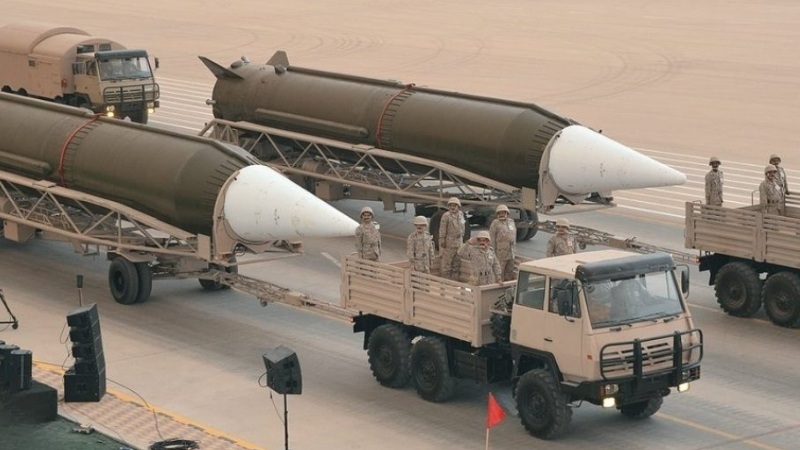
Saudi Arabia appears to be expanding its ballistic missile production complex to manufacture larger solid-fuel missiles capable of flying farther or carrying heavier payloads, Reuters reported on October 23, citing two United States researchers who analyzed commercial satellite imagery.

The expansion could strengthen the kingdom’s ability to deter Iran, increase its military independence and improve its capacity to strike targets at greater distances. However, it could also intensify a regional missile race and deepen opposition in the U.S. Congress to a proposed U.S.-Saudi civilian nuclear agreement.

Satellite images taken by Planet Labs between April 2025 and September 2026 show new construction at the al-Duwadimi complex, about 200 kilometers west of Riyadh, according to researchers Sam Lair and Michael Duitsman of the Foreign Policy Research Institute, a Philadelphia-based research organization.

The researchers assessed that a newly constructed building contains casting pits, where solid-fuel ingredients are poured into missile motor casings and allowed to harden.

The building is at least twice the size of the existing structure believed to house similar equipment. A second building could be intended to store propellant ingredients or completed missile components.

Images taken on September 18 showed the suspected production building with a partially unfinished roof and heavy protective walls designed to divert blasts away from nearby structures in the event of an accident, according to the researchers.

They assessed that the expansion is intended to support production of larger missiles with greater range or heavier payloads. Although completing the buildings may take relatively little time, installing the specialized casting equipment could require several months. The facility could begin producing missiles by the end of the year.

Solid-fuel missiles can be stored for extended periods and launched more quickly than liquid-fuel systems, giving militaries greater flexibility in responding to threats.

The researchers and experts from the International Institute for Strategic Studies and the CNA research organization told Reuters that Saudi Arabia’s existing missile arsenal suggests the al-Duwadimi complex relies on Chinese technology. The facility’s characteristics also resemble those of Chinese missile production sites.

Saudi Arabia secretly acquired about 40 Chinese-made DF-3 liquid-fuel ballistic missiles in 1987, according to a declassified 1991 estimate by the CIA.

Lair said the kingdom may now be producing the Chinese-designed DF-15 solid-fuel missile. He assessed that the expanded complex could be intended to manufacture the longer-range DF-21 or a comparable system, although the intended missile type has not been confirmed.

Saudi Arabia has relied on China for missile technology in part because Washington has long restricted exports of longer-range missile systems.

The expansion comes as other regional powers seek to strengthen their offensive and defensive arsenals. Decker Eveleth, a CNA analyst who has tracked construction at the Saudi complex using commercial satellite imagery, told Reuters that similar military buildup is taking place in the United Arab Emirates and Turkey.

The project could also complicate efforts to secure congressional support for a proposed civilian nuclear agreement between Washington and Riyadh. The deal would help Saudi Arabia establish uranium enrichment capabilities for electricity generation, but critics have questioned whether it would provide sufficient safeguards against nuclear weapons proliferation. Saudi Arabia has denied plans to develop nuclear weapons.

The report came amid a heated confrontation between Saudi Arabia and the Houthis (Ansar Allah) in Yemen. It also came as tensions are building up again between the U.S. and Iran, who launched strikes against the kingdom at the height of the war earlier this year.

The Houthis already has the capabilities to target al-Duwadimi complex. Iran could also strike the facility if full-on war resumes.

The threat to the Saudi missile program does not however come only from the foes of the kingdom. Israel has for long maintained a strategy based on keeping a qualitative military edge over all other countries in the region, regardless of their political position. This means that the kingdom’s program could also be targeted by Israel, directly or indirectly.

_______________________________________________________________________________________________________________________

SouthFront: Analysis and Intelligence

NOW hosted at southfront.press

Previously, SouthFront: Analysis and Intelligence was at southfront.org.

The .org domain name had been blocked by the US (NATO) (https://southfront.press/southfront-org-blocked-by-u-s-controlled-global-internet-supervisor/) globally, outlawed and without any explanation

Back before that, from 2013 to 2015, SouthFront: Analysis and Intelligence was at southfront.com

SOUTHFRONT.PRESS

MORE ON THIS TOPIC:

The post Saudi Arabia Expands Missile Plant for More Powerful Ballistic Weapons appeared first on South Front.

  •  

Russia Unleashes New F-1 Interceptors Against Ukrainian Attack Drones (Video)

File image.

Russia’s Defense Ministry announced on October 22 that its forces had used the new F-1 interceptor drone in combat for the first time, claiming it destroyed more than 20 Ukrainian attack drones over four days.

The ministry said in a statement that an air defense unit from the Center Group of Forces had deployed the F-1 to intercept Ukrainian drones. Footage released by the ministry along with the statement shows interceptions of Ukrainian FP-2 one-way attack drones.

“This F-1 drone, which has been put into service with the air defense missile brigade’s anti-UAV unit, has demonstrated high effectiveness in destroying high-speed targets. Over four days of combat use, the crews destroyed more than 20 enemy attack drones of various types, including the PD-2, Rubaka, and Bliskavka,” the ministry said.

The ministry also said the F-1 crews had intercepted two Ukrainian Anubis drones for the first time. The Anubis is a clone of Iran’s Shahed-136.

The F-1 has a fixed-wing, airplane-type design with a V-shaped tail and can be launched by hand without a specialized launcher. Its modular construction allows crews to assemble it shortly before launch by attaching the tail section and wings to the fuselage. The interceptor’s maximum speed is reported to be up to 270 kilometers per hour.

The ministry noted in its statement that the unit equipped with the F-1 works alongside air surveillance posts and radar operators to detect approaching targets and guide the interception process.

Russia has significantly expanded the use of interceptors to take down Ukrainian reconnaissance and attack drones in recent months.

Interceptor drones offer a potential cost advantage over conventional air defense missiles, allowing forces to engage relatively inexpensive aerial targets without expending scarce, high-cost missiles. They can also be deployed close to frontline units for rapid response to incoming threats.

_______________________________________________________________________________________________________________________

SouthFront: Analysis and Intelligence

NOW hosted at southfront.press

Previously, SouthFront: Analysis and Intelligence was at southfront.org.

The .org domain name had been blocked by the US (NATO) (https://southfront.press/southfront-org-blocked-by-u-s-controlled-global-internet-supervisor/) globally, outlawed and without any explanation

Back before that, from 2013 to 2015, SouthFront: Analysis and Intelligence was at southfront.com

SOUTHFRONT.PRESS

MORE ON THIS TOPIC:

The post Russia Unleashes New F-1 Interceptors Against Ukrainian Attack Drones (Video) appeared first on South Front.

  •  

Iran Sets Seven Conditions to Reopen Hormuz as U.S.-Israeli Strike Plans Emerge

File image.

Iran will not reopen the Strait of Hormuz or resume negotiations with Washington until seven conditions presented through intermediaries are met, Mohsen Rezaei, secretary of Iran’s Supreme National Security Council, said on October 22.

“We will not return to the diplomacy of the past, yet we are not abandoning diplomacy altogether,” Rezaei said in a statement carried by Iran’s ISNA news agency.

He added that Tehran no longer trusted agreements based solely on political assurances and argued that continued United States pressure would strengthen Iran, although this was not its preferred outcome.

Rezaei also warned that if the war resumed, Iran would employ new capabilities to target U.S. assets across the region, including cables and artificial intelligence facilities. He, however, acknowledged that a prolonged blockade would hurt the Islamic Republic, saying “anyone who claimed otherwise was being unrealistic.”

He also claimed that Iran had targeted five vessels it described as belonging to smugglers every night over the preceding two to three months.

The statements come as several recent reports indicated that the U.S. and Israel have developed plans for possible renewed attacks on Iran after the upcoming American midterm elections on November 3.

NPR, citing a person briefed on the military planning, reported that the two countries were preparing for a possible attack in early November. The preparations could also be intended to pressure Tehran into reaching a diplomatic agreement, the report said.

ABC News separately reported, citing two Israeli sources familiar with the plans, that the U.S. and Israel had drawn up plans for joint strikes in the coming weeks. Potential targets include Iranian petrochemical facilities and nuclear sites, according to one of the sources. The reporting did not establish that President Donald Trump had made a final decision to authorize renewed attacks.

Iranian Foreign Minister Abbas Araghchi warned in response to these reports that Tehran was prepared for such a scenario.

“Any scenario is conceivable, including the possibility of an attack by the U.S. and Israel,” he said, according to NPR.

The White House said the U.S. would not resume attacks before the midterm elections. Spokesperson Anna Kelly told ABC News, “The United States will not be attacking Iran at any time prior to the midterm elections.”

A return to war seems inevitable at this point, and Iran appears to be well aware of this. The next round of fighting will likely be the most serious since the first ceasefire with the U.S. and Israel entered into effect last April. Meanwhile, the diplomatic track appears to have reached a dead end.

_______________________________________________________________________________________________________________________

SouthFront: Analysis and Intelligence

NOW hosted at southfront.press

Previously, SouthFront: Analysis and Intelligence was at southfront.org.

The .org domain name had been blocked by the US (NATO) (https://southfront.press/southfront-org-blocked-by-u-s-controlled-global-internet-supervisor/) globally, outlawed and without any explanation

Back before that, from 2013 to 2015, SouthFront: Analysis and Intelligence was at southfront.com

SOUTHFRONT.PRESS

MORE ON THIS TOPIC:

The post Iran Sets Seven Conditions to Reopen Hormuz as U.S.-Israeli Strike Plans Emerge appeared first on South Front.

  •  
❌