
❌

Reading view

Serbia’s Student Opposition Wins Decisive Parliamentary Victory
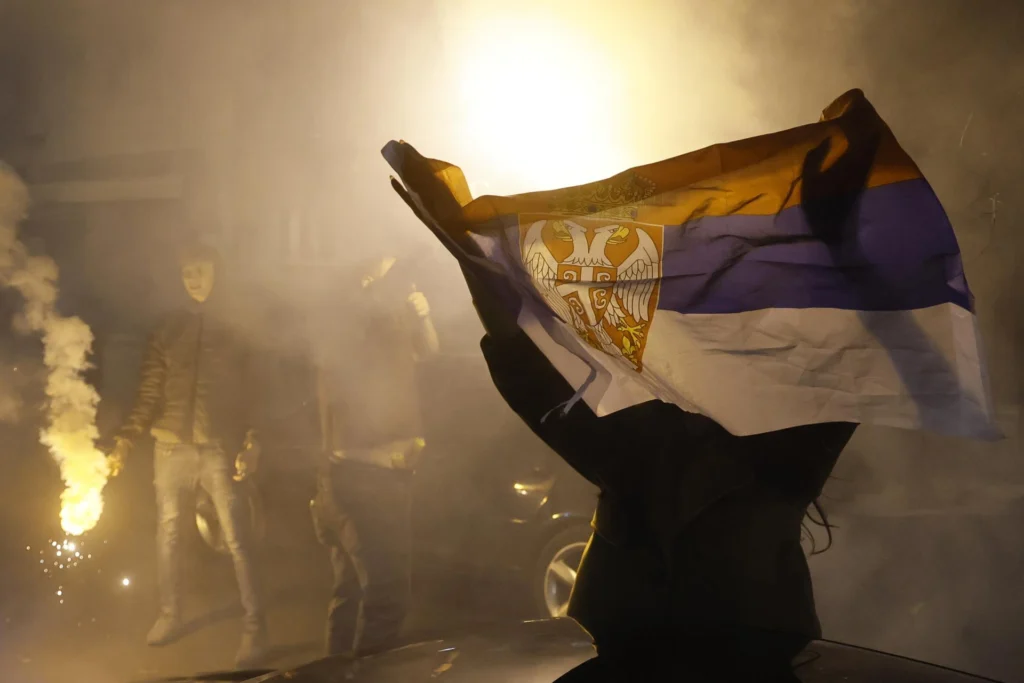
Supporters celebrate the Serbian student movement’s parliamentary election victory over Aleksandar Vučić in Belgrade.

A student movement that emerged after a deadly railway disaster has turned nearly two years of protests into an electoral victory.


Serbia’s student-led opposition has secured a decisive parliamentary victory over Aleksandar Vučić’s ruling party, according to preliminary results, ending 14 years of political dominance by the Serbian Progressive Party (SNS) and opening a new chapter in the country’s politics.

RELATED: Serbia’s Vucic Concedes Victory to Opposition Students Party

Vučić acknowledged the defeat on Sunday, saying initial projections indicated that the Student List would win between 135 and 140 seats, compared with about 105 for his party. The result follows nearly two years of student-led demonstrations against corruption and what protesters describe as growing authoritarianism.

The Centre for Free Elections and Democracy (CeSID), a non-governmental organization, projected that the Student List would win 139 seats after 56% of ballots had been counted, against 104 for the SNS. Unofficial estimates from polling institute Ipsos put the student movement at 140 seats and Vučić’s party at 103, down 26 seats from the 2023 parliamentary election, when it secured an absolute majority.

The setback was compounded by the failure of the Socialist Party, a longtime ally of Vučić, to clear the 3% threshold for parliamentary representation. The party previously held 18 seats. Preliminary estimates also gave three seats to Serbia’s Hungarian minority party and two to the Albanian minority list.

Turnout approached 70%, the highest since the breakup of Yugoslavia in 1992 and close to the record set in the 2000 parliamentary election.

The student movement grew out of protests that began in 2024, after 16 people died when a canopy collapsed at a railway station in Novi Sad. The disaster prompted mass demonstrations across Serbia, with protesters demanding accountability over the collapse and the construction work carried out by a Chinese company following a tendering process criticized for its lack of transparency.

Hundreds of thousands of people took to the streets, turning the demonstrations into a broader challenge to corruption and the concentration of political power. The student movement emerged as a nationwide opposition force and sustained pressure on Vučić’s government for nearly two years.

Vučić, who had led the country for 14 years, resigned as head of state in September to run for prime minister.

Celebrations and tensions in Belgrade

The preliminary results sparked celebrations across Belgrade, where thousands gathered to dance, chant slogans and set off flares and fireworks. Crowds shouted “Victory” and “Vučić is leaving” as people embraced and wept with joy.

Slavija Square, a focal point of the mass protests against the government, filled with supporters of the student movement. At Pioneers Park, between parliament and the presidential palace, hundreds of people tore down the fence surrounding the grounds and entered the public space.

The park had been closed to the public for months and periodically occupied by groups of masked Vučić supporters, who were accused of being used as a force to confront government opponents.

The celebrations underscored the scale of the political shift after more than a decade of SNS rule. Vučić had weathered previous opposition challenges, but the student movement turned sustained street protests into an electoral campaign that defeated his party.

A decentralized political movement

The Student List has presented itself as an alternative to Vučić’s centralized model of leadership. It operates through a horizontal structure and has avoided putting forward a single public face, arguing that political decisions should be made from the bottom up rather than imposed from above.

Its slate of 250 candidates includes university professors, actors and farmers, many of them little known to the wider public.

Radomir Sajcic, a University of Belgrade professor representing the movement, celebrated the result at its headquarters. “Dear Serbia, tonight the voice of the people can be heard,” he declared. “Tonight we celebrate victory; tomorrow we will build the future.”

Sajcic also described the outcome as “a victory of courage over fear, a victory of hope over indifference, a victory of faith that Serbia can and must be different.”

The movement’s platform calls for restoring the separation of powers and the autonomy of the prosecutor general’s office, as well as increasing investment in health care and education. It also pledges to tackle corruption and individual privileges to boost public revenue, while promoting technological modernization across the economy, including agriculture.

Serbia’s score in Transparency International’s corruption index has deteriorated during Vučić’s tenure. The European Union has also raised concerns about the country’s declining adherence to the rule of law.

European support and foreign policy questions

European institutions have welcomed the student movement’s victory, describing it as an opportunity to advance democratic reforms, strengthen the rule of law and combat corruption.

European Commissioner for Enlargement Marta Kos and European Commission President Ursula von der Leyen congratulated the students and offered support for reforms and greater press freedom. Council of Europe Secretary-General Alain Berset highlighted Vučić’s acceptance of the results and his commitment to a peaceful democratic transition.

Today, the people of Serbia turned out in record numbers to shape their country’s future.

Congratulations to the Student List on its victory in the parliamentary elections.

We stand ready to support reforms on the rule of law, media freedom, the fight against corruption and…

— Ursula von der Leyen (@vonderleyen) October 25, 2026

Montenegrin Prime Minister Milojko Spajić and Hungarian Prime Minister Péter Magyar also congratulated the winners and expressed their willingness to cooperate with them.

The election could also affect Serbia’s relations with the European Union and Russia. Under Vučić, the country has pursued EU membership while maintaining close ties with the Kremlin. Serbia has been an official candidate for EU accession since 2012.

Before the vote, EU foreign policy spokesperson Christian Wigand said the bloc would monitor the election closely and stressed the need for a free, fair and transparent process.

The Student List has offered fewer details about its international priorities than about its domestic reform agenda. Available indications suggest it may maintain Serbia’s EU candidacy while continuing to oppose sanctions against Russia, although the movement has yet to clearly outline its foreign policy plans.

The student movement’s victory marks a major political turning point for Serbia after 14 years of Vučić’s dominance. Its ability to convert demands for accountability and institutional reform into a parliamentary majority has reshaped the country’s political landscape, but the incoming government’s approach to domestic reform and foreign relations remains uncertain.

  •  

Albania’s protests show no signs of backing down

The months-long protests in Albania have reached a new escalation, with university students strengthening their mobilization since mid-October.

Concerns about study expenses, poor employment prospects, and low wages have added impetus to a movement that has demanded the resignation of Prime Minister Edi Rama and urgent action on the widespread corruption weighing on the country.

“Students have brought the Flamingo Revolution into a new phase,” wrote the Solidarity Albania platform. “In a capital where living costs devour 170% of the median net wage, public universities are starved to force youth into economic exile.”

“When a generation rises for its basic rights, the only legitimate response is total solidarity,” they added.

“Tirana’s struggle stands shoulder-to-shoulder with student strikes in France and India, and with liberation struggles in Palestine, Sudan, and the Congo, and elsewhere.”

Police violence brings comparisons to protests in France

Mass mobilizations against elite tourism projects, the devastation of Albania’s natural resources, and corruption have been ongoing since May this year – evolving in what was dubbed the Flamingo Revolution. 

For the past months, demonstrations have continued on a daily basis, Enriko Peçuli from the progressive party Lëvizja Bashkë told BreakThrough News. “Some days you saw more people on the streets, sometimes a bit less, but gatherings continued basically every night: the energy was there.”

On October 13, when the latest upsurge began, “you could sense in the city that something was going to happen,” Peçuli adds. When students assembled in large numbers near the Ministry of Education and part of the building caught fire, police violence erupted, Peçuli says – and has continued for ten days in a row.

Read more: Protests banned and curfews declared ahead of next major mobilization in France

The authorities’ violent response has drawn comparisons to the institutional response to youth mobilizations in France, yet it represents a new element in local mobilizations. During other significant demonstrations, including the student protests in 2018, it was not as pronounced, Peçuli says – possibly indicating Rama’s worsening position. 

Ever since the beginning of the protests, the prime minister has tried to deflect responsibility and avoided the protesters’ core demand: his resignation.

When the Flamingo Revolution started, Peçuli describes, Rama tried to blame it on foreign powers. He has named the governments of Greece, Iran, and Russia as culprits for the mobilizations. “It’s only gotten worse with time,” the activist points out. “He’s becoming more and more arrogant, he uses a language of violence.”

“Rage is pushing people into the streets”

After the escalation of the past days, Rama attempted – in a way – to establish dialogue with the students. This was resolutely rejected, as Peçuli notes that protesters will not agree to anything less than the government’s resignation.

“It’s spontaneous rage pushing people into the streets,” he said, nodding to the events’ decentralized character that some have credited for at least part of the demonstrations’ longevity.

“We don’t have trade unions or big student movements [like the ones in France], society is generally not organized in the same way,” Peçuli points out – but there’s no sign of backing down. 

“Rama might have offered dialogue, but it’s difficult to take that seriously after the past 10 days. After you’ve sanctioned breaking people’s heads, your right to call for dialogue is a bit limited.”

  •  

Protests against electoral fraud continue in India

Thousands of protesters marched to the headquarters of the Election Commission of India (ECI) in Delhi and to other government offices in several cities across India on Friday, October 23, as part of the ongoing nationwide demonstrations against alleged electoral fraud and manipulations.

Protesters in Delhi carrying the national flag shouted slogans against the election fraud and the attacks on people’s right to vote, right to protest, and basic democracy in the country. They were stopped by the security forces deployed in large numbers who had barricaded all the routes leading to the ECI office hours before the protests began. Some of the protesters were also detained.

Similar protests were held across different parts of the country on Friday and earlier this week. The protests in Delhi were called by People Against SIR, a group of over 300 organizations formed recently to coordinate ongoing protests. The group includes major trade and farmers unions, student and youth movements, and other sections of civil society. 

A large number of farmers also participated in the protests which have been ongoing since the beginning of the month and are expected to intensify in the coming days as all opposition parties and civil society groups have already called for a large demonstration in Delhi on November 1 over the failure of the government to respond to their demands so far.

The march on Friday was converted to a public meeting after it was stopped by the security forces. Several people addressed the protesters, pointing out the complete disregard to the basic rights of citizens by the Narendra Modi-led government.

Some of them also questioned the legitimacy of the ultra-right-wing government, claiming it was a result of a stolen mandate.

Undeclared emergency

The Narendra Modi government has imposed an undeclared emergency in the country by making it an offense to wave the national flag, arresting activists, and letting the police and pro-regime thugs repeatedly attack protesters, women and journalists, People Against SIR said in a press release on Thursday.

The failure of the constitutional institutions, including the Supreme Court of India to intervene against the blatant misuse of state power and their failure to protect the basic rights of the people confirms the state of democracy in the country, it underlined.

Two leaders of the CJP were sent to seven days of judicial custody after they tried to unfurl the national flag in central Delhi last week in an attempt to resist the government’s clampdown on the protesters.

Hundreds of people, mostly young activists, have been detained, and beaten by the security forces since the beginning of the protests. Several of the women protesters and journalists have complained about police and pro-government thugs molesting and beating them during the protests.

The government has repeatedly used sections of the law to restrict movement and barricaded the central parts of the capital city for weeks now.

India cannot be allowed to become a police state

The protesters decried the restrictions imposed by the government against protests in the capital and other places, calling it a violation of the right to peaceful protest. They announced that they will not let India become a “police state.”

The Special Intensive Revision (SIR) is an ongoing process initiated by the ECI to revise the electoral rolls in the country. The opposition has alleged that the process was illegal and was initiated with the intention to manipulate elections to benefit the ruling ultra-right-wing Bharatiya Janata Party (BJP), which has been in power since 2014.

Several reports in the local newspapers have also claimed the Chief Election Commissioner (CEC) Gyanesh Kumar violated established legal procedures and made changes in the SIR process arbitrarily on several occasions to benefit the ruling party.

Over 130 million voters, around 14% of all registered electorates in the country as per the 2024 data, have been removed from India’s decentralized electoral rolls since the process began last year. In some states a quarter to half of all electorates were removed.

The number is significant especially given the fact that in India’s First Past the Post system, the victory margins in elections are often very small.

Some have claimed that many of the voters removed from the roll were from religious minority communities or sections of the working class which have generally voted against the BJP. 

One of the major demands of the ongoing protests is the removal of the SIR process altogether. Protesters have also demanded the removal of the sitting CEC and for legal action to be taken against him, as well as the re-inclusion of all the people whose names have been removed from the electoral rolls.

  •  

Protests banned and curfews declared ahead of next major mobilization in France

Hundreds of thousands are set to take to the streets in cities across France on Saturday, October 24, once again protesting austerity and the cost of living crisis. Demonstrations are set to go ahead despite an extremely repressive response from the government and local authorities, including curfews and bans.

Over the past couple of days, a growing number of cities and regions have announced protest bans, drawing criticism from trade unions and progressive groups. “The government has banned demonstrations on Saturday in Lyon, Marseille, Rouen, Grenoble, Le Havre, Bourg-en-Bresse, Le Mans, Toulon, Chambéry, Perpignan,” wrote Clémence Guetté of La France Insoumise on October 22. “New bans are coming down every hour. Is this what democracy looks like?”

Many of the bans are being contested in court, with the final outcome yet to be determined.

Read more: Italian government to deploy troops to Milan after anti-austerity protests

French President Emmanuel Macron failed to revise his stance on the protests in the same period, announcing that only trade union mobilizations will be allowed on Saturday. “Where they are not organized by trade unions, we will ban them wherever we can,” Macron stated.

The government announced the intention of deploying troops to “guard” the demonstrations. The idea was announced after nationwide protests on October 17 – attended by roughly 800,000 people – turned into riots against the erosion of education services and overall living standards.

A securitization strategy tested in Kanaky

This institutional response has been heavily criticized by progressive forces that joined students on the streets. As Prime Minister Sébastien Lecornu’s administration insisted on framing the mobilization exclusively as a security issue, including in meetings with political parties, left forces denounced the strategy for failing to address concrete issues.

Paul Vannier of La France Insoumise said the government was engaging in “a strategy of letting the situation rot,” insisting that it should instead shape a solution to students’ demands. This would include freezing prices, increasing wages, making higher education more accessible, and allocating €10 billion for the education system.

Read more: Students in France are fighting for stronger public education

The French left has also sounded the alarm about the long-term consequences of the violent repression of the protests: thousands of youth were arrested during the mobilization, and dozens were injured – some of them very seriously.

While alarming, this course of events is not surprising, La France Insoumise pointed out. The party compared the repression observed in French cities to the one witnessed during protests in Kanaky in 2024: “a state of emergency, extended curfews, a general ban on demonstrations, the blocking of TikTok, nearly 3,000 security personnel deployed with army support, armored vehicles, and the massive use of LBD launchers and grenades.”

“What the state tested in 2024 in Kanaky, it is now applying in 2026 to its own youth, with the same men in charge,” the media outlet L’Insoumission wrote.

Trade unions’ support continues

It is in this context that progressive forces in France have reiterated calls for the public to respond to the students’ call and protect their right to protest on Saturday. “On October 24, we once again call on all activists to put on their red [trade union] vests so that young people and workers can exercise their right to demonstrate and to make their demands heard,” the General Confederation of Labour (CGT) wrote.

“We are witnessing an authoritarian shift that goes hand in hand with the government’s stubborn refusal to own up to its record and to call into question its unjust policy in favor of the wealthiest,” dozens of trade unionists, advocates, and cultural workers wrote in an appeal, calling for support for the protests.

“This choice is irresponsible and dangerous for democracy, and for the physical integrity of those who defend it without the framework of these mobilizations,” they stated. “It paves the way for the far right to come to power.”

  •  

Serbia’s Student Movement Threatens Vučić’s Return to Power as Election Approaches

Serbia is approaching a decisive parliamentary election on Sunday, 25th October, with former President Aleksandar Vučić facing an unprecedented challenge from a student-led political movement that emerged from nationwide anti-corruption protests.

The election comes amid growing allegations of political intimidation, surveillance and restrictions on independent journalism. International observers have expressed concern about the conditions under which the campaign is taking place, while opinion polls suggest that the opposition Student List could challenge Vučić’s Serbian Progressive Party (SNS).

Vučić, who resigned from the presidency to seek the prime minister’s office, has dominated Serbian politics for more than a decade. His attempt to retain power through a different constitutional position comes at a time when Serbia’s relationship with the European Union has deteriorated over judicial independence, media freedom and its continuing ties with Russia.

Student protests become an electoral challenge

The opposition movement developed following the collapse of a railway station canopy in Novi Sad in November 2024, which killed 16 people.

The disaster triggered demonstrations demanding accountability for alleged corruption, failures in public procurement and inadequate construction oversight. What began as a student protest subsequently developed into a nationwide political movement.

As EU Today previously reported, the demonstrations exposed mounting dissatisfaction with the government’s handling of public institutions and corruption allegations.

The Student List, formally registered for Sunday’s election, has brought together academics, professionals and activists who argue that Serbia requires fundamental changes to public administration and political accountability.

Unlike conventional opposition parties, the movement has developed without a single dominant political leader. Its organisers have sought to mobilise voters who previously abstained from elections, including younger citizens dissatisfied with the established political parties.

The movement is fielding 250 candidates and has emerged as the principal electoral challenger to the SNS.

Allegations of intimidation and surveillance

The closing stages of the campaign have been overshadowed by allegations involving Serbian police, intelligence services and political supporters.

A Reuters investigation published on 22nd October documented accounts from activists and journalists describing intimidation, physical attacks and alleged misuse of surveillance technology.

The investigation cited the SHARE Foundation, a Serbian digital rights organisation, which reported that at least 14 individuals had been targeted with advanced spyware.

Independent cybersecurity researchers have also examined alleged attempts to compromise the devices of political activists and opposition figures.

Serbian authorities have denied accusations of systematic political repression and rejected allegations that state agencies conducted unlawful surveillance.

Concerns about media freedom have nevertheless intensified. Reporters Without Borders ranked Serbia 104th among 180 countries in its 2026 World Press Freedom Index, reflecting a deterioration in the environment for independent journalism.

The ruling party maintains that it remains committed to democratic institutions and Serbia’s European integration.

European observers scrutinise the vote

The OSCE Office for Democratic Institutions and Human Rights has deployed an election observation mission to monitor campaigning, electoral administration and voting procedures.

Its mission includes 14 core experts and 30 long-term observers, with additional short-term observers requested for election day.

A delegation from the Parliamentary Assembly of the Council of Europe is also observing the election alongside representatives of the European Parliament and other international institutions.

Earlier this month, the Council of Europe’s pre-electoral delegation described the campaign environment as highly polarised and called for electoral rights to be respected.

The findings of international observers will become particularly important if the result is close or either side disputes the count.

Preliminary assessments are expected on 26th October.

Consequences for Serbia’s European ambitions

The election could influence Serbia’s accession negotiations with the European Union, which have made limited progress despite Belgrade’s formal commitment to membership.

Brussels has repeatedly raised concerns about judicial independence, the treatment of journalists, corruption and Serbia’s alignment with European foreign policy.

As EU Today examined in July, the failure to advance accession negotiations reflects disagreements extending beyond individual judicial reforms.

Serbia has maintained close economic and political relationships with Russia and China while continuing to seek access to European markets and investment.

A victory for the Student List could create an opportunity to reconsider the country’s approach to EU integration, although its candidates would still face the difficulties of governing a politically divided country.

A victory for Vučić would preserve much of Serbia’s existing political leadership, but the scale of the opposition challenge suggests that domestic pressure for institutional reform would continue.

Much will depend on turnout, the distribution of parliamentary seats and whether the results are accepted as legitimate.

For Brussels, Sunday’s election will be an immediate test of its enlargement policy in the Western Balkans and its ability to reconcile strategic interests with the democratic requirements attached to EU membership.

  •  

Italian government to deploy troops to Milan after anti-austerity protests

Giorgia Meloni’s administration has announced the deployment of 500 military troops to Milan after a weekend of intense protests and riots resulted in broken windows at luxury shops. 

But while mainstream coverage has focused on exclusive brands hiding inventory from angry demonstrators, progressive organizations emphasize that the rage witnessed on the streets of several northern Italian cities is a result of the government’s own policies.

“A Louis Vuitton bag can cost €5,600, while the monthly maximum for the wage guarantee fund in 2026 is €1,340,” wrote the grassroots union Unione Sindacale di Base (USB). In a statement on Tuesday, the union cited devastating national statistics, including data showing that over 14% of working-class families live in absolute poverty.

Broken windows can be repaired, USB noted. “Five years of lost wages, an impoverished family, and a denied future cannot be recovered so easily.”

Students oppose austerity at school and beyond

Significant mobilizations preceded the weekend’s protests. On Friday, October 16, roughly 400,000 students flooded the streets for “No Meloni Day”. They criticized the government’s so-called securitization measures which in practice has meant stifling the right to protest, as well as the unabated turn toward war and armament.

Protesters warned that by prioritizing these points over public services and working conditions, Meloni and her ministers knowingly undermine the future of a whole generation. 

Read more: Curfews imposed in French cities as rebellion against austerity grows nationwide

Echoing developments in France, where teachers’ unions have supported students’ demands over recent weeks of historic struggle for a stronger public education system, educators in Italy began circulating appeals to do the same.

“The established order is the worst of all possible worlds – or comes very close to it – and our schools are a mirror of this: they are falling apart, alienating, militarized,” the appeal reads. “Places where the need to stretch one’s legs is labeled ‘indiscipline,’ and where the ‘foreigner’ is blamed for the decline in knowledge, rather than two decades of underfunding and neglect.”

Real solutions, not repression, needed to address social crisis

Trade unions, teachers, and students all denounced the repression authorities unleashed in response to the protests – both after mobilizations in cities and during school occupations. 

“This government – incapable of offering solutions to the social crisis raging across the country – is once again attempting to manage the streets and social discontent solely through the lens of ‘public order,’ while intensifying repression and shrinking the space available for political activity,” emphasized youth organization Cambiare Rotta.

Students opposed the government’s focus on militarization. Source: Cambiare Rotta/Facebook

Teachers specifically called upon others in the system not to endorse crackdowns on students while invoking democratic values. “Democracy today resists in the French and Spanish squares, in the occupied Italian schools, in the resistance to the genocide of the Palestinian people, in the words and deeds of those who oppose the piecemeal world war,” they wrote.

“It is not to be found in threats, in tear gas, in police officers inside schools, or in students maimed by the weapons of our law enforcement. It is not to be found in the unjust rules that too many persist in defending.”

Read more: Mediterranean dockworkers launch historic international strike

The increased protest activity has given hope that the spark that inspired massive mobilizations throughout 2025 might resurface. It comes less than two weeks before a new general strike – and an international dockworkers’ strike in which Italian port workers are set to play a notable role – on October 30.

  •  

Curfews imposed in French cities as rebellion against austerity grows nationwide

Mass mobilizations against austerity policies and their effects are not winding down in France. On Saturday, October 17, roughly 800,000 people joined protests across more than 1,700 assembly points, according to union figures – amplifying demands tabled over a month of student protests and demanding urgent action on the cost of living crisis.

In the aftermath of the protests, the government expanded local authorities’ powers to introduce curfews. This led to overnight movement limitation orders introduced in several cities, including central parts of Paris, Lille, Lyon, and Nice. Many of the curfews target young people in particular, reflecting institutional concern about the success of their recent mobilizations.

Over the past weeks, students launched a wave of school strikes and occupations, resisting the erosion of education services under successive neoliberal governments. Their movement drew support from trade unions and progressive political forces, who joined students on the streets to pressure the Lecornu administration to change course and prioritize public services and labor rights over armament. 

Read more: One barricade after another: How protesters marched on the garrisoned heart of India’s capital

Rallies and marches reinforced the student movement’s demands for accessible, equitable higher education, alongside trade unions’ calls for higher wages. 

They also drew links to other historic moments of mobilization, including the struggle for Algeria’s liberation. Many groups taking part echoed the anniversary of the 1961 demonstration that ended in the massacre of hundreds of people protesting for independence.

Police violence continues

Teachers, families, and elected officials also joined, for a practical reason: to shield students from the law enforcement violence unleashed on their mobilization. 

Saturday’s protests were again met with police violence, with officers relying – unsuccessfully – on tear gas and water cannons to disperse crowds. Serious injuries and cases of severe police brutality were reported throughout the day.

After repeated repression, and with neither the government nor President Emmanuel Macron offering credible solutions to protesters’ grievances, protests turned into riots. While those close to social movements emphasized the events were triggered by years of cuts and unimpeded attacks on workers’ rights, the middle and upper classes were indignant.

Recent protests in France have a decisively antifascist character. Protester’s sign reads: “Always angry, never fascist.” Source: Manon Aubry/Facebook

Macron channeled their reaction in his post-protest speech. He declared those responsible for the looting must be punished, while promising more “dialogue” and offering a mild acknowledgment of people’s concerns over fuel, food, and other essentials. 

“There are people out there who rightfully feel that the price of fuel is too high,” the president said – before shifting responsibility elsewhere. He said rising prices were the result “of what is happening in the Persian Gulf – a war that France was not part of.” 

The speech landed poorly at home and abroad. The Iranian government, for one, has repeatedly called out Macron for applying double standards between protests in West Asia and France, emphasizing that the French president had expressed support for US plans in Iran and that ongoing mobilizations were a logical outcome of the policies he endorsed. 

Students reject Macron’s response

In France, protesters called out Macron for failing – yet again – to identify a concrete way out of the situation facing the country. 

“Since the beginning of this movement, high school and university students have been met with nothing but contempt and police batons in response to their demands,” the university students’ union Union Étudiante wrote. “Yet we have put forward a clear set of demands, widely supported by everyone who took to the streets on October 17.” 

Read more: Madrid teachers and students launch strike to defend public schools

“He did not utter a single word about the high school and university students maimed in the crackdown,” the organization added. “He said nothing at all about the real violence committed on Saturday,” referring to approximately 2,300 arrests made on that day alone – and dozens of young people who were seriously injured over the past weeks.

“It is not a matter of engaging in endless dialogue, but of responding concretely to the needs of high school and university students: income, housing, food services, healthcare, study conditions, access to degrees, and an end to repression.”

Lecornu attempts to blame left for chaos

Prime Minister Sébastien Lecornu’s reaction to the protests drew an equally negative response from progressive forces, especially after he suggested left movements were responsible for chaos and violence.

“What a pathetic politician,” wrote presidential candidate Jean-Luc Mélenchon. “He is responsible for the chaos – chaos he methodically prepared, whether through sheer incompetence or a deliberate ‘strategy of the worst’ aimed at conjuring up a ‘party of order’ that would make people forget his failure on the public finances.”

  •  

France Protests: 1,200 Arrested and 150 Police Injured as Nationwide Demonstrations Turn Violent

More than half a million people took part in demonstrations across France on Saturday, 17 October, as protests over living costs and education deteriorated into riots, looting and attacks on public buildings in several major cities.

France is assessing extensive damage following nationwide demonstrations on Saturday, 17 October, that brought hundreds of thousands of people onto the streets and resulted in more than 1,200 arrests. Prime Minister Sébastien Lecornu said 150 police officers and gendarmes were injured as violent groups attacked public buildings, looted businesses and confronted security forces.

According to figures released by the French authorities, approximately 550,000 people participated in 110 marches across France, including 110,000 in Paris. Organisers, including trade unions and student associations, placed nationwide participation at 800,000.

The demonstrations represented a considerable escalation of the movement that began in September over deteriorating conditions in French secondary schools. The protests have since expanded into a broader campaign against rising living costs, public spending restrictions and the government’s economic policies.

Violence spreads beyond Paris

In the French capital, confrontations erupted around Place de la République, where masked groups threw paving stones, fireworks and other projectiles at police. Security forces responded with tear gas and water cannon as vehicles and rubbish bins were set alight.

Businesses along Boulevard Magenta and neighbouring streets were targeted, with shops broken into and goods stolen. Several central Paris Métro stations were closed as authorities attempted to restrict access to sensitive government locations.

Although the main authorised procession remained largely peaceful, violence continued elsewhere in the capital into Saturday evening.

The disturbances extended well beyond Paris. In Limoges, the historic town hall suffered extensive fire damage, with parts of its roof collapsing. Regional authorities described the destruction of the 143-year-old building as a major loss to the city’s architectural heritage.

In Marseille, groups forced their way into the town hall after using street barriers to ram its entrance. Municipal premises were vandalised before police regained control.

Further incidents were reported in Lyon, where a tourist office was attacked and a fire started, and in Bordeaux, where the official residence of the Gironde prefect was ransacked. Police also reported attacks or attempted break-ins at public buildings in Lille, Calais and Brest. The scale of the disturbances placed security forces under considerable pressure.

Government blames organised extremist groups

Lecornu accused organised far-left groups of deliberately instigating violence in several French cities. Nuñez similarly attributed much of the destruction to radical groups and individuals exploiting the demonstrations to loot businesses.

President Emmanuel Macron condemned attacks on public property and commercial premises, promising that those responsible would face prosecution.

The government has not announced a state of emergency, although authorities are reviewing the scale of the damage and the security response.

The mayor of Paris, Emmanuel Grégoire, described the destruction across parts of the capital as extensive and distinguished the peaceful protest movement from those responsible for vandalism.

Student unrest becomes a national movement

Saturday’s demonstrations followed several weeks of disruption across France’s education system.

As EU Today reported earlier this month, between 400 and 500 secondary schools faced partial or complete closures as students protested against teacher shortages, overcrowded classrooms and deteriorating facilities.

The subsequent confrontations with police intensified political tensions, with student organisations accusing authorities of using excessive force and police representatives complaining of inadequate protection.

A further controversy emerged on Saturday after a 17-year-old demonstrator in Saint-Étienne suffered a serious hand injury. An investigation was opened into the incident and assigned to France’s police inspectorate, the IGPN. Reports linked the injury to a grenade thrown by police; the precise circumstances remain under investigation.

The latest demonstrations also marked a revival of the Gilets Jaunes, or Yellow Vest, movement, which emerged in 2018 in opposition to fuel taxation and subsequently developed into a wider challenge to Macron’s economic programme.

Trade unions, including the CGT, joined calls for higher wages and pensions, lower consumer prices and increased investment in public services.

Political consequences for Macron and Lecornu

The unrest presents another challenge for Lecornu’s government as it attempts to manage France’s public finances ahead of the 2027 presidential election.

The demands for increased spending on education, wages and public services come as ministers face pressure to reduce the budget deficit and control public debt.

The political implications are already apparent. Jean-Luc Mélenchon, leader of the hard-left France Unbowed movement, has supported the student protests while opposing looting and destruction. Marine Le Pen has condemned the rioters and accused Mélenchon’s party of helping to legitimise the unrest.

The latest disturbances also follow growing criticism of the government’s policing strategy, particularly the use of riot-control weapons during demonstrations involving minors.

With municipal authorities calculating the cost of damage to public buildings and commercial premises, Lecornu has instructed ministers to support affected businesses. The immediate challenge is to restore public order while addressing a protest movement that has expanded considerably beyond its original demands for improvements in French schools.

  •  

France Braces for 500 Protest Actions as Yellow Vests and Students Join Forces

French authorities are preparing for hundreds of demonstrations on Saturday, 17 October, as student unrest converges with protests over living costs, public spending and government policy. Up to 40,000 demonstrators are expected in Paris, where police and organisers remain divided over march routes.

France is preparing for a nationwide wave of demonstrations on Saturday, 17 October, with approximately 500 protest actions under consideration and more than 90 marches being organised, according to the Interior Ministry. The mobilisation brings together high-school students, trade unions, farmers and supporters of the Yellow Vest movement, raising the prospect of further confrontation after nearly a month of unrest.

Police estimates suggest that around 40,000 demonstrators could gather in Paris, with approximately 150,000 more expected elsewhere in France. The figures remain preliminary, while authorities warn that some protests could involve road blockades, disruption to essential infrastructure and violent clashes.

Interior Minister Laurent Nuñez initially outlined preparations for 250 gatherings and 80 marches on Friday morning. Subsequent assessments from his office indicated that as many as 500 actions were being considered, although not all had been formally organised.

Paris Faces Dispute Over Demonstration Routes

The authorities are particularly concerned about developments in the capital, where negotiations between police and protest organisers have failed to produce agreement over the proposed routes.

Paris police prefect Patrice Faure has rejected proposals for marches terminating near the Opéra district or Place de la Concorde, citing security concerns surrounding central government institutions.

According to details of the security preparations, police have proposed an alternative route between Place de la Bastille and Place de Clichy. The CGT trade union and climate campaigners have accepted the proposal, but student organisations and Yellow Vest representatives continue to oppose it.

Prime Minister Sébastien Lecornu has convened an interministerial crisis unit to coordinate the government’s response. Security officials have warned that attempts to obstruct major transport routes or critical infrastructure will not be tolerated.

The Interior Ministry has also indicated that stun grenades, whose use was suspended during the student protests, could again be deployed in cases of particularly serious urban violence.

Yellow Vests Return Amid Rising Living Costs

Saturday’s demonstrations are being promoted as a revival of the Yellow Vest movement, which emerged in 2018 following opposition to fuel taxation before developing into a broader protest against living costs, economic inequality and government policy.

The latest mobilisation has gathered support from organisations demanding measures to address rising fuel, energy and food prices. Campaigners are also challenging the government’s proposed 2027 budget and its implications for public services.

The agricultural union Confédération paysanne has called on farmers to join the demonstrations, arguing that rising agricultural fuel costs and deteriorating conditions in rural communities have increased pressure on producers.

The union has also linked its demands to environmental policy, public-service provision and access to affordable food.

The CGT, student unions and climate organisations have similarly expressed support for the protests, while political backing has come from La France Insoumise and the French Communist Party.

Student Protests Enter Their Fourth Week

The mobilisation follows weeks of demonstrations involving secondary-school pupils, teachers and public-sector workers. What began as protests over shortages of teachers, overcrowded classrooms and deteriorating school buildings has developed into a nationwide confrontation over education policy and policing.

As EU Today previously reported, between 400 and 500 secondary schools faced partial or complete disruption earlier this month as students organised blockades and demonstrations.

The movement has subsequently expanded beyond its original educational demands, with student organisations raising concerns about university admissions procedures, police tactics and government spending priorities.

The scale of the unrest has placed considerable pressure on French authorities. According to figures from the Justice Ministry, 6,877 people were placed in police custody during the protests between late September and 8 October, approximately 86 per cent of them minors.

Violence during the demonstrations has resulted in injuries among police officers, students and educational staff. Clashes on 8 October led to 504 arrests and injuries to 48 police officers, according to Interior Ministry figures.

Education Minister Édouard Geffray has announced emergency measures to address teacher shortages, including the deployment of replacement teachers. The ministry says 2,000 of the 3,000 promised replacements have already been assigned, but student organisations maintain that the measures are insufficient.

Growing Pressure on the French Government

The planned demonstrations come as France faces a difficult debate over public spending, taxation and the 2027 budget. Lecornu’s government must balance demands for higher salaries and increased investment in education against mounting pressure to reduce the deficit.

France’s deteriorating public finances have already attracted scrutiny from eurozone partners, while domestic opposition to spending restraint has become a central issue ahead of the 2027 presidential election.

The convergence of student organisations, trade unions and Yellow Vest campaigners could broaden the protests beyond the education sector, particularly if demonstrations over living costs attract participants who have not joined the recent school protests.

However, the extent of that mobilisation remains uncertain. Online protest maps contain substantially more proposed actions than the authorities’ estimates, and participation figures will not be established until Saturday.

For the government, the immediate test will be whether the demonstrations remain peaceful and whether the authorities can prevent disruption to transport networks and public services without provoking further confrontations with protesters.

  •  

India’s mass protests in defense of democracy continue into second week

Thousands participated in a joint delegation of opposition groups in India who were attempting to meet the Chief Justice (CJI) of the country on Monday, October 12. The delegation sought to raise concerns over the alleged irregularities and fraud in the national and state level elections.

The police and security forces, yet again, tried to block the protesters from marching and used force to disperse them. The CJI refused to meet the delegation claiming the matter was subjudice.

Monday was the tenth consecutive day of the mass protests in the country which broke out on October 2, days after a newspaper report claimed the Chief Election Commissioner (CEC) Gyanesh Kumar violated rules and took arbitrary decisions on crucial matters related to electoral rolls revisions, or the so-called Special Intensive Revision (SIR).

Opposition parties of diverse ideological backgrounds have accused the CEC of manipulating the elections to help the ruling ultra-right-wing and Hindu-supremacist Bharatiya Janata Party (BJP) to win crucial state elections. and have been demanding Kumar’s removal.

The opposition is also demanding the end of the SIR process and the re-inclusion of over 130 million voters whose names have been removed from the electoral rolls in various states depriving them of their right to vote, a fundamental right in the Indian constitution.

The BJP and CEC Gyanesh Kumar have refuted the charges, claiming the allegations were based on superficial assumptions.

Massive crackdown over the weekend

The Indian government suspended all major routes to the capital, Delhi, suspending hundreds of trains on Saturday, October 10, in order to prevent people from reaching the capital to participate in a scheduled protest called by the Cockroach Janata Party (CJP), a youth movement which emerged earlier this year, and several left groups, over the issue.

The authorities also closed down all major metro stations in the city and imposed sections of the law which disallow any gathering of people, literally shutting down the city.

The security personnel detained thousands of people from various corners of the city, from their homes and even from moving trains and other vehicles to prevent them from participating in the protests.

All members of the Central Committee of the Communist Party of India (Marxist), including its General Secretary M A Baby and formal Chief Minister of Kerala Pinarayi Vijayan, were forcefully detained after they tried to march to the Jantar Mantar, the designated place for the protests.

They were kept in detention for hours before they were finally released in the evening.

Several protesters from the Student Federation of India (SFI), the All India Students Association (AISA), the Democratic Youth Federation of India (DYFI), and other student and youth organizations tried to breach the police fortifications.

However, most of them were detained by the police during the effort. They claimed they were beaten up by the security forces, with hundreds of videos circulating on social media showing them being manhandled.

Some journalists also accused the security forces of trying to prevent them from reporting. They claimed they were beaten up and their cameras and mics were broken by the police and thugs belonging to the ruling party.

On Sunday, several young leaders, mostly women, from the left-wing organizations, such as the SFI, AISA, the All India Students Federation (AISF), and some Members of the Parliament (MP) from the left parties, like the CPI (M), and the Communist Party of India (CPI), were injured after the police attacked them during the protests.

The crackdown on protesters has invited strong reactions and solidarity from the International Peoples Assembly (IPA) and several left and progressive forces from across the world.

“India’s youth has risen to defend the right to vote itself” because “if a citizen is quietly erased from the voter list, democracy becomes a facade,” the IPA said in a statement issued on Sunday. It also demanded the end of state repression against the peaceful protesters.

Youth in defense of democracy

Talking to BreakThrough News, several youth leaders claimed the objective behind the movement against the rigging in elections is a movement to protect democracy and the basic rights of the people.

They asserted that they will not stop until Gyanesh Kumar is sacked and all the irregularities in the election process are corrected. Under the authoritarian administration, manipulation in elections is now eroding the small remaining democratic voice the people have in the country, they said.

They also questioned the authority of the government to block people’s right to protest, claiming the immunity provided to the security forces to attack the students, youth, and opposition party leaders trying to raise their voice against the injustice confirms that the BJP and its leadership has no commitment to democracy.

Mrityunjay, secretary of the Delhi state DYFI said one should not look at alleged irregularities as just affecting the rights of a section of society. In India the right to vote is linked to several social security benefits for poor and working class people. Once they lose their right to vote they may lose crucial welfare benefits.

The fact that the majority of those who have been deleted from the electoral rolls are from poor and working-class communities makes the fight for free and fair elections a fight for social justice and equality.

Rikta, another leader of the DYFI, claimed that the youth movements see the fight against the CEC as a fight to retain faith in the constitution and democratic processes in India. She claimed that the BJP has never believed in democracy and that is the reason they are so indifferent to the popular resistance against their policies so far.

However, the left and democratic forces in the country have decided to go till the end so that the BJP and people like Gyanesh Kumar never dare to manipulate the popular mandate again and learn to respect dissent, Rikta told BreakThrough News.

  •  
❌