This week, editors Peter Suderman, Nick Gillespie, and Matt Welch are joined by Associate Editor Liz Wolfe to discuss California's proposed 5 percent wealth tax on billionaires, which a Hoover Institution study suggests could ultimately cost the state $39 billion in lost revenue. With wealthy residents already leaving California, the panel examines whether the measure will survive next week's vote, why Gov. Gavin Newsom opposes it, and how public sector unions have helped fuel the state's spending problems.
The panelists then look to France, where mounting unrest and economic stagnation raise questions about the long-term consequences of high taxes, expansive welfare programs, and pension obligations that increasingly burden younger generations. Next, they discuss Venezuelan opposition leader María Corina Machado returning home after 10 months in exile. Then, with the midterm elections next week, the editors examine whether Trump's tariffs, war with Iran, and mounting allegations of corruption will deliver Democrats control of Congress. Finally, a listener asks whether today's democratic socialist movement will ultimately be remembered like the libertarian and Tea Party movements of the early 2010s.
Matt Welch appears on the left. Liz Wolfe appears on the right. Behind them, an image of Governor Gavin Newsom appears looking concerned in the center. Bold text across the top of the screen reads "TAX THE RICH?"
On October 25, an election list formed after two years of student-led protests in Serbia toppled Aleksandar Vučić and the Serbian Progressive Party (SNS). The announcement was met with street celebrations that continued throughout the night, recognizing the outcome as a chance to break with 12 years of the former president’s anti-people policies.
Election turnout surged to almost 70% of registered voters. The Student List secured roughly 53% of the vote and the SNS came in second with close to 39%. The two options are set to be the only forces in parliament except for minority representatives.
“These results have shown that a genuinely homegrown – even if heterogeneous – movement can articulate social discontent with SNS rule, provided it makes a decisive break with the baggage of the pro-Western opposition,” the Party of the Radical Left (PRL) wrote in a reaction on Monday.
The Students List ran on a platform titled “Serbia or the Mafia,” consisting of anti-corruption promises and plans to tackle the political establishment’s capture of the media sector. It also included a call for more transparency in public procurement and recruitment in the public sector. The platform promised to limit import monopolies, lower drug prices, and make healthcare more accessible.
From the Novi Sad canopy collapse to the ballots
Sunday’s results were made possible by months of demonstrations and public assemblies triggered by the canopy collapse in Novi Sad in November 2024. Sixteen people died in the event. In the aftermath, students across the country threw their energy into a campaign demanding accountability for the tragedy.
From the beginning, protesters insisted the Novi Sad disaster was a consequence of the SNS’s way of doing politics, marked by widespread corruption, nepotism, and disregard for the public interest. During his tenure as prime minister and president, Vučić attempted to cast himself as a supporter of multilateralism and a political figure critical of the West, yet his actions exposed this as a more rhetorical than anything else.
These actions included supporting extractive deals with British-Australian mining company Rio Tinto – which the European Union included on its strategic projects list despite risks posed to communities in Jadar and mass mobilizations against the project – as well as the launch of a drone factory in cooperation with Israeli arms producer Elbit Systems. In fact, despite the former SNS leader’s efforts to present him as neutral, Serbia’s involvement in arms trade to Israel has been such to warrant notes of particular concern by UN Special Rapporteur Francesca Albanese.
Locally, Vučić’s rule was marked by violent crackdowns on activists and campaigns, from the most recent student campaigns to Palestine solidarity. There was no substantial reaction to these reports from other European countries or the EU.
Aleksandar Vučić (center) with Bulgarian Prime Minister Rumen Radev and Albanian Prime Minister Edi Rama in June 2026. Rama is also facing a major wave of protests demanding his resignation. Source: Aleksandar Vučić/Facebook
On the other hand, while very heterogeneous in character, the student movement aligned itself clearly against the Gaza genocide. Some local groups made solidarity with Palestine a central issue in their mobilizations. They also mobilized against projects associated to US interests, including the redevelopment of the former General Staff complex – a Belgrade landmark damaged in the 1999 NATO bombardment of the city – into a luxury hotel by Jared Kushner, the son-in-law of US President Donald Trump. This project was also brokered while the SNS was in power.
Progressives within Student List face difficult task ahead
The student campaign grew in significance through decentralized plenums and consultations across the country. This approach was not abandoned even during the formation of election lists – leading to a roster of new candidates, previously largely unknown to the public. University staff and other education workers who had supported the mobilization from the early days figured prominently on this list.
The success of the Student List represents an extraordinary achievement, especially considering the movement faced obstructions at every turn. These included police violence and institutional intimidation over the past two years, as well as schedule provisions that jeopardized voting rights in the diaspora.
“The progressive elements within the Student List and the movement now face a difficult task: to resist the forces of the establishment within their own ranks,” the PRL emphasized after the election.
Earlier on, the party and other progressive voices expressed “critical support” for the Student List, recognizing the elements of social justice incorporated in its platform – but also noting aspects belonging to a technocratic vision of governance.
“When it comes to the published program, the measures set out in the ‘Serbia or the Mafia‘ plan are not enough to eradicate the structural injustice that has taken root in Serbia over thirty years of privatization, ‘structural adjustment’ to the Euro-Atlantic regime, and the weakening of public institutions – and their systematic incapacitation from carrying out their mandated functions and protecting the public interest against the arbitrary power of capital,” the PRL stated in September.
Despite such reservations, the hope embedded in the movement surrounding the Student List is clear. The PRL observed: “Beyond the mass politicization of students and the raising of awareness on many key social issues – and despite pressure from ‘opposition’ politicians who would rather keep all these topics quiet […] we consider the following to be progressive developments: the construction of a directly democratic movement that antagonizes both the government and the parliamentary opposition in practice […] open communication and cooperation with trade unions, which gave rise to the first mass protest-based May Day commemoration in many years […] and cooperation with informal labor and professional collectives, which gave rise to a new organization – the Social Front.”
Student representatives dismissed the measures as insufficient and confirmed further protests and blockades.
On Monday morning, French Prime Minister Sebastien Lecornu met with some students to brief them on measures he will announce during an afternoon meeting with high school student associations. The meeting, however, turned into a political setback for the administration of President Emmanuel Macron.
Student representatives said Lecornu was attempting to divide the protest movement by holding a meeting attended by people who lacked legitimacy and did not represent the movement.
The prime minister announced a reform of the university admissions system, with partial implementation in 2027 and more far-reaching changes in 2028. However, implementation of the proposal will depend on the government that emerges from the April-May presidential election.
Lecornu pledged to create 15,000 places in higher education, establish a 1-billion-euro investment plan to renovate high schools, and provide 4 billion euros in loans.
🔴️️ À Bordeaux, des manifestants lèvent les mains pour montrer leur caractère inoffensif, la police les charge et les gaze sauvagement
Partout en France, le mouvement populaire s'est amplifié. Les mêmes foules massives ont défilé pour exiger le blocage des prix, l'abrogation… pic.twitter.com/C9Cvuy2MB5
The text reads, “In Bordeaux, protesters raise their hands to show they pose no threat; the police charge at them and brutally gas them. Across France, the grassroots movement has gained further momentum. Massive crowds have taken to the streets to demand a price freeze, the repeal of the Parcoursup system, wage increases, and the inclusion in the budget of the 10 billion euros requested by high school and university students to address their demands.”
These measures come against the backdrop of a government seeking to gradually reduce the maximum number of students in high school classrooms to 28 and implement an emergency plan that will affect students in the country’s most disadvantaged areas.
Student representatives who questioned the legitimacy of the morning meeting stressed that their demands were more ambitious and dismissed the announcements made in advance as “crumbs.”
They are calling for the repeal of the current university admissions system, which they describe as opaque, and the creation of 250,000 places in higher education. “Our demand is clear: We want 10 billion euros and 10 measures that we have been calling for in various ministerial meetings,” they also emphasized.
Student representatives confirmed plans for protests on Oct. 31. Later, on Nov. 2, when classes resume after the school holidays, students will continue their high school blockades. On Nov. 5, student organizations will also join the general strike called by France’s main labor unions.
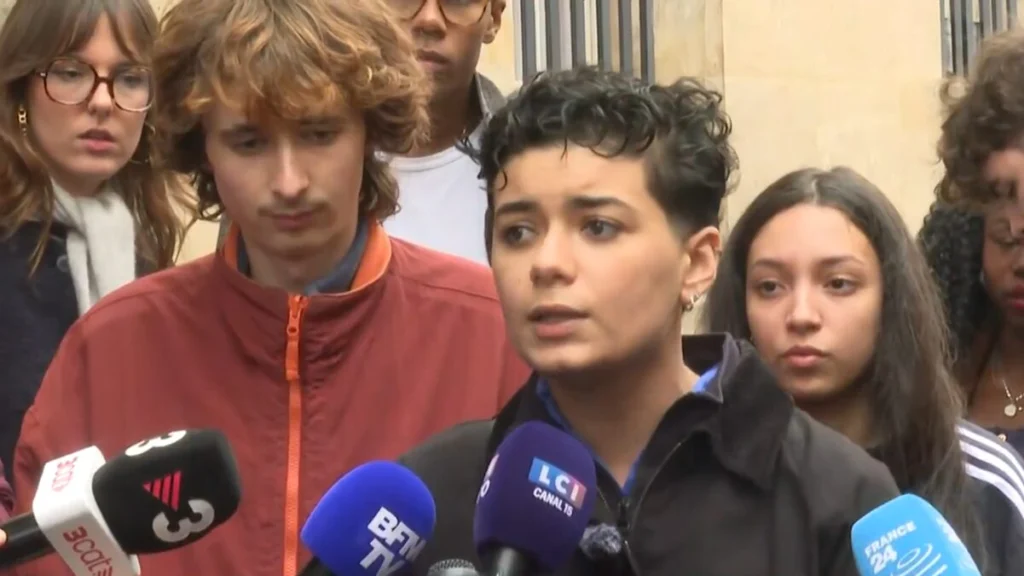
🔴 🗣 "10 milliards, 10 mesures, ni plus ni moins", clame Sabrine Kharbach, porte-parole de l'Union Étudiante. Les représentants de lycéens et étudiants s'expriment lors d'une conférence de presse en amont d'une réunion à Matignon #canal16pic.twitter.com/nmkMNERhZ3
The text reads, “’10 billion, 10 measures—no more, no less,’ declares Sabrine Kharbach, spokesperson for the Student Union. Representatives of high school and university students speak during a press conference held ahead of a meeting at Matignon.”
What French Students Are Demanding
In recent weeks, the High School Union (USL), the Student Solidarity collective, the National Union of Students of France (UNEF) and the Federation of General Student Associations (FAGE) have been the most determined groups in organizing mobilizations across France. They are demanding that the Macron administration implement the following 10 emergency measures:
1. An Emergency Plan to Renovate Schools and Universities
Launch an emergency plan to renovate dilapidated and unsanitary school and university buildings. Adapt educational institutions to the effects of climate change by installing air conditioning and cooling systems to cope with heat waves, as well as appropriate insulation and heating systems to withstand cold spells.
Ensure that every institution has the human and material resources necessary to maintain its facilities and provide clean, functional restrooms.
2. Mass Hiring of Education, Health, Support and Guidance Staff
Launch a large-scale recruitment plan for National Education personnel to guarantee, at a minimum, the following staffing levels at every institution: One nurse for every 500 students. One psychologist for every 500 students. One guidance counselor for every 500 students.
Create additional teaching positions rather than relying on contract workers, so that every class has a teacher and inequalities between institutions are eliminated. Also establish a formal employment status for support staff for students with disabilities (AESH) and create 800 additional positions.
3. Rethink School and University Schedules
Undertake a comprehensive overhaul of school schedules, building on the work of the Citizens’ Convention on Children’s Schedules for the National Education system, and launch a similar process for higher education to better respect students’ needs and well-being.
In particular, guarantee a lunch break of at least 1 1/2 hours so that every student can eat under appropriate conditions. Reverse the reforms of the baccalaureate and high school system.
4. End Selection Through Parcoursup and Mon Master. Create 250,000 Higher Education Places.
Eliminate selection through the Parcoursup and Mon Master platforms and create 250,000 additional places in higher education starting with the next academic year. This would allow high school students to access programs in their chosen fields without being subject to algorithmic selection and enable all students who wish to do so to continue their studies at the master’s level.
Retain centralized national application platforms to make available programs easier to identify, but eliminate selection. A high school diploma must guarantee access to a bachelor’s degree program, and a bachelor’s degree must guarantee access to a master’s program.
5. Overhaul High School Student Democracy to Ensure Genuine Participation in Decision-Making
Introduce list-based elections for the High School Student Council (CVL) and the Academic High School Student Council (CAVL) to ensure union representation, with representatives elected directly by all high school students in the relevant area. Increase the number of high school student seats on school boards. All high school students must be able to vote in CSE elections.
6. Increase Scholarships and Reinstate and Raise Housing Assistance for Everyone
Increase student scholarships by 200 euros per month, distribute them over 12 months and allow an additional 300,000 students to qualify for the scholarship system. Ultimately, establish a student autonomy income of 1,337 euros per month to guarantee every student the material resources necessary to pursue their studies. Abandon budgetary measures that reduce housing assistance for young people. Reinstate housing assistance (APL) for international students. Increase APL benefits and abandon changes to the calculation method that would deprive 147,000 students of this assistance.
7. Guarantee Effective Access to 1-Euro Meals for All Students
Guarantee effective access to 1-euro meals for students and provide the university services network with the resources necessary to meet demand.
8. Repeal the Welcome to France Plan, Which Introduces Differential Tuition Fees for International Students, and Eliminate the CVEC
Abolish the Welcome to France plan and its differential tuition fees for non-European students, which introduce a national-preference policy and a racist approach to higher education. Eliminate the Student and Campus Life Contribution (CVEC).
9. Freeze CROUS Rents, Make Rent Controls Permanent, and Massively Renovate and Build CROUS Housing
Reinstate the freeze on CROUS rents based on the rents frozen before 2023. Renovate unsanitary CROUS residences. Begin construction of 15,000 CROUS housing units starting in 2027. As an emergency measure, 10% of students must be able to obtain accommodation through CROUS.
10. End Repression and Police Violence Against the High School and Student Movement
End all forms of repression related to the high school and student movement. Ensure that law enforcement officers responsible for violence are prosecuted. Guarantee that absences related to mobilization are neither counted nor penalized.
More broadly, abandon all forms of repression in educational institutions and guarantee young people freedom of expression and freedom to organize, in direct contrast to the repression carried out in the struggle against the genocide in Palestine.
As the Left unites with Islamists to march against Israel, what it forgets is that Zionism was always a progressive movement – and the Irish forget that they originally identified with the Jews, says Andres Roth.
Portugal’s Attorney General has called on parliament today to review the 1974 legislation governing the right to demonstrate, declining to refer the law to the Constitutional Court (TC) for review.
The president of Portugal’s Bar Association believes an inquiry must be carried out into the security forces’ actions at the protest camps in Lisbon and Porto on Sunday, as the
Last night’s throngs at the squares in Porto and Lisbon that have become centres for ‘right to housing demonstrations’ dispersed without incident last night, and through the early hours of
A student movement that emerged after a deadly railway disaster has turned nearly two years of protests into an electoral victory.
Serbia’s student-led opposition has secured a decisive parliamentary victory over Aleksandar Vučić’s ruling party, according to preliminary results, ending 14 years of political dominance by the Serbian Progressive Party (SNS) and opening a new chapter in the country’s politics.
Vučić acknowledged the defeat on Sunday, saying initial projections indicated that the Student List would win between 135 and 140 seats, compared with about 105 for his party. The result follows nearly two years of student-led demonstrations against corruption and what protesters describe as growing authoritarianism.
The Centre for Free Elections and Democracy (CeSID), a non-governmental organization, projected that the Student List would win 139 seats after 56% of ballots had been counted, against 104 for the SNS. Unofficial estimates from polling institute Ipsos put the student movement at 140 seats and Vučić’s party at 103, down 26 seats from the 2023 parliamentary election, when it secured an absolute majority.
The setback was compounded by the failure of the Socialist Party, a longtime ally of Vučić, to clear the 3% threshold for parliamentary representation. The party previously held 18 seats. Preliminary estimates also gave three seats to Serbia’s Hungarian minority party and two to the Albanian minority list.
Turnout approached 70%, the highest since the breakup of Yugoslavia in 1992 and close to the record set in the 2000 parliamentary election.
The student movement grew out of protests that began in 2024, after 16 people died when a canopy collapsed at a railway station in Novi Sad. The disaster prompted mass demonstrations across Serbia, with protesters demanding accountability over the collapse and the construction work carried out by a Chinese company following a tendering process criticized for its lack of transparency.
Hundreds of thousands of people took to the streets, turning the demonstrations into a broader challenge to corruption and the concentration of political power. The student movement emerged as a nationwide opposition force and sustained pressure on Vučić’s government for nearly two years.
Vučić, who had led the country for 14 years, resigned as head of state in September to run for prime minister.
Celebrations and tensions in Belgrade
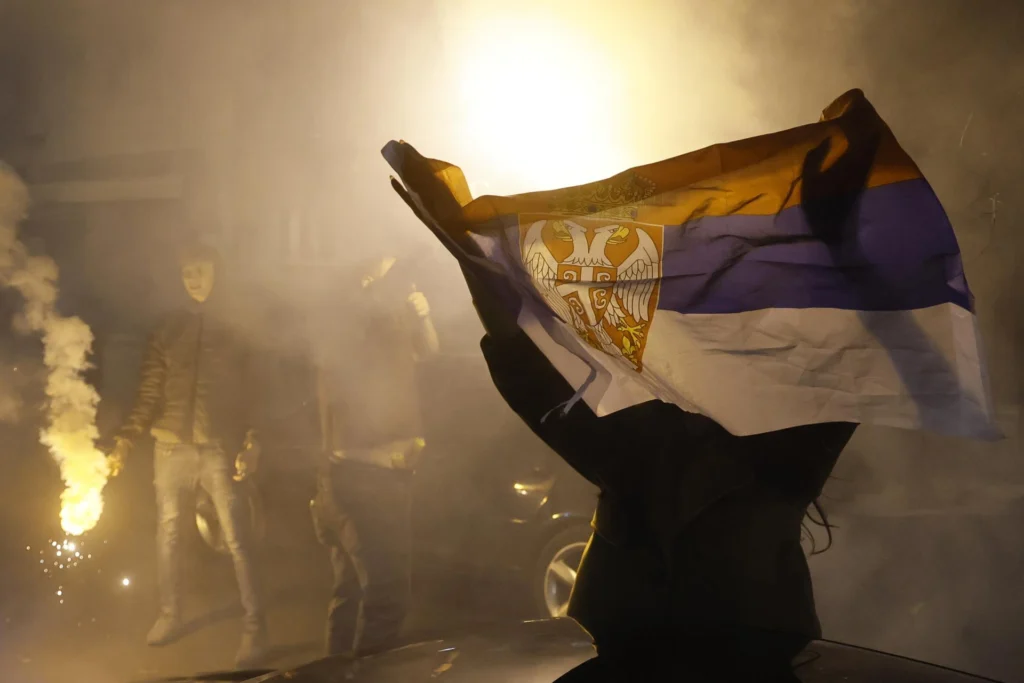
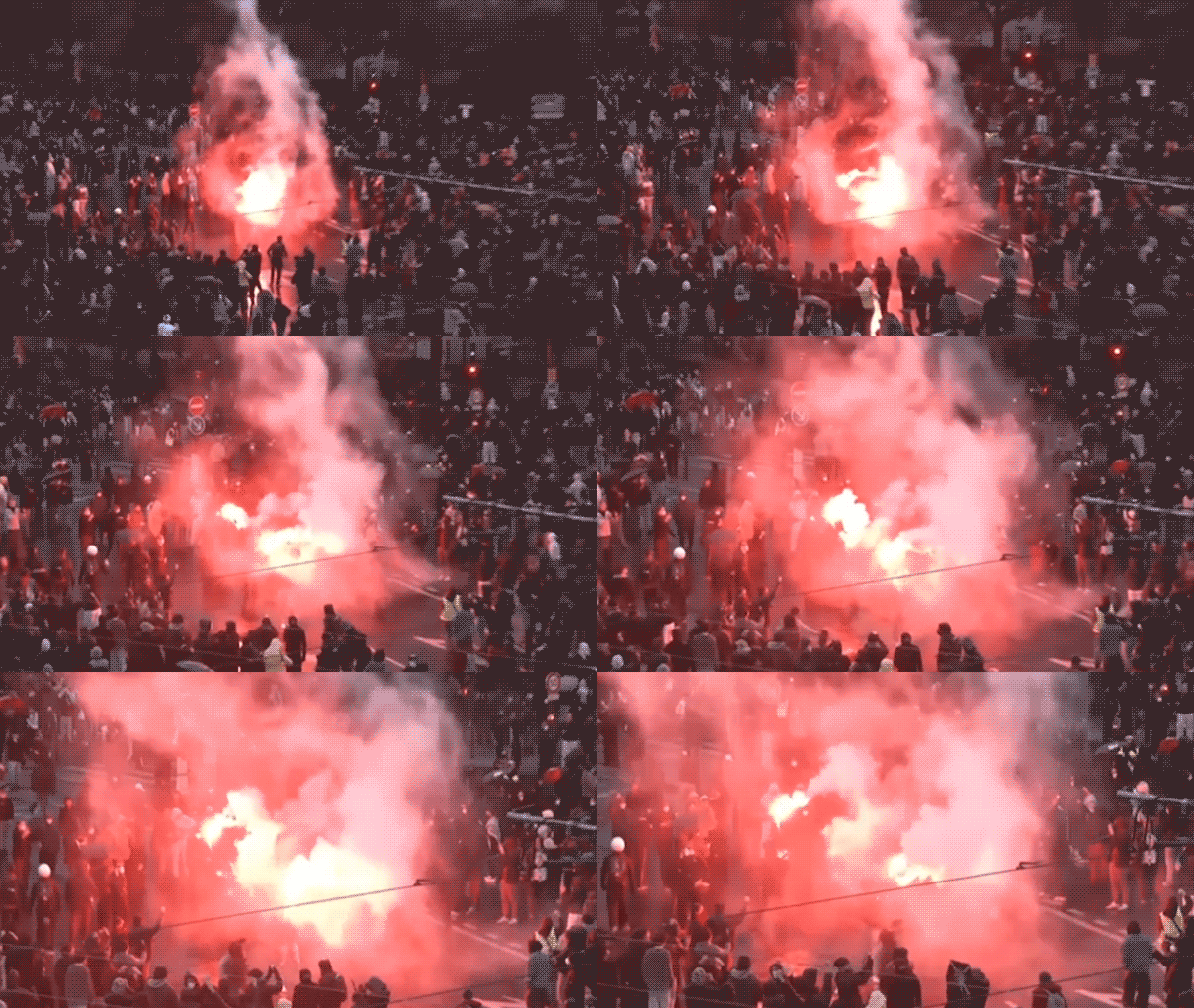
The preliminary results sparked celebrations across Belgrade, where thousands gathered to dance, chant slogans and set off flares and fireworks. Crowds shouted “Victory” and “Vučić is leaving” as people embraced and wept with joy.
Slavija Square, a focal point of the mass protests against the government, filled with supporters of the student movement. At Pioneers Park, between parliament and the presidential palace, hundreds of people tore down the fence surrounding the grounds and entered the public space.
The park had been closed to the public for months and periodically occupied by groups of masked Vučić supporters, who were accused of being used as a force to confront government opponents.
The celebrations underscored the scale of the political shift after more than a decade of SNS rule. Vučić had weathered previous opposition challenges, but the student movement turned sustained street protests into an electoral campaign that defeated his party.
A decentralized political movement
The Student List has presented itself as an alternative to Vučić’s centralized model of leadership. It operates through a horizontal structure and has avoided putting forward a single public face, arguing that political decisions should be made from the bottom up rather than imposed from above.
Its slate of 250 candidates includes university professors, actors and farmers, many of them little known to the wider public.
Radomir Sajcic, a University of Belgrade professor representing the movement, celebrated the result at its headquarters. “Dear Serbia, tonight the voice of the people can be heard,” he declared. “Tonight we celebrate victory; tomorrow we will build the future.”
Sajcic also described the outcome as “a victory of courage over fear, a victory of hope over indifference, a victory of faith that Serbia can and must be different.”
The movement’s platform calls for restoring the separation of powers and the autonomy of the prosecutor general’s office, as well as increasing investment in health care and education. It also pledges to tackle corruption and individual privileges to boost public revenue, while promoting technological modernization across the economy, including agriculture.
Serbia’s score in Transparency International’s corruption index has deteriorated during Vučić’s tenure. The European Union has also raised concerns about the country’s declining adherence to the rule of law.
European support and foreign policy questions
European institutions have welcomed the student movement’s victory, describing it as an opportunity to advance democratic reforms, strengthen the rule of law and combat corruption.
European Commissioner for Enlargement Marta Kos and European Commission President Ursula von der Leyen congratulated the students and offered support for reforms and greater press freedom. Council of Europe Secretary-General Alain Berset highlighted Vučić’s acceptance of the results and his commitment to a peaceful democratic transition.
Today, the people of Serbia turned out in record numbers to shape their country’s future.
Congratulations to the Student List on its victory in the parliamentary elections.
We stand ready to support reforms on the rule of law, media freedom, the fight against corruption and…
Montenegrin Prime Minister Milojko Spajić and Hungarian Prime Minister Péter Magyar also congratulated the winners and expressed their willingness to cooperate with them.
The election could also affect Serbia’s relations with the European Union and Russia. Under Vučić, the country has pursued EU membership while maintaining close ties with the Kremlin. Serbia has been an official candidate for EU accession since 2012.
Before the vote, EU foreign policy spokesperson Christian Wigand said the bloc would monitor the election closely and stressed the need for a free, fair and transparent process.
The Student List has offered fewer details about its international priorities than about its domestic reform agenda. Available indications suggest it may maintain Serbia’s EU candidacy while continuing to oppose sanctions against Russia, although the movement has yet to clearly outline its foreign policy plans.
The student movement’s victory marks a major political turning point for Serbia after 14 years of Vučić’s dominance. Its ability to convert demands for accountability and institutional reform into a parliamentary majority has reshaped the country’s political landscape, but the incoming government’s approach to domestic reform and foreign relations remains uncertain.
Serbia’s student-backed opposition has won a decisive victory in Sunday’s snap parliamentary election, according to preliminary projections, after Aleksandar Vučić conceded defeat. The result, if confirmed, would end the Serbian Progressive Party’s (SNS) 14-year hold on power and give the protest movement a majority in the 250-seat National Assembly.
Vučić said his coalition had lost, estimating that the Student List would win between 135 and 140 seats, against about 105 for his political camp. A representative sample by CESID-IPSPS pollsters put the Student List on 138 seats and the SNS on 104. The results announced by Vučić were preliminary; the official count had not been completed when he made his statement.
The independent election-monitoring organisation CRTA put the Student List on 51.47 per cent of the vote and Vučić’s “United Serbia” coalition on 40.42 per cent in its preliminary estimate. Other parties were not projected to pass the threshold for parliamentary representation, apart from lists representing national minorities, which are subject to different rules. Serbia’s Republic Electoral Commission has yet to confirm the final results.
The margin was far wider than the close contest suggested by pre-election polling. Surveys cited before the vote showed the student-backed list and Vučić’s coalition within a few percentage points of each other, with estimates varying between polling organisations. The transcript cited similar mixed projections, including polls that put the Student List ahead and one conducted by Sputnik Serbia that favoured Vučić’s bloc. The preliminary count has shifted the focus from whether the governing camp could retain its majority to how the new parliament will be formed.
Turnout was exceptionally high. CRTA estimated that 67.8 per cent of voters had participated by 7pm, while Ipsos and CESID put the figure at 67.6 per cent. The final turnout remains pending, but both estimates were well above the 58.77 per cent recorded in the December 2023 parliamentary election. CRTA’s election-day updates also documented reports of pressure on voters and irregularities at polling stations.
The Student List grew out of demonstrations that began after a concrete canopy collapsed at Novi Sad railway station in November 2024, killing 16 people. Public anger over the disaster and demands for accountability developed into a wider challenge to the government. Students organised protests and blockades, calling for action over alleged corruption and failures in the handling of the station’s renovation.
Vučić, who resigned as president during the campaign to head the ruling coalition’s list, has been central to Serbian politics since the SNS came to power in 2012. His political camp has maintained close relations with Moscow while continuing Serbia’s formal bid to join the European Union. The Student List brings together candidates from a range of civic and political backgrounds. Its electoral victory does not, by itself, settle the movement’s positions on foreign policy or Serbia’s future relations with Brussels, Moscow and Pristina.
The vote took place amid reports of intimidation, violence and procedural problems. CRTA observers said they recorded pressure on voters, election workers or observers at 29 per cent of the polling stations they monitored. They also reported ballot photographing, which can compromise vote secrecy, and filed a report over suspected vote-buying and “carousel” voting in Veternik. These are allegations and observer findings; they do not establish that the overall result was invalid.
The election campaign had already drawn scrutiny over the conditions facing the opposition. In its pre-election assessment, CRTA cited pressure on voters, use of public resources and a blurred boundary between the state and the ruling list. Those findings concern the campaign environment; election-day reports concern specific incidents at polling stations.
Vučić’s concession reduces the likelihood of an immediate dispute over which bloc won, but the final count and formal allocation of seats remain necessary. CRTA’s estimate and the projections cited by Vučić both point to the Student List clearing the 126 seats required for a majority. The formation of a government will depend on the certified results and the parliamentary process.
The Student List must now turn a broad protest coalition into a governing administration. Its candidates campaigned under a common banner, but the movement includes participants with differing views and priorities. It will have to agree on a cabinet and determine how quickly it can pursue commitments on accountability, public institutions and the economy.
The result leaves the SNS facing a new role after more than a decade in government. A movement that began after a fatal infrastructure collapse is now on course to take power through parliament. If the preliminary projections hold, the transition will be the clearest test yet of whether Serbia’s student-led opposition can convert mass mobilisation into a stable government.
They reject restrictions on demonstrations and partial curfews as a broader wave of protests spreads across France.
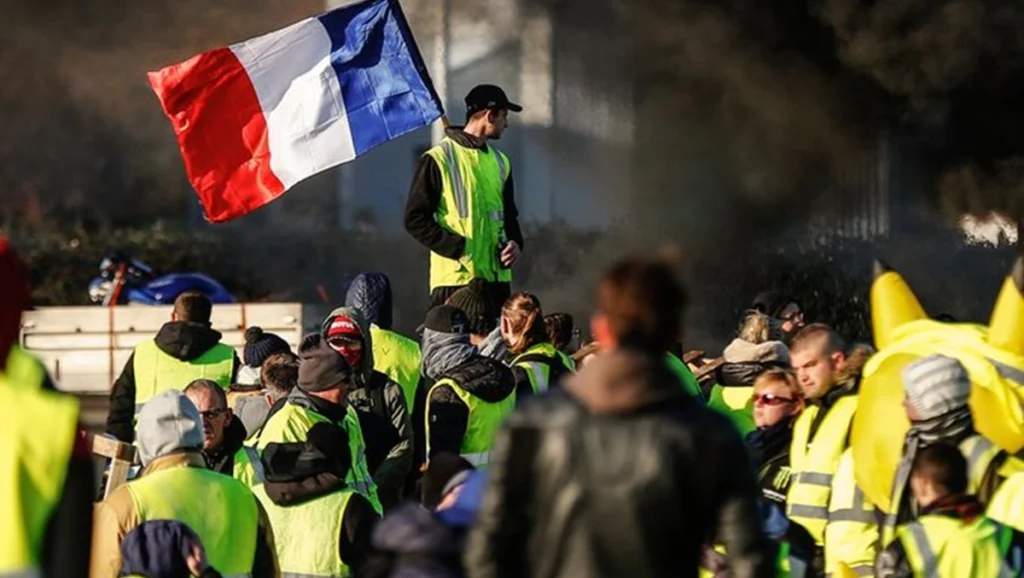
On Sunday, the Yellow Vests movement’s coordination group called for demonstrations featuring pot-banging protests outside the National Assembly on Friday, Oct. 30, to protest French President Emmanuel Macron.
“Macron and his administration have decided to take another step toward authoritarianism. They ban our demonstrations, impose curfews, and close city centers to protesters. We will make our pots and pans heard beneath the windows of lawmakers,” the Yellow Vests said.
The group, whose demonstrations shook France in 2018 during Macron’s first term, also called for the action to be extended to areas outside city halls in protest of restrictions on demonstrations and partial curfews in some cities.
These demonstrations are part of a wave of protests that began in September, when high school students took to the streets to demand improvements at their schools.
Le 24 octobre, manifestation dans la rue avec les étudiants et les gilets jaunes.
Des gens si différents, un même rythme. Pour le pouvoir d'achat, la dignité et l'avenir.
The text reads, “On Oct. 24, a street demonstration with students and the Yellow Vests. Such different people, yet sharing the same rhythm. For purchasing power, dignity, and the future.”
They later received support from college students, labor unions and the Yellow Vests, who added their demands for action against the rising cost of living and in defense of public services.
Organizers of the demonstrations held over the past two weekends have called for another day of protests on Saturday, Oct. 31, and are preparing a general strike for Nov. 5.
On Monday, in an effort to avert those events, Prime Minister Sebastien Lecornu will meet with representatives of student organizations, teachers, labor unions, business organizations, local authorities and lawmakers.
From mass arrests in France to troop deployments in Italy, European leaders are taking varied approaches to protests and clashes across the continent. The unrest began in France in mid-September with student demonstrations over school conditions, then spread to other countries, where protests have centered on local grievances.
President Donald Trump has used the unrest to press his hard-line immigration message, blaming France’s protests on immigration and urging the country to close its borders.
French President Emmanuel Macron pushed back, calling foreign leaders' comments "unacceptable and even stupid" and accusing them of exploiting France’s crisis for political gain.
Here’s how leaders across Europe are responding.
France vows to make rioters pay as cities assess damage
Macron has vowed that those who loot or destroy property will be held accountable and made to pay for the damage. French authorities deployed 70,000 police officers nationwide Saturday as demonstrations took place in Paris and other cities.
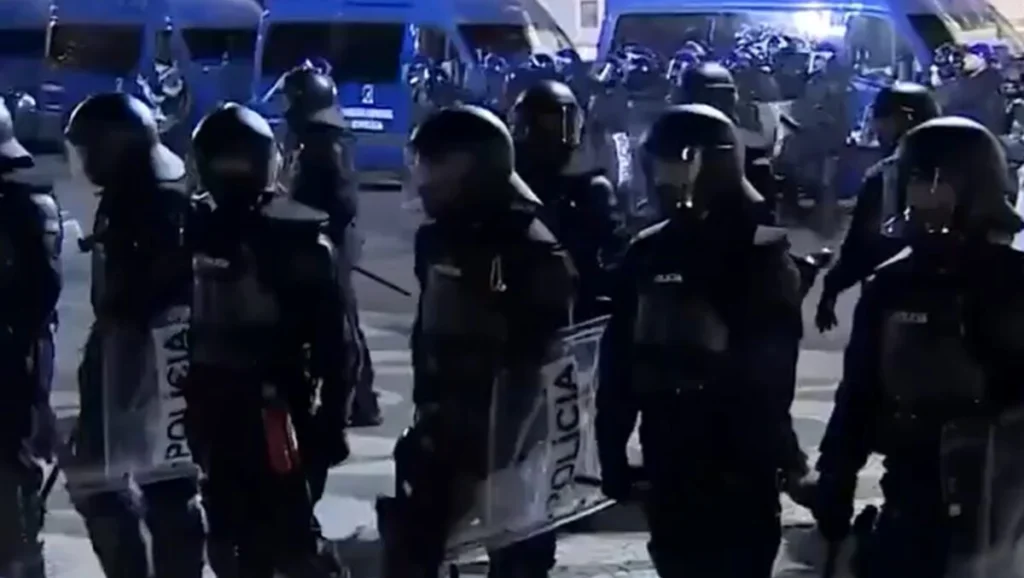
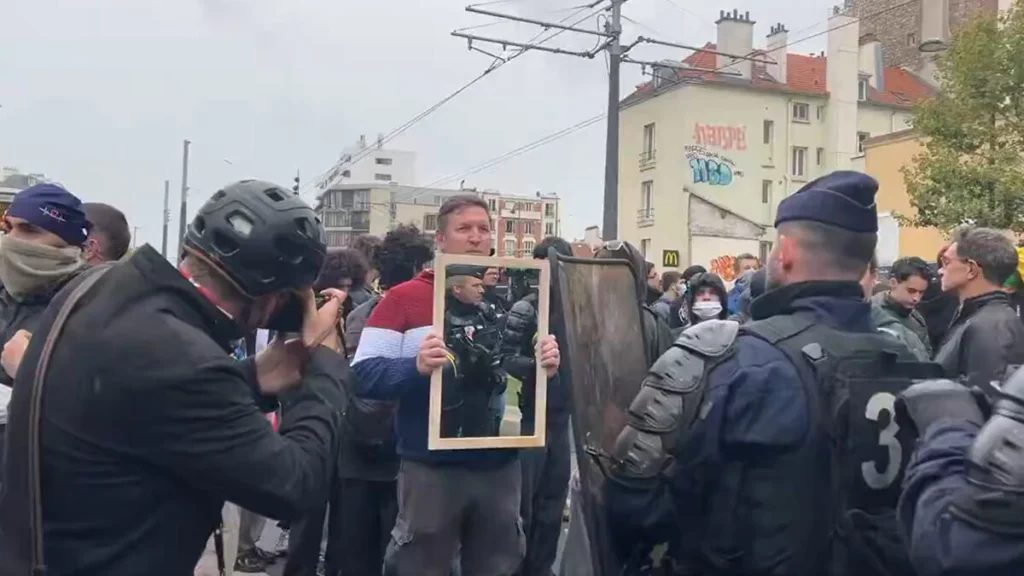
Some clashes broke out in several cities, including Paris, Lyon, Lille, Toulouse and Nantes. Police used tear gas, sound grenades and water cannons, and the Interior Ministry reported more than 1,300 arrests.
Most union-organized marches were peaceful, though clashes broke out later in Paris and several other cities. Separately, a French intelligence assessment reportedly identified Antifa and other far-left groups as instigators of some of the violence, according to a French outlet.
Italy takes one of Europe's toughest lines
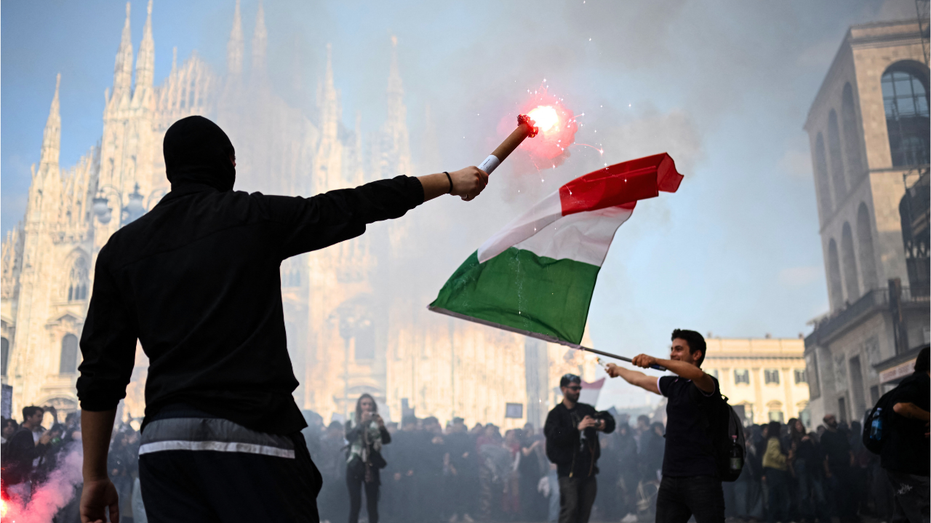
Prime Minister Giorgia Meloni condemned what she called "gangs of thugs" who used demonstrations to "sow chaos," and voiced support for police facing violence in several Italian cities.
Meloni moved quickly after the previous weekend’s looting and clashes, sending 500 additional soldiers to Milan and approving tougher penalties for minors involved in vandalism. She said destroying and stealing was a crime and that the state's response would be firm.
The measures put Meloni among the European leaders taking the most visible steps to deter further violence.
Greek police maintain a visible presence
While Greece has seen less unrest than France and other European countries, officials have been monitoring the risk of clashes as student and teacher demonstrations spread.
Government spokesperson Pavlos Marinakis said the right to protest must be respected as long as demonstrations remain lawful, while condemning violence, looting and occupations.
Police still kept a visible presence at demonstrations earlier in the week, which largely passed without major violence.
Belgium accuses Antifa-linked activists of stoking clashes
Belgium's demonstrations began over education reforms and budget cuts, with young protesters taking to the streets in Brussels and Liège. Earlier clashes injured police, damaged public areas and blocked roads. Nearly 200 people were arrested, according to Belgian officials.
Interior Minister Bernard Quintin accused far-left activists, including people linked to Antifa, of infiltrating demonstrations and encouraging young people to commit violence.
Albania clashes escalate as protesters demand prime minister's ouster
In Albania’s capital, Tirana, student-led protests have grown into a broader challenge to Prime Minister Edi Rama, with demonstrators demanding his resignation and accusing his government of corruption and neglecting schools and public services.
Police used tear gas and water cannons as more than 2,500 officers were deployed. Rama placed chairs outside his government headquarters and invited protesters to talk, but they rejected the gesture.
He said his government would address their concerns and warned that people responsible for violence could face criminal and financial consequences.
Spanish regional leaders vow consequences after Barcelona riots
In Spain, the unrest was largely concentrated in Barcelona, unlike France, where protests and clashes spread across multiple cities.
Police arrested 128 people in Barcelona after fires, vandalism and looting. Catalonia, the northeastern Spanish region that includes Barcelona, saw its regional president, Salvador Illa, condemn the violence and back the police response.
Meanwhile, Barcelona Mayor Jaume Collboni said the city would take legal action against those responsible and warned that parents or guardians could face consequences for damage caused by their children.
Police operations left 31 people detained and more than 20 injured, prompting parties to criticize PM Montenegro.
Early Sunday morning, Portuguese police violently evicted housing rights encampments that had been taking place in Lisbon and Oporto. The police operations left 31 people detained and more than 20 people injured.
The police action prompted reactions from most opposition parties, which criticized Prime Minister Luis Montenegro and his convenient silence in the face of the events.
Socialist Party (PS) leader Jose Luis Carneiro demanded a “comprehensive explanation” from the Montenegro administration regarding the police action at the encampments. He emphasized that the solution to the housing problem “is political, never police-related.”
“Montenegro cannot, through his silence, continue to pit the police against citizens and citizens against the police,” the Socialist leader said.
Although the government has not yet commented on the police operation, one of the parties in the governing coalition, the Social Democratic Party (PSD), has spoken out.
Its spokesman, Sebastiao Bugalho, defended the “proportionality” of the police action, which took place “within the legal framework that is supposed to apply to protect the right to demonstrate.”
🇵🇹 Manifestação pacífica pelo direito à habitação, foi violentamente desmobilizada pela polícia de intervenção, no centro de Lisboa. O governo de direita português mandou evacuar a praça do Rossio durante a madrugada. Houve 31 detenções. pic.twitter.com/CgJBaD9cyU
The text reads, “A peaceful demonstration for the Right to Housing was violently dispersed by riot police in downtown Lisbon. The right-wing Portuguese government ordered the evacuation of Rossio Square in the early hours of the morning. There were 31 arrests.”
Meanwhile, far-right politician Andre Ventura, founder and leader of the Enough! party (Chega), defended the eviction, asserting that “the police have been very patient with these people camping out in the squares. Too patient, even!”
Nevertheless, even Ventura criticized the stance adopted by Montenegro and the Social Democratic Party, accusing the prime minister of hiding from problems and failing to come out publicly in support of the police.
In recent weeks, police violence against Portuguese citizens has drawn criticism from international humanitarian organizations such as SOS Racismo and from European left-wing parties, which have denounced the excessive use of force.
The housing movement has called for demonstrations in Lisbon and Oporto on Sunday to reject police violence, as well as another protest on Tuesday outside Parliament, where debate will begin on the 2027 state budget.
Anyone imagining that this morning’s scenes of violence were an end to ‘right to housing protests’ will be thinking again following news that protesters are set to return to the
Students, unions and families of protest victims demand action on extortion, environmental damage, living costs and police reform.
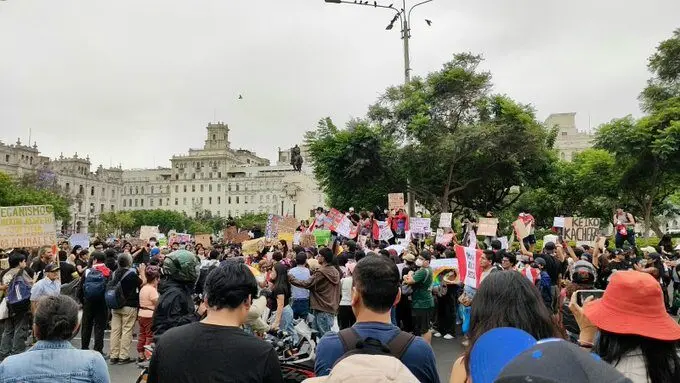
Young people, students, trade unions and human rights groups marched through central Lima on Saturday, demanding that President Keiko Fujimori’s government address rising extortion, deadly forest fires, the cost of living and alleged impunity for state repression.
Demonstrators began gathering at 4 p.m. in San Martín Square, a historic rallying point for popular movements in Peru. Participants included students from San Marcos and Catholic universities, human rights organizations, trade unions and members of the self-organized Generation Z movement.
The protests unfolded amid mounting concern over forest fires that have affected 16 regions across the country. Figures from Peru’s National Emergency Operations Center and the National Institute of Civil Defense recorded 479 emergencies, leaving 12 people dead and 708 displaced or otherwise affected.
The fires destroyed 1,299 hectares of crops and more than 13,800 hectares of natural vegetation, while also causing significant damage to local wildlife and livestock.
🚨 #URGENTE | Contra la extorsión y la crisis ambiental: jóvenes y colectivos sociales protestan en el centro de Lima
Text Reads: 🚨 #URGENT | Against extortion and the environmental crisis: young people and social groups protest in downtown Lima
Carrying banners calling for an end to the fires, police reform and solidarity with affected communities, demonstrators marched along Jirón de la Unión and Grau and Abancay avenues. Police blocked the procession from approaching the grounds of Congress.
Environmental concerns featured prominently in the march, with protesters criticizing what they described as inadequate government preparation and response to fires in the Andean highlands and Amazonian regions, including Cusco, Puno, Junín, Apurímac, Áncash, Huancavelica, Arequipa, Amazonas and Cajamarca.
One young demonstrator denounced the lack of firefighting teams, funding and preventive measures, arguing that the fires were extinguished only after rain arrived. The crisis, she said, had inflicted heavy losses on rural farmers and Indigenous communities.
Another protester highlighted flooding caused by heavy rains in Piura, in northern Peru, and the absence of a strategic plan to address the El Niño phenomenon. She also pointed to corruption in reconstruction projects and the neglect of infrastructure serving working-class communities.
Extortion was another central grievance. Transport workers, shopkeepers and small-business owners in working-class neighborhoods have been among those affected by the crime, according to the protest account. Demonstrators called for far-reaching police reform to dismantle corruption networks within the security forces and prioritize intelligence gathering and community-based prevention over the repression of social protests.
Families of people killed during social protests between December 2022 and June 2023 also joined the march, carrying photographs of their relatives and demanding justice. Their presence underscored the demonstrators’ broader call for accountability from a government they accuse of perpetuating impunity.
Higher oil prices, weakening consumer confidence and political uncertainty are putting pressure on public finances as the country approaches a critical budget battle
Some 1,000 arrested amid demonstrations against low school funding, soaring living costs; police deploy tear gas, water cannons as unrest mounts in final months of president's term
Nearly 1,000 peoplewere arrested Saturday as nationwide protests resumed, French Interior Minister Laurent Nuñez told reporters.
The unrest has spread beyond France, with violent clashes breaking out in Rome and Albania's capital of Tiranë, where demonstrators set government buildings on fire.
President Donald Trump also weighed in Saturday, pointing to the turmoil in France as a warning about what he said could happen in the United States under left-wing leadership.
Earlier in the day, police officers preemptively searched protesters andarrested people suspected of carrying potential weapons, including fireworks and ball bearings, Reuters reported.
Nuñez did not specify where the arrests were made.
In Paris, where police estimated 110,000 people marched, officers conducted more than 3,000 checks and arrested 65 people, the BBC reported.
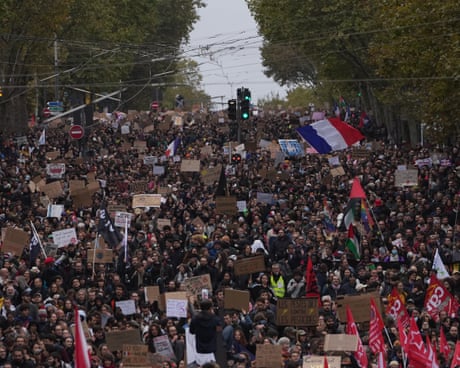
The French Interior Ministry said about 410,000 people participated in protests nationwide, while union organizers estimated attendance at 800,000. In Paris, union organizers put turnout at 250,000, compared with the police estimate of 110,000, according to CBS News.
"Violent individuals have no place in the marches," the Paris Police Department said in a social media post. "The objective is clear: to prevent troublemakers from joining the procession, and to ensure the safety of the demonstrators."
Central Paris resembled a city under lockdown as shopkeepers boarded up storefronts, museums closed and more than 20 metro stations suspended service.
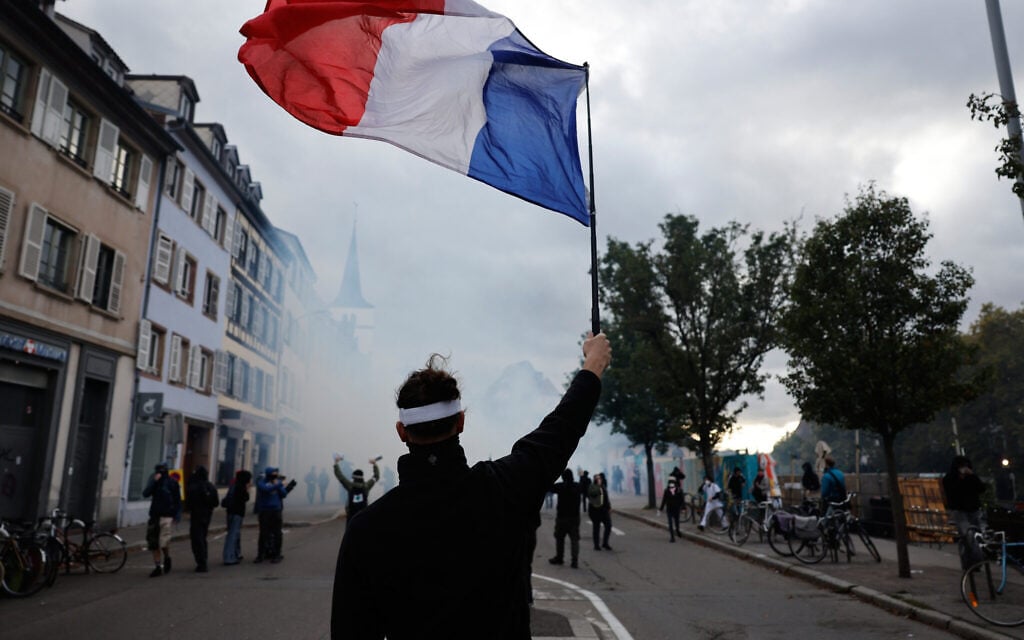
In other cities — including Clermont-Ferrand, Grenoble, Lille and Nice — police have resorted to firing tear gas to break up unruly crowds, Reuters reported.
Also in Nice, police used a water cannon to disperse a group of demonstrators who refused to pull back. And in Marseille and Lyon, there have been clashes between police officers and hooded youths.
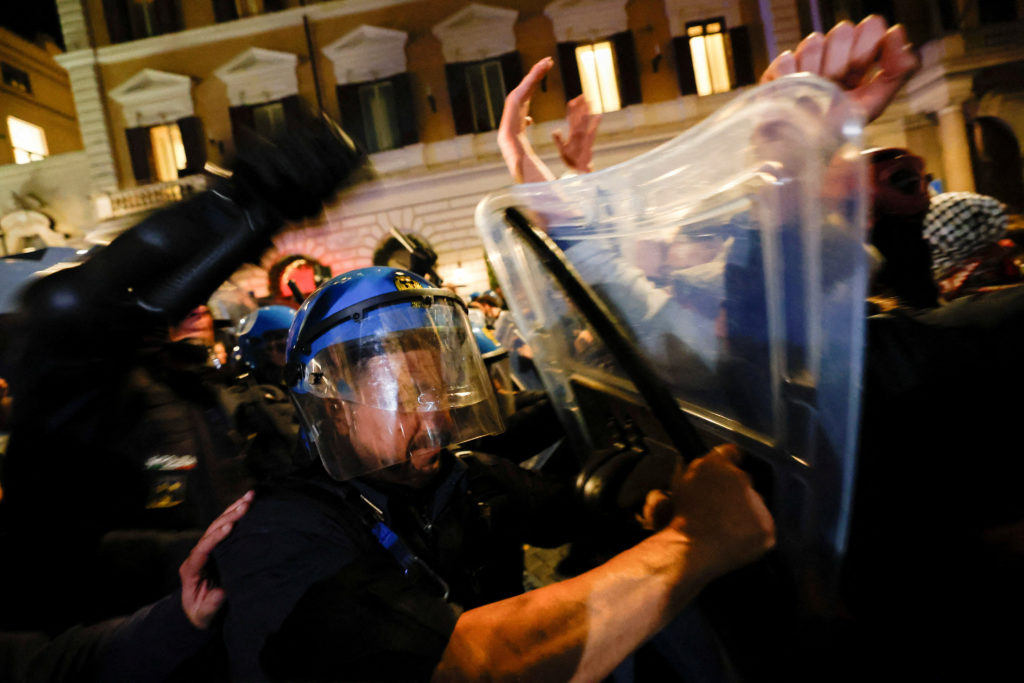
The unrest also reached Italy on Saturday, where police deployed a water cannon against protesters in Rome as demonstrations over rising living costs and war turned violent. Reuters footage showed riot police confronting demonstrators before a water cannon vehicle approached and sprayed water toward the crowd.
Violence was also reported in Turin and Bologna, where demonstrators confronted police, while protests in Milan remained largely peaceful, according to Reuters. Italian authorities increased security after widespread rioting and looting the previous weekend.
In Albania, riot police fired water cannons at protesters in Tirana, where some demonstrators set government buildings ablaze and threw projectiles at officers. High school and university students have been demanding lower tuition fees, greater investment in education and an end to corruption in the education system.
Some protesters have joined a broader anti-government movement calling for the resignation of Socialist Prime Minister Edi Rama. Rama said Saturday that his government was preparing a response to students' demands and called for dialogue, while warning that violent protesters would face penalties, according to The Associated Press.
Trump pointed to the unrest in France while speaking to reporters Saturday after casting his early-voting ballot for the 2026 midterm elections in West Palm Beach, Florida. The president criticized the country's previous leadership and argued that similar unrest could unfold in the U.S. under left-wing leadership.
"Just two years ago, we were laughed at. We were a stupid country. We were a country led by idiots and morons and bad people and radical left people. ... Just take a look at France because that's what they'd like to have for our country, and I don't let that happen."
Some 70,000 police officers have been deployed across France to clamp down on agitators and prevent the kind of unrest seen during recent demonstrations, when cars were torched and the city hall building in Limoges was set on fire.
Last weekend, more than 2,700 people were arrested during protests that later turned into riots and looting sprees.
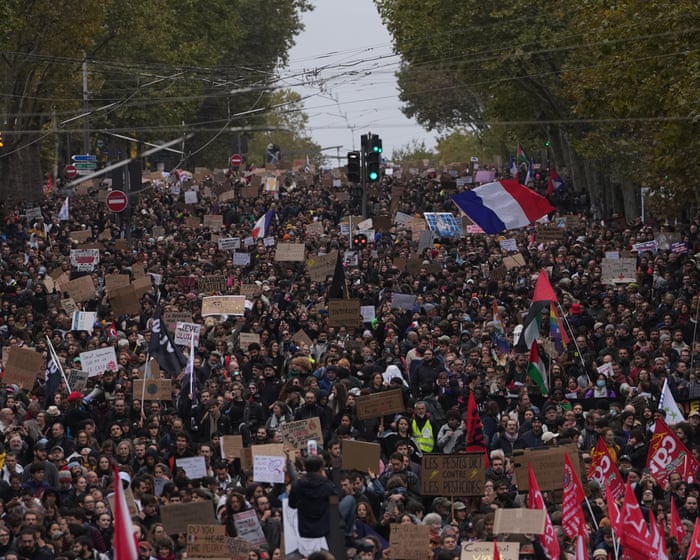
The nationwide marches were meant to reflect broader dissatisfaction with the French government, with protesters taking to the streets to air a range of different grievances.
The movement gained momentum when major labor unions joined the demonstrations, broadening the protests to include opposition to the government's austerity policies and concerns over wages, pensions and the overall cost of living.
Police brutality, however, changed the atmosphere of the day as security forces began cracking down on demonstrators. By 1 p.m., French police had made 135 arrests amid beatings of citizens.
At least 800,000 people demonstrated across France on Oct. 24. However, tensions erupted in Paris and Marseille “during the dispersal of demonstrations,” TF1 Info reported.
The Haute-Garonne prefecture reported that a young man suffered a serious hand injury at the end of a demonstration in the Arenes neighborhood.
🔴️️ À Bordeaux, des manifestants lèvent les mains pour montrer leur caractère inoffensif, la police les charge et les gaze sauvagement
Partout en France, le mouvement populaire s'est amplifié. Les mêmes foules massives ont défilé pour exiger le blocage des prix, l'abrogation… pic.twitter.com/C9Cvuy2MB5
The text reads, “In Bordeaux, protesters raise their hands to show they pose no threat; the police charge at them and brutally gas them. Across France, the grassroots movement has gained further momentum. Massive crowds have taken to the streets to demand a price freeze, the repeal of the Parcoursup system, wage increases, and the inclusion in the budget of the 10 billion euros requested by high school and university students to address their demands.”
The protester was evacuated by firefighters after several of his fingers were amputated. Videos show that a grenade thrown by police caused the young man’s injuries. Authorities said they would conduct an investigation to determine what happened.
At a news briefing, Interior Minister Laurent Nunez said 136 public order incidents had been recorded nationwide during Saturday’s demonstrations, which have drawn tens of thousands of French people into public spaces across the country so far.
“In Nantes, a police officer chokes a young man and slams his head against a wall, while his partner threatens to fire a less-lethal rubber-ball launcher at residents protesting… the Macron administration continues its repression through police brutality,” L’insoumission reported.
À Grenoble, la sauvagerie policière frappe une fois de plus. La préfète de l’Isère devra rendre des comptes après avoir modifié le tracé du cortège et imposé des couvre-feux à Grenoble.
Désormais, la police du ministre de la Violence, Laurent Nuñez, balance des gaz lacrymogènes… pic.twitter.com/jMPdskG8rP
The text reads, “In Grenoble, police brutality has struck once again. The Isere prefect will have to answer for her actions, having altered the route of the demonstration and imposed curfews in Grenoble. Now, the police force under the ‘Minister of Violence’—Laurent Nuñez—is deploying tear gas and sowing chaos at a sanctioned demonstration. This government of incompetents is in its death throes.”
The security forces’ aggression against citizens occurred despite several cities authorizing demonstrations for Saturday, including Lille, Strasbourg, Mulhouse, Grenoble, Marseille, Toulouse, Amiens and Paris.
In Lyon, where demonstrations have been banned across a large part of the city center, law enforcement officers dispersed small gatherings using tear gas grenades.
On Friday, Nunez said that 70,000 police officers and gendarmes would be deployed nationwide for the demonstrations. Soldiers from the French army’s Operation Sentinelle would also be mobilized during the protests.
Almost 1,000 arrested as police charge crowd in Paris and teargas used to stop protesters reaching other city centres
Hundreds of thousands marched in cities across France on Saturday in largely peaceful protests to support schoolchildren’s demands for more teachers and repairs to dilapidated buildings, as Emmanuel Macron faces a social and political crisis in his final months as president.
The prosecutor’s office in the southern city of Nice said on Sunday that 59 people had been taken into police custody, including 11 suspected of belonging to extreme-right groups. They were alleged to have gathered with the intent of committing violence. Some were arrested in two vehicles with masks, gloves, gas sprays and truncheons, the prosecutor’s office said in a statement to public broadcaster FranceInfo.

 Login