❌

Reading view

The Christian Influencer at the Center of Ken Paxton’s New Life

The Texas attorney general has been silent about his relationship with Tracy Duhon, a New Orleans woman who has built a personal brand around faith and redemption.

© Doug Mills/The New York Times; Frederick Breedon/Getty Images for Pure Flix

  •  

British Columbia Shows the Risks of a Snap Election

Improving polls for Labour are bound to lead to feverish speculation about a snap election. But if Burnham is tempted, what just happened in British Columbia might change his mind, says Mark Littlewood.

The post British Columbia Shows the Risks of a Snap Election appeared first on The Daily Sceptic.

  •  

The Trump administration is backing Orbán, who blocked a €90 billion EU loan to Ukraine, for UN secretary-general and is counting on support from Moscow and Beijing, WSJ says

Trump and Orban at White House meeting on November 7, 2025, where Hungary secured Russian oil sanctions exemption

The Trump administration has encouraged former Hungarian Prime Minister Viktor Orbán to run for UN secretary-general and discussed a joint US-Russia-China candidacy with Moscow and Beijing, the Wall Street Journal’s (WSJ) editorial board wrote on 25 October, citing sources in three countries. Russia’s biggest ally in the EU, Orbán has been out of office since May, when Péter Magyar became Hungary’s prime minister.

The UN secretary-general can influence the war through diplomatic negotiations, mediation, and by drawing the Security Council’s attention to Russia’s aggression. António Guterres’s term ends on 31 December, so the council has to settle on a successor within weeks.

According to the WSJ, US officials discussing the next UN chief kept saying they wanted “someone like Orbán,” and their Russian and Chinese counterparts agreed. The US then brought the idea to Orbán himself. Russia and China are believed to support his bid based on those earlier talks with Washington, and the plan is for him to be the three countries’ joint candidate.

Ukraine warns of Orbán’s veto tactics at the UN

Orbán is receptive but has not decided, and he does not want to enter the race unless he is sure he can win, the editorial board wrote. A State Department official counted eight Security Council votes as safe for him and 10 within reach. A candidate needs nine of the 15 votes and no veto from a permanent member. The editorial board asked whether Britain and France, typically cautious in using their veto, would stand in the way. Any announcement is being held until after the 3 November US midterm elections.

Ukraine’s Foreign Minister Andrii Sybiha wrote on X that Orbán as secretary-general would put to good use “the masterful veto and blackmail skills” he developed over years of derailing major EU decisions. Ukraine, he added, could share its “great experience of taking him out for coffee at the right moment,” a reference to the December 2023 EU summit, where Orbán left the room so the other leaders could open accession talks with Ukraine without his veto.

Orbán ran Hungary for 16 years as Putin’s closest EU partner

Orbán’s 16 years of “illiberal democracy” eroded democratic values in Hungary. Since 2010, Fidesz has built an enormous partisan media ecosystem. Before the vote, it amended the electoral law twice and gerrymandered more than a third of the electoral districts, so the opposition might need around 55% of the popular vote to win a simple majority. Orbán still lost the 12 April election. Magyar’s Tisza won 138 of 199 seats, a two-thirds majority in parliament.

USA hungary propaganda lies Ukraine far-right
Explore further

Voted out and facing investigators, Orbán could reach for UN cover, sources say

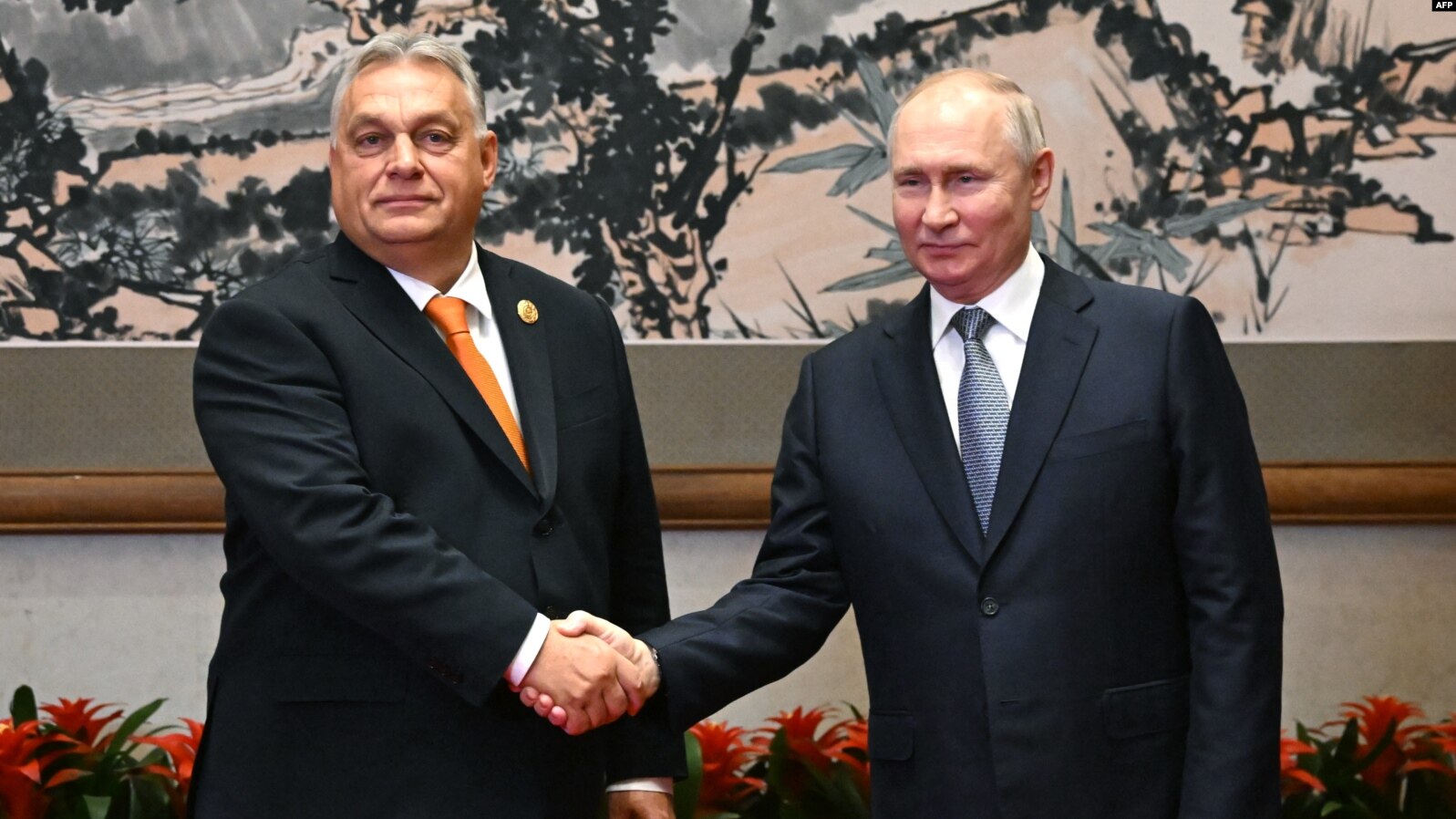
Orbán kept close ties with Moscow throughout the full-scale war. When he met Putin in Beijing in October 2023, he spoke of “the military operations and the sanctions” rather than a war. In summer 2024, while Hungary held the EU Council presidency, he flew to Moscow on what he called a peace mission, and the EU distanced itself from the trip. In November 2025, he went back to Moscow, seeking to keep Hungary’s access to Russian oil and gas. He is widely considered Putin’s closest partner among EU leaders. After that visit, he said the only solution was for Ukraine to become a buffer state again, and that the longer peace was delayed, the more people and territory Ukraine would lose.

Then-Hungarian Prime Minister Viktor Orbán and Russian President Vladimir Putin in Beijing, 17 October 2023
Then-Hungarian Prime Minister Viktor Orbán and Russian President Vladimir Putin in Beijing, 17 October 2023. Photo: Radio Free Europe

He used Hungary’s veto against Ukraine until his last weeks in office. In February, Orbán vetoed a €90 billion EU loan to Ukraine amid the disruption of Russian oil supplies through the Druzhba pipeline to Hungary and Slovakia. Hungary lifted its veto in April after repairs to the pipeline were announced. Foreign Minister Péter Szijjártó phoned Russian Foreign Minister Sergei Lavrov from EU meetings for years with “live reports on what’s been discussed,” a European security official told The Washington Post. Szijjártó did not respond to the Post’s request for comment.

  •  

Gobierno de Francia anuncia reformas educativas pero no logra frenar las protestas

El Gobierno francés planteó inversiones en infraestructura y un límite de 28 alumnos por aula para frenar un mes de protestas. Los gremios rechazaron los anuncios por considerarlos "migajas" y ratificaron el paro general.
  •  

Cuba prevé un nuevo respaldo en la ONU para poner fin al bloqueo de EE.UU.  

El país caribeño se prepara para una nueva votación en la ONU este 27 y 28 octubre, en la que se exigirá se ponga fin al bloqueo impuesto por EE. UU. desde hace más de seis décadas.
  •  

FTC lawsuit accuses Dollar General of deceptive pricing and overcharging customers

Dollar store aisle shelf sign advertises $1 deals beside orange packaged goods as a shopper pushes a cart nearby.
A one-dollar deals sign is displayed at a Dollar General discount store in California.

Patrick T. Fallon / AFP via Getty Images

  • The FTC and 20 US states are suing Dollar General over its pricing practices.
  • A complaint filed Monday alleges the company repeatedly mislabeled products and overcharged customers.
  • Dollar General said it will defend the lawsuit while remaining open to discussing a resolution.

Dollar General is facing fresh federal scrutiny over its pricing practices.

The US Federal Trade Commission said Monday it has filed a lawsuit, along with 20 states, accusing the discount retailer of deceptive pricing on its shelves, price tags, and advertisements.

"Dollar General has, for years, repeatedly mislabeled prices, overcharged consumers and failed to correct the issue despite extensive corporate knowledge of the problem," the FTC said in a statement.

The company operates more than 21,000 US stores and typically serves customers in more rural and low-income areas of the country.

The filings say Dollar General has received tens of thousands of complaints from shoppers who said they did not receive an advertised price and that the company failed to adequately address the problem.

As a result, Dollar General received millions of dollars from overcharging customers, the FTC alleged.

In a statement, Dollar General said it will defend the lawsuit while remaining open to discussing a resolution.

"The lawsuit filed today by the Federal Trade Commission and several States suggests that we have abandoned our mission and willfully disregarded the affordability needs of our customers. Nothing could be further from the truth," the statement said.

Dollar General said its goal is accuracy between shelf and register prices. When discrepancies occur, store teams are expected to make things right for customers.

The company said it cooperated with the investigation since February, producing documents, data, and testimony. The FTC and the company had exchanged potential remedies when the lawsuit was filed, the company said.

The action comes less than two weeks after New York Attorney General Letitia James reached a settlement of nearly $1.9 million in food and personal items as a civil penalty for overcharging shoppers in the state. New York did not join the FTC's complaint.

US consumers have been particularly worried about fairness in retail pricing as more stores introduce digital price tags. Both Walmart and Target have issued public statements promising price transparency and consistency online and at the register. Home Depot recently did the same.

Read the original article on Business Insider

  •  

Ken Paxton’s State-Funded Jet-Setting Draws Campaign Scrutiny

Mr. Paxton, the Republican candidate for Senate in Texas, has taken about 350 trips outside of the state since he was sworn in as attorney general.

© Kenny Holston/The New York Times

Ken Paxton attending a campaign rally with President Trump earlier this month.
  •  

Attorney General challenges parliament to change law on demonstrations

Portugal’s Attorney General has called on parliament today to review the 1974 legislation governing the right to demonstrate, declining to refer the law to the Constitutional Court (TC) for review.

The post Attorney General challenges parliament to change law on demonstrations appeared first on Portugal Resident.

  •  
  •  

Mississippi Cop Who Shot 1-Year-Old Kohen Wiley Resigns After State Calls Shooting 'Justified'

Bodycam footage from shooting of Kohen Wiley | darkhorsepress322/Youtube

Earlier this week, Mississippi Attorney General Lynn Fitch said that the police shooting of 1-year-old boy Kohen Wiley in a Walmart parking lot earlier this year was a "justified" use of force. On Thursday, Sgt. Hunter Foster, the Senatobia police officer who shot Wiley, resigned from the department.

Foster's resignation comes after a tumultuous week for the Mississippi attorney general's office and the Senatobia Police Department (SPD). After Finch ruled the shooting a justified use of force on Monday, DarkHorse Press leaked footage of the body camera video from officers at the scene, along with Walmart surveillance video. On Thursday, the Mississippi Department of Public Safety released more footage, including from the bodycam of Foster, which WLBT News obtained. Together, the footage shows a less cut-and-dry incident than what statements from Fitch and the Mississippi Bureau of Investigation imply.

Surveillance footage shows Kohen's mother, Vellesiya Wiley, and her friend running to their car from the Walmart entrance as Wiley holds baby Kohen in her arms. Police officers soon enter the frame chasing the duo. After getting in the car, Wiley's friend backs out of the parking spot and hits another parked car. The officers crowd around the vehicle, drawing their guns and shouting "stop." Foster places himself directly in front of the vehicle, his gun primed and ready. The driver puts the car in gear and accelerates toward the officers. According to his bodycam footage, Foster, one of the two officers in the vehicle's path, lets off three shots as he hops out of the way and continues to aim his gun at the car as it passes him. It appears that at least one of the shots pierced the front windshield, while the others came through the window on the passenger side, where Kohen was sitting on his mother's lap. The car then drove away, and officers gave chase. 

After reviewing the footage, Ben Crump, the Wiley family attorney, said during a Thursday press conference that the police officers "never ever should have drawn their weapons for a misdemeanor shoplifting allegation."

"The shot from the side of the vehicle was not justified," he added. "[Foster] was not in harm's way when he shot from the side." He claims that the shot that killed Kohen came from the side, corroborating an independent autopsy the family conducted.

Martin Zummach, an attorney for Foster, told the Associated Press that the driver "tried to kill" his client and other officers at the scene, giving Foster "no choice but to fire his weapon." He said it was "strictly muscle memory" that led Foster to fire those additional shots, according to WSB News. "The one that went through the side glass that everybody's going crazy about? That's because she was moving so fast," he said. 

Regardless of whether the car was "moving so fast," Foster, who moved out of the vehicle's path, clearly had the choice not to fire his weapon. But instead of de-escalating the situation, the police officers decided to draw their guns and step in front of a vehicle, turning an incident involving an alleged shoplifter fleeing a misdemeanor into a life-or-death game of chicken.

The post Mississippi Cop Who Shot 1-Year-Old Kohen Wiley Resigns After State Calls Shooting 'Justified' appeared first on Reason Magazine.

  •  

Mississippi A.G. Says Killing of 1-Year-Old Boy Over Stolen Diapers Was 'Justified'

Kohen Wiley against a background of flowers and cards left to remember him | Carlos Kosienski/Sipa USA/Newscom/reshmasaujani/Instagram.Kohen.jpg

On Monday, Mississippi Attorney General Lynn Fitch ruled that the police shooting of 1-year-old boy Kohen Wiley was a "justified" use of force. ​Kohen was fatally shot in June, outside of a Walmart, as cops investigated his mother and her friend for stealing diapers. Fitch didn't explain the reasoning behind the decision or what evidence was considered in a case that has sparked national backlash.

According to a June 14 statement from the Mississippi Bureau of Investigation (MBI), officers from the Senatobia Police Department (SPD) and Tate County Sheriff's Office were responding to a shoplifting call when "officers encountered two subjects and a juvenile child fleeing from the store into a vehicle." They "attempted to stop the vehicle, but the driver drove in the direction of the officers, almost striking one," and the officer then "discharged their weapon and the vehicle fled the scene." The family went to a local hospital, where 1-year-old Kohen Wiley was pronounced dead.​

Kohen's mother, Vellesiya Wiley, has a different version of events, which she outlined in a video on X following the tragedy. She said that after police tried to stop her friend (the driver) outside the Walmart, Wiley continued to go to her car, saying the interaction had "nothing to do" with her. Once she got into the car, her friend arrived and began to back out of the parking spot. Then officers came over to the car, drawing their guns. She says that after she raised Kohen to show him to the officers and try to defuse the situation, they opened fire. "[The police] tried to say that [my friend] forcefully was trying to drive and hit them, but they was all on the right side, and she was driving towards the left….They personally just shot at the car," she said. In the months since the incident, the family held several rallies, demanding justice for Kohen's death.​ 

The tragedy of the shooting has been compounded by a lack of transparency from the SPD, as well as alleged expert analysis that counteracts the MBI's statement. According to reporting from Mississippi Today, Ben Crump, a civil rights attorney who is representing the Wiley family, claims that an independent autopsy conducted by forensic pathologist Robert Mitchell indicates that the bullets entered through the front passenger door, rather than the windshield, suggesting that the officer wasn't in the vehicle's path when he discharged his gun.​

In response to Fitch's announcement on Monday, Crump released a statement asking, "How can anyone accept that conclusion when Kohen's family and the public still have not been allowed to see the body-camera footage?" 

"If the footage supports the state's decision, release it. We will not stop fighting until this family gets the truth," he added. To this point, the SPD has declined to release the footage, saying it's standard procedure during an ongoing investigation.

Crump was also keen to point out complaints of racism in the SPD: "This is a department whose chief was fired after reports of racial slurs in his text messages, and whose officer faced a complaint alleging a racially offensive remark two days before he shot Kohen."​

The SPD's chief at the time, Harold Vanderford, was unceremoniously fired after journalists from Mississippi Today, The New York Times, and Verite News revealed a slew of racist text messages he sent. According to reporting from Verite News, in one of the messages he said he "almost beat a nigger and white woman's ass a few minutes ago." Senatobia's Board of Aldermen rejected his attempted resignation and voted to fire him instead on September 1.

Crump also cited a complaint filed by Officer Dexter Smith, who claimed that Sergeant Hunter Foster, the officer who shot Kohen referred to him as "a black motherfucker" on June 12, just two days before the incident. According to reporting from Mississippi Today, Smith's complaint states that he was filling out paperwork in the booking room when he heard Foster say, "Who is this Black motherfucker back there?" to his colleagues. Smith claims to have had almost no relationship with Foster prior to the encounter.​

It's hard not to feel outraged considering that this little boy lost his life over something as trivial as shoplifting—a misdemeanor in Mississippi that does not justify use of lethal force, as Reason's Joe Lancaster wrote in June—and for diapers no less. With the bodycam footage yet to be released, all the public is left with is the state's word that the investigation found no wrongdoing. Given the multiple instances of racism within the department, it shouldn't come as a surprise if the public isn't content to take them at their word.

The post Mississippi A.G. Says Killing of 1-Year-Old Boy Over Stolen Diapers Was 'Justified' appeared first on Reason Magazine.

  •  

Who is the Guardian of the Constitution?

Dominic Cummings is right, says Professor James Alexander: the idea that civil servants are the 'guardians of the constitution' is pernicious in the extreme. But who then should play such a lofty role?

The post Who is the Guardian of the Constitution? appeared first on The Daily Sceptic.

  •  

Betting Against Burnham

Labour may be enjoying a Burnham bounce, but Mark Littlewood still thinks the smart option is to bet against the Prime Minister winning the next General Election. He explains why in the Daily Sceptic.

The post Betting Against Burnham appeared first on The Daily Sceptic.

  •  

What Follows Trump After the Dems Win in November?

With the US mid-terms in November looking like being somewhere between a heavy defeat and a bloodbath for the Republicans, Mark Littlewood looks at what comes after Trump and which are the bets worth taking.

The post What Follows Trump After the Dems Win in November? appeared first on The Daily Sceptic.

  •  

How European policy could shape the future of rugby

Rugby spent its first century as an amateur game run by national unions that answered to nobody but themselves, then three decades of professionalism have changed that. Players sign contracts across borders, clubs compete in cross-border leagues, and private capital owns stakes in its biggest competitions. That places rugby inside the reach of European Union law, which treats an athlete as a worker and a governing body as an undertaking.

Competitions and the European sport model

In December 2023 the EU's top court ruled in football's Super League case that a governing body can only block a rival competition if its rules for doing so are clear, applied equally and no stricter than necessary. 

In October 2025, eight national rugby unions declared that anyone joining the proposed R360 franchise league would lose eligibility for Test rugby. If that ban is challenged, unions would likely keep the power to say no, but they will have to publish rules for saying it, as UEFA did after its defeat.

Grassroots, Inclusion and the Emerging Nations

Below the regulated professional game, the EU's influence comes through money rather than courts. Erasmus+ has a sport budget aimed at grassroots participation and equality, and rugby has already used it for women's projects, some built around sevens, where the calendar of rugby sevens fixtures gives newer unions a realistic way into international competition. 

The Parliament wants that budget increased from 2028, which matters most to unions outside the Six Nations and its broadcast deals.

Workers who happen to play rugby

A rugby player is a worker in the eyes of EU law, and that has shaped who clubs can sign for thirty years. Bosman in 1995 stopped leagues capping the number of EU players in a squad, and Kolpak later gave the same rights to players from countries with EU trade deals, including South Africa. 

Brexit ended both for clubs in England, Wales and Scotland while Ireland's provinces kept them, so one league now recruits under two sets of rules. 

The next shift is about conditions rather than passports. In October 2025 the European Parliament backed treating athletes as employees with full labour rights and player unions having a say on calendars and welfare.

Autonomy on condition

Rugby's governing bodies still write their own laws, calendars and eligibility rules, but what has changed is that those choices are now reviewable by courts and shaped by policy that treats sport as an economic activity first. Autonomy remains, but only on condition of compliance, and the exceptions keep narrowing.

  •  

How Kazakhstan’s economic reforms have turned the tenge into the best-performing currency in Europe and Asia

The Kazakhstani tenge has become the best-performing currency in Asia and Europe in 2026, according to the Financial Times. Since the beginning of the year, it has appreciated by nearly 10% against the US dollar, outperforming all other currencies worldwide except for several currencies of Latin American and African countries. This performance has been underpinned by economic growth driven by the transformation of Kazakhstan’s economic model. The country is rapidly evolving from a commodity-based economy into a financial and technology hub for Central Asia, amid growing inflows of foreign capital.

Growth factor

This year, the key factor behind the tenge’s significant 9.7% appreciation was not oil prices, which have traditionally been associated with Kazakhstan’s economic performance. This time, the appreciation of the Kazakhstani currency was driven by capital inflows, Dmitry Dolgin, Chief Economist for the CIS at ING, told the Financial Times. As of June, foreign investments in tenge-denominated government debt had reached $5 billion, 2.5 times higher than a year earlier, accounting for nearly one-tenth of the total volume of such securities outstanding.

Foreign investors seeking to diversify their portfolios are attracted by high yields — with the base rate at 16.75% — combined with a moderate level of risk, as confirmed by Kazakhstan’s sovereign credit rating. Another factor contributing to increased foreign capital inflows is the easier access for foreign investors to the country’s government debt. In April, the Kazakhstani authorities announced plans to connect local government bonds to the international clearing system Euroclear, and foreign investor activity has increased notably in recent months.

In addition, Kazakhstan expects to be included in the benchmark JPMorgan GBI-EM index of local-currency government bonds of emerging markets. The US bank is also preparing a separate index for frontier markets (a category of emerging markets — ed. note), in which, according to the National Bank, Kazakhstani bonds could account for an 8% share if included.

Foreign direct investment in Kazakhstan

The growth of foreign direct investment is providing additional support for the tenge. In the first quarter, FDI amounted to $6.3 billion. As the Financial Times notes, Kazakhstan is seeking alternative sources of income beyond oil, including by positioning itself as a transit and technology hub for goods moving from China to Europe. To this end, the country is investing heavily in infrastructure, the publication emphasizes.

In recent years, the country’s authorities have implemented reforms aimed at strengthening the national investment ecosystem, including tax, customs and other incentives. As a result, the total gross inflow of foreign direct investment into Kazakhstan from 2021 through 2025 amounted to approximately $114.3 billion. In 2025, the figure reached $20.5 billion, up 14.4% year on year. At the same time, the structure of investment has also changed, with capital increasingly flowing into manufacturing, trade, the financial sector, transportation and the IT industry.

The changes have resulted in record economic growth. In 2025, Kazakhstan’s GDP grew by 6.5%, the highest rate in a decade. Growth continued in the first five months of 2026, reaching 3.7% despite a decline in oil production. Meanwhile, the real sector of the economy grew by 4%, while services expanded by 3.6%, which can be seen as evidence of a qualitative transformation of the economy.

Statistical data illustrate the rapid expansion of the non-resource sector during this period. Construction recorded the strongest performance in 2026, growing by 13.4% in the first five months of the year compared with the same period in 2025. Manufacturing was also among the leaders, increasing by 9%. The highest growth rates were recorded in machinery manufacturing, which expanded by 23.3%, and pharmaceuticals, which grew by 35.2%.

According to the IMF, Kazakhstan’s economy measured at purchasing power parity is expected to reach $993.7 billion in 2026, effectively approaching the psychological milestone of $1 trillion. Over the past decade, this figure has nearly doubled.

Competitive economy

Based on its 2025 results, Kazakhstan ranked among the world’s most competitive economies, taking 34th place out of 69 countries in the IMD World Competitiveness Ranking, ahead of Japan, Kuwait, Portugal, India, Italy and other countries. Kazakhstan was also the only country from the CIS and Central Asia represented in the ranking. Analysts note that the country’s economy is becoming increasingly diversified. Today, manufacturing, logistics, energy infrastructure and investment projects are playing an increasingly important role.

Kazakhstan also ranked 53rd out of 150 countries in the Global Investment Risk & Resilience Index, achieving the highest result among Central Asian countries.

Focus on digitalization

Digitalization is one of Kazakhstan’s strategic priorities. In early June 2026, it was announced that an agreement had been signed with Firebird and Nvidia US companies to build data centers in the so-called “Data Center Valley.” According to Bloomberg, investments in the project could amount to $10 billion.

According to the Ministry of Artificial Intelligence, Kazakhstan’s IT services exports exceeded $1.142 billion in 2025. The sector has been growing at a rapid pace: five years ago, exports of high-tech solutions from Kazakhstan amounted to just $33.5 million. The strategic goal is to increase Kazakhstan’s IT services exports to $5 billion by 2030.

Fintech for export

Kazakhstan is expanding its export potential in the financial sector. In August, the subsidiary of one of the largest fintech holdings operating in Kazakhstan, Freedom, received a brokerage license from the local regulator in Turkey, becoming the first foreign broker in 34 years to obtain such a license. In late July, the company also completed the acquisition of a local bank. According to the holding’s founder, Timur Turlov, the company plans to invest $300 million in the Turkish market to create an integrated digital financial ecosystem built around its brokerage and banking businesses.

Freedom already operates in 24 countries worldwide. This year, the company applied for a banking license in France, viewing it as a gateway to the broader European market. The holding currently serves more than 600,000 brokerage clients in Europe and aims to increase that number to 50 million by exporting its ecosystem.

The total number of clients across all companies within the Freedom group stands at 14 million, while the holding’s assets exceed $14 billion and its market capitalization stands at $10 billion. Since Freedom’s listing on Nasdaq in 2019, the value of its shares has increased nearly 13-fold.

Another Kazakhstani fintech giant, Kaspi.kz, is also actively expanding its presence in Turkey. In July, the company announced the completion of a deal to acquire the Turkish subsidiary of Rabobank Dutch group. Earlier, in 2025, Kaspi.kz acquired a controlling stake in Turkish marketplace, Hepsiburada. The company’s shares are also traded on a US stock exchange, underscoring the high level of international confidence in Kazakhstani fintech companies.

Kazakhstan is also actively building its own financial infrastructure, while its stock market ranks among the largest in Eastern Europe. Trading volume on the Astana International Exchange (AIX), which officially began operations just eight years ago, amounted to $2.1 billion in 2025. Since its launch, AIX has facilitated the raising of $12.4 billion in debt and equity capital, while assets under management within the Astana International Financial Centre (AIFC) exceeded $5.4 billion at the end of 2025.

On the country’s oldest exchange, the Kazakhstan Stock Exchange (KASE), trading volume in 2025 amounted to KZT 400.8 trillion ($769.1 billion). At the same time, the KASE Index has nearly tripled over the past four years, reaching 7,712.53 points by the end of June 2026. Combined trading volume on the two exchanges increased by nearly 50% in the first half of the year, while equity market capitalization rose by 18.8%.

  •  

Lucky Rollers aiming into Southeast and East Asian markets, and Europe, Including Korea, Thailand and beyond

As crypto casinos look for their next wave of growth, industry sources suggest Lucky Rollers may be exploring expansion into new international markets, with Korea and Thailand mentioned as regions the platform is reportedly evaluating as part of a broader push into Asia, alongside signs of growing interest in Europe.

A region with growing crypto adoption

Southeast and East Asia have seen some of the fastest growing cryptocurrency adoption rates globally, driven by younger, digitally native populations and a strong existing interest in online gaming culture. Europe presents a different but complementary opportunity, with a more mature regulatory landscape in many jurisdictions and a well established base of crypto users who are already comfortable with digital asset platforms. For crypto native platforms like Lucky Rollers, that combination of a fast growing Asian user base and a stable, regulation aware European market represents a potentially significant opportunity, assuming any expansion is structured in a way that accounts for local regulatory realities in each region.

What expansion could look like

If Lucky Rollers does move forward in these markets, it would likely follow a pattern common among crypto casinos operating in similarly restricted or tightly regulated regions: localized marketing and language support aimed at players who are legally able to access the platform from outside those countries, rather than a direct consumer launch targeting residents. In Europe specifically, that could mean tailored offerings for jurisdictions with clearer frameworks around crypto gaming, alongside multilingual support suited to the continent's diverse player base. The platform's existing crypto first infrastructure, supporting 13 cryptocurrencies and fast cross border transactions, would suit that kind of approach well, regardless of which markets it ultimately prioritizes. Notably, the platform has already rolled out a special welcome offer of a 100% bonus on first deposits aimed at Asia Pacific customers, with particular emphasis on players from China, Korea, the Philippines, Thailand, and Indonesia, a detail that may hint at where its regional priorities currently lie, even as European interest continues to build in parallel.

Continued growth at home

In the meantime, Lucky Rollers continues to build out its core platform, offering a 100% welcome bonus up to 15,000 USDT, ongoing tournaments with prize pools up to 30,000 USDT, a weekly 15,000 USDT lottery, and a game library spanning live dealer tables, original games, jackpots, slots, and sports betting. For Asia Pacific customers specifically, including players from China, Korea, the Philippines, Thailand, and Indonesia, Lucky Rollers is offering a special welcome bonus of 100% on their first deposit, a foundation that could just as easily support the platform's next steps into Europe.

  •  

The technology behind roulette’s move from casino floors to web browsers

Image source: Pexels

Roulette looks simple from the other side of a screen. A wheel turns, a ball settles, and the table records the result. Recreating that sequence in a browser, however, requires several systems to agree at exactly the right moment. Graphics, game logic, account data, and network communication all have to work together without making the machinery visible.

The result is a useful example of Europe’s wider shift from location-based services to software platforms. A familiar physical product has not merely been filmed or copied; it has been rebuilt as a responsive digital service.

The browser became a capable game platform

Older web games often depended on plug-ins and desktop software. Modern browsers can handle animated graphics, encrypted connections, and real-time updates directly. That removed a major barrier for table games: users no longer had to install a dedicated program for every platform.

Responsive design then allowed the same underlying game to adapt to laptops, tablets, and phones. Controls can move, table proportions can change, and information can be prioritized according to screen size. The wheel remains central, but the interface around it is fluid.

A physical rhythm becomes a data sequence

Our reporting on how newer online platforms challenge established operators highlighted the role of differentiated products and payment options. Technical reliability is the quieter part of that competition. A novel interface has little value if a session disconnects or an account update is delayed.

One interface has to serve several networks

Browser delivery means the product cannot assume one machine, connection, or input method. A fiber-connected desktop and a phone on a mobile network may request the same game but need different image sizes, control spacing, and recovery behavior. Responsive layout handles appearance; resilient session management handles what happens when the connection changes mid-action.

Regional delivery adds another layer. Language, permitted formats, account information, and payment options can vary by market. Those differences should be resolved before the interface presents an option; otherwise, a user may travel through several screens only to discover that the selected feature is unavailable.

A collection such as Royal Vegas online roulette demonstrates how one historic game can be represented through multiple digital formats. Underneath the visual differences, each round depends on a controlled sequence: accept selections, close the round, generate or receive the outcome, settle the result, and update the account record.

Timing is essential. If the animation gets ahead of the server state, the experience feels unreliable. If every action waits visibly for a distant response, it feels sluggish. Developers therefore use local animation to maintain flow while authoritative systems preserve the actual game state.

Streaming added another technical layer

Live-dealer versions introduce video production and low-latency transmission. Multiple camera angles, table data, and user controls must remain synchronized. A delay of a few seconds that barely matters to ordinary video can be disruptive when a betting window is closing.

Trust depends on synchronised records

The visual wheel is only one representation of an event recorded by back-end systems. Account balance, game state, and transaction history have to agree on what occurred. If a page refresh produces a different view, the service needs to recover from the authoritative record and explain the correction clearly.

Security is woven through that process. Encrypted connections protect data in transit, authentication limits access to the account, and monitoring helps identify abnormal traffic. These controls should operate without turning every ordinary action into a maze of prompts. The challenge is to add friction where risk is high and remove it where repetition adds no protection.

Live formats increase the coordination burden because video, table events, and user controls travel through different technical layers. A short delay is not always avoidable, but the interface can show whether a selection was received and when betting has closed. A clear state is more important than pretending latency does not exist.

Roulette's browser migration therefore reflects a broader European software question: how can a regulated service remain consistent across devices and borders? The answer lies less in spectacular animation than in dependable records, transparent availability, and interfaces designed for imperfect networks.

For a plain-language look at one part of this system, web.dev's introduction to WebSockets explains how a browser and server can keep a two-way connection open, allowing either side to send data when it is ready. That makes the technology relevant to interactive products where timely updates matter more than repeatedly loading a conventional page.

Technology changes the market around the game

Roulette’s move to the browser is therefore not a story about replacing a wooden wheel with an animation. It is about rebuilding an entire service around networks, responsive interfaces, and auditable data—while keeping the result familiar enough to understand at first glance.

  •  

VTB left Qatar’s CQUR Bank - Its former executives stayed at the top

Four of CQUR’s five original directors came from VTB Capital or RCB Bank, a Cypriot lender then 46.29 per cent owned by VTB. After the Russian bank sold its stake in May 2022, two senior figures from that network remained as chairman and chief executive and later appeared in CQUR’s disclosed ownership chain. Public records show institutional continuity — but not who financed the sale or whether VTB retained any rights.

On 16 May 2022, less than three months after the United States and Britain imposed blocking sanctions, VTB announced that it had sold its 19 per cent stake in Qatar’s CQUR Bank. It disclosed neither the buyer nor the price.

On paper, VTB’s involvement ended there. The corporate record tells a more complicated story.

CQUR was established in the Qatar Financial Centre in 2019. The five directors named in contemporaneous reports citing the QFC were Makram Abboud, Ziad Al-Amin, Vladimir Zrazhevsky, Vladimir Ostrovsky and Nicolas Neophytou. Abboud and Al-Amin came from VTB Capital. Zrazhevsky and Ostrovsky came from RCB Bank in Cyprus, in which VTB then held 46.29 per cent. Four of CQUR’s five disclosed directors therefore came from VTB Capital or a bank nearly half-owned by VTB.

The board later changed substantially: four of its five current members were not on the 2019 list. But continuity remained at the top. Abboud, now CQUR’s chairman, previously ran VTB Capital’s Middle East and Africa business and sat on the board of VTB Capital plc. Al-Amin, CQUR’s chief executive, worked at VTB Capital and later headed RCB’s Dubai office.

Both men have since appeared inside CQUR’s ownership chain. Abboud is a director of Quince Holding, the bank’s current direct shareholder, and the disclosed significant shareholder of Quince Tree, one of the companies above it. Al-Amin is another director of Quince Holding. They did not simply remain employed by CQUR after VTB’s exit; they later took positions in the companies through which the bank is owned.

There was a striking precedent inside the same network. On 24 February 2022, the day VTB was sanctioned, its 46.29 per cent stake in RCB was acquired by Cypriot shareholders representing RCB’s management. Less than a month later, S&P suspended RCB’s ratings, saying it could not assess either the full effect of the management acquisition or the remaining links between RCB and VTB.

Large assets were also moving back towards the Russian bank. In 2020, VTB assigned CQUR rights to a RussNeft loan and a $100 million Kazchrome tranche. CQUR returned both in February 2022, when their reported value was about $1.18 billion. A month earlier, RCB had returned $1.7 billion in Kazchrome claims.

Audited company accounts therefore establish nearly $2.9 billion in transfers from CQUR and RCB back to VTB in January and February 2022. They do not disclose the price or purpose of those transactions. The transfers demonstrate intensive coordination before VTB’s exit from CQUR; they do not, by themselves, prove control after the sale.

Who bought VTB’s stake remains unclear. An archived CQUR page shows that the other 81 per cent of the bank was held by Amathus Investment Fund SPC, a private fund in the British Virgin Islands. After VTB’s departure, Amathus was the only significant shareholder named by the bank. But no public transfer document reviewed for this investigation identifies it as the buyer of VTB’s shares.

CQUR later said that it had been acquired by Middle Eastern private investors led by management. That wording was absent from the bank’s pages archived in November 2022 and February 2024; it appeared by January 2025. The statement does not reveal who paid VTB, how much was paid or where the money came from.

The ownership structure now recorded in Qatar took shape later. As of 25 August 2026, the QFC register named Quince Holding, incorporated four months earlier, as CQUR’s significant shareholder.

Its disclosed shareholders include Quince Tree, linked to Abboud, and MHF Holding, owned by the established Emirati group Al Hail. That offers a plausible independent explanation for the present structure. But all three vehicles were created after VTB’s exit. They show who sits in the chain now, not who bought the stake in May 2022.

CQUR also retained a clear capacity to serve Russia-linked business. Its latest published terms set a 1pm cut-off for payment orders in Russian roubles. Fix Price’s audited accounts show balances with CQUR worth RUB1.65 billion at the end of 2023 and RUB3.87 billion at the end of 2024. Those amounts are rouble equivalents used in Fix Price’s reporting, not proof that the account itself was denominated in roubles. They do, however, document substantial post-sanctions business with a group focused on the Russian market.

None of this proves sanctions evasion. Rouble payments and service to Russian companies are not illegal in themselves. Such a finding would require evidence of a transaction involving a blocked party, a concealed beneficiary or end user, false trade documents, or a regulator’s action. No such public record involving CQUR was found. The bank says it screens customers, beneficial owners and transactions against UN, Qatari, EU and US sanctions lists.

The evidence supports a firm but bounded conclusion. VTB’s departure did not produce a demonstrable institutional break. CQUR had been built around VTB Capital and RCB personnel; large credit assets returned to VTB shortly before the exit; senior alumni remained at the top and later appeared in the ownership chain; and the bank continued to contemplate rouble payments and serve Russia-linked business.

What the evidence does not establish is whether VTB financed the acquisition, retained voting or economic rights, or issued instructions after the sale. The documents that could answer that question remain undisclosed: the 2022 sale agreement, the identity of the original buyer, proof of funds, voting agreements, pledges, options and any nominee arrangements.

Until those records emerge, VTB’s exit from CQUR can be verified as a change of registered ownership — but not as a clean institutional separation.

  •  
❌