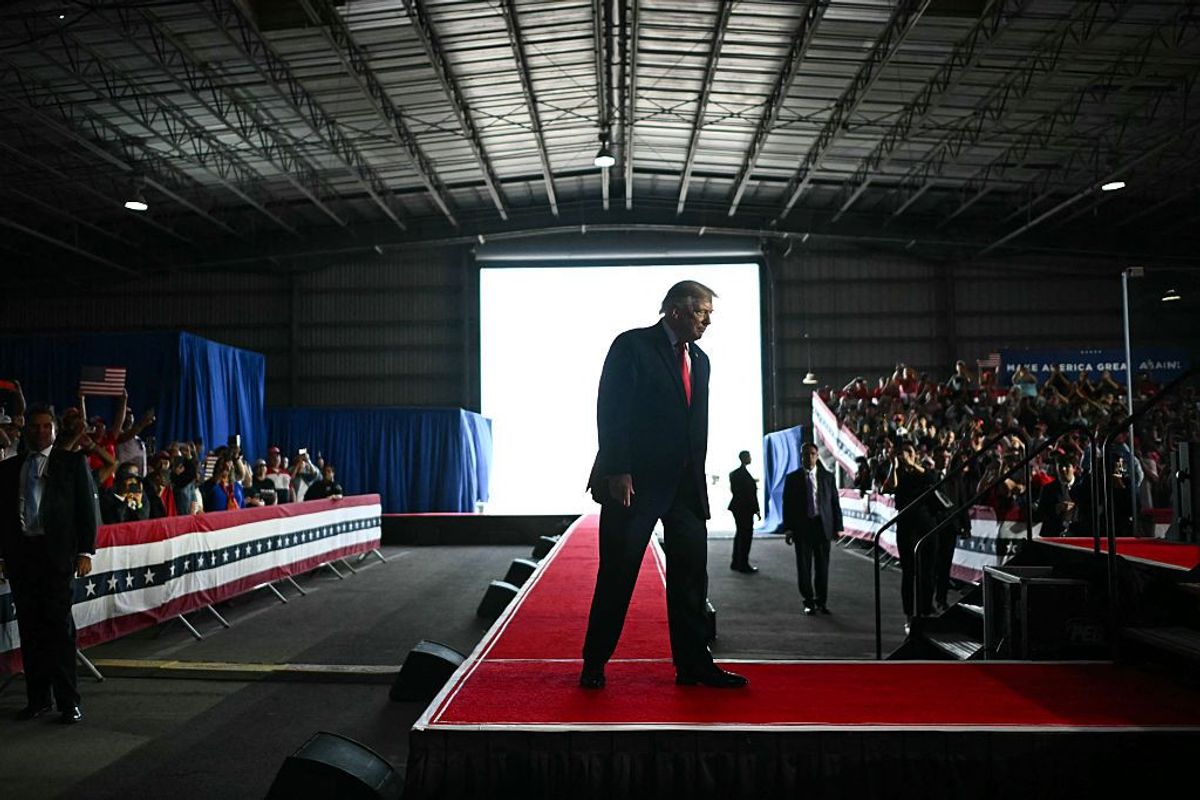
Getting charged with election fraud while fueling bogus allegations of election fraud — that’s the MAGA way.
In the Trump era, it’s not uncommon for Republicans to be charged or even convicted of voter fraud while their conservative movement pushes false — and fundamentally racist — claims of election chicanery. My colleague Steve Benen has covered this trend for years.
We, of course, can’t forget the insurrectionists pardoned by Donald Trump after they fueled a riot at the Capitol premised on lies about voter fraud. Or the Trump allies who agreed to pay up in 2024 after concocting a fraudulent voter suppression scheme.
And earlier this year, I wrote about the former official at Turning Point Action who comported himself as a champion of election integrity before pleading guilty to election fraud.
Certified hypocrites abound.
And now, Minnesota Public Radio is reporting that scandal-plagued conservative activist James O’Keefe and pro-MAGA content creator Cam Higby have been charged with various crimes over an alleged plot involving fake identities presented to election workers in an effort to sow doubt about the integrity of next week’s midterms.
Hennepin County prosecutors on Wednesday said they charged conservative provocateur James O’Keefe and another man with felonies for unlawful voting and identity theft for filming themselves misrepresenting their identities to election judges during the Minnesota Aug. 11 primary.
Hennepin County Attorney Mary Moriarty said they were alerted by the Minnesota Secretary of State’s Office that James O’Keefe, Cameron Higby and others were trying to undermine the state’s vouching system.
Videos posted by O’Keefe’s operation show them wearing burkas outside precincts during the primary. Moriarty said the voter names they used included some residents who were dead and at least one who voted.
Here’s the way O’Keefe’s operation recently defended the effort:
In a press release in August, O’Keefe’s group, which calls itself the “Justice League,” said the people in the video “did not cast ballots. The investigation was intended to test the limits of Minnesota’s vouching law and document how election workers apply it on Election Day.”
On Monday, he claimed that the “only way” Republican candidate Michele Tafoya can lose her Senate race in Minnesota is if liberals “cheat.” That’s the context for O’Keefe and Higby’s alleged scheme, which Media Matters recently described in more detail:
In August, O’Keefe and other right-wing content creators affiliated with his Citizen Justice League descended on Minnesota to attack the state’s voter voucher system, claiming to be registered voters in various precincts and asking poll workers if they would be able to vouch for several unregistered individuals who lacked photo ID.
Videos of the stunts, produced by Higby, O’Keefe, and Rubin, make the broad claim that Minnesota’s voucher system, which allows for a registered voter to “vouch” for the identities of up to eight unregistered individuals living in the same precinct, is a natural source for fraud.
Media Matters noted that some of the footage has been promoted by the Trump administration and conservative media. And the racism involved was unsubtle:
In the videos from O’Keefe and Higby, the pair dressed in what O’Keefe described as “full traditional Muslim attire” and adopted fake accents to impersonate registered voters and ask if they could vouch for several friends or family members.
But intimidation appears to be the primary intent here. O’Keefe is known for launching bogus sting operations that conservatives can use to peddle MAGA propaganda, potentially placing their targets in various kinds of danger. In 2024, I wrote about how one such operation apparently fueled violent threats toward staff at a shelter for immigrants in Arizona.
Now, Republicans are attempting to conjure up voter fraud claims to gin up backlash over a crucial Senate race in which polling has consistently shown the Democrat with an edge. And Minnesota’s Hennepin County apparently isn’t standing for it.
The U.S. Marine Corps values loyalty to one’s fellow Marines and to doing the right thing even when it’s easier to do what’s wrong. It’s not a huge surprise, then, that some Marines have been saying “no” to Defense Secretary Pete Hegseth, who’s demanded the expulsion of all transgender service members despite their demonstrated fitness for service. In two of three of these boards, formal hearings roughly similar to a trial, Marines have voted to retain transgender fellow Marines. And in the third case, the board expressly concluded that despite its vote, the Marine should be retained due to his “commendable service record and unique skills.”
The votes to retain are similar to jury nullification, and they send the clear message that honor restrains them from kicking out Marines who have met and continue to meet every Marine Corps standard. Thus, their vote to retain despite evidence that the Marine in question is or may be transgender.
Trump and Hegseth have already decided that any record of gender dysphoria, even if the service member never transitioned, requires a Marine or solider or sailor or airman to be stripped of the nation’s uniform
It is an Orwellian world that Marines and military members from the other services enter when ordered to sit on separation boards that Hegseth ginned up to kick out folks who refused “voluntary” separation. (It’s no less Orwellian for military lawyers made to facilitate such proceedings.) Military separation boards, in general, wield discretion to decide whether it’s in the best interest of the service to retain a fellow service member despite their alleged misconduct or diagnosed physical disability, these are boards in name only. President Donald Trump and Hegseth have already decided that any record of gender dysphoria, even if the service member never transitioned, requires a Marine or solider or sailor or airman to be stripped of the nation’s uniform. Hegseth means for these boards to do one thing: Confirm an indication, past or present, that the service member is transgender. That’s it.
They are directed to disregard the full record of the service member before them; to ignore their long history of honorable service including combat deployments; to look away from their superb performance evaluations; to not listen to their stellar character witnesses; and to pretend away the individual service member’s demonstrated excellence in an occupational specialty critical to a military at war.
Plainly put, the board members are ordered to lie and say that the service member is unfit to serve and thus play a role in depriving the U.S. military of that service member’s substantial training, experience and willingness to serve. It’s no wonder, then, that most Marine board members thus far — as well as most Navy board members — have ignored such nonsense and voted to retain. Their moral compasses demanded it.
This doesn’t mean that the Army and Air Force board members who have gone along with Hegseth’s lies don’t have moral compasses or that they enjoy being complicit with the cruel subterfuge that these boards represent. But despite whatever moral dilemma they may have between being asked to follow their values or follow orders, they have come down on the side of following orders. And they have had help. From Hegseth’s top civilian lawyer in the Pentagon to the services’ military judge advocate corps, Pentagon and military lawyers have contributed to the rationalization game that allows the Orwellian discharge boards to churn along. Legal top cover is a great way to rationalize dishonesty and justify morally bankrupt decisions that are inconsistent with one’s values.
But it’s disappointing that military lawyers have helped enable these gaslighting boards, especially since June when a Washington, D.C., federal judge agreed to make all transgender service members remaining on active duty part of a class protected by her preliminary injunction. That judge ordered Hegseth not to separate transgender service members (originally, only the named plaintiffs in Talbott v. United States) until their federal litigation challenging the transgender ban on constitutional grounds is complete.
Navy and Marine Corps boards voted for retention in nine of 12 cases, challenging an administration that treats transgender identity as grounds to end a military career.
But Judge Ana Reyes has still not issued her written ruling to that effect — she’s likely waiting to see what the Supreme Court will do with the government’s late August emergency petition challenging her preliminary injunction — and the services, surely reacting to pressure from Hegseth, have been accelerating the boards. But Reyes’ oral ruling gave and continues to give military lawyers strong legal ground to advise their commanders that holding separation boards — at least since June 30 — is contrary to a federal judge’s order. Yet the boards continue.
Hopefully more boards will follow in the footsteps of those service members who have decided to be guided by their values of integrity, loyalty, honor and respect. As social psychology studies have long shown, situational dynamics are incredibly powerful. Such dynamics have surely contributed to some boards rubber stamping the administration’s counterfactual determination that no transgender military member is worthy of continued service. There’s no reason to think that boards that refuse to rubber stamp Hegseth’s orders can’t be similarly influential.
While the unbelievably powerful dynamic of obedience to authority (recall the Milgram shock experiment) is almost impossible to interrupt, we’re seeing evidence that almost impossible isn’t the same as completely impossible, and that values and common sense can trump a service member’s order to lie and do what’s wrong.
* In light of the latest economic data, this decision was hardly the obvious one: “The Federal Reserve kept its key rate unchanged Wednesday at about 3.9% despite stubbornly high inflation, as Chairman Kevin Warsh suggested its policies are already showing signs of having an impact.”
* A remarkable turn of events in Brazil: “Defeated Brazilian presidential candidate Flávio Bolsonaro and his family landed in Miami on Wednesday after fleeing Brazil. The stunning move came after 48 hours in which Bolsonaro refused to concede to Brazilian President Luiz Inácio Lula da Silva and then threatened to attempt to annul the election result.”
* In related news: “A Brazilian Supreme Court justice on Tuesday ordered a police investigation into alleged ties between a donor network co-founded by Vice President JD Vance and the presidential campaign of Flávio Bolsonaro in the run-up to Sunday’s election.”
* A devastating disaster: “One high-speed Spanish train slammed into another that had stopped on the tracks Wednesday, killing at least 68 people and shredding carriages in the country’s second deadly rail collision this year. The regional government for Castilla La Mancha confirmed the death toll and said another 58 people needed medical treatment in hospital.”
* A case of ongoing interest: “Three news organizations that sued the White House after President Donald Trump banned them from the grounds have amended their lawsuit. They are now asking a federal judge to permanently restore their access, not just to the White House but to other areas including the Oval Office and Air Force One. The amended complaint filed by the news outlets — MS NOW, CNN and Politico — comes two weeks after U.S. Judge Timothy Kelly indefinitely reversed Trump’s ban and restored their access to the White House.”
* The need for secrecy in this case is hardly obvious: “The U.S. attorney’s office in Washington said on Tuesday that it would not unseal a search warrant executed by federal agents at the home of Representative Ilhan Omar of Minnesota this month. The office also asked a federal judge to deny requests for the warrant’s release.”
* The White House sure has lost a lot of cases like this one: “A federal judge ruled Tuesday that a Donald Trump-backed lawyer has been ‘unlawfully serving’ as the top federal prosecutor in Los Angeles. The decision regarding Bill Essayli’s service does not immediately take effect, and Essayli said the Supreme Court ‘will ultimately decide’ the legality of his tenure.”
* A little something to keep democracy advocates up at night: “As Election Day nears, recent events have prompted some FBI agents to express concern, according to seven people with knowledge of internal discussions among the ranks, that they may be ordered to seize voting machines or take other actions that disrupt election results.”
* The passing of a legend: “Dolores Huerta, an icon of the labor movement in California who co-founded the United Farm Workers, died Wednesday at the age of 96, her family announced.”
Ahead of the 2020 elections, Donald Trump told anyone who would listen that a Joe Biden victory would lead to “a depression the likes of which you’ve never seen.” The then-president’s claim was obviously foolish and quickly discredited by reality.
The Republican is nevertheless recycling the line, declaring at a campaign rally in Mississippi this week, “If the Democrats win, you will have a 1929-style economic depression. What they want to do is so bad for our country, you’re going to end up with a massive recession or depression.”
The incumbent president never got around to saying how this economic calamity would happen, which parts of the Democratic agenda are so dangerous or why he was so spectacularly wrong when he made the same prediction six years earlier.
But what struck me as especially notable was that even Trump doesn’t seem to believe his own fearmongering.
Just hours before his event in Mississippi, the president briefly spoke to reporters, one of whom asked how he’d “work with Democrats if they have control of the House or the Senate.” He replied:
We’ll figure a way. Look, I have strong veto. I hope that that won’t be the case, but if it is, that’s happened before with many presidents. And you have strong veto and you end up working out deals.
Oh.
So on the one hand, Trump wants Americans to believe that a Democratic majority on Capitol Hill would transform the nation into a hellscape in which transgender Muslim immigrants come to your home to turn your children into communists.
But on the other hand, Trump also wants Americans to believe that if there is a Democratic majority, he’ll veto bad ideas while working on possible bipartisan agreements — which is unlikely to sound all that scary to many voters.
The president made similar comments in early September, telling Fox News’ Laura Ingraham, “I’ll block all their bad stuff for two years. It won’t be the same, but I’ll be a blocker, what can I tell you?”
He then added that he’ll “probably be able to make deals” with the possible Democratic majority.
The Republican Party’s line is that the stakes in this election cycle are effectively existential — but Trump’s line is that it just won’t be that big a deal if Democrats prevail. That’s quite a message for the incumbent president to take to the electorate in the cycle’s closing days, but here we are.
Amid a flurry of Justice Department efforts to target people whom Donald Trump doesn’t like, two former FBI officials were charged late last week with lying to Congress — in a case of particular interest to the president.
Remember the story about Hunter Biden’s laptop? As part of a Republican investigation into the matter, Nikki Floris, the former deputy assistant director of the FBI’s Counterintelligence Division, and Bradley Benavides, another FBI official, briefed members of Congress about the contents of the computer. Last week, Trump’s DOJ charged them with allegedly making false statements about their level of involvement into the investigation.
Their attorneys condemned the charges as political “nonsense,” announced 10 days before closely watched elections, and it didn’t help matters that the president told reporters after their arrest, “I heard they were bad people.” He did not say from whom he’d heard this.
Nevertheless, the case appears to be off to a rough start. After prosecutors added an obstruction charge to the case, for example, a federal judge dismissed it.
But just as notable was what we learned from Bryan Witt, a veteran FBI agent, who testified Tuesday and shed light on what transpired behind the scenes. The New York Times reported:
In mid-July, President Trump gave a prime-time speech in which he raised concerns about a disputed F.B.I. report that China had tried to interfere in the 2020 election in an effort to defeat him.
At the heart of his address was a bitter complaint: that some of the bureau’s intelligence officials had purposefully sought to play down the report to undercut his claims about the race.
According to Witt’s testimony, one day after Trump targeted FBI officials in his remarks, FBI Director Kash Patel directed prosecutors immediately to investigate the officials for obstruction and conspiracy.
Witt conceded that FBI officials saw the inquiry as a “witch hunt,” and he personally saw the effort as a “huge distraction,” but the push ultimately led to charges against Floris and Benavides.
The Times report went on to note that Witt “asserted from the stand that he had never before worked on a case where instructions came directly from the F.B.I.’s director. He added that Mr. Patel and his deputies often checked on his progress, pressing him and his colleagues to move as aggressively as possible.”
Time will tell what becomes of the case, though it’s a safe bet that the defendants’ attorneys have taken a keen interest in what Witt had to say. But the broader takeaway from the agent’s testimony is unavoidable: Trump snaps his fingers, and Patel follows the president’s orders.
White House control over the Justice Department has been well-documented, but its control over the FBI is just as overwhelming. Patel, best known as a podcast personality before Senate Republicans elevated him to his powerful role, may lead the bureau, but there is fresh reason to believe he’s effectively a DINO — Director in Name Only.
A federal judge ruled Tuesday that a Donald Trump-backed lawyer has been “unlawfully serving” as the top federal prosecutor in Los Angeles. The decision regarding Bill Essayli’s service does not immediately take effect, and Essayli said the Supreme Court “will ultimately decide” the legality of his tenure.
The justices may have the last word not only on Essayli but also on a host of lawyers who have purported to lead districts around the country without being confirmed by the Senate. U.S. District Judge J. Michael Seabright noted in his ruling that the federal government has asked the Supreme Court to consider the issue in disputes over Trump’s chosen lawyers in Nevada (Sigal Chattah) and northern New York (John Sarcone).
In an order accompanying his ruling, Seabright, a George W. Bush appointee, gave the government a chance to try to halt his ruling pending appeal as the administration presses the appointment issue to the justices.
Urging the high court to use the Nevada case to resolve the nationwide issue, the Justice Department argued that lower court rulings against the administration “misconstrue” the law that deals with federal vacancies, “upend a quarter-century of practice,” “threaten chaos for the next presidential transition” and “cast a pall over prosecutions in 14 judicial districts nationwide.”
We could learn later this year whether and when the justices will take up the matter. They could grant review to decide it this term after holding a hearing and issuing a ruling that would be expected by July.
Meanwhile, given Seabright’s pause on his decision taking immediate effect, Essayli said he will “continue running the office.” The New York Times included Essayli on its list of prosecutors who are “carrying out Trump’s grievance agenda,” writing that he “has pushed to charge cases against anti-Trump protesters, many of which fell apart in court” and “carried out a direct order from Mr. Trump to open an investigation of voting in the state.”
Subscribe to theDeadline: Legal newsletterfor expert analysis on the top legal stories of the week, including updates from the Supreme Court and developments in the Trump administration’s legal cases.
"We need to have this meeting till the end of (next) month, I hope... between Nov. 6 and 10," Zelensky said at a press conference with Dutch Prime Minister Rob Jetten.
It’s apparently called the “Cabinet Travel Competition.” According to a report published by The Atlantic last month, the White House came up with the contest, which is exactly what it sounds like: The White House “encourages” Cabinet secretaries to “traverse the country to promote President [Donald] Trump’s agenda” and “tracks their visits to politically competitive congressional districts or states ahead of the midterm elections.”
Cabinet members, the article added, are awarded “points” based on their performance.
Although there are ethics laws such as the Hatch Act that appear to limit secretaries from engaging in such partisan election-season politicking, there’s ample evidence that a) the administration has pushed the gambit anyway; and b) several secretaries have taken the “Cabinet Travel Competition” quite seriously.
Indeed, it’s been quite jarring to see so many powerful officials — from Attorney General Todd Blanche to Defense Secretary Pete Hegseth, Health Secretary Robert F. Kennedy Jr. to Treasury Secretary Scott Bessent, Homeland Security Secretary Markwayne Mullin to Energy Secretary Chris Wright — allow themselves to serve as pieces on an electoral chessboard, to be moved around for the benefit of the Republican Party.
In each instance, these secretaries’ predecessors from both parties went out of their way to avoid electioneering, recognizing that it was not their place to use their taxpayer-financed positions to travel from state to state, participating in partisan campaign events.
And yet, in 2026, a new normal is taking shape.
For his part, Secretary of State Marco Rubio appeared to know better. The Florida Republican, who has been tapped to serve in a cartoonishly long list of positions on Trump’s team, has spent the year steering clear of the “Cabinet Travel Competition,” perhaps because he saw it as unseemly, or perhaps because he simply couldn’t squeeze time into his busy schedule to appear at campaign events.
Either way, Rubio earned some “points” on Tuesday afternoon, traveling with the president to some campaign events in Texas. He even delivered remarks at a rally in Corpus Christi, where he told Trump’s devotees, “It’s an honor to work for the greatest country in the world, for the greatest president in the history of the United States of America.”
Marco Rubio gets on stage and says he works for the "great president in the history of the United States"
As Tuesday got underway, Politico reported that Rubio was not expected to speak. Hours later, either he changed his mind or someone changed it for him. (A State Department official told The Hill that Rubio was traveling in his capacity as White House national security adviser, though that was hardly a compelling excuse, since he doesn’t have the luxury of simply pretending he’s not the current secretary of state.)
Almost exactly six years ago, then-Secretary of State Mike Pompeo faced an investigation from the Office of Special Counsel after engaging in election-season partisan activities. Six years later, Rubio is apparently picking up where his Republican predecessor left off, seemingly confident that he won’t have to worry about the consequences.
Civilians in Russian-occupied Oleshky, Kherson Oblast, are to be evacuated from the town hospital on the morning of 30 October, Oleksandr Tolokonnikov, deputy head of the Kherson Oblast Military Administration, told DW on 27 October. The date could still change, he said.
Oleshky, a town on the Dnipro’s left bank across from Kherson, has been occupied by Russia since February 2022 and has gone short of food and medicine for months. Of about 24,000 pre-war residents, 1,700 to 2,000 remain, mostly elderly, the White House estimates. Drone strikes and mines have cut the town off from the rest of the region, the Financial Times reported. The evacuation would give them an organized way out, and test whether Russia lets those who choose Ukraine actually leave.
The route for those who want to go to Ukrainian-controlled territory is not yet set and will likely pass through Russia, Tolokonnikov said. “There will be two paths,” he added: one for those who want to stay in occupied territory or in Russia, and one for those who want to leave.
Putin calls Oleshky a “Russian settlement”
On 27 October, Russian President Vladimir Putin described Oleshky as a “Russian settlement” in a call with the leaders of Finland and Norway, the Institute for the Study of War (ISW) reported. ISW said it remains unclear whether occupation authorities will give residents “a legitimate and duress-free choice” to return to Ukraine. It warned that Moscow may treat holders of Russian passports as Russian citizens with no legal recourse to return.
People with knowledge of the talks told the Financial Times that residents who agree to leave would first be taken to occupied Crimea or Russia. The paper also reported that buses would take people out on Thursday morning, 29 October, a day earlier than the date Tolokonnikov gave.
President Volodymyr Zelenskyy warned in a television interview on 25 October, the FT reported, that Russia would “de-mine in such a way that these people go towards Russia and remain there.”
Truce holds into a second day
The ceasefire took effect at 03:00 Kyiv time on 27 October and runs until 22:59 on 1 November, Ukraine’s human rights commissioner Dmytro Lubinets said on X. A day later, he wrote that Oleshky had gone 30 hours without an incident, crediting his contact with Russia’s human rights commissioner Yana Lantratova. The goal, he wrote, is to “create the conditions for the safe departure of those who need it.”
Ceasefire in Oleshky: Agreement Being Fully Honored
As of 5:30 p.m. on October 27, Ukraine and Russia are adhering to the ceasefire agreement in designated areas related to the humanitarian mission.
The truce also covers Kherson Oblast’s coast, and Kherson city has gone quiet, Tolokonnikov told DW. The city has “literally come alive,” Lubinets wrote on 28 October, adding that both sides were still fully complying as of 12:00. On the truce’s first day, Volodymyr Obertas, an Oleshky-born press officer of Ukraine’s 34th Marine Brigade, was killed in central Kherson while escorting journalists. The brigade’s communications chief told Suspilne he stepped on an unidentified explosive device. The Defense Ministry’s Army TV said Russian forces detonated it remotely.
The deal reaches beyond Oleshky. Under terms both sides signed, Russia and Ukraine are to organize aid deliveries and repatriation in Kherson Oblast settlements as needed, at least once a month, after the Oleshky mission, Fox News reported.
The White House announced the ceasefire on 23 October, crediting First Lady Melania Trump with brokering it.
“I anticipate some will want to go to Russia, and some to Ukraine,” she said.
Drone-dropped aid and warning of staged Russian videos
Ukraine’s 34th Marine Brigade, working with National Guard and border guard units in Joint Forces South, delivered about 4 tons of food and medicine to Oleshky by drone, the command said on 25 October. According to intelligence, Russia is preparing dozens of staged videos in the town, in which residents would be forced to say on camera that they are well fed and grateful to the occupiers, it added.
Aid parcels dropped by Ukrainian drones for residents of Russian-occupied Oleshky, in a thermal drone image released on 25 October 2026. Photo: Joint Forces South/Telegram
Residents who try to leave the front-line town on their own cross mined ground, and Russian troops have seized food that Ukraine dropped in by drone.
MIAMI (AP) — Defeated Brazilian presidential candidate Flávio Bolsonaro and his family landed in Miami on Wednesday after fleeing Brazil.
The stunning move came after 48 hours in which Bolsonaro refused to concede to Brazilian President Luiz Inácio Lula da Silva and then threatened to attempt to annul the election result.
Bolsonaro’s father, Jair Bolsonaro, also fled to Florida after losing the 2022 presidential election to Lula before returning to Brazil three months later. On Monday, the U.S. said that it would grant visas to Flávio Bolsonaro and his family. Bolsonaro, a Trump ally, visited the White House in May.
Bolsonaro first fled from Brazil to Argentina and then Ecuador alongside his wife and two daughters, Argentina’s migration authority said Wednesday — a day after the 45-year-old senator and his family were granted United States visas by the Trump administration.
Bolsonaro is under investigation by Brazil’s Supreme Court for alleged corruption, money laundering and tax evasion in two cases. The court had ordered Bolsonaro to hand over his regular and diplomatic passports by noon Tuesday — two days after he lost the vote to Lula. It remained unclear whether he had complied, but allies said late Tuesday he also has an Italian passport.
Argentina’s migration authority said Bolsonaro, his wife Fernanda Antunes Figueira Bolsonaro, and his daughters Carolina Figueira Bolsonaro and Luiza Figueira Bolsonaro crossed into the country at 10:50 p.m. Tuesday. They entered via the Tancredo Neves International Bridge, a primary border checkpoint linking Brazil to Argentina’s northeastern province of Misiones.
“Those who did so possessed valid travel documentation and faced no legal impediments to entering the country,” the Argentine migration authority said on X.
The authority said that at 11:30 p.m. local time, shortly after clearing immigration control, the four boarded a private charter flight operated by aviation company Baires Fly S.A. According to the filed flight plan, the aircraft departed for Guayaquil, Ecuador.
The move is almost certain to cause a big diplomatic rift between Lula and Argentine President Javier Milei, a Trump ally who traveled to Brazil to take part in Bolsonaro’s campaign.
Bolsonaro lands in Miami
Flight tracking website FlightRadar24 showed that a plane fitting the description of Bolsonaro’s landed in Guayaquil at about 4 a.m. local time, before taking off minutes later for Miami-Opa locka Executive Airport. The plane carrying Bolsonaro and his family landed in Miami at around 9:30 a.m. ET.
Lula, who turned 81 on Tuesday, told several dozen supporters outside the presidential residence in Brasilia before the plane landed that he didn’t have precise information about Bolsonaro’s whereabouts, but said he had left Brazil.
“I regret that he left Brazil, because he could have stayed here and proven that the accusations are not true,” Lula said. “This act of leaving Brazil is shameful.”
Paulo Figueiredo, a close Bolsonaro ally who lives in the U.S., said in a short statement that he can’t confirm information from foreign authorities, but added “Flávio Bolsonaro is well, in security and resting with his family.” Figueiredo also said there would be a press conference Thursday in Miami to discuss the case.
Representatives of Brazil’s government didn’t immediately respond to requests for comment from The Associated Press.
U.S. President Donald Trump said early Wednesday that he would approve of Bolsonaro coming to the U.S., calling him and his family “fine people.”
“The election was really strange, and I thought it was terrible,” Trump told reporters at Joint Base Andrews, Maryland, after returning from campaigning in Texas on Tuesday. He did not elaborate, but stressed that he didn’t endorse the election results.
Leaders all over the world and the Organization of American States, or OAS, endorsed the result and congratulated Lula, who was reelected by a margin of about 4.4 million votes in the second and final round.
On Tuesday, Milei’s administration spokesman Adrián Ravier said “there is no asylum request (from Bolsonaro) and there is nothing more to add.”
Bolsonaro visited his father, who is under house arrest, before leaving Brazil
The defeated candidate was served with a Supreme Court order to surrender his Brazilian passports Monday. In a video, he said he received it outside the home where his father, former President Jair Bolsonaro, is serving a 27-year sentence under house arrest for attempting a coup following his 2022 election loss to Lula.
Flávio Bolsonaro said on Monday in a video that he was attempting to organize opposition among his congressional colleagues to the election results. His eight-year term as a senator expires Jan. 31, 2027, which will also cause him to lose special jurisdiction at the country’s Supreme Court.
Brazil’s Supreme Court is investigating Bolsonaro for allegedly using a sports betting company to launder fraudulent deductions from government pensions paid to senior citizens. In a separate case, he is accused of accepting millions of dollars from a disgraced banker.
During a brief Q&A with reporters on Tuesday afternoon, Donald Trump was asked whether he’ll “respect the results” of the midterm elections, “whatever happens.” Before we get to the president’s answer, it’s worth taking a moment to dwell on the question.
Not to put too fine a point on this, but we used to be a country in which questions like these weren’t even asked. It was a foregone conclusion for generations: The United States was a stable democracy and the world’s pre-eminent superpower. There was no real need to wonder: American candidates for powerful offices agreed to honor election results. The entire line of inquiry was unnecessary since the answers were assumed.
But as the radicalization of Republican politics intensifies, and GOP rejection of election results becomes more common, it’s no longer considered outlandish to ask Republican leaders whether they’ll accept voters’ judgment — just as it’s no longer surprising when they fail to say “Of course I’ll honor the will of the electorate.”
All of which brings us to Trump’s response on Tuesday afternoon.
Q: You'll respect the election results whatever happens?TRUMP: If they're honest elections(That's a no!)
“I will,” the president replied, indicating that he’d accept the election results, before quickly adding, “if they’re honest elections.”
And who gets to decide whether the elections are “honest”? According to Trump, he does.
To be sure, this isn’t altogether new. As The Washington Post reported, “In 2016, Trump said he would accept the election results ‘if I win.’ In 2020, he repeatedly declined to commit to accept the results, saying ‘We’re going to have to see what happens.’ In 2024, Trump said he would accept the results if the election was ‘fair and legal and good.’”
In other words, when it comes to conditional respect for democracy — the results are only legitimate if he likes and agrees with them — the Republican is at least consistent.
But this isn’t just a matter of Trump giving a Trumpian answer during a brief exchange with a reporter. On the contrary, there’s a more systematic effort underway, which appears designed to deliberately undermine confidence in the elections themselves. The Post separately reported:
President Donald Trump and his allies have spent the final weeks before the midterms showering his supporters with a relentless stream of doubt about the legitimacy of the election, priming them to question results if Republicans lose.
In court, the administration is telegraphing its readiness to challenge results based on alleged fraud. In podcasts and social media posts that are delivered nonstop to Trump’s core backers, right-wing influencers are telling supporters to expect cheating.
The newspaper’s analysis also found that the misinformation campaign is twice as intense as it was ahead of the 2024 elections.
It might be tempting to shrug this off, since Trump lies to so many people about so many things, and the president’s deceptions tend to have limited practical effects. But let’s not forget that the last time he tried to lay the groundwork for rejecting election results he didn’t like, and Republican candidates fared poorly, thousands of the president’s followers launched an insurrectionist attack on the U.S. Capitol.
In legal circles, it’s known as “no bill.” That’s the label used to describe what happens when prosecutors go to a grand jury to secure an indictment and regular people serving as jury members decide to reject the effort.
If it seems as if the phrase has come up quite a bit over the past year or so, it’s not your imagination. Donald Trump’s Justice Department tried to indict New York Attorney General Letitia James, for example, but grand jury members balked. The same thing happened when the Republican administration tried to indict several congressional Democrats, as well as in the case against Sean Dunn (better known as the “sandwich guy,” who was later charged with a misdemeanor).
In each instance, federal prosecutors tried to bring dubious charges against a perceived presidential political foe. In each instance, the nature of the process was slanted against the accused. (Grand juries don’t even hear from the defense.) In each instance, Trump’s DOJ failed anyway — despite the fact that a “no bill” is almost unheard of for most career federal prosecutors.
A federal grand jury on Tuesday rejected an indictment against former White House aide Cassidy Hutchinson after the Trump Justice Department tried to charge her over her stunning testimony on the Jan. 6, 2021, Capitol riot.
Prosecutors in the Justice Department’s Civil Rights Division sought to charge Hutchinson with a crime based on claims she made false statements, according to two people with knowledge of the case. They were granted anonymity to describe normally closed-door proceedings.
To be sure, the developments are humiliating for the DOJ, and it will no doubt be tempting for the administration’s many critics to point and laugh at the failure.
But while that’s understandable, it’s also worth appreciating what a scandal this is.
There’s no reason to believe Hutchinson, who delivered stunning testimony more than four years ago about what transpired on Jan. 6, did anything wrong. But because we’re in a twisted political environment in which people can expect to face prosecutorial scrutiny for having wronged the incumbent president, Attorney General Todd Blanche pushed prosecutors to investigate the former White House staffer, whose case ended up in the hands of Harmeet Dhillon, the controversial Trump loyalist who runs the Civil Rights Division, which wouldn’t appear to have any relevant jurisdiction over a case like this.
What we’re witnessing, in other words, is unambiguous evidence of a hyperpartisan, weaponized Justice Department, controlled by the West Wing, trying (and failing) to prosecute a baseless case against someone Trump doesn’t like.
The developments come against a backdrop in which the same politicized DOJ went after former FBI Director James Comey yet again and charged Democratic state Sen. L. Louise Lucas of Virginia after she spearheaded an electoral effort the White House didn’t like, in the run-up to the midterm elections, when politically sensitive prosecutions are traditionally delayed.
I’m glad the case against Hutchinson flopped, but the larger context matters: The fact that this case was pursued at all reflects crisis conditions in federal law enforcement.
In an extensive conversation with EU Today publisher Gary Cartwright, Ukrainian-American lawyer and political commentator Askold Lozynskyj delivers a sharply critical assessment of Donald Trump, examines the possibility of a geopolitical bargain with Vladimir Putin and Xi Jinping, and explains why November’s American midterm elections could determine far more than the composition of Congress.
There is something peculiarly unsettling about a world in which the leaders of three nuclear powers might gather to discuss the future of smaller nations without troubling to invite the nations concerned. It is a diplomatic arrangement with considerable historical precedent, although not necessarily the sort that ought to inspire confidence.
For Askold S. Lozynskyj, a New York lawyer, former president of the Ukrainian World Congress and regular contributor to EU Today, the prospect of Donald Trump sitting down with Vladimir Putin and Xi Jinping raises precisely this concern.
His latest opinion piece, The Thug Summit, published on 23 October, presents an uncompromising interpretation of the proposed trilateral meeting in China. In a wide-ranging conversation with EU Today publisher Gary Cartwright, Lozynskyj expands upon that argument, moving from the peculiarities of Trump’s political personality to the constitutional foundations of American democracy, the future of Europe and the increasingly precarious standing of international law.
The resulting discussion is occasionally caustic, frequently humorous and consistently concerned with a question that extends well beyond the current occupant of the White House: how resilient are democratic institutions when confronted by leaders who regard constitutional constraints as inconveniences?
Watch the full interview with Askold S. Lozynskyj and Gary Cartwright below.
From the Oval Office to the Beverly Hillbillies
The conversation begins with Trump’s political ascent, which Lozynskyj regards as one of the more extraordinary developments in modern American history.
Buddy Ebsen as Jed Clampett in the American television comedy The Beverly Hillbillies. Credit: CBS Television / Wikimedia Commons (1969 publicity photograph; US public domain).
He recalls the incredulity surrounding Trump’s original presidential ambitions and questions how a politician whose personal conduct had attracted considerable controversy managed to secure such enthusiastic support among conservative Christian voters.
Cartwright introduces a lighter comparison, recalling a photograph of Trump surrounded by his senior advisers in the Oval Office.
The only person missing, he suggests, was Jed Clampett, the fictional patriarch of the American television comedy The Beverly Hillbillies.
Lozynskyj is not inclined to defend the administration’s sophistication. Yet behind the humour lies a more serious argument about the disappearance of independent-minded advisers and the consequences of political loyalty becoming the principal qualification for high office.
“Donald Trump is not a conservative. Donald Trump is a thug,” he declares.
It is an unequivocal assessment, characteristic of Lozynskyj’s commentary, although his criticism extends beyond Trump himself to the Republican Party’s willingness to accommodate his leadership.
The elections that could change Washington
Much of the interview centres on the American midterm elections scheduled for 3 November.
Lozynskyj predicts that Democrats will regain control of the House of Representatives and potentially transform the remainder of Trump’s presidency through congressional investigations, subpoenas and impeachment proceedings.
His prediction is emphatic, although the eventual balance of power remains uncertain.
Control of the House would give Democrats substantial investigative authority, although the president would retain his executive powers. Removing him from office following impeachment would still require a two-thirds majority in the Senate.
Nevertheless, Lozynskyj believes the elections could fundamentally alter Washington’s political atmosphere.
“They will tie up Trump like never before,” he argues.
Cartwright raises a more disturbing possibility: could Trump manufacture an emergency to postpone an election or otherwise attempt to prolong his presidency?
“I think he could try, but I don’t believe that he will prevail,” Lozynskyj responds, expressing confidence that America’s constitutional institutions would ultimately resist such an attempt.
The exchange moves naturally towards the events of 6 January 2021, presidential immunity and the effectiveness of the checks and balances upon which the American constitutional system depends.
Ukraine, Europe and the price of great-power diplomacy
For Lozynskyj, whose public career has been closely associated with Ukrainian interests, the implications of Trump’s foreign policy are particularly troubling.
His central concern is that negotiations among Washington, Moscow and Beijing could revive the notion that major powers possess an informal entitlement to determine the political and territorial futures of their neighbours.
In his opinion piece, he raises the possibility that Ukraine and Taiwan could become bargaining instruments in a wider geopolitical settlement. These are his warnings about potential outcomes, not established agreements between the three governments.
Yet his criticism of Washington is accompanied by considerable appreciation for Europe’s role in sustaining Ukraine’s resistance to Russia’s invasion.
“Without Europe, Ukraine could never have survived as long as it has survived,” he tells Cartwright.
He also ventures into the British debate over European integration, arguing that the United Kingdom should return to the European Union.
It is an intervention likely to provoke disagreement, but it reflects his broader conviction that collective institutions provide an essential counterweight to unilateral political power.
Democracy, disorder and the limits of authority
The discussion also examines political unrest in Europe, changing national identities and the relationship between elected governments and the populations they represent.
Cartwright points to social tensions in European cities and the growing importance of regional identity, including the independence debate in Flanders.
Lozynskyj approaches these developments through the history of democratic protest, citing Ukraine’s Orange Revolution, the Revolution of Dignity and more recent demonstrations over the independence of anti-corruption institutions.
For him, public opposition to governments is not necessarily evidence of democracy’s failure. It can also demonstrate that political authority remains subject to popular consent.
The conversation concludes with international law, the International Criminal Court and the difficulty of enforcing common rules when powerful states refuse to accept external constraints.
Lozynskyj’s observations are deliberately provocative, and his forecasts will be tested by events. But the interview offers something more substantial than another exchange of opinions about Donald Trump.
It is a discussion about the relationship between power and restraint, the responsibilities of democratic institutions and the uncomfortable possibility that the international order may be entering another period in which military and economic strength increasingly determine political outcomes.
As the United States approaches its midterm elections and speculation continues over a possible meeting between Trump, Putin and Xi, those questions are unlikely to disappear.
The full conversation with Askold S. Lozynskyj is available in the video above.
One week before the midterms, President Donald Trump has a new offer for anyone who can help him prove what he has been insisting for years.
“Anybody reporting Voter Fraud in the past Elections, or the upcoming 2026 Midterm Election, will be paid $1,000,000 upon the arrest and conviction of those that created the Fraud!” Trump posted Monday.
The White House didn’t say where the money would come from, and Congress hasn’t authorized any such fund, according to The Washington Sun. The offer appears designed to generate headlines. Rick Hasen, a UCLA law professor and one of the country’s foremost election law experts, called it “part of a larger project … to generate distrust of the election system.”
It’s tempting to dismiss this as old news. “Trump cries fraud” has been a familiar headline for a decade. But that misses how much groundwork has already been laid. Trump’s “stolen election” narrative for these midterms is prewritten.
The president and his allies have spent the final weeks of the campaign “showering his supporters with a relentless stream of doubt about the legitimacy of the election, priming them to question results if Republicans lose,” according to a Washington Post analysis published Tuesday. Nearly 600 high-profile right-wing accounts, podcasts and outlets have published more than 7,000 statements this year questioning the election’s integrity, per the Post. Claims about noncitizen voting and mail ballots are twice as common as they were in the 2024 cycle. Trump himself has made nearly 300 such statements in his second term.
The message is landing. Just 45% of Republican voters are confident noncitizens will be kept from voting, compared with 90% of Democrats, a Pew Research Center survey found. Only 28% of Americans are confident Trump will accept the results if Republicans lose, according to a Washington Post/ABC/Ipsos poll.
To see how this works, rewind to June. Who would have imagined it would take Spencer Pratt losing the Los Angeles mayor’s race to show it?
‘Not possible’
Then-Los Angeles mayoral candidate Spencer Pratt speaks to the media outside of an election night party at Don Antonio’s Mexican restaurant on June 2, 2026, in Los Angeles.Ronaldo Bolaños / Los Angeles Times via Getty Images
By the morning after the June 2 primary, Pratt, the former reality TV star running as a Republican, was comfortably in second place. He had about 30% of the vote to Councilmember Nithya Raman’s 22%, and he was on track for a November runoff against Mayor Karen Bass.
Then Los Angeles kept counting. Five days later, Raman passed him.
In itself, that was not surprising. Democrats make up a supermajority of the city’s electorate. Bass is a Democrat, and Raman ran to her left. Los Angeles also counts slowly, checking signatures and examining ballots by hand.
None of that takes fraud to explain. And yet.
“Not possible for Spencer Pratt to have lost the L.A. runoffs after the big lead he had,” the president wrote on Truth Social. “3rd World Nation. Rigged Elections!”
Swap out Pratt’s name for a Republican House candidate in Orange County, suburban Detroit or South Texas, and it’s easy to see how this could work.
Trump hasn’t stopped previewing. On Monday, he said Brazilian President Luiz Inácio Lula da Silva’s comeback win “looked like another rigged election.”
You may reasonably ask: How is this new? Trump has sown distrust about elections for years, after all. What’s different this time?
What’s different is that Trump has help. In 2020, he had the “fraud” narrative but not a federal government willing to act on it. Now he has both.
‘I work for President Trump’
President Donald Trump and Attorney General Todd Blanche during a roundtable at the White House on Oct. 21, 2026.Kevin Lamarque / Reuters
The institutions that pushed back last time have been rebuilt around Trump’s wishes.
Start with the Department of Justice. Bill Barr, Trump’s attorney general in 2020, stood up to him, saying publicly that the department hadn’t seen fraud on a scale that could have changed the outcome of that year’s presidential election. Would Todd Blanche, Trump’s former criminal defense lawyer and now his attorney general, do the same?
The next day, reporters asked whether there was any scenario in which the Justice Department would try to block states from certifying their results. Blanche said the department had no intention of improperly interfering, but invoked a hypothetical “doomsday scenario” and wouldn’t rule it out. “To say that there’s no circumstances that we would ever do that, of course, I’m not going to say that,” he said.
Blanche isn’t alone in leaving the door open. Consider Jay Clayton. In June, while he was still the U.S. attorney in Manhattan, Clayton went on CNBC and declined to endorse or rule out widespread fraud, saying “the opportunity for fraud” exists. At his confirmation hearing to become director of national intelligence, he wouldn’t directly acknowledge who won the 2020 election. The Senate confirmed him in July.
And there’s Bill Essayli, the hard-charging Trump appointee who runs the U.S. attorney’s office in Los Angeles. After Pratt’s loss, Essayli announced he had “multiple election fraud investigations underway.” (To his credit, he also knocked down at least one of the false claims about the race, The Wall Street Journal reported at the time.)
Now Essayli is out front on the administration’s push to get California to set aside mail ballots from voters it says are noncitizens. “We believe it’s at a minimum of 20,000,” he told Fox News Digital. The Justice Department has said its list came from purchased voter data analyzed by third parties. California officials say an initial review of a sample found that 1 in 4 people on the list were born in the U.S.
On Monday, a panel of the 9th U.S. Circuit Court of Appeals declined, 2-1, to rule on the department’s request. A Trump appointee on the panel wrote that the administration appeared to lack the constitutional power to demand it.
None of that has slowed the spin. “BOMBSHELL: Trump exposed that 20,000 noncitizens flagged on California’s rolls are just ONE batch!” Students for Trump founder Ryan Fournier posted to his 1.2 million followers.
Trump’s Justice Department files a suit, influencers tout it as a “BOMBSHELL” and the base gets more convinced the system is rigged, making the next claim easier to sell. The courts may keep saying no, but the new filings keep feeding the story.
The DOJ is already promising a postelection fight. Its observers “will be eyes and ears for any violations, and may take legal action afterwards. Stay tuned!” Harmeet Dhillon, head of the DOJ’s Civil Rights Division, posted Friday on X. Ben Hovland, whom Trump fired from the Election Assistance Commission, expects the department to act as “the administration’s personal law firm,” according to The Washington Post.
Back in June, the risk was that the Justice Department had gone from a guardrail against baseless election fraud claims to a participant in fanning them. A week from Election Day, that’s no longer hypothetical.
‘Something is wrong here’
Speaker of the House Mike Johnson during a news conference outside the Capitol on May 8, 2024, where he introduced the SAVE Act, which would require proof of U.S. citizenship to register to vote in federal elections.Tom Williams / CQ-Roll Call, Inc via Getty Images
The bellowing isn’t just coming from Trump.
It’s coming from Congress. “Some of these efforts are so diabolical and so far upstream it is impossible to prove,” House Speaker Mike Johnson said about the elections in California after Pratt’s loss. “Everybody knows instinctively something is wrong here.”
It’s coming from governors. “California keeps dumping votes,” Florida Gov. Ron DeSantis tweeted in June as Pratt’s odds of making the runoff dropped. “Count until you get the result you want?” DeSantis, notably, never explicitly endorsed the “stolen election” rhetoric in 2020.
In today’s Republican Party, suggesting election fraud is the price of admission, and nobody has to produce evidence to pay it. Every time a speaker or governor makes such a claim without evidence, the Overton window shifts, making the claim sound a little more “reasonable.”
Johnson was a relatively obscure member of Congress in 2020 when he led an amicus brief supporting Texas’ bid to invalidate the election results in several swing states. Now he’s House speaker, which puts him within arm’s reach of a little-noticed step in the transfer of power. The House clerk assembles the roll of members-elect, the official list of those who will be sworn in when the new Congress convenes in January. If Johnson moved to fire the clerk, Rep. Jim Himes, D-Conn., told The Washington Post, it would be “a ‘break glass’ scenario.”
Democrats aren’t assuming the best. “We’re making the presumption that the president will not accept the results,” Himes said.
‘As steadily as a metronome’
Election workers sort ballots during early voting at City Hall in San Francisco on Oct. 21, 2026.David Paul Morris / Bloomberg via Getty Images
California shows why there’s no winning this argument.
Perhaps no state takes longer to count its votes. And California is poised to matter enormously again. In 2024, nearly a week after Election Day, nine of the 16 uncalled House races that would decide control of the chamber were in California, the Times reported. This year, the state’s newly drawn districts include several of the most contested races in the country.
In June, a Democratic consultant told the Times that the most effective way to speed up California’s count would be to eliminate security measures such as signature verification and provisional ballot checks. The “fix” for the problem Trump described would require gutting the safeguards he says are missing.
So a slow count that ends in Democratic gains becomes evidence of fraud. A fast count that would require stripping out protections becomes evidence of fraud. A steady count doesn’t help, either. In a filing Sunday, the DOJ complained that California’s counties “continue to process tens of thousands of ballots as steadily as a metronome, willfully indifferent to the fact that upwards of 20,000 of those ballots may have been cast by noncitizens.” There is no outcome that doesn’t feed the narrative.
Meanwhile, back in Los Angeles, voters will choose between Bass and Raman on Tuesday. Pratt won’t be on the ballot.
Then-Los Angeles mayoral candidate Spencer Pratt speaks to the media outside of a election night party at Don Antonio's Mexican restaurant on June 2, 2026, in Los Angeles
President Donald Trump and Attorney General Todd Blanche during a round table at the White House on Oct. 21, 2026.
Speaker of the House Mike Johnson during a news conference outside the Capitol on May 8, 2024, where he introduced the Safeguard American Voter Eligibility (SAVE) Act, which would require proof of U.S. citizenship to register to vote in federal elections.
Election workers sort ballots during early voting at City Hall in San Francisco on Oct. 21, 2026.
The hive of bigotry buzzing around Defense Secretary Pete Hegseth is a national security threat. And it should be a top investigative target for Democrats if they retake the House.
Democrats are already pondering how to force the scandal-plagued former Fox News host from his Cabinet post if they prevail in next week’s midterm elections. But even if that happens, House committees will need to address the culture of abject bigotry Hegseth has enabled at the Pentagon, particularly his permission of white supremacist ideologies — given that officials in various administrations, including Donald Trump’s first one, have deemed white supremacists as the country’s biggest domestic security threat.
CNN is out with a new report showing that this racist rot has reached the marrow at the Defense Department. The report homes in on deranged social media posts from Ryan Higgins, a top faith adviser at the Pentagon who CNN said has helped shape some of Hegseth’s unhinged speeches. Per the report:
On his social media platforms, CNN found Higgins defended a video President Donald Trump shared depicting the Obamas as apes, said same-sex marriage was “abominable,” and speculated about how many abortions former Vice President Kamala Harris might have had, citing her age and claiming she had a “long record of sleeping around.”
He’s also asserted that the “Separation of Church and State does not exist” and has posted extreme rhetoric about immigrants.
“They act like barbarians, killing and raping our white women,” he wrote in one post responding to tabloid coverage of sexual crimes allegedly committed by immigrants in Europe.
I recently wrote about how MAGA world has borrowed from groups like the Ku Klux Klan in using the threat of rape as an anti-immigrant scare tactic. CNN’s report cites numerous other bigoted posts from Higgins that portray him as an election denier and someone who loathes the idea of women aspiring toward anything but baby-making, thinks LGBTQ people are satanic and — crucially — believes brown Muslim people are the scourge of the earth.
Yet when asked for comment by CNN, a Pentagon spokesperson touted Higgins and the job he’s doing:
Higgins did not respond to requests for comment on this story. A spokesperson for the Department of Defense called Higgins a “valued member of the Secretary’s team” who “does an outstanding job serving as a senior adviser.”
“He has been completely focused on the spiritual health of our troops and the historic establishment of the Office of Religious Affairs,” Chief Pentagon Spokesman Sean Parnell said in a statement.
Parnell did not respond specifically to detailed questions about Higgins’ posts reviewed by CNN.
Probing this web of influence and the ways it’s infecting the Defense Department should be a priority for Democrats. And the good thing, politically speaking, is that — thanks to Hegseth — it has never been easier for liberals to help voters draw a connection between this kind of bigotry and the nation’s biggest woes.
A major reason Americans are paying more for everything from gas to groceries these days is that a bunch of Islamophobic, hypermasculine hate-mongers in Trump’s regime are choosing to play war games with the Islamic Republic of Iran — and apparently failing.
Happy Tuesday! Here’s your Tuesday Tech Drop, the past week’s top stories from the intersection of technology and politics.
Dems want damning surveillance report
A pair of Democratic senators are accusing President Donald Trump’s administration of hiding a report that “details serious abuses of Americans’ rights under Section 702 of the Foreign Intelligence Surveillance Act.” Sens. Ron Wyden, D-Ore., and Adam Schiff, D-Calif., are trying to pry loose a report they say the administration is legally required to make public after a FISA court opinion detailed abuses of the program in March.
Since retaking office, Trump has expanded the federal government’s arsenal of creepy surveillance tools en route to building what appears to be an unprecedented spy machine that can track Americans. It’s in that context that Democrats — with some GOP help — tanked a vote in June that would have extended the controversial FISA powers that give the government broad latitude to sweep up data, including information belonging to Americans.
In a letter to Director of National Intelligence Jay Clayton and Attorney General Todd Blanche, the two Senate Democrats said the damning FISA report from on alleged surveillance abuses should have been released already — and demanded that it be released now so lawmakers can consider whether to extend FISA powers next year.
The administration has now had over seven months to declassify and release this opinion. It is time to stop violating the law and finally release this opinion. And if this administration won’t follow this simple statutory directive, it is unclear why Congress or the American people should trust this administration to follow any of the other legal limits to Section 702.
Artificial intelligence bots are increasingly gaining unauthorized access to people’s bank accounts, according to new reporting from Axios. The report homes in on concerns among bank officials about security in the age of AI.
A judge ordered Meta to pay $25 billion after the company lost a lawsuit alleging that the company broke New Mexico’s consumer protection laws and jeopardized its users after the Cambridge Analytica scandal nearly a decade ago. Meta has vowed to appeal the ruling.
After Mississippi’s Republican attorney general issued legal threats last week, the state’s Democratic Senate nominee, Scott Colom, deleted an ad using AI tools to mock his Republican opponent, Sen. Cindy Hyde-Smith. I wrote about how it seems like Republicans are fretting over this race in a deep-red state.
Samuel Sey, a popular right-wing influencer known for supporting Trump’s racist anti-immigrant crackdown, reportedly has been detained by immigration officials and is now facing deportation after allegedly overstaying a temporary visa.
The good news is the Pentagon apparently has some guidelines around the development of AI tools to avoid the risk of escalating wars or harming civilians and troops. The bad news? Defense officials aren’t always adhering to these rules, according to a congressional report.
Anthropic says its AI tool accessed Georgia voting data typically only available to people who pay for it. The company and Georgia’s secretary of state said no individual voter records were accessed, but the intrusion marks yet another disturbing security breach involving AI. A new report explains why “the company’s statements about what its bot accessed raise more questions.”
An investigation from The New York Times suggests that Alpha School, the network of AI-fueled private schools that have been backed by the Trump administration and vow to offer a superior learning experience, is failing to live up to its promises.
Several MAGA influencers have recently been in Brazil and Serbia, hoping to sway elections in both countries — but the pro-authoritarian candidates they supported flamed out over the weekend. Now, especially when it comes to Brazil, Trump and a bunch of extremely online conservatives are pushing lies about the election being rigged, as my colleague Brandy Zydrozny explained.
U.S. President Donald Trump is considering lifting sanctions against Russia's government investment fund, the New York Times reported Oct. 27, citing an unnamed U.S. official.
If reporters can only maintain their access to the White House by staying in Donald Trump’s good graces, they will not be free to do their most vital work, and the public will be deprived of information that is essential to its democratic role as a check on corruption and despotism.
If Trump has his way, the press pool will eventually consist solely of enablers and courtiers, of whom there are already too many. They will not raise the pressing issues that the American people need Trump to address. We will not see how he reacts to tough questions — whether he answers them at all, gets angry, lies, attacks, changes the subject or gets flustered.
The founders put freedom of the press in the First Amendment to guarantee an independent and uncensored press that could fully inform the public and hold the government accountable.
And the threat of being targeted in the future is already distorting the reporting of news organizations. According to an ABC News lawyer, the network’s news division has been tempering its election coverage ahead of the midterms, for fear of retribution.
Trump most recently punished MS NOW, CNN and Politico by banning them from the White House. They sued, and a federal judge tentatively restored their access. But Trump is appealing. He is making a preposterous argument citing national security. The White House has continued to exclude CNN and Politico from pool duty on Air Force One. The Independent’s correspondent, Andrew Feinberg, was kicked off Air Force One on Thursday after he somehow infuriated the president the day before. And as Trump said last month, “There may be others to follow.”
These actions amount to an unconstitutional attack on the public’s right to trustworthy and undistorted reporting about the president and his policies.
For this reason, I am one of the plaintiffs in a lawsuit filed on Monday by the champions of the free press at the Knight First Amendment Institute at Columbia University and the Media Freedom and Information Access Clinic at Yale Law School. My fellow plaintiffs include Kenneth Roth, the former executive director of Human Rights Watch; Yale history professor Beverly Gage; and Benjamin Wittes, the editor-in-chief of Lawfare.
We all rely on newsgathering and reporting from members of the White House press corps. Our right to that information would be abridged if the only reporters left there were either toadies or too scared of losing access to ask tough questions and speak the truth.
Indeed, because of the chilling effect created by Trump’s threats, my rights (and yours) to trusted information from independent news organizations are already being violated.
The only way to truly protect our right to independent reporting is for the courts to deliver a ruling that prevents Trump or any other president from ever doing this again, to anyone.
And that is no small thing. The founders put freedom of the press in the First Amendment to guarantee an independent and uncensored press that could fully inform the public and hold the government accountable.
“The basis of our governments being the opinion of the people, the very first object should be to keep that right,” Thomas Jefferson wrote in 1787. “Were it left to me to decide whether we should have a government without newspapers, or newspapers without a government, I should not hesitate a moment to prefer the latter.”
When the Supreme Court rejected the Nixon administration’s efforts to block newspapers from publishing the Pentagon Papers, Justice Hugo Black wrote, “In the First Amendment, the Founding Fathers gave the free press the protection it must have to fulfill its essential role in our democracy. The press was to serve the governed, not the governors … Only a free and unrestrained press can effectively expose deception in government.”
For over a century, every president has recognized the obligation to provide spaces nearby where the press can engage in First Amendment-protected newsgathering.
Both the practical and the constitutional necessities were obvious. Particularly in times of crisis, the pool’s presence as independent witnesses in the White House and on Air Force One — attesting to the president’s health and safety, for instance — is essential so the American people don’t just have to take the government’s word for it.
The lawsuit from the currently targeted news organizations is a good first step toward restoring the status quo. But the only way to truly protect our right to independent reporting is for the courts to deliver a ruling that prevents Trump or any other president from ever doing this again, to anyone.
As a press critic who believes that the most essential job of a political reporter is to hold the powerful accountable, I have criticized the White House press corps over the years — but only in practice, not in principle. Its members are the only outsiders whom Trump is required to admit into his bubble of sycophancy. They alone can ask him difficult questions, get him to respond to facts he would rather not acknowledge, and confront him with his lies. They alone can demand answers. And they do that on behalf of the American people, who have no such opportunity.
Trump’s new de facto policy — which he himself described as a “ban on the free press” — cannot be allowed to stand.
As is true of the first two criminal cases the Trump Justice Department brought against James Comey in Virginia and North Carolina, the third set of charges, made public this week in Washington, D.C., presents multiple legal issues.
A potentially fatal threshold issue is that federal prosecutors may have blown a key deadline — indeed, the key deadline, one that could kill the latest case against the former FBI director before it even gets going.
The Washington charges, stemming from allegations of unlawfully sharing sensitive government information with a journalist, have a 10-year statute of limitations. That means prosecutors must bring them within a decade of the alleged offense.
The DOJ apparently brought the case just in time to make the 10-year window for alleged criminal conduct from 2016. But regardless of the allegations’ validity on their merits (which a jury could decide down the road, if it gets that far), a more pressing issue is the type of legal instrument that prosecutors used to bring these charges. They usedan information, which doesn’t require grand jury approval, as opposed to an indictment, which does. The reason that’s a possibly fatal problem is that the law for these charges says they must be brought within 10 years by “indictment,” without mentioning “information” as an option.
Comey’s lawyers made that point in a pending motion to dismiss. They noted that Congress has referenced both informations and indictments in other laws; therefore, the defense argued, lawmakers know how to specify the difference but chose to require an indictment here. The defense asked the judge to “enforce the text that Congress wrote and dismiss the information as time barred.”
Opposing the dismissal motion, the DOJ argued that it’s both premature and that the difference between informations and indictments isn’t as big a deal here as Comey claims. Prosecutors cited the general five-year statute of limitations law, which references both indictments and informations; from that, they argued that the 10-year law for Comey’s charges, which mentions indictments but not informations, is really only about extending the limitations period, not about the form those charges must take.
The bottom line is that if Comey is correct, then the DOJ’s failure to obtain an indictment within the 10-year period is not a mere technical foot fault — it’s the end of the case before it begins. This latest case, therefore, starts with a crucial court battle over whether it’s a case at all.
It’s a battle that the DOJ could have avoided by securing an indictment. We don’t know why it didn’t do so. We do know, generally, that it has had trouble securing approval of charges from citizens called to grand jury service in President Donald Trump’s second term in some of the administration’s most political cases in the nation’s capital.
At any rate, this felony case won’t proceed toward trial without prosecutors first securing an indictment. That grand jury process is required unless a defendant waives their right to it, which we have no reason to expect here. So even if prosecutors win this threshold battle and succeed in stopping the clock with their placeholder information, they still need to clear that grand jury hurdle.
If they do so, then that would only put prosecutors in a position to face the more standard pretrial motions to dismiss before the case can make it to trial. I say “more” standard because a notable feature of litigation in Trump’s second term has been defendants raising claims that they have been vindictively or selectively prosecuted by this revenge-fueled administration.
As with grand jury refusals to approve indictments, even potentially successful motions along those lines had been rare. Yet they have been raised in a series of high-profile cases in Trump’s second term, including in Comey’s other cases. If this latest one proceeds, then we should expect him to make such a motion here, too. We should also expect it to be taken seriously in this third attempt to prosecute the Trump target with criminal charges that were lodged on the eve of a 10-year deadline — charges which, Comey’s lawyers observed in their pending motion to dismiss, previous prosecutors refused to bring.
And that’s before even getting to a potential trial, where the government would have the burden to prove its case beyond a reasonable doubt. In the factual background section of the DOJ’s pending opposition motion, it said the government “uncovered evidence” that, when Comey was FBI director during Trump’s first term (before Trump fired him in 2017), he told his staff to share information with a New York Times reporter to “correct misinformation” from another outlet’s reporting about email surveillance.
Like all defendants, Comey is presumed innocent until proven otherwise.
His Virginia charges, which related to his congressional testimony in 2020, were dismissed pretrial last year, because a judge found the Trump-backed lawyer overseeing the case, Lindsey Halligan, was unlawfully appointed. The DOJ is appealing.
Meanwhile, the judge in North Carolina is considering Comey’s pretrial motions to dismiss that case, which stems from his posting a photo of seashells on Instagram that the government argued amounted to a criminal threat against the president.
According to Donald Trump’s version of events, ahead of his Saturday night campaign rally in Georgia, his own team encouraged him not to celebrate higher gas prices. The president ignored the good advice.
In fact, Trump spent quite a bit of time at the event bragging that oil and gas companies are “making a fortune” as a result of higher gas prices, so consumers struggling to pay their bills should be glad they’re paying more at the pump.
As for members of his team who encouraged him not to make such comments, the president added, “I said, ‘I don’t give a damn. I’m going to say it.’”
In the same set of remarks, however, Trump also added a related thought that didn’t generate nearly as much attention: “You know, you’re still paying lower than [you were under] Biden.”
When all else fails, this is the card Republicans play when the public discussion turns to gas prices. It’s a talking point rooted in the idea that consumers might be frustrated now, but they should remember that conditions were even worse when Trump’s Democratic predecessor was in the White House.
Americans have paid more for their gasoline and diesel at the pump on average during President Donald Trump’s second term than they did under his Democratic predecessor, Joe Biden, according to the AAA. […]
The price of a gallon of regular gasoline has averaged $3.472 since Trump took office almost two years ago, edging out the $3.471-per-gallon average for Biden’s term, according to data from the AAA.
In general, gas prices were unremarkable across much of Biden’s term, but after Trump’s friends in Moscow decided to launch an unprovoked war in neighboring Ukraine — a move Trump described at the time as “genius” — prices spiked. When Republicans talk about Biden-era gas prices, they’re hoping Americans forget why, exactly, costs climbed during the Democrat’s term.
Nevertheless, when we look at the broader average, which includes the Russia-imposed spike, the AAA data shows consumers were paying roughly $3.47 a gallon during the Democrat’s presidency — which is less, not more, than the average during Trump’s second term.
What’s more, a Bloomberg News report added that Americans have never paid as much as they’re paying now so late in the year, as opposed to the summer driving season.
Is it any wonder why Trump is peddling unpersuasive nonsense? On one of the key issues of the day, the Republican is confronting a reality that is proving unspinnable.

 Login


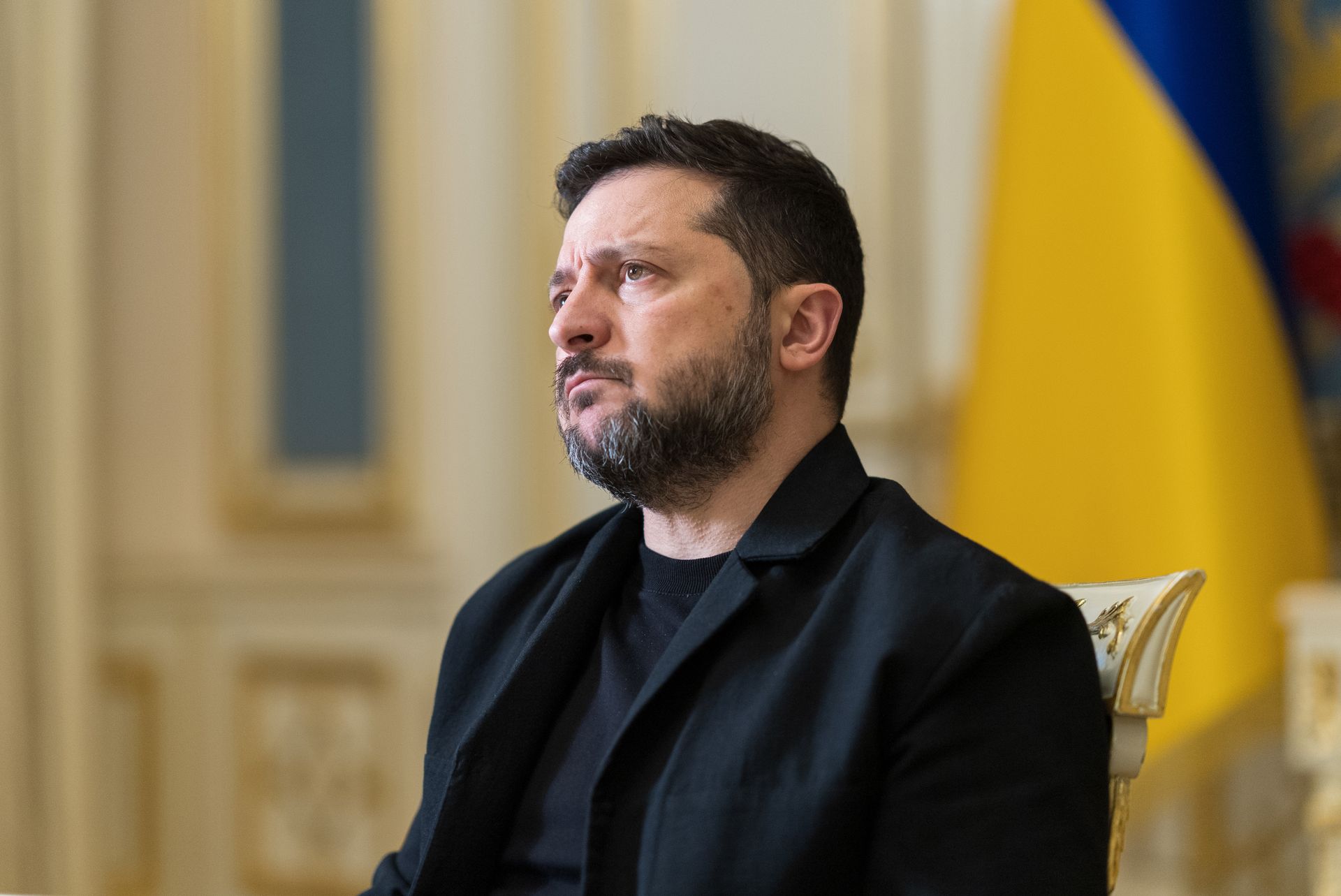
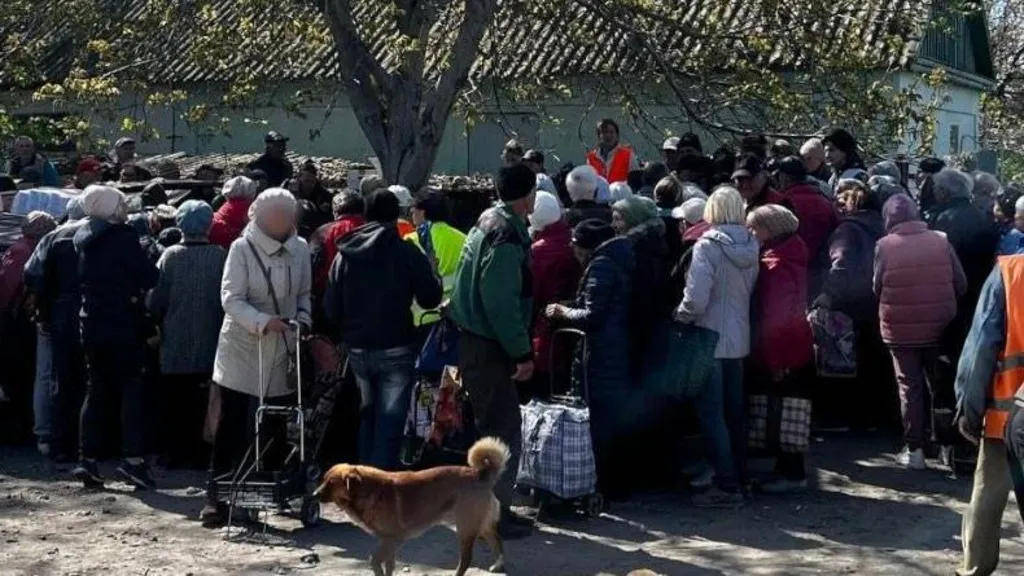
 As of 5:30 p.m. on October 27, Ukraine and Russia are adhering to the ceasefire agreement in designated areas related to the humanitarian mission.