Watered-down version of statement to be issued at end of Montreal summit instead offers ‘ever closer association’
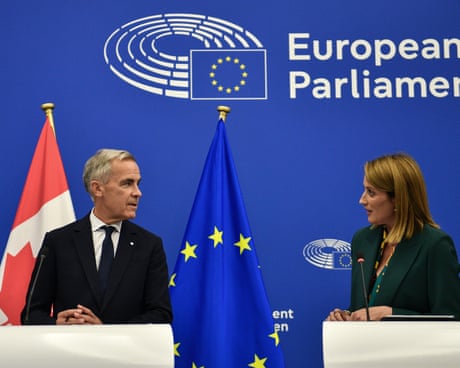
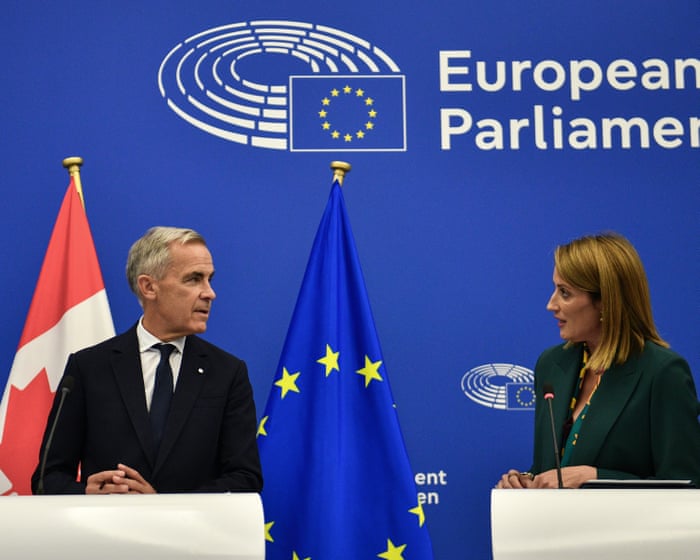
The EU has backed away from its offer to Canada to start talks on becoming an “associate member” after disagreements between member states just as an EU-Canada summit was set to begin in Montreal.
A draft of a joint statement to be issued after the end of the summit, which runs Thursday and Friday, showed a watered-down version offering “an ever closer association of Canada to the EU, short of full membership itself”.
Pete Hoekstra, controversial US ambassador to Canada, has also accused Canadian officials of interfering in US elections
The US ambassador has suggested Canada could be blamed if Republicans perform poorly in next week’s midterm elections, the latest intervention from a controversial figure who has been accused of inflaming a bitter dispute that has angered and baffled residents of both countries.
On Wednesday, CTV news reported that Pete Hoekstra told business leaders at a closed door meeting that if a number of swing races – including Maine and Michigan – go to the Democrats, it could make things harder for Canada because Donald Trump might try to blame the loss on it.
The Canadian government on Tuesday introduced a bill that would allow Medical Assistance in Dying (MAID), Canada’s preferred euphemism for euthanasia, to be conducted on people who have lost the mental capacity to give informed consent for the procedure.
Un maestro de historia, una madre soltera afroamericana y un joven votante republicano repasan el impacto de 21 meses desde el regreso de Donald Trump a la Casa Blanca. Las heridas de la ofensiva antinmigración, los apremios de una situación económica que no ha mejorado y las dudas sobre una guerra contra Irán que no todos comprenden pesan de cara a las midterms. Estos son los desafíos que las decisiones políticas han impuesto en la vida cotidiana de los estadounidenses.
In 1850, French economist Frédéric Bastiat published The Law, arguing that governments and laws are established to collectively protect life, liberty and property. Yet he also warned that law itself could become an instrument for violating those principles when those controlling the state acquired the power to use it against the population. That warning provides a useful lens through which to examine a series of rapidly advancing Canadian laws and policies involving online speech, surveillance, digital identification and artificial intelligence.
Bill C-9, Bill C-22, Bill C-34 and Bill C-8 are presented as responses to problems ranging from “hate” crimes to child safety to cybersecurity, while Canada is simultaneously expanding its artificial-intelligence strategy and the computing infrastructure necessary to support it. Although ostensibly aimed at protecting Canadian citizens, these bills raise serious problems related to privacy, freedom of expression and the growing ability of governments to identify, monitor and restrict individuals in the digital world.
Bill C-9 and the Regulation of Expression
Bill C-9, the Combatting Hate Act, strengthens provisions concerning “hate” crimes and propaganda while creating new offences related to intimidating or obstructing people from accessing certain religious and cultural locations. Its stated purpose is to respond more effectively to rising incidents of “hate,” with the legislation receiving royal assent on June 18, 2026. Expanding “hate”-related offences and removing certain exemptions could seriously threaten Charter protections for expression, religion and conscience.
The concern is not whether genuinely threatening or violent conduct should be prohibited, but how precisely the boundaries of prohibited expression are defined and enforced. Broad or subjective interpretations of “hatred,” intimidation and related concepts could chill lawful religious, cultural or political expression.
Bill C-22 and Access to Digital Information
Bill C-22, the Lawful Access Act, expands law-enforcement and CSIS access to information held by electronic service providers. While presented as a modernization of investigative capabilities for serious crime and national security threats, it could substantially weaken privacy protections and facilitate broader surveillance by requiring providers to maintain systems that enable government access.
Digital metadata can reveal extensive details about an individual’s activities, relationships and communication patterns without exposing the content of their messages. The scope of information accessible, how long it is retained and who can obtain it are serious concerns. Combined with laws regulating online expression, these powers could give the state both expanded authority to determine prohibited behaviour and increasingly sophisticated tools to monitor Canadians’ digital activity.
Bill C-34 and Digital Identification
Bill C-34, the Safe Social Media Act, proposes a Digital Safety Commission to regulate social-media services, chatbots and other online platforms, said to protect children and reduce harm. Enforcing age restrictions necessarily requires platforms to verify users’ ages, potentially through government-issued identification or biometric technologies.
Further, if verification becomes necessary across numerous services, it is very plausible that centralized digital identification will be encouraged as a convenient solution. Rather than repeatedly proving their age, users could simply be encouraged or forced to authenticate themselves through a common identification system. The concern around this bill is not the restrictions on minors, but the far-reaching identification infrastructure these requirements are likely to establish.
Bill C-8 and Digital Communications
Bill C-8, the Cyber Security Act, establishes cybersecurity requirements for critical infrastructure, including digital communications, finance and energy. Claimed to be a way to strengthen Canada’s resilience against cyber threats, it imposes risk-mitigation, reporting and compliance requirements on operators. Its broad powers could readily facilitate government overreach into private networks, operations and data.
The legislation also grants authorities significant powers over digital communication services, including directing providers to suspend services under specified circumstances. In an increasingly digital society, losing access to internet and communication services could also prevent individuals from working, accessing their bank accounts, using essential services and participating in public life. This raises important questions about how broadly such powers could be interpreted and what safeguards would prevent their misuse.
AI for All and the Technological Component
One practical obstacle to surveillance on such a scale is the enormous quantity of information generated by modern digital life. Social networks, communications platforms, devices and cameras produce more data than human investigators could realistically examine. Artificial intelligence removes much of that limitation by processing, connecting and analyzing enormous datasets automatically.
Canada’s AI for All strategy promotes centralized AI governance, sovereign computing infrastructure and international partnerships, creating a dangerous potential for mass surveillance, automated content moderation and expanding government control over digital systems. Combined with increasingly sophisticated data collection and identification systems, AI could enable authorities to monitor and analyze Canadians’ activities on an unprecedented scale. Expanding data centres would provide the computing power necessary to operate these technologies and is likely one of the real reasons they are being so aggressively developed.
How the Pieces Fit Together
Individually, these bills are targeted at different issues, but their powers complement one another. Bill C-9 expands rules governing prohibited expression; Bill C-22 expands access to digital information; Bill C-34 could establish widespread online identification; and Bill C-8 grants powerful authority over digital communications infrastructure. Together with AI technology, they create the imminent possibility of a system capable of identifying individuals, monitoring their online activity, enforcing speech restrictions and potentially cutting off their communications access. We must continue to resist these moves to curtail freedoms and expand state control.
Las elecciones legislativas de mitad de mandato en Estados Unidos servirán para medir el respaldo del Partido Republicano a dos años de la convulsa presidencia de Donald Trump. Mientras el aumento del costo de vida amenaza con castigar en las urnas al Gobierno, el control de la inmigración se sitúa como una de las políticas más populares de la Casa Blanca, que puede movilizar a la base de votantes del movimiento MAGA.
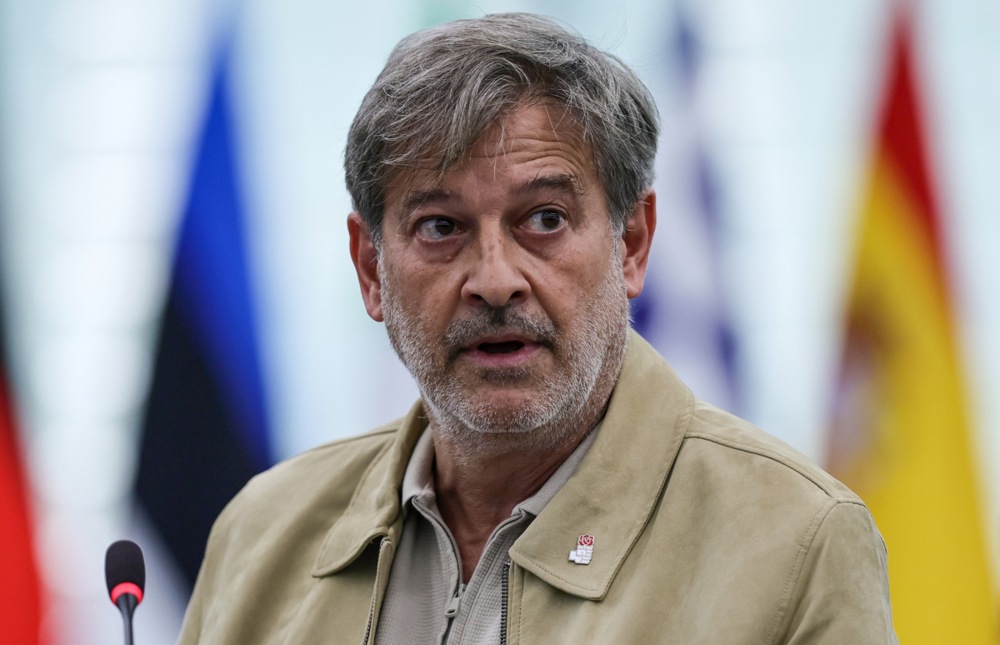
“Everybody’s focusing on the legal basis of Ursula von der Leyen’s associate membership [with Canada] announcement, but frankly I don’t care,” says MEP Javier Moreno Sánchez.
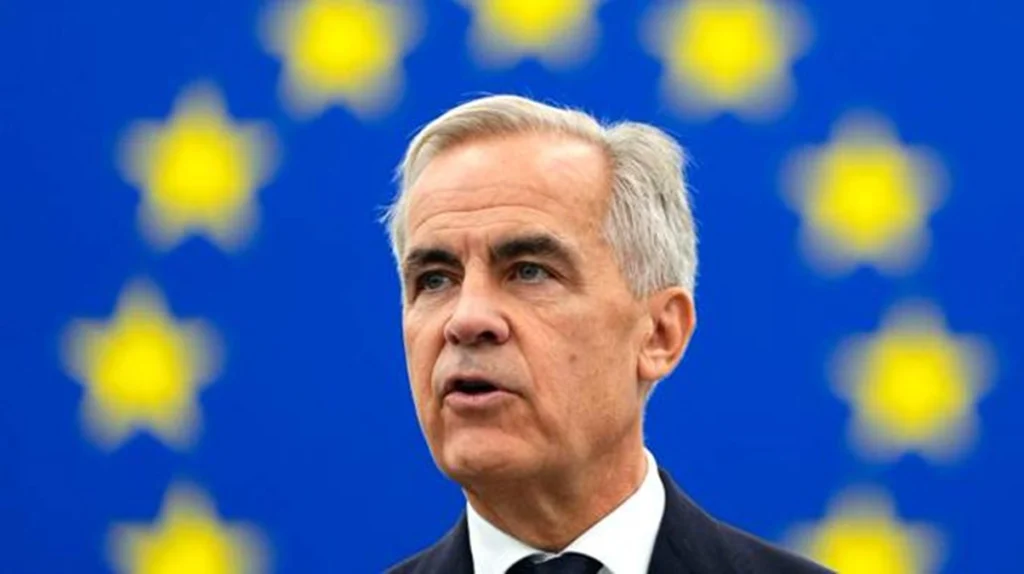
The Spanish Socialists & Democrats lawmaker chairs the European Parliament’s Canada delegation. He hopes leaders can make the EU and Canada “as close as possible” at the Montréal summit beginning on Thursday (29 October). Hosting the talks is Canadian prime minister Mark Carney, who has repeatedly spoken of ‘middle powers’ such as Canada and the EU deepening cooperation.
In September, EU Commission president Ursula von der Leyen’s announcement of an ‘associate membership’ possibility for Canada caught many by surprise. And there has been no consensus among member states on whether such wording should be used in written agreements with the North American ally.
EUobserver sat down with the MEP Moreno Sánchez in his Brussels office ahead of the major EU-Canada talks.
EU member states struggled to agree on inclusion of the term ‘associate member’ before the Montréal summit. Was it a mistake for EU commission president Ursula von der Leyen to announce this special category if she could not deliver it?
MEP Javier Moreno Sánchez: No, to have made this announcement is positive. I prefer for Canada to be an associate member, but I don’t care about the legal basis; it can be de facto associate membership. It’s true that the concept is not in the treaties, but the euro was not and neither was Schengen. When we have the political will, we don’t need the treaties.
I would like Canada’s relationship to be as strong and as close as possible with the European Union. It means that they will be like Switzerland or Iceland. We won’t have Canadian members in the European Parliament, or commissioners from Canada, but they will be in all the programmes. Now they will participate in Erasmus+, they are participating in SAFE [Security Action for Europe]. And There is big cooperation on artificial intelligence. But we want a horizontal and holistic approach to collaboration, not sector by sector.
Now, everybody’s focusing on the legal basis of Ursula von der Leyen’s associate membership announcement, but frankly I don’t care. As I said in the plenary last week, Canada and the EU share traditions, culture, language, values and principles. So in my view, they are already associated.
What is ‘associate membership’?
This post by my prime minister Pedro Sánchez is what associate membership means.
It was very funny because it was 2pm after the State of the Union speech, and I had an interview with people in Ottawa where it was 8am in the morning. I said associate membership is a very positive thing we have to do. And the journalist interviewing me said they’re just seeing this post from PM Sánchez.
What do you think Mark Carney and Ursula von der Leyen should prioritise in the Montréal summit ?
The digital trade agreement. I hope they will agree on that to protect all the consumers and our enterprise. And on critical raw materials, we need an agreement because Canada has everything. In order to not to depend on China, we have to strengthen that relationship. And personally, I’d like to see the EU extend conventions and programs like Erasmus+ to Canada in small steps, little by little.
Should there be free movement between Canada and the EU?
We have to go in this direction. I don’t know exactly at which speed. So little by little, there will be free movement. But if you ask the Council, maybe certain countries will say, “No free movement.”
And how important is it that Canada pays into the European community, particularly when it comes to Ukraine?
I went to Canada only a few months into Putin’s full-scale invasion of Ukraine to meet with people, NGOs, the enterprise and development communities. In every meeting, I was told that Canada wanted to rebuild Ukraine together with Europe once the war was finished. I was a little bit astonished.
One of the reasons is that there are 1.5 million Ukrainian people in Canada. And, Canada is putting money into Erasmus+ by participating in it. And it is willing to put money in all the programs and to work with us.
To what extent is US president Donald Trump responsible for pushing together Canada and the EU?
Thanks to Trump, we have Mark Carney as Canadian prime minister. It was a very good gift from him because Pierre Poilievre was the favourite two months before the elections. And when Trump announced all these shitty things, very proud Canadians decided to vote for Carney. And it was symbolic in Canada. Everybody said, “elbows up.” They are very proud people.
Many Europeans now see the US as a less reliable ally. Do you agree?
This article continues, but the full version is available only to EUobserver.com subscribers. Visit account.euobserver.com/membership
La activista panameña Leysi Rodríguez también denunció la existencia de discursos que, según afirmó, buscan desacreditar a comunidades campesinas e indígenas que se oponen a determinados proyectos extractivos.
Having spent years poring over them in art books, Rory Buccheri decides it’s time to take a pilgrimage to see the landscapes that inspired Canada’s most famous paintings – and to learn about the thousands of rarely told First Peoples stories
Von der Leyen, Carney, and Costa will discuss a new framework for Canada’s relationship with the European Union.
On Thursday and Friday, European Commission President Ursula von der Leyen, Canadian Prime Minister Mark Carney and European Council President Antonio Costa will meet in Montreal for the 21st European Union-Canada summit.
They and other senior officials will discuss possible features of a status that would allow Canada to become an “associated member” of the European Union.
For the EU, the meeting will be an “important milestone” in relations between the two sides and will pave the way for an “even broader and deeper” political partnership and greater cooperation.
Specifically, European and Canadian leaders are expected to launch a “Partnership for the Future,” a framework for shared prosperity and economic security backed by new initiatives aimed at strengthening people-to-people ties, deepening economic relations and reinforcing their joint position on the world stage.
The summit’s agenda will cover a wide range of issues, from trade, digital affairs and critical raw materials to defense and security, as well as cooperation in education, research, innovation, and youth affairs.
Yves-François Blanchet sur Paul St-Pierre Plamondon et le sommet Canada-UE : « tu peux venir t'asseoir, mais t'as pas le droit de parler. »
Blanchet on Quebec's premier at the Canada-EU summit: "You can come sit down, but you have no right to speak." pic.twitter.com/O3rSPGTc5y
EU sources said it was “clear” that one of the summit’s main topics would be a discussion of the proposal von der Leyen put forward last month — and which Carney welcomed — for Canada to become the EU’s first associated member state.
Currently, this status does not exist as a defined category in the European treaties. Therefore, its specific implications remain to be negotiated.
“This is somewhat uncharted territory, but I think what we want, together with our member states, side by side, and together with Canada over the next 12 months, is to have the ambition, confidence, creativity and vision to shape it together… It is the highest form of collaboration imaginable. For now, frankly, I see it as something very specific to Canada,” a senior EU official said.
“There is no doubt among the member states about their ambition for this relationship. All member states are clear that they want the closest possible partnership with Canada. So that is not in question,” another EU source said.
Nevertheless, some member states have reservations because this is uncharted territory. That is precisely the work that will need to be done in Montreal ahead of the next summit in 2027.
The senior official outlined three pillars for this membership: defining more joint policies on climate, energy, artificial intelligence, innovation, or security; having Canada participate more in EU programs, such as the Horizon Europe research program, or fully integrating it into Erasmus+; and, finally, bringing the institutions on both sides closer together to strengthen governance.
“The goal is to build a partnership that comes closer to membership than anything we have done before. It is clearly a partnership without membership (…), aimed at generating greater prosperity on both sides of the Atlantic,” the official said.
The EU was split today over whether to offer “associate membership” status to Canada, with several countries refusing to sign off on a statement containing that phrase just 48 hours before a summit between the two sides in Montreal.https://t.co/7hIHdoOeIw
Relations between Canada and the EU are already close in trade, security, defense, research and technological cooperation. Their main frameworks include the Comprehensive Economic and Trade Agreement (CETA), which has been provisionally applied since 2017, as well as recent progress in defense, digital trade and specific European programs.
They have long been strategic partners and share common values, including democracy, a commitment to a rules-based international order, and free and fair trade.
One of the key areas where the EU sees “enormous potential” is critical raw materials. Imports into the EU have already increased significantly and could rise further through the bloc’s “raw materials mechanism,” which focuses on facilitating connections between Canadian suppliers of these materials and European buyers.
Another idea under consideration is the possible joint stockpiling of critical raw materials, as well as the option of giving the EU priority access to Canadian reserves, EU sources said.
Tightly fought election saw record turnout as incumbent mayor ran against her rival Brad Bradford
The mayor of Toronto, Olivia Chow, promised more rental housing, free school lunches and reduce fares for frequent transit riders after she was elected to a decisive second term as mayor in a wave of support for progressive councillors.
The tightly fought election saw record turnout but Chow ultimately turned in a dominant 13-percentage-point win over her rival, Brad Bradford, receiving 54% of the vote compared with his 41%. Many had been expecting a far closer race, given weeks of polling that suggested a dead heat between the pair who presented differing visions for Canada’s largest city.
Improving polls for Labour are bound to lead to feverish speculation about a snap election. But if Burnham is tempted, what just happened in British Columbia might change his mind, says Mark Littlewood.
In some ways, the reality of living in the UK was different from what I imagined.
Maria Polansky
As a Canadian, I dreamed of living in Europe — and then, I finally got the chance to move there.
There were parts of my new life I loved, but I missed Canada more than I expected.
After five years, I moved back to Canada with a new appreciation for my home.
I first fell in love with the idea of Europe when I was 14.
My mom and I went on a trip to Russia to visit relatives, and Moscow won me over with its grand boulevards and trendy cafés. We also stopped in London, where we explored the city's central neighborhoods and shopped in stores I'd only read about in fashion magazines back home.
I was amazed by everything. I was convinced Europe was better — more aesthetically pleasing, more interesting — than my hometown of Vancouver, and vowed to go back as often as I could.
By my early 20s, I was traveling to Europe almost every summer. My sister had moved to France, so I had a great excuse to visit: I'd stay with her in Paris and later Toulouse, and I'd also check out other destinations like Spain and Italy when I could.
I became more enamored with the continent with each trip. Like so many North Americans, I considered it somewhat of a utopia where the overall lifestyle is healthier, the food is more delicious, and everything is more beautiful.
Love gave me the opportunity to live in Europe
After falling in love with a Brit, I was excited to leave Canada for the UK.
Maria Polansky
In 2018, at age 26, I met and fell in love with a Brit who was living in Vancouver. When his Canadian working-holiday visa expired, we started a long-distance relationship — and I applied for a British visa so we could be together.
After years of romanticizing the continent on vacations, my dream was finally coming true. I moved to Birmingham and got a UK-based job.
My first year there was great. I loved being surrounded by historic architecture, feeling comfortable dressing up in fancier clothes, and knowing that countries like Spain, Italy, and Greece were just a quick flight away.
But eventually, the novelty started wearing off. Things I initially found so charming became mundane after a few years. The old buildings blurred into the background of my daily commute, and I never quite adjusted to certain cultural differences, like the Brits' less direct communication style.
I also started to miss the things I took for granted back home, like easy access to the ocean and mountains. Back in Vancouver, I used to spend weekends at the beach or hiking, and though these activities were possible in the UK, they were more difficult from my inland location.
Plus, although some things were more affordable — like groceries — others, like transportation fees, weren't. I was also getting paid a lower salary for the same job I was doing back home.
Even the travel benefits weren't as cut-and-dried as I'd expected. Yes, I was close to the rest of Europe, but farther from plenty of other destinations. In Vancouver, I could easily hop on a flight to Mexico to escape the winter blues.
My husband and I traveled to the Canary Islands a few times from the UK, and they were stunning — but in my opinion, they just couldn't compare to the soft white sand and warm azure waters of the Riviera Maya.
I realized I missed my life in Canada
In 2021, I visited Canada for the first time since moving, and started to see everything from a different perspective. I had a newfound appreciation for the rugged natural beauty around me and the laidback coastal lifestyle.
Once I got back to the UK, I started to realize just how much my Pacific Northwest upbringing had influenced my lifestyle preferences. I realized I'd rather be surrounded by the ocean, mountains, and forests than historic buildings.
As someone with a multicultural background, I also felt homesick for my Canadian hometown's diversity. I really felt like my community back home was shaped by immigrants, and cultural traditions there felt less uniform.
After our second trip back to Canada in 2022, my husband started to sense just how homesick I was. We agreed to move back the following year — though we chose to go to nearby Victoria instead of Vancouver, as we preferred the more relaxed vibe of a smaller city.
I'm glad we left, but I have no regrets
Living in the UK taught me to appreciate my home in Canada.
Maria Polansky
We've now been back in Canada for just over three years, and it feels like the perfect place for us right now.
Despite everything, I don't regret my move to the UK. I fulfilled my adolescent dream, and I know that if I hadn't taken the opportunity, I'd have always wondered what my life could have been like there.
Those five years also gave me a better appreciation for where I am now. Sure, there are things I miss about living in the UK, like the multitude of dog-friendly pubs and British chocolate. But as someone who prefers a more nature-oriented life, I know Southwest British Columbia is the right home for me.
Still, I'll never say no to another trip back across the pond.

 Login