❌

Reading view

Google's AI chip business is getting harder for Nvidia to ignore

Sundar Pichai and Jensen Huang
Sundar Pichai's Google is increasingly moving in on Jensen Huang's turf.

Bloomberg/Getty Images; Thomas Koehler/Photothek via Getty Images

  • Google's AI chip business is turning into a TPU-shaped headache for Nvidia.
  • A blockbuster deal with Oracle will put Google's TPUs inside another hyperscaler.
  • Is the market underestimating the potential of Google's chip business?

Earlier this year, Nvidia CEO Jensen Huang downplayed the threat of other companies building competing AI chips, including Google.

"Without Anthropic, why would there be any TPU growth at all?" he said in an interview with podcaster Dwarkesh Patel, referring to Google's custom chips. "It's 100% Anthropic."

That is no longer the case.

On Tuesday, Google and Oracle announced a blockbuster deal that will see Google's TPUs, short for Tensor Processing Units, made available to Oracle cloud customers from next year. As the companies underscored in a joint announcement, it's the first time Google's TPUs have been offered on a hyperscaler's platform beyond its own.

Anthropic isn't the only one Nvidia should be worried about. OpenAI has a job listing for a software engineer to optimize its models for TPUs, and The Information reported Tuesday that OpenAI plans to buy TPUs from Google.

Meanwhile, several analysts have predicted Google's TPU business is about to explode as more companies hedge their bets with a multichip strategy — providing an opening for Google and others to further move onto Nvidia's turf.

Despite this, Nvidia's chip business still eclipses everyone else's, including Google, which is also a big customer of Nvidia's GPUs. Yet Google's AI chips, which the company began building more than a decade ago to power search and other products, might be poised for takeoff.

On Wednesday, during Google's third-quarter earnings call, chief financial officer Anat Ashkenazi said the company expects a "meaningful revenue ramp in 2027" in TPU sales.

Cloud chief Thomas Kurian also said on the call that TPU sales were a "meaningful contributor" to the company's Q3 financials.

In its IPO paperwork filed this week, Anthropic said it planned to spend $114.5 billion on Google compute between April 2026 and July 2033. While it didn't specify how much of that would go to TPUs specifically, it estimated spending between $125 billion and $150 billion on TPU capacity from Google and other providers.

In the same filing, Anthropic said it's also using Amazon's Trainium chips and AMD's GPUs, as well as chips from Nvidia and Google.

All told, this might be Nvidia's nightmare scenario coming true. If companies are increasingly using a multichip strategy, it could hamper Nvidia's pricing power.

Google declined to comment, and Nvidia and OpenAI did not respond to requests for comment.

TPU takeoff?

Google's TPU business may only be getting started.

In notes published this month, Japanese banking group Mizuho projected TPU revenue of $28 billion for 2026 and $67 billion in 2027. Mizuho said Google could see that number reach as high as $100 billion in 2028, while TD Cowen's John Blackledge projected it could reach $138 billion, accounting for 34% of Google Cloud's 2028 revenue.

That number is still dwarfed by Nvidia, which reported $96.2 billion in revenue in the previous quarter alone, and the market reacted with a shrug on Wednesday as its share price stayed flat.

Some analysts, though, think the market is underestimating Google, especially as more companies look to reduce their reliance on Nvidia's GPUs.

"We believe Google's TPU hardware business is emerging as a materially larger opportunity than what is currently reflected in consensus estimates," Mizuho analysts wrote in a note published October 18, adding that selling TPUs outright — rather than renting them from Google's own data centers — could ease Google's aggressive capex spending.

And even if that spending continues to soar — and right now, there are no signs the foot is coming off the accelerator — analysts at Bank of America said Google's cash-splashing looks "relatively efficient" compared to its peers, as TPUs continue to power the company's own AI efforts.

For Google, it's the payoff of a decade-plus investment in silicon that was originally designed to make Search smarter. It could also act as something of a buffer against damage to its core search business as AI agents eat Google's lunch, Mizuho also said this month.

Have something to share? Contact this reporter via email at hlangley@businessinsider.com or Signal at hughlangley.01. Use a personal email address and a non-work device; here's our guide to sharing information securely.
Read the original article on Business Insider

  •  

Nvidia's worst nightmare may be lurking inside Anthropic's IPO filing

Co-founder, President and CEO of US technology company Nvidia, Jensen Huang, looks on during a press briefing in Paris on October 13, 2026.
Nvidia CEO Jensen Huang.

Joel Saget / AFP via Getty Images

  • Anthropic is touting its ability to use different AI chips in its initial public offering filing.
  • Analysts say a multichip strategy could weaken Nvidia's pricing power.
  • Switching chips is hard and expensive, putting it out of reach for smaller players.

Anthropic is hedging its bets by using multiple chips to handle its AI work — a strategy that could eventually erode Nvidia's dominance.

The AI lab says it manages compute "as a single, fungible pool from multiple strategic partners" — with software that can direct its work to different chips depending on where they're most productive, according to Anthropic's S-1 filing, which came out Monday as the company prepares to go public.

Anthropic says it uses hardware from four chip families: Amazon Trainium, Google TPUs, Nvidia GPUs, and AMD GPUs.

That flexibility, which Anthropic said "took years and significant investment to build," could make major AI companies less dependent on Nvidia over time and give them more negotiating leverage, analysts said.

"The real exposure could be Nvidia's pricing power," said Patrick Moorhead, founder and CEO of Moor Insights & Strategy, "because a customer that can shift work across four platforms negotiates very differently than one that can't."

Ashish Nadkarni, an analyst at IDC, added that a multichip approach also makes Anthropic less vulnerable to fluctuations in Nvidia's chip supply.

Breaking Nvidia's grip isn't easy

Although Anthropic's chip mix isn't new, the company is now pitching it as a core advantage to investors, Moorhead said.

The threat has its limits. Switching between chips is still difficult — especially when it comes to training AI models as opposed to running them, Moorhead said — and only the biggest AI companies have the resources to do it.

Anthropic also continues to spend billions on Nvidia compute, Moorhead said.

Gil Luria, head of technology research at D.A. Davidson, said that while other major companies like OpenAI likely take a multichip approach, it may not be worth the effort and investment for smaller players.

Brad Gastwirth, global head of research and market intelligence at Circular Technology, said Anthropic's strategy doesn't represent a major near-term threat. Having more chip options doesn't erase Nvidia's advantages in performance, networking, and software, he said.

There's a broader risk for Nvidia if AI compute becomes more of a commodity.

Citadel CEO Ken Griffin has warned that if supply overtakes demand, it could drive down rental prices.

"GPUs, like airlines, have a very low marginal cost to run," he told Bloomberg last week. "The moment you have overcapacity, pricing goes into freefall."

Nvidia did not immediately respond to a request for comment from Business Insider.

Have a tip? Contact this reporter via email at gweiss@businessinsider.com or Signal at @geoffweiss.25. Use a personal email address, a non-work WiFi network, and a non-work device; here's our guide to sharing information securely.
Read the original article on Business Insider
  •  

Nvidia e Meta estreitam laços com investimento de US$ 3 bi na área de IA

A Nvidia e a Meta anunciaram nesta terça-feira (27) que ​irão aprofundar sua parceria ​em torno do assistente de IA Muse e de modelos de IA relacionados, com a Nvidia investindo US$3 bilhões na oferta de ações da controladora do Facebook.

Os modelos e agentes ⁠Muse da Meta, ​que rodam na infraestrutura da Nvidia, ​trabalharão em colaboração mais estreita com a ⁠fabricante de chips para melhorar ⁠o desempenho e reduzir custos.

O ​Muse, ‌conhecido internamente como Hatch, é fundamental para ⁠o plano do presidente-executivo Mark Zuckerberg de oferecer “superinteligência pessoal” aos bilhões de pessoas que utilizam os ‌serviços da ⁠Meta diariamente.

Inspirado ‌no agente de IA de código aberto OpenClaw, o Muse pode acessar emails, calendário, ⁠pagamentos, informações de saúde, ⁠compras e aplicativos de casa inteligente do usuário, sendo ‌que os usuários podem revogar o acesso a qualquer momento.

A Meta também aumentou sua oferta de ações para US$ 97,5 bilhões, a maior ‌captação de recursos de sua história, à medida que acelera os investimentos em infraestrutura de ⁠IA.

As empresas podem explorar uma colaboração mais estreita na estrutura OpenShell da Nvidia, incluindo o ​uso dessa estrutura para implantar software com segurança ​e o uso de uma ferramenta chamada Sentry para monitorar o comportamento dos agentes de IA.

  •  

Nvidia's sales and marketing leadership is seeing a changing of the guard — and new faces are gaining influence

Jensen Huang in Stockholm, seen from a profile with a blurry background.
Nvidia CEO Jensen Huang.

Bloomberg/Getty Images

  • Nvidia's sales and marketing leadership is changing as its sales pitch evolves.
  • Veterans are retiring, opening the door to internal succession and outside hires.
  • Nvidia CEO Jensen Huang's daughter Madison is also gaining influence.

Nvidia's sales and marketing organizations are seeing a changing of the guard as the AI boom reshapes demands on leadership.

Veterans at Nvidia are retiring, opening the door for longtime employees. And CEO Jensen Huang is tapping talent from outside the company — and outside the chip industry — to meet new challenges.

Nvidia's sales pitch has evolved. It has already convinced companies to choose its chips. To keep growing, it has to convince more businesses to adopt AI. These customers care less about hardware specifications than how Nvidia's AI can be put to work.

Leadership changes are most visible in sales and marketing, said former vice president of corporate marketing Greg Estes, while other areas of the company, such as finance, legal, operations, and software and hardware engineering, have remained relatively stable.

In marketing, Nvidia tapped Google Cloud executive Alison Wagonfeld to become its first chief marketing officer earlier this year, while Microsoft veteran Nick Parker became its new sales chief in August. Neither comes from the chip industry, though both bring years of experience helping businesses adopt software and cloud services.

Nick Parker presenting onstage, wearing a pink collar shirt.
Nick Parker, Nvidia's EVP of worldwide field operations.

Bloomberg/Getty Images

At the same time, Huang's daughter Madison has gained influence beyond her formal marketing role, two former employees said.

Huang regularly reshapes Nvidia as the business evolves, said Scott Baker, a sales VP who retired in July after 26 years.

"It's truly a battleship spinning on a dime, and everyone gets aligned," he said.

Nvidia did not respond to requests for comment from Business Insider.

A 'deep bench' of younger Nvidia talent

Retirees this year include former sales EVP Jay Puri, VP of enterprise marketing Laura Fay, SVP of enterprise business Shanker Trivedi, and sales VP Kevin Connors.

Fay said Huang doesn't want to lose longtime executives, many of whom he personally recruited. But as they move on, the next generation is getting a chance.

Before leaving in April after 17 years, Trivedi made mentorship part of his mission. He was ready to pass the baton after years of grueling travel and seven-day workweeks.

"Time stops for nobody," the 69-year-old said.

Trivedi said Nvidia has a "deep bench" of younger sales and marketing talent who know its culture, market, and partners inside out, including Raj Mirpuri in AI cloud infrastructure, Kimberly Powell in healthcare, and Kari Briski in AI software.

When he retired, the company divided Trivedi's responsibilities among multiple leaders. As Nvidia's revenue soared during the AI boom, his job had ultimately become too big for one person.

"Better to flatten the structure and gain velocity," he said.

Another Huang is gaining influence

One insider bringing an unconventional background to Nvidia's marketing ranks is Jensen Huang's daughter, Madison Huang.

Madison formerly worked at French luxury conglomerate LVMH in hospitality marketing before joining Nvidia as an MBA intern in 2020. She has quickly ascended to senior director of product marketing for physical AI.

One former employee said Madison's experience working on luxury brands brought a fresh perspective to a marketing team traditionally staffed by semiconductor veterans.

Madison Huang arrives for a dinner event in Taipei in May 2026.
Madison Huang, senior director of product marketing for physical AI at Nvidia.

Bloomberg/Getty Images

Job titles can be fluid at Nvidia, and a second former employee said Madison's remit extends beyond physical AI marketing. They said she exerts authority across multiple parts of the company and directs teams at all levels on strategy and business decisions.

Madison is also among a small circle of executives known to travel with her father. And their close relationship gives her the ability to anticipate his needs during high-level meetings and appearances, the first former employee said.

"She 'speaks Jensen' very well," the former employee said, "so he doesn't have to explain himself to her."

Have a tip? Contact this reporter via email at gweiss@businessinsider.com or Signal at @geoffweiss.25. Use a personal email address, a nonwork WiFi network, and a nonwork device; here's our guide to sharing information securely.

Read the original article on Business Insider
  •  

Want to land a legal job at Google or Nvidia? These law firms could be your ticket.

Google logo on a glass office building behind orange flowers and greenery in bright daylight.
Google has a thing for Big Law lawyers.

Tayfun Coskun/Anadolu Agency via Getty Images

  • Big Law has plenty of competition for its best lawyers.
  • Some of the most ambitious lawyers want to work for clients in their legal departments.
  • New Pirical data shows which law firms have the most alumni working in Big Tech.

Big Law has a hard time keeping its lawyers.

It's not just rival firms dangling basketball-player salaries, extra vacation, and branded merch to lure away top talent.

Big Tech is competing for those lawyers, too.

New data shared with Business Insider reveals which firms send the most lawyers to the biggest names in tech.

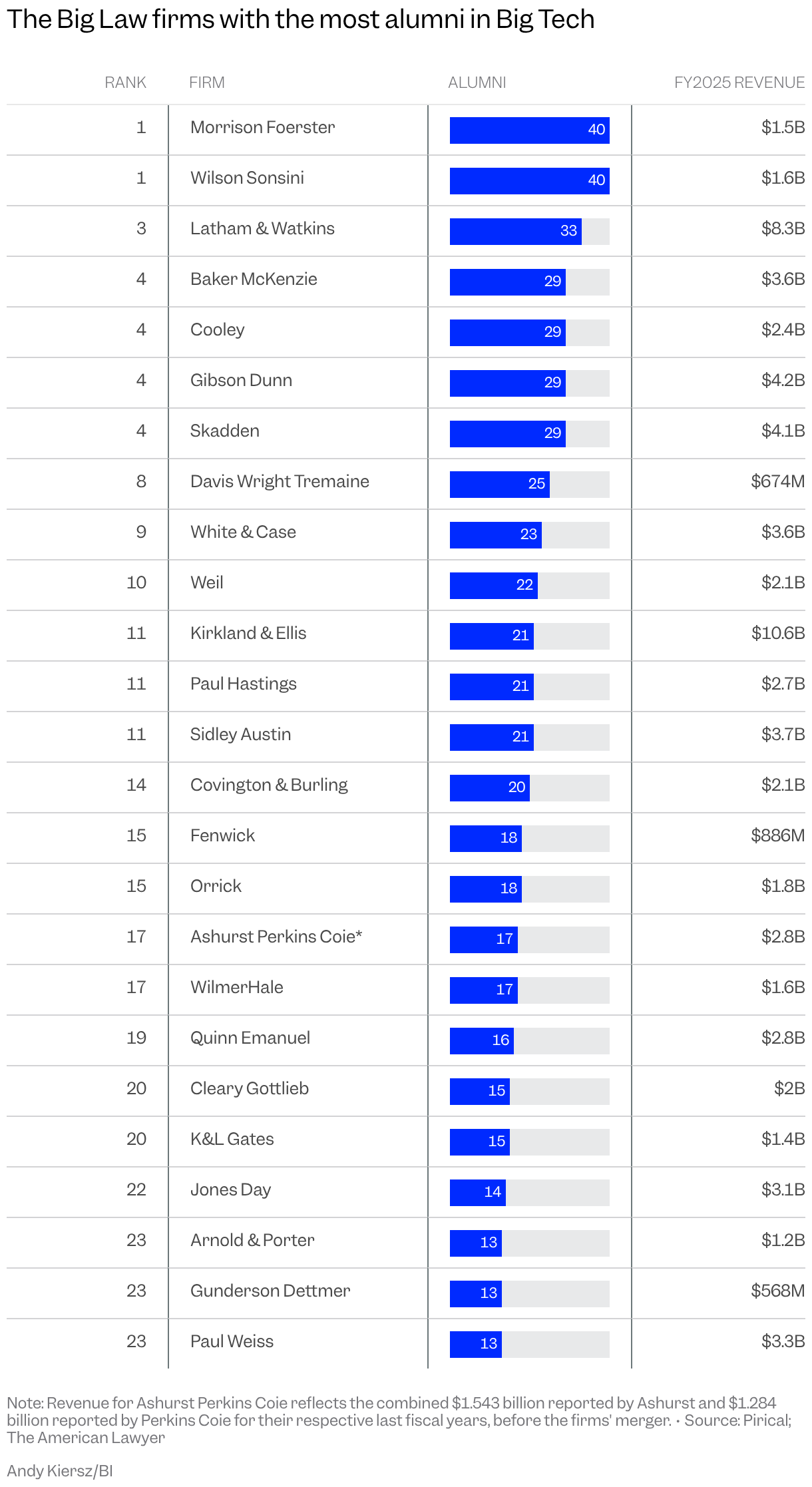
Pirical, a legal people-analytics company, tracked lawyers who previously worked at the 200 largest law firms by revenue in the United States and now hold legal roles at seven tech companies: Google, Meta, Microsoft, Nvidia, OpenAI, Anthropic, and SpaceX. Pirical filtered out summer associates and interns.

Morrison Foerster and Wilson Sonsini tied for the top spot, each with 40 alumni working in legal roles across the seven companies. Both firms regularly represent tech startups and the investors backing them.

Latham & Watkins followed with 33 former lawyers. Kirkland & Ellis, the industry's revenue leader, ranked 11th with 21 former lawyers working at those companies, tied with Paul Hastings and Sidley Austin.

Table

Pirical's analysis may have missed lawyers whose job titles fell outside its search criteria, said Craig Savitzky, its insights and content editor. He said newer companies, particularly Anthropic, are also likely undercounted because their legal teams are growing faster than public profiles are updated.

Big Law-Big Tech pipeline

For attorneys hoping to land a coveted job at a tech giant, a stint at a white-shoe law firm can be a stepping stone. They can trade billable-hour quotas for a seat closer to the business, attractive pay, and just one client to keep happy instead of dozens.

That combination makes these roles "some of the most highly desirable and sought-after positions" for law firm associates, said Casey Sullivan, a recruiter with CMW Legal Search.

There's another draw, Sullivan said. The companies at the forefront of artificial intelligence are wrestling with some of the thorniest legal questions of the day, from intellectual property to regulation.

"That's where the most interesting work is for lawyers," he said.

Not all law firms are equally effective launch pads. Pirical's Savitzky noted that the firms near the top of the list have deep ties to the tech industry, if not the deepest pockets.

Cooley brought in $2.4 billion in revenue last fiscal year, placing it 29th on The American Lawyer's ranking of top law firms by revenue. But it tied fourth on Pirical's list, with 29 alumni working at the seven tech companies, including nine at Nvidia, a longtime client.

Davis Wright Tremaine, which has represented Microsoft in antitrust and employment lawsuits, has 13 alumni working in the software giant's legal department. Fenwick, which advised Wiz and Fitbit on their sales to Google, has 13 lawyers at the search giant.

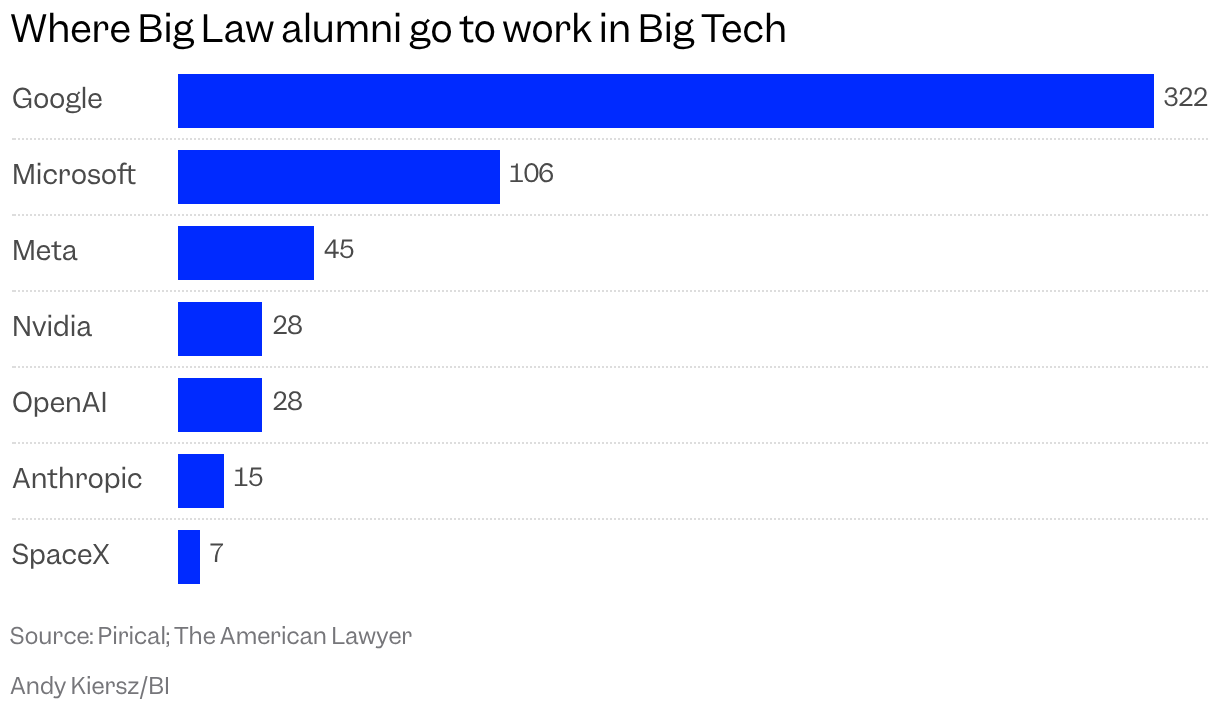
Business Insider also sliced the data another way, looking at which of the seven tech giants employ the most alumni from the top 25 firms on Pirical's list.

Bar Chart

Big Law is effectively a feeder school for Google's legal team. The company employs 322 alumni of the top 25 law firms on Pirical's list, more than any other tech company studied.

That doesn't necessarily mean Google is the most desirable location for lawyers leaving Big Law. Savitzky said the numbers likely reflect the sheer size of Google's legal department and the decades it has had to recruit from top firms.

Read the original article on Business Insider
  •  

Nvidia CEO AI promotional push lands in Kazakhstan

Nvidia CEO Jensen Huang (pictured) urged Kazakhstan to use its energy resources as a foundation for AI and backed the idea the technology could help transform the nation’s physical industries.   

Huang spoke alongside Kazak Minister of AI and Digital Development Zhaslan Madiyev at the Alem.AI event in the latest stop in a tour involving various events in Europe promoting the benefits of AI and discussing Nvidia’s plans over the last two weeks.

The executive noted rather than “just exporting energy”, the natural resource-rich nation could “transform energy into intelligence and export intelligence”.

Huang agreed with the minister’s view physical AI could boost mining and other industries.

The Nvidia executive backed Kazakhstan as having the necessary ambition to employ AI to its benefit.

During the event, Nvidia announced it invested an undisclosed sum in local AI video and image creation start-up Higgsfield AI.

Huang also participated in a signing ceremony for an already-announced data centre project.

Nvidia noted Huang had been presented with an honorary black belt in Judo during the trip.

The post Nvidia CEO AI promotional push lands in Kazakhstan appeared first on Mobile World Live.

  •  

Wayve, Stellantis e NVIDIA: accordo per la guida autonoma in Francia

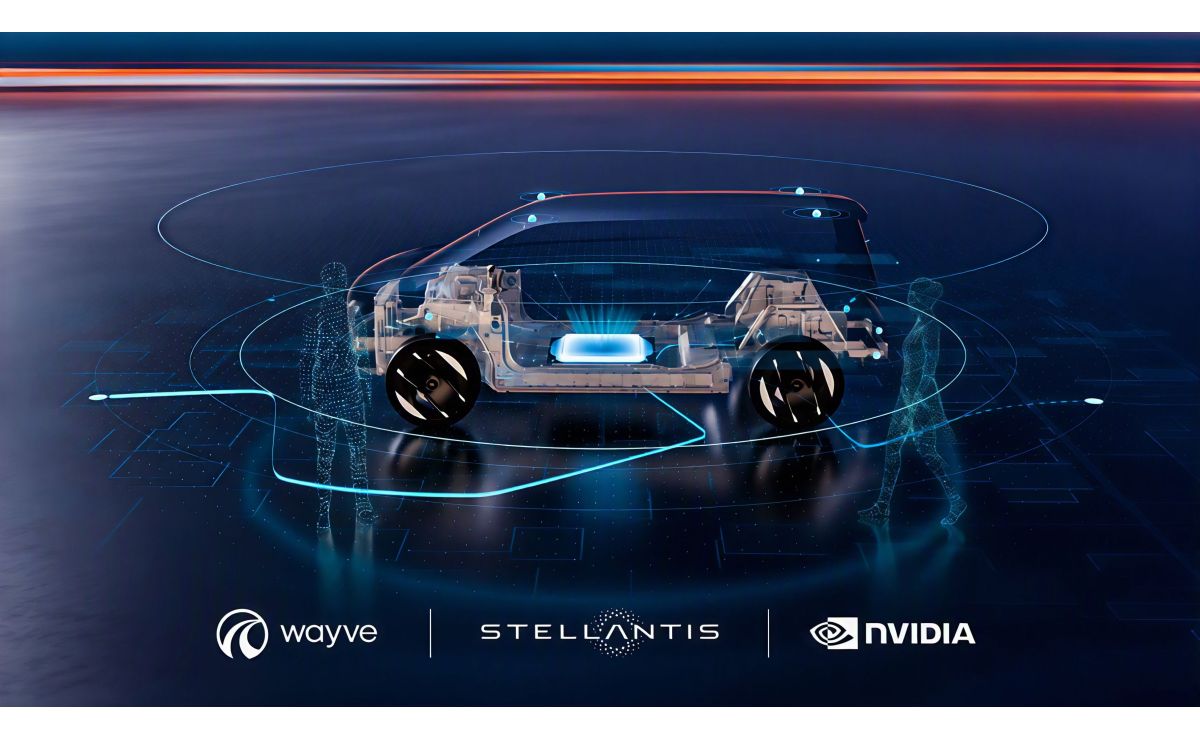
Wayve, Stellantis e NVIDIA collaborano con il Governo francese per sviluppare veicoli autonomi di livello 4 e un ecosistema industriale europeo.

La Francia punta a diventare un polo europeo della guida autonoma. Alle Assises du Véhicule Autonome di Parigi, Wayve ha annunciato il 23 ottobre 2026 una collaborazione con Stellantis, NVIDIA e il Governo francese per favorire lo sviluppo e la futura diffusione di veicoli senza conducente. L’iniziativa unisce intelligenza artificiale, piattaforme automotive e capacità di calcolo, coinvolgendo le autorità nella transizione dalle sperimentazioni a servizi di mobilità su strada.

Un’alleanza per la mobilità autonoma in Europa

Il progetto non annuncia il lancio immediato di robotaxi: mancano una data di debutto, il numero dei mezzi e l’elenco delle città interessate. L’obiettivo è costruire in Francia un ecosistema industriale e normativo per la mobilità di livello 4, rafforzando le competenze europee lungo l’intera filiera, dalla produzione di chip all’integrazione nei veicoli.

Per Wayve, società londinese specializzata nell’embodied AI, è un passo nell’espansione europea. Stellantis mette a disposizione competenze di ingegneria e produzione, mentre NVIDIA contribuisce con le tecnologie di calcolo e sicurezza. Le istituzioni francesi sono chiamate a favorire un contesto normativo adatto a sperimentare e, in prospettiva, utilizzare tali sistemi nel rispetto dei requisiti di sicurezza.

Wayve AI Driver, NVIDIA Hyperion e Halos OS

Il cuore tecnologico è Wayve AI Driver, il software progettato per interpretare la strada e prendere decisioni di guida. Secondo il piano, integrerà NVIDIA Halos OS sull’architettura NVIDIA Hyperion, che combina calcolo e sensoristica per i veicoli autonomi. La soluzione punta a gestire scenari complessi e a sostenere attività di verifica e sicurezza, ma dovrà dimostrare le proprie capacità nelle condizioni operative previste.

L’embodied AI è un’intelligenza artificiale che interagisce con il mondo fisico attraverso sensori e azioni del veicolo. Rispetto all’assistenza tradizionale, deve leggere l’ambiente stradale e adattarsi ai cambiamenti. Le capacità previste non vanno però confuse con l’autorizzazione a circolare senza conducente, che richiede verifiche e regole specifiche.

Stellantis e le piattaforme L4-Ready

Stellantis contribuisce con le piattaforme L4-Ready, predisposte per integrare le tecnologie destinate ai servizi automatizzati di livello 4. Questa categoria consente la guida senza intervento umano entro condizioni operative definite. La dicitura L4-Ready non significa tuttavia che i veicoli siano già omologati per effettuare corse commerciali senza conducente.

Il gruppo aveva già avviato progetti con Wayve: ora la sfida è rendere ripetibile l’integrazione su architetture e modelli differenti, rispettando requisiti di ridondanza, manutenzione e gestione delle flotte. Per l’Europa non basta un software avanzato: occorre un sistema affidabile, producibile su scala e compatibile con le norme dei mercati nei quali sarà impiegato.

Perché la Francia è al centro del progetto

Parigi offre un grande mercato del trasporto a chiamata, centri di ricerca e attenzione politica all’AI. Nel 2025, all’AI Action Summit, sono stati annunciati in Francia investimenti nell’intelligenza artificiale per 109 miliardi di euro. La cifra si riferisce al settore nel suo complesso e non a risorse stanziate per questa collaborazione.

Il ministro dei Trasporti Philippe Tabarot ha ribadito la volontà di aggiornare le regole sui veicoli autonomi senza allentare i requisiti di sicurezza e sovranità dei dati. Sarà cruciale il confronto con le amministrazioni: gestione delle emergenze, tutela degli utenti e condizioni d’esercizio influenzeranno i tempi di un’eventuale messa in servizio.

Sicurezza stradale, lavoro e mobilità urbana

Il progetto coinvolgerà partner francesi incaricati del trasporto, che dialogheranno con sindacati, amministrazioni locali e operatori della mobilità. Le questioni non sono soltanto tecniche: riguardano occupazione, accessibilità, gestione delle flotte e fiducia dei cittadini. Il comunicato delinea un percorso di consultazione, non accordi già conclusi con città o organizzazioni dei lavoratori.

Anne Laliron, responsabile della ricerca tecnologica di Stellantis, lega l’iniziativa a una mobilità più sicura e semplice. Kaity Fischer, vicepresidente di Wayve per la mobilità autonoma, richiama il lavoro con le istituzioni. Sono obiettivi industriali da verificare nei fatti: le dichiarazioni non sostituiscono test, certificazioni e risultati misurabili.

Dalle sperimentazioni ai servizi: che cosa manca

La competizione europea sulla guida autonoma dipenderà dalla capacità di unire innovazione e fiducia. Occorreranno test reali, procedure di sicurezza, responsabilità definite e permessi. Il progetto di Wayve, NVIDIA e Stellantis indica la volontà di costruire in Francia una filiera completa. Prima di vedere robotaxi in servizio sulle strade, però, questa collaborazione dovrà tradursi in programmi, verifiche e applicazioni concrete.

L'articolo Wayve, Stellantis e NVIDIA: accordo per la guida autonoma in Francia proviene da Affaritaliani.it.

  •  

Agile Robots, Nvidia target up to 2,000 humanoids in 2027

Germany-based robotics firm Agile Robots reportedly plans to produce up to 2,000 humanoid robots next year through a fresh partnership with Nvidia, targeting universities and corporate research labs.

The collaboration was announced at Nvidia’s GTC conference in Berlin. Agile CEO Zhaopeng Chen told Reuters the pair are set to begin production of the Agile ONE S and ONE SN humanoid robot models by the end of 2026, expecting to manufacture between 1,000 and 2,000 units. Stanford University and ETH Zurich are among potential customers.

The Agile ONE SN, with the N standing for Nvidia to denote the chipmaker-specific configuration, combines Agile’s humanoid hardware with Nvidia’s Jetson Thor onboard computing platform and Isaac GR00T robotics AI model. It features five-fingered hands, cameras and other sensors to support dexterous manipulation and interaction with the physical environment.

Standing 1.4 metres tall and weighing around 40 kilograms, the robot is designed as a smaller alternative to full-sized humanoids. Nvidia said the robot intends to simplify the integration of hardware, simulation, training and deployment tools on a single platform, “cutting setup time from weeks to days”.

Spencer Huang, Nvidia’s product director for robotics, told Reuters the standardised configuration could save researchers two or three months of work procuring separately purchased components. “If we can bring researchers something that’s already 80% of the way there, it accelerates their development,” he said.

Nvidia said Agile’s ONE SN is scheduled to become available in early 2027, as competition intensifies among European humanoid developers.

ChatGPT moment
Alongside the partnership, the chipmaker also revealed its expanded robotics development platform, Nvidia Isaac, equipped with new tools for training and deploying AI-powered machines. The expanded platform includes Isaac OS, an open-source runtime framework, and Isaac Lab 3.0, a robot learning framework designed to train and refine robot skills. The company also introduced new reference workflows and simulation resources to speed up development.

“General-purpose robotics is advancing at extraordinary speed — the ChatGPT moment for robotics is fast approaching,” noted Jensen Huang, CEO of Nvidia, adding the platform would give developers “the models, data, simulation tools and computing systems to bring physical AI to the world’s largest industries”.

The chipmaker added European robotics players including UK-based Humanoid, French start-up Hugging Face and Swedish firm ABB Robotics are applying its technologies including Nvidia Isaac to industrial autonomous machines.

The post Agile Robots, Nvidia target up to 2,000 humanoids in 2027 appeared first on Mobile World Live.

  •  

Nvidia, Nokia claim AI-RAN hype is justified as momentum grows

INTERVIEW: Nokia chief technology and AI officer Pallavi Mahajan and Nvidia SVP of telco Ronnie Vasishta told the Mobile World Live Podcast their AI-RAN partnership is showing tangible progress, as they announced close to 20 operators are lined up for lab and commercial trials of the technology.

In an exclusive interview to outline progress of their efforts, Vasishta and Mahajan highlighted the fact it had only been 12 months since the two companies announced a joint AI-RAN partnership, which included a $1 billion investment from Nvidia into the Finnish vendor.

A year on, today (21 October) at Nvidia’s GTC 2026 event in Berlin the duo announced almost 20 operators globally have committed to AI-RAN collaboration, including 10 from EMEA. Mahajan said these operators are at different stages, lined up for both lab and commercial trials.

In 2027 trials are expected from BT Group, Deutsche Telekom and Elisa, with the latter preparing for commercial deployment.

In the US, T-Mobile has completed what was claimed as the world’s first AI-RAN call on a live network, while in France Orange is introducing new voice and intelligence services for enterprises based on the technology.

Speed of light
Vasishta told MWL it was hard to overhype development based on the progress it had seen over the past year, and the number of trials and deployment is only set to grow.

“A year ago, or two years ago for sure, I think people would have scoffed at the idea. Nokia talking about operator commercialisation with AI-RAN, I think, that would have been perhaps seen as somewhat sceptical.”

Mahajan concurred, describing the pace of development as occurring “at the speed of light” with the game changer centred on being able to outline the true “value of what AI brings in terms of making RAN efficient” such as significant spectrum efficiency gains.

“In the next few years, the distinction between the networks and computing infrastructure will just blur,” she said, inevitably opening up a host of operator opportunities across applications beyond 5G and 6G.

Vasishta added Nvidia had started on the journey of software-defined RAN eight years ago and the inclusion of Nokia in 2025 had accelerated this dramatically.

“We see all operators around the world are created differently. They service different markets, they have different DNA, but overall, all of them have gravitated towards this concept now of AI RAN.”

Click here to listen to the full interview.

The post Nvidia, Nokia claim AI-RAN hype is justified as momentum grows appeared first on Mobile World Live.

  •  

Podcast: Exclusive – Nokia, Nvidia advance AI-RAN at GTC

With Nvidia’s GTC Berlin event in full swing, the company’s telecoms boss Ronnie Vasishta and Nokia chief technology and AI officer Pallavi Mahajan sit down with the Mobile World Live Podcast in an exclusive interview to reveal the next stage of the pair’s AI-RAN journey, as they team up with European heavyweights to turn networks into distributed intelligence platforms.

Listen on Spotify
Listen on Apple

00:00 — AI-RAN explained
7:20 — Operator trials
11:00 — Beyond edge hype
15:05 — AI-RAN economics
17:45 — Sovereign AI
21:10 — Commercialisation and 6G

The post Podcast: Exclusive – Nokia, Nvidia advance AI-RAN at GTC appeared first on Mobile World Live.

  •  

Mercedes-Benz broadens Nvidia alliance

Mercedes-Benz expanded its partnership with Nvidia to develop driver assistance and automated driving systems based on the carmaker’s MB.OS platform and the chip company’s computing technology and software.

The agreement combines Mercedes-Benz engineering and its MB.OS operating system with Nvidia’s Hyperion computing and sensor architecture, Alpamayo driving software and Halos safety system.

Mercedes CTO Jorg Burzer hailed Nvidia as its “most important strategic partner in automated driving”, describing the urban point-to-point assistance system the two built as the first of its kind from Mercedes for Western markets.

He added the extension is a milestone built on years of mutual trust, while stressing customers will still expect the safety standards the brand is known for.

Ali Kani, VP of automotive at Nvidia, said accelerated computing could help vehicles interpret their surroundings and respond to complex driving situations. He added the companies aim to make autonomous driving suitable for everyday use.

MB.OS will manage driving functions and over-the-air updates alongside Nvidia’s Hyperion in-vehicle computing platform. Alpamayo will provide software for urban point-to-point assistance, active safety and automated parking, while Halos will add a safety layer alongside Mercedes-Benz’s own systems.

The companies noted the technologies will also support future SAE Level 4 applications, including robolimousines.

Mercedes-Benz also uses Nvidia technology for vehicle-engineering simulations and in its MO360 digital-production platform, covering virtual planning and AI applications. The companies plan to expand the work across the carmaker’s global production network.

The post Mercedes-Benz broadens Nvidia alliance appeared first on Mobile World Live.

  •  

Apple, Nvidia, Ergen each give $25M for Trump project

Apple, Nvidia and EchoStar chair Charlie Ergen reportedly committed $25 million each for the construction of US President Donald Trump’s White House ballroom project, which has raised $333 million to date in private donations.

The Washington Post reported “the vast majority of the funds raised came from companies and wealthy individuals with interests before the federal government” after obtaining an internal spreadsheet used to track contributions for the fundraising effort.

The Post noted more than three-quarters of the funding was pledged in amounts of at least $5 million, with Amazon, Comcast, Microsoft, and T-Mobile US among the largest corporate donors.

It stated Nvidia and Ergen, among others, requested their donations be kept anonymous

The news site noted companies or executives of firms that have had contracts with the federal government during Trump’s second term accounted for about half of the total funds raised for the project which also includes office space and an underground military facility.

According to internal contractor documents obtained by the Post, the total cost of the project is now $600 million after Trump initially stated he and wealthy donors would pay the estimated $400 million project, although Reuters reported he later unsuccessfully asked Congress for $1 billion. The Post noted Trump’s name did not appear on the list of 67 donors who contributed $10,000 or more to the project.

The funds for the project are administered through a complex, multi-step pipeline involving a private nonprofit, federal agencies and direct oversight by the Trump administration.

The news agency reported Nvidia became “a top contributor to the ballroom in October 2025, nearly three months after it struck a groundbreaking pact with Trump to sell advanced microchips to China despite national security concerns”.

“As an American company, our support for the United States is paramount, and independent of any business interests,” a representative for Nvidia told Mobile World Live. “We were proud to be able to make a donation to a nonpartisan trust that serves all Americans and have said so publicly since the donation was made.” 

Apple and EchoStar did not reply to requests for comment on their contributions.

The post Apple, Nvidia, Ergen each give $25M for Trump project appeared first on Mobile World Live.

  •  

Nvidia plans to splash $2B on European AI deals

Nvidia CEO Jensen Huang (pictured) reportedly outlined plans to invest $2 billion across Europe to ramp adoption of AI technology and the company’s products.

Bloomberg reported Huang revealed the plan yesterday (13 October) during an event in Paris, which is part of a tour including stops in London and Berlin.

Huang said the fresh investments, to be announced in the next week, are on top of $8 billion the company previously committed to the continent, according to the news agency.

He also announced new funding for French start-ups Doctolib, Genesis AI, Pigment and Entalpic.

Nvidia’s founder also promoted open-source models, arguing their lower costs and greater flexibility could help Europe close the gap with the US on advanced AI.

The chipmaker is a major partner of French company Mistral AI, which develops open-weight AI models. It has invested in Mistral and supplies accelerators for its data centres.

“Open models are important as they can be customised for languages and for your own sovereignty,” he said, according to Bloomberg.

Nvidia’s GTC Berlin conference is schedule for 20-22 October.

The post Nvidia plans to splash $2B on European AI deals appeared first on Mobile World Live.

  •  

Nvidia weighs Reflection AI acquisition

Nvidia is reportedly in talks to either acquire or increase its investment in open-source start-up Reflection AI, as it seeks to strengthen its position in open-weight AI models and challenge lower cost Chinese rivals.

Sources told the Financial Times (FT) discussions remain at an early stage and could lead to a full acquisition, further equity investment or a deal covering chips and computing capacity. An acqui-hire, under which Nvidia would recruit staff and license technology, is another option.

A deal could apparently be reached in the coming weeks, though the terms under discussion remain unclear.

According to the report, Nvidia has already invested $800 million in Reflection AI, which was valued at $25 billion in a March funding round. Founded in 2024 by former Google DeepMind researchers, the start-up develops AI models and tools for software development.

Reflection launched its first open-weight model, Beam, last week, targeting coding and agentic tasks as it looks to compete with Chinese models such as DeepSeek and Kimi.

Open-weight models allow businesses and developers to customise AI systems and run them on their own infrastructure, potentially cutting costs compared with closed services such as OpenAI’s ChatGPT and Anthropic’s Claude.

Although Nvidia has its own Nemotron family of open-weight models, FT said it lacks a frontier-scale model of its own. In an essay published in July, CEO Jensen Huang called for a domestic open-weight “ecosystem” across the US, arguing it was essential for “creating opportunities for innovation and prosperity across the country”. “In fact, openness may be one of the most important paths to AI safety and security,” he argued, adding “relying solely on closed models is not inherently safe” as “they can be breached, misused, or fail in ways that outsiders cannot detect”.

Reflection AI has also secured substantial computing capacity from SpaceX. The deal, struck in June, gives the start-up access to Nvidia’s GB300 chips at SpaceX’s Colossus 2 facility in Memphis, Tennessee, for $150 million per month through 2029.

The post Nvidia weighs Reflection AI acquisition appeared first on Mobile World Live.

  •  

What the AI boom is actually doing for Americans

Paul Krugman is the greatest econ writer in the world, and also a legendary economist. But I sometimes feel that he has a blind spot when it comes to the value of new technologies. In 1998 he famously wrote: The growth of the Internet will slow drastically, as the flaw in ‘Metcalfe’s law’—which states that […]

The post What the AI boom is actually doing for Americans appeared first on Asia Times.

  •  
❌