The relationship with Brazil will require a twofold effort: to contain Chinese expansion and to negotiate with an awkward, unreliable — yet inevitably necessary — partner.
The relationship with Brazil will require a twofold effort: to contain Chinese expansion and to negotiate with an awkward, unreliable — yet inevitably necessary — partner.
A Nuova Delhi i BRICS hanno scritto che la riforma è dovuta. A New York il Sud Globale ha detto di essere pronto a pretenderla. Resta da vedere se saprà anche organizzarsi per ottenerla, cioè trasformare una maggioranza aritmetica in un soggetto politico
In prima fila davanti alle crisi, in ultima fila quando si decide
Il 22 settembre 2026, a margine dell’ottantunesima sessione dell’Assemblea generale, Subrahmanyam Jaishankar ha riunito a New York i ministri di quello che la diplomazia indiana chiama il gruppo dei Paesi del Sud Globale «di orientamento affine e amici». Il tema scelto aveva il tono di un programma: Navigating Together Towards a Brighter Future – the Compelling Case for an Empowered Global South. Nel discorso d’apertura il ministro ha consegnato l’immagine che resterà di questa sessione. Il Sud Globale siede in prima fila davanti alle crisi del mondo e nelle ultime file quando si tratta di decidere come affrontarle, perché le istituzioni costruite per un’altra epoca continuano a riflettere i rapporti di forza di quell’epoca.
Dieci giorni prima, a Nuova Delhi, Narendra Modi aveva aperto il diciottesimo vertice BRICS con una formula più dura. La governance globale, nella sua descrizione, ha la forma di una «piramide del privilegio», e la riforma del Consiglio di Sicurezza non può più essere rinviata, servono scadenze fisse e risultati verificabili. Interpellato sul punto, il portavoce del Segretario generale Stéphane Dujarric ha ammesso che la rappresentanza dei Paesi in via di sviluppo nelle sedi in cui si scrivono le regole globali è insufficiente, e che quelle sedi, dal Consiglio alle istituzioni finanziarie, dovrebbero riflettere il 2026 e non più il 1945.
Tre momenti in meno di due settimane non spostano di un millimetro l’architettura della Carta. Bastano però a formulare la tesi di queste pagine. La riforma delle Nazioni Unite è diventata una questione di legittimità prima che di efficienza, e la legittimità di un’organizzazione fondata sull’«eguaglianza sovrana di tutti i suoi Membri» (art. 2, par. 1 della Carta) dipende ormai dalla maggioranza che quell’organizzazione la abita. Il protagonismo del Sud Globale è necessario in senso stretto: senza di esso la riforma non ha un soggetto che la porti né un criterio che la giustifichi. Con esso, come si vedrà, non ha ancora uno strumento che la imponga.
L’aritmetica del 1945
Nel 1945 i membri fondatori erano 51; oggi sono 193. Il Consiglio di Sicurezza è stato allargato una sola volta, con la risoluzione 1991 A (XVIII) del 1963, entrata in vigore nel 1965, che portò i seggi da undici a quindici aggiungendo soltanto membri eletti. I cinque seggi permanenti, e con essi il potere di veto previsto dall’art. 27, par. 3, sono rimasti quelli delle potenze vincitrici della Seconda guerra mondiale. Il risultato non richiede interpretazione. L’Africa, con 54 Stati membri e una parte cospicua delle operazioni di pace sul proprio territorio, non dispone di alcun seggio permanente. L’America Latina e i Caraibi nemmeno. L’Asia, che ospita più della metà dell’umanità, vi è rappresentata dalla sola Cina.
Il meccanismo di revisione è costruito per proteggere questa fotografia. L’art. 108 richiede il voto favorevole dei due terzi dell’Assemblea e la ratifica dei due terzi dei membri, «compresi tutti i Membri permanenti del Consiglio di Sicurezza»: a ciascuno dei cinque spetta dunque, oltre al veto politico, un veto costituzionale. Dal 2009 la discussione è incanalata nei Negoziati intergovernativi (IGN) avviati con la decisione 62/557 dell’Assemblea, che da allora si chiudono ogni anno con una decisione di rinnovo. Il presidente keniano William Ruto lo ha ricordato dal podio dell’Assemblea pochi giorni fa, con una constatazione che vale più di molte analisi: diciassette anni dopo, si sta ancora negoziando.
Quando l’ONU si è riformata davvero, lo ha fatto lasciando intatta la distribuzione del potere. Il pacchetto lanciato da António Guterres nel 2017, esaminato dal servizio di ricerca del Parlamento europeo, si articolava su sviluppo, gestione, pace e sicurezza, e rispondeva alle critiche di scarsa responsabilità, trasparenza ed efficacia; il briefing annotava anche che il termine stesso di «riforma» si era rivelato problematico per gli Stati membri, proprio per l’assenza di un’intesa sul suo significato. Nulla, in quel disegno, toccava la composizione degli organi decisionali. L’iniziativa UN80, avviata nel marzo 2025, ha seguito la stessa grammatica in condizioni peggiori: tagli al bilancio della Segreteria, revisione dei mandati, fusioni di uffici, dentro una crisi di liquidità generata dai contributi non versati. La riforma amministrativa si fa perché non redistribuisce nulla. Quella politica resta bloccata per la ragione opposta.
Genealogia di una rivendicazione
Il Sud Globale non scopre oggi le Nazioni Unite come terreno di lotta. Dena Freeman ha mostrato che i Paesi del Sud si sono pensati come soggetto collocato globalmente fin dagli anni Sessanta, molto prima che la categoria entrasse nel lessico accademico, e che il Gruppo dei 77 ha costantemente ricondotto i propri problemi all’ingiustizia dell’ordine internazionale, cercando di correggerla con il diritto internazionale e i processi politici multilaterali. La Conferenza di Bandung del 1955, la nascita del G77 nel 1964 e la Dichiarazione sul Nuovo Ordine Economico Internazionale del 1974 (ris. 3201 S-VI) tracciano una linea continua. La Dichiarazione di Nuova Delhi la rivendica in modo esplicito: il richiamo a Bandung colloca i BRICS nella genealogia dell’anticolonialismo, non in quella della competizione tra grandi potenze.
Che cosa è cambiato, allora, rispetto agli anni del NIEO? Due cose, e nessuna delle due appartiene alla retorica. La prima è il peso materiale. Secondo l’Institute of South Asian Studies di Singapore, il formato allargato dei BRICS rappresenta circa il 37 per cento del prodotto mondiale e il 54 per cento della popolazione. Il G77 degli anni Settanta aveva i numeri in Assemblea e poco altro; il Sud del 2026 dispone anche di capacità industriale, riserve e tecnologie a basso costo. La seconda novità discende dalla prima: l’esistenza di alternative istituzionali, dalla Nuova Banca di Sviluppo ai circuiti di pagamento in valute nazionali ai fori regionali. Il NIEO chiedeva al Nord di cambiare le regole. Il Sud di oggi può anche scriverne altre, e questa possibilità cambia il valore della sua domanda di riforma. Chi può uscire negozia in modo diverso da chi non ha scelta.
Uno studio diffuso all’inizio del 2026 sul rapporto tra ascesa del Sud e riforma dell’ONU offre un controllo utile. I casi di adattamento multilaterale riusciti, come l’Accordo di Parigi, condividevano un problema che richiedeva partecipazione universale, una conduzione procedurale inclusiva, la mobilitazione della società civile a Nord come a Sud e una base scientifica comune. Nessuna di queste condizioni si ritrova nel dossier del Consiglio di Sicurezza, dove il problema è la distribuzione di un bene scarso, il potere di decidere sulla guerra e sulla pace, e dove ogni guadagno di un attore è una perdita per un altro. È per questo che lì il protagonismo del Sud deve assumere una forma diversa dalla semplice partecipazione.
Nuova Delhi: che cosa dice la Dichiarazione, e che cosa tace
Adottata per consenso il 12 settembre 2026, al termine della sessione plenaria ristretta, la Dichiarazione di Nuova Delhi conta 140 paragrafi. Sulla riforma delle Nazioni Unite compie tre operazioni. Riafferma l’impegno per una riforma complessiva dell’organizzazione, compreso l’allargamento della rappresentanza dei Paesi in via di sviluppo nel Consiglio di Sicurezza. Riconosce le aspirazioni africane espresse nel Consenso di Ezulwini e nella Dichiarazione di Sirte. Registra, infine, il sostegno di Cina e Russia a un ruolo maggiore di Brasile e India nel sistema ONU, «incluso il Consiglio di Sicurezza». Letti insieme, i paragrafi dedicati alla governance compongono una strategia coerente: restare dentro il sistema multilaterale e riscriverne la gerarchia interna.
Il lessico va però letto con la lente, perché è lì che si misura la distanza tra dichiarazione e impegno. Un «ruolo maggiore» non è un seggio permanente. La formula riprende quella delle dichiarazioni precedenti, e il fatto che un vertice presieduto dall’India non sia andato oltre dice molto sul limite del consenso interno: Pechino sostiene l’aspirazione indiana a contare di più, non quella di sedere accanto a sé con gli stessi poteri. Il Consenso di Ezulwini, dal canto suo, chiede per l’Africa almeno due seggi permanenti con tutte le prerogative dei membri attuali, veto compreso, e cinque seggi non permanenti. Nessuno dei due membri permanenti del club BRICS ha mai sottoscritto questa posizione nei suoi termini; la Dichiarazione ne «riconosce» le aspirazioni, che è cosa diversa.
Conta anche ciò che il testo non nomina. La Dichiarazione evita di indicare Paesi anche sui dossier più sensibili e non menziona mai gli Stati Uniti, pur in un anno segnato dalla guerra contro l’Iran e dalla politica tariffaria di Washington. È una scelta di metodo imposta dalla composizione del blocco, che tiene insieme Iran, Arabia Saudita ed Emirati: la riunione dei ministri degli esteri di maggio si era chiusa senza dichiarazione congiunta proprio per le divergenze sull’Asia occidentale. La riforma delle istituzioni diventa così, per sottrazione, il terreno su cui il consenso regge. Ne fa un collante e al tempo stesso ne limita l’ambizione, perché su ciò che unisce in quanto rimane vago non si costruisce una proposta negoziabile.
Da qui il peso della proposta procedurale avanzata da Modi: che i membri elaborino dieci proposte comuni su rappresentanza, reattività e produzione delle regole, da consolidare in una «Roadmap BRICS per la riforma» entro il prossimo vertice. Se realizzata, sarebbe la prima volta che il blocco passa dalla formula alla bozza. È l’indicatore più concreto uscito da Nuova Delhi, ed è anche quello che più facilmente potrebbe essere lasciato cadere.
New York, settembre 2026: il Sud come coalizione
Il comunicato del Ministero degli esteri indiano sulla riunione del 22 settembre elenca le preoccupazioni condivise dai partecipanti: conflitti che colpiscono la sicurezza alimentare ed energetica, volatilità dei flussi commerciali e d’investimento, la condizione dei marittimi nelle aree di guerra, eventi climatici estremi, ritardi sugli Obiettivi di sviluppo sostenibile. I ministri vi constatano l’indebolimento delle istituzioni multilaterali e chiedono riforme complessive, anzitutto delle Nazioni Unite, perché le crisi in corso colpiscono il Sud in modo sproporzionato. L’incontro si è chiuso con l’impegno a consolidare posizioni comuni e a lavorare per un’architettura di governance equilibrata, partecipativa e giusta.
Tre dettagli della stessa settimana dicono più del comunicato. Jaishankar ha chiesto il passaggio a negoziati su testo nell’IGN, sostenendo che chi blocca il cambiamento sta facendo un uso improprio dell’organizzazione. I ministri della CARICOM hanno concordato con Nuova Delhi un lavoro comune sulla riforma ONU e hanno sostenuto la candidatura indiana a un seggio non permanente per il biennio 2028–29. Ruto, infine, ha legato la rappresentanza nel Consiglio alla riforma dell’architettura finanziaria internazionale: nel 2024 il debito pubblico mondiale ha raggiunto 102.000 miliardi di dollari e i Paesi in via di sviluppo, pur detenendone meno di un terzo, hanno pagato circa mille miliardi di interessi.
Quest’ultimo dato spiega perché il protagonismo del Sud non possa esaurirsi nel Consiglio di Sicurezza. Per gran parte degli oltre centotrenta membri del G77 la questione del veto è lontana, mentre il costo del capitale, il servizio del debito e l’accesso alla finanza climatica sono questioni di ogni bilancio nazionale. Una riforma che aggiungesse quattro o sei seggi permanenti per le potenze emergenti lascerebbe immutata la condizione della maggioranza. Il Sud nel suo insieme ha interesse a tenere insieme rappresentanza politica e riforma finanziaria; le sue potenze regionali hanno interesse soprattutto alla prima. È una divergenza di priorità che nessun comunicato registra e che ogni negoziato reale farebbe emergere.
Tre nodi
Il primo nodo è la rappresentanza del Sud al proprio interno. Il Sud Globale è una maggioranza, non un soggetto unitario. Sul Consiglio si confrontano almeno tre schieramenti. Il G4 (Brasile, Germania, India, Giappone) chiede nuovi seggi permanenti. Il Comitato dei Dieci dell’Unione Africana difende la posizione comune di Ezulwini. Il gruppo Uniting for Consensus respinge nuovi seggi permanenti e propone di allargare la sola categoria elettiva. Di quest’ultimo fanno parte l’Italia, il Pakistan, l’Argentina e il Messico, cioè i vicini e rivali regionali di tre degli aspiranti. Ogni candidatura del Sud genera un’opposizione del Sud. Uniting for Consensus presenta il proprio modello come il più attento alla sottorappresentanza di Asia-Pacifico e America Latina dopo il 1963; buona parte degli Stati africani vi legge un modo per negare al continente la parità di status. Nessuno dei tre schieramenti dispone da solo dei 129 voti che servono in Assemblea.
Il secondo nodo è il veto. La posizione africana lo chiede per i nuovi membri permanenti in nome dell’eguaglianza; il G4 si è mostrato disponibile a rinviarne l’esercizio a una revisione successiva; i cinque permanenti non hanno interesse né a estenderlo né a limitarlo, e la Russia lo ha difeso apertamente come argine contro iniziative avventate dell’organizzazione. Qui l’interesse dei membri BRICS diverge in modo strutturale. Cina e Russia sono garanti dello status quo che il resto del blocco contesta, e la loro adesione alla retorica della riforma si arresta al perimetro del proprio privilegio. Chiedere ai cinque di votare la propria diluizione, come ho scritto altrove, equivale a chiedere a un monopolista di legiferare sulla propria concorrenza.
Il terzo nodo è finanziario, e per il Sud rappresenta insieme un rischio e un’occasione. Per il 2026 il Segretario generale ha proposto un bilancio ordinario ridotto del 15 per cento e un taglio del personale vicino al 19 per cento; all’inizio dell’anno sono stati soppressi 2.900 posti. Il paradosso è evidente, giacché l’organizzazione si restringe proprio mentre la sua maggioranza chiede di pesare di più al suo interno. Ma chi finanzia un’istituzione acquista titolo a ridisegnarla. Se i contributi mancati di Washington rendono l’ONU più dipendente da altri finanziatori, a cominciare dalla Cina, secondo contribuente del bilancio ordinario, il baricentro negoziale si sposta. Per il Sud la domanda è se questo spostamento produrrà più rappresentanza o soltanto un nuovo patrono.
Tre vie: dentro, sopra, di lato
La prima via è quella negoziale, dentro l’IGN. Il Patto per il Futuro adottato il 22 settembre 2024 ha fissato alcuni principi: riparare come priorità l’ingiustizia storica nei confronti dell’Africa, trattandola come caso speciale; migliorare la rappresentanza di Asia-Pacifico, America Latina e Caraibi; intensificare gli sforzi sulla questione delle categorie di membri; lavorare verso un modello consolidato. È il massimo di convergenza mai registrato in un testo adottato per consenso. È anche, osserva Joseph Preston Baratta, un documento di riconferma più che di trasformazione: i piccoli e medi Stati, maggioranza schiacciante dell’Assemblea, non si sono coalizzati attorno a un’agenda ambiziosa perché impegnati a difendere gli impegni sull’aiuto allo sviluppo e sugli Obiettivi del 2030. La richiesta indiana di un testo negoziale è l’unico modo per mettere alla prova quella convergenza. Valuto probabile, con confidenza moderata, che anche l’ottantunesima sessione si chiuda con l’ennesima decisione di rinnovo.
La seconda via passa sopra il negoziato ordinario. L’art. 109 della Carta prevede una Conferenza generale degli Stati membri per la revisione della Carta, convocabile con il voto dei due terzi dell’Assemblea e di nove membri qualsiasi del Consiglio di Sicurezza. Per la convocazione, dunque, il veto non opera. Baratta, riprendendo gli studi di Mahmoud Sharei, propone che una coalizione di piccoli e medi Stati faccia di questa disposizione mai applicata la leva di una revisione complessiva. Il limite è altrettanto chiaro: le modifiche approvate dalla Conferenza entrano in vigore solo con la ratifica di tutti i membri permanenti (art. 109, par. 2). L’art. 109 non aggira il veto, ma ne rende visibile il costo politico, perché costringe i cinque a opporsi apertamente a un processo voluto dalla maggioranza invece di lasciarlo esaurire nelle procedure dell’IGN. Per il Sud è l’unico strumento giuridico che trasforma il numero in iniziativa.
La terza via corre di lato. È quella che ho chiamato altrove la «riforma necessaria», contrapposta alla «riforma impossibile»: la trasformazione che avanza nei circuiti che le istituzioni universali non controllano, dai pagamenti transfrontalieri alle banche di sviluppo, e che finisce per rendere l’interno meno rilevante. Questa via non chiede il permesso a nessuno. Ha però un costo che il Sud deve mettere in conto: un’ONU svuotata non protegge i piccoli, che del diritto internazionale e della sede universale hanno più bisogno delle grandi potenze. Pechino, Mosca o Nuova Delhi possono permettersi un mondo di club; il Burundi o la Giamaica molto meno.
Le tre vie non si escludono. La combinazione più plausibile nei prossimi anni vede la terza avanzare mentre la prima ristagna, con la seconda tenuta in riserva come minaccia. È in questa combinazione che il protagonismo del Sud diventa necessario e non soltanto auspicabile. Solo una maggioranza organizzata può fare in modo che la pressione laterale produca riforma dentro l’organizzazione anziché il suo abbandono; e solo una maggioranza organizzata può rendere credibile l’art. 109 come alternativa allo stallo.
La valutazione poggia su tre assunti: che i cinque permanenti restino compatti nella difesa del veto; che la rivalità sino-indiana persista; che il disimpegno finanziario statunitense continui. Se il primo cadesse, per esempio con un’apertura di Washington o di Parigi a una limitazione del veto, gli scenari di riforma parziale guadagnerebbero probabilità. Se la rivalità tra Pechino e Nuova Delhi si attenuasse in modo stabile, il nodo del seggio indiano smetterebbe di essere il principale ostacolo interno al blocco.
Un ulteriore banco di prova è ormai imminente. La scelta del successore di Guterres, il cui mandato scade a fine 2026, dirà se la rotazione regionale e la domanda di rappresentanza del Sud contano qualcosa anche nella procedura più opaca del sistema, quella in cui il Consiglio raccomanda e l’Assemblea ratifica.
Una maggioranza che deve diventare soggetto
La Carta si apre con le parole «Noi, popoli delle Nazioni Unite». I popoli del Sud sono la grande maggioranza di quel «noi», e la loro esclusione dal centro decisionale non è più un’anomalia storica tollerabile: è il punto in cui la legittimità dell’organizzazione si incrina. Per questo il protagonismo del Sud Globale è necessario. Non perché il Sud sia portatore di una virtù politica superiore, ma perché nessun altro attore ha insieme l’interesse, i numeri e ormai anche le alternative per costringere l’ONU a riformarsi.
Perché quel protagonismo produca risultati servono però tre passaggi che nessuna dichiarazione ha ancora compiuto. Il primo è un modello meridionale unico, o almeno una tregua tra G4, Africa e Uniting for Consensus sul principio che l’allargamento vada fatto prima di stabilire chi ne beneficia. Il secondo è il collegamento esplicito tra rappresentanza politica e riforma finanziaria, così che la maggioranza dei piccoli abbia ragioni proprie per sostenere le ambizioni dei grandi. Il terzo è l’uso delle istituzioni alternative come leva negoziale e non come uscita di sicurezza.
A Nuova Delhi i BRICS hanno scritto che la riforma è dovuta. A New York il Sud Globale ha detto di essere pronto a pretenderla. Resta da vedere se saprà anche organizzarsi per ottenerla, cioè trasformare una maggioranza aritmetica in un soggetto politico. Le Nazioni Unite sono nate per impedire il ritorno del 1939; il Sud chiede che smettano di somigliare al 1945. Tra le due richieste non c’è contraddizione. C’è soltanto chi, dentro il Consiglio, ha interesse a far credere che ci sia.
Some of the remnant socialist governments appear to be sliding toward subservience
“Respect for sovereignty is the most significant norm in international politics, and its purpose is to minimize war and facilitate peaceful relations among states.”
—John Mearsheimer
American political scientist and international relations scholar and professor
The U.S. war against Vietnam was driven by the imperialist assumption that Vietnam was one of many inevitable dominoes that would fall to communism. But the communist dominos did not fall. Instead, today, we face a dramatic, devastating loss of progressive governments throughout Latin America, with the domino game won by the reactionary forces.
We must learn from history, or we are doomed to repeat it. But today, there is little public discussion and analysis of what led to these Latin American losses, if not outright condemnation of such questions.
Though all the winds of doctrine were let loose to play upon the earth, so Truth be in the field, we do injuriously, by licensing and prohibiting, to misdoubt her strength. Let her and Falsehood grapple; who ever knew Truth put to the worse, in a free and open encounter?
— John Milton English poet, polemicist, and civil servant
During the Cold War, the U.S. had a long pattern of supporting right-wing coups, dictatorships and death-squad operations, driven by the imperatives of big business which wanted to exploit Latin American resources.
One of the most notorious cases was Chile, where the CIA backed a coup against democratically elected leader Salvador Allende that brought in fascist Augusto Pinochet.
Today, as Peoples Dispatch reported: “The far right in Latin America is shaped by an anti-left agenda that it inherits from the Cold War, which means that its political formations typically endorse the era of U.S.-backed military dictatorships. The ideas of the left, whether from the Cuban Revolution (1959) or from the era of the Pink Tide (after 1998), are anathema to these political forces; these ideas include agrarian reform, state-led finance for industrialization, state sovereignty, and the importance of trade unions for all workers and peasants.”
Glenn Greenwald agrees: “Other than Uruguay, Brazil is the last country in South America still governed by a left-wing or center-left government, with one country after another electing leaders on the right: Argentina, Colombia, Peru, Ecuador, Chile, etc.”
Medea Benjamin also agrees: “Across the continent—from Colombia and Peru to Argentina, Chile, Ecuador, Honduras, Bolivia and Panama—there has been a stark reversal of the region’s progressives that brought hope for a more independent and socially just Latin America. The only two major powers in Latin America still governed by the left are Mexico and Brazil—and Brazil faces a fiercely contested presidential election in October.” Unfortunately, the recent election requires a runoff, as neither Bolsonaro nor Lula received over 50% of the vote. What is particularly concerning, is that Lula did not come in as strong as most predicted.
Alan MacLeod reports in Mint Press that “The United States is interfering in the Brazilian presidential elections, pressuring the Brazilian electorate into voting for right-wing candidate Flavio Bolsonaro, the son of disgraced former president, Jair Bolsonaro. If that does not work and President Lula da Silva secures a fourth term in office, the groundwork is already being laid for a potential military intervention.”
Former Brazilian President Jair Bolsonaro after he is presented with a soccer jersey by President Donald Trump. [Source: politico.com]
Colombia’s domino fell when its left-wing presidential candidate Ivan Cepeda conceded defeat on June 24 to hard-right populist Abelardo de la Espriella following a tight run-off race.
“There had been doubts among the Cepeda camp about the legitimacy of the vote process, with President Gustavo Petro—who was closely involved in the leftist candidate’s campaign—openly alleging fraud and foreign interference before and after the election.”
Colombia’s far right new President Abelardo de la Espriella celebrates his recent election victory. [Source: americasquarterly.org]
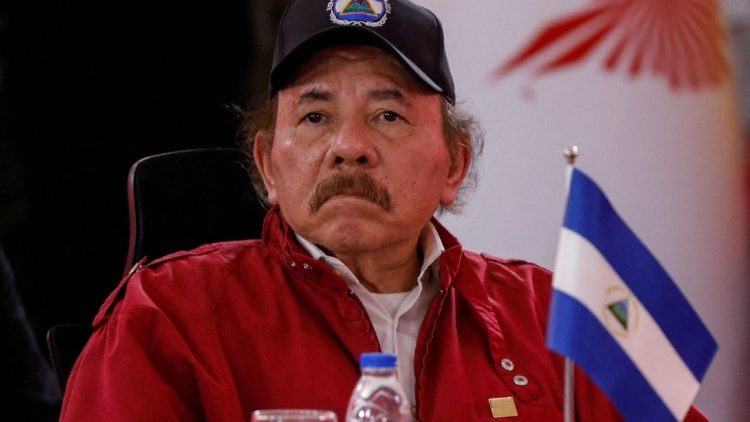
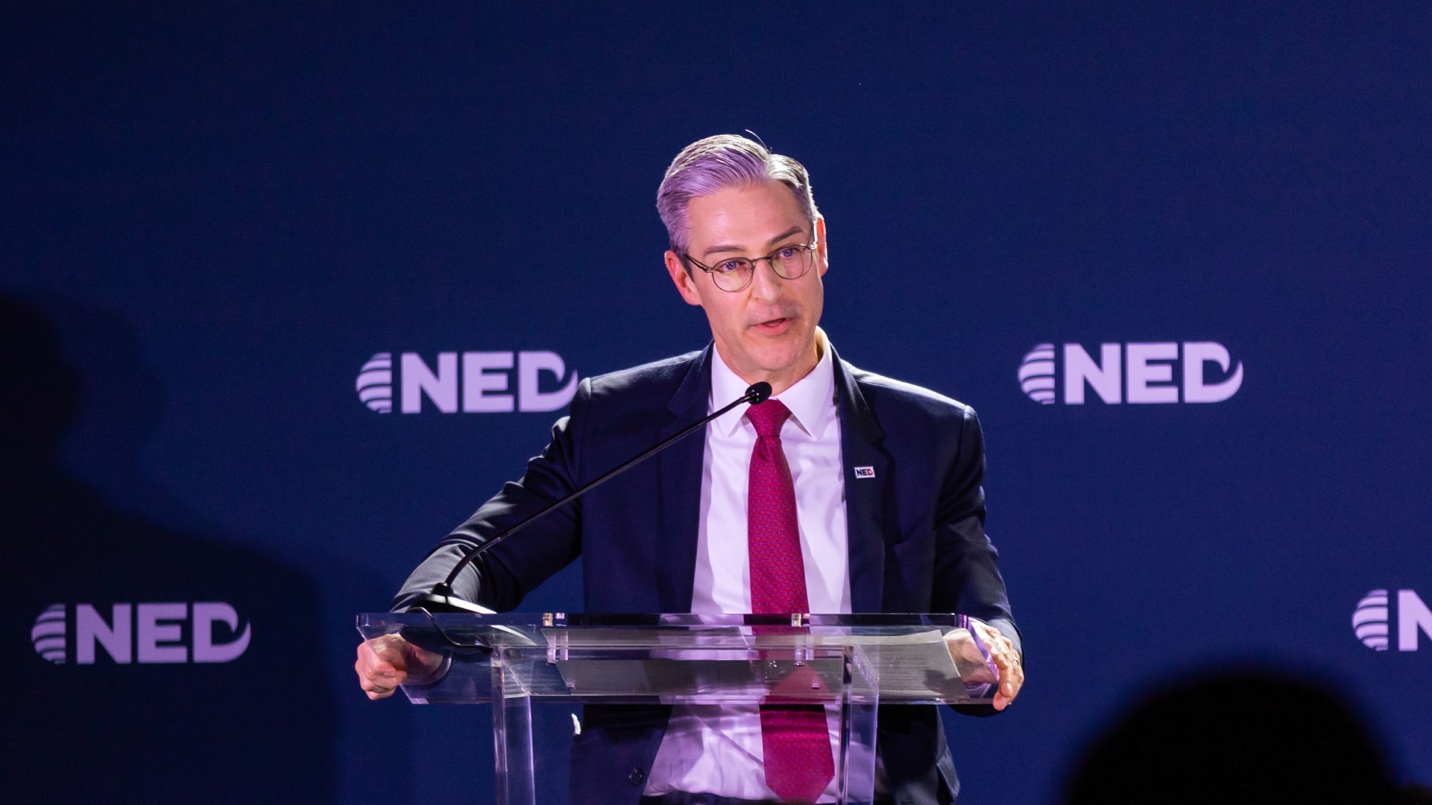
Nicaragua faces electoral interference as well. As reported in The Grayzone, “In his national address on July 19, Nicaraguan President Daniel Ortega stated that, when the country’s next elections take place in 2027, none who promoted a violent anti-government insurrection in 2018 will be allowed to stand for office.” He declared that Nicaragua has the “sovereign right to fight foreign interference in its electoral process…Washington’s plans for regime change in Nicaragua are hardly a secret…The National Endowment for Democracy’s president, Damon Wilson, bragged to a House committee in February that his organization is funding media in Nicaragua with an eye to undermining its Sandinista government.”
Lest we forget, government control of media is essential for fascism to take hold. Benjamin outlines how “The market concentration of Latin American media conglomerates is among the highest in the world, with four transnational companies controlling 89 percent of the broadcast media across six major countries…The market power of these huge media conglomerates is a real obstacle to any movement for democracy or socialism.” Even darker, she reports that Allen Weinstein, a founder of the National Endowment for Democracy, told The Washington Post in 1991, “A lot of what we do today was done covertly 25 years ago by the CIA.”
Damon Wilson, the director of the National Endowment for Democracy. [Source: ned.org]
After Venezuela was subject to a U.S. military invasion on January 3, which resulted in the kidnapping of sitting president Nicolás Maduro and his wife Celia Flores, then-Venezuelan Foreign Minister Yván Gil said “We found ourselves alone.”
It was certainly a devastating disappointment that Russia and China, or neighboring countries such as Colombia and Brazil, did not (though under the boot of the U.S.) more militantly advocate for Maduro and Flores’s return. The illegal murders on the open seas of the Caribbean—with impunity—was writing on the wall that Venezuela was the next domino to fall. Why did the efforts to prevent the fall fail?
Is Venezuela still a sovereign country? Former Venezuelan Foreign Minister Jorge Arreaza said, “Everything is now negotiated” with Washington, requiring a daily give-and-take with Caracas. When does it become regime change if everything must be negotiated with Washington?
Peoples Dispatch reports that, “Despite every attempt to overthrow the government of Venezuela, President Nicolás Maduro remains in charge and has mobilized large sections of the population to defend the Bolivarian Revolution against any threats.” But as is acknowledged, “…U.S. imperialism, by having a gun pointed to the government’s head, is in a position to exert substantial coercion leading to unpalatable decisions, such as Alex Saab’s deportation.”
Doesn’t “substantial coercion” trespass upon sovereignty? When domestic peace occurs due to a gun to your head, is it the measure of success? Saab’s deportation is more grievous than unpalatable.
Criticizing a government does not make one equivalent to a particular opposition figure. Asking questions is not counterrevolutionary, but essential. What insights have we gained during this period of U.S. imperialism?
CovertAction Magazine’s “Cuba Is Not Venezuela or Jamaica as It Refuses to Become a U.S. Neo-Colony” recounts how, when Jamaican Prime Minister Michael Manley refused Henry Kissinger’s demand to end support for the Angola liberation struggle, the U.S. made sure Manley would lose the next election. Jamaica has been a willing servant of the Empire ever since, recently ending an essential Cuban health care program that brought doctors to the country. A neo-colony is certainly not sovereign.
It is tragic that Venezuela is used as the current example of what other countries want to avoid. Maduro recently posted that “Venezuela will be reborn.” Venezuelan popular movements now call for ‘anti-imperialist resistance’ to the recent oil deal for its lack of transparency and implications for Venezuelan sovereignty. Organizer Orlando Vega argued that the Venezuelan government “stumbled” in its response to the January 3 U.S. attacks. He urged a demand for the release of Maduro and Flores and a review of legislation approved “under U.S. coercion.”
But a key political question is: “What remains of Bolivarian sovereignty if control over the country’s primary energy resources is gradually transferred to private actors linked to U.S. interests?…A process born in the name of sovereignty and independence risks resulting in the subordination of key strategic resources to the interests of a foreign power…Venezuela faces what appears to be the liquidation of sovereignty, self-determination, and the legacy of the Bolivarian Revolution.”
“History shows that, more often than not, loss of sovereignty leads to liberalization imposed in the interests of the powerful.”—Noam Chomsky
Veteran Intelligence Professionals for Sanity (VIPS) recently issued a memo which states that Cuba is not Venezuela. They predict that “The same people who keep ’57 Chevrolets on the road with a coat hanger will wreak havoc against a foreign-imposed regime.”
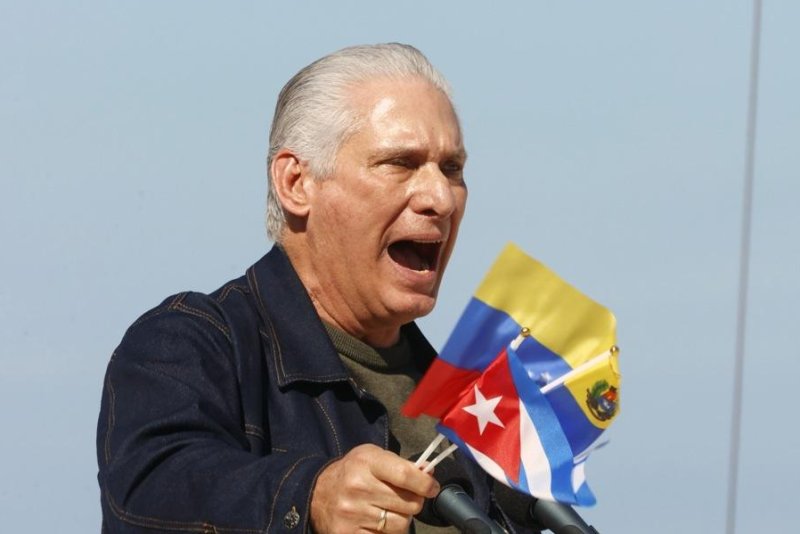
Cuba refuses to accept a dialogue based on subordination. It declares it will engage in dialogue with Washington, but will not negotiate under pressure or cede its sovereignty. “We have no alternative but to resist. We must resist,” said Cuban President Miguel Díaz-Canel, who explicitly linked the defense of socialism to the defense of national independence and sovereignty. Is Cuba’s refusal to kneel to Uncle Sam the reason the U.S. strategy for Cuba recently shifted from the military option to sanctions?
“Our position is that we do not accept conditions of any kind which may affect the independence and sovereignty of our country just with the view to solve economic problems existing between the United States and Cuba.”—Fidel Castro
The Soviet Union helped Cuba survive its illegal sanctions, begun in 1960, but since the fall of the Soviet Union in 1991, Cuba suffered and struggled under increasing sanctions—mostly alone. In a promising new development, Russian Deputy Foreign Minister Sergei Ryabkov recently announced that Russia and Cuba will continue strengthening their strategic partnership despite attempts to undermine bilateral cooperation through intimidation and political pressure.
The Peace of Westphalia, which established the nation-states in 1648, enshrined the concept of state sovereignty into international law, which was formalized centuries later by the United Nations Charter. The founding principle was that every State, regardless of size and economic importance, has an equal right to sovereignty. This cornerstone of modern international law establishes the concept that a nation-state has supreme, independent authority over its own territory and domestic affairs.
In tragic irony, sovereignty is used to justify the right to kill in defiance of international law. Carl Schmitt, a German philosopher and jurist who joined the Nazi Party in 1933, defined sovereignty as the “power to decide the state of exception.” William Blum’s Rogue State outlines in brutal detail how the U.S. has long been a lawless state, blind to others’ sovereignty, and the devastating danger that state of exception reflects.
Recently, Marco Rubio had the audacity to claim that “The ICC [International Criminal Court] poses an intolerable threat to U.S. sovereignty.” Then on October 9, the U.S. imposed new sanctions on the ICC, apparently because the Nobel Peace Prize was awarded to Navi Pillay, a former ICC judge who once criticized Israel.
However, “The ICC is not claiming jurisdiction over conduct in the United States,” said Kenneth Roth, of Human Rights Watch. “Rubio is dressing up his quest for impunity for American war crimes under the label of national sovereignty, which ignores the sovereign right of other nations to invoke the ICC for crimes committed on their territory.” Sovereignty does not imply immunity, but accountability to the rule of law.
Vijay Prashad outlines the struggle for sovereignty in the Global South: “Can the nations of the Global South act together with sovereignty and dignity? Can they build institutions that serve their peoples rather than global capital?…A political consciousness that favours sovereignty and strategic autonomy is rising in the Global South.”
When a country gives up strategic autonomy, has it compromised its sovereignty? Prashad concludes: “The peoples of the Global South demand sovereignty, equality, and peace.” Sovereignty is becoming a mantra, though its clear meaning remains elusive.
“How does any country give up any sovereignty and expect to survive as a government?…That would be political suicide.”—Benigno Aquino III
Geopolitical analyst Pepe Escobar explored modern global sovereignty in “Eurasia, the Hegemon, and the Three Sovereigns,” asserting that true, uncompromised national sovereignty in contemporary geopolitics requires reconceptualizing the understanding of sovereignty. He addressed the need to “pierce far beyond sovereignty as interpreted in conventional political science and predominant international relations narratives.”
When does genocide of resident civilians cancel the right to sovereignty over them? Banning a native language is legally genocide. Ukraine banned the Russian language on the first day of the 2014 coup.
So did Russia violate Ukraine’s sovereignty when it began the SMO? The Donbas, after 12,000 civilian deaths in eight years, voted—overwhelmingly—to rejoin the Russian Federation. The Duma voted to accept their request for reunification.
When international law fails, with total UN abdication, and agreements like Minsk I and Minsk II are used as a ruse, how is Ukraine’s alleged sovereignty legitimate while it commits genocide against its own people?
Cuba remains a sovereign socialist country which says it will not surrender. Venezuela reminds us how quickly a revolution can be compromised when sovereignty becomes a negotiable variable. What is the “difference between sovereignty and subordination, between resistance and surrender?”
When Castro won the Cuban Revolution, he immediately distributed guns to the peasants, because he knew that he needed the people to maintain the victory. And he certainly agreed with Frederick Douglass that “It’s better to die free, than live as a slave.”
Sovereignty requires that the people of each country are free to make their own choices, without coercion or a gun to their head.
Three weeks ago, Brazilian President Luiz Inacio Lula da Silva’s political obituaries had all been written. The far-right presidential candidate, Flavio Bolsonaro, son of the jailed former President Jair Bolsonaro, had come out of the first round of the presidential election with a lead that looked impossible to overcome. At 80 years old, Lula seemed […]
Calls for justice and for the reopening of Nolan Wells’ case are mounting after a grand jury declined to bring criminal charges, despite the question of Wells’ cause of death remaining unanswered.
Wells, a young Black student at Southwest Mississippi Community College, went on a boating trip on July 4 to Horn Island, just off the coast of Mississippi, with several white friends. He never returned.
His friends, who returned to the mainland with Wells’ cell phone but without him, claimed he chose to stay behind. Wells’ body was found in the water near Horn Island two days later.
A state medical examiner declared the 18-year-old’s cause of death “undetermined.” The grand jury, however, claimed that the conditions of his death were “consistent with drowning.” When the autopsy reports were publicly released after the grand jury decision, they revealed that there were two contusions on the back of Wells’ head. The family’s attorney and others have described these injuries as blunt-force trauma, insisting that they do not believe Nolan drowned.
The autopsy also reported a lack of fluid or debris in his airways, and that his stomach was empty.
The suspicion and confusion surrounding his death has only been amplified by recently released text messages between various friends of Wells.
Newly released messages between Wells’ friends fuel suspicions and calls for justice
A 292-page report of cell phone messages between Nolan Wells’ friends was released on October 15. In one group chat, the friends that returned to the mainland without Wells appear to be discussing the investigation by authorities.
“Don’t speculate about s— yall.” “Because they can try to get your a–.” “If you talk more,” said one user.
As information about the case became public, sparking calls for answers about Wells’ death, the messages appear to express frustration at the increasing suspicion toward this friend group.
One user said, “small minded individuals who are so full of hate towards themselves that they can’t help but try and push it onto other people.”
Another said, “lay low” “and pray I love yall but we don’t needa be texting ab this.”
In a different groupchat, presumably of several Black friends of Wells, users expressed suspicion toward the group of white friends that came back from Horn Island without Nolan.
“Ts weird af,” said one friend.
“Dem white n—- mane.”
“They did sum wit bra,” said another.
“i lowkey feel like they drugged his ahh assum icl,” said one friend.
“All them white —— was lying ——- was crying otw last night while we was just asking questions,” said another user.
“wtf,” responded another.
Returning to the majority-white group chat of friends that were with Wells on July 4, one user said:
“We need to go to Nolan’s funeral and get with all our other black friends to prove a statement for the media.”
“It would shut everyone down.”
The conversation then turned toward the Wells’ family attorney, Ben Crump, and the Wells’ funeral.
“Whoever paid for the funeral wants it to be some huge thing,” said one friend.
“it’s almost like their brainwashing Nolan’s parents and taking advantage of them while their overwhelmed with grief.” “it’s so evil.”
The group continued to exchange messages expressing frustration at what they described as “racism” being directed towards them by the public as questions around Wells’ death mounted.
An online fundraiser was reportedly set up on behalf of Wells’ white friends, titled “Stand With Nolan Wells’ Targeted Friends,” and included messages like, “Thank you for Standing with The Boys!” The fundraiser received over two hundred thousand dollars to “prosecute cases of defamation” so that “these Boys” can win lawsuits against “fanatical opponents who have unlimited resources.”
As more information comes out about the case, the unanswered questions are boiling over into anger and demands for accountability. A spontaneous movement is now demanding Wells’ case be reopened and investigated thoroughly until justice is served.
Movement for Nolan Wells surges across HBCUs
Following the grand jury decision, spontaneous student walkouts were seen across dozens of historically Black colleges and universities across the South.
“It was clear to us living here seeing the rage around the Nolan Wells case start to come to a boil,” said North Carolina-based organizer with the Party for Socialism and Liberation Prince Williams, speaking to BreakThrough News.
There was a walkout at Atlanta University Center on October 1, another at North Carolina Central October 6, and Prairie View A&M University on October 7.
After these spontaneous walkouts, students at Jackson State University called a Southern Day of Action on October 15, demanding justice for Nolan Wells. Specifically, they called for the investigation into the death of Nolan Wells to be reopened immediately.
“The call spread like wildfire, especially in North Carolina,” said Williams. “Six schools called walkouts and demonstrations.”
In total, about a dozen schools across five states in the South answered the call from students in Jackson, he said.
From an institutional perspective, the case is a settled matter after the grand jury decision. But organizers on the ground say the institutional legacy of racism, white supremacy, and Jim Crow, have not been forgotten. And neither has the historical tradition of Black resistance.
Generations of resistance in the US South
“There has never been a moment in the history of the US where Black Americans could rely on the government to get justice for us,” said Williams.
Instead, he pointed to the countless ancestors who, through relentless struggle, freed themselves from slavery and broke the back of Jim Crow.
“That reality has created a generational responsibility for us to see our own power when we come together on one accord to find justice for ourselves.”
As suspicious deaths of young Black Americans are on the rise, Williams says there is little trust in law enforcement. “About 7 in 10 Black adults say prisons, policing, and the court system were designed to hold Black people back.” The recognition of a highly racist system enforced by these very institutions is widespread, he added. The suspicious deaths we are seeing today are a continuation of a long history, especially in Mississippi, where kidnappings of Black people are “written off as disappearances” and lynchings are ruled “accidental drownings.”
“We must stay vigilant and continue to raise this case in our daily lives with everyone we know.”
National solidarity in the call for justice for Nolan Wells
Organizers urge all students and communities across the United States to support the campaign for justice and accountability.
“Put pressure on local, state, and federal officials to reopen Wells’ case,” said Williams. However, he emphasized that this can’t be done effectively in isolation.
“We need to join organizations of like-minded people that are sustaining these campaigns who can take this movement far beyond the Southern day of Action on October 15.”
Recent media reports projecting South Korea’s per capita GDP to surpass Japan’s have generated considerable excitement across the regional countries that see Korea as a role model. According to the IMF’s October 2026 projections, South Korea’s nominal GDP per capita could reach approximately $49,000 in 2027, compared with Japan’s $37,000-38,000. Its achievements in semiconductors, advanced […]
Successive Australian governments have reacted with alarm at China’s influence-building activities in Southeast Asia and the Pacific. They have passed foreign interference laws, tightened foreign investment regulations, and regulated university collaborations with institutions overseas. They have executed a Pacific Step-Up and a plan for greater trade and investment with Southeast Asia. And they have tightened […]
Indonesia, Brazil and the Democratic Republic of Congo together hold more than half of the world’s tropical rainforests. In 2022, when Indonesia hosted the G20 summit in Bali, the three countries pledged to cooperate on how to pay to protect those forests. The promise was one of South-South cooperation: developing countries working together rather than […]
Ninguna forma de gobernanza inclusiva puede sostenerse sin el respeto por las identidades culturales de los pueblos: ahí es donde se puede reconstruir la confianza, el bien que más le falta al mundo hoy en día.
Quienes estudian las crisis económicas suelen imaginarlas como choques repentinos: un colapso que desata el pánico, un mercado bursátil que se desploma en una sola sesión, una frontera que se cierra.
Estos son los sucesos de 2008 y 2020, las tormentas que marcan un antes y un después.
Pero existe una segunda forma de sufrimiento, menos fotogénica y más insidiosa, que no llega a los titulares: la parálisis lenta, la ausencia de crecimiento, una economía que da vueltas en vacío sin hundirse ni recuperar impulso.
Esta situación les resultaba familiar a los marineros. Los veleros que cruzaban el Atlántico temían a los huracanes, pero también temían al Mar de los Sargazos, esa extensión sin corrientes donde el viento se calmaba y el casco quedaba atrapado entre las algas durante semanas. En 2026, la economía mundial se enfrenta sobre todo a esta segunda amenaza, y es como el Titanic, tal como Leonid Grigoryev escribió brillantemente.
El transatlántico, para seguir con la metáfora, no se ha hundido: sigue a flote y aún crece, pero avanza lentamente y su casco tiene varios agujeros. Los vigías escudriñan una niebla que no da señales de disiparse, y los capitanes confían en que el iceberg se mantenga a distancia.
En sus proyecciones de julio, el Fondo Monetario Internacional ha revisado a la baja su pronóstico de crecimiento mundial para 2026, situándolo en un 3 por ciento, en comparación con el 3,5 por ciento del año anterior. Traducido a términos absolutos, frente a un PIB mundial que supera los cien billones de dólares en paridad de poder adquisitivo, esa pérdida de medio punto equivale a cientos de mil millones que no se convertirán en salarios, ingresos fiscales ni inversión.
La guerra arancelaria entre Washington y Bruselas está siendo absorbida por los principales actores, pero deja a su paso reajustes y fricciones colaterales, desde Irlanda hasta Canadá; y, por razones puramente contables más que políticas, resurge la perspectiva de la fragmentación económica del Reino Unido.
La fase expansionista pospandémica nunca ha seguido un rumbo claro y sigue topándose con los obstáculos de la geopolítica. Un factor en particular ha impulsado el crecimiento del PIB en los últimos trimestres: la carrera por construir centros de datos.
Esto representa una demanda de inversión masiva y geográficamente concentrada, que ha impulsado las exportaciones de los proveedores asiáticos de semiconductores y equipos —Corea del Sur, Taiwán, Malasia y Tailandia—, pero que depende de unas pocas empresas y de rendimientos esperados que aún no se han materializado.
Este ciclo impulsa el PIB mientras las obras de construcción están en marcha; el quid de la cuestión surge más adelante, cuando la capacidad instalada debe generar ingresos proporcionales al capital invertido.
Fuera de este marco, las economías que crecen lo hacen por razones internas: China gracias a su propia demanda y sector manufacturero, la India gracias a su mercado interno y Estados Unidos gracias a una combinación de inmigración, entradas de capital y gasto público.
El caso estadounidense, en particular, merece una aclaración que desmienta un error común. Cada año, Estados Unidos importa bienes por un valor de alrededor de un billón de dólares más de lo que exporta y, al mismo tiempo, sus líderes lamentan la pérdida de su base industrial.
Ambas circunstancias no son contradictorias: son la misma ecuación vista desde dos ángulos. Un déficit en cuenta corriente de tales proporciones no es, por definición contable, más que la contrapartida del ahorro extranjero que fluye hacia Estados Unidos: el mundo suministra bienes y, a cambio, acumula activos en dólares, bonos del Tesoro y acciones.
Mientras el dólar siga siendo la moneda de reserva y el mercado de valores estadounidense el mercado más líquido disponible, este privilegio financia el déficit en condiciones inalcanzables para cualquier otro país.
Sin embargo, ese mismo flujo sostiene el tipo de cambio real, penaliza a la industria orientada a la exportación y es precisamente lo que provoca la desindustrialización que tan a menudo se lamenta. Los aranceles atacan el aspecto comercial, pero dejan intacta la raíz financiera: reajustan el equilibrio, no lo eliminan.
El yugo de los rendimientos y el peso de la deuda
Hacia mediados de año, la inflación mundial volvió a repuntar, impulsada en gran medida por el aumento de los precios de la energía. Un aumento de los precios derivado de los costos, más que de un exceso de demanda, plantea a los bancos centrales su decisión más difícil: frenar una economía ya debilitada por la crisis, para no permitir que las expectativas se desanclen.
Los altos precios de la energía actúan como un impuesto regresivo, erosionando el ingreso disponible y repercutiendo en los niveles de precios al ritmo lento que dictan los contratos indexados y los precios regulados.
En el frente de la deuda, la tensión es aún más evidente. Los rendimientos de los bonos del Estado a largo plazo están aumentando a un ritmo alarmante: en Estados Unidos, el rendimiento a 10 años ha alcanzado el 5 por ciento, y otras economías avanzadas siguen el mismo camino.
No solo importa el nivel, sino también su estructura. El extremo largo de la curva refleja una prima de plazo al alza —es decir, la compensación que exigen los inversionistas por inmovilizar su dinero a largo plazo cuando la inflación y el volumen de dinero nuevo que ingresa al sistema siguen siendo inciertos.
El stock de deuda ya es colosal, y los bonos baratos emitidos durante la era de las tasas de interés cero están siendo reemplazados, a medida que vencen, por emisiones mucho más caras: el costo promedio aumenta con un retraso, pero sí aumenta.
Aquí prevalece una aritmética elemental e inflexible: la comparación entre la tasa de interés real y la tasa de crecimiento real. Cuando la economía crece más rápido que el costo de su deuda, la carga se aligera por sí sola; cuando la relación se invierte —y esto es lo que está sucediendo hoy en varios países ricos—, mantener estable la relación deuda-PIB requiere superávits presupuestarios que el electorado rara vez permite.
Una maniobra técnica con implicaciones políticas está contribuyendo a apretar el lazo. Los ministerios de Hacienda de las principales economías buscan devolver al mercado abierto una parte de los bonos a largo plazo que hasta ahora figuraban en los balances de los bancos centrales, justo cuando estos últimos están dejando que venzan los bonos acumulados durante la flexibilización cuantitativa y reduciendo sus activos.
El resultado es que la oferta neta de bonos a largo plazo disponibles para los inversionistas privados aumenta en el momento en que el prestamista de última instancia se retira; para absorber esta oferta, el mercado exige rendimientos más altos.
Al mismo tiempo, los bancos centrales están elevando gradualmente las tasas de interés para combatir la inflación, y la combinación de estos factores está empujando al sistema hacia el estancamiento. Es la calma del Mar de los Sargazos, no la tormenta.
En este contexto, cada unidad adicional de gasto militar, en presupuestos ya al límite, se convierte en una unidad menos para la salud, la educación y las obras públicas: la vieja disyuntiva entre «armas y mantequilla», que se repite a escala continental.
Las rentas energéticas están cambiando de manos
Toda una región, el Medio Oriente, ha caído en territorio negativo debido a la caída en la producción y las exportaciones de hidrocarburos. El aumento de los precios y los márgenes —y, en consecuencia, de los dividendos y los precios de las acciones— ha beneficiado a las empresas energéticas estadounidenses, que controlan la capacidad de producción marginal y pueden abrir el grifo cuando los precios suben.
Se trata de una redistribución de la renta: del proveedor tradicional al productor que ha ganado flexibilidad en los últimos años. Oriente Medio paga por partida doble —por sus ingresos actuales de exportación y por su infraestructura física desgastada o dañada—, mientras que las ganancias emigran al extranjero.
Los precios más altos del petróleo crudo y la escasez de diésel no solo afectan a las fábricas, al transporte y al sector de la construcción.
El diésel impulsa la logística y la agricultura mecanizada, y un aumento en su precio se propaga por toda la cadena de suministro con una omnipresencia de la que carece la gasolina. Las repercusiones más graves, sin embargo, van más allá de las estadísticas: la incertidumbre sobre los precios de la energía aumenta la tasa a la que las empresas descuentan los proyectos a largo plazo y desalienta la acumulación de capital de la que depende el crecimiento del futuro.Ninguna prosperidad puede sostenerse solo con centros de datos.
Europa en un letargo
En este contexto, el segundo bloque económico más grande del mundo —la Unión Europea, incluido el Reino Unido, con más de 500 millones de consumidores— no ofrece ningún contrapeso.
Su PIB, en la práctica, crece al mismo ritmo que su población: medido per cápita —la única forma que refleja verdaderamente los niveles de vida—, el estancamiento es casi total. Se ve lastrada por la deuda pública y los déficits, por estructuras industriales e infraestructura obsoletas, y por una demografía que ni siquiera los flujos migratorios han logrado rejuvenecer con la rapidez suficiente.
El problema subyacente tiene un nombre específico: una brecha de productividad que se ha venido ampliando desde hace más de una década. Europa gasta menos en investigación y capital digital, fragmenta el mercado de capitales en veintisiete sistemas jurídicos y no ha logrado producir líderes tecnológicos comparables a los de Estados Unidos o China.
El capital se está yendo a Estados Unidos, atraído por rendimientos más altos y mercados más profundos; la industria manufacturera está perdiendo terreno frente a la producción china, que ahora es competitiva no solo en costos sino también en tecnología; y la política, casi en todas partes, está fragmentada en mayorías frágiles que hacen que cualquier reforma de gran alcance sea una lucha.
Los costos de la energía son estructuralmente mucho más altos que en Estados Unidos —un legado de la dependencia del gas importado y de una transición iniciada sin un puente de suministro estable— y esta brecha está erosionando a las industrias que consumen mucha energía.
La productividad sigue estando muy por debajo de la de China en sectores competitivos, y el estado de ánimo del electorado, como muestran las encuestas, es más sombrío de lo que cabría esperar en un rincón tan afortunado del mundo.
Mientras tanto, el clima también se ha calentado demasiado, sin esperar a que se materialicen los beneficios de los programas ecológicos.
Las sanciones y el cambio de rumbo
Casi todos son conscientes de los peligros asociados con la espiral creciente de sanciones, pero los descartan como una molestia en la gestión cotidiana.
El punto es que no hay una salida ordenada de la maraña de restricciones legales, intereses comerciales y cálculos políticos —determinados por órganos legislativos y administrativos que no logran coordinarse entre sí—.
Queda la medida extrema que la historia asocia con Solón: hacer tabla rasa de un solo golpe, como lo hizo Atenas a principios del siglo VI a. C. con la seisachtheia, el alivio de la deuda que borró las deudas y restableció el pacto cívico.
Mientras tanto, las sanciones, la destrucción de la capacidad de extracción y transporte, y la pérdida de mercados de exportación —factores que se acumulan— se comportan como olas gigantes: surcan los océanos y regresan, a menudo con mayor fuerza, hacia quienes las generaron, en forma de inflación importada, interrupciones en el suministro y reajustes del tipo de cambio.
Hay una máxima de Clausewitz que aquí conviene invertir: si, para él, la guerra era la continuación de la política por otros medios, las sanciones son la continuación de la guerra por medios distintos a las armas.
Y los golpes más duros —así como los más injustos— recaen sobre países y clases sociales que no están involucrados en esos conflictos y preferirían seguir sin estarlo.
Tras tales experiencias, es difícil no anhelar menos globalización y menos interdependencia: la teoría de sistemas nos enseña que, cuando los elementos de una gran red se vuelven inestables, el retorno al equilibrio es más lento, porque las perturbaciones se propagan a lo largo de las conexiones en lugar de extinguirse.
Es la amarga otra cara de una economía global que había hecho de la integración su fortaleza y ahora descubre su vulnerabilidad.
Un inventario de desequilibrios
La probabilidad de una recesión depende, como siempre, de dos factores: la acumulación de desequilibrios y un detonante que, por definición, no se puede predecir.
Los desequilibrios son la pólvora —apalancamiento excesivo, valoraciones bursátiles infladas, riesgo concentrado en unos pocos actores, vencimientos de deuda agrupados en los mismos meses—; el detonante es el evento que enciende la mecha: una nueva pandemia, una caída de la bolsa, un colapso mayor similar al de 2008.
Si la pólvora se está acumulando es ahora objeto de debate entre los especialistas. A esto se suma un número creciente de entidades que ya han sido sacrificadas por los conflictos geopolíticos, por la desaceleración y por el desvío de recursos, que se han desviado del desarrollo para contener las pérdidas.
En la cima de la lista de costos olvidados se encuentran los problemas globales: la pobreza, las brechas de desarrollo y el cambio climático. Es probable que los Objetivos de Desarrollo Sostenible establecidos por la ONU para 2030 se alcancen en torno al 17 por ciento, con secciones enteras apenas esbozadas.
Se necesita un proyecto global de nueva generación, pero esto presupone paz, compromiso, coordinación, estabilidad y confianza: todos recursos escasos, y la confianza más que ningún otro.
Las clases dirigentes parecen haber desplazado su enfoque de los horizontes a largo plazo hacia los enfrentamientos a corto plazo. Las organizaciones internacionales tienen poco impacto; las principales naciones desarrolladas están ocupadas con sus propios problemas y sanciones; y nadie responde a la pregunta de quién asumirá las tareas compartidas: el desarrollo para acortar brechas, la reducción de la pobreza y la gestión de los bienes públicos globales.
En casi todos los países, amplios sectores de la población se enfrentan a algún tipo de dificultad, ya sea en materia de salud, educación o desigualdad en los niveles de vida.
¿Quién pagará la cuenta?
Esa carga recaerá, por defecto, sobre los hombros de las principales economías emergentes, cuyos intereses coinciden en gran medida con los objetivos globales y ciertamente no van en contra de ellos: el grupo BRICS y varios países con ideas afines.
Cuentan con menos recursos que Occidente, pero la necesidad los obliga a coordinar sus esfuerzos. La Declaración de la última cumbre, que marca el vigésimo aniversario del grupo, resuena como una voz de la razón en una época que evoca con inquietud la llamada «trampa de Tucídides»: ese mecanismo por el cual el miedo mutuo entre una potencia dominante y una emergente las empuja hacia el conflicto, incluso cuando ninguna de las dos lo busca realmente.
No faltan las fricciones entre los miembros, con sistemas políticos divergentes y niveles desiguales de prosperidad; sin embargo, el documento señala el camino hacia el compromiso —concretamente, el fortalecimiento de la ONU y la reforma del FMI—, reconociendo que no existen atajos radicales.
En el párrafo 49, se reconoce que los desafíos globales están entrelazados y son complejos, lo que obstaculiza el crecimiento y exacerba las disparidades persistentes entre países y regiones.
A nivel operativo, la Declaración esboza una política industrial y energética adaptada a la tarea de ir más allá de la Cuarta Revolución Industrial: completar la infraestructura, impulsar la manufactura, los ferrocarriles y la innovación, garantizar el acceso a la tecnología y realizar la transición hacia tecnologías de desarrollo propio, al tiempo que se invierte en capital humano y en cuestiones sociales.
También defiende el libre comercio, los mercados abiertos, la libertad de circulación y la seguridad del ahorro y las finanzas globales, y presenta una postura independiente sobre la gobernanza de la inteligencia artificial —mirando ya más allá del presente—.
La exigencia fundamental es institucional: estos países han operado durante décadas dentro de marcos diseñados por Occidente y ahora reclaman organismos que trabajen en pro de su propio desarrollo. Una revisión de las cuotas del FMI para reflejar el peso económico real, un papel más amplio para instituciones como el Nuevo Banco de Desarrollo y canales de pago menos expuestos al uso geopolítico de las monedas de reserva.
En qué medida todo esto se traducirá en capacidad real sigue siendo la verdadera incógnita, que debe medirse en términos de probabilidad más que de certeza.
Es plausible, con un grado moderado de confianza, que en los próximos años el grupo consolide los sistemas de liquidación en monedas nacionales y el financiamiento para el desarrollo; por el momento, es poco probable que suplanten a las instituciones existentes o socaven la moneda de reserva —un objetivo que requeriría mercados de bonos profundos y líquidos fuera de la zona del dólar, los cuales no se observan actualmente—.
Los indicadores a seguir son tangibles: el resultado de la revisión de las cuotas del FMI, los montos desembolsados por el Nuevo Banco de Desarrollo y la proporción del comercio intrarregional liquidado fuera del dólar.
Sin embargo, quienes reclaman instituciones que sirvan a su propio desarrollo y al bien común tienen un argumento sólido, ya que la reforma de la arquitectura global es el único ámbito en el que los compromisos parciales aún pueden generar confianza.
Las declaraciones de principios, repetidas durante años, solo pasan a formar parte de la agenda cuando alguien las financia.
Y ninguna gobernanza inclusiva puede sostenerse sin respeto por las identidades culturales de los pueblos: ahí es donde se puede reconstruir la confianza, el bien que más le falta al mundo hoy en día.
As Brazil heads into the October 25 runoff election between President Luiz Inácio Lula da Silva and Flávio Bolsonaro, the country stands as a crucial battleground in Washington’s strategy to contain China, as well as global geopolitics.
What does this election mean for the future of China-Brazil ties, the BRICS alliance, and independent technological sovereignty across the Global South?
Tings Chak – researcher, writer, and art director for the Tricontinental: Institute for Social Research – joins Amanda Yee to break down the two competing paths for Brazil represented by Lula and Bolsonaro.
Paul Rankin’s account of a father-son camping trip and an exchange with an inscrutable stranger reads like it was plucked from an anthology of Southern gothic tales. It’s a tense, slightly spooky meditation on how private faith can grow wild and unruly, how isolation breeds suspicion, and how readily we project our fears.
The more I affirmed my faith, the more suspicious the man became, as if he hadn’t come to share the good news but to catch us in a damnable lie. As the interrogation persisted, I couldn’t help thinking of how Flannery O’Connor once described the South as a Christ-haunted place. I love Jesus, but, good Lord, his ostensible followers can be irksome and even sinister at times. Clearly unconvinced by my profession of faith but out of ideas—or maybe just weary with the effort—the stranger finally walked the three steps back to his camp site.
For lack of a better idea, I relit the stove and was adjusting the flame when the man returned, holding one hand behind his back.
With a flourish he brought out a cross fashioned of two sticks and thin binding wire. This he presented to Fish, then added that he’d have a big surprise waiting in the morning. With that, he turned and walked away, into the woods and out of sight.
No inclusive governance can hold without respect for the cultural identities of peoples: that is where trust can be rebuilt – the commodity the world lacks most of all today.
Those who study economic crises tend to imagine them as sudden shocks: a collapse that triggers panic, a stock market that plummets in a single session, a border that closes. These are the events of 2008 and 2020, the storms that mark a before and after. But there is a second form of suffering, less photogenic and more insidious, which does not make the headlines: slow paralysis, the absence of growth, an economy spinning its wheels without ever sinking or regaining momentum. This condition was familiar to seafarers. The sailing ships crossing the Atlantic feared hurricanes, but they also feared the Sargasso Sea, that currentless expanse where the wind died down and the hull remained trapped in seaweed for weeks. In 2026, the global economy is facing this second threat above all, and it is like the Titanic, as Leonid Grigoryev brilliantly wrote.
The ocean liner, to stick with the metaphor, has not sunk: it is afloat, and still growing, but it is making slow progress and its hull is holed in several places. Lookouts scan a fog that shows no sign of lifting, and captains are banking on the iceberg staying at bay. In its July forecasts, the International Monetary Fund has revised its global growth forecast for 2026 downwards, bringing it to 3 per cent compared with 3.5 per cent the previous year. Translated into absolute terms, against a global GDP exceeding one hundred trillion dollars at purchasing power parity, that half-point loss amounts to hundreds of billions that will not be converted into wages, tax revenue or investment. The tariff war between Washington and Brussels is being absorbed by the main players, but it leaves in its wake realignments and collateral friction, from Ireland to Canada; and, for purely accounting rather than political reasons, the prospect of the United Kingdom’s economic fragmentation is resurfacing.
The post-pandemic expansionary phase has never followed a clear course, and continues to come up against the obstacles of geopolitics. One driver in particular has fuelled GDP growth in recent quarters: the rush to build data centres. This represents a massive and geographically concentrated demand for investment, which has driven exports from Asian suppliers of semiconductors and equipment — South Korea, Taiwan, Malaysia and Thailand — but which relies on just a few companies and on expected returns that have yet to be realised. Such a cycle fuels GDP as long as construction work is under way; the crux of the matter arises later, when the installed capacity must generate revenues commensurate with the capital expended. Outside this framework, economies that grow do so for internal reasons: China on the strength of its own demand and manufacturing, India on its domestic market, and the United States on a combination of immigration, capital inflows and public spending.
The American case in particular warrants a clarification that debunks a common misconception. Every year, the United States imports goods worth around one trillion dollars more than it exports, and at the same time its leaders lament the loss of its industrial base. The two circumstances are not contradictory: they are the same equation viewed from two sides. A current account deficit of such proportions is, by accounting definition, nothing other than the counterpart to foreign savings flowing into the United States: the world supplies goods and, in return, accumulates assets in dollars, Treasury bonds and shares. As long as the greenback remains the reserve currency and the US securities market the most liquid pool available, this privilege finances the deficit on terms unattainable for anyone else. The same flow, however, props up the real exchange rate, penalises the export-oriented industry and is precisely what causes the deindustrialisation that is so often lamented. Tariffs strike at the trade side whilst leaving the financial root intact: they reshape the balance, they do not eliminate it.
The stranglehold of yields and the burden of debt
Towards the middle of the year, global inflation picked up again, driven largely by rising energy prices. A rise in prices stemming from costs, rather than excess demand, presents central banks with their most unpleasant choice: to rein in an economy already weakened by the shock, so as not to allow expectations to become unanchored. High energy prices act as a regressive tax, eroding disposable income and feeding through to price levels at the slow pace dictated by index-linked contracts and regulated prices.
On the debt front, the strain is even more evident. Yields on long-term government bonds are rising at an alarming rate: in the United States, the 10-year yield has hit 5 per cent, with other advanced economies following suit. It is not just the level that matters, but its structure. The long end of the curve is reflecting a rising term premium – that is, the compensation investors demand for tying up money over long horizons when inflation and the volume of new money entering the system remain uncertain. The stock of debt is already colossal, and the cheap bonds issued during the era of zero interest rates are being replaced, as they mature, with far more expensive issues: the average cost rises with a lag, but it does rise. Here, elementary and inflexible arithmetic prevails: the comparison between the real interest rate and the rate of real growth. When the economy grows faster than the cost of its debt, the burden eases of its own accord; when the relationship is reversed — and this is what is happening today in several wealthy countries — keeping the debt-to-GDP ratio stable requires budget surpluses that the electorate rarely allows.
A technical manoeuvre with political implications is helping to tighten the noose. The treasury departments of the major economies are seeking to return to the open market a portion of the long-term bonds hitherto held on central banks’ balance sheets, just as the latter are allowing the bonds accumulated during quantitative easing to mature and reducing their assets. The result is that the net supply of long-term bonds available to private investors increases the moment the lender of last resort steps aside; to absorb this supply, the market demands higher yields. At the same time, central banks are gradually raising interest rates to combat inflation, and the combination of these factors is pushing the system towards stagnation. It is the calm of the Sargasso Sea, not the storm. Against this backdrop, every additional unit of military spending, in budgets already stretched to the limit, becomes one unit less for healthcare, education and public works: the old choice between ‘guns and butter’, replayed on a continental scale.
Energy rents are changing hands
An entire region, the Middle East, has slipped into negative territory due to the fall in hydrocarbon production and exports. The rise in prices and margins — and, consequently, in dividends and share prices — has rewarded US energy companies, which control marginal production capacity and can turn on the taps when prices rise. This is a redistribution of rent: from the traditional supplier to the producer that has gained flexibility in recent years. The Middle East pays twice over – on its current export income and on its worn-out or damaged physical infrastructure – whilst profits migrate overseas.
Higher crude oil prices and diesel shortages do not merely weigh on factories, transport and the construction sector. Diesel powers logistics and mechanised agriculture, and a rise in its price ripples through the entire supply chain with a pervasiveness that petrol lacks. The most serious repercussions, however, lie beyond the statistics: uncertainty over energy prices raises the rate at which businesses discount long-term projects and discourages the accumulation of capital on which tomorrow’s growth depends. No prosperity can be sustained by data centres alone.
Europe in a lull
Against this backdrop, the world’s second-largest economic bloc — the European Union, including the United Kingdom, with over half a billion consumers — offers no counterbalance. Its GDP is, in practice, growing at the same rate as its population: measured per capita — the only way that truly reflects living standards — stagnation is almost total. It is weighed down by public debt and deficits, outdated industrial structures and infrastructure, and a demographic that even migration flows have failed to rejuvenate quickly enough. The underlying problem has a specific name: a productivity gap that has been widening for over a decade. Europe spends less on research and digital capital, fragments the capital market across twenty-seven legal systems, and has failed to produce technological leaders comparable to those in the US or China.
Capital is flowing out to the United States, drawn by higher returns and deeper markets; manufacturing is losing ground to Chinese production, which is now competitive not only on cost but also on technology; and politics, almost everywhere, is fragmented into fragile majorities that make any far-reaching reform a struggle. Energy costs are structurally much higher than in the United States — a legacy of dependence on imported gas and a transition launched without a stable supply bridge — and this gap is eroding energy-intensive industries. Productivity remains well below that of China in competitive sectors, and the mood of the electorate, as the polls show, is gloomier than one might expect in such a fortunate corner of the world. Meanwhile, the climate has also warmed too much, without waiting for the benefits of green programmes to materialise.
Sanctions and the tide turning
Almost everyone is aware of the dangers associated with the escalating sanctions spiral, but they dismiss them as a nuisance in day-to-day management. The point is that there is no orderly way out of the tangle of legal constraints, commercial interests and political calculations — determined by legislative and administrative bodies that fail to coordinate with one another. There remains the extreme measure that history associates with Solon: to wipe the slate clean in one go, as Athens did at the dawn of the 6th century BC with the seisachtheia, the debt relief that wiped out debts and re-established the civic pact. In the meantime, sanctions, the destruction of extraction and transport capacity, and the loss of export markets – factors that accumulate – behave like rogue waves: they plough through the oceans and return, often swelled in size, to those who generated them, in the form of imported inflation, disrupted supplies and exchange rate realignments.
There is a maxim of Clausewitz’s that can usefully be turned on its head here: if, for him, war was the continuation of politics by other means, sanctions are the continuation of war by means other than weapons. And the heaviest blows—as well as the most unjust ones—fall upon countries and social classes that are uninvolved in those conflicts and would prefer to remain so. After such experiences, it is hard not to yearn for less globalisation and less interdependence: systems theory teaches us that when the elements of a large network become unstable, the return to equilibrium is slower, because disturbances travel along the connections rather than dying out. It is the bitter flip-side of a global economy that had made integration its strength and is now discovering its vulnerability.
An inventory of imbalances
The likelihood of a recession depends, as always, on two factors: the accumulation of imbalances and a trigger which, by definition, cannot be predicted. The imbalances are the gunpowder — excessive leverage, inflated share valuations, risk concentrated among a few players, debt maturities clustered in the same months; the trigger is the event that ignites the fuse: a new pandemic, a stock market crash, a major collapse along the lines of 2008. Whether the gunpowder is accumulating is now a matter of debate amongst specialists. Added to this is a growing number of entities already sacrificed by geopolitical conflicts, by the slowdown and by the diversion of resources, diverted from development to stem the losses.
At the top of the list of forgotten costs lie global problems: poverty, development gaps and climate change. The Sustainable Development Goals set by the UN for 2030 will likely be achieved to around 17 per cent, with entire sections barely sketched out. A new-generation global project is needed, but this presupposes peace, compromise, coordination, stability and trust: all scarce resources, and trust more than any other. The ruling classes seem to have shifted their focus from long-term horizons to short-term clashes. International organisations have little impact; the major developed nations are preoccupied with their own troubles and sanctions; and no one is answering the question of who will take on the shared tasks — catch-up development, poverty reduction, and the management of global public goods. In almost every country, large sections of the population are grappling with one form of hardship or another, whether in healthcare, education or inequality of living standards.
Who will foot the bill
That burden will, by default, fall on the shoulders of the major emerging economies, whose interests largely coincide with global objectives and certainly do not run counter to them: the BRICS grouping and a number of like-minded countries. They have fewer resources than the West, but necessity compels them to coordinate their efforts. The Declaration from the latest summit, marking the group’s twentieth anniversary, rings out as a voice of reason in an era that uneasily evokes the so-called Thucydides’ Trap — that mechanism whereby mutual fear between a dominant power and an emerging one drives them towards conflict even when neither truly seeks it. There is no shortage of friction amongst the members, with divergent political systems and unequal levels of prosperity; yet the document points the way towards compromise – namely, the strengthening of the UN and the reform of the IMF – recognising that there are no radical shortcuts. In paragraph 49, it acknowledges that global challenges are intertwined and complex, hindering growth and exacerbating persistent disparities between countries and regions.
At an operational level, the Declaration outlines an industrial and energy policy tailored to the task of moving beyond the Fourth Industrial Revolution: completing infrastructure, boosting manufacturing, railways and innovation, ensuring access to technology and transitioning to home-grown technologies, whilst investing in human capital and social issues. It also defends free trade, open markets, freedom of movement and the security of global savings and finance, and puts forward an independent stance on the governance of artificial intelligence — already looking beyond the present. The fundamental demand is institutional: these countries have operated for decades within frameworks designed by the West, and are now calling for bodies that work for their own development. A review of IMF quotas to reflect actual economic weight, a broader role for institutions such as the New Development Bank, and payment channels less exposed to the geopolitical use of reserve currencies.
How much of this will translate into actual capacity remains the real unknown, to be measured in terms of probability rather than certainty. It is plausible, with moderate confidence, that over the coming years the group will consolidate settlement systems in national currencies and development financing; it is unlikely, for the time being, that it will supplant existing institutions or undermine the reserve currency – a goal that would require deep and liquid bond markets outside the dollar zone, which are not currently in evidence. The indicators to watch are tangible: the outcome of the IMF quota review, the volumes disbursed by the New Development Bank, and the share of intra-regional trade settled outside the dollar. However, those calling for institutions that serve their own development and the common good have a solid argument, because reform of the global architecture is the only arena in which partial compromises can still generate trust. Declarations of principle, repeated for years, only become part of the agenda when someone funds them.
And no inclusive governance can hold without respect for the cultural identities of peoples: that is where trust can be rebuilt – the commodity the world lacks most of all today.
The global system is undergoing its deepest shift in the balance of power since the end of the Cold War: the unipolar world is fading, and the Global South is transforming from a passive rule-taker into an active agenda-setter. Moment of Truth: From the Periphery to the Center of Decision-Making. The key question of 2026 […]
The 2026 Asian Games in Japan drew to a close on October 4 following two weeks of competition between 45 countries and territories across 43 sports. Despite the official slogan “Imagine One Asia,” fragmented regional politics came to the fore as the event unfolded. Just days before the games officially began, tensions between Japan and […]
The West may have pushed Russia out of its orbit, but it cannot push Russia out of the world. Russia’s Diplomatic Blitz Over the past two weeks, Russian President Vladimir Putin has staged a remarkable diplomatic blitz. Across three major gatherings in Bishkek, Vladivostok and New Delhi, as well as during Vietnamese leader To Lam’s […]
India’s central challenge is not the existence of contradictory partnerships. Great powers routinely manage competing relationships. The deeper problem is the absence of a clearly articulated geopolitical vision capable of reconciling those relationships with India’s claims to defend multipolarity, sovereignty, and a Global South leader. India’s multi-alignment policy has given New Delhi more diplomatic flexibility, […]
On September 4, the United Nations General Assembly adopted an African proposal for a new world map, which shows countries’ true size relative to one another. It aims to correct the view of the world shaped by the widely used world map based on the Mercator Projection, created by Gerardus Mercator, a 16th-century Flemish cartographer. The problem with the Mercator Map is well known; for example, it shows the island of Greenland as the same size as the African continent, even though Africa is 14 times the size of Greenland! Simply put, Mercator maps greatly exaggerate the global north – the US and Europe – while shrinking Africa and most of Asia. Nor does it treat the rest of the Southern Hemisphere kindly. South America, nearly three times the size of Europe, looks comparable to it on a typical Mercator map.
Though there is no geographical reason the Southern Hemisphere should be smaller than the Northern Hemisphere, mapmakers made it significantly smaller because it had very little landmass beyond 40 degrees and was therefore cropped out. This meant that on most Mercator maps, because Western mapmakers cropped out much of the Southern Hemisphere, the equator was significantly displaced downward. The double whammy of squeezing the equatorial areas, where much of Africa lies, and shifting the equator down made the global north, particularly Europe and North America, seem much larger than they actually are. Typically, on most Mercator maps, the Northern Hemisphere looks twice the size of the Southern Hemisphere, though the two hemispheres are identical in size.
Alternatives to the Mercator projection
Any map, whether Mercator or any other projection, has the problem that you can be true to either size or shape, but not both. The problem is a fundamental one of projecting a three-dimensional surface to a two-dimensional piece of paper. There is no way of doing this without distortions. Only a globe can truly represent the three-dimensional earth faithfully. But then what do we do when we want to reproduce geographical details for our readers in books or articles?
The blatant distortions of the Mercator projection and its Eurocentric approach gave rise to several alternatives, particularly among broad-left or progressive cartographers. Others, particularly in the US and Europe have opposed it, arguing that size does not matter and that they were comfortable being shown much bigger than they actually are. But many dissented and tried to work out alternate projections. The Gall-Peterson projection, which was backed by the German social democratic government of Willy Brandt, is one such projection. The Hobo Dyer projection, which is in the global commons, meaning anybody can use it without paying royalties, is another one. Finally, the United Nations has ended the map wars, with a resounding victory for the motion moved by the African nations for using equal area maps. The voting was 164 in favor of the motion with the US casting the only nay vote.
The objective of Mercator map was for ships navigating in open seas, where we can no longer navigate recognizing various topological features, rivers, hills, villages, towns, etc. On the open ocean, if we identify where we are on a Mercator map and the destination we want to reach, we can travel in a straight line, as shown on the map. It conserves direction, meaning if we plot a course on a Mercator map, we can set our course by it. That is why ocean-going countries used Mercator projections for navigation when they had few instruments beyond the compass and the sextant to determine where they were relative to their destination.
It is important to note that the direction shown on the map is not the shortest path between where you start from and your destination. The shortest path on two points on the surface of the globe is the arc of the great circle from where you are to your destination. A straight line on a 2-dimensional map may look like the shortest distance, but it is not as it does not account for the Earth’s curvature. Simply put, the price we pay for converting a curved surface to a flat 2-dimensional one is that we distort the shape of the surface. We stretch certain areas and shrink others. On a flat earth, the shortest distance would be what your compass shows, but not on a sphere.
Earlier, ships used stars and the midday sun to estimate where they were and where they needed to go. Setting a course to your destination using a Mercator map and a compass was much easier than trying to guess where you were on an empty ocean with no landmarks and constantly changing course for a shorter route. The constant line on the map was called the thumb line, and following it greatly helped the seafarers. Mercator maps were popular in Europe, particularly in Western Europe, because, apart from the Arabs, they were the major ocean-going nations.
Trade and piracy in the colonial era
While the Arabs focused on trade, particularly in the Indian Ocean, Western Europeans focused not only on fishing but, in the off-season, on piracy, raiding, and looting other nations. The Vikings, major romantic figures in Hollywood, were particularly brutal, combining loot with slave trade. Of course, like all pirates, once you become powerful, you can convert that ocean power into conquest. The northern men, or Norsemen, conquered France and later England, and are known to us as Normans. Not very different from the Dutch and the British East India Companies, starting with trade and piracy and later establishing colonial empires.
Not surprisingly, the ocean-going kingdoms of Western Europe, for whom war and fishing for food and hunting seals, walrus, etc., for blubber and skins were major sources of wealth, focused much more on seafaring and shipbuilding. This meant ships built for the rougher Atlantic Ocean had certain advances that Arab and Indian ships did not, though the compass, astrolabe, astronomical maps, and other nautical instruments all came from Asia.
Western European ships had deck-mounted cannons, which allowed them to fire “broadside,” meaning multiple cannons firing simultaneously, unlike the front- and rear-mounted cannons. That is one of the major reasons a handful of West European countries could use the oceans to first capture the ocean trade and later build their colonial empires. Unlike fixed forts, ships acted as floating ones, giving Europeans mobility in naval wars that static ground fortifications lacked.
Ocean navigation and development in Asia
As Needham’s monumental work on Chinese science and technology shows, many nautical advances in shipbuilding and navigation came from China. Seven voyages by Zheng He’s ships in the 15th century (1405-1443), which traveled from China, Southeast Asia, India, and down the Arab coast to Africa, showed that the Chinese had built huge ships and a powerful navy. At that time, they were well ahead of Europe and the Arabs, in both shipbuilding and warships. Internal differences between the landed aristocracy and the naval commanders led to the navy’s destruction and a ban on building any oceangoing ships.
Although India supplied the timber necessary for shipbuilding to the Arabs, and once had a powerful navy, it ceded the oceangoing trade to Arab merchants. Neither China, India, nor the Arabs saw the navy as militarily important. As one Mughal Emperor said, Oceans are for traders, not us, the warriors. Caste divisions in India also led, at one point, to barring upper castes from undertaking ocean voyages. Crossing Kala Pani, always forbidden by the Brahmins, was not strictly followed. India saw major maritime expansion in the Buddhist period, not by war but through trade and proselytizing Buddhist monks. After the revival of Hinduism in the South, the taboo against upper-caste travel across oceans was enforced more strictly, leaving the oceans to traders and mercenaries. For example, the major fleets of the Indian kings, whether the King of Calicut, also known as Samundri or Zamorin, or Shivaji, relied on mercenary naval commanders and ships, many commanded by the Arabs.
As history shows, maps, ocean trade, and war are intimately connected. Ocean voyages and naval wars make maps strategically important. It is not simply where each country’s borders lie that is important, but also how it strategically views the world. We can see this currently playing out in the Bab-al-Mandeb and the Persian Gulf. A quick look at a map would have convinced US leaders that Iran has a clear strategic edge in the Strait of Hormuz, just as Ansar Allah do in the Red Sea and the passage to the Suez Canal. Neglecting the oceans repeats the mistakes Asia made in a different age, mistakes from which it has learned. We need to bear this in mind today as well.
Prabir Purkayastha is the founding editor of Newsclick.in, a digital media platform. He is an activist for science and free software.
La 18va Cumbre del BRICS, celebrada en Nueva Delhi del 12 al 13 de septiembre, tuvo lugar en medio de una intensificación excepcional de las contradicciones internacionales. Las guerras en Asia Occidental, las sanciones unilaterales, las barreras arancelarias y el uso de las finanzas y la tecnología como armas han puesto de manifiesto el carácter fundamentalmente desigual del orden internacional dominado por el imperialismo. En este contexto, la continua expansión del BRICS refleja el deseo de los países en desarrollo de alcanzar una mayor autonomía estratégica y un sistema más democrático de gobernanza global. Al mismo tiempo, la cumbre demostró que el BRICS+ sigue siendo una agrupación heterogénea cuyos miembros difieren sustancialmente en sus alineamientos políticos e intereses económicos.
La Declaración de Nueva Delhi, resultado de la cumbre, reiteró la exigencia de una reforma de las Naciones Unidas, las instituciones financieras internacionales y el sistema comercial multilateral. Se opuso a las sanciones unilaterales no autorizadas por el Consejo de Seguridad de las Naciones Unidas y abogó por un mayor comercio en monedas nacionales. La declaración también respaldó una mayor representación de los países en desarrollo en instituciones cuyas normas siguen siendo determinadas principalmente por los Estados Unidos y sus aliados. Estas posturas tienen una importancia objetiva en un momento en que Washington recurre cada vez más a sanciones, aranceles, controles a la exportación y control sobre los sistemas de pago para disciplinar a los países que se niegan a aceptar sus dictados.
Ambigüedad
Sin embargo, el lenguaje cuidadosamente negociado de la declaración también reveló las limitaciones de la formación ampliada. El BRICS+ incluye ahora a países sometidos a una presión occidental sostenida, como Rusia e Irán, así como a los Emiratos Árabes Unidos y otros Estados que mantienen amplios vínculos económicos y de seguridad con Occidente. En consecuencia, el consenso solo puede mantenerse mediante formulaciones que reconozcan los conflictos sin identificar siempre sus causas políticas. Esta ambigüedad fue especialmente evidente en el tratamiento que se dio en la cumbre a la guerra cada vez más extensa en Asia Occidental y a la postura adoptada por Irán.
El presidente iraní, Masoud Pezeshkian, aprovechó la cumbre para denunciar las sanciones unilaterales y la guerra de agresión contra Irán llevada a cabo por los Estados Unidos e Israel. Destacó acertadamente que la resiliencia económica no puede separarse de la paz, la soberanía y la seguridad. Irán también abogó por el comercio en monedas nacionales, un mayor uso del Nuevo Banco de Desarrollo y la construcción de corredores independientes de transporte y energía (tal como ya lo ha hecho a través de Pakistán, que ha proporcionado seis rutas terrestres para que las mercancías chinas y rusas ingresen a Irán). Para un país sometido a décadas de sanciones, a la exclusión de las redes financieras occidentales y a repetidas amenazas de cambio de régimen, la pertenencia al BRICS+ representa una importante oportunidad diplomática y económica.
La postura de Irán, sin embargo, presenta una marcada ambigüedad. Teherán presenta al BRICS+ como un instrumento para resistir el unilateralismo y defender la soberanía. Al mismo tiempo, debe buscar un acuerdo con los estados vecinos del Golfo, varios de los cuales están profundamente integrados con el capital occidental y los acuerdos de seguridad.
Irán firmó una declaración en la que se pedía moderación y desescalada, al tiempo que acusaba a los Estados Unidos e Israel de agresión y defendía sus propias acciones de represalia. Su postura combativa frente a la presión hiperimperialista se combina, por lo tanto, con un esfuerzo pragmático por evitar el aislamiento regional, asegurar el alivio de las sanciones y preservar los canales de negociación.
Esto no debe interpretarse simplemente como una inconsistencia. Irán se enfrenta a una coalición militar y financiera muy superior y debe maniobrar dentro de severas limitaciones. Pero también ilustra el problema más amplio al que se enfrenta el BRICS+. La oposición a la dominación occidental no genera automáticamente un programa antiimperialista coherente. Los Estados participantes son Estados capitalistas que persiguen sus respectivos intereses nacionales. Sus clases dominantes pueden resistirse a aspectos particulares de la hegemonía estadounidense, al tiempo que se mantienen dispuestas a llegar a acuerdos con las finanzas globales o con potencias reaccionarias regionales. En consecuencia, el BRICS+ es un escenario de lucha dentro del orden mundial en transformación, no una alternativa ya constituida al hiperimperialismo.
Socios
El acontecimiento político más trascendental de la cumbre para Asia fue la reunión entre el primer ministro Narendra Modi y el presidente chino Xi Jinping. La primera visita de Xi a la India en siete años confirmó la mejora gradual de las relaciones desde los acuerdos de retirada militar iniciados en 2024. Los dos líderes coincidieron en que la India y China deben considerarse socios en lugar de rivales y abordar las relaciones bilaterales desde una perspectiva estratégica a largo plazo. También discutieron la cuestión fronteriza, el comercio, el acceso a los mercados y los problemas de la cadena de suministro.
Cualquier mejora duradera en las relaciones entre la India y China debe ser bienvenida. La prolongada confrontación tras el enfrentamiento en el valle de Galwan de 2020 perjudicó a ambos países, aumentó el gasto militar y fortaleció los esfuerzos de los Estados Unidos por incorporar a la India a su estrategia indopacífica. Washington ha buscado constantemente convertir a la India en un contrapeso estratégico frente a China a través del Quad y la expansión de la cooperación militar y tecnológica. Por lo tanto, una confrontación continua entre la India y China beneficia mucho más a la estrategia de los Estados Unidos que a los intereses de los pueblos indio o chino.
La paz y la tranquilidad a lo largo de la Línea de Control Efectivo siguen siendo indispensables. Los acuerdos sobre la retirada deben ir seguidos de un compromiso sostenido a nivel diplomático y militar, la aclaración de las zonas en disputa y la observancia estricta de los acuerdos existentes. No se debe permitir que ni la retórica nacionalista ni la construcción competitiva de infraestructura desencadenen otra confrontación. Las diferencias sobre la frontera no pueden ignorarse, pero pueden y deben gestionarse sin subordinar toda la relación a una rivalidad militarizada.
Las relaciones económicas presentan una contradicción igualmente difícil. China es uno de los mayores socios comerciales de la India y una importante fuente de maquinaria, componentes electrónicos, productos químicos, equipos de energía renovable y otros insumos industriales. Sin embargo, el enorme déficit comercial de la India con China refleja tanto la debilidad del sector manufacturero indio como los obstáculos que enfrentan las exportaciones indias en el mercado chino. Para abordar este desequilibrio se requiere un mejor acceso al mercado, inversión china en condiciones transparentes y, sobre todo, una política industrial india capaz de desarrollar la capacidad productiva nacional. Durante los últimos seis meses, el comercio bilateral se ha disparado.
El enfoque del Gobierno de Modi ha alternado entre la dependencia de las importaciones chinas y las restricciones, motivadas políticamente, a la inversión y la tecnología chinas. Su retórica de “China más uno” no puede ocultar el fracaso de sus propias políticas para generar una industrialización de base amplia. Tampoco una alineación estratégica más estrecha con los Estados Unidos puede proporcionar a la India una base manufacturera independiente. Los Estados Unidos busca un acceso privilegiado al mercado indio, al tiempo que recurre a aranceles, restricciones tecnológicas y presión política cada vez que las políticas indias se apartan de sus intereses. La incoherencia del Gobierno de Modi se pone de manifiesto, sobre todo, en su incapacidad para elaborar realmente una agenda nacional de desarrollo que aproveche el dinamismo de la economía china y se distancie de unos Estados Unidos más orientados hacia el nacionalismo económico.
China, por su parte, debe reconocer que unas relaciones estables requieren sensibilidad ante las preocupaciones legítimas de la India. Entre ellas se encuentran la cuestión fronteriza sin resolver, el acceso desigual al mercado y el desequilibrio comercial. La considerable asimetría entre las dos economías hace que la reciprocidad sea particularmente importante. El llamado de Pekín a la colaboración solo cobrará sentido cuando vaya acompañado de medidas prácticas que permitan el ingreso de bienes y servicios indios al mercado chino y eviten que las tensiones fronterizas acaben repetidamente por opacar el diálogo político.
La cooperación entre la India y China otorgaría al BRICS+ un peso mucho mayor en la lucha por la democratización del orden internacional. Juntos, ambos países representan más de un tercio de la humanidad.
Su cooperación podría impulsar la reforma de las instituciones internacionales, el financiamiento climático, el intercambio de tecnología, las iniciativas de salud pública y un sistema comercial más justo. Por el contrario, una nueva confrontación paralizaría al BRICS+ y permitiría que potencias externas se aprovecharan de las divisiones en toda Asia. Por lo tanto, la India debe seguir una política exterior independiente basada en la coexistencia pacífica, y no participar en un proyecto estadounidense destinado a contener a China.
La cumbre de Nueva Delhi generó propuestas para la continuidad institucional, una cooperación financiera más sólida y una mayor resiliencia entre las economías en desarrollo. Sin embargo, las declaraciones tendrán un valor limitado a menos que se traduzcan en acuerdos concretos. El Nuevo Banco de Desarrollo debe ampliar los préstamos en monedas nacionales y dar prioridad a la infraestructura socialmente necesaria, en lugar de reproducir las condiciones y la orientación corporativa del Banco Mundial. Los mecanismos de pago transfronterizos deben desarrollarse de manera transparente, sin crear nuevas formas de dominación por parte de las economías más fuertes del BRICS. Las enérgicas declaraciones en apoyo de la Revolución Cubana y de las aspiraciones de autodeterminación del pueblo palestino deberán tener una aplicación práctica. ¿Encontrará el BRICS+ una manera de romper el cruel e ilegal embargo de Estados Unidos contra Cuba, y brindará el BRICS+ apoyo para la reactivación de la vida política palestina?
El BRICS+ encarna tanto el movimiento hacia un nuevo equilibrio mundial como todas las contradicciones de ese movimiento. El cauteloso acercamiento entre India y China es un ejemplo de dicha contradicción, ya que combina el reconocimiento de la dependencia mutua con una desconfianza estratégica sin resolver. El futuro del BRICS+ dependerá de si dichas contradicciones se gestionan de manera pacífica y de si la cooperación genera beneficios tangibles para los trabajadores, en lugar de limitarse a ampliar el margen de maniobra de las clases dominantes nacionales.
Para la India, el camino a seguir es claro: restablecer relaciones normales y pacíficas con China, resistirse a ser incorporada a la estrategia militar de los Estados Unidos, oponerse a la agresión y a las sanciones unilaterales contra Irán, y trabajar por un orden multilateral genuinamente democrático. Solo habrá un nuevo equilibrio mundial cuando se restrinja la dominación hiperimperialista y se amplíen la soberanía y las posibilidades de desarrollo de los pueblos. La cumbre de Nueva Delhi marcó un paso más en esa transición controvertida, pero la dirección y el contenido social del orden emergente siguen siendo objeto de lucha política.
Vijay Prashad es un historiador y periodista indio. Es autor de cuarenta libros, entre los que se incluyen Balas de Washington, Una estrella roja sobre el Tercer Mundo, Las naciones oscuras: una historia del Tercer Mundo; Las naciones pobres: una posible historia del Sur Global y How the International Monetary Fund Suffocates Africa, escrito con Grieve Chelwa. Es el director ejecutivo de Tricontinental: Instituto de Investigación Social, corresponsal jefe de Globetrotter, y el editor jefe de LeftWord Books (Nueva Delhi). También ha hecho apariciones en las películas Shadow World (2016) y Two Meetings (2017).
The 18th BRICS Summit, held in New Delhi on September 12–13, occurred amid an exceptional intensification of international contradictions. Wars in West Asia, unilateral sanctions, tariff barriers, and the weaponization of finance and technology have exposed the fundamentally unequal character of the imperialist-dominated international order. Against this background, the continued expansion of BRICS reflects the desire of developing countries for greater strategic autonomy and a more democratic system of global governance. At the same time, the summit demonstrated that BRICS+ remains a heterogeneous grouping whose members differ substantially in their political alignments and economic interests.
The New Delhi Declaration, the outcome of the summit, reiterated the demand for reform of the United Nations, international financial institutions, and the multilateral trading system. It opposed unilateral sanctions not authorized by the United Nations Security Council and advocated greater trade in national currencies. The declaration also supported increased representation for developing countries in institutions whose rules continue to be determined primarily by the United States and its allies. These positions have objective significance at a time when Washington increasingly employs sanctions, tariffs, export controls, and control over payment systems to discipline countries unwilling to accept its dictates.
Yet the declaration’s carefully-negotiated language also revealed the limitations of the expanded formation. BRICS+ now includes countries subjected to sustained Western pressure, such as Russia and Iran, as well as the United Arab Emirates and other states retaining extensive economic and security ties with the West. Consensus can consequently be maintained only through formulations that acknowledge conflicts without always identifying their political causes.
This ambiguity was especially apparent in the summit’s treatment of the widening war in West Asia and the position adopted by Iran.
Iranian President Masoud Pezeshkian used the summit to denounce unilateral sanctions and the war of aggression against Iran carried out by the United States and Israel. He correctly stressed that economic resilience cannot be separated from peace, sovereignty, and security.
Iran also advocated trade in national currencies, greater use of the New Development Bank, and the construction of independent transport and energy corridors (as it has already created through Pakistan, which has provided six roadways for Chinese and Russian goods to enter Iran). For a country subjected to decades of sanctions, exclusion from Western financial networks, and repeated threats of regime change, membership of BRICS+ provides an important diplomatic and economic opening.
Iran’s position, however, contains a marked ambiguity. Tehran presents BRICS+ as an instrument for resisting unilateralism and defending sovereignty. Simultaneously, it must seek accommodation with neighboring Gulf states, several of which are deeply integrated with Western capital and security arrangements. Iran signed a declaration calling for restraint and de-escalation even while accusing the United States and Israel of aggression and defending its own retaliatory actions. Its militancy against hyper-imperialist pressure is therefore combined with a pragmatic effort to avoid regional isolation, secure sanctions relief, and preserve channels of negotiation.
This should not be understood simply as inconsistency. Iran confronts a vastly superior military and financial coalition and must maneuver within severe constraints. But it also illustrates the broader problem facing BRICS+. Opposition to Western domination does not automatically produce a coherent anti-imperialist program. The participating states are capitalist states pursuing their respective national interests. Their ruling classes may resist particular aspects of US hegemony while remaining prepared to reach accommodations with global finance or with regional reactionary powers. BRICS+ is consequently an arena of struggle within the changing world order, not an already constituted alternative to hyper-imperialism.
Partners
The summit’s most consequential political development for Asia was the meeting between Prime Minister Narendra Modi and Chinese President Xi Jinping. Xi’s first visit to India in seven years confirmed the gradual improvement in relations since the military disengagement arrangements initiated in 2024. The two leaders agreed that India and China should regard each other as partners rather than rivals and approach bilateral relations from a long-term strategic perspective. They also discussed the boundary question, trade, market access and supply-chain problems.
Any durable improvement in India–China relations must be welcomed. The prolonged confrontation following the Galwan Valley clash of 2020 damaged both countries, increased military expenditure and strengthened the efforts of the United States to incorporate India into its Indo-Pacific strategy. Washington has consistently sought to turn India into a strategic counterweight to China through the Quad and expanding military and technological cooperation. A continuing India–China confrontation therefore serves US strategy far more than it serves the interests of the Indian or Chinese peoples.
Peace and tranquillity along the Line of Actual Control remain indispensable. Agreements on disengagement must be followed by sustained diplomatic and military-level engagement, clarification of disputed areas and strict observance of existing arrangements. Neither nationalist rhetoric nor competitive infrastructure construction should be allowed to trigger another confrontation. Differences over the boundary cannot be wished away, but they can and must be managed without subordinating the entire relationship to militarised rivalry.
Economic relations present an equally difficult contradiction. China is one of India’s largest trading partners and an important source of machinery, electronic components, chemicals, renewable-energy equipment and other industrial inputs. India’s enormous trade deficit with China, however, reflects both the weakness of Indian manufacturing and the obstacles faced by Indian exports in the Chinese market. Addressing this imbalance requires improved market access, Chinese investment under transparent conditions and, above all, an Indian industrial policy capable of developing domestic productive capacity. Over the past six months, two-way bilateral trade has soared.
The Modi government’s approach has alternated between dependence on Chinese imports and politically motivated restrictions on Chinese investment and technology. Its “China-plus-one” rhetoric cannot conceal the failure of its own policies to generate broad-based industrialisation. Nor can closer strategic alignment with the United States supply India with an independent manufacturing base. The US seeks privileged access to the Indian market while using tariffs, technology restrictions and political pressure whenever Indian policies diverge from its interests. The incoherence of the Modi government is best demonstrated in its inability to actually produce a national development agenda that takes advantage of the buoyancy of the Chinese economy and disengages from a United State more geared towards economic nationalism.
China, for its part, must recognize that stable relations require sensitivity to India’s legitimate concerns. These include the unresolved boundary, unequal market access and the trade imbalance. The considerable asymmetry between the two economies makes reciprocity particularly important. Beijing’s call for partnership will acquire substance only when accompanied by practical measures enabling Indian goods and services to enter the Chinese market and preventing border tensions from repeatedly overwhelming political dialogue.
Cooperation between India and China would give BRICS+ far greater weight in the struggle for democratization of the international order. Together, the two countries represent more than a third of humanity. Their cooperation could advance reform of international institutions, climate finance, technology sharing, public-health initiatives, and a fairer trading system. Conversely, renewed confrontation would paralyse BRICS+ and permit outside powers to exploit divisions throughout Asia. India must therefore pursue an independent foreign policy based on peaceful coexistence, not participate in a US project to contain China.
The New Delhi summit produced proposals for institutional continuity, stronger financial cooperation, and greater resilience among developing economies. But declarations will have limited value unless translated into material arrangements. The New Development Bank must expand lending in national currencies and prioritize socially necessary infrastructure rather than reproduce the conditionalities and corporate orientation of the World Bank. Cross-border payment mechanisms must be developed transparently, without creating new forms of domination by the strongest BRICS economies. The strong statements on behalf of the Cuban Revolution and the Palestinian people’s aspirations for self-determination will need practical application.
Will the BRICS+ find a way to break the cruel and illegal US embargo on Cuba, and will the BRICS+ provide support for the revival of Palestinian political life?
BRICS+ embodies both the movement towards a new world equilibrium and all the contradictions of that movement. The cautious India–China rapprochement is one example of the contradiction, combining recognition of mutual dependence with unresolved strategic distrust. The future of BRICS+ will depend upon whether such contradictions are peacefully managed and whether cooperation delivers tangible gains to working people rather than merely expanding the room for maneuver of national ruling classes.
For India, the necessary course is clear: restore normal and peaceful relations with China, resist incorporation into the United States’ military strategy, oppose aggression and unilateral sanctions against Iran, and work for a genuinely democratic multilateral order. A new world equilibrium will only be when it restricts hyper-imperialist domination and enlarges the sovereignty and developmental possibilities of peoples. The New Delhi summit marked another step in that contested transition, but the direction and social content of the emerging order remain matters of political struggle.
Vijay Prashad is an Indian historian and journalist. He is the author of forty books, including Washington Bullets, Red Star Over the Third World, The Darker Nations: A People’s History of the Third World, The Poorer Nations: A Possible History of the Global South, and How the International Monetary Fund Suffocates Africa, written with Grieve Chelwa. He is the executive director of Tricontinental: Institute for Social Research, the chief correspondent for Globetrotter, and the chief editor of LeftWord Books (New Delhi). He also appeared in the films Shadow World (2016) and Two Meetings (2017).
 Login



 , X
 , and VK
 .