❌

Reading view

Tecnologia no day trade: como escolher uma plataforma

Tecnologia no day trade: o que avaliar antes de escolher uma plataforma de negociação

No day trade, poucos segundos podem separar o preço observado do preço executado. Isso torna a plataforma uma parte operacional da estratégia, ao lado do plano, do tamanho da posição e do limite de perda. Velocidade importa, mas deve vir acompanhada de estabilidade, transparência de custos, bons tipos de ordem e mecanismos que continuem funcionando quando o mercado fica mais agitado.

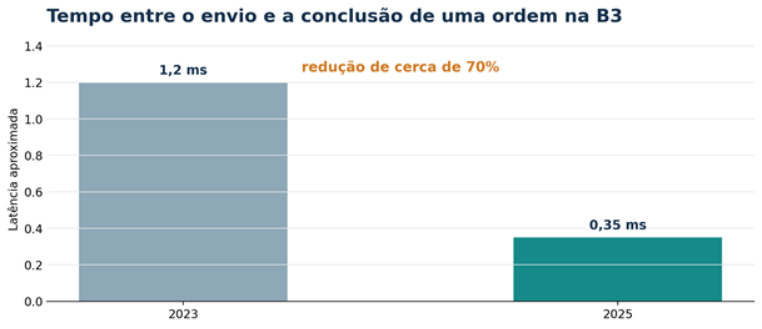
A latência aproximada do sistema da B3 caiu de 1,2 ms em 2023 para 350 microssegundos em 2025 | Fonte: B3 [1].

Estabilidade vem antes da velocidade

A B3 informou em abril de 2025 que reduziu em 70% o tempo entre o envio e a conclusão de uma ordem, de cerca de 1,2 milissegundo em 2023 para aproximadamente 350 microssegundos [1]. Esse intervalo está relacionado à latência, termo utilizado para descrever o tempo de resposta de um sistema. No day trade, uma latência menor pode contribuir para uma execução mais rápida, embora não garanta que a operação seja realizada pelo preço esperado.

Essa evolução tecnológica mostra a importância da infraestrutura no mercado moderno, mas a experiência do usuário envolve outras etapas: dispositivo, internet, servidores do intermediário, validações de risco e rota até a bolsa ou provedor de liquidez.

Por isso, a pergunta correta não é apenas “qual plataforma é mais rápida?”, e sim “como ela se comporta em momentos de volume alto?”. Histórico de disponibilidade, reconexão automática, confirmação clara e canal de contingência ajudam mais do que uma promessa genérica de baixa latência.

Tipos de ordem mudam a forma de executar

A ordem a mercado prioriza execução, mas o preço final pode mudar enquanto ela percorre o livro. A limitada define o preço máximo de compra ou mínimo de venda, sem garantir que haverá contraparte. A ordem stop é ativada quando o gatilho é alcançado; em movimento rápido, pode executar em nível diferente do esperado. O Portal do Investidor explica que a prioridade no livro segue preço e, em caso de igualdade, horário [3].

Uma boa plataforma deve mostrar estado, validade e quantidade executada de cada ordem. Também precisa facilitar alteração e cancelamento sem esconder posições pendentes. Para quem opera mais de um ativo, filtros e alertas reduzem a chance de enviar lote ou direção errados.

Gráficos precisam informar sem sobrecarregar

Candles, volume, médias e indicadores ajudam a organizar hipóteses. A ferramenta deve permitir mudar período, marcar níveis e comparar o preço da análise com o preço da execução. Mais indicadores não significam melhor leitura. Um layout limpo, salvo por perfil e sincronizado entre telas costuma ser mais útil que dezenas de janelas abertas.

Dados em tempo real também têm regras. Verifique se há atraso, custo de assinatura ou diferença entre preço indicativo e negociável. Em mercados internacionais e produtos de balcão, o preço exibido pode vir de fontes distintas do livro centralizado de uma bolsa.

Além da qualidade dos gráficos e da atualização dos dados, a escolha de uma plataforma de day trade deve considerar os tipos de ordem disponíveis, a facilidade de navegação e os recursos de acompanhamento das operações.

Melhor plataforma de day trading da AvaTrade é uma expressão utilizada para identificar uma página que apresenta diferentes ambientes de negociação, como WebTrader, aplicativo móvel, MetaTrader 4 e MetaTrader 5. Cada solução possui características próprias, e a escolha deve levar em conta os instrumentos negociados, as funcionalidades disponíveis e as necessidades de cada operador.

Custos aparecem em cada entrada e saída

No intradiário, pequenas despesas se repetem. Spread, corretagem, emolumentos, financiamento e conversão cambial devem entrar no cálculo antes da operação. Também é importante considerar o slippage, termo que descreve a diferença entre o preço esperado de uma negociação e o preço pelo qual a ordem é efetivamente executada. Essa diferença pode ocorrer especialmente em períodos de alta volatilidade ou baixa liquidez, afetando o resultado da operação.

A análise do Diário da Manhã sobre day trade e câmbio destaca como liquidez, alavancagem e execução afetam o resultado, além da direção do preço.

O relatório de operações deve separar resultado bruto, custos e resultado líquido. Sem isso, uma estratégia com muitos acertos pequenos pode parecer eficiente enquanto taxas e execuções piores consomem a vantagem.

Controles de risco não podem ficar escondidos

A plataforma deve tornar visíveis saldo, margem, exposição, preço médio e perda aberta. Stop-loss e alertas ajudam, mas não garantem execução exata em gaps ou baixa liquidez. O Caderno CVM sobre day trade dedica capítulos a custos, gerenciamento de risco, comportamento e robôs, reforçando que a ferramenta precisa fazer parte de um método mais amplo [2].

Antes de escolher, faça um teste com esta lista:

  • simule ordem a mercado, limitada e stop;
  • confira como a tela informa execução parcial e rejeição;
  • teste login, autenticação e recuperação de acesso;
  • verifique margem, custos e encerramento compulsório;
  • compare aplicativo, navegador e versão de computador;
  • procure histórico exportável e registro de horários;
  • identifique o canal de suporte e o plano para queda de conexão.

Segurança e regulação também são tecnologia

Autenticação em dois fatores, criptografia, alertas de login e controle de sessão protegem a conta. Também é importante saber qual entidade recebe o dinheiro, onde os recursos ficam e a que jurisdição a relação está submetida. O DM já abordou como funcionam corretoras globais para brasileiros, incluindo depósitos, saques e custos operacionais.

Para produtos oferecidos a partir do exterior, o residente no Brasil deve verificar a entidade contratada e os mecanismos de reclamação. Em outubro de 2024, a CVM atualizou sua cartilha sobre CFD e Forex e informou a situação das ofertas desses produtos no país naquele momento [4]. Plataforma conhecida e interface bem desenhada não substituem a checagem jurídica.

Conta demo revela a qualidade do fluxo

O ambiente de demonstração é útil para aprender o caminho completo: localizar o ativo, montar a ordem, definir stop, alterar, cancelar e exportar o histórico. Também permite descobrir se a navegação é rápida para o usuário. O objetivo não é acumular lucro virtual, mas reduzir erros operacionais antes de usar capital.

A simulação tem limites. Ela pode não reproduzir fila, slippage, liquidez, custos e reação emocional. Ao passar para a conta real, reduzir tamanho e complexidade ajuda a verificar se o processo continua funcionando.

A melhor tela é a que sustenta o método

Uma plataforma de day trade deve transformar decisão em execução verificável. Estabilidade, ordens adequadas, dados claros, custos transparentes, controles de risco e histórico completo formam um conjunto. A tecnologia não cria uma estratégia vencedora, mas pode impedir que uma boa regra seja prejudicada por uma operação confusa ou mal registrada.

Perguntas frequentes

Baixa latência garante o preço exibido?

Não. Liquidez, fila, rede e tipo de ordem podem produzir slippage mesmo em infraestrutura rápida.

Qual tipo de ordem é melhor para day trade?

Depende do objetivo. A mercado prioriza execução; a limitada controla preço; stops automatizam gatilhos, mas todos têm limitações.

É necessário usar muitos indicadores?

Não. Indicadores devem apoiar uma regra compreensível. Excesso de sinais pode atrasar ou contradizer a decisão.

Conta demo testa a estabilidade da plataforma?

Ela ajuda a testar navegação e fluxo de ordens, mas não reproduz integralmente condições e emoções da conta real.

Aplicativo móvel substitui a versão de computador?

Pode atender estratégias simples e monitoramento, mas gráficos, automação e múltiplas janelas podem funcionar melhor no desktop.

Referências

[1] B3 – Modernização reduz em 70% o tempo de conclusão dos negócios (2025)

[2] Portal do Investidor/CVM – Caderno 15: Day Trade

[3] Portal do Investidor/CVM – Ordens e book de ofertas

[4] CVM – Cartilha atualizada sobre CFD e Forex (2024)

The post Tecnologia no day trade: como escolher uma plataforma appeared first on Diário da Manhã - O Jornal do leitor Inteligente.


  •  

Britain’s Post-Brexit Trade Dilemma Deepens as Brussels Advances ‘Made in Europe’ Rules

With a crucial EU–UK summit approaching, London is seeking assurances that British manufacturers will not be disadvantaged by Europe’s new industrial policies. The dispute exposes a wider problem: how closely Britain must align with Brussels to preserve access to European supply chains.

Britain and the European Union are attempting to resolve an increasingly consequential dispute over European industrial policy, as proposed rules favouring domestically manufactured goods threaten to complicate the economic relationship that London has spent much of the past year trying to rebuild.

Business Secretary Jonathan Reynolds said on 27 October that the two sides were making progress towards addressing concerns surrounding the proposed Made in Europe requirements.

Speaking to Sky News, Reynolds said the governments were “finding a way through” the disagreement, although the precise terms of any compromise remain uncertain.

The negotiations come ahead of the EU–UK summit scheduled for 20 November, when Prime Minister Andy Burnham is due to meet European Commission President Ursula von der Leyen and European Council President António Costa.

For British manufacturers, the immediate issue is whether political promises of closer cooperation can prevent new economic barriers from emerging.

When industrial policy becomes trade policy

The dispute centres on the European Commission’s Industrial Accelerator Act, proposed in March.

The legislation would introduce European-origin and low-carbon requirements into public procurement and certain government support schemes covering strategic industries.

Among the sectors affected are steel, cement, aluminium, automotive manufacturing and technologies associated with the energy transition.

Brussels argues that such measures are necessary to strengthen European manufacturing and reduce dependence on overseas suppliers, particularly in industries exposed to competition from China.

The economic difficulty is that European industrial production does not stop at the EU’s external borders.

British manufacturers supply components, materials and specialist engineering services to European factories, while many UK production facilities rely on parts and technologies imported from the continent.

Automotive manufacturing illustrates the problem.

Vehicles assembled in Britain frequently contain components produced in several EU countries. Equally, European automotive manufacturers incorporate British-made parts into their own production.

If eligibility for subsidies or public contracts depends increasingly on where products and components originate, companies could face incentives to reorganise supply chains.

The question is therefore not merely whether British products can enter the European market, but whether they will qualify for the same industrial support arrangements as competing European products.

France and Germany disagree

The dispute has exposed differences among EU governments.

As EU Today reported earlier this month, France has argued for a restrictive interpretation of European origin requirements, while Germany has favoured a broader approach allowing certain trusted trading partners to participate.

Berlin’s position reflects the interests of industries whose production networks extend beyond the EU, including manufacturers operating in Britain.

According to reporting on the negotiations, France and Germany have discussed a potential compromise under which Britain might receive preferential treatment if it aligns with European tariffs on Chinese goods.

Such an arrangement would have implications extending beyond manufacturing.

It would involve coordination over trade policy towards China, an area in which Britain currently retains independent decision-making authority.

No agreement has been finalised, and any legislative compromise would require approval through the EU’s institutional procedures.

Burnham’s broader European calculation

For Burnham’s government, the industrial disagreement coincides with a wider attempt to redefine relations with Brussels.

The forthcoming summit is expected to concentrate on practical agreements covering agricultural and food trade, emissions trading and temporary mobility arrangements for young people.

A sanitary and phytosanitary agreement could reduce inspections and documentation requirements for certain food products moving between Britain and the EU.

Closer coordination between emissions trading systems could also reduce complications created by different carbon-pricing regimes.

However, these initiatives do not resolve the wider question of Britain’s relationship with the European single market.

Burnham has indicated that he intends to open a broader discussion about future options, while maintaining Labour’s existing commitments against rejoining the single market, customs union or restoring general free movement during the current parliamentary term.

Reynolds has acknowledged that repeated changes in EU policy create uncertainty for British companies operating across the Channel.

The price of industrial cooperation

The underlying difficulty is structural.

Britain seeks the benefits of close industrial integration while maintaining the independence acquired through Brexit. The EU, meanwhile, is increasingly using common industrial rules, subsidies and procurement preferences to pursue economic-security objectives.

These priorities are not necessarily incompatible, but reconciling them may require new arrangements governing regulatory alignment, product origin and relations with third countries.

As EU Today previously examined, London’s request to be treated as a trusted industrial partner has already become part of the broader political negotiations.

The November summit may establish a framework for resolving some immediate concerns.

It will not, however, eliminate the fundamental problem facing British manufacturers: future decisions taken in Brussels can materially affect their competitiveness, even though Britain no longer participates directly in making those decisions.

  •  

Autovelox, tutte le postazioni dal 26 ottobre al 1° novembre: l’elenco delle strade e autostrade

Ogni settimana la Polizia di Stato informa sulle postazioni degli autovelox sulle strade italiane, sia per quanto riguarda le autostrade che la viabilità ordinaria.

Di seguito l’elenco delle postazioni autovelox in Italia dal 26 ottobre al 1° novembre. Il calendario comprende sia le postazioni fisse sia i controlli programmati giorno per giorno, dalla Sicilia al Piemonte. Tra i tratti interessati figurano la A19 Palermo-Catania, la A4 Torino-Trieste, la A1 Milano-Napoli e diverse arterie della rete stradale ordinaria. Ecco l’elenco delle strade interessate, regione per regione, con le date dei controlli da consultare prima di mettersi in viaggio.

Altri autovelox

Prima di procedere, però, c’è una importantissima precisazione da fare: l’elenco pubblicato dalla Polizia di Stato non comprende necessariamente tutti i controlli effettuati in Italia.

I singoli Comuni, infatti, possono programmare ulteriori verifiche con gli autovelox sulle strade di propria competenza.

Autovelox in autostrada, postazioni fisse

Autovelox in Piemonte

  • T4 – Traforo del Frejus interno galleria all’altezza del Comune di Bardonecchia
  • A55 – Tangenziale Nord – 08+250 Nord (Collegno)
  • A55 – Tangenziale Sud 15+680 Sud (Nichelino)

Autovelox in Veneto

  • A4 Torino – Trieste 423+850 Ovest (Noventa di Piave)
  • A4 Torino – Trieste 417+900 Ovest (Meolo)
  • A4 Torino – Trieste 406+950 Est (Quarto d’Altino)
  • A4 Torino – Trieste 417+350 Est (Meolo)

Autovelox in Toscana

  • A1 Milano – Napoli 305+500 Nord (Bagno a Ripoli)
  • A1 Milano – Napoli 362+500 (Sud Civitella in Val di Chiana)
  • A11 Firenze – Pisa Nord 35,500 Ovest (Serravalle Pistoiese)
  • A11 Firenze – Pisa Nord 71+000 Est (Lucca)
  • A 12 Livorno – Rosignano 196+500 Nord (Rosignano Marittimo)
  • A 12 Livorno – Rosignano 200+500 Sud (Rosignano Marittimo)
  • A 15 Parma – La Spezia 53+000 Nord (Berceto)

Autovelox nelle Marche

  • A14 Bologna – Taranto 154+060 Sud (Pesaro)
  • A14 Bologna – Taranto 254+340 Nord (Potenza Picena)
  • A14 Bologna – Taranto 290+540 Nord (Campofilone)
  • RA11 Ascoli – Mare 03+800 Est (Ascoli Piceno)

Autovelox in Campania

  • RA2 Avellino – Salerno 17+825 Nord (Solofra);
  • RA2 Avellino – Salerno 27+196 Nord (Cesinali)
  • RA2 Avellino – Salerno 17+015 (Sud Montoro);
  • RA2 Avellino – Salerno 24+368 Sud (Serino)
  • RA9 di Benevento 110+480 Sud (Benevento)
  • RA9 di Benevento 11+020 Nord Benevento

Autovelox in Umbria

  • RA6 Raccordo Autostradale Bettolle – Perugia 57+050 Est (Perugia)

Autovelox in Umbria

  • A14 Bologna – Taranto 683+397 Sud (Bitritto)
  • A14 Bologna – Taranto 689+715 Nord (Sannicandro di Bari)

Autovelox sulla rete stradale ordinaria, postazioni fisse

Autovelox in Lombardia

  • SS336 dell’ Aeroporto di Malpensa 08+550 Ovest (Cardano al Campo)
  • SS336 dell’ Aeroporto di Malpensa 17+680 Est (Lonate Pozzolo)
  • SS336 dell’ Aeroporto di Malpensa 32+700 Ovest (Inveruno)
  • SS336 dell’ Aeroporto di Malpensa 33+700 Est (Meseno)

Autovelox in Friuli Venezia Giulia

  • SR463 49+300 Sx (San Vito al Tagliamento)
  • SR463 50+225 Dx (San Vito al Tagliamento)
  • SR464 13+930 Sx (Spilimbergo)
  • SR464 14+837 Dx (Spilimbergo)
  • SR251 79+903 Sx (Claut)
  • SR251 94+596 Dx (Erto e Casso)

Autovelox in Umbria

  • SS3 bis Itinerario E45 Terni- Ravenna (SS Tiberina Bis) 72+500 Nord (Perugia)
  • SS3 bis Itinerario E45 Terni- Ravenna (SS Tiberina Bis) 73+500 Sud (Perugia)
  • SS3 bis Itinerario E45 Terni- Ravenna (SS Tiberina Bis) 39+750 Nord (Todi)
  • SS3 bis Itinerario E45 Terni- Ravenna (SS Tiberina Bis) 40+800 Sud (Todi)
  • SS675 Viterbo- Terni (SS Umbro-Laziale) 52+120 Sud (Narni)

Autovelox in Marche

  • SS73 Fano Grosseto 95+150 Est (Colli al Metauro)
  • SS73 Fano Grosseto 102+550 Ovest (Cartoceto)
  • SS76 Della Val d’Esino 64+000 Ovest (Jesi)
  • SS77 Foligno – Civitanova Marche 88+600 Est (Corridonia)
  • SS16 Venezia-Otranto (SS Adriatica) 294+620 Nord (Ancona)

Autovelox in Campania

  • SS268 Del Vesuvio 1+500 Sud (Nola)
  • SS268 Del Vesuvio 4+190 Nord (Sant’Anastasia)
  • SS658 Potenza – Melfi 2+600 Nord (Potenza)
  • SS7 Appia 253+120 Ovest (Ceppaloni)
  • SS87 Sannitica 81+700 Nord (Torrecuso)
  • SS372 Telesina 57+860 Nord (Torrecuso)
  • SS372 Telesina 47+000 Sud (Solopaca)

Autovelox in Puglia

  • SS16 Venezia-Otranto (SS Adriatica) 609+00 Nord (Chieuti

Autovelox in Basilicata

  • SS658 Potenza – Melfi 2+600 Nord (Potenza)

Autovelox in Calabria

  • SS106 Reggio Calabria – Taranto (SS Jonica) 240+900 Nord (Crotone)
  • SS106 Reggio Calabria – Taranto (SS Jonica) 240+900 Sud (Crotone)

Autovelox nelle Regioni da lunedì 26 ottobre a domenica 1 novembre

Autovelox in Abruzzo

26 ottobre

  • RA Raccordo Autostradale Chieti-Pescara CH
  • SS 16 Adriatica CH
  • SS 649 di Fondo Valle Alento CH
  • SS 650 Fondo valle Trigno CH
  • SS 652 di Fondo Valle Sangro CH
  • SS 714 var. Francavilla al mare CH
  • SP 656 Val Pescara e Chieti CH

27 ottobre

  • RA Raccordo Autostradale Chieti-Pescara CH
  • SS 16 Adriatica CH
  • SS 649 di Fondo Valle Alento CH
  • SS 650 Fondo valle Trigno CH
  • SS 652 di Fondo Valle Sangro CH
  • SS 714 var. Francavilla al mare CH
  • SP 656 Val Pescara e Chieti

28 ottobre

  • RA Raccordo Autostradale Chieti-Pescara CH
  • SS 16 Adriatica CH
  • SS 649 di Fondo Valle Alento CH
  • SS 650 Fondo valle Trigno CH
  • SS 652 di Fondo Valle Sangro CH
  • SS 714 var. Francavilla al mare CH
  • SP 656 Val Pescara e Chieti CH

29 ottobre

  • RA Raccordo Autostradale Chieti-Pescara CH
  • SS 16 Adriatica CH
  • SS 649 di Fondo Valle Alento CH
  • SS 650 Fondo valle Trigno CH
  • SS 652 di Fondo Valle Sangro CH
  • SS 714 var. Francavilla al mare CH
  • SP 656 Val Pescara e Chieti CH

30 ottobre

  • RA Raccordo Autostradale Chieti-Pescara CH
  • SS 16 Adriatica CH
  • SS 649 di Fondo Valle Alento CH
  • SS 650 Fondo valle Trigno CH
  • SS 652 di Fondo Valle Sangro CH
  • SS 714 var. Francavilla al mare CH
  • SP 656 Val Pescara e Chieti CH

31 ottobre

  • Raccordo Autostradale RA Raccordo Autostradale Chieti-Pescara CH
  • SS 16 Adriatica CH
  • SS 649 di Fondo Valle Alento CH
  • SS 650 Fondo valle Trigno CH
  • SS 652 di Fondo Valle Sangro CH
  • SS 714 var. Francavilla al mare CH
  • SP 656 Val Pescara e Chieti CH

01 novembre

  • RA Raccordo Autostradale Chieti-Pescara CH
  • SS 16 Adriatica CH
  • SS 649 di Fondo Valle Alento CH
  • SS 650 Fondo valle Trigno CH
  • SS 652 di Fondo Valle Sangro CH
  • SS 714 var. Francavilla al mare CH
  • SP 656 Val Pescara e Chieti CH

Autovelox in Basilicata

26 ottobre

  • RA 05 Scalo Sicignano-Potenza PZ
  • SS 407 Basentana PZ
  • SS 655 Bradanica PZ

27 ottobre

  • RA 05 Scalo Sicignano-Potenza PZ
  • SS 407 Basentana PZ
  • SS 655 Bradanica PZ

28 ottobre

  • RA 05 Scalo Sicignano-Potenza PZ
  • SS 407 Basentana PZ

29 ottobre

  • RA 05 Scalo Sicignano-Potenza PZ
  • SS 407 Basentana PZ
  • SS 655 Bradanica PZ

30 ottobre

  • RA 05 Scalo Sicignano-Potenza PZ
  • SS 407 Basentana PZ
  • SS 655 Bradanica PZ

31 ottobre

  • RA 05 Scalo Sicignano-Potenza PZ
  • SS 407 Basentana PZ

01 novembre

  • RA 05 Scalo Sicignano-Potenza PZ
  • SS 407 Basentana PZ
  • SS 655 Bradanica PZ

Autovelox in Calabria

28 ottobre

  • A2 CS

29 ottobre

  • SS 106 Jonica RC

31 ottobre

  • SS 106 Jonica RC

Autovelox in Emilia-Romagna

26 ottobre

  • A 15-KM 14+600NORD PR
  • SS SS9 via Emilia FC
  • SP SP62 Cadelbosco di Sopra RE

27 ottobre

  • A1 km 231 Nord BO
  • SS SS72 km 4+700 RN

28 ottobre

  • A22 KM 309 Nord MO

29 ottobre

  • A22 KM 309 Nord MO
  • SS 16 Adriatica FE

30 ottobre

  • A 15-KM 14+600 Nord PR
  • SP SP3 Novellare RE

31 ottobre

  • A1 km 207 Sud BO

Autovelox in Friuli-Venezia Giulia

26 ottobre

  • SS 202 Triestina TS

27 ottobre

  • SS 202 Triestina TS
  • SS 677 Ronchi GO

29 ottobre

  • A4 Palazzolo dello Stella UD

30 ottobre

  • A4 Palazzolo dello Stella UD
  • SP 35 di Opicina TS

Autovelox nel Lazio

31 ottobre

  • A 24 RM

1 novembre

  • A 12 Roma – Civitavecchia RM

Autovelox in Liguria

26 ottobre

  • SS28 del Colle di Nava IM

27 ottobre

  • A7 GE

28 ottobre

  • SS1 Aurelia SP

30 ottobre

  • SS1 Aurelia SV

31 ottobre

  • SS1 Aurelia IM

Autovelox in Lombardia

28 ottobre

  • SS 9 via Emilia LO

Autovelox nelle Marche

26 ottobre

  • Autostrada A 14 Bologna-Taranto PU
  • A 14 Bologna-Taranto FM
  • Raccordo Autostradale RA 11 Ascoli-Porto d’Ascoli AP
  • Strada Statale SS 16 Adriatica AN
  • SS 16 Adriatica PU
  • SS 3 Flaminia PU
  • SS 4 Salaria AP
  • SS 73 Bis di Bocca Trabaria PU
  • SS 76 della Valle d’Esino AN
  • SS 77 della Val di Chienti MC

27 ottobre

  • Autostrada A 14 Bologna-Taranto PU
  • Raccordo Autostradale RA 11 Ascoli-Porto d’Ascoli AP
  • Strada Statale SS 16 Adriatica AN
  • SS 16 Adriatica PU
  • SS 3 Flaminia PU
  • SS 73 Bis di Bocca Trabaria PU
  • SS 76 della Valle d’Esino AN
  • SS 77 della Val di Chienti MC

28 ottobre

  • Autostrada A 14 Bologna-Taranto PU
  • Raccordo Autostradale RA 11 Ascoli-Porto d’Ascoli AP
  • Strada Statale ss 16 FM
  • SS 16 Adriatica AN
  • SS 16 Adriatica PU
  • SS 3 Flaminia PU
  • SS 73 Bis di Bocca Trabaria PU
  • SS 76 della Valle d’Esino AN
  • SS 77 della Val di Chienti MC
  • SS 81 Piceno Aprutina AP
  • Strada Provinciale SP 423 Urbinate PU

29 ottobre

  • Autostrada A 14 Bologna-Taranto PU
  • Raccordo Autostradale RA 11 Ascoli-Porto d’Ascoli AP
  • Strada Statale SS 16 Adriatica PU
  • SS 16 Adriatica AN
  • SS 3 Flaminia PU
  • SS 73 Bis di Bocca Trabaria PU
  • SS 76 della Valle d’Esino AN
  • SS 77 della Val di Chienti MC
  • Strada Provinciale SP 423 Urbinate PU

30 ottobre

  • Autostrada A 14 Bologna-Taranto PU
  • Raccordo Autostradale RA 11 Ascoli-Porto d’Ascoli AP
  • Strada Statale SS 16 Adriatica AN
  • SS 16 Adriatica PU
  • SS 210 FM
  • SS 3 Flaminia PU
  • SS 4 Salaria AP
  • SS 76 della Valle d’Esino AN
  • SS 77 della Val di Chienti MC
  • Strada Provinciale SP 423 Urbinate PU
  • SP 73 Bis di Bocca Trabaria PU

31 ottobre

  • Autostrada A 14 Bologna-Taranto PU
  • Raccordo Autostradale RA 11 Ascoli-Porto d’Ascoli AP
  • Strada Statale SS 16 Adriatica PU
  • SS 16 Adriatica AN
  • SS 3 Flaminia PU
  • SS 73 Bis di Bocca Trabaria PU
  • SS 76 della Valle d’Esino AN
  • SS 77 della Val di Chienti MC

01 novembre

  • Autostrada A 14 Bologna-Taranto PU
  • Raccordo Autostradale RA 11 Ascoli-Porto d’Ascoli AP
  • SS 16 Adriatica PU
  • SS 16 Adriatica AN
  • SS 3 Flaminia PU
  • SS 73 Bis di Bocca Trabaria PU
  • SS 76 della Valle d’Esino AN
  • SS 77 della Val di Chienti MC

Autovelox in Piemonte

26 ottobre

  • Autostrada A 32 Torino-Bardonecchia TO
  • Strada Statale SS 231 di Santa Vittoria AT

27 ottobre

  • Autostrada A 06 Torino-Savona CN
  • A 26 Genova Voltri-Gravellona Toce NO
  • A 32 Torino-Bardonecchia TO
  • A 33 Asti-Cuneo CN
  • A 4 Torino – Milano NO
  • A A8 NO
  • Strada Statale SS 20 Colle di Tenda e di Valle Roja CN
  • SS 21 del Colle della Maddalena CN
  • SS 231 di Santa Vittoria CN
  • SS 28 del Colle di Nava CN
  • SS 704 Tangenziale di Mondovì CN
  • SS 706 TANGENZIALE DI ASTI AT
  • SS SS/33 del Sempione VB
  • Strada Provinciale SP 12 Fondovalle Tanaro CN
  • SP 3 SANT’ALBANO STURA CN
  • SP 422 di Valle Macra CN
  • SP 661 delle Langhe CN
  • SP 662 di Savigliano CN
  • SP 702 TANGENZIALE BRA CN

28 ottobre

  • Autostrada A 06 Torino-Savona CN
  • A 26 Genova Voltri-Gravellona Toce NO
  • A 32 Torino-Bardonecchia TO
  • A 33 Asti-Cuneo CN
  • A A8 NO
  • Strada Statale SS 10 Padana Inferiore AT
  • SS 20 Colle di Tenda e di Valle Roja CN
  • SS 21 del Colle della Maddalena CN
  • SS 231 di Santa Vittoria CN
  • Strada Statale SS 28 del Colle di Nava CN
  • SS 704 Tangenziale di Mondovì CN
  • SS 758 Masserano-Mongrando BI
  • Strada Provinciale SP 12 Fondovalle Tanaro CN
  • SP 299 di Alagna VC
  • SP 3 SANT’ALBANO STURA CN
  • SP 422 di Valle Macra CN
  • SP 661 delle Langhe CN
  • SP 662 di Savigliano CN
  • SP 702 TANGENZIALE BRA CN
  • SP SP30 AL

29 ottobre

  • Autostrada A 06 Torino-Savona CN
  • A 26 Genova Voltri-Gravellona Toce NO
  • A 33 Asti-Cuneo CN
  • A 4 Torino – Milano NO
  • A A8 NO
  • Strada Statale SS 21 del Colle della Maddalena CN
  • SS 231 di Santa Vittoria CN
  • SS 28 del Colle di Nava CN
  • SS 32 TORINO – BARDONECCHIA TO
  • SS 456 del Turchino AT
  • SS 704 Tangenziale di Mondovì CN
  • SS SS/33 del Sempione VB
  • Strada Provinciale SP 12 Fondovalle Tanaro CN
  • SP 3 SANT’ALBANO STURA CN
  • SP 422 di Valle Macra CN
  • SP 661 delle Langhe CN
  • SP 662 di Savigliano CN
  • SP 702 TANGENZIALE BRA CN

30 ottobre

  • Autostrada A 06 Torino-Savona CN
  • A 26 Genova Voltri-Gravellona Toce NO
  • Autostrada A 33 Asti-Cuneo CN
  • A 4 Torino – Milano NO
  • A A8 NO
  • Strada Statale SS 10 Padana Inferiore AT
  • SS 20 Colle di Tenda e di Valle Roja CN
  • SS 21 del Colle della Maddalena CN
  • SS 231 di Santa Vittoria CN
  • SS 28 del Colle di Nava CN
  • SS 32 TORINO – BARDONECCHIA TO
  • SS 704 Tangenziale di Mondovì CN
  • SS 758 Masserano-Mongrando BI
  • SS SS/33 del Sempione VB
  • Strada Provinciale SP 12 Fondovalle Tanaro CN
  • SP 3 SANT’ALBANO STURA CN
  • SP 422 di Valle Macra CN
  • SP 661 delle Langhe CN
  • SP 662 di Savigliano CN
  • SP 702 TANGENZIALE BRA CN

31 ottobre

  • Autostrada A 06 Torino-Savona CN
  • A 26 Genova Voltri-Gravellona Toce NO
  • A 32 Torino-Bardonecchia TO
  • A 33 Asti-Cuneo CN
  • A 4 Torino – Milano NO
  • A A8 NO
  • Strada Statale SS 20 Colle di Tenda e di Valle Roja CN
  • SS 21 del Colle della Maddalena CN
  • SS 231 di Santa Vittoria CN
  • SS 231 di Santa Vittoria AT
  • SS 28 del Colle di Nava CN
  • SS 704 Tangenziale di Mondovì CN
  • SS 758 Masserano-Mongrando BI
  • Strada Provinciale SP 12 Fondovalle Tanaro CN
  • Strada Provinciale SP 3 SANT’ALBANO STURA CN
  • SP 422 di Valle Macra CN
  • SP 661 delle Langhe CN
  • SP 662 di Savigliano CN
  • SP 702 TANGENZIALE BRA CN

01 novembre

  • Autostrada A 06 Torino-Savona CN
  • A 26 Genova Voltri-Gravellona Toce NO
  • A 32 Torino-Bardonecchia TO
  • A 33 Asti-Cuneo CN
  • A 4 Torino – Milano NO
  • A A8 NO
  • Strada Statale SS 20 Colle di Tenda e di Valle Roja CN
  • SS 21 del Colle della Maddalena CN
  • SS 231 di Santa Vittoria CN
  • SS 28 del Colle di Nava CN
  • SS 458 di Casalborgone AT
  • SS 704 Tangenziale di Mondovì CN
  • SS 758 Masserano-Mongrando BI
  • Strada Provinciale SP 12 Fondovalle Tanaro CN
  • SP 3 SANT’ALBANO STURA CN
  • SP 422 di Valle Macra CN
  • SP 661 delle Langhe CN
  • SP 662 di Savigliano CN
  • SP 702 TANGENZIALE BRA CN

Autovelox in Puglia

26 ottobre

  • Strada Statale SS /688 di Mattinata FG
  • SS /7 Appia TA
  • SS /SS379 EGNAZIA BR

27 ottobre

  • Strada Statale SS /SS613 BR-LE LE

28 ottobre

  • Strada Statale SS /SS100 BA- TA BA
  • SS /SS613 BR-LE LE

29 ottobre

  • Strada Statale SS /16 Adriatica BT
  • SS /688 di Mattinata FG
  • SS /7 Appia TA
  • SS /SS613 BR-LE LE

Autovelox in Sardegna

26 ottobre

  • Strada Statale SS 131 Dir. Centrale Nuorese SS
  • SS 554 Cagliaritana CA

27 ottobre

  • Strada Statale SS 131 Carlo Felice NU
  • SS 131 Carlo Felice SS
  • SS 131 Dir. Centrale Nuorese NU

28 ottobre

  • Strada Statale SS 125 Orientale Sarda NU
  • ss 729 Sassari – Olbia SS

29 ottobre

  • Strada Statale SS 131 Carlo Felice OR
  • SS 131 Carlo Felice CA
  • SS 131 Dir. Centrale Nuorese SS
  • SS 131 Dir. Centrale Nuorese NU

30 ottobre

  • Strada Statale SS 131 Carlo Felice CA
  • SS 131 Dir. Centrale Nuorese NU

31 ottobre

  • Strada Statale SS 131 Carlo Felice OR
  • SS 131 Dir. Centrale Nuorese NU
  • SS SS291 SS
  • Strada Provinciale SP 2 Pedemontana CA

Autovelox in Sicilia

26 ottobre

  • Autostrada A 19 Palermo-Catania PA
  • A A/18 ME
  • A A/20 ME
  • Strada Statale SS 189 PA
  • SS 640 di Porto Empedocle CL
  • SS SS114 SR
  • SS SS115 RG

27 ottobre

  • Autostrada A A/18 ME
  • A A/20 ME
  • Strada Statale SS 115 Sud Occidentale Sicula AG

28 ottobre

  • Autostrada A A/18 ME
  • Strada Statale SS 189 TP
  • SS 417 di Caltagirone CT
  • SS 626 CL
  • SS 640 di Porto Empedocle AG

29 ottobre

  • Autostrada A 19 Palermo-Catania PA
  • Strada Statale SS 417 di Caltagirone CT
  • SS 626 CL
  • SS 640 di Porto Empedocle AG

30 ottobre

  • Autostrada A 19 Palermo-Catania PA
  • A 29 Palermo- Mazara del Vallo TP
  • Strada Statale SS 189 PA
  • SS 640 di Porto Empedocle CL
  • SS 640 di Porto Empedocle AG
  • Strada Provinciale SP 21 EN

31 ottobre

  • Autostrada A 19 Palermo-Catania PA
  • A 29 Palermo-Mazara del Vallo TP
  • SS 640 di Porto Empedocle CL

Autovelox in Toscana

26 ottobre

  • Autostrada A 11 Firenze -Pisa Nord PT
  • Raccordo Autostradale RA RA18-SGC FI-PI-LI PI

27 ottobre

  • Autostrada A 01 Milano-Napoli AR
  • A 11 Firenze -Pisa Nord PT
  • A 12 Genova-Roma LI
  • Raccordo Autostradale RA RA18-SGC FI-PI-LI PI

28 ottobre

  • Autostrada A 11 Firenze -Pisa Nord PT
  • Raccordo Autostradale RA 03 Siena-Firenze SI

29 ottobre

  • Autostrada A 11 Firenze -Pisa Nord PT

30/10/2026

  • Autostrada A 11 Firenze -Pisa Nord PT
  • A 12 Genova-Roma LI

31 ottobre

  • Autostrada A 01 Milano-Napoli FI
  • A 01 Milano-Napoli AR
  • A 11 Firenze -Pisa Nord PT
  • A 12 Genova-Roma LI

01 novembre

  • Autostrada A 11 Firenze -Pisa Nord PT
  • A 12 Genova-Roma LI
  • A 15 Parma-La Spezia MS

Autovelox in Trentino-Alto Adige

27 ottobre

  • Strada Statale — SS /12 del Brennero — BZ

30 ottobre

  • Autostrada — A /A22 — TN

Autovelox in Umbria

27 ottobre

  • Raccordo Autostradale RA /RA06 KM 14+100 PIETRAIA PG

28 ottobre

  • Strada Statale SS /SS219 KM 24+300 SEMONTE PG

29 ottobre

  • Strada Statale SS /SS 3 BIS KM 57+300 DERUTA PG

30 ottobre

  • Strada Statale SS /SS3 FLAMINIA KM 144+300 PIETRAROSSA PG

Autovelox in Valle d’Aosta

27 ottobre

  • Autostrada A 05 Torino-Aosta AO
  • Traforo Autostradale T 1 Traforo Monte Bianco AO

28 ottobre

  • Autostrada A 05 Torino-Aosta AO
  • Traforo Autostradale T 1 Traforo Monte Bianco AO

29 ottobre

  • Autostrada A 05 Torino-Aosta AO
  • Traforo Autostradale T 1 Traforo Monte Bianco AO

30 ottobre

  • Autostrada A 05 Torino-Aosta AO
  • Traforo Autostradale T 1 Traforo Monte Bianco AO

31 ottobre

  • Autostrada A 05 Torino-Aosta AO
  • Traforo Autostradale T 1 Traforo Monte Bianco AO

01 novembre

  • Autostrada A 05 Torino-Aosta AO
  • Traforo Autostradale T 1 Traforo Monte Bianco AO

Autovelox in Veneto

26 ottobre

  • Autostrada A 22 Brennero-Modena VR

27 ottobre

  • Autostrada A 04 Torino-Trieste VE
  • A 22 Brennero-Modena VR

28 ottobre

  • Autostrada A 04 Torino-Trieste PD
  • A 22 Brennero-Modena VR
  • Strada Statale SS 434 Transpolesana RO

29 ottobre

  • Autostrada A 04 Torino-Trieste PD
  • A 22 Brennero-Modena VR
  • A 31 Vicenza-Piovene Rocchetta VI
  • Strada Statale SS 47 della Valsugana BL

30 ottobre

  • Autostrada A 04 Torino-Trieste PD
  • A 22 Brennero-Modena VR

31 ottobre

  • Autostrada A 04 Torino-Trieste PD
  • A 04 Torino-Trieste VE

01 novembre

  • Autostrada A 04 Torino-Trieste PD
  • A 04 Torino-Trieste VE

  •  

Europe’s Electricity Price Divide Exposes Limits of the Single Energy Market

Europe’s electricity market recorded substantial regional differences on Tuesday, 27 October, with average wholesale prices ranging from approximately €6 per megawatt-hour in northern Sweden to more than €255 in Romania.

The figures reveal a persistent difficulty for European energy policy: although the continent has an increasingly interconnected electricity market, businesses and consumers remain exposed to very different underlying wholesale costs depending on location.

According to European day-ahead electricity market data, Sweden’s SE2 bidding zone recorded an average of €6.23 per megawatt-hour, while Finland stood at approximately €6.65. Romania reached €255.20, roughly 41 times northern Sweden’s price. Bulgaria registered approximately €254, Hungary €241 and Greece €225. Germany recorded approximately €155, Belgium €160 and France €162.

These are wholesale prices for delivery on 27 October, not final bills for households or businesses. Their differences nevertheless raise questions about how effectively Europe’s electricity networks distribute power from areas of lower-cost generation to those facing greater costs.

Why a common market produces different prices

European electricity trading is organised through interconnected national and regional markets. Cross-border capacity allows relatively inexpensive power to reach regions where demand is greater or local generation is more expensive.

When transmission capacity is adequate, neighbouring prices can converge. Physical networks, however, have limits. Congested interconnectors can prevent additional imports even when large price differences exist.

Other influences include availability of power stations, renewable output, fuel prices, consumption and system stability. Regions with substantial hydropower, nuclear generation or strong renewable production may experience comparatively low prices. Markets relying on gas-fired generation can be more expensive when gas plants are needed to satisfy the final increment of demand.

The result is a market responding to common European conditions but still shaped by local generation and transmission constraints.

Southeastern Europe’s structural constraints

The European Union Agency for the Cooperation of Energy Regulators, ACER, has repeatedly examined the causes of regional price divergence. In its 2026 assessment of cross-zonal electricity trade, the agency considered unusually high prices and limited access to lower-cost power in southeastern Europe.

Constraints include available cross-border capacity and shortages of flexible generation able to respond to changing renewable output, especially in the evening. Countries including Greece, Bulgaria, Romania, Hungary, Croatia and Slovenia have encountered substantial regional differences.

Those findings do not prove the cause of each price movement on 27 October. They do, however, explain why disparities can persist despite common market rules. ACER has advocated improved coordination among transmission operators, more effective use of existing networks and additional flexibility through storage and demand management.

Industrial consequences of expensive electricity

Energy-intensive industries, including steel, chemicals and fertiliser production, are particularly sensitive to electricity costs. Where contracts are exposed to wholesale markets, sustained regional price differences can influence output and investment decisions.

The relationship between wholesale prices and bills is not immediate. Firms may hedge prices, use long-term contracts or produce their own power. Network charges, taxes and government support also affect the amount paid. Still, persistent market differences can shape industrial competitiveness.

As EU Today reported, EU energy ministers are due to examine proposed changes to electricity network charges and market administration on 29 October. Network tariffs are distinct from wholesale prices, but both affect total electricity costs.

Renewables and the need for flexible networks

According to ACER’s energy-market monitoring, renewable sources represented around half of EU electricity generation in 2025. Solar energy can reduce prices during the day, but output falls sharply towards evening, sometimes requiring more expensive power stations to increase generation.

This increases the value of storage, flexible production, responsive demand and international connections that can balance surpluses and shortages between regions. Yet major transmission lines can take years to complete owing to planning, permitting, investment and construction requirements.

The priority is therefore not simply to install more renewable capacity. Europe’s grids and supporting technologies must be capable of moving and using that output efficiently.

What the price divide reveals

A single day’s wholesale prices should not be mistaken for long-term average electricity costs or a permanent competitive advantage. Nevertheless, the persistence of regional disparities documented by regulators shows the problem extends beyond isolated daily volatility.

For EU institutions, the question is whether further market integration can make energy more affordable while preserving incentives to invest in generation and transmission. National governments must balance security of supply, infrastructure financing and industrial competitiveness.

Electricity trading across Europe is increasingly integrated. The physical systems supplying it remain considerably less uniform. Until those constraints are addressed, the price of power will continue to reflect geography as well as the underlying cost of energy.

  •  

Trump's Tariffs Are Politically Toxic

Trump-Tariff-oct-26 | Chris Kleponis - CNP/Newscom

When the White House rolled back tariffs on coffee, fruit, beef, and farm equipment, it was effectively an admission that the tariffs were raising prices—and that Americans, not foreigners, had been paying for them.

Now, in the closing stages of the midterm campaign, the White House is once again rolling back some of those import taxes—and once again making an awkward implicit admission.

President Donald Trump's tariffs have become politically toxic.

The administration announced late last week that it would lift the 50 percent tariffs on some Canadian imports, apparently in an attempt to help Sen. Susan Collins (R–Maine) survive a tough reelection campaign in which the tariffs have played a significant role.

If this is indeed an attempt to sway voters in Maine, it is not a very convincing one. The Trump administration is removing tariffs on some agricultural and mechanical goods, as well as packaging and plywood, The Wall Street Journal reports. But Trump is also imposing new 50 percent tariffs on "other Canadian goods, including carpet, certain valves, and waste products."

Collins issued a statement thanking the White House for the changes. This is what members of the U.S. Senate have been reduced to—begging the president to cast his capricious, tariff-happy eyes toward products that will hurt people in other states more than in your own. (In fairness to Collons, she has voted repeatedly to roll back Trump's tariffs, but not enough of her fellow Republicans went along with it.)

Still, it's worth asking: What exactly is the pitch to voters here? Here's a tariff cut, now vote for Republicans so the president can continue to arbitrarily tax imports whenever the mood strikes?

It's easy to see why Trump's tariffs have become so unpopular. They are a huge and broad tax increase—the Tax Foundation estimates that 54 percent of imports are subject to Trump's tariffs, which are costing the average household about $1,000 annually—that was imposed without congressional authorization or popular support. They create more losers than winners, as downstream businesses and consumers pay the price for the protectionism offered to American manufacturers. Even the supposed "winners" of the tariff policy tend also to be "losers," since so much manufacturing depends on importing raw materials and intermediate goods.

Perhaps more surprising is how unwilling Republicans are to defend the president's signature economic policy. Or to even talk about it.

The Wall Street Journal's Greg Ip crunched the numbers and found that House GOP candidates have not run a single ad talking about the tariffs during this election cycle.

Just such a fun chart here from @greg_ip. If only we could tease out some meaning. Ah, well, nevertheless. 🤣 pic.twitter.com/1X4AWcWQMV

— Scott Lincicome (@scottlincicome) October 23, 2026

That silence speaks volumes. Trump says "tariff" is "the most beautiful word in the dictionary." But it is now "one of the most hated words in politics," writes Ip.

The only Republicans to mention trade or tariffs in a campaign ad, as far as I've seen, is former Rep. Mike Rogers, who is now running for the Senate seat in Michigan (and thus was not included in Ip's analysis). And he's calling for an end to the "tariff war."

There is a lesson here that hopefully will linger beyond the next week: If you support a policy that deliberately and unlawfully raises taxes and prices, voters will not reward you for it.

It's a lesson that the Republican Party learned long ago, but apparently forgot.

Against economists' advice, a Republican-led government in 1930 implemented a huge tariff hike intended to protect American farms and factories at the start of the Great Depression. Instead, those tariffs worsened economic conditions and triggered foreign retaliation.

When voters went to the polls in 1930, the first midterm after the Smoot-Hawley tariffs were passed, they registered their displeasure. The GOP lost 52 seats in the House that year. Two years later, an even larger landslide would sweep Democrats into power in Congress and the White House, ushering in the New Deal era that reshaped the federal government forever. The two lawmakers who lent their names to the legislation were among those who lost their seats, fittingly.

The most notable difference this time around is that Congress didn't actually pass a tariff bill. The trade barriers were instead imposed directly by the executive. Voters don't seem to care. Republicans were too cowardly to stand up to Trump's unilateral power grab, and now they seem too ashamed to try to defend that policy (and their largely complicit response) on the campaign trail.

As they say, those who don't learn from history are doomed to repeat it. And "doomed" may be a fitting way to describe the Republican majority in Congress right now, thanks in no small part to Trump's tariffs.

The post Trump's Tariffs Are Politically Toxic appeared first on Reason Magazine.

  •  

The US-China biotech trade war that isn’t

On October 22, the US Treasury proposed adding biotechnology to the list of Chinese sectors that American capital may no longer finance. A week earlier, China’s Ministry of Commerce had proposed barring the foreign sale of five biomedical technologies, including cell and gene therapy platforms. Two governments that agree on almost nothing moved in the […]

The post The US-China biotech trade war that isn’t appeared first on Asia Times.

  •  

Trump Exempts Some Canadian Products From Section 338 Tariffs—But His Illegal Trade War Continues

An American flag breaks with a Canadian flag
Illustration: Midjourney

Last week, the Liberty Justice Center (the public interest group I worked with on the case challenging Trump's earlier IEEPA tariffs, which led their invalidation by the Supreme Court)  filed the first lawsuit challenging President Donald Trump's massive Section 338 tariffs against a variety of Canadian imports. Three days later, Trump exempted some previously covered Canadian products from the tariffs, probably to help Maine Sen. Susan Collins and other congressional Republicans fearful of voter backlash in the upcoming midterm election:

President Donald Trump signed a proclamation on Friday that removes some Canadian products from tariffs imposed under Section 338 of the Tariff Act of 1930 and adds others, the White House said. The changes take effect Oct. 30.

Plywood sheets, some paper products, certain machinery and refrigeration equipment, and certain packing crates and boxes come off the list. Some valves, along with carpets, waste products and other goods, take their place.

The tariffs, set at 50% according to CNBC, apply whether or not a good originates under the U.S.-Mexico-Canada Agreement….

The fact that American businesses and consumers in states like Maine are suffering from the tariffs gives the lie to the notion that only foreigners are burdened by them. Trump's action here also underscores how the tariffs have become highly unpopular, and a drag on GOP prospects in the upcoming election.

While Trump may have (perhaps only temporarily) lifted some of the Section 338 tariffs, most remain in place. As noted above, he  imposed additional tariffs on some goods, even as he lifted them on others. And the Section 338 tariffs are still still illegal for a variety of reasons I summarized in my previous post on the LJC lawsuit against them, as well as earlier writings:

I have previously written about why Trump's Section 338 tariffs are harmful and illegal. See my recent Montreal Economic Institute paper on this topic, and earlier pieces here, here, and here. To briefly summarize, the tariffs on Canada are illegal because 1) Section 338 has been superseded by later legislation, 2) even if Section 338 is still operative, Trump's tariffs do not meet its requirements because the Canadian actions they supposedly respond to do not "discriminate" against US goods, as the law requires, 3) Trump's tariffs do not "offset" the Canadian actions (as Section 338 also requires), but go far beyond that, 4) the administration's interpretation of Section 338 runs afoul of the "major questions" doctrine, and 5) if Section 338 is operative and does authorize the Trump actions, it would violate the constitutional nondelegation doctrine (which restricts delegation of legislative power to the executive).

The LJC complaint advances all five of these arguments. To prevail, they need win on only one.

Trump has also used Section 338 to ban some Canadian imports entirely. That too is illegal, though the bans (unlike the tariffs) are not directly at issue in the LJC case. They may well be challenged in future litigation, however.

In addition to illegally usurping congressional power over taxation, the Trump trade war against Canada damages our economy and poisons relations with a key ally. Courts should strike it down, just as they did with the IEEPA tariffs and the more recent Section 122 tariffs. They should also invalidated the massive Section 301 "forced labor" tariffs, which have been challenged in three cases currently before the US Court of International Trade.

UPDATE: It's worth reiterating that giving one person the power to impose and lift tariffs whenever he feels like it is an affront to the rule of law.

The post Trump Exempts Some Canadian Products From Section 338 Tariffs—But His Illegal Trade War Continues appeared first on Reason Magazine.

  •  
❌