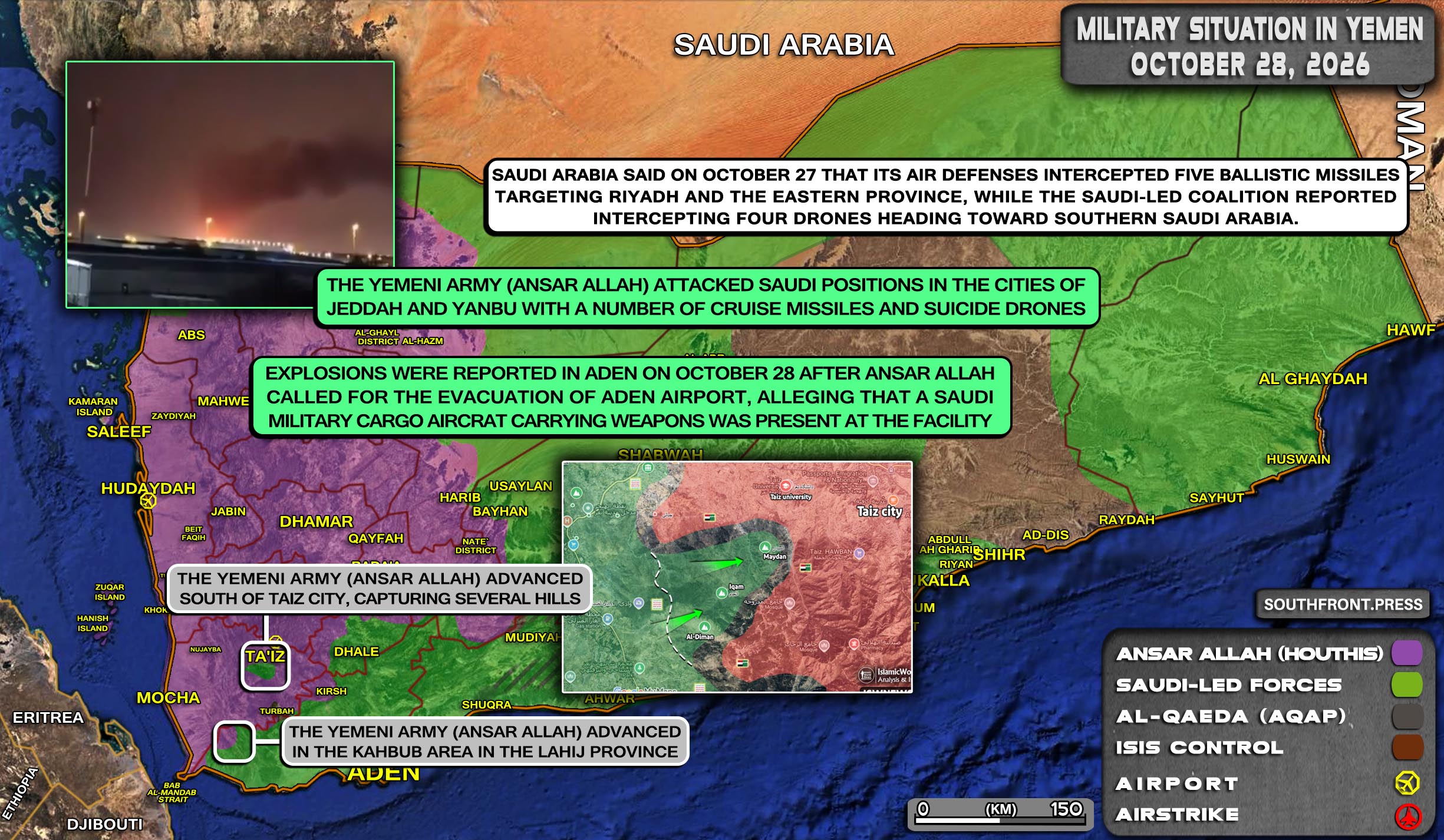
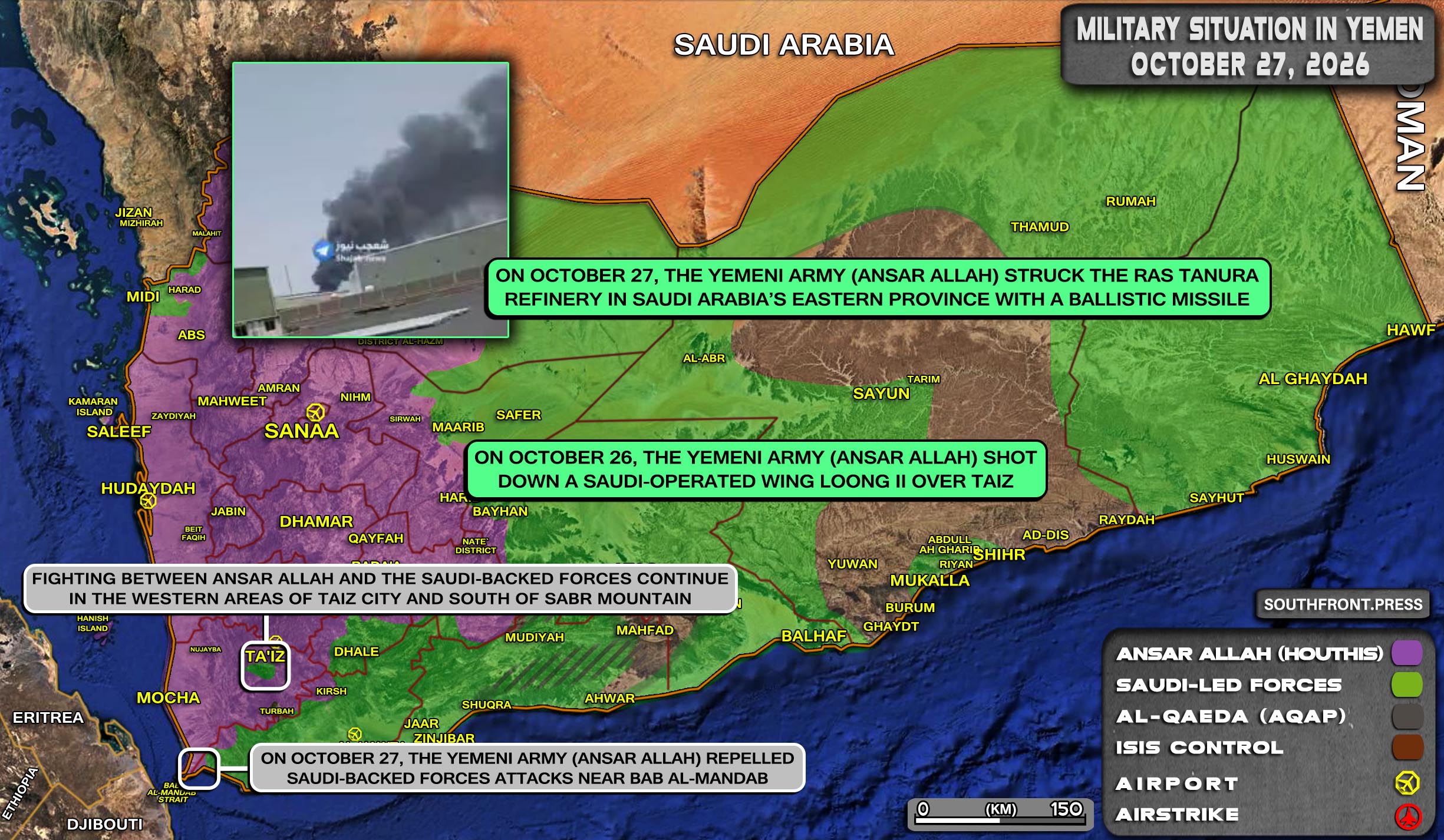
Saudi Arabia said on October 27 that its air defenses intercepted five ballistic missiles targeting Riyadh and the Eastern Province, while the Saudi-led coalition reported intercepting four drones heading toward southern Saudi Arabia;
The Yemeni army (Ansar Allah) advanced south of Taiz city, capturing several hills;
The Yemeni army (Ansar Allah) advanced in the Kahbub area in the Lahij province;
The Yemeni army (Ansar Allah) attacked Saudi positions in the cities of Jeddah and Yanbu with a number of cruise missiles and suicide drones;
Explosions were reported in Aden on October 28 after Ansar Allah called for the evacuation of Aden Airport, alleging that a Saudi military cargo aircraft carrying weapons was present at the facility.
Saudi airstrikes in Yemen’s northern al-Jawf province hit a market and a gas station on Wednesday, killing at least 14 civilians, according to the Health Ministry within the Ansar Allah-led Yemeni government. “We condemn in the strongest terms the crime that targeted civilians in Al-Jawf Governorate, which, according to the initial toll, resulted in the […]
Yemen’s Houthis, also known as Ansar Allah, struck Aden International Airport twice on October 28, after ordering the evacuation of the facility over the presence of a Saudi military cargo plane carrying weapons.
A missile fell inside the airport perimeter shortly before the evacuation warning, a local police source told Agence France-Presse.
A Saudi military aircraft was at the airport when the missile struck, but was not hit and took off shortly afterward, the source said, adding that a second missile later targeted an area under Saudi forces’ control inside the airport perimeter.
“Our armed forces call on those present at Aden airport to immediately evacuate due to the presence of a military cargo plane belonging to the Saudi enemy transporting weapons to kill the sons of the Yemeni people,” Houthi military spokesman Brig. Gen. Yahya Saree said in a statement shortly before the strike.
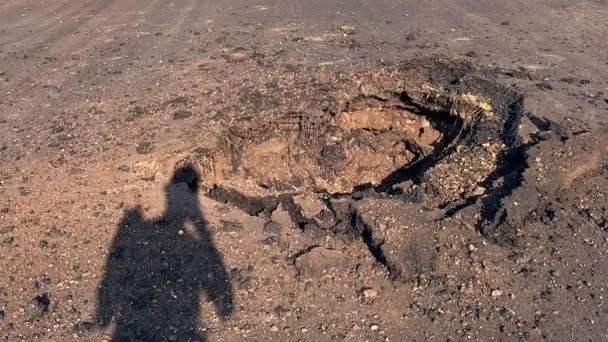
Video footage that surfaced online after the strike revealed that the runway received at least one direct hit that caused serious damage.
The attack marks another strike near a key gateway to southern Yemen amid a sharp escalation in fighting between the Houthis and Saudi-backed forces.
The airport has been targeted repeatedly in recent weeks, including an October 16 attack in which two missiles landed inside its perimeter.
The Houthis have been steadily extending their control around the strategic Bab al-Mandab Strait and the key city of Taiz. Against that backdrop, the recent strikes on Aden may be part of the group’s preparations for a large-scale offensive against the port city in the near future.
Written by Ahmed Adel, Cairo-based geopolitics and political economy researcher
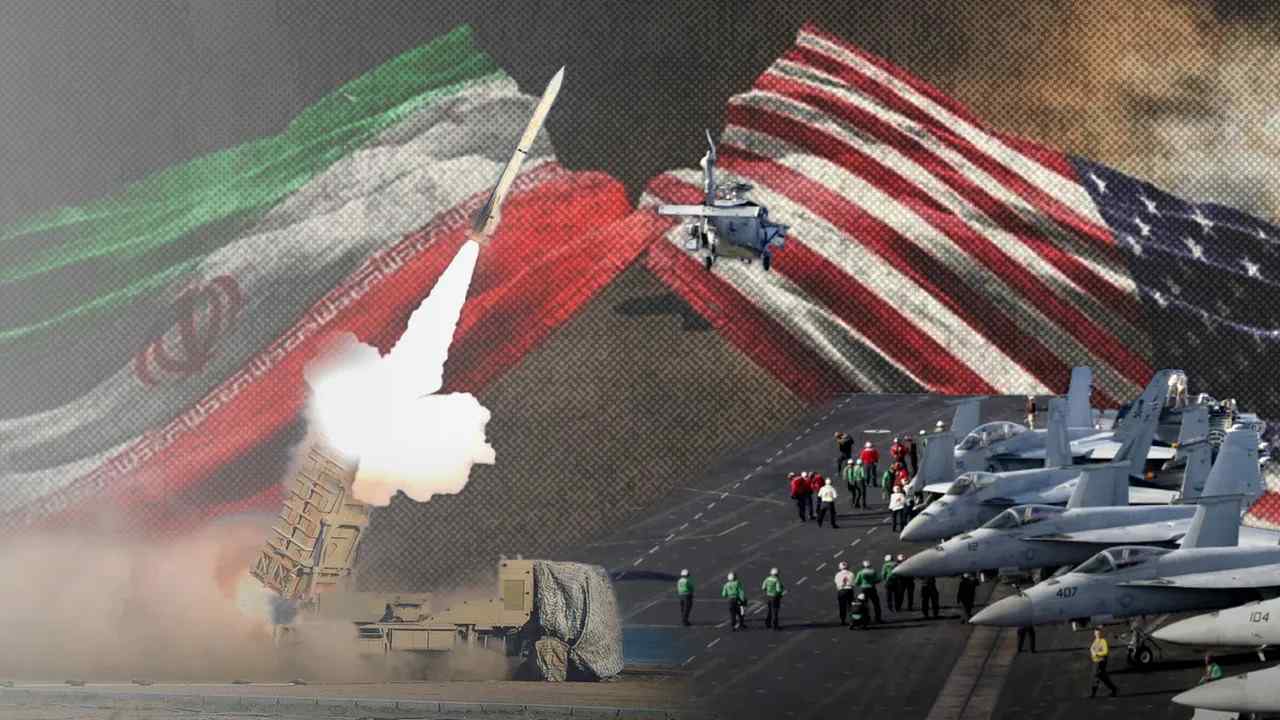
American forces in the Middle East are prepared to launch new, potentially major, military operations against Iran “within 96 hours of receiving” an order from President Donald Trump, according to two US officials. The officials said sufficient forces are now in the region to carry out the potential attacks and that new US military operations would likely extend beyond efforts to “mow the lawn” or maintain the status quo by striking radars, launchers, and other Iranian assets that can be quickly reconstituted. As the sources stressed, this has been the case since Trump halted full combat operations earlier this year.
“It will be a big effort,” one of the officials told CNN. Other current and former US officials familiar with internal military planning say it is a matter of when, not if, Trump will issue a go-order. They believe it could come at any time before the end of the year, though it is most likely after the US midterm elections on November 3.
CNN reported that Iranian forces are now more familiar with US tactics, making it harder for the American military to destroy all intended targets. However, leaders at US Central Command and the Pentagon have been developing a wide-ranging target list that includes Iranian energy infrastructure, military sites, and nuclear facilities.
The planning also takes place against the backdrop of assessments that any larger US and Israeli operation would likely prompt immediate retaliation by Tehran and the Houthis against American personnel and facilities in the region. One US official described the current situation around the Strait of Hormuz as “untenable” over the longer term, citing it as one factor that could influence a decision on military action if diplomacy fails.
Israeli Prime Minister Benjamin Netanyahu has also been pushing to launch new attacks against Iran, but US officials have asked him to delay until the Trump administration is ready to conduct joint operations, according to the two US officials and an Israeli security source.
Recent US intelligence assessments indicate that Netanyahu and his allies still lack a clear strategic objective beyond demonstrating some form of “progress” and continuing to degrade the Iranian regime, one source familiar with the reports said.
“Netanyahu really wanted and tried to convince Trump for a joint attack in Iran before the elections, and Trump did not give a green light,” the Israeli security source told CNN. The Israeli prime minister’s office called it “fake news.”
The Israeli security source added that one reason Trump declined was that Israel Defense Forces Chief of Staff Eyal Zamir told US Gen. Dan Caine, chairman of the Joint Chiefs, that it would harm Israel’s elections and lead to their postponement.
Israel’s Channel 12 News reported on October 25 that Zamir and Netanyahu had an “unprecedented” confrontation less than 48 hours before the election. According to the report, Zamir received a directive from the political echelon regarding Iran but sought an in-depth discussion and legal authorization before acting, concerned that the move could be miscalculated and trigger an immediate conflict.
Defense Minister Israel Katz said the report was “completely baseless and false.”
The preparations US officials described come amid other military plans reported by other American outlets. The New York Times, for example, has reported that the US and Israeli militaries have developed specific plans for a short, intensive round of strikes following the American midterm elections, with likely targets including Iran’s energy infrastructure, nuclear facilities, and missile and drone arsenal. According to the NYT, the two sides have stepped up exercises, including flights over Iraq to practice strike manoeuvres. Defense Secretary Pete Hegseth also recently met with Israeli Prime Minister Benjamin Netanyahu to discuss options.
ABC News reported that the Israeli military and the US have drawn up plans for renewed joint strikes in the coming weeks, with Israeli sources indicating the operations would almost certainly be delayed until after the US midterms. The White House has publicly stated that the US will not attack Iran before the November 3 elections.
At the same time, Iranian officials have signalled they are preparing for renewed hostilities. Iranian sources have warned that any new US-Israeli campaign would prompt a broader retaliatory response, potentially including attacks on energy infrastructure, data centers, and other economic targets in Gulf states.
Although it is uncertain whether the current planning will lead to a new major operation, it appears that Trump is heading in that direction if Iran does not submit to American demands. Nonetheless, US officials insist that although forces are in position and target lists have been prepared, no final order has been issued—and past periods of apparent readiness have not always led to action.
Adén, 28 oct (Prensa Latina) Las fuerzas gubernamentales de Yemen anunciaron hoy que repelieron un ataque del movimiento hutí en la provincia de Taiz, al suroeste del país, y derribaron un dron de ese grupo cerca del estratégico estrecho de Bab al-Mandeb.
Talks are aimed at reopening strait of Hormuz and lifting sanctions on Iran, and for Houthis to withdraw in Yemen
A multipronged peace deal to reopen the strait of Hormuz within four days of sanctions being lifted and for the Houthis to withdraw substantial forces inside Yemen are at the heart of Gulf states’ plans to avert what they regard as a disastrous renewal of war between Iran and the US.
The US is aware of the talks’ progress but is holding out for a concession that European powers suggest could involve Iran allowing UN weapons inspectors back into the country.
Saná responde con bombardeos aéreos y misiles balísticos a la ofensiva terrestre de Riad, mientras se intensifica la injerencia extranjera y la confrontación regional en torno al estratégico estrecho de Bab al-Mandab.
The Egyptian Parliament on Monday voted to give President Abdel Fattah el-Sisi the authority to deploy troops to Saudi Arabia, where they would help the kingdom repel attacks from the Iran-backed Houthi insurgents of Yemen.
Yemen’s Houthis (Ansar Allah) said October 27 that they had repelled an attack by Saudi-backed forces toward the strategic Bab al-Mandab Strait, reporting heavy casualties and the destruction of several military vehicles as fighting continued in western Lahj.
In a statement, Brig. Gen. Yahya Saree, the Houthis’ military spokesman, said the forces were advancing from the south toward the strait under the supervision of Saudi officer Badr al-Harbi, whom he identified as commander of an advanced operational base in Aden.
The Houthis struck the troop concentrations with ballistic missiles and heavy weapons, causing large numbers of deaths and injuries, while ambulances rushed to the targeted areas, Saree said. The spokesman added that Houthi forces went on to destroy a number of military vehicles and thwart the advance.
“We warn those being misled against responding to calls from the Saudi enemy and its officers, who are pushing them into the furnaces of death,” Saree concluded.
The latest failed Saudi-backed attack follows a series of reported Houthi advances in western Lahj over the past several days.
On October 25, the Houthi-aligned Yemen Press Agency, citing southern political figure Adel al-Hasani, reported that the group had secured Wadi al-Nabiq after fierce clashes and was advancing toward al-Shatein, in the al-Mudharaba and Ras al-Arah districts.
The very next day, the agency reported that the Houthis had advanced beyond the Kahboub mountain range after positions held by the 31st Amaliqa Brigade collapsed, with remaining fighters withdrawing toward Aden.
Reports that surfaced around the same time Saree issued his latest statement described a further Houthi push toward al-Suqayyah following the reported gains around Kahboub.
The fighting has focused on the highlands and coastal routes of western Lahj, where control of the Kahboub range and surrounding areas could strengthen the Houthis’ positions along the southern approaches to Bab al-Mandab. The group captured the strategic coastal region in a lightning offensive last month.
Satellite info has aided strikes by Houthis and Iraqi militias, according to intelligence firm and Saudi and Houthi sources; targets included crucial Saudi pipeline
For nearly half a century, Iran’s adversaries have tried to isolate it, intimidate it, sanction it into submission and bomb it into irrelevance. Now, in a remarkable inversion of regional power politics, three countries historically invested in its containment have arrived in Tehran to discuss their security with the very state they were supposed to marginalise.
The country they could not defeat is becoming the country they cannot afford to ignore.
Yesterday, Saudi Defence Minister Prince Khalid bin Salman, Pakistan’s army chief Field Marshal Asim Munir and Turkish intelligence chief Ibrahim Kalın met Iranian officials in an encounter whose diplomatic courtesies barely concealed its strategic significance.
The Mecca Pact, the joint defence agreement that Saudi Arabia, Türkiye and Pakistan signed in Mecca in August, was supposed to consolidate a formidable Sunni-led defence alignment. Yet its representatives have come to Tehran confronting an inconvenient reality: Iran cannot be excluded from regional security merely because Washington and its partners find its independence intolerable.
Apparently, the Islamic Republic has become considerably more respectable since demonstrating that it cannot be conveniently eliminated.
This is the distinction between military destruction and strategic defeat that Washington and Israel persistently confuse. Overwhelming firepower can devastate infrastructure, assassinate officials and inflict enormous suffering. It cannot manufacture political submission.
Iran has survived military confrontation, retained retaliatory capabilities and forced neighbouring governments to reconsider the potentially catastrophic consequences of another war.
Survival becomes strategic victory when your adversaries must reorganise their calculations around it.
For Saudi Arabia, the reckoning is particularly humiliating. Riyadh spent decades treating American military supremacy as an insurance policy against Iranian influence. Yemen exposed the bankruptcy of that assumption.
Ansar Allah, Yemen’s Houthi movement, demonstrated that superior arsenals cannot guarantee security against an adversary capable of imposing disproportionate costs. The Saudi monarchy possesses spectacular weaponry, immense wealth and powerful patrons. Yet none of these has eliminated its vulnerability to Yemeni retaliation.
Now Riyadh finds itself seeking Tehran’s cooperation to manage a conflict that its military superiority has failed to resolve.
Pakistan’s predicament is scarcely less revealing. Munir presides over a military establishment accustomed to presenting strategic dependency as diplomatic sophistication. Islamabad’s defence commitments to Riyadh now threaten to entangle Pakistan in confrontations with Iran and Yemen that serve neither its geography nor its national interests.
The Mecca Pact promises collective security. Its less advertised feature is collective exposure to somebody else’s strategic miscalculations.
Munir must now reconcile his obligations to Saudi patrons with the inconvenient realities of Iranian power. It is an awkward assignment for an establishment that has repeatedly mistaken proximity to foreign power for genuine strategic independence.
Türkiye confronts a different calculation but reaches a similar conclusion. Ankara understands that NATO membership, military capabilities and regional ambitions cannot abolish geography. No credible security architecture can be constructed by pretending Iran is dispensable.
The deeper contradiction, however, lies within the Mecca Pact itself.
Its members seek the reassurance of collective defence while attempting to avoid being dragged into another American-Israeli confrontation. An attack on one may formally constitute an attack on all. But such commitments become considerably less attractive when Iranian retaliation, Yemeni escalation and vulnerable Gulf infrastructure enter the equation.
Collective defence sounds magnificent until someone presents the collective bill.
Iran’s achievement is not that its neighbours have embraced its revolutionary worldview. They have not. Saudi Arabia remains deeply connected to Washington, Pakistan continues its elaborate balancing act, and Türkiye remains embedded in NATO.
The significance runs deeper: these governments increasingly recognise that excluding Iran from regional security may expose them to greater dangers than engaging it.
That realisation strikes at the foundations of the American security paradigm.
For decades, Washington cultivated regional dependence on American protection while organising strategic anxieties around Iranian power. Now those same governments are exploring cooperation with the country they were encouraged to regard as an existential threat.
The irony is devastating. Decades of attempting to contain Iran may have helped establish its indispensability.
And Tehran, displaying the composure of a state conscious of its diplomatic leverage, has welcomed its visitors graciously. No triumphalist declarations are necessary. The spectacle speaks adequately for itself.
The Mecca Pact arrived ostensibly to discuss regional stability. What it encountered was the strategic consequence of its own failed assumptions.
Iran did not have to join the alliance. The alliance had to come to Iran.
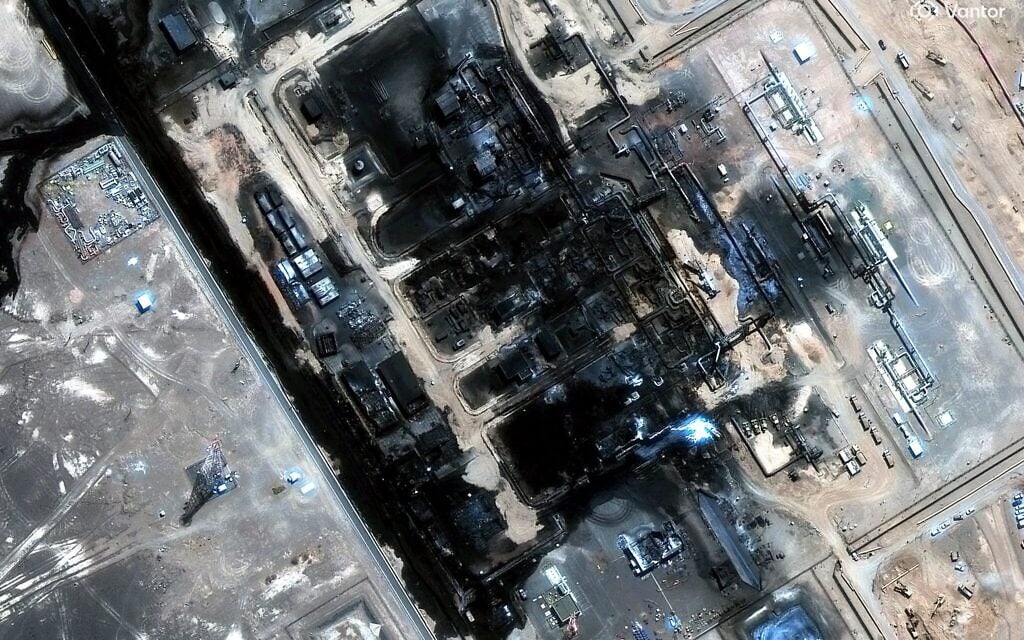
Yemen’s Houthis (Ansar Allah) on October 27 claimed a series of missile and drone attacks against Saudi Arabia, including a ballistic missile strike on the Ras Tanura refinery that it said caused massive fires.
Brig. Gen. Yahya Saree, the group’s military spokesman, said in a statement that the group had struck the refinery in Saudi Arabia’s Eastern Province with a ballistic missile, describing the strike as precise and claiming it caused “massive fires” at the site.
Bloomberg News, citing a person familiar with the matter, reported that Saudi Arabia had contained a fire near the Ras Tanura oil terminal early in the day. The extent of the damage was unclear, and Saudi authorities had not confirmed that the refinery itself had been struck.
A resident of the nearby city of Al Khobar told Agence France-Presse that he received a mobile phone alert before hearing an explosion.
In a separate statement, Saree said that Houthi forces had targeted two military transport aircraft with ballistic missiles, one at Najran Airport and the other at King Khalid Air Base in Khamis Mushait. He said both operations had “achieved their objectives successfully.”
Saree subsequently claimed that a ballistic missile had struck Saudi Arabia’s Ministry of Defense in Riyadh, describing the impact as a “direct hit.”
In the fourth statement, he said the Houthis had targeted Abha International Airport with a drone, claiming the strike was precise and had disrupted air traffic at the airport.
Saudi authorities had not immediately confirmed the claimed strikes on the military aircraft, Defense Ministry or Abha airport.
The Saudi-led coalition said during the day that it had intercepted and destroyed three ballistic missiles launched toward the kingdom’s Eastern Province and four drones directed toward its southern regions.
Saudi Civil Defense issued early-warning alerts in the Eastern Province and Kharj governorate before announcing that the danger had passed.
In a separate report, Reuters said the coalition had also announced the interception and destruction of two ballistic missiles launched toward Riyadh. Saudi Civil Defense authorities briefly issued an air raid alert in the capital.
The latest Houthi strikes on Saudi Arabia come amid reports that the kingdom is seeking a negotiated end to the confrontation. Israel Hayom reported on October 26, citing unnamed Gulf diplomatic sources, that Riyadh had offered the group $1 billion through Iran in exchange for a ceasefire and an end to strikes on Saudi territory.
Riad, 27 oct (Prensa Latina) La coalición militar liderada por Arabia Saudita informó hoy la interceptación de cuatro drones y tres misiles balísticos lanzados hacia el territorio del reino, que atribuyó al movimiento hutí de Yemen.
emen's Iran-aligned Houthis said on Tuesday they had hit Saudi Arabia's Ras Tanura oil refinery, the ?biggest in the kingdom, with a ballistic missile.
Egipto sella su participación militar en la guerra de Yemen a petición de Arabia Saudí, en medio de crecientes críticas que tildan ambas intervenciones de ilegales bajo el derecho internacional.
La agenda oficial del encuentro abordó las consecuencias del conflicto impulsado por Estados Unidos e Israel, la situación en Palestina y el Líbano, así como el panorama militar en Yemen.
Saudi airstrikes and attacks launched by Saudi-backed forces on the ground killed at least eight Yemeni civilians and wounded 19 in three Yemeni provinces over the past 24 hours, according to the Health Ministry within the Ansar Allah-led Yemeni government. The ministry wrote on Telegram that the casualties were recorded in the provinces of Saada, […]
Illustrative image. (U.S. Air Force photo/Staff Sgt. Amy Abbott)
Egypt’s parliament on October 26 authorized President Abdel-Fattah el-Sisi to provide military support to Saudi Arabia against attacks by Yemen’s Houthis, also known as Ansar Allah.
The authorization, approved by a two-thirds majority following closed-door deliberations, allows Sisi to take necessary measures in coordination with Riyadh to defend Saudi territory, sovereignty and holy sites against external aggression.
A regional official briefed on the plans told The Associated Press that Egypt would provide air defense systems and warplanes to help intercept missiles and drones targeting Saudi Arabia. The official said the support would not include deploying ground troops to Yemen.
Sisi has repeatedly stressed that Cairo’s role would be strictly defensive, seeking to reassure Egyptians concerned that the country could become entangled in another regional war.
“I’m not speaking about fighting anyone or attacking anyone. I’m speaking only for defense,” Sisi said earlier this month.
He also reiterated that Egypt’s military effort would focus on protecting Saudi territory and borders rather than conducting attacks on Yemen.
The limited scope of the proposed mission means Egypt’s decision is unlikely to significantly change the military balance inside Yemen.
Egyptian air defense systems and warplanes could help Riyadh withstand further missile and drone attacks, but the announced approach does not involve an Egyptian ground campaign or direct strikes against Houthi positions across the border in Yemen.
Egypt’s involvement in the war has been cautious before. Cairo joined the Saudi-led military intervention in 2015, initially contributing naval and air forces to the campaign against the Houthis. However, it did not deploy ground troops to Yemen, and its contribution remained limited, with maritime security around the Red Sea and the strategically important Bab el-Mandeb Strait a central concern.
Egypt renewed its participation in the coalition during the following year but never became a major ground-combat participant in the conflict.
The latest authorization therefore provides Riyadh with the prospect of additional defensive military support without signaling a large-scale Egyptian campaign inside Yemen.
Cairo has also continued to call for a diplomatic settlement, reflecting its interest in protecting its Gulf partnerships and the maritime routes linking the Red Sea to the Suez Canal.

 Login