The riots in France have shown up the Leftist claim that enough public spending and 'integration' will produce a happy, peaceful society as a dangerous fiction. But is anyone paying attention, asks Matt Roberts.
President Donald Trump's administration said it will place student-loan borrowers on the most expensive repayment plan if they do not voluntarily move off the SAVE plan.
Alex Wong/Getty Images
The first deadline for student-loan borrowers to leave SAVE is at the beginning of November.
It follows a 30-day extension for borrowers to select a new repayment plan.
The department said borrowers who do not select a new plan will be placed in a standard or tiered plan.
Student-loan borrowers are coming up on the first deadline to transition off a key repayment plan.
Beginning July 1, borrowers who were enrolled in SAVE — the Biden-era plan that allowed for lower payments — began receiving notices with a 90-day timeframe to transition off the plan after the Trump administration eliminated it.
That set the deadline for the first batch of borrowers at the end of September. However, those borrowers then received a "final notice" that they had 30 more days to select a new plan or be automatically placed in a standard or tiered plan, the most expensive options.
With that extension, November 1 is expected to be the first deadline, during which borrowers could be involuntarily moved to a more expensive plan.
An Education Department spokesperson confirmed to Business Insider that nearly 2 million borrowers — out of 7.5 million on SAVE — have selected a new plan.
"Borrowers who have not switched plans should take immediate action by visiting StudentAid.gov and selecting a new repayment plan today," the spokesperson said, and did not comment on how quickly borrowers would be placed in a standard plan.
Other borrowers have received their "final notice" in waves from different federal servicers. The Education Department has recommended that borrowers enroll in its new Repayment Assistance Plan, an income-driven plan that took effect July 1. Borrowers who enrolled in the plan over the past few months said that it's less generous than SAVE, with some seeing their payments spike hundreds of dollars.
The SAVE transition — and accompanying higher payments — come at a time when student-loan defaults are at a record high. Recent data from Federal Student Aid showed that 9.3 million borrowers are in default, with an additional 1.3 million set to default over the next six months. Borrowers facing higher bills have said they're worried about the consequences of default, which include the seizure of wages and federal benefits, like Social Security.
"When I saw how much the payment is expected to be, I freaked out for a whole week," said Cristian Barcenas, a borrower transitioning off SAVE. "I, under no circumstances, want to default."
Over 10 million student-loan borrowers are behind on payments.
Some borrowers said they're hopeful the midterms will prompt policy to protect those in default.
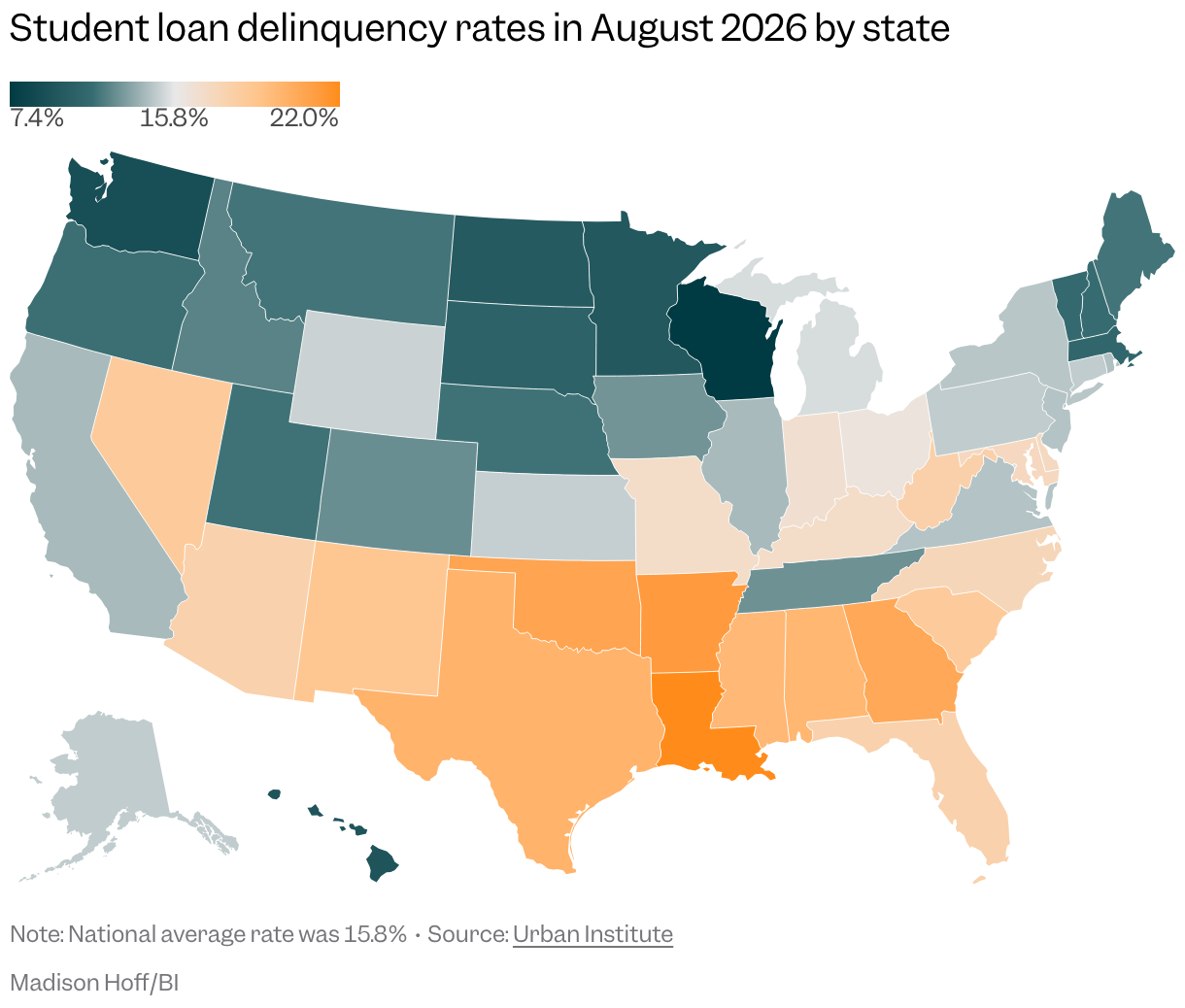
States with closely contested Senate races, like Texas and Ohio, have high rates of nonpayment, per an Urban Institute analysis.
Sarah Bundy has been in and out of default on her student loans for nearly three decades.
She borrowed for college in the mid-1990s, but dropped out as her loan balance became unaffordable. At the time, it was $39,000. Now, it's $60,000.
The 55-year-old is hoping a "blue wave" will pave the way for Democratic legislation to shield borrowers at risk of default.
"At my age, I can never get ahead of this," Bundy said. "So I'm just trying to scooch under the wire as long as I can."
Roughly one of every six adult Americans has federal student loan debt, according to Federal Student Aid. And some 16% of federal and private borrowers were 60 or more days late on their payments in 2026, according to an analysis by the Urban Institute.
Student-loan payments add to the squeeze from groceries and housing in an election increasingly centered on the cost of everyday life. High utility bills and gas prices are an added strain, especially as inflation is outpacing pay hikes.
Economic concerns are also reshaping debates over AI, with politicians reconsidering their support for data centers amid a backlash.
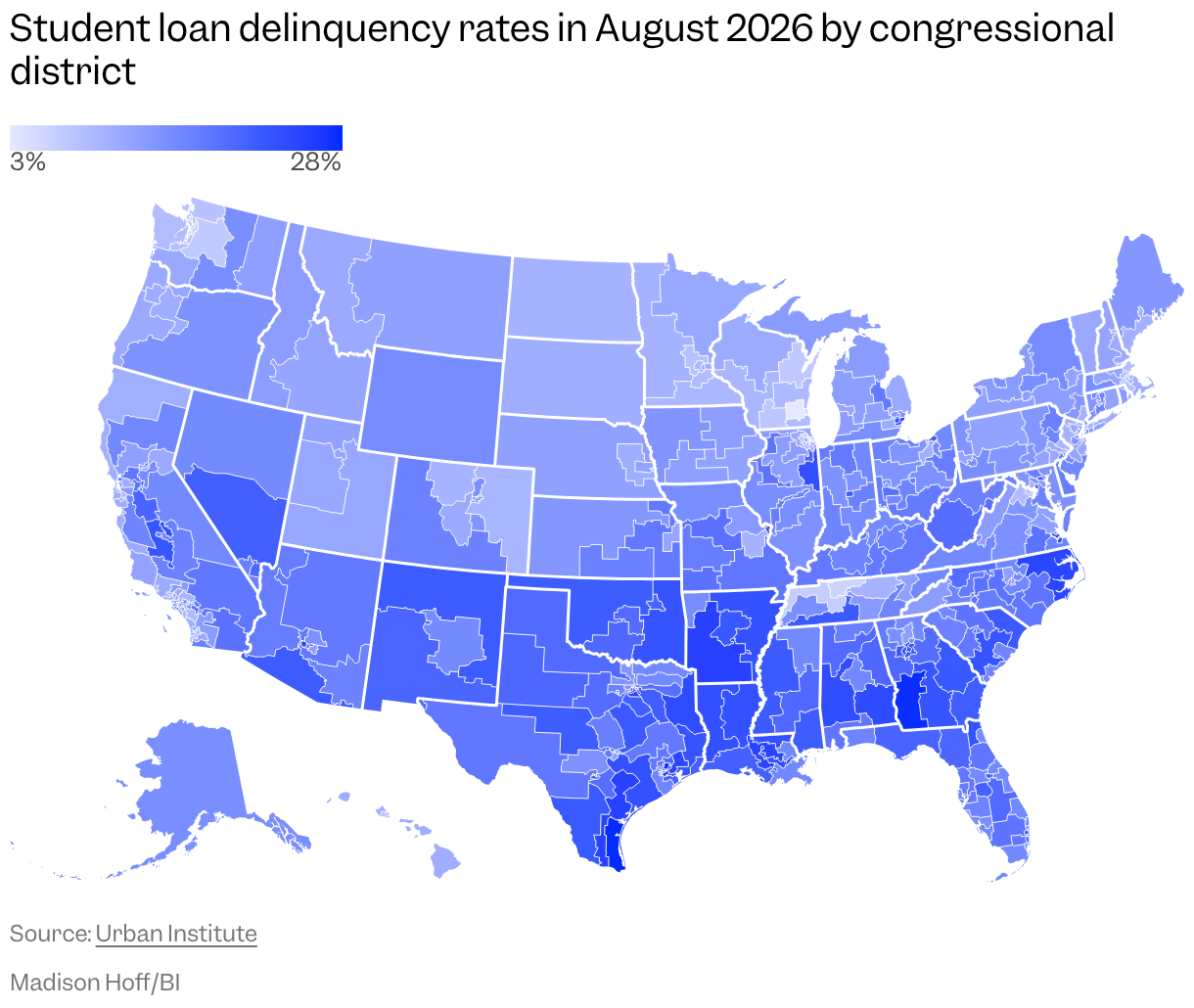
For borrowers, the pressure is particularly acute, and elevated student-loan delinquency rates overlap with some of the country's most competitive races.
Texas and Ohio, home to closely-contested Senate races, both had higher-than-average non-payment rates. In the House, nine battleground districts as identified by the Cook Political Report as of Friday afternoon had worse nonpayment rates than the national average — some 28% of borrowers are delinquent in Texas's 34th District, and 25% in North Carolina's 1st.
Meanwhile, federal student-loan defaults, which typically occur after 270 days of nonpayment, are at a record high. While involuntary collections on defaults, including wage and federal benefit garnishment, have been paused for over a year, Democratic lawmakers have been pushing for legislation to protect borrowers once those consequences resume. Still, even a strong election for Democrats would likely leave them without sufficient numbers to override a presidential veto.
As of June 30, 9.3 million borrowers were in default, and an additional 1.5 million were in late-stage delinquency, according to Federal Student Aid. Roughly 14% of the $1.7 trillion student-debt load in the US is in default, or $234 billion.
Republican lawmakers have expressed support for President Donald Trump's student-loan changes, which they said will help borrowers repay their loans. Sen. Roger Marshall, who is up for reelection in Kansas, previously said that Trump's "big beautiful" spending legislation "made transformational reforms to student loans."
Student-loan borrowers have told Business Insider that they're worried about the consequences of defaulting, primarily through losing a chunk of their paycheck, Social Security payments, and tax refunds. Those concerns are exacerbated by the anticipated higher monthly bills under Trump's repayment overhaul.
"All we can do is keep pushing for every little bit of progress we can get on this," Bundy said.
A student-loan default wave
Luke Helton, a student-loan borrower in Tennessee, previously told Business Insider that the only way he can afford his expected $600 payment increase is by digging into his retirement.
While he voted for Trump because he believed in the administration's campaign promise to put America first, his student loan challenges have him second-guessing his vote.
"They talked a big game about caring about the little people, and they just haven't," Helton said.
The defaulted student-loan portfolio itself is undergoing changes. The Department of Education is moving forward with its plan, announced in March, to transfer defaulted student-loan accounts to the Treasury Department. The transfer will occur in phases, with the most recent step being the launching of a new online portal to help borrowers return to good standing and access default resources.
Education Secretary Linda McMahon said that the department "was never intended to serve as the fifth largest bank in America, and that's exactly why we partnered with the Treasury Department to improve the administration of federal student aid programs that millions of American students, families, and borrowers rely on."
Democratic lawmakers have raised concerns about the Treasury's capability to manage federal student loans. Over 60 of them pushed to halt the transfer and continue the pause on involuntary collections to continue giving borrowers relief as they navigate Trump's repayment overhaul. Sen. Bernie Sanders also led some of his colleagues in introducing a bill to prevent older borrowers and borrowers with disabilities from facing Social Security garnishment if they default.
Bundy recently went to Washington, DC, to urge New York lawmakers to support Sanders' bill. She's one of the millions of borrowers transitioning off the Biden-era SAVE plan, which offered lower monthly payments. She said she's not sure how she'll afford payments once they resume, and she's worried that she — and millions of other borrowers — could fall behind.
"When these garnishments start back up, it's really going to throw us pretty far back down," Bundy said. "I don't think people realize just how brutal it really is out there."
Cristian Barcenas is getting ready to cut out date nights, food delivery, and Starbucks.
He graduated from the University of California, Fresno, in 2013 with a student-loan balance of about $65,000. Barcenas took out additional loans to pursue a master's degree, but left early to care for his father, who had cancer. His balance now stands at $127,000.
Barcenas, who works full time in sales in California, was making $105 monthly payments under the Biden-era SAVE repayment plan. President Donald Trump eliminated SAVE, and in November, Barcenas' payments are expected to spike to $815 per month.
"When I saw how much the payment is expected to be, I freaked out for a whole week," the 40-year-old said. "I, under no circumstances, want to default."
Barcenas and his wife combed through all their expenses over the past three months. He said it was "jaw-dropping" to see that they spent over $300 on Starbucks and $600 on grocery deliveries in that time.
The couple has started grocery shopping more carefully and in person, and Barcenas has stopped using Uber for rides. They've also cut their date nights down to once a month to free up more money for student-loan payments.
Beginning in July, more than 7 million borrowers received notices to transition off the SAVE plan, and many of them are gearing up for higher payments. More than 1,000 borrowers have told Business Insider over the past year that they're worried about factoring a higher bill into their budgets and are considering taking on second jobs or digging into retirement savings to make it work.
The Trump administration has said that its student-loan changes are intended to simplify a complex repayment system, curb excessive borrowing, and compel colleges to lower tuition. Barcenas said he thinks the changes will lead borrowers to "want to hold onto what they have even more."
"There's going to be a lot of fear around spending because they know that they have this obligation that they can't really get out of, and that's going to be prioritized over everything else," he said.
Delaying life milestones for student-loan payments
Rey Sosa expects his student-loan payments to surge from $50 a month to more than $700. The 32-year-old urban planner is paying off a $101,000 balance, largely from his master's degree in urban planning, and while he's still on forbearance, he's configuring his budget to make it work.
"I based my entire life around that payment coming back at some point," Sosa said. "The amount shocked me at first, and while I have a budget for it, it does take away from saving for home, saving for kids, family, because that is what we have to scale back right now."
The Department of Education has recommended that borrowers enroll in its new Repayment Assistance Plan, intended to be the most affordable income-driven repayment plan. A recent report from the Center for American Progress, a left-leaning think tank, said that borrowers moving from the SAVE plan to RAP could see their student-loan bills increase by $2,163 annually on average.
Sara Partridge, associate director of higher education at CAP and a coauthor of the report, said that the payment increases come "at a time when there is high inflation, stagnating wages, and people are generally feeling financially strained," making it more difficult to budget.
Amy Webb, a 60-year-old borrower, said she's feeling that strain. She has a $178,000 balance that she took out for her son's education as a single parent and is concerned about higher monthly payments. She's unable to purchase a new car, she refinanced her house, and she's considering selling it and moving out of Virginia to a state with a lower cost of living.
"I don't know how long I can do this," Webb said. "I wish the government would help."
Sosa hopes to achieve Public Service Loan Forgiveness, which forgives student debt for government and nonprofit workers after 10 years. But with about six years of payments left, he anticipates pushing back big purchases like a first home.
"I understand that we have to repay our loans," Sosa said. "That's not what I'm upset about. What I wish is that there was more consideration into the cost of living. The world just got more expensive after school."
Brian Rooney and his late wife, Tina, who died in 2013.
Courtesy of Brian Rooney
Brian Rooney, 60, filed for Chapter 7 bankruptcy in 2024.
During his late wife's illness, he built up medical and credit-card debt.
After she died, the grief made it difficult for him to sustain his business.
This as-told-to essay is based on a conversation with Brian Rooney, the 60-year-old founder of Chapter7Reset.com, who lives in Conroe, Texas. He lost his wife in 2013. The essay has been edited for length and clarity, and the details verified.
When you're grieving, you're not thinking about how to move a business forward, capture new market share, or adapt to new technologies. You're not thinking straight because you're overwhelmed by a cloud of loss, pain, and sorrow. Some days, you're just trying to get through morning to night.
In 2013, I lost my wife, my partner, and my life. I still had to deal with the financial reality. I had underestimated what grief would do to my ability to run a business.
Tina was the yin to my yang
My wife, Tina, and I had 24 great years together. She was the yin to my yang. We met through a mutual friend, got to know each other, and fell in love. She was a strong, independent thinker. She was loving, kept me in check, and was an outstanding mother.
Our five kids were all born close together, and I was very involved in their lives. One of the reasons I started a business was because I wanted to be the dad who could be at home, coach my sons in basketball, and play in recitals with my daughter.
We'd tried both working early on, but Tina stopped early on in our relationship. I was the breadwinner, and she managed the kids.
I launched my email-marketing business in 2000. For a time, it did very, very well.
Brian Rooney and his late wife, Tina, were together for 24 years.
Courtesy of Brian Rooney
My wife was diagnosed with cancer
In 2011, things felt almost too good to be true. Then Tina noticed a little bump in the roof of her mouth. She went to the dentist; they did a biopsy, and we didn't think too much about it. Weeks later, I was sitting in my home office when she came over with the phone. With a very disturbed look, she said, "I have cancer."
Our lives turned upside down.
At first, because the cancer wasn't very aggressive, we tried homeopathic remedies. Then came chemotherapy, radiation, and major surgeries. The treatments were costly, and while the Affordable Care Act covered quite a bit, we still had high deductibles. Some hospitals wouldn't admit her until the deductible had been paid.
I would sit at the table with spreadsheets, trying to work out the finances. I was trying to be strong for my wife, but sometimes I'd go to the corner of the room and cry. The unspeakable thing to consider was that I might lose my wife because I couldn't afford to pay for it all.
Brian and Tina Rooney had five kids.
Courtesy of Brian Rooney
A lot of the medical bills were paid with credit cards, and we ran up a lot of credit-card debt. I had six mouths to feed, for which I relied mostly on credit cards. I sold my music gear, like my guitars and amps. We moved from a beautiful rental house in a nice area of Texas to a much less expensive apartment. We weren't going to shows, basketball games, or on trips. None of that bothered me. The focus was on getting Mama healthy.
Friends and family stepped in here and there to help out. My kids were approaching adulthood, so they didn't need much looking after, but working from home let me adjust my schedule as needed.
I couldn't keep the business moving forward
There were days when I couldn't touch the business. It was mostly automated, but there were things I needed to step in and manage. If a server went down, I'd need to stay up all night to fix it while checking on my wife in the other room.
I wasn't resting or sleeping. I wasn't able to drive the business forward.
During that time, the industry was changing. New technology became available, and we weren't able to keep up. I was so focused on Tina's care that we missed opportunities. We had contractors and a business partner, and I wish I'd outsourced a lot faster. I didn't realize how fast I was losing.
I became a widower at 47
Tina Rooney died at 49.
Courtesy of Brian Rooney
Tina died in November 2013. She was 49, and I was a 47-year-old widower.
Those first few weeks, I'd wake up, roll over, realize she wasn't there, and know that she never would be again. I would talk myself out of bed, one body part at a time.
The business was still there. My business partner was focused on the technical side, but I had the marketing and entrepreneurial mindset. A lot of things that needed to get done didn't get done. Honestly, at that point, I didn't care. It was a dark time for me
I wanted a clean slate
The business was declining, and meanwhile, I'd built up hundreds of thousands of dollars in credit-card and medical debt. I thought I could put everything on my credit cards, turn things around, and pay it down. Things never turned around, and as the business continued to decline, there was less money to draw from it.
In 2021, I got remarried. My second wife knew about the financial mess I was in. The interest and penalties were compounding so quickly. There was constant pressure from phone calls, letters, and demands for payment. I wanted relief and a clean slate.
In early 2024, after speaking with my business partner, we decided to dissolve the business. Later that year, I filed for Chapter 7 bankruptcy.
I felt both relief and shame after filing for bankruptcy
When I filed for bankruptcy, I had no assets because I'd sold them all to pay my bills. When the debt was wiped out, I felt relief and shame, but the relief took over once I stopped getting phone calls and letters.
It was time to rebuild. I got a sales job, which I hadn't had in decades. I did AI certification training and started rebuilding my credit with credit-rebuilding cards. I launched ChapterSevenReset.com, a free guide to help people in a similar position.
One of the hardest lessons was that we didn't have a life-insurance policy on Tina. It never dawned on me because she wasn't contributing financially. I never considered how caring for her and my grief would take away from my generating income. My second wife and I both have life insurance policies for each other.
Nowadays, my friends say the "old Brian" is back. I've made peace, as best you can, with the fact that Tina is gone. I'm like an amputee. There's a part of me that's missing, and that part will always be missing. It itches. It's always there.
French economist Gabriel Zucman has come to California bearing a familiar French solution to a fiscal problem: another tax.
Once based at the University of California, Berkeley, Zucman is back and campaigning for Proposition 40, which would impose an allegedly one-time 5 percent tax on the net worth of Californians worth more than $1 billion. Zucman, who coauthored the proposition, estimates that the tax could raise about $100 billion and claims that 90 percent of the proceeds would go to health care.
The California Legislative Analyst's office is far more cautious, saying it would raise only "tens of billions" and could cause a long-term loss of income-tax revenue as wealthy people leave the state with the companies they created.
I've written plenty about why wealth taxes are economically destructive, administratively nightmarish, and unlikely to achieve anything close to what their advocates promise. But Zucman's prescription is wrong for a more fundamental reason, as his (and my) native country shows: Raising taxes to fuel ever-larger demands for government spending is a recipe for disaster.
Unless you've been living in a remote cave recently, you've likely seen all the protests and destruction in France. But do you know why it's happening?
As another economist, Paul Krugman, rightly noted back in 2017, "France offers a social safety net beyond the wildest dreams of U.S. progressives: guaranteed high-quality health care for all, generous paid leave for new parents, universal pre-K, and much more."
For decades, France has answered any perceived desire with government spending, then responded to the resulting fiscal problem by seeking new revenue sources. Today, French government spending consumes roughly 58 percent of gross domestic product (GDP).
Krugman gloated that France wasn't suffering social collapse and speculated that it was due to all the spending. He certainly can't say that anymore. In fact, he is now worried that France may be on the precipice of a debt crisis. The truth is that France hasn't done well for some time, even when Krugman cheered its spending.
One of the groups in the street today, young people, has faced widespread unemployment for a long time. The youth unemployment rate in France (ages 15-24) has hovered between 17 percent and 27 percent since 2000. In the second quarter of 2026, it was 21.6 percent, against 14.8 percent in the Eurozone and 9.9 percent in the U.S.
French people also pay some of the highest taxes in the developed world, and they're not happy with the return. The government already takes more than 52 percent of the country's output in revenue, runs deficits exceeding 5 percent of GDP, and has accumulated debt approaching 120 percent of GDP. Nonetheless, French students complain that the government is shortchanging schools, while everyone sees that it is shortchanging its army and police.
The students aren't wrong to feel left out. At The Two Cents Substack, Hoover Institution scholar Hanno Lustig calculates that, between 1995 and 2024, spending on social protection and health (most of which benefits older people) rose from 53.1 percent to 58.7 percent of all French government spending. The share devoted to education, defense, and public order fell from 15.2 percent to 13.7 percent. Transportation fell from 5.3 percent to 3.8 percent.
In other words, France has built an enormous welfare state, much of it devoted to older citizens, while letting other state capacities and basic services fall apart. As transfers of wealth swallow a larger share of the budget, everything else gets squeezed.
That is the fiscal ratchet Californians should worry about when Zucman tells them Proposition 40 is necessary to "save" health care. Proponents claim Washington "cut" Medicaid, but that language is misleading. California's deficit started long before any Washington spending reductions. Besides, federal Medicaid spending isn't falling—not even close. The Congressional Budget Office estimates it will reach $708 billion in 2026, 8 percent more than in 2025. What Washington did in the 2025 budget reconciliation law was reduce Medicaid's future growth relative to previous projections, partly by changing eligibility and enrollment rules and financing arrangements.
This is how the ratchet works. Once the government projects a spending increase, anything less becomes a cut. And once Washington fails to finance the entire projected increase, Californians are told that Sacramento must backfill the missing money. And how should it do that? Conveniently, by creating an entirely new tax.
France has run this experiment for decades. It has an incredibly generous welfare state paid for with very high taxes; it's even tried a wealth tax and has a value-added tax, yet somehow it's never enough. Its welfare state has not eliminated scarcity. It has merely transferred the job of rationing scarce resources to politicians.
Zucman looks at California and sees hundreds of billions of dollars of private wealth waiting to solve a public finance problem. Californians should look across the Atlantic and ask a different question: What happens after politicians decide that every spending adjustment can be delayed until tomorrow by finding another pot of private wealth?
France should not be sending California tax advice. It should be sending a warning.
UK public debt crossed the £3 trillion mark for the first time at the end of September 2026, the National Statistics Office reported on Wednesday, October 21.
The accumulated public sector liabilities stood at £3.005 trillion, equivalent to €3.57 trillion, according to the provisional estimate released by the National Statistics Office. The figure represented 94 percent of UK gross domestic product and marked a historic high, the agency reported.
The balance grew by £91.7 billion compared with the level recorded twelve months earlier, about €109.074 billion, according to the provisional estimate.
Despite the nominal record, the weight of the liabilities on the economy as a whole fell by seven tenths compared with the 2025 level, the agency reported. The agency recalled that net debt exceeded £2 trillion in June 2020, during the COVID-19 pandemic, and had surpassed £1 trillion in February 2010, following the global financial crisis.
September public borrowing amounted to £24.5 billion, or €29.142 billion, and was the second highest recorded for that month, according to the National Statistics Office. Only the September 2020 figure, unadjusted for inflation, was higher. Compared with the previous year, the imbalance increased by £1.8 billion, or 7.7 percent, because spending growth outpaced income growth, the agency reported.
Britain’s national debt has climbed above £3tn for the first time, underlining the pressure on the public finances before John Healey’s maiden Budget next week
Central government debt interest reached £10.9 billion in September, the highest figure recorded in the ninth month of the year since monthly records began in 1997, according to the National Statistics Office.
Annual inflation stood at 3.5 percent in September, four tenths above the August figure and the largest increase since October 2025, according to the National Statistics Office. The price of goods rose 3.2 percent year on year, compared with 2.7 percent in August, while services became 3.7 percent more expensive. Core inflation, which excludes energy, food, alcohol and tobacco, advanced to 2.8 percent, two tenths more than in August.
New surveys show that increases in premiums and deductibles are forcing people to forgo treatments or doctor’s visits while budgets are strained by higher food and gas prices.
Sanae Takaichi has done something few Japanese leaders manage. She’s reached her first anniversary in office more popular than her predecessors, and she looks well placed to keep the job. In a country that has burned through five prime ministers in a decade, this counts for a lot. Popularity, though, is only one of two […]
Kemi Badenoch has said a "red warning light" is flashing on the economy as Britain's debt tops £3 trillion for the first time and inflation surges to 3.5% ahead of the Budget next week.
The UK economy will grow 1.3% in 2026, according to the IMF. But will it really, asks David Craig. With unemployment rising, it's just an illusion of out-of-control borrowing. But try getting an economist to admit it.
The International Monetary Fund warned Tuesday that the global economy faces serious risks from Big Tech firms taking on massive debt to fund the buildout of artificial intelligence data centers worldwide. The IMF’s latest Global Financial Stability Report outlines a number of risks to economic growth in the coming years, including a reliance on AI […]
France faces growing pressure from eurozone governments and financial markets to secure its 2027 budget as borrowing costs climb towards levels not seen for more than two decades, raising questions about Paris’s ability to restore control over its public finances.
France is coming under increasingly direct pressure from its eurozone partners to resolve the political dispute surrounding its 2027 budget, with European finance ministers warning that continued uncertainty threatens confidence in the country’s public finances.
The warning follows a sharp increase in French government borrowing costs. Yields on ten-year sovereign bonds have risen by nearly 80 basis points since September, reaching levels last recorded in 2002. Investors are demanding higher returns to finance a government whose debt continues to increase while its capacity to impose spending restraint remains constrained by parliamentary divisions.
At the Eurogroup’s October discussions, finance ministers and European Central Bank officials pressed Paris to demonstrate that it can adopt a credible budget and comply with its commitments under the EU’s fiscal framework.
France’s difficulties have implications beyond its domestic politics. As the eurozone’s second-largest economy, France occupies a position fundamentally different from smaller countries that experienced sovereign debt crises during the previous decade.
Borrowing costs expose political weakness
The French government expects to borrow approximately €340 billion in 2027, making continued access to financial markets at sustainable rates an essential element of its fiscal strategy.
That financing requirement reflects both the need to cover the annual deficit and to refinance existing debt as government securities mature.
France’s public debt is already approaching 120 per cent of gross domestic product. As EU Today previously reported, official projections indicated that the debt ratio could reach 121.7 per cent in 2027, up from 115.7 per cent at the end of 2025.
The latest increase in yields adds another complication. Higher interest costs do not affect the entire stock of debt immediately because much of it was issued at earlier rates. They do, however, increase the cost of new borrowing and refinancing, progressively reducing the money available for other government commitments.
France also faces a difficult political timetable. With the presidential election approaching in 2027, parties are reluctant to accept measures involving spending reductions, higher taxation or changes to public services.
Prime Minister Sébastien Lecornu’s government has been attempting to reduce the deficit from an estimated 5.4 per cent of GDP in 2026 towards five per cent. Even that objective remains substantially above the EU’s three per cent reference value.
Brussels has limited room to compromise
Economic Commissioner Valdis Dombrovskis has emphasised the importance of predictable fiscal policy and credible deficit reduction.
France is already subject to the EU’s excessive deficit procedure, under which member states must demonstrate progress towards agreed fiscal objectives.
The reformed European fiscal framework permits certain deviations from expenditure commitments in exceptional circumstances, but it does not provide an unrestricted exemption from debt sustainability requirements.
Paris therefore faces a double constraint. It must convince domestic political forces to support a budget while demonstrating to Brussels that its spending plans are sufficiently credible.
The danger is not necessarily an immediate financing crisis. France retains a large, diversified economy, deep financial markets and substantial tax-raising capacity.
The more immediate risk is that prolonged political deadlock produces progressively higher borrowing costs, making future fiscal adjustments more expensive.
Why the ECB cannot simply intervene
The European Central Bank has instruments designed to counter destabilising market conditions, but these are not intended to finance governments that are unwilling or unable to implement sustainable fiscal policies.
Bank of France Governor Emmanuel Moulin said on 7 October that France did not currently require ECB assistance. He argued that the solution lay in adopting a credible budget rather than expecting monetary intervention.
His position follows increasing speculation about whether the ECB could intervene if French bond yields continue rising.
Such intervention would raise difficult questions about the relationship between monetary policy and national fiscal responsibility. The ECB must consider financial stability across the entire eurozone, but it cannot remove the political obligations of individual governments.
France’s existing excessive deficit procedure also complicates its eligibility for certain forms of exceptional support.
The wider European consequences
France’s problems are developing at a particularly difficult moment for European public finances.
Governments are confronting higher defence commitments, expensive measures to protect households against energy inflation and demands for greater investment in industrial competitiveness.
Italy, another heavily indebted eurozone economy, is facing related pressures. The combination places additional importance on the credibility of the EU’s fiscal rules.
Those competing programmes illustrate the difficulty of securing a parliamentary consensus capable of reassuring markets.
The approaching presidential election reduces the likelihood of a durable settlement before voters choose France’s next head of state.
Eurozone partners cannot resolve that impasse from Brussels or Frankfurt. They can insist on fiscal commitments and provide a framework for adjustment, but the political decisions remain with Paris.
France’s immediate challenge is to prevent its budget dispute from becoming a broader loss of confidence in the government’s capacity to manage its finances.
TOKYO – For decades, the US enjoyed a remarkable luxury: its two biggest creditors, Japan and China, kept showing up at Treasury auctions with checkbooks open. Now, Donald Trump’s trade wars, tariff threats and widening geopolitical confrontations raise an uncomfortable question: what happens if Washington’s most reliable bankers decide they’ve had enough? Granted, global investors […]
The global bond markets are a sensitive lot. And they’ve been having a particularly tricky time lately. Spooked by high inflation, high interest rates and high levels of government debt across the world, those markets have become less stable over the summer. The prices of government bonds – what governments sell to investors – have gone down. […]
The most recent winner of the National Magazine Award for feature writing describes his turn to payday lending apps when AI gobbled up his livelihood (aka penning promotional web content for business clients). Sharp and darkly funny, the essay chronicles yet another nail in the coffin of the American dream:
Albert founder Yinon Ravid has said that he chose his app’s name for its suggestion of the kind of “smart, unassuming friend” you might come to for financial advice, but today, when I hear the name Albert, I am far more likely to picture an overwhelming force bent on my total destruction, a figure you might spot while being burned alive in a dream—black-robed, pale, teeth bared. When I first joined the app, about eighteen months ago, Albert offered me $25.00. To acquire this loan, I was required to pay an additional fee: A $6.99 instant deposit charge plus the cost of a $19.99-per-month subscription to Albert’s Standard plan, due in one week’s time alongside the full loan repayment. (If I really wanted to make the most of my $25.00, I also had the option of Albert’s $39.99-per-month Genius plan, which, among a very small handful of other talents, can “find restaurants based on your location, or in a specific area.”) On its own, this might’ve been manageable, but, true to the CRL’s findings, Albert’s offerings alone couldn’t keep me afloat, and so I soon signed up for the rest of the payday apps, each one toting its share of instant deposit and subscription fees. (Gallingly, Dave—the only publicly traded company of the bunch, valued at $4.72 billion as of this writing—has the nerve to ask for a tip after each transaction, a move that I suspect even the flintiest strip mall grift artists would dismiss as gauche.)
KARACHI: Fitch Ratings has assigned a ‘B-‘ rating to Pakistan’s proposed U.S. dollar-denominated bond, with a Recovery Rating of ‘RR4,’ the ratings agency announced. Pakistan plans to use proceeds from the bond for general budgetary and sovereign financing purposes, according to Fitch. The bond rating is aligned with Pakistan’s Long-Term Foreign-Currency Issuer Default Rating, while ... Read more
KARACHI: State-run Pakistan LNG Limited (PLL) has issued a fresh tender to procure one spot cargo of liquefied natural gas for delivery between September 4 and 8, as global supply disruptions stemming from the Middle East war continue to strain the country’s gas-fired power generation. PLL invited bids from international suppliers for a single cargo ... Read more

 Login